Questions

4 Marks Question

🎯

Test yourself on this topic

37 questions · timed · auto-graded

Question 14 Marks
You are the personnel manager of Kapila and Company Ltd. You have been directed by the directors of the company to select a chartered accountant for the company. Explain the selection procedure you will follow for the same.
Answer
Following steps are involved in the selection process :
(i) Scrutiny of applications Applications are received in response to the advertisement or from other sources. They are scrutinised in the light of requirement and suitability and those found unsuitable are dropped or rejected.
(ii) Selection/Employment tests These tests are developed by psychologists and other experts to assess candidate’s nature, abilities and characteristics. There are several tests such as aptitude test, Intelligence test, Interest test, personality test, trade test, etc.
(iii) Employment interview In this interview, the ability and suitability of a candidate for a specific job is directly judged by experts or specialists in the board of selection.
(iv) Selection decision Candidates who are considered suitable are selected after taking the opinion of all the selectors, especially the manager of the concerned department.
(v) Medical or physical test Selected candidates may be asked to get themselves thoroughly examined by a prescribed doctor within or outside the organisation.
(vi) Job offer After satisfying, a job offer is being given to the applicant so that within a reasonable time an applicant would be able to report.
(vii) Contract of employment Than after the acceptance of job offer a contract uf employment is being given to the employees that includes terms and conditions^!; employment such as job title, job description, pay, working hours etc.
View full question & answer
Question 24 Marks
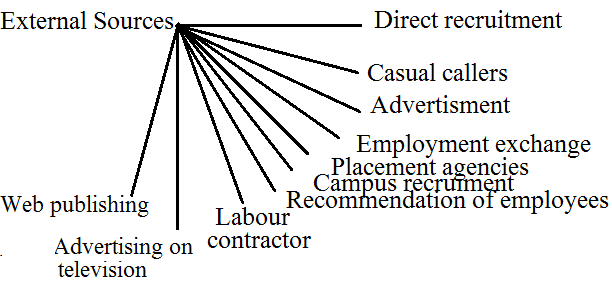
Explain briefly ‘Casual Callers’ and ‘Labour Contractors’ as external sources of recruitment.
Answer
Casual Callers: Many reputed business organisations keep a database of unsolicited applicants in their offices. Such job-seekers can be a valuable source of manpower. A list of such job-seekers can be prepared and can be screened to fill the vacancies as they arise. The major merit of this source of recruitment is that it reduces the cost of recruiting workforce in comparison to other sources.
Labour Contractors: Labour contractors maintain close contacts with labourers and they can provide the required number of unskilled workers at short notice. Workers are recruited through labour contractors who are themselvesemployees of the organisation. The disadvantages of this system are that if the contractor himself decides to leave the organisation, all the workers employed through him will follow suit.
View full question & answer
Question 34 Marks
The workers of 'Gargya Ltd.' are unable to work on new computerised machines imported by the company to fulfil the increased demand. Therefore, the workers are seeking extra guidance from the supervisor, and the supervisor is overburdened with the frequent calls of workers.
Suggest how the supervisor, by increasing the skills and knowledge of workers, can make them handle their work independently.
Also, state any three benefits that the workers will derive by the decision of the supervisor.
Answer
Training is any process by which the aptitudes, skills and abilities of employees to perform specific jobs are increased. It is a process of learning new skills and application of knowledge. It attempts to improve their performance on the current job or prepare them for any intended job.
By providing appropriate training to the subordinates the supervisor can help them work independently.Benefits the workers will derive by the decision of the supervisor:
  1. It helps in promotion and career growth due to improved skills and knowledge.
  2. It helps them to earn more due to improved performance.
  3. It reduces accidents as the employees are more efficient to handle machines.
  4. It increases the morale of the employees as the employees are more satisfied.
View full question & answer
Question 44 Marks
State any four advantages of external sources of recruitment.
Answer
Advantages of external sources of recruitment:
  1. Qualified Personnel: By using external sources of recruitment, the management can attract qualified and trained people to apply for vacant jobs in the organisation.
  2. Wider Choice: When vacancies are advertised widely, a large number of applicants from outside the organisation apply. The management has a wider choice while selecting the people for employment.
  3. Fresh Talent: The present employees may be insufficient or they may not fulfill the specifications of the jobs to be filled. External recruitment provide wider choice and brings new blood in the organisation. However, it is expensive and time consuming.
  4. Competitive Spirit: If a company taps external sources, the extisting staff will have to compete with the outsiders. They will work harder to show better performance.
View full question & answer
Question 54 Marks
Atul is working in an organisation. After every three months his manager transfers him from one department to another so that he may gain a broader understanding of all the departments of the organisation.
Name and explain the method of training Atul is undergoing.
Answer
Job Rotation:
  1. This method of training involves shifting the trainee from one department to another or from one job to another.
  2. It enables the trainee to gain a broader understanding of all parts of the business and how the organisation functions as a whole.
  3. It makes it easier for organisation at the time of promotions, replacements and transfers.
View full question & answer
Question 64 Marks
“Some learning opportunities are designed and delivered to improve skills and abilities of employees whereas some others are designed to help in the growth of the individual in all respects". Identify and explain the two concepts explained above.
Answer
‘Some learning opportunities are designed and delivered to improve skills, and abilities of employees’ refers to TRAINING.‘Some other are designed to help in the growth of individuals in all respects’ refers to DEVELOPMENT.
Training is the process by which the aptitudes, skills and abilities of the employees to perform specific jobs are improved.
Development is the process by which the employees acquire skills and competence for handling higher jobs in the future. It refers to learning opportunities designed to help employees grow.
View full question & answer
Question 74 Marks
State any four reasons why staffing is needed in an organisation.
Answer
Proper staffing ensures the following benefits to the organisation:
  1. Helps in discovering and obtaining competent personnel for various jobs; makes for higher performance, by putting right person on the right job;
  2. Ensures the continuous survival and growth of the enterprise through the succession planning for managers; helps to ensure optimum utilization of the human resources.
  3. By avoiding overmanning, it prevents under-utilisation of personnel and high labour costs. At the same time it avoids disruption of work by indicating in advance the shortages of personnel; and
  4. Improves job satisfaction and morale of employees through objective assessment and fair reward for their contribution.
View full question & answer
Question 84 Marks
Distinguish between 'external' and 'internal' sources of recruitment.
Answer
Basis of differentiation
Internal sources
External sources
Definition
Internal Recruitment is a recruitment in which the supply of manpower is done internally, i.e. within the organisation.
External Recruitment refers to recruitment in which the candidates are selected from outside the organisation.
Process
Internal sources of recruitment is faster as the required candidate is selected from within the organisations
External recruitment involves stages like advertising and inviting applications, screening of applications, short listing, conducting an examination and interview, selection, placement, training, testing, induction, etc.
Training
Internal recruitment does not require induction training,
external recruitment, induction training is a must.because new candidate are selected
Fresh talent
In internal recruitment, the choice is very limited, i.e. the scope of fresh talent is restricted.
when the company opts for external recruitment, it can hope for talented candidates from outside the organisation, which means new blood and ideas are infused in the organisation.
Cost effectiveness
Internal Recruitment is a cost effective process.
External Recruitment requires a large amount of investment.
View full question & answer
Question 94 Marks
Explain ‘Direct Recruitment’ and ‘Advertisement’ as external sources of recruitment.
Answer
Direct Recruitment: Under the direct recruitment, a notice is placed on the notice-board of the enterprise specifying the details of the jobs available. Jobseekers assemble outside the premises of the organisation on the specified date and selection is done on the spot. The practice of direct recruitment is followed usually for casual vacancies of unskilled or semi-skilled jobs. Such workers are known as casual or ‘badli’ workers and they are paid remuneration on daily wage basis. This method of recruitment is very inexpensive as it does not involve any cost of advertising the vacancies. It is suitable for filling casual vacancies when there is a rush ofwork or when some permanent workers are absent.
Advertisement: Advertisement in newspapers or trade and professional journals is generally used when a wider choice is required. Most of the senior positions of industry as well as commerce are filled by this method. The advantage of advertising vacancies is that more information about the organization and job can be given in the advertisement. Advertisement gives the management a wider range of candidates from which to choose. Advertisements may be placed in leading newspapers. Its disadvantage is that it may bring in a flood of response, and many times, from quite unsuitable candidates.
View full question & answer
Question 104 Marks
How is training of employees beneficial for the organisation? State by giving any four reasons.
Answer
As jobs have become more complex the importance of employee training has increased. Training and development help both the organisation and the individual.Benefits to the organisation:
The benefits of training and development to an organisation are as follows:
  1. Training is a systematic learning, always better than hit and trial methods which lead to wastage of efforts and money.
  2. It enhances employee productivity both in terms of quantity and quality, leading to higher profits.
  3. Training equips the future manager who can take over in case of emergency.
  4. Training increases employee morale and reduces absenteeism and employee turnover.
View full question & answer
Question 114 Marks
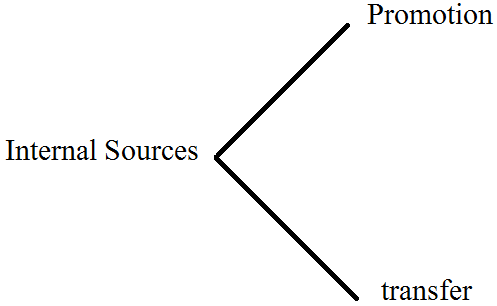
Explain briefly ‘transfers’ and ‘promotions’ as internal sources of recruitment.
Answer
Transfers: It involves shifting of an employee from one job to another, one department to another or from one shift to another, without a substantive change in the responsibilities and status of the employee. It may lead to changes in duties and responsibilities, working condition etc., but not necessarily salary. Transfer is a good source of filling the vacancies with employees from overstaffed departments. It is practically a horizontal movement of employees. Shortage of suitable personnel in one branch transfer from other branch or department.
Promotions: Business enterprises generally follow the practice of filling higher jobs by promoting employees from lower jobs. Promotion leads to shifting an employee to a higher position, carrying higher responsibilities, facilities, status and pay. Promotion is a vertical shifting of employees. This practice helps to improve the motivation, loyalty and satisfaction level of employees. It has a great psychological impact over the employees because a promotion at the higher level may lead to a chain of promotions at lower levels in the organisation.
View full question & answer
Question 124 Marks
The workers of 'Vyam Ltd.' are unable to work on new and hi-tech machines imported by the company to fulfil the increased demand. Therefore, the workers are seeking extra guidance from the supervisor. The supervisor is overburdened with the frequent calls of workers. Suggest how the supervisor, by increasing the skills and knowledge of workers, can make them handle their work independently?Also, state any three benefits that the workers will derive by the decision of the supervisor.
Answer
Training is any process by which the aptitudes, skills and abilities of employees to perform specific jobs are increased. It is a process of learning new skills and application of knowledge. It attempts to improve their performance on the current job or prepare them for any intended job
By providing appropriate training to the subordinates the supervisor can help them work independently. Benefits the workers will derive by the decision of the supervisor:
  1. It helps in promotion and career growth due to improved skills and - statement knowledge.
  2. It helps them to earn more due to improved performance.
  3. It reduces accidents as the employees are more efficient to handle machines.
  4. It increases the morale of the employees as the employees are more satisfied.
View full question & answer
Question 134 Marks
Ayasha Ltd. assured their employees that inspite of recession no worker will be retrenched from the job.
  1. Name and explain the type of incentive offered to the employees.
  2. Explain one more incentive of the same category.
Answer
  1. The incentive is Job security.
It is a non-financial incentive which refers to the stability about future income and work so that the employees do not feel worried on these aspects and work with greater zeal.
  1. One more incentive of same category is,
Status: In the organizational context, status means ranking of positions in the organisation. The authority, responsibility, rewards, recognition, perquisites and prestige of job indicate the status given to a person holding a managerial position.
View full question & answer
Question 144 Marks
'Some learning opportunities are designed and delivered to improve skills and abilities of employees whereas some other are designed to help in the growth of individuals in all respects'. Identify and explain the two concepts explained above.
Answer
'Some learning opportunities are designed and delivered to improve skills, and abilities of employees' refers to TRAINING.'Some other are designed to help in the growth of individuals in all respects' refers to DEVELOPMENT.
Training is the process by which the aptitudes, skills and abilities of the employees to perform specific jobs are improved.
Development is the process by which the employees acquire skills and competence for handling higher jobs in the future. It refers to learning opportunities designed to help employees grow.
View full question & answer
Question 154 Marks
State any four reasons why training is needed in any organisation.
Answer
The benefits of training and development to an organisation are as follows:
  1. Training is a systematic learning, always better than hit and trial methods which lead to wastage of efforts and money.
  2. It enhances employee productivity both in terms of quantity and quality, leading to higher profits.
  3. Training equips the future manager who can take over in case of emergency.
  4. Training increases employee morale and reduces absenteeism and employee turnover.
  5. It helps in obtaining effective response to fast changing environment - technological and economic.
View full question & answer
Question 164 Marks
With the help of suitable examples bring out any four differences between training and development.
Answer
Difference between training and development:
Basis
Training
Development
Meaning
It is concerned with teaching of technical skills.
It is concerned with imparting technical human and conceptual skills that will enable people to carry out non-technical organisational functions more effectively. e.g. problem solving, decision making, etc.
Level of personnel
Suitable in case of non-managerial personnel.
Suitable in case of managerial personnel.
Depth of knowledge
Seeks to develop skills already possessed by workers.
Seeks to develop hidden qualities and talents of persons.
Methods used
Makes use of on the job training methods – apprenticeship, job rotation, etc.
Makes use of off the job training methods – lectures, brain storming, etc.
Purpose
Seeks to make workers proficient in their existing jobs.
Seeks to prepare employees for handling more responsible and challenging jobs.
View full question & answer
Question 174 Marks
Sunder Lai runs a security service providers agency. Considering that psychological testing is a critical step for judging the potential of the prospective candidates for a career in law enforcement, he uses various types of psychological tests as part of the selection processes. This is done to ensure that potential new officers are emotionally and psychologically suited to carry out the requirements of the job.
In context of the above case :
  1. Briefly outline any one more type of test that Sunder Lai may use to assess the potential of the prospective candidates.
  2. Briefly outline the steps involved in the selection process after conducting the assessment tests.
Answer
  1. Interest Tests: Interest tests are used to know the pattern of interests or involvement of a person.
  2. The further important steps in the process of selection, after conducting assessment tests are as follows :
    • Employment Interview: It is a face-to-face interaction between the interviewers and prospective candidate. It involves a formal, in-depth conversation that is conducted to evaluate the applicant’s suitability for the job.
    • Reference and Background Checks: At the time of filling up of the job application form, the prospective candidates are required to provide names, addresses, and telephone numbers of references for the purpose of verifying information and gaining additional information about him/her.
    • Selection Decision: The final decision about the selection is made from among the candidates who pass the tests and interview.
    • Medical Examination: After the selection decision and before the job offer is made, the candidate is required to undergo a medical fitness test.
    • Job Offer: The next step in the selection process is job offer, given to those applicants who have passed all the previous tests.
    • Contract of Employment: After candidate accepts the job offer, a contract of employment is issued. Basic information that should be included in a written contract of employment will vary according to the level of the job, but it will include information like job title, duties, responsibilities, date of joining, pay and allowances, etc.
View full question & answer
Question 184 Marks
Prateek has started an advertising agency in Gurgaon. One of the page on his company’s website contains the following information, “Welcome to all the visitors of this page who are looking for an opportunity to make a career in the field of advertising. The openings are available in the company at various levels, so don’t miss the chance.” This page includes a link to provide further details about the vacancies available in terms of the desired qualifications, experience, personality characteristics and so on. Through a continuous assessment of the number and types of human resources necessary for the performance of various jobs and accomplishment of organisational objectives and in relation to the number and type available, he gets the information on this page updated.
In context of the above case :
  1. Identify and explain the steps in the staffing process being carried out by Prateek by quoting lines from the paragraph.
  2. Name the concept that relates to the details about the vacancies available in terms of the desired qualifications, experience, personality characteristics and so on.
Answer
  1. The two steps in the staffing process being carried out by Prateek are as follows :
    • Estimating the Manpower Requirements: It is the first step in the staffing process and is carried out with the help of workload analysis (assessment of the number and types of human resources necessary for the performance of various jobs and accomplishment of organisational objectives) and work force analysis (assessment of the number and type available).
      “Through a continuous assessment of the number and types of human resources necessary for the performance of various jobs and accomplishment of organisational objectives and in relation to the number and type available.”
    • Recruitment: Recruitment may be defined as the process of searching for prospective employees and stimulating them to apply for jobs in the organisation.
      “One of the pages on his company’s website contains the following information, “Welcome to all the visitors of this page who are looking for an opportunity to make a career in the field of advertising. The openings are available in the company at various levels, so don’t miss the chance.”This page includes a link to provide further details about the vacancies available.”
      “..he gets the information on this page updated.”
  2. Job description is the concept that relates to the details about the vacancies available in terms of the desired qualifications, experience, personality characteristics and so on.
View full question & answer
Question 194 Marks
Atul-The Assistant Manager, Vikas-the Marketing Head and Leena-The Human Resource Manager of ‘Montac Enterprises Ltd.’ decided to leave the company.
The Chief Executive Officer of the company called the Human Resource Manager, Leena and requested her to fill up the vacancies before leaving the organisation. Leena suggested that her subordinate Miss Rama Wadhwa is very competent and trustworthy, if she could be moved up in the hierarchy, she would do the needful. The Chief Executive Officer agreed for the same. Miss Rama Wadhwa contacted ‘Smith Recruiters’ who advertised for the post of marketing head for ‘Montac Enterprises Ltd’. They were able to recruit a suitable candidate for the company. Atul’s vacancy was filled up by screening the database of unsolicited applications lying in the office.

(1) Name the internal/external sources of recruitment used by ‘Montac Enterprises Ltd.’ to fill up the above-stated vacancies.

(2) Also state anyone merit of each of the above-identified source of recruitment.

Answer
The internal/external sources of recruitment used by ‘Montac Enterprises Ltd’ to fill up the above-stated vacancies are.
      1. Promotion : It is an internal source of recruitment in which an employee is shifted to a higher post. Leena’s vacancy was filled by using this source.
      2. Placement Agencies and Management Consultants : It is an external source of recruitment. These agencies provide nationwide service in matching personnel demand and supply. Vikas’s vacancy was filled by using this source.
      3. Casual Callers : It is again an external source of recruitment through which the organisation keeps a database of unsolicited applicants in their files. Atul’s vacancy was filled by using this source.

        Merits
        :
    1. Promotion : It helps to increase the motivation and satisfaction of employees as their status and salary are enhanced.
    2. Placement Agencies and Management Consultants : They help organisations to recruit technical, professional and managerial personnel easily. They establish a balance between the demand and supply of the employees.
    3. Casual Callers : It is an inexpensive method of recruitment. The casual callers, also called as unsolicited applications are the job seekers who come to the well-renowned organizations casually and either mail or drop in their job applications seeking the job opportunity.
View full question & answer
Question 204 Marks
You are a personnel manager of Alfa Co. What is your opinion about the importance of staffing function of management?
Answer
Yes, the staffing function of management is essential. Following are the important points of the importance of staffing:
  1. Helpful in Discovering and Obtaining Competent Personnel: Under staffing latest techniques are used for recruiting and selecting the employees. As a result, it becomes possible to search for and to select able employees for different posts. Under the recruitment process, search for employees is conducted and through selection they are selected.
  2. Helpful in Better Performance: Through the medium of staffing, right people are posted at right places. Thus, suitable people are selected, keeping in mind the importance of organisational posts. As a result, it increases the efficiency and effectiveness of employees.
  3. Helpful in Continuous Survival and Growth of the Enterprise: Every enterprise aspires for its continuous survival and growth. This is possible only when it has human asset of supreme quality. This, aspiration of an enterprise can be fulfilled through staffing.
  4. Helpful in Optimum utilization of the Human Resource: Under staffing all the activities related to human resource are performed systematically. By doing this the situation of overmanning never arises. As a result, optimum utilization of employees takes place and subsequently, labour cost is reduced.
View full question & answer
Question 214 Marks
What do you mean by employee development? Why is it needed?
Answer
Employee development means to improve overall effectiveness of the employees at their current posts and to prepare them for handling more responsibility in future. In other words, the objective of Human Resource Development (HRD) in an organisation is to prepare those types of managers who not only perform well in the present but are also able to handle more responsibility at higher posts in the future. Need for Employee DevelopmentThe need for employee development is mainly for the following reasons:
  1. To make the managers able to handle more responsibilities.
  2. To prepare ways of promotion for the managers.
  3. To generate ability in the managers for establishing relation between cause and effect.
  4. To create ability in the managers for taking effective decisions.
View full question & answer
Question 224 Marks
“Some learning opportunities are designed and delivered to improve skills and abilities of employees whereas some others are designed to help in the growth of the individuals in all respects”.
Answer
  1. ‘Some learning opportunities are designed and delivered to improve skills and abilities of employees’.- This statement is related with Training.
Training: It refers to a process designed to maintain and improve current job performance. Under it, an effort is made to make an employee expert at doing a particular job.
  1. 'Some others are designed to help in the growth of individuals in all respects'.- This statement is related with Development.
Development: It refers to a process designed to develop skills necessary for future work activities. Under it, an effort is made to make the employee expert in all fields.
View full question & answer
Question 234 Marks
Distinguish between the term “training and 'development.
Answer
Difference between Training and Development:
  1. On the basis of level of persons/ trainees: The word “training' is mostly used in relation to first level managers or non-managerial personnel, i.e., the operative employees, while the term 'development is applied to the growth of managerial personnel, i.e., the second and third level managers.
  2. Purpose/ Objective: Training is used to add the skills and abilities of the workers, while 'development involves improving the capacity and capability of the managerial personnel to take up more difficult and risky ventures with greater success besides increasing their skills and competency in their present jobs.
  3. Depth of knowledge: Training means learning skills and knowledge for doing a particular job while development means the growth of an employee in all respects. It shapes attitude.
  4. Initiative in learning: The term “training’ is generally used to denote imparting specific skills among operative workers and employees while the term development' is associated with the overall growth of the executives.
  5. Focus/ Orientation: Training is a job oriented process whereas development is a career oriented process.
  6. Time period: Training involves short duration while development involves long term as it is career oriented.
View full question & answer
Question 244 Marks
Explain briefly any four types of employment tests.
Answer
Main psychological tests are as under:
  1. Interest Test: The objective of this test is to examine the interest of the candidate in a special work. On the basis of such a test, it becomes easy to appoint the candidate on the job of his interest.
  2. Intelligence Test: In order to test the intelligence of the candidates, their reception power, memory power and reasoning power, etc. are examined. For this test, a long list of questions is prepared and the candidates are asked to answer the same in a given time period. On this basis, their level of intelligence is known.
  3. Aptitude Test: Through this test, efforts are made to know the hidden qualities of the candidate, so that it is ensured if he can be taught by training or not.
  4. Personality Test: By this test, it is seen how much ability a person has to interact with others, how much he can influence and motivate them. It is also seen whether or not he has the power to remove the obstacles that may arise in the job on which he is appointed.
View full question & answer
Question 254 Marks
Write a short note on different types of employment tests.
Answer
The different types of tests used in selection process are:
  1. Intelligence tests: These tests measure the overall intellectual capacity or intelligence of an individual. These tests measures the ability to understand instructions and to make decisions. These tests also reveals whether an individual has the capacity to deal with new problems.
  2. Aptitude tests: These tests measure the ability or potential of a candidate to learn a new job or skill. Defects in a person's sensory or intellectual capacity can be detected through these tests.
  3. Personality tests: These tests are used to judge the psychological makeup of a person. These tests discover clues to an individual's value system, emotional reactions, maturity and his characteristic mood. These tests are used to select supervisors, executives and for counseling people.
  4. Trade tests: These tests measure the level of knowledge and skills of an individual already acquired through training and on the job experience. Such tests are useful in the selection of stenographers, typists, sales persons, etc. These tests can be oral and written.
  5. Interest tests: These tests identify individual's likes and dislikes in relation to work. These tests help to identify the kind of work that will satisfy him.
View full question & answer
Question 264 Marks
How are candidates shortlisted through preliminary and selection interviews?
Answer
Mostly, there are two types of interviews in a selection process:
  1. Preliminary Interview: The candidate is physically and mentally examined in this interment. Those found deficient are not included in subsequent process.
  2. Final Interview: It is mostly conducted in two stages. In the first stage, personnel manager collects detailed information regarding candidates. Those found suitable on the basis of appraisal are directed for interview with those departmental managers who had put up demand for their services. Departmental manager converses face to face with the candidate on the basis of nature of work and having satisfied himself, declares the latter successful in the interview.
View full question & answer
Question 274 Marks
Explain any three methods of ‘On-the-Job Training’.
Answer
  1. Induction Training: Induction training means to acquaint the newly appointed employees with their job and the organisation. Under this, new employees are introduced both to their superior and subordinates so that they can work with them as a team. Apart from this, he/ she is informed about the objectives and policies of the organisation. He/ She is also informed about their own authorities and responsibilities. In short, the purpose of induction is to accommodate new employees in the new environment expeditiously.
  2. Apprenticeship Programme: This method is used in those cases where long-term training is required to attain complete proficiency to perform a particular job. The trainee is required to work with an expert for a specific period of time. The period of training may often vary from two to seven years. During the course of training, the expert imparts complete knowledge of both theoretical and practical aspects of the job.
  3. Internship Training: Under internship training, technical institutions and business organisations jointly impart training to their members. The objective of this training is to strike a balance between theoretical and practical knowledge. Educational institutions impart theoretical knowledge to their students but for practical knowledge they are sent to business organisations. Likewise, employees already working in business organisations are sent to educational institutions from time-to-time to get latest theoretical knowledge. In this way, both kinds of institutions render mutual help to each other.
View full question & answer
Question 284 Marks
Define HRM. Explain the various stages of the evolution of HRM.
Answer
Definition: According to French Wendell, ‘‘Human resource management is the recruitment, selection, development, utilisation, compensation and motivation of human resources of the organisation”.
Evolution of HRM: The kind of role today HRM is playing was not the same since inception.Various phases of its development are as follows:
  1. Labour Welfare Stage: Earlier businesses used to be on small scales. That was the era of establishment of Trade Unions. By its effect the need for a person is felt who can act as a mediator between the employer and the employees. For this Labour Welfare Officer was appointed. His role was limited to provide least welfare facilities to the employees.
  2. Personnel Management Stage: With the expansion of business, factory system came into existence. Many people start getting employment under one roof. As a result, the need for a person is felt, whose job is to make employees available for a company. With this approach, earlier Personnel Officers and later on Personnel Managers were appointed. Their role was limited to recruit, select and place the employees.
  3. HRM Stage: The business further expanded and simultaneously the technology was developing at a fast pace. In this situation, the need was felt for the training and development of employees. Human resource was now considered to be an important part of organisation and was felt that it can be developed. With this cult, Personnel Manager was replaced by Human Resource Manager. His job is to effectively manage the people so that they remain to be a part of the organisation for all.
View full question & answer
Question 294 Marks
What is the meaning of training? What are its chief objectives?
Answer
Training means the process of increasing the knowledge and skills of an employee for doing a particular job. It seeks to improve the job performance and work behaviour of those trained.
Training programmes may be conducted to achieve the following objectives:
  1. To provide necessary information to newly appointed employees so as to help them in getting adjusted to the jobs assigned to them.
  2. To bring about improvement in the performance of work, so as to bridge the gap between existing level and desired level of performance.
  3. To prepare employees for promotion to higher positions in the organisation.
  4. To improve job satisfaction of employees and thereby minimise labour turnover and absenteeism.
View full question & answer
Question 304 Marks
What do you mean by staffing? Explain its elements.
Answer
Meaning: It refers to filling and keeping filled the posts with people.
Elements: In the modern form of staffing, following three elements are included:
  1. Recruitment: Recruitment means the process under which different sources for future employees are searched for, and they are motivated to apply by sending application-forms for their selection in the organisation. In this process, effort is made to receive maximum number of application-forms. That is why it is known as a positive process.
  2. Selection: Selection means to select pre-determined number of able applicants from the pool of applicants with the help of various tests. Its nature is negative because in this, effort is made to reduce the number of applications.
  3. Training: Training is a process through which effort is made to increase efficiency in the employees for a particular job, so that their knowledge and skill both are increased.
View full question & answer
Question 314 Marks
Distinguish between internal and external sources of recruitment on the basis of economy, quality of recruitment and time involved.
Answer
Following are the differences between internal and external sources of recruitment:
  1. Economy: Internal sources are economical in comparison to external sources. For using external sources, amount is to be spent on advertisement or hiring the services of private employment exchanges or management consultants, which is not required in case of internal sources.
  2. Quality of recruitment: Internal sources provide limited choice, i.e., candidates available within the organisation only. In case of external source of recruitment, the organisation has extensive choice as many candidates from other organisations send their applications.
  3. Time involved: Less time is consumed in recruitment from internal sources whereas external source of recruitment is comparatively more time consuming.
View full question & answer
Question 324 Marks
Despite internal sources of recruitment being economical, why do the companies not always use this source? Give any four reasons.
Answer
Because of the following reasons, companies always not use the internal sources but use the external sources of recruitment:
  1. Qualified Personnel: The external source of recruitment gives an opportunity to the qualified people from outside the organisation to enter it. This benefits both the organisation and the applicants from outside.
  2. Wider Choice: By using the external source of recruitment, the number of applicants increases manifold which in turn increases the area of choice. The managers can appoint the most talented persons after examining the capabilities and talents of all the applicants.
  3. Fresh Talent: The external source of recruitment helps the people with new and modern ideas to enter an organisation which certainly helps the organisation.
  4. Competitive Spirit: When the existing employees in an organisation come in contact with the new employees recruited through the process of external recruitment, a spirit of competition is born. Consequently, their work performance is improved.
View full question & answer
Question 334 Marks
How does recruitment take place through ‘Placement Agencies’ and ‘Recommendation’?
Answer
  1. Placement Agencies: These days placement agencies are coming up as a good source of external recruitment. These agencies are established by private individuals. People can get their names registered with them. Such a registration is done usually for high or medium level jobs. On the request of an organisation, these agencies do the whole job of recruitment on behalf of the organisation. They get their fee for rendering this service from theorganisation. They are helpful in establishing a balance between the demand and supply of the employees on the national level.
  2. Recommendations: With a view to establishing good employer-employee relations, sometimes managers recruit people on the recommendation of their existing employees. In this way, present employees feel encouraged and there is a complete control over new employees. This source is mostly used for appointing lower level employees.
View full question & answer
Question 344 Marks
Explain in brief the following methods of training.
  1. Apprenticeship programmes.
  2. Induction training.
Answer
  1. Apprenticeship programme: It is a type of programme, in which people seeking to become plumbers, electricians etc are required to work under the supervision of an experienced guide for prescribed amount of time under his guidance. The period of training may often vary from two to five years. During the period of training, stipend is paid to the trainee by the employer.
  2. Induction training: When a newly hired employee reports for work, he should be made familiar with the work environment and the fellow employees. This is known as induction or orientation. The new employee can be inducted into the organisation by introducing him to his job, to fellow workers, to superiors, to subordinates and to the organisation as a whole.
The new employee should be oriented to the new organisation and its policies, rules and regulations. In short, induction is socialising the employees to contribute towards the growth of an organisation.
View full question & answer
Question 354 Marks
How staffing is a line as well as staff function?
Answer
  1. Personnel Manager as Line Manager: When personnel manager performs staffing as a function of management then he plays the role of a Line Manager. In this role he completes the work of recruiting, selecting, training, etc. It is the characteristic of Line Manager that he is directly responsible for his work.
  2. Personnel Manager as Staff Manager: When Personnel Manager does staffing as a functional area of management he plays the role of Staff Manager. In this role, he gives advice to other departmental managers so that they can resolve problems of the employees. It is the characteristic of Staff Manager that he is not responsible for the results of the suggestions given by him.
View full question & answer
Question 364 Marks
Briefly enumerate the important sources of recruitment.
Answer
  1.  
​​​​​​
When the firm arranges for manpower from within the organisation then it is known as an internal source.
These are of two types-
  1. Transfer: When we move an employee from one department to the other, from one branch to the other, from one division to another which leads to a change in his/her working environment it is known as a transfer. There is hardly any change in his authority and responsibility.
  2. Promotion: When we move an employee to a higher level in the same department, branch, division or different department, branch or division which increases his authority, responsibility and status. It is known as a promotion.
  1.  

When the firm makes arrangements for manpower from outside the organisation from any of the above given sources, it is known as external sources of recruitment.
View full question & answer
Question 374 Marks
'Human Resource Management includes many specialised activities and duties'. State any four such activities.
Answer
  1. Recruitment: The primary function of the human resource manager is to find out the number of employees required by the organisation and make provision for their recruitment. To discharge this function he indulges himself in activities like recruitment, selection, placement, training, promotion, transfer, etc.
  2. Providing Expert Services: Human resource manager renders certain services which require special knowledge, e.g., job evaluation, performance appraisal and negotiating with trade unions.
  3. Developing Compensation and Incentive Plans: Human resource manager conducts research from time to time with the aim of improving upon the policies concerning personnel. On the basis of his research, he brings to the notice of top-level management new techniques in different fields of human resource management, such as suggesting new compensation and incentive plans.
  4. Handling Grievances and Complaints: It is the responsibility of the human resource manager to establish cordial relations between the employers and the employees. To do this, he informs both the parties about the expectations of each other. In the event of disputes arising between them occasionally, he serves as a pacifier.
View full question & answer
4 Marks Question - Business Studies STD 12 Commerce Questions - Vidyadip