Questions

3 Marks Question

🎯

Test yourself on this topic

7 questions · timed · auto-graded

Question 13 Marks
What is half $-$ life of a reaction? Derive formula for half$-$life of zero and first order reaction.
Answer
$\rightarrow$ Half$-$life of a reaction: "The time in which the concentration of a reactant is reduced to one half of its initial concentration is called half $-$ life $\left( t _{\frac{1}{2}}\right)$ of a reaction."
Half$-$life for zero order reaction:
$\rightarrow$ For a zero order reaction, rate constant is given by following equation
$\rightarrow k =\frac{[ R ]_0-[ R ]}{ t }$
$\text { At } t = t _{\frac{1}{2}},[ R ]=\frac{1}{2}[ R ]_0$
The rate constant at $t _{\frac{1}{2}}$ becomes
$k =\frac{[ R ]_0-\frac{1}{2}[ R ]_0}{ t _{\frac{1}{2}}^2}$
$t _{\frac{1}{2}} =\frac{[ R ]_0}{2 k }$
It is clear that $t_{\frac{1}{2}}$ for a zero order reaction is directly proportional to the initial concentration of the reactants and inversely proportional to the rate constant.
Half $-$ life for first order reactior
$\rightarrow$ For the first order reaction,
$k =\frac{2.303}{ t } \log \frac{[ R ]_0}{[ R ]}$
$\text { at } t = t _{\frac{1}{2}}[ R ]=\frac{[ R ]_0}{2}$
$\rightarrow$ So, the above equation become
$k =\frac{2.303}{ t _{\frac{1}{2}}^2} \log \frac{[ R ]_0}{\frac{\left[ R p _0\right.}{2}}$
$\text { or } t _{\frac{1}{2}}=\frac{2.303}{ k } \log 2$
$t _{\frac{1}{2}}=\frac{2.303}{ k } \times 0.301$
$t _{\frac{1}{2}}=\frac{0.693}{ k }$
$\rightarrow$ It can be seen that for a first order reaction, half $-$ life period is constant, i.e. it is independent of initial concentration of the reacting species.
The half $-$ life of a first order equation is readily calculated from the rate constant and vice versa.
For zero order reaction $t _{\frac{1}{2}} \times[ R ]_0$ for first order reaction $t _{\frac{1}{2}}$ is independent of $[ R ]_0$
View full question & answer
Question 23 Marks
Derive integrated rate equation for zero order reaction and also explain how the rate constant can be determine with help of graph.
Answer
$\rightarrow$ "Zero order reaction means that the rate of the reaction is proportional to zero power of the concentration of reactants."
$\rightarrow$ Consider the reaction.
$R \rightarrow P$
$\rightarrow$ Rate of reaction for this reaction can be expressed as
Rate $=-\frac{ d [ R ]}{ dt }= k [ R ]^0$
$\rightarrow$ As any quantity raised to power zero is units.
Rate $=-\frac{ d [ R ]}{ dt }= k \text { X I }$
$\rightarrow$ Thus, the rate of zero order reaction is independent from concentration of reactants.
$d [ R ]=- k\ dt$
$\rightarrow$ Integrating both sides
$[ R ]=- kt + I ...Eq. (1)$
Where, $I$ is the constant of integration
$\rightarrow$ At $t=0$, the concentration of the reactant
$R=[ R ]_0$, where $[ R ]_0$ is initial concentration of the reactant.
$\rightarrow$ Substituting in equation $(1)$
${[ R ]_0=- kx 0+ I }$
${[ R ]_0= I }$
$\rightarrow$ Substituting the value of $I$ in the equation $(1)$
$[ R ]=- kt +[ R ]_0 ......Eq. (2)$
$\rightarrow$ Further simplifying equation $(2)$
$k =\frac{[ R ]_0-[ R ]}{ t } ...... Eq. (3)$
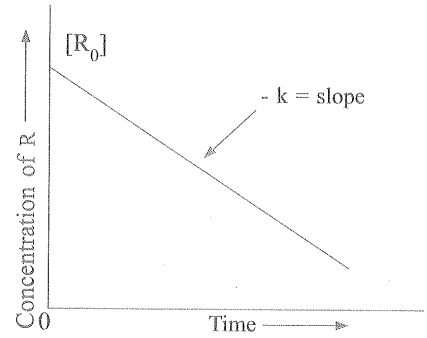
$\rightarrow$ Comparing equation $(2)$ with equation of straight line, $y=m x+c$, if we plot $[R]$ against $t$ , we get a straight line with slope $=- k$ and intercept equal to $[ R ]_0$
Image
View full question & answer
Question 33 Marks
What is activation energy? Explain with the help of graph by suitable example
Answer
$\rightarrow$ Activation energy can be understood clearly using the formation reaction of hydrogen iodide.
$\rightarrow H2(g) + I2(g)$
$\rightarrow 2HI(g)$
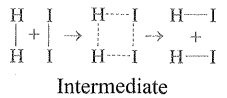
$\rightarrow$ According to Arrhenius, this reaction can take place only when a molecule hydrogen and molecule of iodine collide to form an unstable intermediate. It exists for a very short time and then breaks up to form two molecules of hydrogen iodide.
Image
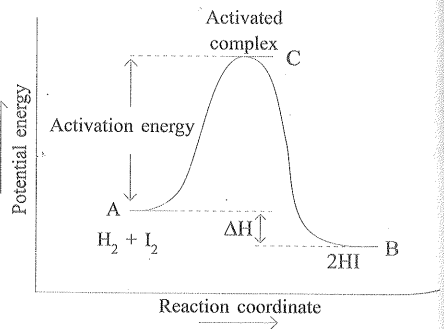
$\rightarrow$ The energy required to form this intermediate, called activated complex $(C),$ is known as activation energy $(E_a).$
$\rightarrow$ Below figure is obtained by plotting potential energy $VS$ reaction coordinate. Reaction coordinate represents the profile of energy change when reactant change into products.
Image
$\rightarrow$ Some energy is released when the complex decomposes to form products. So, the final enthalpy of the reaction depends upon the nature of reactants and products.
View full question & answer
Question 43 Marks
Derive integrated rate equation for first order reaction containing gaseous components.
Answer
$\rightarrow$ Let us consider a typical first order gas phase reaction.
$\rightarrow A(g) \rightarrow B(g) + C(g)$
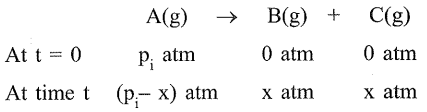
$\rightarrow$ Let $p_i$ be the initial pressure of $A$ and $p_t$ the total pressure at time $' t\ '$. Integrated rate equation for such a reaction can be derived as
$\rightarrow$ Total pressure $p _{ t }= p _{ A }+ p _{ B }+ p _{ C } ($pressure units$)$
$\rightarrow$ $p _{ A }, p _{ B }$ and $p _{ C }$ are partial pressures of $A , B$ and $C$ respectively. If $x$ atm can be the decrease in pressure of $A$ at time $t$ and one mole each of $B$ and $C$ is being formed. The increase in pressure of $B$ and $C$ will also be $X$ atm each
Image
where, $p_i$ is the initial pressure at time $t=0$
$p _{ t }=\left( p _{ i }- x \right)+ x + x = p _{ i }+ x$
$x =\left( p _{ t }- p _{ i }\right)$
where, $p_A=p_i-x=p_i-\left(p_t-p_i\right)=2 p_i-p_t$
$k =\left(\frac{2.303}{ t }\right)\left(\log \frac{ p _{ i }}{ p _{ A }}\right)$
$ =\frac{2.303}{ t } \log \frac{ p _{ i }}{2 p _{ i }- p _{ t }}$
View full question & answer
Question 53 Marks
Write a note on molecularity of a reaction and its different types.
Answer
→ Molecularity of a reaction: The number of reacting species (atoms, ions or molecules taking part in an elementary reaction, which must collide simultaneously in order to bring about a chemical reaction is called molecularit of a reaction.
→ For elementary reaction, order of a reaction an molecularity of a reaction are same.
→ The reaction can be unimolecular when on reacting species is involved. For exampl decomposition of ammonium nitrite.
$NH _4 NO _2 \rightarrow N _2+2 H _2 O$
→ Bimolecular reactions involve simultaneous collision between two species, for example, dissociation of hydrogen iodide. $2 HI \rightarrow H _2+ I _2$
→ Trimolecular or tetramolecular reactions involve simultaneous collision between three reacting species, for example, $2 NO + O _2 \rightarrow 2 NO _2$
→ The probability that more than three molecules can collide and react simultaneously is very small. Hence, the reaction with the molecularity three are very rare and slow to proceed.
View full question & answer
Question 63 Marks
What is order of reaction? Discuss elementary and complex reactions, Explain units of rate constant in detail.
Answer
$\rightarrow$ "The sum of power of the concentration of the reactants in the rate law expression is called the order of that chemical reaction."
$\rightarrow$ For reaction : $aA + bB \rightarrow$ product
$\rightarrow$ Rate $= k [ A ]^{ x }[ B ]^y \ x$ and $y$ indicate how sensitive the rate is to change in concentration of $A$ and $B$ .
$\rightarrow$ Sum of these exponents, i.e. $x+y$ gives the overall order of a reaction whereas $x$ and $y$ represent the order with respect to the reactants $A$ and $B$ respectively.
$\rightarrow$ Order of reaction can be $0. 1. 2. 3$ and even fraction.
$\rightarrow $ A zero order reaction means that the rate reaction is independent of the concentration reactants.
$\rightarrow$ The reactions taking place in one step are calles elementary reactions.
$\rightarrow$ When a sequence of elementary reactio $($called mechanism$)$ gives us the products,then reactions are called complex reactions.
Units of rate constant:
For a general reaction
$aA + bB \rightarrow cC + dD$
$\text { Rate }= k [ A ]^{ x }[ B ]^{ y }$
where $x + y = n =$ order of the reaction
$k =\frac{\text { Rate }}{[ A ]^{ x }[ B ]^{ y }}=\frac{\text { concentration }}{\text { time }} \times \frac{1}{\text { $($concentration) }}\ ($where $[ A ]=[ B ] )$
$\rightarrow$ Taking $SI$ unit of concentration, mol $L { }^{-1}$ an time, $s ,$ the unit of $k$ for different reaction order listed in table.
Reaction Order Units of rate constant
Zero order reaction $0$ $ \frac{ molL ^{-1}}{s} \times \frac{1}{\left(mol L ^{-1}\right)^0}$
$ = mol L ^{-1} s^{-1}$
First order reaction $1$ $\frac{ molL ^{-1}}{s} \times \frac{1}{\left(mol L ^{-1}\right)^1}$
$\quad= S ^{-1}$
Second order reaction $2$ $\frac{ mol L ^{-1}}{s} \times \frac{1}{\left(mol L ^{-1}\right)^2}$
$= mol ^{-1} L S ^{-1}$
View full question & answer
Question 73 Marks
Explain Rate law and Rate constant with an example.
Answer
$\rightarrow$ Rate of a reaction depends upon the concentration of reactants.
$\rightarrow $ Consider a general reaction
$\rightarrow aA + bB \rightarrow cC + dD$
where $a , b , c$ and d are the stoichiometric coefficients of reactants and products.
$\rightarrow$ The rate expression for this reaction is Rate $\alpha[ A ]^{ x }[ B ]^{ y }$
where exponents $x$ and $y$ may or may not be equal to the stoichiometric coefficients $(a$ and $b)$ of the reactants. Above equation can also be written as
$\text { Rate }= k [ A ]^{ x }[ B ]^{ y }$
$-\frac{ d [ A ]}{ dt }= k [ A ]^{ x }[ B ]^{ y }$
$\rightarrow$ This form of equation is known as differential rate equation,
$\rightarrow$  where $k$ is proportionality constant called rate constant.
$\rightarrow$ The equation which relates the rate of reaction to concentration of reactants is called rate law or rate expression.
$\rightarrow$ "Thus, rate law is the expression in which reaction rate is given in terms of molar concentration of reactants with each term raised to some power, which may or may not be same as stoichiometric coefficient of the reacting species in a balanced equation."
$\rightarrow$ For example : $2 \ce{NO ( g )+ O _2(g) \rightarrow 2 NO _2(g)}$ the rate equation for this reaction will be
$\text { Rate }= k [ \ce{NO} ]^2\left[\ce{ O} _2\right]$
$\rightarrow$ This differential form of this rate expression is given as
$-\frac{ d [ R ]}{ dt }= k [\ce{ NO} ]^2\left[ \ce{O }_2\right]$
$\rightarrow$ Some other examples are given below :
Reaction
$1. \ce{CHCl _3+ Cl _2 \rightarrow CCl _4+ HCl}$
$2. \ce{CH _3 COOC _2 H _5+ H _2 O \rightarrow CH _3 COOH +}$
$\ce{C _2 H _5 OH}$
Experimental rate expression
$\text { Rate }= k \left[ \ce{CHCl} _3\right] \cdot\left[ \ce{Cl} _2\right]^{\frac{1}{2}}$
$\text { Rate }= k \left[\ce{CH _3 COOC _2 H} _5\right]\left[ \ce{H _2 O} \right]^0$
$\rightarrow$ In these reactions, the exponents of the concentration terms are not the same as their stoichiometric coefficients.
Thus, we can say that:
$\rightarrow$ Rate law for any reaction cannot be predicted by merely looking at the balanced chemical equation.
i.e. theoretically but must be determined experimentally.
View full question & answer
3 Marks Question - Chemistry STD 12 Science Questions - Vidyadip