Question 15 Marks
$(i).$ Illustrate the following reactions giving suitable example in each case:
$a.$ Ammonolysis
$b.$ Coupling reaction
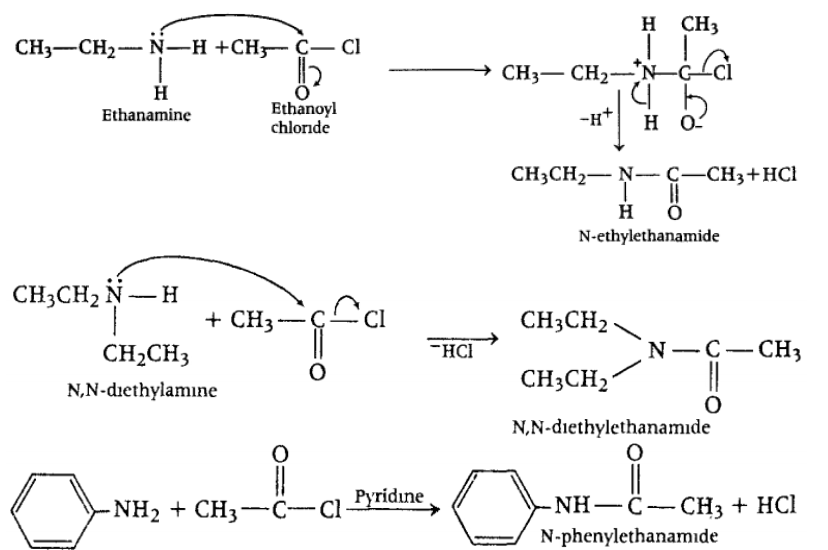
$c.$ Acetylation of amines
$(ii).$ Describe Hinsberg method for the identification of primary, secondary and tertiary amines. Also, write the chemical equations of the reactions involved.
$a.$ Ammonolysis
$b.$ Coupling reaction
$c.$ Acetylation of amines
$(ii).$ Describe Hinsberg method for the identification of primary, secondary and tertiary amines. Also, write the chemical equations of the reactions involved.
Answer
View full question & answer→$(a).$ Ammonolysis The process of cleavage of the $C-X$ bond by ammonia molecule is known as ammonolysis. In this process, an alkyl or benzyl halide on reaction with an ethanolic solution of ammonia undergoes nucleophilic substitution reaction in which halogen atom is replaced by an amino $(-NH_2)$ group. The reaction is carried out in a sealed tube at $373 \ K.$ The primary amine thus obtained behaves as a nucleophile and can further react with alkyl halide to form secondary and tertiary amines and further quaternary salts.

$(b).$ Coupling reaction Arenediazonium salts react with highly reactive $($i.e. electron$-$rich$)$ aromatic compounds such as aniline, phenols to form brightly coloured azo compounds, $Ar-N =N-Ar.$ This reaction is called coupling reaction. e.g. Benzene diazonium chloride reacts with aniline in faintly acidic medium $(pH 4-5)$ at $273-278K,$ in which the molecule at its para$-$position is coupled with the diazonium salt to form $p-$aminoazobenzene. This is an example of coupling reaction.

$(c).$ Acetylation of amines The process of introducing an acetyl group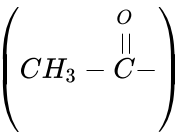 into the molecule is called acetylation of amines.
$(2)$ The reaction of primary and secondary amines with benzenesulphonyl chloride $(C_6H_5SO_2Cl,)$ known as Hinsberg's reagent to form sulphonamides is known as Hinsberg's method $($or reaction$).$ This method $($or reaction$)$ is used for separating $1^\circ , 2^\circ$ and $3^\circ$ amines.
$(a).$ The reaction of benzenesulphonyl chloride with primary amine yields $N-$ethylbenzenesulphonamide.
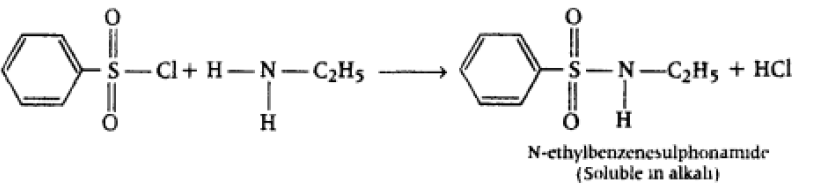
The hydrogen attached to $N-$atom in sulphonamide is strogly acidic due to the presence of strong electron withdrawing sulphonyl group. Hence, it is soluble in alkali.
$(b).$ In the reaction with secondary amine, $N, N-$diethylbenzenes amide is formed.
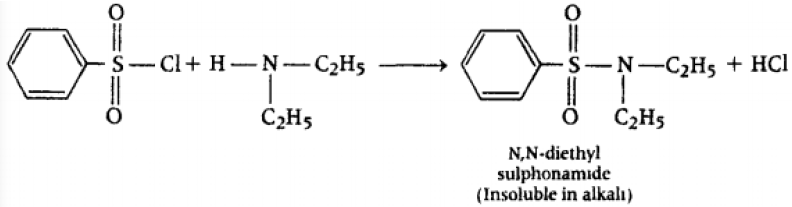
Since, $N, N-$diethylbenzenesulphonamide does not contain any hydrogen atom attached to nitrogen atom, it is not acidic and hence, insoluble in alkali.
$c.$ Tertiary amines do not react with benzenesulphonyl chloride. as it doesn't contain replaceable hydrogens.
$(b).$ Coupling reaction Arenediazonium salts react with highly reactive $($i.e. electron$-$rich$)$ aromatic compounds such as aniline, phenols to form brightly coloured azo compounds, $Ar-N =N-Ar.$ This reaction is called coupling reaction. e.g. Benzene diazonium chloride reacts with aniline in faintly acidic medium $(pH 4-5)$ at $273-278K,$ in which the molecule at its para$-$position is coupled with the diazonium salt to form $p-$aminoazobenzene. This is an example of coupling reaction.
$(c).$ Acetylation of amines The process of introducing an acetyl group
into the molecule is called acetylation of amines.$(2)$ The reaction of primary and secondary amines with benzenesulphonyl chloride $(C_6H_5SO_2Cl,)$ known as Hinsberg's reagent to form sulphonamides is known as Hinsberg's method $($or reaction$).$ This method $($or reaction$)$ is used for separating $1^\circ , 2^\circ$ and $3^\circ$ amines.
$(a).$ The reaction of benzenesulphonyl chloride with primary amine yields $N-$ethylbenzenesulphonamide.
The hydrogen attached to $N-$atom in sulphonamide is strogly acidic due to the presence of strong electron withdrawing sulphonyl group. Hence, it is soluble in alkali.
$(b).$ In the reaction with secondary amine, $N, N-$diethylbenzenes amide is formed.
Since, $N, N-$diethylbenzenesulphonamide does not contain any hydrogen atom attached to nitrogen atom, it is not acidic and hence, insoluble in alkali.
$c.$ Tertiary amines do not react with benzenesulphonyl chloride. as it doesn't contain replaceable hydrogens.