MCQ 511 Mark
A $10 \mathrm{~m}$ long wire of $20 \Omega$ resistance is connected with a battery of $3$ volt e.m.f. (negligible internal resistance) and a $10 \Omega$ resistance is joined to it is series. Potential gradient along wire in volt per meter is
- A
$0.02$
- B
$0.3$
- ✓
$0.2$
- D
$1.3$
Answer$ \text { Potential gradient } x=\frac{e}{\left(R+R_h+r\right)} \cdot \frac{R}{L} $
$ =\frac{3}{(20+10+0)} \times \frac{20}{10}=0.2$
View full question & answer→MCQ 521 Mark
The material of wire of potentiometer is
Answer(c) Manganin or constantan are used for making the potentiometer wire.
View full question & answer→MCQ 531 Mark
A potentiometer has uniform potential gradient across it. Two cells connected in series (i) to support each other and (ii) to oppose each other are balanced over $6 \mathrm{~m}$ and $2 \mathrm{~m}$ respectively on the potentiometer wire. The e.m.f.'s of the cells are in the ratio of
- A
$1: 2$
- B
$1: 1$
- C
$3: 1$
- ✓
$2: 1$
AnswerCorrect option: D. $2: 1$
(d) $\frac{E_1}{E_2}=\frac{l_1+l_2}{l_1-l_2}=\frac{(6+2)}{(6-2)}=\frac{2}{1}$
View full question & answer→MCQ 541 Mark
Equal potentials are applied on an iron and copper wire of same length. In order to have the same current flow in the two wires, the ratio $r$ (iron) $/ r$ (copper) of their radii must be (Given that specific resistance of iron $=1.0 \times 10^{-7} \mathrm{ohm}-\mathrm{m}$ and specific resistance of copper $=1.7 \times 10^{-8}$ ohm-m)
Answer(b) $\frac{r_{\text {iron }}}{r_{\text {Copper }}}=\sqrt{\frac{\rho_{\text {iron }}}{\rho_{\text {copper }}}}=\sqrt{\frac{1 \times 10^{-7}}{1.7 \times 10^{-8}}} \approx 2.4$.
View full question & answer→MCQ 551 Mark
A voltmeter has a resistance of $G$ ohms and range $V$ volts. The value of resistance used in series to convert it into a voltmeter of range $n V$ volts is
- A
$n G$
- ✓
$(n-1) G$
- C
$\frac{G}{n}$
- D
$\frac{G}{(n-1)}$
AnswerCorrect option: B. $(n-1) G$
View full question & answer→MCQ 561 Mark
Two non-ideal identical batteries are connected in parallel. Consider the following statements $(i)$ The equivalent $\text{e.m.f.}$ is smaller than either of the two $\text{e.m.f.}_s \ (ii) $ The equivalent internal resistance is smaller than either of the two internal resistances
- A
Both $(i)$ and $(ii)$ are correct
- B
$(i)$ is correct but $(ii)$ is wrong
- ✓
$(ii)$ is correct but $(i)$ is wrong
- D
Both $(i)$ and $(ii)$ are wrong
AnswerCorrect option: C. $(ii)$ is correct but $(i)$ is wrong
$(ii)$ is correct but $(i)$ is wrong
View full question & answer→MCQ 571 Mark
A galvanometer has resistance of $7 \Omega$ and gives a full scale deflection for a current of $1.0 \mathrm{~A}$. How will you convert it into a voltmeter of range $10 \mathrm{~V}$
- ✓
$3 \Omega$ in series
- B
$3 \Omega$ in parallel
- C
$17 \Omega$ in series
- D
$30 \Omega$ in series
AnswerCorrect option: A. $3 \Omega$ in series
(a) By connecting a series resistance$R=\frac{V}{i_g}-G=\frac{10}{1}-7=3 \Omega$
View full question & answer→MCQ 581 Mark
The net resistance of a voltmeter should be large to ensure that
- A
It does not get overheated
- B
It does not draw excessive current
- C
It can measure large potential difference
- ✓
It does not appreciably change the potential difference to be measured
AnswerCorrect option: D. It does not appreciably change the potential difference to be measured
(d) The resistance of voltmeter is too high, so that it draws negligible current from the circuit, hence potential drop in the external circuit is also negligible.
View full question & answer→MCQ 591 Mark
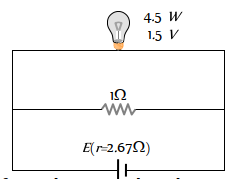
A torch bulb rated as $4.5 W, 1.5 V$ is connected as shown in the figure. The e.m.f. of the cell needed to make the bulb glow at full intensity is
- A
$4.5 \mathrm{~V}$
- B
$1.5 \mathrm{~V}$
- C
$2.67 \mathrm{~V}$
- ✓
$13.5 \mathrm{~V}$
AnswerCorrect option: D. $13.5 \mathrm{~V}$
Current in the bulb $=\frac{P}{V}=\frac{4.5}{1.5}=3 \mathrm{~A}$Current in $1 \Omega$ resistance $=\frac{1.5}{1}=1.5 \mathrm{~A}$
Hence total current from the cell $i=3+1.5=4.5 \mathrm{~A}$
By using $E=V+i r \Rightarrow E=1.5+4.5 \times(2.67)=13.5 \mathrm{~V}$
View full question & answer→MCQ 601 Mark
The resistance of a galvanometer is $50 \mathrm{ohms}$ and the current required to give full scale deflection is $100 \mu \mathrm{A}$. In order to convert it into an ammeter, reading upto $10 A$, it is necessary to put a resistance of
- A
$5 \times 10^{-3} \Omega$ in parallel
- ✓
$5 \times 10^{-4} \Omega$ in parallel
- C
$10^5 \Omega$ in series
- D
$99,950 \Omega$ in series
AnswerCorrect option: B. $5 \times 10^{-4} \Omega$ in parallel
(b) Resistance in parallel $S=\frac{G i_g}{i-i_g}=\frac{50 \times 100 \times 10^{-6}}{\left(10-100 \times 10^{-6}\right)}$$\Rightarrow S=5 \times 10^{-4} \Omega$
View full question & answer→MCQ 611 Mark
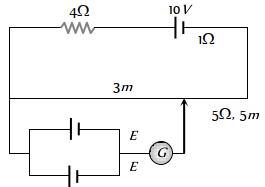
A resistance of $4 \Omega$ and a wire of length 5 metres and resistance $5 \Omega$ are joined in series and connected to a cell of e.m.f. $10 V$ and internal resistance $1 \Omega$. A parallel combination of two identical cells is balanced across $300 \mathrm{~cm}$ of the wire. The e.m.f. $E$ of each cell is
- A
$1.5 \mathrm{~V}$
- ✓
$3.0 \mathrm{~V}$
- C
$0.67 \mathrm{~V}$
- D
$1.33 \mathrm{~V}$
AnswerCorrect option: B. $3.0 \mathrm{~V}$
$E=x l=\frac{V}{l}=\frac{i R}{L} \times l $
$\Rightarrow E=\frac{e}{\left(R+R_h+r\right)} \times \frac{R}{L} \times l $
$ \Rightarrow E=\frac{10}{(5+4+1)} \times \frac{5}{5} \times 3=3 V$
View full question & answer→MCQ 621 Mark
Two resistances $R_1$ arid $\kappa_2$ are made of different materials. The temperature coefficient of the material of $R_1$ is $\alpha$ and of the material of $R_2$ is $-\beta$. The resistance of the series combination of $R_1$ and $R_2$ will not change with temperature, if $R_1 / R_2$ equals
AnswerCorrect option: D. $\frac{\beta}{\alpha}$
$ R_1+R_2=R_1(1+\alpha t)+R_2(1-\beta t) $
$ \Rightarrow R_1+R_2=R_1+R_2+R_1 \alpha t-R_2 \beta t \Rightarrow \frac{R_1}{R_2}=\frac{\beta}{\alpha}$
View full question & answer→MCQ 631 Mark
When a resistance of $2 \mathrm{ohm}$ is connected across the terminals of a cell, the current is 0.5 amperes. When the resistance is increased to $5 \mathrm{ohm}$, the current is 0.25 amperes. The internal resistance of the cell is
- A
$0.5 \mathrm{ohm}$
- ✓
$1.0 \mathrm{ohm}$
- C
$1.5 \mathrm{ohm}$
- D
$2.0 \mathrm{ohm}$
AnswerCorrect option: B. $1.0 \mathrm{ohm}$
(b) Current through each arm $D A C$ and $D B C=1 A$$V_D-V_A=2 \text { and } V_D-V_B=3 \Rightarrow V_A-V_B=+1 V$
View full question & answer→MCQ 641 Mark
A moving coil galvanometer has a resistance of $50 \Omega$ and gives full scale deflection for $10 \mathrm{~mA}$. How could it be converted into an ammeter with a full scale deflection for $1 A$
- A
$50 / 99 \Omega$ in series
- ✓
$50 / 99 \Omega$ in parallel
- C
$0.01 \Omega$ in series
- D
$0.01 \Omega$ in parallel
AnswerCorrect option: B. $50 / 99 \Omega$ in parallel
(b) $S=\frac{i_g \times G}{i-i_g}=\frac{10 \times 10^{-3} \times 50}{1-10^{-3} \times 10}=\frac{50}{99} \Omega$ in parallel.
View full question & answer→MCQ 651 Mark
$A B$ is a wire of uniform resistance. The galvanometer $G$ shows no current when the length $A C=20 \mathrm{~cm}$ and $C B=80 \mathrm{~cm}$. The resistance $R$ is equal to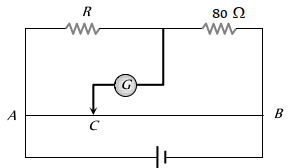
- A
$2 \Omega$
- B
$8 \Omega$
- ✓
$20 \Omega$
- D
$40 \Omega$
AnswerCorrect option: C. $20 \Omega$
(c) By Wheatstone bridge, $\frac{R}{80}=\frac{A C}{B C}=\frac{20}{80} \Rightarrow R=20 \Omega$
View full question & answer→MCQ 661 Mark
A certain piece of silver of given mass is to be made like a wire. Which of the following combination of length $(L)$ and the area of cross-sectional $$ will lead to the smallest resistance
- A
$L$ and $A$
- B
$2 L$ and $A / 2$
- ✓
$L / 2$ and $2 A$
- D
Any of the above, because volume of silver remains same
AnswerCorrect option: C. $L / 2$ and $2 A$
(c) $R=\rho \frac{l}{A}$
View full question & answer→MCQ 671 Mark
A battery of e.m.f. $E$ and internal resistance $r$ is connected to a variable resistor $R$ as shown here. Which one of the following is true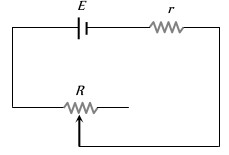
- A
Potential difference across the terminals of the battery is maximum when $R=r$
- B
Power delivered to the resistor is maximum when $R=r$
- C
Current in the circuit is maximum when $R=r$
- D
Current in the circuit is maximum when $R \gg r$
View full question & answer→MCQ 681 Mark
The figure shows a network of currents. The magnitude of currents is shown here. The current $i$ will be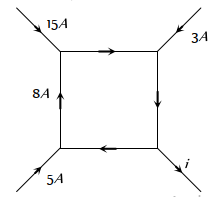
- A
$3 A$
- B
$13 A$
- C
$23 A$
- ✓
$-3 A$
AnswerCorrect option: D. $-3 A$
(d) The last two resistance are out of circuit. Now $8 \Omega$ is in parallel with $(1+1+4+1+1) \Omega$.$\therefore R=8 \Omega \| 8 \Omega=\frac{8}{2}=4 \Omega \Rightarrow R_{A B}=4+2+2=8 \Omega$
View full question & answer→MCQ 691 Mark
The circuit shown here is used to compare the e.m.f. of two cells $E_1$ and $E_2\left(E_1>E_2\right)$. The null point is at $C$ when the galvanometer is connected to $E_1$. When the galvanometer is connected to $E_2$, the null point will be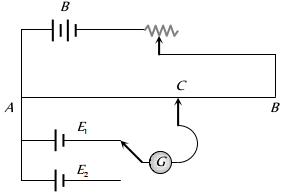
- ✓
To the left of $C$
- B
To the right of $C$
- C
At $C$ itself
- D
Nowhere on $A B$
AnswerCorrect option: A. To the left of $C$
(a) $E \propto l$ (balancing length)
View full question & answer→MCQ 701 Mark
For a metallic wire, the ratio $V / i \quad(V=$ the applied potential difference, $i=$ current flowing) is
- A
Independent of temperature
- ✓
Increases as the temperature rises
- C
Decreases as the temperature rises
- D
Increases or decreases as temperature rises, depending upon the metal
AnswerCorrect option: B. Increases as the temperature rises
Increases as the temperature rises
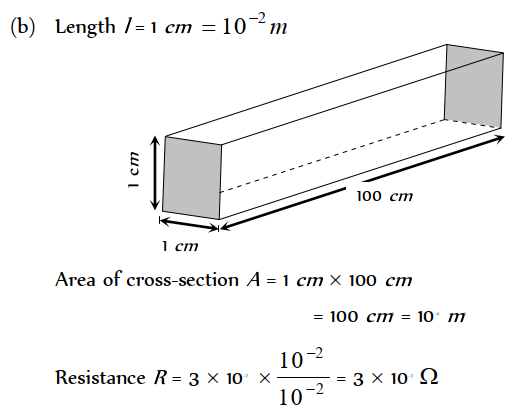
View full question & answer→MCQ 711 Mark
The resistance of a galvanometer is $25 \mathrm{ohm}$ and it requires $50 \mu \mathrm{A}$ for full deflection. The value of the shunt resistance required to convert it into an ammeter of 5 amp is
AnswerCorrect option: A. $2.5 \times 10^{-4} \mathrm{ohm}$
(a) $S=\frac{G}{\frac{i}{i_g}-1}=\frac{25}{\frac{5}{50 \times 10^{-6}}-1}=\frac{25}{10^5-1}=\frac{25}{10^5}=2.5 \times 10^{-4} \Omega$
View full question & answer→MCQ 721 Mark
A copper wire of length $1 \mathrm{~m}$ and radius $1 \mathrm{~mm}$ is joined in series with an iron wire of length $2 \mathrm{~m}$ and radius $3 \mathrm{~mm}$ and a current is passed through the wires. The ratio of the current density in the copper and iron wires is
- A
$18: 1$
- ✓
$9: 1$
- C
$6: 1$
- D
$2: 3$
AnswerCorrect option: B. $9: 1$
Current density $J=\frac{i}{A}=\frac{i}{\pi r^2} \Rightarrow \frac{J_1}{J_2}=\frac{i_1}{i_2} \times \frac{r_2^2}{r_1^2}$
But the wires are in series, so they have the same current, hence $i_1=i_2$.
So $\frac{J_1}{J_2}=\frac{r_2^2}{r_1^2}=9: 1$
View full question & answer→MCQ 731 Mark
For comparing the e.m.f.'s of two cells with a potentiometer, a standard cell is used to develop a potential gradient along the wires. Which of the following possibilities would make the experiment unsuccessful
AnswerCorrect option: D. The e.m.f. of the standard cell is smaller than the e.m.f.'s of the two cells
(d) The emf of the standard cell must be greater than that of experimental cells, otherwise balance point is not obtained.
View full question & answer→MCQ 741 Mark
A voltmeter having a resistance of $998 \mathrm{ohms}$ is connected to a cell of e.m.f. 2 volt and internal resistance $2 \mathrm{ohm}$. The error in the measurement of e.m.f. will be
- A
$4 \times 10^{-1}$ volt
- B
$2 \times 10^{-3}$ volt
- ✓
$4 \times 10^{-3}$ volt
- D
$2 \times 10^{-1}$ volt
AnswerCorrect option: C. $4 \times 10^{-3}$ volt
View full question & answer→MCQ 751 Mark
Which is a wrong statement
- A
The Wheatstone bridge is most sensitive when all the four resistances are of the same order
- ✓
In a balanced Wheatstone bridge, interchanging the positions of galvanometer and cell affects the balance of the bridge
- C
Kirchhoff's first law (for currents meeting at a junction in an electric circuit) expresses the conservation of charge
- D
The rheostat can be used as a potential divider
AnswerCorrect option: B. In a balanced Wheatstone bridge, interchanging the positions of galvanometer and cell affects the balance of the bridge
(b) In balanced Wheatstone bridge, the arms of galvanometer and cell can be interchanged without affecting the balance of the bridge.
View full question & answer→MCQ 761 Mark
The resistance of a wire of iron is 10 ohms and temp. coefficient of resistivity is $5 \times 10^{-3} /{ }^{\circ} \mathrm{C}$. At $21 \mathrm{x}$ it carries 30 milliamperes of current. Keeping constant potential difference between its ends, the temperature of the wire is raised to $120^{\circ} \mathrm{C}$. The current in milliamperes that flows in the wire is
Answer(a)$\frac{R_1}{R_2}=\frac{\left(1+\alpha t_1\right)}{\left(1+\alpha t_2\right)} \Rightarrow \frac{10}{R_2}=\frac{\left(1+5 \times 10^{-3} \times 20\right)}{\left(1+5 \times 10^{-3} \times 120\right)}$
$ \Rightarrow R_2 \approx 15 \Omega$ Also $\frac{i_1}{i_2}=\frac{R_2}{R_1} \Rightarrow \frac{30}{i_2}=\frac{15}{10} \Rightarrow i_2=20 \mathrm{~mA}$
View full question & answer→MCQ 771 Mark
The resistances of a wire at temperatures $t^{\circ} \mathrm{C}$ and $0^{\circ} \mathrm{C}$ are related by
- ✓
$R_t=R_0(1+\alpha t)$
- B
$R_t=R_0(1-\alpha t)$
- C
$R_t=R_0^2(1+\alpha t)$
- D
$R_t=R_0^2(1-\alpha t)$
AnswerCorrect option: A. $R_t=R_0(1+\alpha t)$
View full question & answer→MCQ 781 Mark
Two wires of the same material are given. The first wire is twice as long as the second and has twice the diameter of the second. The resistance of the first will be
Answer(b) By $R=\rho l / A$
View full question & answer→MCQ 791 Mark
A galvanometer can be converted into an ammeter by connecting
- A
- B
High resistance in parallel
- ✓
Low resistance in parallel
- D
High resistance in series
AnswerCorrect option: C. Low resistance in parallel
(c) To convert a galvanometer into an ammeter a low value resistance is to be connected in parallel to it called shunt.
View full question & answer→MCQ 801 Mark
An ammeter gives full scale deflection when current of $1.0 \mathrm{~A}$ is passed in it. To convert it into $10 \mathrm{~A}$ range ammeter, the ratio of its resistance and the shunt resistance will be
- A
$1: 9$
- B
$1: 10$
- C
$1: 11$
- ✓
$9: 1$
AnswerCorrect option: D. $9: 1$
(d) $S=\frac{i_g G}{\left(i-i_g\right)} \Rightarrow \frac{G}{S}=\frac{i-i_g}{i_g}=\frac{10-1}{1}=\frac{9}{1}$
View full question & answer→MCQ 811 Mark
$50 \Omega$ and $100 \Omega$ resistors are connected in series. This connection is connected with a battery of 2.4 volts. When a voltmeter of $100 \Omega$ resistance is connected across $100 \Omega$ resistor, then the reading of the voltmeter will be
- A
$1.6 \mathrm{~V}$
- B
$1.0 \mathrm{~V}$
- ✓
$1.2 \mathrm{~V}$
- D
$2.0 \mathrm{~V}$
AnswerCorrect option: C. $1.2 \mathrm{~V}$
(c) Equivalent resistance of the circuit $R_{e q}=100 \Omega$ current through the circuit $i=\frac{2.4}{100} \mathrm{~A}$P.D. across combination of voltmeter and $100 \Omega$ resistance $=\frac{2.4}{100} \times 50=1.2 \mathrm{~V}$Since the voltmeter and $100 \Omega$ resistance are in parallel, so the voltmeter reads the same value i.e. 1.2 $\mathrm{V}$.
View full question & answer→MCQ 821 Mark
$10^{-3} \mathrm{amp}$ is flowing through a resistance of $1000 \Omega$. To measure the correct potential difference, the voltmeter is to be used of which the resistance should be
- A
$0 \Omega$
- B
$500 \Omega$
- C
$1000 \Omega$
- ✓
$>1000 \Omega$
AnswerCorrect option: D. $>1000 \Omega$
$>1000 \Omega$
View full question & answer→MCQ 831 Mark
A cell of internal resistance $1.5 \Omega$ and of e.m.f. 1.5 volt balances $500 \mathrm{~cm}$ on a potentiometer wire. If a wire of $15 \Omega$ is connected between the balance point and the cell, then the balance point will shift
- A
- B
By $500 \mathrm{~cm}$
- C
By $750 \mathrm{~cm}$
- ✓
Answer(d) Balance point has some fixed position on potentiometer wire. It is not affect by the addition of resistance between balance point and cell.
View full question & answer→MCQ 841 Mark
The potential difference in open circuit for a cell is $2.2 \mathrm{volts}$. When a $4 \mathrm{ohm}$ resistor is connected between its two electrodes the potential difference becomes 2 volts. The internal resistance of the cell will be
- A
$1 \mathrm{ohm}$
- ✓
$0.2 \mathrm{ohm}$
- C
$2.5 \mathrm{ohm}$
- D
$0.4 \mathrm{ohm}$
AnswerCorrect option: B. $0.2 \mathrm{ohm}$
(b) Because all the lamps have same voltage.
View full question & answer→MCQ 851 Mark
The resistivity of a wire
- A
Increases with the length of the wire
- B
Decreases with the area of cross-section
- C
Decreases with the length and increases with the cross-section of wire
- ✓
None of the above statement is correct
AnswerCorrect option: D. None of the above statement is correct
(d) Resistivity is the property of the material. It does not depend upon size and shape.
View full question & answer→MCQ 861 Mark
The example for non $-$ ohmic resistance is
View full question & answer→MCQ 871 Mark
A cell of internal resistance $3\ \mathrm{ohm}$ and $\mathrm{emf}\ 10\ \mathrm{volt}$ is connected to a uniform wire of length $500 \mathrm{~cm}$ and resistance $3 \ \mathrm{ohm}$. The potential gradient in the wire is
- A
$30 \mathrm{mV} / \mathrm{cm}$
- ✓
$10 \mathrm{mV} / \mathrm{cm}$
- C
$20 \mathrm{mV} / \mathrm{cm}$
- D
$4 \mathrm{mV} / \mathrm{cm}$
AnswerCorrect option: B. $10 \mathrm{mV} / \mathrm{cm}$
(b$ \text { Potential gradient }=\frac{e \cdot R}{(R+r) \cdot L}=\frac{10 \times 3}{(3+3)\times 5} $
$ =1 \mathrm{~V} / \mathrm{m}=10 \mathrm{mV} / \mathrm{cm}$
View full question & answer→MCQ 881 Mark
In the circuit shown below $E=4.0 \mathrm{~V}, R=2 \Omega, E=6.0 \mathrm{~V}, R=4 \Omega$ and $R=2 \Omega$. The current $l$ is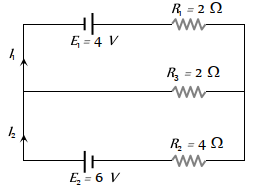
- A
$1.6 \mathrm{~A}$
- ✓
$1.8 \mathrm{~A}$
- C
$1.25 \mathrm{~A}$
- D
$1.0 \mathrm{~A}$
AnswerCorrect option: B. $1.8 \mathrm{~A}$
View full question & answer→MCQ 891 Mark
A $100 \mathrm{ohm}$ galvanometer gives full scale deflection at $10 \mathrm{~mA}$. How much shunt is required to read $100 \mathrm{~mA}$
- ✓
$11.11 \mathrm{ohm}$
- B
$9.9 \mathrm{ohm}$
- C
$1.1 \mathrm{ohm}$
- D
$4.4 \mathrm{ohm}$
AnswerCorrect option: A. $11.11 \mathrm{ohm}$
$ i_g=i \frac{S}{G+S} \Rightarrow 10 \times 10^{-3}=\frac{S}{100+S} \times 100 \times 10^{-3}$
$90 S=1000 \Rightarrow S=\frac{1000}{90}=11.11 \Omega$
View full question & answer→MCQ 901 Mark
A battery has e.m.f. $4 V$ and internal resistance $r$. When this battery is connected to an external resistance of $2 \mathrm{ohms}$, a current of 1 amp. flows in the circuit. How much current will flow if the terminals of the battery are connected directly
- A
$1 \mathrm{amp}$
- B
- C
$4 \mathrm{amp}$
- D
AnswerSo total current $=0.8+0.4=1.2 A$
View full question & answer→MCQ 911 Mark
In a circuit 5 percent of total current passes through a galvanometer. If resistance of the galvanometer is $G$ then value of the shunt is
- A
$19 G$
- B
$20 G$
- C
$\frac{G}{20}$
- ✓
$\frac{G}{19}$
AnswerCorrect option: D. $\frac{G}{19}$
(d) $\frac{i_g}{i}=\frac{S}{G+S} \Rightarrow \frac{5}{100}=\frac{S}{G+S} \Rightarrow S=\frac{G}{19}$
View full question & answer→MCQ 921 Mark
An ammeter gives full deflection when a current of 2 amp. flows through it. The resistance $E$ of ammeter is 12 ohms. If the same ammeter is to be used for measuring a maximum current of 5 amp. then the ammeter must be connected with a resistance of
- A
$8 \mathrm{ohms}$ in series
- B
$18 \mathrm{ohms}$ in series
- ✓
$8 \mathrm{ohms}$ in parallel
- D
AnswerCorrect option: C. $8 \mathrm{ohms}$ in parallel
(c) $\frac{i}{i_g}=1+\frac{G}{S} \Rightarrow \frac{5}{2}=1+\frac{12}{S} \Rightarrow S=8 \Omega$. (In parallel).
View full question & answer→MCQ 931 Mark
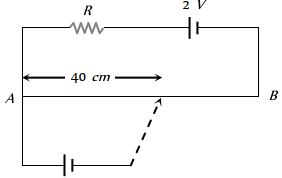
$A B$ is a potentiometer wire of length $100 \mathrm{~cm}$ and its resistance is $10$ ohms. It is connected in series with a resistance $R=40 \mathrm{ohms}$ and a battery of e.m.f. $2 V$ and negligible internal resistance. If a source of unknown e.m.f. $E$ is balanced by $40 \mathrm{~cm}$ length of the potentiometer wire, the value of $E$ is
- A
$0.8 \mathrm{~V}$
- B
$1.6 \mathrm{~V}$
- C
$0.08 \mathrm{~V}$
- ✓
$0.16 \mathrm{~V}$
AnswerCorrect option: D. $0.16 \mathrm{~V}$
(d) $\quad E=\frac{e}{\left(R+R_h+r\right)} \frac{R}{L} \times l=\frac{2}{(10+40+0)} \times \frac{10}{1} \times 0.4=0.16 \mathrm{~V}$.
View full question & answer→MCQ 941 Mark
At what temperature will the resistance of a copper wire become three times its value at $0 C$ (Temperature coefficient of resistance for copper $=4 \times 10 \cdot \operatorname{per}^{\cdot} \mathrm{C}$ )
- A
$400 \mathrm{C}$
- B
$450 C$
- ✓
$500 \mathrm{C}$
- D
$550 \mathrm{C}$
AnswerCorrect option: C. $500 \mathrm{C}$
(c) By using $R_t=R_0(1+\alpha t)$$3 \times R_0=R_0\left(1+4 \times 10^{-3} t\right) \Rightarrow t=500^{\circ} \mathrm{C} .$
View full question & answer→MCQ 951 Mark
A rod of a certain metal is $1.0 \mathrm{~m}$ long and $0.6 \mathrm{~cm}$ in diameter. lts resistance is $3.0 \times 10^{-3} \mathrm{ohm}$. Another disc made of the same metal is $2.0 \mathrm{~cm}$ in diameter and $1.0 \mathrm{~mm}$ thick. What is the resistance between the round faces of the disc
- A
$1.35 \times 10^{-8} \mathrm{ohm}$
- ✓
$2.70 \times 10^{-7} \mathrm{ohm}$
- C
$4.05 \times 10^{-6} \mathrm{ohm}$
- D
$8.10 \times 10^{-5} \mathrm{ohm}$
AnswerCorrect option: B. $2.70 \times 10^{-7} \mathrm{ohm}$
(b) Resistivity of the material of the
$\rho=\frac{R A}{l}=\frac{3 \times 10^{-3} \pi\left(0.3 \times 10^{-2}\right)^2}{1}=27 \times 10^{-9} \pi \Omega \times m$
Resistance of disc $R=\frac{\text { (Thickness) }}{\text { (Area of cross section) }}$
$=27 \times 10^{-9} \pi \times \frac{\left(10^{-3}\right)}{\pi \times\left(1 \times 10^{-2}\right)^2}=2.7 \times 10^{-7} \Omega.$
View full question & answer→MCQ 961 Mark
An electron (charge $=1.6 \times 10^{-}$coulomb) is moving in a circle of radius $5.1 \times 10 \mathrm{~m}$ at a frequency of $6.8 \times 10$ revolutions $/ \mathrm{sec}$. The equivalent current is approximately
- A
$5.1 \times 10^{-3} \mathrm{amp}$
- B
$6.8 \times 10^{-3} \mathrm{amp}$
- ✓
$1.1 \times 10^{-3} \mathrm{amp}$
- D
$2.2 \times 10^{-3} \mathrm{amp}$
AnswerCorrect option: C. $1.1 \times 10^{-3} \mathrm{amp}$
(c) $i=e v=1.6 \times 10^{-19} \times 6.8 \times 10^{15}=1.1 \times 10^{-3} \mathrm{amp}$.
View full question & answer→MCQ 971 Mark
A galvanometer has a resistance of $25 \mathrm{ohm}$ and a maximum of 0.01 $A$ current can be passed through it. In order to change it into an ammeter of range $10 \mathrm{~A}$, the shunt resistance required is
- A
$5 / 999 \mathrm{ohm}$
- B
$10 / 999 \mathrm{ohm}$
- C
$20 / 999 \mathrm{ohm}$
- ✓
$25 / 999 \mathrm{ohm}$
AnswerCorrect option: D. $25 / 999 \mathrm{ohm}$
$i_g=i \frac{S}{G+S} \Rightarrow 0.01=10 \frac{S}{25+S} $
$ \Rightarrow 1000 S=25+S \Rightarrow S=\frac{25}{999} \Omega .$
View full question & answer→MCQ 981 Mark
Seven resistances are connected as shown in the figure. The equivalent resistance between $A$ and $B$ is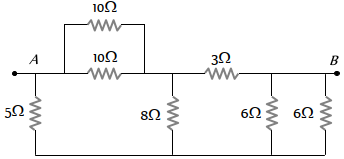
- A
$3 \Omega$
- ✓
$4 \Omega$
- C
$4.5 \Omega$
- D
$5 \Omega$
AnswerCorrect option: B. $4 \Omega$
View full question & answer→MCQ 991 Mark
When a resistance of $2 \mathrm{ohm}$ is connected across the terminals of a cell, the current is $0.5 \mathrm{~A}$. When the resistance is increased to $5 \mathrm{ohm}$, the current is $0.25 \mathrm{~A}$. The e.m.f. of the cell is
- A
$1.0 \mathrm{~V}$
- ✓
$1.5 \mathrm{~V}$
- C
$2.0 \mathrm{~V}$
- D
$2.5 \mathrm{~V}$
AnswerCorrect option: B. $1.5 \mathrm{~V}$
View full question & answer→MCQ 1001 Mark
In a neon discharge tube $2.9 \times 10^{18} \mathrm{Ne}^{+}$ions move to the right each second while $1.2 \times 10^{18}$ electrons move to the left per second. Electron charge is $1.6 \times 10^{-19} \mathrm{C}$. The current in the discharge tube
- A
$1 A$ towards right
- ✓
$0.66 A$ towards right
- C
$0.66 A$ towards left
- D
AnswerCorrect option: B. $0.66 A$ towards right
$0.66 A$ towards right
View full question & answer→