MCQ 1011 Mark
Constantan wire is used in making standard resistances because its
- A
Specific resistance is low
- B
- ✓
Temperature coefficient of resistance is negligible
- D
AnswerCorrect option: C. Temperature coefficient of resistance is negligible
(c) Due to the negligible temperature co-efficient of resistance of constantan wire, there is no change in it's resistance value with change in temperature.
View full question & answer→MCQ 1021 Mark
A $100 V$ voltmeter of internal resistance $20 \mathrm{k} \Omega$ in series with a high resistance $R$ is connected to a $110 V$ line. The voltmeter reads 5 $V$, the value of $R$ is
- A
$210 \mathrm{k} \Omega$
- B
$315 \mathrm{k} \Omega$
- ✓
$420 \mathrm{k} \Omega$
- D
$440 \mathrm{k} \Omega$
AnswerCorrect option: C. $420 \mathrm{k} \Omega$
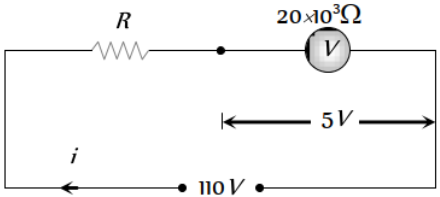
$\text { Here } i=\frac{110}{20 \times 10^3+R}$
$ \because V=i R \Rightarrow 5=\left(\frac{110}{20 \times 10^3+R}\right) \times 20 \times 10^3$
$\Rightarrow 10^5+5 R=22 \times 10^5 \Rightarrow R=21 \times \frac{10^5}{5}=420\ K \Omega$ View full question & answer→MCQ 1031 Mark
When a potential difference is applied across the ends of a linear metallic conductor
- A
The free electrons are accelerated continuously from the lower potential end to the higher potential end of the conductor
- B
The free electrons are accelerated continuously from the higher potential end to the lower potential end of the conductor
- ✓
The free electrons acquire a constant drift velocity from the lower potential end to the higher potential end of the conductor
- D
The free electrons are set in motion from their position of rest
AnswerCorrect option: C. The free electrons acquire a constant drift velocity from the lower potential end to the higher potential end of the conductor
View full question & answer→MCQ 1041 Mark
In a wire of circular cross-section with radius $r$, free electrons travel with a drift velocity $V$ when a current $I$ flows through the wire. What is the current in another wire of half the radius and of the same material when the drift velocity is $2 \mathrm{~V}$
AnswerCorrect option: C. $I / 2$
(c)$\begin{aligned}& \frac{R_1}{R_2}=\frac{\left(1+\alpha t_1\right)}{\left(1+\alpha t_2\right)} \Rightarrow \frac{50}{76.8}=\frac{\left(1+3.92 \times 10^{-3} \times 20\right)}{\left(1+3.92 \times 10^{-3} t\right)} \\& \Rightarrow t=167^{\circ} \mathrm{C}\end{aligned}$
View full question & answer→MCQ 1051 Mark
The voltage $V$ and current $I$ graph for a conductor at two different temperatures $T_1$ and $T_2$ are shown in the figure. The relation between $T_1$ and $T_2$ is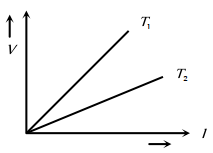
- ✓
$T_1>T_2$
- B
$T_1 \approx T_2$
- C
$T_1=T_2$
- D
$T_1
AnswerCorrect option: A. $T_1>T_2$
(a) Slope of the $V-i$ curve at any point equal to resistance at that point. From the curve slope for $T>$ slope for $T$$\Rightarrow R_{T_1}>R_{T_2}$. Also at higher temperature resistance will be higher so $T>T$
View full question & answer→MCQ 1061 Mark
A steady current $i$ is flowing through a conductor of uniform crosssection. Any segment of the conductor has
Answer(a) As steady current is flowing through the conductor, hence the number of electrons entering from one end and outgoing from the other end of any segment is equal. Hence charge will be zero.
View full question & answer→MCQ 1071 Mark
The resistance of a galvanometer is $90 \mathrm{ohms}$. If only 10 percent of the main current may flow through the galvanometer, in which way and of what value, a resistor is to be used
- A
- ✓
$10 \mathrm{ohms}$ in parallel
- C
$810 \mathrm{ohms}$ in series
- D
$810 \mathrm{ohms}$ in parallel
AnswerCorrect option: B. $10 \mathrm{ohms}$ in parallel
(b) $\because i_g=10 \%$ of $i=\frac{i}{10} \Rightarrow S=\frac{G}{(n-1)}=\frac{90}{(10-1)}=10 \Omega$
View full question & answer→MCQ 1081 Mark
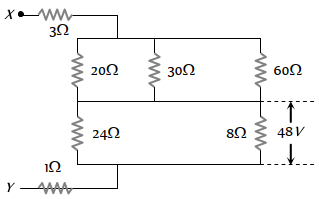
The potential difference across $8 \mathrm{ohm}$ resistance is $48 \mathrm{volt}$ as shown in the figure. The value of potential difference across $X$ and $\gamma$ points will be
- A
$160 \mathrm{volt}$
- ✓
$128 \mathrm{volt}$
- C
$80 \mathrm{volt}$
- D
$62 \mathrm{volt}$
AnswerCorrect option: B. $128 \mathrm{volt}$
View full question & answer→MCQ 1091 Mark
The electromotive force of a primary cell is 2 volts. When it is shortcircuited it gives a current of 4 amperes. lts internal resistance in ohms is
MCQ 1101 Mark
A torch battery consisting of two cells of 1.45 volts and an internal resistance $0.15 \Omega$, each cell sending currents through the filament of the lamps having resistance $1.5 \mathrm{ohms}$. The value of current will be
- A
$16.11 \mathrm{amp}$
- B
$1.611 \mathrm{amp}$
- C
$0.1611 \mathrm{amp}$
- D
$2.6 \mathrm{amp}$
View full question & answer→MCQ 1111 Mark
A new flashlight cell of e.m.f. 1.5 volts gives a current of 15 amps, when connected directly to an ammeter of resistance $0.04 \Omega$. The internal resistance of cell is
- A
$0.04 \Omega$
- B
$0.06 \Omega$
- C
$0.10 \Omega$
- ✓
$10 \Omega$
AnswerCorrect option: D. $10 \Omega$
(d) $R_{\text {series }}=R_1+R_2+R_3+\ldots \ldots$
View full question & answer→MCQ 1121 Mark
A metal wire of specific resistance $64 \times 10^{-6} \mathrm{ohm}-\mathrm{cm}$ and length $198 \mathrm{~cm}$ has a resistance of $7 \mathrm{ohm}$, the radius of the wire will be
- A
$2.4 \mathrm{~cm}$
- B
$0.24 \mathrm{~cm}$
- ✓
$0.024 \mathrm{~cm}$
- D
$24 \mathrm{~cm}$
AnswerCorrect option: C. $0.024 \mathrm{~cm}$
(c)$R=\rho \frac{l}{A} \Rightarrow 7=\frac{64 \times 10^{-6} \times 198}{\frac{22}{7} \times r^2} \Rightarrow r=0.024 \mathrm{~cm}$
View full question & answer→MCQ 1131 Mark
A galvanometer of resistance $25 \Omega$ gives full scale deflection for a current of 10 milliampere, is to be changed into a voltmeter of range $100 V$ by connecting a resistance of ' $R$ ' in series with galvanometer. The value of resistance $R$ in $\Omega$ is
- A
$10000$
- B
$10025$
- C
$975$
- ✓
$9975$
AnswerCorrect option: D. $9975$
(d) $R=\frac{V}{i_g}-G=\frac{100}{10 \times 10^{-3}}-25=9975 \Omega$
View full question & answer→MCQ 1141 Mark
Which of the following statement is wrong
- A
Voltmeter should have high resistance
- B
Ammeter should have low resistance
- ✓
Ammeter is placed in parallel across the conductor in a circuit
- D
Voltmeter is placed in parallel across the conductor in a circuit
AnswerCorrect option: C. Ammeter is placed in parallel across the conductor in a circuit
(c) Ammeter is always connected in series with circuit.
View full question & answer→MCQ 1151 Mark
In an experiment of meter bridge, a null point is obtained at the centre of the bridge wire. When a resistance of $10 \mathrm{ohm}$ is connected in one gap, the value of resistance in other gap is
- ✓
$10 \Omega$
- B
$5 \Omega$
- C
$\frac{1}{5} \Omega$
- D
$500 \Omega$
AnswerCorrect option: A. $10 \Omega$
(a) Wheatstone bridge is balanced, therefore$\frac{P}{Q}=\frac{R}{S} \text { or } 1=\frac{10}{S} \Rightarrow S=10 \mathrm{ohm}$
View full question & answer→MCQ 1161 Mark
Potential gradient is defined as
- ✓
Fall of potential per unit length of the wire
- B
Fall of potential per unit area of the wire
- C
Fall of potential between two ends of the wire
- D
Potential at any one end of the wire
AnswerCorrect option: A. Fall of potential per unit length of the wire
(a) Potential gradient $=\frac{\text { Potentialdifference }}{\text { Length }}$
View full question & answer→MCQ 1171 Mark
Sensitivity of potentiometer can be increased by
- A
Increasing the e.m.f. of the cell
- ✓
Increasing the length of the potentiometer wire
- C
Decreasing the length of the potentiometer wire
- D
AnswerCorrect option: B. Increasing the length of the potentiometer wire
(b) The sensitivity of potentiometer can be increased by decreasing the potential gradient i.e. by increasing the length of potentiometer wire.(Sensitivity $\propto \frac{1}{P . G .} \propto$ Length)
View full question & answer→MCQ 1181 Mark
The tangent galvanometer, when connected in series with a standard resistance can be used as
- A
- ✓
- C
- D
Both an ammeter and a voltmeter
View full question & answer→MCQ 1191 Mark
For which of the following the resistance decreases on increasing the temperature
Answer(c) For semiconductors, resistance decreases on increasing the temperature.
View full question & answer→MCQ 1201 Mark
In the above question, the resistance between the square faces is
- A
$3 \times 10^{-9} \mathrm{ohm}$
- B
$3 \times 10^{-7} \mathrm{ohm}$
- C
$3 \times 10^{-5} \mathrm{ohm}$
- ✓
$3 \times 10^{-3} \mathrm{ohm}$
AnswerCorrect option: D. $3 \times 10^{-3} \mathrm{ohm}$
(d) In the above question for calculating equivalent resistance between two opposite square faces.
$ I=100 \mathrm{~cm}=1 \mathrm{~m}, A=1 \mathrm{~cm}=10 \cdot \mathrm{m}, \text { so resistance } R=3 \times 10$
$ \times \frac{1}{10^{-4}}=3 \times 10^{-3} \Omega$
View full question & answer→MCQ 1211 Mark
Dimensions of a block are $1 \mathrm{~cm} \times 1 \mathrm{~cm} \times 100 \mathrm{~cm}$. If specific resistance of its material is $3 \times 10^{-7} \mathrm{ohm}-\mathrm{m}$, then the resistance between the opposite rectangular faces is
- A
$3 \times 10^{-9} \mathrm{ohm}$
- B
$3 \times 10^{-7} \mathrm{ohm}$
- C
$3 \times 10^{-5} \mathrm{ohm}$
- D
$3 \times 10^{-3} \mathrm{ohm}$
View full question & answer→MCQ 1221 Mark
The e.m.f. of a standard cell balances across $150 \mathrm{~cm}$ length of a wire of potentiometer. When a resistance of $2 \Omega$ is connected as a shunt with the cell, the balance point is obtained at $100 \mathrm{~cm}$. The internal resistance of the cell is
- A
$0.1 \Omega$
- ✓
$1 \Omega$
- C
$2 \Omega$
- D
$0.5 \Omega$
AnswerCorrect option: B. $1 \Omega$
(b) Using $r=R\left(\frac{l_1}{l_2}-1\right)=2\left(\frac{150}{100}-1\right)=1 \Omega$
View full question & answer→MCQ 1231 Mark
An ammeter of $5 \mathrm{ohm}$ resistance can read $5 \mathrm{~mA}$. If it is to be used to read 100 volts, how much resistance is to be connected in series
- A
$19.9995 \Omega$
- B
$199.995 \Omega$
- C
$1999.95 \Omega$
- ✓
$19995 \Omega$
AnswerCorrect option: D. $19995 \Omega$
(d) By using $R=\frac{V}{i_g}-G \Rightarrow R=\frac{100}{5 \times 10^{-3}}-5=19,995 \Omega$
View full question & answer→MCQ 1241 Mark
In order to pass $10 \%$ of main current through a moving coil galvanometer of $99 \mathrm{ohm}$, the resistance of the required shunt is
- A
$9.9 \Omega$
- B
$10 \Omega$
- ✓
$11 \Omega$
- D
$9 \Omega$
AnswerCorrect option: C. $11 \Omega$
(c) Shunt resistances $S=\frac{i_g G}{\left(i-i_g\right)}=\frac{10 \times 99}{(100-10)}=11 \Omega$
View full question & answer→MCQ 1251 Mark
The resistance of a wire is $20 \mathrm{ohms}$. It is so stretched that the length becomes three times, then the new resistance of the wire will be
- A
$6.67 \mathrm{ohms}$
- B
$60.0 \mathrm{ohms}$
- C
$120 \mathrm{ohms}$
- ✓
$180.0 \mathrm{ohms}$
AnswerCorrect option: D. $180.0 \mathrm{ohms}$
(d) In case of stretching of wire $R \propto l^2$$\Rightarrow$ If length becomes 3 times so Resistance becomes 9 times i.e. $R^{\prime}=9 \times 20=180 \Omega$
View full question & answer→MCQ 1261 Mark
When the length and area of cross-section both are doubled, then its resistance
Answer$ R_1 \propto \frac{l}{A} \Rightarrow R_2 \propto \frac{2 l}{2 A} \text { i.e. } R_2 \propto \frac{l}{A} $
$ \therefore R_1=R_2$
View full question & answer→MCQ 1271 Mark
Two cells of equal e.m.f. and of internal resistances $r_1$ and $r_2\left(r_1>r_2\right)$ are connected in series. On connecting this combination to an external resistance $R$, it is observed that the potential difference across the first cell becomes zero. The value of $R$ will be
- A
$r_1+r_2$
- ✓
$r_1-r_2$
- C
$\frac{r_1+r_2}{2}$
- D
$\frac{r_1-r_2}{2}$
AnswerCorrect option: B. $r_1-r_2$
View full question & answer→MCQ 1281 Mark
$5$ amperes of current is passed through a metallic conductor. The charge flowing in one minute in coulombs will be
- A
$5$
- B
$12$
- C
$1 / 12$
- ✓
$300\ ^{\circ}C$
AnswerCorrect option: D. $300\ ^{\circ}C$
(d) Charge $=$ Current $\times$ Time $=5 \times 60=300\ ^{\circ}C$
View full question & answer→MCQ 1291 Mark
A potentiometer is used for the comparison of e.m.f. of two cells $E_1$ and $E_2$. For cell $E_1$ the no deflection point is obtained at $20 \mathrm{~cm}$ and for $E_2$ the no deflection point is obtained at $30 \mathrm{~cm}$. The ratio of their e.m.f.'s will be
AnswerCorrect option: A. $2 / 3$
(a) Ratio will be equal to the ratio of no deflection lengths i.e.$\frac{E_1}{E_2}=\frac{l_1}{l_2}=\frac{2}{3}$
View full question & answer→MCQ 1301 Mark
A galvanometer of $10 \mathrm{ohm}$ resistance gives full scale deflection with 0.01 ampere of current. It is to be converted into an ammeter for measuring 10 ampere current. The value of shunt resistance required will be
AnswerCorrect option: A. $\frac{10}{999} \mathrm{ohm}$
(a) $S=\frac{i_g G}{i-i_g}=\frac{10 \times 0.01}{10-0.01}=\frac{10}{999} \mathrm{ohm}$
View full question & answer→MCQ 1311 Mark
For measurement of potential difference, potentiometer is preferred in comparison to voltmeter because
- A
Potentiometer is more sensitive than voltmeter
- B
The resistance of potentiometer is less than voltmeter
- C
Potentiometer is cheaper than voltmeter
- ✓
Potentiometer does not take current from the circuit
AnswerCorrect option: D. Potentiometer does not take current from the circuit
(d) Potentiometer works on null deflection method. In balance condition no current flows in secondary circuit.
View full question & answer→MCQ 1321 Mark
The resistance of $1 A$ ammeter is $0.018 \Omega$. To convert it into $10 A$ ammeter, the shunt resistance required will be
- A
$0.18 \Omega$
- B
$0.0018 \Omega$
- ✓
$0.002 \Omega$
- D
$0.12 \Omega$
AnswerCorrect option: C. $0.002 \Omega$
(c) $S=\frac{i_g G}{\left(i-i_g\right)}=\frac{1 \times 0.018}{10-1}=\frac{0.018}{9}=0.002 \Omega$
View full question & answer→MCQ 1331 Mark
By ammeter, which of the following can be measured
Answer(c) Ammeter is used to measure the current through the circuit.
View full question & answer→MCQ 1341 Mark
An electron revolves $6 \times 10$ times $/ \mathrm{sec}$ in circular loop. The current in the loop is
- ✓
$0.96 \mathrm{~mA}$
- B
$0.96 \mu \mathrm{A}$
- C
$28.8 \mathrm{~A}$
- D
AnswerCorrect option: A. $0.96 \mathrm{~mA}$
(a) $i=6 \times 10^{15} \times 1.6 \times 10^{-19}=0.96 \mathrm{~mA}$.
View full question & answer→MCQ 1351 Mark
$100 \mathrm{~mA}$ current gives a full scale deflection in a galvanometer of $2 \Omega$ resistance. The resistance connected with the galvanometer to convert it into a voltmeter to measure $5 \mathrm{~V}$ is
- A
$98 \Omega$
- B
$52 \Omega$
- C
$50 \Omega$
- ✓
$48 \Omega$
AnswerCorrect option: D. $48 \Omega$
(d) $R=\frac{V}{i_g}-G=\frac{5}{100 / 10^3}-2=\frac{5000}{100}-2=48 \Omega$
View full question & answer→MCQ 1361 Mark
If a $0.1 \%$ increase in length due to stretching, the percentage increase in its resistance will be
- ✓
$0.2 \%$
- B
$2 \%$
- C
$1 \%$
- D
$0.1 \%$
AnswerCorrect option: A. $0.2 \%$
(a) $R \propto l^2 \Rightarrow \frac{\Delta R}{R}=\frac{2 \Delta l}{l} \Rightarrow \frac{\Delta R_0}{R} \%=2 \times 0.1=0.2 \%$
View full question & answer→MCQ 1371 Mark
Two cells, e.m.f. of each is $E$ and internal resistance $r$ are connected in parallel between the resistance $R$. The maximum energy given to the resistor will be, only when
- A
$R=r / 2$
- B
$R=r$
- ✓
$R=2 r$
- D
$R=0$
AnswerCorrect option: C. $R=2 r$
(c) Lowest resistance will be in the case when all the resistors are connected in parallel.$\begin{aligned}& \frac{1}{R}=\frac{1}{0.1}+\frac{1}{0.1} \ldots \ldots . . \quad 10 \text { times } \\& \frac{1}{R}=10+10 \ldots \ldots .10 \text { times } \\& \frac{1}{R}=100 \text { i.e. } R=\frac{1}{100} \Omega\end{aligned}$
View full question & answer→MCQ 1381 Mark
In meter bridge or Wheatstone bridge for measurement of resistance, the known and the unknown resistances are interchanged. The error so removed is
- ✓
- B
- C
Due to temperature effect
- D
Answer(a) In meter bridge experiment, it is assumed that the resistance of the $L$ shaped plate is negligible, but actually it is not so. The error created due to this is called, end error. To remove this the resistance box and the unknown resistance must be interchanged and then the mean reading must be taken.
View full question & answer→MCQ 1391 Mark
A cell of e.m.f. $E$ is connected with an external resistance $R$, then p.d. across cell is $V$. The internal resistance of cell will be
- A
$\frac{(E-V) R}{E}$
- ✓
$\frac{(E-V) R}{V}$
- C
$\frac{(V-E) R}{V}$
- D
$\frac{(V-E) R}{E}$
AnswerCorrect option: B. $\frac{(E-V) R}{V}$
(c) Resistance of 1 ohm group $=\frac{R}{n}=\frac{1}{3} \Omega$This is in series with $\frac{2}{3} \Omega$ resistor.$\therefore \text { Total resistance }=\frac{2}{3}+\frac{1}{3}=\frac{3}{3} \Omega=1 \Omega$
View full question & answer→MCQ 1401 Mark
When cells are connected in parallel, then
MCQ 1411 Mark
The length of the resistance wire is increased by $10 \%$. What is the corresponding change in the resistance of wire
- A
$10 \%$
- B
$25 \%$
- ✓
$21 \%$
- D
$9 \%$
AnswerCorrect option: C. $21 \%$
(c) $\frac{R_1}{R_2}=\left(\frac{l_1}{l_2}\right)^2$, if $l_1=100$ then $l=110$$\Rightarrow \frac{R_1}{R_2}=\left(\frac{100}{110}\right)^2 \Rightarrow R_2=1.21 R_1$\% change $\frac{R_2-R_1}{R_1} \times 100=21 \%$
View full question & answer→MCQ 1421 Mark
When a current flows through a conductor its temperature
MCQ 1431 Mark
Two wires of same material have length $L$ and $2 L$ and crosssectional areas $4 A$ and $A$ respectively. The ratio of their specific resistance would be
- A
$1: 2$
- B
$8: 1$
- C
$1: 8$
- ✓
$1: 1$
AnswerCorrect option: D. $1: 1$
(d) Specific resistance doesn't depend upon length and area.
View full question & answer→MCQ 1441 Mark
The alloys constantan and manganin are used to make standard resistance due to they have
- A
- B
- C
Low temperature coefficient of resistance
- ✓
View full question & answer→MCQ 1451 Mark
All of the following statements are true except
- A
Conductance is the reciprocal of resistance and is measured in Siemens
- B
Ohm's law is not applicable at very low and very high temperatures
- ✓
Ohm's law is applicable to semiconductors
- D
Ohm's law is not applicable to electron tubes, discharge tubes and electrolytes
AnswerCorrect option: C. Ohm's law is applicable to semiconductors
Ohm's law is applicable to semiconductors
View full question & answer→MCQ 1461 Mark
Two wires that are made up of two different materials whose specific resistance are in the ratio $2: 3$, length $3: 4$ and area $4: 5$. The ratio of their resistances is
- A
$6: 5$
- B
$6: 8$
- ✓
$5: 8$
- D
$1:2$
AnswerCorrect option: C. $5: 8$
($ \text { Resistance }=\rho \frac{l}{A}$)
$ \therefore \frac{R_1}{R_2}=\frac{\rho_1}{\rho_2} \times \frac{l_1}{l_2} \times \frac{A_2}{A_1}=\frac{2}{3} \times \frac{3}{4} \times \frac{5}{4}=\frac{5}{8}$
View full question & answer→MCQ 1471 Mark
The electric field $E$, current density $J$ and conductivity $\sigma$ of a conductor are related as
- A
$\sigma=E / j$
- ✓
$\sigma=j / E$
- C
$\sigma=j E$
- D
$\sigma=1 / j E$
AnswerCorrect option: B. $\sigma=j / E$
View full question & answer→MCQ 1481 Mark
A galvanometer has 30 divisions and a sensitivity $16 \mu \mathrm{A} /$ div. It can be converted into a voltmeter to read $3 v$ by connecting
View full question & answer→MCQ 1491 Mark
The length of the wire is doubled. Its conductance will be
MCQ 1501 Mark
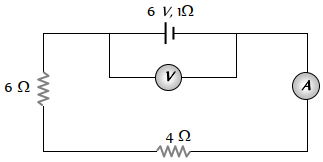
In the circuit shown here, the readings of the ammeter and voltmeter are
- A
$6 \mathrm{~A}, 60 \mathrm{~V}$
- B
$0.6 \mathrm{~A}, 6 \mathrm{~V}$
- ✓
$6 / 11 A, 60 / 11 \mathrm{~V}$
- D
$11 / 6 \mathrm{~A}, 11 / 60 \mathrm{~V}$
AnswerCorrect option: C. $6 / 11 A, 60 / 11 \mathrm{~V}$
View full question & answer→