MCQ 1511 Mark
There are three voltmeters of the same range but of resistances $10000 \Omega, 8000 \Omega$ and $4000 \Omega$ respectively. The best voltmeter among these is the one whose resistance is
- ✓
$10000 \Omega$
- B
$8000 \Omega$
- C
$4000 \Omega$
- D
AnswerCorrect option: A. $10000 \Omega$
$10000 \Omega$
View full question & answer→MCQ 1521 Mark
A galvanometer of resistance $20 \Omega$ is to be converted into an ammeter of range $1 A$. If a current of $1 \mathrm{~mA}$ produces full scale deflection, the shunt required for the purpose is
- A
$0.01 \Omega$
- B
$0.05 \Omega$
- ✓
$0.02 \Omega$
- D
$0.04 \Omega$
AnswerCorrect option: C. $0.02 \Omega$
(c) $\frac{i}{i_g}=1+\frac{G}{S} \Rightarrow \frac{1}{10^{-3}}=1+\frac{20}{S} \Rightarrow S=\frac{20}{999} \approx 0.02 \Omega$.
View full question & answer→MCQ 1531 Mark
A wire of length $100 \mathrm{~cm}$ is connected to a cell of emf $2 \mathrm{~V}$ and negligible internal resistance. The resistance of the wire is $3 \Omega$. The additional resistance required to produce a potential drop of 1 milli volt per $\mathrm{cm}$ is
- A
$60 \Omega$
- B
$47 \Omega$
- ✓
$57 \Omega$
- D
$35 \Omega$
AnswerCorrect option: C. $57 \Omega$
$\text { Potential gradient } x=\frac{e}{\left(R+R_h+r\right)} \cdot \frac{R}{L}$
$ \Rightarrow \frac{10^{-3}}{10^{-2}}=\frac{2}{\left(3+R_h+0\right)} \times \frac{3}{1} \Rightarrow R_h=57 \Omega .$
View full question & answer→MCQ 1541 Mark
Calculate the amount of charge flowing in 2 minutes in a wire of resistance $10 \Omega$ when a potential difference of $20 V$ is applied between its ends
- A
$120 C$
- B
$240 C$
- ✓
$20 C$
- D
$4 C$
AnswerCorrect option: C. $20 C$
(b) $i=\frac{V}{R}=\frac{Q}{t} \Rightarrow Q=\frac{V t}{R}=\frac{20 \times 2 \times 60}{10}=240 C$.
View full question & answer→MCQ 1551 Mark
In a potentiometer experiment two cells of e.m.f. $E$ and $E$ are used in series and in conjunction and the balancing length is found to be $58 \mathrm{~cm}$ of the wire. If the polarity of $E$ is reversed, then the balancing length becomes $29 \mathrm{~cm}$. The ratio $\frac{E_1}{E_2}$ of the e.m.f. of the two cells is
- A
$1: 1$
- B
$2: 1$
- ✓
$3: 1$
- D
$4: 1$
AnswerCorrect option: C. $3: 1$
(c) $\frac{E_1}{E_2}=\frac{l_1+l_2}{l_1-l_2}=\frac{58+29}{58-29}=\frac{3}{1}$
View full question & answer→MCQ 1561 Mark
How much work is required to carry a $6 \mu \mathrm{C}$ charge from the negative terminal to the positive terminal of a $9 V$ battery
- A
$54 \times 10^{-3} \mathrm{~J}$
- ✓
$54 \times 10^{-6} \mathrm{~J}$
- C
$54 \times 10^{-9} \mathrm{~J}$
- D
$54 \times 10^{-12} \mathrm{~J}$
AnswerCorrect option: B. $54 \times 10^{-6} \mathrm{~J}$
From the definition of E.M.F of cell,
$E=\frac{W}{q}$
Where W is work done by the cell in taking the +ve charge from one terminal to the other.
$\Rightarrow 9 V=\frac{W}{6 \mu C} $
$\Rightarrow W=9 \times 6=54 \mu J$
$\therefore W=54 \times 10^{-6} J$
View full question & answer→MCQ 1571 Mark
If a wire of resistance $R$ is melted and recasted to half of its length, then the new resistance of the wire will be
- ✓
$R / 4$
- B
$R / 2$
- C
$R$
- D
$2 R$
AnswerCorrect option: A. $R / 4$
(a) $R \propto l^2 \Rightarrow \frac{R_1}{R_2}=\left(\frac{l_1}{l_2}\right)^2 \Rightarrow \frac{R}{R_2}=\left(\frac{l}{l / 2}\right)^2=4 \Rightarrow R_2=\frac{R}{4}$.
View full question & answer→MCQ 1581 Mark
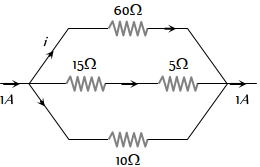
The magnitude of $i$ in ampere unit is
View full question & answer→MCQ 1591 Mark
Two resistances are connected in two gaps of a metre bridge. The balance point is $20 \mathrm{~cm}$ from the zero end. A resistance of $15 \mathrm{ohms}$ is connected in series with the smaller of the two. The null point shifts to $40 \mathrm{~cm}$. The value of the smaller resistance in ohms is
Answer(c) Let $S$ be larger and $R$ be smaller resistance connected in two gaps of meter bridge.
$\therefore S=\left(\frac{100-l}{l}\right) R=\frac{100-20}{20} R=4 R$
When $15 \Omega$ resistance is added to resistance $R$, then
$S=\left(\frac{100-40}{40}\right)(R+15)=\frac{6}{4}(R+15)$
From equations (i) and (ii) $R=9 \Omega$
View full question & answer→MCQ 1601 Mark
The $n$ rows each containing $m$ cells in series are joined in parallel. Maximum current is taken from this combination across an external resistance of $3 \Omega$ resistance. If the total number of cells used are 24 and internal resistance of each cell is $0.5 \Omega$ then
- A
$m=8, n=3$
- B
$m=6, n=4$
- ✓
$m=12, n=2$
- D
$m=2, n=12$
AnswerCorrect option: C. $m=12, n=2$
(c) Total cells $=m \times n=24$for maximum current in the circuit $R=\frac{m r}{n}$$\Rightarrow 3=\frac{m}{n} \times(0.5) \Rightarrow m=6 n$On solving equation (i) and (ii), we get $m=12, n=2$
View full question & answer→MCQ 1611 Mark
The maximum current that can be measured by a galvanometer of resistance $40 \Omega$ is $10 \mathrm{~mA}$. It is converted into a voltmeter that can read upto $50 \mathrm{~V}$. The resistance to be connected in series with the galvanometer is ... (in ohm)
- A
$5040$
- ✓
$4960$
- C
$2010$
- D
$4050$
AnswerCorrect option: B. $4960$
(b) $i_g=\frac{50}{10 \times 10^{-3}}-40=4960 \Omega$
View full question & answer→MCQ 1621 Mark
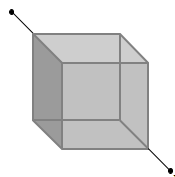
Twelve wires of equal length and same crosssection are connected in the form of a cube. If the resistance of each of the wires is $R$, then the effective resistance between the two diagonal ends would be
- A
$2 R$
- B
$12 R$
- ✓
$\frac{5}{6} R$
- D
$8 R$
AnswerCorrect option: C. $\frac{5}{6} R$
View full question & answer→MCQ 1631 Mark
The reading of a high resistance voltmeter when a cell is connected across it is $2.2 \mathrm{~V}$. When the terminals of the cell are also connected to a resistance of $5 \Omega$ the voltmeter reading drops to $1.8 \mathrm{~V}$. Find the internal resistance of the cell
- A
$1.2 \Omega$
- B
$1.3 \Omega$
- C
$1.1 \Omega$
- D
$1.4 \Omega$
View full question & answer→MCQ 1641 Mark
By a cell a current of 0.9 A flows through $2 \mathrm{ohm}$ resistor and $0.3 \mathrm{~A}$ through $7 \mathrm{ohm}$ resistor. The internal resistance of the cell is
- A
$0.5 \Omega$
- B
$1.0 \Omega$
- ✓
$1.2 \Omega$
- D
$2.0 \Omega$
AnswerCorrect option: C. $1.2 \Omega$
$1.2 \Omega$
View full question & answer→MCQ 1651 Mark
A potentiometer has uniform potential gradient. The specific resistance of the material of the potentiometer wire is 10 ohmmeter and the current passing through it is 0.1 ampere, cross-section of the wire is $10 . \mathrm{m}$. The potential gradient along the potentiometer wire is
- A
$10^{-4} \mathrm{~V} / \mathrm{m}$
- B
$10^{-6} \mathrm{~V} / \mathrm{m}$
- ✓
$10^{-2} \mathrm{~V} / \mathrm{m}$
- D
$10^{-8} \mathrm{~V} / \mathrm{m}$
AnswerCorrect option: C. $10^{-2} \mathrm{~V} / \mathrm{m}$
(c) Potential gradient $(x)=\frac{i \rho}{A}=\frac{0.1 \times 10^{-7}}{10^{-6}}=10^{-2} \mathrm{~V} / \mathrm{m}$
View full question & answer→MCQ 1661 Mark
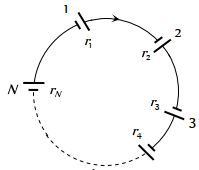
A group of $N$ cells whose emf varies directly with the internal resistance as per the equation $E=1.5 r$ are connected as shown in the figure below. The current $l$ in the circuit is
- A
$0.51 \mathrm{amp}$
- B
$5.1 \mathrm{amp}$
- C
$0.15 \mathrm{amp}$
- ✓
$1.5 \mathrm{amp}$
AnswerCorrect option: D. $1.5 \mathrm{amp}$
$i =\frac{E_1+E_2+E_3+\ldots . .+E_n}{\left(r_1+r_2+r_3+\ldots \ldots .+r_n\right)}$
$=\frac{1.5\left(r_1+r_2+r_3+\ldots \ldots+r_n\right)}{\left(r_1+r_2+r_3+\ldots . .+r_n\right)}=1.5 \mathrm{~A} .$
View full question & answer→MCQ 1671 Mark
The resistance of an incandescent lamp is
- A
Greater when switched off
- B
- ✓
- D
The same whether it is switched off or switched on
View full question & answer→MCQ 1681 Mark
A milliammeter of range $10 \mathrm{~mA}$ has a coil of resistance $1 \Omega$. To use it as voltmeter of range 10 volt, the resistance that must be connected in series with it, will be
- ✓
$999 \Omega$
- B
$99 \Omega$
- C
$1000 \Omega$
- D
AnswerCorrect option: A. $999 \Omega$
(a) $\quad R=\frac{V}{i_g}-G=\frac{10}{10 \times 10^{-3}}-1=999 \Omega$.
View full question & answer→MCQ 1691 Mark
The resistance of a conductor is $5 \mathrm{ohm}$ at $50 \mathrm{C}$ and $6 \mathrm{ohm}$ at $100 \mathrm{C}$. Its resistance at $0 C$ is
- A
$1 \mathrm{ohm}$
- B
$2 \mathrm{ohm}$
- C
$3 \mathrm{ohm}$
- ✓
$4 \mathrm{ohm}$
AnswerCorrect option: D. $4 \mathrm{ohm}$
(d) $\frac{R_1}{R_2}=\frac{\left(1+\alpha t_1\right)}{\left(1+\alpha t_2\right)} \Rightarrow \frac{5}{6}=\frac{(1+\alpha \times 50)}{(1+\alpha \times 100)} \Rightarrow \alpha=\frac{1}{200}$ per ${ }^{\circ} \mathrm{C}$Again by $R_t=R_0(1+\alpha t)$$\Rightarrow 5=R_0\left(1+\frac{1}{200} \times 50\right) \Rightarrow R_0=4 \Omega$
View full question & answer→MCQ 1701 Mark
A uniform wire of resistance $R$ is uniformly compressed along its length, until its radius becomes $n$ times the original radius. Now resistance of the wire becomes
- ✓
$\frac{R}{n^4}$
- B
$\frac{R}{n^2}$
- C
$\frac{R}{n}$
- D
$n R$
AnswerCorrect option: A. $\frac{R}{n^4}$
(a) $\frac{R_1}{R_2}=\left(\frac{r_2}{r_1}\right)^4 \Rightarrow \frac{R}{R_2}=\left(\frac{n r}{r}\right)^4 \Rightarrow R_2=\frac{R}{n^4}$.
View full question & answer→MCQ 1711 Mark
The resistance of an ideal ammeter is
MCQ 1721 Mark
The resistance of a coil is $4.2 \Omega$ at $100 C$ and the temperature coefficient of resistance of its material is $0.004 / C$. Its resistance at 0 is
- A
$6.5 \Omega$
- B
$5 \Omega$
- ✓
$3 \Omega$
- D
$4 \Omega$
AnswerCorrect option: C. $3 \Omega$
$ R_t=R_0(1+\alpha t) $
$ \Rightarrow 4.2=R_0(1+0.004 \times 100)=1.4 R_0 \Rightarrow R_0=3 \Omega.$
View full question & answer→MCQ 1731 Mark
In a balanced Wheatstone's network, the resistances in the arms $Q$ and $S$ are interchanged. As a result of this
- ✓
- B
Network is still balanced
- C
Galvanometer shows zero deflection
- D
Galvanometer and the cell must be interchanged to balance
View full question & answer→MCQ 1741 Mark
A potentiometer wire of length $1 \mathrm{~m}$ and resistance $10 \Omega$ is connected in series with a cell of $e m f 2 V$ with internal resistance $1 \Omega$ and a resistance box including a resistance $R$. If potential difference between the ends of the wire is $1 \mathrm{mV}$, the value of $R$ is
- A
$20000 \Omega$
- ✓
$19989 \Omega$
- C
$10000 \Omega$
- D
$9989 \Omega$
AnswerCorrect option: B. $19989 \Omega$
$ V=i . R .=\frac{e}{\left(R+R_h+r\right)} \cdot R \Rightarrow 10^{-3}=\frac{2}{(10+R+r)} \times 10$
$\Rightarrow R=19,989 \Omega .$
View full question & answer→MCQ 1751 Mark
A steady current flows in a metallic conductor of non$-$uniform crosssection. The quantity$/$ quantities constant along the length of the conductor is$/$are
- A
Current, electric field and drift speed
- B
- C
- ✓
View full question & answer→MCQ 1761 Mark
The resistivity of alloys $=R_{\text {alloy }}$; the resistivity of constituent metals $R_{\text {metal }}$. Then, usually
- A
$\quad R_{\text {alloy }}=R_{\text {metal }}$
- B
$\quad R_{\text {alloy }}
- C
There is no simple relation between $R_{\text {alloy }}$ and $R_{\text {metal }}$
- ✓
$R_{\text {alloy }}>R_{\text {metal }}$
AnswerCorrect option: D. $R_{\text {alloy }}>R_{\text {metal }}$
(d) If $E$ be electric field, then current density $j=\sigma E$Also we know that current density $j=\frac{i}{A}$Hence $j$ is different for different area of cross-sections. When $j$ is different, then $E$ is also different. Thus $E$ is not constant. The drift velocity $v_d$ is given by $v_d=\frac{j}{n e}=$ different for different $j$ values. Hence only current $i$ will be constant.
View full question & answer→MCQ 1771 Mark
A potentiometer wire has length $10 \mathrm{~m}$ and resistance $20 \Omega$. A 2. 5 $V$ battery of negligible internal resistance is connected across the wire with an $80 \Omega$ series resistance. The potential gradient on the wire will be
- ✓
$5 \times 10^{-5} \mathrm{~V} / \mathrm{mm}$
- B
$2.5 \times 10^{-4} \mathrm{~V} / \mathrm{cm}$
- C
$0.62 \times 10^{-4} \mathrm{~V} / \mathrm{mm}$
- D
$1 \times 10^{-5} \mathrm{~V} / \mathrm{mm}$
AnswerCorrect option: A. $5 \times 10^{-5} \mathrm{~V} / \mathrm{mm}$
$ \text { Potential gradient } x=\frac{e}{\left(R+R_h+r\right)} \cdot \frac{R}{L} $
$ \Rightarrow x=\frac{2.5}{(20+80+0)} \times \frac{20}{10}=5 \times 10^{-5} \frac{\mathrm{V}}{\mathrm{mm}}$
View full question & answer→MCQ 1781 Mark
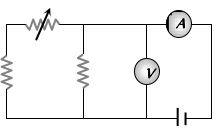
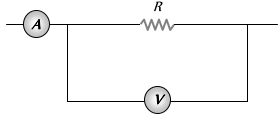
The ammeter $A$ reads $2 A$ and the voltmeter $V$ reads $20 \mathrm{~V}$. the value of resistance $R$ is $($Assuming finite resistance's of ammeter and voltmeter$)$
- A
Exactly $10\ \mathrm{ohm}$
- B
Less than $10\ \mathrm{ohm}$
- ✓
More than $10\ \mathrm{ohm}$
- D
AnswerCorrect option: C. More than $10\ \mathrm{ohm}$
$2 R>20 \Rightarrow R>10 \ \Omega$.
View full question & answer→MCQ 1791 Mark
The new resistance of wire of $R \Omega$, whose radius is reduced half, is
- ✓
$16 R$
- B
$3 R \quad$
- C
$2 R$
- D
$R$
AnswerCorrect option: A. $16 R$
(a) In stretching, $\frac{R_2}{R_1}=\left(\frac{r_1}{r_2}\right)^4 \Rightarrow \frac{R_2}{R}=\left(\frac{2}{1}\right)^4 \Rightarrow R_2=16 R$
View full question & answer→MCQ 1801 Mark
A storage cell is charged by 5 amp D.C. for 18 hours. Its strength after charging will be
- A
$18 \mathrm{AH}$
- B
$5 \mathrm{AH}$
- C
$90 \mathrm{AH}$
- ✓
$15 \mathrm{AH}$
AnswerCorrect option: D. $15 \mathrm{AH}$
(d) $6 \Omega$ and $6 \Omega$ are in series, so effective resistance is $12 \Omega$ which is in parallel with $3 \Omega$, so$\begin{aligned}& \frac{1}{R}=\frac{1}{3}+\frac{1}{12}=\frac{15}{36} \Rightarrow R=\frac{36}{15} \\& \therefore I=\frac{V}{R}=\frac{4.8 \times 15}{36}=2 \mathrm{~A}\end{aligned}$
View full question & answer→MCQ 1811 Mark
A cell of emf $6 \mathrm{~V}$ and resistance $0.5 \mathrm{ohm}$ is short circuited. The current in the cell is
- A
$3 \mathrm{amp}$
- B
$12 \mathrm{amp}$
- C
$24 a m p$
- D
$6 \mathrm{amp}$
View full question & answer→MCQ 1821 Mark
In the figure shown, the capacity of the condenser $C$ is $2 \mu F$. The current in $2 \Omega$ resistor is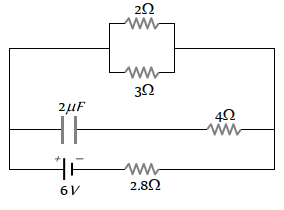
AnswerCorrect option: B. $0.9 \mathrm{~A}$
(b) No current flows through the capacitor branch in steady state. Total current supplied by the battery$i=\frac{6}{2.8+1.2}=\frac{3}{2} \text {. }$Current through $2 \Omega$ resistor $=\frac{3}{2} \times \frac{3}{5}=0.9 \mathrm{~A}$
View full question & answer→MCQ 1831 Mark
A resistance $R$ is stretched to four times its length. Its new resistance will be
- A
$4 R$
- B
$64 R$
- C
$R / 4$
- ✓
$16 R$
AnswerCorrect option: D. $16 R$
(d) $\quad R^{\prime}=n^2 R \Rightarrow R^{\prime}=16 R$
View full question & answer→MCQ 1841 Mark
Find out the value of current through $2 \Omega$ resistance for the given circuit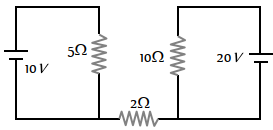
- A
$5 \mathrm{~A}$
- B
$2 \mathrm{~A}$
- ✓
- D
$4 A$
Answer(c) Since the current coming out from the positive terminal is equal to the current entering the negative terminal, therefore, current in the respective loop will remain confined in the loop itself.$\therefore$ current through $2 \Omega$ resistor $=0$
View full question & answer→MCQ 1851 Mark
For the post office box arrangement to determine the value of unknown resistance the unknown resistance should be connected between
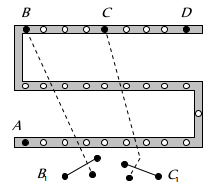
- A
$B$ and $C$
- B
$C$ and $D$
- ✓
$A$ and $D$
- D
$B$ and $C$
AnswerCorrect option: C. $A$ and $D$
$A$ and $D$
View full question & answer→MCQ 1861 Mark
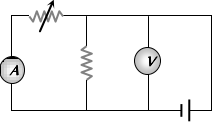
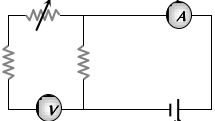
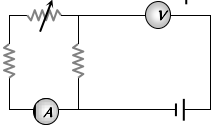
Express which of the following setups can be used to verify Ohm's law
AnswerAmmeter is always connected in series and Voltmeter is always connected in parallel.
View full question & answer→MCQ 1871 Mark
In the shown arrangement of the experiment of the meter bridge if $A C$ corresponding to null deflection of galvanometer is $x$, what would be its value if the radius of the wire $A B$ is doubled
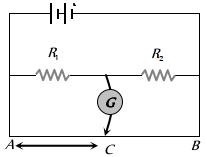
AnswerBalancing length is independent of the cross sectional area of the wire.
View full question & answer→MCQ 1881 Mark
The effective resistance between points $P$ and $Q$ of the electrical circuit shown in the figure is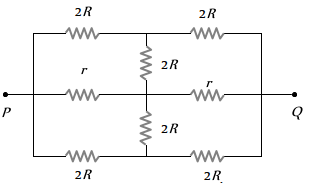
- ✓
$2 R r /(R+r)$
- B
$8 R(R+r) /(3 R+r)$
- C
$2 r+4 R$
- D
$5 R / 2+2 r$
AnswerCorrect option: A. $2 R r /(R+r)$
View full question & answer→MCQ 1891 Mark
A wire of length $L$ and 3 identical cells of negligible internal resistances are connected in series. Due to current, the temperature of the wire is raised by $\Delta T$ in a time $t$. A number $N$ of similar cells is now connected in series with a wire of the same material and cross-section but of length $2 L$. The temperature of the wire is raised by the same amount $\Delta T$ in the same time $t$. the value of $N$ is
AnswerLet $R$ and $m$ be the resistance and mass of the first wire, then the second wire has resistance $2 R$ and mass $2 m$.
Let $(E)=$ emf of each cell, $S=$ specific heat capacity of the material of the wire.
For the first wire, current $\dot{i}_1=\frac{3 E}{R}$ and $i_1^2 R t=m S \Delta T$
For the second wire, $i_2=\frac{N E}{2 R}$ and $i_2^2(2 R) t=2 m S \Delta T$.
Thus, $i_1=i_2$ or $N=6$.
View full question & answer→MCQ 1901 Mark
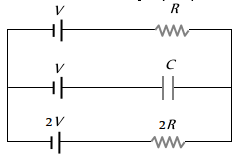
In the given circuit, with steady current, the potential drop across the capacitor must be
- A
$\mathrm{V}$
- B
$V / 2$
- ✓
$V / 3$
- D
$2 V / 3$
AnswerCorrect option: C. $V / 3$
View full question & answer→MCQ 1911 Mark
In the given circuit, it is observed that the current $l$ is independent of the value of the resistance $R$. Then the resistance values must satisfy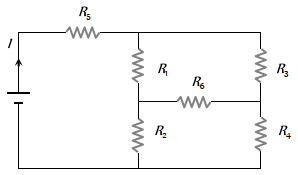
- A
$R_1 R_2 R_5=R_3 R_4 R_6$
- B
$\frac{1}{R_5}+\frac{1}{R_6}=\frac{1}{R_1+R_2}+\frac{1}{R_3+R_4}$
- ✓
$R_1 R_4=R_2 R_3$
- D
$R_1 R_3=R_2 R_4=R_5 R_6$
AnswerCorrect option: C. $R_1 R_4=R_2 R_3$
(c) As $I$ is independent of $R_6$, no current flows through $R_6$ this requires that the junction of $R_1$ and $R_2$ is at the same potential as the junction of $R_3$ and $R_4$. This must satisfy the condition $\frac{R_1}{R_2}=\frac{R_3}{R_4}$, as in the Wheatstone bridge.
View full question & answer→MCQ 1921 Mark
In the circuit shown $P \neq R$, the reading of the galvanometer is same with switch $S$ open or closed. ThenA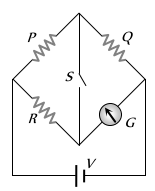
- ✓
$I_R=I_G$
- B
$I_P=I_G$
- C
$I_Q=I_G$
- D
$I_Q=I_R$
AnswerCorrect option: A. $I_R=I_G$
(a) Reading of galvanometer remains same whether switch $S$ is open or closed, hence no current will flow through the switch i.e. $R$ and $G$ will be in series and same current will flow through them. $I_R=I_G$.
View full question & answer→MCQ 1931 Mark
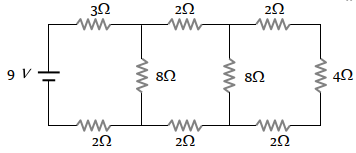
In the circuit shown in the figure, the current through
- A
The $3 \Omega$ resistor is $0.50 A$
- B
The $3 \Omega$ resistor is $0.25 \mathrm{~A}$
- C
The $4 \Omega$ resistor is $0.50 A$
- D
The $4 \Omega$ resistor is $0.25 \mathrm{~A}$
View full question & answer→MCQ 1941 Mark
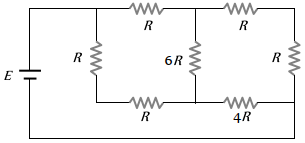
A battery of internal resistance $4 \Omega$ is connected to the network of resistances as shown. In order to give the maximum power to the network, the value of $R$ (in $\Omega$ ) should be
- A
$4 / 9$
- B
$8 / 9$
- ✓
$2$
- D
$18$
View full question & answer→MCQ 1951 Mark
The temperature coefficient of resistance for a wire is $0.00125 /{ }^{\circ} \mathrm{C}$. At $300 \mathrm{~K}$ its resistance is $1 \mathrm{ohm}$. The temperature at which the resistance becomes $2 \mathrm{ohm}$ is
- A
$1154 K$
- B
$1100 K$
- C
$1400 K$
- ✓
$1127 K$
AnswerCorrect option: D. $1127 K$
$ \frac{\rho_1}{\rho_2}=\frac{\left(1+\alpha t_1\right)}{\left(1+\alpha t_2\right)} $
$\Rightarrow \frac{1}{2}=\frac{(1+0.00125 \times 27)}{(1+0.00125 \times t)}$
$ \Rightarrow t=854^{\circ} \mathrm{C} \Rightarrow T=1127 \mathrm{~K}$
View full question & answer→MCQ 1961 Mark
A dry cell has an e.m.f. of $1.5 \quad V$ and an internal resistance of $0.05 \Omega$. The maximum current obtainable from this cell for a very short time interval is
- A
$30 \mathrm{~A}$
- B
$300 A$
- C
$3 A$
- D
$0.3 \mathrm{~A}$
View full question & answer→MCQ 1971 Mark
In an experiment to measure the internal resistance of a cell by potentiometer, it is found that the balance point is at a length of $2 \mathrm{~m}$ when the cell is shunted by a $5 \Omega$ resistance; and is at a length of $3 m$ when the cell is shunted by a $10 \Omega$ resistance. The internal resistance of the cell is, then
- A
$1.5 \Omega$
- ✓
$10 \Omega$
- C
$15 \Omega$
- D
$1 \Omega$
AnswerCorrect option: B. $10 \Omega$
$ r=\left(\frac{l_1-l_2}{l_2}\right) \times R^{\prime}=\left(\frac{l_1-2}{2}\right) \times 5 $
$ \text { and } r=\left(\frac{l_1-3}{3}\right) \times 10$
On solving (i) and (ii) $r=10 \Omega$
View full question & answer→MCQ 1981 Mark
A galvanometer of $25 \Omega$ resistance can read a maximum current of $6 m A$. It can be used as a voltmeter to measure a maximum of $6 \mathrm{~V}$ by connecting a resistance to the galvanometer. Identify the correct choice in the given answers
AnswerCorrect option: C. $975 \Omega$ in series
(c) $R=\frac{V}{i_g}-G=\frac{6}{6 \times 10^{-3}}-25=975 \Omega$ (in series).
View full question & answer→MCQ 1991 Mark
If six identical cells each having an e.m.f. of $6 \mathrm{~V}$ are connected in parallel, the e.m.f. of the combination is
- A
$1 \mathrm{~V}$
- ✓
$36 \mathrm{~V}$
- C
$\frac{1}{6} V$
- D
$6 \mathrm{~V}$
AnswerCorrect option: B. $36 \mathrm{~V}$
(b) To obtain minimum resistance, all resistors must be connected in parallel.Hence equivalent resistance of combination $=\frac{r}{10}$
View full question & answer→MCQ 2001 Mark
The resistance of an ideal voltmeter is
Answer(d) The resistance of an ideal voltmeter is considered as infinite.
View full question & answer→