MCQ 1011 Mark
The Poisson's ratio cannot have the value
Answer(a) Value of Poisson's ratio lie in range of -1 to $\frac{1}{2}$
View full question & answer→MCQ 1021 Mark
A steel ring of radius $r$ and cross-section area ' $A$ ' is fitted on to a wooden disc of radius $R(R>r)$. If Young's modulus be $E$, then the force with which the steel ring is expanded is
AnswerCorrect option: A. $A E \frac{R}{r}$
(b) Initial length (circumference) of the ring $=2 \pi r$Final length (circumference) of the ring $=2 \pi R$Change in length $=2 \pi R-2 \pi r$.strain $=\frac{\text { change in length }}{\text { originallength }}=\frac{2 \pi(R-r)}{2 \pi r}=\frac{R-r}{r}$Now Young's modulus $E=\frac{F / A}{l / L}=\frac{F / A}{(R-r) / r}$$\therefore F=A E\left(\frac{R-r}{r}\right)$
View full question & answer→MCQ 1031 Mark
Two wires of equal lengths are made of the same material. Wire $A$ has a diameter that is twice as that of wire $B$. If identical weights are suspended from the ends of these wires, the increase in length is
- A
Four times for wire $A$ as for wire $B$
- B
Twice for wire $A$ as for wire $B$
- C
Half for wire $A$ as for wire $B$
- ✓
One-fourth for wire $A$ as for wire $B$
AnswerCorrect option: D. One-fourth for wire $A$ as for wire $B$
(d)$\begin{aligned}& l=\frac{F L}{A Y} \Rightarrow l \propto \frac{1}{r^2}(F, L \text { and } Y \text { are same }) \\& \frac{l_A}{l_B}=\left(\frac{r_B}{r_A}\right)^2=\left(\frac{r_B}{2 r_B}\right)^2=\frac{1}{4} \Rightarrow l_A=4 l_B \text { or } l_B=\frac{l_A}{4}\end{aligned}$
View full question & answer→MCQ 1041 Mark
The reason for the change in shape of a regular body is
MCQ 1051 Mark
A substance breaks down by a stress of $10 \cdot N / m$. If the density of the material of the wire is $3 \times 10 kg / m$, then the length of the wire of the substance which will break under its own weight when suspended vertically, is
- A
$66.6 \ m$
- B
$60.0 \ m$
- ✓
$33.3 \ m$
- D
$30.0 \ m$
AnswerCorrect option: C. $33.3 \ m$
(c) $L=\frac{p}{d g}=\frac{10^6}{3 \times 10^3 \times 10}=\frac{100}{3}=33.3 \mathrm{~m}$
View full question & answer→MCQ 1061 Mark
Which statement is true for a metal
- A
$\quad Y<\eta$
- B
$Y=\eta$
- ✓
$Y>\eta$
- D
$Y<1 / \eta$
AnswerCorrect option: C. $Y>\eta$
(c) $\quad Y=2 \eta(1+\sigma)$
View full question & answer→MCQ 1071 Mark
Two identical wires of rubber and iron are stretched by the same weight, then the number of atoms in the iron wire will be
- A
- B
Less than that of the rubber
- ✓
More than that of the rubber
- D
AnswerCorrect option: C. More than that of the rubber
View full question & answer→MCQ 1081 Mark
There are two wires of same material and same length while the diameter of second wire is 2 times the diameter of first wire, then ratio of extension produced in the wires by applying same load will be
- A
$1: 1$
- B
$2: 1$
- C
$1: 2$
- ✓
$4: 1$
AnswerCorrect option: D. $4: 1$
(d)
$l=\frac{F L}{A Y}$
$ \therefore l \propto \frac{1}{r^2}(F, L \text { and } Y \text { are constant })$
$ \frac{l_1}{l_2}=\left(\frac{r_2}{r_1}\right)^2=(2)^2=4$
View full question & answer→MCQ 1091 Mark
In solids, inter-atomic forces are
MCQ 1101 Mark
A rubber cord catapult has cross-sectional area $25 mm ^2$ and initial length of rubber cord is $10 cm$. It is stretched to $5 cm$. and then released to project a missile of mass $5 gm$. Taking $Y_{\text {rubber }}=5 \times 10^8 N / m ^2$ velocity of projected missile is
- A
$20 ms ^{-1}$
- B
$100 ms ^{-1}$
- ✓
$250 ms ^{-1}$
- D
$200 ms ^{-1}$
AnswerCorrect option: C. $250 ms ^{-1}$
(c) Potential energy stored in the rubber cord catapult will be converted into kinetic energy of mass.
$\frac{1}{2} m v^2=\frac{1}{2} \frac{Y A l^2}{L}$
$\Rightarrow v=\sqrt{\frac{Y A l^2}{m L}} $
$ =\sqrt{\frac{5 \times 10^8 \times 25 \times 10^{-6} \times\left(5 \times 10^{-2}\right)^2}{5 \times 10^{-3} \times 10 \times 10^{-2}}}$
$=250 \mathrm{~m} / \mathrm{s}$
View full question & answer→MCQ 1111 Mark
Two similar wires under the same load yield elongation of $0.1 mm$ and $0.05 mm$ respectively. If the area of cross- section of the first wire is $4 mm ^2$, then the area of cross section of the second wire is
- A
$6 mm ^2$
- ✓
$8 mm ^2$
- C
$10 mm ^2$
- D
$12 mm ^2$
AnswerCorrect option: B. $8 mm ^2$
(b)$l=\frac{F L}{A Y}$
$ \therefore l \propto \frac{1}{A} \quad(F, L \text { and } Y \text { are constant })$
$\frac{A_2}{A_1}=\frac{l_1}{l_2}$
$ \Rightarrow A_2=A_1\left(\frac{0.1}{0.05}\right)=2 A_1=2 \times 4=8 \mathrm{~mm}^2$
( $F, L$ and $Y$ are constant)
View full question & answer→MCQ 1121 Mark
The units of Young 's modulus of elasticity are
- A
$Nm ^{-1}$
- B
$N-m$
- ✓
$Nm ^{-2}$
- D
$N-m^2$
AnswerCorrect option: C. $Nm ^{-2}$
View full question & answer→MCQ 1131 Mark
Calculate the work done, if a wire is loaded by ' $M g$ ' weight and the increase in length is ' $I$
- A
$M g l$
- B
- ✓
$M g l / 2$
- D
$2 M g l$
AnswerCorrect option: C. $M g l / 2$
(c) Work done $=\frac{1}{2} F l=\frac{M g l}{2}$
View full question & answer→MCQ 1141 Mark
The graph is drawn between the applied force $F$ and the strain $(x)$ for a thin uniform wire. The wire behaves as a liquid in the part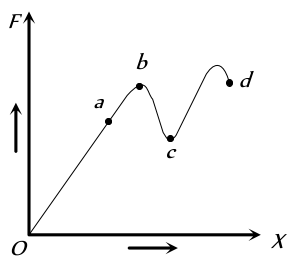
Answer(b) At point b, yielding of material starts.
View full question & answer→MCQ 1151 Mark
Bulk modulus was first defined by
MCQ 1161 Mark
The potential energy $U$ between two molecules as a function of the distance $X$ between them has been shown in the figure. The two molecules are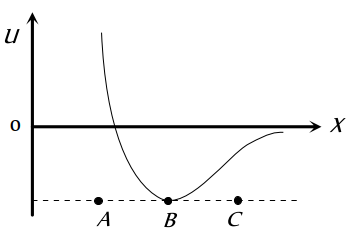
- A
Attracted when $x$ lies between $A$ and $B$ and are repelled when $X$ lies between $B$ and $C$
- ✓
Attracted when $x$ lies between $B$ and $C$ and are repelled when $X$ lies between $A$ and $B$
- C
Attracted when they reach $B$
- D
Repelled when they reach $B$
AnswerCorrect option: B. Attracted when $x$ lies between $B$ and $C$ and are repelled when $X$ lies between $A$ and $B$
(b) $F=-\left(\frac{d U}{d x}\right)$.In the region $B C$ slope of the graph is positive$\therefore F=$ negative i.e. force is attractive in natureIn the region $A B$ slope of the graph is negative$\therefore F=$ positive i.e. force is repulsive in nature
View full question & answer→MCQ 1171 Mark
When a certain weight is suspended from a long uniform wire, its length increases by one $cm$. If the same weight is suspended from another wire of the same material and length but having a diameter half of the first one then the increase in length will be
- A
$0.5 cm$
- B
$2 cm$
- ✓
$4 cm$
- D
$8 cm$
AnswerCorrect option: C. $4 cm$
(c)
$l=\frac{F L}{A Y}$
$ \Rightarrow l \propto \frac{1}{r^2}(F, L \text { and } Y \text { are constant })$
$\frac{l_2}{l_1}=\left(\frac{r_1}{r_2}\right)^2=(2)^2=4 \Rightarrow l_2=4 l_1=4 \mathrm{~cm}$
View full question & answer→MCQ 1181 Mark
Which of the following relations is true
AnswerCorrect option: D. $\sigma=\frac{0.5 Y-\eta}{\eta}$
(d) $Y=2 \eta(1+\sigma) \Rightarrow \sigma=\frac{0.5 Y-\eta}{\eta}$
View full question & answer→MCQ 1191 Mark
A beam of metal supported at the two ends is loaded at the centre. The depression at the centre is proportional to
- A
$Y^2$
- B
$Y$
- ✓
$1 / Y$
- D
$1 / Y^2$
AnswerCorrect option: C. $1 / Y$
View full question & answer→MCQ 1201 Mark
The adiabatic elasticity of a gas is equal to
AnswerCorrect option: C. $\gamma \times$ pressure
(c) Adiabatic elasticity $K_a=\gamma P$
View full question & answer→MCQ 1211 Mark
The isothermal elasticity of a gas is equal to
Answer(c) 1sothermal elasticity $K_i=P$
View full question & answer→MCQ 1221 Mark
Increase in length of a wire is $1 mm$ when suspended by a weight. If the same weight is suspended on a wire of double its length and double its radius, the increase in length will be
- A
$2 mm$
- ✓
$0.5 mm$
- C
$4 mm$
- D
$0.25 mm$
AnswerCorrect option: B. $0.5 mm$
(b)$\begin{aligned}& l=\frac{F L}{A Y} \Rightarrow l \propto \frac{L}{r^2}(F \text { and } Y \text { are same }) \\& \therefore \frac{l_2}{l_1}=\frac{L_2}{L_1}\left(\frac{r_1}{r_2}\right)^2=2\times\left(\frac{1}{2}\right)^2=\frac{1}{2} \Rightarrow l_2=\frac{l_1}{2}=\frac{l}{2}=0.5 \mathrm{~mm} .\end{aligned}$
View full question & answer→MCQ 1231 Mark
The extension of a wire by the application of load is $3 mm$. The extension in a wire of the same material and length but half the radius by the same load is
- ✓
$12 mm$
- B
$0.75 mm$
- C
$15 mm$
- D
$6 mm$
AnswerCorrect option: A. $12 mm$
(a)
$l=\frac{F L}{A Y}$
$ \Rightarrow l \propto \frac{1}{r^2}(F, L \text { and } Y \text { are constant })$
$\frac{l_2}{l_1}=\left(\frac{r_1}{r_2}\right)^2=(2)^2 \Rightarrow l_2=4 l_1=4 \times 3=12 \mathrm{~mm}$
View full question & answer→MCQ 1241 Mark
The Bulk modulus for an incompressible liquid is
MCQ 1251 Mark
The only elastic modulus that applies to fluids is
MCQ 1261 Mark
The diagram shows a force-extension graph for a rubber band. Consider the following statements
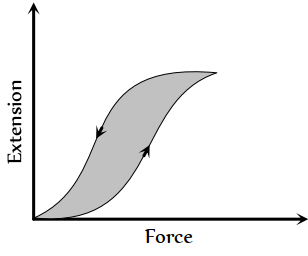
1. It will be easier to compress this rubber than expand it
11. Rubber does not return to its original length after it is stretched
111. The rubber band will get heated if it is stretched and released Which of these can be deduced from the graph
Answer(a) Area of hysterisis loop gives the energy loss in the process of stretching and unstretching of rubber band and this loss will appear in the form of heating.
View full question & answer→MCQ 1271 Mark
The graph shows the behaviour of a length of wire in the region for which the substance obeys Hook's law. $P$ and $Q$ represent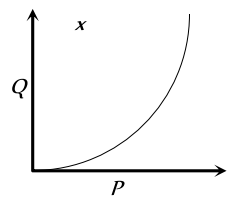
- A
$P=$ applied force, $Q=$ extension
- B
$P=$ extension, $Q=$ applied force
- ✓
$P=$ extension, $Q=$ stored elastic energy
- D
$P=$ stored elastic energy, $Q=$ extension
AnswerCorrect option: C. $P=$ extension, $Q=$ stored elastic energy
(c) Graph between applied force and extension will be straight line because in elastic range,Applied force $\propto$ extensionbut the graph between extension and stored elastic energy will be parabolic in natureAs $U=1 / 2 k x^2$ or $U \propto x^2$.
View full question & answer→MCQ 1281 Mark
A $5 m$ long aluminium wire $\left(Y=7 \times 10^{10} N / m ^2\right)$ of diameter $3 mm$ supports a $40 kg$ mass. In order to have the same elongation in a copper wire ( $\left.Y=12 \times 10^{10} N / m ^2\right)$ of the same length under the same weight, the diameter should now be, in $mm$.
Answer(c)
$l=\frac{F L}{\pi r^2 Y} \Rightarrow r^2 \propto \frac{1}{Y}$( $F, L$ and $/$ are constant)
$ \frac{r_2}{r_1}=\left(\frac{Y_1}{Y_2}\right)^{1 / 2}=\left(\frac{7 \times 10^{10}}{12 \times 10^{10}}\right)^{1 / 2}$
$ \Rightarrow r_2=1.5\times\left(\frac{7}{12}\right)^{1 / 2}$
$=1.145 \mathrm{~mm}$
$ \therefore \mathrm{dia}=2.29 \mathrm{~mm}$
View full question & answer→MCQ 1291 Mark
The breaking stress of a wire depends upon
- A
- B
- ✓
- D
Shape of the cross section
View full question & answer→MCQ 1301 Mark
The isothermal bulk modulus of a gas at atmospheric pressure is
AnswerCorrect option: C. $1.013 \times 10^5 N / m ^2$
(c) 1sothermal elasticity $K_i=P=1 \mathrm{~atm}=1.013 \times 10^5 \mathrm{~N} / \mathrm{m}^2$
View full question & answer→MCQ 1311 Mark
Which of the following affects the elasticity of a substance
MCQ 1321 Mark
The diagram shows stress $v / s$ strain curve for the materials $A$ and $B$. From the curves we infer that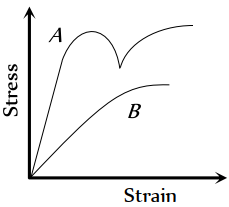
- A
$A$ is brittle but $B$ is ductile
- ✓
$A$ is ductile and $B$ is brittle
- C
Both $A$ and $B$ are ductile
- D
Both $A$ and $B$ are brittle
AnswerCorrect option: B. $A$ is ductile and $B$ is brittle
(b) In ductile materials, yield point exist while in Brittle material, failure would occur without yielding.
View full question & answer→MCQ 1331 Mark
The value of Poisson's ratio lies between
AnswerCorrect option: A. -1 to $\frac{1}{2}$
(a) $Y=3 K(1-2 \sigma), Y=2 \eta(1+\sigma)$For $Y=0$, we get $1-2 \sigma=0$, also $1+\sigma=0$$\Rightarrow \sigma$ lies between $\frac{1}{2}$ and -1 .
View full question & answer→MCQ 1341 Mark
- A
- ✓
Increased potential energy
- C
- D
Decreased potential energy
AnswerCorrect option: B. Increased potential energy
View full question & answer→MCQ 1351 Mark
Two wires $A$ and $B$ of same length and of the same material have the respective radii $r_1$ and $r_2$. Their one end is fixed with a rigid support, and at the other end equal twisting couple is applied. Then the ratio of the angle of twist at the end of $A$ and the angle of twist at the end of $B$ will be
- A
$\frac{r_1^2}{r_2^2}$
- B
$\frac{r_2^2}{r_1^2}$
- ✓
$\frac{r_2^4}{r_1^4}$
- D
$\frac{r_1^4}{r_2^4}$
AnswerCorrect option: C. $\frac{r_2^4}{r_1^4}$
(c) Twisting couple $C=\frac{\pi \eta r^4 \theta}{2 l}$If material and length of the wires $A$ and $B$ are equal and equal twisting couple are applied then$\theta \propto \frac{1}{r^4} \therefore \frac{\theta_1}{\theta_2}=\left(\frac{r_2}{r_1}\right)^4$
View full question & answer→MCQ 1361 Mark
An iron rod of length $2 m$ and cross section area of $50 mm ^2$, stretched by $0.5 mm$, when a mass of $250 kg$ is hung from its lower end. Young's modulus of the iron rod is
- ✓
$19.6 \times 10^{10} N / m ^2$
- B
$19.6 \times 10^{15} N / m ^2$
- C
$19.6 \times 10^{18} N / m ^2$
- D
$19.6 \times 10^{20} N / m ^2$
AnswerCorrect option: A. $19.6 \times 10^{10} N / m ^2$
(a)
$Y =\frac{M g L}{A l}=\frac{250 \times 9.8 \times 2}{50 \times 10^{-6} \times 0.5 \times 10^{-3}} $
$=19.6 \times 10^{10} \mathrm{~N} / \mathrm{m}^2$
View full question & answer→MCQ 1371 Mark
In which case there is maximum extension in the wire, if same force is applied on each wire
- A
$L=500 cm , d=0.05 mm$
- B
$L =200 cm , d=0.02 mm$
- C
$L =300 cm , d=0.03 mm$
- ✓
$L=400 cm , d=0.01 mm$
AnswerCorrect option: D. $L=400 cm , d=0.01 mm$
(d) $l \propto \frac{L}{r^2}$( $Y$ and $F$ are constant)Maximum extension takes place in that wire for which the ratio of $\frac{L}{r^2}$ will be maximum.
View full question & answer→MCQ 1381 Mark
A ball falling in a lake of depth $200 m$ shows $0.1 \%$ decrease in its volume at the bottom. What is the bulk modulus of the material of the ball
- ✓
$19.6 \times 10^8 N / m ^2$
- B
$19.6 \times 10^{-10} N / m ^2$
- C
$19.6 \times 10^{10} N / m ^2$
- D
$19.6 \times 10^{-8} N / m ^2$
AnswerCorrect option: A. $19.6 \times 10^8 N / m ^2$
(a)
$B=\frac{\Delta p}{\Delta V / V}=\frac{h \rho g}{0.1 / 100}=\frac{200 \times 10^3 \times 9.8}{1 / 1000} $
$=19.6 \times 10^8 \mathrm{~N} / \mathrm{m}^2$
View full question & answer→MCQ 1391 Mark
Four identical rods are stretched by same force. Maximum extension is produced in
- A
$L=10 cm , D=1 mm$
- ✓
$L=100 cm , D=2 mm$
- C
$L=200 cm , D=3 mm$
- D
$L=300 cm , D=4 mm$
AnswerCorrect option: B. $L=100 cm , D=2 mm$
(b) $l=\frac{F L}{\pi r^2 Y} \therefore l \propto \frac{L}{r^2}$Ratio of $\frac{L}{r^2}$ is maximum for wire in option (b).
View full question & answer→MCQ 1401 Mark
Minimum and maximum values of Poisson's ratio for a metal lies between
- A
$-\infty$ to $+\infty$
- B
- C
$-\infty$ to 1
- ✓
View full question & answer→MCQ 1411 Mark
If a spring is extended to length $l$, then according to Hook's law
- ✓
$F=k l$
- B
$F=\frac{k}{l}$
- C
$F=k^2 l$
- D
$F=\frac{k^2}{l}$
AnswerCorrect option: A. $F=k l$
View full question & answer→MCQ 1421 Mark
A rubber pipe of density $1.5 \times 10^3 N / m ^2$ and Young's modulus $5 \times 10^6 N / m ^2$ is suspended from the roof. The length of the pipe is $8 m$. What will be the change in length due to its own weight
- A
$9.6 m$
- B
$9.6 \times 10^3 m$
- C
$19.2 \times 10^{-2} m$
- ✓
$9.6 \times 10^{-2} m$
AnswerCorrect option: D. $9.6 \times 10^{-2} m$
(d) $l=\frac{L^2 d g}{2 Y}=\frac{(8)^2 \times 1.5 \times 10^3 \times 10}{2 \times 5 \times 10^6}=9.6 \times 10^{-2} \mathrm{~m}$
View full question & answer→MCQ 1431 Mark
A wire of cross-sectional area $3 mm ^2$ is first stretched between two fixed points at a temperature of $20^{\circ} C$. Determine the tension when the temperature falls to $10^{\circ} C$. Coefficient of linear expansion $\alpha=10^{-5 \circ} C ^{-1}$ and $Y=2 \times 10^{11} N / m ^2$
- A
$20 N$
- B
$30 N$
- ✓
$60 N$
- D
$120 N$
AnswerCorrect option: C. $60 N$
(c) $F=Y A \alpha \Delta t=2 \times 10^{11} \times 3 \times 10^{-6} \times 10^{-5} \times(20-10)=60 \mathrm{~N}$
View full question & answer→MCQ 1441 Mark
The relation between $\gamma, \eta$ and $K$ for a elastic material is
- A
$\frac{1}{\eta}=\frac{1}{3 \gamma}+\frac{1}{9 K}$
- B
$\frac{1}{K}=\frac{1}{3 \gamma}+\frac{1}{9 \eta}$
- C
$\frac{1}{\gamma}=\frac{1}{3 K}+\frac{1}{9 \eta}$
- ✓
$\frac{1}{\gamma}=\frac{1}{3 \eta}+\frac{1}{9 K}$
AnswerCorrect option: D. $\frac{1}{\gamma}=\frac{1}{3 \eta}+\frac{1}{9 K}$
View full question & answer→MCQ 1451 Mark
The ratio of two specific heats of gas $C_p / C_v$ for argon is 1.6 and for hydrogen is 1.4. Adiabatic elasticity of argon at pressure $P$ is $E$. Adiabatic elasticity of hydrogen will also be equal to $E$ at the pressure
- A
$P$
- ✓
$\frac{8}{7} P$
- C
$\frac{7}{8} P$
- D
$1.4 P$
AnswerCorrect option: B. $\frac{8}{7} P$
(b) Adiabatic elasticity $E=\gamma P$For argon $E_{A r}=1.6 P$For hydrogen $E_{H 2}=1.4 P^{\prime}$As elasticity of hydrogen and argon are equal
$[\therefore 1.6 P=1.4 P^{\prime} \Rightarrow P^{\prime}=\frac{8}{7} P$
View full question & answer→MCQ 1461 Mark
Density of rubber is $d$. A thick rubber cord of length $L$ and crosssection area $A$ undergoes elongation under its own weight on suspending it. This elongation is proportional to
- A
$d L$
- B
$A d / L$
- C
$A d / L^2$
- ✓
$d L^2$
AnswerCorrect option: D. $d L^2$
(d) Increment in length $l=\frac{L^2 d g}{2 Y} \therefore l \propto L^2 d$
View full question & answer→MCQ 1471 Mark
A force of $10^3$ newton stretches the length of a hanging wire by 1 millimetre. The force required to stretch a wire of same material and length but having four times the diameter by 1 millimetre is
AnswerCorrect option: B. $16 \times 10^3 N$
(b) $F=Y \times A \times \frac{l}{L} \Rightarrow F \propto r^2(Y, I$ and $L$ are constant $)$ If diameter is made four times then force required will be 16 times. i.e. $16 \times 10 \mathrm{~N}$
View full question & answer→MCQ 1481 Mark
Liquids have no Poisson's ratio, because
- ✓
- B
- C
It has lesser density than solid
- D
View full question & answer→MCQ 1491 Mark
If Young's modulus for a material is zero, then the state of material should be
Answer(b) $Y$ is defined for solid only and for powders, $Y=0$
View full question & answer→MCQ 1501 Mark
The elastic limit for a gas
- ✓
- B
Exists only at absolute zero
- C
- D
View full question & answer→