MCQ 511 Mark
A galvanometer coil has $500$ turns and each turn has an average area of $3 \times 10^{-4}\, m ^{2}$. If a torque of $1.5\,Nm$ is required to keep this coil parallel to magnetic field when a current of $0.5\, A$ is flowing through it, the strength of the field (in $T )$ is
Answer$\vec{\tau}=\vec{m} \times \vec{B}$
$\tau=N I \times A \times B$
$105=500 \times 3 \times 10^{-4} \times \frac{1}{2} \times B$
$B=20$
View full question & answer→MCQ 521 Mark
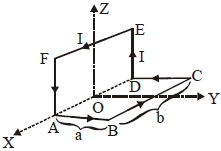
A wire carrying current $I$ is bent in the shape $A\,B\,C\,D\,E\,F\,A$ as shown, where rectangle $A\,B\,C\,D\,A$ and $A\,D\,E\,F\,A$ are perpendicular to each other. If the sides of the rectangles are of lengths $a$ and $b,$ then the magnitude and direction of magnetic moment of the loop $A\,B\,C\,D\,E\,F\,A\,$ is
- A
$\sqrt{2}$ $abI$, along $\left(\frac{\hat{j}}{\sqrt{2}}+\frac{\hat{ k }}{\sqrt{2}}\right)$
- B
$\sqrt{2}$ $abI,$ along $\left(\frac{\hat{j}}{\sqrt{5}}+\frac{2 \hat{k}}{\sqrt{5}}\right)$
- C
$abI,$ along $\left(\frac{\hat{j}}{\sqrt{2}}+\frac{\hat{k}}{\sqrt{2}}\right)$
- D
$abI,$ along $\left(\frac{\hat{j}}{\sqrt{5}}+\frac{2 \hat{ k }}{\sqrt{5}}\right)$
AnswerSol. $\quad M=N I A$
$N =1$
For $ABCD$
$\overrightarrow{ M }_{1}= abI \hat{ K }$
For $DEFA$
$\overrightarrow{ M }_{2}= abI \hat{ j }$
$\overrightarrow{ M }=\overrightarrow{ M }_{1}+\overrightarrow{ M }_{2}$
$=\operatorname{ab} I (\hat{ k }+\hat{j})$
$=\operatorname{ab} I \sqrt{2}\left(\frac{\hat{j}}{\sqrt{2}}+\frac{\hat{ k }}{\sqrt{2}}\right)$
View full question & answer→MCQ 531 Mark
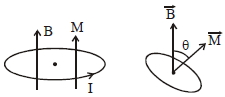
A small circular loop of conducting wire has radius $a$ and carries current $I$. It is placed in a uniform magnetic field $\mathrm{B}$ perpendicular to its plane such that when rotated slightly about its diameter and released, it starts performing simple harmonic motion of time period $T$. If the mass of the loop is $m$ then
- A
$\mathrm{T}=\sqrt{\frac{\pi \mathrm{m}}{2 \mathrm{IB}}}$
- B
$\mathrm{T}=\sqrt{\frac{2 \pi \mathrm{m}}{\mathrm{IB}}}$
- C
$\mathrm{T}=\sqrt{\frac{\pi \mathrm{m}}{\mathrm{IB}}}$
- D
$\mathrm{T}=\sqrt{\frac{2 \mathrm{m}}{\mathrm{IB}}}$
Answer$\overrightarrow{\mathrm{T}}=\overrightarrow{\mathrm{M}} \times \overrightarrow{\mathrm{B}}=-\mathrm{MB} \sin \theta$
$\mathrm{I} \alpha=-\mathrm{MB} \sin \theta$
for small $\theta$
$\alpha=-\frac{\mathrm{MB}}{\mathrm{I}} \theta$
$\omega=\sqrt{\frac{\mathrm{MB}}{\mathrm{I}}}=\sqrt{\frac{(\mathrm{I})\left(\pi \mathrm{R}^{2}\right) \mathrm{B}}{\left(\frac{\mathrm{mR}^{2}}{2}\right)}}$
$\omega=\sqrt{\frac{2 \mathrm{I} \pi \mathrm{B}}{\mathrm{m}}}$
$\therefore \mathrm{T}=\frac{2 \pi}{\omega}=\sqrt{\frac{2 \pi \mathrm{m}}{\mathrm{IB}}}$
View full question & answer→MCQ 541 Mark
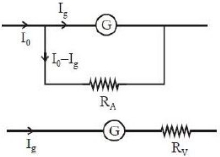
A moving coil galvanometer, having a resistance $G$, produces full scale deflection when a current $I_g$ flows through it. This galvanometer can be converted into $(i)$ an ammeter of range $0$ to $I_0 (I_0 > I_g)$ by connecting a shunt resistance $R_A$ to it and $(ii)$ into a voltmeter of range $0$ to $V(V = GI_0)$ by connecting a series resistance $R_V$ to it. Then,
- A
${R_A}{R_V} = {G^2}$ and $\,\frac{{{R_A}}}{{{R_V}}} = \frac{{{I_g}}}{{\left( {{I_0} - {I_g}} \right)}}$
- B
${R_A}{R_V} = {G^2}$ and $\,\,\frac{{{R_A}}}{{{R_V}}} = {\left( {\frac{{{I_g}}}{{{I_0} - {I_g}}}} \right)^2}$
- C
${R_A}{R_V} = {G^2}\left( {\frac{{{I_g}}}{{{I_0} - {I_g}}}} \right)\,$ and $\,\,\frac{{{R_A}}}{{{R_V}}} = {\left( {\frac{{{I_0} - {I_g}}}{{{I_g}}}} \right)^2}$
- D
${R_A} - {R_V} = {G^2}\left( {\frac{{{I_0} - {I_g}}}{{{I_g}}}} \right)\,$ and $\,\,\frac{{{R_A}}}{{{R_V}}} = {\left( {\frac{{{I_g}}}{{{I_0} - {I_g}}}} \right)^2}$
AnswerWhen galvanometer is used an ammeter shunt is used in parallel with galvanometer.
$\therefore \quad \mathrm{I}_{g} \mathrm{G}=\left(\mathrm{I}_{0}-\mathrm{I}_{g}\right) \mathrm{R}_{\mathrm{A}}$
$\therefore \quad R_{A}=\left(\frac{I_{g}}{I_{0}-I_{g}}\right) G$
When galvanometer is used as a voltmeter, resistance is used in series with galvanometer.
$\mathrm{I}_{g}\left(\mathrm{G}+\mathrm{R}_{\mathrm{v}}\right)=\mathrm{V}=\mathrm{GI}_{0}\left(\text { given } \mathrm{V}=\mathrm{GI}_{0}\right)$
$\therefore R_{v}=\frac{\left(I_{0}-I_{g}\right) G}{I_{g}}$
$\therefore \quad {{\text{R}}_{\text{A}}}{{\text{R}}_{\text{v}}} = {{\text{G}}^2}\& \frac{{{{\text{R}}_{\text{A}}}}}{{{{\text{R}}_{\text{v}}}}} = {\left( {\frac{{{{\text{I}}_g}}}{{{{\text{I}}_0} - {{\text{I}}_g}}}} \right)^2}$
View full question & answer→MCQ 551 Mark
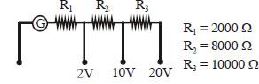
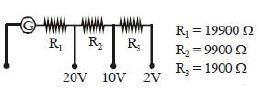
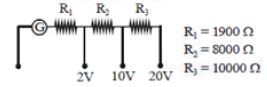
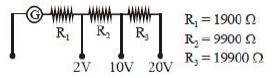
A galvanometer of resistance $100\,\Omega $ has $50\, divisions$ on its scale and has sensitivity of $20\,\mu A / division$. It is to be converted to a voltmeter with three ranges, of $0-2\, V$, $0-10\, V$ and $0-20\, V$. The appropriate circuit to do so is
Answer$20 \times 50 \times 10^{-6}=10^{-3}\, \mathrm{Amp}$
$\mathrm{v}_{1}=\frac{2}{10^{-3}}=100+\mathrm{R}_{1}$
$1900=\mathrm{R}_{1}$
$\mathrm{V}_{2}=\frac{10}{10^{-3}}=\left(2000+\mathrm{R}_{2}\right)$
$\mathrm{R}_{2}=8000$
$\mathrm{V}_{3}=\frac{20}{10^{-3}}=10 \times 10^{3}+\mathrm{R}_{3}=10 \times 10^{3} \mathrm{R}_{3}$
View full question & answer→MCQ 561 Mark
A moving coil galvanometer allows a full scale current of $10^{-4}\, A$. A series resistance of $2\, M\,\Omega $ is required to convert the above galvanometer into a voltmeter of range $0 -5\, V$. Therefore the value of shunt resistance required to convert the above galvanometer into a ammeter of range $0-10\, mA$ is....$\Omega $
Answer$200 + 10^{-4}\, G = 5$
$G = -ve$
View full question & answer→MCQ 571 Mark
A moving coil galvanometer has a coil with $175\, turns$ and area $1\, cm^2$ It uses a torsion band of torsion constant $10^{-6}\, N\, -m/rad$. The coil is placed in a magnetic field $B$ parallel to its plane. The coil deflects by $10$ for a current of $1\, mA$. The value of $B$ (in Tesla) is approximately
- A
$10^{-3}$
- B
$10^{-1}$
- C
$10^{-4}$
- D
$10^{-2}$
Answer$\tau=\overrightarrow{\mathrm{M}} \times \overrightarrow{\mathrm{B}}$
$\mathrm{C} \theta=\mathrm{i} \mathrm{N} \mathrm{A} \mathrm{B}$
$10^{-6} \times \frac{\pi}{180}=10^{-3} \times 10^{-4} \times 175 \times B$
$B=10^{-3}$ $Tesla$
View full question & answer→MCQ 581 Mark
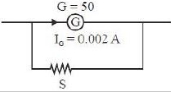
The resistance of a galvanometer is $50\, ohm$ and the maximum current which can be passed through it is $0.002\, A$. What resistance must be connected to it in order to convert it into an ammeter of range $0 -0.5\, A$ ?....$ohm$
- A
$0.2$
- B
$0.002$
- C
$0.02$
- D
$0.5$
Answersince shunt resistance is connected in parallel with galvanometer, both will have same voltage drop.
$(0.002)\left(R_{G}\right)=(0.5-0.002)\left(r_{s}\right)$
$\Rightarrow r_{s} \approx 0.2\, \Omega$
View full question & answer→MCQ 591 Mark
A moving coil galvanometer has resistance $50\,\Omega $ and it indicates full deflection at $4\,mA$ current. A voltmeter is made using this galvanometer and a $5\,k\Omega $ resistance. The maximum voltage, that can be measured using this voltamenter, will be close to ......$V$
Answer$G=50\, \Omega$
$\mathrm{S}=5000 \,\Omega$
$\mathrm{I}_{\mathrm{g}}=4 \times 10^{-3}$
$\mathrm{V}=\mathrm{i}_{g}(\mathrm{G}+\mathrm{S})$
$V=4 \times 10^{-3}(50+5000)$
$=4 \times 10^{-3}(5050)=20.2$ $volt$
View full question & answer→MCQ 601 Mark
A galvanometer, whose resistance is $50\,ohm,$ has $25$ divisions in it. When a current of $4\times 10^{-4}\,A$ passes through it, its needle (pointer) deflects by one division. To use this galvanometer as a voltmeter of range $2.5\,V,$ it should be connected to a resistance of.......$ohm$
- A
$250$
- B
$200$
- C
$6200$
- D
$6250$
Answer${{\text{V}}_{\text{o}}} = {{\text{i}}_{{{\text{g}}_0}}}\left( {{{\text{R}}_{\text{G}}} + {\text{R}}} \right)$
${{\text{i}}_{{g_0}}} = 4 \times {10^{ - 4}} \times 25 = {10^{ - 2}}{\mkern 1mu} {\text{A}}$
$\mathrm{V}_{0}=2.5\, \mathrm{V}$
$R_{0}+R=\frac{V_{0}}{i_{0}}=\frac{2.5}{10^{-2}}=250$
$\Rightarrow \quad \mathrm{R}=200\, \Omega$
View full question & answer→MCQ 611 Mark
A galvanometer having a resistance of $20\,\Omega $ and $30\, divisions$ on both sides has figure of merit $0.005\, ampere /division$. The resistance that should be connected in series such that it can be used as a voltmeter upto $15\, volt$ is ........... $\Omega$
Answer$\mathrm{R}_{9}=20 \,\Omega$
$\mathrm{N}_{\mathrm{L}}=\mathrm{N}_{\mathrm{g}}=\mathrm{N}=30$
$\mathrm{FOM}=\frac{1}{\phi}=0.005 \,\mathrm{A/Div}$
Current sentivity $=\mathrm{CS}=\left(\frac{1}{0.005}\right)=\frac{\phi}{1}$
$I{g_{\max }} = 0.005 \times 30$
$=15 \times 10^{-2}=0.15$
$15=0.15[20+\mathrm{R}]$
$100=20+R$
$R=80$.
View full question & answer→MCQ 621 Mark
A square loop is carrying a steady current $I$ and the magnitude of its magnetic dipole moment is $m$. If this square loop is changed to a circular loop and it carries the same current, the magnitude of the magnetic dipole moment of circular loop will be
- A
$\frac {m}{\pi }$
- B
$\frac {3m}{\pi }$
- C
$\frac {4m}{\pi }$
- D
$\frac {2m}{\pi }$
Answer$m = I{l^2}$ $2\pi r = 4l$
${{{\text{m}}^\prime } = \frac{{I4{\ell ^2}}}{\pi }}$ ${{\text{r}} = \frac{{2\ell }}{\pi }}$
${{{\text{m}}^\prime } = \frac{{I4{\ell ^2}}}{\pi }}$ ${\pi {r^2} = \frac{{\pi 4{\ell ^2}}}{{{\pi ^2}}} = \frac{{4{\ell ^2}}}{\pi }}$
${{{\text{m}}^\prime } = \frac{4}{\pi }\,{\text{m}}}$
View full question & answer→MCQ 631 Mark
A rectangular coil (Dimension $5\,cm\times 2\,cm$ ) with $100\,turns,$ carrying a current of $3\,A$ in the clock-wise direction, is kept centered at the origin and in the $X-Z$ plane. A magnetic field of $1\,T$ is applied along $X-$ axis. If the coil is tilted through $45^o$ about $Z-$ axis, then the torque on the coil is.....$Nm$
- A
$0.42$
- B
$0.27$
- C
$0.55$
- D
$0.38$
Answer$|\overrightarrow{\mathrm{t}}|=|\overrightarrow{\mathrm{M}} \times \overrightarrow{\mathrm{B}}|$
$\tau=\mathrm{NI} \times \mathrm{A} \times \mathrm{B} \times \sin 45^{\circ}$
$\tau=0.27\, \mathrm{Nm}$
View full question & answer→MCQ 641 Mark
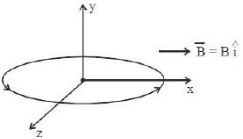
A circular coil having $N\,turns$ and radius $r$ carries a current. It is held in the $XZ$ plane in a magnetic field $B\hat i$ . The torque on the coil due to the magnetic field is
Answer$ \text { Magnetic moment of coil } =\mathrm{NIA} \hat{\mathrm{j}}$
$=\mathrm{Nl}\left(\pi \mathrm{r}^{2}\right) \hat{\mathrm{j}} $
Torque on loop (coil) $=\overline{\mathrm{M}} \times \overline{\mathrm{B}}$
$=\mathrm{Nl}\left(\pi \mathrm{r}^{2}\right) \mathrm{B} \sin 90^{\circ}(-\hat{\mathrm{k}})$
$=\mathrm{NI} \pi \mathrm{r}^{2} \mathrm{B}(-\hat{\mathrm{k}})$
View full question & answer→MCQ 651 Mark
An insulating thin rod of length $l$ has a linear charge density $\rho \left( x \right) = {\rho _0}\,\frac{x}{l}$ on it. The rod is rotated about an axis passing through the origin $(x = 0)$ and perpendicular to the rod. If the rod makes $n$ rotations per second, then the time averaged magnetic moment of the rod is
Answer$\mathrm{dM} =\mathrm{di} \mathrm{A} $
$=\left(\frac{\mathrm{d} \mathrm{q} \omega}{2 \pi}\right) \pi \mathrm{x}^{2} $
$=(\rho \mathrm{d} \mathrm{x}) \frac{\omega}{2 \pi} \pi \mathrm{x}^{2} $
$\mathrm{M} =\int_{0}^{\mathrm{L}} \mathrm{dM}$
View full question & answer→MCQ 661 Mark
A galvanometer with its coil resistance $25\,\Omega $ requires a current of $1\,mA$ for its full deflection. In order to construct an ammeter to read up to a current of $2\,A,$ the approximate value of the shunt resistance should be
- A
$2.5 \times {10^{ - 2}}\,\Omega $
- B
$1.25 \times {10^{ - 3}}\,\Omega $
- C
$2.5 \times {10^{ - 3}}\,\Omega $
- D
$1.25 \times {10^{ - 2}}\,\Omega $
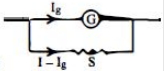
AnswerA ccording to question, current through galvanometer, $\mathrm{I}_{\mathrm{g}}=1\, \mathrm{mA}$
Current through shunt $\left(I-I_{g}\right)=2\, A$
Galvanometer resistance $\mathrm{R}_{\mathrm{g}}=25\, \Omega$
Resistance of shunt, $\mathrm{S}=?$
$\mathrm{I}_{\mathrm{g}} \mathrm{R}_{\mathrm{g}}=\left(\mathrm{I}-\mathrm{I}_{\mathrm{g}}\right) \mathrm{S}$
$ \Rightarrow S = \frac{{{{10}^{ - 3}} \times 25}}{2}$
$S \simeq 1.25 \times {10^{ - 2}}\,\Omega $
View full question & answer→MCQ 671 Mark
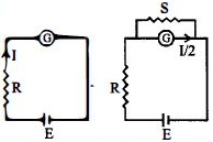
In a circuit for finding the resistance of a galvanometer by half deflection method, a $6\,V$ battery and a high resistance of $11\,k\Omega $ are used. The figure of merit of the galvanometer $60\,\mu A/$ division. In the absence of shunt resistance, the galvanometer produces a deflection of $\theta = 9$ divisions when current flows in the circuit. The value of the shunt resistance that can cause the deflection of $\theta /2 ,$ is closest to .................. $\Omega$
AnswerFigure of merit of a galvanometer is the current required to produce a deflection of one division in the galvancmeter i.e., figure of merit $=\frac{\mathrm{I}}{\theta}$
$\mathrm{I}=\frac{\varepsilon}{\mathrm{R}+\mathrm{G}} \quad \mathrm{G}=\frac{1}{9}\, \mathrm{K}\, \Omega$
$\frac{1}{2}=\frac{\varepsilon}{R+\frac{G S}{G+\bar{S}}} \times \frac{S}{S+G} \Rightarrow \frac{1}{2}=\frac{\varepsilon S}{R(S+G)+G S}$
$S=\frac{R G \times \frac{1}{2}}{\varepsilon-\frac{(R+G) I}{2}}$
$S=\frac{11 \times 10^{3} \times \frac{1}{2} \times 10^{2} \times 270 \times 10^{-6}}{6-\left(\frac{6}{2}\right)}=110\, \Omega$
View full question & answer→MCQ 681 Mark
A charge $q$ is spread uniformly over an insulated loop of radius $r$ . If it is rotated with an angular velocity $\omega $ with respect to normal axis then the magnetic moment of the loop is
- A
$\frac{1}{2}\,\,q\omega {r^2}$
- B
$\frac{4}{3}\,\,q\omega {r^2}$
- C
$\frac{3}{2}\,\,q\omega {r^2}$
- D
$q\omega {r^2}$
AnswerMagnetic moment, $\mu \, = \,IA\, = \,\frac{{qv}}{{2\pi r}}(\pi {r^2})$
or, $\mu \,\, = \,\,\frac{{qr\omega }}{{2\pi r}}(\pi {r^2})\, = \,\frac{1}{2}\,q{r^2}\omega $
View full question & answer→MCQ 691 Mark
The dipole moment of a circular loop carrying a current $I$, is $m$ and the magnetic field at the centre of the loop is $B_1$ . When the dipole moment is doubled by keeping the current constant, the magnetic field at the centre of the loop is $B_2$ . The ratio $\frac{{{B_1}}}{{{B_2}}}$ is
- A
$\sqrt 3 $
- B
$\sqrt 2 $
- C
$\frac{1}{{\sqrt 2 }}$
- D
$2$
AnswerMagnetic field at the centre of $\operatorname{loop}, B_{1}=\frac{\mu_{0} I}{2 R}$
Dipole moment of circular loop is $m=I A$
$\mathrm{m}_{1}=\mathrm{I} \cdot \mathrm{A}=\mathrm{I} \pi \mathrm{R}^{2} \quad\{\mathrm{R}=\text { Radius of the loop }\}$
If moment is doubled (keeping current constant) $R$ becomes $\sqrt{2 \mathrm{R}}$
${{\text{m}}_2} = {\text{L}}\pi {(\sqrt 2 {\text{R}})^2} = 2.{\text{I}}\pi {{\text{R}}^2} = 2{{\text{m}}_1}$
$B_{2}=\frac{\mu_{0} I}{2(\sqrt{2} R)}$
View full question & answer→MCQ 701 Mark
When a current of $5\ mA$ is passed through a galvanometer having a coil of resistance $15\ \Omega$, it shows full scale deflection. The value of the resistance to be put in series with the galvanometer to convert it into to voltmeter of range $0 - 10\ V$ is
AnswerGiven : Current through the galvanometer, $i_{g}=5 \times 10^{-3} \,A$
Galvanometer resistance, $G=15\, \Omega$
Let resistance $R$ to be put in series with the galvanometer to convert it into a voltmeter.
$V=i_{g}(R+G)$
$10= 5 \times 10^{-3}(R+15) $
$ \therefore \quad R=2000-15=1985 $
$=1.985 \times 10^{3} \,\Omega $
View full question & answer→MCQ 711 Mark
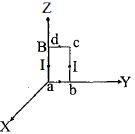
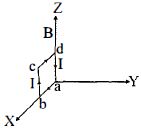
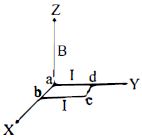
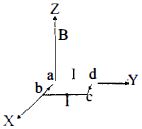
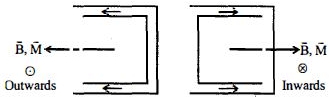
A uniform magnetic field $B$ of $0.3\, T$ is along the positive $Z-$ direction . A rectangular loop $(abcd)$ of sides $10\, cm\times5\, cm$ carries a current $I$ of $12\, A$. Out of the following different orientations which one corresponds to stable equilibrium ?
AnswerMagnetic moment of current carrying rectangular loop of area $\mathrm{A}$ is given by $\mathrm{M}=$ $N I A$
magnetic moment of current carrying coil is a vector and its direction is given by right hand thumbrule, for rectangular loop, $\overrightarrow{B}$ at centre due to current in loop and $\overrightarrow{\mathrm{M}}$ are always parallel.
Hence, $(c)$ corresponds to stable equilibrium.
View full question & answer→MCQ 721 Mark
A galvanometer has a $50$ $division$ scale. Battery has no internal resistance. It is found that there is deflection of $40$ $divisions$ when $R = 2400\,\Omega $. Deflection becomes $20$ $divisions$ when resistance taken from resistance box is $4900\,\Omega $ . Then we can conclude
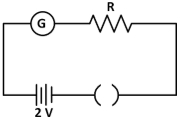
- A
Full scale deflection current is $2\, mA$.
- B
Resistance of galvanometer is $200\,\Omega \,$
- C
Resistance required on $R.B.$ for a deflection of $10$ $divisions$ is $9800\,\Omega \,$
- D
Current sensitivity of galvanometer is $20\,\mu A$ $/ division$
AnswerLet full scale deflection of current $=1$
In case $1,$ when $\mathrm{R}=2400 \Omega$ and deflection of 40 divisions present.
$\therefore \quad \frac{40}{50} \mathrm{I}=\frac{V}{G+R}$
$\Rightarrow \quad \frac{4}{5} \mathrm{I}=\frac{2}{G+2400}\dots (1)$
In case $2,$ when $\mathrm{R}=4900 \Omega$ and deflection of 20 divisions present
$\therefore \quad \frac{20}{50} \mathrm{I}=\frac{V}{G+R}$
$\Rightarrow \quad \frac{2}{5} \mathrm{I}=\frac{2}{G+4900}\dots (2)$
From $(1)$ and $(2)$ we get,
$\frac{4}{2}=\frac{G+4900}{G+2400}$
$\Rightarrow 2 G+4800=G+4900$
$\Rightarrow \mathrm{G}=100 \Omega$
Putting value of G in equation (1), we get.
$\frac{4}{5} \mathrm{I}=\frac{2}{100+2400}$
$\Rightarrow \mathrm{I}=1 \mathrm{mA}$
Current sensitivity $=\frac{\mathrm{I}}{\text { number of divisions }}$
$=\frac{1}{50}$
$=0.02 \mathrm{mA} /$ division
$=20 \mu \mathrm{A} /$ division
Resistance required for deflection of 10 divisions
$\frac{10}{50} \mathrm{I}=\frac{V}{G+R}$
$\Rightarrow \frac{1}{5} \times 1 \times 10^{-3}=\frac{2}{100+R}$
$\Rightarrow \mathrm{R}=9900 \Omega$
View full question & answer→MCQ 731 Mark
A $50\,\Omega $ resistance is connected to a battery of $5\,V$. A galvanometer of resistance $100\, \Omega $ is to be used as an ammeter to measure current through the resistance, for this a resistance $r_s$ is connected to the galvanometer. Which of the following connections should be employed if the measured current is within $1\% $ of the current without the ammeter in the circuit ?
- A
$r_s = 0.5\, \Omega $ in series with the galvanometer
- B
$r_s = 1\, \Omega $ in series with galvanometer
- C
$r_s = 1\, \Omega $ in parallel with galvanometer
- D
$r_s = 0.5\, \Omega $ in parallel with the galvanometer
AnswerAs we know, $\mathrm{I}=\frac{\mathrm{V}}{\mathrm{R}}=\frac{5}{50}=0.1$
$I' = 0.099$
When Galvanometer is connected
$R_{e q}=50+\frac{100 S}{100+S}=\frac{V}{I}$
$\Rightarrow \frac{100 \mathrm{S}}{100+\mathrm{S}}=\frac{5}{0.099}-50$
$\Rightarrow \frac{100 \mathrm{S}}{100+\mathrm{S}}=50.50-50 \Rightarrow \frac{100 \mathrm{S}}{100+\mathrm{S}}=0.5$
$\Rightarrow 100 \mathrm{S}=50+0.55 \Rightarrow 99.5 \mathrm{S}=50$
$S=\frac{50}{99.05}=0.5 \,\Omega$
So, shunt of resistance $=0.5\, \Omega$ is onnected in parallel with the galvanometer.
View full question & answer→MCQ 741 Mark
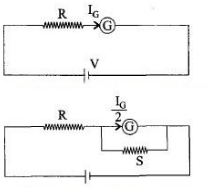
To know the resistance $G$ of a galvanometer by half deflection method, a battery of $emf\, V_E$ and resistance $R$ is used to deflect the galvanometer by angle $\theta $. If a shunt of resistance $S$ is needed to get half deflection then $G, R$ and $S$ related by the equation
- A
$S (R+ G) = RG$
- B
$2S (R+G)=RG$
- C
$2G = S$
- D
$2S=G$
AnswerAccording to Ohm's Law, $I$ $=\frac{V}{R}$
$\mathrm{I}_{\mathrm{g}}=\frac{\mathrm{V}}{\mathrm{R}+\mathrm{G}}$
where, $I $$_{g}$ - Galvanometer current, $G-$Galvonometer resistance
When shunt of resistance $S$ is connected parallel to the Galvanometer then
$\mathrm{G}=\frac{\mathrm{GS}}{\mathrm{G}+\mathrm{S}}$
$\therefore I=\frac{V}{R+\frac{G S}{G+S}}$
Equal potential difference is given by
$\mathrm{I}_{\mathrm{g}}^{\prime} \mathrm{G}=\left(\mathrm{I}-\mathrm{I}_{\mathrm{B}}^{\prime}\right) \mathrm{S}$
$\mathrm{I}_{\mathrm{g}}^{\prime}(\mathrm{G}+\mathrm{S})=\mathrm{IS}$
$\Rightarrow \frac{\mathrm{I}_{\mathrm{g}}}{2}=\frac{\mathrm{IS}}{\mathrm{G}+\mathrm{S}}$
$\Rightarrow \frac{\mathrm{v}}{2(\mathrm{R}+\mathrm{G})}=\frac{\mathrm{v}}{\mathrm{R}+\frac{\mathrm{GS}}{\mathrm{G}+\mathrm{S}}} \times \frac{\mathrm{S}}{\mathrm{G}+\mathrm{S}}$
$ \Rightarrow \frac{1}{{2(R + G)}} = \frac{S}{{R(G + S) + GS}}$
$\Rightarrow R(G+S)+G S=2 S(R+G)$
$\Rightarrow \mathrm{RG}+\mathrm{RS}+\mathrm{GS}=2 \mathrm{S}(\mathrm{R}+\mathrm{G})$
$\Rightarrow \mathrm{RG}=2 \mathrm{S}(\mathrm{R}+\mathrm{G})-\mathrm{S}(\mathrm{R}+\mathrm{G})$
$\therefore \mathrm{RG}=\mathrm{S}(\mathrm{R}+\mathrm{G})$
View full question & answer→MCQ 751 Mark
A galvanometer having a coil resistance of $100\ \Omega$. gives a full scale deflection, when a currect of $I\ mA$ is passed through it. The value of the resistance, which can convert this galvanometer into ammeter giving a full scale deflection for a current of $10\ A$, is :......$Ω$
Answer$\lg \mathrm{G}=(\mathrm{I}-\mathrm{Ig}) \mathrm{s}$
$\therefore 10^{-3} \times 100=\left(10-10^{-3}\right) \times \mathrm{S}$
$\therefore \mathrm{S} \approx 0.01 \,\Omega$
View full question & answer→MCQ 761 Mark
In the circuit diagrams $(A, B, C$ and $D$) shown below, $R$ is a high resistance and $S$ is a resistance of the order of galvanometer resistance $G$. The correct circuit, corresponding to the half deflection method for finding the resistance and figure of merit of the galvanometer, is the circuit labelled as
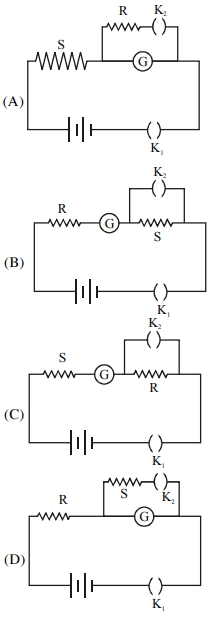
- A
Circuit $A$ with $G = \frac{{RS}}{{R - S}}$
- B
Circuit $B$ with $G\, = S$
- C
Circuit $C$ with $G\, = S$
- D
Circuit $D$ with $G = \frac{{RS}}{{R - S}}$
AnswerThe correct circuit diagram is $D$ with galvanometer resistance $G = \frac{{RS}}{{R - S}}$
View full question & answer→MCQ 771 Mark
A conductor lies along the $z-$axis $a$ $-1.5$$ \le Z < 1.5\,m$ carries a fixed current of $10.0\ A$ in $ - {\hat a_z}$ direction (see figure). For a field $\vec B$ $=$ $3.0 \times 10^{-4}$ $e^{-0.2x}$ ${\hat a_y}\,T$ find the power required to move the conductor at constant speed to $x = 2.0\ m, y = 0\ m$ in $5 \times 10^{-3}\ s$. Assume parallel motion along the $x-$axis........$ W$
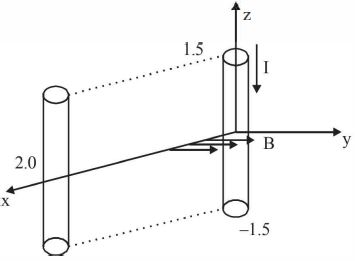
- A
$2.97$
- B
$14.85$
- C
$29.7 $
- D
$1.57$
AnswerWork done in moving the conductor is,
$W=\int_{0}^{2} F d x$
$=\int_{0}^{2} 3.0 \times 10^{-4} e^{-0.2 x} \times 10 \times 3 d x$
$=9 \times 10^{-3} \int_{0}^{2} e^{-0.2 x} d x$
$=\frac{9 \times 10^{-3}}{0.2}\left[-e^{-0.2 \times 2}+1\right] B=3.0 \times 10^{-4} e^{-0.2 x}$
(By exponential function)
$=\frac{9 \times 10^{-3}}{0.2} \times\left[1-e^{-0.4}\right]$
$=9 \times 10^{-3} \times(0.33)=2.97 \times 10^{-3}\, \mathrm{J}$
Power required to move the conductor is, $P=\frac{W}{t}$
$P=\frac{2.97 \times 10^{-3}}{(0.2) \times 5 \times 10^{-3}}=2.97 \,\mathrm{W}$
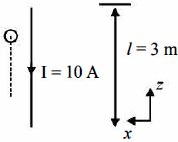
View full question & answer→MCQ 781 Mark
A shunt of resistance $1\,\Omega $ is connected across a galvanometer of $120\,\Omega $ resistance. A current of $5.5\, ampere$ gives full scale deflection in the galvanometer. The current that will give full scale deflection in the absence of the shunt is nearly ............... $ampere$
- A
$5.5$
- B
$0.5$
- C
$0.004$
- D
$0.045$
AnswerThe current that will given full scale deflection in the absence of the shunt is nearly equal to the current through the galvanometer when shunt is connected i.e. $I_g$
$ \text { As } I_{8} =\frac{1 S}{G+S} $
$=\frac{5.5 \times 1}{120+1}=0.045 \text { ampere } $
View full question & answer→MCQ 791 Mark
This questions has Statement $I$ and Statement $II$ Of the four choices given after the Statements, choose the one that best describes into two Statements.
Statement$-I$ : Higher the range, greater is the resistance of ameter.
Statement$-II$ : To increase the range of ammeter, additional shunt needs to be used across it.
- A
Statement$-I$ is true, Statement$-II$ is true, Statement$-II$ is the correct explanation of Statement$-I.$
- B
Statement$-I$ is true, Statement$-II$ is true, Statement$-II$ is not the correct explanation of Statement$-I.$
- C
Statement-$I$ is true, Statement-$II$ is false
- D
Statement-$I$ is false, Statement-$II$ is true.
AnswerStatements $I$ is false and Statement $II$ is true
For ammeter, shunt resistance, $\mathrm{S}=\frac{\mathrm{IgG}}{\mathrm{I}-\mathrm{Ig}}$
Therefore for $I$ to increase, $S$ should decrease, So additional $S$ can be connected across it.
View full question & answer→MCQ 801 Mark
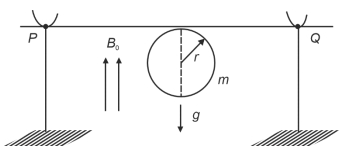
A thin stiff insulated metal wire is bent into a circular loop with its two ends extending tangentially from the same point of the loop. The wire loop has mass $m$ and radius $r$ and it is in a uniform vertical magnetic field $B_0$, as shown in the figure. Initially, it hangs vertically downwards, because of acceleration due to gravity $g$, on two conducting supports at $P$ and $Q$. When a current $/$ is passed through the loop, the loop turns about the line $P Q$ by an angle $\theta$ given by
- A
$\tan \theta=\pi r I B_0 /(m g)$
- B
$\tan \theta=2 \pi r I B_0 /(m g)$
- C
$\tan \theta=\pi r I B_0 /(2 m g)$
- D
$\tan \theta=m g /\left(\pi r / B_0\right)$
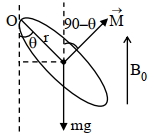
AnswerLet loop makes angle $\theta$ with vertical.
$\text { in equilibrium } \tau_{\text {net }}=0$
$\tau_0= MB \sin (90-\theta)- mg \cdot r \sin \theta=0$
$\text { I. } \pi r ^2 \cdot B _0 \cos \theta= mg r \cdot \sin \theta$
$\tan \theta=\frac{\pi rIB }{ mg }$
View full question & answer→MCQ 811 Mark
Two resistances $R_1=X \Omega$ and $R_2=1 \Omega$ are connected to a wire $A B$ of uniform resistivity, as shown in the figure. The radius of the wire varies linearly along its axis from $0.2 mm$ at $A$ to $1 mm$ at $B$. A galvanometer ($G$) connected to the center of the wire, $50 cm$ from each end along its axis, shows zero deflection when $A$ and $B$ are connected to a battery. The value of $X$ is. . . . .
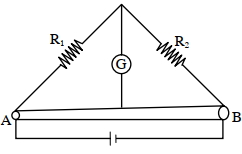
AnswerFor the balanced Wheatstone bridge
$\frac{ R _1}{ R _2}=\frac{\int_0^{0.5} \frac{\rho d x}{\pi r _x^2}}{\int_{0.5}^1 \frac{\rho dx }{\pi r _x^2}}$
$\frac{ R _1}{ R _2}=\frac{+\left[\frac{1}{ r _x}\right]_0^{0.5}}{+\left[\frac{1}{ r _{ x }}\right]_{0.5}^1}$
$\therefore R _1=5 R _2=5 \Omega$
View full question & answer→MCQ 821 Mark
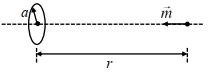
A special metal $S$ conducts electricity without any resistance. A closed wire loop, made of $S$, does not allow any change in flux through itself by inducing a suitable current to generate a compensating flux. The induced current in the loop cannot decay due to its zero resistance. This current gives rise to a magnetic moment which in turn repels the source of magnetic field or flux. Consider such a loop, of radius $a$, with its center at the origin. A magnetic dipole of moment $m$ is brought along the axis of this loop from infinity to a point at distance $r \gg a)$ from the center of the loop with its north pole always facing the loop, as shown in the figure below.
The magnitude of magnetic field of a dipole $m$, at a point on its axis at distance $r$, is $\frac{\mu_0}{2 \pi} \frac{m}{r^3}$, where $\mu_0$ is the permeability of free space. The magnitude of the force between two magnetic dipoles with moments, $m_1$ and $m_2$, separated by a distance $r$ on the common axis, with their north poles facing each other, is $\frac{k m_1 m_2}{r^4}$, where $k$ is a constant of appropriate dimensions. The direction of this force is along the line joining the two dipoles.
($1$) When the dipole $m$ is placed at a distance $r$ from the center of the loop (as shown in the figure), the current induced in the loop will be proportional to
$(A)$ $\frac{m}{r^3}$ $(B)$ $\frac{m^2}{r^2}$ $(C)$ $\frac{m}{r^2}$ $(D)$ $\frac{m^2}{r}$
($2$) The work done in bringing the dipole from infinity to a distance $r$ from the center of the loop by the given process is proportional to
$(A)$ $\frac{m}{r^5}$ $(B)$ $\frac{m^2}{r^5}$ $(C)$ $\frac{m^2}{r^6}$ $(D)$ $\frac{m^2}{r^7}$
Give the answer or qution ($1$) and ($2$)
- A
$A.B$
- B
$A.C$
- C
$A.D$
- D
$A.B,C$
Answer$\phi= L 1=\frac{\mu_0 m }{2 \pi r ^3} \times \pi a ^2$
$\Rightarrow i =\frac{\mu_0 m \pi a ^2}{2 \pi r ^3 L }$
$\Rightarrow i \propto \frac{ m }{ r ^3}$
$m ^{\prime}=\pi a ^2 i =\frac{\mu_0 m ^2 a ^4}{2 \pi r ^3 L }$
$F =\frac{ km ^2 \pi^2 a ^4}{2 \pi r ^7 L }$
$W =\int Fdr \propto \int \frac{ m ^2 dr }{ r ^7}$
$W \propto \frac{ m ^2}{ r ^6}$
View full question & answer→MCQ 831 Mark
A circular coil of radius $R$ and $N$ turns has negligible resistance. As shown in the schematic figure, its two ends are connected to two wires and it is hanging by those wires with its plane being vertical. The wires are connected to a capacitor with charge $Q$ through a switch. The coil is in a horizontal uniform magnetic field $B_0$ parallel to the plane of the coil. When the switch is closed, the capacitor gets discharged through the coil in a very short time. By the time the capacitor is discharged fully, magnitude of the angular momentum gained by the coil will be (assume that the discharge time is so short that the coil has hardly rotated during this time)-
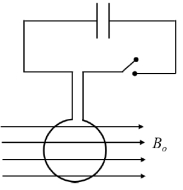
AnswerTorque experienced by circular loop $=\overrightarrow{ M } \times \overrightarrow{ B }$
$\text { where } \quad \vec{M} \text { is magnetic moment }$
$\vec{B} \text { is magnetic field }$
$\therefore \tau=i \pi R ^2 N B B _0 \text { [at the instant shown } \theta=\pi / 2 \text { ] }$
$\therefore \vec{\tau} dt = d \overrightarrow{ L }= i \pi R ^2 NB _0 dt = Q \pi R ^2 N B _0[ idt = Q ]$
View full question & answer→MCQ 841 Mark
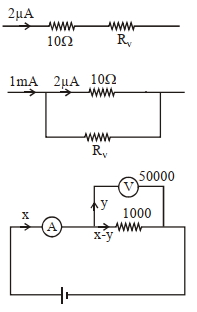
Two identical moving coil galvanometer have $10 \Omega$ resistance and full scale deflection at $2 \mu A$ current. One of them is converted into a voltmeter of $100 mV$ full scale reading and the other into an Ammeter of $1 mA$ full scale current using appropriate resistors. These are then used to measure the voltage and current in the Ohm's law experiment with $R =1000 \Omega$ resistor by using an ideal cell. Which of the following statement( $s$ ) is/are correct?
$(1)$ The measured value of $R$ will be $978 \Omega$
$(2)$ The resistance of the Voltmeter will be $100 k \Omega$.
$(3)$ The resistance of the Ammeter will be $0.02 \Omega$ (round off to $2^{\text {nd }}$ decimal place)
$(4)$ If the ideal cell is replaced by a cell having internal resistance of $5 \Omega$ then the measured value of $R$ will be more than $1000 \Omega$.
Answer(image)
$0.1=2 \times 10^{-6}\left(10+R_V\right)$
$\therefore R_V=49990 \Omega$
(image)
$2 \times 10^{-6} \times 10=10^{-3} R _{ A } \therefore R _{ A }=0.02 \Omega$
(image)
$y 50000=(x-y) 1000$
$\therefore 51 y=x$
Reading $=\frac{y 50000}{x} \approx 980$
View full question & answer→MCQ 851 Mark
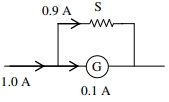
A moving coil galvanometer has $50$ turns and each turn has an area $2 \times 10^{-4} m ^2$. The magnetic field produced by the magnet inside the galvanometer is $0.02 T$. The torsional constant of the suspension wire is $10^{-4} N m rad ^{-1}$. When a current flows through the galvanometer, a full scale deflection occurs if the coil rotates by $0.2$ rad. The resistance of the coil of the galvanometer is $50 \Omega$. This galvanometer is to be converted into an ammeter capable of measuring current in the range $0-1.0 A$. For this purpose, a shunt resistance is to be added in parallel to the galvanometer. The value of this shunt resistance, in ohms, is. . . . . .
- A
$5.40$
- B
$5.50$
- C
$5.56$
- D
$5.60$
AnswerNumber of turns $=50$
Area $=2 \times 10^{-4} m ^2$
$B=0.02 T$
Torsional constant $C =10^{-4}$
At full scale deflection $\theta=0.2 rad$
Resistance $R =50 \Omega$
Torque $\tau= C \theta=$ niAB
Full scale current $i =\frac{ C \theta}{ nAB }=\frac{0.2 \times 10^{-4}}{50 \times 2 \times 10^{-4} \times 0.02}$
$i =0.1 amp$
$0.9 \times S =0.1 \times R$
$S =\frac{ R }{9}=\frac{50}{9} \Omega$
$S =5.56 \Omega$
View full question & answer→MCQ 861 Mark
Consider two identical galvanometers and two identical resistors with resistance $R$. If the internal resistance of the galvanometers $R_{ C } < R / 2$
($A$) The maximum voltage range is obtained when all the components are connected in series
($B$) The maximum voltage range is obtained when the two resistors and one galvanometer are connected in series, and the second galvanometer is connected in parallel to the first galvanometer
($C$) The maximum current range is obtained when all the components are connected in parallel
($D$) The maximum current range is obtained when the two galvanometers are connected in series and the combination is connected in parallel with both the resistors
View full question & answer→MCQ 871 Mark
A galvanometer gives full scale deflection with $0.006$ A current. By connecting it to a $4990 \ \Omega$ resistance, it can be converted into a voltmeter of range $0-30 \ V$. If connected to a $\frac{2 n }{249} \Omega$ resistance, it becomes an ammeter of range $0-1.5 \ A$. The value of $n$ is:
Answer$\frac{6}{1000}(G+4990)=30 $
$\Rightarrow G+4990=\frac{30,000}{6}=5000 $
$\Rightarrow G=10 $
$\frac{6}{1000} \times 10=\left(1.5-\frac{6}{1000}\right) S $
$\Rightarrow S =\frac{60}{1494}=\frac{2 n}{249} $
$\Rightarrow=\frac{249 \times 30}{1494}=\frac{2490}{498}=5$
View full question & answer→MCQ 881 Mark
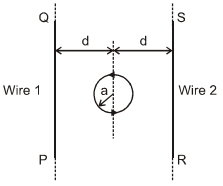
The figure shows a circular loop of radius a with two long parallel wires (numbered $1$ and $2$) all in the plane of the paper. The distance of each wire from the centre of the loop is $d$. The loop and the wires are carrying the same current $I$. The current in the loop is in the counterclockwise direction if seen from above.$Image$
$1.$ When $d \approx$ a but wires are not touching the loop, it is found that the net magnetic filed on the axis of the loop is zero at a height $h$ above the loop. In that case
$(A)$ current in wire $1$ and wire $2$ is the direction $P Q$ and $R S$, respectively and $h \approx a$
$(B)$ current in wire $1$ and wire $2$ is the direction $PQ$ and $SR$, respectively and $h \approx a$
$(C)$ current in wire $1$ and wire $2$ is the direction $PQ$ and $SR$, respectively and $h \approx 1.2 a$
$(D)$ current in wire $1$ and wire $2$ is the direction $PQ$ and $RS$, resepectively and $h \approx 1.2 a$
$2.$ Consider $d \gg a$, and the loop is rotated about its diameter parallel to the wires by $30^{\circ}$ from the position shown in the figure. If the currents in the wires are in the opposite directions, the torque on the loop at its new position will be (assume that the net field due to the wires is constant over the loop)
$(A)$ $\frac{\mu_0 I^2 a^2}{d}$ $(B)$ $\frac{\mu_0 I^2 a^2}{2 d}$ $(C)$ $\frac{\sqrt{3} \mu_0 I^2 a^2}{d}$ $(D)$ $\frac{\sqrt{3} \mu_0 I^2 a^2}{2 d}$
Give the answer question $1$ and $2.$
- A
$(B,D)$
- B
$(B,C)$
- C
$(A,C)$
- D
$(C,B)$
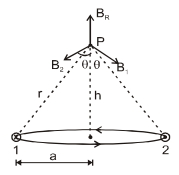
Answer$1.$ $\vec{B}_R=\vec{B}$ due to ring
$\vec{B}_1=\vec{B}$ due to wire $-1$
$\vec{B}_2=\vec{B}$ due to wire $-2$
In magnitudes $B _1= B _2=\frac{\mu_0 I }{2 \pi r }$
Resultant of $B _1$ and $B _2=2 B _1 \cos \theta=\frac{\mu_0 Ia }{\pi \pi^2}$
$B _{ R }=\frac{2 \mu_0 I a ^2}{4 \pi r ^3}$
For zero magnetic field at $P$
$\frac{\mu_0 Ia }{\pi r ^2}=\frac{2 \mu I \pi a ^2}{4 \pi r ^3} $
$\Rightarrow h \approx 1.2 a$
$Image$
$2.$ Magnetic field at mid point of two wires $=\frac{\mu_0 I }{\pi d } \otimes $
Magnetic moment of loop $= I a ^2 $
Torque on loop $= MB \sin 150^{\circ} $
$\qquad=\frac{\mu_0 I ^2 a ^2}{2 d }$
View full question & answer→MCQ 891 Mark
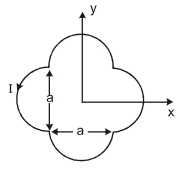
A loop carrying current $I$ lies in the $x$-y plane as shown in the figure. the unit vector $\hat{ k }$ is coming out of the plane of the paper. the magnetic moment of the current loop is :
- A
$a^2 I \hat{k}$
- B
$\left(\frac{\pi}{2}+1\right) a^2 I \hat{k}$
- C
$-\left(\frac{\pi}{2}+1\right) a^2 I \hat{k}$
- D
$(2 \pi+1) a^2 I \hat{k}$
Answer$\text { Area }=a^2+4 \times \frac{\pi\left(\frac{a}{2}\right)^2}{2} $
$=a^2+\frac{\pi a^2}{2} $
$A=\left(1+\frac{\pi}{2}\right) a^2 \hat{k}$
View full question & answer→MCQ 901 Mark
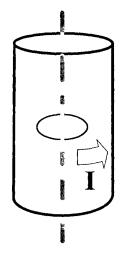
A long circular tube of length $10 \ m$ and radius $0.3 \ m$ carries a current $I$ along its curved surface as shown. A wire-loop of resistance $0.005$ ohm and of radius $0.1 \ m$ is placed inside the tube with its axis coinciding with the axis of the tube. The current varies as $I=I_0 \cos (300 t)$ where $I_0$ is constant. If the magnetic moment of the loop is $N \mu_0 I_0 \sin (300 t)$, then ' $N$ ' is
Answer$l =10 m, r _1=0.3 \ m$
$R =0.005 \Omega, r _2=0.1 \ m$
$I = I _0 \cos (300 t )$
So we get $\omega=300$
The magnetic field of the tube, $B=\frac{\mu_0 NI }{ L }$
In the problem $N =1, \quad L=10 m, \quad I = I _0 \cos (300 t$ )
So, $B=\frac{\mu_0 I_0 \cos (300 t)}{10}$
$Q=\frac{\mu_0 I_0 \cos (300 t)}{10} \times \pi(0.1)^2$
$\text { Induced emf, } e=-\frac{d Q}{d t}=300 \mu_0 \pi I_0 \sin (300 t) \times 10^{-3}$
$e=0.3 \mu_0 \pi I_0 \sin (300 t)$
The current in the ring $i =\frac{ e }{ R }$
$i =\frac{0.3 \pi \mu_0 I _0 \sin (300 t)}{0.005}$
$\text { or } i =60 \mu_0 \pi I _0 \sin (300 t)$
$\text { Magnetic moment, } M = iA = i \pi r ^2$
$M =60 \mu_0 \pi I _0 \sin (300 t) \times \pi(0.1)^2$
$=0.6 \mu_0 \pi^2 I _0 \sin (300 t) A$
$=\left(0.6 \times \pi^2\right) \mu_0 I _0 \sin (300 t)$
$=6 \mu_0 I _0 \sin (300 t)$
So, the value of $N =6$
View full question & answer→MCQ 911 Mark
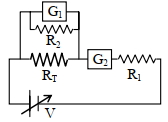
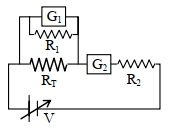
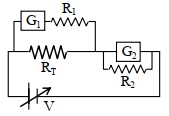
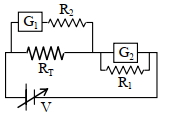
To Verify Ohm's law, a student is provided with a test resistor $\mathrm{R}_{\mathrm{T}}$, a high resistance $\mathrm{R}_1$, a small resistance $\mathrm{R}_2$, two identical galvanometers $\mathrm{G}_1$ and $\mathrm{G}_2$, and a variable voltage source $\mathrm{V}$. The correct circuit to carry out the experiment is
Answer$\mathrm{G}_1$ is acting as voltmeter and $\mathrm{G}_2$ is acting as ammeter.
View full question & answer→MCQ 921 Mark
A moving coil galvanometer of resistance $100 \,\Omega$ is used as an ammeter using a resistance $0.1 \,\Omega$. The maximum deflection current in the galvanometer is $100\,\mu A$. Find the minimum current in the circuit so that the ammeter shows maximum deflection ............... $mA$
- ✓
$100.1$
- B
$1000.1$
- C
$10.01$
- D
$1.01$
AnswerCorrect option: A. $100.1$
(a) ${I_G} \times G = \left( {I - {I_G}} \right)\,S$
$ \Rightarrow $ $I =$ $\left( {1 + \frac{G}{S}} \right){I_G}$
$ \Rightarrow $ $ I = 100.1\, mA$
View full question & answer→MCQ 931 Mark
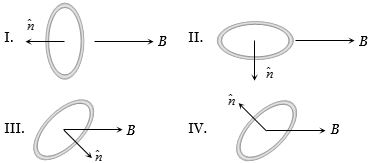
A current carrying loop is placed in a uniform magnetic field in four different orientations, $I$, $II$, $III$ & $IV$ arrange them in the decreasing order of potential Energy
- A
$I > III > II > IV$
- B
$I > II >III > IV$
- ✓
$I > IV > II > III$
- D
$III > IV > I > II$
AnswerCorrect option: C. $I > IV > II > III$
(c) $U = - MB\cos \theta $; where $\theta = $ Angle between normal to the plane of the coil and direction of magnetic field.
View full question & answer→MCQ 941 Mark
A particle of charge $q$ and mass $m$ moves in a circular orbit of radius $r$ with angular speed $\omega $. The ratio of the magnitude of its magnetic moment to that of its angular momentum depends on
- A
$\omega \,{\rm{and}}\,q$
- B
$\omega, \,q\,{\rm{and}}\,m$
- ✓
$q\,\,{\rm{and}}\,m$
- D
$\omega \,{\rm{and}}\,m$
AnswerCorrect option: C. $q\,\,{\rm{and}}\,m$
(c)The effective current $i = \frac{{q\omega }}{{2\pi }}$and $A = \pi {r^2}$.
Magnetic moment $M = iA = \frac{1}{2}q\omega {r^2}$
Angular moment $L = I\omega = m{r^2}\omega $ $==>$ $\frac{M}{L} = \frac{q}{{2m}}$
View full question & answer→MCQ 951 Mark
Two particles each of mass $m$ and charge $q$ are attached to the two ends of a light rigid rod of length $2R$. The rod is rotated at constant angular speed about a perpendicular axis passing through its centre. The ratio of the magnitudes of the magnetic moment of the system and its angular momentum about the centre of the rod is
- ✓
$\frac{q}{{2m}}$
- B
$\frac{q}{m}$
- C
$\frac{{2q}}{m}$
- D
$\frac{q}{{\pi m}}$
AnswerCorrect option: A. $\frac{q}{{2m}}$
(a) $i = \frac{{2q\omega }}{{2\pi }} = \frac{{q\omega }}{\pi };\;\;\therefore M = iA = \frac{{q\omega }}{\pi }\pi {R^2} = q\omega {R^2}$
$L = 2R.mv = 2R.mR\omega = 2m{R^2}\omega \;\;(\therefore v = R\omega )$
$==>$ $\frac{M}{L} = \frac{q}{{2m}}$
View full question & answer→MCQ 961 Mark
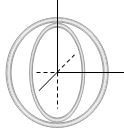
Two insulated rings, one of slightly smaller diameter than the other are suspended along their common diameter as shown. Initially the planes of the rings are mutually perpendicular. When a steady current is set up in each of them
- ✓
The two rings rotate into a common plane
- B
The inner ring oscillates about its initial position
- C
The inner ring stays stationary while the outer one moves into the plane of the inner ring
- D
The outer ring stays stationary while the inner one moves into the plane of the outer ring
AnswerCorrect option: A. The two rings rotate into a common plane
(a) The torque will be exerted on rings.
View full question & answer→MCQ 971 Mark
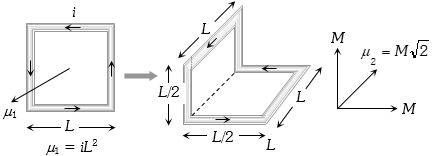
A steady current $i$ flows in a small square loop of wire of side $L$ in a horizontal plane. The loop is now folded about its middle such that half of it lies in a vertical plane. Let $\overrightarrow {{\mu _1}} $ and $\overrightarrow {{\mu _2}} $ respectively denote the magnetic moments due to the current loop before and after folding. Then
- A
$\overrightarrow {{\mu _2}} = 0$
- B
$\overrightarrow {{\mu _1}} $ and $\overrightarrow {{\mu _2}} $ are in the same direction
- ✓
$\frac{{|\overrightarrow {{\mu _1}} |}}{{|\overrightarrow {{\mu _2}} |}} = \sqrt 2 $
- D
$\frac{{|\overrightarrow {{\mu _1}} \,|}}{{|\overrightarrow {{\mu _2}} |}} = \left( {\frac{1}{{\sqrt 2 }}} \right)$
AnswerCorrect option: C. $\frac{{|\overrightarrow {{\mu _1}} |}}{{|\overrightarrow {{\mu _2}} |}} = \sqrt 2 $
(c) Initial magnetic moment $=$ $\mu_1 = iL^2$
After folding the loop, $M =$ magnetic moment due to each part $ = i\,\left( {\frac{L}{2}} \right) \times L = \frac{{i{L^2}}}{2} = \frac{{{\mu _1}}}{2}$
$==>$ ${\mu _2} = M\sqrt 2 = \frac{{{\mu _1}}}{2} \times \sqrt 2 = \frac{{{\mu _1}}}{{\sqrt 2 }}$
View full question & answer→MCQ 981 Mark
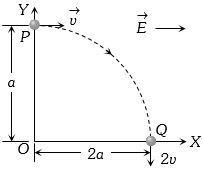
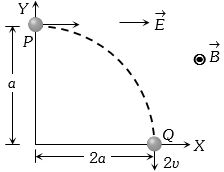
A particle of charge $+q$ and mass $m$ moving under the influence of a uniform electric field $E\hat i$ and a uniform magnetic field $B\hat k$ follows trajectory from $P$ to $Q$ as shown in figure. The velocities at $P$ and $Q$ are $v\hat i$ and $ - 2v\hat j$ respectively. Which of the following statement(s) is/are correct
- A
$E = \frac{3}{4}\frac{{m{v^2}}}{{qa}}$
- B
Rate of work done by electric field at P is $\frac{3}{4}\frac{{m{v^3}}}{a}$
- C
Rate of work done by both the fields at $Q$ is zero
- ✓
Answer(d) Kinetic energy of the particle at point $P = \frac{1}{2}m{v^2}$
$K.E.$ of the particle at point $Q = \frac{1}{2}m{(2v)^2}$
Increase in $K.E.$ $ = \frac{3}{2}m{v^2}$
It comes from the work done by the electric force $qE$ on the particle as it covers a distance $2a$ along the $x$-axis. Thus $\frac{3}{2}m{v^2} = qE \times 2a \Rightarrow E = \frac{3}{4}\frac{{m{v^2}}}{{qa}}$. The rate of work done by the electric field at $P$ $ = F \times v = qE \times v = 3\frac{{m{v^3}}}{{4a}}$
At $Q,\;\overrightarrow {{F_e}} = q\overrightarrow E $ is along $x$-axis while velocity is along negative $y$-axis. Hence rate of work done by electric field Similarly, according to equation $\overrightarrow {{F_m}} = q(\overrightarrow {v\,} \times \overrightarrow B )$
Force $\overrightarrow {{F_{\rm{m}}}} $ is also perpendicular to velocity vector .
Hence the rate of work done by the magnetic field = $0$
View full question & answer→MCQ 991 Mark
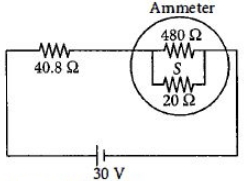
A circuit contains an ammeter, a battery of $30\,V$ and a resistance $40.8\, ohm$ all connected in series. If the ammeter has a coil of resistance $480\,ohm$ and a shunt of $20\,ohm$, the reading in the ammeter will be .................. $A$
AnswerThe circuit is shown in the figure.
Resistance of the ammeter is
$R_{A}=\frac{(480\, \Omega)(20\, \Omega)}{(480\, \Omega+20\, \Omega)}=19.2\, \Omega$
(As $480 \,\Omega$ and $20\, \Omega$ are in parallel)
As ammeter is in series with $40.8\, \Omega$,
$\therefore \quad$ Total resistance of the circuit is
$R=40.8\, \Omega+R_{A}=40.8\, \Omega+19.2\, \Omega=60\, \Omega$
By Ohm's law,
Current in the circuit is
$I=\frac{V}{R}=\frac{30\, \mathrm{V}}{60\, \Omega}=\frac{1}{2} \mathrm{A}=0.5\, \mathrm{A}$
Thus the reading in the ammeter will be $0.5\, \mathrm{A}$.
View full question & answer→MCQ 1001 Mark
A rectangular coil of length $0 .12\, m$ and width $0.1\, m$ having $50$ turns of wire is suspended vertically in a uniform magnetic field of strength $0.2\,\, Weber/m^2.$ The coil carries a current of $2 \,\,A.$ If the plane of the coil is inclined at an angle of $30^o $ with the direction of the field, the torque required to keep the coil in stable equilibrium will be .......$Nm$
- A
$0.12$
- B
$0.15$
- C
$0.20$
- D
$0.24$
AnswerThe required torque is $\tau=N I A B \sin \theta$
where $N$ is the number of turns in the coil, $I$ is the current through the coil, $B$ is the uniform magnetic field, $A$ is the area of the coil and $\theta$ is the angle between the direction of the magnetic field and nomal to the plane of the coil. Here, $N=50, I=2\, \mathrm{A},$
$A=0.12\, \mathrm{m} \times 0.1\, \mathrm{m}=0.012\, \mathrm{m}^{2}$
$B=0.2\, \mathrm{Wb} / \mathrm{m}^{2} \text { and } \theta=90^{\circ}-30^{\circ}=60^{\circ}$
$\therefore \quad \tau =(50)(2\, \mathrm{A})\left(0.012\, \mathrm{m}^{2}\right)\left(0.2\, \mathrm{Wb} / \mathrm{m}^{2}\right) \sin 60^{\circ} $
$=0.20\, \mathrm{N} \mathrm{m}$
View full question & answer→