MCQ 1011 Mark
In an ammeter $0.2\%$ of main current passes through the galvanometer. If resistance of galvanometer is $G,$ the resistance of ammeter will be
- A
$\frac{1}{{499}}G$ $Ω$
- B
$\frac{{499}}{{500}}G$ $Ω$
- C
$\frac{1}{{500}}G\;\;$ $Ω$
- D
$\frac{{500}}{{499}}G\;\;$ $Ω$
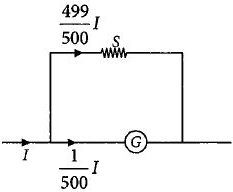
AnswerHere, resistance of the galvanometer $=G$
Current through the galvanometer,
$I_{G}=0.2 \% \text { of } I=\frac{0.2}{100} I=\frac{1}{500} I$
$\therefore$ Current through the shunt,
$I_{S}=I-I_{G}=I-\frac{1}{500} I=\frac{499}{500} I$
As shunt and galvanometer are in parallel
$\therefore \quad I_{G} G=I_{S} S$
$\left(\frac{1}{500} I\right) G=\left(\frac{499}{500}\right) S \text { or } S=\frac{G}{499}$
Resistance of the ammeter $R_{A}$ is
${\frac{1}{R_{A}}=\frac{1}{G}+\frac{1}{S}=\frac{1}{G}+\frac{1}{G}=\frac{500}{G}}$
${R_{A}=\frac{1}{500} \,G}$
View full question & answer→MCQ 1021 Mark
A current loop in a magnetic field
- A
experiences a torque whether the field is uniform or non uniform in all orientations.
- B
can be in equilibrium in one orientation.
- C
can be in equilibrium in two orientations,both the equilibrium states are unstable.
- D
can be in equilibrium in two orientations, one stable while the other is unstable.
AnswerWhen a current loop is placed in a magnetic field it experiences a torque. It is given by
$\vec{\tau}=\vec{M} \times \vec{B}$
where, $\vec{M}$ is the magnetic moment of the loop and $\vec{B}$ is the magnetic field.
or $\quad \tau=M B \sin \theta$ where $\theta$ is angle between $M$ and $B$ When $\vec{M}$ and $\vec{B}$ are parallel (i.e. $\theta=0^{\circ}$ ) the equilibrium is stable and when they are antiparallel (i.e. $\theta=\pi$ ) the equilibrium is unstable.
View full question & answer→MCQ 1031 Mark
An alternating electric field, of frequency $f$, is applied across the dees $(\, radius \,\approx\, R)$ of a cyclotron that is being used to accelerate protons $(\,mass \,\approx \, m).$ The operating magnetic field $(B)$ used in the cyclotron and the kinetic energy $(K)$ of the proton beam, produced by it, are given by
- A
$B = \frac{{mf}}{e}$ ,$K = 2m{\pi ^2}{f^2}{R^2}$
- B
$\;B = \frac{{2\pi mf}}{e}$ ,$K = \pi {m^2}{f^{}}{R^2}$
- C
$B = \frac{{2\pi mf}}{e}$ ,$K = 2m{\pi ^2}{f^2}{R^2}$
- D
$B = \frac{{mf}}{e}$ ,$K = \pi {m^2}{f^{}}{R^2}$
Answer$\text { Frequency, } v=\frac{e B}{2 \pi m}$
or $\quad B=\frac{2 \pi m v}{e}.........(i)$
As $\frac{m v^{2}}{R}=e v B$
${\text{or }}v = \frac{{eBR}}{m} = \frac{{e2\pi mvR}}{{me}}\,\,\,\,\,(U\sin g\,(i))$
$ = 2\pi vR{\text{ }}.........{\text{(ii)}}$
${\text{Kinetic energy, }}K = \frac{1}{2}m{v^2} = \frac{1}{2}m{(2\pi vR)^2}{\text{ }}$
$=2m\pi ^2v^2R^2$
View full question & answer→MCQ 1041 Mark
A milli voltmeter of $25$ $milli$ $volt$ range is to be converted into an ammeter of $25$ $ampere$ range. The value (in $ohm$) of necessary shunt will be
- A
$0.001\,Ω$
- B
$0.01\,Ω$
- C
$1\,Ω$
- D
$0.05\,Ω$
Answer$S=\frac{V_{g}}{\left(I-I_{g}\right)}$
Neglecting $I_{z}$
$\therefore \quad S=\frac{V_{g}}{I}=\frac{25 \times 10^{-3} \,\mathrm{V}}{25 \,\mathrm{A}}=0.001\, \Omega$
View full question & answer→MCQ 1051 Mark
A galvanometer of resistance, $G,$ is shunted by a resistance $S$ $ohm$. To keep the main current in the circuit unchanged, the resistance to be put in series with the galvanometer is
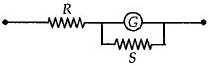
AnswerLet resistance $R$ is to be put in series with galvanometer $G$ to keep the main current in the circuit unchanged.
$\therefore \frac{G S}{G+S}+R=G$
$R=G-\frac{G S}{G+S} \Rightarrow R=\frac{G^{2}+G S-G S}{G+S}$
$R=\frac{G^{2}}{G+S}$
View full question & answer→MCQ 1061 Mark
A galvanometer has a coil of resistance $100\, ohm$ and gives a full scale deflection for $30\, mA$ current. If it is to work as a voltmeter of $30\, volt$ range, the resistance required to be added will be.....$Ω$
- A
$900 $
- B
$1800$
- C
$500 $
- D
$1000$
AnswerResistance of galvanometer, $G=100 \,\Omega$
Current for full scale deflection, $I_{g}=30 \,\mathrm{mA}$
$=30 \times 10^{-3}\, \mathrm{A}$
Range of voltmeter, $V=30\, \mathrm{V}$
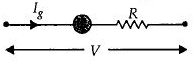
To convert the galvanometer into an voltmeter of a given range, a resistance $R$ is connected in series with it as shown in the figure.
From figure, $V=I_{g}(G+R)$
$ \text { or } R=\frac{V}{I_{8}}-G =\frac{30}{30 \times 10^{-3}}-100\, \Omega $
$=1000-100=900\, \Omega$
View full question & answer→MCQ 1071 Mark
A closely wound solenoid of $2000$ $turns$ and area of cross-section $1.5 \times 10^{-4}\ m^2$ carries a current of $2.0\, A.$ It is suspended through its centre and perpendicular to its length, allowing it to turn in a horizontal plane in a uniform magnetic field $5 \times 10^{- 2}$ $tesla$ making an angle of $30^o $ with the axis of the solenoid. The torque on the solenoid will be
- A
$3 \times 10^{-3}\ Nm$
- B
$1.5 \times 10^{-3}\ Nm$
- C
$1.5 \times 10^{-2}\ Nm$
- D
$3 \times 10^{-2}\ Nm$
AnswerMagnetic moment of the loop.
$ M=N I A=2000 \times 2 \times 1.5 \times 10^{-4}=0.6 \,\mathrm{J} / \mathrm{T} $
$\text { Torque } \tau =M B \sin 30^{\circ} $
$=0.6 \times 5 \times 10^{-2} \times \frac{1}{2}=1.5 \times 10^{-2}\, \mathrm{N} \mathrm{m}$
View full question & answer→MCQ 1081 Mark
A galvanometer having a coil resistance of $60\,\,\Omega$ shows full scale deflection when a current of $1.0$ $amp$ passes through it. It can be converted into an ammeter to read currents upto $5.0$ $amp$ by
- A
putting in series a resistance of $15\,Ω $
- B
putting in series a resistance of $240\,Ω $
- C
putting in parallel a resistance of $15\,Ω$
- D
putting in parallel a resistance of $240\,Ω$
Answer$i G=(I-i) S$ where $G$ is the galvanometer resistance and $S$ is the shunt used with the ammeter. $1.0 \times 60=(5-1) S$ where $S$ is the shunt used to read a $5\, A$ current when the galvanometer can stand by $1\, \mathrm{A}.$
$S=\frac{1.0 \times 60}{4}=15 \,\Omega $ in parallel.
View full question & answer→MCQ 1091 Mark
A galvanometer of resistance $50\, \Omega$ is connected to a battery of $3\, V$ along with a resistance of $2950\, \Omega$ in series. A full scale deflection of $30$ divisions is obtained in the galvanometer. In order to reduce this deflection to $20$ divisions, the resistance in series should be.......$Ω$
- A
$6050$
- B
$4450$
- C
$5050$
- D
$5550$
AnswerTotal initial resistance $=R_{G}+R_{1}=(50+2950)\, \Omega=3000\, \Omega$
$\varepsilon=3\, \mathrm{V}$
$\therefore$ Current $=\frac{3\, \mathrm{V}}{3000 \,\Omega}=1 \times 10^{-3} \,\mathrm{mA}$
If the deflection has to be reduced to $20$ divisions, current $i=1\, \mathrm{mA} \times \frac{2}{3}$ as the full deflection scale for
$1\,\mathrm{mA}=30$ divisions.
$3\, \mathrm{V}=3000\, \Omega \times 1 \,\mathrm{mA}=x\, \Omega \times \frac{2}{3} \,\mathrm{mA}$
$\Rightarrow x=3000 \times 1 \times \frac{3}{2}=4500\, \Omega$
But the galvanometer resistance $=50\, \Omega$
Therefore the resistance to be added
$=(4500-50) \,\Omega=4450\, \Omega$
View full question & answer→MCQ 1101 Mark
The resistance of an ammeter is $13\, \Omega$ and its scale is graduated for a current upto $100$ $amps$. After an additional shunt has been connected to this ammeter it becomes possible to measure currents upto $750$ $ampere$ by this meter. The value of shunt-resistance is
- A
$2 \,\Omega $
- B
$0.2 \,\Omega $
- C
$2 \,k\Omega $
- D
$20 \,\Omega $
AnswerLet the shunt resistance be $S$.
Given: $I=750\, \mathrm{A}$
$I_{\mathrm{g}}=100\, \mathrm{A}, R_{G}=13\, \Omega$
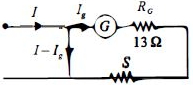
From the figure,
$I_{g} R_{G}=\left(I-I_{g}\right) S$
or $100 \times 13=[750-100] S$
or $1300=650\, S$
$\therefore S=1300 / 650=2\, \Omega$
View full question & answer→MCQ 1111 Mark
A coil in the shape of an equilateral triangle of side $l$ is suspended between the pole pieces of a permanent magnet such that $\vec {B}$ is in plane of the coil. If due to a current $i$ in the triangle a torque $\tau$ acts on it, the side $l$ of the triangle is
- A
$\frac{2}{\sqrt{3}}\left(\frac{\tau}{B i}\right)$
- B
$2\left(\frac{\tau}{\sqrt{3} B i}\right)^{1 / 2}$
- C
$\frac{2}{\sqrt{3}}\left(\frac{\tau}{B i}\right)^{1 / 2}$
- D
$\frac{1}{\sqrt{3}} \frac{\tau}{B i}$
AnswerThe current flowing clockwise in an equilateral triangle has a magnetic field in the direction of $\hat{ k }$
$\tau=\operatorname{BiN} A \sin \theta$
$\tau=\operatorname{BiN} A \sin 90^{\circ}$
$\tau= Bi \times \frac{\sqrt{3}}{4} I ^{2} \times 1$
$\left[\because\right.$ Area of equilateral triangle $=\frac{\sqrt{3}}{4} I ^{2}$ and $\left. N =1\right]$
$\Rightarrow I ^{2}=\frac{4 \tau}{\sqrt{3} Bi } \Rightarrow I =2\left[\frac{\tau}{ Bi \sqrt{3}}\right]^{1 / 2}$
View full question & answer→MCQ 1121 Mark
A galvanometer can be used as a voltmeter by connecting a
- A
High resistance in series
- B
- C
High resistance in parallel
- D
Low resistance in parallel
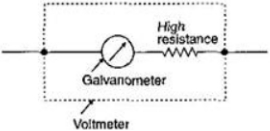
AnswerA galvanometer has its own resistance low but a voltmeter must have high resistance. $A$ voltmeter indeed is a modified form of a pivoted coil galvanometer. since the resistance of coil of galvanometer of its own is low, its resistance is to be increased as is a necessary condition for a voltmeter. For this an appropriate high resistance should be connected in series with the galvanometer as shown.
Note$:$The resistance of an ideal voltmeter should be infinite.
View full question & answer→MCQ 1131 Mark
A galvanometer of $50\, ohm$ resistance has $25$ divisions. A current of $4 \times 10^{-4}$ ampere gives a deflection of one division. To convert this galvanometer into a voltmeter having a range of $25\, volts$, it should be connected with a resistance of
- A
$2500 \,\Omega$ as a shunt
- B
$2450 \,\Omega$ as a shunt
- C
$2550 \,\Omega$ in series
- D
$2450 \,\Omega$ in series
AnswerFull deflection current ${i_g} = 25 \times 4 \times {10^{ - 4}}$$ = 100 \times {10^{ - 4}}A$
Using $R = \frac{V}{{{I_g}}} - G$$ = \frac{{25}}{{100 \times {{10}^{ - 4}}}} - 50$$ = 2450\,\Omega $ in series.
View full question & answer→MCQ 1141 Mark
If number of turns, area and current through a coil is given by $N, A$ and $I$ respectively then its magnetic moment will be
- A
$NIA^2$
- B
$\frac {NI}{\sqrt A}$
- C
${N^2}AI$
- D
$NIA$
AnswerMagnetic dipole moment of coil $=$ $NIA$
View full question & answer→MCQ 1151 Mark
A galvanometer having a resistance of $9\, ohm$ is shunted by a wire of resistance $2\, ohm$. If the total current is $1\, amp$, the part of it passing through the shunt will be ............ $amp$
- A
$0.25$
- B
$0.8$
- C
$0.2$
- D
$0.5$
Answer${i_g}S = (i - {i_g})G$
${i_g}(S + G) = iG$
$\frac{{{i_g}}}{i} = \frac{G}{{S + G}} = \frac{9}{{2 + 9}} \approx 0.8$
View full question & answer→MCQ 1161 Mark
A circular loop of area $0.01\,{m^2}$ carrying a current of $10\, A$, is held perpendicular to a magnetic field of intensity $0.1\,T$. The torque acting on the loop is......$N-m$
- A
$0$
- B
$0.01$
- C
$0.001$
- D
$0.8$
AnswerGiven:
$A=0.01 \mathrm{~m}^2, \mathrm{I}=10 \mathrm{~A}, \mathrm{~B}=0.1 \mathrm{~T},$
$\theta=0^{\circ}$
To find:
Torque acting on the loop, $\tau$
Solution:
Magnetic moment, $M=(I)(A)$
The torque acting on the loop is given as, $\vec{\tau}=\vec{M} \times \vec{B}$
$\tau=M B \sin \theta $
$\tau=1 A B \sin 0$
$\tau=0\;\mathrm{Nm}$
View full question & answer→MCQ 1171 Mark
A coil carrying electric current is placed in uniform magnetic field, then
Answer(a) As magnetic field is uniform so its rate of change with time is zero. By Faraday's law of induction, no emf is induced.
But current carrying coil experience torque inside magnetic field, which is cross product of magnetic moment of the coil and the magnetic field. $\vec{\tau}=\vec{M} \times \vec{B}$
Option $A$ is correct.
View full question & answer→MCQ 1181 Mark
To convert a galvanometer into a ammeter, one needs to connect a
- A
low resistance in parallel
- B
high resistance in parallel
- C
- D
high resistance in series
AnswerTo convert a galvanometer into an ammeter, one needs to connect a low resistance in parallel so that maximum current passes through the shunt wire and ammeter remains protected.
View full question & answer→MCQ 1191 Mark
Energy in a current carrying coil is stored in the form of
- A
- B
Electric field and Magnetic field both
- C
- D
AnswerA current carrying coil does not necessarily carry the electric charge.But it will always generate magnetic field therefore, energy in a current carrying wire is stored in the form of magnetic field.
View full question & answer→MCQ 1201 Mark
A current carrying coil is subjected to a uniform magnetic field. The coil will orient so that its plane becomes
AnswerThe plane of coil will orient it self so that area vector aligns itself along the magnetic field. So, the plane will orient perpendicular to the magnetic field.
View full question & answer→MCQ 1211 Mark
$\alpha$ particle is revolving in radius $r$ with frequency $f$ then find value of magnetic dipole moment.
- A
$2\,evr$
- B
$evr$
- C
$3\,evr$
- D
$4\,evr$
AnswerThe magnetic dipole moment is calculated as,
$M=i \times \pi r^{2}$
$=\frac{2 e}{2 \pi r} \times v \times \pi r^{2}$
$=\frac{2 e v r}{2}$
$=e v r$
View full question & answer→MCQ 1221 Mark
A coil is placed in $y-z$ plane making an angle of $30^{\circ}$ with $x$ -axis. The current through coil is $I,$ and number of turns are $N$. If a magnetic field of strength $'B'$ is applied in positive $x-$direction, then find the torque experienced by the coil (Radius of coil is $R$) (in $N \cdot m$)
$\left(N=100, I=1 A, R=2\, m, B=\frac{1}{\pi} T\right)$
AnswerThe torque experienced by the coil is calculated as,
$\tau=N L A B \sin \theta$
$=N I\left(\pi R^{2}\right) B \sin 30^{\circ}$
$=100 \times \pi \times(2)^{2} \times \frac{1}{\pi} \times \frac{1}{2}$
$=200 N - m$
View full question & answer→MCQ 1231 Mark
In the adjoining circuit diagram, the readings of ammeter and voltmeter are $2\, A$ and $120 \,V$, respectively. If the value of $R$ is $75\, \Omega$, then the voltmeter resistance will be $\Omega$
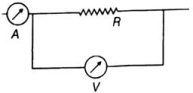
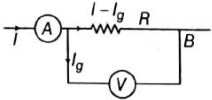
Answer$\because V_{A B}=\left(I-I_{g}\right) R=I_{g} \cdot G$
Where, $G=$ voltmeter (resistance)
Given, $V_{A B}=120 V , I=2 A, R=75 \Omega$
$\Rightarrow 120=\left(2-I_{g}\right) 75 \Rightarrow I_{g}=0.4 A$
Now, $V_{A B}=I_{g} G \Rightarrow G=\frac{120}{0.4}=300 \Omega$
View full question & answer→MCQ 1241 Mark
In the circuit, shown the galvanometer $G$ of resistance $60\, \Omega$ is shunted by a resistance $r=0.02\, \Omega$. The current through $R$ (in $ohm$) is nearly $1\, A$. The value of resistance $R$ (in $ohm$) is nearly (in $\Omega$)
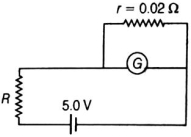
AnswerHere, resistance of the galvanometer
$R_{G}=60 \Omega$
When the galvanometer is shunted by a resistance $r$, its effective resistance
$R_{P}=\frac{R_{G} r}{R_{G}+r}=\frac{60 \times 0.02}{60+0.02} \approx 0.02 \Omega$
Total resistance of the circuit $=R+R_{P}=R+0.02$
Current, $I=\frac{5}{R+0.02} \Rightarrow 1=\frac{5}{R+0.02}$
$R+0.02=5 \Rightarrow R=5-0.02=4.98 \approx 5 \Omega$
View full question & answer→MCQ 1251 Mark
A voltmeter of resistance $20000\,\Omega$ reads $5$ volt. To make it read $20$ volt, the extra resistance required is
- A
$40000\,\Omega$ in parallel
- B
$60000\,\Omega$ in parallel
- ✓
$60000\,\Omega$ in series
- D
$40000\,\Omega$ in series
AnswerCorrect option: C. $60000\,\Omega$ in series
(c)
For a voltmeter, in which current $I_g$ passes,
when range is lower, $5= G \times I_g$
when range is higher, $20=(G+R) I_g$
where $G=$ resistance of voltmeter $=20000\,\Omega$
$\therefore \quad \operatorname{From}(i)$ and $(i i)$
$\frac{5}{20}=\frac{G}{G+R}$ or $\frac{1}{4}=\frac{G}{G+R}$
or $R=3 G=3 \times 20000=60000$
or extra resistance $=60000\,\Omega$ in series.
View full question & answer→MCQ 1261 Mark
Assertion : The sensitivity of a moving coil galvanometer is increased by placing a suitable magnetic material as a core inside the coil.
Reason : Soft iron has high magnetic permeability and cannot be easily magnetized or demagnetized.
- A
If both Assertion and Reason are correct and the Reason is a correct explanation of the Assertion.
- B
If both Assertion and Reason are correct but Reason is not a correct explanation of the Assertion.
- C
If the Assertion is correct but Reason is incorrect.
- D
If both the Assertion and Reason are incorrect.
AnswerSensitivity of galvanometer
$s\, = \,\frac{\theta }{i} \simeq \frac{{\tan \,\theta }}{i} = \frac{{{\mu _0}N}}{{2R{B_H}}}.$
If a magnetic material is placed inside coil of galvanometer, then
$s\,'\, = \,\frac{{{\mu _r}{\mu _0}N}}{{2R{B_H}}}$
View full question & answer→MCQ 1271 Mark
Assertion: To convert a galvanometer into an ammeter a small resistance is connected in parallel with it.
Reason: The small resistance increases the combined resistance of the combination.
- A
If both Assertion and Reason are correct and Reason is the correct explanation of Assertion.
- B
If both Assertion and Reason are correct, but Reason is not the correct explanation of Assertion.
- C
If Assertion is correct but Reason is incorrect.
- D
If both the Assertion and Reason are incorrect.
AnswerAn ammeter should have a low resistance which we get when we connect low resistance in parallel with galvanometer.
View full question & answer→MCQ 1281 Mark
Consider the diagram shown below. A voltmeter of resistance $150\,\Omega$ is connected across $A$ and $B$. The potential drop across $B$ and $C$ measured by voltmeter is $...........\,V$
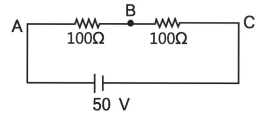
Answer(c)
When a voltmeter of resistance $150\,\Omega$ is connected across $A$ and $B$, the resistance across $A$ and $B$ will be
$R _{ ab }=\frac{150 \times 100}{150+100}=60\,\Omega$
Now the equivalent resistance of the circuit will be $R_{a c}=R_{a b}+R_{b c}=60+100=$ $160\,\Omega$
The current in the circuit will be $I=50 / 160=0.31\,A$
Thus, Potential drop across B and C will be $V _{ bc }= IR _{ bc }=(0.31)(100)=31\,V$
View full question & answer→MCQ 1291 Mark
Four wires, each of length $2.0\,m$, are bent into four loops $P,\,Q,\,R$ and $S$ and then suspended in a uniform magnetic field. If the same current is passed in each, then the torque will be maximum on the loop
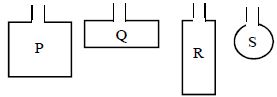
AnswerFor a given perimeter the area of circle is maximum. So magnetic moment of $(S)$ is greatest.
View full question & answer→MCQ 1301 Mark
The resistance of a galvanometer is $50\,\Omega $ and current required to give full scale deflection is $100\,μA$ in order to convert it into an ammeter for reading upto $10\,A$. It is necessary to put an resistance of
- A
$3.5\times 10^{-4}\,\Omega $
- B
$10\times 10^{-4}\,\Omega $
- C
$2.5\times 10^{-4}\,\Omega $
- D
$5\times 10^{-4}\,\Omega $
Answer$\mathrm{G}=50\, \Omega$, $\mathrm{I}_{\mathrm{G}}=100\, \mu \mathrm{A}$, $\mathrm{I}=10\, \mathrm{A}$
Shunt, $\mathrm{S}=\left(\frac{\mathrm{I}_{\mathrm{G}}}{\mathrm{I}-\mathrm{I}_{\mathrm{G}}}\right) \mathrm{G}$
$\Rightarrow $ $\mathrm{S}=\left(\frac{100 \times 10^{-6}}{10-100 \times 10^{-6}}\right) \times 50$
$=\frac{10^{-4}}{10} \times 50=5 \times 10^{-4}\,\Omega$
View full question & answer→MCQ 1311 Mark
Assertion : Voltmeter is connected in parallel with the circuit.
Reason : Resistance of a voltmeter is very large.
- A
If both Assertion and Reason are correct and the Reason is a correct explanation of the Assertion.
- B
If both Assertion and Reason are correct but Reason is not a correct explanation of the Assertion.
- C
If the Assertion is correct but Reason is incorrect.
- D
If both the Assertion and Reason are incorrect.
AnswerVoltmeter is a galvanometer with high resistance. It measures potential drop across any part of an electrical circuit. It is connected in parallel so that it does not draw any current itself (due to high resistance) and does not affect net resistance of the circuit.
View full question & answer→MCQ 1321 Mark
The cyclotron frequency of an electron grating in a magnetic field of $1\, T$ is approximately
- A
$28\, MHz$
- B
$280\, MHz$
- C
$2.8\, GHz$
- ✓
$28\, GHz$
AnswerCorrect option: D. $28\, GHz$
(d) Cyclotron frequency $v = \frac{{Bq}}{{2\pi m}}$
$ \Rightarrow v = \frac{{1 \times 1.6 \times {{10}^{ - 19}}}}{{2 \times 3.14 \times 9.1 \times {{10}^{ - 31}}}} = 2.79 \times {10^{10}}{H_z}$
$ = 27.9 \times {10^9}HZ \cong \;28\;GHz$
View full question & answer→MCQ 1331 Mark
Cyclotron is used to accelerate
Answer(c) A cylotron is a device by which the positively charged particles like proton, deuetron etc., can be acclearated. The working of cyclotron is bassed on the fact that a positively charged particle can be accelerated to a suffciently high energy with the help of similler values of oscilating electric field by making it to cross the same electric field time and again with the use of strong magentic field.
View full question & answer→MCQ 1341 Mark
Assertion : Cyclotron does not accelerate electron.
Reason : Mass of the electrons is very small
- A
If the Assertion is correct but Reason is incorrect.
- B
If both Assertion and Reason are correct but Reason is not a correct explanation of the Assertion.
- C
If both Assertion and Reason are correct and the Reason is a correct explanation of the Assertion.
- D
If both the Assertion and Reason are incorrect.
AnswerCyclotron does not accelerate electron because mass of electron is very small. It gets accelerated very appreciably as a result of which its mass increases. It result is mismatch between frequency of $a.c.$ used and frequency of rotation of electron in the Dee’s. So cyclotron stops accelerating electrons after some time.
View full question & answer→MCQ 1351 Mark
The resistance of a galvanometer is $50\, ohms$ and the current required to give full scale deflection is $100\,\mu A$. In order to convert it into an ammeter, reading upto $10\,A$, it is necessary to put a resistance of
- A
$5 \times {10^{ - 3}}\,\Omega $ in parallel
- B
$5 \times {10^{ - 4}}\,\Omega $ in parallel
- C
${10^5}\,\Omega $ in series
- D
$99,950\,\Omega $ in series
AnswerResistance in parallel $S = \frac{{G{i_g}}}{{i - {i_g}}} = \frac{{50 \times 100 \times {{10}^{ - 6}}}}{{(10 - 100 \times {{10}^{ - 6}})}}$
$ \Rightarrow $ $S = 5 \times {10^{ - 4}}\,\Omega $
View full question & answer→MCQ 1361 Mark
Assertion : Cyclotron is a device which is used to accelerate the positive ion.
Reason : Cyclotron frequency depends upon the velocity
- A
If both Assertion and Reason are correct and the Reason is a correct explanation of the Assertion.
- B
If both Assertion and Reason are correct but Reason is not a correct explanation of the Assertion.
- C
If the Assertion is correct but Reason is incorrect.
- D
If both the Assertion and Reason are incorrect.
AnswerCyclotron is used to accelerate charged partides. So Assertion is correct.
We know that time period of a particle
$\mathrm{T}=\frac{2 \pi \mathrm{r}}{\mathrm{v}_{0}} ; \frac{\mathrm{mv}_{0}^{2}}{\mathrm{r}}=\mathrm{Bqv}_{0} \Rightarrow \mathrm{v}_{0}=\frac{\mathrm{Bqr}}{\mathrm{m}}$
$\mathrm{T}=\frac{2 \pi \mathrm{r}}{\mathrm{Bqr}} \times \mathrm{m}=\frac{2 \pi}{\mathrm{Bq}} \mathrm{m}$
Frequency $=\frac{1}{\mathrm{T}}=\frac{\mathrm{Bq}}{2 \pi \mathrm{m}}$
This does not dpeend upon velocity so Reason is incorrect.
View full question & answer→MCQ 1371 Mark
A thin circular disk of radius $R$ is uniformly charged with density $\sigma>0$ per unit area. The disk rotates about its axis with a uniform angular speed $\omega$. The magnetic moment of die disk is
- A
$2 \pi R^{4} \sigma \omega$
- B
$\pi R^{4} \sigma \omega$
- C
$\frac{\pi R ^{4}}{2} \sigma \omega$
- D
$\frac{\pi R^{4}}{4} \cdot \sigma \omega$
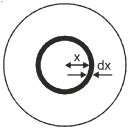
Answer$dq =\sigma \times 2 \pi x \times dx =2 \pi \sigma xdx$
$dI =\frac{ dq }{ dt }$ $=\frac{2 \pi \cdot \sigma \cdot x \cdot dx }{ dt }$
$\frac{2 \pi}{ dt }=\omega$
$\therefore dI =\omega \cdot \sigma \cdot x \cdot dx$
$dM = dI \times \pi \times x ^{2}$
$=\omega \sigma x d x \cdot \pi \cdot x^{2}$
$=\omega \sigma x ^{3} dx$
$M=\int_{0}^{R} d M$
$=\int_{0}^{R} \omega \sigma \pi x^{3} d x$
$=\omega \sigma \pi \int_{0}^{ R } x ^{3} \cdot dx$
$=\omega \cdot \sigma \cdot \pi\left(\frac{ x ^{4}}{4}\right)_{0}^{ R }$
$=\omega \cdot \sigma \cdot \pi\left(\frac{ R ^{4}}{4}\right)$
$=\frac{1}{4} \pi R ^{4} \cdot \sigma w$
View full question & answer→MCQ 1381 Mark
A moving coil galvanometer has $150$ equal divisions. Its current sensitivity is $10$ divisions per milliampere and voltage sensitivity is $2$ divisions per millivolt. In order that each division reads $1\, volt$, the resistance in $ohms$ needed to be connected in series with the coil will be
- A
$99995$
- B
$9995$
- C
${10^3}$
- D
${10^5}$
AnswerVoltage sensitivity $ = \frac{{{\rm{Current \,sensitivity}}}}{{{\rm{Resistance\, of \,galvanometer}}\,{\rm{G}}}}$
$ \Rightarrow $ $G = \frac{{10}}{2} = 5\,\Omega $.
Here ${i_g} = $ Full scale deflection current $ = \frac{{150}}{{10}} = 15\,mA$.
$V =$ Voltage to be measured $= 150 × 1 = 150 \,V.$
Hence $R = \frac{V}{{{i_g}}} - G = \frac{{150}}{{15 \times {{10}^{ - 3}}}} - 5 = 9995\,\Omega $.
View full question & answer→MCQ 1391 Mark
An ammeter reads upto $1\, ampere$. Its internal resistance is $0.81\, ohm$. To increase the range to $10\, A$ the value of the required shunt is ............ $\Omega $
- A
$0.09 $
- B
$0.03 $
- C
$0.3$
- D
$0.9 $
Answer$\frac{i}{{{i_g}}} = 1 + \frac{G}{S}$
$ \Rightarrow $ $\frac{{10}}{1} = 1 + \frac{{0.81}}{S}$
$ \Rightarrow S = 0.09\,\Omega $.
View full question & answer→MCQ 1401 Mark
A magnetic needle lying parallel to a magnetic field requires $W$ units of work to turn it through $60°$ . The torque required to maintain the needle in this position will be
- ✓
$\sqrt 3 \,W$
- B
$W$
- C
$\frac{{\sqrt 3 }}{2}W$
- D
$2\,\,W$
AnswerCorrect option: A. $\sqrt 3 \,W$
(a)$W = MB(\cos {\theta _1} - \cos {\theta _2}) = MB(\cos {0^o} - \cos {60^o})$
$ = MB\,\left( {1 - \frac{1}{2}} \right) = \frac{{MB}}{2}$
and $\tau = MB\sin \theta = MB\sin {60^o} = MB\frac{{\sqrt 3 }}{2}$
$\therefore \;\tau = \left( {\frac{{MB}}{2}} \right)\sqrt 3 \Rightarrow \tau = \sqrt 3 \,W$
View full question & answer→MCQ 1411 Mark
If an ammeter is to be used in place of a voltmeter then we must connect with the ammeter a
- A
Low resistance in parallel
- B
High resistance in parallel
- ✓
High resistance in series
- D
AnswerCorrect option: C. High resistance in series
(c)If ammeter is used in place of voltmeter (i.e. in parallel) it may damage due to large current in circuit. Hence to control this large amount of current a high resistance must be connected in series.
View full question & answer→MCQ 1421 Mark
The flux density obtained at the centre of a circular coil of radius $R$ which carries a current $i$, is $B_0$. At a distance $‘pR’$ from the centre on the axis, the flux density will be
- A
$\frac{{{B_0}}}{{\left( { - p + 1} \right)\sqrt {p + 1} }}$
- B
$\frac{{{B_0}}}{{\left( {{p^2} + 1} \right)\sqrt {{p^2} - 1} }}$
- C
$\frac{{{B_0}}}{{\left( {{p^2} + 1} \right)\sqrt {{p^2} + 1} }}$
- D
$\frac{{{B_0}}}{{\left( { p - 1} \right)\sqrt {p - 1} }}$
View full question & answer→MCQ 1431 Mark
A conducting ring of radius $'r$' is placed in a varying magnetic field perpendicular to the plane of the ring, the rate at which magnetic field varies is $x$ the electric field intensity at any point of the ring is
- A
$rx$
- B
$\frac{{rx}}{2}$
- C
$2rx$
- D
$\frac{{4r}}{x}$
Answer$\oint \mathrm{E.d} \ell=\frac{\mathrm{d} \phi_{\mathrm{B}}}{\mathrm{dt}}$
$E$. $2 \pi r=\pi r^{2} \frac{d B}{d t}$
$\mathrm{E} .2 \pi \mathrm{r}=\pi \mathrm{r}^{2} \mathrm{x}$
View full question & answer→MCQ 1441 Mark
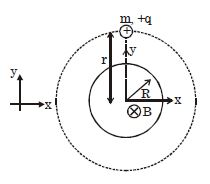
Circular region of radius $R$ has uniform magnetic field $B = {B_0} + {B_0}t\left( { - \hat k} \right).\,At\,\,t\, = 0\,$ acceleration of charged particle
- A
$\frac{{q{B_0}{R^2}}}{{2mr}}$
- B
$\frac{{q{B_0}R}}{{2mr}}$
- C
$\frac{{q{B_0}{R^3}}}{{2m{r^2}}}$
- D
$\frac{{q{B_0}{R^2}}}{{mr}}$
Answer$\pi \mathrm{R}^{2} \mathrm{B}_{0}=\mathrm{E} \times 2 \pi \mathrm{r}$
$\mathrm{E}=\frac{\pi \mathrm{R}^{2}}{2 \pi \mathrm{r}} \mathrm{B}_{0}=\frac{\mathrm{R}^{2} \mathrm{B}_{0}}{2 \mathrm{r}}$
$a=\frac{q E}{m}=\frac{q}{m} \frac{R^{2} B_{0}}{2 r}=\frac{q B_{0} R^{2}}{2 m r}$
View full question & answer→MCQ 1451 Mark
The field normal to the plane of a wire of $n$ turns and radius $r$ which carries a current $i$ is measured on the axis of the coil at a small distance $h$ from the centre of the coil. This is smaller than the field at the centre by the fraction
- ✓
$\frac{3}{2}\frac{{{h^2}}}{{{r^2}}}$
- B
$\frac{2}{3}\frac{{{h^2}}}{{{r^2}}}$
- C
$\frac{3}{2}\frac{{{r^2}}}{{{h^2}}}$
- D
$\frac{2}{3}\frac{{{r^2}}}{{{h^2}}}$
AnswerCorrect option: A. $\frac{3}{2}\frac{{{h^2}}}{{{r^2}}}$
(a) Field at the centre ${B_1} = \frac{{{\mu _0}}}{{4\pi }} \times \frac{{2\pi in}}{r} = \frac{{{\mu _0}}}{2}.\frac{{ni}}{r}$
Field at a distance $h$ from the centre
${B_2} = \frac{{{\mu _0}}}{{4\pi }}.\frac{{2\pi ni{r^2}}}{{{{({r^2} + {h^2})}^{3/2}}}} = \frac{{{\mu _0}}}{2}.\frac{{ni{r^2}}}{{{r^3}{{\left( {1 + \frac{{{h^2}}}{{{r^2}}}} \right)}^{3/2}}}}$
$ = {B_1}{\left( {1 + \frac{{{h^2}}}{{{r^2}}}} \right)^{ - 3/2}} = {B_1}\left( {1 - \frac{3}{2}.\frac{{{h^2}}}{{{r^2}}}} \right)$(By binomial theorem)
Hence $B_2$ is less than $B_1$ by a fraction $ = \frac{3}{2}\frac{{{h^2}}}{{{r^2}}}$
View full question & answer→MCQ 1461 Mark
A proton is accelerating in a cyclotron where the applied magnetic field is $2 \,T$. If the potential gap is effectively $100 \,kV$ then how much revolutions the proton has to make between the "dees" to acquire a kinetic energy of $20 \,MeV$ ?
Answer(a)
Energy increased in each revolution $=2 \times 100 \times 10^3 \,eV$
$=2 \times 10^5 \,eV$
Now for energy $E=2 \times 10^7 \,eV$
Number of revolution $=\frac{2 \times 10^7 \,eV }{2 \times 10^5 \,eV }=100$
View full question & answer→MCQ 1471 Mark
The oscillator frequency of a cyclotron is $10 \,MHz$. What should be the operating magnetic field for accelerating proton is ......... $T$
- A
$0.156$
- B
$0.256$
- C
$0.356$
- ✓
$0.656$
AnswerCorrect option: D. $0.656$
(d)
$f=\frac{q B}{2 \pi m} \quad\left(\because T =\frac{2 \pi m}{q B}\right)$
$\Rightarrow 10 \times 10^6=\frac{1.6 \times 10^{-19} \times B}{2 \pi\left(1.6 \times 10^{-27}\right)}$
$B=0.656 \,T$
View full question & answer→MCQ 1481 Mark
The maximum velocity to which a proton can be accelerated in a cyclotron of $10\, MHz$ frequency and radius $50\, cm$ is
- A
$6.28\times10^8\, m/s$
- B
$3.14\times10^8\, m/s$
- C
$6.28\times10^7\, m/s$
- D
$3.14\times10^7\, m/s$
AnswerThe motion of proton in magnetic field will be circular
$\therefore v=2 \pi r f=2 \times 3.14 x 50 \times 10^{-2} \times 10 \times 10^6$
$=3.14 \times 10^7\,ms ^{-1}$
View full question & answer→MCQ 1491 Mark
The cyclotron frequency of an electron gyrating in a magnetic field of $1\, T$ is approximately
- A
$28\, MHz$
- B
$280\, MHz$
- C
$2.8\, GHz$
- D
$28\, GHz$
AnswerCyclotron frequency,
${\mathrm{f}=\frac{\mathrm{q} \mathrm{B}}{2 \pi \mathrm{m}}=\frac{1.6 \times 10^{-19} \times 1}{2 \times 3.14 \times 9.1 \times 10^{-31}}} $
${=28 \times 10^{9} \mathrm{\,Hz}=28 \mathrm{\,GHz}}$
View full question & answer→MCQ 1501 Mark
The oscillating frequency of acyclotron is $10\, MHz$. If the radius of its dee is $0.5\, m$, the kinetic energy of a proton, which is accelerated by the cyclotron is......$MeV$
- A
$10.2$
- B
$2.55$
- C
$20.4$
- D
$5.1$
Answer$KE$ of charged particle in a cyclotron.
$E_{k}=\frac{q^{2} B^{2} r^{2}}{2 m}$
But frequency, $f=\frac{\mathrm{qB}}{2 \pi \mathrm{m}}$
$\therefore \mathrm{E}_{\mathrm{k}}=\frac{(2 \pi \mathrm{mf})^{2} \mathrm{r}^{2}}{2 \mathrm{m}}=2 \pi^{2} \mathrm{mf}^{2} \mathrm{r}^{2}$
or $\quad \mathrm{E}_{\mathrm{k}}=2 \times(3.14)^{2} \times 1.67 \times 10^{-27} \times\left(10 \times 10^{6}\right)^{2} \times(0.5)^{2}$
$=8.23 \times 10^{-13} \,\mathrm{J}$
$\therefore $ $\mathrm{E}_{\mathrm{k}}=\frac{8.23 \times 10^{-13}}{1.6 \times 10^{-19}}=5.1 \times 10^{6} \mathrm{eV}=5.1\, \mathrm{MeV}$
View full question & answer→