MCQ 511 Mark
A ball is projected with velocity $V_o$ at an angle of elevation $30^{\circ}$.$\sqrt{2 \sin }$
- A
Kinetic energy will be zero at the highest point of the trajectory
- B
Vertical component of momentum will be conserved
- ✓
Horizontal component of momentum will be conserved
- D
Gravitational potential energy will be minimum at the highest point of the trajectory
AnswerCorrect option: C. Horizontal component of momentum will be conserved
(c) Since horizontal component of velocity is constant, hence momentum is constant.
View full question & answer→MCQ 521 Mark
A car is moving with speed $30 m / sec$ on a circular path of radius $500 m$. Its speed is increasing at the rate of $2 m / sec ^2$, What is the acceleration of the car
- A
$2 m / \sec ^2$
- ✓
$2.7 m / sec ^2$
- C
$1.8 m / sec ^2$
- D
$9.8 m / sec ^2$
AnswerCorrect option: B. $2.7 m / sec ^2$
(b) $\quad T=m g+\frac{m v^2}{l}=m g+2 m g=3 m g$where $v=\sqrt{2 g l}$ from $\frac{1}{2} m v^2=m g l$
View full question & answer→MCQ 531 Mark
A particle of mass $M$ moves with constant speed along a circular path of radius $r$ under the action of a force $F$. Its speed is
- ✓
$\sqrt{\frac{r F}{m}}$
- B
$\sqrt{\frac{F}{r}}$
- C
$\sqrt{F m r}$
- D
$\sqrt{\frac{F}{m r}}$
AnswerCorrect option: A. $\sqrt{\frac{r F}{m}}$
(a) $F=\frac{m v^2}{r} \Rightarrow v=\sqrt{\frac{r F}{m}}$
View full question & answer→MCQ 541 Mark
A ball of mass $0.1 Kg$. is whirled in a horizontal circle of radius $1 m$. by means of a string at an initial speed of 10 R.P.M. Keeping the radius constant, the tension in the string is reduced to one quarter of its initial value. The new speed is
Answer(a)$T=m \omega^2 r \Rightarrow \omega \propto \sqrt{T} \therefore \frac{\omega_2}{\omega_1}=\sqrt{\frac{1}{4}} \Rightarrow\omega_2=\frac{\omega_1}{2}=5 r p m$
View full question & answer→MCQ 551 Mark
When a body is thrown with a velocity $u$ making an angle $\theta$ with the horizontal plane, the maximum distance covered by it in horizontal direction is
- A
$\frac{u^2 \sin \theta}{g}$
- B
$\frac{u^2 \sin 2 \theta}{2 g}$
- ✓
$\frac{u^2 \sin 2 \theta}{g}$
- D
$\frac{u^2 \cos 2 \theta}{g}$
AnswerCorrect option: C. $\frac{u^2 \sin 2 \theta}{g}$
View full question & answer→MCQ 561 Mark
Radius of the curved road on national highway is $R$. Width of the road is $b$. The outer edge of the road is raised by $h$ with respect to inner edge so that a car with velocity $v$ can pass safe over it. The value of $h$ is
- ✓
$\frac{v^2 b}{R g}$
- B
$\frac{v}{R g b}$
- C
$\frac{v^2 R}{g}$
- D
$\frac{v^2 b}{R}$
AnswerCorrect option: A. $\frac{v^2 b}{R g}$
(a) We know that $\tan \theta=\frac{v^2}{R g}$ and $\tan \theta=\frac{h}{b}$Hence $\frac{h}{b}=\frac{v^2}{R g} \Rightarrow h=\frac{v^2 b}{R g}$
View full question & answer→MCQ 571 Mark
A boy on a cycle pedals around a circle of 20 metres radius at a speed of 20 metres / sec. The combined mass of the boy and the cycle is $90 kg$. The angle that the cycle makes with the vertical so that it may not fall is $\left(g=9.8 m / sec ^2\right)$
- A
$60.25^{\circ}$
- ✓
$63.90^{\circ}$
- C
$26.12^{\circ}$
- D
$30.00^{\circ}$
AnswerCorrect option: B. $63.90^{\circ}$
(b) $\tan \theta=\frac{v^2}{r g}=\frac{400}{20 \times 9.8} \Rightarrow \theta=63.9^{\circ}$
View full question & answer→MCQ 581 Mark
A particle of mass $m$ is projected with velocity $v$ making an angle of $45^{\circ}$ with the horizontal. The magnitude of the angular momentum of the particle about the point of projection when the particle is at its maximum height is (where $g=$ acceleration due to gravity)
- A
- ✓
$m v^3 /(4 \sqrt{2} g)$
- C
$m v^3 /(\sqrt{2} g)$
- D
$m v^2 / 2 g$
AnswerCorrect option: B. $m v^3 /(4 \sqrt{2} g)$
View full question & answer→MCQ 591 Mark
A ball is projected with kinetic energy $E$ at an angle of $45^{\circ}$ to the horizontal. At the highest point during its flight, its kinetic energy will be
- A
- ✓
$\frac{E}{2}$
- C
$\frac{E}{\sqrt{2}}$
- D
$E$
AnswerCorrect option: B. $\frac{E}{2}$
(b) $E^{\prime}=E \cos ^2 \theta=E \cos ^2\left(45^{\circ}\right)=\frac{E}{2}$
View full question & answer→MCQ 601 Mark
In uni form circular motion
- A
Both the angular velocity and the angular momentum vary
- B
The angular velocity varies but the angular momentum remains constant
- ✓
Both the angular velocity and the angular momentum stay constant
- D
The angular momentum varies but the angular velocity remains constant
AnswerCorrect option: C. Both the angular velocity and the angular momentum stay constant
(c) $L=I \omega$. In U.C.M. $\omega=$ constant $\therefore L=$ constant.
View full question & answer→MCQ 611 Mark
A weightless thread can support tension upto $30 N$. A stone of mass $0.5 kg$ is tied to it and is revolved in a circular path of radius $2 m$ in a vertical plane. If $g=10 m / s ^2$, then the maximum angular velocity of the stone will be
- A
$5 rd / s$
- ✓
$\sqrt{30} rad / s$
- C
$\sqrt{60} rad / s$
- D
$10 rad / s$
AnswerCorrect option: B. $\sqrt{30} rad / s$
View full question & answer→MCQ 621 Mark
A particle is moving in a horizontal circle with constant speed. It has constant
Answer(c) K.E. $=\frac{1}{2} m v^2$. Which is scalar, so it remains constant.
View full question & answer→MCQ 631 Mark
The length of second's hand in a watch is $1 cm$. The change in velocity of its tip in 15 seconds is
- A
- B
$\frac{\pi}{30 \sqrt{2}} cm / sec$
- C
$\frac{\pi}{30} cm / sec$
- ✓
$\frac{\pi \sqrt{2}}{30} cm / sec$
AnswerCorrect option: D. $\frac{\pi \sqrt{2}}{30} cm / sec$
(d) In 15 second's hand rotate through $90^{\circ}$. Change in velocity $|\overrightarrow{\Delta v}|=2 v \sin (\theta / 2)$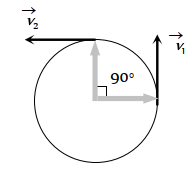
$\begin{aligned}& =2(r \omega) \sin \left(90^{\circ} / 2\right)=2 \times 1 \times\frac{2 \pi}{T} \times \frac{1}{\sqrt{2}} \\& =\frac{4 \pi}{60 \sqrt{2}}=\frac{\pi \sqrt{2}}{30}\frac{ cm }{ sec } \quad[\text { As } T=60 sec ]\end{aligned}$[As $T=60 sec$]
View full question & answer→MCQ 641 Mark
The string of pendulum of length $l$ is displaced through $90^{\circ}$ from the vertical and released. Then the minimum strength of the string in order to withstand the tension, as the pendulum passes through the mean position is
- ✓
$m g$
- B
$3 m g$
- C
$5 mg$
- D
$6 m g$
Answer(a)$\begin{aligned}& T_{\max }=m \omega_{\max }^2 r+m g \Rightarrow \frac{T_{\max }}{m}=\omega^2 r+g \\& \Rightarrow \frac{30}{0.5}-10=\omega^2{ }_{\max } r \Rightarrow \omega_{\max }=\sqrt{\frac{50}{r}}=\sqrt{\frac{50}{2}}=5 rad / s\end{aligned}$
View full question & answer→MCQ 651 Mark
An object is thrown along a direction inclined at an angle of $45^{\circ}$ with the horizontal direction. The horizontal range of the particle is equal to
- A
- B
Twice the vertical height
- C
Thrice the vertical height
- ✓
Four times the vertical height
AnswerCorrect option: D. Four times the vertical height
(d) $R=4 H \cot \theta$ if $\theta=45^{\circ}$ then $R=4 H \cot \left(45^{\circ}\right)=4 H$
View full question & answer→MCQ 661 Mark
In an atom for the electron to revolve around the nucleus, the necessary centripetal force is obtained from the following force exerted by the nucleus on the electron
Answer(d) Electrostatic force provides necessary centripetal force for circular motion of electron.
View full question & answer→MCQ 671 Mark
A fighter plane is moving in a vertical circle of radius ' $r$ '. Its minimum velocity at the highest point of the circle will be
- A
$\sqrt{3 g r}$
- ✓
$\sqrt{2 g r}$
- C
$\sqrt{g r}$
- D
$\sqrt{g r / 2}$
AnswerCorrect option: B. $\sqrt{2 g r}$
(b) $v=\sqrt{2 g h}=\sqrt{2 \times 10 \times 0.2}=2 m / s$
View full question & answer→MCQ 681 Mark
A motorcycle is going on an overbridge of radius $R$. The driver maintains a constant speed. As the motorcycle is ascending on the overbridge, the normal force on it
View full question & answer→MCQ 691 Mark
A body of mass $0.5 kg$ is projected under gravity with a speed of 98 $m / s$ at an angle of $30^{\circ}$ with the horizontal. The change in momentum (in magnitude) of the body is
- A
$24.5 N-s$
- ✓
$49.0 N - s$
- C
$98.0 N - s$
- D
$50.0 N-S$
AnswerCorrect option: B. $49.0 N - s$
(b) Change in momentum $=2 m u \sin \theta=2 \times 0.5 \times 98 \times \sin 30=45 N-s$
View full question & answer→MCQ 701 Mark
A heavy mass is attached to a thin wire and is whirled in a vertical circle. The wire is most likely to break
AnswerCorrect option: A. When the mss is t the highest point of the circle
(a) Max. tension that string can bear $=3.7 kgwt =37 N$Tension at lowest point of vertical loop $=m g+m \omega^2 r$$\begin{gathered}= \\0.5 \times 10+0.5 \times \omega^2 \times 4=5+2 \omega^2 \\\therefore 37=5+2 \omega \Rightarrow \omega=4 rad / s .\end{gathered}$
View full question & answer→MCQ 711 Mark
Two masses $M$ and $m$ are attached to a vertical axis by weightless threads of combined length $l$. They are set in rotational motion in a horizontal plane about this axis with constant angular velocity $\omega$. If the tensions in the threads are the same during motion, the distance of $M$ from the axis is
- A
$\frac{M l}{M+m}$
- ✓
$\frac{m l}{M+m}$
- C
$\frac{M+m}{M} l$
- D
$\frac{M+m}{m} l$
AnswerCorrect option: B. $\frac{m l}{M+m}$
View full question & answer→MCQ 721 Mark
The horizontal range is four times the maximum height attained by a projectile. The angle of projection is
- A
$90^{\circ}$
- B
$60^{\circ}$
- ✓
$45^{\circ}$
- D
$30^{\circ}$
AnswerCorrect option: C. $45^{\circ}$
(c) $R=4 H \cot \theta$, if $R=4 H$ then $\cot \theta=1 \Rightarrow \theta=45^{\circ}$
View full question & answer→MCQ 731 Mark
A particle of mass $m$ is executing uniform circular motion on apath of radius $r$. If $p$ is the magnitude of its linear momentum. The radial force acting on the particle is
- A
$p m r$
- B
$\frac{r m}{p}$
- C
$\frac{m p^2}{r}$
- ✓
$\frac{p^2}{r m}$
AnswerCorrect option: D. $\frac{p^2}{r m}$
(d) Radial force $=\frac{m v^2}{r}=\frac{m}{r}\left(\frac{p}{m}\right)^2=\frac{p^2}{m r}[$ As $p=m v]$
View full question & answer→MCQ 741 Mark
A mass of $100 gm$ is tied to one end of a string $2 m$ long. The body is revolving in a horizontal circle making a maximum of 200 revolutions per min. The other end of the string is fixed at the centre of the circle of revolution. The maximum tension that the string can bear is (approximately)
- A
$8.76 N$
- B
$8.94 N$
- C
$89.42 N$
- ✓
$87.64 N$
AnswerCorrect option: D. $87.64 N$
(d) Maximum tension $=m \omega^2 r=m \times 4 \pi^2 \times n^2 \times r$By substituting the values we get $T_{-}=87.64 N$
View full question & answer→MCQ 751 Mark
Galileo writes that for angles of projection of a projectile at angles $(45+\theta)$ and $(45-\theta)$, the horizontal ranges described by the projectile are in the ratio of (if $\theta \leq 45$ )
- A
$2: 1$
- B
$1: 2$
- ✓
$1: 1$
- D
$2: 3$
AnswerCorrect option: C. $1: 1$
(c)$\begin{aligned}& \text { For angle }\left(45^{\circ}-\theta\right), R=\frac{u^2 \sin\left(90^{\circ}-2 \theta\right)}{g}=\frac{u^2 \cos 2 \theta}{g} \\& \text { For angle }\left(45^{\circ}+\theta\right), R=\frac{u^2 \sin \left(90^{\circ}+2 \theta\right)}{g}=\frac{u^2 \cos 2 \theta}{g}\end{aligned}$
View full question & answer→MCQ 761 Mark
An aeroplane is flying at a constant horizontal velocity of $600 km / hr$ at an elevation of $6 km$ towards a point directly above the target on the earth's surface. At an appropriate time, the pilot releases a ball so that it strikes the target at the earth. The ball will appear to be falling
- A
On a parabolic path as seen by pilot in the plane
- B
Vertically along a straight path as seen by an observer on the
- ✓
On a parabolic path as seen by an observer on the ground near the target
- D
On a zig-zag path as seen by pilot in the plane
AnswerCorrect option: C. On a parabolic path as seen by an observer on the ground near the target
(c) The pilot will see the ball falling in straight line because the reference frame is moving with the same horizontal velocity but the observer at rest will see the ball falling in parabolic path.
View full question & answer→MCQ 771 Mark
The kinetic energy $k$ of a particle moving along a circle of radius $R$ depends on the distance covered $s$ as $k=a s^2$ where $a$ is a constant. The force acting on the particle is
AnswerCorrect option: B. $2 a s\left(1+\frac{s^2}{R^2}\right)^{1 / 2}$
(b) According to given problem $\frac{1}{2} m v^2=a s^2 \Rightarrow v=s \sqrt{\frac{2 a}{m}}$So $a_R=\frac{v^2}{R}=\frac{2 a s^2}{m R}$Further more as $a_t=\frac{d v}{d t}=\frac{d v}{d s} \cdot \frac{d s}{d t}=v \frac{d v}{d s}$By chain rule)Which in light of equation (i) i.e. $v=s \sqrt{\frac{2 a}{m}}$ yields $a_t=\left[s \sqrt{\frac{2 a}{m}}\right]\left[\sqrt{\frac{2 a}{m}}\right]=\frac{2 a s}{m}$So that $a=\sqrt{a_R^2+a_t^2}=\sqrt{\left[\frac{2 a s^2}{m R}\right]^2\left[\frac{2 a s}{m}\right]^2}$Hence $a=\frac{2 a s}{m} \sqrt{1+[s / R]^2}$$\therefore F=m a=2 a s \sqrt{1+[s / R]^2}$
View full question & answer→MCQ 781 Mark
A particle moves in a circle of radius $25 cm$ at two revolutions per second. The acceleration of the particle in $m / s^2$ is
- A
$\pi^2$
- B
$8 \pi^2$
- ✓
$4 \pi^2$
- D
$2 \pi^2$
AnswerCorrect option: C. $4 \pi^2$
(c) Since $n=2, \omega=2 \pi \times 2=4 \pi rad / s ^2$So acceleration $=\omega^2 r=(4 \pi)^2 \times \frac{25}{100} m / s ^2=4 \pi^2$
View full question & answer→MCQ 791 Mark
A particle revolves round a circular path. The acceleration of the particle is
- A
Along the circumference of the circle
- B
- ✓
- D
View full question & answer→MCQ 801 Mark
A car of mass $800 kg$ moves on a circular track of radius $40 m$. If the coefficient of friction is 0.5 , then maximum velocity with which the car can move is
- A
$7 m / s$
- ✓
$14 m / s$
- C
$8 m / s$
- D
$12 m / s$
AnswerCorrect option: B. $14 m / s$
(b) $v_{\max .}=\sqrt{\mu r g}=\sqrt{0.5 \times 40 \times 9.8}=14 m / s$
View full question & answer→MCQ 811 Mark
A bomber plane moves horizontally with a speed of $500 m / s$ and a bomb released from it, strikes the ground in $10 sec$. Angle at which it strikes the ground will be $\left(g=10 m / s ^2\right)$
AnswerCorrect option: A. $\tan ^{-1}\left(\frac{1}{5}\right)$
View full question & answer→MCQ 821 Mark
A body crosses the topmost point of a vertical circle with critica speed. Its centripetal acceleration, when the string is horizontal wil be
- A
$6 g$
- B
$3 g$
- C
$2 g$
- ✓
$g$
Answer(d) Tension at mean position, $m g+\frac{m v^2}{r}=3 m g$$v=\sqrt{2 g l}$and if the body displaces by angle $\theta$ with the vertical then $v=\sqrt{2 g l(1-\cos \theta)}$Comparing (i) and (ii), $\cos \theta=0 \Rightarrow \theta=90^{\circ}$
View full question & answer→MCQ 831 Mark
The ratio of angular speeds of minute hand and hour hand of a watch is
- A
$1: 12$
- B
$6: 1$
- ✓
$12: 1$
- D
$1: 6$
AnswerCorrect option: C. $12: 1$
(c)$\begin{aligned}& \omega_{\min }=\frac{2 \pi}{60} \frac{ Rad }{ min } \text { and } \omega_{h r}=\frac{2 \pi}{12 \times 60} \frac{ Rad }{ min } \\& \therefore \frac{\omega_{\min }}{\omega_{h r}}=\frac{2 \pi / 60}{2 \pi / 12 \times 60}\end{aligned}$
View full question & answer→MCQ 841 Mark
A cyclist goes round a circular path of circumference $34.3 m$ in $\sqrt{22}$ sec. the angle made by him, with the vertical, will be
View full question & answer→MCQ 851 Mark
The angular velocity of a wheel is $70 rad / sec$. If the radius of the wheel is $0.5 m$, then linear velocity of the wheel is
- ✓
$70 m / s$
- B
$35 m / s$
- C
$30 m / s$
- D
$20 m / s$
AnswerCorrect option: A. $70 m / s$
(a) $2 \pi r=34.3 \Rightarrow r=\frac{34.3}{2 \pi}$ and $v=\frac{2 \pi r}{T}=\frac{2 \pi r}{\sqrt{22}}$Angle of binding $\theta=\tan ^{-1}\left(\frac{v^2}{r g}\right)=45^{\circ$
View full question & answer→MCQ 861 Mark
The angle of projection at which the horizontal range and maximum height of projectile are equal is
AnswerCorrect option: C. $\theta=\tan ^{-1} 4$ or $\left(\theta=76^{\circ}\right)$
(c) $R=4 H \cot \theta$.When $R=H$ then $\cot \theta=1 / 4 \Rightarrow \theta=\tan ^{-1}(4)$
View full question & answer→MCQ 871 Mark
The average acceleration vector for a particle having a uniform circular motion is
Answer(d) In complete revolution change in velocity becomes zero so average acceleration will be zero.
View full question & answer→MCQ 881 Mark
In case of uniform circular motion which of the following physical quantity do not remain constant
Answer(b) It is a vector quantity.
View full question & answer→MCQ 891 Mark
Two bodies of equal masses revolve in circular orbits of radii $R_1$ and $R_2$ with the same period. Their centripetal forces are in the ratio
AnswerCorrect option: B. $\frac{R_1}{R_2}$
(b) $F=m\left(\frac{4 \pi^2}{T^2}\right) R$. If masses and time periods are same then$F \propto R \therefore F_1 / F_2=R_1 / R_2$
View full question & answer→MCQ 901 Mark
If the length of the second's hand in a stop clock is $3 cm$ the angular velocity and linear velocity of the tip is
- A
$0.2047 rad / sec$, $0.0314 m / sec$
- B
$0.2547 rad / sec$, $0.314 m / sec$
- C
$0.1472 rad / sec$, $0.06314 m / sec$
- ✓
$0.1047 rad / sec , 0.00314 m / sec$
AnswerCorrect option: D. $0.1047 rad / sec , 0.00314 m / sec$
(d) $\omega=\frac{2 \pi}{T}=\frac{2 \pi}{60}=0.1047 rad / s$and $v=\omega r=0.1047 \times 3 \times 10^{-2}=0.00314 m / s$
View full question & answer→MCQ 911 Mark
An object is projected at an angle of $45^{\circ}$ with the horizontal. The horizontal range and the maximum height reached will be in the ratio.
- A
$1: 2$
- B
$2: 1$
- C
$1: 4$
- ✓
$4: 1$
AnswerCorrect option: D. $4: 1$
(d) $R=4 H \cot \theta$, if $\theta=45^{\circ}$ then $R=4 H \Rightarrow \frac{R}{H}=\frac{4}{1}$
View full question & answer→MCQ 921 Mark
A proton of mass $1.6 \times 10^{\star} kg$ goes round in a circular orbit of radius $0.10 m$ under a centripetal force of $4 \times 10^{\circ} N$. then the frequency of revolution of the proton is about
- ✓
$0.08 \times 10$ cycles per sec
- B
$4 \times 10^*$ cycles per sec
- C
$8 \times 11^*$ cycles per sec
- D
$12 \times 10^{-}$cycles per sec
AnswerCorrect option: A. $0.08 \times 10$ cycles per sec
(a) $m 4 \pi^2 n^2 r=4 \times 10^{-13} \Rightarrow n=0.08 \times 10^8$ cycles $/ sec$.
View full question & answer→MCQ 931 Mark
An athlete completes one round of a circular track of radius $10 m$ in $40 sec$. The distance covered by him in $2 \min 20 sec$ is
- A
$70 m$
- B
$140 m$
- C
$110 m$
- ✓
$220 m$
AnswerCorrect option: D. $220 m$
(d) Time period $=40 sec$No. of revolution $=\frac{\text { Total time }}{\text { Time period }}=\frac{140 sec }{40 sec }=3.5 Rev$.So, distance $=3.5 \times 2 \pi R=3.5 \times 2 \pi \times 10=220 m$.
View full question & answer→MCQ 941 Mark
The coefficient of friction between the tyres and the road is 0.25 . The maximum speed with which a car can be driven round a curve of radius $40 m$ without skidding is (assume $g=10 ms$ )
- A
$40 ms$
- B
$20 ms$
- C
$15 ms$
- ✓
$10 ms$
AnswerCorrect option: D. $10 ms$
(d) $v=\sqrt{\mu rg }=\sqrt{0.25 \times 40 \times 10}=10 m / s$
View full question & answer→MCQ 951 Mark
A cricketer can throw a ball to a maximum horizontal distance of $100 m$. The speed with which he throws the ball is (to the nearest integer)
- A
$30 ms$
- B
$42 ms$
- ✓
$32 ms$
- D
$35 ms$
AnswerCorrect option: C. $32 ms$
(c) $R_{\max }=\frac{u^2}{g}=100 \Rightarrow u=10 \sqrt{10}=32 m / s$
View full question & answer→MCQ 961 Mark
The horizontal range of a projectile is $4 \sqrt{3}$ times its maximum height. Its angle of projection will be
Answer(d) $R=4 H \cot \theta$, if $R=4 \sqrt{3} H$ then $\cot \theta=\sqrt{3} \Rightarrow \theta=30^{\circ}$
View full question & answer→MCQ 971 Mark
When a body moves in a circular path, no work is done by the force since,
- A
- B
- ✓
Force and displacement are perpendicular to each other
- D
The force is always away from the centre
AnswerCorrect option: C. Force and displacement are perpendicular to each other
(c) $\because W=F S \cos \theta \quad \therefore \theta=90^{\circ}$
View full question & answer→MCQ 981 Mark
Neglecting the air resistance, the time of flight of a projectile is determined by
- ✓
$U_{\text {vertical }}$
- B
$U_{\text {horizontal }}$
- C
$U=U_{\text {vertical }}^2+U^2$ horizontal
- D
$U=U\left(U_{\text {vertical }}^2+U^2 \text { horizontal }\right)^{1 / 2}$
AnswerCorrect option: A. $U_{\text {vertical }}$
(a) Time of flight $=\frac{2 u \sin \theta}{g}=\frac{2 u_y}{g}=\frac{2 \times u_{\text {vertical }}}{g}$
View full question & answer→MCQ 991 Mark
A $500 kg$ car takes a round turn of radius $50 m$ with a velocity of $36 km / hr$. The centripetal force is
- ✓
$250 N$
- B
$750 N$
- C
$1000 N$
- D
$1200 N$
AnswerCorrect option: A. $250 N$
(a) $T=\frac{m v^2}{r} \Rightarrow 25=\frac{0.25 \times v^2}{1.96} \Rightarrow v=14 m / s$
View full question & answer→MCQ 1001 Mark
When a ceiling fan is switched off its angular velocity reduces to $50 \%$ while it makes 36 rotations. How many more rotation will it make before coming to rest (Assume uniform angular retardation)
Answer(b) $v=\sqrt{3 g r}$ and $a=\frac{v^2}{r}=\frac{3 g r}{r}=3 g$
View full question & answer→