MCQ 511 Mark
A particle $P$ moving with speed $v$ undergoes a head -on elastic collision with another particle $Q$ of identical mass but at rest. After the collision
- A
Both $P$ and $Q$ move forward with speed $\frac{v}{2}$
- B
Both $P$ and $Q$ move forward with speed $\frac{v}{\sqrt{2}}$
- ✓
$P$ comes to rest and $Q$ moves forward with speed $v$
- D
$P$ and $Q$ move in opposite directions with speed $\frac{v}{\sqrt{2}}$
AnswerCorrect option: C. $P$ comes to rest and $Q$ moves forward with speed $v$
View full question & answer→MCQ 521 Mark
Which of the following statements are true in case when two water drops coalesce and make a bigger drop
- Energy is released
- Energy is absorbed
- The surface area of the bigger drop is greater than the sum of the surface areas of both the drops
- The surface area of the bigger drop is smaller than the sum of the surface areas of both the drops
- ✓
$1$ and $4$
- B
$2$ and $4$
- C
$3$ and $4$
- D
$2$ and $3$
AnswerCorrect option: A. $1$ and $4$
View full question & answer→MCQ 531 Mark
In a surface tension experiment with a capillary tube water rises upto $0.1 \mathrm{~m}$. If the same experiment is repeated on an artificial satellite, which is revolving around the earth, water will rise in the capillary tube upto a height of
- A
$0.1 \mathrm{~m}$
- B
$0.2 \mathrm{~m}$
- C
$0.98 \mathrm{~m}$
- ✓
Full length of the capillary tube
AnswerCorrect option: D. Full length of the capillary tube
(d) In the satellite, the weight of the liquid column is zero. So the liquid will rise up to the top of the tube.
View full question & answer→MCQ 541 Mark
A mercury drop of $1 \mathrm{~cm}$ radius is broken into $10^6$ small drops. The energy used will be (surface tension of mercury is $\left.35 \times 10^{-3} \mathrm{~N} / \mathrm{cm}\right)$
- ✓
$4.4 \times 10^{-3} \mathrm{~J}$
- B
$2.2 \times 10^{-4} \mathrm{~J}$
- C
$8.8 \times 10^{-4} \mathrm{~J}$
- D
$10^4 \mathrm{~J}$
AnswerCorrect option: A. $4.4 \times 10^{-3} \mathrm{~J}$
$ E=4 \pi R^2 T\left(n^{1 / 3}-1\right) $
$ =4 \times 3.14 \times 10^{-4} \times 35 \times 10^{-1}\left(10^{6 / 3}-1\right)=4.4 \times 10^{-3} J$
View full question & answer→MCQ 551 Mark
A body of mass $m$ moving with velocity $v$ collides head on with another body of mass $2 \mathrm{~m}$ which is initially at rest. The ratio of K.E. of colliding body before and after collision will be
- A
$1: 1$
- B
$2: 1$
- C
$4: 1$
- ✓
$9: 1$
AnswerCorrect option: D. $9: 1$
(d) K.E. of colliding body before collision $=\frac{1}{2} m v^2$
After collision itsvelocity becomes $v^{\prime}=\frac{\left(m_1-m_2\right)}{\left(m_1+m_2\right)} v=\frac{m}{3 m} v=\frac{v}{3}$
$\therefore$ K.E. after collision $\frac{1}{2} mv^{\prime}2=\frac{1}{2}\frac{m v^2}{9}$
$\text { Ratio of kinetic energy }=\frac{\mathrm{K} \cdot \mathrm{E}_{\text {before }}}{\mathrm{K} \cdot \mathrm{E}_{\text {after }}}=\frac{\frac{1}{2} m v^2}{\frac{1}{2}\frac{m v^2}{9}}=9: 1$
View full question & answer→MCQ 561 Mark
The spring extends by $x$ on loading, then energy stored by the spring is : (if $T$ is the tension in spring and $k$ is spring constant)
- ✓
$\frac{T^2}{2 k}$
- B
$\frac{T^2}{2 k^2}$
- C
$\frac{2 k}{T^2}$
- D
$\frac{2 T^2}{k}$
AnswerCorrect option: A. $\frac{T^2}{2 k}$
(a) $U=\frac{F^2}{2 k}=\frac{T^2}{2 k}$
View full question & answer→MCQ 571 Mark
A body moving with velocity $v$ has momentum and kinetic energy numerically equal. What is the value of $v$
- ✓
$2 \mathrm{~m} / \mathrm{s}$
- B
$\sqrt{2} m / s$
- C
$1 \mathrm{~m} / \mathrm{s}$
- D
$0.2 \mathrm{~m} / \mathrm{s}$
AnswerCorrect option: A. $2 \mathrm{~m} / \mathrm{s}$
(a) $P=E \Rightarrow m v=\frac{1}{2} m v^2 \Rightarrow v=2 \mathrm{~m} / \mathrm{s}$
View full question & answer→MCQ 581 Mark
A particle moves from position $\vec{r}_1=3 \hat{i}+2 \hat{j}-6 \hat{k}$ to position $\vec{r}_2=14 \hat{i}+13 \hat{j}+9 \hat{k}$ under the action of force $4 \hat{i}+\hat{j}+3 \hat{k} N$. The work done will be
- ✓
$100 \mathrm{~J}$
- B
$50 \mathrm{~J}$
- C
$200 \mathrm{~J}$
- D
$75 \mathrm{~J}$
AnswerCorrect option: A. $100 \mathrm{~J}$
(a)$W=\vec{F} \cdot\left(\overrightarrow{r_2}-\overrightarrow{r_1}\right)$
$=(4 \hat{i}+\hat{j}+3 \hat{k})(1 \hat{1}+11 \hat{j}+15 \hat{k})$
$W=44+11+45=100\text{Joule}$
View full question & answer→MCQ 591 Mark
A wooden stick $2 \mathrm{~m}$ long is floating on the surface of water. The surface tension of water $0.07 \mathrm{~N} / \mathrm{m}$. By putting soap solution on one side of the sticks the surface tension is reduced to $0.06 \mathrm{~N} / \mathrm{m}$. The net force on the stick will be
- A
$0.07 \mathrm{~N}$
- B
$0.06 \mathrm{~N}$
- C
$0.01 \mathrm{~N}$
- ✓
$0.02 \mathrm{~N}$
AnswerCorrect option: D. $0.02 \mathrm{~N}$
(d) Net force on stick $=F_1-F_2=\left(T_1-T_2\right) l$$=(0.07-0.06) l=0.01 \times 2=0.02 N$
View full question & answer→MCQ 601 Mark
A cylinder of mass $10 \mathrm{~kg}$ is sliding on a plane with an initial velocity of $10 \mathrm{~m} / \mathrm{s}$. If coefficient of friction between surface and cylinder is 0.5 , then before stopping it will describe
- A
$12.5 \mathrm{~m}$
- B
$5 \mathrm{~m}$
- C
$7.5 \mathrm{~m}$
- ✓
$10 \mathrm{~m}$
AnswerCorrect option: D. $10 \mathrm{~m}$
(d) $s=\frac{u^2}{2 \mu g}=\frac{10 \times 10}{2 \times 0.5 \times 10}=10 \mathrm{~m}$
View full question & answer→MCQ 611 Mark
A body of mass $40 \mathrm{~kg}$ having velocity $4 \mathrm{~m} / \mathrm{s}$ collides with another body of mass $60 \mathrm{~kg}$ having velocity $2 \mathrm{~m} / \mathrm{s}$. If the collision is inelastic, then loss in kinetic energy will be
- A
$440 \mathrm{~J}$
- B
$392 \mathrm{~J}$
- ✓
$48 \mathrm{~J}$
- D
$144 \mathrm{~J}$
AnswerCorrect option: C. $48 \mathrm{~J}$
Given,
$m _1=40 kg, v _1=4 m / s , m _2=60 kg,, v _2=2\ m / s$
Since the body is inelastic, both masses would move together at the velocity $v$, According to the conservation of momentum,
$m _1 v _1+ m _2 v _2=\left( m _1+ m _2\right) \ v$
$\Rightarrow 40 \times 4+60 \times 2=(40+60) \ v$
$\Rightarrow 280=100\ v $
$\Rightarrow v =2.8\ m / s$
So initial
$KE =0.5 \times m _1\left( v _1^2\right)+0.5 m_2\left( v _2\right)^2$
$=0.5 \times 40 \times 16+0.5 \times 60 \times 4=440\ J$
The final $KE =0.5(40+60) 2.8^2=392 J$
Thus the difference in the kinetic energy $=440-392=48 J$
View full question & answer→MCQ 621 Mark
During capillary rise of a liquid in a capillary tube, the surface of contact that remains constant is of
MCQ 631 Mark
The quantity that is not conserved in an inelastic collision is
MCQ 641 Mark
Two bodies having same mass $40 \mathrm{~kg}$ are moving in opposite directions, one with a velocity of $10 \mathrm{~m} / \mathrm{s}$ and the other with $7 \mathrm{~m} / \mathrm{s}$. If they collide and move as one body, the velocity of the combination is
- A
$10 \mathrm{~m} / \mathrm{s}$
- B
$7 \mathrm{~m} / \mathrm{s}$
- C
$3 \mathrm{~m} / \mathrm{s}$
- ✓
$1.5 \mathrm{~m} / \mathrm{s}$
AnswerCorrect option: D. $1.5 \mathrm{~m} / \mathrm{s}$
(d) By the conservation of momentum$40 \times 10+(40) \times(-7)=80 \times v \Rightarrow v=1.5 \mathrm{~m} / \mathrm{s}$
View full question & answer→MCQ 651 Mark
A body of mass $5 \mathrm{~kg}$ moving with a velocity $10 \mathrm{~m} / \mathrm{s}$ collides with another body of the mass $20 \mathrm{~kg}$ at, rest and comes to rest. The velocity of the second body due to collision is
- ✓
$2.5 \mathrm{~m} / \mathrm{s}$
- B
$5 \mathrm{~m} / \mathrm{s}$
- C
$7.5 \mathrm{~m} / \mathrm{s}$
- D
$10 \mathrm{~m} / \mathrm{s}$
AnswerCorrect option: A. $2.5 \mathrm{~m} / \mathrm{s}$
Momentum conservation$5\times10+20\times0=5\times0+20\times v\Rightarrow v=2.5\mathrm{~m}/ \mathrm{s}$
View full question & answer→MCQ 661 Mark
If a shell fired from a cannon, explodes in mid air, then
- ✓
Its total kinetic energy increases
- B
lts total momentum increases
- C
lts total momentum decreases
- D
AnswerCorrect option: A. Its total kinetic energy increases
View full question & answer→MCQ 671 Mark
The work done in blowing a soap bubble of radius $0.2 \mathrm{~m}$ is (the surface tension of soap solution being $0.06 \mathrm{~N} / \mathrm{m}$ )
- ✓
$192 \pi \times 10^{-4} \mathrm{~J}$
- B
$280 \pi \times 10^{-4} \mathrm{~J}$
- C
$200 \pi \times 10^{-3} \mathrm{~J}$
- D
AnswerCorrect option: A. $192 \pi \times 10^{-4} \mathrm{~J}$
(a) $W=8 \pi r^2 \times T=8 \pi \times(0.2)^2 \times 0.06=192 \pi \times 10^{-4} J$
View full question & answer→MCQ 681 Mark
If a force $\vec{F}=4 \hat{i}+5 \hat{j}$ causes a displacement $\vec{s}=3 \hat{i}+6 \hat{k}$, work done is
- A
$4 \times 6$ unit
- B
$6 \times 3$ unit
- C
$5 \times 6$ unit
- ✓
$4 \times 3$ unit
AnswerCorrect option: D. $4 \times 3$ unit
(d) $W=\vec{F} \cdot s=(4 \hat{i}+5 \hat{j}+0 \hat{k}) \cdot(3 \hat{i}+0 \hat{j}+6\hat{k})=4 \times 3$ units
View full question & answer→MCQ 691 Mark
If a man increase his speed by $2 \mathrm{~m} / \mathrm{s}$, his K.E. is doubled, the original speed of the man is
- A
$(1+2 \sqrt{2}) \mathrm{m} / \mathrm{s}$
- B
$4 \mathrm{~m} / \mathrm{s}$
- ✓
$(2+2 \sqrt{2}) \mathrm{m} / \mathrm{s}$
- D
$(2+\sqrt{2}) \mathrm{m} / \mathrm{s}$
AnswerCorrect option: C. $(2+2 \sqrt{2}) \mathrm{m} / \mathrm{s}$
Initial kinetic energy $E=\frac{1}{2} mv^2$
Final kinetic energy $2E=\frac{1}{2}m(v+2)^2$
by solving equation (i) and (ii) we get $v=(2+2 \sqrt{2}) \mathrm{m} / \mathrm{s}$
View full question & answer→MCQ 701 Mark
A force of $2 \hat{i}+3 \hat{j}+4 \hat{k} N$ acts on a body for 4 second, produces a displacement of $(3 \hat{i}+4 \hat{j}+5 \hat{k}) m$. The power used is
- ✓
$9.5 \mathrm{~W}$
- B
$7.5 \mathrm{~W}$
- C
$6.5 \mathrm{~W}$
- D
$4.5 \mathrm{~W}$
AnswerCorrect option: A. $9.5 \mathrm{~W}$
(a) $\quad P=\frac{\vec{F} \cdot \vec{s}}{t}=\frac{(2 \hat{i}+3 \hat{j}+4 \hat{k})\cdot(3 \hat{i}+4 \hat{j}+5 \hat{k})}{4}=\frac{38}{4}=9.5 \mathrm{~W}$
View full question & answer→MCQ 711 Mark
The force required to take away a flat circular plate of radius $2 \mathrm{~cm}$ from the surface of water, will be (the surface tension of water is 70 dyne/cm)
- ✓
$280 \pi d y n e$
- B
$250 \pi$ dyne
- C
$140 \pi d y n e$
- D
$210 \pi$ dyne
AnswerCorrect option: A. $280 \pi d y n e$
(a) Force required, $F=2 \pi r T=2 \pi \times 2 \times 70=280 \pi$.Dyne
View full question & answer→MCQ 721 Mark
The kinetic energy acquired by a body of mass $m$ is travelling some distance $s$, starting from rest under the actions of a constant force, is directly proportional to
- ✓
$m^0$
- B
$m$
- C
$m^2$
- D
$\sqrt{m}$
Answer(a) K.E. acquired by the body $=$ work done on the body$K . E .=\frac{1}{2} m v^2=F$ S i.e. it does not depend upon the mass of the body although velocity depends upon the mass$v^2 \propto \frac{1}{m}$[If $F$ and $s$ are constant]
View full question & answer→MCQ 731 Mark
Two long capillary tubes $A$ and $B$ of radius $R>R$ dipped in same liquid. Then
AnswerCorrect option: A. Water rise is more in $A$ than $B$
(a) $h \propto \frac{1}{R}$
View full question & answer→MCQ 741 Mark
A spring with spring constant $k$ is extended from $x=0$ to $x=x_1$.The work done will be
- A
$k x_1^2$
- ✓
$\frac{1}{2} k x_1^2$
- C
$2 k x_1^2$
- D
$2 k x_1$
AnswerCorrect option: B. $\frac{1}{2} k x_1^2$
View full question & answer→MCQ 751 Mark
A spring with spring constant $k$ when stretched through $1 \mathrm{~cm}$, the potential energy is $U$. If it is stretched by $4 \mathrm{~cm}$. The potential energy will be
- A
$4 U$
- B
$8 U$
- ✓
$16 \mathrm{U}$
- D
$2 U$
AnswerCorrect option: C. $16 \mathrm{U}$
(c) Potential energy $U=\frac{1}{2} k x^2$$\therefore U \propto x^2$ [if (k=$constant]If elongation made 4 times then potential energy will become 16 times.
View full question & answer→MCQ 761 Mark
A body of mass $m$ is at rest. Another body of same mass moving with velocity $\mathrm{V}$ makes head on elastic collision with the first body. After collision the first body starts to move with velocity
- ✓
$\mathrm{V}$
- B
$2 \mathrm{~V}$
- C
- D
AnswerCorrect option: A. $\mathrm{V}$
View full question & answer→MCQ 771 Mark
Four particles given, have same momentum which has maximum kinetic energy
Answer$E=\frac{P^2}{2 m} \therefore E \propto \frac{1}{m}$ (If $P=$constant)
i.e.thelightest particle will possess maximum kinetic energy and in the given option mass of electr on is minimum.
View full question & answer→MCQ 781 Mark
Due to a force of $(6 \hat{i}+2 \hat{j}) N$ the displacement of a body is $(3 \hat{i}-\hat{j}) m$, then the work done is
- ✓
$16 \mathrm{~J}$
- B
$12 \mathrm{~J}$
- C
$8 J$
- D
AnswerCorrect option: A. $16 \mathrm{~J}$
Work done $=\vec{F} \cdot \vec{S}$
$=(6 \hat{i}+2 \hat{j})\cdot(3\hat{i}\hat{j})=6\times 3-2 \times 1=18-2=16 \mathrm{~J}$
View full question & answer→MCQ 791 Mark
A mass of $100 \mathrm{~g}$ strikes the wall with speed $5 \mathrm{~m} / \mathrm{s}$ at an angle as shown in figure and it rebounds with the same speed. If the contact time is $2 \times 10^{-3} \mathrm{sec}$, what is the force applied on the mass by the wall
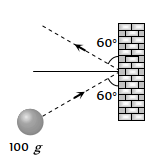
AnswerCorrect option: C. $250 \sqrt{3} N$ to left
Force $=$ Rate of change of momentumInitial momentum $\vec{P}_1=mv\sin\theta\hat{i}+m v \cos \theta \hat{j}$
Final momentum $(\vec{P_2}=mv\ \sin\theta\ \hat{i}+mv \cos\theta\ \hat{j}$
$\therefore\vec{F}=\frac{\Delta\vec{P}}{\Delta t}=\frac{-2mv}{\sin\theta}{2}\times10^{-3}$
Substituting $m=0.1 \mathrm{~kg}, v=5 \mathrm{~m} / \mathrm{s}, \theta=60^{\circ}$
Forceon the ball $\vec{F}=-250 \sqrt{3} N$ Negative sign indicates direction of the force
View full question & answer→MCQ 801 Mark
Two bodies of masses $m$ and $4 \mathrm{~m}$ are moving with equal K.E. The ratio of their linear momentums is
- A
$4: 1$
- B
$1: 1$
- ✓
$1: 2$
- D
$1: 4$
AnswerCorrect option: C. $1: 2$
$P=\sqrt{2 m E}$
$\therefore P \propto \sqrt{m} \Rightarrow \frac{P_1}{P_2}=\sqrt{\frac{m_1}{m_2}}=\sqrt{\frac{m}{4 m}}=\frac{1}{2}$
View full question & answer→MCQ 811 Mark
When a spring is stretched by $2 \mathrm{~cm}$, it stores $100 \mathrm{~J}$ of energy. If it is stretched further by $2 \mathrm{~cm}$, the stored energy will be increased by
- A
$100 \mathrm{~J}$
- B
$200 \mathrm{~J}$
- ✓
$300 \mathrm{~J}$
- D
$400 \mathrm{~J}$
AnswerCorrect option: C. $300 \mathrm{~J}$
(c)
$100=\frac{1}{2} k x^2 \quad \text { (given) } $
$W=\frac{1}{2}k\left(x_2^2-x_1^2\right)=\frac{1}{2} k\left[(2 x)^2-x^2\right] $
$=3 \times\left(\frac{1}{2} kx^2\right)=3 \times 100=300 \mathrm{~J}$
View full question & answer→MCQ 821 Mark
A body of mass $M_1$ collides elastically with another mass $M_2$ at rest. There is maximum transfer of energy when
AnswerCorrect option: C. $M_1=M_2$
View full question & answer→MCQ 831 Mark
A body of mass $2 \mathrm{~kg}$ moving with a velocity of $3 \mathrm{~m} / \mathrm{sec}$ collides head on with a body of mass $1 \mathrm{~kg}$ moving in opposite direction with a velocity of $4 \mathrm{~m} / \mathrm{sec}$. After collision, two bodies stick together and move with a common velocity which in $\mathrm{m} / \mathrm{sec}$ is equal to
- A
$1 / 4$
- B
$1 / 3$
- ✓
$2 / 3$
- D
$3 / 4$
AnswerCorrect option: C. $2 / 3$
(c)
$m_1 v_1-m_2 v_2=\left(m_1+m_2\right) v$
$\Rightarrow 2\times3-1\times 4=(2+1) v $
$\Rightarrow v=\frac{2}{3} \mathrm{~m} / \mathrm{s}$
View full question & answer→MCQ 841 Mark
Which of the following statements is true
AnswerCorrect option: C. Total kinetic energy is not conserved but momentum is conserved in inelastic collisions
View full question & answer→MCQ 851 Mark
A cannon ball is fired with a velocity $200 \mathrm{~m} / \mathrm{sec}$ at an angle of $60^{\circ}$ with the horizontal. At the highest point of its flight it explodes into $3$ equal fragments, one going vertically upwards with a velocity $100\ \mathrm{m} / \mathrm{sec}$, the second one falling vertically downwards with a velocity $100 \mathrm{~m} / \mathrm{sec}$. The third fragment will be moving with a velocity
- A
$100 \mathrm{~m} / \mathrm{s}$ in the horizontal direction
- ✓
$300 \mathrm{~m} / \mathrm{s}$ in the horizontal direction
- C
$300 \mathrm{~m} / \mathrm{s}$ in a direction making an angle of $60^{\circ}$ with the horizontal
- D
$200 \mathrm{~m} / \mathrm{s}$ in a direction making an angle of $60^{\circ}$ with the horizontal
AnswerCorrect option: B. $300 \mathrm{~m} / \mathrm{s}$ in the horizontal direction
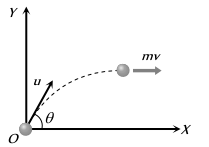
Momentum of ball (mass $m$ ) before explosion at the highest
$\text{point}=m v \hat{i}=m u \cos 60^{\circ} \hat{i} $
$=m \times 200 \times \frac{1}{2} \hat{i}=100\ m\ \hat{i} \ \mathrm{kgms}^{-1}$
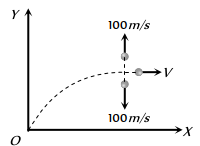
Let the velocity of third part after explosion is $V$After explosion momentum of system $=\vec{P}_1+\vec{P}_2+\vec{P}_3$
$=\frac{m}{3} \times 100 \hat{j}-\frac{m}{3}\times100\hat{j}+\frac{m}{3} \times \hat{V}$
comparing momentum of system before and after the explosion
$\frac{m}{3} \times 100 \hat{j}-\frac{m}{3} \times 100 \hat{j}+\frac{m}{3}\hat{V}i=100m\hat{i} \Rightarrow V=300 \mathrm{~m} / \mathrm{s}$ View full question & answer→MCQ 861 Mark
If two soap bubbles of different radii are in communication with each other
- A
Air flows from larger bubble into the smaller one
- B
The size of the bubbles remains the same
- ✓
Air flows from the smaller bubble into the large one and the larger bubble grows at the expense of the smaller one
- D
The air flows from the larger
AnswerCorrect option: C. Air flows from the smaller bubble into the large one and the larger bubble grows at the expense of the smaller one
(c) Since $\Delta P \propto \frac{1}{R}$
View full question & answer→MCQ 871 Mark
Kerosene oil rises up the wick in a lantern
- ✓
Due to surface tension of the oil
- B
The wick attracts the kerosene oil
- C
Of the diffusion of the oil through the wick
- D
AnswerCorrect option: A. Due to surface tension of the oil
View full question & answer→MCQ 881 Mark
A body moves a distance of $10 \mathrm{~m}$ along a straight line under the action of a force of $5 \mathrm{~N}$. If the work done is $25$ joules, the angle which the force makes with the direction of motion of the body is
- A
$0^{\circ}$
- B
$30^{\circ}$
- ✓
$60^{\circ}$
- D
$90^{\circ}$
AnswerCorrect option: C. $60^{\circ}$
(c) $W=F s \cos \theta \Rightarrow \cos \theta=\frac{W}{F} =\frac{25}{50}=\frac{1}{2}\Rightarrow \theta=60^{\circ}$
View full question & answer→MCQ 891 Mark
A particle of mass $m$ moving eastward with a speed $v$ collides with another particle of the same mass moving northward with the same speed $v$. The two particles coalesce on collision. The new particle of mass $2 \mathrm{~m}$ will move in the north-easterly direction with a velocity
- A
$v / 2$
- B
$2 v$
- ✓
$v / \sqrt{2}$
- D
$\mathrm{v}$
AnswerCorrect option: C. $v / \sqrt{2}$
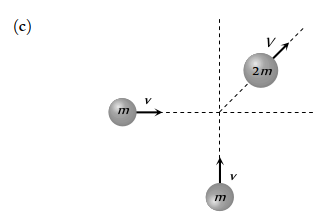
Initial momentum of the system
$\vec{P}_i=m v \hat{i}+m \hat{v j} $
$\left|\vec{P}_i\right|=\sqrt{2} m v$
Final momentum of the system $=2 \mathrm{m}V$
By the law of conservation of momentum
$\sqrt{2} m v=2 m V \Rightarrow V=\frac{v}{\sqrt{2}}$ View full question & answer→MCQ 901 Mark
When two capillary tubes of different diameters are dipped vertically, the rise of the liquid is
- A
- B
More in the tube of larger diameter
- C
Less in the tube of smaller diameter
- ✓
More in the tube of smaller diameter
AnswerCorrect option: D. More in the tube of smaller diameter
(d) $h=\frac{2 T \cos \theta}{r d g} \therefore h \propto \frac{1}{r}(T, \theta, d$ and $g$ are constant $)$ If $r$ is less then $h$ will be more.
View full question & answer→MCQ 911 Mark
Tripling the speed of the motor car multiplies the distance needed for stopping it by
Answer(c) $s \propto u^2$ i.e. if speed becomes three times then distance needed for stoppingwill be nine times.
View full question & answer→MCQ 921 Mark
A body of mass $m$ moving with a constant velocity $v$ hits another body of the same mass moving with the same velocity $v$ but in the opposite direction and sticks to it. The velocity of the compound body after collision is
Answer(c) Initial momentum of the system $=m v-m v=0$As body sticks together
$\therefore$ final momentum $=2\ \mathrm{mV}$
By conservation of momentum $2\ m V=0$
$ \therefore V=0$
View full question & answer→MCQ 931 Mark
A body of mass $m$ is moving in a circle of radius $r$ with a constant speed $v$. The force on the body is $\frac{m v^2}{r}$ and is directed towards the centre. What is the work done by this force in moving the body over half the circumference of the circle
- A
$\frac{m v^2}{\pi r^2}$
- ✓
- C
$\frac{m v^2}{r^2}$
- D
$\frac{\pi r^2}{m v^2}$
AnswerWork done by centripetal force is always zero, because force and instantaneousdisplacement are always perpendicular.
$W=\vec{F} \cdot s=F s \cos\theta=Fs\cos\left(90^{\circ}\right)=0$
View full question & answer→MCQ 941 Mark
A drop of oil is placed on the surface of water. Which of the following statement is correct
- A
It will remain on it as a sphere
- ✓
It will spread as a thin layer
- C
It will be partly as spherical droplets and partly as thin film
- D
It will float as a distorted drop on the water surface
AnswerCorrect option: B. It will spread as a thin layer
View full question & answer→MCQ 951 Mark
A soap bubble assumes a spherical surface. Which of the following statement is wrong
- A
The soap film consists of two surface layers of molecules back to back
- B
The bubble encloses air inside it
- ✓
The pressure of air inside the bubble is less than the atmospheric pressure; that is why the atmospheric pressure has compressed it equally from all sides to give it a spherical shape
- D
Because of the elastic property of the film, it will tend to shrink to as small a surface area as possible for the volume it has enclosed
AnswerCorrect option: C. The pressure of air inside the bubble is less than the atmospheric pressure; that is why the atmospheric pressure has compressed it equally from all sides to give it a spherical shape
View full question & answer→MCQ 961 Mark
A light and a heavy body have equal kinetic energy. Which one has a greater momentum ?
- A
- ✓
- C
- D
It is not possible to say anything without additional information
Answer(b) $\quad P=\sqrt{2 m E}$ if $E$ are equal then $P \propto \sqrt{m}$i.e. heavier body will possess greater momentum.
View full question & answer→MCQ 971 Mark
Two balls at same temperature collide. What is conserved
MCQ 981 Mark
A bullet hits and gets embedded in a solid block resting on a horizontal frictionless table. What is conserved ?
- A
Momentum and kinetic energy
- B
- ✓
- D
Neither momentum nor kinetic energy
View full question & answer→MCQ 991 Mark
From a stationary tank of mass $125000$ pound a small shell of mass $25$ pound is fired with a muzzle velocity of $1000\ \mathrm{ft} / \mathrm{sec}$. The tank recoils with a velocity of
- A
$0.1\ \mathrm{ft} / \mathrm{sec}$
- ✓
$0.2\ \mathrm{ft} / \mathrm{sec}$
- C
$0.4\ \mathrm{ft} / \mathrm{sec}$
- D
$0.8\ \mathrm{ft} / \mathrm{sec}$
AnswerCorrect option: B. $0.2\ \mathrm{ft} / \mathrm{sec}$
(b) According to conservation of momentum Momentum of tank $=$Momentumofshell$125000\times v_{-}=25 \times 1000 \Rightarrow v-0.2\ \mathrm{ft} / \mathrm{sec}$
View full question & answer→MCQ 1001 Mark
Two springs of spring constants $1500 \mathrm{~N} / \mathrm{m}$ and $3000 \mathrm{~N} / \mathrm{m}$ respectively are stretched with the same force. They will have potential energy in the ratio
- A
$4: 1$
- B
$1: 4$
- ✓
$2: 1$
- D
$1: 2$
AnswerCorrect option: C. $2: 1$
(c) $U=\frac{F^2}{2 k} \Rightarrow \frac{U_1}{U_2}=\frac{k_2}{k_1} $
(if force are same) $\therefore \frac{U_1}{U_2}=\frac{3000}{1500}=\frac{2}{1}$
View full question & answer→