MCQ 1011 Mark
A soap bubble in vacuum has a radius of $3 \mathrm{~cm}$ and another soap bubble in vacuum has a radius of $4 \mathrm{~cm}$. If the two bubbles coalesce under isothermal condition, then the radius of the new bubble is
- A
$2.3 \mathrm{~cm}$
- B
$4.5 \mathrm{~cm}$
- ✓
$5 \mathrm{~cm}$
- D
$7 \mathrm{~cm}$
AnswerCorrect option: C. $5 \mathrm{~cm}$
(c) $r=\sqrt{r_1^2+r_2^2}=\sqrt{9+16}=5 \mathrm{~cm}$
View full question & answer→MCQ 1021 Mark
A car of mass ' $m$ ' is driven with acceleration ' $a$ ' along a straight level road against a constant external resistive force ' $R$. When the velocity of the car is ' $V$, the rate at which the engine of the car is doing work will be
- A
$R V$
- B
$\mathrm{maV}$
- ✓
$(R+m a) V$
- D
$(m a-R) V$
AnswerCorrect option: C. $(R+m a) V$
Force required to move with constant velocity
$\therefore$ Power $=F V$ Forceisrequired to oppose the resistive force $R$ and also to accelerate the body of mass with acceleration$a$).
$\therefore$ Power $=(R+m a) V$
View full question & answer→MCQ 1031 Mark
A particle of mass $m$ moving with velocity $v$ strikes a stationary particle of mass $2 \mathrm{~m}$ and sticks to it. The speed of the system will be
- A
$v / 2$
- B
$2 \mathrm{v}$
- ✓
$v / 3$
- D
$3 v$
AnswerCorrect option: C. $v / 3$
View full question & answer→MCQ 1041 Mark
At which of the following temperatures, the value of surface tension of water is minimum
- A
$4 \mathrm{C}$
- B
$25 . \mathrm{C}$
- C
$50 \cdot \mathrm{C}$
- ✓
$75 . \mathrm{C}$
AnswerCorrect option: D. $75 . \mathrm{C}$
$75 . \mathrm{C}$
View full question & answer→MCQ 1051 Mark
A frictionless track $A B C D E$ ends in a circular loop of radius $R$. A body slides down the track from point $A$ which is at $a$ height $h=5$ $\mathrm{cm}$. Maximum value of $R$ for the body to successfully complete the loop is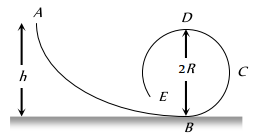
AnswerCorrect option: D. $2 \mathrm{~cm}$
From the conservation of energy,
$mgh =\frac{1}{2} mv ^2 $
$v =\sqrt{2 gh }$
The condition for completing the loop is given as,
$\sqrt{2 g h}=\sqrt{5 g R} $
$R=\frac{2 \times 5}{5} $
$=2\ cm$
Thus, the maximum value of $R$ for the body to successfully complete the loop is $2\ cm .$
View full question & answer→MCQ 1061 Mark
Two soap bubbles have different radii but their surface tension is the same. Mark the correct statement
- ✓
Internal pressure of the smaller bubble is higher than the internal pressure of the larger bubble
- B
Pressure of the larger bubble is higher than the smaller bubble
- C
Both bubbles have the same internal pressure
- D
AnswerCorrect option: A. Internal pressure of the smaller bubble is higher than the internal pressure of the larger bubble
(a)$\Delta P=\frac{4 T}{R} \therefore \Delta P \propto \frac{1}{R} \quad(T=\text { constant })$Hence, the internal pressure of smaller bubble is larger than that of larger bubble.
View full question & answer→MCQ 1071 Mark
A particle of mass $\mathrm{m}$ moving with horizontal speed $6 \mathrm{~m} / \mathrm{sec}$ as shown in figure. If $m \ll M$ then for one dimensional elastic collision, the speed of lighter particle after collision will be
- ✓
$2 \mathrm{~m} / \mathrm{sec}$ in original direction
- B
$2 \mathrm{~m} / \mathrm{sec}$ opposite to the original direction
- C
$4 \mathrm{~m} / \mathrm{sec}$ opposite to the original direction
- D
$4 \mathrm{~m} / \mathrm{sec}$ in original direction
AnswerCorrect option: A. $2 \mathrm{~m} / \mathrm{sec}$ in original direction
View full question & answer→MCQ 1081 Mark
If a long spring is stretched by $0.02 \mathrm{~m}$, its potential energy is $U$. If the spring is stretched by $0.1 \mathrm{~m}$, then its potential energy will be
- A
$\frac{U}{5}$
- B
$U$
- C
$5 \ U$
- ✓
$25\ \mathrm{U}$
AnswerCorrect option: D. $25\ \mathrm{U}$
(d) $U \propto x^2 \Rightarrow \frac{U_2}{U_1}=\left(\frac{x_2}{x_1}\right)^2=\left(\frac{0.1}{0.02}\right)^2=25 \therefore U_2=25 \ U$
View full question & answer→MCQ 1091 Mark
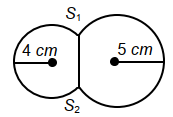
Two soap bubbles of radii $r_1$ and $r_2$ equal to $4 \mathrm{~cm}$ and $5 \mathrm{~cm}$ are touching each other over a common surface $S_1 S_2$ (shown in figure). Its radius will be
- A
$4 \mathrm{~cm}$
- ✓
$20 \mathrm{~cm}$
- C
$5 \mathrm{~cm}$
- D
$4.5 \mathrm{~cm}$
AnswerCorrect option: B. $20 \mathrm{~cm}$
(b) $\quad r=\frac{r_1 r_2}{r_1-r_2}=\frac{5 \times 4}{5-4}=20 \mathrm{~cm}$
View full question & answer→MCQ 1101 Mark
Two capillary tubes of same diameter are put vertically one each in two liquids whose relative densities are 0.8 and 0.6 and surface tensions are 60 and $50 \mathrm{dyne} / \mathrm{cm}$ respectively Ratio of heights of liquids in the two tubes $\frac{h_1}{h_2}$ is
- A
$\frac{10}{9}$
- B
$\frac{3}{10}$
- C
$\frac{10}{3}$
- ✓
$\frac{9}{10}$
AnswerCorrect option: D. $\frac{9}{10}$
(d) Ascent formula $h=\frac{2 T \cos \theta}{r d g}$
$ \Rightarrow \frac{h_1}{h_2}=\frac{T_1}{T_2} \times \frac{d_2}{d_1} \quad(r, \theta \text { and } g \text { are constants })$
$ =\frac{60}{50} \times \frac{0.6}{0.8}=\frac{9}{10}$
View full question & answer→MCQ 1111 Mark
A ball of mass $m$ moving with velocity $V$, makes a head on elastic collision with a ball of the same mass moving with velocity $2 \mathrm{~V}$ towards it. Taking direction of $V$ as positive velocities of the two balls after collision are
- A
$-V$ and $2 V$
- B
$2 V$ and $-V$
- C
$V$ and $-2 V$
- ✓
$-2 V$ and $V$
AnswerCorrect option: D. $-2 V$ and $V$
(d) Due to elastic collision of bodies having equal mass, their velocities get interchanged.
View full question & answer→MCQ 1121 Mark
The radii of two soap bubbles are $r$ and $r$. In isothermal conditions, two meet together in vaccum. Then the radius of the resultant bubble is given by
AnswerCorrect option: C. $R^2=r_1^2+r_2^2$
View full question & answer→MCQ 1131 Mark
Water rises to a height $h$ in a capillary at the surface of earth. On the surface of the moon the height of water column in the same capillary will be
- ✓
$6 h$
- B
$\frac{1}{6} h$
- C
$h$
- D
Answer(a) $h=\frac{2 T \cos \theta}{r d g} \therefore h \propto \frac{1}{g}$As $g_m=\frac{g_e}{6} \therefore h_m=6 h_e$
View full question & answer→MCQ 1141 Mark
A particle of mass $m$ moving with a velocity $\vec{V}$ makes a head on elastic collision with another particle of same mass initially at rest. The velocity of the first particle after the collision will be
- A
$\vec{V}$
- B
$-\vec{V}$
- C
$-2 \vec{V}$
- ✓
Answer(d) In perfectly elastic head on collision of equal masses velocities gets interchanged
View full question & answer→MCQ 1151 Mark
If a lighter body $($mass $M_1$ and velocity $V_1 )$ and a heavier body $($mass $M_2$ and velocity $V_2 )$ have the same kinetic energy, then
- A
$M_2 V_2$
- B
$M_2 V_2=M_1 V_1$
- C
$M_2 V_1=M_1 V_2$
- ✓
$M_2 V_2>M_1 V_1$
AnswerCorrect option: D. $M_2 V_2>M_1 V_1$
$M_2 V_2>M_1 V_1$
View full question & answer→MCQ 1161 Mark
The amount of work done in blowing a soap bubble such that its diameter increases from $d$ to $D$ is ( $T$ = surface tension of the solution)
- A
$4 \pi\left(D^2-d^2\right) T$
- B
$8 \pi\left(D^2-d^2\right) T$
- C
$\pi\left(D^2-d^2\right) T$
- ✓
$2 \pi\left(D^2-d^2\right) T$
AnswerCorrect option: D. $2 \pi\left(D^2-d^2\right) T$
$ W=T \times 8 \pi\left(r_2^2-r_1^2\right)=T \times 8 \pi\left(\frac{D^2}{4}-\frac{d^2}{4}\right)$
$ =2 \pi\left(D^2-d^2\right) T$
View full question & answer→MCQ 1171 Mark
When two soap bubbles of radius $r_1$ and $r_2\left(r_2>r_1\right)$ coalesce, the radius of curvature of common surface is
AnswerCorrect option: C. $\frac{r_1 r_2}{r_2-r_1}$
View full question & answer→MCQ 1181 Mark
A force $\boldsymbol{F}=(5 \hat{\boldsymbol{i}}+3 \hat{\boldsymbol{j}})$ newton is applied over a particle which displaces it from its origin to the point $\boldsymbol{r}=(2 \hat{i}-1 \hat{\boldsymbol{j}})$ metres. The work done on the particle is
Answer(c) $W=\vec{F} \cdot \vec{s}=(5 \hat{i}+3 \hat{j}) \cdot(2\hat{i}\hat{j})=10-3=7\mathrm{~J}$
View full question & answer→MCQ 1191 Mark
The work done in blowing a soap bubble of $10 \mathrm{~cm}$ radius is (Surface tension of the soap solution is $\frac{3}{100} \mathrm{~N} / \mathrm{m}$ )
- ✓
$75.36 \times 10^{-4}$ joule
- B
$37.68 \times 10^{-4}$ joule
- C
$150.72 \times 10^{-4}$ joule
- D
AnswerCorrect option: A. $75.36 \times 10^{-4}$ joule
(a) $W=8 \pi R^2 T=8 \times 3.14 \times\left(10 \times 10^{-2}\right) \times \frac{3}{100}$
View full question & answer→MCQ 1201 Mark
A body of mass $m$ having an initial velocity $v$, makes head on collision with a stationary body of mass $M$. After the collision, the body of mass $m$ comes to rest and only the body having mass $M$ moves. This will happen only when
- A
$m \gg M$
- B
$m<<\ M$
- ✓
$m=M$
- D
$m=\frac{1}{2} M$
Answer(c) Velocity exchange takes place when the masses of bodies are equal
View full question & answer→MCQ 1211 Mark
If temperature increases, the surface tension of a liquid
MCQ 1221 Mark
If the kinetic energy of a body increases by $0.1 \%$, the percent increase of its momentum will be
- ✓
$0.05 \%$
- B
$0.1 \%$
- C
$1.0 \%$
- D
$10 \%$
AnswerCorrect option: A. $0.05 \%$
(a) $P=\sqrt{2 m E} \therefore P \propto \sqrt{E}$Percentage increase in $P=\frac{1}{2}$ (percentage increase in $E$ )$=\frac{1}{2}(0.1 \%)=0.05 \%$
View full question & answer→MCQ 1231 Mark
The potential energy of a molecule on the surface of liquid compared to one inside the liquid is
MCQ 1241 Mark
A body of mass $m \mathrm{~kg}$ is lifted by a man to a height of one metre in $30 \mathrm{sec}$. Another man lifts the same mass to the same height in 60 sec. The work done by them are in the ratio
- A
$1: 2$
- ✓
$1: 1$
- C
$2: 1$
- D
$4: 1$
AnswerCorrect option: B. $1: 1$
(b) Work done does not depend on time.
View full question & answer→MCQ 1251 Mark
Force necessary to pull a circular plate of $5 \mathrm{~cm}$ radius from water surface for which surface tension is 75 dynes $/ \mathrm{cm}$, is
AnswerCorrect option: D. $750 \pi$ dynes
(d) The total length of the circular plate on which the force will act $=2 \pi R$Force to pull $=2 \pi R T=2 \times \pi \times 5 \times 75=750 \pi$ dynes
View full question & answer→MCQ 1261 Mark
Surface tension of a soap solution is $1.9 \times 10^{-2} \mathrm{~N} / \mathrm{m}$. Work done in blowing a bubble of $2.0 \mathrm{~cm}$ diameter will be
- A
$7.6 \times 10^{-6} \pi$ joule
- ✓
$15.2 \times 10^{-6} \pi$ joule
- C
$1.9 \times 10^{-6} \pi$ joule
- D
$1 \times 10^{-4}$ joule
AnswerCorrect option: B. $15.2 \times 10^{-6} \pi$ joule
(b) $W=8 \pi R^2 T=8 \pi \times\left(1 \times 10^{-2}\right)^2 \times 1.9 \times 10^{-2}=15.2 \times 10^{-6} \pi J$
View full question & answer→MCQ 1271 Mark
Pressure inside two soap bubbles are $1.01$ and $1.02$ atmospheres. Ratio between their volumes is
- A
$102: 101$
- B
$(102):(101)$
- ✓
$8: 1$
- D
$2: 1$
AnswerCorrect option: C. $8: 1$
Outside pressure $=1 \mathrm{~atm}$
Pressure inside first bubble $=1.01 \mathrm{~atm}$
Pressure inside second bubble $=1.02 \mathrm{~atm}$
Excess pressure $\Delta P_1=1.01-1=0.01 \mathrm{~atm}$
Excess pressure $\Delta P_2=1.02-1=0.02 \mathrm{~atm}$
$\Delta P \propto \frac{1}{r} \Rightarrow r \propto \frac{1}{\Delta P}\Rightarrow \frac{r_1}{r_2}=\frac{\Delta P_2}{\Delta P_1}=\frac{0.02}{0.01}=\frac{2}{1}$
Since $V=\frac{4}{3} \pi r^3 \quad \therefore \frac{V_1}{V_2}=\left(\frac{r_1}{r_2}\right)^3=\left(\frac{2}{1}\right)^3=\frac{8}{1}$
View full question & answer→MCQ 1281 Mark
Water rises upto $10 \mathrm{~cm}$ height in a long capillary tube. If this tube is immersed in water so that the height above the water surface is only $8 \mathrm{~cm}$, then
AnswerCorrect option: B. Water rises upto upper end and forms a spherical surface
View full question & answer→MCQ 1291 Mark
A square frame of side $\mathrm{L}$ is dipped in a liquid. On taking out, a membrane is formed. If the surface tension of the liquid is $T$, the force acting on the frame will be
- A
$2 T L$
- B
$4 T L$
- ✓
$8 T L$
- D
$10 \mathrm{TL}$
AnswerCorrect option: C. $8 T L$
(c) Force on each side $=2 T L$ (due to two surfaces)$\therefore$ Force on the frame $=4(2 T L)=8 T L$
View full question & answer→MCQ 1301 Mark
A long cylindrical glass vessel has a small hole of radius ' $r$ ' at its bottom. The depth to which the vessel can be lowered vertically in the deep water bath $($surface tension $T )$ without any water entering inside is
- A
$477 \rho r g$
- B
$377 \rho r g$
- ✓
$27 / \rho r g$
- D
$\mathrm{T} / \rho r g$
AnswerCorrect option: C. $27 / \rho r g$
$h d g=\frac{2 T}{r} \Rightarrow h=\frac{2 T}{r d g}$
View full question & answer→MCQ 1311 Mark
The excess of pressure inside a soap bubble than that of the outer pressure is
- A
$\frac{2 T}{r}$
- ✓
$\frac{4 T}{r}$
- C
$\frac{T}{2 r}$
- D
$\frac{T}{r}$
AnswerCorrect option: B. $\frac{4 T}{r}$
View full question & answer→MCQ 1321 Mark
In the glass capillary tube, the shape of the surface of the liquid depends upon
- A
Only on the cohesive force of liquid molecules
- B
Only on the adhesive force between the molecules of glass and liquid
- ✓
Only on relative cohesive and adhesive force between the atoms
- D
Neither on cohesive nor on adhesive force
AnswerCorrect option: C. Only on relative cohesive and adhesive force between the atoms
View full question & answer→MCQ 1331 Mark
The surface tension of a soap solution is $2 \times 10^{-2} \mathrm{~N} / \mathrm{m}$. To blow a bubble of radius $1 \mathrm{~cm}$, the work done is
- A
$4 \pi \times 10^{-6} J$
- B
$8 \pi \times 10^{-6} \mathrm{~J}$
- C
$12 \pi \times 10^{-6} J$
- ✓
$16 \pi \times 10^{-6} \mathrm{~J}$
AnswerCorrect option: D. $16 \pi \times 10^{-6} \mathrm{~J}$
(d) $W=8 \pi R^2 T=8 \times \pi \times\left(10^{-2}\right)^2 \times 2 \times 10^{-2}=16 \pi \times 10^{-6} J$
View full question & answer→MCQ 1341 Mark
The excess pressure due to surface tension in a spherical liquid drop of radius $r$ is directly proportional to
- A
$r$
- B
$r^2$
- ✓
$r^{-1}$
- D
$r^{-2}$
AnswerCorrect option: C. $r^{-1}$
View full question & answer→MCQ 1351 Mark
The angle of contact between glass and mercury is
- A
$0^{\circ}$
- B
$30$
- C
$90$
- ✓
$135$
View full question & answer→MCQ 1361 Mark
The radius of a soap bubble is increased from $\frac{1}{\sqrt{\pi}} \mathrm{cm}$ to $\frac{2}{\sqrt{\pi}} \mathrm{cm}$. If the surface tension of water is $30$ dynes per $\mathrm{cm}$, then the work done will be
- A
$180$ ergs
- B
$360$ ergs
- ✓
$720$ ergs
- D
$960$ ergs
AnswerCorrect option: C. $720$ ergs
$ W=8 \pi T\left(r_2^2-r_1^2\right)=8 \pi T\left[\left(\frac{2}{\sqrt{\pi}}\right)^2-\left(\frac{1}{\sqrt{\pi}}\right)^2\right] \therefore W=8 \times \pi \times 30 \times \frac{3}{\pi}=720\ \mathrm{erg}$
View full question & answer→MCQ 1371 Mark
Two bodies of masses $m_1$ and $m_2$ have equal kinetic energies. If $p_1$ and $p_2$ are their respective momentum, then ratio $p_1: p_2$ is equal to
- A
$m_1: m_2$
- B
$m_2: m_1$
- ✓
$\sqrt{m_1}: \sqrt{m_2}$
- D
$m_1^2: m_2^2$
AnswerCorrect option: C. $\sqrt{m_1}: \sqrt{m_2}$
(c) $\quad P=\sqrt{2 m E} \quad \therefore P\propto\sqrt{m} (if)(E)=$ const
$(\therefore\frac{P_1}{P_2}=\sqrt{\frac{m_1}{m_2}})$
View full question & answer→MCQ 1381 Mark
A light and a heavy body have equal momenta. Which one has greater $K.E$
View full question & answer→MCQ 1391 Mark
Two capillary tubes $P$ and $Q$ are dipped in water. The height of water level in capillary $P$ is $2 / 3$ to the height in $Q$ capillary. The ratio of their diameters is
- ✓
$2: 3$
- B
$3: 2$
- C
$3: 4$
- D
$4: 3$
AnswerCorrect option: A. $2: 3$
(b) $r \propto \frac{1}{h} \Rightarrow \frac{r_P}{r_Q}=\frac{h_Q}{h_P}=\frac{h}{\frac{2}{3} h}=\frac{2}{3}$
View full question & answer→MCQ 1401 Mark
A mercury drop does not spread on a glass plate because the angle of contact between glass and mercury is
MCQ 1411 Mark
The surface tension of a liquid at its boiling point
- ✓
- B
- C
is equal to the value at room temperature
- D
is half to the value at the room temperature
View full question & answer→MCQ 1421 Mark
Work done in splitting a drop of water of $1 \mathrm{~mm}$ radius into 10 droplets is (Surface tension of water $=72 \times 10^{-3} \mathrm{~J} / \mathrm{m}^2$ )
- A
$9.58 \times 10^{-5} J$
- ✓
$8.95 \times 10^{-5} J$
- C
$5.89 \times 10^{-5} J$
- D
$5.98 \times 10^{-6} J$
AnswerCorrect option: B. $8.95 \times 10^{-5} J$
(b) Work done in splitting a water drop of radius $R$ into $n$ drops of equal size $=4 \pi R^2 T\left(n^{1 / 3}-1\right)$$\begin{aligned}& =4 \pi \times\left(10^{-3}\right)^2 \times 72 \times 10^{-3} \times\left(10^{6 / 3}-1\right) \\& =4 \pi \times 10^{-6} \times 72 \times 10^{-3} \times 99=8.95 \times 10^{-5} \mathrm{~J}\end{aligned}$
View full question & answer→MCQ 1431 Mark
A pin or a needle floats on the surface of water, the reason for this is
MCQ 1441 Mark
The meniscus of mercury in the capillary tube is
MCQ 1451 Mark
The kinetic energy of a body of mass $3 \mathrm{~kg}$ and momentum $2 \mathrm{Ns}$ is
AnswerCorrect option: B. $\frac{2}{3} \mathrm{~J}$
(b) $E=\frac{P^2}{2 m}=\frac{4}{2 \times 3}=\frac{2}{3} \mathrm{~J}$
View full question & answer→MCQ 1461 Mark
The potential energy of a weight less spring compressed by a distance a is proportional to
- A
$a$
- ✓
$a^2$
- C
$a^{-2}$
- D
$a^0$
Answer(b) Potential energy of spring $=\frac{1}{2} K x^2$$\therefore P E\propto x^2\Rightarrow P E \propto a^2$
View full question & answer→MCQ 1471 Mark
In an explosion a body breaks up into two pieces of unequal masses. In this
- ✓
Both parts will have numerically equal momentum
- B
Lighter part will have more momentum
- C
Heavier part will have more momentum
- D
Both parts will have equal kinetic energy
AnswerCorrect option: A. Both parts will have numerically equal momentum
(a) Both part will have numerically equal momentum and lighter part will have more velocity.
View full question & answer→MCQ 1481 Mark
A bullet of mass $m$ moving with velocity $v$ strikes a block of mass $M$ at rest and gets embedded into it. The kinetic energy of the composite block will be
- ✓
$\frac{1}{2} m v^2 \times \frac{m}{(m+M)}$
- B
$\frac{1}{2} m v^2 \times \frac{M}{(m+M)}$
- C
$\frac{1}{2} m v^2 \times \frac{(M+m)}{M}$
- D
$\frac{1}{2} M v^2 \times \frac{m}{(m+M)}$
AnswerCorrect option: A. $\frac{1}{2} m v^2 \times \frac{m}{(m+M)}$
(a) By conservation of momentum, $\quad m v+M \times 0=(m+M) V$ Velocity of compositeblock$V=\left(\frac{m}{m+M}\right) v$K.E. of composite block $=\frac{1}{2}(M+m) V^2$$=\frac{1}{2}(M+m)\left(\frac{m}{M+m}\right)^2 v^2=\frac{1}{2} m v^2\left(\frac{m}{m+M}\right)$
View full question & answer→MCQ 1491 Mark
A film of water is formed between two straight parallel wires of length $10 \mathrm{~cm}$ each separated by $0.5 \mathrm{~cm}$. If their separation is increased by $1 \mathrm{~mm}$ while still maintaining their parallelism, how much work will have to be done $\left(\right.$ Surface tension of water $=7.2 \times 10^{-2} \mathrm{~N} / \mathrm{m}$ )
- A
$7.22 \times 10^{-6}$ Joule
- ✓
$1.44 \times 10^{-5}$ Joule
- C
$2.88 \times 10^{-5}$ Joule
- D
$5.76 \times 10^{-5}$ Joule
AnswerCorrect option: B. $1.44 \times 10^{-5}$ Joule
$ \text { Increment in area of soap film }=A_2-A_1 $
$ =2 \times[(10 \times 0.6)-(10 \times 0.5)] \times 10^{-4}=2 \times 10^{-4} \mathrm{~m}^2 $
$ \text { Work done }=T \times \Delta A$
$ =7.2 \times 10^{-2} \times 2 \times 10^{-4}=1.44 \times 10^{-5} \mathrm{~J}$
View full question & answer→MCQ 1501 Mark
If the momentum of a body increases by $0.01 \%$, its kinetic energy will increase by
- A
$0.01 \%$
- ✓
$0.02 \%$
- C
$0.04 \%$
- D
$0.08 \%$
AnswerCorrect option: B. $0.02 \%$
(b) $E \propto P^2$ (if $m=$ constant)Percentage increase in $E=2$ (Percentage increase in $P$ )$=2 \times 0.01 \%=0.02 \%$
View full question & answer→