MCQ 3011 Mark
For adiabatic processes $\left(\gamma=\frac{C_p}{C_v}\right)$
AnswerCorrect option: C. $T V^{\gamma-1}=$ constant
In adiabatic process $P V^\gamma=$ constant
$\Rightarrow\left(\frac{R T}{V}\right)\cdot V^\gamma=\mathrm{constant}$
$\Rightarrow T V^{\gamma-1}=\mathrm{constant}$
View full question & answer→MCQ 3021 Mark
First law thermodynamics states that
AnswerHeat always refers to energy in transit from one body to another because of temperature difference.
View full question & answer→MCQ 3031 Mark
First law thermodynamics states that
AnswerHeat always refers to energy in transit from one body to another because of temperature difference.
View full question & answer→MCQ 3041 Mark
First law thermodynamics states that
Answer(d) Heat always refers to energy in transit from one body to another because of temperature difference.
View full question & answer→MCQ 3051 Mark
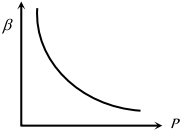
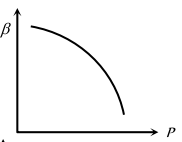
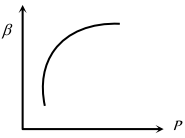
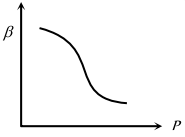
Which of the following graphs correctly represents the variation of $\beta=-(d V / d P) / V$ with $P$ for an ideal gas at constant temperature
AnswerFor an isothermal process $P V=$ constant$\Rightarrow P d V+V d P=0\Rightarrow\frac{1}{V}\left(\frac{d V}{d P}\right)=\frac{1}{P}$So, $\beta=\frac{1}{P} $
$\therefore$ graph will be rectangular hyperbola.
View full question & answer→MCQ 3061 Mark
Which of the following graphs correctly represents the variation of $\beta=-(d V / d P) / V$ with $P$ for an ideal gas at constant temperature
AnswerFor an isothermal process $P V=$ constant $\Rightarrow P d V+V d P=0\Rightarrow\frac{1}{V}\left(\frac{d V}{d P}\right)=\frac{1}{P}$
So, $\beta=\frac{1}{P} \therefore$ graph will be rectangular hyperbola.
View full question & answer→MCQ 3071 Mark
Which of the following graphs correctly represents the variation of $\beta=-(d V / d P) / V$ with $P$ for an ideal gas at constant temperature
AnswerFor an isothermal process $P V=$ constant$\Rightarrow P d V+V d P=0\Rightarrow\frac{1}{V}\left(\frac{d V}{d P}\right)=\frac{1}{P}$
So, $\beta=\frac{1}{P} \therefore$ graph will be rectangular hyperbola.
View full question & answer→MCQ 3081 Mark
An ideal monoatomic gas is taken round the cycle $A B C D A$ as shown in following $P-V$ diagram. The work done during the cycle is
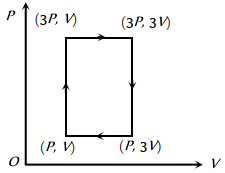
- A
$\mathrm{PV}$
- B
$2 \mathrm{PV}$
- ✓
$4 \mathrm{PV}$
- D
AnswerCorrect option: C. $4 \mathrm{PV}$
(c) Work done $=$ Area of curve enclosed$=2 V \times 2 P=4 P V$
View full question & answer→MCQ 3091 Mark
An ideal monoatomic gas is taken round the cycle $A B C D A$ as shown in following $P-V$ diagram. The work done during the cycle is
- A
$\mathrm{PV}$
- B
$2 \mathrm{PV}$
- ✓
$4 \mathrm{PV}$
- D
AnswerCorrect option: C. $4 \mathrm{PV}$
(c) Work done $=$ Area of curve enclosed$=2 V \times 2 P=4 P V$
View full question & answer→MCQ 3101 Mark
An ideal monoatomic gas is taken round the cycle $A B C D A$ as shown in following $P-V$ diagram. The work done during the cycle is
- A
$\mathrm{PV}$
- B
$2 \mathrm{PV}$
- ✓
$4 \mathrm{PV}$
- D
AnswerCorrect option: C. $4 \mathrm{PV}$
(c) Work done $=$ Area of curve enclosed$=2 V \times 2 P=4 P V$
View full question & answer→MCQ 3111 Mark
A thermally insulated rigid container contains an ideal gas heated by a filament of resistance $100 \Omega$ through a current of $1 A$ for $5 \mathrm{~min}$ then change in internal energy is
- A
$0 \mathrm{~kJ}$
- B
$10 \mathrm{~kJ}$
- C
$20 \mathrm{~kJ}$
- ✓
$30 \mathrm{~kJ}$
AnswerCorrect option: D. $30 \mathrm{~kJ}$
(d) Volume of the ideal gas is constant so $W=P \Delta V=0$ using FLOT $\Delta Q=\Delta U $
$\Rightarrow \Delta U=i^2 R t=1^2 \times 100 \times 5 \times 60$ $=30 \times 10^3=30 K J$
View full question & answer→MCQ 3121 Mark
A thermally insulated rigid container contains an ideal gas heated by a filament of resistance $100 \Omega$ through a current of $1 A$ for $5 \mathrm{~min}$ then change in internal energy is
- A
$0 \mathrm{~kJ}$
- B
$10 \mathrm{~kJ}$
- C
$20 \mathrm{~kJ}$
- ✓
$30 \mathrm{~kJ}$
AnswerCorrect option: D. $30 \mathrm{~kJ}$
(d) Volume of the ideal gas is constant so $W=P \Delta V=0$ using FLOT $\Delta Q=\Delta U$
$ \Rightarrow \Delta U=i^2 R t=1^2 \times 100 \times 5 \times 60$ $=30 \times 10^3=30 K J$
View full question & answer→MCQ 3131 Mark
A thermally insulated rigid container contains an ideal gas heated by a filament of resistance $100 \Omega$ through a current of $1 A$ for $5 \mathrm{~min}$ then change in internal energy is
- A
$0 \mathrm{~kJ}$
- B
$10 \mathrm{~kJ}$
- C
$20 \mathrm{~kJ}$
- ✓
$30 \mathrm{~kJ}$
AnswerCorrect option: D. $30 \mathrm{~kJ}$
Volume of the ideal gas is constant so $W=P \Delta V=0$ using FLOT $\Delta Q=\Delta U \Rightarrow \Delta U=i^2 R t=1^2 \times 100 \times 5 \times 60$ $=30 \times 10^3=30\ K J$
View full question & answer→MCQ 3141 Mark
A gas mixture consists of $2$ moles of oxygen and $4$ moles argon at temperature $T$. Neglecting all vibrational modes, the total internal energy of the system is
- A
$4 R T$
- B
$15 R T$
- C
$9 R T$
- ✓
$11 \mathrm{RT}$
AnswerCorrect option: D. $11 \mathrm{RT}$
Oxygen is diatomic gas, hence its energy of two moles$=2 \times \frac{5}{2} R T=5 R T$
Argon is a monoatomic gas, hence its internal energy of $4$ moles $=4 \times \frac{3}{2} R T=6 R T$
Total Internal energy $=(6+5) R T=11 R T$
View full question & answer→MCQ 3151 Mark
A gas mixture consists of $2$ moles of oxygen and $4$ moles argon at temperature $T$. Neglecting all vibrational modes, the total internal energy of the system is
- A
$4 R T$
- B
$15 R T$
- C
$9 R T$
- ✓
$11 \mathrm{RT}$
AnswerCorrect option: D. $11 \mathrm{RT}$
Oxygen is diatomic gas, hence its energy of two moles$=2 \times \frac{5}{2} R T=5 R T$
Argon is a monoatomic gas, hence its internal energy of $4$ moles $=4 \times \frac{3}{2} R T=6 R T$
Total Internal energy $=(6+5) R T=11 R T$
View full question & answer→MCQ 3161 Mark
A gas mixture consists of $2$ moles of oxygen and $4$ moles argon at temperature $T$. Neglecting all vibrational modes, the total internal energy of the system is
- A
$4 R T$
- B
$15 R T$
- C
$9 R T$
- ✓
$11 \mathrm{RT}$
AnswerCorrect option: D. $11 \mathrm{RT}$
Oxygen is diatomic gas, hence its energy of two moles$=2 \times \frac{5}{2} R T=5 R T$
Argon is a monoatomic gas, hence its internal energy of 4 moles $=4 \times \frac{3}{2} R T=6 R T$
Total Internal energy $=(6+5) R T=11 R T$
View full question & answer→MCQ 3171 Mark
During the melting of a slab of ice at $273 \mathrm{~K}$ at atmospheric pressure
- A
Positive work is done by ice-water system on the atmosphere
- B
Positive work is done on the ice water system by the atmosphere
- C
The internal energy of the ice-water system increases
- ✓
AnswerThere is a decrease in volume during melting on an ice slab at $273 K$. Therefore, negative work is done by ice-water system on the atmosphere or positive work is done on the ice-water system by the atmosphere. Hence option (b) is correct. Secondly heat is absorbed during melting (i.e. $\Delta Q$ is positive) and as we have seen, work done by ice-water system is negative ( $\Delta W$ is negative). Therefore, from first law of thermodynamics $\Delta U=\Delta Q-\Delta W$.Change in internal energy of ice-water system, $\Delta U$ will be positive or internal energy will increase.
View full question & answer→MCQ 3181 Mark
During the melting of a slab of ice at $273 \mathrm{~K}$ at atmospheric pressure
- A
Positive work is done by ice-water system on the atmosphere
- B
Positive work is done on the ice water system by the atmosphere
- C
The internal energy of the ice-water system increases
- ✓
AnswerThere is a decrease in volume during melting on an ice slab at $273 K$. Therefore, negative work is done by ice-water system on the atmosphere or positive work is done on the ice-water system by the atmosphere. Hence option (b) is correct. Secondly heat is absorbed during melting (i.e. $\Delta Q$ is positive) and as we have seen, work done by ice-water system is negative ( $\Delta W$ is negative). Therefore, from first law of thermodynamics $\Delta U=\Delta Q-\Delta W$.Change in internal energy of ice-water system, $\Delta U$ will be positive or internal energy will increase.
View full question & answer→MCQ 3191 Mark
During the melting of a slab of ice at $273 \mathrm{~K}$ at atmospheric pressure
- A
Positive work is done by ice-water system on the atmosphere
- B
Positive work is done on the ice water system by the atmosphere
- C
The internal energy of the ice-water system increases
- ✓
AnswerThere is a decrease in volume during melting on an ice slab at $273 K$. Therefore, negative work is done by ice-water system on the atmosphere or positive work is done on the ice-water system by the atmosphere. Hence option (b) is correct. Secondly heat is absorbed during melting (i.e. $\Delta Q$ is positive) and as we have seen, work done by ice-water system is negative ( $\Delta W$ is negative). Therefore, from first law of thermodynamics $\Delta U=\Delta Q-\Delta W$.Change in internal energy of ice-water system, $\Delta U$ will be positive or internal energy will increase.
View full question & answer→MCQ 3201 Mark
When an ideal diatomic gas is heated at constant pressure, the fraction of the heat energy supplied which increases the internal energy of the gas, is
- A
$\frac{2}{5}$
- B
$\frac{3}{5}$
- C
$\frac{3}{7}$
- ✓
$\frac{5}{7}$
AnswerCorrect option: D. $\frac{5}{7}$
Fraction of supplied energy which in creases the internal energy is given by
$[f=\frac{\Delta U}{(\Delta Q)_P}=\frac{(\Delta Q)_V}{(\Delta Q)_P}]$
$=\frac{\mu C_V \Delta T}{\mu C_P \Delta T}=\frac{1}{\gamma}$
For diatomic gas $\gamma=\frac{7}{5} \Rightarrow f=\frac{5}{7}$
View full question & answer→MCQ 3211 Mark
When an ideal diatomic gas is heated at constant pressure, the fraction of the heat energy supplied which increases the internal energy of the gas, is
- A
$\frac{2}{5}$
- B
$\frac{3}{5}$
- C
$\frac{3}{7}$
- ✓
$\frac{5}{7}$
AnswerCorrect option: D. $\frac{5}{7}$
Fraction of supplied energy which in creases the internal energy is given by
$[f=\frac{\Delta U}{(\Delta Q)_P}=\frac{(\Delta Q)_V}{(\Delta Q)_P}]$
$=\frac{\mu C_V \Delta T}{\mu C_P \Delta T}=\frac{1}{\gamma}$
For diatomic gas $\gamma=\frac{7}{5} \Rightarrow f=\frac{5}{7}$
View full question & answer→MCQ 3221 Mark
When an ideal diatomic gas is heated at constant pressure, the fraction of the heat energy supplied which increases the internal energy of the gas, is
- A
$\frac{2}{5}$
- B
$\frac{3}{5}$
- C
$\frac{3}{7}$
- ✓
$\frac{5}{7}$
AnswerCorrect option: D. $\frac{5}{7}$
Fraction of supplied energy which in creases the internal energy is given by
$[f=\frac{\Delta U}{(\Delta Q)_P}=\frac{(\Delta Q)_V}{(\Delta Q)_P}]$
$=\frac{\mu C_V \Delta T}{\mu C_P \Delta T}=\frac{1}{\gamma}$
For diatomic gas $\gamma=\frac{7}{5} \Rightarrow f=\frac{5}{7}$
View full question & answer→MCQ 3231 Mark
A given system undergoes a change in which the work done by the system equals the decrease in its internal energy. The system must have undergone an
AnswerIn adiabatic change $Q=$ constant $\Rightarrow \Delta Q=0$
So $(\Delta W=\Delta U(\because \Delta Q=\Delta U+\Delta W)$
View full question & answer→MCQ 3241 Mark
A given system undergoes a change in which the work done by the system equals the decrease in its internal energy. The system must have undergone an
AnswerIn adiabatic change $Q=$ constant $\Rightarrow \Delta Q=0$
So $(\Delta W=\Delta U(\because \Delta Q=\Delta U+\Delta W)$
View full question & answer→MCQ 3251 Mark
A given system undergoes a change in which the work done by the system equals the decrease in its internal energy. The system must have undergone an
AnswerIn adiabatic change $Q=$ constant $\Rightarrow \Delta Q=0$
So $(\Delta W=\Delta U(\because \Delta Q=\Delta U+\Delta W)$
View full question & answer→MCQ 3261 Mark
An ideal gas at a pressures of $1$ atmosphere and temperature of $27^{\circ} \mathrm{C}$ is compressed adiabatically until its pressure becomes $8$ times the initial pressure, then the final temperature is $(\gamma=3 / 2)$
- A
$627^{\circ} \mathrm{C}$
- B
$527^{\circ} \mathrm{C}$
- C
$427^{\circ} \mathrm{C}$
- ✓
$327^{\circ} \mathrm{C}$
AnswerCorrect option: D. $327^{\circ} \mathrm{C}$
Using relation $\frac{T_2}{T_1}=\left(\frac{P_2}{P_1}\right)^{\frac{\gamma-1}{\gamma}}=(8)^{\frac{3 / 2-1}{3 / 2}}=2$.
$[\Rightarrow T_2=2T_1\Rightarrow T_2=2(273+27)=600\mathrm{~K}=327^{\circ} \mathrm{C}$
View full question & answer→MCQ 3271 Mark
An ideal gas at a pressures of $1$ atmosphere and temperature of $27^{\circ} \mathrm{C}$ is compressed adiabatically until its pressure becomes 8 times the initial pressure, then the final temperature is $(\gamma=3 / 2)$
- A
$627^{\circ} \mathrm{C}$
- B
$527^{\circ} \mathrm{C}$
- C
$427^{\circ} \mathrm{C}$
- ✓
$327^{\circ} \mathrm{C}$
AnswerCorrect option: D. $327^{\circ} \mathrm{C}$
Using relation $\frac{T_2}{T_1}=\left(\frac{P_2}{P_1}\right)^{\frac{\gamma-1}{\gamma}}=(8)^{\frac{3 / 2-1}{3 / 2}}=2$.
$[\Rightarrow T_2=2T_1\Rightarrow T_2=2(273+27)=600\mathrm{~K}=327^{\circ} \mathrm{C}$
View full question & answer→MCQ 3281 Mark
An ideal gas at a pressures of $1$ atmosphere and temperature of $27^{\circ} \mathrm{C}$ is compressed adiabatically until its pressure becomes $8$ times the initial pressure, then the final temperature is $(\gamma=3 / 2)$
- A
$627^{\circ} \mathrm{C}$
- B
$527^{\circ} \mathrm{C}$
- C
$427^{\circ} \mathrm{C}$
- ✓
$327^{\circ} \mathrm{C}$
AnswerCorrect option: D. $327^{\circ} \mathrm{C}$
Using relation $\frac{T_2}{T_1}=\left(\frac{P_2}{P_1}\right)^{\frac{\gamma-1}{\gamma}}=(8)^{\frac{3 / 2-1}{3 / 2}}=2$.
$[\Rightarrow T_2=2T_1\Rightarrow T_2=2(273+27)=600\mathrm{~K}=327^{\circ} \mathrm{C}$
View full question & answer→MCQ 3291 Mark
When heat energy of $1500$ Joules, is supplied to a gas at constant pressure $2.1 \times 10^5 \mathrm{~N} / \mathrm{m}^2$, there was an increase in its volume equal to $2.5 \times 10^{-3} \mathrm{~m}^3$. The increase in internal energy of the gas in Joules is
- A
$450$
- B
$525$
- ✓
$975$
- D
$2025$
AnswerAccording to FLOT
$\Delta Q=\Delta U+P(\Delta V)$
$\Rightarrow \Delta U=\Delta Q-P(\Delta V) $
$=1500-\left(2.1 \times 10^5\right)\left(2.5 \times 10^{-3}\right)=975 \text { Joule }$
View full question & answer→MCQ 3301 Mark
When heat energy of $1500$ Joules, is supplied to a gas at constant pressure $2.1 \times 10^5 \mathrm{~N} / \mathrm{m}^2$, there was an increase in its volume equal to $2.5 \times 10^{-3} \mathrm{~m}^3$. The increase in internal energy of the gas in Joules is
- A
$450$
- B
$525$
- ✓
$975$
- D
$2025$
AnswerAccording to FLOT
$\Delta Q=\Delta U+P(\Delta V)$
$\Rightarrow \Delta U=\Delta Q-P(\Delta V) $
$=1500-\left(2.1 \times 10^5\right)\left(2.5 \times 10^{-3}\right)=975 \text { Joule }$
View full question & answer→MCQ 3311 Mark
When heat energy of $1500$ Joules, is supplied to a gas at constant pressure $2.1 \times 10^5 \mathrm{~N} / \mathrm{m}^2$, there was an increase in its volume equal to $2.5 \times 10^{-3} \mathrm{~m}^3$. The increase in internal energy of the gas in Joules is
- A
$450$
- B
$525$
- ✓
$975$
- D
$2025$
AnswerAccording to FLOT
$\Delta Q=\Delta U+P(\Delta V)$
$\Rightarrow \Delta U=\Delta Q-P(\Delta V) $
$=1500-\left(2.1 \times 10^5\right)\left(2.5 \times 10^{-3}\right)=975 \text { Joule }$
View full question & answer→MCQ 3321 Mark
A closed hollow insulated cylinder is filled with gas at $0^{\circ} \mathrm{C}$ and also contains an insulated piston of negligible weight and negligible thickness at the middle point. The gas on one side of the piston is heated to $100^{\circ} \mathrm{C}$. If the piston moves $5 \mathrm{~cm}$, the length of the hollow cylinder is
- A
$13.65 \mathrm{~cm}$
- B
$27.3 \mathrm{~cm}$
- C
$38.6 \mathrm{~cm}$
- ✓
$64.6 \mathrm{~cm}$
AnswerCorrect option: D. $64.6 \mathrm{~cm}$
Using Boyle's law, we have $\frac{V}{T}=$ constant $\Rightarrow \frac{\frac{l}{2}+5}{373}=\frac{\frac{l}{2}-5}{273}$
As the piston moves $5 \mathrm{~cm}$, the length of one side will be $\left(\frac{l}{2}+5\right)$ and other side $\left(\frac{l}{2}-5\right)$.
On solving this equation, we get $I=64.6 \mathrm{~cm}$.
View full question & answer→MCQ 3331 Mark
One mole of an ideal gas with $\gamma=1.4$, is adiabatically compressed so that its temperature rises from $27^{\circ} \mathrm{C}$ to $35^{\circ} \mathrm{C}$. The change in the internal energy of the gas is $(R=8.3 \mathrm{~J} / \mathrm{mol} . \mathrm{K})$
- A
$-166 J$
- ✓
$166 \mathrm{~J}$
- C
$-168\ J$
- D
$168 \mathrm{~J}$
AnswerCorrect option: B. $166 \mathrm{~J}$
Change in internal energy of the gas
$\Delta U=-\Delta W \frac{R}{\gamma-1}\left[T_2-T_1\right]=\frac{8.3}{(1.4-1)}[308-300]=166 J$
View full question & answer→MCQ 3341 Mark
A gas for which $\gamma=1.5$ is suddenly compressed to $\frac{1}{4}$ th of the initial volume. Then the ratio of the final to the initial pressure is
- A
$1: 16$
- B
$1: 8$
- C
$1: 4$
- ✓
$8: 1$
AnswerCorrect option: D. $8: 1$
(d) $P_1 V_1^\gamma=P_2 V_2^\gamma \Rightarrow \frac{P_2}{P_1}=\left[\frac{V_1}{V_2}\right]^\gamma=\left[\frac{4}{1}\right]^{3 / 2}=\frac{8}{1}$
View full question & answer→MCQ 3351 Mark
A closed hollow insulated cylinder is filled with gas at $0^{\circ} \mathrm{C}$ and also contains an insulated piston of negligible weight and negligible thickness at the middle point. The gas on one side of the piston is heated to $100^{\circ} \mathrm{C}$. If the piston moves $5 \mathrm{~cm}$, the length of the hollow cylinder is
- A
$13.65 \mathrm{~cm}$
- B
$27.3 \mathrm{~cm}$
- C
$38.6 \mathrm{~cm}$
- ✓
$64.6 \mathrm{~cm}$
AnswerCorrect option: D. $64.6 \mathrm{~cm}$
(d) Using Boyle's law, we have $\frac{V}{T}=$ constant$\Rightarrow \frac{\frac{l}{2}+5}{373}=\frac{\frac{l}{2}-5}{273}$
As the piston moves $5 \mathrm{~cm}$, the length of one side will be $\left(\frac{l}{2}+5\right)$ and other side $\left(\frac{l}{2}-5\right)$.
On solving this equation, we get $I=64.6 \mathrm{~cm}$.
View full question & answer→MCQ 3361 Mark
One mole of an ideal gas with $\gamma=1.4$, is adiabatically compressed so that its temperature rises from $27^{\circ} \mathrm{C}$ to $35^{\circ} \mathrm{C}$. The change in the internal energy of the gas is $(R=8.3 \mathrm{~J} / \mathrm{mol} . \mathrm{K})$
- A
$-166 J$
- ✓
$166 \mathrm{~J}$
- C
$-168\ J$
- D
$168 \mathrm{~J}$
AnswerCorrect option: B. $166 \mathrm{~J}$
Change in internal energy of the gas
$\Delta U=-\Delta W \frac{R}{\gamma-1}\left[T_2-T_1\right]=\frac{8.3}{(1.4-1)}[308-300]=166 J$
View full question & answer→MCQ 3371 Mark
A gas for which $\gamma=1.5$ is suddenly compressed to $\frac{1}{4}$ th of the initial volume. Then the ratio of the final to the initial pressure is
- A
$1: 16$
- B
$1: 8$
- C
$1: 4$
- ✓
$8: 1$
AnswerCorrect option: D. $8: 1$
(d) $P_1 V_1^\gamma=P_2 V_2^\gamma \Rightarrow \frac{P_2}{P_1}=\left[\frac{V_1}{V_2}\right]^\gamma=\left[\frac{4}{1}\right]^{3 / 2}=\frac{8}{1}$
View full question & answer→MCQ 3381 Mark
A closed hollow insulated cylinder is filled with gas at $0^{\circ} \mathrm{C}$ and also contains an insulated piston of negligible weight and negligible thickness at the middle point. The gas on one side of the piston is heated to $100^{\circ} \mathrm{C}$. If the piston moves $5 \mathrm{~cm}$, the length of the hollow cylinder is
- A
$13.65 \mathrm{~cm}$
- B
$27.3 \mathrm{~cm}$
- C
$38.6 \mathrm{~cm}$
- ✓
$64.6 \mathrm{~cm}$
AnswerCorrect option: D. $64.6 \mathrm{~cm}$
Using Boyle's law, we have $\frac{V}{T}=$ constant$\Rightarrow \frac{\frac{l}{2}+5}{373}=\frac{\frac{l}{2}-5}{273}$
As the piston moves $5 \mathrm{~cm}$, the length of one side will be $\left(\frac{l}{2}+5\right)$ and other side $\left(\frac{l}{2}-5\right)$.
On solving this equation, we get $I=64.6 \mathrm{~cm}$.
View full question & answer→MCQ 3391 Mark
One mole of an ideal gas with $\gamma=1.4$, is adiabatically compressed so that its temperature rises from $27^{\circ} \mathrm{C}$ to $35^{\circ} \mathrm{C}$. The change in the internal energy of the gas is $(R=8.3 \mathrm{~J} / \mathrm{mol} . \mathrm{K})$
- A
$-166 J$
- ✓
$166 \mathrm{~J}$
- C
$-168\ J$
- D
$168 \mathrm{~J}$
AnswerCorrect option: B. $166 \mathrm{~J}$
Change in internal energy of the gas
$\Delta U=-\Delta W \frac{R}{\gamma-1}\left[T_2-T_1\right]=\frac{8.3}{(1.4-1)}[308-300]=166 J$
View full question & answer→MCQ 3401 Mark
A gas for which $\gamma=1.5$ is suddenly compressed to $\frac{1}{4}$ th of the initial volume. Then the ratio of the final to the initial pressure is
- A
$1: 16$
- B
$1: 8$
- C
$1: 4$
- ✓
$8: 1$
AnswerCorrect option: D. $8: 1$
(d) $P_1 V_1^\gamma=P_2 V_2^\gamma \Rightarrow \frac{P_2}{P_1}=\left[\frac{V_1}{V_2}\right]^\gamma=\left[\frac{4}{1}\right]^{3 / 2}=\frac{8}{1}$
View full question & answer→MCQ 3411 Mark
In an isothermal change, an ideal gas obeys
Answer(a) In isothermal process, compressibility $E_\theta=\rho$.
View full question & answer→MCQ 3421 Mark
In an isothermal change, an ideal gas obeys
Answer(a) In isothermal process, compressibility $E_\theta=\rho$.
View full question & answer→MCQ 3431 Mark
In an isothermal change, an ideal gas obeys
Answer(a) In isothermal process, compressibility $E_\theta=\rho$.
View full question & answer→MCQ 3441 Mark
Work done by 0.1 mole of a gas at $27^{\circ} \mathrm{C}$ to double its volume at constant pressure is $(R=2 \mathrm{cal} \mathrm{mol} \mathrm{C})$
- A
$54 \mathrm{cal}$
- B
$600 \mathrm{cal}$
- ✓
$60 \mathrm{cal}$
- D
$546 \mathrm{cal}$
AnswerCorrect option: C. $60 \mathrm{cal}$
(c) $W=P \Delta V=n R \Delta T=0.1 \times 2 \times 300=60 \mathrm{cal}$
View full question & answer→MCQ 3451 Mark
Work done by 0.1 mole of a gas at $27^{\circ} \mathrm{C}$ to double its volume at constant pressure is $(R=2 \mathrm{cal} \mathrm{mol} \mathrm{C})$
- A
$54 \mathrm{cal}$
- B
$600 \mathrm{cal}$
- ✓
$60 \mathrm{cal}$
- D
$546 \mathrm{cal}$
AnswerCorrect option: C. $60 \mathrm{cal}$
(c) $W=P \Delta V=n R \Delta T=0.1 \times 2 \times 300=60 \mathrm{cal}$
View full question & answer→MCQ 3461 Mark
Work done by 0.1 mole of a gas at $27^{\circ} \mathrm{C}$ to double its volume at constant pressure is $(R=2 \mathrm{cal} \mathrm{mol} \mathrm{C})$
- A
$54 \mathrm{cal}$
- B
$600 \mathrm{cal}$
- ✓
$60 \mathrm{cal}$
- D
$546 \mathrm{cal}$
AnswerCorrect option: C. $60 \mathrm{cal}$
(c) $W=P \Delta V=n R \Delta T=0.1 \times 2 \times 300=60 \mathrm{cal}$
View full question & answer→MCQ 3471 Mark
Find the change in internal energy of the system when a system absorbs $2$ kilocalorie of heat and at the same time does $500$ joule of work
- ✓
$7900 \mathrm{~J}$
- B
$8200 \mathrm{~J}$
- C
$5600 \mathrm{~J}$
- D
$6400 \mathrm{~J}$
AnswerCorrect option: A. $7900 \mathrm{~J}$
$\Delta Q=2 \mathrm{kcal}=2 \times 10^3 \times 4.2 \mathrm{~J}=8400 \mathrm{~J}$ and $\Delta W=500 \mathrm{~J}$.
Hence from $\Delta Q=\Delta U+\Delta W, $
$\Delta W=\Delta Q-\Delta U=8400-$ $500=7900 \mathrm{~J}$
View full question & answer→MCQ 3481 Mark
Find the change in internal energy of the system when a system absorbs $2$ kilocalorie of heat and at the same time does $500$ joule of work
- ✓
$7900 \mathrm{~J}$
- B
$8200 \mathrm{~J}$
- C
$5600 \mathrm{~J}$
- D
$6400 \mathrm{~J}$
AnswerCorrect option: A. $7900 \mathrm{~J}$
$\Delta Q=2 \mathrm{kcal}=2 \times 10^3 \times 4.2 \mathrm{~J}=8400 \mathrm{~J}$ and $\Delta W=500 \mathrm{~J}$.
Hence from $\Delta Q=\Delta U+\Delta W, $
$\Delta W=\Delta Q-\Delta U=8400-$ $500=7900 \mathrm{~J}$
View full question & answer→MCQ 3491 Mark
Find the change in internal energy of the system when a system absorbs $2$ kilocalorie of heat and at the same time does $500$ joule of work
- ✓
$7900 \mathrm{~J}$
- B
$8200 \mathrm{~J}$
- C
$5600 \mathrm{~J}$
- D
$6400 \mathrm{~J}$
AnswerCorrect option: A. $7900 \mathrm{~J}$
$\Delta Q=2 \mathrm{kcal}=2 \times 10^3 \times 4.2 \mathrm{~J}=8400 \mathrm{~J}$ and $\Delta W=500 \mathrm{~J}$.
Hence from $\Delta Q=\Delta U+\Delta W, $
$\Delta W=\Delta Q-\Delta U=8400-$ $500=7900 \mathrm{~J}$
View full question & answer→MCQ 3501 Mark
In a thermodynamic process, pressure of a fixed mass of a gas is changed in such a manner that the gas molecules gives out $20 \mathrm{~J}$ of heat and $10 \mathrm{~J}$ of work is done on the gas. If the initial internal energy of the gas was $40 \mathrm{~J}$, then the final internal energy will be
- A
$30 \mathrm{~J}$
- B
$20 \mathrm{~J}$
- ✓
$60 \mathrm{~J}$
- D
$40 \mathrm{~J}$
AnswerCorrect option: C. $60 \mathrm{~J}$
(c)$\Delta Q=\Delta U+\Delta W=\left(U_f-U_i\right)+\Delta W $
$\Rightarrow 30=\left(U_f-40\right)+10 $
$\Rightarrow U_f=60 J$
View full question & answer→