MCQ 511 Mark
The time period of rotation of the sun is $25$ days and its radius is $7 \times 10^8 m$. The Doppler shift for the light of wavelength $6000 \mathring A$ emitted from the surface of the sun will be
- ✓
$0.04 \mathring A$
- B
$0.40 \mathring A$
- C
$4.00 \mathring A$
- D
$40.0 \mathring A$
AnswerCorrect option: A. $0.04 \mathring A$
$0.04 \mathring A$
View full question & answer→MCQ 521 Mark
The observed wavelength of light coming from a distant galaxy is found to be increased by $0.5 \%$ as compared with that coming from a terrestrial source. The galaxy is
AnswerCorrect option: D. Receding from the earth with a velocity equal to $1.5 \times 10^6 m / s$
$\frac{\Delta \lambda}{\lambda} =\frac{v}{c}, \text { Now } \Delta \lambda=\frac{0.5}{100} \lambda \Rightarrow \frac{\Delta \lambda}{\lambda}=\frac{0.5}{100}$
$\therefore v =\frac{0.5}{100} \times c=\frac{0.5}{100} \times 3 \times 10^8=1.5 \times 10^6 m / s $
View full question & answer→MCQ 531 Mark
Wave nature of light follows because
- ✓
light rays travel in a straight line
- B
light exhibits the phenomena of reflection and refraction
- C
light exhibits the phenomenon of interference
- D
Light causes the phenomenon of photoelectric effect
AnswerCorrect option: A. light rays travel in a straight line
Interference is explained by wave nature of light.
View full question & answer→MCQ 541 Mark
Two identical light sources $S$ and $S$ emit light of same wavelength $\lambda$. These light rays will exhibit interference if
- ✓
Their phase differences remain constant
- B
Their phases are distributed randomly
- C
Their light intensities remain constant
- D
Their light intensities change randomly
AnswerCorrect option: A. Their phase differences remain constant
For interference phase difference must be constant.
View full question & answer→MCQ 551 Mark
A star producing light of wavelength $6000 \mathring A$ moves away from the earth with a speed of $5 km / sec$. Due to Doppler effect the shift in wavelength will be $\left(c=3 \times 10^8 m / sec \right)$
- ✓
$0.1 \mathring A$
- B
$0.05 \mathring A$
- C
$0.2 \mathring A$
- D
$1 \mathring A$
AnswerCorrect option: A. $0.1 \mathring A$
Doppler's shift is given by
$\Delta \lambda=\frac{v \lambda}{c}=\frac{5000 \times 6000}{3 \times 10^8}=0.1 \mathring A$
View full question & answer→MCQ 561 Mark
Doppler's effect in sound in addition to relative velocity between source and observer, also depends while source and observer or both are moving. Doppler effect in light depend only on the relative velocity of source and observer. The reason of this is
- A
Einstein mass - energy relation
- ✓
Einstein theory of relativity
- C
- D
AnswerCorrect option: B. Einstein theory of relativity
With reference to this theory the velocity of the observer is neglected w.r.t. the light velocity.
View full question & answer→MCQ 571 Mark
The periodic time of rotation of a certain star is $22$ days and its radius is $7 \times 10^*$ metres. If the wavelength of light emitted by its surface be $4320 \mathring A$, the Doppler shift will be $(1$ day $= 86400 \sec )$
- ✓
$0.033 \mathring A$
- B
$0.33 \mathring A$
- C
$3.3 \mathring A$
- D
$33 \mathring A$
AnswerCorrect option: A. $0.033 \mathring A$
$0.033 \mathring A$
View full question & answer→MCQ 581 Mark
Intensities of the two waves of light are $l$ and $4 l$. The maximum intensity of the resultant wave after superposition is
- A
$5 l$
- ✓
$9 l$
- C
$16 I$
- D
$25 l$
Answer$ I_{\max }=I_1+I_2+2 \sqrt{I_1 I_2}$
So, $I_{\max }=I+4 I+2 \sqrt{I .4 I}=9 I$
View full question & answer→MCQ 591 Mark
In a wave, the path difference corresponding to a phase difference $\phi$ is
- A
$\frac{\pi}{2 \lambda} \phi$
- B
$\frac{\pi}{\lambda} \phi$
- ✓
$\frac{\lambda}{2 \pi} \phi$
- D
$\frac{\lambda}{\pi} \phi$
AnswerCorrect option: C. $\frac{\lambda}{2 \pi} \phi$
For $2 \pi$ phase difference $\rightarrow$ Path difference is $\lambda$
$\therefore$ For $\phi$ phase difference $\rightarrow$ Path difference is $\frac{\lambda}{2 \pi} \times \phi$
View full question & answer→MCQ 601 Mark
The ratio of intensities of two waves is $9: 1$. They are producing interference. The ratio of maximum and minimum intensities will be
- A
$10: 8$
- B
$9: 1$
- ✓
$4: 1$
- D
$2: 1$
AnswerCorrect option: C. $4: 1$
$\frac{I_{\max }}{I_{\min }} =\left(\frac{\sqrt{\frac{I_1}{I_2}}+1}{\sqrt{\frac{I_1}{I_2}}-1}\right)^2 =\left(\frac{\sqrt{\frac{9}{1}+1}}{\sqrt{\frac{9}{1}}-1}\right)$
$= \frac{4}{1}$
View full question & answer→MCQ 611 Mark
In the Young's double slit experiment, if the phase difference between the two waves interfering at a point is $\phi$, the intensity at that point can be expressed by the expressionWhere $A$ and $B$ depend upon the amplitudes of the two waves.
- A
(a) $I=\sqrt{A^2+B^2 \cos ^2 \phi}$
- B
(b) $I=\frac{A}{B} \cos \phi$
- C
(c) $I=A+B \cos \frac{\phi}{2}$
- ✓
(d) $I=A+B \cos \phi$
AnswerCorrect option: D. (d) $I=A+B \cos \phi$
(d) Since $P$ is ahead of $Q$ by 90 and path difference between $P$ and $Q$ is $\lambda / 4$. Therefore at $A$, phase difference is zero, so intensity is 4l. At $C$ it is zero and at $B$, the phase difference is 90 , so intensity is $2 l$.
View full question & answer→MCQ 621 Mark
light coming from a star is observed to have a wavelength of $3737\mathring A$, while its real wavelength is $3700 \mathring A$. The speed of the star relative to the earth is [Speed of light $3 \times 10^8 m / s$ ]
- A
$3 \times 10^5 m / s$
- ✓
$3 \times 10^6 m / s$
- C
$3.7 \times 10^7 m / s$
- D
$3.7 \times 10^6 m / s$
AnswerCorrect option: B. $3 \times 10^6 m / s$
$\Delta \lambda=\lambda \frac{v}{c} $
$\Rightarrow(3737-3700)=3700 \times \frac{v}{3 \times 10^8} $
$\Rightarrow v=3 \times 10^6 m / s$
View full question & answer→MCQ 631 Mark
A light source approaches the observer with velocity $0.8 c$. The doppler shift for the light of wavelength $5500 \mathring A$ is
- A
$4400 A$
- B
$1833 A$
- ✓
$3167 \mathring A$
- D
$7333 \mathring A$
AnswerCorrect option: C. $3167 \mathring A$
According to Doppler's principle
$\lambda^{\prime}=\lambda \sqrt{\frac{1-v / c}{1+v / c}}$ for $v=c$
$\lambda^{\prime}=5500 \sqrt{\frac{(1-0.8)}{1+0.8}}=1833.3 $
$\therefore \text { Shift }=5500-1833.3=3167 \mathring A$
View full question & answer→MCQ 641 Mark
A star emitting light of wavelength $5896 \mathring A$ is moving away from the earth with a speed of $3600 km / sec$. The wavelength of light observed on earth will $\left(c=3 \times 10^8 m / sec\right.$ is the speed of light)
- A
Decrease by $5825.25 \mathring A$
- B
Increase by $5966.75 \mathring A$
- C
Decrease by $70.75 \mathring A$
- ✓
Increase by $70.75 \mathring A$
AnswerCorrect option: D. Increase by $70.75 \mathring A$
$\Delta \lambda=\frac{v}{c} \lambda=\frac{3600 \times 10^3}{3 \times 10^8} \times 5896=70.75 \mathring A$
So the increased wavelength of light is observed.
View full question & answer→MCQ 651 Mark
Which of the following is conserved when light waves interfere
AnswerEnergy is conserved in the interference of light.
View full question & answer→MCQ 661 Mark
Plane polarised light is passed through a polaroid. On viewing through the polaroid we find that when the polariod is given one complete rotation about the direction of the light, one of the following is observed
- A
The intensity of light gradually decreases to zero and remains at zero
- B
The intensity of light gradually increases to a maximum and remains at maximum
- C
There is no change in intensity
- ✓
The intensity of light is twice maximum and twice zero
AnswerCorrect option: D. The intensity of light is twice maximum and twice zero
View full question & answer→MCQ 671 Mark
For constructive interference to take place between two monochromatic light waves of wavelength $\lambda$, the path difference should be
- A
$(2 n-1) \frac{\lambda}{4}$
- B
$(2 n-1) \frac{\lambda}{2}$
- ✓
$n \lambda$
- D
$(2 n+1) \frac{\lambda}{2}$
AnswerCorrect option: C. $n \lambda$
For constructive interference path difference is even multiple of$\frac{\lambda}{2} \text {. }$
View full question & answer→MCQ 681 Mark
Two coherent sources of light can be obtained by
- A
- B
Two different lamps but of the same power
- C
Two different lamps of same power and having the same colour
- ✓
AnswerThe coherent source cannot be obtained from two different light sources.
View full question & answer→MCQ 691 Mark
Electromagnetic waves travel in a medium which has relative permeability $1.3$ and relative permittivity $2.14.$ Then the speed of the electromagnetic wave in the medium will be
- A
$13.6 \times 10^6 m / s$
- B
$1.8 \times 10^2 m / s$
- C
$3.6 \times 10^8 m / s$
- ✓
$1.8 \times 10^8 m / s$
AnswerCorrect option: D. $1.8 \times 10^8 m / s$
$v=\frac{c}{\sqrt{\mu_r \varepsilon_r}}=\frac{3 \times 10^8}{\sqrt{1.3 \times 2.14}}=1.8 \times 10^8 m / sec$
View full question & answer→MCQ 701 Mark
Which of following can not be polarised
AnswerUltrasonic waves are longitudinal waves.
View full question & answer→MCQ 711 Mark
When the angle of incidence on a material is $60^{\circ}$, the reflected light is completely polarized. The velocity of the refracted ray inside the material is (in $m s$ )
AnswerCorrect option: C. $\sqrt{3} \times 10^8$
From Brewster's law $\mu=\tan i_p \Rightarrow \frac{c}{v}=\tan 60^{\circ}=\sqrt{3}$
$\Rightarrow v=\frac{c}{\sqrt{3}}=\frac{3 \times 10^8}{\sqrt{3}}=\sqrt{3} \times 10^8 m / sec .$
View full question & answer→MCQ 721 Mark
Which one of the following is not electromagnetic in nature
MCQ 731 Mark
The speed of electromagnetic wave in vacuum depends upon the source of radiation
AnswerCorrect option: C. (c) Is same for all of them
(c) Speed of EM waves in vacuum $=\frac{1}{\sqrt{\mu_0 \in_0}}=$ constant
View full question & answer→MCQ 741 Mark
Electromagnetic radiation of highest frequency is
AnswerCorrect option: D. $\gamma$-rays
$v_{\gamma \text {-rays }}>v_{\text {visibleradiation }}>v_{\text {Infrared }}>v_{\text {Radio waves }}$
View full question & answer→MCQ 751 Mark
- A
- ✓
- C
$X$-rays
- D
$\gamma$-rays
AnswerOzone layer absorbs most of the $U V$ rays emitted by sun.
View full question & answer→MCQ 761 Mark
Select the right option in the following
- A
Christian Huygens a contemporary of Newton established the wave theory of light by assuming that light waves were transverse
- ✓
Maxwell provided the compelling theoretical evidence that light is transverse wave
- C
Thomas Young experimentally proved the wave behaviour of light and Huygens assumption
- D
All the statements give above, correctly answers the question "what is light"
AnswerCorrect option: B. Maxwell provided the compelling theoretical evidence that light is transverse wave
View full question & answer→MCQ 771 Mark
When unpolarised light beam is incident from air onto glass $(n=1.5)$ at the polarising angle
- ✓
(a) Reflected beam is polarised 100 percent
- B
(b) Reflected and refracted beams are partially polarised
- C
(c) The reason for (a) is that almost all the light is reflected
- D
AnswerCorrect option: A. (a) Reflected beam is polarised 100 percent
(a) According to Brewster's law, when a beam of ordinary light (i.e. unpolarised) is reflected from a transparent medium (like glass), the reflected light is completely plane polarised at certain angle of incidence called the angle of polarisation.
View full question & answer→MCQ 781 Mark
Infrared radiation was discovered in $1800$ by
View full question & answer→MCQ 791 Mark
The wave theory of light was given by
AnswerWave theory of light is given by Huygen.
View full question & answer→MCQ 801 Mark
Specific rotation of sugar solution is $0.01 Sl$ units. $200 kgm ^{-3}$ of impure sugar solution is taken in a polarimeter tube of length $0.25 m$ and an optical rotation of $0.4 rad$ is observed. The percentage of purity of sugar is the sample is
- A
(a) $80 \%$
- B
(b) $89 \%$
- C
(c) $11 \%$
- ✓
(d) $20 \%$
AnswerCorrect option: D. (d) $20 \%$
(d) If $l$ is the final intensity and $l$ is the initial intensity then$I=\frac{I_0}{2}\left(\cos ^2 30^{\circ}\right)^5 \text { or } \frac{I}{I_0}=\frac{1}{2} \times\left(\frac{\sqrt{3}}{2}\right)^{10}=0.12$
View full question & answer→MCQ 811 Mark
Huygen's principle of secondary wavelets may be used to
- A
Find the velocity of light in vacuum
- B
Explain the particle behaviour of light
- ✓
Find the new position of the wavefront
- D
Explain photoelectric effect
AnswerCorrect option: C. Find the new position of the wavefront
View full question & answer→MCQ 821 Mark
Two waves have their amplitudes in the ratio $1: 9$. The maximum and minimum intensities when they interfere are in the ratio
- ✓
$\frac{25}{16}$
- B
$\frac{16}{26}$
- C
$\frac{1}{9}$
- D
$\frac{9}{1}$
AnswerCorrect option: A. $\frac{25}{16}$
$\frac{I_{\max }}{I_{\min }}=\left(\frac{\frac{a_1}{a_2}+1}{\frac{a_1}{a_2}-1}\right)^2=\left(\frac{\frac{1}{9}+1}{\frac{1}{9}-1}\right)^2=\left(\frac{5}{4}\right)^2=\frac{25}{16}$.
View full question & answer→MCQ 831 Mark
$V_o$ and $V_E$ represent the velocities, $\mu_o$ and $\mu_E$ the refractive indices of ordinary and extraordinary rays for a doubly refracting crystal. Then
- A
(a) $V_o \geq V_E, \mu_o \leq \mu_E$ if the crystal is calcite
- B
(b) $V_o \leq V_E, \mu_o \leq \mu_E$ if the crystal is quartz
- ✓
(c) $V_o \leq V_E, \mu_o \geq \mu_E$ if the crystal is calcite
- D
(d) $V_o \geq V_E, \mu_o \geq \mu_E$ if the crystal is quartz
AnswerCorrect option: C. (c) $V_o \leq V_E, \mu_o \geq \mu_E$ if the crystal is calcite
(c) In double refraction light rays always splits into two rays $(O$ ray \& $E$-ray). $O$-ray has same velocity in all direction but $E$-ray has different velocity in different direction.For calcite $\mu<\mu \Rightarrow v>v$For quartz $\mu>\mu \Rightarrow v>v$.
View full question & answer→MCQ 841 Mark
light passes successively through two polarimeters tubes each of length $0.29\ m$. The first tube contains dextro rotatory solution of concentration $60\ kgm$ and specific rotation $0.01\ rad\ mkg$. The second tube contains laevo rotatory solution of concentration $30\ kg / m$ and specific rotation $0.02\ radm\ kg$. The net rotation produced is
- A
$15^{\circ}$
- ✓
$0^{\circ}$
- C
$20^{\circ}$
- D
$10^{\circ}$
AnswerCorrect option: B. $0^{\circ}$
Rotation produced $\theta=S / c$Net rotation produced $\theta=\theta-\theta=I(S c-S c)$
$=0.29 \times[0.01 \times 60-0.02 \times 30]=0^\circ$
View full question & answer→MCQ 851 Mark
Three observers $A, B$ and $C$ measure the speed of light coming from a source to be $v_A, v_B$ and $v_C$. The observer $A$ moves towards the source, the observer $C$ moves away from the source with the same speed. The observer $B$ stays stationary. the surrounding space is vacuum every where. Then
- A
$v_A>v_B>v_C$
- B
$v_A$
- ✓
$v_A=v_B=v_C$
- D
$v_A =v_B > v_C$
AnswerCorrect option: C. $v_A=v_B=v_C$
$v_A=v_B=v_C$
View full question & answer→MCQ 861 Mark
When one of the slits of Young's experiment is covered with a transparent sheet of thickness $4.8 mm$, the central fringe shifts to a position originally occupied by the $30^*$ bright fringe. What should be the thickness of the sheet if the central fringe has to shift to the position occupied by $20^{\circ}$ bright fringe
- ✓
(a) $3.8 mm$
- B
(b) $1.6 mm$
- C
(c) $7.6 mm$
- D
(d) $3.2 mm$
AnswerCorrect option: A. (a) $3.8 mm$
(a) According to given condition $(\mu-1) t=n \lambda$ for minimum $t, n=1$So, $(\mu-1) t_{\min }=\lambda$$t_{\min }=\frac{\lambda}{\mu-1}=\frac{\lambda}{1.5-1}=2 \lambda$
View full question & answer→MCQ 871 Mark
The electromagnetic waves travel with a velocity
- A
Equal to velocity of sound
- ✓
Equal to velocity of light
- C
Less than velocity of light
- D
AnswerCorrect option: B. Equal to velocity of light
Velocity of EM waves $=\frac{1}{\sqrt{\mu_0 \in_0}} 3 \times 10^8 m / s =$ velocity of light
View full question & answer→MCQ 881 Mark
When light is incident on a doubly refracting crystal, two refracted rays-ordinary ray $(O$-ray) and extra ordinary ray $(E$-ray) are produced. Then
- A
Both $O$-ray and $E$-ray are polarised perpendicular to the plane of incidence
- B
Both $O$-ray and $E$-ray are polarised in the plane of incidence
- C
$E$-ray is polarised perpendicular to the plane of incidence and $O$-ray in the plane of incidence
- ✓
$E$-ray is polarised in the plane of incidence and $O$-ray perpendicular to the plane of incidence
AnswerCorrect option: D. $E$-ray is polarised in the plane of incidence and $O$-ray perpendicular to the plane of incidence
View full question & answer→MCQ 891 Mark
A $20 cm$ length of a certain solution causes right-handed rotation of $38^{\circ}$. A $30 cm$ length of another solution causes left-handed rotation of $24^{\circ}$. The optical rotation caused by $30 cm$ length of a mixture of the above solutions in the volume ratio $1: 2$ is
- ✓
(a) Left handed rotation of $14^{\circ}$
- B
(b) Right handed rotation of $14^{\circ}$
- C
(c) Left handed rotation of $3^{\circ}$
- D
(d) Right handed rotation of $3^{\circ}$
AnswerCorrect option: A. (a) Left handed rotation of $14^{\circ}$
(a) Using Matus law, $I=I_0 \cos ^2 \theta$As here polariser is rotating i.e all the values of $\theta$ are possible.$I_{a v}=\frac{1}{2 \pi} \int_0^{2 \pi} I d \theta=\frac{1}{2 \pi} \int_0^{2 \pi} I_0 \cos ^2 \theta d \theta$On integration we get $I_{a v}=\frac{I_0}{2}$where $I_0=\frac{\text { Energy }}{\text { Area } \times \text { Time }}=\frac{p}{A}=\frac{10^{-3}}{3 \times 10^{-4}}=\frac{10}{3} \frac{ Watt }{ m ^2$$\therefore I_{a v}=\frac{1}{2} \times \frac{10}{3}=\frac{5}{3} Watt$and Time period $T=\frac{2 \pi}{\omega}=\frac{2 \times 3.14}{31.4}=\frac{1}{5} sec$$\therefore$ Energy of light passing through the polariser per revolution$=I_{a v} \times \text { Area } \times T=\frac{5}{3} \times 3 \times 10^{-4} \times \frac{1}{5}=10^{-4} J .$
View full question & answer→MCQ 901 Mark
Radio waves and visible light in vacuum have
- ✓
Same velocity but different wavelength
- B
Continuous emission spectrum
- C
- D
AnswerCorrect option: A. Same velocity but different wavelength
In vacuum velocity of all EM waves are same but their wavelengths are different.
View full question & answer→MCQ 911 Mark
The dual nature of light is exhibited by
- A
- B
Refraction and interference
- C
Diffraction and reflection
- ✓
Diffraction and photoelectric effect
AnswerCorrect option: D. Diffraction and photoelectric effect
Diffraction shows the wave nature of light and photoelectric effect shows particle nature of light.
View full question & answer→MCQ 921 Mark
TV waves have a wavelength range of $1-10$ meter. Their frequency range in $MHz$ is
- ✓
$30-300$
- B
$3-30$
- C
$300-3000$
- D
$3-3000$
AnswerCorrect option: A. $30-300$
$v=\frac{C}{\lambda}$
$ \Rightarrow v_1=\frac{3 \times 10^8}{1}=3 \times 10^8 Hz =300 MHz $
$\text { and } v_2=\frac{3 \times 10^8}{10}=3 \times 10^7 Hz =30 MHz$
View full question & answer→MCQ 931 Mark
The similarity between the sound waves and light waves is
- A
Both are electromagnetic waves
- B
Both are longitudinal waves
- C
Both have the same speed in a medium
- ✓
They can produce interference
AnswerCorrect option: D. They can produce interference
Sound wave and light waves both shows interference.
View full question & answer→MCQ 941 Mark
thin slice is cut out of a glass cylinder along a plane parallel to its axis. The slice is placed on a flat glass plate as shown. The observed interference fringes from this combination shall be
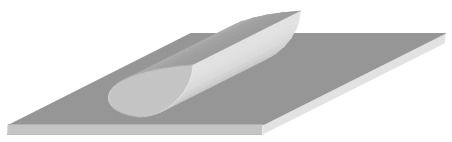
- ✓
- B
- C
- D
Having fringe spacing which increases as we go outwards
AnswerThe cylindrical surface touches the glass plate along a line parallel to axis of cylinder. The thickness of wedge shaped film increases on both sides of this line. Locus of equal path difference are the lines running parallel to the axis of the cylinder. Hence straight fringes are obtained.
View full question & answer→MCQ 951 Mark
A beam of electron is used in an $\text{YDSE}$ experiment. The slit width is $d.$ When the velocity of electron is increased, then
- A
No interference is observed
- B
- ✓
- D
Fringe width remains same
View full question & answer→MCQ 961 Mark
In Young's double slit experiment intensity at a point is $(1 / 4)$ of the maximum intensity. Angular position of this point is
- A
$\sin (\lambda / d)$
- B
$\sin (\lambda / 2 d)$
- ✓
$\sin (\lambda / 3 d)$
- D
$\sin (\lambda / 4 d)$
AnswerCorrect option: C. $\sin (\lambda / 3 d)$
$\sin (\lambda / 3 d)$
View full question & answer→MCQ 971 Mark
In a YDSE bi-chromatic light of wavelengths $400 nm$ and $560 nm$ are used. The distance between the slits is $0.1 mm$ and the distance between the plane of the slits and the screen is $1 m$. The minimum distance between two successive regions of complete darkness is
- ✓
(a) $4 mm$
- B
(b) $5.6 mm$
- C
(c) $14 mm$
- D
(d) $28 mm$
AnswerCorrect option: A. (a) $4 mm$
(a)$\frac{\Delta \lambda}{\lambda}=\frac{v}{c}$
$ \Rightarrow \frac{(401.8-393.3)}{393.3}=\frac{v}{3 \times 10^8} $
$\Rightarrow v=6.48 \times 10 m / s $
$=6480 km / sec .$
View full question & answer→MCQ 981 Mark
In the ideal double-slit experiment, when a glass-plate (refractive index 1.5) of thickness $t$ is introduced in the path of one of the interfering beams (wavelength $\lambda$ ), the intensity at the position where the central maximum occurred previously remains unchanged. The minimum thickness of the glass-plate is
AnswerCorrect option: A. (a) $2 \lambda$
(a)$\Delta \lambda=\lambda \frac{v}{c} \text { and } v=r \omega$
$v=7 \times 10^8 \times \frac{2 \pi}{25 \times 24 \times 3600}, c=3 \times 10^8 m / s $
$\therefore \Delta \lambda=0.04 \mathring A$
View full question & answer→MCQ 991 Mark
Two beams of light having intensities $l$ and $4 l$ interfere to produce a fringe pattern on a screen. The phase difference between the beams is $\frac{\pi}{2}$ at point $A$ and $\pi$ at point $B$. Then the difference between the resultant intensities at $A$ and $B$ is
AnswerAt point $A$, resultant intensity
$I_A=I_1+I_2=5 I ; \text { and at point } B $
$I_B=I_1+I_2+2 \sqrt{I_1 I_2} \cos \pi=5 I+4 I $
$I_B=9 I \text { so } I_B-I_A=4 I .$
View full question & answer→MCQ 1001 Mark
In Young's double slit experiment, the two slits act as coherent sources of equal amplitude $A$ and wavelength $\lambda$. In another experiment with the same set up the two slits are of equal amplitude $A$ and wavelength $\lambda$ but are incoherent. The ratio of the intensity of light at the mid$-$point of the screen in the first case to that in the second case is
- A
$1: 2$
- ✓
$2: 1$
- C
$4: 1$
- D
$1: 1$
AnswerCorrect option: B. $2: 1$
$2: 1$
View full question & answer→