MCQ 1011 Mark
A ray of light of intensity $l$ is incident on a parallel glass-slab at a point $A$ as shown in fig. It undergoes partial reflection and refraction. At each reflection $25 \%$ of incident energy is reflected. The rays $A B$ and $A^{\prime} B^{\prime}$ undergo interference. The ratio $I_{\max } / I_{\min }$ is
- A
$4: 1$
- B
$8: 1$
- C
$7: 1$
- ✓
$49: 1$
AnswerCorrect option: D. $49: 1$
View full question & answer→MCQ 1021 Mark
In Young's double slit experiment, white light is used. The separation between the slits is $b$. The screen is at a distance $d(d>>b)$ from the slits. Some wavelengths are missing exactly in front of one slit. These wavelengths are
- ✓
$\lambda=\frac{b^2}{d}$
- B
$\lambda=\frac{2 b^2}{d}$
- C
$\lambda=\frac{b^2}{3 d}$
- D
$\lambda=\frac{2 b^2}{3 d}$
AnswerCorrect option: A. $\lambda=\frac{b^2}{d}$
View full question & answer→MCQ 1031 Mark
Energy stored in electromagnetic oscillations is in the form of
MCQ 1041 Mark
Which rays are not the portion of electromagnetic spectrum
- A
$X$-rays
- B
- ✓
$\alpha$-rays
- D
AnswerCorrect option: C. $\alpha$-rays
View full question & answer→MCQ 1051 Mark
Consider the following statements $A$ to $B$ and identify the correct answer A. Polarised light can be used to study the helical surface of nucleic acids.B. Optics axis is a direction and not any particular line in the crystal
AnswerCorrect option: A. $A$ and $B$ are correct
View full question & answer→MCQ 1061 Mark
For the study of the helical structure of nucleic acids, the property of electromagnetic radiation generally used is
MCQ 1071 Mark
light waves producing interference have their amplitudes in the ratio $3: 2$. The intensity ratio of maximum and minimum of interference fringes is
- A
$36: 1$
- B
$9: 4$
- ✓
$25: 1$
- D
$6: 4$
AnswerCorrect option: C. $25: 1$
$\frac{I_{\max }}{I_{\min }}=\left(\frac{\frac{a_1}{a_2}+1}{\frac{a_1}{a_2}-1}\right)^2=\frac{25}{1}$
View full question & answer→MCQ 1081 Mark
The frequency of light ray having the wavelength $3000 \mathring A$ is
Answer(b) $\quad v=\frac{c}{\lambda}=\frac{3 \times 10^8}{3000 \times 10^{-10}}=10^{15}$ cycles $/$ sec
View full question & answer→MCQ 1091 Mark
View full question & answer→MCQ 1101 Mark
A star emits light of $5500 \mathring A$ wavelength. Its appears blue to an observer on the earth, it means
- A
Star is going away from the earth
- B
- ✓
Star is coming towards earth
- D
AnswerCorrect option: C. Star is coming towards earth
Blue radiations have the wavelength around $4600 \stackrel{\circ}{A}$.
It shows that apparent wavelength is smaller than the real wavelength. It means that the star is proceeding towards earth.
View full question & answer→MCQ 1111 Mark
If a source is transmitting electromagnetic wave of frequency $8.2 \times 10^6 Hz$, then wavelength of the electromagnetic waves transmitted from the source will be
- ✓
$36.5 m$
- B
$40.5 m$
- C
$42.3 m$
- D
$50.9 m$
AnswerCorrect option: A. $36.5 m$
$\lambda=\frac{c}{v}=\frac{3 \times 10^8}{8.2 \times 10^6}=36.5 m$
View full question & answer→MCQ 1121 Mark
For the sustained interference of light, the necessary condition is that the two sources should
- ✓
Have constant phase difference
- B
- C
- D
AnswerCorrect option: A. Have constant phase difference
The essential condition for sustained interference is constancy of phase difference.
View full question & answer→MCQ 1131 Mark
An optically active compound
- ✓
Rotates the plane polarised light
- B
Changing the direction of polarised light
- C
Do not allow plane polarised light to pass through
- D
AnswerCorrect option: A. Rotates the plane polarised light
When the plane-polarised light passes through certain substance, the plane of polarisation of the light is rotated about the direction of propagation of light through a certain angle.
View full question & answer→MCQ 1141 Mark
Radiations of intensity $0.5 W / m ^2$ are striking a metal plate. The pressure on the plate is
- ✓
$0.166 \times 10^{-8} N / m ^2$
- B
$0.332 \times 10^{-8} N / m ^2$
- C
$0.111 \times 10^{-8} N / m ^2$
- D
$0.083 \times 10^{-8} N / m ^2$
AnswerCorrect option: A. $0.166 \times 10^{-8} N / m ^2$
Intensity or power per unit area of the radiations $P=f v \Rightarrow$ $f=\frac{P}{v}=\frac{0.5}{3 \times 10^8}=0.166 \times 10^{-8} N / m ^2$
View full question & answer→MCQ 1151 Mark
Laser beams are used to measure long distance because
- A
- B
They are highly polarised
- C
- ✓
They have high degree of parallelism
AnswerCorrect option: D. They have high degree of parallelism
Laser beams are perfectly parallel. So that they are very narrow and can travel a long distance without spreading. This is the feature of laser while they are monochromatic and coherent these are characteristics only.
View full question & answer→MCQ 1161 Mark
A heavenly body is receding from earth such that the fractional change in $\lambda$ is $1,$ then its velocity is
- ✓
$C$
- B
$\frac{3 C}{5}$
- C
$\frac{C}{5}$
- D
$\frac{2 C}{5}$
Answer$\frac{\Delta \lambda}{\lambda}=\frac{v}{c} \Rightarrow 1=\frac{v}{c} \Rightarrow v=c$
View full question & answer→MCQ 1171 Mark
- A
Reduce intensity of light
- ✓
- C
Increase intensity of light
- D
Produce unpolarised light
AnswerPolariser produced prolarised light.
View full question & answer→MCQ 1181 Mark
Maxwell's equations describe the fundamental laws of
MCQ 1191 Mark
A polaroid is placed at $45$ to an incoming light of intensity $I_0$. Now the intensity of light passing through polaroid after polarisation would be
- A
$I_0$
- ✓
$I_0 / 2$
- C
$I_0 / 4$
- D
AnswerCorrect option: B. $I_0 / 2$
$I=I_0 \cos ^2 \theta=l \cos 45=\frac{I_0}{2}$
View full question & answer→MCQ 1201 Mark
A signal emitted by an antenna from a certain point can be received at another point of the surface in the form of
AnswerGround wave and sky wave both are amplitude modulated wave and the amplitude modulated signal is transmitted by a transmitting antenna and received by the receiving antenna at a distance place.
View full question & answer→MCQ 1211 Mark
Out of the following statements which is not correct
- ✓
When unpolarised light passes through a Nicol's prism, the emergent light is elliptically polarised
- B
Nicol's prism works on the principle of double refraction and total internal reflection
- C
Nicol's prism can be used to produce and analyse polarised light
- D
Calcite and Quartz are both doubly refracting crystals
AnswerCorrect option: A. When unpolarised light passes through a Nicol's prism, the emergent light is elliptically polarised
It magnitude of light vector varies periodically during it's rotation, the tip of vector traces an ellipse and light is said to be elliptically polarised. This is not in nicol prism.
View full question & answer→MCQ 1221 Mark
The idea of the quantum nature of light has emerged in an attempt to explain
- A
- B
- ✓
Radiation spectrum of a black body
- D
AnswerCorrect option: C. Radiation spectrum of a black body
According to Plank's hypothesis, black bodies emits radiations in the form of photons.
View full question & answer→MCQ 1231 Mark
A ray of light is incident on the surface of a glass plate at an angle of incidence equal to Brewster's angle $\phi$. If $\mu$ represents the refractive index of glass with respect to air, then the angle between reflected and refracted rays is
View full question & answer→MCQ 1241 Mark
Figure represents a glass plate placed vertically on a horizontal table with a beam of unpolarised light falling on its surface at the polarising angle of 57 with the normal. The electric vector in the reflected light on screen $S$ will vibrate with respect to the plane of incidence in a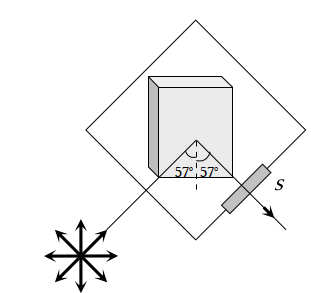
- ✓
- B
- C
(c) Plane making an angle of 45 with the vertical
- D
(d) Plane making an angle of 57 with the horizontal
Answer(a) When unpolarised light is made incident at polarising angle, the reflected light is plane polarised in a direction perpendicular to the plane of incidence.Therefore $\vec{E}$ in reflected light will vibrate in vertical plane with respect to plane of incidence.
View full question & answer→MCQ 1251 Mark
A beam of light $A O$ is incident on a glass slab $(\mu=1.54)$ in a direction as shown in figure. The reflected ray $O B$ is passed through a Nicol prism on viewing through a Nicole prism, we find on rotating the prism that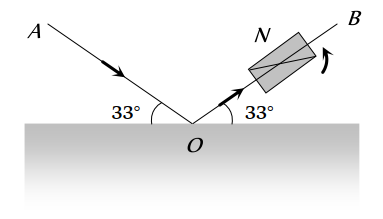
- A
(a) The intensity is reduced down to zero and remains zero
- B
(b) The intensity reduces down some what and rises again
- C
(c) There is no change in intensity
- ✓
(d) The intensity gradually reduces to zero and then again increases
AnswerCorrect option: D. (d) The intensity gradually reduces to zero and then again increases
(d) In the arrangement shown, the unpolarised light is incident at polarising angle of $90^{\circ}-33^{\circ}=57^{\circ}$. The reflected light is thus plane polarised light. When plane polarised light is passed through Nicol prism (a polariser or analyser), the intensity gradually reduces to zero and finally increases.
View full question & answer→MCQ 1261 Mark
If the ratio of intensities of two waves is $1: 25$, then the ratio of their amplitudes will be
- A
$1: 25$
- B
$5: 1$
- C
$26: 24$
- ✓
$1: 5$
AnswerCorrect option: D. $1: 5$
$\frac{I_1}{I_2}=\frac{1}{25} ; \therefore \frac{a_1^2}{a_2^2}=\frac{1}{25} \Rightarrow \frac{a_1}{a_2}=\frac{1}{5}$
View full question & answer→MCQ 1271 Mark
A wave can transmit from one place to another
AnswerA wave can transmit energy from one place to another.
View full question & answer→MCQ 1281 Mark
The wavelength of light visible to eye is of the order of
- A
$10^{-2} m$
- B
$10^{-10} m$
- C
$1 m$
- ✓
$6 \times 10^{-7} m$
AnswerCorrect option: D. $6 \times 10^{-7} m$
$6 \times 10^{-7} m$
View full question & answer→MCQ 1291 Mark
Polarised glass is used in sun glasses because
- ✓
It reduces the light intensity to half an account of polarisation
- B
- C
- D
AnswerCorrect option: A. It reduces the light intensity to half an account of polarisation
View full question & answer→MCQ 1301 Mark
The apparent wavelength of the light from a star moving away from the earth is $0.01 \%$ more than its real wavelength. Then the velocity of star is
- A
$60 km / sec$
- B
$15 km / sec$
- C
$150 km / sec$
- ✓
$30 km / sec$
AnswerCorrect option: D. $30 km / sec$
$\frac{\Delta \lambda}{\lambda}=\frac{v}{c} $
$\Rightarrow v=\frac{c}{\lambda} \Delta \lambda=\frac{c}{\lambda}\left(\lambda^{\prime}-\lambda\right)=c \times \frac{0.01}{100} $
$=3 \times 10^4 m / s =30 km / sec$
View full question & answer→MCQ 1311 Mark
In the propagation of electromagnetic waves the angle between the direction of propagation and plane of polarisation is
MCQ 1321 Mark
Which of the following represents an infrared wavelength
- ✓
$10^{-4} cm$
- B
$10^{-5} cm$
- C
$10^{-6} cm$
- D
$10^{-7} cm$
AnswerCorrect option: A. $10^{-4} cm$
View full question & answer→MCQ 1331 Mark
Huygen's conception of secondary waves
- A
Allow us to find the focal length of a thick lens
- ✓
Is a geometrical method to find a wavefront
- C
Is used to determine the velocity of light
- D
Is used to explain polarisation
AnswerCorrect option: B. Is a geometrical method to find a wavefront
View full question & answer→MCQ 1341 Mark
Colours of thin films result from or On a rainy day, a small oil film on water show brilliant colours. This is due to
AnswerColour's of thin film are due to interference of light.
View full question & answer→MCQ 1351 Mark
A calcite crystal is placed over a dot on a piece of paper and rotated, on seeing through the calcite one will be see
- A
- ✓
- C
- D
One dot rotating about the other
View full question & answer→MCQ 1361 Mark
If $\lambda_v, \lambda_r$ and $\lambda_m$ represent the wavelength of visible light $x-$rays and microwaves respectively, then
- A
$\lambda_m>\lambda_x>\lambda_v$
- B
$\lambda_v>\lambda_m>\lambda_y$
- ✓
$\lambda_m>\lambda_v>\lambda_v$
- D
$\lambda_v>\lambda_x>\lambda_m$
AnswerCorrect option: C. $\lambda_m>\lambda_v>\lambda_v$
$\lambda_m>\lambda_v>\lambda_x$
View full question & answer→MCQ 1371 Mark
Which of the following shows green house effect
MCQ 1381 Mark
Biological importance of Ozone layer is
AnswerCorrect option: A. It stops ultraviolet rays
View full question & answer→MCQ 1391 Mark
The frequencies of $X$-rays, $\gamma$-rays and ultraviolet rays are respectively $a, b$ and $c$. Then
- ✓
(a) $ac$
- B
(b) $a>b, b>c$
- C
(c) $a>b, b
- D
(d) $a
AnswerCorrect option: A. (a) $ac$
(a) $v_{\gamma-\text { rays }}>v_{X-\text { rays }}>v_{U V-\text { rays }}$
View full question & answer→MCQ 1401 Mark
Wavelength of light of frequency $100 Hz$
- A
$2 \times 10^6 m$
- ✓
$3 \times 10^6 m$
- C
$4 \times 10^6 m$
- D
$5 \times 10^6 m$
AnswerCorrect option: B. $3 \times 10^6 m$
$\lambda=\frac{c}{v}=\frac{3 \times 10^8}{100}=3 \times 10^6 m$
View full question & answer→MCQ 1411 Mark
The $21\ cm$ radio wave emitted by hydrogen in interstellar space is due to the interaction called the hyperfine interaction is atomic hydrogen. the energy of the emitted wave is nearly
- A
$10^{-17}$ Joule
- B
$1$ joule
- C
$7 \times 10^{-8}$ Joule
- ✓
$10^{-24}$ Joule
AnswerCorrect option: D. $10^{-24}$ Joule
$E=\frac{h c}{\lambda}=\frac{6.6 \times 10^{-34} \times 3 \times 10^8}{21 \times 10^{-2}}=0.94 \times 10^{-24} \approx 10^{-24} J$
View full question & answer→MCQ 1421 Mark
An electromagnetic wave travels along $z$-axis. Which of the following pairs of space and time varying fields would generate such a wave
- ✓
$E_x, B_y$
- B
$E_y, B_x$
- C
$E_z, B_x$
- D
$E_y, B_z$
AnswerCorrect option: A. $E_x, B_y$
$E_x$ and $B_y$ would generate a plane EM wave travelling in $z$ direction. $\vec{E}, \vec{B}$ and $\vec{k}$ form a right handed system $\vec{k}$ is along $z_{-}$axis. As $\hat{i}_{\times} \hat{j}_{=} \hat{k}$
View full question & answer→MCQ 1431 Mark
The oscillating electric and magnetic vectors of an electromagnetic wave are oriented along
AnswerCorrect option: C. Mutually perpendicular directions and are in phase
Mutually perpendicular directions and are in phase
View full question & answer→MCQ 1441 Mark
light is an electromagnetic wave. Its speed in vacuum is given by the expression
- A
$\sqrt{\mu_o \varepsilon_o}$
- B
$\sqrt{\frac{\mu_o}{\varepsilon_o}}$
- C
$\sqrt{\frac{\varepsilon_o}{\mu_o}}$
- ✓
$\frac{1}{\sqrt{\mu_o \varepsilon_o}}$
AnswerCorrect option: D. $\frac{1}{\sqrt{\mu_o \varepsilon_o}}$
$\mu_0=4 \pi \times 10^{-7}, \varepsilon_0=8.85 \times 10^{-12} \frac{ N - m ^2}{ C ^2} $
$\text { so } c=\frac{1}{\sqrt{\mu_0 \varepsilon_0}}=3 \times 10^8 \frac{ meter }{ sec } .$
View full question & answer→MCQ 1451 Mark
light waves can be polarised as they are
AnswerOnly transverse waves can be polarised.
View full question & answer→MCQ 1461 Mark
Interference was observed in interference chamber when air was present, now the chamber is evacuated and if the same light is used, a careful observer will see
- A
- B
Interference with bright bands
- C
Interference with dark bands
- ✓
Interference in which width of the fringe will be slightly increased
AnswerCorrect option: D. Interference in which width of the fringe will be slightly increased
The refractive index of air is slightly more than $1.$ When chamber is evacuated, refractive index decreases and hence the wavelength increases and fringe width also increases.
View full question & answer→MCQ 1471 Mark
The ratio of intensities of two waves are given by $4: 1$. The ratio of the amplitudes of the two waves is
- ✓
$2: 1$
- B
$1: 2$
- C
$4: 1$
- D
$1: 4$
AnswerCorrect option: A. $2: 1$
$I \propto a^2 \Rightarrow \frac{a_1}{a_2}=\left(\frac{4}{1}\right)^{1 / 2}=\frac{2}{1}$
View full question & answer→MCQ 1481 Mark
If $\vec{E}$ and $\vec{B}$ are the electric and magnetic field vectors of E.M. waves then the direction of propagation of E.M. wave is along the direction of
- A
$\vec{E}$
- B
$\vec{B}$
- ✓
$\vec{E} \times \vec{B}$
- D
AnswerCorrect option: C. $\vec{E} \times \vec{B}$
EM waves travels with perpendicular to $E$ and $B$. Which are also perpendicular to each other $\vec{v}=\vec{E} \times \vec{B}$
View full question & answer→MCQ 1491 Mark
Which one of the following phenomena is not explained by Huygen's construction of wavefront
AnswerOrigin of spectra is not explained by Huygen's theory.
View full question & answer→MCQ 1501 Mark
Approximate height of ozone layer above the ground is
- A
$60\ km$ to $70 \ km$
- ✓
$59 \ km$ to $80 \ km$
- C
$70 \ km$ to $100 \ km$
- D
$100 \ km$ to $200 \ km$
AnswerCorrect option: B. $59 \ km$ to $80 \ km$
$59 \ km$ to $80 \ km$
View full question & answer→