MCQ 511 Mark
In $a$ wire of cross-section radius $r$, free electrons travel with drift velocity $v$ when a current $I$ flows through the wire. What is the current in another wire of half the radius and of the same material when the drift velocity is $2v$?
Answerc
$I_{1}=\operatorname{ne} A_{1} v_{d_{1}} \& I_{2}=\operatorname{ne} A_{2} v_{d_{2}}$
$\frac{I_{2}}{I_{1}}=\frac{A_{2}}{A_{1}} \times \frac{v_{d_{2}}}{v_{d_{1}}}=\frac{1}{4} \times \frac{2 v}{v} \Rightarrow I_{2}=\frac{I}{2}$
View full question & answer→MCQ 521 Mark
$A$ current $I$ flows through a uniform wire of diameter $d$ when the mean electron drift velocity is $V$. The same current will flow through a wire of diameter $d/2$ made of the same material if the mean drift velocity of the electron is :
Answerd
$j=\frac{I}{A}=n e v_{d}$
$\frac{4 I}{\pi d^{2}}=n e v$
$\frac{161}{\pi d^{2}}=n e v^{\prime}$
From equaiton $( I )$ and $( II )$
$\frac{4 I}{16 I}=\frac{v^{\prime}}{v^{\prime}} \Rightarrow v^{\prime}=4 v$
View full question & answer→MCQ 531 Mark
A wire has a non-uniform cross-section as shown in figure.A steady current flows through it. The drift speed of electrons at points $P$ and $q$ is $v_P$ and $v_Q$.
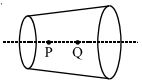
- A
$v_P = v_Q$
- B
$v_P < v_Q$
- ✓
$v_P > v_Q$
- D
AnswerCorrect option: C. $v_P > v_Q$
c
The drift speed of electrons is inversely proportional to the radius of cross section. Thus here the cross sectional area at point $P$ is smaller than the cross sectional area at point $Q$. Hence, the drift velocity is large for smaller area and small for larger area. The drift speed will relate as per the relation given below
$v_{P}>v_{Q}$
View full question & answer→MCQ 541 Mark
$A$ uniform copper wire carries a current $i$ amperes and has $p$ carriers per meter$^3$. The length of the wire is $\lambda$ meters and its cross-section area is $s$ meter $^2$. If the charge on a carrier is $q$ coulombs, the drift velocity in $ms^{-1}$ is given by
- A
$i/\lambda sq$
- ✓
$i/psq$
- C
$psq/i$
- D
$i/ps\lambda q$
AnswerCorrect option: B. $i/psq$
b
The current flowing through the wire is given by
$I=n e A v$
Where I = current
$\mathrm{n}=$ charge carrier current density
$\mathrm{e}=$ charge on the carriers
$A=$ cross sectional area
$\mathrm{v}=$ drift velocity
In the above example
$l=$ current $=\mathrm{i}$
$\mathrm{n}=$ charge carrier current density $=\mathrm{p}$
$\mathrm{e}=$ charge on the carriers $=\mathrm{q}$
$A=$ cross sectional area $=s$
$\mathrm{v}=$ drift velocity $=\mathrm{v}$
hence $i=p q s v$
$\therefore v=\frac{i}{p q{s}}$
View full question & answer→MCQ 551 Mark
$A$ current passes through a wire of nonuniform cross section. Which of the following quantities are independent of the cross-section?
- A
the charge crossing in a given time interval.
- B
- C
- ✓
Both $(A)$ and $(C)$
AnswerCorrect option: D. Both $(A)$ and $(C)$
d
As the current passes, the value of current at any point in the circuit remains the same. Therefore the charge crossing in any given interval is same and does not change with the cross section of the wire
$I=J A$
As $A -cross$ section of wire changes, $J -current$ density changes and $I$ current remains same.
The free electron density is a property of the material and doesnot change when current passes.
As the cross section changes, current density changes and hence the drift velocity changes.
View full question & answer→MCQ 561 Mark
The charge flowing through a resistor $R$ varies with time $t$ as $Q = 3t -6t^2.$ The heat produced in $R$ till the current in it becomes zero is
- ✓
$\frac{3R}{4}$
- B
$\frac{3R}{2}$
- C
$\frac{4R}{4}$
- D
$\frac{9R}{4}$
AnswerCorrect option: A. $\frac{3R}{4}$
a
$\mathrm{i}=\frac{\mathrm{d} Q}{\mathrm{dt}}=3-12 \mathrm{t}$
$t=\frac{1}{4} \sec$
$\mathrm{H}-\int_{0}^{1 / 4}(3-12 \mathrm{t})^{2} \times \mathrm{Rdt}$
$=\left.\frac{(3-12 t)^{2}}{3 x-12}\right|_{0} ^{1 / 4} R$
$=\frac{+1}{36}[27]=\frac{3 \mathrm{R}}{4}$
View full question & answer→MCQ 571 Mark
Figure shows a cross-section of a large-section of an infinite metal sheet carrying an electric current along its surface. The current per unit length is $J$ . A current carrying square loop is placed nearby the metal sheet such that the plane of square is perpendicular to the plane of sheet then
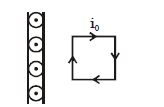
- A
Square loop will be attracted towards the sheet
- B
Square loop will be repelled away from the sheet
- ✓
Square loop will remain in translational equilibrium
- D
Square loop will remain in rotational equilibrium
AnswerCorrect option: C. Square loop will remain in translational equilibrium
View full question & answer→MCQ 581 Mark
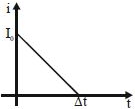
What amount of heat will be generated in a coil of resistance $R$ due to a charge $q$ passing through it if the current in the coil decreases to zero uniformly during a time interval $\Delta t$
- ✓
$\frac{4}{3}\frac{{{q^2}R}}{{\Delta t}}$
- B
$\ln \frac{{{q^2}R}}{{2\Delta t}}$
- C
$\frac{{2{q^2}R}}{{3\Delta t}}$
- D
$\ln \frac{{\left( {2\Delta t} \right)}}{{{q^2}R}}$
AnswerCorrect option: A. $\frac{4}{3}\frac{{{q^2}R}}{{\Delta t}}$
a
$q=\int \mathrm{idt}=$ area of $\mathrm{i} \mathrm{v} / \mathrm{s}$ $t$ graph
$=\frac{1}{2}\left(I_{0}\right)(\Delta t)$
$I_{0}=\frac{2 q}{\Delta t}$
also, $\mathrm{i}=-\left(\frac{\mathrm{I}_{0}}{\Delta \mathrm{t}}\right) \mathrm{t}+\mathrm{I}_{0}$
heat loss $=\int i^{2} \mathrm{Rdt}=\frac{4}{3} \frac{\mathrm{q}^{2} \mathrm{R}}{\Delta \mathrm{t}}$
View full question & answer→MCQ 591 Mark
A meta sample carrying a current along $x-$ axis with density $J$ is subjected to a magnetic field $B$ (along $z-$ axis). The electric field $E$ developed along $y-$ axis is directly proportional to $J$ as well as $B$. The constant of proportionality has $SI\ unit$
- A
$C/m^2$
- B
$m^2s/C$
- C
$m^2/C$
- ✓
$m^3/C$
AnswerCorrect option: D. $m^3/C$
d
$J=J=\frac{1}{A}$
$i=J A$
$\mathrm{ev}_{\mathrm{d}} \mathrm{B}=\mathrm{e} \mathrm{E}$
$\operatorname{ne} \mathrm{A} \mathrm{v}_{\mathrm{d}}=\mathrm{JA}$
$\mathrm{E}=\frac{\mathrm{JB}}{\mathrm{ne}}$
Constant of proporionality $=\frac{1}{\mathrm{ne}}=\frac{\mathrm{m}^{3}}{\mathrm{C}}$
View full question & answer→MCQ 601 Mark
What is the number density of donor atoms which must be added to a pure germanium semiconductor to make $n-$ type semiconductor of conductivity $6.4\ {\Omega ^{ - 1}}\,c{m^{ - 1}}$? The mobility of electr ons in $n-$ type germanium is $4 \times {10^3}\ cm^2\ V^{-1}\ s^{-1}$. Neglect the contribution of holes to conductivity
- A
$10^{16}\ m^{-3}$
- B
$10^{18}\ m^{-3}$
- C
$10^{20}\ m^{-3}$
- ✓
$10^{22}\ m^{-3}$
AnswerCorrect option: D. $10^{22}\ m^{-3}$
d
$\mathrm{J}=\sigma \mathrm{E}$
$\sigma=\frac{\mathrm{J}}{\mathrm{E}}=\frac{\mathrm{neVd}}{\mathrm{E}}=\mathrm{ne}\left(\frac{\mathrm{Vd}}{\mathrm{E}}\right)$
$\sigma=$ $\mathrm{ne}$ (mobility)
$6.4 \times 100\, r^{-1} m^{-1}$
$=n\left(1.6 \times 10^{-19}\right)\left(4 \times 10^{3} \times 10^{-1}\right)$
$\Rightarrow n=10^{22} \mathrm{\,m}^{-3}$
View full question & answer→MCQ 611 Mark
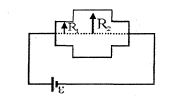
A cylindrical resistance is connected across battery $\varepsilon $ . Cylinder has uniform free electron density, mid part of cylinder has larger radius as shown in figure. Then $V_d$ (drift velocity) $V/S$ (distance across the length of the resistance)
Answera
$\mathrm{i}=\mathrm{JA}$
$\mathrm{J}=\mathrm{neVd}$
$\mathrm{i}=$ $\mathrm{Ane}$ $\mathrm{Vd}$
$\mathrm{i}=$ constant
$\mathrm{AVd}=$ Constant
View full question & answer→MCQ 621 Mark
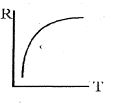
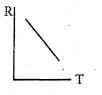
Assume a hypothetical wire in which free electron density changes with temperature in proportionality $n\ \alpha \ T$ assuming $\tau $(Relaxation time of collision) and dimensions of wire remain unchanged with increasing temperature. Which one of the resistance $v/s$ temperature graph is true
Answera
$R = \left( {\frac{{2lm}}{{{e^2}\tau A}}} \right)\frac{1}{n}$
View full question & answer→MCQ 631 Mark
Find the number of photons emitted per second from of source of light which results in a photocurrent with drift velocity of $1.5\ m/s$ in a conductor with cross-section area $0.25\ m^2$ , volume density of electrons $10^{20}\ per \ m^3$ , (Assume that $60\%$ of photons emitted result in electron emission)
- ✓
$6.25 \times 10^{19}$
- B
$6.25 \times 10^{20}$
- C
$6 \times 10^{19}$
- D
$6 \times 10^{20}$
AnswerCorrect option: A. $6.25 \times 10^{19}$
a
$ \mathrm{i}=\mathrm{neAV}_{\mathrm{d}} $
$ \Rightarrow \frac{{{{\rm{n}}_{\rm{e}}} \times {\rm{e}}}}{{\rm{t}}} = {10^{20}} \times 1.6 \times {10^{ - 19}} \times 0.25 \times 1.5$
$= 16 \times \frac{1}{4} \times \frac{3}{2}=6 $
$ \Rightarrow \frac{\mathrm{n}_{e}}{\mathrm{t}}=\frac{6}{1.6 \times 10^{-19}} $
$ \Rightarrow \frac{{{{\rm{n}}_{\rm{p}}}}}{{\rm{t}}} = 6.25 \times {10^{19}}\,$ [ Given ${{\rm{ }}\frac{{{{\rm{n}}_{\rm{p}}}}}{{\rm{t}}} \times 60\% = \frac{{{{\rm{n}}_{\rm{e}}}}}{{\rm{t}}}}$]
View full question & answer→MCQ 641 Mark
Three copper rods are subjected to different potential difference. Compare the drift speed of electrons through them. Assume that all $3$ are at the same temperature.
| |
Length |
Diameter |
Potential difference |
| $(A)$ |
$L$ |
$3d$ |
$V$ |
| $(B)$ |
$2L$ |
$d$ |
$2V$ |
| $(C)$ |
$3L$ |
$2d$ |
$2V$ |
- ✓
$v_A = v_B > v_C$
- B
$v_A > v_B > v_C$
- C
$v_A < v_B < v_C$
- D
AnswerCorrect option: A. $v_A = v_B > v_C$
a
$\mathrm{i}=\mathrm{neAV}_{\mathrm{drift}}=\frac{\mathrm{V}}{\mathrm{R}}$
$\mathrm{R}=\frac{\rho \ell}{\mathrm{A}}=\frac{4 \rho \ell}{\pi \mathrm{d}^{2}}$
$\therefore {{\rm{V}}_{{\rm{drift}}}} = \frac{{\rm{V}}}{{{\rm{RneA}}}} = \frac{{\rm{V}}}{{\frac{{\rho \ell }}{{\rm{A}}} \times {\rm{neA}}}} = \frac{{\rm{V}}}{{\rho \ell {\rm{ne}}}} \propto \frac{{\rm{V}}}{\ell }$
View full question & answer→MCQ 651 Mark
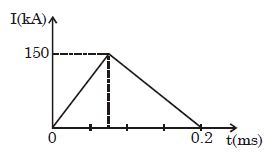
During lighting, a current pulse, shown in figure, flows from the cloud at a height $1.5\ km$ to the ground. If the breakdown electric field of humid air is about $400\ kVm^{-1}$ , the energy released during lighting would be (in unit of $10^9\ J$ )
Answera
Energy released $=\mathrm{q} . \mathrm{v}.$
$\mathrm{q}=$ area under curve $=\frac{1}{2} \times 150 \times 0.2=\frac{30}{2} \mathrm{\,C}$
$\mathrm{v}=\mathrm{E} \cdot \mathrm{d}=400 \times 10^{3} \times 1500=60 \times 10^{7}$
energy released $=60 \times 10^{7} \times 15=900 \times 10^{7}$
$=9 \times 10^{9} \mathrm{\,J}$
View full question & answer→MCQ 661 Mark
A constant electric current $I$ is passed through a straight conductor of length $l$. If $S$ in specific charge of electron then the total momentum of electrons is
- A
$\frac{{IS}}{l}$
- ✓
$\frac{{Il}}{S}$
- C
$\frac{{Sl}}{I}$
- D
$\frac{{2Il}}{S}$
AnswerCorrect option: B. $\frac{{Il}}{S}$
b
Total momentum of electrons $=$ total no. electron
$\times$ momentum of each electron
$=\mathrm{Nmv}_{\mathrm{d}}=\mathrm{nA} \ell \mathrm{mv}_{\mathrm{d}}$
$=\frac{\mathrm{I} \ell}{\mathrm{e}} \mathrm{m}=\frac{\mathrm{I} \ell}{\mathrm{S}}$
View full question & answer→MCQ 671 Mark
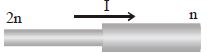
Two cylindrical rods of uniform crosssection area $A$ and $2A$, having free electrons per unit volume $2n$ and $n$ respectively are joined in series. A current $I$ flows through them in steady state. Then the ratio of drift velocity of free electron in left rod to drift velocity of electron in the right rod is $\left( {\frac{{{v_L}}}{{{v_R}}}} \right)$
Answera
Since current ${\rm{I}} = neA{v_d}$ through both rods
is same $2(\mathrm{n})$ e $\mathrm{A} \mathrm{v}_{\mathrm{L}}=\mathrm{n}$ e $(2 \mathrm{A}) \mathrm{v}_{\mathrm{R}} \Rightarrow \frac{\mathrm{v}_{\mathrm{L}}}{\mathrm{v}_{\mathrm{R}}}=1$
View full question & answer→MCQ 681 Mark
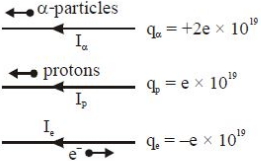
In a region $10^{19}$ $\alpha -$ particels and $10^{19}$ protons per second move to the left, while $10^{19}$ electrons moves to the right per second. The current is
- A
$3.2\,A$ towards left
- B
$3.2\,A$ towards right
- ✓
$6.4\,A$ towards left
- D
$6.4\,A$ towards right
AnswerCorrect option: C. $6.4\,A$ towards left
c
Current due to protons and $\alpha$ -particles is towards left and as ${e^ - }$ have $-$ ive charge, so current due to electrons is also towards left
$\therefore $ total current $\mathrm{I}=(2 \mathrm{e}+\mathrm{e}+\mathrm{e}) \times 10^{19}$
${=4 \times 1.6 \times 10^{-19} \times 10^{19}} $
${=6.4 \mathrm{\,A}}$
View full question & answer→MCQ 691 Mark
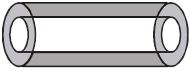
In given hollow cylindrical conductor current density is $J = \frac{J_0}{r^2}$ where $J_0$ is constant and $r$ is the distance from axis of cylinder. If radius of inner surface is $'a'$ and radius of outer surface is $2a$ then find current passed through the conductor.
- A
$\pi J_0 ln2$
- ✓
$2\pi J_0 ln2$
- C
$2\pi J_0$
- D
$2\pi J_0 ln3$
AnswerCorrect option: B. $2\pi J_0 ln2$
View full question & answer→MCQ 701 Mark
A copper wire of diameter $1.02\, mm$ carries a current of $1.7\, amp$. Find the drift velocity $(v_d)$ of electrons in the wire. Given $n$, number density of electrons in copper $= 8.5 \times 10^{27} /m^3$....................... $mm/sec$
- A
$1.75$
- B
$1.25$
- C
$0.15 $
- ✓
$1.5 $
AnswerCorrect option: D. $1.5 $
d
$\mathrm{I}=1.7 \mathrm{\,A}$
$\mathrm{J}=$ current density
$=\frac{\mathrm{I}}{\pi \mathrm{r}^{2}}=\frac{1.7}{\pi \times\left(0.51 \times 10^{-3}\right)^{2}}=\mathrm{nev}_{\mathrm{d}}$
$=8.5 \times 10^{27} \times\left(1.6 \times 10^{-19}\right) \times v_{d}$
$\therefore $ $\mathrm{v}_{\mathrm{d}}=\frac{1.7}{\pi \times\left(0.51 \times 10^{-3}\right)^{2} \times 8.5 \times 10^{27} \times 1.6 \times 10^{-19}}$
$=1.5 \times 10^{-3} \mathrm{\,m} / \mathrm{sec} .=1.5 \mathrm{\,mm} / \mathrm{sec}$
View full question & answer→MCQ 711 Mark
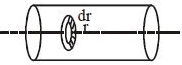
For a cylinder of radius $R$ current density $J =J_0 \frac{r}{R} $, where $J_0$ is a constant and $r$ is distance from axis. Calculate total current
- ✓
$\frac{2J_0A}{3}$
- B
$\frac{4J_0A}{3}$
- C
$\frac{5J_0A}{3}$
- D
$\frac{7J_0A}{4}$
AnswerCorrect option: A. $\frac{2J_0A}{3}$
a
$\mathrm{dI}=\mathrm{J} .2 \pi \mathrm{r} \mathrm{dr}$
$=\frac{\mathrm{J}_{0} \mathrm{r}}{\mathrm{R}} \times 2 \pi \mathrm{dr}$
$\mathrm{I}=\frac{\mathrm{J}_{0} 2 \pi}{\mathrm{R}} \int_{0}^{\mathrm{R}} \mathrm{r}^{2} \mathrm{dr}=\frac{2 \pi \mathrm{J}_{0}}{\mathrm{R}} \times \frac{\mathrm{R}^{3}}{3}=\frac{2}{3} \mathrm{J}_{0} \cdot \pi \mathrm{R}^{2}$
$=\frac{2}{3} J_{0} A$
View full question & answer→MCQ 721 Mark
The current in a wire varies with time according to relation $I = 4 + 2t$. The quantity of charge which has passed through a crosssectionn of the wire during the time $t = 2\, s$ to $t = 6\, s$ will be .............. $\mathrm{C}$
Answerb
$\mathrm{q}=\int_{2}^{6}(4+2 \mathrm{t}) \mathrm{dt}=48 \mathrm{\,C}$
View full question & answer→MCQ 731 Mark
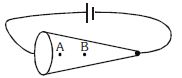
Suppose a current carrying wire has a cross-sectional area that, gradually become smaller along the wire, has the shape of a very long cone as shown in figure. Choose the correct statement
- A
Electric current is different in different portions of wire
- B
Electric field at point $A$ is same as that of point $B$
- ✓
Drift speed of electrons at point $A$ is lesser than that of at point $B$
- D
Drift speed of electrons at point $A$ is same as that of at point $B$
AnswerCorrect option: C. Drift speed of electrons at point $A$ is lesser than that of at point $B$
c
$\mathrm{I}=\mathrm{neAV}_{\mathrm{d}}$
$\mathrm{I}=$ constant
$\mathrm{V}_{\mathrm{d}} \propto \frac{1}{\mathrm{A}}$
$\left(\mathrm{V}_{\mathrm{d}}\right)_{\mathrm{B}}>\left(\mathrm{V}_{\mathrm{d}}\right)_{\mathrm{A}}$
View full question & answer→MCQ 741 Mark
In a wire of cross section radius $r,$ free electrons travel with drift velocity $v$ when a current $I$ flows through the wire. What is the current in another wire of half the radius and of the same material when the drift velocity is $2v$ ?
Answerc
$I_{1}=\operatorname{ne} A_{1} v_{d_{1}} \& I_{2}=\operatorname{ne} A_{2} v_{d_{2}}$
$\frac{I_{2}}{I_{1}}=\frac{A_{2}}{A_{1}} \times \frac{v_{d_{2}}}{v_{d_{1}}}=\frac{1}{4} \times \frac{2 v}{v} \Rightarrow I_{2}=\frac{I}{2}$
View full question & answer→MCQ 751 Mark
The total momentum of electrons in a straight wire of copper of length $1\, metre$ carrying a current of $16\, A$ is
- ✓
$91 \times 10^{-12}\, kg\, m/sec$
- B
$91 \times 10^{-15}\, kg\, m/sec$
- C
$91 \times 10^{-14}\, kg\, m/sec$
- D
$91 \times 10^{-6}\, kg\, m/sec$
AnswerCorrect option: A. $91 \times 10^{-12}\, kg\, m/sec$
a
$P = nMe{V_d} = \left[ {\frac{{iL}}{e}} \right]\,Me$
View full question & answer→MCQ 761 Mark
In copper wire each atom releases one free electron. If diameter is $1\, mm$ and current is $1.1\,A$ find drift velocity. ($\rho = 9 \times 10^{+3}\, kg/m^3$ $M = 63\, gm/mole$)
- A
$0.33\, mm/sec$
- ✓
$0.1\, mm/sec$
- C
$0.2\, mm/sec$
- D
$0.2\, cm/sec$
AnswerCorrect option: B. $0.1\, mm/sec$
b
Given : $I=1.1 \mathrm{A} d=1 \mathrm{mm}=0.001 \mathrm{m} \rho=9 \times 10^{3} \mathrm{kg} / \mathrm{m}^{3}$
Molecular mass of copper $M=63 g m=0.063 k g$
Number of copper atoms per unit volume $n=\frac{\rho N_{A}}{M}$
$\therefore n=\frac{9 \times 10^{3} \times 6.023 \times 10^{23}}{0.063}=8.60 \times 10^{28} \mathrm{m}^{-3}$
As one copper atom gives one free electron, thus number of electrons per unit volume is $8.6 \times 10^{28} \mathrm{m}^{-3}$
Cross-section area of wire $A=\frac{\pi d^{4}}{4}=\frac{3.14 \times(0.001)^{2}}{4}=7.85 \times 10^{-7} \mathrm{m}^{2}$
Drift velocity $v_{d}=\frac{I}{A n e}$
$\therefore v_{d}=\frac{1.1}{\left(7.85 \times 10^{-7}\right)\left(8.6 \times 10^{28}\right)\left(1.6 \times 10^{-19}\right)}=0.01 \times 10^{-2} \mathrm{m} / \mathrm{s}=0.1 \mathrm{mm} / \mathrm{s}$
View full question & answer→MCQ 771 Mark
The current through a wire depends on time as $i = (2+3t)\, mA$. The charge crossing through a section of the wire in $1\, min$ is .............. $\mathrm{C}$
- A
$40.20$
- B
$24.55$
- C
$12.75$
- ✓
$5.52$
AnswerCorrect option: D. $5.52$
d
$i=2+3 t$
$\int \mathrm{d} q=\int i d t$
$\mathrm{q}=\int_{0}^{60} 2+3 \mathrm{t} \mathrm{dt}\left(\times 10^{-3}\right)$
$\mathrm{q}=\left[2 \mathrm{t}+\frac{3 \mathrm{t}^{2}}{2}\right]_{0}^{60} \times 10^{-3}$
$=[120+5400] \times 10^{-3}=5.52$ $\mathrm{coulamb}.$
View full question & answer→MCQ 781 Mark
The charge flowing in a conductor varies with time as $Q = at -bt^2$. Then for current, which statement is incorrect.
$(A)$ decreases linearly with time
$(B)$ reaches a maximum and then decreases
$(C)$ fall to zero after time $t = a/2b$
$(D)$ changes at a rate $-2b$
Options :
- A
$A, B, C$
- B
$A, C, D$
- C
$B, C$
- ✓
Only $B$
AnswerCorrect option: D. Only $B$
d
$(i)$ $\mathrm{I}=\frac{\text { da }}{\mathrm{dt}}=\mathrm{a}-2 \mathrm{bt}$ (linearly decreasing with time)
$(ii)$ $\mathrm{t} \uparrow \mathrm{I} \downarrow$
$(iii)$ For $\mathrm{I}=0 ; \mathrm{a}-2 \mathrm{bt}=0 ; \mathrm{t}=\mathrm{a} / 2 \mathrm{b}$
$(iv)$ $\frac{\mathrm{dI}}{\mathrm{dt}}=-2 \mathrm{b}$
Hence option $(4)$ is incorrect.
View full question & answer→MCQ 791 Mark
At what rate the potential difference between the plates of a capacitor be changed to set up a displacement current of $1\, A$ in a capacitor of $2\,\mu F$ ?
- A
${10^{ + 6}}\,V/s$
- ✓
$0.5 \times {10^{ + 6}}\,V/s$
- C
${10^{ - 6}}\,V/s$
- D
$0.5 \times {10^{ - 6}}\,V/s$
AnswerCorrect option: B. $0.5 \times {10^{ + 6}}\,V/s$
b
$\mathrm{I}_{\mathrm{D}}=\frac{\mathrm{d} \mathrm{q}}{\mathrm{dt}}=\frac{\mathrm{d}}{\mathrm{dt}}(\mathrm{VC})=\mathrm{C} \frac{\mathrm{d} \mathrm{V}}{\mathrm{dt}}$
Here $\mathrm{I}_{\mathrm{p}}=1 \mathrm{\,A}, \mathrm{C}=2 \times 10^{-6} \mathrm{\,F}$
View full question & answer→MCQ 801 Mark
Two wires $A$ and $B$ of the same material, having radii in the ratio $1: 2$ carry currents in the ratio $4: 1$. The ratio of drift speed of electrons in $A$ and $B$ is .......
- ✓
$16: 1$
- B
$1: 16$
- C
$1: 4$
- D
$4: 1$
AnswerCorrect option: A. $16: 1$
a
(a)
$4 i= neA V_D$
$i=n e(4 A) V_D^{\prime}$
$4=\frac{V_D}{4 V_D^a}$
$\frac{V_D}{V_D^{\prime}}=16: 1$
View full question & answer→MCQ 811 Mark
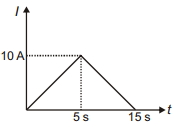
Current $l$ versus time $t$ graph through a conductor is shown in the figure. Average current through the conductor in the interval $0$ to $15 \,s$ is ............ $A$
Answerd
(d)
$\Delta q=$ Area $( l / t )$
$\Delta q=\frac{1}{2} \cdot 10 \times 15=75 \,C$
$i_{\text {avg }}=\frac{75}{15}=5 \,A$
View full question & answer→MCQ 821 Mark
Two long coaxial and conducting cylinders of radius $a$ and $b$ are separated by a material of conductivity $\sigma$ and a constant potential difference $V$ is maintained between them, by a battery. Then the current, per unit length of the cylinder flowing from one cylinder to the other is -
- A
$\frac{4 \pi \sigma}{\ln (b / a)} V$
- B
$\frac{4 \pi \sigma}{(b+a)} V$
- ✓
$\frac{2 \pi \sigma}{\ln (b / a)} V$
- D
$\frac{2 \pi \sigma}{(b+a)} V$
AnswerCorrect option: C. $\frac{2 \pi \sigma}{\ln (b / a)} V$
c
(c)
$V =\int_{ a }^{ b } E \cdot d \ell=\frac{\lambda}{2 \pi \varepsilon_0 r } \ln \left(\frac{ b }{ a }\right)$
Now, I $=\sigma \int \overrightarrow{ E } \cdot \overrightarrow{ dA }=\sigma \int \frac{\lambda}{2 \pi \varepsilon_0 r } \cdot 2 \pi dr =\frac{\sigma \lambda}{\varepsilon_0}$
From $(1)$: $I =\frac{2 \sigma \pi \varepsilon_0}{\varepsilon_0 \ln ( b / a )}=\frac{2 \pi \sigma}{\ln ( b / a )} v$
View full question & answer→MCQ 831 Mark
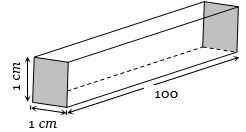
Dimensions of a block are $1\,cm \times 1\,cm \times 100\,cm$. If specific resistance of its material is $3 \times {10^{ - 7}}\,ohm - m$, then the resistance between the opposite rectangular faces is
- A
$3 \times {10^{ - 9}} \,ohm$
- ✓
$3 \times {10^{ - 3}} \,ohm$
- C
$3 \times {10^{ - 5}}\, ohm$
- D
$3 \times {10^{ - 7}}\, ohm$
AnswerCorrect option: B. $3 \times {10^{ - 3}} \,ohm$
b
Length $l = 100\,cm =1\,m$
Area of cross-section $A = 1 \,cm \times 1 \,cm= 1\, cm^2 = 10^{-4} \,m^2$
Resistance $ R = 3 \times 10^{-7} \times \frac{{{1}}}{{{{10}^{ - 4}}}}= 3 \times 10^{-3}\, ohm$
View full question & answer→MCQ 841 Mark
Dimensions of a block are $1\,cm \times 1\,cm \times 100\,cm$. If specific resistance of its material is $3 \times {10^{ - 7}}\,ohm - m$, the resistance between the square faces is
- A
$3 \times {10^{ - 9}} \,ohm$
- B
$3 \times {10^{ - 7}} \,ohm$
- C
$3 \times {10^{ - 5}} \, ohm$
- ✓
$3 \times {10^{ - 3}} \,ohm$
AnswerCorrect option: D. $3 \times {10^{ - 3}} \,ohm$
d
(d) In the above question for calculating equivalent resistance between two opposite square faces.
$l = 100 \,cm = 1\,m$, $A = 1\,cm^2 = 10^{-4} \,m^2$, so resistance $R = 3 \times 10^{-7} \times \frac{1}{{{{10}^{ - 4}}}}= 3 \times 10^{-3} \,\Omega $
View full question & answer→MCQ 851 Mark
The resistance of a wire is$10\,\Omega $. Its length is increased by $10\%$ by stretching. The new resistance will now be .......... $\Omega$
Answera
(a) Since $R \propto {l^2}$ $ \Rightarrow $ If length is increased by $10\%$, resistance is increases by almost $20\%$
Hence new resistance $R' = 10 + 10 $ of $20\%$
$ = 10 + \frac{{20}}{{100}} \times 10 = 12\,\Omega .$
View full question & answer→MCQ 861 Mark
Resistance of tungsten wire at $150\,^oC$ is $133\,\Omega $. Its resistance temperature coefficient is $0.0045\,^oC$. The resistance of this wire at $500\,^oC$ will be .............. $\Omega$
Answerc
(c) $\frac{{{R_{150}}}}{{{R_{500}}}} = \frac{{[1 + \alpha (150)]}}{{[1 + \alpha (500)]}}$. Putting ${R_{150}} = 133\,\Omega $ and $\alpha = 0.0045\,^o C,$ we get ${R_{500}} = 258\,\Omega $
View full question & answer→MCQ 871 Mark
If the resistance of a conductor is $5\,\Omega\,\,$ at $\,50\,^oC$ and $7\, \Omega\,$ at $\,100\,^oC$ then the mean temperature coefficient of resistance of the material is ............... $^oC$
- ✓
$0.008$
- B
$0.006$
- C
$0.004$
- D
$0.001$
AnswerCorrect option: A. $0.008$
a
Using ${R_{{T_2}}} = {R_{{T_1}}}[1 + \alpha ({T_2} - {T_1})]$
$ \Rightarrow $ ${R_{100}} = {R_{50}}[1 + \alpha (100 - 50)]$
$ \Rightarrow $ $7 = 5\,[1 + (\alpha \times 50)]$ $ \Rightarrow $ $ \propto \, = \,\frac{{(7 - 5)}}{{250}} = 0.008\,{^o}C$
View full question & answer→MCQ 881 Mark
A platinum resistance thermometer has a resistance of $50\,\Omega $ at $20\,^o C$. When dipped in a liquid the resistance becomes $76.8\,\Omega $. The temperature coefficient of resistance for platinum is $\alpha = 3.92 \times {10^{ - 3}}\,^o C$. The temperature of the liquid is .............. $^o C$
Answerc
$\frac{{{R_1}}}{{{R_2}}} = \frac{{(1 + \alpha {t_1})}}{{(1 + \alpha {t_2})}} \Rightarrow \frac{{50}}{{76.8}} = \frac{{(1 + 3.92 \times {{10}^{ - 3}} \times 20)}}{{(1 + 3.92 \times {{10}^{ - 3}}t)}}$
$ \Rightarrow t = 167\,^o C$
View full question & answer→MCQ 891 Mark
Two wires $A$ and $B $ of same material and same mass have radius $2r$ and $r$ . If resistance of wire $A$ is $34\,\Omega $, then resistance of $B$ will be ............ $\Omega$
Answera
(a) $R = \rho \frac{l}{A}$ and mass $m =$ volume ($V$) $×$ density ($d$) $=$ ($A l$) $d$
Since wires have same material so $r$ and $d$ is same for both.
Also they have same mass $ \Rightarrow $ $Al$ $=$ constant $ \Rightarrow $ $l \propto \frac{1}{A}$
$ \Rightarrow $ $\frac{{{R_1}}}{{{R_2}}} = \frac{{{l_1}}}{{{l_2}}} \times \frac{{{A_2}}}{{{A_1}}} = {\left( {\frac{{{A_2}}}{{{A_1}}}} \right)^2} = {\left( {\frac{{{r_2}}}{{{r_1}}}} \right)^4}$
$ \Rightarrow $ $\frac{{34}}{{{R_2}}} = {\left( {\frac{r}{{2r}}} \right)^4}$ $ \Rightarrow $ ${R_2} = 544\,\Omega $
View full question & answer→MCQ 901 Mark
The resistance of a conductor is $5\, ohm$ at $50\,^oC$ and $6\, ohm$ at $100\,^oC$. Its resistance at $0\,^oC$ is ................ $ohm$
Answerd
$\frac{{{R_1}}}{{{R_2}}} = \frac{{(1 + \alpha {t_1})}}{{(1 + \alpha {t_2})}} \Rightarrow \frac{5}{6} = \frac{{(1 + \alpha \times 50)}}{{(1 + \alpha \times 100)}}$$ \Rightarrow \alpha = \frac{1}{{200}}\,{\rm{ per}}\,{{\rm{ }}\,^o}C$
Again by ${R_t} = {R_0}(1 + \alpha t)$
$ \Rightarrow \,\,5 = {R_0}\left( {1 + \frac{1}{{200}} \times 50} \right) \Rightarrow {R_0} = 4\,\Omega .$
View full question & answer→MCQ 911 Mark
At what temperature will the resistance of a copper wire become three times its value at $0\,^oC$ ................. $^oC$ (Temperature coefficient of resistance for copper = $4 × 10^{-3} \,per\, \,^oC$ )
Answerc
By using ${R_t} = {R_0}(1 + \alpha t)$
$3 \times {R_0} = {R_0}(1 + 4 \times {10^{ - 3}}t)$$ \Rightarrow \,\,t = {500\,^o}C$.
View full question & answer→MCQ 921 Mark
Masses of $3$ wires of same metal are in the ratio $1 : 2 : 3$ and their lengths are in the ratio $3 : 2 : 1$. The electrical resistances are in ratio
- A
$1:4:9$
- B
$9:4:1$
- C
$1:2:3$
- ✓
$27:6:1$
AnswerCorrect option: D. $27:6:1$
d
$R \propto \frac{{{l^2}}}{m} \Rightarrow {R_1}:{R_2}:{R_3} = \frac{{l_1^2}}{{{m_1}}}:\frac{{l_2^2}}{{{m_2}}}:\frac{{l_3^2}}{{{m_3}}}$
$ \Rightarrow \,\,\,\,\,{R_1}:{R_2}:{R_3} = \frac{9}{1}:\frac{4}{2}:\frac{1}{3} = 27:6:1$.
View full question & answer→MCQ 931 Mark
A wire of radius $r$ has resistance $R$. If it is stretched to a radius of $\frac{{3r}}{4}$, its resistance becomes
- A
$\frac{{9R}}{{16}}$
- B
$\frac{{16R}}{9}$
- C
$\frac{{81R}}{{256}}$
- ✓
$\frac{{256R}}{{81}}$
AnswerCorrect option: D. $\frac{{256R}}{{81}}$
d
$\frac{{{R_1}}}{{{R_2}}} = {\left( {\frac{{{r_2}}}{{{r_1}}}} \right)^4}$ $ \Rightarrow $ $\frac{R}{{{R_2}}} = {\left( {\frac{{3r/4}}{r}} \right)^4} = \frac{{81}}{{256}} = {R_2} = \frac{{256}}{{81}}R$
View full question & answer→MCQ 941 Mark
A thick wire is stretched so that its length become two times. Assuming that there is no change in its density, then what is the ratio of change in resistance of wire to the initial resistance of wire
Answerc
(c) In stretching $R \propto {l^2}$ $ \Rightarrow $ $\frac{{{R_2}}}{{{R_1}}} = \frac{{{l_2}^2}}{{{l_1}^2}}$ $ \Rightarrow $ $\frac{{{R_2}}}{{{R_1}}} = {\left( {\frac{2}{1}} \right)^2}$
$ \Rightarrow $${R_2} = 4{R_1}$. Change in resistance $ = {R_2} - {R_1} = 3{R_1}$
Now, $\frac{{{\rm{Change}}\,\,{\rm{in}}\,\,{\rm{resistance}}}}{{{\rm{Original}}\,\,{\rm{resistance}}}} = \frac{{3{R_1}}}{{{R_1}}} = \frac{3}{1}$
View full question & answer→MCQ 951 Mark
The length of the resistance wire is increased by $10\%$. What is the corresponding change in the resistance of wire ................ $\%$
Answerc
$\frac{{{R_1}}}{{{R_2}}} = {\left( {\frac{{{l_1}}}{{{l_2}}}} \right)^2},$ If ${l_1} = 100$ then $l_2 = 110$
$ \Rightarrow $ $\frac{{{R_1}}}{{{R_2}}} = {\left( {\frac{{100}}{{110}}} \right)^2}$ $ \Rightarrow $ ${R_2} = 1.21\,{R_1}$
$\%$ change $\frac{{{R_2} - {R_1}}}{{{R_1}}} \times 100 = 21\% $
View full question & answer→MCQ 961 Mark
Two wires of equal diameters, of resistivities ${\rho _1}$ and ${\rho _2}$ and lengths $l_1$ and $l_2$, respectively, are joined in series. The equivalent resistivity of the combination is
- ✓
$\frac{{{\rho _1}{l_1} + {\rho _2}{l_2}}}{{{l_1} + {l_2}}}$
- B
$\frac{{{\rho _1}{l_2} + {\rho _2}{l_1}}}{{{l_1} - {l_2}}}$
- C
$\frac{{{\rho _1}{l_2} + {\rho _2}{l_1}}}{{{l_1} + {l_2}}}$
- D
$\frac{{{\rho _1}{l_1} - {\rho _2}{l_2}}}{{{l_1} - {l_2}}}$
AnswerCorrect option: A. $\frac{{{\rho _1}{l_1} + {\rho _2}{l_2}}}{{{l_1} + {l_2}}}$
a
${R_1} = \frac{{{\rho _1}{l_1}}}{A}$ and ${R_2} = \frac{{{\rho _2}{l_2}}}{A}$.
In series ${R_{eq}} = {R_1} + {R_2}$
$\frac{{{\rho _{eq.}}({l_1} + {l_2})}}{A} = \frac{{{\rho _1}{l_1}}}{A} + \frac{{{\rho _2}{l_2}}}{A}$ $ \Rightarrow \,\,{\rho _{eq}} = \frac{{{\rho _1}{l_1} + {\rho _2}{l_2}}}{{{l_1} + {l_2}}}$.
View full question & answer→MCQ 971 Mark
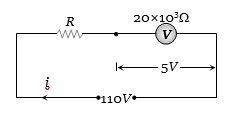
A $100\, V$ voltmeter of internal resistance $20\,k\Omega $ in series with a high resistance $R$ is connected to a $110\, V$ line. The voltmeter reads $5\, V$, the value of $R$ is ................ $k \Omega $
Answerc
(c) Here $i = \frac{{110}}{{20 \times {{10}^3} + R}}$
$V = iR$
$ \Rightarrow $ $5 = \left( {\frac{{110}}{{20 \times {{10}^3} + R}}} \right) \times 20 \times {10^3}$
$ \Rightarrow $ ${10^5} + 5R = 22 \times {10^5}$
$ \Rightarrow $ $R = 21 \times \frac{{{{10}^5}}}{5} = 420\,K\Omega $
View full question & answer→MCQ 981 Mark
Constantan wire is used in making standard resistances because its
- A
Specific resistance is low
- B
- ✓
Temperature coefficient of resistance is negligible
- D
AnswerCorrect option: C. Temperature coefficient of resistance is negligible
c
(c) Due to the negligible temperature co-efficient of resistance of constantan wire, there is no change in it's resistance value with change in temperature.
View full question & answer→MCQ 991 Mark
Two uniform wires $A$ and $B$ are of the same metal and have equal masses. The radius of wire $A$ is twice that of wire $B$. The total resistance of A and $B$ when connected in parallel is
- ✓
$4\,\Omega $ when the resistance of wire $A$ is $4.25\,\Omega $
- B
$5\,\Omega $ when the resistance of wire $A$ is $4.25\,\Omega $
- C
$4\,\Omega $ when the resistance of wire $B$ is $4.25\,\Omega $
- D
$4\,\Omega $ when the resistance of wire $B$ is $4.25\,\Omega $
AnswerCorrect option: A. $4\,\Omega $ when the resistance of wire $A$ is $4.25\,\Omega $
a
$\frac{{{R_A}}}{{{R_B}}} = {\left( {\frac{{{r_B}}}{{{r_A}}}} \right)^4}$ $ \Rightarrow $ $\frac{{{R_A}}}{{{R_B}}} = {\left( {\frac{1}{2}} \right)^4} = \frac{1}{{16}}$ $ \Rightarrow $ ${R_B} = 16{R_A}$
When $R_A$ and $R_B $ are connected in parallel then equivalent resistance
${R_{eq}} = \frac{{{R_A}{R_B}}}{{({R_A} + {R_B})}} = \frac{{16}}{{17}}{R_A}$
If ${R_A} = 4.25\,\Omega $ then ${R_{eq}} = 4\,\Omega $ i.e. option $(a)$ is correct.
View full question & answer→MCQ 1001 Mark
The resistance of a wire of iron is $10\, ohms$ and temp. coefficient of resistivity is $5 \times {10^{ - 3}}\,^oC$. At $20\,^oC$ it carries $30$ milliamperes of current. Keeping constant potential difference between its ends, the temperature of the wire is raised to $120\,^oC$. The current in milliamperes that flows in the wire is
Answera
$\frac{{{R_1}}}{{{R_2}}} = \frac{{(1 + \alpha {t_1})}}{{(1 + \alpha {t_2})}}$
$\frac{{10}}{{{R_2}}} = \frac{{(1 + 5 \times {{10}^{ - 3}} \times 20)}}{{(1 + 5 \times {{10}^{ - 3}} \times 120)}}$
${R_2} \approx 15\,\Omega $
Also $\frac{{{i_1}}}{{{i_2}}} = \frac{{{R_2}}}{{{R_1}}}$
$\frac{{30}}{{{i_2}}} = \frac{{15}}{{10}}$
${i_2} = 20\,mA$
View full question & answer→