MCQ 3511 Mark
When a resistance of $2\, ohm$ is connected across the terminals of a cell, the current is $0.5\, A$. When the resistance is increased to $5\, ohm$, the current is $0.25\, A$. The $e.m.f.$ of the cell is ................. $V$
Answerb
Since $i\, = \left( {\frac{E}{{R + r}}} \right),$ we get
$0.5 = \frac{E}{{2 + r}}$ ...... $(i)$
$0.25 = \frac{E}{{5 + r}}$ ..... $(ii)$
Dividing $(i)$ by $(ii)$,
we get $2 = \frac{{5 + r}}{{2 + r}}$ $ \Rightarrow $ $r = 1\,\Omega $
$0.5 = \frac{E}{{2 + 1}}$ $ \Rightarrow $ $E = 1.5\,V$
View full question & answer→MCQ 3521 Mark
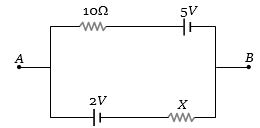
If ${V_{AB}} = 4\,V$ in the given figure, then resistance $X$ will be .............. $\Omega$
Answerd
${V_{AB}} = 4 = \frac{{5X + 2 \times 10}}{{X + 10}}$ $ \Rightarrow $ $X = 20\,\Omega $
View full question & answer→MCQ 3531 Mark
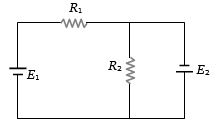
Two resistances ${R_1}$ and ${R_2}$ are joined as shown in the figure to two batteries of $e.m.f.$ ${E_1}$ and ${E_2}$. If ${E_2}$ is short-circuited, the current through ${R_1}$ is
- ✓
${E_1}/{R_1}$
- B
${E_2}/{R_1}$
- C
${E_2}/{R_2}$
- D
${E_1}/({R_2} + {R_1})$
AnswerCorrect option: A. ${E_1}/{R_1}$
a
(a) After short circuiting, $R_2$ becomes meaningless.
View full question & answer→MCQ 3541 Mark
The number of dry cells, each of $e.m.f.$ $1.5\,volt$ and internal resistance $0.5\, ohm$ that must be joined in series with a resistance of $20\, ohm$ so as to send a current of $0.6\,A$ through the circuit is
Answerc
In series $i = \frac{{nE}}{{nr + R}}$ $ \Rightarrow $ $0.6 = \frac{{n \times 1.5}}{{n \times 0.5 \times 20}}$ $ \Rightarrow $ $n = 10$
View full question & answer→MCQ 3551 Mark
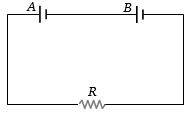
Two batteries $A$ and $B$ each of $e.m.f.$ $2\, V$ are connected in series to an external resistance $R = 1 \,ohm$. If the internal resistance of battery $A$ is $1.9\, ohms$ and that of $B$ is $0.9\, ohm$, what is the potential difference between the terminals of battery $A$ ............. $V$
Answerc
$i = \frac{{2 + 2}}{{1 + 1.9 + 0.9}} = \frac{4}{{3.8}}\,A$
For cell $A$ $E = V + ir$ $ \Rightarrow $ $V = 2 - \frac{4}{{3.8}} \times 1.9 = 0$.
View full question & answer→MCQ 3561 Mark
When a resistor of $11 \,\Omega$ is connected in series with an electric cell, the current flowing in it is $0.5\, A$. Instead, when a resistor of $5 \,\Omega$ is connected to the same electric cell in series, the current increases by $0.4\, A$. The internal resistance of the cell is ................ $\Omega$
Answerc
By using $i = \frac{E}{{R + r}}$
$ \Rightarrow 0.5 = \frac{E}{{11 + r}}$ $ \Rightarrow $ $E = 5.5 + 0.5r$ ..… $( i)$
and $0.9 = \frac{E}{{5 + r}}$ $ \Rightarrow $ $E = 4.5 + 0.9r$ ..… $(ii)$
On solving these equation, we have $r = 2.5\,\Omega $
View full question & answer→MCQ 3571 Mark
When the resistance of $9 \,\Omega$ is connected at the ends of a battery, its potential difference decreases from $40\, volt$ to $30\, volt$. The internal resistance of the battery is ............... $\Omega$
Answerb
The internal resistance of battery is given by
$r = \left( {\frac{E}{V} - 1} \right)R = \left( {\frac{{40}}{{30}} - 1} \right) \times 9$$ = \frac{{9 \times 10}}{{30}} = 3\,\Omega $
View full question & answer→MCQ 3581 Mark
When connected across the terminals of a cell, a voltmeter measures $5\,V$ and a connected ammeter measures $10\, A$ of current. A resistance of $2\, ohms$ is connected across the terminals of the cell. The current flowing through this resistance will be ............ $A$
Answerb
(b) Emf $E = 5\,V$ , Internal resistance $r = \frac{5}{{10}} = 0.5\,\Omega $
Current through the resistance $i = \frac{5}{{(2 + 0.5)}} = 2\,A$
View full question & answer→MCQ 3591 Mark
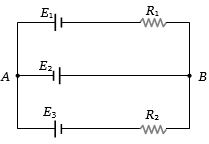
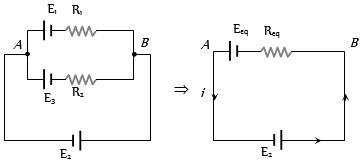
In the circuit shown here, $E_1 = E_2 = E_3 = 2 V$ and $R_1 = R_2 = 4\,ohms$. The current flowing between points $A$ and $B$ through battery $E_2$ is
- A
- ✓
$2\, amp$ from $A$ to $B$
- C
$2\, amp$ from $B$ to $A$
- D
AnswerCorrect option: B. $2\, amp$ from $A$ to $B$
b
The given circuit can be redrawn
${E_{eq}} = \frac{{{E_1}{R_2} + {E_2}{R_1}}}{{{R_1} + {R_2}}} = \frac{{2 \times 4 + 2 \times 4}}{{4 + 4}} = 2\,V$ and
${R_{eq}} = \frac{4}{2} = 2\Omega $. Current $i = \frac{{2 + 2}}{2} = 2A$ from $A$ to $B$ through $E_2.$
View full question & answer→MCQ 3601 Mark
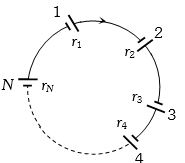
A group of $N$ cells whose $emf$ varies directly with the internal resistance as per the equation $E_N = 1.5\, r_N$ are connected as shown in the figure below. The current $I$ in the circuit is ........... $amp$
- A
$0.51$
- B
$5.1$
- C
$0.15$
- ✓
$1.5 $
AnswerCorrect option: D. $1.5 $
d
$i = \frac{{{E_1} + {E_2} + {E_3} + ..... + {E_n}}}{{({r_1} + {r_2} + {r_3} + ....... + {r_n})}}$
$ = \frac{{1.5({r_1} + {r_2} + {r_3} + ...... + {r_n})}}{{({r_1} + {r_2} + {r_3} + ..... + {r_n})}} = 1.5\,A$.
View full question & answer→MCQ 3611 Mark
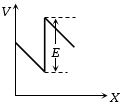
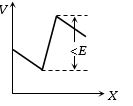
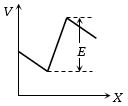
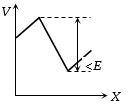
The two ends of a uniform conductor are joined to a cell of $e.m.f.$ $E$ and some internal resistance. Starting from the midpoint $P$ of the conductor, we move in the direction of current and return to $P$. The potential $V$ at every point on the path is plotted against the distance covered $(x)$. Which of the following graphs best represents the resulting curve
Answerb
(b) When we move in the direction of the current in a uniform conductor, the potential difference decreases linearly. When we pass through the cell, from it's negative to it's positive terminal, the potential increases by an amount equal to it's potential difference. This is less than it's $emf$, as there is some potential drop across it's internal resistance when the cell is driving current.
View full question & answer→MCQ 3621 Mark
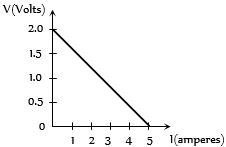
For a cell, the graph between the potential difference $(V) $ across the terminals of the cell and the current $(I)$ drawn from the cell is shown in the figure. The $e.m.f.$ and the internal resistance of the cell are
- A
$2\,V$, $0.5\,\Omega $
- ✓
$2\,V$, $0.4\,\Omega $
- C
$ > 2\,V$, $0.5\,\Omega $
- D
$ > 2\,V$, $0.4\,\Omega $
AnswerCorrect option: B. $2\,V$, $0.4\,\Omega $
b
E.m.f. is the value of voltage, when no current is drawn from the circuit so $E = 2\,V$.
Also $r = $ slope $=\frac{2}{5} = 0.4\,\Omega $
View full question & answer→MCQ 3631 Mark
A car has a fresh battery of $e.m.f$. $12\, V$ and internal resistance of $0.05\, \Omega$. If the starter motor draws a current of $90\, A$, the terminal voltage when the starter is on will be ............... $V$
Answerd
$V = E - i.r = 12 - 90 \times 0.05 = 12 - 4.5 = 7.5\,V$.
View full question & answer→MCQ 3641 Mark
A battery of $24$ cells, each of emf $1.5\, V$ and internal resistance $2\, \Omega$ is to be connected in order to send the maximum current through a $12 \,\Omega$ resistor. The correct arrangement of cells will be
- ✓
$2$ rows of $12$ cells connected in parallel
- B
$3$ rows of $8$ cells connected in parallel
- C
$4$ rows of $6$ cells connected in parallel
- D
AnswerCorrect option: A. $2$ rows of $12$ cells connected in parallel
a
Suppose $m$ rows are connected in parallel and each row contains $n$ identical cells (each cell having $E = 15\, V$ and $r = 2\, \Omega$)
For maximum current in the external resistance $R$, the necessary condition is $R = \frac{{nr}}{m}$
$ \Rightarrow $ $12 = \frac{{n \times 2}}{m}$ $ \Rightarrow $ $n = 6\,m$ ..... $(i)$
Total cells $= 24 = n \times m$ ..... $(ii)$
On solving equations $(i)$ and $(ii)$
$n = 12$ and $m = 2$
i.e. $2$ rows of $12$ cells are connected in parallel.
View full question & answer→MCQ 3651 Mark
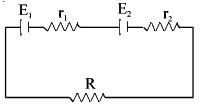
Under what condition current passing through the resistance $R$ can be increased by short circuiting the battery of emf $E_2$. The internal resistances of the two batteries are $r_1$ and $r_2$ respectively.
- A
$E_2r_1 > E_1 (R + r_2)$
- ✓
$E_1r_2 > E_2 (R + r_1)$
- C
$E_2r_2 > E_1 (R + r_2)$
- D
$E_1r_1 > E_2 (R + r_1)$
AnswerCorrect option: B. $E_1r_2 > E_2 (R + r_1)$
b
$\frac{E_{1}}{r_{1}+R}>\frac{E_{2}+E_{1}}{r_{1}+r_{2}+R}$
$E_{1} r_{1}+E_{1} r_{2}+E_{1} R>E_{2} r_{1}+E_{2} R+E_{1} r_{1}+E_{1} R$
$E_{1} r_2 >E_{2}\left(r_{1}+R\right)$
View full question & answer→MCQ 3661 Mark
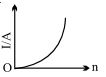
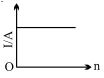
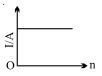
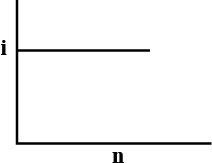
$A$ battery consists of a variable number $n$ of identical cells having internal resistance connected in series. The terminals of the battery are short circuited and the current $I$ measured. Which one of the graph below shows the relationship between $I$ and $n$?
Answerd
Here, $i=\frac{n E}{N R}=\frac{E}{R}$
Because $I$ is totally independent of $n$, hence it will remain constant.
View full question & answer→MCQ 3671 Mark
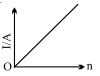
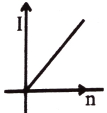
In previous problem, if the cell had been connected in parallel (instead of in series) which of the above graphs would have shown the relationship between total current $I$ and $n$?
Answera
$I=\frac{E}{\frac{r}{n}}=\frac{n E}{r}$
View full question & answer→MCQ 3681 Mark
$n$ identical cells are joined in series with its two cells $A$ and $B$ in the loop with reversed polarities. $EMF$ of each shell is $E$ and internal resistance $r$. Potential difference across cell $A$ or $B$ is (here $n > 4$)
AnswerCorrect option: D. $2E\left( {1 - \frac{2}{n}} \right)$
d
The two opposite cells $A$ and $B$ will cancel two more cells, so net emf will be $n-4 .$ So current is $I=\frac{(n-4) \varepsilon}{n r}$
Now $pd$ across $A$ or $B$ is
$I \varepsilon+I r$ (as they will be in charging state), brgt
$=\varepsilon=\frac{(n-4) \varepsilon}{n}=2 \varepsilon\left(1-\frac{2}{n}\right)=\frac{2 \varepsilon(n-2)}{n}$
View full question & answer→MCQ 3691 Mark
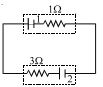
In the figure shown, battery $1$ has $\mathrm{emf}$ $= 6\, V$ and internal resistance $= 1 \,\Omega$. Battery $2$ has $\mathrm{emf}$ $= 2\,V$ and internal resistance $= 3\, \Omega$ . The wires have negligible resistance. What is the potential difference across the terminals of battery $2$ ? ................ $V$
Answerc
Battery $2$ is in changing mode
$I=\frac{6-2}{1+3}=1 A m p$
$V_{2}=E_{2}+I r_{2}=2+1 \times 3=5 V$
View full question & answer→MCQ 3701 Mark
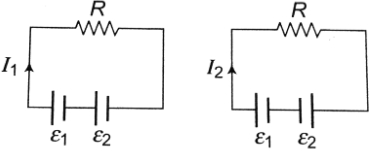
In order to determine the $e.m.f.$ of a storage battery it was connected in series with a standard cell in a certain circuit and a current $I_1$ was obtained. When the battery is connected to the same circuit opposite to the standard cell a current $I_2$ flow in the external circuit from the positive pole of the storage battery was obtained. What is the $e.m.f$. $\varepsilon_1$ of the storage battery? The $e.m.f$. of the standard cell is $\varepsilon_2$.
- ✓
$\varepsilon_1 = \frac{{{I_1} + {I_2}}}{{{I_1} - {I_2}}}\, \varepsilon_2$
- B
$\varepsilon_1 = \frac{{{I_1} + {I_2}}}{{{I_2} - {I_1}}}\, \varepsilon_2$
- C
$\varepsilon_1 =\, \frac{{{I_1} - {I_2}}}{{{I_1} + {I_2}}} \,\varepsilon_2$
- D
$\varepsilon_1 = \, \frac{{{I_2} - {I_1}}}{{{I_1} + {I_2}}} \, \varepsilon_2$
AnswerCorrect option: A. $\varepsilon_1 = \frac{{{I_1} + {I_2}}}{{{I_1} - {I_2}}}\, \varepsilon_2$
a
$\varepsilon_{1}+\varepsilon_{2}=I_{1} R, \varepsilon_{1}-\varepsilon_{2}=I_{2} R$
Dividing $\varepsilon_{1}=\left(\frac{I_{1}+I_{2}}{I_{1}-I_{2}}\right) \varepsilon_{2}$
View full question & answer→MCQ 3711 Mark
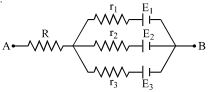
In the network shown the potential difference between $A$ and $B$ is ................. $V$ $(R = r_1 = r_2 = r_3 = 1 \Omega$ ,$ E_1 = 3\, V, E_2 = 2\, V, E_3 = 1\, V)$
Answerb
No current through $R$, so potential difference across
$A B$ is$V=\frac{\frac{E_{1}}{r_{1}}+\frac{E_{2}}{r_{2}}+\frac{E_{3}}{r_{3}}}{\frac{1}{r_{1}}+\frac{1}{r_{2}}+\frac{1}{r_{3}}}=\frac{\frac{3}{1}+\frac{2}{1}+\frac{1}{1}}{\frac{1}{1}+\frac{1}{1}+\frac{1}{1}}=2 V$
View full question & answer→MCQ 3721 Mark
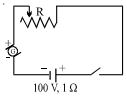
The battery in the diagram is to be charged by the generator $G$. The generator has a terminal voltage of $120$ $\mathrm{volts}$ when the charging current is $10$ $\mathrm{amperes}.$ The battery has an $\mathrm{emf}$ of $100$ $\mathrm{volts}$ and an internal resistance of $1$ $\mathrm{ohm}.$ In order to charge the battery at $10$ $\mathrm{amperes}$ charging current, the resistance $R$ should be set at ................ $\Omega$
Answerc
The generator has a terminal voltage of $120$ volts when the charging current is $10$ amperes. Hence,
$E=V+I r=120+10(1)=130 \mathrm{V}$
Hence, in circuit
$R=\frac{E-V}{I}$
$R=\frac{130-120}{10}=1 \Omega$
View full question & answer→MCQ 3731 Mark
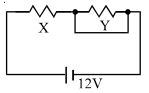
When an ammeter of negligible internal resistance is inserted in series with circuit it reads $1A$. When the voltmeter of very large resistance is connected across $X$ it reads $1V$. When the point $A$ and $B$ are shorted by a conducting wire, the voltmeter measures $10\, V$ across the battery. The internal resistance of the battery is equal to .............. $\Omega$
Answerc
Initially ammeter measures current $1 A$ through the circuit, when voltmeter measures voltage $1 \mathrm{V}$ the resistance is,
$R=\frac{V}{I}=1 \Omega$
When the point $A$ and $B$ are shorted by a conducting wire, the voltmeter measures $10 \mathrm{V}$ across the battery.
Hence the current is
$I=\frac{10}{1}=10 A$
Now, the voltage across the terminals of the battery is
$V=E-I r$
$10=12-10 r$
$10 r=2$
$r=0.2 \Omega$
View full question & answer→MCQ 3741 Mark
$A$ battery is of $\mathrm{emf}$ $E$ is being charged from a charger such that positive terminal of the battery is connected to terminal $A$ of charger and negative terminal of the battery is connected to terminal $B$ of charger. The internal resistance of the battery is $r$.
Answerd
A battery is of emf $E$ is being charged from a charger and hence current inside the cell is from anolde to cathode
$I=\frac{V-E}{I}$
$V=E+I r$
Therefore, when a cell is being charged the potential difference across its terminals is greater than emf of a cell. Also in charging the positive terminal is connected to anode of the cell and negative terminal to cathode.
Here, positive terminal of the battery is connected to terminal $A$ of charger and negative terminal of the battery is connected to terminal $B$ of charger.
Hence, Potential difference across points $A$ and $B$ must be more than $E$, $A$ must be at higher potential than $B$ and In battery, current flows from positive terminal to the negative terminal
View full question & answer→MCQ 3751 Mark
$A$ simple circuit contains an ideal battery and a resistance $R$. If a second resistor is placed in parallel with the first,
- A
the potential across $R$ will decrease
- B
the current through $R$ will decreased
- ✓
the current delivered by the battery will increase
- D
the power dissipated by $R$ will increased.
AnswerCorrect option: C. the current delivered by the battery will increase
c
When a resistor is added parallel to other resistor in circuit it results in the reduction of overall resistance, since there are multiple pathways by which charge can flow. adding another resistor in a separate branch provides another pathway by which to direct charge through the main area of resistance within the circuit. This decreased resistance resulting from increasing the number of branches will have the effect of increasing the rate at which charge flows i.e. the current.
View full question & answer→MCQ 3761 Mark
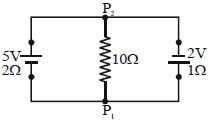
A $5\, V$ battery with internal resistance $2\, \Omega$ and a $2\,V$ battery internal resistance $1\, \Omega$ are connected to a $10\, \Omega$ resistor as shown in the figure. The current in the $10\, \Omega$ resistor is :-
- A
$0.03A\, P_1$ to $P_2$
- ✓
$0.03A\, P_2$ to $P_1$
- C
$0.27A\, P_1$ to $P_2$
- D
$0.27A\, P_2$ to $P_1$
AnswerCorrect option: B. $0.03A\, P_2$ to $P_1$
b
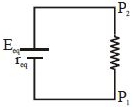
$\mathrm{E}_{\mathrm{eq}}=\left(\frac{\frac{5}{2}-\frac{2}{1}}{\frac{1}{2}+1}\right) \mathrm{V}^{\mathrm{r}_{\mathrm{eq}}}=\frac{2 \times 1}{2+1}=\frac{2}{3}\, \Omega$
$\mathrm{i}=\frac{\mathrm{E}_{\mathrm{eq}}}{10+\mathrm{r}_{\mathrm{eq}}}=0.03 \mathrm{\,A}$ from $\mathrm{P}_{2}$ to $ \mathrm{P}_{1}$
View full question & answer→MCQ 3771 Mark
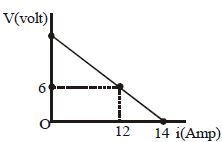
$10\,Cells$, each of emf $'E'$ and internal resistance $'r'$, are connected in series to a variable external resistance. Figure shows the variation of terminal potential difference of their combination with the current drawn from the combination.$Emf$ of each cell is ............. $V$
Answerd
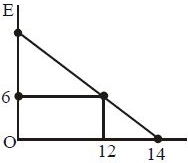
From similar triangle method
$\frac{6-0}{14-12}=\frac{E-0}{14-0}$
$\frac{6}{2}=\frac{E}{14} \quad \Rightarrow E=42$ $\mathrm{volt}$
$\mathrm{E}_{\mathrm{eq}}=42=10 \mathrm{\,E} \quad \Rightarrow \mathrm{E}=4.2 \mathrm{\,volt}$
View full question & answer→MCQ 3781 Mark
$n$ equal cell having emf $E$ and internal resistance $r$, are connected in a circuit of a resistance $R$ . Same current flows in circuit either they are connected in series or parallel, if
- A
$R = nr$
- B
$R = \frac {r}{n}$
- C
$R = n^2r$
- ✓
$R = r$
AnswerCorrect option: D. $R = r$
d
$\frac{\mathrm{nE}}{\mathrm{R}+\mathrm{nr}}=\frac{\mathrm{E}}{\frac{\mathrm{r}}{\mathrm{n}}+\mathrm{R}}$
$\Rightarrow \mathrm{r}+\mathrm{Rn}=\mathrm{R}+\mathrm{nr}$
$\Rightarrow \mathrm{r}=\mathrm{R}$
View full question & answer→MCQ 3791 Mark
A $6\,\,V$ battery is connected to the terminals of a $3\, m$ long uniform wire having resistance $100\,\Omega $. The difference in potential between two points on the wire separated by a distance of $50\, cm$ will be ............. $V$
Answerc
$\phi=\frac{6}{3}$
$\Rightarrow \Delta \mathrm{V}=\frac{6}{3} \times 0.5=1 \mathrm{\,V}$
View full question & answer→MCQ 3801 Mark
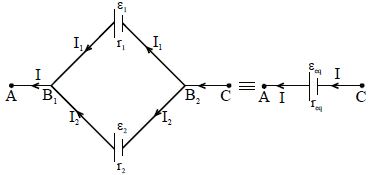
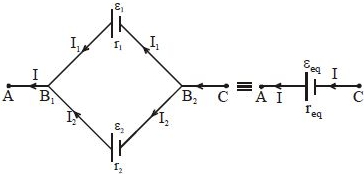
Consider a parallel combination of the cellsshown in the figure.The potential difference in between $B_1$ and $B_2$ is
- ✓
${\rm{V = }}{\varepsilon _{eq}} - I{r_{eq}}$
- B
${\rm{V = }}{\varepsilon _2} - I{r_2}$
- C
${\rm{V = }}{2\varepsilon _{eq}} - I{r_{eq}}$
- D
${\rm{V = }}{\varepsilon _1} - 2I{r_1}$
AnswerCorrect option: A. ${\rm{V = }}{\varepsilon _{eq}} - I{r_{eq}}$
a
$\mathrm{I}=\mathrm{I}_{1}+\mathrm{I}_{2}$
$I_{1}=\frac{\varepsilon_{2}-V}{r_{1}} \Rightarrow I_{2}=\frac{\varepsilon_{2}-V}{r_{2}}$
Combining the last three equations
$\mathrm{I}=\mathrm{I}_{1}+\mathrm{I}_{2}=\frac{\varepsilon_{1}-\mathrm{V}}{\mathrm{r}_{1}}+\frac{\varepsilon_{2}-\mathrm{V}}{\mathrm{r}_{2}}$
$=\left(\frac{\varepsilon_{1}}{\mathrm{r}_{1}}+\frac{\varepsilon_{2}}{\mathrm{r}_{2}}\right)-\mathrm{V}\left(\frac{1}{\mathrm{r}_{1}}+\frac{1}{\mathrm{r}_{2}}\right)$
Hence, $\mathrm{V}$ is given by, $\mathrm{V}=\frac{\varepsilon_{1} \mathrm{r}_{2}+\varepsilon_{2} \mathrm{r}_{1}}{\mathrm{r}_{1}+\mathrm{r}_{2}}-\mathrm{I} \frac{\mathrm{r}_{1} \mathrm{r}_{2}}{\mathrm{r}_{1}+\mathrm{r}_{2}}$
If we want to replace the combination by a single cell, between $\mathrm{B}_{1}$ and $\mathrm{B}_{2}$ of emf $\varepsilon_{\mathrm{eq}}$ and internal resistance $\mathrm{r}_{\mathrm{eq}},$
we would have $\mathrm{V}=\varepsilon_{\mathrm{eq}}-\mathrm{Ir}_{\mathrm{eq}}$
View full question & answer→MCQ 3811 Mark
When a current of $2\,A$ flows in a battery from negative to positive terminal, the potential difference across it is $12\,V$. If a current of $3\,A$ flows in the opposite direction potential difference across the terminals of the battery is $15\,V$, the emf of the battery is ............... $\mathrm{V}$
- A
$12.6$
- ✓
$13.2$
- C
$13.5$
- D
$14$
AnswerCorrect option: B. $13.2$
b
$\mathrm{T} . \mathrm{P.D.}=\mathrm{E}-\mathrm{I} \mathrm{r} \Rightarrow 12=\mathrm{E}-2 \mathrm{r}$ ..........$(1)$
$\mathrm{T.P.D.}=\mathrm{E}+\mathrm{Ir} \Rightarrow 15=\mathrm{E}+3 \mathrm{r} $ .........$(2)$
Solve ${\rm{e}}{{\rm{q}}^n}$ $(1)$ and $(2)$

View full question & answer→MCQ 3821 Mark
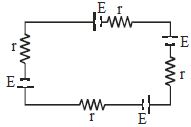
Four identical cells of $EMF$ $E$ and internal resistance $r$ are connected as shown in figure, find terminal voltage across any one cell
- A
$\frac{{2E}}{3}$
- B
$\frac{{3E}}{2}$
- C
$E$
- ✓
Answerd
Current in the circuit $I=\frac{4 E}{4 r}=\frac{E}{r}$
Terminal potential $\quad \mathrm{V}=\mathrm{E}-\mathrm{Ir}$
$=\mathrm{E}-\frac{\mathrm{E}}{\mathrm{r}} \times \mathrm{r}=0$
View full question & answer→MCQ 3831 Mark
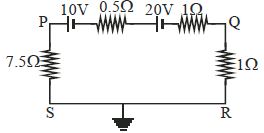
In the circuit shown in figure, which of the statement is incorrect ?
- ✓
Potential at $P$ is $-7.5\,V$
- B
Potential at $Q$ is $-3\, V$
- C
Potential at $R$ is zero
- D
Potential at $S$ is zero
AnswerCorrect option: A. Potential at $P$ is $-7.5\,V$
a
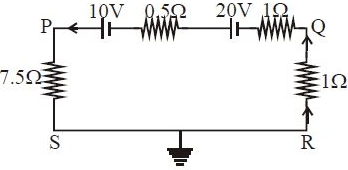
$i=\frac{30}{10}=3$
$\mathrm{V}_{\mathrm{P}}-\mathrm{V}_{\mathrm{S}}=7.5 \times 3=22.5$ $\mathrm{volt}$
but $\mathrm{V}_{\mathrm{S}}=0 \quad$ so $\mathrm{V}_{\mathrm{P}}=22.5$ $\mathrm{volt}$
$\mathrm{V}_{\mathrm{R}}-\mathrm{V}_{\mathrm{Q}}=1 \times 3$
$\mathrm{V}_{\mathrm{Q}}=-3 \mathrm{\,V}$
View full question & answer→MCQ 3841 Mark
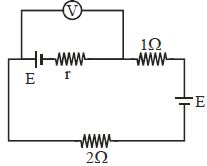
In the given circuit reading of ideal voltmeter is $\frac{E}{2}$ then internal resistance of cell is ............. $\Omega$
- ✓
$1$
- B
$\frac{2}{3}$
- C
$0.4$
- D
$2.5$
Answera
$\frac{\varepsilon}{2}=\varepsilon-i r$ or $i=\frac{\varepsilon}{2 r}$
$2 \varepsilon=i(3+r)$
$r=1 \Omega$
View full question & answer→MCQ 3851 Mark
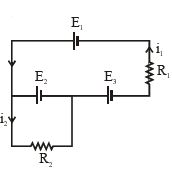
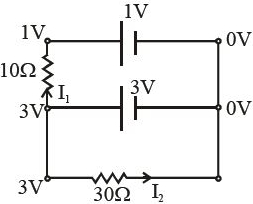
The current $i_1$ and $i_2$ through the resistors $R_1(=10\,\Omega )$ and ${R_2}\left( { = 30\,\Omega } \right)$ in the circuit diagram with $E_1 = 3\,V$, $E_2 = 3\,V$ and $E_3 = 2\,V$ are respectively
- ✓
$0.2\, A, 0.1\, A$
- B
$0.4\, A, 0.2\, A$
- C
$0.1\, A, 0.2\, A$
- D
$0.2\, A, 0.4\, A$
AnswerCorrect option: A. $0.2\, A, 0.1\, A$
a
$I_{1}=\frac{3-1}{10}=0.2 \,A$
$I_{2}=\frac{3-0}{30}=0.1 \,A$
View full question & answer→MCQ 3861 Mark
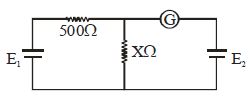
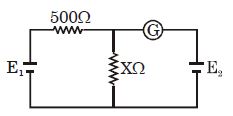
In the adjoining circuit, the battery $E_1$ has an emf of $12\, volt$ and zero internal resistance while the battery $E_2$ has an $emf$ of $2\, volt$. If the galvanometer $G$ reads zero, then the value of the resistance $X$ (in $ohm$ ) is
Answerb
Current across $(500 \Omega) \rightarrow$
$I=\frac{E_{1}-E_{2}}{500}$ ............$(1)$
$\mathrm{E}_{2}=\mathrm{IX}$ .........$(2)$
View full question & answer→MCQ 3871 Mark
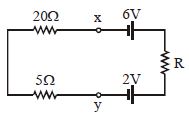
The current flowing in the given circuit is $0.1\,A$ . The potential difference between the points $X$ and $Y$ is ................ $\mathrm{V}$
View full question & answer→MCQ 3881 Mark
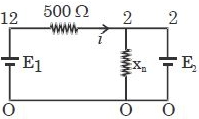
In the adjoining circuit, the battery $E_1$ has an $e.m.f.$ of $12\, volts$ and zero internal resistance, while the battery $E_2$ has an $e.m.f.$ of $2\, volts$. If the galvanometer $G$ reads zero, then the value of the resistance $X$ in $ohms$ is
Answerb
$i=\frac{10}{500}$
$2=\mathrm{i} \times \mathrm{x}$
$x=100$
View full question & answer→MCQ 3891 Mark
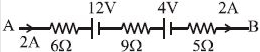
The potential difference between $A$ and $B$ in the Figure is ................... $\mathrm{V}$

Answerd
Applying $\mathrm{KVI}$
$\mathrm{V}_{\mathrm{A}}-12-12-18+4-10=\mathrm{V}_{\mathrm{B}}$
$\Rightarrow \mathrm{V}_{\mathrm{A}}-\mathrm{V}_{\mathrm{B}}=48 \mathrm{\,V}$
View full question & answer→MCQ 3901 Mark
$n$ identical cells are joined in series with two cells $A$ and $B$ with reversed polarities. $emf$ of each cell is $E$ and internal resistance is $r$. Potential difference across cell $A$ and $B$ is : $(n > 4)$
AnswerCorrect option: D. $2E\left( {1 - \frac{2}{n}} \right)$
d
Net $\mathrm{emf}$ of the circuit $= (n -2) E -2E = (n -4)E$ total resistance of the circuit $= nr$
$\therefore $ Current in the circuit will be,
$\mathrm{i}=\frac{(\mathrm{n}-4) \mathrm{E}}{\mathrm{nr}}$
Hence, potential difference across $\mathrm{A}$ or $\mathrm{B}$ is,
${\mathrm{V}=\mathrm{E}+\mathrm{Ir}=\mathrm{E}+\frac{(\mathrm{n}-4) \mathrm{E}}{\mathrm{nr}} \cdot \mathrm{r}} $
${=2 \mathrm{E}\left(1-\frac{2}{\mathrm{n}}\right)}$
View full question & answer→MCQ 3911 Mark
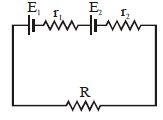
Under what conditions current passing through a resistance $R$ can be increased by short circuiting the battery of emf $E_2$. The internal resistances of the two batteries are $r_1$ and $r_2$ respectively
- A
$E_2r_1 > E_1(R + r_2)$
- ✓
$E_1r_2 > E_2(R + r_1)$
- C
$E_2r_2 > E_1(R + r_2)$
- D
$E_1r_1 > E_2(R + r_1)$
AnswerCorrect option: B. $E_1r_2 > E_2(R + r_1)$
b
The current through the circuit before the battery of $\mathrm{emf}$ $\mathrm{E}_{2}$ is short circuited is,
$I_{1}=\frac{E_{1}+E_{2}}{R+r_{1}+r_{2}}$
After short circuiting the battery of $\mathrm{emf}$ $\mathrm{E}_{2}$. current through resistance $\mathrm{R}$ would be,
$I_{2}=\frac{E_{1}}{R+r_{1}}$
Now, $\quad \mathrm{I}_{2}>\mathrm{I}_{1}$
$\therefore $ ${\frac{\mathrm{E}_{1}}{\mathrm{R}+\mathrm{r}_{1}}>\frac{\mathrm{E}_{1}+\mathrm{E}_{2}}{\mathrm{R}+\mathrm{r}_{1}+\mathrm{r}_{2}}} $
${\mathrm{E}_{1} \mathrm{r}_{2}>\mathrm{E}_{2}\left(\mathrm{R}+\mathrm{r}_{1}\right)}$
View full question & answer→MCQ 3921 Mark
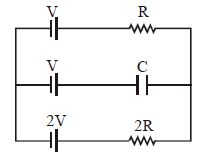
In the given circuit, with steady current, the potential drop across the capacitor must be
Answerc
in sleady state
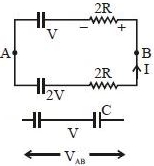
$I=\frac{2 V-V}{2 R+R}=\frac{V}{3 R}$
Potential differnce across $"\mathrm{R}"$ $=\frac{\mathrm{V}}{3 \mathrm{R}} \times \mathrm{R}=\frac{\mathrm{V}}{3}$
$\therefore \mathrm{V}_{\mathrm{AB}}=\mathrm{V}+\frac{\mathrm{V}}{3}$
and
So potential difference across $\mathrm{C}=\frac{\mathrm{V}}{3}$
View full question & answer→MCQ 3931 Mark
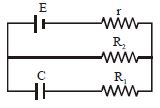
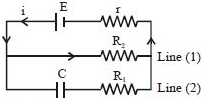
In the given figure each plate of capacitance $C$ has partial value of charge
- A
$CE$
- B
$\frac{{CE{R_1}}}{{{R_2} - r}}$
- ✓
$\frac{{CE{R_2}}}{{{R_2} + r}}$
- D
$\frac{{CE{R_1}}}{{{R_1} - r}}$
AnswerCorrect option: C. $\frac{{CE{R_2}}}{{{R_2} + r}}$
c
$\mathrm{i}=\frac{\mathrm{E}}{\left(\mathrm{R}_{2}+\mathrm{r}\right)}$
In steady state capacitor is fully charged hence
No current will flow through line $(2)$ Hence potential difference across line $(1)$ is
$\mathrm{V}=\frac{\mathrm{E}}{\left(\mathrm{R}_{2}+\mathrm{r}\right)} \times \mathrm{R}_{2},$ the same potential difference appears across the capacitor, so charge on capacitor
$\mathrm{Q}=\mathrm{C} \times \frac{\mathrm{ER}_{2}}{\left(\mathrm{R}_{2}+\mathrm{r}\right)}$
View full question & answer→MCQ 3941 Mark
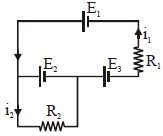
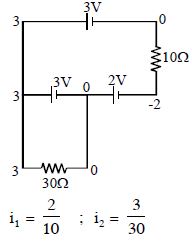
The current $i_1$ and $i_2$ through the resistor $R_1 (= 10\,\Omega )$ and $R_2 (=30 \,\Omega )$ in the circuit diagram with $E_1 = 3\,V, E_2 = 3\,V$ and $E_3 = 2\,V$ are respectively:
- ✓
$0.2\, A, 0.1\, A$
- B
$0.4\, A, 0.2\, A$
- C
$0.1\, A, 0.2\, A$
- D
$0.2\, A, 0.4\, A$
AnswerCorrect option: A. $0.2\, A, 0.1\, A$
a
View full question & answer→MCQ 3951 Mark
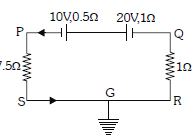
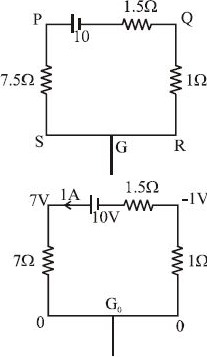
In the circuit shown in the figure below, which of the following statement is incorrect ?
- ✓
The potential at $P$ is $-7.5\, V$
- B
The potential at $Q$ is $-1\, V$
- C
The potential at $R$ is zero
- D
The potential at $S$ is zero
AnswerCorrect option: A. The potential at $P$ is $-7.5\, V$
a
The equivalent circuit can be drawn :
$\mathrm{V}_{\mathrm{p}}=7 \mathrm{\,V}$
$\mathrm{V}_{\mathrm{q}}=-1 \mathrm{\,V}$
$\mathrm{V}_{\mathrm{S}}=\mathrm{V}_{\mathrm{R}}=0 \mathrm{\,V}$
View full question & answer→MCQ 3961 Mark
A circuit of resistacne $R$ is connected to $n$ similar cells. If the current in the circuit is the same when the cells are connected in series or in parallel. If the internal resistacne $r$ of each cell then
- A
$r\,=\,\frac {R}{n}$
- B
$r=\,nR$
- ✓
$r=R$
- D
$r\,=\,\frac {1}{R}$
Answerc
When the cells are connected in series, current
$\mathrm{I}_{1}$ is given by :
$I_{1}=\frac{n E}{R+n r}$ $. .(i)$
When the cells connected in parallel, current
$\mathrm{I}_{2}$ is given by :
$\mathrm{I}_{2}=\frac{\mathrm{E}}{\mathrm{R}+\frac{\mathrm{r}}{\mathrm{n}}}=\frac{\mathrm{nE}}{\mathrm{nR}+\mathrm{r}}$ $\ldots(\mathrm{ii})$
As $I_{1}=I_{2}$
So, $\frac{\mathrm{nE}}{\mathrm{R}+\mathrm{nr}}=\frac{\mathrm{nE}}{\mathrm{nR}+\mathrm{r}}$
$\therefore \quad \mathrm{R}+\mathrm{nr}=\mathrm{nR}+\mathrm{r}$
or $(n-1) r=(n-1) R$ or $r=R$
View full question & answer→MCQ 3971 Mark
A cell of $emf$ $E$ and internal resistance $r$ is connected in series with an external resistacne $nr.$ Then, the ratio of the terminal potential difference to $emf$ is
- A
$\frac {1}{n}$
- B
$\frac {1}{(n+1)}$
- ✓
$\frac {n}{(n+1)}$
- D
$\frac {(n+1)}{n}$
AnswerCorrect option: C. $\frac {n}{(n+1)}$
c
$I=\frac{E}{r+n r}=\frac{E}{r(n+1)}$
$V=E-I r=E-\frac{E}{r(n+1)} r=\frac{n E}{n+1} \Rightarrow \frac{V}{E}=\frac{n}{n+1}$
View full question & answer→MCQ 3981 Mark
Two cells of $emfs$ $E_1$ and $E_2$ and internal resistances $r_1$ and $r_2$ are connected in parallel. The $emf$ and internal resistance of the equivalent source is
- A
${E_1}\, + \,{E_2}$ and $\frac{{{r_1}{r_2}}}{{{r_1} + {r_2}}}$
- B
${E_1}\, - \,{E_2}$ and $r_1\, +\, r_2$
- ✓
$\frac{{{E_1}{r_2}\, + \,\,{E_2}{r_1}}}{{{r_1} + {r_2}}}$ and $\frac{{{r_1}{r_2}}}{{{r_1} + {r_2}}}$
- D
$\frac{{{E_1}{r_2}\, + \,\,{E_2}{r_1}}}{{{r_1} + {r_2}}}$ and $r_1\, +\, r_2$
AnswerCorrect option: C. $\frac{{{E_1}{r_2}\, + \,\,{E_2}{r_1}}}{{{r_1} + {r_2}}}$ and $\frac{{{r_1}{r_2}}}{{{r_1} + {r_2}}}$
c
In parallel connection
${{\rm{E}}_{{\rm{eq}}}} = \frac{{\Sigma \frac{{{{\rm{E}}_1}}}{{{{\rm{r}}_1}}}}}{{\Sigma \frac{1}{{{{\rm{r}}_1}}}}} \Rightarrow \frac{{\frac{{{{\rm{E}}_1}}}{{{{\rm{r}}_1}}} + \frac{{{{\rm{E}}_2}}}{{{{\rm{r}}_2}}}}}{{\frac{1}{{{{\rm{r}}_1}}} + \frac{1}{{{{\rm{r}}_2}}}}}{{\rm{E}}_{{\rm{eq}}}} = \frac{{{{\rm{E}}_1}{{\rm{r}}_2} + {{\rm{E}}_{2{\rm{r}}}}}}{{{{\rm{r}}_1} + {{\rm{r}}_2}}}$
$\frac{1}{{{r_{eq}}}} = \Sigma \frac{1}{{{r_1}}} = \frac{1}{{{r_1}}} + \frac{1}{{{r_2}}} \Rightarrow {r_{eq}} = \frac{{{r_1}{r_2}}}{{{r_1} + {r_2}}}$
View full question & answer→MCQ 3991 Mark
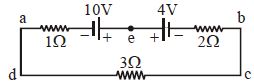
In the circuit diagram shown below, the magnitude and direction of the flow of current respectively would be
- A
$\frac {7}{3}$ $amp$ from $a$ to $b$ via $e$
- B
$\frac {7}{3}$ $amp$ from $b$ to $a$ via $e$
- C
$1.0$ $amp$ from $b$ to $a$ via $e$
- ✓
$1.0$ $amp$ from $a$ to $b$ via $e$
AnswerCorrect option: D. $1.0$ $amp$ from $a$ to $b$ via $e$
d
Total resistance of the circuit
$R=1\, \Omega+2\, \Omega+3\, \Omega=6 \,\Omega$
Current, $\quad \mathrm{I}=\frac{10-4}{6}=1 \mathrm{\,amp}$
The direction of the current would be from $\mathrm{a}$ to $\mathrm{b}$ via $\mathrm{e}.$
View full question & answer→MCQ 4001 Mark
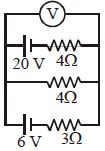
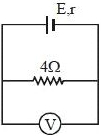
What will be reading of voltmeter ................. $V$
Answera
From parallel combination of cell,
$\Rightarrow \mathrm{E}=\frac{\frac{20}{4}+\frac{6}{3}}{\frac{1}{4}+\frac{1}{3}}=12$ $\mathrm{volt}$ $\Rightarrow \mathrm{r}=\frac{12}{7}$
$\Rightarrow \mathrm{V}=4\left[\frac{12}{4+\frac{12}{7}}\right]=8.4 \mathrm{\,volt}$
View full question & answer→