MCQ 3011 Mark
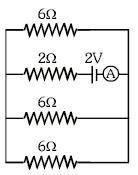
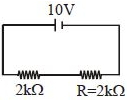
The ammeter reading in the following circuit will be .............. $A$
- A
$0.125$
- B
$0.75$
- ✓
$0.5$
- D
$2$
Answerc
$R=\frac{6}{3}+2=4 \Omega$
$I=\frac{v}{4}=\frac{2}{4}=\frac{1}{2}$
View full question & answer→MCQ 3021 Mark
A uniform wire of resistance $9\, ohm$ is bent in the form of a circle. The effective resistance across the points $A$ and $B$ is ............... $\Omega$

View full question & answer→MCQ 3031 Mark
The measurement of ammeter in the following circuit is ................... $A$ (Assuming ideal ammeter)
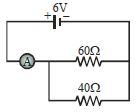
AnswerCorrect option: D. $0.25$
View full question & answer→MCQ 3041 Mark
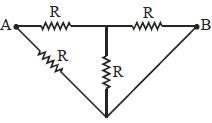
Find equivalent resistance $A$ and $B$
- ✓
$\frac{{3R}}{5}$
- B
$\frac{{2R}}{5}$
- C
$\frac{{R}}{5}$
- D
$\frac{{5R}}{3}$
AnswerCorrect option: A. $\frac{{3R}}{5}$
View full question & answer→MCQ 3051 Mark
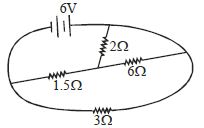
Find the value of current from battery in the circuit ............... $A$
View full question & answer→MCQ 3061 Mark
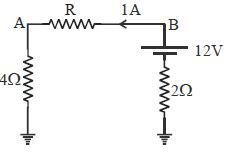
In the given circuit
- A
$R = 8\,\Omega $
- ✓
$R = 6\,\Omega $
- C
$R = 10\,\Omega $
- D
$R = 20\,\Omega $
AnswerCorrect option: B. $R = 6\,\Omega $
View full question & answer→MCQ 3071 Mark
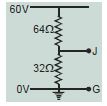
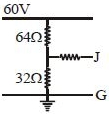
Find potential of $J$ with : respect to $G -$ ............. $V$
Answerc
Using voltage dividing rule.
$\mathrm{V}_{\mathrm{J}}=\frac{32}{(32+64)} \times 60=20 \mathrm{\,V}$
View full question & answer→MCQ 3081 Mark
Equivalent resistance between $A$ and $B$ is ............ $\Omega$
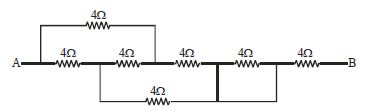
Answerb
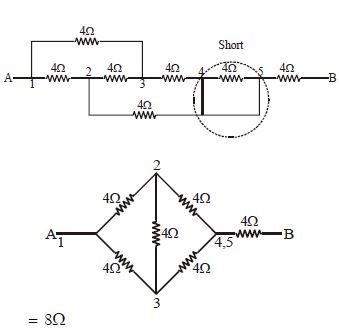
View full question & answer→MCQ 3091 Mark
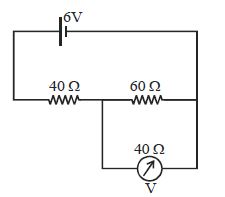
The reading of voltmeter in the circuit shown is ............. $V$
- ✓
$2.25$
- B
$3.25$
- C
$4.25$
- D
$6.25$
AnswerCorrect option: A. $2.25$
a
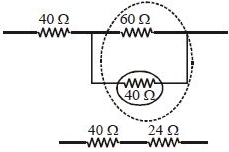
$\frac{60 \times 40}{60+40}=24\, \Omega$
$\mathrm{V}$ $=\frac{6 \times 24}{40+24}$ $ = \boxed{2.25\,{\text{V}}}$
View full question & answer→MCQ 3101 Mark
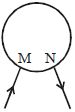
A uniform wire of resistance $20\,ohm$ having resistance $1\Omega /m$ is bent in the adjoining form of a circle as shown in the figure. If the equivalent resistance between $M$ and $N$ is $1.8 \,\Omega $, then the length of the shorter section is ................ $m$
Answera
Let the resistance of the shorter part $\mathrm{MN}$ be $\mathrm{x}$. Total resistance is $20 \,\Omega .$ Hence, the resistance of longer $\mathrm{MN}$ part will be $(20-x)$. With respect to $\mathrm{M}$ and $\mathrm{N},$ the two portions are connected in parallel. Hence,
$R_{e q}=\frac{(20-x) x}{(20-x)+x}=1.8$
Solving, we get; $\mathrm{x}=2\, \Omega$
The resistance per unit length is $1\, \Omega / \mathrm{m} .$ So, length of shorter part $=2 \mathrm{\,m}.$
View full question & answer→MCQ 3111 Mark
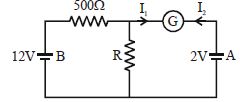
In the adjoining circuit, the galvanometer $G$ shows zero deflection. If the batteries $A$ and $B$ have negligible internal resistance, the value of the resistor $R$ will be .............. $\Omega$
- A
$500$
- B
$1000$
- C
$200$
- ✓
$100$
Answerd
Galvanometer will show zero deflection, if $\mathrm{I}_{1}=\mathrm{I}_{2}$
$\therefore $ $\frac{12}{500+R}=\frac{2}{R}$
or $\mathrm{R}=100\, \Omega$
View full question & answer→MCQ 3121 Mark
A wire of length $100\, cm$ is connected to a cell of emf $2\,V$ and negligible internal resistance. The resistance of the wire is $3\,\Omega $. The additional resistance required to produce a potential difference of $1\, mV/cm$ is ............. $\Omega$
Answerb
Let additional resistance is $\mathrm{R}$
then $\mathrm{I}=\frac{\mathrm{E}}{\mathrm{R}+\mathrm{R}_{\mathrm{wire}}}=\frac{2}{\mathrm{R}+3}$
$\phi = \frac{{{V_{{\rm{wire }}}}}}{\ell } = \frac{{I{R_{{\rm{wire }}}}}}{\ell }$
$\frac{10^{-3}}{10^{-2}}=\left(\frac{2}{\mathrm{R}+3}\right) \frac{3}{(1)}$ solving this, we get
$\mathrm{R}=57 \,\Omega$
View full question & answer→MCQ 3131 Mark
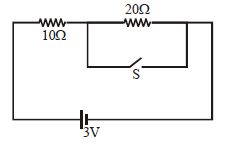
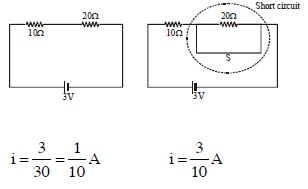
Consider the circuit shown in fig. The current through the $10\,\Omega $ resistor when switch $'s'$ is $(a)$ open $(b)$ closed.
- A
$\frac{1}{{10}}A,\frac{2}{{10}}A$
- B
$\frac{3}{{10}}A,\frac{1}{{10}}A$
- ✓
$\frac{1}{{10}}A,\frac{3}{{10}}A$
- D
AnswerCorrect option: C. $\frac{1}{{10}}A,\frac{3}{{10}}A$
c
View full question & answer→MCQ 3141 Mark
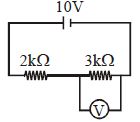
In the circuit shown in figure, the resistance of voltmeter is $6\, k\Omega $. The voltmeter reading will be ................. $\mathrm{V}$
Answerb
$\mathrm{R}=\frac{3 \times 6}{3+6}=2 \mathrm{\,K} \Omega$
voltage reading:
$\mathrm{V}=\frac{2}{2+2} \times 10=5 \mathrm{\,Volt}$
View full question & answer→MCQ 3151 Mark
In the given circuit, calculate the value of current in $4.5\,\Omega $ resistor .............. $\mathrm{A}$
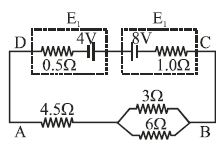
Answerd
${I_{net}} = \frac{{{E_{net}}}}{{{R_{net}}}}$
View full question & answer→MCQ 3161 Mark
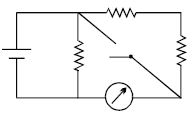
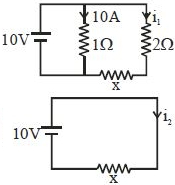
In the circuit shown, the reading of the Ammeter is doubled after the switch is closed. Each resistor has a resistance $1\,\Omega $ and the ideal cell has an $e.m.f.$ $10\, V$. Then, the Ammeter has a coil resistance equal to ............... $\Omega$
Answera
(when switch is opened)
$10 \times 1 =\mathrm{i}_{1} \times(2+\mathrm{x}) $
$\mathrm{i}_{1} =\frac{10}{2+\mathrm{x}}$ .......$(i)$
$\mathrm{i}_{2}=\frac{10}{\mathrm{x}}$
$\therefore i_{2}=2 i_{1}$
$\frac{10}{x}=2\left(\frac{10}{2+x}\right)$
$x=2\, \Omega$
View full question & answer→MCQ 3171 Mark
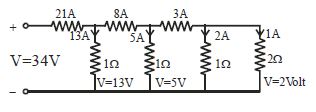
Each element in the finite chain of resistors shown in the figure is $1\,\Omega $. A current of $1\, A$ flows through the final element. Then what is the potential difference $V$ across input terminals of the chain ............... $\mathrm{volt}$
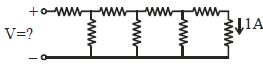
Answerb
View full question & answer→MCQ 3181 Mark
The current from the cell for the given circuit is ................ $\mathrm{A}$
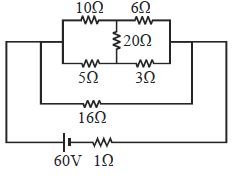
Answera
$\mathrm{R}_{\mathrm{eff}}=[(10+6)\|(5+3)\| 16\, \Omega] \,\mathrm{s} \,1\, \Omega$
$\mathrm{R}_{\mathrm{eff}}=5 \,\Omega$
Hence $\mathrm{I}=\frac{\mathrm{E}}{\mathrm{R}_{\mathrm{eff}}}=\frac{60}{5}=12 \mathrm{\,A}$
View full question & answer→MCQ 3191 Mark
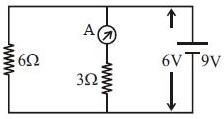
In the figure shown, if the internal resistance of the battery is $1\, ohm$ , the reading of the ammeter will be ................. $\mathrm{A}$
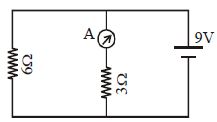
Answera
$R_{\text {net }}=\frac{6 \times 3}{6+3}+1=3\, \Omega$
$I_{\text {net }}=\frac{9}{3}=3 \mathrm{\,A}$
$T.P.D.$ of cell $=E-I r=9-3 \times 1=6 \,V$
reading of ameter $=\frac{6}{3}=2 \mathrm{\,A}$
View full question & answer→MCQ 3201 Mark
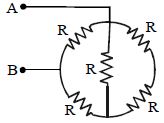
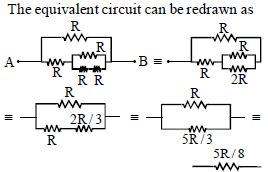
The equivalent resistance between $A$ and $B$ is
- A
$\frac {8R}{5}$
- ✓
$\frac {5R}{8}$
- C
$\frac {3R}{8}$
- D
$\frac {7R}{8}$
AnswerCorrect option: B. $\frac {5R}{8}$
b
View full question & answer→MCQ 3211 Mark
Two resistors are joined in parallel whose, resultant is $\frac{6}{5} \,\Omega$. One of the resistance wire is broken and the effective resistance becomes $2 \,ohms$. Then the resistance (in $ohm$) of the wire that got broken is ..........
- A
$\frac{6}{5}$
- B
$2$
- C
$\frac{3}{5}$
- ✓
$3$
Answerd
(d)
$\frac{R_1 R_2}{R_1+R_2}=\frac{6}{5}$
$R_1=2$
$\frac{2 R_2}{2+R_2}=\frac{6}{5}$
$5 R_2=6+3 R_2$
$2 R_2=6$
$R_2=3 \,\Omega$
View full question & answer→MCQ 3221 Mark
A technician has only two resistance coils. By using them singly, in series or in parallel, he is able to obtain the resistance $3,4,12$ and $16 \,ohms$. The resistance of the two coils are ........... $ohms$
- A
$6$ and $10$
- ✓
$4$ and $12$
- C
$7$ and $9$
- D
$4$ and $16$
AnswerCorrect option: B. $4$ and $12$
b
(b)
$\frac{R_1 R_2}{R_1+R_2}=3$
$R_1+R_2=16$
$R_1 R_2=48$
$R_1\left(16-R_1\right)=48$
$R_1^2-16 R_1+48=0$
$R_1=4,12$
View full question & answer→MCQ 3231 Mark
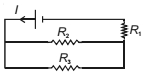
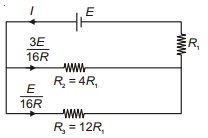
Refer to the circuit shown. What will be the total power dissipation in the circuit if $P$ is the power dissipated in $R_1$ ? It is given that $R_2=4 R_1$ and $R_3=12 R_1$ are .......... $P$
Answera
(a)
$\frac{E}{16 R} R_3=12 R_1$
$R_{\text {net }}=4 R_1$
$i=\frac{E}{4 R_1}$
$P=\frac{E^2 R_1}{16 R_1^2}=\frac{E^2}{16 R_1}$
$P_2=\frac{9 E^2}{256 R_1{ }^2} \cdot 4 R_1=\frac{9 P}{4}$
$P_3=\frac{E^2}{256 R_1{ }^2} \cdot 12 R_1=\frac{3 E^2}{64 R_1}=\frac{3 P}{4}$
$P+\frac{9 P}{4}+\frac{3 P}{4}=\frac{16 P}{4}=4P$
View full question & answer→MCQ 3241 Mark
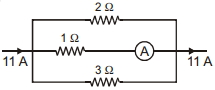
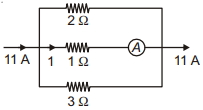
The ammeter reading in the circuit below is .............. $A$
Answerc
(c)
$\frac{i}{11-i}=\frac{1.2}{1}$
$i=13.2-1.2 i$
$i=\frac{13.2}{2.2}=\frac{132}{22}$
$i=6 \,A$
View full question & answer→MCQ 3251 Mark
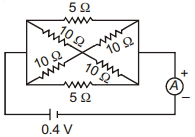
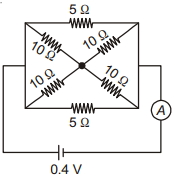
Calculate the current shown by the ammeter $A$ in the circuit diagram is .............. $A$
Answerb
(b)
$R_{\text {net }}=2 \,\Omega$
$0.4=i(2)$
$i=0.2 \,A$
View full question & answer→MCQ 3261 Mark
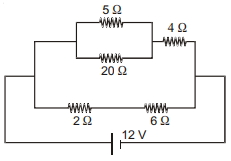
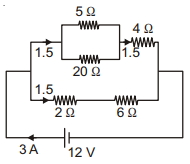
A circuit containing five resistors is connected to a battery with a $12 \,V$ emf as shown in figure. The potential difference across $4 \,\Omega$ resistor is ........... $V$
Answerb
(b)
$i=\frac{12}{4}=3 \,A$
$\Delta V_4=6 \,V$
View full question & answer→MCQ 3271 Mark
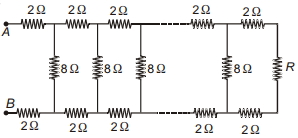
Consider the ladder network shown in figure. What should be the value of resistance $R$, so that effective resistance between $A$ and $B$ becomes independent of number of elements in the combination is ............. $\Omega$
Answerb
(b)
For $R=4 r$, the sequence repeats itself.
View full question & answer→MCQ 3281 Mark
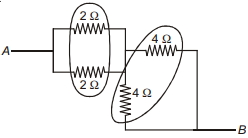
Effective resistance across $A B$ in the network shown in .......... $\Omega$
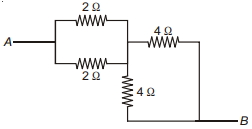
Answerb
(b)
$R_{ net }=3 \,\Omega$
View full question & answer→MCQ 3291 Mark
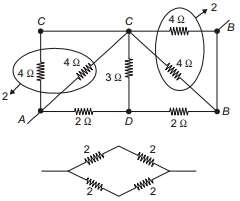
Resistance across $A B$ as shown in figure is ............. $\Omega$
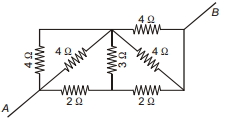
Answera
(a)
$2 \,\Omega$ net resistance
View full question & answer→MCQ 3301 Mark
Potential difference $V_B-V_A$ in the network shown is ............. $V$
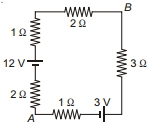
Answera
(a)
$R_{\text {net }}=9$
$V=9 V$
$i=1 A$
View full question & answer→MCQ 3311 Mark
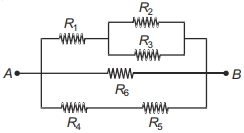
Consider the combination of resistors as shown in figure and pick out the correct statement
- A
$R_1$ and $R_4$ are connected in parallel
- B
$R_1$ and $R_2$ are connected in series
- ✓
$R_2$ and $R_3$ are connected in parallel
- D
$R_6$ and $R_4$ are connected in parallel
AnswerCorrect option: C. $R_2$ and $R_3$ are connected in parallel
c
(c)
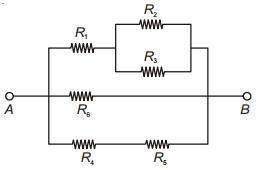
$R_2$ and $R_3 \Rightarrow$ Parallel
View full question & answer→MCQ 3321 Mark
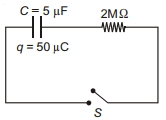
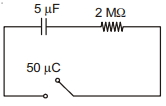
The following circuit consist of a $5 \,\mu F$ capacitor, having charge $50 \,\mu C$ as shown. The switch is closed at $t=0$. The value of current in $2 \,M \Omega$ resistor at $t=0$ is ........... $\mu A$
Answerc
(c)
$\Delta V=\frac{50}{5}=10 V$
$10=i\left(2 \times 10^6\right)$
$i=5 \,\mu A$
View full question & answer→MCQ 3331 Mark
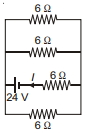
Current $I$ in the network shown in figure is .......... $A$
Answerb
(b)
$R_{ net }=8 \,\Omega$
$V=24 \,V$
$24=i(8)$
$i=3 \,A$
View full question & answer→MCQ 3341 Mark
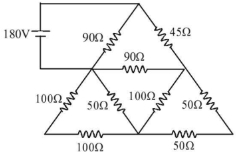
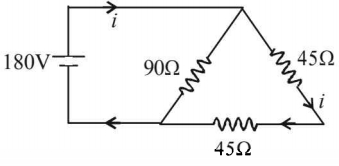
In the circuit shown in the figure, find the current in $45\, \Omega$ $..........\,A$
Answerc
(c)
$i=\frac{180}{90}=2\,A$
View full question & answer→MCQ 3351 Mark
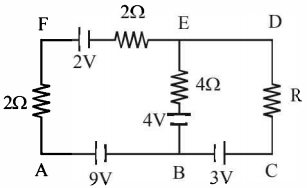
In the electric network shown, when no current flows through the $4 \Omega$ resistor in the arm EB, the potential difference between the points $A$ and $D$ will be $.............\,V$
Answerc
(c)
As no current flows through arm $E B$ then $V _{ D }=0 V ; \quad V _{ E _{ D }}=0 V ; \quad V _{ B }=-4 V ; \quad V _{ A }=5 V$ So, potential difference between the points $A$ and $D$
$V_A-V_D=5\,V$
View full question & answer→MCQ 3361 Mark
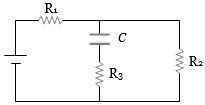
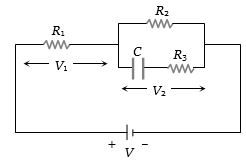
In the circuit here, the steady state voltage across capacitor $C$ is a fraction of the battery $e.m.f.$ The fraction is decided by
AnswerCorrect option: B. $R_1$ and $R_2$ only
b
(b) In steady state potential difference across capacitor
$V_2$$=$potential difference across resistance ${R_2} = \left( {\frac{{{R_2}}}{{{R_1} + {R_2}}}} \right)\,V$
Hence $V_2$ depends upon $R_2$ and $R_1$
View full question & answer→MCQ 3371 Mark
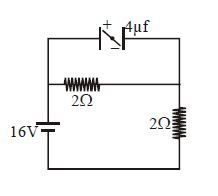
What is net force on the small dipole placed inside the capacitor at steady state if the plates are separated by $1\ cm$ ?......$N$
Answera
In uniform field net force is zero
View full question & answer→MCQ 3381 Mark
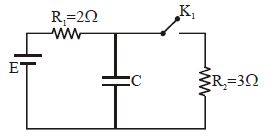
In the circuit shown in the figure $K_1$ is open. The charge on capacitor $C$ in steady state is $q_1$. Now key is closed and at steady state charge on $C$ is $q_2$. The ratio of charges $q_1/q_2$ is
AnswerCorrect option: A. $1.67$
a
$q_1 = CE$
$q_2 = CE × \frac{3}{5}$
View full question & answer→MCQ 3391 Mark
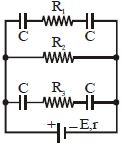
In the circuit diagram of figure, $E = 5\, volt, r = 1\, \Omega ,$$ R_2 = 4\, \Omega , R_1 = R_3 = 1 \Omega$ and $C = 3\, μF.$ Then the magnitude of the charge on each capacitor plate is......$\mu C$
Answera
$6 \,\mu \mathrm{C},$ Hint : the $p.d$ across $\mathrm{R}_{2}$ is $4$ $volt.$ The total charge in the two parallel arms is $12\, \mu C$.
Thus in each row,
$q=6\, \mu C.$
View full question & answer→MCQ 3401 Mark
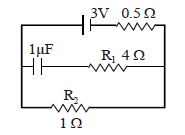
A $1\,\mu F$ capacitor is connected in the circuit shown below. The emf of the cell is $3\ volts$ and internal resistance is $0.5\ ohms$ . The resistors $R_1$ and $R_2$ have values $4\ ohms$ and $1\ ohm$ respectively. The charge on the capacitor in steady state must be.......$\mu C$
Answerb
In steady state current in the branch containing the capacitor is zero and hence
$\mathrm{emf}$ $\mathrm{E}$ is shared between
$\mathrm{r} $ and $ \mathrm{R}_{2}=$ in the ratio of their resistance voltage across $\mathrm{R}_{2}$ is $\frac{\mathrm{ER}_{2}}{\mathrm{R}_{2}+\mathrm{r}}=2 \mathrm{\,Volts}$
$=$ Voltage across capacitor.
$\therefore $ $\mathrm{Q}=\mathrm{CV}_{\mathrm{c}}=2 \mu \mathrm{C}$
View full question & answer→MCQ 3411 Mark
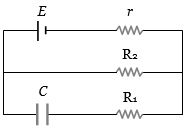
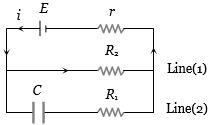
In the given figure each plate of capacitance $C$ has partial value of charge
- A
$CE$
- B
$\frac{{CE{R_1}}}{{{R_2} - r}}$
- ✓
$\frac{{CE{R_2}}}{{{R_2} + r}}$
- D
$\frac{{CE{R_1}}}{{{R_1} - r}}$
AnswerCorrect option: C. $\frac{{CE{R_2}}}{{{R_2} + r}}$
c
(c) In steady state current drawn from the battery $i = \frac{E}{{({R_2} + r)}}$
In steady state capacitor is fully charged hence No current will flow through line $(2)$
Hence potential difference across line $(1)$ is $V = \frac{E}{{({R_2} + r)}} \times {R_2}$, the same potential difference appears across the capacitor, so charge on capacitor $Q = C \times \frac{{E{R_2}}}{{({R_2} + r)}}$
View full question & answer→MCQ 3421 Mark
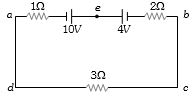
The magnitude and direction of the current in the circuit shown will be
- A
$\frac{7}{3}A$ from $a$ to $b$ through $e$
- B
$\frac{7}{3}A$ from $b$ to $a$ through $e$
- C
$1A$ from $b$ to $a$ through $e$
- ✓
$1A$ from $a$ to $b$ through $e$
AnswerCorrect option: D. $1A$ from $a$ to $b$ through $e$
d
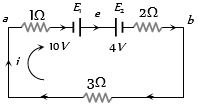
Since ${E_1}(10\,V) > {E_2}(4\,V)$
So current in the circuit will be clockwise.
Applying Kirchoff's voltage law
$ - \,1 \times i + 10 - 4 - 2 \times i - 3i = 0$ $ \Rightarrow $ $i = 1\,A$ $(a$ to $b$ via $e)$
Current $ = \frac{V}{R} = \frac{{10 - 4}}{6} = 1.0\,ampere$
View full question & answer→MCQ 3431 Mark
By a cell a current of $0.9\, A$ flows through $2\, ohm$ resistor and $0.3\,A$ through $7\, ohm$ resistor. The internal resistance of the cell is ............ $\Omega$
Answera
(a) $0.9 (2 + r) = 0.3 (7 + r) \Rightarrow 6 + 3r = 7 + r \Rightarrow r = 0.5$ $\Omega$
View full question & answer→MCQ 3441 Mark
A cell of e.m.f. $E$ is connected with an external resistance $R$, then p.d. across cell is $V$. The internal resistance of cell will be
- A
$\frac{{(E - V)R}}{E}$
- ✓
$\frac{{(E - V)R}}{V}$
- C
$\frac{{(V - E)R}}{V}$
- D
$\frac{{(V - E)R}}{E}$
AnswerCorrect option: B. $\frac{{(E - V)R}}{V}$
b
(b) Let the current in the circuit $ = i = \frac{V}{R}$
Across the cell, $E = V + ir$ $ \Rightarrow $ $r = \frac{{E - V}}{i} = \frac{{E - V}}{{V/R}} = \left( {\frac{{E - V}}{V}} \right)\,R$
View full question & answer→MCQ 3451 Mark
When a resistance of $2\,ohm$ is connected across the terminals of a cell, the current is $0.5$ amperes. When the resistance is increased to $5\, ohm$, the current is $0.25\, amperes$. The internal resistance of the cell is ............. $ohm$
Answerb
(b) Let the $e.m.f.$ of cell be $E$ and internal resistance be $r$.
Then $0.5 = \frac{E}{{(r + 2)}}$ and $0.25 = \frac{E}{{(r + 5)}}$
On dividing, $2 = \frac{{5 + r}}{{2 + r}}$ $ \Rightarrow $ $r = 1\,\Omega $
View full question & answer→MCQ 3461 Mark
The potential difference in open circuit for a cell is $2.2\, volts$. When a $4\, ohm$ resistor is connected between its two electrodes the potential difference becomes $2\, volts$. The internal resistance of the cell will be .............. $ohm$
Answerd
$(4 + r)i = 2.2$ ...... $(i)$
and $4i = 2$ $ \Rightarrow $ $i = \frac{1}{2}$
Putting the value of $i$ in $(i)$, we get $r = 0.4\, ohm$.
View full question & answer→MCQ 3471 Mark
$n$ identical cells each of $e.m.f.$ $E$ and internal resistance $r$ are connected in series. An external resistance $R$ is connected in series to this combination. The current through $R$ is
- ✓
$\frac{{nE}}{{R + nr}}$
- B
$\frac{{nE}}{{nR + r}}$
- C
$\frac{E}{{R + nr}}$
- D
$\frac{{nE}}{{R + r}}$
AnswerCorrect option: A. $\frac{{nE}}{{R + nr}}$
a
Total $e.m.f. = nE$,
Total resistance $R + nr$
$ \Rightarrow $ $i = \frac{{nE}}{{R + nr}}$
View full question & answer→MCQ 3481 Mark
Two identical cells send the same current in $2\,\Omega $ resistance, whether connected in series or in parallel. The internal resistance of the cell should be ............... $\Omega$
Answerb
In series , ${i_1} = \frac{{2E}}{{2 + 2r}}$
In parallel, ${I_2} = \frac{E}{{2 + \frac{r}{2}}} = \frac{{2E}}{{4 + r}}$
Since ${i_1} = {i_2}$ $ \Rightarrow $ $\frac{{2E}}{{4 + r}} = \frac{{2E}}{{2 + 2r}}$ $ \Rightarrow $ $r = 2\,\Omega $
View full question & answer→MCQ 3491 Mark
A torch battery consisting of two cells of $1.45\, volts$ and an internal resistance $0.15\,\Omega $, each cell sending currents through the filament of the lamps having resistance $1.5\,ohms$. The value of current will be ....... $A$
- A
$16.11$
- ✓
$1.611$
- C
$0.1611$
- D
$2.6$
AnswerCorrect option: B. $1.611$
b
Here two cells are in series.
Therefore total emf $=$ $2E$.
Total resistance $=$ $R + 2r$
$i = \frac{{2E}}{{R + 2r}} = \frac{{2 \times 1.45}}{{1.5 + 2 \times 0.15}} = \frac{{2.9}}{{1.8}} = \frac{{29}}{{18}} = 1.611\,amp$
View full question & answer→MCQ 3501 Mark
A current of two amperes is flowing through a cell of $e.m.f.$ $5\, volts$ and internal resistance $0.5\, ohm$ from negative to positive electrode. If the potential of negative electrode is $10\,V$, the potential of positive electrode will be .............. $V$
Answerb
${V_2} - {V_1} = E - ir = 5 - 2 \times 0.5 = 4\,volt$
$ \Rightarrow $ ${V_2} = 4 + {V_1} = 4 + 10 = 14\,volt$
View full question & answer→