MCQ 1511 Mark
If the complement of an angle is $79^\circ ,$ then the angle will be of:
- A
$1^\circ $
- ✓
$11^\circ $
- C
$79^\circ $
- D
$101^\circ $
AnswerCorrect option: B. $11^\circ $
Let the angle be $x^\circ .$ Then, the complement of $x$ will be $(90 - x)^\circ .$
Given, complement of $x^\circ $ is $79^\circ .$
$\therefore(90-\text{x})^\circ=79^\circ$
$\Rightarrow\text{x}^\circ=90^\circ-79^\circ=11^\circ$
Therefore, the required angle is $11^\circ .$
Note Sum of the complementary angles is $90^\circ .$
View full question & answer→MCQ 1521 Mark
Lines $PQ$ and $RS$ intersect at $O.$ If $\angle\text{POS}=2\angle\text{SOQ},$ then the four angles at $O$ are:
- A
$30^\circ , 30^\circ , 120^\circ , 180^\circ $
- ✓
$60^\circ , 60^\circ , 120^\circ , 120^\circ $
- C
$60^\circ , 90^\circ , 90^\circ , 120^\circ $
- D
$30^\circ , 60^\circ , 90^\circ , 180^\circ$
AnswerCorrect option: B. $60^\circ , 60^\circ , 120^\circ , 120^\circ $
$PQ$ and $RS$ intersect at $O.$ then,
$\angle\text{POS}=\angle\text{QOR}$ (opposite angles)
$\angle\text{SOQ}=\angle\text{POR}$ (opposite angles)
Given, $\angle\text{POS}=2\angle\text{SOQ}$
Sum of all angles $= 360$
$\angle\text{POS}+\angle\text{SOQ}+\angle\text{QOR}+\angle\text{ROP}=360$
$6\angle\text{SOQ}=360$
$\angle\text{SOQ}=60$
Hence, the four angles $= 60^\circ , 60^\circ , 120^\circ , 120^\circ .$
View full question & answer→MCQ 1531 Mark
If two parallel lines are intersected by a transversal, then interior angles on the same side of the transversal are ............
AnswerAnswer is option $A$
If thetransversalcrosses two parallellines.
Each pair of interior angles are inside the parallel lines, and on the same side of the transversal.
are supplementary $($add to $180$ degrees$)$
View full question & answer→MCQ 1541 Mark
The difference of two complementary angles is $30^\circ .$ Then, the angles are:
- ✓
$60^\circ , 30^\circ $
- B
$70^\circ , 40^\circ$
- C
$20^\circ , 50^\circ$
- D
$105^\circ , 75^\circ$
AnswerCorrect option: A. $60^\circ , 30^\circ $
Let one of the angle be $x.$ Since, the difference between the two angles is $30^\circ $,
then the other angle will be $(x – 30^\circ ).$
Also, the two angles are complementary, so their sum is equal to $90^\circ .$
$\therefore\text{x}+\text{(x}-30^\circ)=90^\circ$
$\Rightarrow\text{x}+\text{x}-30^\circ=90^\circ$
$\Rightarrow2\text{x}=90^\circ+30^\circ$
$\Rightarrow2\text{x}=120^\circ$
$\Rightarrow\text{x}=\frac{120^\circ}{2}$
$\Rightarrow\text{x}=60^\circ$
$\therefore$ Required angles are $60^\circ $ and $(60^\circ - 30^\circ ),$ i.e. $60^\circ $ and $30^\circ $
View full question & answer→MCQ 1551 Mark
If two straight lines intersect the measures of the vertically opposite angles are $......$
AnswerIt is the property of vertically opposite angles.
View full question & answer→MCQ 1561 Mark
If two interior angles on the same side of a transversal intersecting two parallel lines are in the ratio $2 : 3,$ then the smaller of two angles is :
- ✓
$72^\circ $
- B
$108^\circ$
- C
$54^\circ$
- D
$36^\circ$
AnswerCorrect option: A. $72^\circ $
Let the angles be $2x$ and $3x$ Sum of angles on the same side of transversal intersecting two parallel lines is $180^\circ $
$\Rightarrow 2x + 3x = 180^\circ $
$\Rightarrow 5x = 180^\circ $
$\Rightarrow x = 36^\circ $
So the angles are $2x = 2 \times 36^\circ = 72^\circ $
$3x = 3 \times 36^\circ = 108^\circ $
So the smaller angle is $72^\circ $
View full question & answer→MCQ 1571 Mark
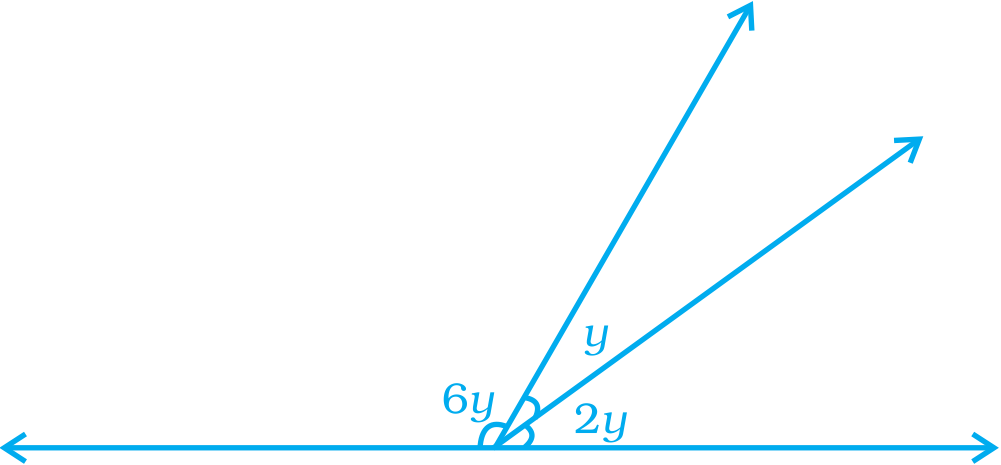
In the given figure, the value of $y$ is:
- A
$30^\circ $
- B
$15^\circ$
- ✓
$20^\circ$
- D
$22.5^\circ$
AnswerCorrect option: C. $20^\circ$
Since, sum of all the angles on a straight line is $180^\circ .$
Therefore, $6\text{y}+\text{y}+2\text{y}=180^\circ$
$\Rightarrow9\text{y}=180^\circ$
$\Rightarrow\frac{180^\circ}{9}$
$\therefore\text{y}=20^\circ$
View full question & answer→MCQ 1581 Mark
Mark the correct alternative of the following.
If the measures of the angles of a triangle are $(2x)^\circ , (3x - 5)^\circ $ and $(4x - 13)^\circ .$ Then the value of $x$ is$?$
AnswerSum of angles of triangles $= 180^\circ $
$2x + 3x - 5 + 4x - 13 = 180^\circ $
$9x - 18 = 180^\circ $
$9x = 198^\circ $
$x = 22^\circ $
View full question & answer→MCQ 1591 Mark
In Fig. $AOB$ is a straight line and $4x = 5y.$ The value of $x$ is:
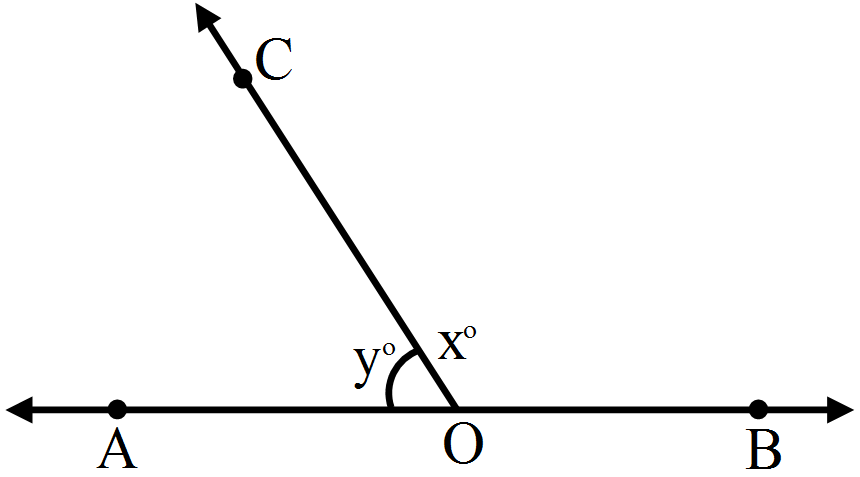
Answer$\angle \text{AOC}+\angle\text{BOC}=180^\circ$ [$\because$ Linear pair angles]
$\Rightarrow \text{y}^\circ+\text{x}^\circ=180^\circ$
$\Rightarrow \text{y}+\text{x}=180$
$\Rightarrow \frac{4\text{x}}{5}+\text{x}=180$ $\big[\because 4\text{x}=5\text{y}\Rightarrow \text{y}=\frac{4\text{x}}{5}\big]$
$\Rightarrow 4\text{x}+5\text{x}=180\times 5$
$\Rightarrow 9\text{x}=180\times 5$
$\Rightarrow \text{x}=100$
Hence, the correct answer is option $(a).$
View full question & answer→MCQ 1601 Mark
If two supplementary angles are in the ratio $1 : 2,$ then the bigger angle is:
- ✓
$120^\circ$
- B
$125^\circ$
- C
$110^\circ$
- D
$90^\circ$
AnswerCorrect option: A. $120^\circ$
It is given that the angles are in the ratio of $1 : 2.$
Let the angles will be $x$ and $2x.$
Also, the two angles are supplementary, i.e. their sum is equal to $180^\circ .$
$\therefore \text{x}+2\text{x}=180^\circ$
$\Rightarrow3\text{x}=180^\circ$
$\Rightarrow\text{x}=\frac{180^\circ}{3}$
$\Rightarrow\text{x}=60^\circ$
Hence, the required angles are $60^\circ $ and $2 \times 60^\circ ,$ i.e. $60^\circ $ and $120^\circ $
$\therefore$ Bigger of the two angles is $120^\circ .$
View full question & answer→MCQ 1611 Mark
$\angle \text{A}$ is an obtuse angle. The measure of $\angle \text{A}$ and twice its supplementary differ by $30^\circ .$ Then $\angle \text{A}$ can be:
- A
$150^\circ $
- ✓
$110^\circ $
- C
$140^\circ $
- D
$120^\circ $
AnswerCorrect option: B. $110^\circ $
Supplementary of $\angle \text{A}=180^\circ-\angle \text{A}$
Now,
$\angle \text{A}+30^\circ=2(180^\circ-\angle \text{A})$
$\Rightarrow \angle \text{A}+30^\circ=360^\circ-2\angle \text{A}$
$\Rightarrow 3\angle \text{A}=360^\circ-30^\circ$
$\Rightarrow 3\angle \text{A}=330^\circ$
$\Rightarrow \angle \text{A}=110^\circ$
Hence, the correct answer is option $(b).$
View full question & answer→MCQ 1621 Mark
Find the measure of the supplementary angle of $54^\circ $
- A
$26^\circ$
- ✓
$126^\circ$
- C
$34^\circ$
- D
$134^\circ $
AnswerCorrect option: B. $126^\circ$
Two angles are supplementary when they add up to form $180$ degrees.
If one angle $= 54$
Let the other angle be $x$
Hence $x = 180 − 54$
$= 126$
Hence supplementary angle of the following angle is $126.$
View full question & answer→MCQ 1631 Mark
Mark the correct alternative of the following.
If the measures of the angles of a triangle are $(2x)^\circ ,(3x - 5)^\circ $ and $(4x -13)^\circ .$ Then the value of $x$ is$?$
AnswerSum of angles of triangles $= 180^\circ $
$2x + 3x - 5 + 4x - 13 = 180^\circ $
$9x - 18 = 180^\circ $
$9x = 198^\circ $
$x = 22^\circ $
View full question & answer→MCQ 1641 Mark
In Fig. if $\text{AB} || \text{CD}$, $\angle\text{ APQ} = 50^\circ$ and $\angle\text{PRD} = 130^\circ$, then $\angle\text{QPR}$ is: 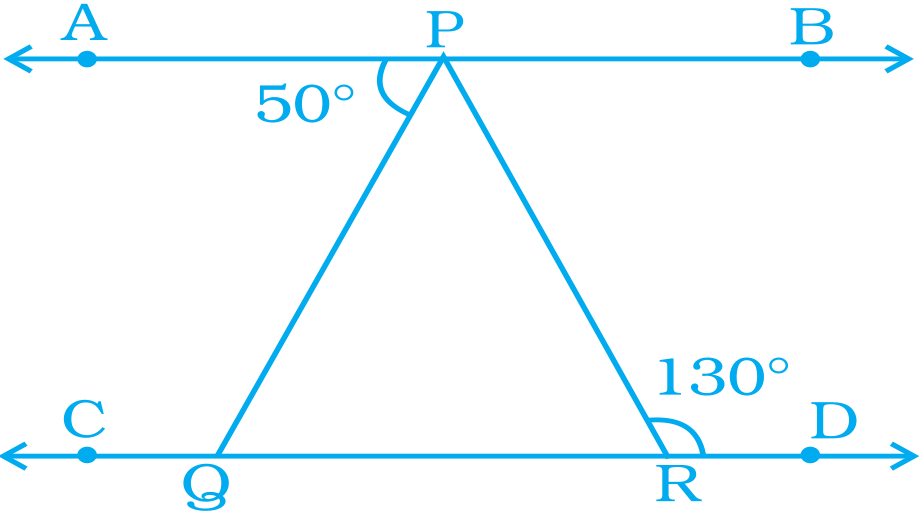
- A
$130^\circ $
- B
$50^\circ$
- ✓
$80^\circ$
- D
$30^\circ$
AnswerCorrect option: C. $80^\circ$
Since, $AB$ and $CD$ are parallel and $PR$ is a transversal.
$\therefore\angle\text{BPR}+\angle\text{PRD}=180^\circ[\therefore$ Sum of consecutive interior angle is $180^\circ ]$
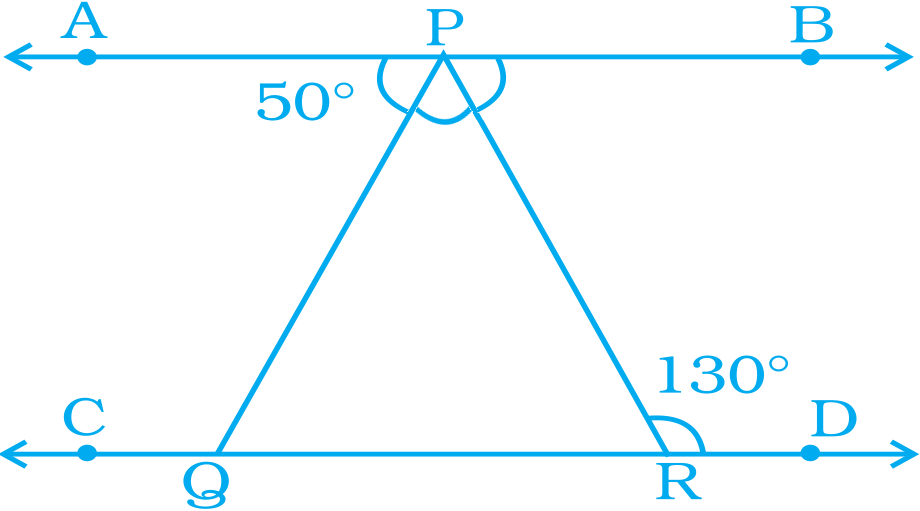
$\Rightarrow \angle \text{BPR} +130^\circ=180^\circ$
$[\therefore\angle\text{PRD}=130^\circ]$
$\Rightarrow\angle \text{BPR}=180^\circ-130^\circ$
$\Rightarrow \angle \text{BPR}=50^\circ$
Also, $\angle\text{APQ}+\angle \text{QPR}+\angle\text{BPR}=180^\circ$
$[\therefore$ sum of all the angies on a straight line is $180^\circ ]$
$\Rightarrow 50^\circ+\angle\text{QPR}+50^\circ=180^\circ$
$\Rightarrow\angle\text{QPR}+100^\circ=180^\circ$
$\Rightarrow\angle \text{QPR}=180^\circ-100^\circ$
$\therefore\angle\text{QPR}=80^\circ$ View full question & answer→MCQ 1651 Mark
In Fig. if $AB || CD$ then the value of $x$ is:
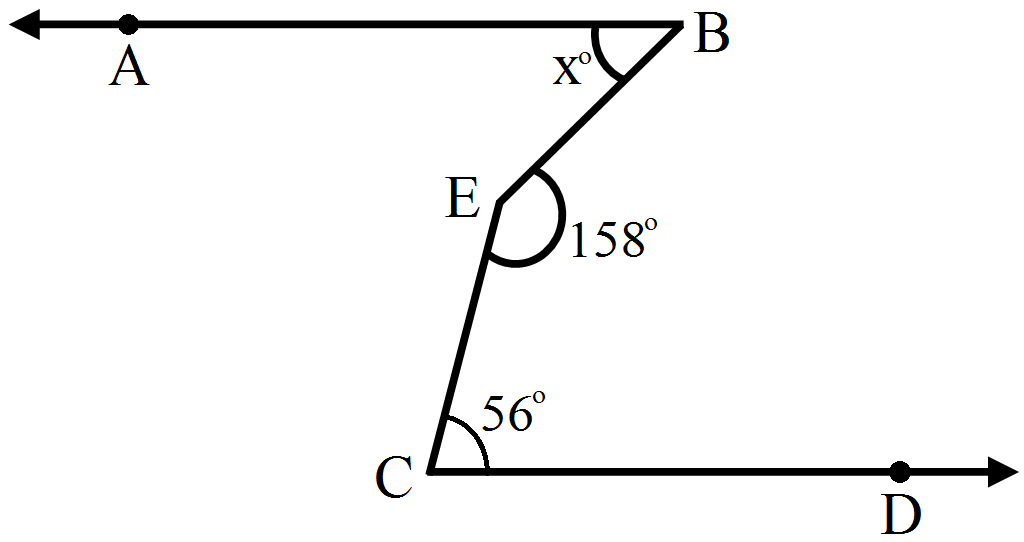
Answer 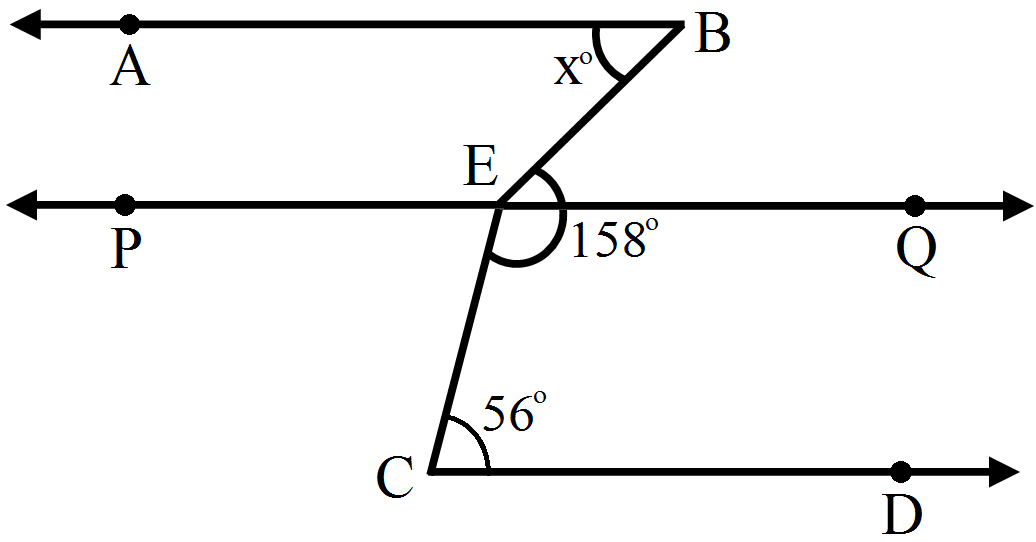
Construction: Draw a line $PQ$ parallel to $AB$ which is also parallel to $CD$
$\angle \text{QFC}+\angle \text{ECD}=180^\circ$ [Angles on the same side of a transversal line are supplementary]
$\Rightarrow \angle \text{QEC}+56^\circ=180^\circ$
$\Rightarrow \angle \text{QEC}=124^\circ$
Now, $\angle \text{BEQ}+\angle \text{QEC}=\angle \text{BEC}$
$\Rightarrow \angle \text{BEQ}+124^\circ=158^\circ$
$\Rightarrow\angle \text{BEQ}=34^\circ$
Now, $\angle \text{ABE}=\angle \text{BEQ}=34^\circ$ [Corresponding angles]
$\therefore \text{x}^\circ=34^\circ$
$\Rightarrow \text{x}=34$
Hence, the correct answer is option $(a).$
View full question & answer→MCQ 1661 Mark
If angle $P$ and angle $Q$ are supplementary and the measure of angle $P$ is $60^\circ ,$ then the measure of angle $Q$ is:
- ✓
$120^\circ $
- B
$60^\circ $
- C
$30^\circ $
- D
$20^\circ $
AnswerCorrect option: A. $120^\circ $
It is given that, angles $P$ and $O$ are supplementary. Hence, the sum of $P$ and $O$ will be $180^\circ $
$\therefore\angle\text{P}=\angle\text{Q}=180^\circ$
$\Rightarrow60^\circ=\angle\text{Q}=180^\circ$ $[\because\angle=60^\circ,\text{given}]$
$\angle\text{Q}=180^\circ-60^\circ $
$\angle\text{Q}=120^\circ$
View full question & answer→MCQ 1671 Mark
In Fig. lines $l$ and $m$ intersect each other at a point. Which of the following is false$?$
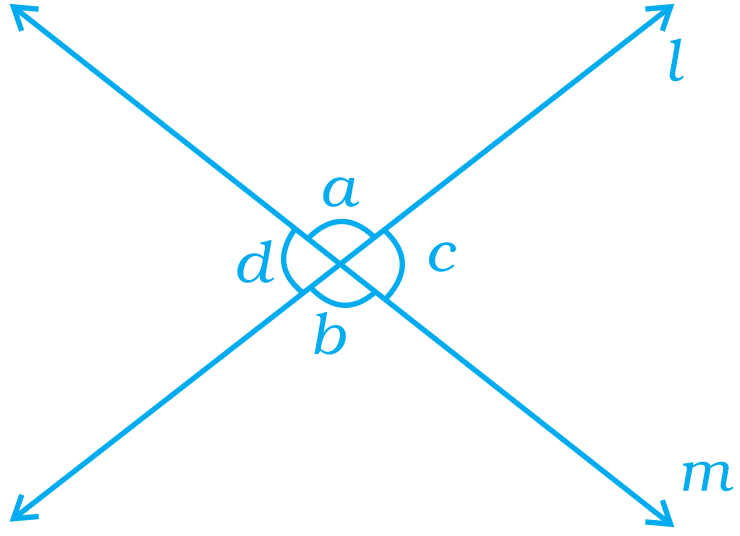
- A
$\angle\text{a}=\angle\text{b}$
- B
$\angle\text{b}=\angle\text{c}$
- C
$\angle\text{a}+\angle\text{d}=180^\circ$
- ✓
$\angle\text{a}=\angle\text{d}$
AnswerCorrect option: D. $\angle\text{a}=\angle\text{d}$
From the given Figure it is clear that, $\angle\text{a}=\angle\text{b}$ and $\angle\text{c}=\angle\text{d}$.
[vertically opposite angles]
Also, $\angle\text{a}=\angle\text{b}=180^\circ$
And $\angle\text{c}=\angle\text{d}=180^\circ$[Liner pair]
View full question & answer→MCQ 1681 Mark
In Fig. if $QP || SR,$ the value of $a$ is:
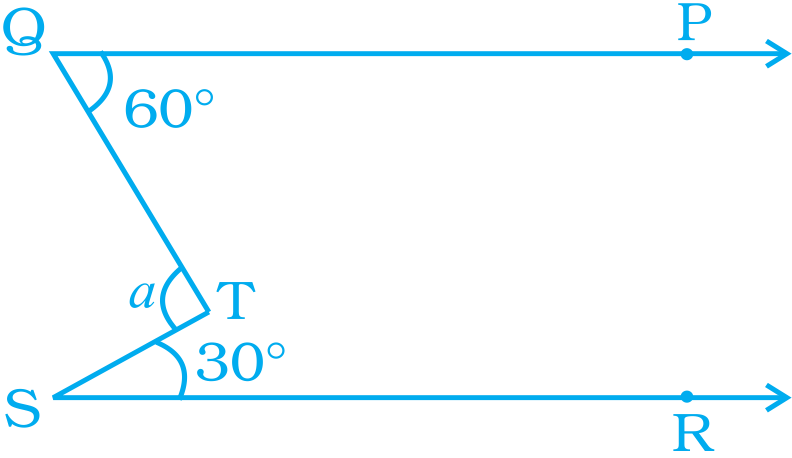
- A
$40^\circ$
- B
$30^\circ $
- ✓
$90^\circ$
- D
$80^\circ$
AnswerCorrect option: C. $90^\circ$
Draw a line $l$ parallel to $QP.$
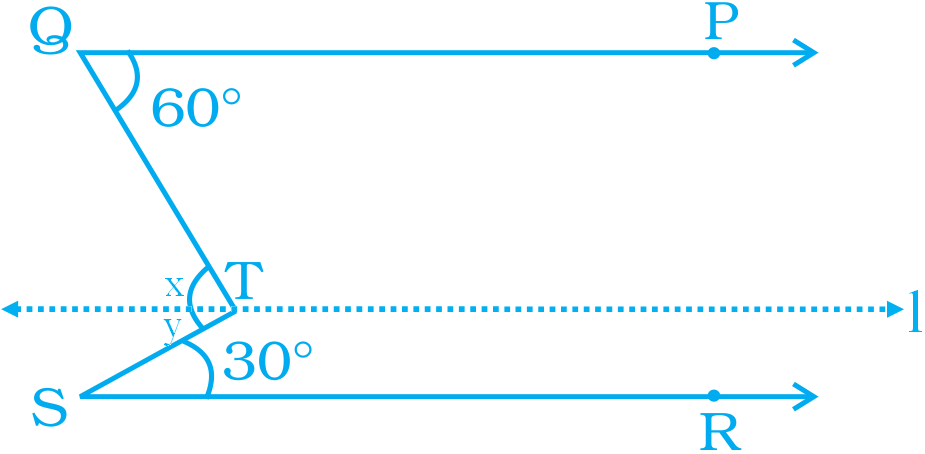
$\therefore \angle \text{PQT}=\text{x}$
$\Rightarrow \text{x}=60^\circ$ [Alternate interior angles]
Also, $\angle\text{RST}=\text{y}$
$\Rightarrow \text{y}=30^\circ$ [Alternate interior angles]
Now, $\text{a}=\text{x}+\text{y}$
$\Rightarrow\text{a}=60^\circ+30^\circ$
$\Rightarrow\text{a}=90^\circ$
View full question & answer→MCQ 1691 Mark
Supplementary angle of $108.5^\circ $ is:
- A
$70.5^\circ $
- ✓
$71.5^\circ $
- C
$71^\circ $
- D
$72.5^\circ $
AnswerCorrect option: B. $71.5^\circ $
Given angle is $= 108.5^\circ $
Let the angle supplementary with above angle be $x.$
Now, sum of two supplementary angles $= 180^\circ $
$\Rightarrow x + 108.5^\circ = 180^\circ $
$\Rightarrow x = 71.5^\circ .$
View full question & answer→MCQ 1701 Mark
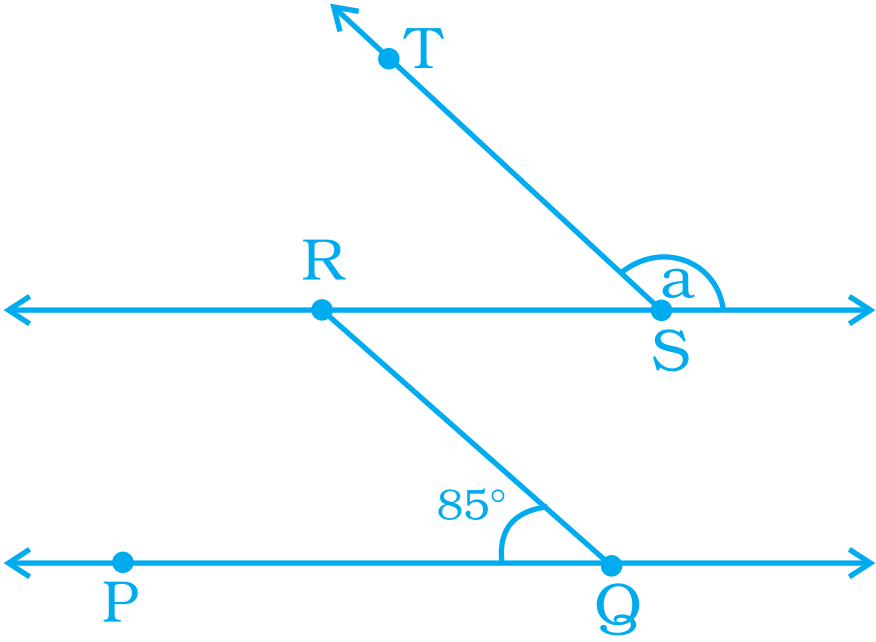
In Fig. if $PQ || RS$ and $QR || TS,$ then the value a is:
- ✓
$95^\circ $
- B
$90^\circ$
- C
$85^\circ $
- D
$75^\circ$
AnswerCorrect option: A. $95^\circ $
Since, $PQ || RS$ and $QR$ is transversal.
$\therefore\angle\text{PQR}=\angle\text{SRQ}$ [Alternate interior angles]
$\Rightarrow\angle\text{SRQ}=85^\circ$
Also, $ST || QR$ and $RS$ is transversal.
$\therefore\angle\text{SRQ}=\angle\text{RST}$ [Alternate interior angles]
$\Rightarrow\angle\text{RST}=85^\circ$
Now, $\angle\text{RST}+\text{a}=180^\circ$ [Liner pair]
$\Rightarrow \text{a}= 180^\circ-\angle\text{RST}$
$\Rightarrow \text{a}=180^\circ-85^\circ$
$\Rightarrow \text{a}=95^\circ$ $[\because\angle\text{RST}=85^\circ]$
View full question & answer→MCQ 1711 Mark
Find the supplement of the angle: $\frac{2}{5}$ of a right angle.
AnswerTwo angles are supplementary if their sum is $180^\circ $
If one angle is $\frac{2}{5}$ of a right angle, then other angle is
$180-\Big(\frac{2}{5}\times90\Big)$
$=180-(2\times18)$
$=180-36=144^\circ$
View full question & answer→MCQ 1721 Mark
Find the complement of the angle: $\frac{1}{4}$ of a right angle.
- ✓
$67.5^\circ$
- B
$57.5^\circ$
- C
$37.5^\circ$
- D
AnswerCorrect option: A. $67.5^\circ$
Two angles are complementary if their sum is $90^\circ .$
If one angle is $\frac{1}{4},$ then other angle is $\frac{3}{4}\times90=67.5$
View full question & answer→MCQ 1731 Mark
Find the angle which is $20^\circ $ more than its supplement.
AnswerLet the required angle be $x,$ then its supplement $= (180 - x)$
Given that $x = (180 - x) + 20$
$⇒ 2x = 200$
$\Rightarrow x = 100^\circ $
View full question & answer→MCQ 1741 Mark
In fig. if $\angle \text{AOC}$ is a straight line, then the value of $x$ is:
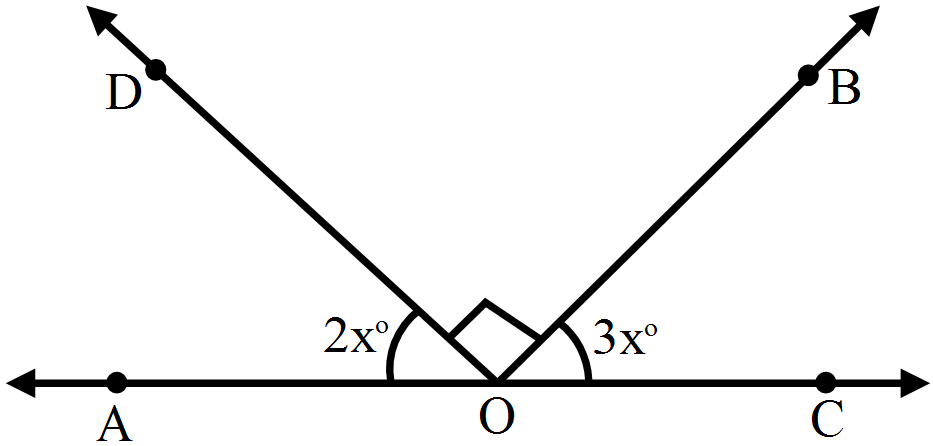
Answer$\angle\text{AOD}+\angle\text{DOB}+\angle \text{BOC}=180^\circ [AOC$ is a straight line$]$
$\Rightarrow 2\text{x}^\circ+90^\circ+3\text{x}^\circ=180^\circ$
$\Rightarrow 5\text{x}^\circ+90^\circ=180^\circ$
$\Rightarrow 5\text{x}=90$
$\Rightarrow \text{x}=18$
Hence, the correct answer is option $(b).$
View full question & answer→MCQ 1751 Mark
The angle which is twice its supplement is:
- ✓
$120^\circ $
- B
$90^\circ$
- C
$60^\circ$
- D
$30^\circ$
AnswerCorrect option: A. $120^\circ $
Let the required angle be $x$
Therefore, $x = 2 (180 - x)$
$\Rightarrow x = 360 - 2x$
$\Rightarrow 3x = 360$
$\Rightarrow x = 120^\circ $
View full question & answer→MCQ 1761 Mark
The measure of an angle which is four times its supplement, is:
- A
$36^\circ $
- ✓
$144^\circ$
- C
$16^\circ$
- D
$64^\circ$
AnswerCorrect option: B. $144^\circ$
Let the required angle be $x.$
Then, its supplement will be $(180^\circ – x).$
It is given that, the angle is four times its supplement.
Therefore, $\text{x}=4(180^\circ-\text{x})$
$\Rightarrow\text{x}=4\times180^\circ-4\text{x}$
$\Rightarrow \text{x}+4\text{x}=720^\circ$
$\Rightarrow 5\text{x}=720^\circ$
$\Rightarrow\text{x}=\frac{720^\circ}{5}$
$\Rightarrow \text{x}=144^\circ$
Hence, the required angle is $144^\circ .$
View full question & answer→MCQ 1771 Mark
Measure of an angle of linear pair is $125^\circ ,$ then what is the measure of another angle$?$
- ✓
$55^\circ $
- B
$75^\circ $
- C
$65^\circ$
- D
$45^\circ $
AnswerCorrect option: A. $55^\circ $
Let another angle be $x + 25^\circ = 180^\circ $
$x = 180^\circ - 125^\circ $
$x = 55^\circ $
Hence, another angle $= 55^\circ $
View full question & answer→MCQ 1781 Mark
The angles $x – 10^\circ $ and $190^\circ – x$ are:
- A
Interior angles on the same side of the transversal.
- B
- C
- ✓
AnswerSum of the given angles.
$= (x - 10^\circ ) + (190^\circ - x) = x - 10^\circ + 190^\circ – x$
$= (x - x) + (190^\circ - 10^\circ ) = 0 + 180^\circ = 180^\circ $
Since, the sum of given angles is $180^\circ ,$
Hence, they are supplementary.
View full question & answer→MCQ 1791 Mark
Mark the correct alternative of the following.
In a $\triangle\text{ABC},$ if $2\angle\text{A}=3\angle\text{B}=6\angle\text{C},$ then the measure of the smallest angle is?
- A
$90^\circ$
- B
$60^\circ$
- C
$40^\circ$
- ✓
$30^\circ$
AnswerCorrect option: D. $30^\circ$
Given, $2\angle\text{A}=3\angle\text{B}=6\angle\text{C},$
$2\angle\text{A}=6\angle\text{C}\angle\text{A}=3\angle\text{C}$
$3\angle\text{B}=6\angle\text{CB}=2\angle\text{C}$
Now, $\angle\text{A}=\angle\text{B}=\angle\text{C}=180^\circ$
$3\angle\text{C}+2\angle\text{C}+\angle\text{C}=180^\circ$
$6\angle\text{C}=180^\circ$
$\angle\text{C}=30^\circ$
Small angle $= 30^\circ $
View full question & answer→MCQ 1801 Mark
A ray stands on a line, then the sum of the two adjacent angles so formed is ______.
- ✓
$180^\circ $
- B
$90^\circ$
- C
$360^\circ$
- D
$270^\circ$
AnswerCorrect option: A. $180^\circ $
Answer is option $A$
If a ray stands on a line, then the sum of two adjacent angles so formed is $180.$
Conversely if the sum of two adjacent angles is $180,$ then a ray stands on a line (i.e., the non-common arms form a line).
View full question & answer→MCQ 1811 Mark
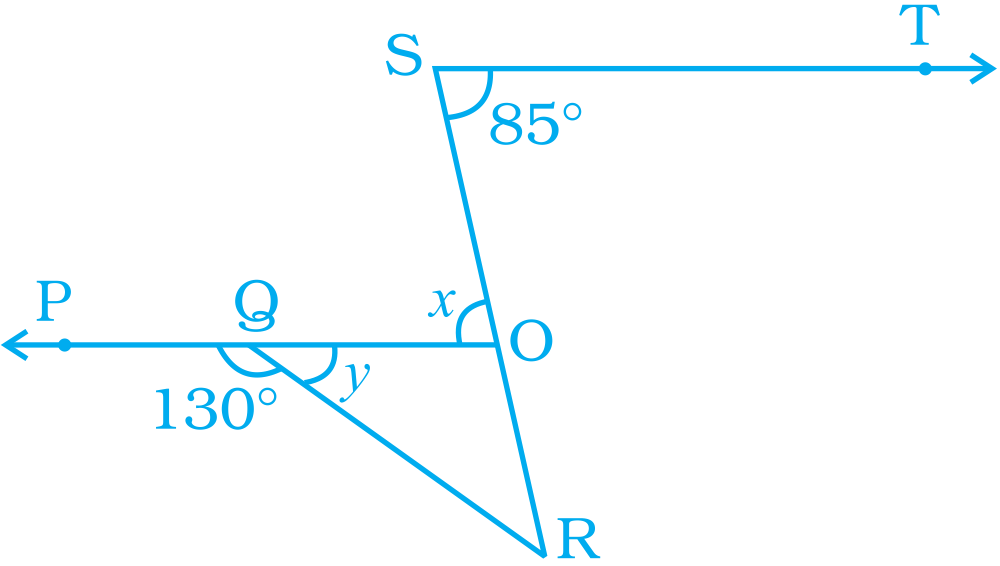
In Fig. $PQ || ST.$ Then, the value of $x + y$ is:
- A
$125^\circ $
- ✓
$135^\circ$
- C
$145^\circ$
- D
$120^\circ$
AnswerCorrect option: B. $135^\circ$
Since, $PQ || ST,$ then $PO$ will also parallel to $ST.$
Now, $PO || ST$ and $OS$ is transversal.
Therefore,
$x = 85^\circ [$Alternate interior angles$]$
Now, $y + 130^\circ = 180^\circ [$Liner pair$]$
$\Rightarrow y = 180^\circ - 130^\circ $
$\Rightarrow y = 50^\circ $
$\therefore x + y = 85^\circ + 85^\circ = 135^\circ $
View full question & answer→MCQ 1821 Mark
In Fig. if $AB$ is parallel to $CO$ and $EF$ is a transversal, then $x =$
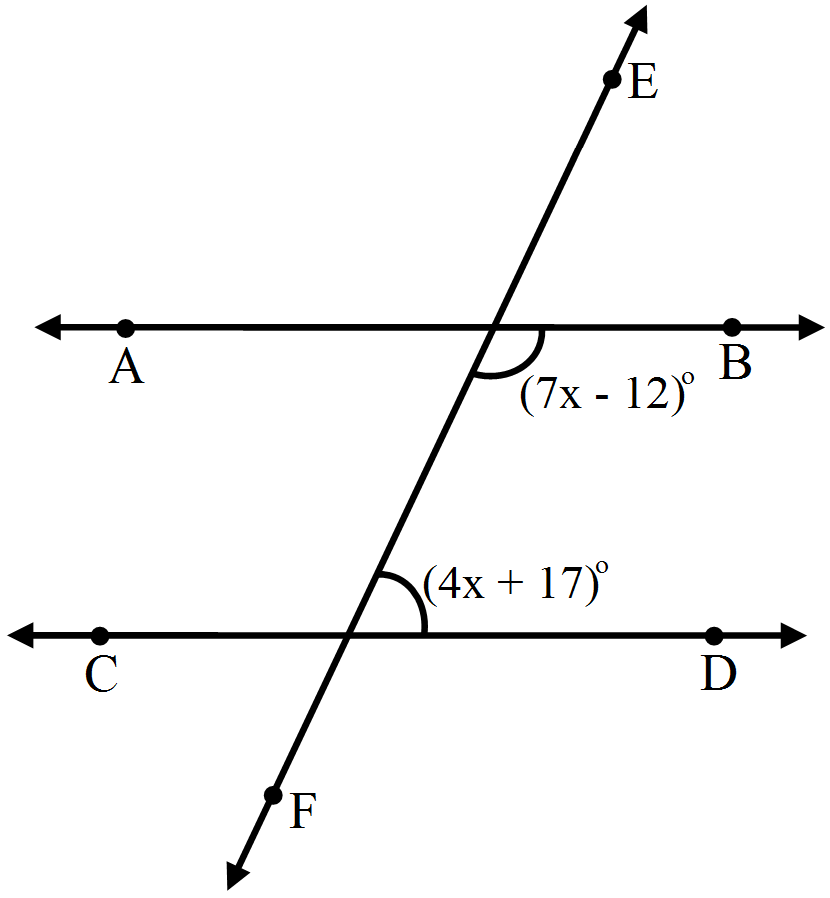
AnswerLet the line $EF$ intersect $AB$ and $CD$ at $P$ and $Q$ respectively.
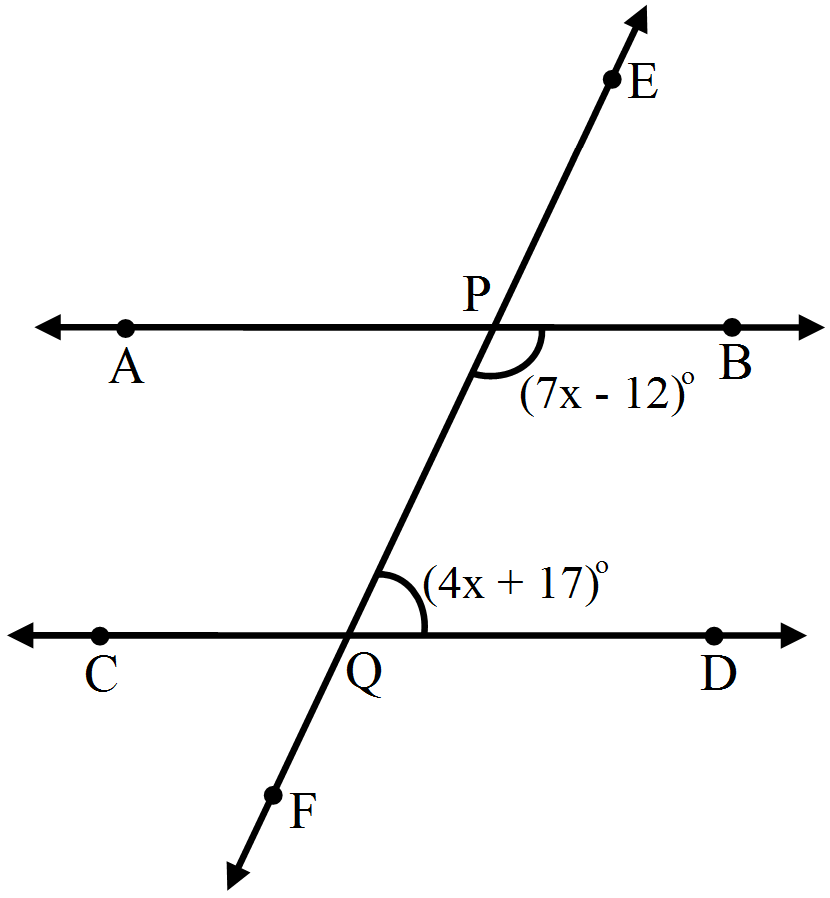
Since, $AB \| CD$
$\therefore \angle \text{BPQ}+ \angle \text{PQD}=180^\circ ($Angles on the same side of a transversal line are supplementary$)$
$\Rightarrow (7\text{x}-12)^\circ+(4\text{x}+17)^\circ=180^\circ$
$\Rightarrow 7\text{x}-12+4\text{x}+17=180$
$\Rightarrow 11\text{x}+5=180$
$\Rightarrow 11\text{x}=175$
$\Rightarrow \text{x}=15.90$
Disclaimer: No option is correct. View full question & answer→MCQ 1831 Mark
If two supplementary angles are differ by $44^\circ ,$ then one of the angle is _______.
- A
$102^\circ $
- B
$65^\circ$
- ✓
$112^\circ$
- D
$72^\circ$
AnswerCorrect option: C. $112^\circ$
Let the angles be $x$ and $y$ Given $x − y = 44^\circ .....(i)$
Sum of supplementary angles is $x + y = 180^\circ ......(ii)$
Solving $(i)$ and $(ii)$
$\Rightarrow x = 112^\circ , y = 68^\circ $
View full question & answer→MCQ 1841 Mark
Which of the following statements best describes two parallel line $?$
- A
They meet at exactly one point
- B
They meet at exactly two point
- ✓
They are always the same distance apart
- D
AnswerCorrect option: C. They are always the same distance apart
Parallel lines are always the same distance apart.
View full question & answer→MCQ 1851 Mark
The angle which makes a linear pair with an angle of $61^\circ $, is of:
- A
$29^\circ$
- ✓
$61^\circ $
- C
$122^\circ $
- D
$119^\circ$
AnswerCorrect option: B. $61^\circ $
Let the required angle be $x^\circ .$ It is given that $x^\circ$ makes a linear pair with $61^\circ $
$\therefore x + 61^\circ = 180^\circ [ \therefore$ sum of angles forming linear pair is $180^\circ ]$
$\Rightarrow x = 180^\circ - 61^\circ = 199^\circ $
View full question & answer→MCQ 1861 Mark
The sum of an angle and half of its complementary angle is $75^\circ .$ The measure of the angle is:
- A
$40^\circ $
- B
$50^\circ$
- ✓
$60^\circ$
- D
$80^\circ$
AnswerCorrect option: C. $60^\circ$
Let the required angle be $x$
Now, complementnary of the required angle $= 90^\circ - x$
Then,
$\text{x}+\frac{1}{2}(90^\circ-\text{x})=75^\circ$
$\Rightarrow2\text{x}+90^\circ-\text{x}=150^\circ$
$\Rightarrow \text{x}=150-90^\circ$
$\Rightarrow \text{x}=60^\circ$
Hence, the correct answer is option $(c).$
View full question & answer→MCQ 1871 Mark
The supplementary angle of $120^\circ $ is:
- A
$30^\circ$
- B
$50^\circ$
- C
$240^\circ$
- ✓
$60^\circ$
AnswerCorrect option: D. $60^\circ$
Let the supplementary angle be $x$ Sum of supplementary angles is $180^\circ $
$\Rightarrow x + 120^\circ = 180^\circ $
$\Rightarrow x = 180^\circ - 120^\circ $
$\Rightarrow x = 60^\circ $
View full question & answer→MCQ 1881 Mark
Two adjacent angles whose sum is $180^\circ $ is called:
- A
- ✓
- C
Vertically opposite angles
- D
AnswerTwo adjacent angles whose sum is $180^\circ $ is called linear pair.
View full question & answer→MCQ 1891 Mark
The complement angle of the supplement angle of $150^\circ $ is:
- A
$90^\circ$
- B
$70^\circ$
- ✓
$60^\circ$
- D
$75^\circ$
AnswerCorrect option: C. $60^\circ$
Supplement of $150^\circ $ is $30^\circ $ and complement angle of $30^\circ $ is $60^\circ .$
View full question & answer→MCQ 1901 Mark
The angle which is $\frac{1^\text{th}}{5}$ of its supplement is:
- A
$15^\circ $
- ✓
$30^\circ$
- C
$45^\circ$
- D
$60^\circ$
AnswerCorrect option: B. $30^\circ$
Let the angles be $xx$ and its supplement be $y = 180 - x$
Given: $\text{x}=\frac{1}{5}\text{y}$
$\Rightarrow\text{x}=\frac{1}{5}\times(180-\text{x})$
$\Rightarrow5\text{x}=180-\text{x}$
$\Rightarrow6\text{x}=180$
$\therefore\text{x}=\frac{180}{6}$
$\therefore\text{x}=30^\circ$
View full question & answer→MCQ 1911 Mark
A pair of angles with a common vertex and common arm are called:
AnswerA pair of angles with a common vertex and common arm are called adjacent angles..
View full question & answer→MCQ 1921 Mark
$\overline{\text{PQ}}$ is perpendicular to $\overline{\text{RS}}$ is symbolically written as ______.
- ✓
$\overline{\text{PQ}}\perp\overline{\text{RS}}$
- B
$\overline{\text{PQ}}\parallel\overline{\text{RS}}$
- C
$\overline{\text{PQ}}\neq\overline{\text{RS}}$
- D
$\overline{\text{PQ}}-\overline{\text{RS}}$
AnswerCorrect option: A. $\overline{\text{PQ}}\perp\overline{\text{RS}}$
$\perp$ represents Perpendicularity.
Here Line $PQ$ is perpendicular to Line $RS$
$\therefore\overline{\text{PQ}}\perp\overline{\text{RS}}$
View full question & answer→MCQ 1931 Mark
Which one of the following statement is not false$?$
AnswerCorrect option: C. One of the angles forming a linear pair can be obtuse angle.
Since when two angles form linear pair they are supplementary, they add up to form $180$ degrees.
Hence, one angle has to be acute and other angle obtuse if there sum is $180$ degrees.
View full question & answer→MCQ 1941 Mark
Two angles are called adjacent if
- A
They have a common vertex
- B
They have a ray in common
- C
Their other arms lie on the opposite sides of the common arm
- ✓
Answerall of three fulfill the condition of adjecent angles
View full question & answer→MCQ 1951 Mark
Line $l,$ line $m,$ and point $P$ lie in a plane such that $l\ \| \ m$ and $P$ is between $l$ and $m$. If line $t$ in the same plane passes through point $P,$ which of the following could be true$?$
$I.\ t$ intersects $l$ but not $m.$
$II.\ t$ intersects both $l$ and $m.$
$III.\ t$ does not intersect either $l$ or $m.$
- A
$II$ and $IIl$
- B
$II$ only
- C
$III$ only
- ✓
$I$ and $II$
AnswerCorrect option: D. $I$ and $II$
Given that $2$ parallel lines, $l$ and $m$ lie in the same plane as point $P.$
Another line $t$ is in the same plane.
This line either intersects both or none.
If it is parallel two the first $2$ lines, then it never intersects.
If it is not parallel, then it intersects both.
There is no way possible that it intersects any one line.
View full question & answer→MCQ 1961 Mark
Two supplementary angles differ by $48^\circ .$ Find the angles.
- A
$36^\circ , 84^\circ$
- B
$46^\circ , 94^\circ$
- C
$56^\circ , 104^\circ$
- ✓
$66^\circ , 114^\circ$
AnswerCorrect option: D. $66^\circ , 114^\circ$
Supplementary angles add up to form $180$
Let one angle be $x$ and other be $180 - x$
Hence, $x - (180 − x) = 48 ....($Given$)$
$⇒ x - 180 + x = 48$
$⇒ 2x = 48 + 180 = 228$
$\Rightarrow\text{x}=\frac{288}{2}=114$
Hence, other angle $= 180 - x = 180 - 114 = 66$
Two angles are $114$ and $66.$
View full question & answer→MCQ 1971 Mark
In Fig. $AB || CD || EF,$ $\angle \text{ABG}=110^\circ,\angle \text{GCO}=100^\circ$ and $\angle \text{BGC}=\text{x}^\circ.$ The value of $x$ is:
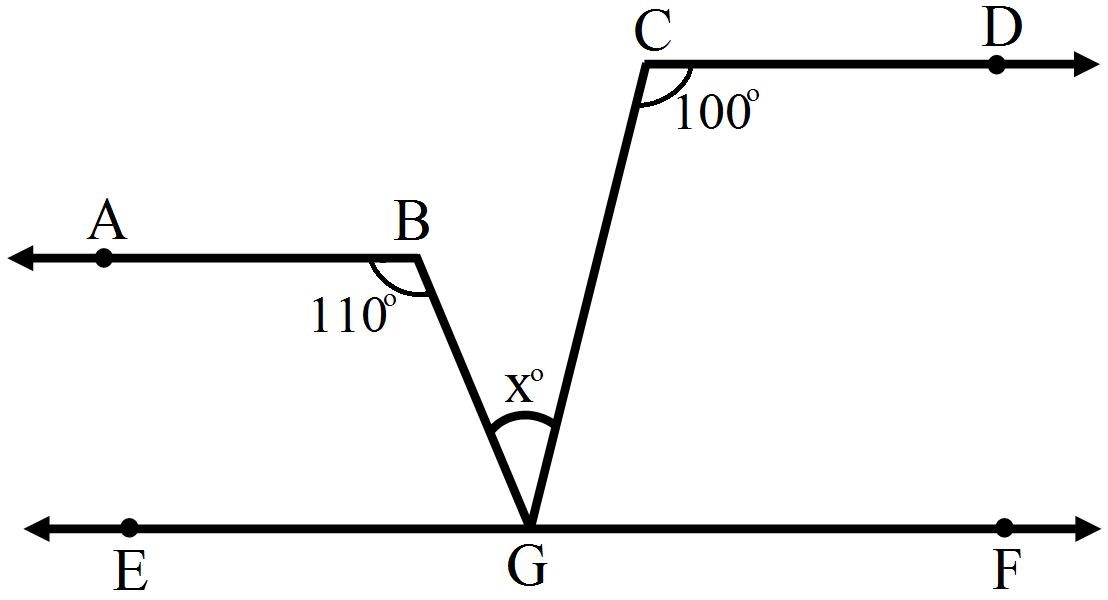
AnswerSince, $AB || EG$
$\therefore \angle \text{ABG}+\angle \text{EGB}=180^\circ$ (Angles on the same side of a transversal line are supplementary)
$\Rightarrow 110^\circ+\angle \text{EGB}=180^\circ$
$\Rightarrow \angle \text{EGB}=70^\circ$
Again, $CD || GF$
$\therefore \angle \text{DCG}+\angle \text{FGC}=180^\circ$ (Angles on the same side of a transversal line are supplementary)
$\Rightarrow 100^\circ+\angle \text{FGC}=180^\circ$
$\Rightarrow \angle \text{FGC}=80^\circ$
Now, $\angle \text{EGB}+\angle \text{BGC}+\angle \text{FGC}=180^\circ$
$\Rightarrow 70^\circ+\text{x}^\circ+80^\circ=180^\circ$
$\Rightarrow 150^\circ+ \text{x}^\circ=180^\circ$
$\Rightarrow \text{x}^\circ=30^\circ$
$\Rightarrow \text{x}=30$
Hence, the correct answer is option $(c).$
View full question & answer→MCQ 1981 Mark
If an angle is eight times its complementary angle, then the measurement of the angle is:
- A
$10^\circ$
- B
$20^\circ$
- ✓
$80^\circ$
- D
$160^\circ$
AnswerCorrect option: C. $80^\circ$
Two angles are said to be complimentary angles if their sum is $90^\circ .$
Let $x$ denote the required angle. Then its complimentary angle is $90 − x.$
It is given that,
$x = 8 \times (90 − x)$
$\Rightarrow x = 720 − 8x$
$\Rightarrow 9x = 720$
$\Rightarrow x = 80^\circ $
View full question & answer→MCQ 1991 Mark
The angles are adjacent and form an angle of $140^\circ .$ The smaller is $28^\circ $ less than the larger.
- A
$34$ and $56.$
- B
$84$ and $66.$
- C
$44$ and $56.$
- ✓
$84$ and $56.$
AnswerCorrect option: D. $84$ and $56.$
The two adjacent angles add up to $140 .$
Therefore the sum of the two should give $140.$
Let the larger be $x$
then the smaller is $x - 28$
$x + x - 28 = 140$
$2x - 28 = 140$
$2x = 140 + 28 = 168$
$2x = 168 ($divide both sides by two$)$
$x = 84 ($the larger angle$)$
$84 - 28 = 56 ($the smaller angle$)$
The two angles are $84$ and $56.$
View full question & answer→MCQ 2001 Mark
Find the angle which is $80^\circ $ more than its complement.
Answer Let the required angle be $x,$ then its complement $= (90 - x)$
Given that $x = (90 - x) + 80$
$\Rightarrow \text{x}=\frac{170}{2}$
$\Rightarrow \text{x}=85^\circ$
View full question & answer→