MCQ 1011 Mark
The angle that is three times as large as its complement is:
- A
$135^\circ $
- ✓
$67.5^\circ$
- C
$50.5^\circ$
- D
$45^\circ$
AnswerCorrect option: B. $67.5^\circ$
Let the measure of the angle be $x$ degrees.
Since it is given that the angle is three times as large as its complement, it means
$x = 3 (90 - x)$
$\Rightarrow x = 270 - 3x$
$\Rightarrow x + 3x = 270$
$\Rightarrow 4x = 270$
$\Rightarrow\text{x}=\frac{270}{4}$
$\Rightarrow x = 67.5$
Therefore, the measure of the angle is $67.5^\circ .$
View full question & answer→MCQ 1021 Mark
If two angles are complementary and in the ratio $17 : 13.$ Find the measure of angles.
- A
$61^\circ , 29^\circ$
- ✓
$51^\circ , 39^\circ$
- C
$71^\circ , 19^\circ$
- D
$17^\circ , 13^\circ$
AnswerCorrect option: B. $51^\circ , 39^\circ$
Let the angle be $A$ and $B$
$A + B = 90^\circ ($complementary angles$)$
If $A = 17x, B = 13x ($Given$)$
$17x + 13x =90^\circ $
$30x = 90^\circ $
$x = 3^\circ $
$\therefore A = 17 \times 3^\circ = 51^\circ , B = 13 \times 3^\circ = 39^\circ $
View full question & answer→MCQ 1031 Mark
The supplement angle of the complement of $30^\circ $ is:
- A
$150^\circ$
- ✓
$120^\circ$
- C
$90^\circ$
- D
$210^\circ$
AnswerCorrect option: B. $120^\circ$
Complement of $30^\circ = 60^\circ $
Supplement of $60^\circ = 120^\circ $
View full question & answer→MCQ 1041 Mark
Angles forming a linear pair can both be acute angles.
AnswerBoth Angles forming linear pair cannot be acute as they add up to form $180$ degrees.
Hence one angle can be acute and other be obtuse or both the angles can be right angles if they form linear pair.
Hence the above statement is false.
View full question & answer→MCQ 1051 Mark
The measure of an angle which is its own complement is:
- A
$30^\circ $
- B
$60^\circ $
- C
$90^\circ$
- ✓
$45^\circ$
AnswerCorrect option: D. $45^\circ$
Let the required angle be $x$
Now, complementary of the required angle $= 90^\circ - x$
Then,
$x = 90^\circ - x$
$\Rightarrow x = 90^\circ - x$
$\Rightarrow 2x = 90^\circ $
$\Rightarrow x = 45^\circ $
Hence, the correct answer is option $(d).$
View full question & answer→MCQ 1061 Mark
The supplementary angle of the complementary angle of anglehaving measure $23$ hasmeasure
Answer Angle $= 230$ Complementary
$\angle=90-23^\circ=67^\circ$
Supplementary
$\angle=180-67^\circ=113^\circ$
View full question & answer→MCQ 1071 Mark
The complementary angle of $60^\circ $ is:
- A
$60^\circ$
- ✓
$30^\circ$
- C
$45^\circ$
- D
$90^\circ$
AnswerCorrect option: B. $30^\circ$
Complementary angle of $60^\circ = 90^\circ - 60^\circ = 30^\circ $
View full question & answer→MCQ 1081 Mark
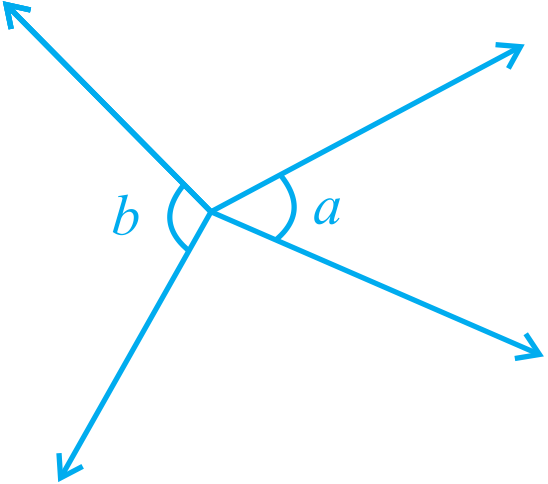
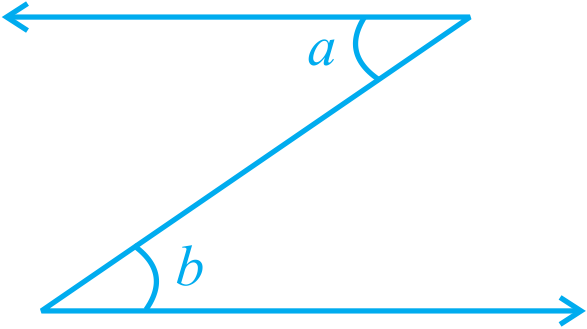
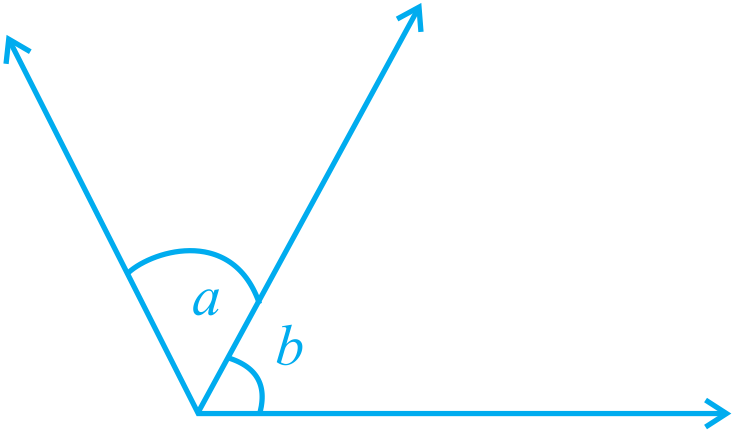
In which of the following figures, a and b are forming a pair of adjacent angles?
Answer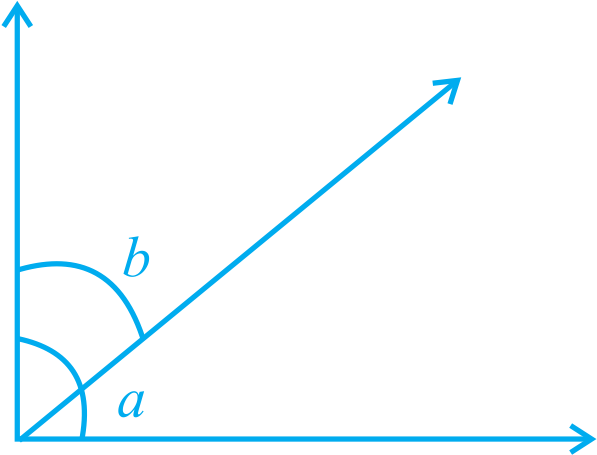 Two angles are called adjacent angles, if they have a common vertex and a common arm but no common interior points.
$\therefore$ In option $(d),$ a and b form a pair of adjacent angles. View full question & answer→MCQ 1091 Mark
The complementary angle of the supplementary of $100^\circ $ is:
- A
$80^\circ$
- ✓
$10^\circ$
- C
$170^\circ$
- D
$50^\circ$
AnswerCorrect option: B. $10^\circ$
Supplementary angle are two angles sum of $180^\circ $
Complementary angle are two angles sum of $90^\circ $
Supplementary angle $= 180 - 100 = 80^\circ $
Complementary angle $= 90 - 80 = 10^\circ $
View full question & answer→MCQ 1101 Mark
What is the measure of supplementary angle of $32^\circ ?$
- A
$58^\circ $
- ✓
$148^\circ$
- C
$138^\circ$
- D
$78^\circ$
AnswerCorrect option: B. $148^\circ$
Required Measure of supplementary angle $= 180 - 32 = 148^\circ $
View full question & answer→MCQ 1111 Mark
Find smallest of two supplementary angles, if they are in the ratio $7 : 11.$
AnswerTwo angles whose sum is $180^\circ $ are said to be supplementary.
Given two angles are the ratio of $7 : 11.$
Let the two angles be $7x$ and $11x.$
So, $7x + 11x = 180^\circ $
$\Rightarrow 18x = 180^\circ $
$\Rightarrow\text{x}=\frac{180}{18}$
$x = 10$
Therefore, the two angles are $7x = 70$ and $11x = 110$
View full question & answer→MCQ 1121 Mark
In Fig. $PR$ is a straight line and $\angle \text{PQS}:\angle \text{SQR}=7:5$ The measure of $\angle \text{SQR}$ is: 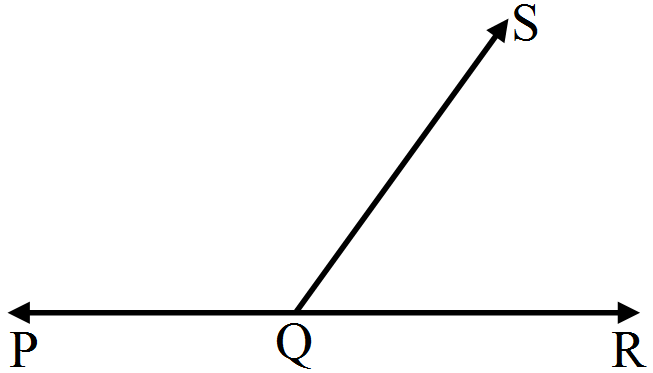
- A
$60^\circ$
- B
$62\frac{1^\circ}{2}$
- C
$67\frac{1^\circ}{2}$
- ✓
$75^\circ$
AnswerCorrect option: D. $75^\circ$
Let the measures of the angle $\angle \text{PQS}$ and $\angle \text{SQR}$ be $7x$ and $5x$
Now, $\angle \text{PQS}+\angle \text{SQR}=180^\circ$[Linear pair angles]
$\Rightarrow 7\text{x}+5\text{x}=180^\circ$
$\Rightarrow 12\text{x}=180^\circ$
$\Rightarrow \text{x}=15^\circ$
$\therefore \angle \text{SQR}=5\text{x}=5\times 15^\circ$
$=75^\circ$
Hence, the correct answer is option $(d).$
View full question & answer→MCQ 1131 Mark
Two angles are supplementary, if one of them is $49^\circ .$ Find the other angle$?$
- A
$139^\circ $
- ✓
$131^\circ$
- C
$141^\circ $
- D
$135^\circ $
AnswerCorrect option: B. $131^\circ$
Since, two angles are supplementary their sum is $180^\circ $
$\angle1+\angle2=180^\circ$
$49^\circ+\angle2=180^\circ$ (As one of the angle is $49^\circ $
$\angle2=180^\circ-49^\circ$
$=131^\circ$
View full question & answer→MCQ 1141 Mark
The measure of an angle which is $5$ times its supplement is:
- A
$30^\circ $
- B
$60^\circ$
- C
$120^\circ$
- ✓
$150^\circ$
AnswerCorrect option: D. $150^\circ$
Let $x$ and $y$ be supplementary angles
$\Rightarrow x + y = 180^\circ $
Let x be an angle which is $5$ times its supplement
$\Rightarrow x = 5y$
But y $= 180^\circ − x .......$ From $(i)$
$\Rightarrow x = 5 (180^\circ - x)$
$\Rightarrow x = 5 \times 180^\circ - 5x$
$\Rightarrow 6x = 5 \times 180^\circ $
$\Rightarrow x = 5 \times 30^\circ = 150^\circ $
Hence, $x = 150^\circ $
View full question & answer→MCQ 1151 Mark
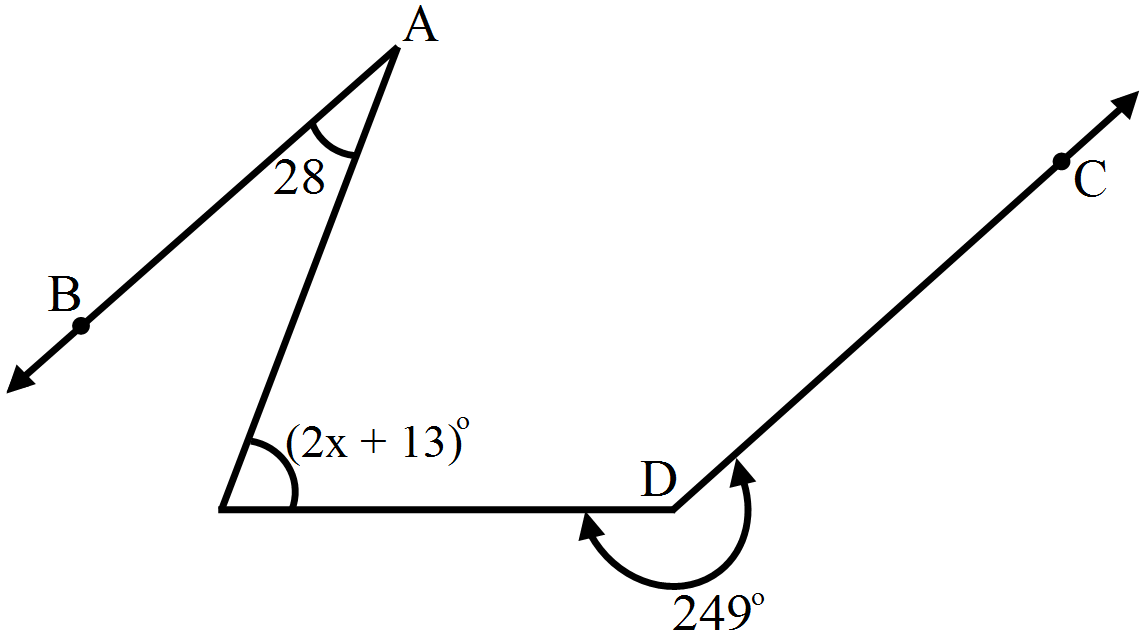
In Fig. if $AB || CD,$ then $x =$
Answer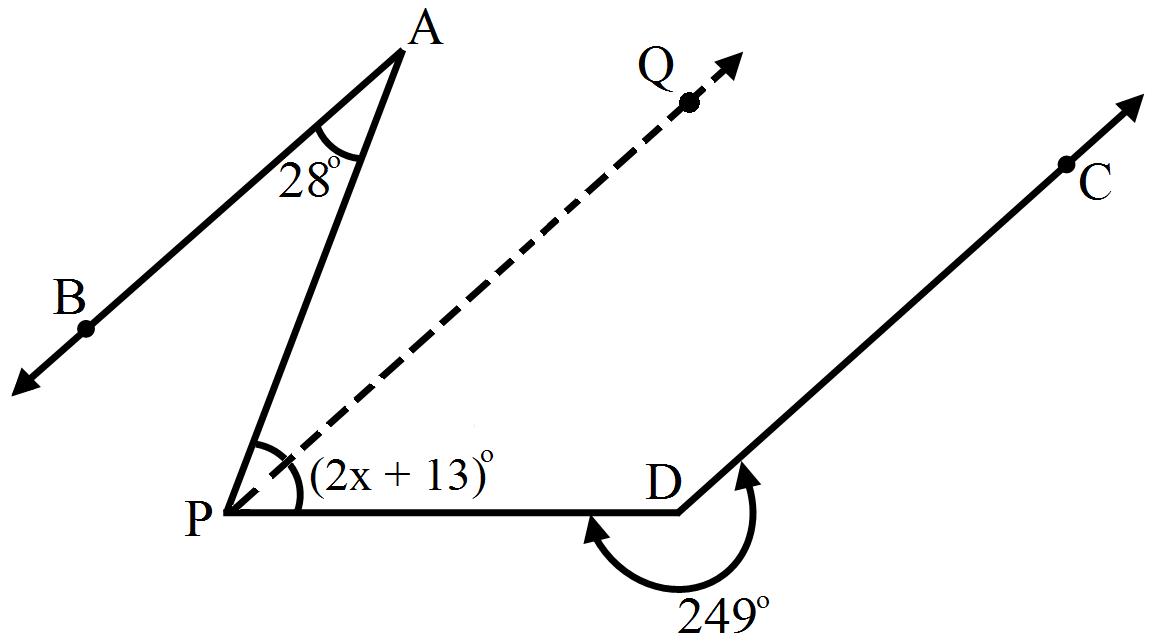
Construction: Draw a line $PQ$ parallel to $AB$ which is also parallel to $CD$
$\angle \text{CDP}+\text{Reflex}\angle \text{CDP}=360^\circ$ [Complete angle]
$\therefore \text{CDP}+249^\circ=360^\circ$
$\Rightarrow \angle \text{CDP}=111^\circ$
Since, $PQ || AB$
$\therefore \angle \text{BAP}=\angle \text{APQ}$ [Alternate angles]
$\Rightarrow \angle \text{BAP}=28^\circ$
Now, $\angle \text{APQ}+\angle \text{QPD}=\angle \text{APD}$
$\Rightarrow 28^\circ+\angle \text{QPD}=(2\text{x}+13)^\circ$
$\Rightarrow \angle \text{QPD}=(2\text{x}+13)^\circ-28^\circ$
Since, $PQ || CD$
$\therefore \angle \text{QPD}+\angle \text{CDP}=180^\circ$ [Angles on the same side of a transversal line are supplementary]
$\Rightarrow (2\text{x}+13)^\circ-286\circ+111^\circ=180^\circ$
$\Rightarrow 2\text{x}+13-28+111=180$
$\Rightarrow 2\text{x}=84$
$\Rightarrow \text{x}=42$
Hence, the correct answer is option $(b).$ View full question & answer→MCQ 1161 Mark
Find the measure of an angle, if five times of its complement is $24$ less than twice of its supplement.
AnswerTwo angles whose sum is $180^\circ $ are said to be supplementary.
Two angles whose sum is $90^\circ $ are said to be complementary.
Let the angle be $x.$
Given that $5 (90 - x) = 2(180 - x) - 24$
$\Rightarrow 450 - 5x = 360 - 2x - 24$
$\Rightarrow 5x - 2x = 450 - 360 + 24$
$\Rightarrow 3x = 474 - 360$
$\Rightarrow 3x = 114$
$\Rightarrow\text{x}=\frac{114}{3}\Rightarrow\text{x}=38$
Therefore, the angle is $38^\circ .$
View full question & answer→MCQ 1171 Mark
$\angle{\text{A}}$ supplementary to $\angle{\text{B}},$ $\angle{\text{B}}$ is complementary to $\angle{\text{C}}.$ If $\angle{\text{A}}=118^\circ,$ what is the measure of $\angle{\text{C}}$?
- A
$62^\circ $
- B
$34^\circ$
- C
$118^\circ$
- ✓
$28^\circ$
AnswerCorrect option: D. $28^\circ$
$\angle{\text{B}}=180^\circ-\angle{\text{A}}=180^\circ=118^\circ=62^\circ$
$\angle{\text{C}}=90^\circ-62^\circ=28^\circ.$
View full question & answer→MCQ 1181 Mark
Two supplementary angles are in the ratio $3 : 2.$ The smaller angle measures$?$
- A
$108^\circ $
- B
$81^\circ$
- ✓
$72^\circ$
- D
$68^\circ $
AnswerCorrect option: C. $72^\circ$
Given two supplementary angles are in the ratio $3 : 2.$
Let the measurement of the angles be $3x$ and $2x.$
Two angles are said to be supplementary if they sum upto $180^\circ .$
Then we have, $3x + 2x = 180^\circ $
$5x = 180^\circ $ or, $x = 36^\circ .$
So the smaller angle is $36^\circ \times 2 = 72^\circ .$
View full question & answer→MCQ 1191 Mark
Choose the pair of complementary angles-
- ✓
$66^\circ , 24^\circ$
- B
$30^\circ , 120^\circ $
- C
$60^\circ , 90^\circ $
- D
$15^\circ , 60^\circ $
AnswerCorrect option: A. $66^\circ , 24^\circ$
In a pair of complimentary angles, sum of angles is $90^\circ $
$60^\circ + 24^\circ = 90^\circ $
View full question & answer→MCQ 1201 Mark
Mark the correct alternative of the following.
The angles of a triangle are in the ratio $2 : 3 : 7.$ The measure of the largest angle is$?$
- A
$84^\circ$
- B
$91^\circ$
- ✓
$105^\circ$
- D
$98^\circ$
AnswerCorrect option: C. $105^\circ$
Given the angles of a triangle are in the ratio $2 : 3 : 7.$
Let the angles of triangle be $2x, 3x$ and $7x.$
Then according to the problem we get,
$2x + 3x + 7x = 180^\circ $
or, $12x = 180^\circ $
or, $x = 15^\circ .$
Then the largest angle is $ 7 \times 15^\circ = 105^\circ .$
View full question & answer→MCQ 1211 Mark
If two angles are complementary of each other, then each angle is:
Answer If two angles are complementary of each other, then angles add up to form $90$ degree.
The angles are less than $90.$
Hence, angles which are complementary of each other are acute angles.
View full question & answer→MCQ 1221 Mark
Find the complement of an angle whose measure is $3x - 8^\circ .$
- A
$3x - 98^\circ $
- B
$82^\circ - 3x$
- ✓
$98^\circ - 3x$
- D
AnswerCorrect option: C. $98^\circ - 3x$
Complement of an angle $A = 90^\circ - A$
So, complement of angle
$3x - 8^\circ = 90^\circ - (3x - 8^\circ )$
$= 98^\circ - 3x$
View full question & answer→MCQ 1231 Mark
If two angles are formed on a straight line, then what may be the combination of angles$?$
- ✓
$1$ acute & $1$ obtuse
- B
$1$ straight & $1$ acute
- C
$1$ obtuse & $1$ right
- D
$1$ acute & $1$ right
AnswerCorrect option: A. $1$ acute & $1$ obtuse
Only one acute and one obtuse can be formed on a same side of straight line.
Say, if a angle is $60^\circ$ then another angle will be $(180^\circ - 60^\circ ) = 120^\circ ,$
So one acute and one obtuse angle can be formed.
View full question & answer→MCQ 1241 Mark
Two angles are complementary. If the larger angle is twice the measure of a smaller angle, then smaller is _____.
- ✓
$30^\circ $
- B
$45^\circ$
- C
$60^\circ$
- D
$15^\circ$
AnswerCorrect option: A. $30^\circ $
Let, $\alpha$ be the larger angle and \beta be the smaller angle.
if, two angles are complementary then their sum is equal to $90^\circ $
So, $\alpha+\beta=90^\circ....(1)$
According to question, $\alpha=2\beta.....(2)$
So, $2\beta+\beta=90^\circ ($from eqn$(1)$ and eqn $(2))$ or, $3\beta=90^\circ$ or $\beta=30^\circ.$
Therefore, the smaller angle $= 30^\circ $
View full question & answer→MCQ 1251 Mark
Assertion : If two lines intersect, then the vertically opposite angles are equal. Reason : If a transversal intersects, two other parallel lines, then the sum of two interior angles on the same side of the transversal is $180^\circ .$
- A
Both Assertion and Reason are correct and Reason is the correct explanation for Assertion.
- ✓
Both Assertion and Reason are correct but Reason is not the correct explanation for Assertion.
- C
Assertion is correct but Reason is incorrect.
- D
Both Assertion and Reason are incorrect.
AnswerCorrect option: B. Both Assertion and Reason are correct but Reason is not the correct explanation for Assertion.
When a transversal intersects two parallel lines, the angle made on the interior same side is $180$ degrees.
So, both are facts but reason does not explain assertion correctly.
View full question & answer→MCQ 1261 Mark
Angles which are both supplementary and vertically opposite are:
- A
$95^\circ , 85^\circ$
- ✓
$90^\circ , 90^\circ$
- C
$100^\circ , 80^\circ$
- D
$45^\circ , 45^\circ$
AnswerCorrect option: B. $90^\circ , 90^\circ$
Two angles are said to be supplementary, if their sum is $180^\circ .$ Also, if two angles are vertically opposite, then they are equal.
Therefore, angles given in option $(b)$ are supplementary as well as vertically opposite.
View full question & answer→MCQ 1271 Mark
If two interior angles on the same side of a transversal intersecting two parallel lines are in the ratio $2 : 3$ which is the smallest of the two angles$?$
- ✓
$72^\circ $
- B
$108^\circ$
- C
$54^\circ$
- D
$36^\circ$
AnswerCorrect option: A. $72^\circ $
Let the angles be $2x$ and $3x$
Now sum of interior angles on same side of transversal intersecting two parallel lines is $180^\circ $
$\Rightarrow 2x + 3x = 180^\circ $
$\Rightarrow 5x = 180^\circ $
$\Rightarrow x = 36^\circ $
So the angles are $2x = 2 \times 36^\circ = 72^\circ $
$3x = 3 \times 36^\circ = 108^\circ $
So the smaller angle is $72^\circ .$
View full question & answer→MCQ 1281 Mark
Find the measure of the complementary angle of each of $77^\circ $
- A
$43^\circ $
- B
$70^\circ $
- C
$47^\circ $
- ✓
$13^\circ $
AnswerCorrect option: D. $13^\circ $
Two angles are Comple mentary when they add upto form $90$ degrees (Right Angle).
If one angle $= 77$
Let the other angle be $x$
Hence $x = 90 − 77$
$= 13$
Hence complementarty angle of the following angle is $13$
View full question & answer→MCQ 1291 Mark
If two lines intersect such that four vertical angles are equal, then each angle is:
- A
$45^\circ $
- B
$100^\circ$
- C
$180^\circ$
- ✓
$90^\circ$
AnswerCorrect option: D. $90^\circ$
Let each vertical angle be $x$
Now the sum of vertical angles is $360^\circ $
$\Rightarrow\text{x}+\text{x}+\text{x}+\text{x}=360^\circ$
$\Rightarrow4\text{x}=360^\circ$
$\Rightarrow\text{x}=\frac{360^\circ}{4}=90^\circ$
View full question & answer→MCQ 1301 Mark
he difference between the supplement of an angle and the angle is $36^\circ .$ The supplement is:
- A
$72^\circ$
- ✓
$108^\circ$
- C
$63^\circ$
- D
$27^\circ$
AnswerCorrect option: B. $108^\circ$
Let the supplement be $x$ Sum of supplementary angles is $180^\circ $
$\therefore x + 36^\circ = 180^\circ $
$\Rightarrow x = 144^\circ $
Difference between supplement and given angle
$= 144 − 36 = 108$
View full question & answer→MCQ 1311 Mark
For Fig. statements $p$ and $q$ are given below:
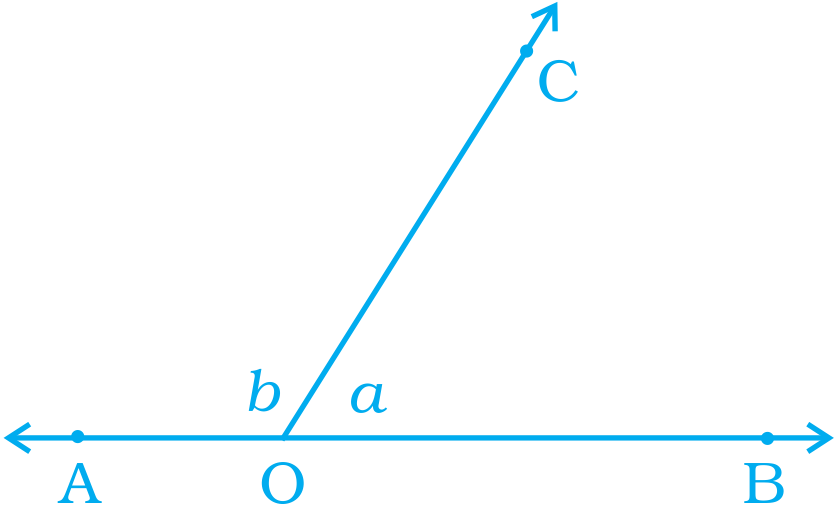
$p. a$ and $b$ are forming a linear pair.
$q. a$ and $b$ are forming a pair of adjacent angles.
Then,
- ✓
Both $p$ and $q$ are true.
- B
$P$ is true and $q$ is false.
- C
$P$ is false and $q$ is true.
- D
Both $p$ and $q$ are false.
AnswerCorrect option: A. Both $p$ and $q$ are true.
Two angles are called adjacent angles, if they have a common vertex and a common arm but no common interior points.
A linear pair is a pair of adjacent. Angles
whose non$-$common sides are opposite rays.
$\therefore a$ and $b$ are pair of adjacent angles and form a linear pair.
View full question & answer→MCQ 1321 Mark
Complementary angle of $72\frac{1^\circ}{2}$ is:
- A
$17^\circ$
- B
$18\frac{1^\circ}{2}$
- C
$21\frac{1^\circ}{2}$
- ✓
$17\frac{1^\circ}{2}$
AnswerCorrect option: D. $17\frac{1^\circ}{2}$
Given angle is $72.5$ or $72\frac{1^\circ}{2}$
Let the other angle $= x$ Sum of complementary angles
$=90^\circ\Rightarrow\text{x}+72\frac{1^\circ}{2}=90^\circ$
$\Rightarrow\text{x}=17\frac{1^\circ}{2}$
View full question & answer→MCQ 1331 Mark
The angles between North and West and South and East are:
Answer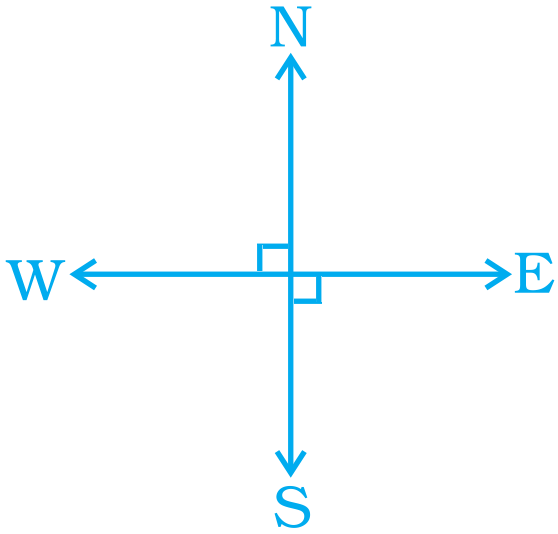
From the above figure, it is clear that the angle between North and West is $90^\circ $ and South and East is $90^\circ .$
$\therefore$ Sum of these two angles $= 90^\circ + 90^\circ = 180^\circ $
Hence, the two angles are supplementary, as their sum is $180^\circ .$
View full question & answer→MCQ 1341 Mark
Two angles the sum of whose measure is $90^\circ $ are called ______ angles.
Answer Two angles the sum of whose measure is $90^\circ $ is called Complimentary angles.
View full question & answer→MCQ 1351 Mark
Two supplementary angles are in ratio $4: 5.$ Find the measure of greater angle.
- A
$70^\circ $
- B
$80^\circ$
- ✓
$100^\circ$
- D
$110^\circ$
AnswerCorrect option: C. $100^\circ$
Let two angles be $4x$ and $5x$
Sum of supplementary angles is $180^\circ $
$4x + 5x = 180^\circ $
$9x = 180^\circ $
$\text{x}=\frac{180}{9}=20^\circ$
So, one angle $= 4x = 4 \times 20 = 80^\circ $
Another angle $= 5x = 5 \times 20 = 100^\circ $
Larger of two angle is $100^\circ $
View full question & answer→MCQ 1361 Mark
Two complementary angles are in the ratio $1 : 9.$ The angles are:
- A
$54^\circ , 36^\circ$
- ✓
$9^\circ , 81^\circ$
- C
$10^\circ , 90^\circ$
- D
$11^\circ , 79^\circ$
AnswerCorrect option: B. $9^\circ , 81^\circ$
Let the angles be $x$ and $9x$ Sum of complementary angles is $90^\circ $
$\Rightarrow x + 9x = 90^\circ $
$\Rightarrow 10x = 90^\circ $
$\Rightarrow x = 9^\circ $
So the angles are $1 \times 9^\circ = 9^\circ $
$9 \times 9^\circ = 81^\circ $
View full question & answer→MCQ 1371 Mark
In Fig. $AOB$ is a straight line such that $\angle \text{AOC}=(3\text{x}+10)^\circ. \angle \text{COD}=50^\circ$ and $\angle \text{BOD}=(\text{x}-8)^\circ.$ The value of $x$ is:
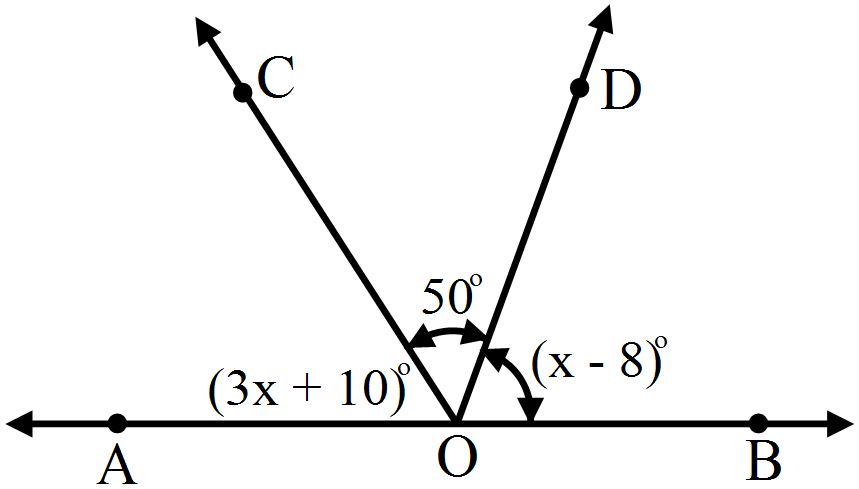
Answer $\angle \text{AOC}+\angle \text{COD}+\angle \text{BOD}=180^\circ [AOB$ is a straight line$]$
$\Rightarrow (3\text{x}+10)^\circ+50^\circ+(\text{x}-8)^\circ=180^\circ$
$\Rightarrow 3\text{x}+10+50+\text{x}-8=180$
$\Rightarrow 4\text{x}+52=180$
$\Rightarrow 4\text{x}=128$
$\Rightarrow \text{x}=32$
Hence, the correct answer is option $(a).$
View full question & answer→MCQ 1381 Mark
Supplementary angle of $100^\circ $ is:
- A
$180^\circ$
- B
$90^\circ$
- ✓
$80^\circ$
- D
$60^\circ$
AnswerCorrect option: C. $80^\circ$
Let the supplement be $x$
If angles are supplementary then their sum is $180^\circ $
$\Rightarrow x + 100^\circ = 180^\circ $
$x =180^\circ - 100^\circ $
$x = 80^\circ $
View full question & answer→MCQ 1391 Mark
In Fig. if $AB || CD$ then the value of $x$ is:
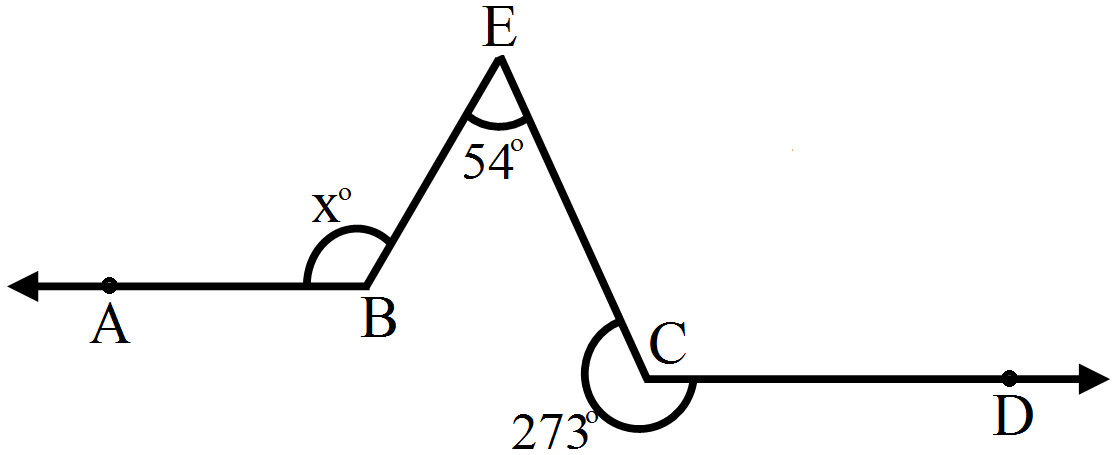
Answer 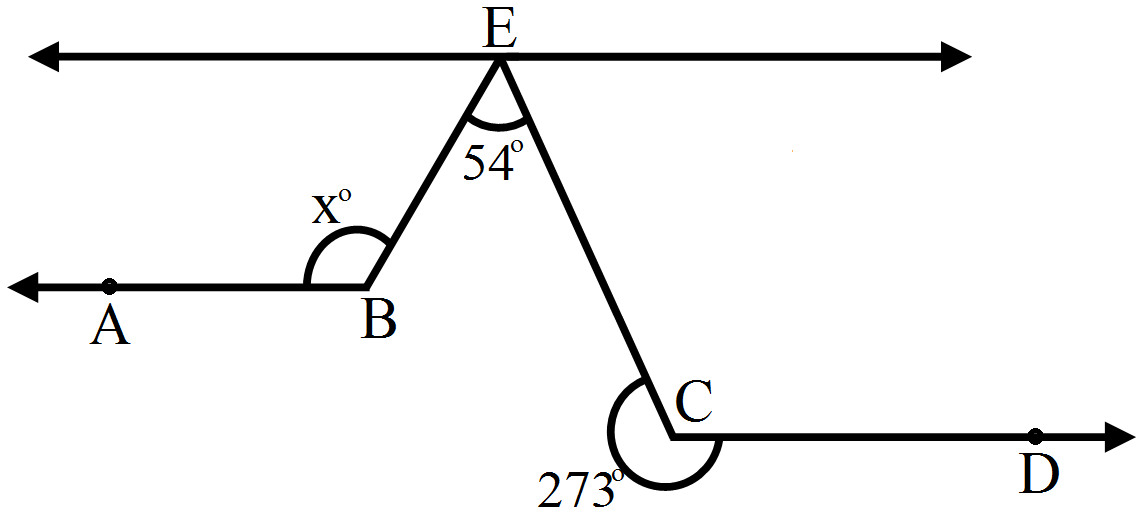
Construction: Draw a line $PQ$ parallel to $AB$ which is also parallel to $CD$
$\angle \text{FCD}+\text{Reflex}\angle \text{FCD}=360^\circ$ (Complere angle)
$\Rightarrow \angle \text{FCD}+273^\circ=360^\circ$
$\Rightarrow \angle \text{FCD}=87^\circ$
Since, $PQ || CD$
$\therefore \angle \text{QFC}+\angle \text{FCD}=180^\circ$ (Angles on the same side of a transversal line are supplementary)
$\Rightarrow \angle \text{QFC}+87^\circ=180^\circ$
$\Rightarrow \angle \text{QFC}=93^\circ$
Now, $\angle \text{ABF}=\angle \text{BFQ}$ (Corresponding angles)
$=\angle \text{BFC}+\angle \text{QFC}$
$=54^\circ+93^\circ$
$=147^\circ$
$\therefore \text{x}^\circ=147^\circ$
$\Rightarrow \text{x}=147$
Hence, the correct answer is option $(c).$
View full question & answer→MCQ 1401 Mark
If $O$ is the ethnocentric of the $\triangle\text{ABC},$ then:
- A
$\angle\text{BOC}-2\angle\text{BAC}$
- ✓
$\angle\text{BOC}\text{ and} \angle\text{BAC}\text{ are supplementary}$
- C
$\angle\text{BOC}-\angle\text{BAC}$
- D
$\text{None of these}$
AnswerCorrect option: B. $\angle\text{BOC}\text{ and} \angle\text{BAC}\text{ are supplementary}$
Suppose a circle is drawn passing through all the vertices of the triangle $ABC$ with centre at $O$ (orthocenter). thus the angle formed at the orhtocenter is the supplement of the angle at the vertex.
$\angle\text{BOC}+\angle\text{BAC}=180^\circ$
So, $\angle\text{BOC}$ and $\angle\text{BAC}$ are supplementary.
View full question & answer→MCQ 1411 Mark
Two supplementary angles are in the ratio $4 : 5.$ The angles are
- A
$90^\circ , 90^\circ$
- ✓
$80^\circ , 100^\circ$
- C
$30^\circ , 150^\circ$
- D
$45^\circ , 45^\circ$
AnswerCorrect option: B. $80^\circ , 100^\circ$
Let the angles be $4x$ and $5x$ Angles are supplementary
$\therefore 4x + 5x = 180^\circ $
$\Rightarrow 9x = 180^\circ $
$\Rightarrow x = 20^\circ $
So the angles are
$4 \times 20^\circ = 80^\circ $
$5 \times 20^\circ = 100^\circ $
View full question & answer→MCQ 1421 Mark
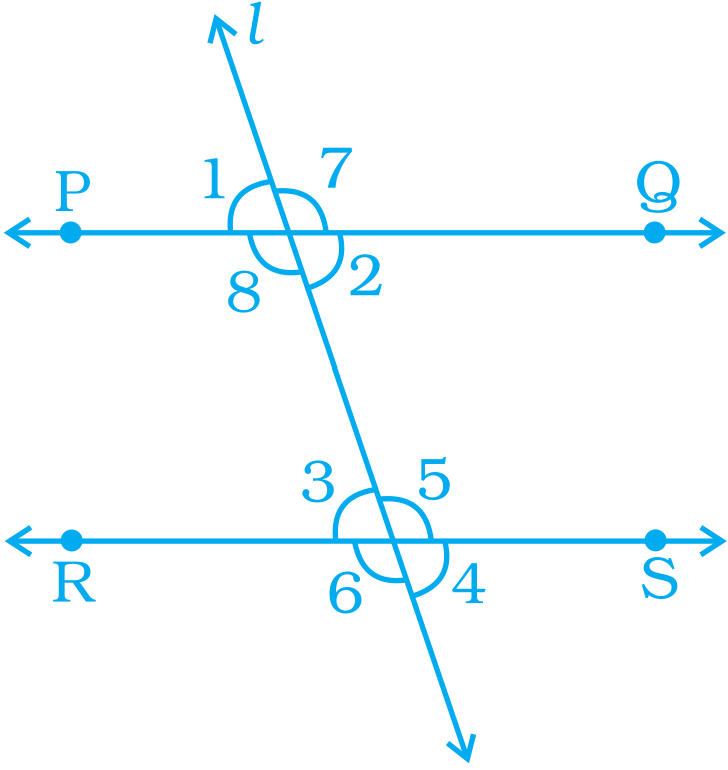
In Fig. which one of the following is not true?
- A
$\angle1 + \angle5 = 180^\circ$
- B
$\angle2 + \angle5 = 180^\circ$
- C
$\angle3 + \angle8 = 180^\circ$
- ✓
$\angle2 + \angle3 = 180^\circ$
AnswerCorrect option: D. $\angle2 + \angle3 = 180^\circ$
From the above figure, $\angle2$ and $\angle3$ are alternate interior angles.
Hence, $\angle2 = \angle3$
View full question & answer→MCQ 1431 Mark
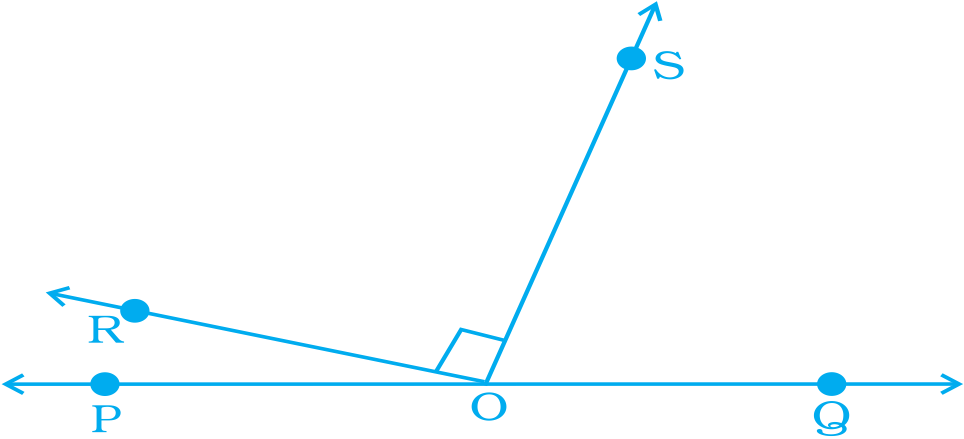
In Fig. $\angle \text{ROS}$ is a right angle and $\angle\text{POR}$ and $\angle\text{POR}$ are in the ratio $1 : 5.$ Then, $\angle\text{QOS}$ measures:
- A
$150^\circ $
- ✓
$75^\circ$
- C
$45^\circ$
- D
$60^\circ$
AnswerCorrect option: B. $75^\circ$
Since $\angle\text{POR}$ and $\angle\text{QOS}$ are in the ratio $1 : 5$ Let angles will be $x$ and $5x,$ respectively. We know that, the sum of angles forming linear pair is $180^\circ $
$\therefore \angle\text{POR}+ \angle\text{ROS}+\angle\text{QOS}=180^\circ$
$\Rightarrow\text{x}+90^\circ+5\text{x}=180^\circ$
$\Rightarrow6\text{x}=180^\circ-90^\circ$
$\Rightarrow6\text{x}=90^\circ\Rightarrow \text{x}=\frac{90^\circ}{6}$
$\text{x}=15^\circ$
$\therefore\angle\text{QOS}=5\text{x}=5\times15^\circ$
$\angle\text{QOS}=75^\circ$
View full question & answer→MCQ 1441 Mark
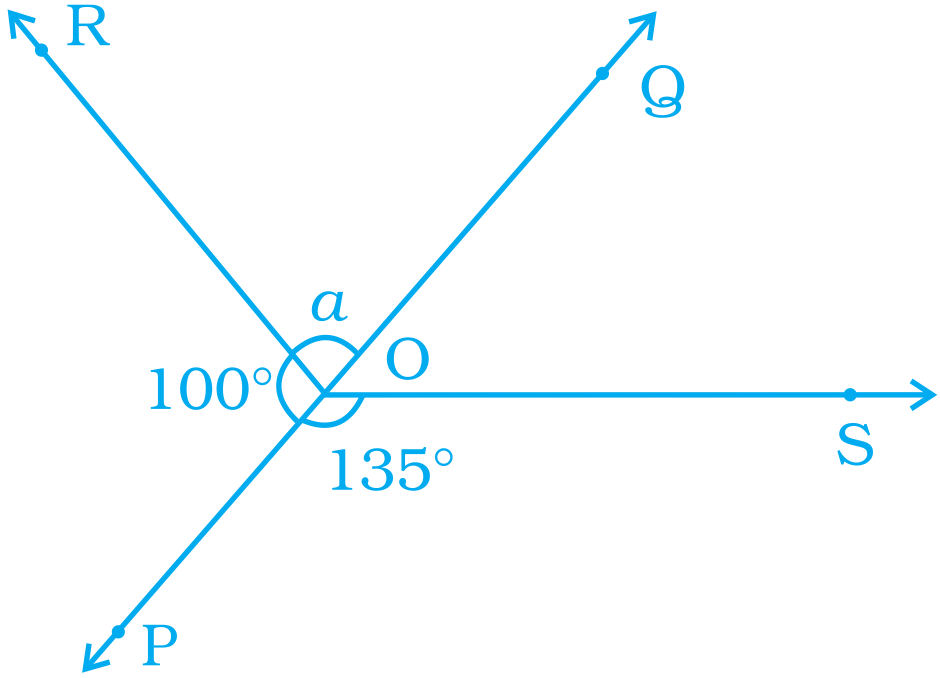
In Fig. $POQ$ is a line, then a is equal to:
- A
$35^\circ$
- B
$100^\circ$
- ✓
$80^\circ$
- D
$135^\circ$
AnswerCorrect option: C. $80^\circ$
Since, $POQ$ is a line.
Here, $\angle\text{POR}$, and $\angle\text{QOR}$ from a liner pair.
$\therefore\angle\text{POR}+\angle\text{QOR}=180^\circ [ \therefore$ Sum of the liner pair is $180^\circ ]$
$\Rightarrow100^\circ+\text{a}=180^\circ$
$\Rightarrow\text{a}=180^\circ-100^\circ=80^\circ$
View full question & answer→MCQ 1451 Mark
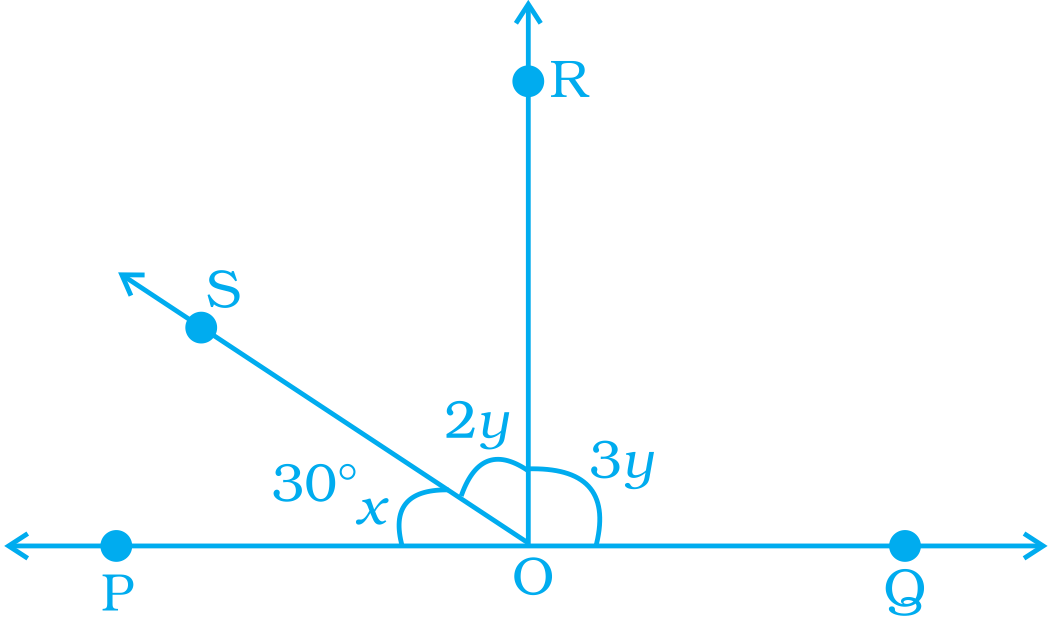
In Fig. $POQ$ is a line. If $x = 30^\circ ,$ then $\angle\text{QOR}$ is:
- ✓
$90^\circ$
- B
$30^\circ$
- C
$150^\circ$
- D
$60^\circ$
AnswerCorrect option: A. $90^\circ$
It is given that, $POQ$ is a line. Since, sum of all the angles on a straight line is $180^\circ .$
Therefore, $\text{x}+2\text{y}+3\text{y}=180^\circ$
$\Rightarrow\text{x}+5\text{y}=180^\circ$ $[\because\text{x}=30^\circ,\text{given}]$
$\Rightarrow 30^\circ+5\text{y}=180^\circ$
$\Rightarrow 5\text{y}=180^\circ-30^\circ$
$\Rightarrow 5\text{y}=150^\circ$
$\Rightarrow\text{y} = \frac{150^{\circ}}{5}$$$
$\Rightarrow \text{y}=30^\circ$
$\therefore\angle\text{QOR}=3\text{y}=3\times30^\circ=90^\circ$
View full question & answer→MCQ 1461 Mark
Statements $A$ and $B$ are as given below:
$A.$ If two lines intersect, then the vertically opposite angles are equal.
$B.$ If a transversal intersects, two other lines, then the sum of two interior angles on the same side of the transversal is $180^\circ .$
Then
- A
Both $a$ and $b$ are true.
- ✓
$A$ is true and$ b$ is false.
- C
$A$ is false and $b$ is true.
- D
Both $a$ and $b$ are false.
AnswerCorrect option: B. $A$ is true and$ b$ is false.
Statement $A$
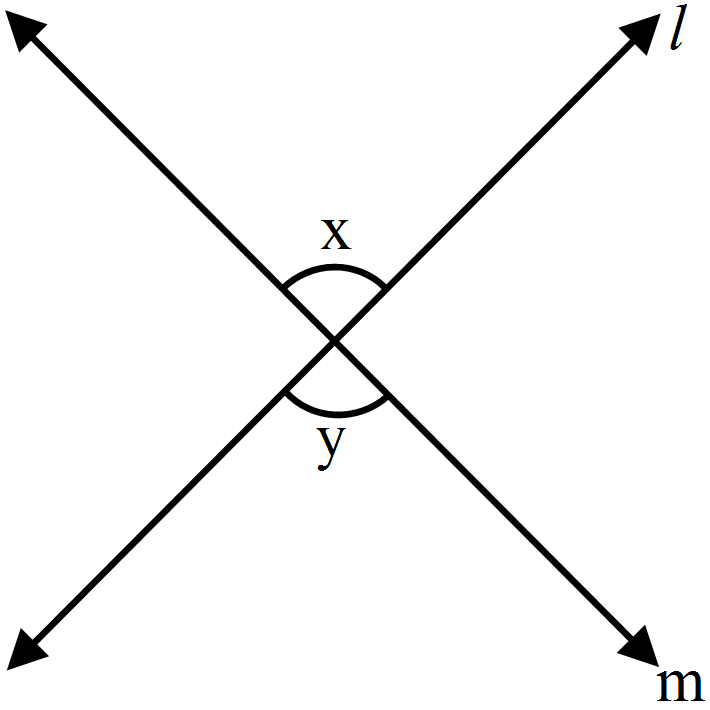
If linne $ l$ and $m$ intersect each other, then $x$ and $y$ are know as vertically opposite angle. The vertycally opposite angles so formed are equal.
$\therefore \text{x}=\text{y}$
Statement $B$
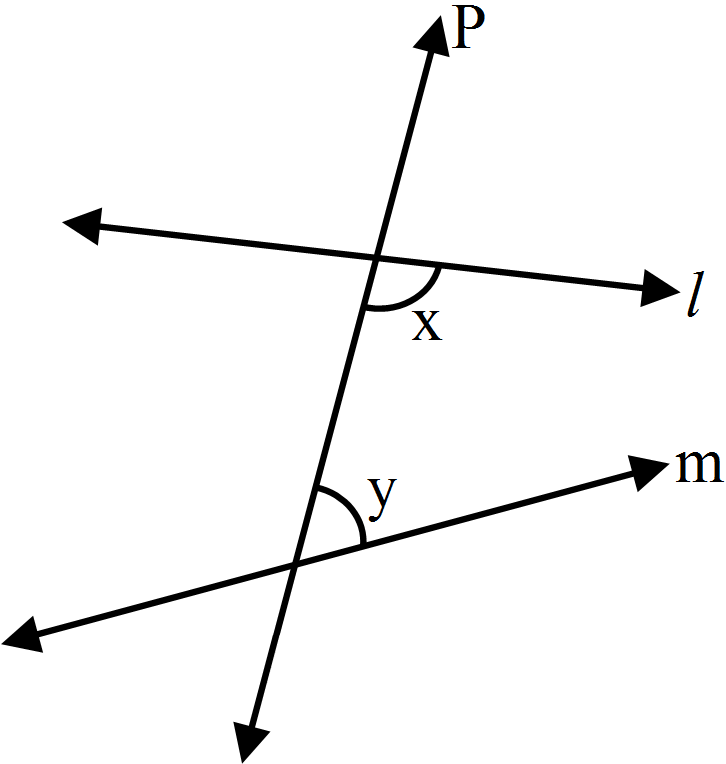
If two lines $l$ and $m$ are intersected by a transversal $p,$ then the sum of two interior angles will be $180^\circ ,$ only if $l$ and $m$ are parallel. View full question & answer→MCQ 1471 Mark
In Fig. $AOB$ is a straight line and the ray $OC$ stands on it. The value of $x$ is:
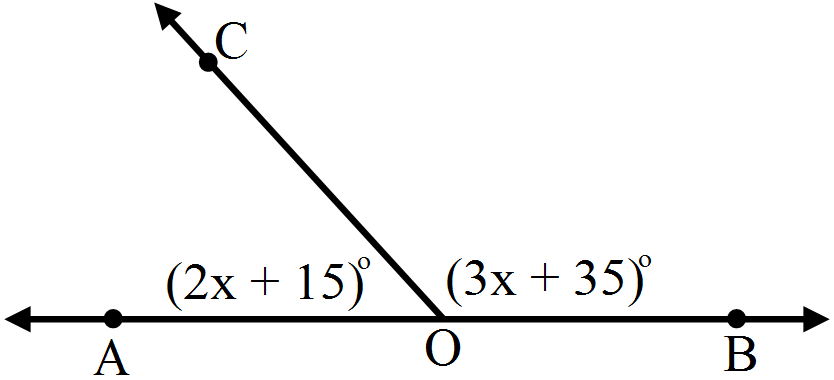
Answer$\angle\text{AOC}+\angle\text{BOC}=180^\circ$ [$\because$ Linear pair angles]
$\Rightarrow (2\text{x}+15)^\circ+(3\text{x}+35)^\circ=180^\circ$
$\Rightarrow (5\text{x}+50)^\circ=180^\circ$
$\Rightarrow 5\text{x}+50=180$
$\Rightarrow 5\text{x}=130$
$\Rightarrow \text{x}=26$
Hence, the correct answer is option $(b).$
View full question & answer→MCQ 1481 Mark
In Fig. $AB || CO$ and $EF$ is a transversal intersecting $AB$ and $CD$ at $P$ and $Q$ respective. The measure of $\angle \text{OOP}$ is:
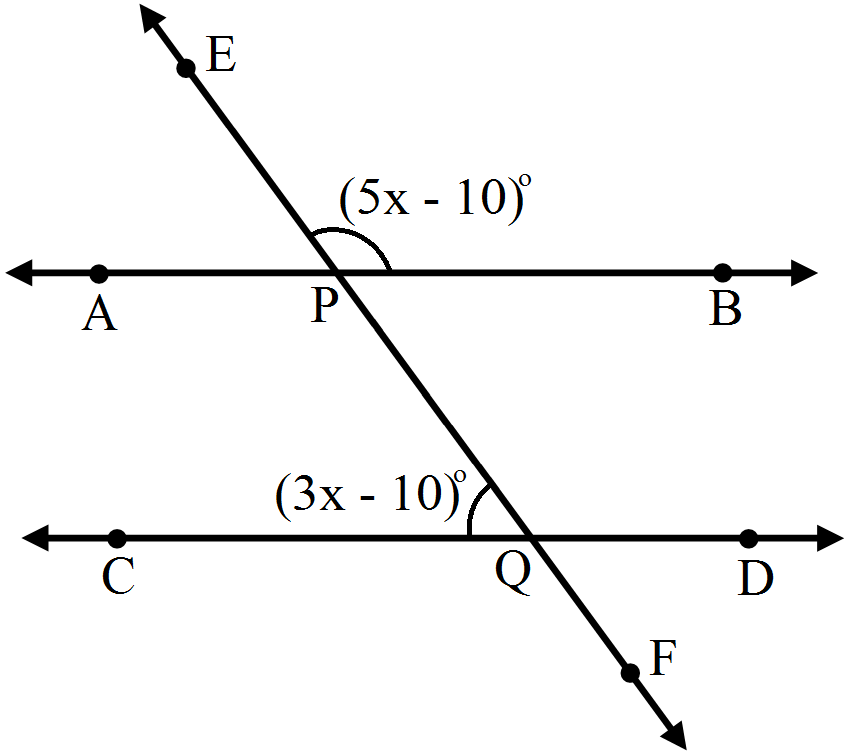
Answer$\angle \text{BPE}=\angle \text{APQ}=(5\text{x}-10)^\circ$ [Vertically opposite angles]
Since, $AB || CD$
$\therefore \angle \text{APQ}+ \angle \text{CQP}=180^\circ$ [Angles on the same side of a transversal line are supplementary]
$\Rightarrow(5\text{x}-10)^\circ+(3\text{x}-10)^\circ=180^\circ$
$\Rightarrow 8\text{x}-20=180$
$\Rightarrow 8\text{x}=200$
$\Rightarrow \text{x}=25$
$\therefore \angle \text{BPE}=(5\times 25-10)^\circ=115^\circ$
Now, $\angle \text{BPE}=\angle \text{DQP}=115^\circ$ [Corresponding angles]
Hence, the correct answer is option $(c).$
View full question & answer→MCQ 1491 Mark
The supplement of an acute angle is a/ an __________ angle.
AnswerWe know acute angle $ < 90^\circ $
Let us take an example.
$\angle\text{x}=45^\circ.....\text{x}$ is an acute angle.
Supplement of $x$ is $180^\circ − 45^\circ = 135^\circ $
It is an Obtuse angle Obtuse angle $ > 90^\circ $.
View full question & answer→MCQ 1501 Mark
The supplement of five - sixth of a right angle is:
- A
$5^\circ $
- ✓
$105^\circ $
- C
$95^\circ $
- D
$126^\circ $
AnswerCorrect option: B. $105^\circ $
Five sixth of right angle $=\frac{5}{6}\times90^\circ=75^\circ$
Let the supplement be $x$
$\therefore x + 75^\circ = 180^\circ $
$\Rightarrow x = 180^\circ − 75^\circ $
$\Rightarrow x = 105^\circ $
View full question & answer→