Question types

Civics Ch - 4 Judiciary question types

85 questions across 9 question groups — pick any mix to generate a Social Studies paper with step-by-step answer keys.

85
Questions
9
Question groups
5
Question types
Sample Questions

Civics Ch - 4 Judiciary questions

One sample from each question group in this chapter. Select any group above to see the full set with answer keys.

Q 1MCQ (1 Mark)1 Mark
What is the full form of PIL?###What is the expansion at PIL?
  • Public Interest Litigation
  • B
    Private Interest Litigation
  • C
    Private Interest Litigation
  • D
    Public Information Law

Answer: A.

View full solution
Q 2MCQ (1 Mark)1 Mark
The Supreme Court in the early 1980s, devised a mechanism of PIL to increase access to _______________ .
  • justice
  • B
    development
  • C
    employment
  • D
    trade

Answer: A.

View full solution
Q 4MCQ (1 Mark)1 Mark
Mayank sharma married to Damini Sharma in 1999. On 17th August 2000. Damini was found dead in her apartment. She has several injuries on her body. Her family filed a case in court. The trial Court acquitted Mayank and his family members and did not gave any sentence against thern.
The family members of Damini can appeal in which of the following courts?
  • Appeal to a higher court
  • B
    Appeal in Parliament
  • C
    Appeal in District Court
  • D
    Appeal to the President of India

Answer: A.

View full solution
Q 5MCQ (1 Mark)1 Mark
'The district judiciary is the primary interface between the justice system and the people'.
Which of the following statements best explains this statement?
  • A
    The district judiciary is the first level of the judiciary that most people come into contact with.
  • B
    The district judiciary is the most affordable level of the judiciary.
  • C
    The district judiciary is the most convenient level of the judiciary
  • All of the above

Answer: D.

View full solution
Assertion (A) All citizens of India have a right to justice through the courts.
Reason (R) Access to courts is difficult for a vast majority of the poor in India.
  • A
    Both A and R are true and R is the correct explanation of A
  • Both A and R are true, but R is not the correct explanation of A
  • C
    A is true, but R is false
  • D
    A is false, but R is true

Answer: B.

View full solution
Assertion (A) Every citizen of India can approach the Supreme Court or the High Court if they believe that their Fundamental Rights have been violated.
Reason (R) The judiciary is responsible for upholding the law and enforcing fundamental rights.
  • Both A and R are true and R is the correct explanation of A
  • B
    Both A and R are true, but R is not the correct explanation of A
  • C
    A is true, but R is false
  • D
    A is false, but R is true

Answer: A.

View full solution
Re-read excerpts from the judgement on the Olga Tellis vs Bombay Municipal Corporation case. Now write in your own words what the judges meant when they said that the Right to Livelihood was part of the Right to Life.
View full solution
Fill in the table given below based on what you have understood about criminal and civil law.
Description of violationBranch of law followedProcedure to be followed
A group of girls are persistently harassed by a group of boys while walking to school.--
A tenant who is being forced to move out files a case in court against the landlord.--
View full solution
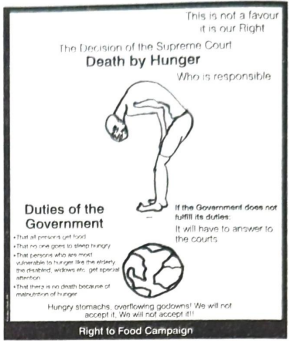
The following is a poster made by the Right to Food campaign.
Read this poster and list the duties of the government to uphold the Right to Food.
How does the phrase "Hungry stomachs, overflowing godowns! We will not accept it!!" used in the poster relate to the photo essay on the Right to Food on.
Image
View full solution
"While the courts are available for all, in reality access to courts has always been difficult for a vast majority of the poor in India. Legal procedures involve a lot of money and paperwork as well as take up a lot of time."
(i) How did the Supreme Court tried to solve these problems?
(ii) Give example of any one success story of this initiative of Supreme Court.
View full solution
Read the given passage below and answer the questions that follow.
High Courts were first established in the three Presidency cities of Calcutta, Bombay and Madras in 1862. The High Court of Delhi came up in 1966. Currently, there are 25 High Courts. While many states have their own High Courts, Punjab and Haryana share a common High Court at Chandigarh and four North-Eastern states of Assam, Nagaland, Mizoram and Arunachal Pradesh have a common High Court at Guwahati. Andhra Pradesh (Amaravati) and Telangana (Hyderabad) have separate High Courts from 1st January, 2019. Some High Courts have benches in other parts of the state for greater accessibility.
Q. 1. When was the first High Court established in India?
(a) 1862
(b) 1866
(c) 1966
(d) 2019
Q. 2. A High Court bench located outside the state capital serves which primary purpose?
(a) To handle legal matters related to a specific region within the state.
(b) To reduce the work load on the main court in the capital city.
(c) To provide easier access to justice for citizens in remote areas..
(d) All of the above
Q. 3. Which of the following statements is not true about the establishment of High Courts in India?
(a) The first High Courts were established in 1862 in Calcutta, Bombay and Madras.
(b) The High Court of Delhi was established in 1966.
(c) Currently, there are 25 functioning High Courts in India.
(d) All states have their own High Courts.
Q. 4. What is the purpose of having benches of High Courts in other parts of the state?
(a) To make access to justice easier for people living in remote areas.
(b) To reduce the workload on the main High Court.
(c) To provide specialised courts for certain types of cases.
(d) All of the above
View full solution

Generate a Civics Ch - 4 Judiciary paper free

Pick question groups from the list above, set marks and difficulty, and export a branded PDF with step-by-step answer keys. First 3 chapters free — no signup.

Download App