MCQ 11 Mark
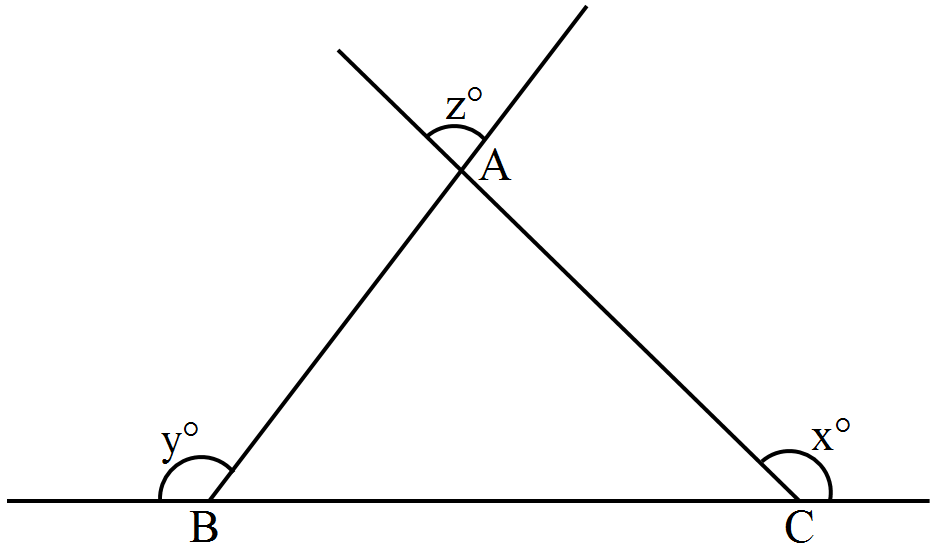
In figure, what is $z$ in terms of $x$ and $y?$
- A
$180^\circ - (x + y)$
- B
$x + y + 180^\circ $
- C
$x + y + 360^\circ $
- ✓
$x + y - 180^\circ $
AnswerCorrect option: D. $x + y - 180^\circ $
From figure
$\angle\text{A} = \text{z}^\circ$
$\angle\text{ACB} = 180 - \text{z}^\circ$
$\angle\text{ABC} = 180 - \angle\text{y}^\circ$
Now, in $\triangle\text{ABC}$
$\angle\text{A} + \angle\text{B} + \angle\text{C} = 180^\circ$
$⇒ \text{z}^\circ + 180 - \text{y}^\circ + 180^\circ - \text{x}^\circ = 180^\circ$
$⇒ \text{z}^\circ = \text{x}^\circ + \text{y}^\circ- 180^\circ$
View full question & answer→MCQ 21 Mark
In $\triangle\text{ABC, AB=AC}$ and $\angle\text{B}=50^\circ.$ Then $\angle\text{A}=?.$
Answer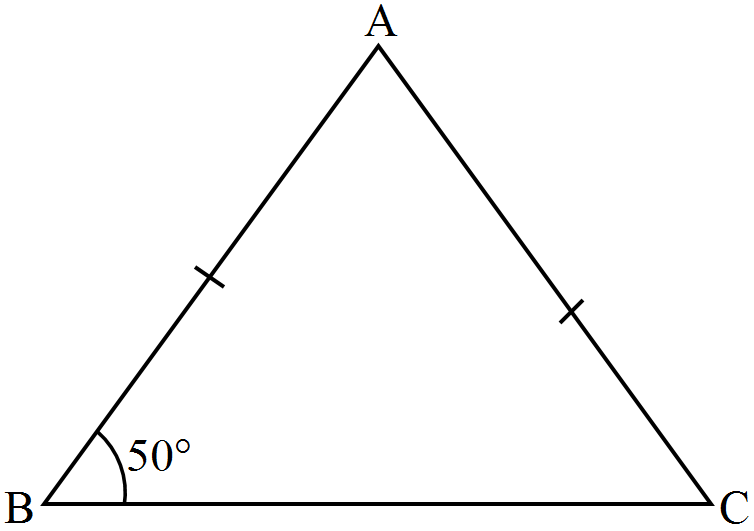
$\text{AB = AC}$ and $\angle\text{B}=50^\circ$
therefore, $\angle\text{C}=50^\circ$ also [angles opposite to equal sides are equal]
$\angle\text{A}+\angle\text{B}+\angle\text{C} = 180^\circ$ [by angle sum property of a triangle]
$⇒\angle\text{A}+50^\circ+50^\circ=180^\circ$
$⇒\angle\text{A} = 80^\circ$ View full question & answer→MCQ 31 Mark
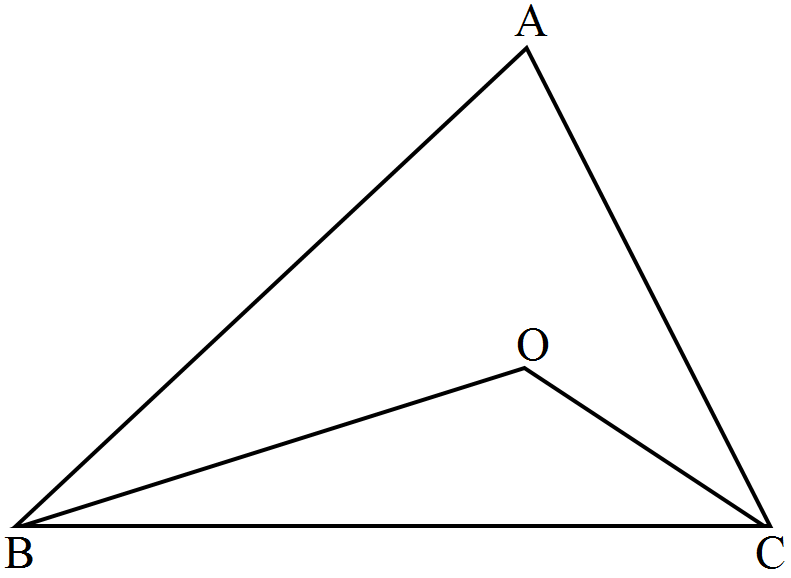
In the given figure $AB > AC$. If $BO$ and $CO$ are the bisectors of $\angle\text{B}$ and $\angle\text{C}$ respectively then,
- A
- B
$OB = OC$
- C
$OB < OC$
- ✓
$OB > OC$
AnswerCorrect option: D. $OB > OC$
$AB > AC$ (given)
$\therefore\ \angle\text{C}>\angle\text{B}$
Or, $\frac{1}{2}\angle\text{C}>\frac{1}{2}\angle\text{B}$
Therefore, $OB > OC$
View full question & answer→MCQ 41 Mark
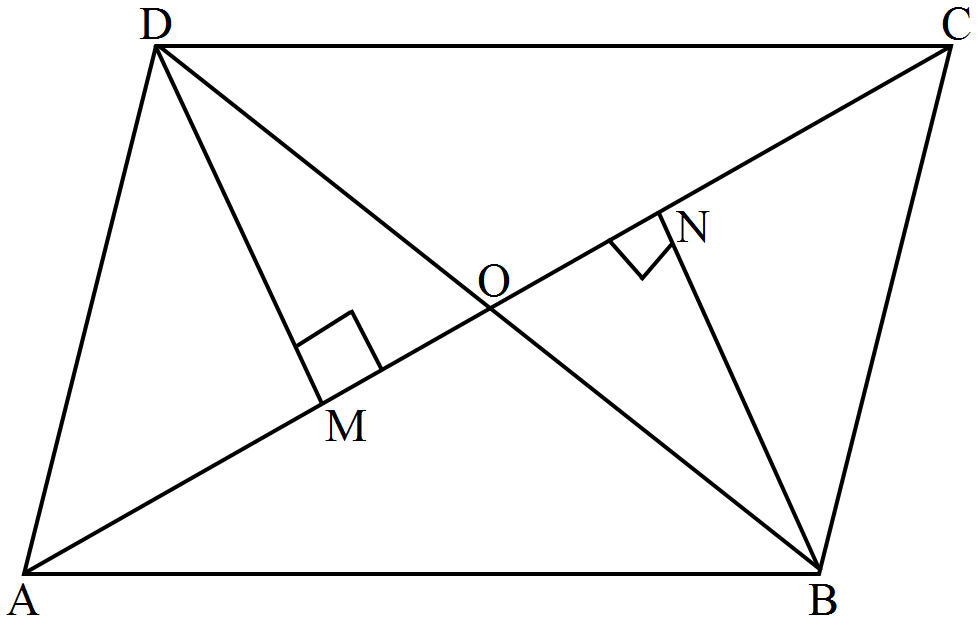
In the adjoining figure, $ABCD$ is a quadrilateral in which $BN$ and $DM$ are drawn perpendiculars to $AC$ such that $BN = DM$. If $OB = 4cm$. then $BD$ is:
- A
$6\ cm$
- ✓
$8\ cm$
- C
$10\ cm$
- D
$12\ cm$
AnswerCorrect option: B. $8\ cm$
In Triangle $DMO$ and triangle $BNO,$
$BN = DM$ and $\angle\text{DMO} = \angle\text{BNO} (90^{\circ}$)
$\angle\text{DMO} = \angle\text{BNO}$
Therefore, Triangle $DMO$ and triangle $BNO$ are congruent by $AAS$ criteria
Therefore, $OB = OD$ (by $CPCT)$
So $OD = 4\ cm, BD = OD + OB = 4 + 4 = 8\ cm$
View full question & answer→MCQ 51 Mark
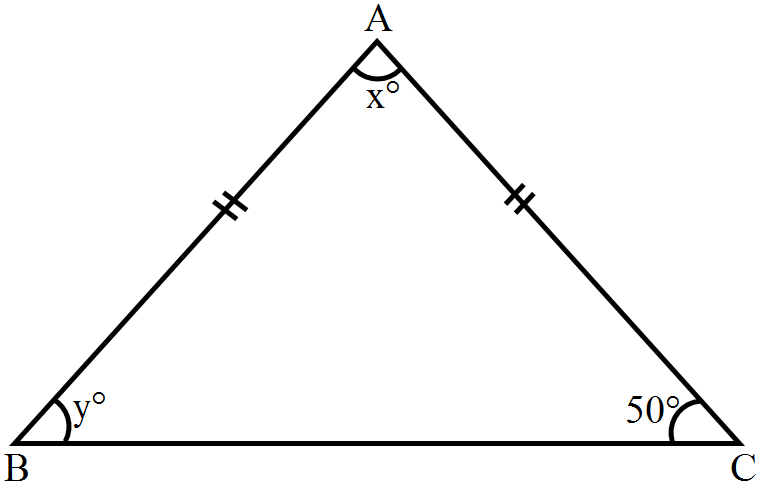
In the adjoining fig. $AB = AC$. If $\angle\text{C} = 50^\circ,$ then the value of $x$ and $y$ are:
- A
$x = 50^{\circ}$ and $y = 80^{\circ}$
- B
$x = 60^{\circ}$ and $y = 70^{\circ}$
- C
$x = 70^{\circ}$ and $y = 60^{\circ}$
- ✓
$x = 80^{\circ}$ and $y = 50^{\circ}$
AnswerCorrect option: D. $x = 80^{\circ}$ and $y = 50^{\circ}$
In triangle $ABC, AB = AC$, hence their opposite angles will be equal.
$\Rightarrow\angle\text{B}=\angle\text{C}= 50^\circ$
$\Rightarrow y = 50^{\circ}$
Now, by angle sum property,
$\angle\text{A} + \angle\text{B} + \angle\text{C} = 180^\circ$
or, $x+50^{\circ}+50^{\circ}=180^{\circ}$
or, $x+100^{\circ}=180^{\circ}$
$\Rightarrow x=80^{\circ}$
View full question & answer→MCQ 61 Mark
If $\triangle\text{ABC}\cong\triangle\text{LKM},$ then side of $\triangle\text{LKM}$ equal to side AC of $\triangle\text{ABC}$ is:
Answer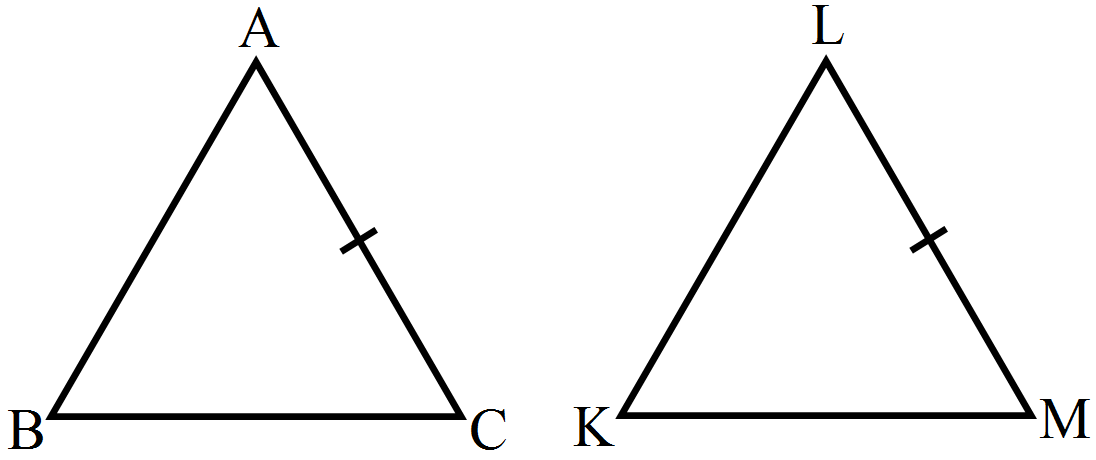
If $\triangle\text{ABC}\cong\triangle\text{LKM},$ then from figure $\text{AC}=\text{LM}.$
Hence, correct option is $(c).$ View full question & answer→MCQ 71 Mark
The area of a right angled triangle is $20\ m^2$ and one of the sides containing the right triangle is $4\ cm$. Then the altitude on the hypotenuse is:
AnswerCorrect option: C. $\frac{20}{\sqrt{29}}\text{cm}$
Area of right angle triangle $= 20$ sq.m
$\Rightarrow 12 \times $ Base $\times $ Height $= 20$
$\Rightarrow 12 \times $ Base $\times 4 = 20$
$\Rightarrow $ Base $= 10cm$
Then, Hypotenuse $=\sqrt{10^2+4^2}=2\sqrt{29}\text{m}$
If the altitude drawn to the hypotenuse of a right angle triangle, then the lenght of required altitude
$=\frac{10\times4}{2\sqrt{29}}=\frac{20}{\sqrt{29}}\text{cm}$
View full question & answer→MCQ 81 Mark
In Fig. The measure of $\angle\text{B}'\text{A}'\text{C}'$ is: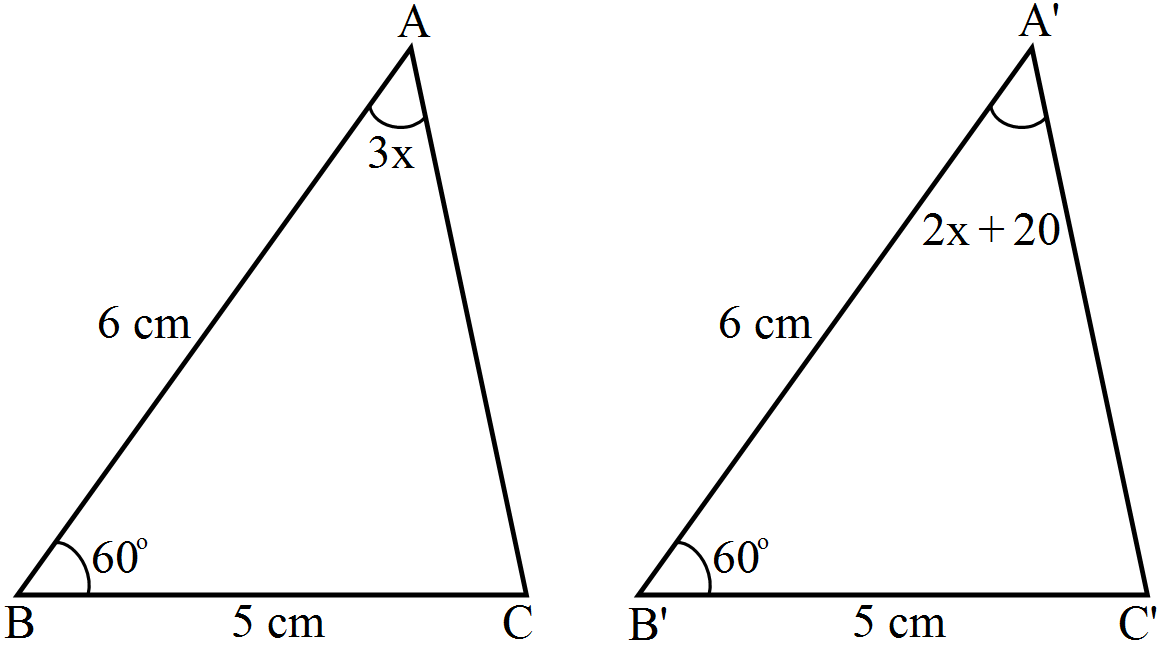
- A
$50^\circ$
- ✓
$60^\circ$
- C
$70^\circ$
- D
$80^\circ$
AnswerCorrect option: B. $60^\circ$
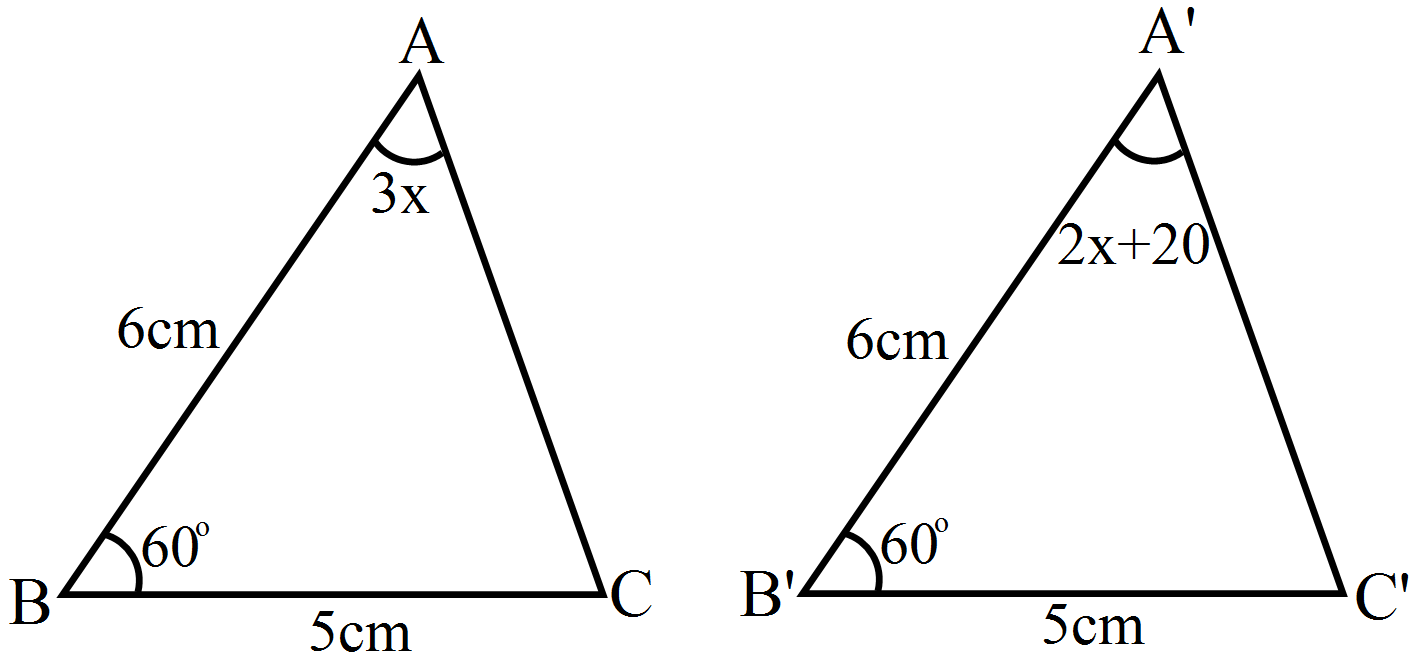
In $\triangle\text{ABC}$ and $\triangle\text{A}'\text{B}'\text{C},$
$\text{AB}=\text{A}'\text{B}'$
$\text{BC}=\text{B}'\text{C}'$
$\angle\text{ABC}=\angle\text{A}'\text{B}'\text{C}'$
So $\triangle\text{ABC}\cong\triangle\text{A}'\text{B}'\text{C}'$ by SAS creterion
$\Rightarrow\angle\text{BAC}=\angle\text{B}'\text{A}'\text{C}'$
$\Rightarrow3\text{x}=2\text{x}+20$
$\text{x}=20^\circ$
$2\text{x}+20=2\times20+60^\circ=\angle\text{B}'\text{A}'\text{C}'$
Hence, correct option is (b). View full question & answer→MCQ 91 Mark
If $\triangle\text{PQR}≡\triangle\text{EFD},$ then $\angle\text{E}=$
- A
$\angle\text{Q}$
- B
$\angle\text{R}$
- C
$\text{None of these}$
- ✓
$\angle\text{P}$
AnswerCorrect option: D. $\angle\text{P}$
Since, by corresponding part of congruent $\angle\text{E}$ of $\triangle\text{EFD}$ is equal to the $\angle\text{P}$ of $\triangle\text{PQR}.$
View full question & answer→MCQ 101 Mark
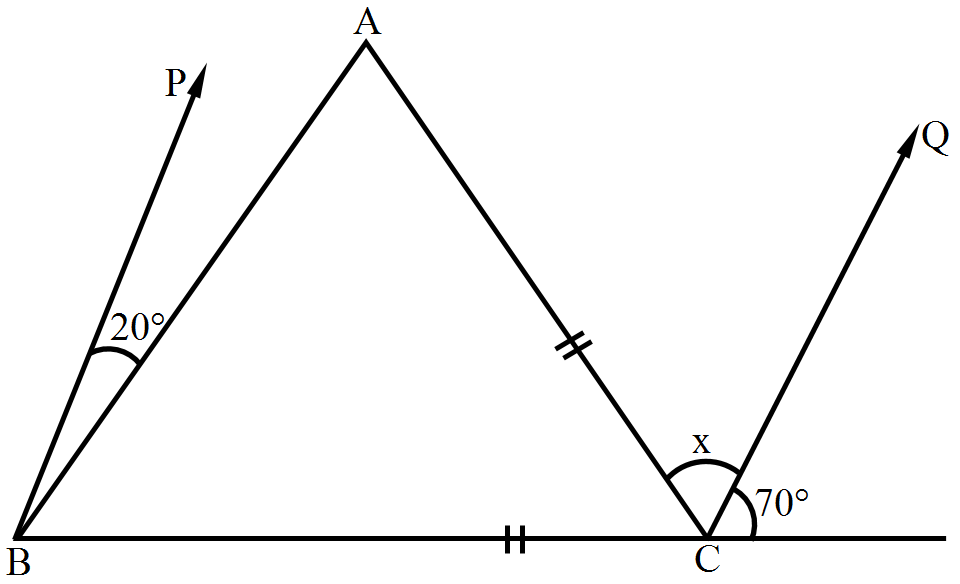
In Figure, if $\text{BP||CQ}$ and $AC = BC$, then the measure of $x$ is:
- A
$25^\circ$
- B
$20^\circ$
- ✓
$30^\circ$
- D
$35^\circ$
AnswerCorrect option: C. $30^\circ$
$\angle\text{PBC} = \angle\text{QCD}$ (Corresponding angles, $\text{OP || CQ}$ and $BC$ is transverse)
$\Rightarrow \angle\text{PBC} = 70^\circ$
Now, $\angle\text{PBA} + \angle\text{ABC} = \angle\text{PBC}$
$\Rightarrow 20^\circ+\angle\text{ABC}=70^\circ$
$\Rightarrow \angle\text{ABC}=50^\circ$
In $\triangle\text{ABC},$
$\angle\text{ABC} + \angle\text{BAC} + \angle\text{ACB} = 180^\circ \ ...\ (\text{i})$
Now, $\angle\text{ABC} + \angle\text{BAC} = 50^\circ$ (isosceles $\triangle$)
And, $\angle\text{ACB} = 180^\circ - (70^\circ + \text{x})$
From $(i),$
$50^\circ + 50^\circ + 180^\circ - (70^\circ + x) = 180^\circ $
Hence $x = 30^\circ $
View full question & answer→MCQ 111 Mark
Two sides of a triangle are of length $4\ cm$ and $2.5\ cm$. The length of the third side of the triangle cannot be.
- A
$5.5\ cm$
- ✓
$6.5\ cm$
- C
$6\ cm$
- D
$6.3\ cm$
AnswerCorrect option: B. $6.5\ cm$
Length of the greatest side of a triangle must be less than the sum of the other two sides.
View full question & answer→MCQ 121 Mark
In Fig. $AB$ and $CD$ are parallel lines and transversal $EF$ intersect them at $P$ and $Q$ respectively. If $\angle\text{APR}=25^\circ,\angle\text{RQC}=30^\circ$ and $\angle\text{CQF}=65^\circ,$ then: 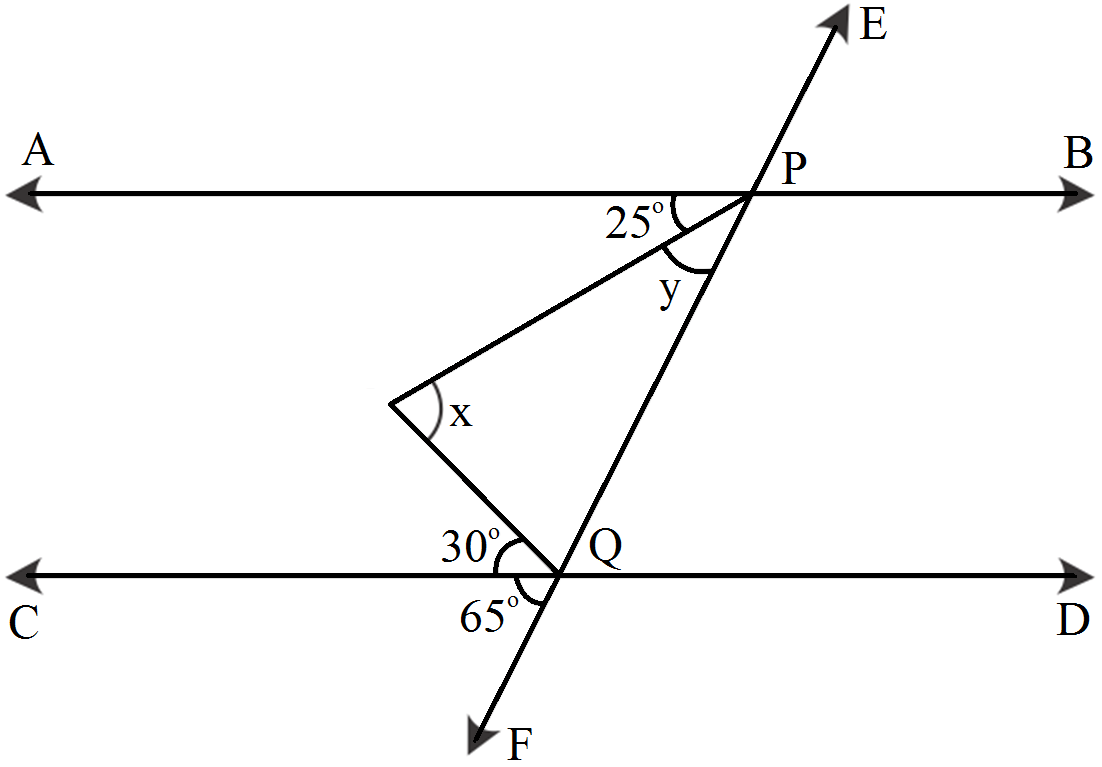
- ✓
$x = 55^\circ , y = 40^\circ$
- B
$x = 50^\circ , y = 45^\circ$
- C
$x = 60^\circ , y = 35^\circ$
- D
$x = 35^\circ , y = 60^\circ$
AnswerCorrect option: A. $x = 55^\circ , y = 40^\circ$
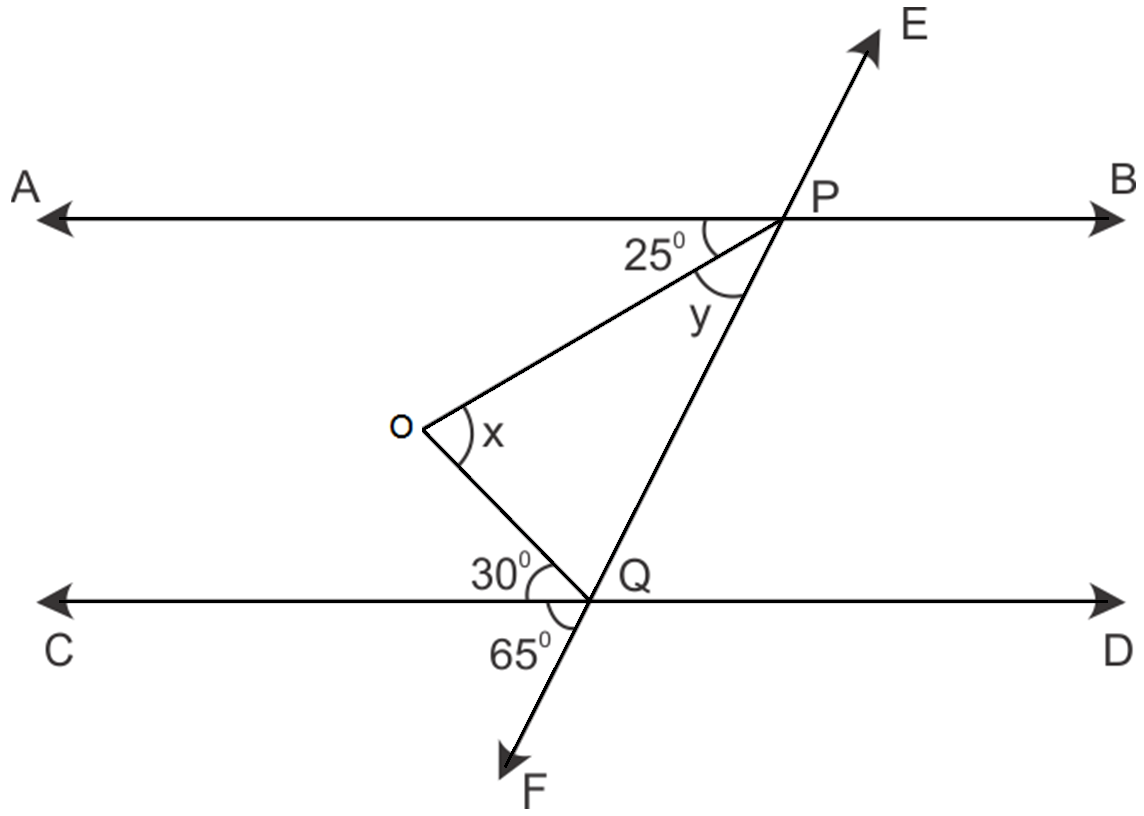
$\angle\text{OQP}=180^\circ-\angle\text{OQF}$
$=180^\circ-(30^\circ+65^\circ)$
$\Rightarrow\angle\text{OQP}=85^\circ\dots(1)$
$\angle\text{APQ}=\angle\text{CQF}$ (Corresponding angles)
$\Rightarrow25^\circ+\text{y}^\circ=65^\circ$
$\Rightarrow\text{y}^\circ=65^\circ-25^\circ$
$\Rightarrow\text{y}^\circ=40^\circ$
Now in $\triangle\text{OPQ}$
$\angle\text{O}+\angle\text{OPQ}+\angle\text{PQO}=180^\circ$
$\Rightarrow\text{x}^\circ+40^\circ+85^\circ=180^\circ$
$\text{x}^\circ=180^\circ-85^\circ-40^\circ=55^\circ$
$\Rightarrow\text{x}^\circ=55^\circ,\text{y}=40^\circ$ View full question & answer→MCQ 131 Mark
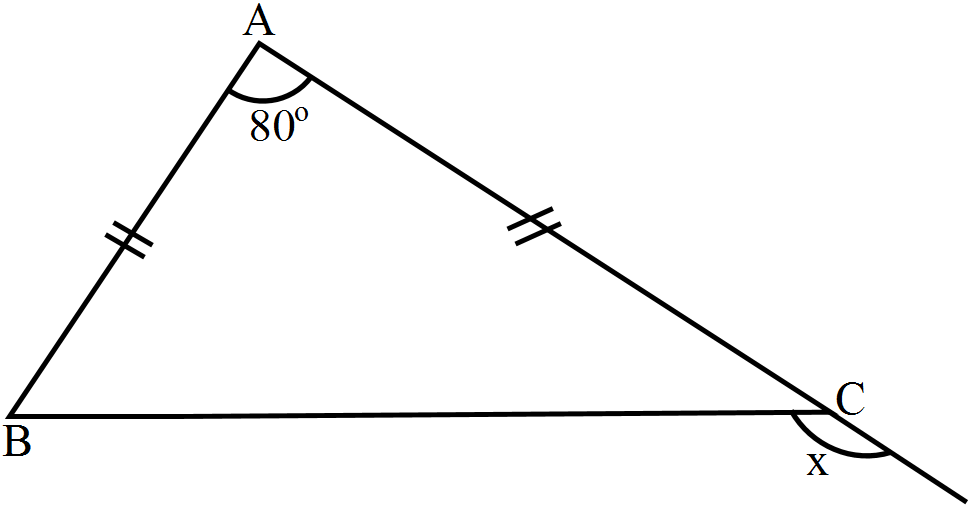
In fig, in $\triangle\text{ABC}.\ \text{AB = AC},$ then the value of $x$ is:
- A
$120^\circ$
- B
$100^\circ$
- ✓
$130^\circ$
- D
$80^\circ$
AnswerCorrect option: C. $130^\circ$
$\triangle\text{ABC}$ is an iscosceles triangle and hence in the triangle other two angles are $50$ and $50$.
Therefore,
$X = 180 - 50= 130^\circ$
View full question & answer→MCQ 141 Mark
In Fig. $ABC$ is a triangle in which $\angle\text{B}=2\angle\text{C}.$ $D$ is a point on side $BC$ such that $AD$ bisects $\angle\text{BAC}$ and $\text{AB}=\text{CD}.$ Be is the bisector of $\angle\text{B}.$ The measure of $\angle\text{BAC}$ is:
- ✓
$72^\circ$
- B
$95^\circ$
- C
$73^\circ$
- D
$74^\circ$
AnswerCorrect option: A. $72^\circ$
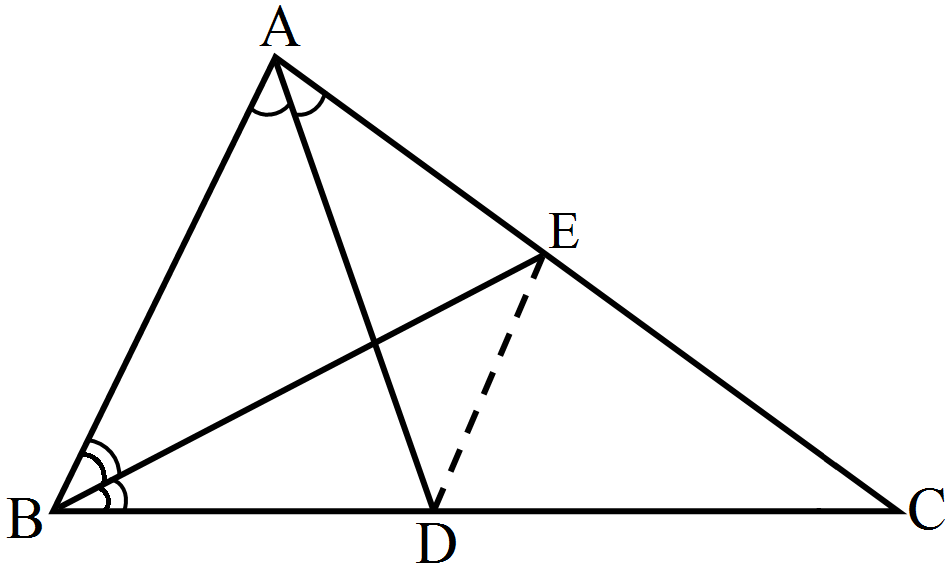
$\angle\text{ABE}=\angle\text{EBC}$ $($EBC is bisector of $\angle\text{B})$
and $\angle\text{C}=\frac{\angle\text{B}}{2}$
$\Rightarrow\angle\text{EBC}=\angle\text{ECB}$
So $\triangle\text{EBC}$ is isosceles triangle.
$\Rightarrow\text{EB}=\text{EC}\ ....(1)$
Now Consider $\triangle\text{ABE}$ and $\triangle\text{DCE}$
$\text{AB}=\text{DC}$ (Given)
$\text{BE}=\text{CE}$ [From (1)]
$\angle\text{ABE}=\angle\text{DCE}$ (From above data)
So $\triangle\text{ABE}\cong\triangle\text{DCE}$ by SAS property
$\Rightarrow\text{AE}=\text{DE}$
$\angle\text{BAE}=\angle\text{CDE}=\angle\text{A}$
Now consider $\triangle\text{AED},$
$\text{AE}=\text{DE}$ (above proved)
$\Rightarrow\triangle\text{AED}$ is isosceles triangle
$\Rightarrow\angle\text{EAD}=\angle\text{EDA}=\frac{\angle\text{A}}{2}$ $($AD is Bisector of $\angle\text{A})\ ....(2)$
Now, consider $\triangle\text{ABC},$
$\angle\text{A}+\angle\text{B}+\text{C}=180^\circ$
$\Rightarrow\angle\text{A}+2\angle\text{C}+\angle\text{C}=180^\circ(\angle\text{B}=2\angle\text{C)}$
$\Rightarrow\angle\text{A}+3\angle\text{C}=180^\circ\ .....(3)$
Consider $\triangle\text{ADE},$
$\Rightarrow\frac{\angle\text{A}}{2}+\angle\text{ADC}+\angle\text{}\text{C}=180^\circ$
$\Rightarrow\frac{\angle\text{A}}{2}+(\angle\text{EDA}+\angle\text{CDE})+\angle\text{C}=180^\circ$
$\Rightarrow\frac{\angle\text{A}}{2}+\frac{\angle\text{A}}{2}+\angle\text{A}+\angle\text{C}=180^\circ$
$\Rightarrow\angle\text{}A+\angle\text{A}+\angle\text{C}=180^\circ$
$\Rightarrow2\angle\text{A}+\angle\text{C}=180^\circ\ .....(4)$
Right hand side of equations (3) and (4) are equal, hence Left hand side.
$\Rightarrow\angle\text{A}+3\angle\text{C}=2\angle\text{A}+\angle\text{C}$
$\Rightarrow\angle\text{A}=2\angle\text{C}$
Substituting in equation (3),
$2\angle\text{C}+3\angle\text{C}=180^\circ$
$\Rightarrow5\angle\text{C}=180^\circ$
$\Rightarrow\angle\text{C}=36^\circ$
$\Rightarrow\angle\text{A}=2\times36^\circ=72^\circ$
Hence, correct option is $(a).$ View full question & answer→MCQ 151 Mark
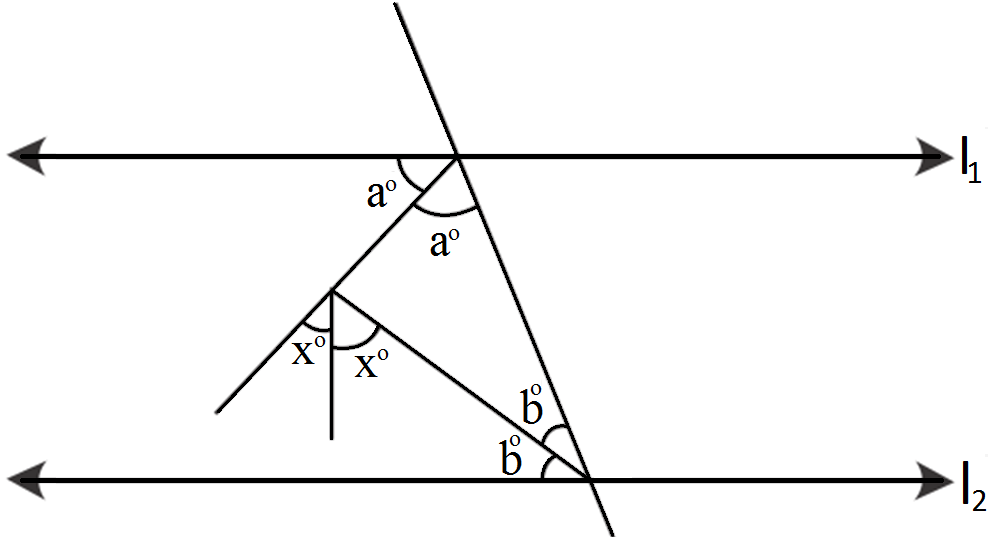
In Fig. if $I_1 \| I_2$, the value of $x$ is:
- A
$22\frac{1}{2}$
- B
$30$
- ✓
$45$
- D
$60$
Answer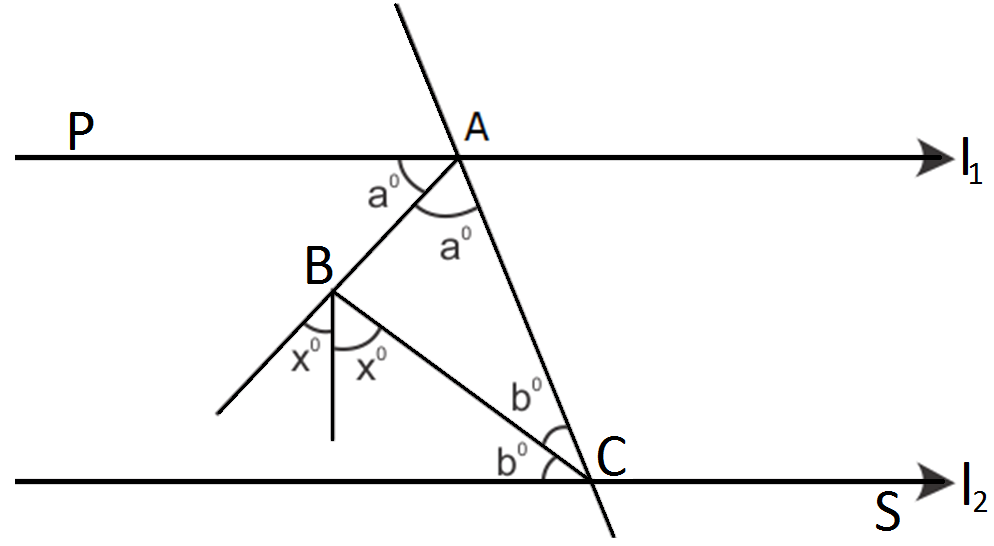
From figure,
$\angle\text{ACS}=180^\circ-2\text{b}^\circ$
also $\angle\text{ACS}=\angle\text{PAC}=2\text{a}^\circ$ (alternate angles)
$\Rightarrow2\text{a}^\circ=180^\circ-2\text{b}^\circ$
$\Rightarrow\text{a}^\circ+\text{b}^\circ=90^\circ$
Now, in $\triangle\text{ABC}$
$\text{a}^\circ+\text{b}^\circ+\angle\text{ABC}=180^\circ$
$\angle\text{ABC}=180^\circ-2\text{x}^\circ$
$\Rightarrow\text{a}^\circ+\text{b}^\circ+180^\circ-2\text{x}^\circ=180^\circ$
$\Rightarrow2\text{x}^\circ=\text{a}^\circ+\text{b}^\circ=90^\circ$
$\Rightarrow\text{x}^\circ=45^\circ$ View full question & answer→MCQ 161 Mark
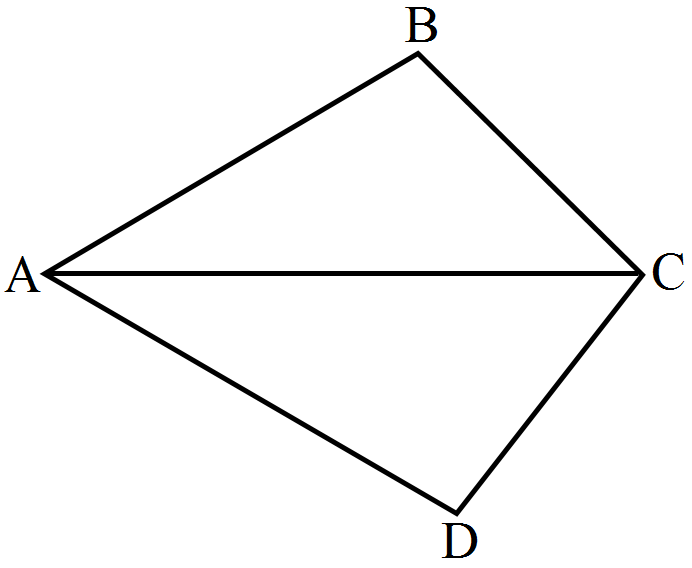
In the adjoining figure, $\triangle\text{ABG}\cong\triangle\text{ADG}.$ If $\angle\text{BAC} = 30^\circ$ and $\angle\text{ABC} = 100^\circ$ then $\angle\text{ACD}$ is equal to:
- ✓
$50^\circ$
- B
$80^\circ$
- C
$30^\circ$
- D
$60^\circ$
AnswerCorrect option: A. $50^\circ$
In $\triangle\text{ABC}, \triangle\text{BAC} = 30^\circ$ and $\triangle\text{ABC}= 100^\circ$ (Given)
$\angle\text{BAC} + \angle\text{ABC}+ \angle\text{BCA} = 180^\circ$
$\angle\text{BCA}= 50^\circ$
Also $\angle\text{ACD}= 50^\circ$ (Since, $\triangle\text{ABC}\cong\triangle\text{ADC}$).
View full question & answer→MCQ 171 Mark
In $\triangle\text{ABC, BC = AB}$ and $\angle\text{B}=80^{\circ}.$ Then, $\angle\text{A = ?}$
- ✓
$50^\circ$
- B
$40^\circ$
- C
$100^\circ$
- D
$80^\circ$
AnswerCorrect option: A. $50^\circ$
In $\triangle\text{ABC,}$
$\text{BC = AB}$
$\Rightarrow\angle\text{A}=\angle\text{C}$ (angles opposite to equal sides are equal)
Now, $\angle\text{A}+\angle\text{B}+\angle\text{C}=180^{\circ}$
$\Rightarrow\angle\text{A}+80^{\circ}+\angle\text{A}=180^{\circ}$
$\Rightarrow2\angle\text{A}+100^{\circ}$
$\Rightarrow\angle\text{A}=50^{\circ}$
View full question & answer→MCQ 181 Mark
The base $BC$ of triangle $ABC$ is produced both ways and the measure of exterior angles formed are $94^\circ $ and $126^\circ $. Then, $\angle\text{BAC} =$
- A
$54^\circ$
- B
$94^\circ$
- C
$44^\circ$
- ✓
$40^\circ$
AnswerCorrect option: D. $40^\circ$
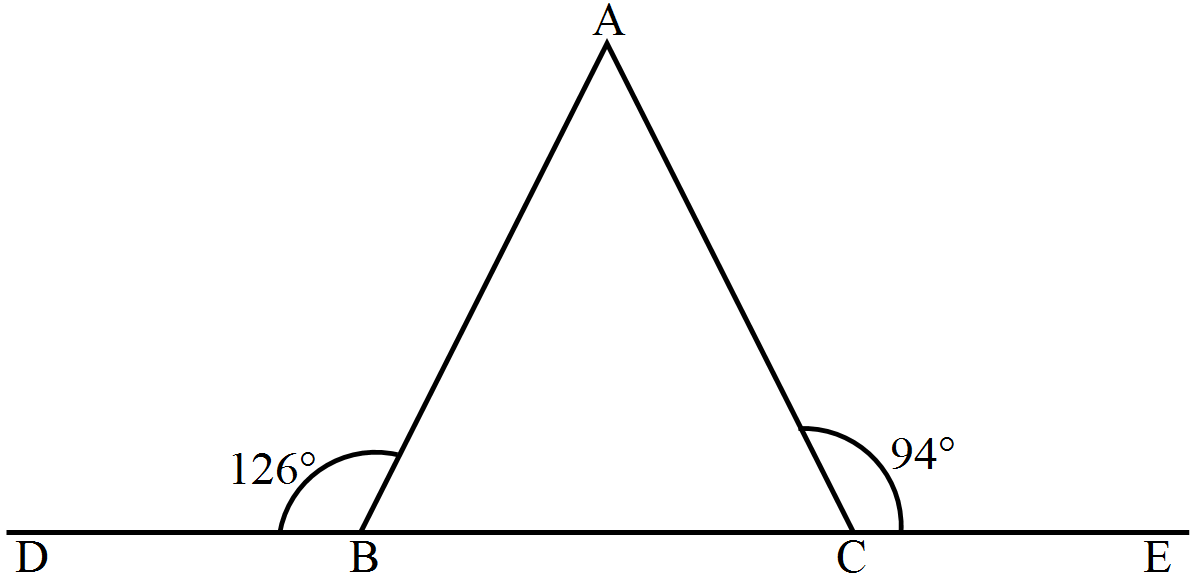
$\angle\text{ABC} = 180^\circ - 126^\circ = 54^\circ$
$\angle\text{ACB} = 180^\circ - 94^\circ = 86^\circ$
Now, in $\triangle\text{ABC}$
$\angle\text{BAC} + \angle\text{ABC} + \angle\text{ACB} = 180^\circ$
$\Rightarrow \angle\text{BAC} = 180^\circ - \angle\text{ABC} - \angle\text{ACB}$
$= 180^\circ - 54^\circ - 86^\circ$
$\Rightarrow \angle\text{BAC} = 40^\circ$ View full question & answer→MCQ 191 Mark
In figure, what is the value of $x?$
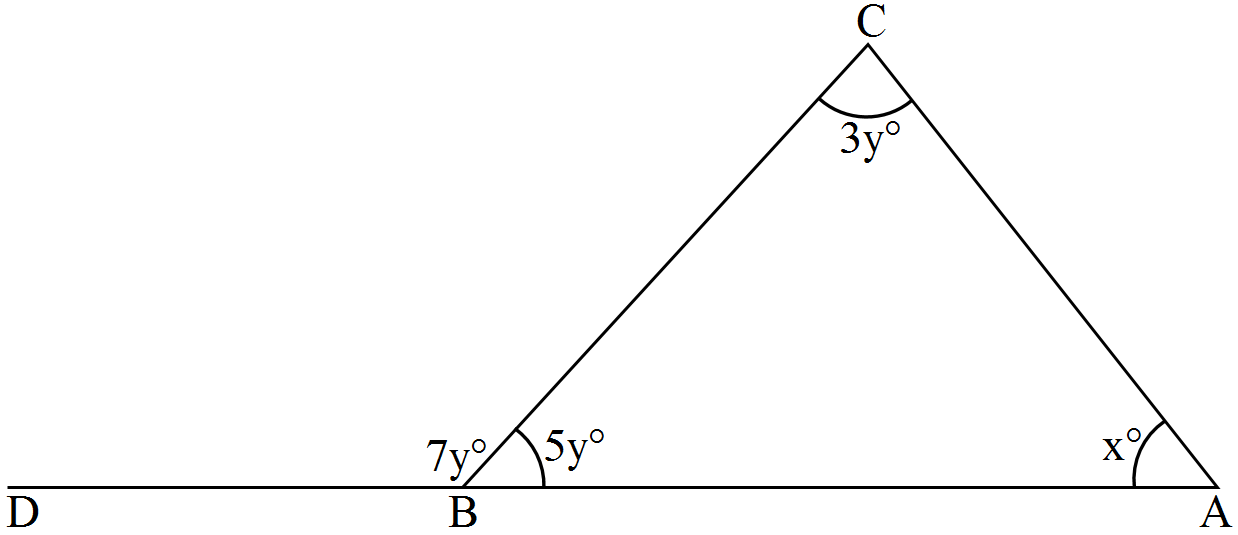
AnswerIn $\triangle\text{ABC},$
$\angle\text{BCA} + \angle\text{CAB} + \angle\text{ABC} = 180^\circ$
$\Rightarrow 3\text{y}^\circ+\text{x}^\circ+5\text{y}^\circ = 180^\circ$
$\Rightarrow 8\text{y}^\circ+\text{x}^\circ = 180^\circ \ ...\ (\text{i})$
Also, $5\text{y}^\circ = 180^\circ - 7\text{y}^\circ$
$\Rightarrow 12\text{y}^\circ=180^\circ$
$\Rightarrow \text{y}^\circ=15^\circ$
From (i), $\text{x}^\circ=180^\circ−8\text{y}^\circ$
$\Rightarrow \text{x}^\circ=180^\circ−8\times 15^\circ$
$\Rightarrow \text{x}^\circ=60^\circ$
View full question & answer→MCQ 201 Mark
In $\triangle\text{ABC},\ \angle\text{A} = 50^\circ,\ \angle\text{B} = 60^\circ.$ Find the longest side of the triangle?
AnswerBy angle sum property, we have,
$\angle\text{A} + \angle\text{B} + \angle\text{C} = 180^\circ$
$\Rightarrow 50^\circ + 60^\circ + \angle\text{C} = 180^\circ$
$\Rightarrow\ \angle\text{C} = 180^\circ - (50^\circ+ 60^\circ) = 70^\circ$
Therefore, $\angle\text{C}$ is the largest angle in the triangle and the side opposite to it i.e. $AB$ is the longest side.
View full question & answer→MCQ 211 Mark
An exterior angle of a triangle is $108^\circ $ and its interior opposite angles are in the ratio $4 : 5$. The angles of the triangle are:
- A
$42^\circ , 60^\circ , 76^\circ $
- ✓
$48^\circ , 60^\circ , 72^\circ$
- C
$50^\circ , 60^\circ , 70^\circ $
- D
$2^\circ , 56^\circ , 72^\circ$
AnswerCorrect option: B. $48^\circ , 60^\circ , 72^\circ$
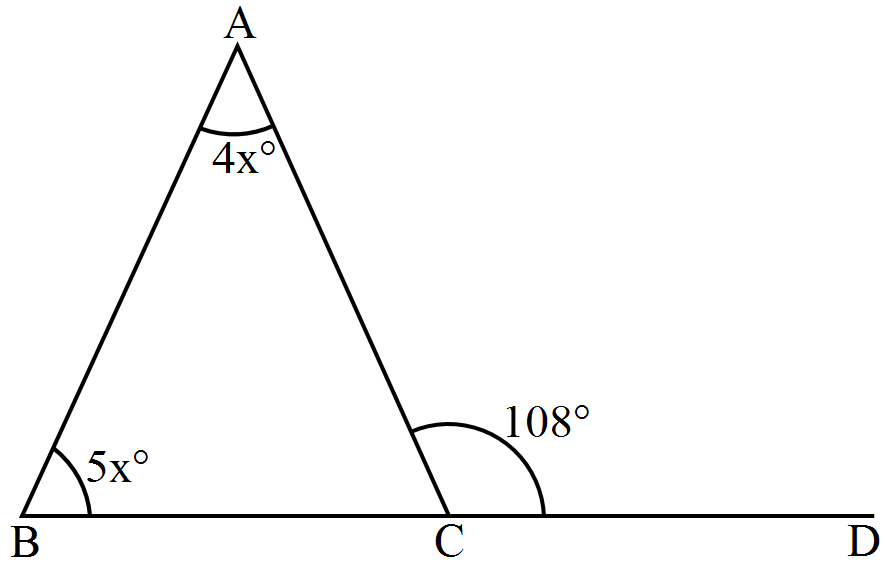
From figure, we have
$\angle\text{A}+ \angle\text{B} = \angle\text{ACD}$
$⇒ 4\text{x}^\circ + 5\text{x}^\circ = 180^\circ$
$⇒ 9\text{x}^\circ = 108^\circ$
$⇒ \text{x} = 12^\circ$
So, $\angle\text{A} = 48^\circ,\ \angle\text{B} = 60^\circ$
$\Rightarrow \angle\text{C} = 180^\circ - 48^\circ - 60^\circ = 72^\circ$ View full question & answer→MCQ 221 Mark
In a $\triangle\text{ABC},$ if $\angle\text{A}=60^\circ,\angle\text{B}=80^\circ$ and the bisectors of $\angle\text{B}$ and $\angle\text{C}$ meet at $O$, then $\angle\text{BOC}=$
- A
$60^\circ$
- ✓
$120^\circ$
- C
$150^\circ$
- D
$30^\circ$
AnswerCorrect option: B. $120^\circ$
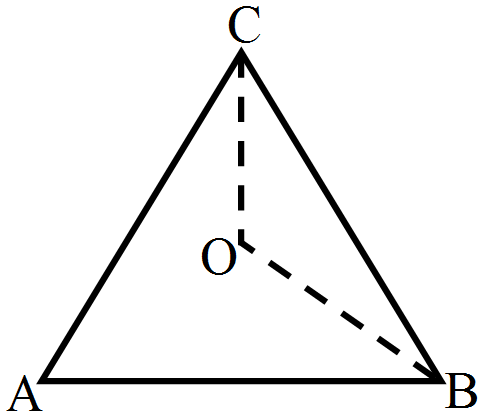
O is point where bisectors of $\angle\text{C }\& \angle\text{B}$ meets.
$\angle\text{A}+\angle\text{B}+\angle\text{C}=180^\circ$
$60^\circ+80^\circ+\angle\text{C}=108^\circ$
$\angle\text{C}=40^\circ$
$\frac{\angle\text{C}}{2}=20^\circ$
$\frac{\angle\text{C}}{2}=20^\circ=\angle\text{BCO}\dots(1)$
$\frac{\angle\text{B}}{2}=\frac{80^\circ}{2}=40^\circ=\angle\text{OBC}\dots(2)$
In $\triangle\text{BOC}$
$\angle\text{BCO}+\angle\text{OBC}+\angle\text{BOC}=180^\circ$
from $(1)$ and $(2)$
$20^\circ+40^\circ+\angle\text{BOC}=180^\circ$
$\Rightarrow\angle\text{BOC}=180^\circ-60^\circ=120^\circ$ View full question & answer→MCQ 231 Mark
In $\triangle\text{ABC},$ if $AB = AC$ and $\angle\text{ACD}=1200,$ find $\angle\text{A}.$ 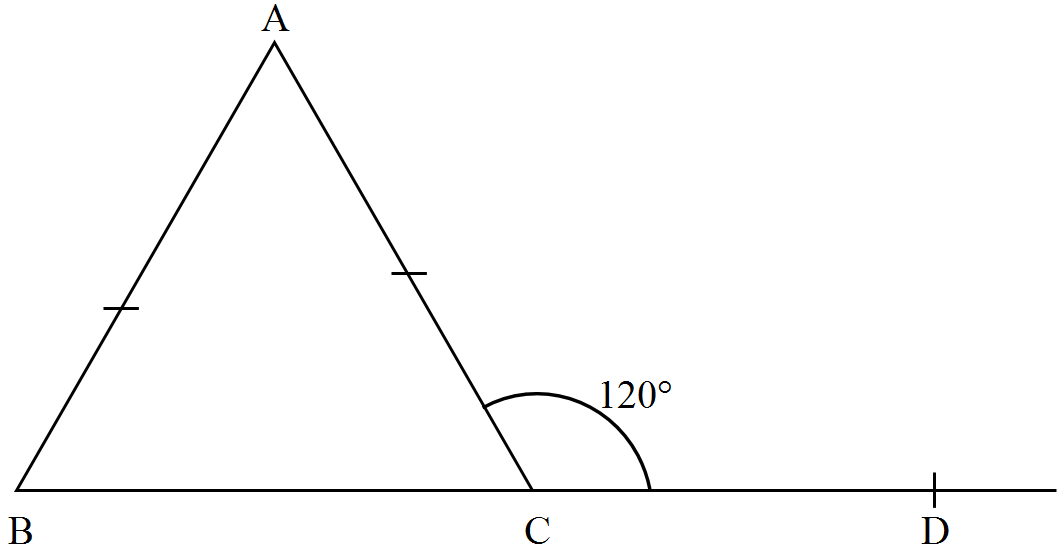
- A
$70^\circ$
- B
- C
$50^\circ$
- ✓
$60^\circ$
AnswerCorrect option: D. $60^\circ$
In $\triangle\text{ABC}, \ \text{AB} = \text{AC}$
$\Rightarrow \angle\text{ABC} = \angle\text{ACB}$
Also, $\angle\text{ACD}=120^\circ$
$\Rightarrow \angle\text{ACB} = 180^\circ- \angle\text{ACD}$ (Linear pair)
$\Rightarrow \angle\text{ACB} = 180^\circ- 120^\circ = 60^\circ$
$\Rightarrow \angle\text{ABC} = 60^\circ$
By using angle sum property, we have
$\angle\text{ABC} + \angle\text{ACB} + \angle\text{BAC} = 180^\circ$
$60^\circ + 60^\circ+ \angle\text{A} = 180^\circ$
or, $\angle\text{A} = 180^\circ - 120^\circ= 60^\circ$
View full question & answer→MCQ 241 Mark
In Figure, if $\text{EC}\ ||\text{ AB}, \angle\text{ECD} = 70^\circ$ and $\angle\text{BDO} = 20^\circ,$ then $\angle\text{OBD}$ is: 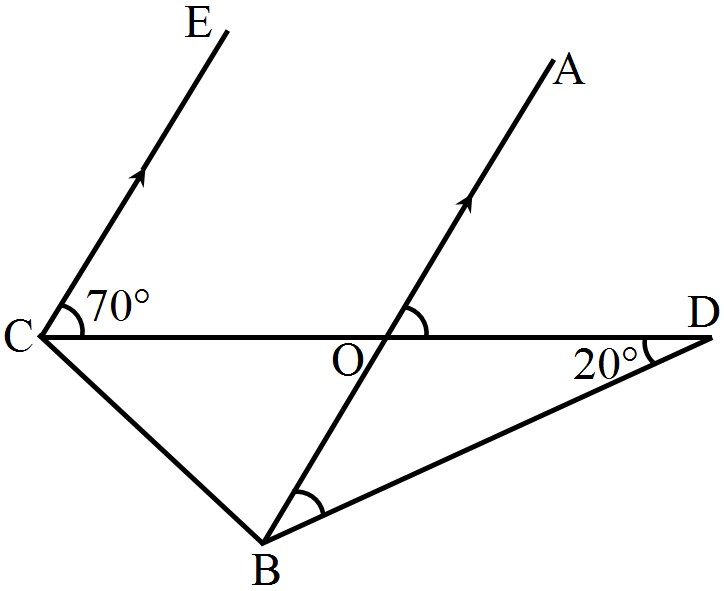
- A
$60^\circ $
- B
$70^\circ$
- C
$20^\circ $
- ✓
$50^\circ $
AnswerCorrect option: D. $50^\circ $
$\text{EC}\ ||\text{ AB}$ and $CD$ is transverse to it.
Now $\angle\text{ECD} = \angle\text{AOD} = 70^\circ$ (Corresponding angles)
In $\angle\text{OBD}$
$\angle\text{OBD} + \angle\text{BOD} + \angle\text{ODB} = 180^\circ$
$\angle\text{BOD} = 180^\circ - \angle\text{AOD} = 180^\circ - 70^\circ = 110^\circ$
$\angle\text{ODB} = 20^\circ$ (Given)
So, $\angle\text{OBD} = 180^\circ - \angle\text{BOD} - \angle\text{ODB}$
$= 180^\circ - 110^\circ - 20^\circ$
$= 50^\circ$
View full question & answer→MCQ 251 Mark
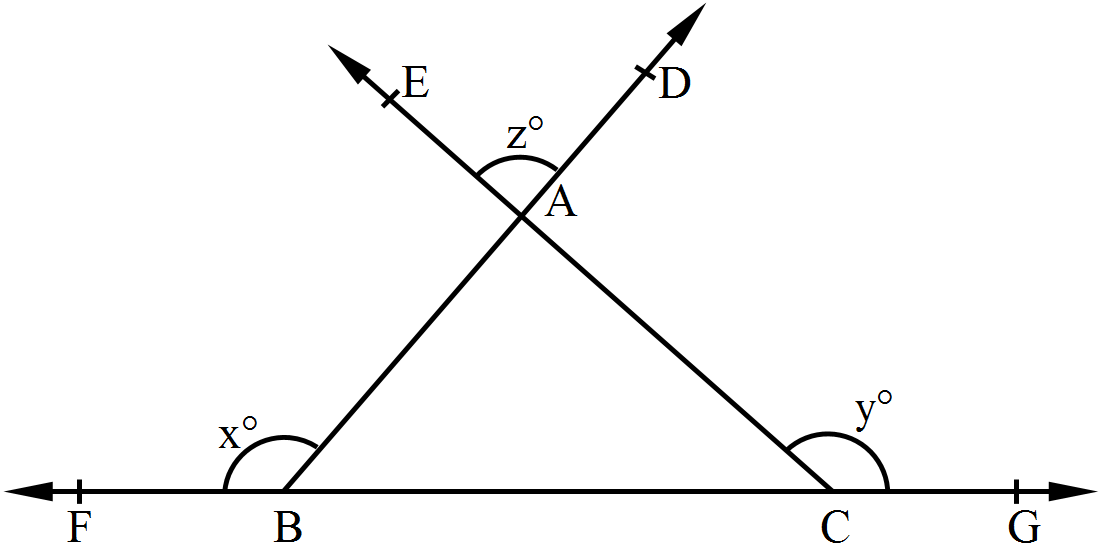
In the given figure, two rays $BD$ and $CE$ intersect at a point A. The side $BC$ of $\triangle\text{ABC}$ have been produced on both sides to points $F$ and $G$ respectively. If $\angle\text{ABF}=\text{x}^\circ, \ \angle\text{ACG}=\text{y}^\circ$ and $\angle\text{DAE}=\text{z}^\circ$ then $\text{z} = ?$
- A
$x + y + 180$
- B
$180 - (x + y)$
- ✓
$x + y - 180$
- D
$x + y + 360^\circ$
AnswerCorrect option: C. $x + y - 180$
In the given figure, $\angle\text{ABF}+\angle\text{ABC}=180^\circ$ (Linear pair of angles)
$\therefore \text{x}^\circ+\angle\text{ABC}=180^\circ$
$\Rightarrow \angle\text{ABC}=180^\circ−\text{x}^\circ ...\ (\text{i})$
Also, $\angle\text{ACG}+\angle\text{ACB}=180^\circ$ (Linear pair of angles)
$\therefore \text{y}′+\angle\text{ACB}=180^\circ$
$\Rightarrow \angle\text{ACB}=180^\circ−\text{y}′\ ...\ \text{(ii)}$
Also, $\angle\text{BAC}=\angle\text{DAE}=\text{z}^\circ \ ....\ \text{(iii)}$ (Vertically opposite angles)
In $\triangle\text{ABC}$
$\angle\text{BAC}+\angle\text{ABC}+\angle\text{ACB}=180^\circ$ (Angle sum property)
$\therefore \text{z}^\circ+180−\text{x}^\circ+180^\circ−\text{y}^\circ=180^\circ$ [Using (1), (2) and (3)]
$\Rightarrow \text{z} = \text{x} + \text{y} – 180$
View full question & answer→MCQ 261 Mark
In $\triangle\text{PQR},\ \angle\text{R} = \angle\text{P} $ and $QR = 4\ cm$ and $PR = 5\ cm$. Then the length of $PQ$ is:
- ✓
$4\ cm$
- B
$2.5\ cm$
- C
$5\ cm$
- D
$2\ cm$
AnswerCorrect option: A. $4\ cm$
In a triangle, if two of its angles are equal then the sides opposite to equal angles are also equal.In $\triangle\text{PQR},\ \angle\text{R} = \angle\text{P}$
$\Rightarrow QR$ (side opposite to $ \angle\text{P}$) $= PQ$ (side opposite to $ \angle\text{R}$)
Given that, $QR = 4cm$
$\Rightarrow PQ = 4cm$
View full question & answer→MCQ 271 Mark
In the given figure, the sides $CB$ and $BA$ of $\triangle\text{ABC}$ have been produced to $D$ and $E$ respectively such that $\angle\text{ABD}=110^\circ$ and $\angle\text{CAF}=135^\circ,$ Then $\angle\text{ACB} = ?$ 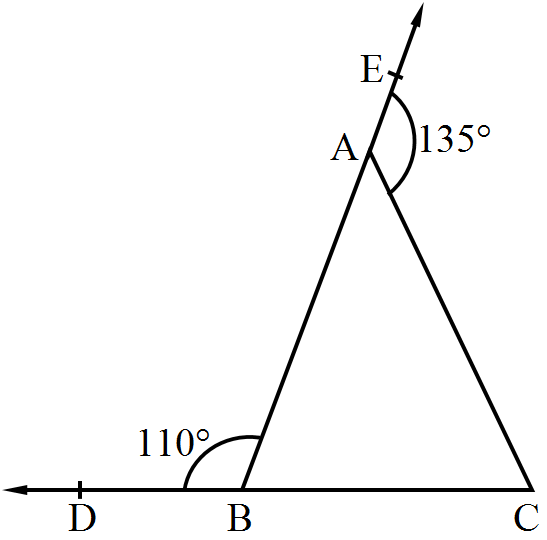
- A
$35^\circ$
- B
$55^\circ$
- C
$45^\circ$
- ✓
$65^\circ$
AnswerCorrect option: D. $65^\circ$
We can find $\angle\text{CBA}$ as follows:
Given that $\angle\text{EBA}=110^\circ$
$\angle\text{CBA} = 180 - 110$ ... (linear pair)
$=70^\circ$
Given $\angle\text{CAD}=135^\circ$
So, $\angle\text{CAB} = 180 - 135$ ... (linear pair)
$=45^\circ$
So, $\angle\text{ACB} = 180 - (70 + 45)$ ... (angle sum property of triangle)
$=65^\circ$
View full question & answer→MCQ 281 Mark
In $\triangle\text{ABC},$ if $\angle\text{C}>\angle\text{B},$ then
- A
$BC > AC$
- ✓
$AB > AC$
- C
$BC < AC$
- D
$AB < AC$
AnswerCorrect option: B. $AB > AC$
Greater angle has greater side opposite to it.
View full question & answer→MCQ 291 Mark
In the following, write the correct answer. In $\triangle\text{ABC}$ and $\triangle\text{PQR},$ if $AB = AC,$ $\angle\text{C}=\angle\text{P}$ and $\angle\text{B}=\angle\text{Q}$ then the two triangles are:
- ✓
Isosceles but not congruent.
- B
- C
Congruent abut not isosceles.
- D
Neither congruent nor isosceles.
AnswerCorrect option: A. Isosceles but not congruent.
In $\triangle\text{ABC},$$AB = AC$
$\angle\text{C}=\angle\text{B}$
So, is an isosceles triangle.
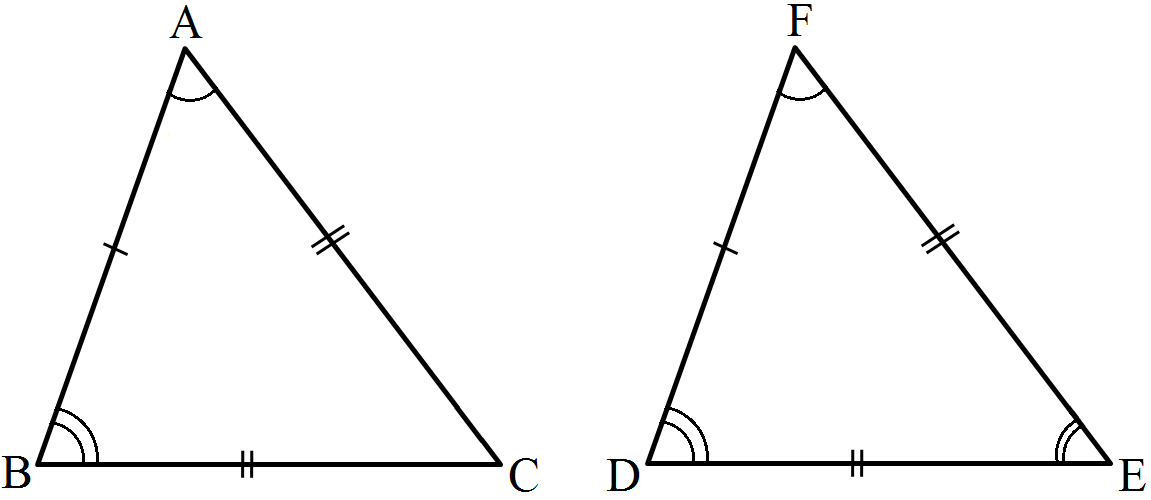
But it is given that,
$\angle\text{B}=\angle\text{Q}$
$\angle\text{C}=\angle\text{P}$
$\angle\text{P}=\angle\text{Q}$
So, is also an isosceles triangle.Therefore both triangle are isosceles but not congruent. View full question & answer→MCQ 301 Mark
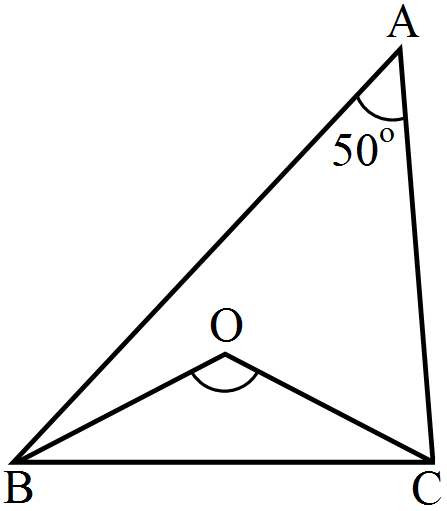
In the given figure, $BO$ and $CO$ are bisectors of $\angle\text{B}$ and $\angle\text{C}$ respectively. If $\angle\text{A}=50^\circ$ then $\angle\text{BOC}=?$
- A
$130^\circ$
- B
$100^\circ$
- ✓
$115^\circ$
- D
$120^\circ$
AnswerCorrect option: C. $115^\circ$
$\angle\text{A}+\angle\text{B}+\angle\text{C}=180^\circ$ (Angle sum property)
$\Rightarrow50^\circ+\angle\text{B}+\angle\text{C}=180^\circ$
$\Rightarrow\angle\text{B}+\angle\text{C}=130^\circ$
$\Rightarrow\frac{1}{2}\angle\text{B}+\frac{1}{2}\angle\text{C}=65^\circ$
In $\triangle\text{OBC},$
$\angle\text{OBC}+\angle\text{OCB}+\angle\text{BOC}=180^\circ$ (Angle sum property)
$\Rightarrow\frac{1}{2}\angle\text{B}+\frac{1}{2}\angle\text{C}+\angle\text{BOC}=180^\circ$
$\Rightarrow65^\circ+\angle\text{BOC}=180^\circ$
$\Rightarrow\angle\text{BOC}=115^\circ$
View full question & answer→MCQ 311 Mark
In fig, if $AD = BC$ and $\angle\text{BAD} = \angle\text{ABC},$ then $\angle\text{ACB}$ is equal to: 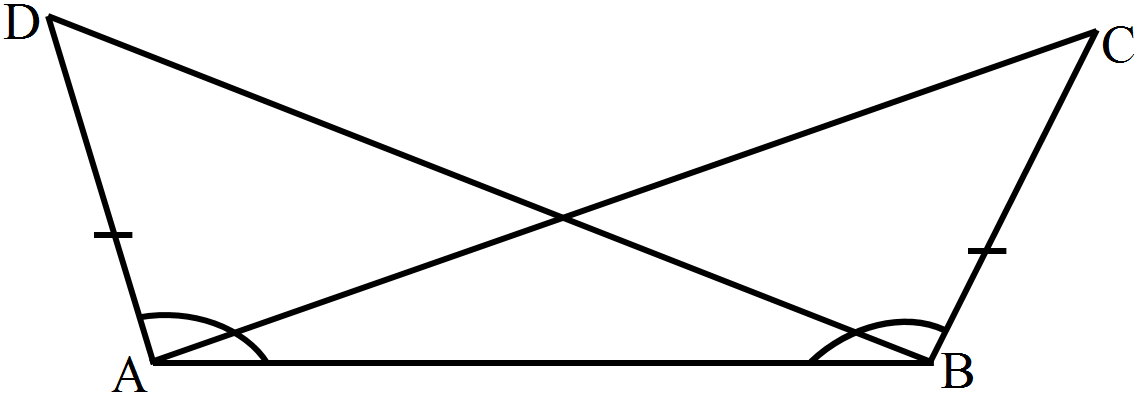
- A
$\angle\text{BAD}$
- B
$\angle\text{BAC}$
- ✓
$\angle\text{BDA}$
- D
$\angle\text{ABD}$
AnswerCorrect option: C. $\angle\text{BDA}$
The two triangles are congruent according to ($SAS CONGRUENCY$) as $AD = BC$ (given), $\angle\text{BAD} = \angle\text{ABC},$ (given) and $AB = AB$ (common) and hence corresponding angles are equal (cpct).
View full question & answer→MCQ 321 Mark
In figure, for which value of $x$ is $11||12?$
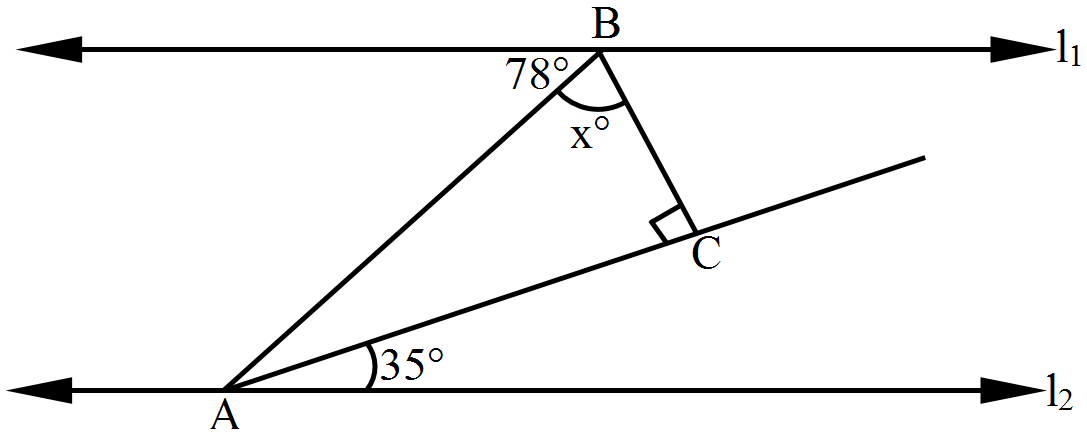
AnswerLet if $11||12$ and $AB$ is transverse to itThen,
$\angle\text{PBA}$ should be equal to $\angle\text{BAS}$ (Alternate angles)
So if $11||12,$ then $\angle\text{BAS}=70^\circ$
$\Rightarrow \angle\text{BAC} = 78^\circ - 35^\circ = 43^\circ\ ...\ (\text{i})$
Now, in $\angle\text{ABC}$
$\text{x}^\circ + \angle\text{C} + \angle\text{BAC} = 180^\circ$
$\Rightarrow \text{x}^\circ + 90^\circ + 43^\circ = 180^\circ$
$\Rightarrow \text{x}^\circ = 180^\circ - 90^\circ - 43^\circ = 47^\circ$
$\Rightarrow \text{x}^\circ = 47^\circ$
So if $\text{x}^\circ = 47^\circ$ then $11||12$
View full question & answer→MCQ 331 Mark
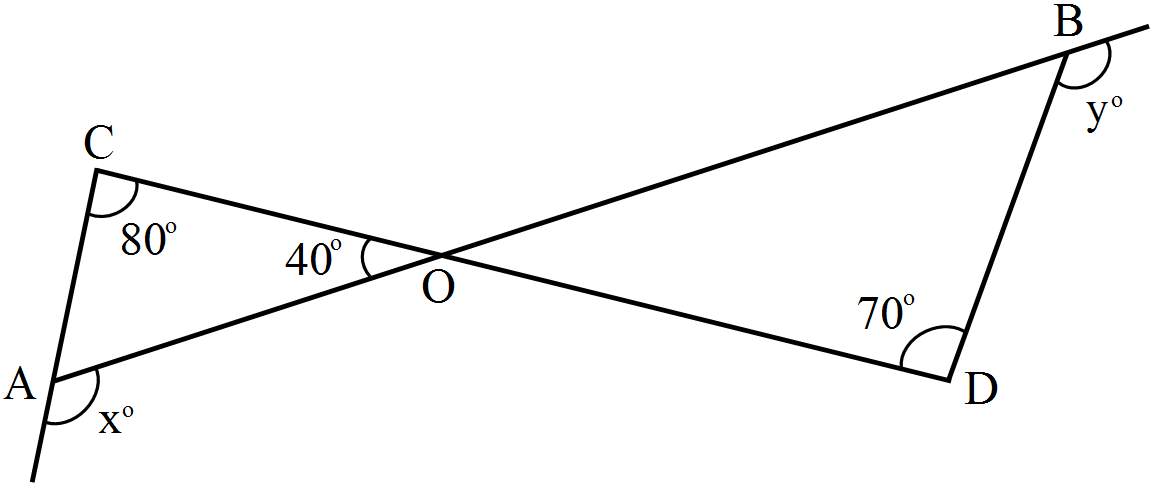
In Fig. $x + y =$
- A
$270^\circ$
- ✓
$230^\circ$
- C
$210^\circ$
- D
$190^\circ$
AnswerCorrect option: B. $230^\circ$
$\triangle\text{ACO}$
$\angle\text{ACO}+\angle\text{COA}+\angle\text{COA}=180^\circ$
Now, $\angle\text{OAC}=180^\circ-\text{x}^\circ$
$\Rightarrow80^\circ+40^\circ+180^\circ-\text{x}^\circ=180^\circ$
$\Rightarrow\text{x}^\circ=120^\circ$
$\angle\text{BOD}=\angle\text{COA}=40^\circ$ (Opposite angles)
$\angle\text{BDO}=70^\circ$
In $\triangle\text{OBD},$
$\angle\text{OBD}=180^\circ-40^\circ-70^\circ=70^\circ$
Also, $\text{y}^\circ=180^\circ-\angle\text{OBD}=180^\circ-70^\circ=110^\circ$
$\Rightarrow\text{x}^\circ+\text{y}^\circ=120^\circ+110^\circ=230^\circ$
View full question & answer→MCQ 341 Mark
In the following, write the correct answer. Which of the following is not a criterion for congruence of triangles?
AnswerWe know that, two triangles are congruent, if the sides and angles of one triangle are equal to the corresponding sides and angles of the other triangle.Also, criterion for congruence of triangles are $SAS$ (Side-Angle-Side), $ASA$ (Angle-Side- Angle), $SSS$ (Side-Side-Side) and $RHS$ (right angle-hypotenuse-side).
So, $SSA$ is not a criterion for congruence of triangles.
View full question & answer→MCQ 351 Mark
If $\triangle\text{ABC} ≅\triangle\text{PQR}$ by $SSS$ congruence rule, then:
- A
$AC = PQ$
- B
$BC = PQ$
- ✓
$BC = QR$
- D
$AC = QR$
AnswerCorrect option: C. $BC = QR$
If $\triangle\text{ABC} ≅\triangle\text{PQR}$ by SSS congruence rule, then the corresponding sides must be equal i.e $AB = PQ, BC = QR$ and $AC = PR.$
View full question & answer→MCQ 361 Mark
Which of the following statements is true?
- ✓
A triangle can have two acute angles.
- B
A triangle can have two right angles.
- C
A triangle can have two obtuse angles.
- D
AnswerCorrect option: A. A triangle can have two acute angles.
A triangle can have two or even all three acute angles (in case of an equilateral triangle) but it cannot have two right angles or two obtuse angles as the sum of the interior angles of a triangle is $180^\circ $ and two right angles or two obtuse angles would sum up to $180^\circ $ or more leaving the no space for the third angle.
View full question & answer→MCQ 371 Mark
In $\triangle\text{ABC}$ and $\triangle\text{DEF,}$ it is given that $\angle\text{B}=\angle\text{E}$ and $\angle\text{C}=\angle\text{F}.$ In order that $\triangle\text{ABC}\cong\triangle\text{DEF},$ we must have:
AnswerCorrect option: C. $BC = EF$
In $\triangle\text{ABC}$ and $\triangle\text{DEF},$
$\angle\text{B}=\angle\text{E}$ and $\angle\text{C}=\angle\text{F}$
So, the induded sides should be equal for the triangle to be congruent by the ASA congruence criterion.
Thus, we must have $BC = EF.$
View full question & answer→MCQ 381 Mark
In the above figure $\text{AB∥CD},$ $O$ is the mid point $BC$. Which of the following is true?
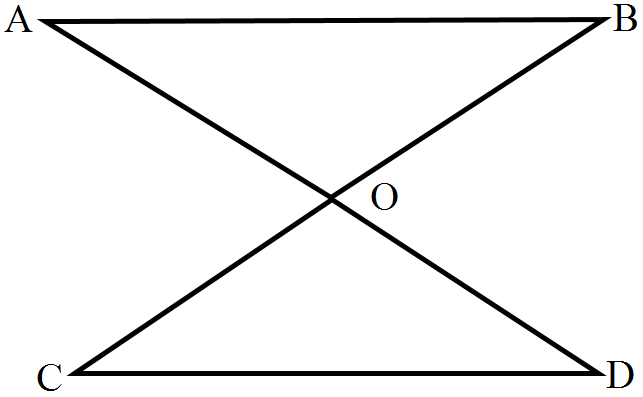
AnswerIn $\triangle\text{AOB}$ and $\triangle\text{DOC}$
$\angle\text{OAB}=\angle\text{ODC}$ (alternate interior angles)
$\angle\text{OBA}=\angle\text{OCD}$
$OB = OC$ (given)
So, from ASA congruence, we have
$\triangle\text{AOB}\cong\triangle\text{DOC}$
Now, from $CPCT,$ we have
$AB = CD$
$OA = OD$ which means $O$ is the mid-point of $AD.$
Hence, all the given statements are true.
View full question & answer→MCQ 391 Mark
In $\triangle\text{ABC},\angle\text{B}=\angle\text{C}$ and ray $AX$ bisects the exterior angle $\angle\text{DAC}.$ If $\angle\text{DAX}=70^\circ$ then $\angle\text{ACB}=$
- A
$35^\circ$
- B
$90^\circ$
- ✓
$70^\circ$
- D
$55^\circ$
AnswerCorrect option: C. $70^\circ$
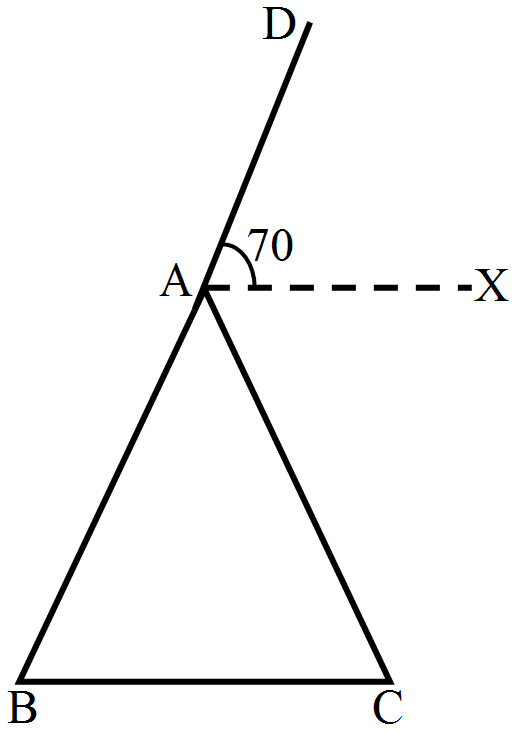
AX is bisector of $\angle\text{DAC}.$
$\Rightarrow\angle\text{DAX}=\angle\text{XAC}=70^\circ$
$\Rightarrow\angle\text{DAC}=2\times70^\circ=140^\circ$
Now, $\angle\text{A}=180^\circ-\angle\text{DAC}=180^\circ-140^\circ=40^\circ$
In $\triangle\text{ABC},$
$\angle\text{A}+\angle\text{B}+\angle\text{C}=180^\circ$
$\Rightarrow40^\circ+\angle\text{B}+\angle\text{C}=180^\circ$
$\Rightarrow40^\circ+\angle\text{C}+\angle\text{C}=180^\circ\dots(\angle\text{B}=\angle\text{C})$
$\Rightarrow2\angle\text{C}=140^\circ$
$\Rightarrow\angle\text{C}=70^\circ$
$\text{i.e}\angle\text{ACB}=70^\circ$ View full question & answer→MCQ 401 Mark
The side $BC$ of $\triangle\text{ABC}$ is produced to a poin D. The bisector of $\angle\text{A}$ meet side $BC$ in $L.$ If $\angle\text{ABC}=30^\circ$ and $\angle\text{ACD}=115^\circ,$ then $\angle\text{ALC}=$
- A
$85^\circ$
- ✓
$72\frac{1}{2}^\circ$
- C
$145^\circ$
- D
$\text{None of these}$
AnswerCorrect option: B. $72\frac{1}{2}^\circ$
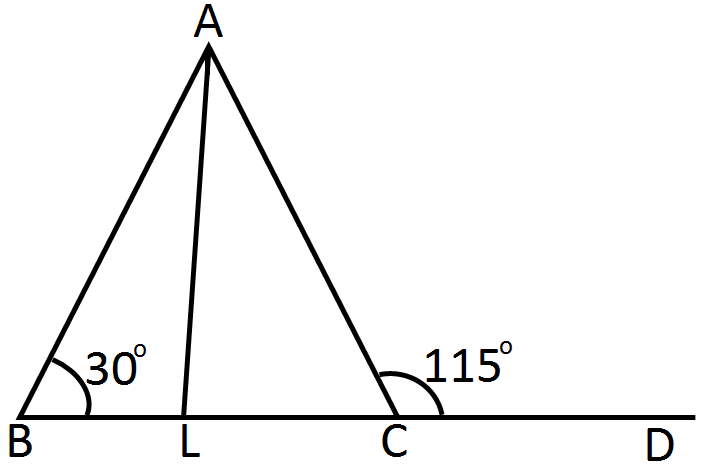
$\angle\text{C}=180^\circ-\angle\text{ACD}=180^\circ-115^\circ=65^\circ$
In $\triangle\text{ABC},$
$\angle\text{A}+\angle\text{B}+\angle\text{C}=180^\circ$
$\Rightarrow\angle\text{A}=180^\circ-30^\circ-65^\circ$
$\Rightarrow\angle\text{A}=85^\circ$
Now in $\angle\text{ALC}$
$\angle\text{ALC}+\angle\text{LAC}+\angle\text{C}=180^\circ$
$\Rightarrow\angle\text{ALC}=180^\circ-\angle\text{LAC}-\angle\text{C}$
$=180^\circ-\frac{\angle\text{A}}{2}-\angle\text{C}$
$=180^\circ-\frac{85^\circ}{2}-65^\circ$
$=\frac{145^\circ}{2}$
$=72\frac{1}{2}^\circ$ View full question & answer→MCQ 411 Mark
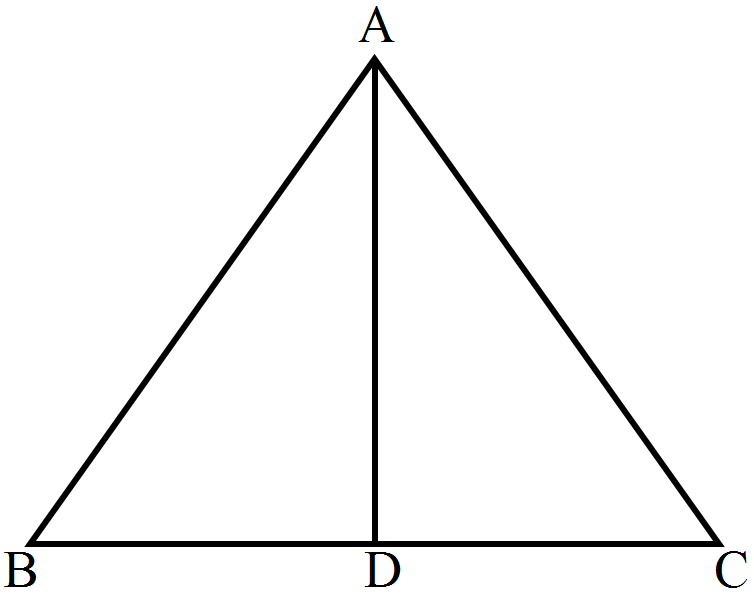
$AD$ is the median of the triangle. Which of the following is true?
- A
$AC + CD$
- B
$AB + BD$
- C
$AB + BC + AC > AD$
- ✓
$AB + BC + AC > 2AD$
AnswerCorrect option: D. $AB + BC + AC > 2AD$
In triangle $ADB$
$AB + BO > AD$
In triangle $ADC$
$AC + DC > AD$
Adding both,
$AB + AC + BO + DC > 2AD$
Now, $BO + DC = BC$
So, $AB + AC+ BC > 2AD$
View full question & answer→MCQ 421 Mark
In the following, write the correct answer. In $\triangle\text{ABC}$ and $\triangle\text{DEF},$ if $AB = AC,$ $\angle\text{A}=\angle\text{D}.$ The two triangles are:
- A
$BC = EF$
- ✓
$AC = DE$
- C
$AC = EF$
- D
$BC = DE$
AnswerCorrect option: B. $AC = DE$
In $\triangle\text{ABC},AB = DF$
$\angle\text{A}=\angle\text{D}$
We know that, two triangles will be congruent by $ASA$ rule, if two angles and the included side of one triangle are equal to the two angles and the included side of other triangle.
$AC = DE.$
View full question & answer→MCQ 431 Mark
If the altitudes from two vertices of a triangle to the opposite sides are equal, then the triangle is:
Answer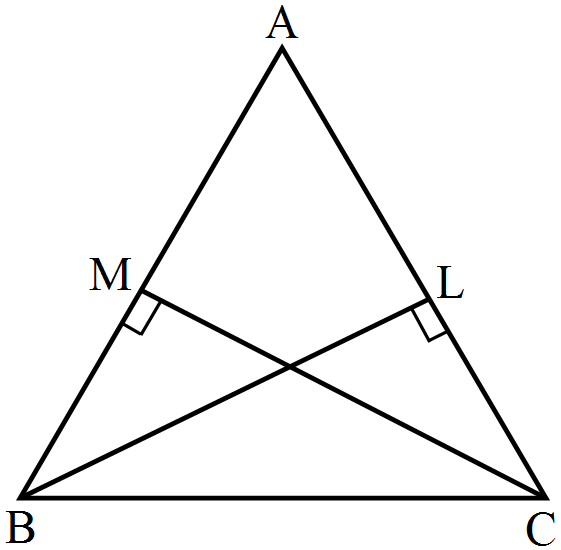
A $\triangle\text{ABC}$ is given in which $\text{BL}\perp\text{AC}$ and $\text{CM}\perp\text{AB}$ such that $\text{BL = CM.}$
TO prove: $\text{AB = AC}$
In $\triangle\text{ABL}$ and $\triangle\text{AMC,}$
$\text{BL = CM} ...($Given$)$
$\angle\text{ALB}=\angle\text{AMC} ...(E$ach is $90^\circ)$
$\angle\text{LAB}=\angle\text{MAC} ...($Common angle$)$
$\therefore\triangle\text{ABL}$ and $\triangle\text{AMC} ...(\text{AAS}$ congruence criterion$)$
$\Rightarrow\text{AB = AC} ...(\text{C.P.C.T.})$
Hence, the $\triangle\text{ABC}$ is an Isosceles triangle. View full question & answer→MCQ 441 Mark
In the given figure, side $BC$ of $\triangle\text{ABC}$ has been produced to a point $D$. If $\angle\text{A}=3\text{y}^\circ \angle\text{B}=\text{x}^\circ, \ \angle\text{C}=5\text{y}^\circ$ and $\angle\text{CBD}=7\text{y}^\circ.$ Then, the value of $x$ is: 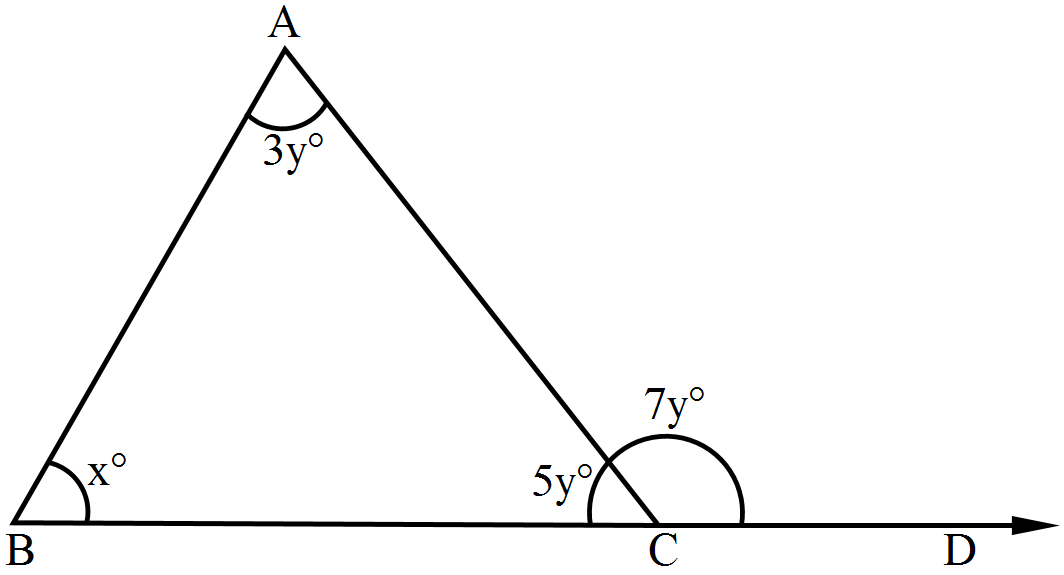
AnswerIn the given figure $\angle\text{ACB}+\angle\text{ACD}=180^\circ$ (Linear pair of angles)
$\therefore 5\text{y}′+7\text{y}′=180^\circ$
$\Rightarrow 12y^{\circ} = 180^{\circ}$
$\Rightarrow y = 15 ...(i)$
In $\triangle\text{ABC},$
$\angle\text{A}+\angle\text{B}+\angle\text{ACB}=180^\circ$ (angle sum property)
$\therefore 3\text{y}′+\text{x}′+5\text{y}′=180^\circ$
$\Rightarrow x^{\circ}+8 y^{\circ}=180^{\circ}$
$\Rightarrow x^2+8 \times 15^{\circ}=180^{\circ}[\text { using (1)] }$
$\Rightarrow x^{\prime}+120^{\circ}=180^{\circ}$
$\Rightarrow x^{\circ}=180^{\circ}-120^{\circ}=60^{\circ}$
Thus, the value of $x$ is $60 $.
View full question & answer→MCQ 451 Mark
In a $\triangle\text{ABC}, \ \angle\text{A} = 50^\circ$ and $BC$ is produced to a point $D$. If the bisectors $\angle\text{ACD}$ meet at $E$, then $\angle\text{E} =$
- ✓
$25^\circ$
- B
$50^\circ$
- C
$75^\circ$
- D
$100^\circ$
AnswerCorrect option: A. $25^\circ$
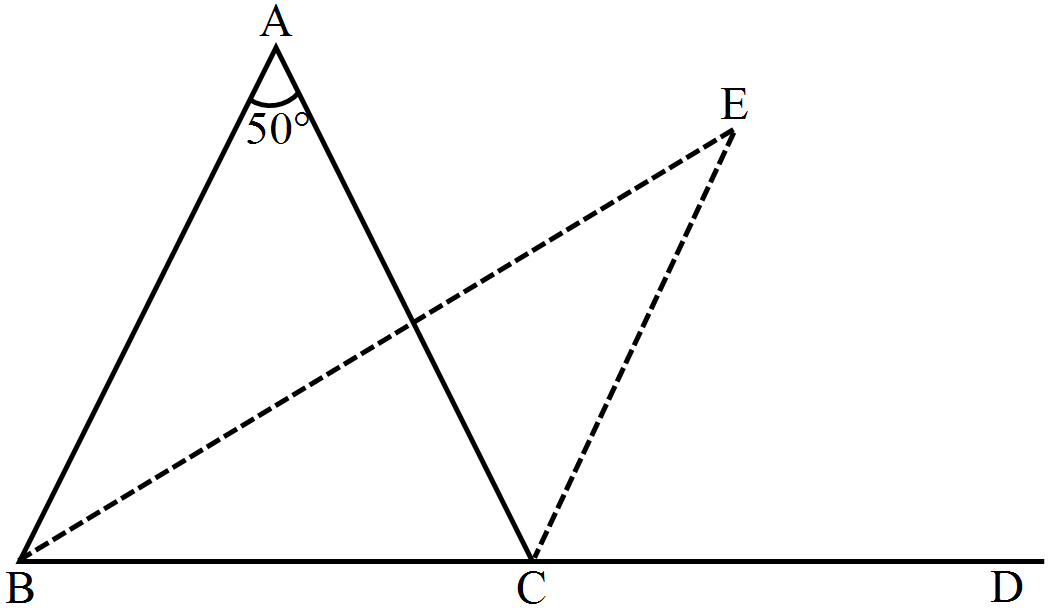
$BE$ and $CE$ are bisectors of $\angle\text{B}$ and $\angle\text{ACD}.$
in $\triangle\text{ABC}$
$\angle\text{A}+\angle\text{B}+\angle\text{C}=180^\circ$
$\Rightarrow\ \angle\text{B}+\angle\text{C}=180^\circ-50^\circ=130^\circ\ ...\ \text{(i)}$
Now,in $\triangle\text{BEC}$
$\angle\text{CBE}+\angle\text{BEC}+\angle\text{ECB}=180^\circ$
$\angle\text{CBE}=\frac{\angle\text{B}}{2},\ \angle\text{BEC}=\angle\text{E},\ \angle\text{ECB}=\angle\text{C}+\angle\text{ACE}$
Now, $\angle\text{ACD}=180^\circ-\angle\text{C}$
$\angle\text{ACE}=\frac{\angle\text{ACD}}{2}=\frac{180^\circ-\angle\text{C}}{2}=90^\circ-\frac{ \angle\text{C}}{2}$
So, $\angle\text{ECB}=\angle\text{C}+90^\circ-\frac{\angle\text{C}}{2}$
$\Rightarrow\ \angle\text{ECB}=90^\circ+\frac{\angle\text{C}}{2}$
Now putting all values in eq. $(ii)$
$\frac{\angle\text{B}}{2}+\angle\text{E}+90^\circ+\frac{\angle\text{C}}{2}=180^\circ$
$\Rightarrow\ \angle\text{E}=180^\circ-90^\circ-\Big(\frac{\angle\text{B}+\angle\text{C}}{2}\Big)$
$=90^\circ-\Big(\frac{\angle\text{B}+\angle\text{C}}{2}\Big)$
$=90^\circ-\frac{130^\circ}{2}$
$\Rightarrow\ \angle\text{E}=25^\circ$ View full question & answer→MCQ 461 Mark
$D$ is a point on the side $BC$ of a $\triangle\text{ABC}$ such that $AD$ bisects $\triangle\text{BAC}$ then:
- A
$CD > CA$
- B
$BD = CD$
- C
$BD > BA$
- ✓
$BA > BD$
AnswerCorrect option: D. $BA > BD$
Since, $\triangle\text{BAC}$ is bisected by $AD$, then $\triangle\text{BAD}$ is less than $\triangle\text{ABC},$ hence the side opposite $\triangle\text{ABC},$ i.e., $BA$ is greater than the side opposite to $\triangle\text{BAD}$ i.e.$, BD.$
View full question & answer→MCQ 471 Mark
In the above quadrilateral $ACBD$, we have $AC = AD$ and $AB$ bisect the $\angle\text{A}$ .Which of the following is true?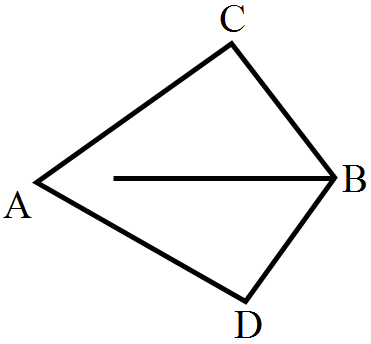
AnswerIn triangle $ABC$ and $ABD$, we have
$AC = AD$
$\angle\text{AB} = \angle\text{BAD}$
$AB = AB$
By $SAS$, we have
$\triangle\text{ABC}\cong\triangle\text{ABD}$
Hence, we have $BC = BD$ and $\angle\text{C} = \angle\text{D}.$
So, all the given options are true.
View full question & answer→MCQ 481 Mark
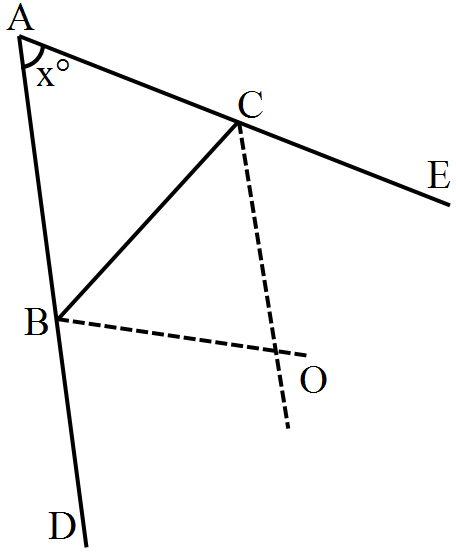
The bisector of exterior angles at $B$ and $C$ of $\triangle\text{ABC}$ meet at $O$. If $\angle\text{A} = \text{x}^\circ,$ then $\angle\text{BOC}.$
- ✓
$90^\circ-\frac{\text{x}^\circ}{2}$
- B
$180^\circ+\frac{\text{x}^\circ}{2}$
- C
$90^\circ+\frac{\text{x}^\circ}{2}$
- D
$180^\circ-\frac{\text{x}^\circ}{2}$
AnswerCorrect option: A. $90^\circ-\frac{\text{x}^\circ}{2}$
In $\triangle\text{ABC}$
$\angle\text{A}+\angle\text{B}+\angle\text{C}=180^\circ$
$\angle\text{B}+\angle\text{C}=180^\circ-\text{x}^\circ\ ...\ \text{(i)}$
$\angle\text{CBD}=180^\circ-\angle\text{B}\ ...\ \text{(ii)}$
$\angle\text{ECB}=180^\circ-\angle\text{C}\ ...\ \text{(iii)}$
$\Rightarrow\ \frac{\angle\text{CBD}}{2}=\angle\text{OBC}=90^\circ-\frac{\angle\text{B}}{2}\ ...\ \text{(iv)}$
$\Rightarrow\ \frac{\angle\text{ECB}}{2}=\angle\text{OCB}=90^\circ-\frac{\angle\text{C}}{2}\ ...\ \text{(v)}$
Now, in $\triangle\text{BOC}$
$\angle\text{OBC}+\angle\text{OCB}+\angle\text{BOC}=180^\circ$
$\angle\text{BOC}=180^\circ-(\angle\text{OBC}\ +\ \angle\text{OCB})$
From eq. $(iv)$ and $(v)$
$\angle\text{BOC}=180^\circ-\Big(90^\circ-\frac{\angle\text{B}}{2}+90^\circ-\frac{\angle\text{C}}{2}\Big)$
$=\ 180^\circ-\Big(180^\circ-\frac{\angle\text{B}}{2}-\frac{\angle\text{C}}{2}\Big)$
$=\frac{\angle\text{B}+\angle\text{C}}{2}$
$=\frac{180^\circ+\text{x}^\circ}{2}$
$\angle\text{BOC}=90^\circ-\frac{\text{x}^\circ}{2}$
View full question & answer→MCQ 491 Mark
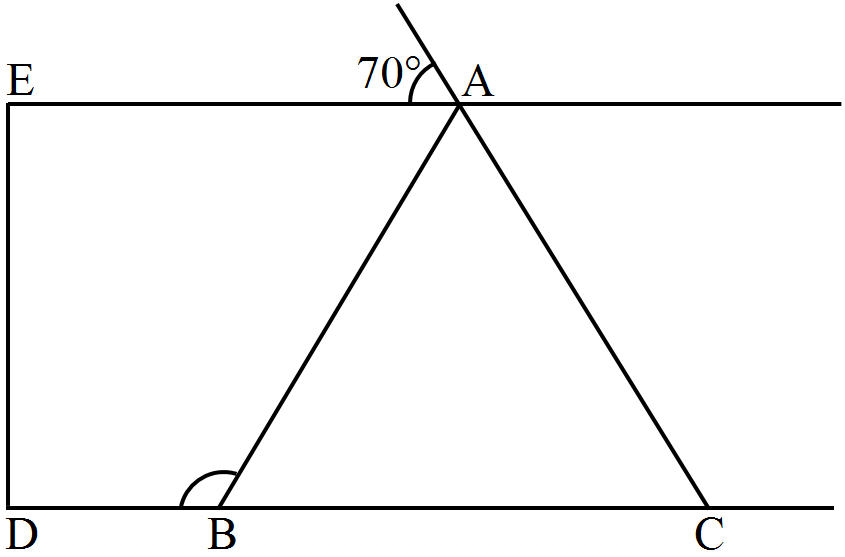
In figure, if $\text{AE}||\text{DC}$ and $AB = AC$, the value of $\angle\text{ABD}$ is:
- ✓
$110^\circ$
- B
$120^\circ$
- C
$70^\circ$
- D
$130^\circ$
AnswerCorrect option: A. $110^\circ$
$\angle\text{EAP} = \angle\text{BCA}$ (Corresponding angles)
$\angle\text{BCA} = 70^\circ$
$\angle\text{CBA} = \angle\text{BCA}$ (Angles opposite to equal sides are equal)
$\angle\text{CBA} = 70^\circ$
Now,
$\angle\text{ABD} + \angle\text{CBA }= 180^\circ$
$\angle\text{ABD} + 70 = 180^\circ$
$\angle\text{ABD} = 110^\circ$
View full question & answer→MCQ 501 Mark
In the following, write the correct answer. $D$ is point on the side $BC$ of a $\triangle\text{ABC}$ such that $AD$ bisects Then.
- A
$BC = CD$
- ✓
$BA > BD$
- C
$BD > BA$
- D
$CD > CA$
AnswerCorrect option: B. $BA > BD$
In $\triangle\text{ADC},$
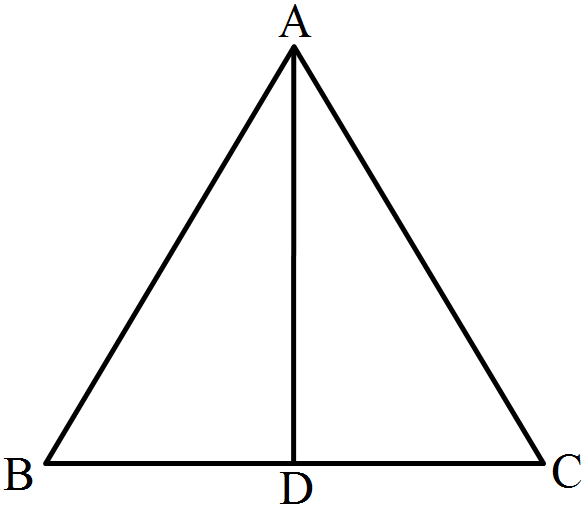
$AB > BD.$ View full question & answer→