MCQ 511 Mark
In a $\triangle\text{ABC},$ if $3\angle\text{A}=4\angle\text{B}=6\angle\text{C}$ then $A : B : C =?$
- A
$3 : 4 : 6$
- ✓
$4 : 3 : 2$
- C
$2 : 3 : 4$
- D
$6 : 4 : 3$
AnswerCorrect option: B. $4 : 3 : 2$
Given that $3\angle\text{A}=4\angle\text{B}=6\angle\text{C}=\text{k}.$
$\Rightarrow\angle\text{A}=\frac{\text{k}}{3},\angle\text{B}=\frac{\text{k}}{4}\text{ and}\ \angle\text{C}=\frac{\text{k}}{6}$
$\Rightarrow\text{A}:\text{B}:\text{C}=\frac{\text{k}}{3}:\frac{\text{k}}{4}:\frac{\text{k}}{6}$
$\Rightarrow\text{A}:\text{B}:\text{C}=\frac{1}{3}:\frac{1}{4}:\frac{1}{3}$
The $LCM$ of $3, 4$ and $6$ is $12.$
Multiply by $12$ throughout.
$\Rightarrow A : B : C = 4 : 3 : 2$
View full question & answer→MCQ 521 Mark
In Fig. $X$ is a point in the interior of square $ABCD. AXYZ$ is also a square. If $DY = 3\ cm$ and $AZ = 2\ cm$, then $BY =$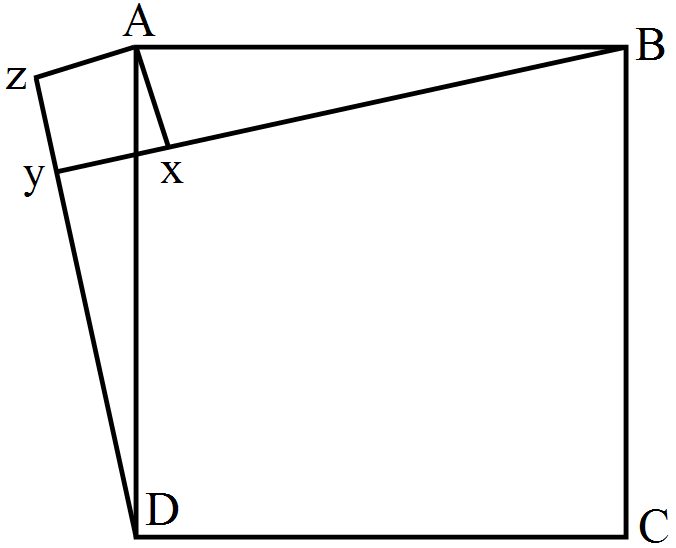
- A
$5\ cm$
- B
$6\ cm$
- ✓
$7\ cm$
- D
$8\ cm$
AnswerCorrect option: C. $7\ cm$
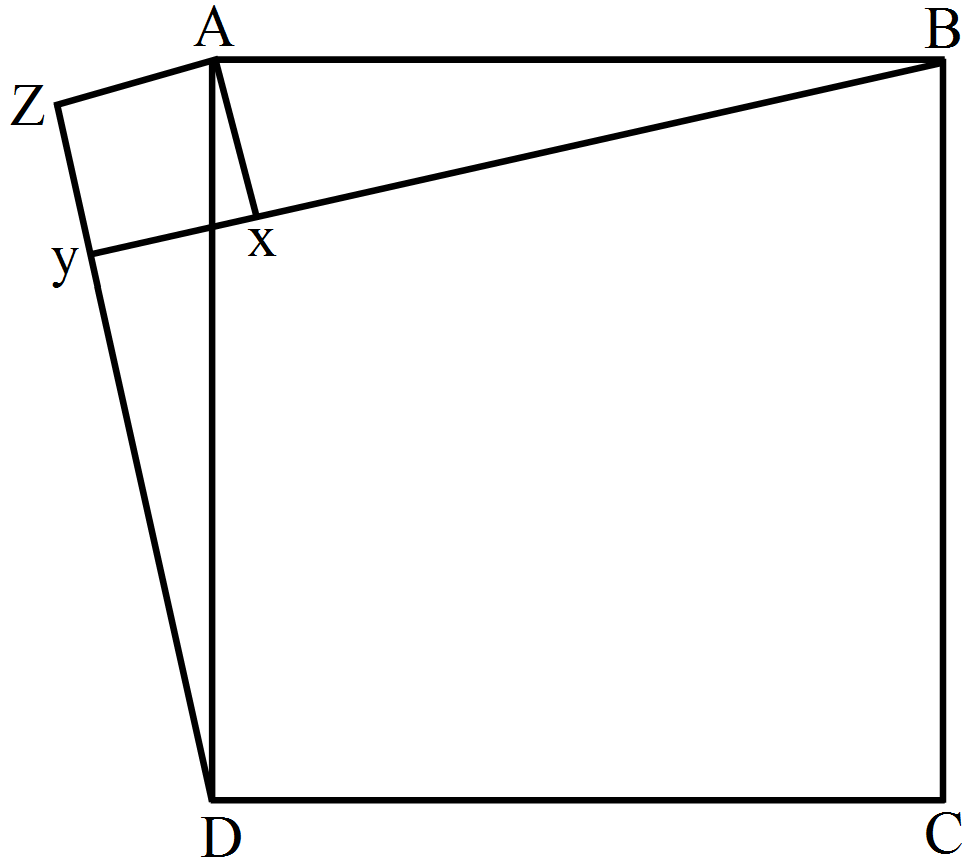
Consider $\triangle\text{ AZD}$ and $\triangle\text{AXB}$
$\text{AZ}=\text{AX}=2\text{cm}$ (AXYZ is a square)
$\angle\text{AZD}=\angle\text{AXB}=90^\circ$
$\text{AD}=\text{AB}$ (ABCD is a square)
So by RHS creterion, $\triangle\text{AZD}\cong\triangle\text{AXB}$
$\Rightarrow\text{ZD}=\text{XB}$
Now, $\text{ZD}=\text{ZY}+\text{DY}$
$=2cm + 3cm (ZY = AZ = 2cm)$
$=5cm$
$\Rightarrow XB = 5cm$
$\Rightarrow BY = YX + XB = 2cm + 5cm = 7cm$
Hence, correct option is $(c)$ View full question & answer→MCQ 531 Mark
Which of the following is not a criterion for congruence of triangles?
Answer$SSA$ is not a criterion for congruence of triangles.
View full question & answer→MCQ 541 Mark
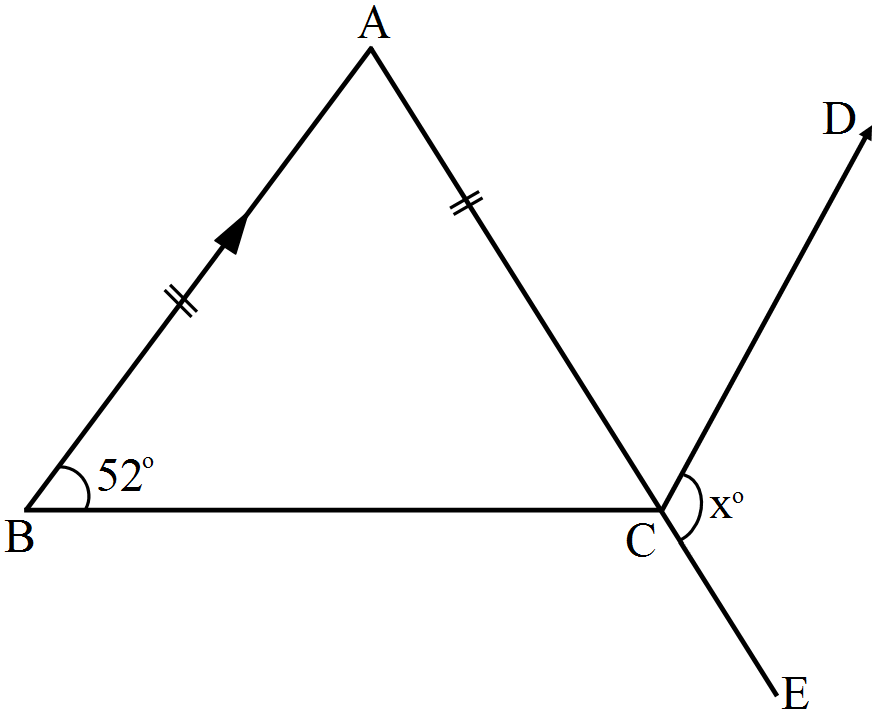
In Fig. $ABC$ ids an isosceles triangle whose side $AC$ is produced to $E$. Through $C, CD$ is drawn parallel to $BA$. The value of $x$ is:
- A
$52^\circ$
- B
$76^\circ$
- C
$156^\circ$
- ✓
$104^\circ$
AnswerCorrect option: D. $104^\circ$
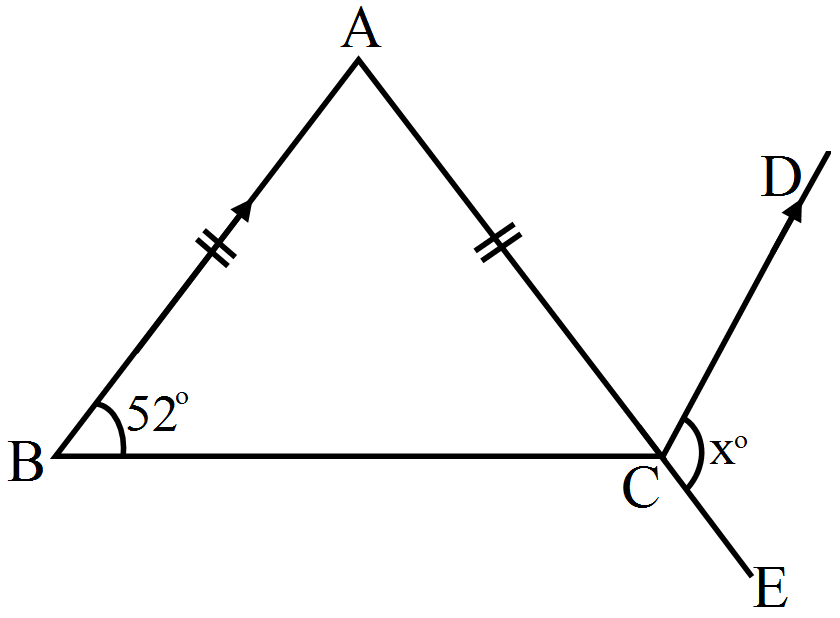
$\triangle\text{ABC}$ is isosceles
$\angle\text{ABC}=\angle\text{ACB}=52^\circ$
then $\angle\text{BAC}=180^\circ-52^\circ-52^\circ=76^\circ$
If $\text{AB}\parallel\text{CD},$ AC is transversal
then $\angle\text{BAC}=\angle\text{ACD}$ (alternate angles)
$\Rightarrow\angle\text{ACD}=76^\circ$
Now from figure,
$\angle\text{ACD}+\text{x}^\circ=180^\circ$
$\Rightarrow\text{x}^\circ=180^\circ-76^\circ$
$\Rightarrow\text{x}^\circ=104^\circ$
Hence, correct option is $(d).$ View full question & answer→MCQ 551 Mark
In figure, $ABC$ is a triangle in which $\angle\text{B} = 2\angle\text{C}.$ $D$ is a point on side $BC$ such that $AD$ bisects $\angle\text{BAC}$ and $AB = CD. BE$ is the bisector of $\angle\text{B}.$ The measure of $\angle\text{BAC}$ is: 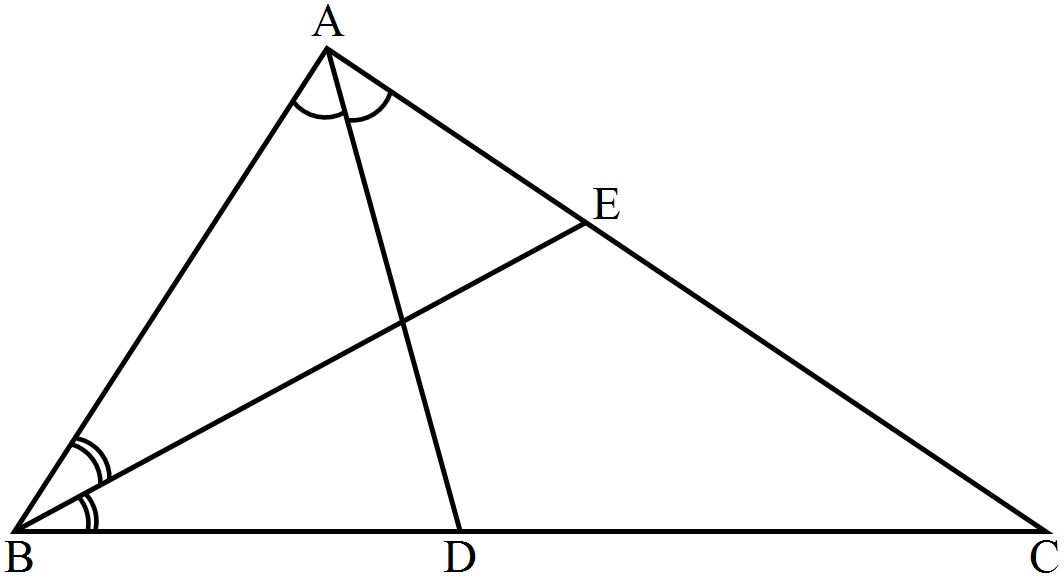
- A
$95^\circ$
- B
$73^\circ$
- ✓
$72^\circ$
- D
$74^\circ$
AnswerCorrect option: C. $72^\circ$
Given that $\triangle\text{ABC}$
BE is bisector of $\angle\text{B}$ and $AD$ is bisector of $\angle\text{BAC}$
$\angle\text{B} = 2\angle\text{C}$
By exterior angle theorem in triangle $ADC$
$\angle\text{ADB} = \angle\text{DAC} + \angle\text{C} ...\ \text{(i)}$
In $\triangle\text{ADB},$
$\angle\text{ABD} + \angle\text{BAD} + \angle\text{ADB} = 180^\circ$
$2\angle\text{C} + \angle\text{BAD} + \angle\text{DAC} + \angle\text{C} = 180^\circ$ [From $(i)]$
$3\angle\text{C} + \angle\text{BAC} = 180^\circ$
$\angle\text{BAC} = 180^\circ - 3\angle\text{C} ...\ \text{(ii)}$
Therefore,
$\text{AB = CD}$
$\angle\text{C} = \angle\text{DAC}$
$\angle\text{C} = \frac{1}{2}\angle\text{BAC}\ ...\ \text{(iii)}$
Putting value of Angle $C$ in $(ii)$, we get
$\angle\text{BAC} = 180^\circ - \frac{1}{2} \angle\text{BAC}$
$\angle\text{BAC} +\frac{3}{2} \angle\text{BAC} =180^\circ$
$\frac{5}{2} \angle\text{BAC} =180^\circ$
$\angle\text{BAC} = \frac{180\times2}{2}$
$=72^\circ$
$\angle\text{BAC} = 72^\circ$
View full question & answer→MCQ 561 Mark
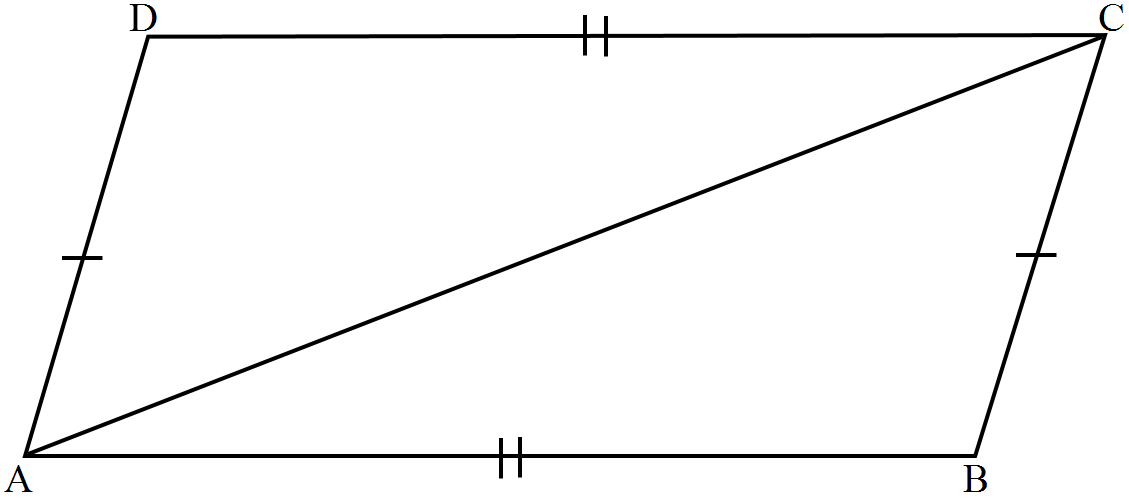
In the given fig., if $ABCD$ is a quadrilateral in which $AD = BC, AB = CD$, and $\angle\text{D} = \angle\text{B},$ then $\angle\text{CAB}$ is equal to:
- A
$\angle\text{CAD}$
- ✓
$\angle\text{ACD}$
- C
$\angle\text{ABC}$
- D
$\angle\text{BAC}$
AnswerCorrect option: B. $\angle\text{ACD}$
$\angle\text{ACD}$ is the right answer;In $\triangle\text{ACD}$ and $\triangle\text{CAB}$
$AD = BC$ (Given)
$\angle\text{D}=\angle\text{B}$ (Given)
$AB = CD$ (Given)
$\therefore\triangle\text{ACD}≅\triangle\text{CAB}$ (by $SAS$ congruence criteria),
$\Rightarrow \angle\text{CAB} = \angle\text{ACD}$ (cpct).
View full question & answer→MCQ 571 Mark
$D, E, F$ are the mid-point of the sides $BC, CA$ and $AB$ respectively of $\triangle\text{ABC}.$ Then $\triangle\text{DEF}$ is congruent to triangle.
- A
$ABC$
- B
$AEF$
- C
$BFD, CDE$
- ✓
$AFE, BFD, CDE$
AnswerCorrect option: D. $AFE, BFD, CDE$
In anytriangle, a line joining the mid-points of any two sides is parallel to the third side.
$\Rightarrow EF || BC EF || DC$ and $BD$
Similiarly $DF || EC$
$\Rightarrow DF || AE$ and $EC$
Also $DE || AB.$
$\Rightarrow DE || AF$ and $BF$
From this information it is clear that $EFDC, EFBD, EAFD$
are the parallelogram by property.
Now consider one parallelogram $EFDC$
Consider $\triangle\text{DEF}$ and $\triangle\text{EDC}$
$\text{DE}=\text{ED}$ (common)
$\angle\text{DEF}=\angle\text{EDC}$
$\angle\text{EDF}=\angle\text{DEC}$ (ASA property)
$\Rightarrow\triangle\text{DEF}\cong\triangle\text{EDC}$
Similiarly in parallelogram $EAFD,$
$\triangle\text{DEF}\cong\triangle\text{AFC}$
And in parallelogram $EFBD$
$\triangle\text{DEF}\cong\triangle\text{FBD}$
Hence, correct option is $(d).$
Note: Option $(d)$ modified.
View full question & answer→MCQ 581 Mark
In the adjoining figure, $AC= BD$. If $\angle\text{CAB} = \angle\text{DBA},$ then $\angle\text{ACB}$ is equal to: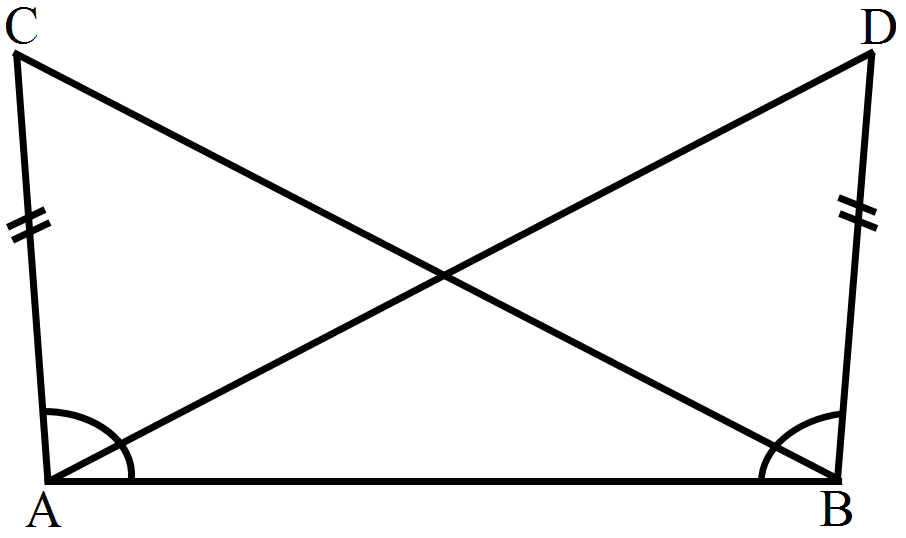
- A
$\angle\text{ABC}$
- ✓
$\angle\text{BDA}$
- C
$\angle\text{ABD}$
- D
$\angle\text{ABC}$
AnswerCorrect option: B. $\angle\text{BDA}$
In $\triangle\text{CAB}$ and $\triangle\text{DBA},$
AC = BD and $\angle\text{CAB} = \angle\text{DBA}$ (Given)
AB (Common)
Therefore, $\triangle\text{CAB}$ and $\triangle\text{DBA}$ are congruent by $SAS$ criteria
Therefore, $\angle\text{ACP} = \angle\text{BDA}$ (by $CPCT)$
View full question & answer→MCQ 591 Mark
An exterior angle of a triangle is $108^\circ $ and its interior opposite angles are in the ratio $4 : 5$ The angles of the triangle are:
- ✓
$48^\circ , 60^\circ , 72^\circ$
- B
$50^\circ , 60^\circ , 70^\circ$
- C
$52^\circ , 56^\circ , 72^\circ$
- D
$42^\circ , 60^\circ , 76^\circ$
AnswerCorrect option: A. $48^\circ , 60^\circ , 72^\circ$
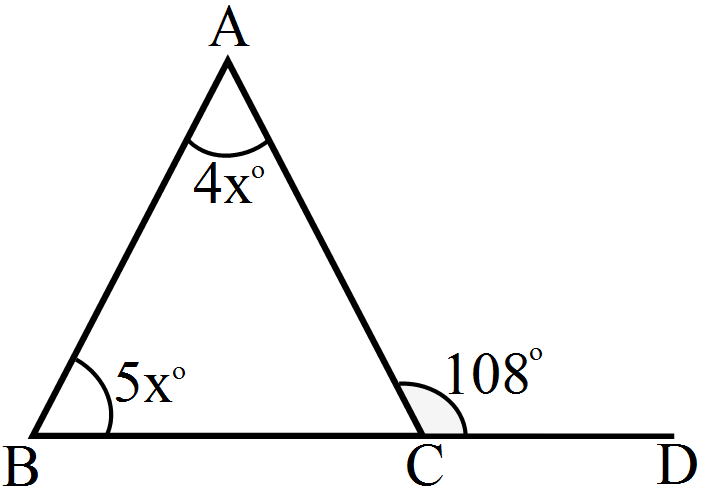
From figure, we have
$\angle\text{A}+\angle\text{B}=\angle\text{ACD}$
$\Rightarrow4\text{x}^\circ+5\text{x}^\circ=108^\circ$
$\Rightarrow9\text{x}^\circ=108^\circ$
$\Rightarrow\text{x}=12^\circ$
So, $\angle\text{A}=48^\circ,\angle\text{B}=60^\circ$
$\Rightarrow\angle\text{C}=180^\circ-48^\circ-60^\circ=72^\circ$ View full question & answer→MCQ 601 Mark
In fig, if $AD = BC$ and $\angle\text{BAD} = \angle\text{ABC},$ then $\angle\text{ACB}$ is equal to: 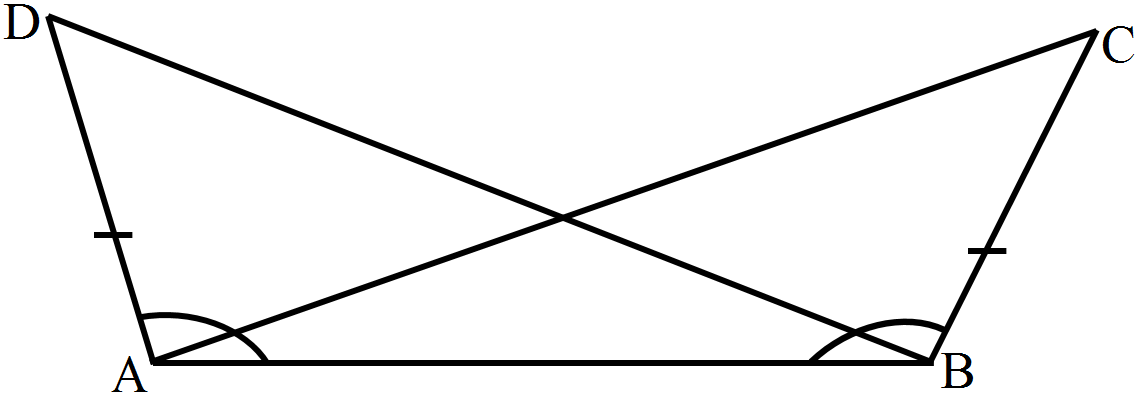
- ✓
$\angle\text{BDA}$
- B
$\angle\text{BAC}$
- C
$\angle\text{ABD}$
- D
$\angle\text{BAD}$
AnswerCorrect option: A. $\angle\text{BDA}$
The two triangles are congruent according to ($SAS \ CONGRUENCY$) as $AD = BC$ (given), $\angle\text{BAD} = \angle\text{ABC},$ (given) and $AB = AB$ (common) and hence corresponding angles are equal (cpct).
View full question & answer→MCQ 611 Mark
Find the measure of angles which is equal to its supplement.
- A
$45^\circ$
- B
$60^\circ$
- C
$120^\circ$
- ✓
$90^\circ$
AnswerCorrect option: D. $90^\circ$
We know that the sum of supplementary angle is $180^\circ$
Let the angle be x the other angle is 180° - x and the two angles are equal,
$\Rightarrow x = 180^\circ - x$
$\Rightarrow 2x = 180^\circ$
$\Rightarrow\ \text{X}=\frac{180^\circ}{2}$
$\Rightarrow\ \text{X}=90^\circ$
View full question & answer→MCQ 621 Mark
If $ABC$ and $DEF$ are two triangles such that $\triangle\text{ABC}\cong\triangle\text{FDE}$ and $\text{AB}=5\text{m},\angle\text{B}=40^\circ$ and $\angle\text{A}=80^\circ.$ Then, which of the following is true?
- A
$\text{DF}=5\text{cm},\angle\text{F}=60^\circ$
- B
$\text{DE}=5\text{cm},\angle\text{E}=60^\circ$
- ✓
$\text{DF}=5\text{cm},\angle\text{E}=60^\circ$
- D
$\text{DE}=5\text{cm},\angle\text{D}=40^\circ$
AnswerCorrect option: C. $\text{DF}=5\text{cm},\angle\text{E}=60^\circ$
In $\triangle\text{ABC},$
$\angle\text{C}=180^\circ-\angle\text{A}+\angle\text{B}=180^\circ-80^\circ-40^\circ=60^\circ$
$\triangle\text{ABC}\cong\triangle\text{FDE}$
$\Rightarrow\text{AB}=\text{FD}=5\text{cm}$
$\Rightarrow\angle\text{B}=\angle\text{D}=40^\circ$
$\Rightarrow\angle\text{A}=\angle\text{F}=80^\circ$
$\Rightarrow\angle\text{C}=\angle\text{E}=60^\circ$
$\Rightarrow\text{DF}=\text{FD}=5\text{cm}$ and $\angle\text{E}=60^\circ$
Hence, correct option is $(c).$
View full question & answer→MCQ 631 Mark
The cost of turfing a triangular field at the rate of Rs. $45$ per $100m^2$ is Rs. $900$. If the double the base of the triangle is $5$ times its height, then its height is:
- A
$42\ cm$
- B
$32\ cm$
- C
$44\ cm$
- ✓
$40\ cm$
AnswerCorrect option: D. $40\ cm$
Cost of turfing a triangilar field at the rate of Rs. $45$ per $100 = Rs. 900$
$\frac{\text{Arae}\times45}{100}=900$
$\Rightarrow $ Area $= 2000$ sq.cm
According to question,
$2 \times $ Base $= 5 \times $ Height
$\Rightarrow\ \text{Base}=\frac{\text{Height}\times5}{2}$
Area of a triangle $= 2000$ sq.cm
$\Rightarrow\ \frac{1}{2}\times\text{Base}\times\text{Height}=2000$
$\Rightarrow\ \frac{1}{2}\times\frac{\text{Height}\times5}{2}\times\text{Height}=2000$
$\Rightarrow\ \text{(Height)}^2=1600$
$\Rightarrow\ \text{Height}=40\text{cm}$
View full question & answer→MCQ 641 Mark
In $\triangle\text{ABC},$ $BC = AB$ and $\angle\text{B} = 80^\circ.$ Then $\angle\text{A}$ is equal to:
- A
$100^\circ$
- B
$80^\circ$
- C
$40^\circ$
- ✓
$50^\circ$
AnswerCorrect option: D. $50^\circ$
Given: $\triangle\text{ABC},\ \text{(BC=AB)}$ and $\angle\text{B} = 80^\circ$
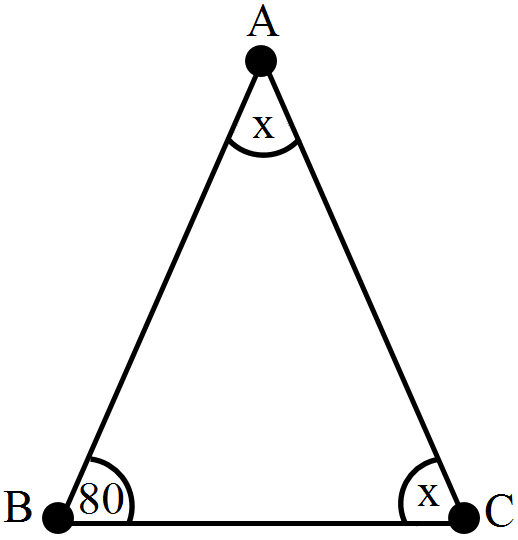
As $BC = AB$
So it is an isosceles triangle.
let $\angle\text{C} = \angle\text{A} = \text{x}$
$\angle B = \angle\text{B} = 80^\circ$ (given)
As we know $\angle\text{A} + \angle\text{B} + \angle\text{C} = 180^\circ$
$\Rightarrow x + 80^\circ + x = 180^\circ$
$\Rightarrow 2x = 180^\circ - 80^\circ$
$\Rightarrow 2x = 100^\circ$
$\Rightarrow x = 50^\circ$
So, $\angle\text{C} = \angle\text{A} = 50^\circ$ View full question & answer→MCQ 651 Mark
The sum of the interior angles of a triangle is:
- A
$90^\circ$
- ✓
$180^\circ$
- C
$270^\circ$
- D
$360^\circ$
AnswerCorrect option: B. $180^\circ$
For a triangle,
Number of sides $(n) = 3$
Sum of interior angles $= (n - 2) \times 180^\circ$
$= (3 - 2) \times 180^\circ$
$= 1 \times 180^\circ$
$= 180^\circ$
View full question & answer→MCQ 661 Mark
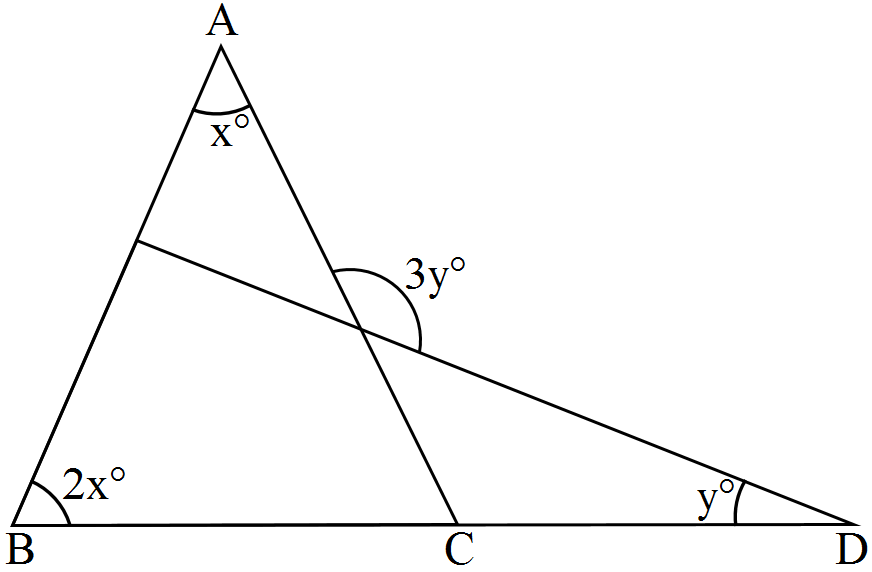
In figure, what is $Y$ in terms of $X?$
- ✓
$\frac{3}{2}\text{X}^\circ$
- B
$\frac{3}{4}\text{X}^\circ$
- C
$\frac{4}{3}\text{X}^\circ$
- D
$\text{X}$
AnswerCorrect option: A. $\frac{3}{2}\text{X}^\circ$
From Figure, $\angle\text{DOC} = 180^\circ - \angle\text{AOD}$ (Both are Supplementary)$\Rightarrow \ \angle\text{DOC} = 180^\circ−3\text{y}^\circ$
Also, $\angle\text{ACB} = 180^\circ- \angle\text{A} - \angle\text{B}$
$\Rightarrow \angle\text{ACB} = 180^\circ - \text{x}^\circ−2\text{x}^\circ = 180^\circ - 3\text{x}^\circ$
And $ \angle\text{ACD} = 180^\circ - \angle\text{ACB}$
$= 180^\circ - (180^\circ- 3\text{x}^\circ)$
$\Rightarrow \angle\text{ACD}=3\text{x}^\circ$
Now, in $\triangle\text{OCD}$
$\angle\text{DOC} + \angle\text{OCD} + \angle\text{D} = 180^\circ$
$180^\circ − 3\text{y}^\circ + 3\text{x}^\circ + \text{y}^\circ = 180^\circ\ [\angle\text{OCD} = \angle\text{ACD}]$
$\Rightarrow 2\text{y}^\circ=3\text{x}^\circ$
$\Rightarrow\ \text{Y}=\frac{3}{2}\text{X}^\circ$
View full question & answer→MCQ 671 Mark
In $\triangle\text{ABC},$ if $\angle\text{A} = 45^\circ$ and $\angle\text{B} = 70^\circ,$ then the shortest and the longest sides of the triangle are ________ .
- A
$BC, AB$
- ✓
$BC, AC$
- C
$AB, BC$
- D
$AB, AC$
AnswerCorrect option: B. $BC, AC$
Smallest angle is $A$ and greatest angle is $B$ and hence sides opposite to these angles are $BC$ and $AC$ and they are shortest and longest respectively.
View full question & answer→MCQ 681 Mark
If the altitudes from two vertices of a triangle to the opposite sides are equal then the triangle is:
Answer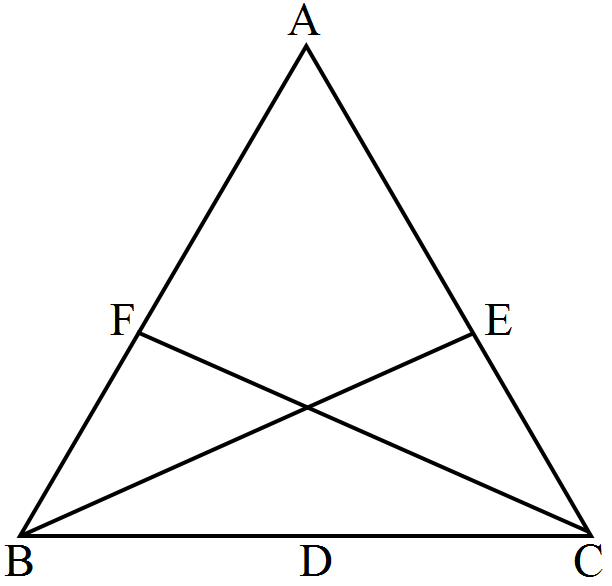
In triangles $ABE$ and $ACF$
$\angle\text{AEB}=\angle\text{AFC}$ $(90^\circ $ each)
$\angle\text{BAE}=\angle\text{CAF}$ (common angle)
$\Rightarrow\angle\text{ABE}=\angle\text{ACF}$ ... using angle sum property
$BE = CF$ (given)
$⇒\triangle\text{ABE}≅\triangle\text{ACF} (ASA)$
$\Rightarrow AB = AC$ (c.p.c.t)
Hence, $\triangle\text{ABC}$ is an isosceles triangle .... as two sides are equal to each other. View full question & answer→MCQ 691 Mark
It is given that $\triangle\text{ABC} ≅\triangle\text{FDE}$ and $AB = 5\ cm$, $\angle\text{B} = 40^\circ$ and $\angle\text{A} = 80^\circ$ Then which of the following is true?
- A
$\text{DF} = 5\text{cm}, \ \angle\text{F} = 60^\circ$
- B
$\text{DE} = 5\text{cm}, \ \angle\text{D} = 40^\circ$
- C
$\text{DE} = 5\text{cm}, \ \angle\text{E} = 60^\circ$
- ✓
$\text{DF} = 5\text{cm}, \ \angle\text{E} = 60^\circ$
AnswerCorrect option: D. $\text{DF} = 5\text{cm}, \ \angle\text{E} = 60^\circ$
Given that: In $\triangle\text{ABC}, \ \text{AB} = 5\text{cm},\ \angle\text{B} = 40^\circ$ and $\angle\text{A} = 80^\circ$
Using angles sum property of triangle, we have
$\angle\text{A} + \angle\text{B} + \angle\text{C} = 180^\circ$
$\Rightarrow 80^\circ + 40^\circ + \angle\text{C} = 180^\circ$
$\Rightarrow 120^\circ + \angle\text{C} = 180^\circ$ [$\therefore\ \angle\text{B} = 40^\circ$ and $\angle\text{A} = 80^\circ$]
$\Rightarrow \angle\text{C} = 180^\circ – 120^\circ$
$\Rightarrow \angle\text{C} = 60^\circ$
It is given that $\triangle\text{ABC} ≅\triangle\text{FDE},$ so we have
$AB = FD, BC = DE$ and $\text{AC}=\text{FE}\ \&\ \angle\text{A} = \angle\text{F}, \ \angle\text{B} = \angle\text{D}$ and $\angle\text{C} = \angle\text{E}$
$\Rightarrow AB = FD = 5cm$ and $\angle\text{C} = \angle\text{E} = 60^\circ$
View full question & answer→MCQ 701 Mark
The side $BC, CA$ and $AB$ of $\triangle\text{ABC}$ have been produced to $D, E$ and $F$ respectively. $\angle\text{BAE}+\angle\text{CBF}+\angle\text{ACD}=?$
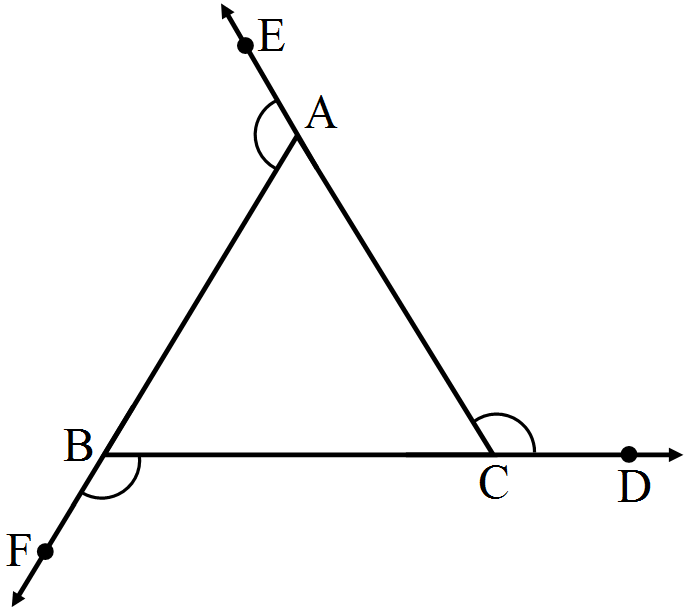
- A
$240^\circ$
- B
$300^\circ$
- C
$320^\circ$
- ✓
$360^\circ$
AnswerCorrect option: D. $360^\circ$
Clearly, $\angle1+\angle\text{BAE}=180^\circ\ ....(\text{i)}$(Supplementary angles)
Also, $\angle2+\angle\text{CBF}=180^\circ\ .....(\text{ii)}$ (Supplementary angles)
And $\angle\text{3}+\angle\text{ACD}=180^\circ\ .....(\text{iii)}$ (Supplementary angles)
$\therefore(\angle1+\angle2+\angle3)+(\angle\text{BAE}\\+\angle\text{CBF}+\angle\text{ACD})=540^\circ$
$\Rightarrow180^\circ+(\angle\text{BAE}+\angle\text{CBF}+\angle\text{ACD})=540^\circ$ (Angle sum property)
$\Rightarrow\angle\text{ACD}+\angle\text{BAE}+\angle\text{CBF}=360^\circ$
View full question & answer→MCQ 711 Mark
In $\angle\text{ABC}, \angle\text{A}=40^\circ$ and $\angle\text{B}=60^\circ$ Then, the longest side of $\triangle\text{ABC}$ is:
AnswerThe third angle $\angle\text{C}=80^\circ$ [Angle sum property]
The side opposite to the longest angle is the longest side.
Therefore, $AB$ is the longest side of the triangle.
View full question & answer→MCQ 721 Mark
In an isosceles triangle, if the vertex angle is twice the sum of the base angles, then the measure of vertex angle of the triangle is:
- A
$100^\circ$
- ✓
$120^\circ$
- C
$110^\circ$
- D
$130^\circ$
AnswerCorrect option: B. $120^\circ$
Let $\triangle\text{ABC}$ be an isosceles triangle with
vertex angle = $\angle\text{A}$ and base angles = $\angle\text{B}$ and $\angle\text{C}$
Now, $\angle\text{A}=2(\angle\text{B}+\angle\text{C})$
$\Rightarrow\frac{\angle\text{A}}{2}=\angle\text{B}+\angle\text{C}\ ....(1)$
Also in $\triangle\text{ABC},$
$\angle\text{A}+\angle\text{B}+\angle\text{C}=180^\circ$
$\Rightarrow\angle\text{A}+(\angle\text{B}+\angle\text{C})=180^\circ$
$\Rightarrow\angle\text{A}+\frac{\angle\text{A}}{2}=180^\circ$ .....[From $(1)]$
$\Rightarrow\frac{3}{2}\angle\text{A}=180^\circ$
$\Rightarrow\angle\text{A}=\frac{180^\circ\times2}{3}$
$\Rightarrow\angle\text{A}=120^\circ$
Hence, correct option is $(b).$
View full question & answer→MCQ 731 Mark
Which of the following pairs of angle are supplementary?
- A
$30^\circ , 60^\circ$
- B
$135^\circ , 55^\circ$
- C
- ✓
$45^\circ , 135^\circ$
AnswerCorrect option: D. $45^\circ , 135^\circ$
We know that the sum of supplementary angle is $180^\circ $
and the sum of $45^\circ , 135^\circ $ is also $180^\circ .$
View full question & answer→MCQ 741 Mark
In figure, $ABCD$ is a quadrilateral in which $AB = BC$ and $AD = DC$. The measure of $\angle\text{BCD}$ is: 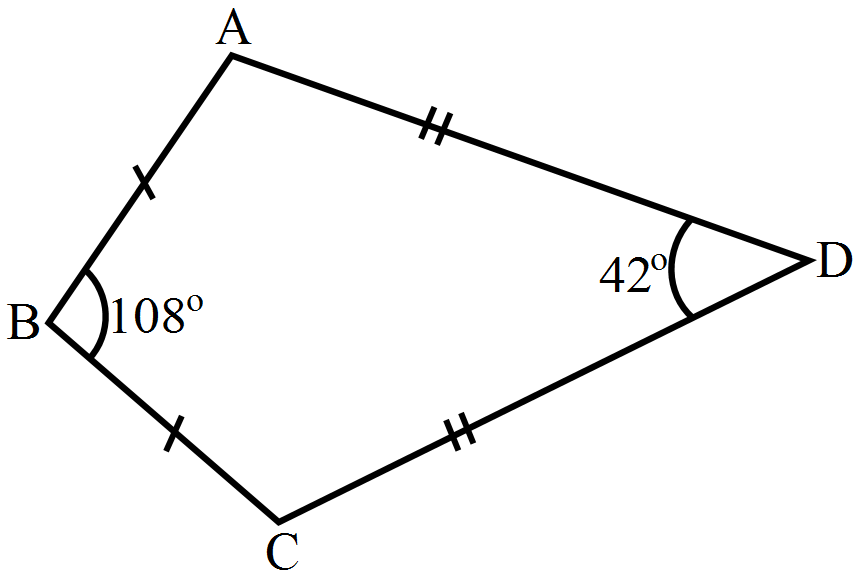
- A
$30^\circ$
- ✓
$105^\circ$
- C
$150^\circ$
- D
$72^\circ$
AnswerCorrect option: B. $105^\circ$
Join $AC$. We get two isosceles triangles. $\triangle\text{ABC}$ and $\triangle\text{ACD}.$
In $\triangle\text{ABC},\ \angle\text{ABC}= 108^\circ$
$\therefore\angle\text{BAC} = \angle\text{BCA} = \frac{(180^\circ -108^\circ)}{2} = \frac{72^\circ}{2} = 36^\circ$
In $\triangle\text{ACD},\ \angle\text{ADC}= 42^\circ$
$\therefore\angle\text{DAC} = \angle\text{DCA} = \frac{(180^\circ -42^\circ)}{2} = \frac{138^\circ}{2} = 69^\circ$
Now, $\angle\text{BCD} = \angle\text{BCA} + \angle\text{DCA} = 36^\circ + 69^\circ = 105^\circ$
View full question & answer→MCQ 751 Mark
Which of the following is not a criterion for congruence of triangles?
AnswerThe criteria for congruence of triangles are $SSS$(Side-Side-Side), $SAS$(Side-Angle-Side), $ASA$(Angle-Side- Angle) and $RHS$(Right angle-Hypotenuse-Side).
View full question & answer→MCQ 761 Mark
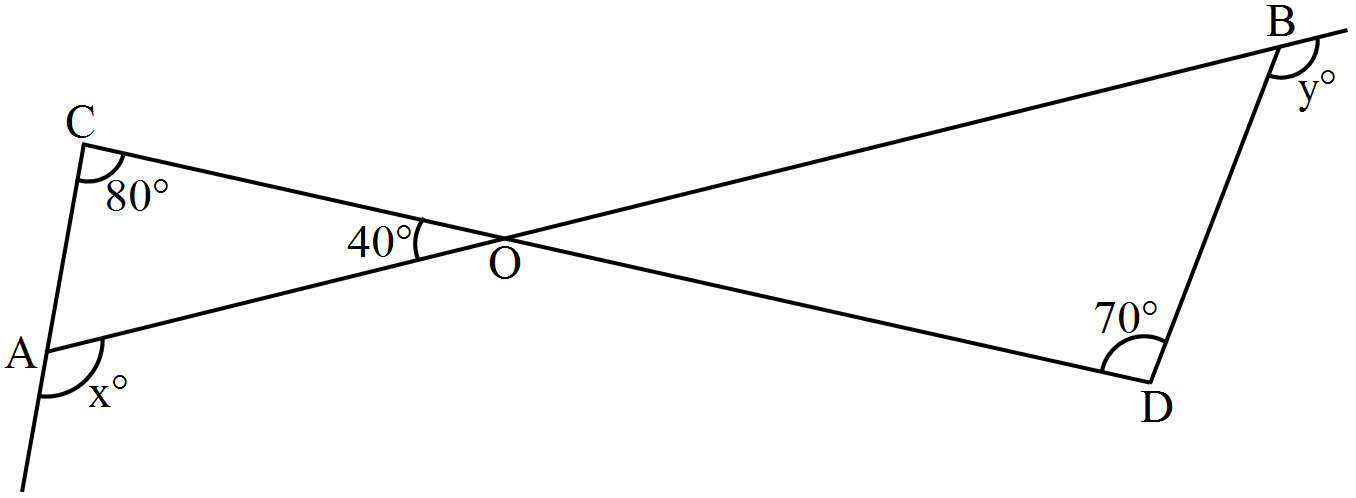
In figure, $x + y =$
- A
$190^\circ$
- B
$210^\circ$
- C
$270^\circ$
- ✓
$230^\circ$
AnswerCorrect option: D. $230^\circ$
In $\triangle\text{ACO}$$\angle\text{ACO} + \angle\text{COA} + \angle\text{OAC} = 180^\circ$
Now, $\angle\text{OAC} = 180^\circ$
$\Rightarrow \ 80^\circ + 40^\circ + 180^\circ - \text{x}^\circ= 180^\circ$
$\Rightarrow \ \text{x}^\circ = 120^\circ$
$ \angle\text{BOD} = \angle\text{COA} = 40^\circ$ (Opposite angles)
$\angle\text{BDO} = 70^\circ$
In $\triangle\text{OBD}$
$\angle\text{OBD} = 180^\circ - 40^\circ - 70^\circ = 70^\circ$
Also, $\text{y}^\circ = 180^\circ - \angle\text{OBD} = 180^\circ - 700^\circ = 110^\circ$
$\Rightarrow \ \text{x}^\circ + \text{y}^\circ = 120^\circ + 110^\circ = 230^\circ$
View full question & answer→MCQ 771 Mark
If one angle of a triangle is equal to the sum of the other two angles, then the triangle is:
AnswerLet the three angles of a triangle be $A, B$ and $C$.
Now, $A + B + C = 180^\circ $
If $A = B + C$
Then $A + (A) = 180^\circ $
i.e. $2A = 180^\circ $
i.e. $A = 90^\circ $
Since, one of the angle is $90^\circ$, the triangle is a Right triangle.
View full question & answer→MCQ 781 Mark
In a $\triangle\text{ABC},$ if $\angle\text{A}-\angle\text{B}=42^\circ$ and $\angle\text{B}-\angle\text{C}=21^\circ$ then $\angle\text{B}=?$
- A
$32^\circ$
- B
$63^\circ$
- ✓
$53^\circ$
- D
$95^\circ$
AnswerCorrect option: C. $53^\circ$
$\angle\text{A}-\angle\text{B}=42^\circ$
$\Rightarrow\angle\text{A}=\angle\text{B}+42^\circ$
$\angle\text{B}-\angle\text{C}=21^\circ$
$\Rightarrow\angle\text{C}=\angle\text{B}-21^\circ$
In $\triangle\text{ABC},$
$\angle\text{A}+\angle\text{B}+\angle\text{C}=180^\circ$
$\Rightarrow\angle\text{B}+42^\circ+\angle\text{B}+\angle\text{B}-21^\circ=180^\circ$
$\Rightarrow3\angle\text{B}=159$
$\Rightarrow\angle\text{B}=53^\circ$
View full question & answer→MCQ 791 Mark
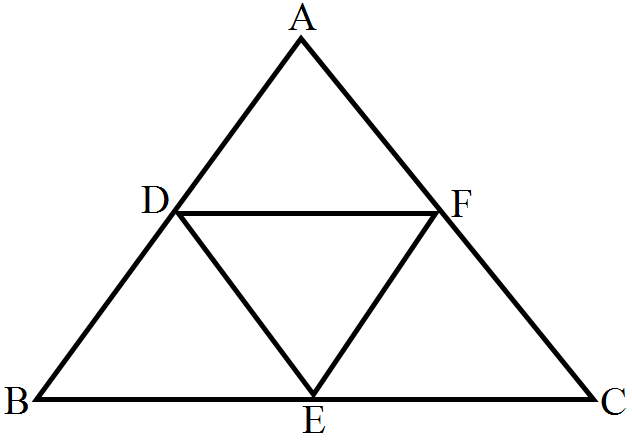
$D, E$ and $F$ are the mid points of sides $AB, BC$ and $CA$ of $\triangle\text{ABC}.$ If perimetre of $\triangle\text{ABC}$ is 16cm, then perimetre of $\triangle\text{DEF}.$
- A
- ✓
$8\ cm$
- C
$4\ cm$
- D
$32\ cm$
AnswerCorrect option: B. $8\ cm$
Using relation
perimeter, $\triangle\text{DEF}=\frac{1}{2}$
perimeter, $\triangle\text{ABC}$
$=\frac{1}{2}×16=8\text{cm}$
View full question & answer→MCQ 801 Mark
In $\triangle\text{ABC,}$ if $\angle\text{C}>\angle\text{B},$ then:
- A
$BC > AC$
- ✓
$AB > AC$
- C
$AB < AC$
- D
$BC < AC$
AnswerCorrect option: B. $AB > AC$
We know that in a triangle, the greater angle has the longer side opposite to it.
In $\triangle\text{ABC},$
$\angle\text{C}>\angle\text{B}$
$\Rightarrow\text{AB > AC}$
View full question & answer→MCQ 811 Mark
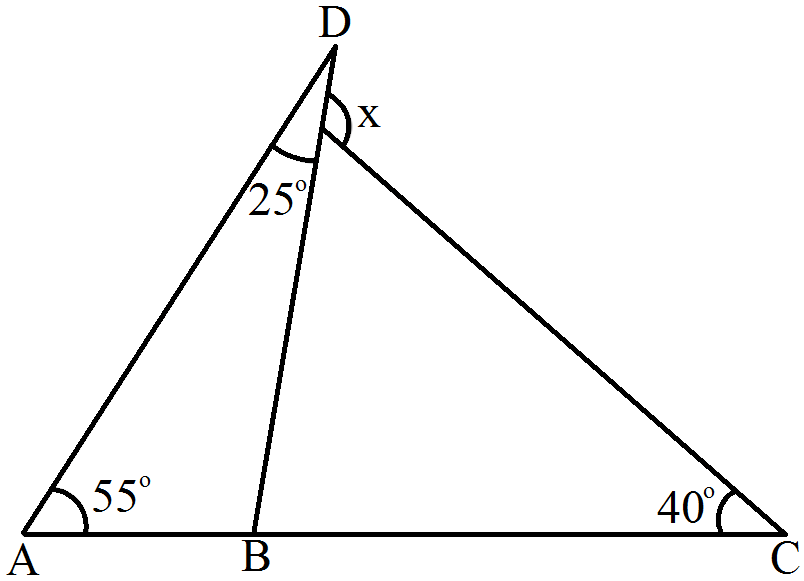
In Fig the value of $x$ is
:
- A
$65^\circ$
- B
$80^\circ$
- C
$95^\circ$
- ✓
$120^\circ$
AnswerCorrect option: D. $120^\circ$
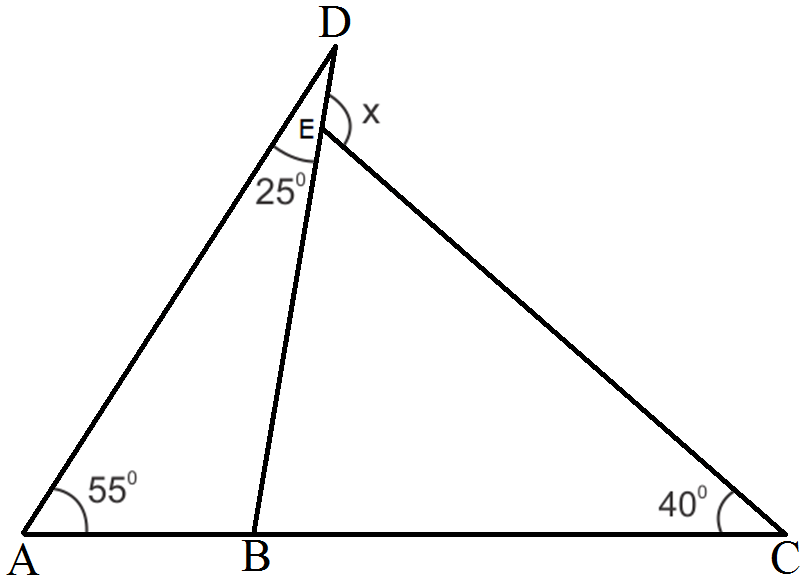
In $\triangle\text{ABD}$
$\angle\text{A}+\angle\text{B}+\angle\text{D}=180^\circ$
$\Rightarrow55^\circ+\angle\text{DBA}+25^\circ=180^\circ$
$\Rightarrow\angle\text{DBA}=180^\circ-55^\circ-25^\circ$
$=180^\circ-80^\circ$
$\Rightarrow\angle\text{DBA}=100^\circ$
So, $\angle\text{DBC}=180^\circ-\angle\text{DBA}$
$=180^\circ-100^\circ$
$\Rightarrow\angle\text{DBC}=80^\circ$
Now, in $\triangle\text{EBC}$
$\angle\text{E}+\angle\text{EBC}+\angle\text{C}=180^\circ$
$\Rightarrow\angle\text{E}+80^\circ+40^\circ=180^\circ$ $\big(\angle\text{DBC}=\angle\text{EBC}\big)$
$\Rightarrow\angle\text{E}=180^\circ-120^\circ=60^\circ$
Also, $\text{x}=180^\circ-\angle\text{E}=180^\circ-60^\circ$
$\Rightarrow\text{x}=120^\circ$ View full question & answer→MCQ 821 Mark
The sides $BC, CA$ and $AB$ of $\triangle\text{ABC}$ have been produced to $D, E$ and $F$ respectively. $\angle\text{BAE}+\angle\text{CBF}+\angle\text{ACD}= ?$
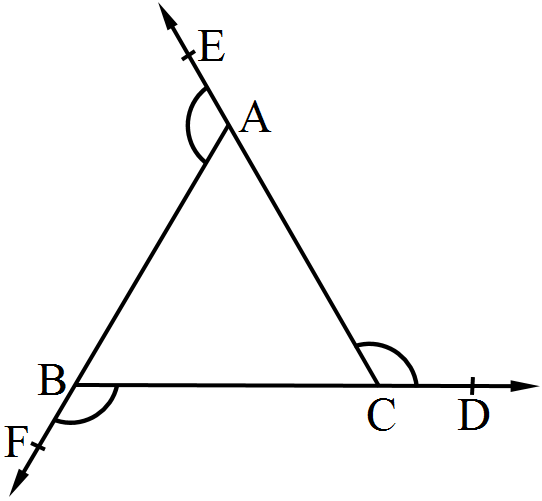
- A
$320^\circ$
- B
$240^\circ$
- C
$300^\circ$
- ✓
$360^\circ$
AnswerCorrect option: D. $360^\circ$
We have:
$\angle1+\angle\text{BAE}=180^\circ\ ...\ \text{(i)}$
$\angle2+\angle\text{CBF}=180^\circ ...\ \text{(ii)}$
$\angle\text{3}+\angle\text{ACD}=180^\circ ...\ \text{(iii)}$
Adding $(i),(ii)$ and $(iii)$, we get:
$(\angle1+\angle2+\angle3)+(\angle\text{BAE}+\angle\text{CBF}+\angle\text{ACD})=540^\circ$
$\Rightarrow 180^\circ+\angle\text{BAE}+\angle\text{CBF}+\angle\text{ACD}=540^\circ$
$ [\because \angle1+\angle2+\angle3=180^\circ]$
$\Rightarrow \angle\text{BAE}+\angle\text{CBF}+\angle\text{ACD}=360^\circ.$
View full question & answer→MCQ 831 Mark
In the given figure, $AD$ is the median, then $\angle\text{BAD}$ is:
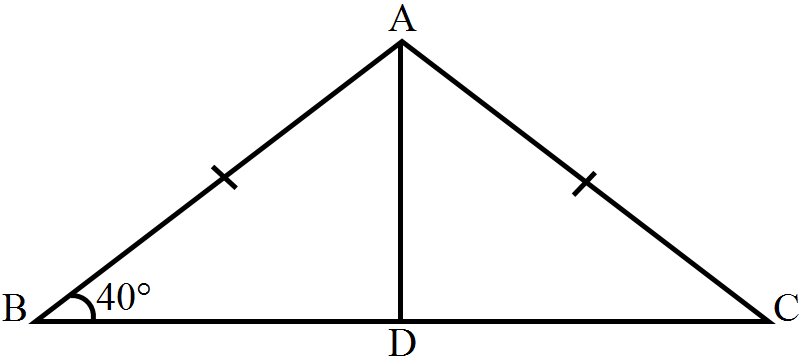
- A
$100^\circ$
- B
$40^\circ$
- ✓
$50^\circ$
- D
$55^\circ$
AnswerCorrect option: C. $50^\circ$
In the given $\angle\text{ABC},\ \text{AB}\ =\ \text{AC}$
Hence, $\angle\text{B} = \angle\text{C} = 40^\circ$
Now, by angle sum property,
$\angle\text{A} + \angle\text{B} + \angle\text{C} = 180^\circ$
$\Rightarrow\ \angle\text{A} + 40^\circ + 40^\circ = 180^\circ$
$\Rightarrow\ \angle\text{A} = 100^\circ$
Now, in $\triangle\text{BAD}$ and $\triangle\text{DAC}.$
$AB = AC$ (given)
$BD = DC (D$ is the mid-point of $BC)$
$\angle\text{ABD} = \angle\text{ACD} = 40^\circ$
$\angle\text{A}= \frac{1}{2} × 100^\circ = 50^\circ $
Hence by $SAS$, $\triangle\text{BAD}$ and $\triangle\text{DAC}$ are congruent.
This means, $\angle\text{BAD} = \angle\text{CAD} = \frac{1}{2}$ Therefore, $\triangle\text{BAD}=50^\circ.$
View full question & answer→MCQ 841 Mark
In a $\triangle\text{ABC},$ if $3\angle\text{A}=4\angle\text{B}=6\angle\text{C}$ then $A : B : C = ?$
- A
$4 : 3 : 2$
- B
$6 : 4 : 3$
- C
$2 : 3 : 4$
- ✓
$3 : 4 : 6$
AnswerCorrect option: D. $3 : 4 : 6$
In the given figure, $\angle\text{ACB}+\angle\text{ACD}=180^\circ$ (Linear pair of angles)
$\therefore 5y^\circ + 7y^\circ = 180^\circ $
$\Rightarrow 12y^\circ = 180^\circ $
$\Rightarrow y = 15$
In $\triangle\text{ABC}$
$\angle\text{A}+\angle\text{B}+\angle\text{ACB}=180^\circ$ (Angle sum property)
$\therefore 3y^\circ + x^\circ + 5y^\circ = 180^\circ $
$\Rightarrow x^\circ + 8y^\circ = 180^\circ $
$\Rightarrow x^\circ + 8 \times 15^\circ = 180^\circ $
$\Rightarrow x^\circ + 120^\circ = 180^\circ $
$\Rightarrow x^\circ = 180^\circ − 120^\circ = 60^\circ $
Thus, the value of $x$ is $60^\circ .$
Hence the correct answer is $3 : 4 : 6$
View full question & answer→MCQ 851 Mark
In fig., $\triangle\text{ABD}\cong\triangle\text{ACD},$ $AB = AC, BD = DC$ name the criteria by which the triangles are congruent:
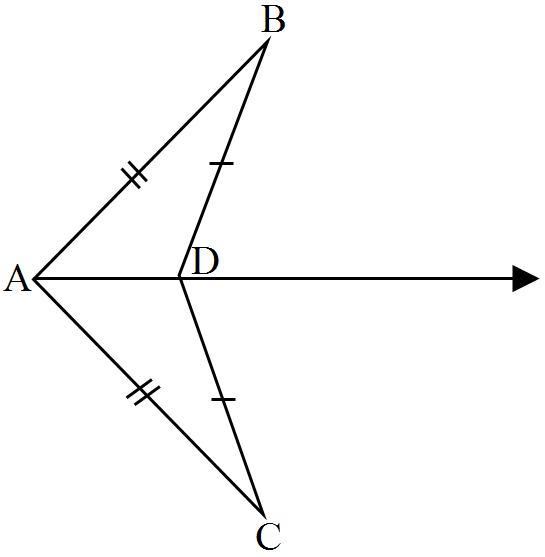
AnswerGiven that two sides are equal and third side is common I.e. $AD$ hence all three corresponding sides are equal.
View full question & answer→MCQ 861 Mark
If $\triangle\text{PQR}≅\triangle\text{EFD},$ then $ED =$
AnswerSince, by corresponding part of congruent triangle ED of $\triangle\text{EFD}$ is equal to the $PR$ of $\triangle\text{PQR}.$
View full question & answer→MCQ 871 Mark
If $\triangle\text{ABC}≅\triangle\text{LKM},$ then side of $\triangle\text{LKM}$ equal to side $AC$ of $\triangle\text{ABC}$ is:
AnswerSince, by corresponding part of congruent triangle $AC$ of $\triangle\text{ABC}$ is equal to the $LM$ of $\triangle\text{LKM}.$
View full question & answer→MCQ 881 Mark
If two acute angles of a right triangle are equal, then each acute is equal to:
- A
$30^\circ $
- ✓
$45^\circ $
- C
$90^\circ $
- D
$60^\circ$
AnswerCorrect option: B. $45^\circ $
Let the measure of each acute angle of a triangle be $x^\circ .$
Then, we have
$x^\circ + x^\circ + 90^\circ = 180^\circ $
i.e. $2x^\circ = 90^\circ $
i.e. $x^\circ = 45^\circ $
View full question & answer→MCQ 891 Mark
In the adjoining figure, $AB = AC$ and $\text{AD}\bot\text{BC}.$ The rule by which $\triangle\text{ABD}\cong\triangle\text{ACD}$ is:
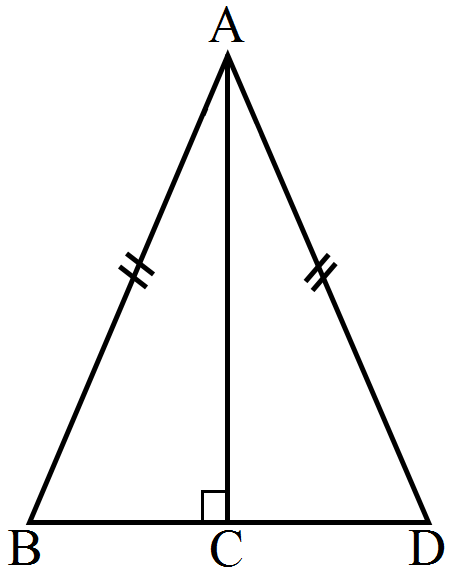
AnswerIn $\triangle\text{ABD}$ and $\triangle\text{ACD},$ we have
$\angle\text{ADB} = \angle\text{ADC}$ (Right angles)
$AB = AC$ (Given and hypotenuses)
$AD = AD$ (common in both)
Therefore, $\triangle\text{ABD}\cong\triangle\text{ACD}$ by $RHS.$
View full question & answer→MCQ 901 Mark
If the measures of angles of a triangle are in the ratio of $3 : 4 : 5$, what is the measure of the smallest angle of the triangle?
- A
$30^\circ $
- B
$25^\circ $
- ✓
$45^\circ $
- D
$60^\circ$
AnswerCorrect option: C. $45^\circ $
The measures of angles of a triangle are in ratio $3: 4: 5.$
Let the angles be $3x, 4x$ and $5x.$
In any triangle, sum of all angles $= 180^\circ $
$\Rightarrow 3x + 4x + 5x = 180^\circ $
$\Rightarrow 12x = 180^\circ $
$\Rightarrow x = 15^\circ $
So, smallest angle $= 3 \times 15^\circ = 45^\circ $
View full question & answer→MCQ 911 Mark
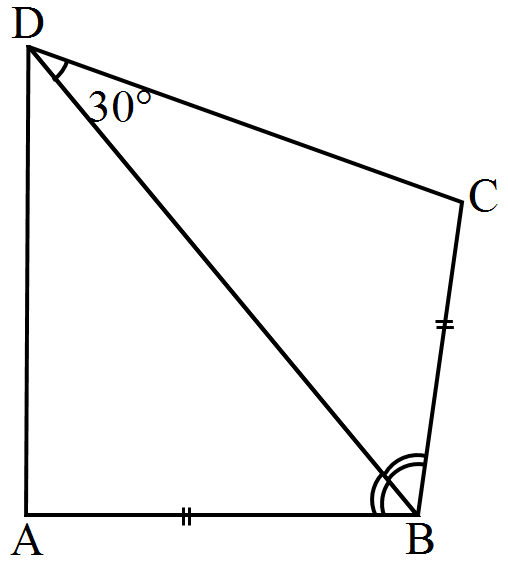
In the adjoining figure, $AB = BC$ and $\angle\text{ABD} = \angle\text{CBD},$ then another angle which measures $30^\circ $ is:
- A
$\angle\text{BAD}$
- B
$\angle\text{BCA}$
- ✓
$\angle\text{BDA}$
- D
$\angle\text{BCD}$
AnswerCorrect option: C. $\angle\text{BDA}$
In triangle $ABD$ and $CBD$
$AB = BC$ and $\angle\text{ABD} = \angle\text{CBD},$ (Given)
$BD$ (Common)
Therefore In triangle $ABD$ and $CBD$ are congruent by $SAS$ criteria.
Therefore, $\angle\text{BDA}=30^\circ$ (by $CPCT)$
View full question & answer→MCQ 921 Mark
In the adjoining figure, $PQ = PR$. If $\angle\text{Q} = 70^\circ,$ then measure of $\angle\text{P}$ is: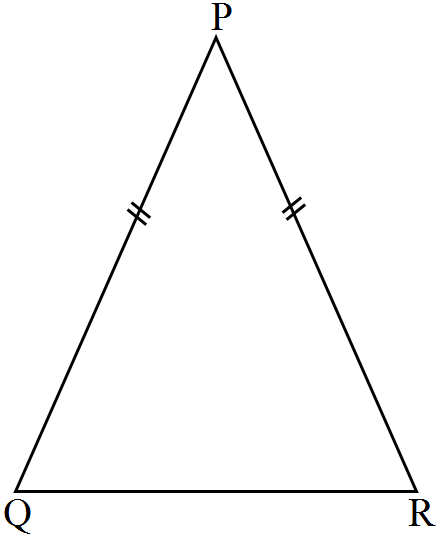
- ✓
$40^\circ$
- B
$70^\circ$
- C
$110^\circ$
- D
$80^\circ$
AnswerCorrect option: A. $40^\circ$
Since, It is given that $PQ = QR$, then $\angle\text{Q} = \angle\text{R}$ (Isosceles trangle property)
As $\angle\text{Q} = 70^\circ,$ therefore $\angle\text{R} = 70^\circ,$
Sum of all the three angles of triangle $= 180^\circ $, therefore $\angle\text{P}+\angle\text{Q}+\angle\text{R}=180^\circ$
$\angle\text{P} = 180 - 70 - 70\ = \ 40^\circ$
View full question & answer→MCQ 931 Mark
In Fig. if $BP \| CQ$ and $AC = BC$, then the measure of $x$ is:
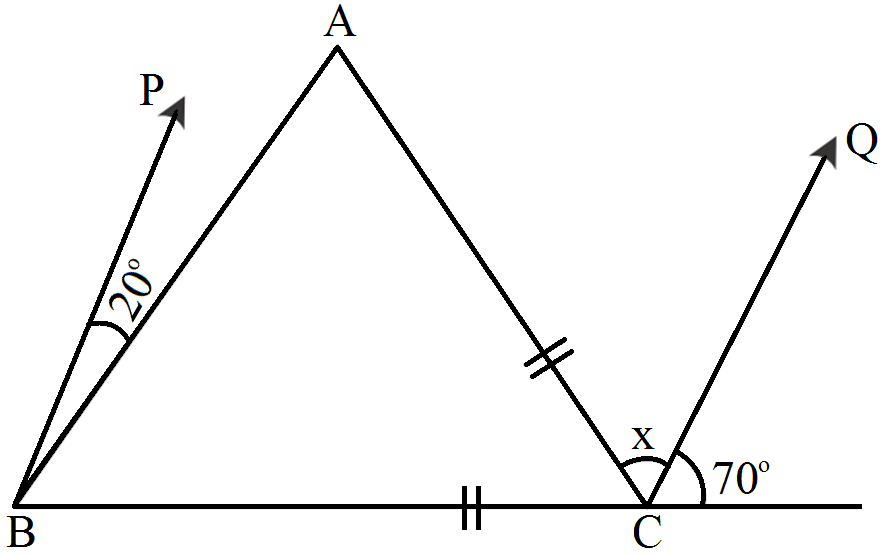
- A
$20^\circ$
- B
$25^\circ$
- ✓
$30^\circ$
- D
$35^\circ$
AnswerCorrect option: C. $30^\circ$
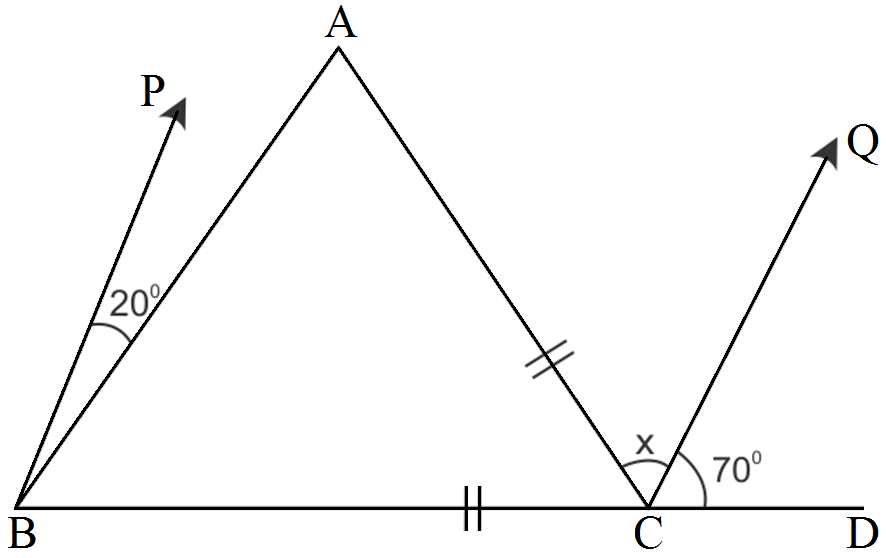
$\angle\text{PBC}=\angle\text{QCD}$ (Corresponding angles, $OP \| CQ$ and $BC$ is transverse)
$\Rightarrow\angle\text{PBC}=70^\circ$
Now, $\angle\text{PBA}+\angle\text{ABC}+\angle\text{PBC}$
$\Rightarrow20^\circ+\angle\text{ABC}=70^\circ$
$\Rightarrow\angle\text{ABC}=50^\circ$
In $\triangle\text{ABC},$
$\angle\text{ABC}+\angle\text{BAC}+\angle\text{ACB}=180^\circ\dots(1)$
Now, $\angle\text{ABC}=\angle\text{BAC}=50^\circ$ $($isosceles $\triangle)$
And, $\angle\text{ACB}=180^\circ-(70^\circ+\text{x})$
From $(1)$
$50^\circ+50^\circ+180^\circ-(70^\circ+\text{x})=180^\circ$
$\Rightarrow\text{x}=30^\circ$ View full question & answer→MCQ 941 Mark
In an isosceles $\triangle\text{ABC},$ if AB = AC and $\angle\text{A} = 90^\circ,$ Find $\angle\text{B}.$
- A
$60^\circ$
- B
$80^\circ$
- C
$95^\circ$
- ✓
$ 45^\circ$
AnswerCorrect option: D. $ 45^\circ$
We know that sum of all angle of a triangle is $180^\circ$
So, $\angle\text{A}+\angle\text{B}+\angle\text{C}=180^\circ$
$\angle\text{A} = 90^\circ$
$AB = AC$
$\angle\text{B} = \angle\text{C}$ (The angle opposite to equal side is also equal)
$90^\circ + \angle\text{B} + \angle\text{C} = 180^\circ$
$\angle\text{B} + \angle\text{C} = 180^\circ - 90^\circ$
$\angle\text{B} + \angle\text{C} = 90^\circ ( \angle\text{B} = \angle\text{C})$
$2\angle\text{B} = 90^\circ$
View full question & answer→MCQ 951 Mark
Two sides of a triangle are of lengths 5cm and $1.5\ cm$. The length of the third side of the triangle cannot be.
- ✓
$3.4\ cm$
- B
$4\ cm$
- C
$3.8\ cm$
- D
$3.6\ cm$
AnswerCorrect option: A. $3.4\ cm$
Given that: Two sides of triangle are $5\ cm$ and $1.5\ cm$. We know that the sum of two sides of the triangle is always greater than the third side. Hence, $3.4\ cm$ cannot be the third side. If it is the third side the sum of $3.4\ cm$ and $1.5\ cm$ will be smaller than $5\ cm$, so, the triangle will not be possible.
View full question & answer→MCQ 961 Mark
In triangles $ABC$ and $PQR$ three equality relation between some parts are as follows: $\text{AB}=\text{QP},\angle\text{B}=\angle\text{P}$ and $\text {BC}=\text{PR}$ State which of the congruence conditions applies:
Answer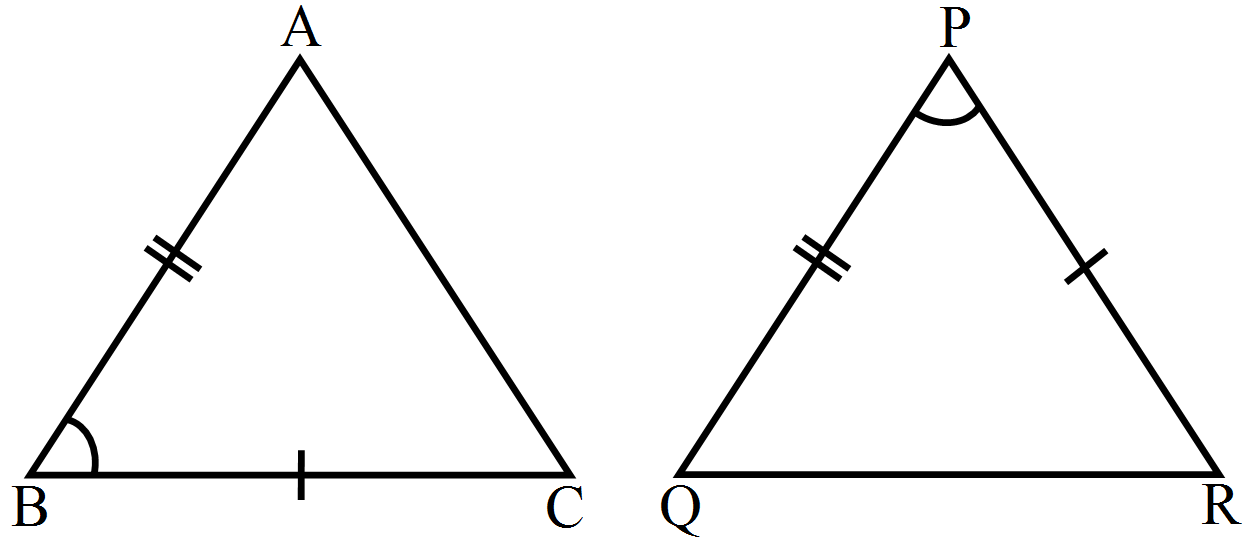
From given conditions, we have
$\text{AB}=\text{PQ}$
$\text{BC}=\text{PR}$
And the angle between these sides are also equal
i.e. $\angle\text{B}=\angle\text{P}$
So SAS property.
Hence, correct option is $(a).$ View full question & answer→MCQ 971 Mark
IF $\text{AB}⊥\text{BC}$ and $\angle\text{BAC} = \angle\text{BCA},$ then which of the following statements is true?
- A
$AB \neq BC$
- B
$AB = AC$
- ✓
$AB = BC$
- D
$BC = AC$
AnswerCorrect option: C. $AB = BC$
$ABC$ is a right-angled isosceles triangle with $\angle\text{BAC} = \angle\text{BCA},$ and hence sides opposite to equal angles must be equal. Hence, we can say that $AB = BC.$
View full question & answer→MCQ 981 Mark
If the measure of angles of a triangle are in the ratio of $3 : 4 : 5$, what is the measure of the smallest angle of the triangle?
- A
$25^\circ $
- B
$30^\circ$
- ✓
$45^\circ$
- D
$60^\circ$
AnswerCorrect option: C. $45^\circ$
The measures of angles of a triangle are in ratio $3 : 4 : 5.$
Let the angles be $3x, 4x$, and $5x.$
in any triangle, sum of all angles $= 180^\circ $
$\Rightarrow 3x + 4x + 5x = 180^\circ $
$\Rightarrow 12x = 180^\circ $
$\Rightarrow x = 15^\circ $
So, smallest angle $= 3 \times 15^\circ = 45^\circ $
View full question & answer→MCQ 991 Mark
In the given figure, $EAD \perp BCD$. Ray $FAC$ cuts ray $EAD$ at a point A such that $\angle EAF =30^{\circ}$. Also, in $\triangle BAC , \angle BAC = x ^{\circ}$ and $\angle ABC =( x +10)^{\circ}$. Then, the value of $x$ is:
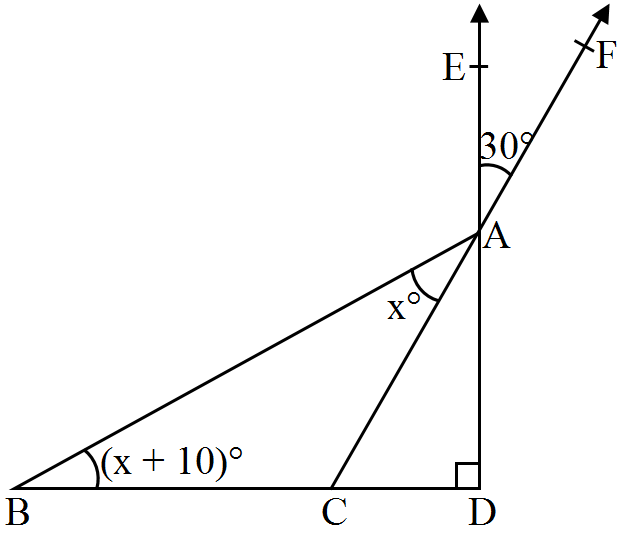
AnswerIn the given figure $\angle\text{CAD}=\angle\text{EAF}$ (Vertically opposite angels)$\therefore \angle\text{CAD}=30^\circ$
In $\triangle\text{ABD},$
$\angle\text{ABD}+\angle\text{BAD}+\angle\text{ADB}=180^\circ$ (Angle sum property)
$\Rightarrow (\text{x}+10)^\circ+(\text{x}^\circ+30^\circ)+90^\circ=180^\circ$
$\Rightarrow 2\text{x}+130^\circ=180^\circ$
$\Rightarrow 2\text{x}=180^\circ−130^\circ=50^\circ$
$\Rightarrow \text{x} = 25$
Thus, the value of $x$ is $25.$
View full question & answer→MCQ 1001 Mark
$\triangle\text{ABC}\cong\triangle\text{PQR},$ then which of the following is true?
- A
$AB = RP$
- B
$AC = RQ$
- ✓
$CA = RP$
- D
$CB = QP$
AnswerCorrect option: C. $CA = RP$
Corresponding sides are equal for two congruent triangles.
View full question & answer→