Question types

Model Paper 4 question types

44 questions across 8 question groups — pick any mix to generate a Social Studies paper with step-by-step answer keys.

44
Questions
8
Question groups
5
Question types
Sample Questions

Model Paper 4 questions

One sample from each question group in this chapter. Select any group above to see the full set with answer keys.

Q 2MCQ (1 Mark)1 Mark
Economic activities have been divided into which of the two parts?
  • A
    Service and Secondary
  • B
    Primary and Secondary activities activities
  • Market and non-market
  • D
    Production and non- production activities activities

Answer: C.

View full solution
Q 5MCQ (1 Mark)1 Mark
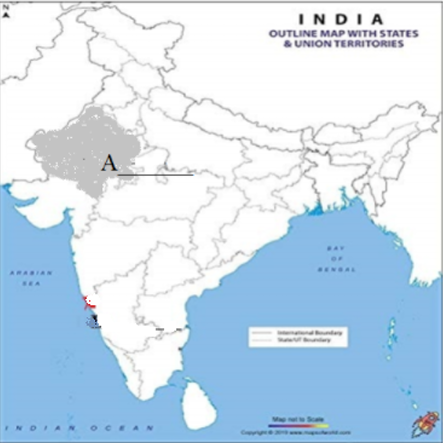
On the political map of India, $A$ is marked as the largest state area-wise. Identify it from the following options.

Image
  • A
    Madhya Pradesh
  • Rajasthan
  • C
    Maharashtra
  • D
    Uttar Pradesh

Answer: B.

View full solution
Here are some facts on Indian elections. Comment on each of these to say whether they reflect the strength or the weakness of our electoral system.
a. The Lok Sabha has had less than 10% of women members till 2009.
b. The Election Commission often refuses to accept the government's advice about when the elections should be held.
c. The current Lok Sabha has more than 145 members whose assets are more than Rs. 1 crore.
d. After losing an election the Chief Minister said, "I respect the people's verdict".
View full solution
Assertion (A): The subsistence crisis occurred frequently during the Old Regime.
Reason (R): In Old Regime, the monarch did not have the power to impose taxes.
  • A
    Both $A$ and $R$ are true and $R$ is
  • Both $A$ and $R$ are true but $R$ is the correct explanation of A . not the correct explanation of A.
  • C
    $A$ is true but $R$ is false.
  • D
    $A$ is false but $R$ is true.

Answer: B.

View full solution
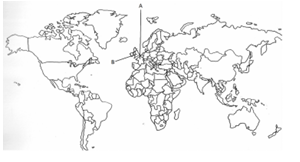
Two places A and B have been marked on the given outline map of the world. Identify them and write their correct names on the lines drawn near them
A. North-Eastern region not affected by the Great Fear.
B. An axis power
View full solution
On the outline map of India locate and label ANY THREE of the following with suitable Symbols.
a. The Vindhya - Mountain Range
b. Kanha -National Park
c. Dachigam - Wildlife Sanctuaries
d. The Krishna -The Peninsular rivers
Image
View full solution
There were a number of causes for the widespread poverty in India. One historical reason is the low level of economic development under the British colonial administration. The policies of the colonial government ruined traditional handicrafts and discouraged the development of industries like textiles. This resulted in fewer job opportunities and a low growth rate of incomes. This was accompanied by a high growth rate of population. The two combined to make the growth rate of per capita income very low. The failure at both the fronts: promotion of economic growth and population control perpetuated the cycle of poverty. Unable to find proper jobs in cities, many people started working as rickshaw pullers, vendors, construction workers, domestic servants, etc. With irregular small incomes, these people could not afford expensive housing. They started living in slums on the outskirts of the cities and the problems of poverty, largely a rural phenomenon also became the feature of the urban sector. Another feature of high poverty rates has been the huge income inequalities. One of the major reasons for this is the unequal distribution of land and other resources. Major policy initiatives like land reforms which aimed at the redistribution of assets in rural areas have not been implemented properly and effectively by most of the state governments. Since lack of land resources has been one of the major causes of poverty in India, proper implementation of policy could have improved the lives of millions of rural poor. Many other socio-cultural and economic factors also are responsible for poverty. In order to fulfill social obligations and observe religious ceremonies, people in India, including the very poor, spend a lot of money. Small farmers need money to buy agricultural inputs like seeds, fertilizer, pesticides, etc. Since poor people hardly have any savings, they borrow. Unable to repay because of poverty, they become victims of indebtedness. So the high level of indebtedness is both the cause and effect of poverty.
i. What are the reasons behind the huge income inequalities in rural areas?
ii. What are the economic and socio-cultural causes of poverty?
iii. What was the root cause of India's poverty historically?
View full solution
The Indian landmass has a central location between East and West Asia. India is a southward extension of the Asian continent. The trans-Indian Ocean routes, which connect the countries of Europe in the West and the countries of East Asia, provide a strategic central location to India. The Deccan Peninsula protrudes into the Indian Ocean, thus helping India to establish close contact with West Asia, Africa, and Europe from the western coast and with Southeast and East Asia from the eastern coast. No other country has a long coastline on the Indian Ocean as India has and indeed, it is India's eminent position in the Indian Ocean, which justifies the naming of an Ocean after it. Since the opening of the Suez Canal in 1869, India's distance from Europe has been reduced by 7000 km. India's contacts with the World have continued through ages but her relationships through the land routes are much older than her maritime contacts. The various passes across the mountains in the north have provided passages to the ancient travellers, while the oceans restricted such interaction for a long time. These routes have contributed to the exchange of ideas and commodities since ancient times.
i. When did the Suez Canal first open? How has it helped India?
ii. State any two reasons that make India's strategic location at the head of the Indian Ocean so important.
iii. Which peninsula helps India to establish easy contact with West Asia, East Africa, and Europe from the Western coast?
View full solution
The First World War left a deep imprint on European society and polity. Soldiers came to be placed above civilians. Politicians and publicists laid great stress on the need for men to be aggressive, strong and masculine. The media glorified trench life. The truth, however, was different. Aggressive war propaganda and national honour occupied centre stage in the public sphere, while popular support grew for conservative dictatorships that had recently come into being. Democracy was indeed a young and fragile idea, which could not survive the instabilities of interwar Europe.
i. How did the First World War impact the political system of Germany? 
ii. What does the given passage highlight?
iii. The media glorified trench life. What was the actual truth about trench life?
View full solution

Generate a Model Paper 4 paper free

Pick question groups from the list above, set marks and difficulty, and export a branded PDF with step-by-step answer keys. First 3 chapters free — no signup.

Download App