MCQ 11 Mark
$\frac{\text{d}}{\text{dx}}\Big\{\tan^{-1}\Big(\frac{\cos\text{x}}{1+\sin\text{x}}\Big)\Big\}$ equals:
- A
$\frac{1}{2}$
- ✓
$-\frac{1}{2}$
- C
$1$
- D
$-1$
AnswerCorrect option: B. $-\frac{1}{2}$
Let $\text{u}=\tan^{-1}\Big(\frac{\cos\text{x}}{1+\sin\text{x}}\Big)$
$\Rightarrow\text{u}=\tan^{-1}\bigg(\frac{\cos^2\frac{\text{x}}{2}-\sin^2\frac{\text{x}}{2}}{\cos^2\frac{\text{x}}{2}+\sin^2\frac{\text{x}}{2}+2\sin\frac{\text{x}}{2}\cos\frac{\text{x}}{2}}\bigg)$
$\Rightarrow\text{u}=\tan^{-1}\frac{\big(\cos\frac{\text{x}}{2}-\sin\frac{\text{x}}{2}\big)\big(\cos\frac{\text{x}}{2}+\sin\frac{\text{x}}{2}\big)}{\big(\cos\frac{\text{x}}{2}+\sin\frac{\text{x}}{2}\big)^2}$
$\Rightarrow\text{u}=\tan^{-1}\bigg(\frac{\cos\frac{\text{x}}{2}-\sin\frac{\text{x}}{2}}{\cos\frac{\text{x}}{2}+\sin\frac{\text{x}}{2}}\bigg)$
dividing by $\cos\frac{\text{x}}{2}$
$\Rightarrow\text{u}=\tan^{-1}\bigg[\frac{1-\tan\frac{\text{x}}{2}}{1+\tan\frac{\text{x}}{2}}\bigg]$
$\Rightarrow\text{u}=\tan^{-1}\bigg[\frac{\tan\frac{\pi}{2}-\tan\frac{\text{x}}{2}}{1+\tan\frac{\text{x}}{2}\times\tan\frac{\text{x}}{2}}\bigg]$
$\Rightarrow\text{u}=\tan^{-1}\Big[\tan\Big(\frac{\pi}{2}-\frac{\text{x}}{2}\Big)\Big]$
$\Rightarrow\text{u}=\frac{\pi}{4}-\frac{\text{x}}{2}$
$\Rightarrow\frac{\text{du}}{\text{dx}}=0-\Big(\frac{1}{2}\Big)$
$\Rightarrow\frac{\text{du}}{\text{dx}}=-\frac{1}{2}$
View full question & answer→MCQ 21 Mark
If $\text{f(x)}=\begin{cases}\frac{|\text{x}+2|}{\tan^{-1}(\text{x}+2)}, & \text{x}\neq-2\\2, & \text{x}=-2\end{cases},$ then $f(x)$ is :
- A
Continuous at $x = -2$
- ✓
Not continuous at $x = -2$
- C
Diffrentiable at $x = -2$
- D
Continuous but nit derivable at $x = -2$
AnswerCorrect option: B. Not continuous at $x = -2$
$\lim\limits_{\text{x}\rightarrow-2}\frac{|\text{x}+2|}{\tan^{-1}(\text{x}+2)}$
Let, $x = -2 + h$
$x \rightarrow -2$
$ \Rightarrow h \rightarrow 0$
$\lim\limits_{\text{h}\rightarrow0}\frac{|-2+\text{h}+2|}{\tan^{-1}(-2+\text{h}+2)}$
$\lim\limits_{\text{h}\rightarrow0}\frac{\text{h}}{\tan^{-1}\text{h}}=1$
$\lim\limits_{\text{h}\rightarrow0}\frac{|\text{x}+2|}{\tan^{-1}(\text{x}+2)}\neq\text{f}(-2)$
Function is not continuous at $x = -2.$
View full question & answer→MCQ 31 Mark
If $f(x) = |3 − x| + (3 + x),$ where $(x) $ denotes the least integer greater than or equal to $x,$ then $f(x)$ is :
- A
Continuous and differentiable at $x = 3$
- B
Continuous but not differentiable at $x = 3$
- C
Differentiable nut not continuous at $x = 3$
- ✓
Neither differentiable nor continuous at $x = 3$
AnswerCorrect option: D. Neither differentiable nor continuous at $x = 3$
Given function can be writter as
$\text{f(x)}=-\text{x}+9\ \text{ x} < 3$
$=\text{x}+4\ \text{ x} > 3$
$\lim\limits_{\text{x}\rightarrow3^{+}}\text{f(x)}=\lim\limits_{\text{x}\rightarrow3}-\text{x}+9=6$
$\lim\limits_{\text{x}\rightarrow3^{-}}\text{f(x)}=\lim\limits_{\text{x}\rightarrow3}\text{x}+4=7$
Function is not continuous at $x = 3$
$⇒$ Function is not diffentiable at $x = 3.$
View full question & answer→MCQ 41 Mark
Let $\text{f(x)=}\begin{cases}\frac{\text{x}-4}{|\text{x}-4|}+\text{a},&\text{if }\text{ x} < 4\\\text{a}+\text{b},&\text{if }\text{ x} =4\\\frac{\text{x}-4}{|\text{x}-4|}+\text{b},&\text{if }\text{ x} > 4\end{cases}$ Then$, f(x)$ is continus at $x = 4$ when:
- A
$a = 0, b = 0$
- B
$a = 1, b = 1$
- C
$a = -1, b = 1$
- ✓
$a = 1, b = -1$
AnswerCorrect option: D. $a = 1, b = -1$
Given, $\text{f(x)=}\begin{cases}\frac{\text{x}-4}{|\text{x}-4|}+\text{a},&\text{if }\text{ x} < 4\\\text{a}+\text{b},&\text{if }\text{ x} =4\\\frac{\text{x}-4}{|\text{x}-4|}+\text{b},&\text{if }\text{ x} > 4\end{cases}$
We have $(\text{LHL at x = 4})=\lim\limits_{\text{x}\rightarrow4^-}\text{f(x)}=\lim\limits_{\text{h}\rightarrow0}\text{f}(4-\text{h})$
$=\lim\limits_{\text{h}\rightarrow0}\Big(\frac{4- \text{h}-4}{|4-\text{h}-4|}+\text{a}\Big)=\lim\limits_{\text{h}\rightarrow0}\Big(\frac{-\text{h}}{|-\text{h}|}+\text{a}\Big)=\text{a}-1$
$(\text{RHL at x = 4})=\lim\limits_{\text{x}\rightarrow4^+}\text{f(x)}=\lim\limits_{\text{h}\rightarrow0}\text{f(4+h)}$
$=\lim\limits_{\text{h}\rightarrow0}\Big(\frac{4+\text{h}-4}{|4+\text{h}-4|}+\text{b}\Big)=\lim\limits_{\text{h}\rightarrow0}\Big(\frac{\text{h}}{|\text{h}|}+\text{b}\Big)=\text{b}+1$
Also, $\text{f}(4)=\text{a+b}$
if $(x)$ is continuous at $x = 4,$ then
$\lim\limits_{\text{x}\rightarrow4^-}\text{f(x)}=\lim\limits_{\text{x}\rightarrow4^+}\text{f(x)}=\text{f}(4)$
$\Rightarrow\text{a}-1=\text{b}+1=\text{a + b}$
$\Rightarrow\text{a}-\text{1}=\text{a + b}$ and $\text{b}+1=\text{a + b} $
$\Rightarrow\text{b}=-1$ and $\text{a}=1$
View full question & answer→MCQ 51 Mark
If $4a + 2b + c = 0$, then the equation $3 a x^2+2 b x+c=0$ has atleast one real root lying in the interval :
- A
$(0, 1)$
- B
$(1, 2)$
- ✓
$(0, 2)$
- D
AnswerCorrect option: C. $(0, 2)$
Let, $f(x)=a x^3+b x^2+c x+d$
$f(0)=d$
$f(2)=8 a+4 b+2 c+d$
$=2(4 a+2 b+c)+d$
$=2 \times 0+d$
$=0$
$f$ is continuous and differentiable on $(0,2)$
$f(0)=f(2)$
Using Rolle's theorem,
$f^{\prime}(x)=0 \text { for }(0,2)$
$3 a x^2+2 b x+c=0$
$f(x)$ has atleast one root in the interval $(0,2)$.
Hence $f^{\prime}(x)$ must have root in the interval $(0,2)$
View full question & answer→MCQ 61 Mark
Differential coefficient of $\sec(\tan^{-1}\text{x})$ is:
- A
$\frac{\text{x}}{1+\text{x}^2}$
- B
$\text{x}\sqrt{1+\text{x}^2}$
- C
$\frac{\text{x}}{\sqrt{1+\text{x}^2}}$
- ✓
$\frac{\text{x}}{\sqrt{1+\text{x}^2}}$
AnswerCorrect option: D. $\frac{\text{x}}{\sqrt{1+\text{x}^2}}$
We have, $\text{y}=\sec(\tan^{-1}\text{x})$
$\Rightarrow\frac{\text{dy}}{\text{dx}}=\sec\big(\tan^{-1}\text{x}\big)\tan\big(\tan^{-1}\text{x}\big)\times\frac{\text{d}}{\text{dx}}\big(\tan^{-1}\text{x}\big)$
$\Rightarrow\frac{\text{dy}}{\text{dx}}=\sec\big(\tan^{-1}\text{x}\big)\tan\big(\tan^{-1}\text{x}\big)\times\frac{1}{\sqrt{1+\text{x}^2}}$
$\Rightarrow\frac{\text{dy}}{\text{dx}}=\text{y}\Big(\frac{\text{x}}{\sqrt{1+\text{x}^2}}\Big)$
$\Rightarrow\frac{\text{dy}}{\text{dx}}=\Big(\frac{\text{x}}{\sqrt{1+\text{x}^2}}\Big)\text{y}$
View full question & answer→MCQ 71 Mark
Let $\text{U}=\sin^{-1}\Big(\frac{2\text{x}}{1+\text{x}^2}\Big)$ and $\text{V}=\tan^{-1}\Big(\frac{2\text{x}}{1-\text{x}^2}\Big),$ then $\frac{\text{dU}}{\text{dV}}=$
Answer$\text{U}=\sin^{-1}\Big(\frac{2\text{x}}{1+\text{x}^2}\Big)$ and ${V}=\tan^{-1}\Big(\frac{2\text{x}}{1+\text{x}^2}\Big)$
Put, $\text{x}=\tan\theta$
$\text{U}=\sin^{-1}\Big(\frac{2\tan\theta}{1+\tan^2\theta}\Big)$ and ${V}=\tan^{-1}\Big(\frac{2\tan\theta}{1-\tan^2\theta}\Big)$
$\text{U}=\sin^{-1}(\sin2\theta)$ and ${V}=\tan^{-1}(\tan2\theta)$
$\text{U}=2\theta$ and ${V}=2\theta$
$\text{U}=2\tan^{-1}\text{ x}$ and ${V}=2\tan^{-1}\text{x}$
$\frac{\text{dU}}{\text{dx}}=\frac{\text{dV}}{\text{dx}}=\frac{2}{1+\text{x}^2}$
$\frac{\text{dU}}{\text{dV}}=\frac{\frac{\text{dU}}{\text{dx}}}{\frac{\text{dU}}{\text{dx}}}=1$
View full question & answer→MCQ 81 Mark
If $\text{f(x)}=\text{a}|\sin\text{x}|+\text{be}^{|\text{x}|}+\text{c|x|}^3$and if $f(x)$ is differentiable at $x = 0,$ then :
- A
$\text{a}=\text{b}=\text{c}=0$
- ✓
$\text{a}=0,\text{b}=0;\text{c}\in\text{R}$
- C
$\text{b}=\text{c}=0,\text{a}\in\text{R}$
- D
$\text{c}=0,\text{a}=0,\text{b}\in\text{R}$
AnswerCorrect option: B. $\text{a}=0,\text{b}=0;\text{c}\in\text{R}$
$\text{f(x)}=\text{a}|\sin\text{x}|+\text{be}^{|\text{x}|}+\text{c|x|}^3$
$=\begin{cases}\text{a}\sin\text{x}+\text{bx}^\text{x}+\text{cx}^3 & 0<\text{x} < \frac{\pi}{2}\\-\text{a}\sin\text{x}+\text{be}^{-\text{x}}-\text{cx}^3 & -\frac{\pi}{2}<\text{x} < 0\end{cases}$
Here, $f(x)$ is differentiable at $x = 0$
Therefore,$ (\text{LHL}$ at $x = 0) = (\text{RHL}$ at $x = 0)$
$\Rightarrow\lim\limits_{\text{x}\rightarrow0^{-}}\frac{\text{f(x)}-\text{f}(0)}{\text{x}-0}=\lim\limits_{\text{x}\rightarrow0^{+}}\frac{\text{f(x)}-\text{f}(0)}{\text{x}-0}$
$\Rightarrow\lim\limits_{\text{x}\rightarrow0^{-}}\frac{-\text{a}\sin\text{x}+\text{be}^{-\text{x}}-\text{cx}^3-\text{b}}{\text{x}}=\lim\limits_{\text{x}\rightarrow0^{+}}\frac{\text{a}\sin\text{x}+\text{be}^{\text{x}}-\text{cx}^3-\text{b}}{\text{x}}$
$\Rightarrow\lim\limits_{\text{h}\rightarrow0}\frac{-\text{a}\sin(0-\text{h})+\text{be}^{-(0-\text{h)}}-\text{c}(0-\text{h})^3-\text{b}}{0-\text{h}}$ $=\lim\limits_{\text{h}\rightarrow0}\frac{\text{a}\sin(0+\text{h})+\text{be}^{(0+\text{h)}}+\text{c}(0+\text{h})^3-\text{b}}{0+\text{h}}$
$\Rightarrow\lim\limits_{\text{h}\rightarrow0}\frac{\text{a}\sin\text{h}+\text{be}^{\text{h}}+\text{ch}^3-\text{b}}{-\text{h}}=\lim\limits_{\text{h}\rightarrow0}\frac{\text{a}\sin\text{h}+\text{be}^{\text{h}}+\text{ch}^3-\text{b}}{\text{h}} $
$\Rightarrow\lim\limits_{\text{h}\rightarrow0}\frac{\text{a}\cos\text{h}+\text{be}^{\text{h}}+3\text{ch}^2}{-1}=\lim\limits_{\text{h}\rightarrow0}\frac{\text{a}\cos\text{h}+\text{be}^{\text{h}}+3\text{ch}^2}{1}\ ($By $L\ '$ Hospital rule$)$
$\Rightarrow-(\text{a}+\text{b})=\text{a}+\text{b}$
$\Rightarrow-2(\text{a}+\text{b})=0$
$\Rightarrow\text{a}+\text{b}=0$
This is true for all value of $c$
$\therefore\text{c}\in\text{R}$
In the given option $(b)$ satisfies $a + b = 0$ and $\text{c}\in\text{R.}$
View full question & answer→MCQ 91 Mark
Choose the correct answers from the given four options: If $\text{y}=\sqrt{\sin\text{x}+\text{y}},$ then $\frac{\text{dy}}{\text{dx}}$ is equal to:
- ✓
$\frac{\cos\text{x}}{2\text{y}-1}$
- B
$\frac{\cos\text{x}}{1-2\text{y}}$
- C
$\frac{\sin\text{x}}{1-2\text{y}}$
- D
$\frac{\sin\text{x}}{2\text{y}-1}$
AnswerCorrect option: A. $\frac{\cos\text{x}}{2\text{y}-1}$
We have, $\because\text{y}=(\sin\text{x}+\text{y})^{\frac{1}{2}}$
$\therefore \frac{\text{dy}}{\text{dx}}=\frac{1}{2}(\sin\text{x}+\text{y})^{\frac{-1}{2}}\cdot\frac{\text{d}}{\text{dx}}(\sin\text{x}+\text{y})$
$\Rightarrow \frac{\text{dy}}{\text{dx}}=\frac{1}{2}\cdot\frac{1}{(\sin\text{x}+\text{y})^{\frac{1}{2}}}\cdot\Big(\cos\text{x}+\frac{\text{dy}}{\text{dx}}\Big)$
$\Rightarrow \frac{\text{dy}}{\text{dx}}=\frac{1}{2\text{y}}\cdot\Big(\cos\text{x}+\frac{\text{dy}}{\text{dx}}\Big)$ $\big[\because(\sin\text{x}+\text{y})^{\frac{1}{2}}=\text{y}\big]$
$\Rightarrow \frac{\text{dy}}{\text{dx}}\Big(1-\frac{1}{2\text{y}}\Big)=\frac{\cos\text{x}}{2\text{y}}$
$\therefore \frac{\text{dy}}{\text{dx}}=\frac{\cos\text{x}}{2\text{y}}\cdot\frac{2\text{y}}{2\text{y}-1}=\frac{\cos\text{x}}{2\text{y}-1}$
View full question & answer→MCQ 101 Mark
If $\text{f}(\text{x})=\tan^{-1}\sqrt{\frac{1+\sin\text{x}}{1-\sin\text{x}}},0\leq\text{x}\leq\frac{\pi}{2},$ then $\text{f}\ '\Big(\frac{\pi}{6}\Big)$ is:
- A
$-\frac{1}{4}$
- B
$-\frac{1}{2}$
- C
$\frac{1}{4}$
- ✓
$\frac{1}{2}$
AnswerCorrect option: D. $\frac{1}{2}$
$\text{f}(\text{x})=\tan^{-1}\sqrt{\frac{1+\sin\text{x}}{1-\sin\text{x}}}$
$\text{f}(\text{x})=\tan^{-1}\sqrt{\frac{\Big(\cos\frac{\text{x}}{2}+\sin\frac{\text{x}}{2}\Big)^2}{\Big(\cos\frac{\text{x}}{2}-\sin\frac{\text{x}}{2}\Big)^2}}$
$\text{f}(\text{x})=\tan^{-1}\frac{\cos\frac{\text{x}}{2}+\sin\frac{\text{x}}{2}}{\cos\frac{\text{x}}{2}-\sin\frac{\text{x}}{2}}$
$\text{f}(\text{x})=\tan^{-1}\Bigg(\tan\bigg(\frac{1+\tan\frac{\text{x}}{2}}{1+\tan\frac{\text{x}}{2}}\bigg)\Bigg)$
$\text{f}(\text{x})=\tan^{-1}\Big(\tan\Big(\frac{\pi}{4}+\frac{\text{x}}{2}\Big)\Big)$
$\text{f}(\text{x})=\frac{\pi}{4}+\frac{\text{x}}{2}$
$\text{f}\ '(\text{x})=\frac{1}{2}$
View full question & answer→MCQ 111 Mark
If $\text{f(x)}=\frac{1-\sin\text{x}}{(\pi-2\text{x})^2},$ when $\text{x}\neq\frac{\pi}{2}=\lambda$ then $f(x)$ will be continuous function at $\text{x}=\frac{\pi}{2},$ where $\lambda=$
- ✓
$\frac{1}{8}$
- B
$\frac{1}{4}$
- C
$\frac{1}{2}$
- D
AnswerCorrect option: A. $\frac{1}{8}$
If $f(x)$ is continuous at $\text{x}=\frac{\pi}{2},$ then
$\lim\limits_{\text{x}\rightarrow\frac{\text{x}}{2}}\text{f}\text{(x)}=\text{f}\Big(\frac{\pi}{2}\Big)$
$\lim\frac{1-\sin\text{x}}{\text{x}\rightarrow\frac{\pi}{2}(\pi-2\text{x})^2}=\text{f}\Big(\frac{\pi}{2}\Big) \ ...(\text{i})$
suppose $\Big(\frac{\pi}{2}-\text{x}\Big)=\text{t},$ then
$\lim\limits_{\text{t}\rightarrow0}\begin{bmatrix}\frac{1-\sin\Big(\frac{\pi}{2}-\text{t}\Big)}{(2\text{t})^2} \end{bmatrix}=\text{f}\Big(\frac{\pi}{2}\Big)\ [$From eq. $(i)]$
$\Rightarrow\lim\limits_{\text{t}\rightarrow0}\begin{bmatrix}\frac{1-\cos\text{t}}{(2\text{t})^2} \end{bmatrix}=\text{f}\Big(\frac{\pi}{2}\Big)$
$\Rightarrow\frac{1}{4}\lim\limits_{t\rightarrow0}\begin{bmatrix}\frac{2\sin^2\Big(\frac{\text{t}}{2}\Big)}{\text{t}^2} \end{bmatrix}=\text{f}\Big(\frac{\pi}{2}\Big)$
$\Rightarrow \frac{1}{4}\lim\limits_{\text{t} \rightarrow0} \begin{bmatrix}\frac{\frac{2}{4}\sin^{2}\big(\frac{\text{t}}{2}\big)}{\frac{\text{t}^{2}}{4}} \end{bmatrix} = \text{f} \Big(\frac{\pi}{2}\Big)$
$\Rightarrow \frac{1}{8}\lim\limits_{\text{t} \rightarrow0} \begin{bmatrix}\frac{\frac{2}{4}\sin^{2}\big(\frac{\text{t}}{2}\big)}{\frac{\text{t}^{2}}{4}} \end{bmatrix} = \text{f} \Big(\frac{\pi}{2}\Big)$
$\Rightarrow\frac{1}{8}\lim\limits_{\text{t}\rightarrow0}\begin{bmatrix}\frac{\sin\Big(\frac{\text{t}}{2}\Big)}{\frac{\text{t}}{2}} \end{bmatrix}^2=\text{f}\Big(\frac{\pi}{2}\Big)$
$\Rightarrow\text{f}\Big(\frac{\pi}{2}\Big)=\lambda=\frac{1}{8}$
View full question & answer→MCQ 121 Mark
For the function $\text{f}(\text{x})=\text{x}+1\text{x},\text{x}\in[1,3],$ the value of $c$ for the Lagrange's mean value theorem is :
AnswerCorrect option: B. $\sqrt3$
We have
$\text{f}(\text{x})=\text{x}+\frac{1}{\text{x}}=\frac{\text{x}^2+1}{\text{x}}$
Clearly, $f(x)$ is continuous on $[1, 3]$ and derivable on $(1, 3).$
Thus, both the conditions of Lagrange's theorem is satisfied.
Concequently there exists $\text{c}\in(1,3)$ such that
$\text{f}\ '(\text{c})=\frac{\text{f}(3)-\text{f}(1)}{3-1}=\frac{\text{f}(3)-\text{f}(1)}{2}$
Now, $\text{f}(\text{x})=\frac{\text{x}^2+1}{\text{x}}$
$\text{f}\ '(\text{x})=\frac{\text{x}^2-1}{\text{x}^2},\text{f}(1)=2,\text{f}(3)=\frac{10}{3}$
$\therefore\ \text{f}\ '(\text{x})=\frac{\text{f}(3)-\text{f}(1)}{2}$
$\Rightarrow\frac{\text{x}^2-1}{\text{x}^2}=\frac{4}{6}$
$\Rightarrow\frac{\text{x}^2-1}{\text{x}^2}=\frac{2}{3}$
$\Rightarrow3\text{x}^2-3=2\text{x}^2$
$\Rightarrow\text{x}=\pm\sqrt3$
Thus, $\text{c}=\sqrt3\in(1,3)$ such that $\text{f}\ '(\text{c})=\frac{\text{f}(3)-\text{f}(1)}{3-1}.$
View full question & answer→MCQ 131 Mark
If $\text{f(x)}=\begin{cases}\frac{1-\sin\text{x}}{(\pi-2\text{x}^2)}\times\frac{\log\sin\text{x}}{\log(1+\pi^2-4\pi\text{x}+4\text{x}^2)},&\text{x}\neq\frac{\pi}{2}\\\text{k},&\text{x}=\frac{\pi}{2}\end{cases}$ is continuous at $\text{x}=\frac{\pi}{2},$ then $k =$
- A
$-\frac{1}{16}$
- B
$-\frac{1}{32}$
- ✓
$-\frac{1}{64}$
- D
$-\frac{1}{28}$
AnswerCorrect option: C. $-\frac{1}{64}$
if $f(x)$ is continuous at $\text{x}=\frac{\pi}{2},$ then
$\lim\limits_{\text{x}\rightarrow\frac{\pi}{2}}\text{f(x)}=\text{f}(\frac{\pi}{2})$
$\text{f }\frac{\pi}{2}-\text{x = t},$ then
$\Rightarrow\lim\limits_{\text{t}\rightarrow0}\text{f}\big(\frac{\pi}{2}-\text{t}\big)=\text{f}(\frac{\pi}{2})$
$\Rightarrow\lim\limits_{\text{t}\rightarrow0}\Bigg(\frac{1-\sin(\frac\pi{2}-\text{t}{})}{4\text{t}^2}\times\frac{\log\sin(\frac{\pi}{2})}{\log\big(1+\pi^2-4\pi\big(\frac{\pi}{2}-\text{t}\big)+4\big(\frac{\pi}{2}-\text{t}\big)^2\big)}\Bigg)=\text{k}$
$\Rightarrow\lim\limits_{\text{t}\rightarrow0}\Bigg(\frac{(1-\cos\text{t})}{4\text{t}^2}\times\frac{\log\cos\text{t}}{\log\big(1+\pi^2-2\pi^2+4\pi\text{t}+4\big(\frac{\pi^2}{4}+\text{t}^2-\pi\text{t}\big)}\Bigg)=\text{k}$
$\Rightarrow\lim\limits_{\text{t}\rightarrow0}\bigg(\frac{(1-\cos\text{t})}{4\text{t}^2}\times\frac{\log\cos\text{t}}{\log(1-\pi^2+4\pi\text{t})+(\pi^2+4\text{t}^2-4\pi\text{t}}\bigg)=\text{t}$
$\Rightarrow\lim\limits_{\text{t}\rightarrow0}\bigg(\frac{(1-\cos\text{t})}{4\text{t}^2}\times\frac{\log \cos\text{t}}{\log(1+4\text{t}^2)}\bigg)=\text{k}$
$\Rightarrow\lim\limits_{\text{t}\rightarrow0}\bigg(\frac{2\sin^2\frac{\text{t}}{2}}{16\times\frac{\text{t}^2}{4}}\times\frac{\log\cos\text{t}}{\log(1+4\text{t}^2)}\bigg)=\text{k}$
$\Rightarrow\frac{2}{16}\lim\limits_{\text{t}\rightarrow0}\begin{pmatrix}\frac{\sin^2\frac{\text{t}}{2}}{\bigg(\frac{\text{t}^2}{4}\bigg)}\times\frac{\log\cos\text{t}}{\bigg(\frac{4\text{t}^2\log(1+4\text{t}^2)}{4\text{t}^2}\bigg)} \end{pmatrix}=\text{k}$
$\Rightarrow\frac{1}{8}\lim\limits_{\text{t}\rightarrow0}\begin{pmatrix}\frac{\sin^2\frac{\text{t}}{2}}{(\frac{\text{t}}{2})^2}\times\frac{\frac{\log\cos\text{t}}{4\text{t}^2}}{\bigg({\frac{\log(1+4\text{t}^2)}{4\text{t}}\bigg)}} \end{pmatrix}=\text{k}$
$\Rightarrow\frac{1}{8}\lim\limits_{\text{t}\rightarrow0}\begin{pmatrix}\frac{\sin^2\frac{\text{t}}{2}}{(\frac{\text{t}}{2})}\times\frac{\frac{\log\sqrt{1-\sin^2\text{t}}}{4\text{t}^2}}{\bigg({\frac{\log(1+4\text{t}^2)}{4\text{t}^2}\bigg)}} \end{pmatrix}=\text{k}$
$\Rightarrow\frac{1}{8}\lim\limits_{\text{t}\rightarrow0}\begin{pmatrix}\frac{\sin^2\frac{\text{t}}{2}}{\big(\frac{\text{t}}{2}\big)^2}\times\frac{\bigg(\frac{\log(1-\sin^2\text{t})}{(8\text{t}^2)}\bigg)}{\bigg({\frac{\log(1+4^2\text{t})}{4\text{t}^2}}\bigg)} \end{pmatrix}=\text{k}$
$\Rightarrow\frac{1}{64}\lim\limits_{\text{t}\rightarrow0}\begin{pmatrix}\frac{\sin^2\frac{\text{t}}{2}}{\big(\frac{\text{t}}{2}\big)}\times\frac{\bigg(\frac{\log(1-\sin^2\text{t})}{\text{t}^2}\bigg)}{\bigg(\frac{\log(1+4\text{t}^2)}{4\text{t}^2}\bigg)} \end{pmatrix}=\text{k}$
$\Rightarrow\frac{1}{64}\begin{pmatrix}\lim\limits_{\text{t}\rightarrow0}\Bigg(\frac{\sin\frac{\text{t}}{2}}{\big({\frac{\text{t}}{2}\big)}}\Bigg)^2\times\frac{\lim\limits_{\text{t}\rightarrow0}\bigg(\frac{\log(1-\sin^2\text{t})}{\text{t}^2}\bigg)}{\lim\limits_{\text{t}\rightarrow0}\bigg(\frac{\log(1+4\text{t}^2)}{4\text{t}^2}\bigg)} \end{pmatrix}=\text{k}$
$\Rightarrow\frac{1}{64}\bigg(1\times\lim\limits_{\text{t}\rightarrow0}\frac{(-\sin^2\text{t})\log(1-\sin^2\text{t})}{\text{t}^2(-\sin^2\text{t})}\bigg)=\text{k}$
$\Rightarrow\frac{-1}{64}\bigg(\lim\limits_{\text{t}\rightarrow0}\frac{(\sin^2\text{t})\log(1-\sin^2\text{t})}{\text{t}^2(-\sin^2\text{t})}\bigg)=\text{k}$
$\Rightarrow\frac{-1}{64}\Bigg(\lim\limits_{\text{t}\rightarrow0}\bigg(\frac{\sin\text{t}}{\text{t}}\bigg)^2\lim\limits_{\text{t}\rightarrow0}\frac{\log(1-\sin^2\text{t})}{(-\sin^2\text{t})}\Bigg)=\text{k}$
$\Rightarrow\frac{-1}{64}\Bigg(\lim\limits_{\text{t}\rightarrow0}\bigg(\frac{\sin\text{t}}{\text{t}}\bigg)^2\lim\limits_{\text{t}\rightarrow0}\frac{\log(1-\sin^2\text{t})}{(-\sin^2\text{t})}\Bigg)=\text{k}$
$\Rightarrow\text{k}=\frac{-1}{64}$
$\bigg[\because\lim\limits_{\text{x}\rightarrow0}\frac{\log(1-\text{x})}{\text{x}}=1\bigg]$
View full question & answer→MCQ 141 Mark
If the function $\text{f(x)}=\frac{2\text{x}-\sin^{-1}\text{x}}{2\text{x}+\tan^{-1}\text{x}}$ is continuous at each point of its domain, then the value of $f(0)$ is:
- A
$2$
- ✓
$\frac{1}{3}$
- C
$-\frac{1}{3}$
- D
$\frac{2}{3}$
AnswerCorrect option: B. $\frac{1}{3}$
$\text{f}(0)=\lim\limits_{\text{x}\rightarrow0}\frac{2\times-\sin^{-1}\text{x}}{2\times+\tan^{-1}\text{x}}$
$\text{f}\text{(0)}=\lim\limits_{\text{x}\rightarrow0}\frac{2\times-\frac{\sin^{-1}\text{x}}{\text{x}}}{2+\frac{\tan^{-1}\text{x}}{\text{x}}}$
$\text{f}(0)=\frac{2-1}{2+1}=\frac{1}{3}$
View full question & answer→MCQ 151 Mark
If $\text{f(x)}=\begin{cases}\text{x}\sin\frac{\pi}{2}(\text{x}+1),&\text{x}\leq0\\\frac{\tan\text{x}-\sin\text{x}}{\text{x}^3},&\text{x} > 0\end{cases}$ is continuous at $x = 0,$ then a equals :
- ✓
$\frac{1}{2}$
- B
$\frac{1}{3}$
- C
$\frac{1}{4}$
- D
$\frac{1}{6}$
AnswerCorrect option: A. $\frac{1}{2}$
Given, $\text{f(x)}=\begin{cases}\text{x}\sin\frac{\pi}{2}(\text{x}+1),&\text{x}\leq0\\\frac{\tan\text{x}-\sin\text{x}}{\text{x}^3},&\text{x} > 0\end{cases}$
We have,
$(\text{LHL}$ at ${x}=0)=\lim\limits_{\text{x}\rightarrow0^{-}}\text{f(x)}=\lim\limits_{\text{h}\rightarrow0}\text{f}(0-\text{h})\\=\lim\limits_{\text{h}\rightarrow0}\text{f}(-\text{h})=\lim\limits_{\text{h}\rightarrow0}\text{a}\sin\Big(\frac{\pi}{2}(-\text{h+1})\Big)=\text{a}\sin\Big(\frac{\pi}{2}\Big)=\text{a}$
$(\text{RHL}$ at ${x}=0)=\lim\limits_{\text{x}\rightarrow0^+}\text{f(x)}\\=\lim\limits_{\text{h}\rightarrow0}\text{f}(0+\text{h})=\lim\limits_{\text{h}\rightarrow0}\text{f(h)}=\lim\limits\frac{\tan\text{h}-\sin\text{h}}{\text{h}^3}$
$=\lim\limits_{\text{h}\rightarrow0}\frac{\frac{\sin\text{h}}{\cos\text{h} }-\sin\text{h}}{\text{h}^3}$
$=\lim\limits_{\text{h}\rightarrow0}\frac{\frac{\sin\text{h}}{\cos\text{h}}(1-\cos\text{h})}{\text{h}^3}$
$=\lim\limits_{\text{h}\rightarrow0}\frac{(1-\cos\text{h})\tan\text{h}}{\text{h}^3}$
$=\lim\limits_{\text{h}\rightarrow0}\frac{2\sin^2\frac{\text{h}}{2}\tan\text{h}}{4\times\frac{\text{h}^2}{4}\times\text{h}}$
$=\frac{2}{4}\lim\limits_{\text{h}\rightarrow0}\frac{\sin^2\frac{\text{h}}{2}\tan\text{h}}{\frac{\text{h}^2}{4}\times\text{h}}$
$=\frac{1}{2}\lim\limits_{\text{h}\rightarrow0}\bigg(\frac{\sin\frac{\text{h}}{2}}{\frac{\text{h}}{2}}\bigg)^2\times\lim\limits_{\text{h}\rightarrow0}\frac{\tan\text{h}}{\text{h}}$
$=\frac{1}{2}\times1\times1$
$=\frac{1}{2}$
If $f(x)$ is continuous at $x = 0,$ then
$\lim\limits_{\text{x}\rightarrow0^-}\text{f(x)}=\lim\limits_{\text{x}\rightarrow0^+}\text{f(x)}$
$\Rightarrow\text{a}=\frac{1}{2}$
View full question & answer→MCQ 161 Mark
The derivative of $\cos^{-1}(2\text{x}^2-1)$ with respect to $\cos^{-1}\text{x}$ is :
AnswerLet, $\text{u}=\cos^{-1}(2\text{x}^2-1)$ and ${v}=\cos^{-1}\text{x}$
Put $\text{x}=\cos\theta$
$\Rightarrow\theta=\cos^{-1}\text{x}$
$\text{u}=\cos^{-1}(2\cos^2\theta-1)$ and ${v}=\cos^-1(\cos\theta)$
$\text{u}=\cos^{-1}(\cos2\theta)$ and ${v}=\theta$
$\text{u}=2\theta$
$\text{u}=2\cos^{-1}\text{x}$ and ${v}=\cos^{-1}\text{x}$
$\frac{\text{du}}{\text{dx}}=\frac{-2}{\sqrt{1-\text{x}^2}}$ and $\frac{\text{dv}}{\text{dx}}=\frac{-1}{\sqrt{1-\text{x}^2}}$
$\Rightarrow\frac{\text{du}}{\text{dv}}=\frac{\frac{-2}{\sqrt{1-\text{x}^2}}}{\frac{-1}{\sqrt{1-\text{x}^2}}}=2$
View full question & answer→MCQ 171 Mark
If $x^y=e^{x-y}$ then $\frac{\text{dy}}{\text{dx}}$ is :
- A
$\frac{1+\text{x}}{1+\log\text{x}}$
- B
$\frac{1-\log\text{x}}{1+\log\text{x}}$
- C
- ✓
$\frac{\log\text{x}}{(1+\log\text{x})^2}$
AnswerCorrect option: D. $\frac{\log\text{x}}{(1+\log\text{x})^2}$
We have, $x^y=e^{x-y}$
Taking $\log$ on both sides we get,
$\Rightarrow\text{y}\log\text{x}=(\text{x}-\text{y})\log)_\text{e}\text{e}$
$\Rightarrow\text{y}\log\text{x}=\text{x}-\text{y}$
$\Rightarrow\text{y}\log\text{x}+\text{y}=\text{x}$
$\Rightarrow\text{y}(1+\log\text{x})=\text{x}$
$\Rightarrow\text{y}=\frac{\text{x}}{(1+\log\text{x})}$
$\Rightarrow\frac{\text{dy}}{\text{dx}}=\frac{(1+\log\text{x})\times1-\text{x}\times\Big(1+\frac{1}{\text{x}}\Big)}{(1+\log\text{x})^2}$
$\Rightarrow\frac{\text{dy}}{\text{dx}}=\frac{1+\log\text{x}-1}{(1+\log\text{x})^2}$
$\Rightarrow\frac{\text{dy}}{\text{dx}}=\frac{\log\text{x}}{(1+\log\text{x})^2}$
View full question & answer→MCQ 181 Mark
The set points where the function $f(x)$ given by $\text{f(x)=}|\text{x}-3|\cos\text{x}$ is diffrentiable, is :
- ✓
$R$
- B
$R - 3$
- C
$(0,\infty)$
- D
Answer$\text{(LHL}$ at $x = 3) =\lim\limits_{\text{x}\rightarrow3^{-}}\frac{\text{f(x)}-\text{f}(3)}{\text{x}-3}$
$\text{(LHL}$ at $x = 3) =\lim\limits_{\text{h}\rightarrow0}\frac{\text{f}(3-\text{h})-\text{f}(3)}{3-\text{h}-3}$
$\text{(LHL}$ at $x = 3) =\lim\limits_{\text{h}\rightarrow0}\frac{\text{f}(3-\text{h})-\text{f}(3)}{-\text{h}}$
$\text{(LHL}$ at $x = 3) =\lim\limits_{\text{h}\rightarrow0}\frac{|3-\text{h}-3|\cos(3-\text{h})-\text{f}(3)}{-\text{h}}$
$\text{(LHL}$ at $x = 3) =\lim\limits_{\text{h}\rightarrow0}\frac{\text{h}\cos(3-\text{h})-0}{-\text{h}}=-\cos3$
$\text{(RHL}$ at $x = 3) =\lim\limits_{\text{x}\rightarrow3^{+}}\frac{\text{f(x)}-\text{f}(3)}{\text{x}-3}$
$\text{(RHL}$ at $x = 3) =\lim\limits_{\text{h}\rightarrow0}\frac{\text{f}(3+\text{h})-\text{f}(3)}{3+\text{h}-3}$
$\text{(RHL}$ at $x = 3) =\lim\limits_{\text{h}\rightarrow0}\frac{\text{f}(3+\text{h})-\text{f}(3)}{\text{h}}$
$\text{(RHL}$ at $x = 3) =\lim\limits_{\text{h}\rightarrow0}\frac{|3+\text{h}-3|\cos(3+\text{h})-\text{f}(3)}{\text{h}}$
$\text{(RHL}$ at $x = 3) =\lim\limits_{\text{h}\rightarrow0}\frac{\text{h}\cos(3+\text{h})-0}{\text{h}}=\cos3$
So, $f(x)$ is not diffrentiable at $x = 3.$
Also,$f(x)$ is diffrentiable at all other points because both modulus and cosine function are differentiable and the product of two differentiable function is differentiable.
View full question & answer→MCQ 191 Mark
Let $\sin\text{y}=\text{x}\sin(\text{a}+\text{y}),$ then $\frac{\text{dy}}{\text{dx}}$ is :
- A
$\frac{\sin\text{a}}{\sin\text{a}\sin^2(\text{a}+\text{y})}$
- ✓
$\frac{\sin^2(\text{a}+\text{y})}{\sin\text{a}}$
- C
$\sin\text{a}\sin^2(\text{a}+\text{y})$
- D
$\frac{\sin^2(\text{a}+\text{y})}{\sin\text{a}}$
AnswerCorrect option: B. $\frac{\sin^2(\text{a}+\text{y})}{\sin\text{a}}$
We have, $\sin\text{y}=\text{x}\sin(\text{a}+\text{y})$
$\Rightarrow\frac{\text{d}}{\text{dx}}(\sin\text{y})=\frac{\text{d}}{\text{dx}}\big[\text{x}\sin(\text{a}+\text{y})\big]$
$\Rightarrow\cos\text{y}\frac{\text{dy}}{\text{dx}}=\sin(\text{a}+\text{y})\frac{\text{d}}{\text{dx}}(\text{x})+\text{x}\frac{\text{d}}{\text{dx}}\big\{\sin(\text{a}+\text{y})\big\}$
$\Rightarrow\cos\text{y}\frac{\text{dy}}{\text{dx}}=\sin(\text{a}+\text{y})\times1+\text{x}\cos(\text{a}+\text{y})\frac{\text{dy}}{\text{dx}}$
$\Rightarrow\cos\text{y}\frac{\text{dy}}{\text{dx}}=\sin(\text{a}+\text{y})+\text{x}\cos(\text{a}+\text{y})\frac{\text{dy}}{\text{dx}}$
$\Rightarrow\cos\text{y}\frac{\text{dy}}{\text{dx}}-\text{x}\cos(\text{a}+\text{y})\frac{\text{dy}}{\text{dx}}=\sin(\text{a}+\text{y})$
$\Rightarrow\big\{\cos\text{y}-\text{x}\cos(\text{a}+\text{y})\big\}\frac{\text{dy}}{\text{dx}}=\sin(\text{a}+\text{y})$
$\Rightarrow\Big\{\cos\text{y}-\frac{\sin\text{y}}{\sin(\text{a}+\text{y})}\times\cos(\text{a}+\text{y})\Big\}\frac{\text{dy}}{\text{dx}}=\sin(\text{a}+\text{y})$
$\begin{bmatrix} \because \sin\text{y}=2\sin\text{c}\cos\text{x} \\ \therefore\text{x}=\frac{\sin\text{y}}{\sin(\text{a}+\text{y})} \end{bmatrix}$
$\Rightarrow\Big\{\frac{\sin(\text{a}+\text{y})\cos\text{y}-\sin\text{y}\cos(\text{a}+\text{y})}{\sin(\text{a}+\text{y})}\Big\}\frac{\text{dy}}{\text{dx}}=\sin(\text{a}+\text{y})$
$\Rightarrow\frac{\sin(\text{a}+\text{y}-\text{y})}{\sin(\text{a}+\text{y})}\times\frac{\text{dy}}{\text{dx}}=\sin(\text{a}+\text{y})$
$\Rightarrow\frac{\text{dy}}{\text{dx}}=\frac{\sin^2(\text{a}+\text{y})}{\sin\text{a}}$
View full question & answer→MCQ 201 Mark
The value of $f(0),$ so that the function $\text{f(x)}=\frac{\sqrt{\text{a}^2+\text{ax+x}^2}-\sqrt{\text{a}^2+\text{ax+x}^2}{}}{\sqrt{\text{a+x}}-\sqrt{\text{a-x}}}$ becomes continuous for all $x,$ given by :
AnswerCorrect option: C. $-\text{a}^{\frac{1}{2}}$
Given, $\text{f(x)}=\frac{\sqrt{\text{a}^2+\text{ax+x}^2}-\sqrt{\text{a}^2+\text{ax+x}^2}{}}{\sqrt{\text{a+x}}-\sqrt{\text{a-x}}}$
$\Rightarrow\text{f(x)}=\frac{\big(\sqrt{\text{a}^2-\text{ax+x}^2}-\sqrt{\text{a}^2+\text{ax+x}^2}\big)\big(\sqrt{\text{a}^2-\text{ax+x}^2}+\sqrt{\text{a}^2+\text{ax+x}^2}\big)}{\big(\sqrt{\text{a+x}}-\sqrt{\text{a-x}}\big)\big(\sqrt{\text{a}^2-\text{ax+x}^2}+\sqrt{\text{a}^2+\text{ax+x}^2}\big)}$
$\Rightarrow\text{f(x)}=\frac{\big(\text{a}^2-\text{ax+x}^2\big)-\big(\text{a}^2+\text{ax+x}^2\big)}{\big(\sqrt{\text{a+x}}-\sqrt{\text{a-x}}\big)\big(\sqrt{\text{a}^2-\text{ax+x}^2}+\sqrt{\text{a}^2+\text{ax+x}^2}\big)}$
$\Rightarrow\text{f(x)}=\frac{(-2\text{ax})\big(\sqrt{\text{a+x}}+\sqrt{\text{a-x}}\big)}{\big(\sqrt{\text{a+x}}-\sqrt{\text{a-x}}\big)\big(\sqrt{\text{a}^2-\text{ax+x}^2}+\sqrt{\text{a}^2+\text{ax+x}^2}\big)\big(\sqrt{\text{a+x}}+\sqrt{\text{a-x}}\big)}$
$\Rightarrow\text{f(x)}=\frac{(-2\text{ax})\big(\sqrt{\text{a+x}}+\sqrt{\text{a-x}}\big)}{\big(\text{a+x-a+x}\big)\big(\sqrt{\text{a}^2-\text{ax+x}^2}+\sqrt{\text{a}^2}+\text{ax+x}^2\big)}$
$\Rightarrow\text{f(x)}=\frac{(-2\text{ax})\big(\sqrt{\text{a+x}}+\sqrt{\text{a-x}}\big)}{(2\text{x})\big(\sqrt{\text{a}^2-\text{ax+x}^2}+\sqrt{\text{a}^2+\text{ax+x}^2}\big)}$
$\Rightarrow\text{f(x)}=\frac{-\text{a}\big(\sqrt{\text{a+x}}+\sqrt{\text{a-x}}\big)}{\big(\sqrt{\text{a}^2-\text{ax+x}^2}+\sqrt{\text{a}^2+\text{ax+x}^2}\big)}$
So, if $f(x)$ is continuous at $x = 0,$ then
$\lim\limits_{\text{x}\rightarrow0}\text{f(x)}=\text{f(0)}$
$\Rightarrow\lim\limits_{\text{x}\rightarrow0}\Bigg[\frac{-\text{a}\big(\sqrt{\text{a+x}}+\sqrt{\text{a-x}}\big)}{\big(\sqrt{\text{a}^2-\text{ax+x}}+\sqrt{\text{a}^2+\text{ax+x}^2}\big)} \Bigg]$
$\Rightarrow\bigg[\frac{-2\text{a}(\sqrt{\text{a}})}{(\sqrt{a}^2+\sqrt{\text{a}^2})}\bigg]=\text{f(0)}$
$\Rightarrow\begin{bmatrix}\frac{-2\text{a}(\sqrt{a})}{(\text{a+a})} \end{bmatrix}=\text{f(0)}$
$\Rightarrow\text{f}(0)$
$=-\sqrt{a}$
View full question & answer→MCQ 211 Mark
The value of $c$ in Rolle's theorem for the function $\text{f}(\text{x})=\frac{\text{x}(\text{x}+1)}{\text{e}^{\text{x}}}$ defined on $[-1, 0]$ is:
- A
$0.5$
- B
$\frac{1+\sqrt5}{2}$
- ✓
$\frac{1-\sqrt5}{2}$
- D
$-0.5$
AnswerCorrect option: C. $\frac{1-\sqrt5}{2}$
$\text{f}(\text{x})=\frac{\text{x}(\text{x}+1)}{\text{e}^{\text{x}}}$ defined on $[-1, 0]$
$\Rightarrow f(-1)=0$
also $f(0)=0$
Now$,f(x)=e^{-x}\left(x^2+x\right)$
$\Rightarrow f^{\prime}(x)=e^{-x}(2 x+1)-\left(x^2+x\right) e^{-x}$
$\Rightarrow f^{\prime}(x)=e^{-x}\left(2 x+1-x^2+x\right)$
$\Rightarrow f^{\prime}(x)=e^{-x}\left(-x^2+x-1\right)$
$\Rightarrow f^{\prime}(x)=0$
$\Rightarrow e^{-x}\left(-x^2+x-1\right)=0$
$\Rightarrow-x^2+x-1=0$
$\Rightarrow x^2-x+1=0$
$\Rightarrow\text{x}=\frac{1\pm\sqrt5}{2}$
As, $\text{x}\in[-1,0]$
$\text{x}=\frac{1-\sqrt5}{2}$
View full question & answer→MCQ 221 Mark
The differential coefficient of $\text{f}(\log\text{x}) \ w.r.t. x,$ where $\text{f(x)}=\log\text{x}$ is:
- A
$\frac{\text{x}}{\log\text{x}}$
- B
$\frac{\log\text{x}}{\text{x}}$
- ✓
$(\text{x}\log\text{x})^{-1}$
- D
AnswerCorrect option: C. $(\text{x}\log\text{x})^{-1}$
$\text{f(x)}=\log\text{x}$
$\Rightarrow\text{f}(\log\text{x})=\log(\log\text{x})$
$\Rightarrow\text{f}\ '(\log\text{x})=\frac{1}{\text{x}\log\text{x}}=(\text{x}\log\text{x})^{-1}$
View full question & answer→MCQ 231 Mark
The derivative of the function $\cot^{-1}\Big|(\cos2\text{x})^{\frac{1}{2}}\Big|$ at $\text{x}=\frac{\pi}{6}$ is:
AnswerCorrect option: A. $\Big(\frac{2}{3}\Big)^\frac{1}{2}$
We have$, \text{y}=\cot^{-1}\Big(\sqrt{\cos2\text{x}}\Big)$
$\Rightarrow\frac{\text{dy}}{\text{dx}}=\frac{-1}{1+\cot2\text{x}}\frac{\text{d}}{\text{dx}}\sqrt{\cos2\text{x}}$
$\Rightarrow\frac{\text{dy}}{\text{dx}}=\frac{-1}{2\cos^2\text{x}}\times\frac{1}{2\sqrt{\cos2\text{x}}}\frac{\text{d}}{\text{dx}}(\cos2\text{x})$
$\Rightarrow\frac{\text{dy}}{\text{dx}}=\frac{-1}{2\cos^2\text{x}}\times\frac{1}{2\sqrt{\cos2\text{x}}}\times-2\sin2\text{x}$
$\Rightarrow\frac{\text{dy}}{\text{dx}}=\frac{\sin2\text{x}}{\cos^2\text{x}\times2\sqrt{\cos2\text{x}}}$
$\Rightarrow\frac{\text{dy}}{\text{dx}}=\frac{2\sin\text{x}\cos\text{x}}{\cos^2\text{x}\times2\sqrt{\cos2\text{x}}}$
$\Rightarrow\frac{\text{dy}}{\text{dx}}=\frac{\tan\text{x}}{\sqrt{\cos2\text{x}}}$
So, at $\text{x}=\frac{\pi}{6},$ we get
$\Big(\frac{\text{dy}}{\text{dx}}\Big)_{\text{x}=\frac{\pi}{6}}=\frac{\tan\big(\frac{\pi}{6}\big)}{\sqrt{\cos2\big(\frac{\pi}{6}\big)}}=\frac{\big(\frac{1}{\sqrt{3}}\big)}{\sqrt{\frac{1}{2}}}=\Big(\frac{2}{3}\Big)^\frac{1}{2}$
View full question & answer→MCQ 241 Mark
If $\text{f(x)}=\begin{cases}\frac{1-\cos\text{x}}{\text{x}\sin\text{x}}, & \text{x}\neq 0\\\frac{1}{2} & \text{x}= 0\end{cases}$ then at $x = 0, f(x)$ is:
- ✓
Continuous and differentiable.
- B
Differentiable but not continuous.
- C
Continuous but not differentiable.
- D
Neither continuous not differentiale.
AnswerCorrect option: A. Continuous and differentiable.
We have,
$\text{f(x)}=\begin{cases}\frac{1-\cos\text{x}}{\text{x}\sin\text{x}}, & \text{x}\neq 0\\\frac{1}{2}, & \text{x}= 0\end{cases}$
Continuity at $x = 0$
$(\text{RHL}$ at $x = 0) =\lim\limits_{\text{x}\rightarrow0^{+}}\text{f(x)}$
$=\lim\limits_{\text{h}\rightarrow0}\text{f}(0+\text{h})$
$=\lim\limits_{\text{h}\rightarrow0}\text{f(h)}$
$=\lim\limits_{\text{h}\rightarrow0}\frac{1-\cos\text{h}}{(\text{h})\sin(\text{h})}$
$=\lim\limits_{\text{h}\rightarrow0}\frac{1-\cos\text{h}}{\text{h}\sin\text{h}}$
$=\lim\limits_{\text{h}\rightarrow0}1-\cos\text{h}\lim\limits_{\text{h}\rightarrow0}\frac{1}{\text{h}\sin\text{h}}$
$=1-\cos0.\frac{1}{0\sin0}$
$=0$
Hence$, f(x)$ is continuous at $x = 0.$
For differentiable at $= 0$
$(\text{LHL}$ at $x = 0) =\lim\limits_{\text{x}\rightarrow0^{-}}\frac{\text{f(x)}-\text{f}(0)}{\text{x}-0}$
$=\lim\limits_{\text{h}\rightarrow0}\frac{\text{f}(0-\text{h})-\text{f}(0)}{0-\text{h}-0}$
$=\lim\limits_{\text{h}\rightarrow0}\frac{\text{f}(-\text{h})-\frac{1}{2}}{-\text{h}}$
$=\lim\limits_{\text{h}\rightarrow0}\frac{\frac{1-\cos(-\text{h})}{-\text{h}\sin(-\text{h})}-\frac{1}{2}}{-\text{h}}$
$=\frac{1}{\text{h}}\lim\limits_{\text{h}\rightarrow0}\frac{1-\cos\text{h}}{\text{h}\sin\text{h}}-\lim\limits_{\text{h}\rightarrow0}\frac{1}{2}$
$=\frac{1}{2}-0=\frac{1}{2}$
$(\text{RHL}$ at $x = 0) =\lim\limits_{\text{x}\rightarrow0^{+}}\frac{\text{f(x)}-\text{f}(0)}{\text{x}-0}$
$=\lim\limits_{\text{h}\rightarrow0}\frac{\text{f}(0+\text{h})-\text{f}(0)}{0-\text{h}-0}$
$=\lim\limits_{\text{h}\rightarrow0}\frac{\text{f}(\text{h})-\frac{1}{2}}{-\text{h}}$
$=\lim\limits_{\text{h}\rightarrow0}\frac{\frac{1-\cos(\text{h})}{-\text{h}\sin(\text{h})}-\frac{1}{2}}{-\text{h}}$
$=-\frac{1}{\text{h}}\lim\limits_{\text{h}\rightarrow0}\frac{1-\cos\text{h}}{\text{h}\sin\text{h}}-\lim\limits_{\text{h}\rightarrow0}\frac{1}{2}$
$=\frac{1}{2}-0=\frac{1}{2}$
$(\text{LHL}$ at $x = x) =\lim\limits_{\text{x}\rightarrow0^{-}}\text{f(x)}$
$=\lim\limits_{\text{h}\rightarrow0}\text{f}(0-\text{h})$
$=\lim\limits_{\text{h}\rightarrow0}\text{f}(-\text{h})$
$=\lim\limits_{\text{h}\rightarrow0}\frac{1-\cos(-\text{h})}{(-\text{h})\sin(-\text{h})}$
$=\lim\limits_{\text{h}\rightarrow0}\frac{1-\cos\text{h}}{\text{h}\sin\text{h}}$
$=\lim\limits_{\text{h}\rightarrow0}1-\cos\text{h}\lim\limits_{\text{h}\rightarrow0}\frac{1}{\text{h}\sin\text{h}}$
$=1-\cos(0).\frac{1}{0\sin0}$
View full question & answer→MCQ 251 Mark
The function $\text{f(x)}=\begin{cases}\frac{\text{x}^2}{\text{a}},&0\leq\text{x}<1\\\text{a},&1\leq\text{x}<\sqrt{2}\\\frac{2\text{b}^2-4\text{b}}{\text{x}^2},&\sqrt{2}\leq\text{x}<\infty\end{cases}$ is continuous for $0\leq\text{x}<\infty,$ then the most suitable values of $a$ and $b$ are:
- A
$\text{a}=1,\text{ b}=-1$
- B
$\text{a}=-1,\text{ b}=1+\sqrt{2}$
- ✓
$\text{a}=-1,\text{ b}=1$
- D
AnswerCorrect option: C. $\text{a}=-1,\text{ b}=1$
Given$, f(x)$ is continuous for $0\leq\text{x}<\infty.$
This means that $f(x)$ is continuous for $\text{x}=1,\sqrt{2.}$
Now,
If $(x)$ is continuons at $x = 1,$ then
$\lim\limits_{\text{x}\rightarrow1^-}\text{f(x)}=\text{f}(1)$
$\Rightarrow\lim\limits_{\text{h}\rightarrow0}\text{f}(1-\text{h})=\text{a}$
$\Rightarrow\frac{(1-\text{h})^2}{\text{a}}=\text{a}$
$\Rightarrow\frac{1}{\text{a}}=\text{a}$
$\Rightarrow\text{a}^2=1$
$\Rightarrow\text{a}=\pm1$
If $f(x)$ is continuous at $\text{x}={\sqrt{2}},$ then
$\lim\limits_{\text{x}\rightarrow\sqrt{2}^-}\text{f(x)}=\text{f}(\sqrt{2})$
$\Rightarrow\lim\limits_{\text{h}\rightarrow0}\text{f}(\sqrt{2}-\text{h})=\frac{2\text{b}^2-4\text{b}}{2}$
$\Rightarrow\lim\limits_{\text{h}\rightarrow0}\text{a=b}^2-2\text{b}$
$\Rightarrow\text{a = b}^2-2\text{b}$
$\Rightarrow\text{b}^2-2\text{b - a}=0$
$\therefore$ For $a = -1,$ We have
$\text{b}^2-2\text{b}+1=0$
$\Rightarrow(\text{b}-1)^2=0$
$\Rightarrow\text{b}=1$
Thus$, a = -1$ and $b=1$
View full question & answer→MCQ 261 Mark
If $\text{x}=\text{f}(\text{t})\cos\text{t}-\text{f}(\text{t})\sin\text{t}$ and $\text{y}=\text{f}(\text{t})\sin\text{t}+\text{f}(\text{t})\cos\text{t},$ then $\Big(\frac{\text{dx}}{\text{dt}}\Big)^2+\Big(\frac{\text{dy}}{\text{dt}}\Big)^2=$
- A
$\text{f}(\text{t})-\text{f}(\text{t})$
- B
$\{\text{f}(\text{t})-\text{f}(\text{t})\}^2$
- ✓
$\{\text{f}(\text{t})+\text{f}(\text{t})\}^2$
- D
AnswerCorrect option: C. $\{\text{f}(\text{t})+\text{f}(\text{t})\}^2$
Here,
$\text{x}=\text{f}(\text{t})\cos\text{t}-\text{f}\ '(\text{t})\sin\text{t}$
and $\text{y}=\text{f}(\text{t})\sin\text{t}+\text{f}\ '(\text{t})\cos\text{t}$
$ \Rightarrow\frac{\text{dx}}{\text{dt}}=\text{f}\ '(\text{t})\cos\text{t}-\text{f}(\text{t})\sin\text{t}-\text{f}\ ''(\text{t})\sin\text{t}-\text{f}\ '(\text{t})\cos\text{}\text{t}$
and $\frac{\text{dy}}{\text{dt}}=\text{f}\ '(\text{t})\sin\text)\cos\text{t}+\text{f}\ '{t}+\text{f}(\text{t})$
$\Rightarrow\frac{\text{dx}}{\text{dt}}=-\text{f}(\text{t})\sin\text{t}-\text{f}\ ''(\text{t})\sin\text{t}$
and $\frac{\text{dy}}{\text{dt}}=\text{f}(\text{t})\cos\text{t}+\text{f}\ ''(\text{t})\cos\text{t}$
Thus
$\Big(\frac{\text{dx}}{\text{dt}}\Big)^2+\Big(\frac{\text{dy}}{\text{dt}}\Big)^2$
$=\Big \{-\text{f}(\text{t})\sin\text{t}\}^2+\{\text{f}(\text{t})\cos\text{t}+\text{f}\ ''(\text{t})\cos\text{t}\Big\}^2$
$=\{\text{f}(\text{t})\sin\text{t}+\text{f}\ ''(\text{t})\sin\text{t}\}^2+\{\text{f}(\text{t})\cos\text{t}+\text{f}\ ''(\text{t})\cos\text{t}\}^2$
$=\sin^2\text{t}\{\text{f}(\text{t})+\text{f}\ ''(\text{t})\}^2+\cos^2\text{t}\{\text{f}(\text{t})+\text{f}\ ''(\text{t})\}^2$
$=\{\text{f}(\text{t})+\text{f}\ ''(\text{t})\}^2(\sin^2\text{t}+\cos^2\text{t})$
$=\{\text{f}(\text{t})+\text{f}\ ''(\text{t})\}^2$
View full question & answer→MCQ 271 Mark
If $\text{x}=\text{a}\cos^3\theta,\text{y}=\text{a}\sin^3,$ then $\sqrt{1+\Big(\frac{\text{dy}}{\text{dx}}\Big)^2}=$
- A
$\tan^2\theta$
- B
$\sec^2\theta$
- C
$\sec^2\theta$
- ✓
$|\sec\theta|$
AnswerCorrect option: D. $|\sec\theta|$
We have, $\text{x}=\text{a}\cos^2\theta$
$\Rightarrow\frac{\text{dx}}{\text{d}\theta}=\text{a}\frac{\text{d}}{\text{d}\theta}(\cos^2\theta)$
$\Rightarrow\frac{\text{dx}}{\text{d}\theta}=3\text{a}\cos^2\theta\frac{\text{d}}{\text{d}\theta}(\cos\theta)$
$\Rightarrow\frac{\text{dx}}{\text{d}\theta}=-3\text{a}\cos^2\theta\sin\theta\ .....(\text{i})$
And,
$\text{y}=\text{a}\sin^3\theta$
$\Rightarrow\frac{\text{dx}}{\text{d}\theta}=\text{a}\frac{\text{d}}{\text{d}\theta}(\sin^3\theta)$
$\Rightarrow\frac{\text{dx}}{\text{d}\theta}=3\text{a}\sin^2\theta\frac{\text{d}}{\text{d}\theta}(\sin\theta)$
$\Rightarrow\frac{\text{dx}}{\text{d}\theta}=3\text{a}\sin^2\theta\cos\theta\ .....(\text{ii})$
Dividing $(ii)$ by $(i),$ we get,
$\frac{\frac{\text{dy}}{\text{d}\theta}}{\frac{\text{dx}}{\text{d}\theta}}=\frac{3\text{a}\sin^2\theta\cos\theta}{-3\text{a}\cos^2\theta\sin\theta}$
$\Rightarrow\frac{\text{dy}}{\text{dx}}=\frac{\sin\theta}{-\cos\theta}$
$\Rightarrow\frac{\text{dy}}{\text{dx}}=-\tan\theta$
Now, $\sqrt{1+\Big(\frac{\text{dy}}{\text{dx}}\Big)^2}=\sqrt{1+\tan^2\theta}$
$=\sqrt{\sec^2\theta}=|\sec\theta|$
View full question & answer→MCQ 281 Mark
If $\text{y}=\text{a}+\text{bx}^2,\text{a,b}$ arbitrary constants, then
- A
$\frac{\text{d}^2\text{y}}{\text{dx}^2}=2\text{xy}$
- ✓
$\text{x}\frac{\text{d}^2\text{y}}{\text{dx}^2}=\text{y}_1$
- C
$\text{x}\frac{\text{d}^2\text{y}}{\text{dx}^2}-\frac{\text{dy}}{\text{dx}}+\text{y}=0$
- D
$\text{x}\frac{\text{d}^2\text{y}}{\text{dx}^2}=2\text{xy}$
AnswerCorrect option: B. $\text{x}\frac{\text{d}^2\text{y}}{\text{dx}^2}=\text{y}_1$
$\text{y}=\text{a}+\text{bx}^2$
$\Rightarrow\text{y}_1=2\text{bx}$
$\Rightarrow\text{y}_2=2\text{b}$
Multiply by $x$ on both sides we get
$\text{xy}_2=2\text{bx}=\text{y}_1$
$\Rightarrow\text{x}\frac{\text{d}^2\text{y}}{\text{dx}^2}=\text{y}_1$
View full question & answer→MCQ 291 Mark
If $\text{y}=\tan^{-1}\Big\{\frac{\log(\frac{\text{e}}{\text{x}})^2}{\log(\frac{\text{e}}{\text{x}})^2}\Big\}+\tan^{-1}\Big(\frac{3-2\log,\text{x}}{1-6\log,\text{x}}\Big)$ then $\frac{\text{d}^2\text{y}}{\text{dx}^2}=$
Answer$\text{y}=\tan^{-1}\Big\{\frac{\log(\frac{\text{e}}{\text{x}})^2}{\log(\frac{\text{e}}{\text{x}})^2}\Big\}+\tan^{-1}\Big(\frac{3-2\log,\text{x}}{1-6\log,\text{x}}\Big)$
$=\tan^{-1}\Big\{\frac{1-2\log_\text{e}\text{x}}{1+2\log_\text{e}\text{x}}\Big\}+\tan^{-1}\Big\{\frac{3+2\log_\text{e}\text{x}}{1-6\log_\text{e}\text{x}}\Big\}$
$=\tan^{-1}1-\tan^{-1}(2\log_\text{e}\text{x})+\tan^{-1}(3)+\tan^{-1}(2\log_\text{e}\text{x})$
$=\tan^{-1}+\tan^{-1}(3)$
$\frac{\text{d}^2\text{y}}{\text{dx}^2}=0$
View full question & answer→MCQ 301 Mark
Let $\text{f(x)}=\frac{\tan\Big(\frac{\pi}{4}-\text{x}\Big)}{\cot2\text{x}},\text{ x}\neq\frac{\pi}{4}$ The value which should be assigned to $f(x)$ at $\text{x}=\frac{\pi}{4},$ so that it is continuous everywhere is:
AnswerCorrect option: B. $\frac{1}{2}$
$\text{f}\big(\frac{\pi}{2}\big)=\lim\limits_{\text{x}\rightarrow\frac{\pi}{4}}\frac{\tan\Big(\frac{\pi}{4}-\text{x}\Big)}{\cot2\text{x}}$
$\text{f}\Big(\frac{\pi}{4}\Big)=\lim\limits_{\text{x}\rightarrow\frac{\pi}{4}}\frac{\frac{1-\tan\text{x}}{1+\tan\text{x}}}{\cot2\text{x}}$
$\text{f}\Big(\frac{\pi}{4}\Big)=\lim\limits_{\text{x}\rightarrow\frac{\pi}{4}}\tan2\text{x}\Big(\frac{1-\tan\text{x}}{1+\tan\text{x}}\Big)$
$\text{f}\Big(\frac{\pi}{4}\Big)=\lim\limits_{\text{x}\rightarrow\frac{\pi}{4}}\frac{2\tan\text{x}}{1-\tan^2\text{x}}\Big(\frac{1-\tan\text{x}}{1+\tan\text{x}}\Big)$
$\text{f}\Big(\frac{\pi}{4}\Big)=\lim\limits_{\text{x}\rightarrow\frac{\pi}{4}}\frac{2\tan\text{x}}{(1-\tan\text{x})(1+\tan\text{x})}\Big(\frac{1-\tan\text{x}}{1+\tan\text{x}}\Big)$ $\begin{pmatrix}\because\tan\frac{\pi}{4}\rightarrow1\\1-\tan\frac{\pi}{4}\neq0 \end{pmatrix}$
$\text{f}\Big(\frac{\pi}{4}\Big)=\lim\limits_{\text{x}\rightarrow\frac{\pi}{4}}\frac{2\tan\text{x}}{(1+\tan\text{x})^2}=\frac{2}{4}=\frac{1}{2}$
View full question & answer→MCQ 311 Mark
If $\text{f(x)}=\begin{cases}\text{mx}+1,&\text{x}\leq\frac{\pi}{2}\\\sin\text{x}+\text{n},&\text{n}>\frac{\pi}{2}\end{cases}$ is continuous at $\text{x}=\frac{\pi}{2},$ then:
- A
$\text{m}=1,\text{ n}=0$
- B
$\text{m}=\frac{\text{n}\pi}{2}+1$
- ✓
$\text{n}=\frac{\text{m}\pi}{2}$
- D
$\text{m}=\text{n}=\frac{\pi}{2}$
AnswerCorrect option: C. $\text{n}=\frac{\text{m}\pi}{2}$
Here,
$\text{f}\Big(\frac{\pi}{2}\Big)=\frac{\text{m}\pi}{2}+1$
$\Big(\text{LHL}\text{ x}=\frac{\pi}{2}\Big)=\lim\limits_{\text{x}\rightarrow\frac{\pi}{2}^-}\text{f(x)}=\lim\limits_{\text{h}\rightarrow0}\Big(\frac{\pi}{2}-\text{h}\Big)\\=\lim\limits_{\text{h}\rightarrow0}\text{m}\Big(\frac{\pi}{2}-\text{h}\Big)+1=\frac{\text{m}\pi}{2}+1$
$\Big(\text{RHL}\text{ x}=\frac{\pi}{2}\Big)=\lim\limits_{\text{x}\rightarrow\frac{\pi}{2}^-}\text{f(x)} = \lim\limits_{\text{h}\rightarrow0}\text{f}(\frac{\pi}{2}+\text{h})\\=\lim\limits_{\text{h}\rightarrow0}\Big[\sin\Big(\frac{\pi}{2}+\text{h}\Big)+\text{n}\Big]=\text{n}+1$
Thus,
if $f(x)$ is continuons at $\text{x}= \frac{\pi}{2},$ then
$\lim\limits_{\text{x}\rightarrow\frac{\pi}{2}^-}\text{f(x)}=\lim\limits_{\text{x}\rightarrow\frac{\pi}{2}^+}\text{f(x)}$
$\Rightarrow\frac{\text{m}\pi}{2}+1=\text{n}+1$
$\Rightarrow\frac{\text{m}\pi}{2}=\text{n}$
View full question & answer→MCQ 321 Mark
The function $\text{f(x)}=1+|\cos\text{x}|$ is:
AnswerGraph of the function $\text{f(x)}=1+|\cos\text{x}|$ is as show blow:
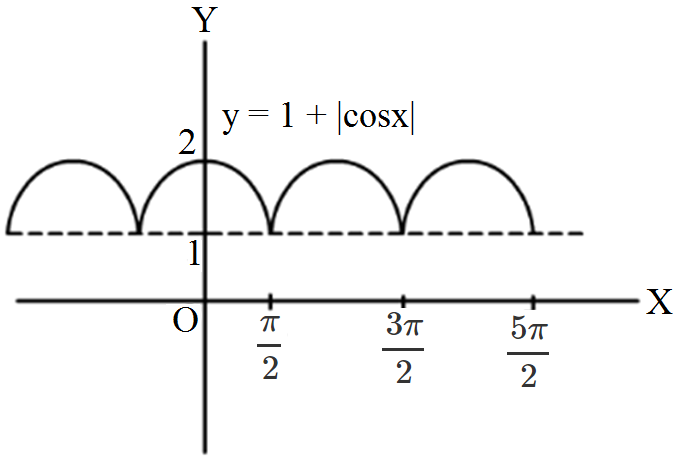
From the graph, we can see that$ f(x)$ is everywhere continuous but not differentiable at $\text{x}=(2\text{n}+1)\frac{\pi}{2},\text{n}\in\text{Z}.$ View full question & answer→MCQ 331 Mark
The value of f(0), so that the function $\text{f(x)}=\frac{2-(256-7\text{x})^{\frac{1}{8}}}{(5\text{x}+32)^\frac{1}{5}-2},\text{ x}\neq0$ is continuous everywhere, is given by:
Answer$\text{f}(0)=\lim\limits_{\text{x}\rightarrow0}\frac{2-(256-7\text{x})^{\frac{1}{8}}}{(5\text{x}+32)^\frac{1}{5}-2}$
$\text{f}(0)=\lim\limits_{\text{x}\rightarrow0}\frac{-\bigg[(256-7\text{x})^\frac{1}{8}-256^\frac{1}{8}\bigg]}{(5\text{x+32})^\frac{1}{5}-32\frac{1}{5}}$
$\text{f}(0)=\lim\limits_{\text{x}\rightarrow0}\frac{\frac{-\bigg[(256-7\text{x})^{\frac{1}{8}}-256\bigg]}{-7\text{x}}}{\frac{(5\text{x}+32)^{\frac{1}{5}}-32^\frac{1}{5}}{5\text{x}}}$
$\text{f}(0)=\lim\limits_{\text{x}\rightarrow0}\frac{\frac{-\bigg[(256-7\text{x})^\frac{1}{8}-256^\frac{1}{8}\bigg]}{-7\text{x}}\text{x}-7}{\frac{(5\text{x}+32)^\frac{1}{5}-32^\frac{1}{5}}{5\text{x}}\times5}$
$\text{f}(0)=\frac{7}{5}\times\frac{\frac{1}{8}\times256^\frac{-7}{8}}{\frac{1}{5}\times32^\frac{-4}{5}}$
$\text{f}(0)=\frac{7}{5}\times\frac{5\times2^4}{8\times2^7}=\frac{7}{8}\times\frac{1}{8}=\frac{7}{64}$
View full question & answer→MCQ 341 Mark
If $\text{x}=\text{f}(\text{t})$ and $\text{y}=\text{g}(\text{t}),$ then $\frac{\text{d}^2\text{y}}{\text{dx}^2}$ is equals to :
- ✓
$\frac{\text{f}\ '\text{g}\ ''-\text{g}\ '\text{f}\ ''}{(\text{f}\ ')^3}$
- B
$\frac{\text{f}\ '\text{g}\ ''-\text{g}\ '\text{f}\ ''}{(\text{f}\ ')^2}$
- C
$\frac{\text{g}\ ''}{\text{f}\ ''}$
- D
$\frac{\text{f}\ ''\text{g}\ '-\text{g}\ ''\text{f}\ '}{(\text{g}\ ')^3}$
AnswerCorrect option: A. $\frac{\text{f}\ '\text{g}\ ''-\text{g}\ '\text{f}\ ''}{(\text{f}\ ')^3}$
$\text{x}=\text{f}(\text{t})$
$\text{y}=\text{g}(\text{t}),$
$\frac{\text{dy}}{\text{dx}}=\frac{\frac{\text{dy}}{\text{dt}}}{\frac{\text{dx}}{\text{dt}}}=\frac{\text{g}\ '}{\text{f}\ '}$
$\frac{\text{d}^2\text{y}}{\text{dx}^2}$
$=\frac{\text{d}}{\text{dx}}\Big(\frac{\text{dy}}{\text{dx}}\Big)$
$=\frac{\text{d}}{\text{dx}}\Big(\frac{\text{dy}}{\text{dx}}\Big)\frac{\text{dt}}{\text{dx}}$
$=\frac{\text{f}'\text{g}\ ''-\text{g}'\text{f}\ ''}{\text{f}\ '^2}\frac{1}{\text{f}'}$
$=\frac{\text{f}\ '\text{g}\ ''-\text{g}'\text{f}''}{(\text{f}\ ')^3}$
View full question & answer→MCQ 351 Mark
The value of a for which the function $\text{f(x)}=\begin{cases}5\text{x}-4,&\text{if }0 < \text{x}\leq1\\4\text{x}^2+3\text{ax},&\text{if } < \text{x} < 2\end{cases}$ is continuous at every point of its domain, is :
- A
$\frac{13}{3}$
- B
$1$
- C
$0$
- ✓
$-1$
Answer$\lim\limits_{\text{x}\rightarrow1^-}\text{f(x)}=\lim\limits_{\text{x}\rightarrow1^+}\text{f(x)}$
$\lim\limits_{\text{x}\rightarrow1}5\text{x}-4=\lim\limits_{\text{x}\rightarrow1}4\text{x}^2+3\text{ax}$
$1=4+3\text{a}$
$\text{a}=-1$
View full question & answer→MCQ 361 Mark
If $\text{y}=\text{x}^{\text{n}-1}\log\text{x}\ \text{x}^2\text{y}_2+(3-2\text{n})\text{xy}_1$ is equals to :
- ✓
$-(n-1)^2 y$
- B
$(n-1)^2 y$
- C
$-n^2 y$
- D
$n^2 y$
AnswerCorrect option: A. $-(n-1)^2 y$
Here,
$\text{y}=\text{x}^{\text{n}-1}\log\text{x}$
$\Rightarrow\text{y}_1=(\text{n}-1)\text{x}^{\text{n-2}}\log\text{x}+\frac{\text{x}^{\text{n}-1}}{\text{x}}$
$\Rightarrow\text{y}_1=\frac{(\text{n}-1)\text{x}^{\text{n}-1}\log\text{x}+\text{x}^{\text{n}-1}}{\text {x}}$
$\Rightarrow\text{xy}_1=(\text{n}-1)\text{y}+\text{x}^{\text{n-1}}$
$\Rightarrow\text{xy}_2+\text{y}_1=(\text{n}-1)\text{y}_1+(\text{n}-1)\text{x}^{\text{n-2}}$
$\Rightarrow\text{xy}_2+\text{y}_1=(\text{n}-1)\text{y}_1+\frac{(\text{n}-1)\text{x}^{\text{n}-1}}{\text{x}}$
$\Rightarrow\text{x}^2\text{y}_2+\text{xy}_1=\text{x}(\text{n}-1)\text{y}_1+(\text{n}-1)\text{x}^{\text{n}-1}$
$\Rightarrow\text{x}^2\text{y}_2+\text{xy}_1=\text{x}(\text{n}-1)\text{y}_1+(\text{n}-1)\{\text{xy}_1-(\text{n}-1)\text{y}\}$
$\Rightarrow\text{x}^2\text{y}_2+\text{xy}_1=\text{x}(\text{n}-1)\text{y}_1+(\text{n}-1)\text{xy}_1-(\text{n}-1)^2\text{y}$
$\Rightarrow\text{x}^2\text{y}_2+\text{xy}_1=2\text{x}(\text{n}-1)\text{y}_1+(\text{n}-1)^2\text{y}$
$\Rightarrow\text{x}^2\text{y}_2+\text{xy}_1(1-2\text{n}+2)=-(\text{n}-1)^2\text{y}$
$\Rightarrow\text{x}^2\text{y}_2+(3-2\text{n})\text{xy}_1=-(\text{n}-1)^2\text{y}$
View full question & answer→MCQ 371 Mark
Directions : In the following questions, the Assertions $(A)$ and Reason $(s)\ (R)$ have been put forward. Read both the statements carefully and choose the correct alternative from the following :
Assertion $ (A) : \frac{\text{d}}{\text{dx}}(\text{x}^2+\text{x}+1)^4=(\text{x}^2+\text{x}+1)^3(2\text{x}+1)$
Reason $ (R) : (\text{fog}\ '=\text{f '}[\text{g(x)}].\text{g '(x)}$
- ✓
Both $A$ and $R$ are true and $R$ is the correct explanation of $A$
- B
Both $A$ and $R$ are true but $R$ is $\text{NOT}$ the correct explanation of $A$.
- C
$A$ is true but $R$ is false
- D
$A$ is false but $R$ is true
AnswerCorrect option: A. Both $A$ and $R$ are true and $R$ is the correct explanation of $A$
View full question & answer→MCQ 381 Mark
If $f(x)$ defind by $\text{f(x)}=\begin{cases}\frac{|\text{x}^2-\text{x}|}{\text{x}^2-\text{x}},&\text{x}\neq0,1\\1,&\text{x}=0\\-1,&\text{x}=1\end{cases}$ then $f(x)$ is continuse for all :
AnswerCorrect option: D. $x$ except at $x = 0$ and $x = 1$
Given function $\text{f(x)}=\frac{|\text{x}^2-\text{x}|}{\text{x}^2-\text{x}}$
Consider,
$\text{f}(0^+)=\lim\limits_{\text{x}\rightarrow0}\frac{|\text{x}^2-\text{x}|}{\text{x}^2-\text{x}}=\lim\limits_{\text{x}\rightarrow0}\frac{|\text{x(x}-1)|}{\text{x(x}-1)}=\lim\limits_{\text{x}\rightarrow0}\frac{\text{x(x}-1)}{\text{x(x}-1)}=1$
$\text{f}(0^-)=\lim\limits_{\text{x}\rightarrow0}\frac{|\text{x}^2-\text{x}|}{\text{x}^2-\text{x}}=\lim\limits_{\text{x}\rightarrow0}\frac{|\text{x}(\text{x}-1)|}{\text{x}(\text{x}-1)}=\lim\limits_{\text{x}\rightarrow0}\frac{-\text{x}(\text{x}-1)}{\text{x}(\text{x}-1)}=-1$
Also, for $f\left(1^{+}\right)$and $f\left(1^{-}\right)$you can check.
View full question & answer→MCQ 391 Mark
Let $f(x) = (x + |x|) |x|$. Then, for all $x:$
$(a) \ f$ is continuous.
$(b)\ f$ is differentiable for some $x$
$(c)\ f\ '$ is continuous.
$(d)\ f\ ''$ is continuous.
- ✓
$a$ and $c$
- B
$b $ and $c$
- C
$a$ and $d$
- D
$b$ and $d$
AnswerCorrect option: A. $a$ and $c$
$\text{f(x)}=(\text{x}+|\text{x}|)|\text{x}|$
$\Rightarrow\text{f(x)}=2\text{x}^2,\text{ x} > 0$
$=0,\text{ x} < 0$
$\lim\limits_{\text{x}\rightarrow0}2\text{x}^2=0$
Function is continuous at $x = 0.$
Also, differentiable at $x = 0$ as it is polynomial function.
View full question & answer→MCQ 401 Mark
If $\text{f(x)}=|\log_\text{e}\text{x}|,$ then :
$(a)\ \text{f}\ '(1^+)=1$
$(b)\ \text{f}\ '(1^-)=-1$
$(c)\ \text{f}\ '(1)=1$
$(d)\text{f}\ '(1)=-1$
- A
$a$ and $b$
- ✓
$a$ and $d$
- C
$c$ and $b$
- D
AnswerCorrect option: B. $a$ and $d$
$\text{f(x)}=|\log_\text{e}\text{x}|,=\begin{cases}-\log_\text{e}\text{x}, & \text{for}0 < \text{x} < 1\\\log_\text{e}\text{x}, & \text{for x}\geq1\end{cases}$
Differentiability at $x = 1,$
We have,
$\text{(LHL}$ at $x = 1)$
$=\lim\limits_{\text{x}\rightarrow1^{-}}\frac{\text{f(c)}-\text{f}(1)}{\text{x}-1}$
$=\lim\limits_{\text{x}\rightarrow1^{-}}\frac{-\log\text{x}-\log12}{\text{x}-1}$
$=\lim\limits_{\text{x}\rightarrow1^{-}}\frac{\log\text{x}}{\text{x}-1}$
$=\lim\limits_{\text{h}\rightarrow0}\frac{\log(1-\text{h})}{1-\text{h}-1}$
$=\lim\limits_{\text{h}\rightarrow0}\frac{\log(1-\text{h})}{-\text{h}}$
$=-1$
$\text{(RHL}$ at $x = 1)$
$=\lim\limits_{\text{x}\rightarrow1^{+}}\frac{\text{f(c)}-\text{f}(1)}{\text{x}-1}$
$=\lim\limits_{\text{x}\rightarrow1^{+}}\frac{\log\text{x}-\log1}{\text{x}-1}$
$=\lim\limits_{\text{h}\rightarrow0}\frac{\log(1+\text{h})}{\text{x}-1}$
$=\lim\limits_{\text{h}\rightarrow0}\frac{\log(1+\text{h})}{\text{h}}$
$=1$
View full question & answer→MCQ 411 Mark
If $\text{f(x)}=(\text{x+1})^{\cot\text{x}}$ be continuous at $x = 0,$ then $f(0)$ is equal to :
- A
$0$
- B
$\frac{1}{\text{e}}$
- ✓
$e$
- D
AnswerGiven, $\text{f(x)}=(\text{x+1})^{\cot\text{x}}$
$\log\text{f(x)}=(\cot\text{x})(\log(\text{x+1})) \ [$Taking log on both sides$]$
$\Rightarrow\lim\limits_{\text{x}\rightarrow0}\log\text{f(x)}=\lim\limits_{\text{x}\rightarrow0}(\cot\text{x})(\log(\text{x+1}))$
$\Rightarrow\lim\limits_{\text{x}\rightarrow0}\log\text{f(x)}=\lim\limits_{\text{x}\rightarrow0}\Big(\frac{\log(\text{x+1})}{\tan\text{x}}\Big)$
$\Rightarrow\lim\limits_{\text{x}\rightarrow0}\log\text{f(x)}=\lim\limits_{\text{x}\rightarrow0}\frac{\Big(\frac{\log(\text{x+1})}{\text{x}}\Big)}{\Big(\frac{\tan\text{x}}{\text{x}}\Big)}$
$\Rightarrow\lim\limits_{\text{x}\rightarrow0}\log\text{f(x)}=\frac{\lim\limits_{\text{x}\rightarrow0}\Big(\frac{\log(\text{x+1})}{\text{x}}\Big)}{\lim\limits_{\text{x}\rightarrow0}\Big(\frac{\tan\text{x}}{\text{x}}\Big)}$
$\Rightarrow\log\Big(\lim\limits_{\text{x}\rightarrow0}\text{f(x)}\Big)=\frac{\lim\limits_{\text{x}\rightarrow0}\Big(\frac{\log(\text{x+1})}{\text{x}}\Big)}{\lim\limits_{\text{x}\rightarrow0}\Big(\frac{\tan\text{x}}{\text{x}}\Big)}$ $[\because f(x)$ is continuous at $x =0]$
$\Rightarrow\log\Big(\lim\limits_{\text{x}\rightarrow0}\text{f(x)}\Big)=1$
$\Rightarrow\lim\limits_{\text{x}\rightarrow0}\text{f(x)}=\text{e}$
$\Rightarrow\text{f(0)}=\text{e} \ [\because f(x) $ is continuous at $x = 0$]$
View full question & answer→MCQ 421 Mark
If $\text{y}=\sqrt{\sin\text{x}+\text{y}},$ then $\frac{\text{dy}}{\text{dx}}$ equals :
- A
$\frac{\cos\text{x}}{2\text{y}-1}$
- ✓
$\frac{\cos\text{x}}{1-2\text{y}}$
- C
$\frac{\sin\text{x}}{1-2\text{y}}$
- D
$\frac{\sin\text{x}}{2\text{y}-1}$
AnswerCorrect option: B. $\frac{\cos\text{x}}{1-2\text{y}}$
$\text{y}=\sqrt{\sin\text{x}+\text{y}}$
$\frac{\text{dy}}{\text{dx}}=\frac{1}{2\sqrt{\sin\text{x}+\text{y}}}\times\Big(\cos\text{x}+\frac{\text{dy}}{\text{dx}}\Big)$
$\frac{\text{dy}}{\text{dx}}=\frac{\cos}{2\sqrt{\sin\text{x}+\text{y}}}+\frac{1}{2\sqrt{\sin\text{x}+\text{y}}}\frac{\text{dy}}{\text{dx}}$
$\frac{\text{dy}}{\text{dx}}-\frac{1}{2\sqrt{\sin\text{x}+\text{y}}}\frac{\text{dy}}{\text{dx}}=\frac{\cos}{2\sqrt{\sin\text{x}+\text{y}}}$
$\Big(1-\frac{1}{2\sqrt{\sin\text{x}+\text{y}}}\Big)\frac{\text{dy}}{\text{dx}}=\frac{\cos\text{x}}{2\sqrt{\sin\text{x}+\text{y}}}$
$\Big(1-\frac{1}{2\text{y}}\Big)\frac{\text{dy}}{\text{dx}}=\frac{\cos\text{x}}{2\text{y}}$
$\Big(\frac{2\text{y}-1}{2\text{y}}\Big)\frac{\text{dy}}{\text{dx}}=\frac{\cos\text{x}}{2\text{y}}$
$\frac{\text{dy}}{\text{dx}}=\frac{\cos\text{x}}{2\text{y}-1}$
View full question & answer→MCQ 431 Mark
When the tangent to the curve $\text{y}=\text{x}\log\text{x}$ is parallel to the chord joining the points $(1, 0)$ and $(e, e),$ the value of $x$ is :
- ✓
$\text{e}^{\frac{1}{1}-\text{e}}$
- B
$\text{e}^{(\text{e}-1)(2\text{e}-1)}$
- C
$\text{e}^{\frac{2\text{e}-1}{\text{e}-1}}$
- D
$\frac{\text{e}-1}{\text{e}}$
AnswerCorrect option: A. $\text{e}^{\frac{1}{1}-\text{e}}$
Given :
$\text{y}=\text{f}(\text{x})=\text{x}\log\text{x}$
Differentiating the given function with respect to $x,$ we get
$\text{f}\ '(\text{x})=1+\log\text{x}$
$\Rightarrow $ Slope of the tangent to the curve $=1+\log\text{x}$
Also,
Slope of the chord joining the points $(1, 0)$ and $(e, e), (\text{m})=\frac{\text{e}}{\text{e}-1}$
The tangent to the curve is parallel to chord joining the points $(1, 0)$ and $(e, e).$
View full question & answer→MCQ 441 Mark
The function $\text{f(x)}=\tan\text{x}$ is discontinuous on the set :
- A
$\{\text{n}\pi:\text{n}\in\text{z}\}$
- B
$\{2\text{n}\pi:\text{n}\in\text{z}\}$
- ✓
$\{(2\text{n}+1)\frac{\pi}{2}:\text{n}\in\text{z}\}$
- D
$\Big\{\frac{\text{n}\pi}{2}:\text{n}\in\text{z}\Big\}$
AnswerCorrect option: C. $\{(2\text{n}+1)\frac{\pi}{2}:\text{n}\in\text{z}\}$
When $\tan(2\text{n}+1)\frac{\pi}{2}=\tan\Big(\text{n}\pi+\frac{\pi}{2}\Big)=-\cot\text{n}\pi,$ it is not defined at the integral points.
$[\text{n}\in\text{z}]$
Hence, $f(x)$ is discontinuous on the set $\{(2\text{n}+1)\frac{\pi}{2}:\text{n}\in\text{z}\}$
View full question & answer→MCQ 451 Mark
Choose the correct answers from the given four options : For the function $\text{f(x)}=\text{x}+\frac{1}{\text{x}},\text{x}\in[1,3],$ the value of $c$ for mean value theorem is :
AnswerCorrect option: B. $\sqrt{3}$
$\text{f(x)}=\text{x}+\frac{1}{\text{x}},$ which is continuous and differentiable.
So, by mean value theorem there exists atleast one $\text{c}\in(1,3)$ such that
$\because\ \text{f}\ '\text{c}=\frac{\text{f(b)}-\text{f(a)}}{\text{b}-\text{a}}$
$\Rightarrow\ 1-\frac{1}{\text{c}^2}=\frac{\frac{10}{3}-2}{3-1}$
$\Rightarrow\ \frac{\text{c}^2-1}{\text{c}^2}=\frac{2}{3}$
$\Rightarrow\ 3(\text{c}^2-1)=2\text{c}^2$
$\Rightarrow\ 3\text{c}^2-2\text{c}^2=3$
$\Rightarrow\ \text{c}^2=3$
$\Rightarrow\ \text{c}=\sqrt{3}\in(1,3)$
View full question & answer→MCQ 461 Mark
If $\text{f(x)}=\begin{cases}\text{ax}^2+\text{b},&0\leq\text{x} < 1\\4,&\text{x}=1\\\text{x}+3,&1<\text{x}\leq2\end{cases}$ then the value of $(a, b)$ for which $f(x)$ cannot be continuous at $x = 1,$ is :
- A
$(2, 2)$
- B
$(3, 1)$
- C
$(4, 0)$
- ✓
$(5, 2)$
AnswerCorrect option: D. $(5, 2)$
$\lim\limits_{\text{x}\rightarrow1^-}\text{f(x)}=\text{f}(1)$
$\lim\limits_{\text{x}\rightarrow1}\text{ax}^2+\text{b}=4$
$a + b = 4$
We have possible values as $(2, 2), (3, 1), (4, 0)$
But can not be $(5, 2).$
Function is can not be continuous at $(5, 2).$
View full question & answer→MCQ 471 Mark
The function $f(x) = [x],$ where $[x]$ denotes the greatest integer function, is continuous at :
View full question & answer→MCQ 481 Mark
If $\text{f}\text{(x)}=\sqrt{\text{x}^2-10\text{x}+25},$ then the derivative of $f(x)$ in the intereval $[0, 7]$ is :
Answer$\text{f}(\text{x})=\sqrt{\text{x}^2-10\text{x}+25}$
$\text{f}(\text{x})=\sqrt{(\text{x}-5)^2}=|\text{x}-5|$
$\text{f}(\text{x})=\text{x}-5\ \text{x}\geq5$
$=-(\text{x}-5)\ \text{x} < 5$
$\text{f}\ '\text{(x)}=1\ \text{x}\geq5$
$=-1\text{ x} < 5$
Hence, we can not define derivative of the function on $[0, 7].$
View full question & answer→MCQ 491 Mark
The value of $k$ which makes $\text{f(x)}=\begin{cases}\sin\frac{1} {\text{x}},&\text{x}\neq0\\\text{k},&\text{x}=0\end{cases}$ continuous at $x = 0,$ is :
AnswerIf $f(x)$ is continuous at $x = 0, $ then
$\lim\limits_{\text{x}\rightarrow0}\text{f(x)}=\text{f}(0)$
$\Rightarrow\lim\limits_{\text{x}\rightarrow0}\Big(\sin\frac{1}{\text{x}}\Big)=\text{k}$
But $\lim\limits_{\text{x}\rightarrow0}\Big(\sin\frac{1}{\text{x}}\Big)$ does not exist.
Thus, there dose not exist any $k$ thet makes $f(x)$ a continuous function.
View full question & answer→MCQ 501 Mark
Let $\text{f(x)}\begin{cases}\text{ax}^2+1,&\text{x}<1\\\text{x}+\frac{1}{2},&\text{x}\leq1\end{cases}.$ Then, $f(x)$ is derivable at $x = 1,$ if :
- A
$a = 2$
- B
$a = 1$
- C
$a = 0$
- ✓
$\text{a}=\frac{1}{2}$.
AnswerCorrect option: D. $\text{a}=\frac{1}{2}$.
Given : $\text{f(x)}=\begin{cases}\text{ax}^2+1,&\text{x}<1\\\text{x}+\frac{1}{2},&\text{x}\leq1\end{cases}$
The function is derivable at $x = 1,$ if left hand derivative and right hand derivative of the function are equal at $x = 1.$
$\text{(LHL}$ at $x = 1) =\lim\limits_{\text{x}\rightarrow1^{-}}\frac{\text{f(x)}-\text{f}(1)}{\text{x}-1}$
$\text{(LHL}$ at $x = 1) =\lim\limits_{\text{h}\rightarrow0}\frac{\text{f}(1-\text{h})-\text{f}(1)}{1-\text{h}-1}$
$\text{(LHL}$ at $x = 1) =\lim\limits_{\text{h}\rightarrow0}\frac{\text{f}(1-\text{h})-\text{f}(1)}{-\text{h}}$
$\text{(LHL}$ at $x = 1) =\lim\limits_{\text{h}\rightarrow0}\frac{\Big(1-\text{h}+\frac{1}{2}\Big)-\frac{3}{2}}{-\text{h}}=1$
$\text{(RHL}$ at $x = 1) =\lim\limits_{\text{x}\rightarrow1^{+}}\frac{\text{f(x)}-\text{f}(1)}{\text{x}-1}$
$\text{(RHL}$ at $x = 1) =\lim\limits_{\text{h}\rightarrow0}\frac{\text{f}(1+\text{h})-\text{f}(1)}{1+\text{h}-1}$
$\text{(RHL}$ at $x = 1) =\lim\limits_{\text{h}\rightarrow0}\frac{\text{f}(1+\text{h})-\text{f}(1)}{\text{h}}$
$\text{(RHL}$ at $x = 1) =\lim\limits_{\text{h}\rightarrow0}\frac{\text{a}(1+\text{h})^2+1-\frac{3}{2}}{\text{h}}$
$\text{(RHL}$ at $x = 1) =\lim\limits_{\text{h}\rightarrow0}\frac{\text{a}(1-\text{h}^2+2\text{h})-\frac{1}{2}}{\text{h}}$
$\therefore\text{LHL}=\text{RHL}$
$\Rightarrow\text{a}-\frac{1}{2}=0$
$\Rightarrow\text{a}-\frac{1}{2}$
View full question & answer→