MCQ 11 Mark
જો $A, B, C$ એ એવા ત્રણ ગણ છે કે જેથી $n(A \cap B) = n(B \cap C) = n(C \cap A) = n(A \cap B \cap C) = 2$ થાય તો $n((A × B) \cap (B × C)) $ =
View full question & answer→MCQ 21 Mark
જો $f(x) = \cos [{\pi ^2}]x + \cos [ - {\pi ^2}]x$, તો
AnswerCorrect option: D. $f\left( {\frac{\pi }{2}} \right) = - 1$
(d) $f(x) = \cos \,[{\pi ^2}]x + \cos \,[ - {\pi ^2}]\,x$
$f(x) = \cos (9x) + \cos ( - 10x)$$ = \cos (9x) + \cos (10x)$
$ = 2\cos \left( {\frac{{19x}}{2}} \right)\cos \left( {\frac{x}{2}} \right)$
$f\left( {\frac{\pi }{2}} \right) = 2\cos \left( {\frac{{19\pi }}{4}} \right)\cos \left( {\frac{\pi }{4}} \right)$;
$f\left( {\frac{\pi }{2}} \right) = 2 \times \frac{{ - 1}}{{\sqrt 2 }} \times \frac{1}{{\sqrt 2 }} = - 1$.
View full question & answer→MCQ 31 Mark
વિધેય $f(x) = {\left[ {{{\log }_{10}}\left( {\frac{{5x - {x^2}}}{4}} \right)} \right]^{1/2}}$ નો પ્રદેશ મેળવો.
AnswerCorrect option: B. $1 \le x \le 4$
(b) We have $f(x) = {\left[ {{{\log }_{10}}\left( {\frac{{5x - {x^2}}}{4}} \right)} \right]^{1/2}}$…..(i)
From (i), clearly $f(x)$ is defined for those values of $x$ for which ${\log _{10}}\left[ {\frac{{5x - {x^2}}}{4}} \right] \ge 0$
==> $\left( {\frac{{5x - {x^2}}}{4}} \right) \ge {10^0} \Rightarrow \left( {\frac{{5x - {x^2}}}{4}} \right) \ge 1$
==> ${x^2} - 5x + 4 \le 0$ ==> $(x - 1)(x - 4) \le 0$
Hence domain of the function is $[1, 4].$
View full question & answer→MCQ 41 Mark
વિધેય $f(x) = {\log _{3 + x}}({x^2} - 1)$ નો પ્રદેશ મેળવો.
- A
$( - 3,\; - 1) \cup (1,\;\infty )$
- B
$[ - 3,\; - 1) \cup [1,\;\infty )$
- ✓
$( - 3,\; - 2) \cup ( - 2,\; - 1) \cup (1,\;\infty )$
- D
$[ - 3,\; - 2) \cup ( - 2,\; - 1) \cup [1,\;\infty )$
AnswerCorrect option: C. $( - 3,\; - 2) \cup ( - 2,\; - 1) \cup (1,\;\infty )$
(c) $f(x)$ is to be defined when ${x^2} - 1 > 0$
==> ${x^2} > 1,$ ==> $x < - 1{\rm{ \,or\, }}x > 1$ and $3 + x > 0$
$\therefore$ $x > - 3$ and $x \ne - 2$
$\therefore$ ${D_f} = ( - 3,\, - 2) \cup ( - 2,\, - 1) \cup (1,\,\infty )$.
View full question & answer→MCQ 51 Mark
$f(x) = \sqrt {2 - 2x - {x^2}} $ નો પ્રદેશ મેળવો.
- A
$ - \sqrt 3 \le x \le \sqrt 3 $
- ✓
$ - 1 - \sqrt 3 \le x \le - 1 + \sqrt 3 $
- C
$ - 2 \le x \le 2$
- D
$ - 2 + \sqrt 3 \le x \le - 2 - \sqrt 3 $
AnswerCorrect option: B. $ - 1 - \sqrt 3 \le x \le - 1 + \sqrt 3 $
(b) The quantity under root is positive, when
If we want the range of $f(x)$ to be real then, $0 \leq 2-2 x-x^{2}$
$\Longrightarrow x^{2}+2 x \leq 2$
$\Longrightarrow x^{2}+2 x+1 \leq 3$
$\Longrightarrow(x+1)^{2} \leq 3$
$\Longrightarrow-\sqrt{3} \leq x+1 \leq \sqrt{3}$
$\Longrightarrow-\sqrt{3}-1 \leq x \leq \sqrt{3}-1$
So the domain of $x$ is $[-1-\sqrt{3},-1+\sqrt{3}]$
View full question & answer→MCQ 61 Mark
વિધેય $\sqrt {\log ({x^2} - 6x + 6)} $ નો પ્રદેશ મેળવો.
- A
$( - \infty ,\;\infty )$
- B
$( - \infty ,\;3 - \sqrt 3 ) \cup (3 + \sqrt 3 ,\;\infty )$
- ✓
$( - \infty ,\;1] \cup [5,\;\infty )$
- D
$[0,\;\infty )$
AnswerCorrect option: C. $( - \infty ,\;1] \cup [5,\;\infty )$
(c) The function $f(x) = \sqrt {\log ({x^2} - 6x + 6)} $ is defined when $\log ({x^2} - 6x + 6) \ge 0$
==> ${x^2} - 6x + 6 \ge 1$ ==> $(x - 5)(x - 1) \ge 0$
This inequality holds if $x \le 1$ or $x \ge 5$.
Hence, the domain of the function will be $( - \infty ,\,1] \cup [5,\,\infty )$.
View full question & answer→MCQ 71 Mark
વિધેય $f(x) = \sec \left( {\frac{\pi }{4}{{\cos }^2}x} \right)\,,\; - \infty < x < \infty $ નો વિસ્તાર મેળવો.
- ✓
$[1,\;\sqrt 2 ]$
- B
$[1,\;\infty )$
- C
$[ - \sqrt 2 ,\; - 1] \cup [1,\;\sqrt 2 ]$
- D
$( - \infty ,\; - 1] \cup [1,\;\infty )$
AnswerCorrect option: A. $[1,\;\sqrt 2 ]$
(a) $f(x) = \sec \left( {\frac{\pi }{4}\,{{\cos }^2}x} \right)$
We know that, $0 \le {\cos ^2}x \le 1$ at $\cos x = 0,\,$ $f(x) = 1$ and
at $\cos x = 1$, $f(x) = \sqrt 2 $
$\therefore$ $1 \le x \le \sqrt 2 $==>$x \in [1,\,\,\sqrt 2 ]$.
View full question & answer→MCQ 81 Mark
ધારોકે $f(x)=\frac{1}{7-\sin 5 x}$ એ ${R}$ પર વ્યાખ્યાયિત એક વિધેય છે. તો વિધેય $f(x)$ નો વિસ્તાર ............. છે.
- A
$\left[\frac{1}{8}, \frac{1}{5}\right]$
- B
$\left[\frac{1}{7}, \frac{1}{6}\right]$
- C
$\left[\frac{1}{7}, \frac{1}{5}\right]$
- D
$\left[\frac{1}{8}, \frac{1}{6}\right]$
Answer$ \sin 5 x \in[-1,1] $
$ -\sin 5 x \in[-1,1] $
$ 7-\sin 5 x \in[6,8] $
$ \frac{1}{7-\sin 5 x} \in\left[\frac{1}{8}, \frac{1}{6}\right]$
View full question & answer→MCQ 91 Mark
ધારો કે $\mathrm{A}=\{1,2,3, \ldots ., 7\}$ અને ધારો કે $\mathrm{P}(\mathrm{A})$ એ $\mathrm{A}$ નો ઘાતગણ દર્શાવે છે.જો $\mathrm{a} \in f(\mathrm{a}), \forall \mathrm{a} \in \mathrm{A}$ થાય તેવા વિધેયો $f: \mathrm{A} \rightarrow \mathrm{P}(\mathrm{A})$ ની સંખ્યા $\mathrm{m}^{\mathrm{n}}$ હોય, $\mathrm{m}$ તથા $\mathrm{n} \in \mathrm{N}$ અને $\mathrm{m}$ ન્યૂનતમ છે, તો $\mathrm{m}+\mathrm{n}=$_________.
Answer$ f: A \rightarrow P(A) $
$ a \in f(a)$
That means 'a' will connect with subset which contain element ' $a$ '.
Total options for 1 will be $2^6$. (Because $2^6$ subsets contains $1$)
Similarly, for every other element
Hence, total is $2^6 \times 2^6 \times 2^6 \times 2^6 \times 2^6 \times 2^6 \times 2^6=2^{42}$
Ans. $2+42=44$
View full question & answer→MCQ 101 Mark
જે વિધેય $f(x)=\frac{\sqrt{x^2-25}}{\left(4-x^2\right)}+\log _{10}\left(x^2+2 x-15\right)$ નો પ્રદેશ $(-\infty, \alpha) \cup[\beta, \infty)$ હોય, તો $\alpha^2+\beta^3=$___________.
Answer$ f(x)=\frac{\sqrt{x^2-25}}{4-x^2}+\log _{10}\left(x^2+2 x-15\right) $
$ \text { Domain : } x^2-25 \geq 0 \Rightarrow x \in(-\infty,-5] \cup[5, \infty) $
$ 4-x^2 \neq 0 \Rightarrow x \neq\{-2,2\} $
$ x^2+2 x-15>0 \Rightarrow(x+5)(x-3)>0 $
$ \Rightarrow x \in(-\infty,-5) \cup(3, \infty) $
$ \therefore x \in(-\infty,-5) \cup[5, \infty) $
$ \alpha=-5 ; \beta=5 $
$ \therefore \alpha^2+\beta^3=150$
View full question & answer→MCQ 111 Mark
જો વિધેય $\sin ^{-1}\left(\frac{3 x-22}{2 x-19}\right)+\log _e\left(\frac{3 x^2-8 x+5}{x^2-3 x-10}\right)$ નો પ્રદેશ $(\alpha, \beta]$ હોય, તો $3 \alpha+10 \beta=$..........
Answer$-1 \leq \frac{3 x-22}{2 x-19} \leq 1 $ $ \frac{3 x^2-8 x+5}{x^2-3 x-10}>0 $
$x \in\left(5, \frac{41}{5}\right] $
$3 \alpha+10 \beta=97 $
Option ($1$)
View full question & answer→MCQ 121 Mark
$f(x)=\frac{\log _{(x+1)}(x-2)}{e^{2 \log _e x}-(2 x+3)}, x \in R$ નો પ્રદેશ $...........$ છે.
- A
$R -\{1-3\}$
- B
$(2, \infty)-\{3\}$
- C
$(-1, \infty)-\{3\}$
- D
$R -\{3\}$
Answer$x-2>0 \Rightarrow x>2$
$x+1 > 0 \Rightarrow x > -1$
$x+1 \neq 1 \Rightarrow x \neq 0 \text { and } x > 0$
Denominator
$x^2-2 x-3 \neq 0$
$(x-3)(x+1) \neq 0$
$x \neq-1,3$
So Ans $(2, \infty)-\{3\}$
View full question & answer→MCQ 131 Mark
વિધેય $f(x)=\sqrt{3-x}+\sqrt{2+x}$ નો વિસ્તાર $.........$ છે.
Answer$y^2=3-x+2+x+2 \sqrt{(3-x)(2+x)}$
$=5+2 \sqrt{6+x-x^2}$
$y^2=5+2 \sqrt{\frac{25}{4}-\left(x-\frac{1}{2}\right)^2}$
$y_{\max }=\sqrt{5+5}=\sqrt{10}$
$y_{\min }=\sqrt{5}$
View full question & answer→MCQ 141 Mark
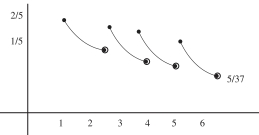
જો વિધેય $f(x)=\frac{[x]}{1+x^2}$ નો પ્રદેશ $[2,6)$ હોય, તો તેનો વિસ્તાર $............$ છે.
- A
$\left(\frac{5}{26}, \frac{2}{5}\right]-\left\{\frac{9}{29}, \frac{27}{109}, \frac{18}{89}, \frac{9}{53}\right\}$
- B
$\left(\frac{5}{26}, \frac{2}{5}\right]$
- C
$\left(\frac{5}{37}, \frac{2}{5}\right]-\left\{\frac{9}{29}, \frac{27}{109}, \frac{18}{89}, \frac{9}{53}\right\}$
- D
$\left(\frac{5}{37}, \frac{2}{5}\right]$
Answer$\begin{array}{ll}f(x)=\frac{2}{1+x^2} & x \in[2,3) \\ f(x)=\frac{3}{1+x^2} & x \in[3,4) \\ f(x)=\frac{4}{1+x^2} & x \in[4,5) \\ f(x)=\frac{5}{1+x^2} & x \in[5,6)\end{array}$
$\left(\frac{5}{37}, \frac{2}{5}\right]$
View full question & answer→MCQ 151 Mark
ધારોકે $f: R -\{2,6\} \rightarrow R$ એ $f(x)=\frac{x^2+2 x+1}{x^2-8 x+12}$ મુજબ વ્યાખ્યાયિત વાસ્તવિક મુલ્ય વિધેય છે.તો $f$ નો વિસ્તાર $........$ છે.
- A
$\left(-\infty,-\frac{21}{4}\right] \cup[0, \infty)$
- B
$\left(-\infty,-\frac{21}{4}\right) \cup(0, \infty)$
- C
$\left(-\infty,-\frac{21}{4}\right] \cup\left[\frac{21}{4}, \infty\right)$
- D
$\left(-\infty,-\frac{21}{4}\right] \cup[1, \infty)$
AnswerLet $y=\frac{x^2+2 x+1}{x^2-8 x+12}$
By cross multiplying
$y x^2-8 x y+12 y-x^2-2 x-1=0$
$x^2(y-1)-x(8 y+2)+(12 y-1)=0$
Case $1, y \neq 1$
$D \geq 0$
$\Rightarrow(8 y+2)^2-4(y-1)(12 y-1) \geq 0$
$\Rightarrow y(4 y+21) \geq 0$
$y \in\left(-\infty, \frac{-21}{4}\right] \cup[0, \infty)-\{1\}$
Case $2, y =1$
$x^2+2 x+1=x^2-8 x+12$
$10 x=11$
$x =\frac{11}{10} \quad$ So, $y$ can be 1
Hence $y \in\left(-\infty, \frac{-21}{4}\right] \cup[0, \infty)$
View full question & answer→MCQ 161 Mark
અંતરાલ $[-1,2]$ માં વિધેય $f(x)=\left|x^2-x+1\right|+\left[x^2-x+1\right]$ નું નિરપેક્ષ ન્યૂનતમ મૂલ્ય $..............$ છે.
- A
$\frac{3}{4}$
- B
$\frac{3}{2}$
- C
$\frac{1}{4}$
- D
$\frac{5}{4}$
Answer$f ( x )=\left| x ^2- x +1\right|+\left[ x ^2- x +1\right] ; x \in[-1,2]$
Let $g(x)=x^2-x+1$
$=\left(x-\frac{1}{2}\right)^2+\frac{3}{4}$
$\because\left| x ^2- x +1\right| \text { and }\left[ x ^2- x +2\right]$
Both have minimum value at $x =1 / 2$
$\Rightarrow \text { Minimum } f ( x )=\frac{3}{4}+0$
$=\frac{3}{4}$
View full question & answer→MCQ 171 Mark
જો વિધેય $f(x)=\sqrt{x}$ અને $g ( x )=\sqrt{1- x }$ આપેલ છે તો આપેલ વિધેયો $f+g, f-g, f / g, g / f, g-f$ નો સામાન્ય પ્રદેશ મેળવો કે જ્યાં $(f \pm g)(x)=$ $f(x) \pm g(x),(f / g)(x)=\frac{f(x)}{g(x)}$ દર્શાવે છે.
- A
$0 \leq x \leq 1$
- B
$0 \leq x< 1$
- C
$0< x< 1$
- D
$0< x \leq 1$
Answer$f(x)+g(x)=\sqrt{x}+\sqrt{1-x},$ domain $[0,1]$
$f(x)-g(x)=\sqrt{x}-\sqrt{1-x},$ domain $[0,1]$
$g(x)-f(x)=\sqrt{1-x}-\sqrt{x},$ domain $[0,1]$
$\frac{f(x)}{g(x)}=\frac{\sqrt{x}}{\sqrt{1-x}},$ domain $[0,1)$
$\frac{g(x)}{f(x)}=\frac{\sqrt{1-x}}{\sqrt{x}},$ domain $(0,1]$
So, common domain is $(0,1)$
View full question & answer→MCQ 181 Mark
$Z$એ પૂર્ણાક સંખ્યાઓ નો ગણ છે. જો $A\, = \,\{ x\, \in \,Z\,:\,{2^{(x + 2)({x^2} - 5x + 6)}} = 1\} $ અને $B\, = \,\{ x\, \in \,Z\,:\, - 3\, < \,2x\, - 1\, < \,9\} ,$ તો ગણ $A \times B,$ ના કુલ ઉપગણો ની સંખ્યા મેળવો.
- A
$2^{15}$
- B
$2^{18}$
- C
$2^{12}$
- D
$2^{10}$
Answer$A\, = \,\left\{ {x\, \in \,Z\,:\,{2^{(x\, + 2)({x^2} - 5x + 6)}}\, = \,1} \right\}$
${2^{(x\, + 2)({x^2} - 5x + 6)}}\, = \,{2^0}\, \Rightarrow \,x\, = \, - \,2,2,3$
$A\, = \,\{ - 2\,,\,2\,,3\} $
$B\, = \,\{ x\, \in \,Z\,:\, - \,3\,\, < \,\,2x\, - \,1\, < \,9\} $
$B\, = \,\{ 0,1,2,3,4\} $
Hence, $A\times B$ has is $15$ elements. So number of subsets of $A\times B$ is $2^{15}$
View full question & answer→MCQ 191 Mark
વિધેય $f(x) = \frac{{{x^2} + x + 2}}{{{x^2} + x + 1}};\;x \in R$ નો વિસ્તાર મેળવો.
- A
$(1,\;\infty )$
- B
$(1,\;11/7]$
- ✓
$(1,\;7/3]$
- D
$(1,\;7/5]$
AnswerCorrect option: C. $(1,\;7/3]$
(c) $f(x) = 1 + \frac{1}{{{{\left( {x + \frac{1}{2}} \right)}^2} + \frac{3}{4}}}$
==> Range $ = (1,\,7/3]$.
View full question & answer→MCQ 201 Mark
$f(x) = \frac{{{{\log }_2}(x + 3)}}{{{x^2} + 3x + 2}}$ નો પ્રદેશ મેળવો.
- A
$R - \{ - 1,\; - 2\} $
- B
$( - 2,\; + \infty )$
- C
$R - \{ - 1,\; - 2,\; - 3\} $
- ✓
$( - 3,\; + \infty ) - \{ - 1,\; - 2\} $
AnswerCorrect option: D. $( - 3,\; + \infty ) - \{ - 1,\; - 2\} $
(d) Here $x + 3 > 0$ and ${x^2} + 3x + 2 \ne 0$
$\therefore$ $x > - 3$ and $(x + 1)(x + 2) \ne 0,$ $i.e.$ $x \ne - 1,\, - 2$
$\therefore$ Domain$ = ( - 3,\,\infty ) - \{ - 1,\, - 2\} $.
View full question & answer→MCQ 211 Mark
જો $A, B$ અને $C$ એ ત્રણ ગણ હોય તો $A × (B \cup C)$ મેળવો.
AnswerCorrect option: A. $(A × B) \cup (A × C)$
(a) It is distributive law.
View full question & answer→MCQ 221 Mark
જો $A = \{ 2,\,4,\,5\} ,\,\,B = \{ 7,\,\,8,\,9\} ,$ તો $n(A \times B)$ =
Answer(b) $A × B = {(2, 7), (2, 8), (2, 9), (4, 7), (4, 8), (4, 9), (5, 7), (5, 8), (5, 9)}$
$n(A × B) = n(A) . n(B) = 3 × 3 = 9.$
View full question & answer→MCQ 231 Mark
જો ગણ $A$ માં $p$ ઘટકો,ગણ $B$ માં $q$ ઘટકો હોય તો $A × B$ માં . . . ઘટકો છે.
- A
$p + q$
- B
$p + q + 1$
- ✓
$pq$
- D
${p^2}$
Answer(c) $n(A \times B) = pq$.
View full question & answer→MCQ 241 Mark
જો $A = \{ a,\,b\} ,\,B = \{ c,\,d\} ,\,C = \{ d,\,e\} ,\,$તો $\{ (a,\,c),\,(a,\,d),\,(a,\,e),\,(b,\,c),\,(b,\,d),\,(b,\,e)\} $ એ . . . . . બરાબર છે.
- A
$A \cap (B \cup C)$
- B
$A \cup (B \cap C)$
- ✓
$A × (B \cup C)$
- D
$A × (B \cap C)$
AnswerCorrect option: C. $A × (B \cup C)$
(c) $B \cup C = \{c, d\} \cup \{d, e\} = \{c, d, e\}$
$\therefore A × (B \cup C) = {a, b} × {c, d, e}$
$= {(a, c), (a, d), (a, e), (b, c), (b, d), (b, e)}.$
View full question & answer→MCQ 251 Mark
જો $P$, $Q$ અને $R$ એ ગણ $A$ ના ઉપગણ હોય તો $R × (P^c \cup Q^c)^c =$
AnswerCorrect option: A. $(R × P) \cap (R × Q)$
(a) $R \times {({P^c} \cup {Q^c})^c} = R \times [{({P^c})^c} \cap {({Q^c})^c}]$
= $R \times (P \cap Q) = (R \times P) \cap (R \times Q)$ = $(R \times Q) \cap (R \times P)$.
View full question & answer→MCQ 261 Mark
જો $A$ અને $B$ બે ગણ હોય તો $A × B = B × A$ થવા માટે. . .
- A
$A \subseteq B$
- B
$B \subseteq A$
- ✓
$A = B$
- D
AnswerCorrect option: C. $A = B$
(c) In general, $A \times B \ne B \times A$
$A \times B = B \times A$ is true, if $A = B$.
View full question & answer→MCQ 271 Mark
જો $A = \{1, 2, 4\}, B = \{2, 4, 5\}, C = \{2, 5\}$, તો $(A -B) × (B -C)$ મેળવો.
- A
$\{(1, 2), (1, 5), (2, 5)\}$
- ✓
$\{(1, 4)\}$
- C
$(1, 4)$
- D
AnswerCorrect option: B. $\{(1, 4)\}$
(b) $A - B = \{ 1\} $ and $B - C = \{ 4\} $$(A - B) \times (B - C) = \{ (1,\,4)\} $.
View full question & answer→MCQ 281 Mark
જો $(1, 3), (2, 5)$ અને $(3, 3)$ એ $A × B$ ના ઘટકો હોય અને જો $A \times B$ માં કુલ $6$ ઘટકો છે તો $A \times B$ ના બાકીના ઘટકો મેળવો.
- ✓
$(1, 5); (2, 3); (3, 5)$
- B
$(5, 1); (3, 2); (5, 3)$
- C
$(1, 5); (2, 3); (5, 3)$
- D
AnswerCorrect option: A. $(1, 5); (2, 3); (3, 5)$
View full question & answer→MCQ 291 Mark
$A = \{1, 2, 3\}$ અને $B = \{3, 8\}$, તો $(A \cup B) × (A \cap B) = . . . $
- A
$\{(3, 1), (3, 2), (3, 3), (3, 8)\}$
- ✓
$\{(1, 3), (2, 3), (3, 3), (8, 3)\}$
- C
$\{(1, 2), (2, 2), (3, 3), (8, 8)\}$
- D
$\{(8, 3), (8, 2), (8, 1), (8, 8)\}$
AnswerCorrect option: B. $\{(1, 3), (2, 3), (3, 3), (8, 3)\}$
(b) $A \cup B = \{ 1,{\rm{ 2, 3, 8}}\} $; $A \cap B = \{ 3\} $
$(A \cup B) \times (A \cap B) = \{ (1,\,3),\,(2,3),(3,3),(8,3)\} $.
View full question & answer→MCQ 301 Mark
જો $A = \{2, 3, 5\}, B = \{2, 5, 6\},$ તો $(A -B) × (A \cap B)$ મેળવો.
- A
$\{(3, 2), (3, 3), (3, 5)\}$
- B
$\{(3, 2), (3, 5), (3, 6)\}$
- ✓
$\{(3, 2), (3, 5)\}$
- D
AnswerCorrect option: C. $\{(3, 2), (3, 5)\}$
(c) $A - B = \{ 3\} ,\,A \cap B = \{ 2,5\} $
$(A - B) \times (A \cap B) = \{ (3,\,2);\,(3,\,5)\} $.
View full question & answer→MCQ 311 Mark
જો $A = \{ 1,\,2,\,3,\,4\} $; $B = \{ a,\,b\} $ અને $f:A \to B$, તો $A \times B$ મેળવો.
- A
$\{(a, 1), (3, b)\}$
- B
$\{(a, 2), (4, b)\}$
- ✓
$\{(1, a), (1, b), (2, a), (2, b), (3, a), (3, b), (4, a), (4, b)\}$
- D
AnswerCorrect option: C. $\{(1, a), (1, b), (2, a), (2, b), (3, a), (3, b), (4, a), (4, b)\}$
View full question & answer→MCQ 321 Mark
જો $A = \{ x:{x^2} - 5x + 6 = 0\} ,\,B = \{ 2,\,4\} ,\,C = \{ 4,\,5\} ,$ તો $A \times (B \cap C)$ = . . . .
- ✓
$\{(2, 4), (3, 4)\}$
- B
$\{(4, 2), (4, 3)\}$
- C
$\{(2, 4), (3, 4), (4, 4)\}$
- D
$\{(2,2), (3,3), (4,4), (5,5)\}$
AnswerCorrect option: A. $\{(2, 4), (3, 4)\}$
(a) Clearly, $A = \{2, 3\}, B = \{2, 4\}, C = \{4, 5\}$
$B \cap C = \{4\}$
$\therefore$ $A × (B \cap C) = \{(2, 4); (3, 4)\}.$
View full question & answer→MCQ 331 Mark
જો $A = \{1, 2, 3, 4, 5\}; B = \{2, 3, 6, 7\}$. તો $(A × B) \cap (B × A)$ ની સભ્ય સંખ્યા મેળવો.
Answer(c) Here $A$ and $B$ sets having $2$ elements in common, so $A \times B$ and $B \times A$ have ${2^2}$ i.e., $4$ elements in common.
Hence, $n\,[(A \times B) \cap (B \times A)] = 4$.
View full question & answer→MCQ 341 Mark
જો $A = \{1, 2, 3\}$ તો $A$ પરના ભિન્ન સંબંધની સંખ્યા મેળવો.
AnswerCorrect option: A. ${2^9}$
(a) $n(A \times A) = n(A).n(A) = {3^2} = 9$
So, the total number of subsets of $A \times A$ is ${2^9}$ and a subset of $A \times A$ is a relation over the set $A$.
View full question & answer→MCQ 351 Mark
જો $X = \{ 1,\,2,\,3,\,4,\,5\} $ અને $Y = \{ 1,\,3,\,5,\,7,\,9\} $ તો નીચેના પૈકી . . . એ $X$ થી $Y$ પરનો સંબંધ ર્દશાવે.
- A
${R_1} = \{ (x,\,y)|y = 2 + x,\,x \in X,\,y \in Y\} $
- B
${R_2} = \{ (1,\,1),\,(2,\,1),\,(3,\,3),\,(4,\,3),\,(5,\,5)\} $
- C
${R_3} = \{ (1,\,1),\,(1,\,3)(3,\,5),\,(3,\,7),\,(5,\,7)\} $
- D
Answer$R_1=\{(x, y): y=2+x, x \in X, y \in Y\}$
$x=1 \rightarrow y=1+2=3$
$x=2 \rightarrow y=2+2=4$
$x=3 \rightarrow y=3+2=5$
$x=4 \rightarrow y=4+2=6$
$x=5 \rightarrow y=5+2=7$
$R=\{(1,3),(2,4),(3,5),(4,6),(5,7)\}$
Here in $(4,6)$ ,$6$ does not belong to either $X$or$Y$
So $R_1$ is not a relation between $X$ and $Y$
In $R _4$, since it contains an element $(7,9)$ which relates set $Y$ to set $Y$, while rest elements relate set $X$ to $Y$.
$\therefore R _4$ is not a relation between $X$ and $Y$
View full question & answer→MCQ 361 Mark
બે શાંન્ત ગણ $A$ અને $B$ આપેલ છે કે જેથી $n(A) = 2, n(B) = 3 $ હોય તો $A$ થી $B$ પરના કુલ સંબંધની સંખ્યા મેળવો.
Answer(c) Here $n(A \times B) = 2 × 3 = 6$
Since every subset of $A × B$ defines a relation from $A$ to $B$, number of relation from $A$ to $B$ is equal to number of subsets of $A \times B = {2^6} = 64$.
View full question & answer→MCQ 371 Mark
પ્રાકૃતિક સંખ્યાગણ પર સંબંધ $R$ એ $\{(a, b) : a - b = 3\}$ દ્વારા વ્યાખ્યાયિત હોય તો $R=$
- A
$\{(1, 4, (2, 5), (3, 6),.....\}$
- ✓
$\{(4, 1), (5, 2), (6, 3),.....\}$
- C
$\{(1, 3), (2, 6), (3, 9),..\}$
- D
AnswerCorrect option: B. $\{(4, 1), (5, 2), (6, 3),.....\}$
(b) $R = \{ (a,\,b):a,\,b \in N,\,a - b = 3\} = \{ ((n + 3),n):n \in N\} $
$ = \{ (4,\,1),\,(5,\,2),\,(6,\,3),\,.....\} $.
View full question & answer→MCQ 381 Mark
વિધેય $\log {x^2}$ એ . . . ને સમાન છે .
- A
$2\log x$
- ✓
$2\log |x|$
- C
$|\log {x^2}|$
- D
${(\log x)^2}$
AnswerCorrect option: B. $2\log |x|$
(b) As $\log x$ is defined for only positive values of $x$.
But $\log {x^2}$ defined for all real values of $x$, also $\log |x|$ is also defined $\forall $ real $x$.
Hence $\log {x^2}$and $2\log |x|$ are identical functions.
View full question & answer→MCQ 391 Mark
જો $f(x) = \frac{{x - |x|}}{{|x|}}$, તો $f( - 1) = $
Answer(b) $f( - 1) = \frac{{ - 1 - | - 1|}}{{| - 1|}} = \frac{{ - 1 - 1}}{1} = - \,2$.
View full question & answer→MCQ 401 Mark
જો $f(x) = 4{x^3} + 3{x^2} + 3x + 4$, તો ${x^3}f\left( {\frac{1}{x}} \right) = . . .$
AnswerCorrect option: D. $f(x)$
(d) ${x^3}f\left( {\frac{1}{x}} \right) = {x^3}\,\left[ {\frac{4}{{{x^3}}} + \frac{3}{{{x^2}}} + \frac{3}{x} + 4} \right]$
$ = 4 + 3x + 3{x^2} + 4{x^3} = f(x)$.
View full question & answer→MCQ 411 Mark
જો $f:R \to R$ માટે વિધેય $f(x) = 2x + |x|$ રીતે વ્યખ્યાયિત હોય તો $f(2x) + f( - x) - f(x) = $
- A
$2x$
- ✓
$2|x|$
- C
$ - 2x$
- D
$ - 2|x|$
AnswerCorrect option: B. $2|x|$
(b) $f(2x) = 2(2x) + |2x|\, = 4x + 2|x|$,
$f(-x) = -2x + |-x|$ = $\,-2x + \,|x|$
$f(x) = 2x + |x|$ ==> $f(2x) + f( - x) - f(x)$
$ = 4x + 2|x| + |x| - 2x - 2x - |x|$$ = 2\,\,|x|$.
View full question & answer→MCQ 421 Mark
$f(x) = \frac{{|x - 3|}}{{x - 3}}$ નો પ્રદેશ અને વિસ્તાર અનુક્રમે . . . . . અને . . . થાય.
AnswerCorrect option: B. $R - \{ 3\} ,\;\left\{ {1,\; - 1} \right\}$
(b) Domain of $f(x) = R - \left\{ 3 \right\},$ and range ${1, -1}.$
View full question & answer→MCQ 431 Mark
$\log |{x^2} - 9|$ નો પ્રદેશ મેળવો.
- A
$R$
- B
$R - [ - 3,\;3]$
- ✓
$R - \{ - 3,\;3\} $
- D
AnswerCorrect option: C. $R - \{ - 3,\;3\} $
(c) For $x = - 3,\,\,3,\,\,\,|\,\,{x^2} - 9\,\,|\, = 0$
Therefore $\log \,|{x^2} - 9|\,$ does not exist at $x = - \,3,\,\,3.$
Hence domain of function is $R - \left\{ { - \,3,\,\,3} \right\}.$
View full question & answer→MCQ 441 Mark
$f(x) = \log |\log x|$ નો પ્રદેશ મેળવો.
AnswerCorrect option: C. $(0,\;1) \cup (1,\;\infty )$
(c) $f(x) = \log |\log x|$, $f(x)$ is defined if $|\log x| > 0$ and $x > 0$
$i.e.,$ if $x > 0$ and $x \ne 1$
==> $x \in (0,\,1) \cup (1,\,\infty ).$
View full question & answer→MCQ 451 Mark
જો વિધેય $f(x) = {x^2} - 6x + 7$ નો પ્રદેશ $( - \infty ,\;\infty )$ હોય તો વિધેય નો વિસ્તાર મેળવો.
- A
$( - \infty ,\;\infty )$
- ✓
$[ - 2,\;\infty )$
- C
$( - 2,\;3)$
- D
$( - \infty ,\; - 2)$
AnswerCorrect option: B. $[ - 2,\;\infty )$
(b) ${x^2} - 6x + 7 = {(x - 3)^2} - 2$
Obviously, minimum value is $-2$ and maximum $\infty $.
Hence range of function is $[-2, \infty].$
View full question & answer→MCQ 461 Mark
વિધેય $f(x) = \sqrt {\log \frac{1}{{|\sin x|}}} $ નો પ્રદેશ મેળવો.
- A
$R - \{ 2n\pi ,\;n \in I\} $
- ✓
$R - \{ n\pi ,\;n \in I\} $
- C
$R - \{ - \pi ,\;\pi \} $
- D
$( - \infty ,\;\infty )$
AnswerCorrect option: B. $R - \{ n\pi ,\;n \in I\} $
(b) $f(x) = \sqrt {\,\log \frac{1}{{|\sin x|}}} $
==> $3 + x > 0$==> $x \ne n\pi + {( - 1)^n}0$
==> $x \ne n\pi $. Domain of $f(x) = R - \{ n\pi ,\,\,n \in I\} $.
View full question & answer→MCQ 471 Mark
વિધેય $f(x) = \log (\sqrt {x - 4} + \sqrt {6 - x} )$ નો પ્રદેશ મેળવો.
- A
$[4,\infty )$
- B
$( - \infty ,\;6]$
- ✓
$[4,\;6]$
- D
AnswerCorrect option: C. $[4,\;6]$
(c) $f(x) = \log (\sqrt {x - 4} + \sqrt {6 - x} )$
==> $y = {x^x}\, \Rightarrow \,\,\,\log y = x\log x$ and $6 - x \ge 0$==>$x \ge 4$ and $x \le 6$
$\therefore $ Domain of $f(x)$ = $[4,\,\,6]$.
View full question & answer→MCQ 481 Mark
જો $‘n’$ એ પૃણાંક હોય તો $\sqrt {\sin 2x} $ નો પ્રદેશ મેળવો.
- A
$\left[ {n\pi - \frac{\pi }{2},\;n\pi } \right]$
- ✓
$\left[ {n\pi ,\;n\pi + \frac{\pi }{2}} \right]$
- C
$[(2n - 1)\pi ,\;2n\pi ]$
- D
$[2n\pi ,\;(2n + 1)\pi ]$
AnswerCorrect option: B. $\left[ {n\pi ,\;n\pi + \frac{\pi }{2}} \right]$
(b) According to question, as $\sqrt {\sin 2x} $ can’t be negative.
So the option $(b)$ is correct
Domain of function $\sqrt {\sin 2x} $ is $[n\pi ,\,n\pi + \pi /2]$.
View full question & answer→MCQ 491 Mark
વિધેય $f(x) = \frac{{x - 3}}{{(x - 1)\sqrt {{x^2} - 4} }}$ નો પ્રદેશ મેળવો.
- A
$(1, 2)$
- B
$( - \infty ,\; - 2) \cup (2,\;\infty )$
- C
$( - \infty ,\; - 2) \cup (1,\;\infty )$
- D
$( - \infty ,\;\infty ) - \{ 1,\; \pm 2\} $
AnswerObviously, here $|x|\,\, > \,\,2$ and $x \ne 1$
$i.e.,$ $x \in ( - \,\infty ,\, - \,2)\, \cup \,(2,\,\infty )$.
View full question & answer→MCQ 501 Mark
વિધેય $\sqrt {\log \left\{ {(5x - {x^2})/6} \right\}} $ નો પ્રદેશ મેળવો.
- A
$(2, 3)$
- ✓
$[2, 3]$
- C
$[1, 2]$
- D
$[1, 3]$
AnswerCorrect option: B. $[2, 3]$
(b) $\log \,\left\{ {\frac{{5x - {x^2}}}{6}} \right\}\, \ge 0\,\, \Rightarrow \,\frac{{5x - {x^2}}}{6} \ge 1$
or ${x^2} - 5x + 6 \le 0$ or $(x - 2)\,(x - 3) \le 0$.
Hence $2 \le x \le 3.$
View full question & answer→