Question 12 Marks
Indicate the number of unpaired electrons in: Fe.
AnswerIron (Fe):
Atomic number = 26
The electronic configuration is:
$1 s^2\ 2 s^2\ 2 p^6\ 3 s^2\ 3 p^6\ 4 s^2\ 3 d^6$
The orbital picture of chromium is:

From the orbital picture, iron has four unpaired electrons. View full question & answer→Question 22 Marks
The velocity associated with a proton moving in a potential difference of 1000 V is $4.37 \times 10^5 \mathrm{~ms}^{-1}$. If the hockey ball of mass 0.1 kg is moving with this velocity, calcualte the wavelength associated with this velocity.
AnswerAccording to de Broglie’s expression,
$\lambda=\frac{\text{h}}{\text{mv}}$
Substituting the values in the expression,
$\lambda=\frac{6.626\times10^{-34}\text{Js}}{(0.1\text{kg})(4.37\times10^5\text{ms}^{-1})}$
$\lambda=1.516\times10^{-38}\text{m}$
View full question & answer→Question 32 Marks
The energy associated with the first orbit in the hydrogen atom is $-2.18 \times 10^{-18} \mathrm{~J}$ atom ${ }^{-1}$. What is the energy associated with the fifth orbit?
AnswerEnergy associated with the fifth orbit of hydrogen atom is calculated as:
$\text{E}_5=\frac{-(2.18\times10^{-18})}{(5)^2}=\frac{-2.18\times10^{-18}}{25}$
$E_5=-8.72 \times 10^{-20} \mathrm{~J}$
View full question & answer→Question 42 Marks
An electron is in one of the 3d orbitals. Give the possible values of n, l and ml for this electron.
AnswerFor the 3d orbital:
Principal quantum number (n) = 3
Azimuthal quantum number (l) = 2
Magnetic quantum number ($m_l$) = -2, -1, 0, 1, 2
View full question & answer→Question 52 Marks
What are the atomic numbers of elements whose outermost electrons are represented by
- $3s^1$
- $2p^3$
- $3p^5$
Answer
- $3s^1$
Completing the electron configuration of the element as
$1s^2 2s^2 2p^6 3s^1.$
$\therefore$ Number of electrons present in the atom of the element
$= 2 + 2 + 6 + 1 = 11$
$\therefore$ Atomic number of the element $= 11$
- $2p^3$
Completing the electron configuration of the element as
$1s^2 2s^2 2p^3.$
$\therefore$ Number of electrons present in the atom of the element $= 2 + 2 + 3 = 7$
$\therefore$ Atomic number of the element $= 7$
- $3p^5$
Completing the electron configuration of the element as
$1s^2 2s^2 2p^6 3s^2 3p^51s^2 2s^2 2p^6 3s^2 3p^5$
$\therefore$ Number of electrons present in the atom of the element $= 2 + 2 + 6+2+5 = 17$
$\therefore$ Atomic number of the element $= 17$ View full question & answer→Question 62 Marks
Indicate the number of unpaired electrons in: Fe.
AnswerKrypton (Kr):
Atomic number $=36$
The electronic configuration is:
$1 s^2 2 s^2 2 p^6 3 s^2 3 p^6 4 s^2 3 d^{10} 4 p^6$
The orbital picture of krypton is:

Since all orbitals are fully occupied, there are no unpaired electrons in krypton. View full question & answer→Question 72 Marks
$2 \times 10^8$ atoms of carbon are arranged side by side. Calculate the radius of carbon atom if the length of this arrangement is 2.4cm.
AnswerTotal length $=2.4 \mathrm{~cm}$
Total number of atoms along the length $=2 \times 10^8$
$\therefore$ Diameter of each atom $=\frac{2.4\text{cm}}{2\times10^8}=1.2\times10^{-8}\text{cm}$
$\therefore$ Radius of the atom $=\frac{\text{Diameter}}{2}=\frac{1.2\times10^{-8}\text{cm}}{2}=0.6\times10^{-8}\text{cm}$
View full question & answer→Question 82 Marks
Calculate the wavelength, frequency and wavenumber of a light wave whose period is $2.0 \times 10^{-10} \mathrm{~s}$.
AnswerFrequency $\text{(v)}=\frac{1}{\text{Period}}=\frac{1}{2.0\times10^{-10}}\text{s}=5\times10^9\text{s}^{-1}$
Wavelength $(\lambda)=\frac{\text{c}}{\text{v}}=3.0\times10^8\frac{\text{ms}^{-1}}{5\times10^9}\text{s}^{-1}=6.0\times10^2\text{m}$
Wave number $(\stackrel{{\sim}}{\hbox{v}})=\frac{1}{\lambda}=\frac{1}{6.0\times10^2\text{m}}=16.66\text{ m}^{-1}$
View full question & answer→Question 92 Marks
Arrange the following type of radiations in increasing order of frequency:
- Radiation from microwave oven.
- Amber light from traffic signal.
- Radiation from $FM$ radio.
- Cosmic rays from outer space and $(e) X-$rays.
AnswerThe increasing order of frequency is as follows:
Radiation from $FM$ radio $<$ amber light $<$ radiation from microwave oven $< X-$ rays $<$ cosmic rays.
View full question & answer→Question 102 Marks
How many electrons will be present in the subshells having ms value of $-\frac{1}{2}$ for $\mathrm{n}=4$ ?
AnswerNumber of orbitals in the $\mathrm{n}^{\text {th }}$ shell $=\mathrm{n}^2$
For $n=4$
Number of orbitals $=16$
If each orbital is taken fully, then it will have 1 electron with $m_s$ value of $-\frac{1}{2}$.
View full question & answer→Question 112 Marks
An atom of an element contains $29$ electrons and $35$ neutrons. Deduce
- The number of protons
- The electronic configuration of the element.
Answer
- For an atom to be neutral, the number of protons is equal to the number of electrons.
$\therefore$ Number of protons in the atom of the given element $= 29$
- The electronic configuration of the atom is
$1 s^2 ~2 s^2 ~2 p^6 ~3 s^2 ~3 p^6 ~4 s^2 ~3 d^{10}$. View full question & answer→Question 122 Marks
Which of the following orbitals are possible? 1p, 2s, 2p and 3f
Answer1p is not possible because when n = 1, l = 0(for p, l = 1)
2s is possible because when n = 2, l = 0, 1(for s, l = 0)
2p is possible because when n = 2, l = 0, 1(for p, l = 1)
3f is not possible because when n = 3, l = 0, 1 , 2(for f, l = 3)
View full question & answer→Question 132 Marks
Indicate the number of unpaired electrons in: Cr.
AnswerChromium (Cr):
Atomic number $=24$
The electronic configuration of Cr is:
$1 s^2 2 s^2 2 p^6 3 s^2 3 p^6 4 s^1 3 d^5$
The orbital picture of chromium is:

From the orbital picture, chromium has six unpaired electrons. View full question & answer→Question 142 Marks
In Milikan's experiment, static electric charge on the oil drops has been obtained by shining X-rays. If the static electric charge on the oil drop is $-1.282 \times 10^{-18} \mathrm{C}$, calculate the number of electrons present on it.
AnswerCharge on the oil drop $=1.282 \times 10^{-18} \mathrm{C}$
Charge on one electron $=1.6022 \times 10^{-19} \mathrm{C}$
$\therefore$ Number of electrons present on the oil drop
$=\frac{1.282\times10^{-18}\text{C}}{1.6022\times10^{-19}\text{C}}$
$=0.8001\times10^1$
$=8.0$
View full question & answer→Question 152 Marks
An atomic orbital has $n=3$. What are the possible values of $l$ and $m_l$ ?
AnswerFor a given value of $n$, I can have values from 0 to $(\mathrm{n}-1)$.
$\therefore$ For $n=3, l=0,1,2$
For a given value of $\mathrm{l}, \mathrm{m}_l$ can have $(2 l+1)$ values.
When $\mathrm{l}=0, \mathrm{~m}=0$
$\mathrm{l}=1, \mathrm{~m}=-1,0,1$
$\mathrm{l}=2, \mathrm{~m}=-2,-1,0,1,2$
$\mathrm{l}=3, \mathrm{~m}=-3,-2,-1,0,1,2,3$
View full question & answer→Question 162 Marks
In Rutherford’s experiment, generally the thin foil of heavy atoms, like gold, platinum etc. have been used to be bombarded by the $\alpha$-particles. If the thin foil of light atoms like aluminium etc. is used, what difference would be observed from the above results?
AnswerHeavy atoms have nucleus carrying large amount of positive charge. Therefore, some $\alpha$-particles will easily deflected back. Also a number of α-particles are deflected through small angles because of large positive charge.
If light atoms are used, their nuclei will have small positive charge, hence the number of $\alpha$-particles getting deflected even through small angles will be negligible.
View full question & answer→Question 172 Marks
Indicate the number of unpaired electrons in: P.
AnswerPhosphorus (P):
Atomic number = 15
The electronic configuration of P is:
$1 s^2 2 s^2 2 p^6 3 s^2 3 p^3$
The orbital picture of P can be represented as:

From the orbital picture, phosphorus has three unpaired electrons. View full question & answer→Question 182 Marks
What is the lowest value of n that allows g orbitals to exist?
AnswerFor g-orbital’s, l = 4.
For any value 'n' of principal quantum number, the Azimuthal quantum number (l) can have a value from zero to (n - 1).
$\therefore$ For l = 4, minimum value of n = 5
View full question & answer→Question 192 Marks
Calculate the radius of Bohr’s fifth orbit for hydrogen atom.
AnswerRadius of Bohr's $\mathrm{n}^{\text {th }}$ orbit for hydrogen atom is given by,
$r_n=(0.0529 n m) n^2$
For,
$n=5$
$r_5=(0.0529 n \mathrm{~m})(5)^2$
$r_5=1.3225 \mathrm{~nm}$
View full question & answer→Question 202 Marks
Indicate the number of unpaired electrons in: Si.
AnswerSilicon (Si):
Atomic number $=14$
The electronic configuration of Si is:
$1 s^2 2 s^2 2 p^6 3 s^2 3 p^2$
The orbital picture of Si can be represented as:

From the orbital picture, silicon has two unpaired electrons. View full question & answer→Question 212 Marks
Discuss the similarities and differences between $1s$ and $2s-$orbitals.
AnswerThe similarities in $1s$ and $2s-$orbitals are as follows:
- Both have spherical shape.
- Both have the same angular momentum.
The difference in between them are as follows:
- Size of $2s-$orbital is larger than that of $1s-$orbital.
- Energy of $2s-$orbital is greater than that of $1s-$orbital.
- $2s-$orbital has one node while $1s-$orbital has no node.
View full question & answer→Question 222 Marks
How does the Bohr theory of the hydrogen atom differ from that of Schrodinger?
AnswerBohr's theory does not consider the de-Broglie concept of dual nature of electron and also contradicts with the Heisenberg's uncertainty principle, while the Schrodinger equation is based on quantum mechanics which deals with the microscopic objects having both the particle as well as wave like character.
View full question & answer→Question 232 Marks
Write the electronic configuration of ${ }_9 \mathrm{~F}^{19},{ }_{16} \mathrm{~S}^{32}$ and ${ }_{18} \mathrm{Ar}^{38}$ and then point out the element with:
- Maximum nuclear charge.
- Minimum number of neutrons.
- Maximum number of unpaired electrons.
Answer$_9\text{F}^{19}=1\text{s}^2\ 2\text{s}^2\ 2\text{p}^2_\text{x}\ 2\text{p}^2_\text{y}\ 2\text{p}^1_\text{z},$
$_{16}\text{S}^{32}=1\text{s}^2\ 2\text{s}^2\ 2\text{p}^6\ 3\text{s}^2\ 3\text{p}^2_\text{x}\ 3\text{p}^1_\text{y}\ 3\text{p}^1_\text{z},$
$_{18}\text{Ar}^{38}=1\text{s}^2\ 2\text{s}^2\ 2\text{p}^6\ 3\text{s}^2\ 3\text{p}^6$
- Maximum nuclear charge $=18$ in ${ }_{18} \mathrm{Ar}^{38}$.
- Minimum number of neutrons $=10$ in ${ }_9 \mathrm{~F}^{19}$.
- Maximum number of unpaired electrons $=2$ in ${ }_{16} S^{32}$.
View full question & answer→Question 242 Marks
The Vividh Bharati station of All India Radio, Delhi, broadcasts on a frequency of 1,368kHz (kilohertz). Calculate the wavelength of the electromagnetic radiation emitted by transmitter. Which part of the electromagnetic spectrum does it belong to?
AnswerWhere v is fiequency. 'C' is velocity $'\lambda'$ is wavelength
$\Rightarrow1368\times10^{3}\text{Hz}=\frac{3\times10^8\text{ms}^{-1}}{\lambda}$
$\lambda=\frac{3\times10^8\text{ms}^{-1}}{1368\times10^3}$
Hz = 219.3m, radiowave.
View full question & answer→Question 252 Marks
The electronic energy of the ground state of hydrogen atom works out to be $-1.312 \times 10^6 \mathrm{~J} \mathrm{~mol}^{-1}$. What change will occur in the position of electron in this atom if energy of $9.84 \times 10 \mathrm{~J} \mathrm{~mol}^{-1}$ is added to the hydrogen atom?
Answer$\Delta\text{E}=-1.312\times10^6\text{J}\bigg(\frac{1}{\text{n}^2_2}-\frac{1}{\text{n}^2_1}\bigg)$
$9.84\times10^5\text{J mol}^{-1}$
$=+1.312\times10^6\text{J}\bigg(\frac{1}{1}-\frac{1}{\text{n}^2_2}\bigg)$
$\Rightarrow\frac{9.84}{13.12}=1-\frac{1}{\text{n}^2_2}$
$\Rightarrow\frac{3}{4}=1-\frac{1}{\text{n}^2_2}$
$\Rightarrow\frac{1}{\text{n}^2_2}=\frac{1}{4}$
$\Rightarrow\text{n}^2_2=4$
$\Rightarrow\text{n}_2=2$
View full question & answer→Question 262 Marks
If electron is revolving in the first Bohr orbital of a H -atom with a velocity $2.19 \times 10^8 \mathrm{~cm} / \mathrm{s}^{-1}$, what will velocity of electron in 3rd orbital of hydrogen atom.
Answer$\text{V}_\text{n}=\frac{\text{nh}}{2\text{m}\pi\text{r}}\text{V}_1=\frac{1\times\text{h}}{2\text{mr}_1\times\pi}$
$\text{V}_3=\frac{3\times\text{h}}{2\text{m}\times9\times\text{r}_1 \times\pi}$
$\frac{\text{V}_1}{\text{V}_3}=\frac{\text{h}}{2\text{mr}_1\times\pi3\text{h}}\times2\text{m}\times9\times\text{r}_1\times\pi$
$\Rightarrow\text{V}_\text{n}=\frac{\text{V}_1}{\text{V}_3}=\frac{3}{1}$
$\Rightarrow\text{V}_3=\frac{\text{V}_1}{3}=\frac{2.19\times10^8}{3}$
$=9.3\times10^7\text{cm/ s}^{-1}$
$\because\text{r}_3=\text{r}_1\times\text{n}^2$
$\text{r}_3=9\text{r}_1$
View full question & answer→Question 272 Marks
Define an orbital. What does angular quantum number tell about an orbital?
AnswerAn orbital is a region or space where there is maximum probability of finding electron.
Angular quantum number tells about the shape of an orbital.
View full question & answer→Question 282 Marks
Calculate wave number of the line having frequency $5 \times 10^{16} \mathrm{~Hz}$.
Answer$\text{v}=\frac{1}{\lambda}=\frac{\text{v}}{\text{c}}$
$=\frac{5\times10^{16}\text{s}^{-1}}{3\times10^8\text{ms}^{-1}}=1.666\times10^8\text{m}^{-1}$
View full question & answer→Question 292 Marks
Explain giving reason, which of the following sets of quantum numbers are not possible:
- $\text{n}=1,\text{l}=1\text{m}_\text{l}=0\text{m}_\text{s}=+\frac{1}{2}$
- $\text{n}=0,\text{l}=2,\text{m}_\text{l}=-2,\text{m}_\text{s}=-\frac{1}{2}$
Answer
- It is not possible because $\text{n}\not=\text{l}.$
- It is also not possible because $I$ cannot be greater than $n$.
View full question & answer→Question 302 Marks
The ionisation energy of H-atom (in the ground state) is x kJ. Find the energy required for an electron to jump from second to third energy level.
Answer$\therefore\text{E}=\frac{-\text{x}}{\text{n}^2}$
$\because\text{E}=\frac{-2.18\times10^{-18}\text{J atom}^{-1}}{\text{n}^2}$
Where 'n' is energy level.
$\text{E}_2=-\frac{\text{x}}{2^2}=-\frac{\text{x}}{4}$
$\text{E}_3=-\frac{\text{x}}{3^2}=-\frac{\text{x}}{9}$
$\text{E}_3-\text{E}_2=-\frac{\text{x}}{9}+\frac{\text{x}}{4}=\frac{5\text{x}}{36}$
View full question & answer→Question 312 Marks
A gas absorbs a photon of 355nm and emits at two wavelengths. If one of the emissions is at 680nm, at what place the other emission occur?
AnswerThe wavelength of absorbed radiation is related to those of emitted radiation as,
$\frac{1}{\lambda_{\text{absorbad}}}=\frac{1}{\lambda_1}+\frac{1}{\lambda_2}$
Therefore, $\frac{1}{355}=\frac{1}{680}+\frac{1}{\lambda_2}$
$\frac{1}{355}-\frac{1}{680}=\frac{1}{\lambda_2}$
$\Rightarrow\frac{325}{241400}=\frac{1}{\lambda_2}$
$\lambda_2=\frac{241400}{325}=742.78\text{nm}\simeq743\text{cm}$
View full question & answer→Question 322 Marks
Write the electronic configuration of the following ions:
i. $\mathrm{H}^{-}$
ii. $\mathrm{Na}^{+}$
iii. $\mathrm{O}^{2-}$
iv. $\mathrm{F}^{-}$
Answeri. $\mathrm{H}^{-}: 1 \mathrm{s}^2$
ii. $\mathrm{Na}^{+}: 1 \mathrm{s}^2 ~2 \mathrm{s}^2 ~2 \mathrm{p}^6$
iii. $\mathrm{O}^{2-}: 1 \mathrm{s}^2 ~2 \mathrm{s}^2 ~2 \mathrm{p}^6$
iv. $\mathrm{F}^{-}: 1 \mathrm{s}^2 ~2 \mathrm{s}^2 ~2 \mathrm{p}^6$
View full question & answer→Question 332 Marks
i. How many subshells are associated with $\mathrm{n}=5$ ?
ii. Write the electronic configuration of $\mathrm{Fe}^{2+}$ ions $(z=26)$
Answeri. $\mathrm{n}=5, \mathrm{I}=0,1,2,3,[\because \mathrm{I}=0,1, \ldots . \mathrm{n}-1$ but $\mathrm{I}=4$ is not possible ' g ' orbital is not being orbital used $]$ $n=5, l=0,5 s, n=5, I=1$ is $5 p$.
$\mathrm{n}=5, \mathrm{l}=2$ is $5 d, \mathrm{n}=5, \mathrm{l}=3$ is $5 f$
ii. $1 s^2 2 s^2 2 p^6 3 s^2 3 p^6 4 s^0 3 d^6$
[Electrons are removed from outer 4s orbital first and then from 3d-orbitals]
View full question & answer→Question 342 Marks
Arrange s, p and d sub-shells of a shell in the increasing order of effective nuclear charge ($Z_{\text {eff }}$) experienced by the electron present in them.
AnswerThe net positive charge experienced by the outer electrons is known as effective nuclear charge ( $\left.Z_{\text {eff}} \mathrm{e}\right)$. The $Z_{\text {eff }}$ experienced by the electron decreases with increase of azimuthal quantum number (I), that is, the s orbital electron will be more tightly bound to the nucleus than p orbital electron which in turn will be better tightly bound than the $d$ orbital electron.
Hence the arrangement of sub-shells in the increasing order of effective nuclear charge is:
$d<p<s$
View full question & answer→Question 352 Marks
Red light has wavelength 750 nm , whereas violet light has wavelength 400 nm . Calculate their frequency and energy,
$\left(\mathrm{c}=3 \times 10^8 \mathrm{~ms}-1, \mathrm{~h}=6.63 \times 10^{-34} \mathrm{Js}\right)$.
Answer$'\lambda_1'=750\text{nm}=750\times10^{-9}\text{m}$
$'\text{C}_1'=3\times10^8\text{ms}^{-1}$
Frequency, $\text{v}=\frac{\text{c}}{\lambda}=\frac{3\times10^8\text{ms}^{-1}}{750\times10^{-9}\text{m}}=4\times10^{14}\text{Hz};$
Energy, $\text{E}=\text{hv}=6.63\times10^{-34}\times4\times10^{14}$
$=2.652\times10^{-19}\text{J}$
$'\lambda'_1=400\text{nm}=400\times10^{-9}\text{m}$
$'\text{c}_2'=3\times10^8\text{ms}^{-1}$
Frequency, $\text{v}=\frac{3\times10^8\text{ms}^{-1}}{400\times10^{-9}\text{m}}=7.5\times10^{14}\text{Hz};$
Energy, $\text{E}=6.63\times10^{-34}\times7.5\times10^{14}$
$=4.972\times10^{-19}\text{J}$
View full question & answer→Question 362 Marks
Which has more energy.
- Last electron of $\mathrm{Cl}^{-}$or last electron of $\mathrm{O}^{2-}$
- $n=4, I=3$ or $n=5, I=2$
Answer$[\because4\text{f}$ has lower value of $'n\ '$ although both have same value of $(n + l)]$
$n = 4, l = 3$ represents $4f$ orbital.
$n = 5, l = 2$ represents $5d$ orbital.
$\because l = 0$ for $'s\ ' l = 1$ for $'p\ ', l = 2$ for $'d\ '$
$l = 3$ for $'f\ '$
View full question & answer→Question 372 Marks
Prove that if the uncertainty in position of a moving electron is equal to its de-Broglie wavelength then its velocity is completely uncertain.
AnswerLet the uncertainty in position be $\Delta\text{x}.$
$\therefore\Delta\text{x}=\lambda$ (de-Broglie wavelength)
Using dc-Broglic relationship, $\lambda=\frac{\text{h}}{\text{mv}}.$
Putting, $\lambda=\Delta\text{x},$ we get
$\Delta\text{x}=\frac{\text{h}}{\text{mv}}=\frac{\text{h}}{\text{P}}$
According to Heisenberg's uncertainty principle,
$\Delta\text{x}.\Delta\text{P}=\frac{\text{h}}{4\pi}$
$\therefore\frac{\text{h}}{\text{P}}\times\Delta\text{P}\approx\frac{\text{h}}{4\pi}$ or $\frac{\Delta\text{P}}{\text{P}}\approx\frac{1}{4\pi}$ $\Big[\because\Delta\text{x}=\frac{\text{h}}{\text{P}}\Big]$
Now, $\text{P}=\text{m}\times\text{v}\ ...(\text{i})$
and $\Delta\text{P} =\text{m}\times\Delta\text{v},\ \text{so}\ ...(\text{ii})$
By dividing equation (ii) by equation (i) we get,
$\frac{\Delta\text{v}}{\text{v}}\approx\frac{1}{4\pi}\Rightarrow\Delta\text{v}=\frac{\text{v}}{4\pi}$
Thus, uncertainty in velocity is so large that its velocity is uncertain.
View full question & answer→Question 382 Marks
How many 4d electrons can have spin quantum number $-\frac{1}{2}?$ Explain.
AnswerFive 4d electrons can have spin quantum number $-\frac{1}{2}$ because there are total 10 electrons in d-orbitals, out of which five will have $+\frac{1}{2}$ and other five will have $-\frac{1}{2}$ spin quantum numbers.
View full question & answer→Question 392 Marks
An element of atomic weight Z consists of two isotopes of mass number Z - 1 and Z + 2. Calculate the % of higher isotope.
AnswerLet the % of higher isotope (Z + 2) is x, other isotope (Z - 1) will be (100 - x)
Average atomic weight(Z)
$=\frac{\text{x}(\text{Z}+2)+(100-\text{x})(\text{Z}-1)}{100}$
$100\text{Z}=\text{Zx}+2\text{x}+100\text{Z}-100-\text{Zx}+\text{x}$
$3\text{x}=100$
$\Rightarrow\text{x}=33.33\%$
View full question & answer→Question 402 Marks
What kind of information about an electron in an atom is obtained from its wave function?
AnswerThe square of the amplitude of the electron wave, i.e. $|\psi|^2$ at any point gives probability of finding an electron at that point. Since, the region around the nucleus which represents the electron density at different points is called an orbital, hence the wave function for an electron in an atom is called orbital wave function.
View full question & answer→Question 412 Marks
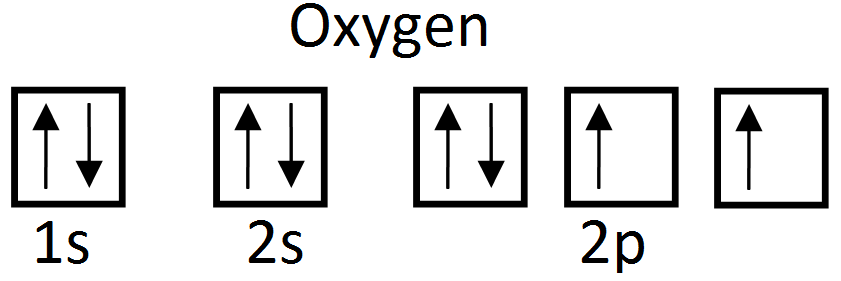
Show the distribution of electrons in oxygen atom (atomic number 8) using orbital diagram.
AnswerOxygen atomic number is 8 .
Electronic configuration is $1 s^2 ~2 s^2 ~2 p^4$
So distribution of electrons in orbitals is:
View full question & answer→Question 422 Marks
The mass of an electron is $9.1 \times 10^{-31} \mathrm{~kg}$. If its kinetic energy is $3.0 \times 10^{-25} \mathrm{~J}$, calculate its wave length.
[Given: $\mathrm{h}=6.626 \times 10^{-34} \mathrm{~kg}$ ]
AnswerGiven $\text{m}=9.1\times10^{-31}\text{kg}$
and $\text{K.E}=3.0\times10^{-25}\text{J}.$
$\text{K.E}=\frac{1}{2}\text{mc}^2$
$\Rightarrow\text{c}^2=\frac{2\text{K.E}}{\text{m}}$
$\Rightarrow\text{c}=\sqrt{\frac{2\text{K.E}}{\text{m}}}$
Also, de Broglie $\text{Eq}^\text{n}\lambda=\frac{\text{}\text{h}}{\text{mc}}$
$\Rightarrow\lambda=\frac{\text{h}}{\text{m}\times\sqrt{\frac{2\text{K.E}}{\text{m}}}}$
$\Rightarrow\lambda=\frac{\text{h}}{\sqrt{2\times\text{K>E}\times\text{m}}}$
$\Rightarrow\lambda=\frac{6.626\times10^{-34}}{\sqrt{2\times3\times10^{-25}\times9.1\times10^{-31}}}$
$\Rightarrow\lambda=\frac{66.26\times10^{-34}}{\sqrt{54.6\times10^{-56}}}$
$\Rightarrow\lambda=\frac{66.26\times10^{-35}}{7.39\times10^{-28}}=8.97\times10^{-7}\text{m}$
$\Rightarrow\lambda=8.97\times10^{-7}\text{m}\times10^{9}=897\text{nm}.$
View full question & answer→Question 432 Marks
For a hydrogen like particle, derive the expression,
$\text{v}_\text{n}=\Big(\frac{\text{Ze}^2}{\text{mr}_\text{n}}\Big)^\frac{1}{2}$
Where vn is the velocity of the electron at distance rn from the nucleus, Z is the atomic number of the H-like particle, e and m are the charge and mass of the electron.
AnswerFor H-like particle, force of attraction between the electron and the nucleus = centrifugal force.
View full question & answer→Question 442 Marks
Calculate the uncertainty in position of an electron if uncertainty in its velocity is $0.001 \%$. Mass of electron $=9.1 \times 10^{-31} \mathrm{~kg}$, velocity of electron $=300 \mathrm{~ms}^{-1}$.
$\left(\mathrm{h}=6.626 \times 10^{-34} \mathrm{~kg} / \mathrm{m}^2 \mathrm{~s}^{-1}\right)$
Answer$\Delta\text{x}\times\Delta\text{p}=\frac{\text{h}}{4\pi}$
$\Delta\text{x}=\frac{\text{h}}{4\pi\text{m}\Delta\text{V}}$
Where $\Delta\text{r}$ is uncertainty in position,
$'\Delta\text{p}'$ is uncertainty in momentum,
$'\text{p}'=\text{m}\Delta\text{v}$
$\Delta\text{v}$ is uncertainty in velocity.
Given: Velociry of electon $=300 \mathrm{~ms}^{-1}$: Uncertainty in velocity = 0.001%
Mass of electron $=9.1\times10^{-31}\text{kg};\text{h}=6.626\times10^{-34}\text{Js}$
$\Delta\text{x}=\frac{6.626\times10^{-34}\text{Js}}{4\times3.14\times9.1\times10^{-31}\text{kg}\times\big(\frac{0.001}{100}\times300\big)\text{ms}^{-1}}$
$=19.32\times10^{-3}\text{m}=1.932\times10^{-2}\text{m}$
View full question & answer→Question 452 Marks
The electronic configuration of valence shell of Cu is $3 d^{10} ~4 s^1$ and not $3 d^9 ~4 s^2$. How is this configuration explained?
AnswerConfiguration with completely filled and half-filled orbitals has extra stability. In $3 d^{10} ~4 s^1$, $d$-orbital are completely filled and s-orbital is half- filled. Hence, it is a more stable configuration.
View full question & answer→Question 462 Marks
The threshold frequency v , for a metal is $7.0 \times 10^{14} \mathrm{~s}^{-1}$. Calculate the kinetic energy of an electron emitted when radiation of $\mathrm{v}=1.0 \times 10^{15} \mathrm{~s}^{-1}$ hits the metal.
Answer$\mathrm{K} . \mathrm{E}=\frac{1}{2} \mathrm{mv}^2$
$\Rightarrow \frac{1}{2} \mathrm{~m}_{\mathrm{e}} \mathrm{v}^2=\mathrm{h}\left(\mathrm{v}-\mathrm{v}_0\right)$
$\lambda=\text { frequency of incident light }$
$\mathrm{v}_0=\text { threshold fiequency }$
$\text { 'h' }=\text { Planck's constant }$
$\text { 'v' Velocity }$
$=\left(6.626 \times 10^{-34} \mathrm{~J} \mathrm{~s}\right)\left(1.0 \times 10^{15} \mathrm{~s}^{-1}-7.0 \times 10^{14} \mathrm{~s}^{-1}\right)$
$=\left(6.626 \times 10^{-34} \mathrm{~J}\right)\left(10 \times 10^{14} \mathrm{~s}^{-1}-7.0 \times 10^{14} \mathrm{~s}^{-1}\right)$
$=\left(6.626 \times 10^{-34} \mathrm{~J} \mathrm{~s}\right)\left(3.0 \times 10^{14} \mathrm{~s}^{-1}\right)=1.988 \times 10^{-19} \mathrm{~J}$
View full question & answer→Question 472 Marks
i. Write down the value of $n, \mathrm{I}$ and m for electron present in $3 p$.
ii. What will be wavelength of a ball of mass $0.1 \ kg$ moving with a velocity of $10 \mathrm{~ms}^{-1}$ ?
Answer
- $\mathrm{n}=3, \mathrm{I}=1, \mathrm{~m}$ can have any value $-1,0,+1$.
- $\lambda=\frac{\text{h}}{\text{mc}}$
$\Rightarrow\lambda=\frac{6.626\times10^{-34}}{0.1\times10}=6.626\times10^{-34}\text{m}$ View full question & answer→Question 482 Marks
Out of $\mathrm{Cu}^{2+}, \mathrm{Fe}^{2+}$ and $\mathrm{Cr}^{3+}$, which ion is most paramagnetic and why?
AnswerElectronic configuration of:
$\mathrm{Cu}^{2+}=[\mathrm{Ar}] 3 \mathrm{~d}^9$
$\mathrm{Fe}^{2+}=[\mathrm{Ar}] 3 \mathrm{~d}^6$
$\mathrm{Cr}^{3+}=[\mathrm{Ar}] 3 \mathrm{~d}^3$
Paramagnetism depends on the number of unpaired electrons. From the electronic configuration of these ions, it is clear that $\mathrm{Cu}^{2+}$ has one, $\mathrm{Fe}^{2+}$ has four and $\mathrm{Cr}^{3+}$ has three unpaired electrons. Therefore, $\mathrm{Fe}^{2+}$ is most paramagnetic in nature.
View full question & answer→Question 492 Marks
A proton is moving with kinetic energy $5\times10^{-27}\text{J}$. What is the velocity of the proton?
AnswerMass of proton $=\frac{1.008\times10^{-3}}{6.02\times10^{23}}\text{kg}=1.67\times10^{-27}\text{kg}$
$\text{KE}=\frac{1}{2}\text{mv}^2$
or $\text{v}=\frac{2\text{KE}}{\text{m}}=\frac{2\times5\times10^{-27}}{1.67\times10^{-27}}=5.98$
View full question & answer→Question 502 Marks
Wavelengths of different radiations are given below:
$\lambda(\text{A})=300\text{nm},\ \lambda(\text{B})=300\mu\text{m},\ \lambda(\text{C})=3\text{nm},\ \lambda(\text{D})=30\mathring{\text{A}}$
Arrange these radiations in the increasing order of their energies.
Answer$\text{E}=\text{hv or }=\frac{\text{hc}}{\lambda}\ \text{or E}\propto\frac{1}{\lambda}$
$\lambda(\text{A})=300\text{nm}=300 \times10^{-9}\text{m}\ \text{or}\ =3\times10^{-7}\text{m};$
$\lambda(\text{B})=300\times10^{-6}\text{m}=3\times10^{-4}\text{m}$
$\lambda(\text{C})=3\times10^{-9}\text{m},\lambda(\text{D})=30\times10^{-10}\text{m}=3\times10^{-9}\text{m}$
$\therefore$ Increasing order of energies is:
$\text{B}<\text{A}<\text{C}=\text{D}$
View full question & answer→Question 512 Marks
The work function ($W_0$) of some metals is listed below. Count the number of metals which will show photoelectric effect when light of 300nm wavelength falls on the metal.
| Metal |
Li |
Na |
K |
Mg |
Cu |
Ag |
Fe |
Pt |
W |
| $W_0(\mathrm{eV})$ |
2.4 |
2.3 |
2.2 |
3.7 |
4.8 |
4.3 |
4.7 |
6.3 |
4.75 |
AnswerGiven that wavelength is:
$\lambda=300\text{nm}=3\times10^{-17}\text{m}$
Therefore, energy is,
$\text{E}=\text{hv}=\frac{\text{hc}}{\lambda}$
$=\frac{6.626\times10^{-34}\times3\times10^8}{3\times10^{-7}\times1.6\times10^{-19}}=4.1\text{eV}$
For a metal to show photoelectric effect, its work function has to be less than or equal to 4.1 eV So, the number of metals having work function less than 4.1 eV are 4, i.e. Li, Na, K and Mg.
View full question & answer→Question 522 Marks
An atom having atomic mass number 13 has 7 neutrons. What is the atomic number of the atom?
AnswerAtomic mass number = A = 13, n = 7
As A = n + p
p = A - n = 13 - 7 = 6
Hence, Z = p = 6.
View full question & answer→Question 532 Marks
How many quantum numbers specify an:
- Electron,
- Orbital? Name them.
Answer
- Four quantum numbers $'n\ ', 'l\ ', 'm\ '$ and $'s\ '$ specify an electron.
- Three quantum numbers, principal $(n)$, azimuthal $(l)$ and magnetic $(\text{m}_l)$ specify an orbital.
View full question & answer→Question 542 Marks
Calculate the energy associated with the first orbit of He. What is the radius of this orbit?
Answer$\text{E}_\text{n}=\frac{-13.595\text{eV}}{\text{n}^2}\times\text{Z}^2=\frac{-13.595}{\text{l}^2}\times2^2$
eV = eletron volt,
$\text{E}_\text{n}=\frac{-13.595}{\text{l}}\times4=-54.380\text{eV}$
$\text{r}_\text{n}=\frac{0.529}{\text{Z}}\text{n}^2=\frac{0.529\times1^2}{2}=0.2645\mathring{\text{A}}$
View full question & answer→Question 552 Marks
The Balmer series in the hydrogen spectrum corresponds to the transition from $n_1=2$ to $n_2=3,4$, .......... This series lies in the visible region. Calculate the wave number of line associated with the transition in Balmer series when the electron moves to $\mathrm{n}=4$ orbit.
$\left(\mathrm{RH}=109677 \mathrm{~cm}^{-1}\right)$
Answer$\bar{\text{v}}=\text{R}_\text{H}\Big(\frac{1}{\text{n}_1^2}-\frac{1}{\text{n}_2^2}\Big)\text{cm}^{-1}$
$=109677\Big(\frac{1}{2^2}-\frac{1}{4^2}\Big)=109677\Big(\frac{1}{4}-\frac{1}{16}\Big)$
$=20564.44\text{cm}^{-1}$
View full question & answer→Question 562 Marks
Calculate the energy per photon associated with the following radiations:
i. Radiation of frequency $=3 \times 10^{15} \mathrm{~s}^{-1}$
ii. Radiation of wavelength $=40 \mathrm{~nm}$.
$\left(\mathrm{h}=6.62 \times 140^{-34} \mathrm{~J} \mathrm{~s} ; \mathrm{c}=3 \times 10^8 \mathrm{~ms}^{-1}\right)$
AnswerWhere $v$ is fiequency,
$'h'$ is planck's constant,
$'\lambda'$ is wavelengrh,
$'E'$ is energy
- $\text{E}=\text{hv}=6.62\times10^{-34}\text{Js}\times3\times10^{15}\text{s}^{-1}$
$=1.986\times10^{-18}\text{J}$
- $\text{E}=\frac{\text{hc}}{\lambda}=\frac{6.62\times10^{-34}\text{Js}\times3\times10^8\text{ms}^{-1}}{40\times10^{-9}\text{m}}$
$\lambda=40\text{nm}=40\times10^{-9}\text{m}$
$=4.965\times10^{-18}\text{J}$ View full question & answer→Question 572 Marks
Calculate the velocity of a particle of mass 0.1 mg which is associated with a wavelength of $3.3 \times 10^{-29} \mathrm{~m}\left(\mathrm{~h}=6.6 \times 10^{-34} \mathrm{~kg} / \mathrm{m}^2 \mathrm{~s}^{-1}\right)$.
AnswerGiven, $\text{m}=0.1\text{mg}=0.1\times10^{-6}\text{kg},$
$\lambda=3.3\times10^{-29}\text{m}$
$\text{h}=6.6\times10^{-34}\text{kg/ m}^2\text{s}^{-1}$
de Broglie equation $=\lambda=\frac{\text{h}}{\text{mc}}$
$\Rightarrow\text{c}=\frac{\text{h}}{\text{m}}$
$=\frac{6.6\times10^{-34}\text{kg/ m}^2\text{s}^{-1}}{0.1\times10^{-6}\text{kg}\times3.3\times10^{-29}\text{m}}$
$=2\times10^2\text{ms}^{-1}$
View full question & answer→Question 582 Marks
In each of the following pairs of salts, which so one is more stable?
- Ferrous and ferric salts.
- Cuprous and cupric salts.
Answer$i.$ Ferrous and ferric salts In ferrous salts $\mathrm{Fe}^{2+}$, the configuration is $1 s^2 2 s^2, 2 p^6, 3 s^2, 3 p^6, 3 d^6$. In ferric salts $\mathrm{Fe}^{3+}$, the configuration is, $1 s^2 2 s^2, 2 p^6, 3 s^2, 3 p^6, 3 d^5$,
As half$-$filled $3d$ configuration is more stable therefore ferric salts are more stable than ferrous salts.
$ii.$ Cuprous and cupric salts In cuprous salts, the configuration of Cut is $1 s^2 2 s^2 2 p^6 3 s^2 3 d^{10}$ In cupric salts, the configuration of. $\mathrm{Cu}^{2+}$ is $1 s^2 2 s^2, 2 p^6, 3 s^2, 3 p^6, 3 d^9$. Although $\mathrm{Cu}^{+}$has completely filled $d-$orbital, yet cuprous salts are less stable.
This is because the nuclear charge is not sufficient enough to hold $18$ electrons of $\mathrm{Cu}^{+}$ion present in the outermost shell.
View full question & answer→Question 592 Marks
Nickel atom can lose two electrons to form $\mathrm{Ni}^{2+}$ ion. The atomic number of nickel is 28. From which orbital will nickel lose two electrons.
AnswerNickel's atomic no. is 28 i.e $1 s^2 2 s^2 2 p^6 3 s^2 3 p^6 4 s^2 3 d^8$
It will lose 2 electrons from $4 s^2$ (became $4 s^9$ ) because s-orbital has highest energy level of $n=4$ in this case. So sorbital will lose first before, $d$-orbital and so $\mathrm{Ni}^{+2}$ can be written as $[\mathrm{Ar}] 4 \mathrm{~s}^0 3 \mathrm{~d}^8$.
View full question & answer→Question 602 Marks
Calculate the wavelength of an electron that has been accelerated in a particle accelerator through a potential difference of 100 million volts.
$\left(1 \mathrm{eV}=1.6 \times 10^{-19} \mathrm{~J}, \mathrm{~m}_{\mathrm{e}}=9.1 \times 10^{-31} \mathrm{~kg}, \mathrm{~h}=6.6 \times 10^{-34} \mathrm{~J}, \mathrm{c}=3.0 \times 10^8 \mathrm{~ms}^{-1}\right)$.
AnswerK.E. of the electron = 100 MeV [Million electron volt]
$[1\text{eV}=1.602\times10^{-19}\text{C}]$
$=100\times10^6\text{eV}=10^8\text{eV}$
$=100\text{eV}\times1.6\times10^{-19}\text{J/ eV}$
$=1.6\times10^{-11}\text{J}$
$\lambda=\frac{\text{hc}}{\text{K.E.}}$
$=\frac{6.6\times10^{-34}\text{Js}\times3\times10^8\text{ms}^{-1}}{1.6\times10^{-11}\text{J}}$
$\Rightarrow\lambda=1.24\times10^{-14}\text{m}$
View full question & answer→Question 612 Marks
An atom of an element contains $29$ electrons and $35$ neutrons. Deduce:
- Number of protons.
- Electronic configuration of the element.
- Number of paired electrons.
- number of unpaired electrors.
Answer
- Electrons $= 29$, Neutrons $= 35$, Protons $=$ Electrons $= 29$
- Electronic configuration is,
$1 s^2 2 s^2 2 p^6 3 s^2 3 p^6 4 s^1 3 d^{10}$.
- There are $28$ paired electrons.
- There is one unpaired electron.
View full question & answer→Question 622 Marks
Which orbital in each of the following pairs is lower in energy in a many electron atom?
- $2s, 2p$
- $3p, 3d$
- $3s, 4s$
- $40, 5f$
Answer
- $2s < 2p$
- $3p < 3d$
- $3s < 4s$
- $4d < 5f$
This is because lower the value of $(n + 1)$, lower is the energy and if $(n + l)$ are same, the orbital with lower value of $n$ is of lower energy. View full question & answer→Question 632 Marks
What will be the wavelength of a ball of mass 0.1 kg moving with a velocity of $10 \mathrm{~ms}^{-1}$ ?
AnswerAccording to de-Broglie equation,
$\lambda=\frac{\text{h}}{\text{mv}}$
$=\frac{6.62\times10^{-34}\text{kg/ m}^2\text{s}^{-1}}{0.1\text{kg}\times10\text{ms}^{-1}}$
$=6.62\times10^{-34}\text{m}$
$'\lambda'$ is wavelength, 'h' is plancks constant, 'm' is mass of object, v is velocity.
View full question & answer→Question 642 Marks
In an atom, an electron is moving with a speed of $600 \mathrm{~ms}^{-1}$ with an accuracy of $0.005 \%$. Find the certainty with which the position of the electron can be located. $\left(\mathrm{h}=6.6 \times 10^{-34} \mathrm{~kg} / \mathrm{m}^2 \mathrm{~s}^{-1}\right.$, mass of electron $\left.\mathrm{me}=9.1 \times 10^{-31} \mathrm{~kg}\right)$.
Answer$\Delta\text{v}=600\times\frac{0.005}{100}=0.03\text{ms}^{-1}$
Using Heisenberg's uncertainty principle,
you get, $\Delta\text{x}=\frac{6.6\times10^{-34}}{4\times3.14\times9.1\times10^{-31}\times0.03}$
$=1.92\times10^{-3}\text{m}$
View full question & answer→Question 652 Marks
In photoelectric effect experiment, irradiation of a metal with light of frequency $5 \times 10^{20} \mathrm{~s}^{-1}$ yields electrons with maximum K.E. $=6.63 \times 10^{-14} \mathrm{~J}$. Calculate $\mathrm{v}_0$ (threshold frequency) for the metal.
Answer$\text{hv}=\text{hv}_0+\text{K.E}$
$\Rightarrow\text{h}(\text{v}-\text{v}_0)=\text{K.E}$
$\Rightarrow\text{v}-\text{v}_0=\frac{\text{K.E}}{\text{h}}=\frac{6.63\times10^{-14}\text{J}}{6.63\times10^{-34}\text{Js}}$
$=1\times10^{20}\text{s}^{-1}$
$\Rightarrow5\times10^{20}-1\times10^{20}\text{v}_0$
$\Rightarrow\text{v}_0=4\times10^{20}\text{s}^{-1}\ \text{or }\text{Hz}$
View full question & answer→Question 662 Marks
Using $'s\ ', 'p\ ', 'd\ ', 'f\ '$ notations, describe the orbital with following quantum numbers.
- $n = 1, l = 0$
- $n = 2, l = 0$
- $n = 3, l = 1$
- $n = 4, l = 2$
- $n = 4, l = 3$
View full question & answer→Question 672 Marks
Out of principal, angular, magnetic and spin quantum number, which quantum number determines the following:
- Shape of orbital.
- Number of orbitals in an orbit.
- Size of orbital.
- Spin orientation of the electron.
Answer
- Angular quantum number.
- Magnetic quantum number.
- Principal quantum number.
- Spin quantum number.
View full question & answer→Question 682 Marks
For an electron in any of 3d orbitals. What are values of $n, \mathrm{l}, \mathrm{m}$, and $\mathrm{m}_{\mathrm{s}}$ ?
Answer$\text{n} =3,\text{l}=2,$
$\text{m}_\text{l}=-2,-\text{p},0,+1, +2$
$\text{m}_\text{s}=+\frac{1}{2}$ or $-\frac{1}{2}$ for each electron.
View full question & answer→Question 692 Marks
One of the spectral lines of caesium has a wavelength of 456 nm . Calculate the frequency of this line $\left(\mathrm{c}=3.0 \times 10^8 \mathrm{~ms}^{-1}\right)$.
Answer$\lambda=456\text{nm}=456\times10^{-9}\text{m},$
$\text{v}=\ ?,\text{c}=3.0\times10^8\text{ms}^{-1}$
$\text{v}=\frac{\text{c}}{\lambda}=\frac{3.0\times10^8\text{ms}^{-1}}{456\times10^{-9}\text{m}}$
$=6.578\times10^{14}\text{Hz}$
View full question & answer→Question 702 Marks
Give four differences between 3p and 4p subshell.
Answer
|
S. No
|
3p
|
4p
|
|
1.
|
It belongs to third energy level.
|
It is belongs to $4^{th}$ energy level.
|
|
2.
|
It has lower energy.
|
It has higher energy.
|
|
3.
|
It is smaller in size.
|
It is bigger in size.
|
|
4.
|
It has more effective nuclear charge.
|
It has less effective nuclear charge.
|
View full question & answer→Question 712 Marks
Calculate the number of protons, neutrons and electrons in $^{80}_{35}\text{Br}.$
Answer Number of protons = 35, Number of electrons = 35,
Number of neutrons = 45.
View full question & answer→Question 722 Marks
Which of the following orbitals are degenerate?
$3 \mathrm{~d}_{\mathrm{xy}}, 4 \mathrm{~d}_{\mathrm{xy}}, 3 \mathrm{~d}_{\mathrm{z}^2}, 3 \mathrm{~d}_{\mathrm{yz}}, 4 \mathrm{~d}_{\mathrm{yz}}, 4 \mathrm{~d}_{\mathrm{z}^2}$
AnswerDegenerate orbitals are the orbitals of the same sub shell of the same main shell. Hence, these are, $\left(3 \mathrm{~d}_{\mathrm{xy}}, 3 \mathrm{~d}_{\mathrm{z}^2}, 3 \mathrm{~d}_{\mathrm{yz}}\right)$ and $\left(4 \mathrm{~d}_{\mathrm{xy}}, 4 \mathrm{~d}_{\mathrm{xz}}, 4 \mathrm{~d}_{\mathrm{z}^2}\right)$
View full question & answer→Question 732 Marks
Calculate the total number of angular nodes and radial nodes present in 3p orbital.
AnswerFor 3p orbital n = 3, l = 1
Number of angular nodes = l = 1
Number of radial nodes = n - l - 1 = 3 - 1 - 1 = 1.
View full question & answer→Question 742 Marks
Two particles $A$ and $B$ are in motion. The momentum of particle ' $B$ ' is half of ' $A$ '. If the wavelength associated with the particle 'A' is $5 \times 10^{-8} \mathrm{~m}$, calculate the wavelength associated with the particle ' $\mathrm{B}^{\prime}$.
AnswerMomentum(p) of B is $\frac{1}{2}$ of $\text{A},\lambda_\text{A}=\frac{\text{h}}{\text{p}}$
$\Rightarrow\text{h}=\text{p}\times5\times10^{-8}\text{m}$
$\Rightarrow\text{p}=\frac{\text{h}}{5\times10^{-8}\text{m}}$
$\because\lambda=\frac{\text{h}}{\text{p}}$ where 'p' is momentum (de-Broglie equation),
$\lambda_\text{B}=\frac{\text{h}}{\frac{1}{2}\text{p}}$
$\Rightarrow\lambda_\text{B}=\frac{\text{h}\times5\times10^{-8}\text{m}}{\frac{1}{2}\text{h}}$
$=10\times10^{-8}=10^{-7}\text{m}$
View full question & answer→Question 752 Marks
Calculate the mass of photon with wavelength 5pm.
Answer$\mathrm{m}=?$
$\mathrm{C}=\text { velocity of photon }$
$=\text { velocity of light }=3 \times 10^8 \mathrm{~ms}^{-1}$
$\lambda=5\text{pm}=5\times10^{-10}\text{m}$
using de Broglie equation,
$\lambda=\frac{\text{h}}{\text{mc}}$
$5\times10^{-10}=\frac{6.626\times10^{-34}\text{Js}^{-1}}{\text{m}\times3\times10^8\text{ms}^{-1}}$
$\text{m}=\frac{6.626\times10^{-34}}{5\times10^{-10}\times3\times10^8}$
$=\frac{6.626}{15}\times10^{-34+10-8}=\frac{6.626\times10^{-32}}{15}$
$\text{m}=\frac{66.26}{15}\times10^{-33}\text{kg}$
$=4.417\times10^{-33}\text{kg}$
View full question & answer→Question 762 Marks
Calculate the energy of one mole of photons of radiation whose frequency is $5 \times 10^{14} \mathrm{~Hz}$.
AnswerEnergy of I Photon, E = hy
v is frequency,
$=6.626 \times 10^{-34} \mathrm{~J} \mathrm{~s} \times 5 \times 10^{14} \mathrm{~s}^{-1}$
$=33.130 \times 10^{-20} \mathrm{~J}$
Energy of 1 mole of photon,
$=33.130 \times 10^{-20} \times 6.022 \times 10^{23}$
$=199.51 \times 10^3 \mathrm{~J}=199.51 \mathrm{~kJ} / \mathrm{mol}^{-1}$
View full question & answer→Question 772 Marks
The ionisation energy of H-atom (in the ground state) is x kJ. Find the energy required for an electron to jump from second to third energy level.
AnswerEnergy in second energy level, $\text{E}_2 =-\frac{\text{x}}{2^2}=-\frac{\text{x}}{4}$
Energy in third energy level, $\text{E}_2 -\frac{\text{x}}{3^2}=-\frac{\text{x}}{9}$
Energy required for an electron to jump,
$(\text{E}_3-\text{E}_2)=-\frac{\text{x}}{9}+\frac{\text{x}}{4}=\frac{5\text{x}}{36}$
View full question & answer→Question 782 Marks
An electron has a speed of $40 \mathrm{~ms}^{-1}$ accurate upto $99.99 \%$. What is the uncertainty in locating its position? [Given, $\mathrm{m}=9.11 \times 10^{-31} \mathrm{~kg}$ ]
Answer$\Delta\text{v}=$ Uncertainty in speed $=100-99.99=0.01\%$
$\Delta\text{V}=40\text{ms}^{-1}\times\frac{0.01}{100}=410\times10^{-4}$
$=4\times10^{-3}\text{ms}^{-1}$
According to Heisen berg's Principle,
$\Delta\text{x},\Delta\text{V}=\frac{\text{h}}{4\pi\text{m}}$
$\Delta\text{x}=\frac{\text{h}}{4\pi\text{m}\ \Delta\text{v}}$
Where $\Delta\text{x}$ is uncertainty in position. 'h' is plank's constant, 'm' is mass of electron, $\pi=3.142.$
$\Delta\text{x}=\frac{6.626\times10^{-34} \text{kg/ m}^2\text{s}^{-1}}{4\times4\times10^{-3}\text{ms}^{-1}\times9.11\times10^{-31}\text{kg}\times3.142}$
$\Delta\text{x}=1.447\times10^{-2}\text{m}$
View full question & answer→Question 792 Marks
On the basis of Heisenberg's uncertainty principle, show that electron cannot exist within the atomic nucleus.
(Nuclear radius $=10^{-15} \mathrm{~m}, \mathrm{~h}=6.626 \times 10^{-34} \mathrm{~J} \mathrm{~s}$ ).
Answer$\Delta\text{x},\Delta\text{v}=\frac{\text{h}}{4\text{m}\pi}$ [Heisenberg's uncertainty principle]
Uncertainty in velocity,
$\Delta\text{v}=\frac{6.626\times10^{-34}\text{Js}}{4\times9.1\times10^{-31}\text{kg}\times3.142\times10^{-15}\text{m}}$
$=5.7\times10^{10}\text{ms}^{-1}$
Since this value is more than the velocity of light which is impossible, therefore, electron cannot exist within the nucleus.
View full question & answer→Question 802 Marks
Calculate the mass of a photon with wavelength $3.6\mathring{\text{A}}.$
Answer$\lambda=3.6\mathring{\text{A}}=3.6\times10^{-10}\text{m}$
Velocity of Photon = Velocity of light de Broglie equation,
$\text{m}=\frac{\text{h}}{\lambda\text{c}}=\frac{6.626\times10^{-34}\text{Js}}{\big(3.6\times10^{10}\text{m}\big)\big(3.0\times10^8\text{ms}^{-1}\big)}$
$=6.135\times10^{-33}\text{kg}$
View full question & answer→Question 812 Marks
When would the wavelength associated with an electron be equal to the wavelength associated with a proton? Mass of electron $=9.1095 \times 10^{-28} \mathrm{~g} ;$ Mass of proton $=1.6725 \times 10^{-24} \mathrm{~g} \cdot \mathrm{OR}$
Calculate the velocity condition for the wavelength associated with a moving electron to be equal to the wavelength associated with a moving proton.
(Mass of electron $=9.11 \times 10^{-48} \mathrm{~g} ;$ Mass of proton $=1.67 \times 10^{-24} \mathrm{~g} ; \mathrm{h}=6.6 \times 10^{-34} \mathrm{Js} ; \mathrm{J}=\mathrm{kg} / \mathrm{m}^2 \mathrm{~s}^{-2}$.
Answer$\lambda_{\mathrm{e}}=\frac{\mathrm{h}}{\mathrm{~m}_{\mathrm{e}} \mathrm{~V}_{\mathrm{e}}}$
$\lambda_{\mathrm{p}}=\frac{\mathrm{h}}{\mathrm{~m}_{\mathrm{p}} \mathrm{~V}_{\mathrm{p}}}$
$\Rightarrow \lambda_{\mathrm{e}}=\lambda_{\mathrm{p}}$
$\lambda_{\mathrm{e}}=\text { wavelengh of electron }$
$\lambda_{\mathrm{p}}=\text { wavelength of proton }$
$\text { Where, } \mathrm{m}_{\mathrm{e}}=\text { mass of electron }$
$\mathrm{m}_{\mathrm{p}}=\text { mass of proton }$
$\mathrm{V}_{\mathrm{e}}=\text { velocity of electron }$
$\mathrm{V}_{\mathrm{p}}=\text { velocity ofproton, }$
$\Rightarrow \mathrm{m}_{\mathrm{e}} \mathrm{~V}_{\mathrm{e}}=\mathrm{m}_{\mathrm{p}} \mathrm{~V}_{\mathrm{p}}$
$\Rightarrow \frac{\mathrm{~V}_{\mathrm{e}}}{\mathrm{~V}_{\mathrm{p}}}=\frac{\mathrm{m}_{\mathrm{p}}}{\mathrm{~m}_{\mathrm{e}}}=\frac{1.6725 \times 10^{-24}}{9.1095 \times 10^{-28}}=1836$
$\Rightarrow \mathrm{~V}_{\mathrm{e}}=1836 \mathrm{~V}_{\mathrm{p}}$
View full question & answer→Question 822 Marks
A hypothetical electromagnetic wave is shown in Fig. Find out the wavelength of the radiation.
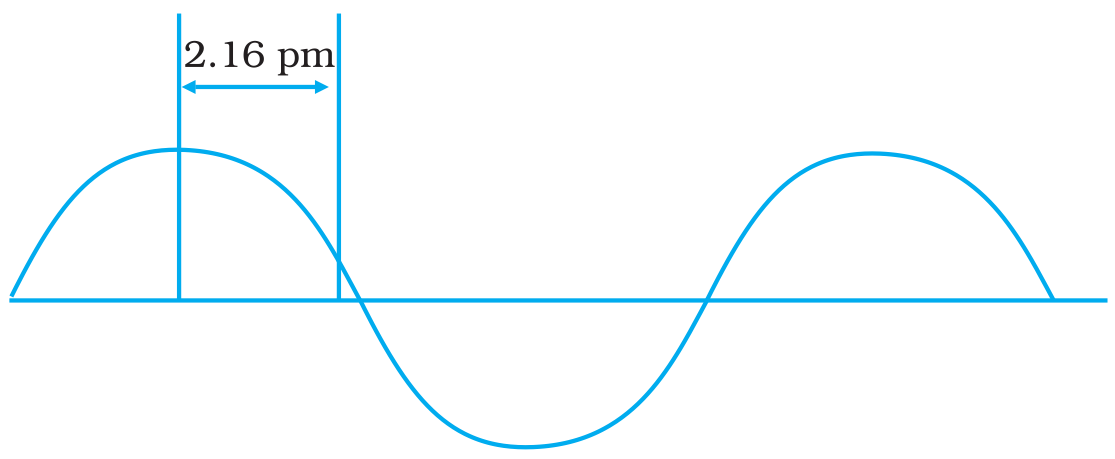
AnswerWavelength is the distance between two successive peaks or two successive troughs of a wave. So $\lambda$ = 4 × 2.16pm = 8.64pm.
View full question & answer→