Questions

5 Marks Questions

Take a timed test

29 questions · self-marked practice — reveal the answer and mark yourself.

Question 15 Marks
Describe the importance of the following:'
  1. Limestone.
  2. Cement.
  3. Plaster of paris.
Answer
  1. Limestone: It is used,
  • In the manufacture of quick lime, slaked lime, cement, washing soda and glass,
  • As a flux in the smelting of iron and lead ores.
  1. Cement: It is an important building material. It is used in concrete and reinforced concrete, in plastering and in the construction of bridges, dams and buildings.
  2. Plaster of Paris : The largest use of plaster of Paris is in the building industry as well as plasters. It is used for immobilizing the affected part of organ where there is a bone fracture or sprain. It is also employed in dentistry, in ornamental work and for making casts of statues.
View full question & answer
Question 25 Marks
When an alkali metal dissolves in liquid ammonia the solution can acquire different colours. Explain the reasons for this type of colour change.
Answer
The alkali metals dissolve in liq. $NH_3$​​​​​​​ without evolution of hydrogen. The colour of the dilute solution is blue. The metal atom loses an electron and it combines with ammonia molecule.
$\text{M}+(\text{x}+\text{y})\text{NH}_3\xrightarrow{\ \ \ \ \ }\big[\text{M}(\text{NH})_\text{x}\big]^++\big[\text{e}(\text{NH}_3)_\text{y}]^-$
The blue colour of the solution is due to the ammoniated electron which absorbs energy in the visible region of light and thus, imparts blue colour to the solution. The solutions are paramagnetic and on standing, slowly they liberate hydrogen resulting in the formation of an amide.
$\text{M}^+_{(\text{am})}+\text{e}^-_{(\text{am})}+\text{NH}_{3(\text{l})}\xrightarrow{\ \ \ \ \ \ }\text{MNH}_{2(\text{am})}+\frac{1}{2}\text{H}_2\uparrow$
am = solution in ammonia
In concentrated solution, the blue colour changes to bronze and becomes diamagnetic.
View full question & answer
Question 35 Marks
Discuss the various reactions that occur in the Solvay process.
Answer
Solvay process is used to prepare sodium carbonate.
When carbon dioxide gas is bubbled through a brine solution saturated with ammonia, sodium hydrogen carbonate is formed. This sodium hydrogen carbonate is then converted to sodium carbonate.
Step 1: Brine solution is saturated with ammonia.
$2\text{NH}_3+\text{H}_2\text{O}+\text{CO}_2\xrightarrow{\ \ \ \ \ }(\text{NH}_4)_2\text{CO}_3$
This ammoniated brine is filtered to remove any impurity.
Step 2: Carbon dioxide is reacted with this ammoniated brine to result in the formation of insoluble sodium hydrogen carbonate.
$\text{NH}_3+\text{H}_2\text{O}+\text{CO}_2\xrightarrow{\ \ \ }\text{NH}_4\text{HCO}_3\ \\\text{NaCl}+\text{NH}_4\text{HCO}_3\xrightarrow{\ \ \ }\text{NaHCO}_3+\text{NH}_4\\\text{ClNH}_3+\text{H}_2\text{O}+\text{CO}_2\xrightarrow{\ \ \ }\text{NH}_4\text{HCO}_3\ \\\text{NaCl}+\text{NH}_4\text{HCO}_3\xrightarrow{\ \ \ }\text{NaHCO}_3+\text{NH}_4\text{Cl}$
Step 3: The solution containing crystals of $NaHCO_3$ is filtered to obtain $NaHCO_3$.
Step 4: $NaHCO_3$ is heated strongly to convert it into $NaHCO_3$.
$2\text{NahCO}_3\xrightarrow{\ \ \ \ \ }\text{Na}_2\text{CO}_3+\text{CO}_2+\text{H}_2\text{O}$
Step 5: To recover ammonia, the filtrate (after removing $NaHCO_3$) is mixed with $Ca(OH)_2$ and heated.
$\text{Ca}(\text{OH})_2+2\text{NH}_4\text{Cl}\xrightarrow{\ \ \ }2\text{NH}_3+2\text{H}_2\text{O}+\text{CaCl}_2$
The overall reaction taking place in Solvay process is
$2\text{NaCl}+\text{CaCO}_3\xrightarrow{\ \ \ \ \ }\text{Na}_2\text{CO}_3+\text{CaCl}_2$
View full question & answer
Question 45 Marks
What happens when (i) magnesium is burnt in air (ii) quick lime is heated with silica (iii) chlorine reacts with slaked lime (iv) calcium nitrate is heated?
Answer
  1. Magnesium burns in air with a dazzling light to form $MgO$ and $Mg_3N_2$.
$2\text{Mg}+\text{O}_2\xrightarrow{\ \ \ {\text{Buming}}\ \ \ \ \ }2\text{MgO}$

$3\text{Mg}+\text{N}_2\xrightarrow{\ \ \ {\text{Buming}}\ \ \ \ \ }\text{Mg}_3\text{N}_2$
  1. Quick lime (CaO) combines with silica $(SiO_2)$ to form slag.
$\text{CaO}+\text{SiO}_2\xrightarrow{\ \ \ {\text{heat}}\ \ \ \ }\text{CaSiO}_3$
  1. When chloride is added to slaked lime, it gives bleaching powder.
$\text{Ca}(\text{OH})_2+\text{Cl}_2\xrightarrow{\ \ {\Delta}\ \ \ \ }\text{CaOCl}_2+\text{H}_2\text{O}\\\ \ \ \ \ \ \ \ \ \ \ \ \ \ \ \ \ \ \ \ \ \ \ \ \ \ \ \ \ \ \ \ \ \ \ \ \ \ \text{Bleaching}\\ \ \ \ \ \ \ \ \ \ \ \ \ \ \ \ \ \ \ \ \ \ \ \ \ \ \ \ \ \ \ \ \ \ \ \ \ \ \ \text{powder}$
  1. Calcium nitrate, on heating, decomposes to give calcium oxide.
$2\text{Ca}(\text{NO}_3)_{2(\text{s})}\xrightarrow{\ \ {\Delta}\ \ \ }2\text{CaO}_{(\text{s})}+4\text{NO}_{2(\text{g})}+\text{O}_{2(\text{g})}$
View full question & answer
Question 55 Marks
In what ways lithium shows similarities to magnesium in its chemical behaviour?
Answer
Similarities between lithium and magnesium:
  1. Lithium and magnesium reacts slow with cold water.
  2. Oxides of lithium and magnesium are less soluble in $H_2O$. Also the hydroxides of both decompose at high temperature.
$2\text{LiOH}\xrightarrow{\ \ \ \ \ }\text{Li}_2\text{O}+\text{H}_2\text{O}$
$\text{Mg}(\text{OH})_2\xrightarrow{\ \ \ \ \ }\text{MgO}+\text{H}_2\text{O}$
  1. Nitrides are formed from both the lithium and magnesium when they react with $N_2$.
$6\text{Li}+\text{N}_2\xrightarrow{\ \ \ \ }2\text{Li}_3\text{N}$
$3\text{Mg}+\text{N}_2\xrightarrow{\ \ \ \ }\text{Mg}_3\text{N}_2$
  1. Neither Li nor Mg form superoxide’s or peroxides.
  2. Both the carbonates of lithium and magnesium are naturally covalent. They decompose on heating.
$\text{Li}_2\text{CO}_3\xrightarrow{\ \ \ \ }\text{Li}_2\text{O}+\text{CO}_2$
$\text{MgCO}_3\xrightarrow{\ \ \ \ \ }\text{MgO}+\text{CO}_2$
  1. They do not form bicarbonates which are solid.
  2. Both $MgCl_2$ and LiCl are soluble in ethanol because they are naturally covalent.
  3. Both $MgCl_2$ and LiCl are naturally deliquescent. They crystallize as hydrates from aqueous solutions.
Example:

$\text{LiCl}.2\text{H}_2\text{O and MgCl}_2.8\text{H}_2\text{O}$
View full question & answer
Question 65 Marks
Explain the significance of sodium, potassium, magnesium and calcium in biological fluids.
Answer
Importance of sodium, potassium, magnesium, and calcium in biological fluids:
Sodium (Na): Sodium ions are found primarily in the blood plasma. They are also found in the interstitial fluids surrounding the cells.
  • Sodium ions help in the transmission of nerve signals.
  • They help in regulating the flow of water across the cell membranes.
  • They also help in transporting sugars and amino acids into the cells.
Potassium (K): Potassium ions are found in the highest quantity within the cell fluids.
  • K ions help in activating many enzymes.
  • They also participate in oxidising glucose to produce ATP.
  • They also help in transmitting nerve signals.
Magnesium (Mg) and calcium (Ca): Magnesium and calcium are referred to as macro-minerals. This term indicates their higher abundance in the human body system.
  • Mg helps in relaxing nerves and muscles.
  • Mg helps in building and strengthening bones.
  • Mg maintains normal blood circulation in the human body system.
  • Ca helps in the coagulation of blood
  • Ca also helps in maintaining homeostasis.
View full question & answer
Question 75 Marks
Describe two important uses of each of the following:
  1. Caustic soda.
  2. Sodium carbonate.
  3. Quicklime.
Answer
  1. Caustic soda: It is the commercial name of NaOH. It is used:
  • In refining of petroleum.
  • In the manufacture of soap, paper, rayon, drugs and dyes
  1. Sodium Carbonate: It is used:
  • In laundries and in softening of water as washing soda.
  • In the manufacture of glass, sodium silicate, paper, borax, caustic soda, etc.
  1. Quick lime: It is used:
  • In the purification of sugar, manufacture of dye stuffs, bleaching powder, $CaC_2$, mortar, cement, glass, etc.
  • As a cheap alkali, i.e., as acid neutralizer.
View full question & answer
Question 85 Marks
What are the common physical and chemical features of alkali metals?
Answer
Physical properties of alkali metals are as follows:
  1. They are quite soft and can be cut easily. Sodium metal can be easily cut using a knife.
  2. They are light coloured and are mostly silvery white in appearance.
  3. They have low density because of the large atomic sizes. The density increases down the group from Li to Cs. The only exception to this is K, which has lower density than Na.
  4. The metallic bonding present in alkali metals is quite weak. Therefore, they have low melting and boiling points.
  5. Alkali metals and their salts impart a characteristic colour to flames. This is because the heat from the flame excites the electron present in the outermost orbital to a high energy level. When this excited electron reverts back to the ground state, it emits excess energy as radiation that falls in the visible region.
  6. They also display photoelectric effect. When metals such as Cs and K are irradiated with light, they lose electrons.
Chemical properties of alkali metals:
Alkali metals are highly reactive due to their low ionization enthalpy. As we move down the group, the reactivity increases.
  1. They react with water to form respective oxides or hydroxides. As we move down the group, the reaction becomes more and more spontaneous.
  2. They react with water to form their respective hydroxides and dihydrogens. The general reaction for the same is given as
$2\text{M}+2\text{H}_2\text{O}\xrightarrow{\ \ \ \ \ }2\text{m}^++2\text{OH}^{\ominus}+\text{H}_2$
  1. They react with dihydrogen to form metal hydrides. These hydrides are ionic solids and have high melting points.
$2\text{M}+\text{H}_2\xrightarrow{\ \ \ \ \ \ }2\text{M}^+\text{H}^-$
  1. Almost all alkali metals, except Li, react directly with halogens to form ionic halides.
$2\text{M}+\text{Cl}_2\xrightarrow{\ \ \ \ \ }2\text{MCl}$
$(\text{M}=\text{Li, K, Rb, Cs})$
Since $Li^+$ ion is very small in size, it can easily distort the electron cloud around the negative halide ion. Therefore, lithium halides are covalent in nature.
  1. They are strong reducing agents. The reducing power of alkali metals increases on moving down the group. However, lithium is an exception. It is the strongest reducing agent among the alkali metals. It is because of its high hydration energy.
  2. They dissolve in liquid ammonia to form deep blue coloured solutions. These solutions are conducting in nature.
$\text{M}+(\text{x}+\text{y})\text{NH}_3\xrightarrow{\ \ \ \ \ }\big[\text{M}(\text{NH}_3)_\text{x}\big]^++\big[\text{M}(\text{NH}_3)_\text{y}\big]^-$
The ammoniated electrons cause the blue colour of the solution. These solutions are paramagnetic and if allowed to stand for some time, then they liberate hydrogen. This results in the formation of amides.
$\text{M}^+_{(\text{am})}+\text{e}^-+\text{NH} _{3(\text{l})}\xrightarrow{\ \ \ \ \ }\text{MNH}_{(\text{am})}+\frac{1}{2}\text{H}_{2(\text{g)}}$
In a highly concentrated solution, the blue colour changes to bronze and the solution becomes diamagnetic.
View full question & answer
Question 95 Marks
Compare the solubility and thermal stability of the following compounds of the alkali metals with those of the alkaline earth metals.
  1. Nitrates.
  2. Carbonates.
  3. Sulphates.
Answer
  1. Nitrates
Thermal stability
Nitrates of alkali metals, except $LiNO_3$, decompose on strong heating to form nitrites.
$2\text{KNO}_{3(\text{s})}\xrightarrow{\ \ \ \ \ }2\text{KNO}_{2\text{s}}+\text{O}_{2(\text{g})}$
$LiNO_3$, on decomposition, gives oxide.
$2\text{LiNO}_{3(\text{s})}\xrightarrow{\ \ {\Delta}\ \ \ \ }\text{Li}_2\text{O}_{(\text{s})}+2\text{NO}_{2(\text{g})}+\text{O}_{2(\text{g})}$
Similar to lithium nitrate, alkaline earth metal nitrates also decompose to give oxides.
$2\text{Ca}(\text{NO}_3)_{(\text{s})}\xrightarrow{\ \ {\Delta}\ \ \ \ }2\text{CaO}_{(\text{s})}+4\text{NO}_{2(\text{g})}+\text{O}_{2(\text{g})}$
As we move down group 1 and group 2, the thermal stability of nitrate increases.
Solubility
Nitrates of both group 1 and group 2 metals are soluble in water
  1. Carbonates
Thermal stability
The carbonates of alkali metals are stable towards heat. However, carbonate of lithium, when heated, decomposes to form lithium oxide. The carbonates of alkaline earth metals also decompose on heating to form oxide and carbon dioxide.
$\text{Na}_2\text{CO}_3\xrightarrow{\ \ {\Delta}\ \ \ \ }\text{No effect}$
$\text{Li}_2\text{CO}_3\xrightarrow{\ \ {\Delta}\ \ \ \ }\text{Li}_2\text{O}+\text{CO}_2$
$\text{Mg}\text{CO}_3\xrightarrow{\ \ {\Delta}\ \ \ \ }\text{MgO}+\text{CO}_2$
Solubility
Carbonates of alkali metals are soluble in water with the exception of $Li_2CO_3$. Also, the solubility increases as we move down the group.
Carbonates of alkaline earth metals are insoluble in water.
  1. Sulphates
Thermal stability
Sulphates of both group 1 and group 2 metals are stable towards heat.
Solubility
Sulphates of alkali metals are soluble in water. However, sulphates of alkaline earth metals show varied trends.
$BeSO_4$ Fairly soluble
$MgSO_4$ Soluble
$CaSO_4$ Sparingly soluble
$SrSO_4$ Insoluble
$BaSO_4$ Insoluble
In other words, while moving down the alkaline earth metals, the solubility of their sulphates decreases.
View full question & answer
Question 105 Marks
Discuss the general characteristics and gradation in properties of alkaline earth metals.
Answer
  1. Electronic configuration: The valence electronic configuration of atoms of the group II A elements is $ns^2$, where ‘n’ is the period number.
  2. Atomic and ionic sizes: The size of the atom increases gradually from Be to Ra. Their ions are also large and size of the ion increases from $Be^{2+}$​​​​​​​ to $Ra^{2+}​​​​​​​$​​​​​​​.
  3. Ionization enthalpy: The $1^{st}$​​​​​​​ and $2^{nd}$​​​​​​​ ionization energies of these metals decrease from Be to Ba as size increases.
  4. Melting and boiling points: Due to the presence of two electrons in the valence shell and stronger bonding in solid state, they have higher melting and boiling points than corresponding alkali metals.
  5. Metallic character: Due to low ionization energy values, these metals are highly electropositive and readily form $M^{2+}$​​​​​​​ ions.
  6. Flame coloration: Except Be and Mg, other members impart characteristic colours when their salts are introduced in the flame.
  7. Hydration energy: The $M^{2+}$ ions of alkaline earth metals are extensively hydrated to form $[M(H_2O)x]^{2+}​​​​​​​$​​​​​​​ ions and during hydration a huge amount of energy called hydration energy is released.
$\text{M}^2+\text{xH}_2\text{O}\xrightarrow{\ \ \ \ \ }\big[\text{M}(\text{H}_2\text{O})\text{x}\big]^{2+}+\text{Energy}$
  1. Reactivity towards air or oxygen: They react with air or oxygen slowly on heating. Be, Mg and Ca form normal oxides $(MO)$ while Sr and Ba form superoxide’s $(SrO_2, BaO_2​​​​​​​)$. BeO is amphoteric, $MgO$ is weakly basic and others are distinctly basic.
  2. Reactivity towards water: They have lesser reactivity towards water. Be does not react even with boiling water. $Mg$ forms $Mg(OH)_2​​​​​​​$​​​​​​​ liberating $H_2$​​​​​​​ gas with boiling water.
  3. Reactivity towards halogens: All the metals of the group combine with various halogens at appropriate temperature forming halides of the formula $MX_2​​​​​​​$​​​​​​​.
  4. Tendency to form complexes: Due to their smaller ionic sizes and greater charge densities Be, Mg metals have highest tendency to form complexes.
$\text{BeF}_2+2\text{F}^-\xrightarrow{\ \ \ }[\text{BeF}_4]^{2-}$
  1. Reducing character: Except Be all other metals of this group are reducing agents.
View full question & answer
Question 115 Marks
Starting with sodium chloride how would you proceed to prepare.
  1. Sodium metal
  2. Sodium hydroxide
  3. Sodium peroxide
  4. Sodium carbonate?
Answer
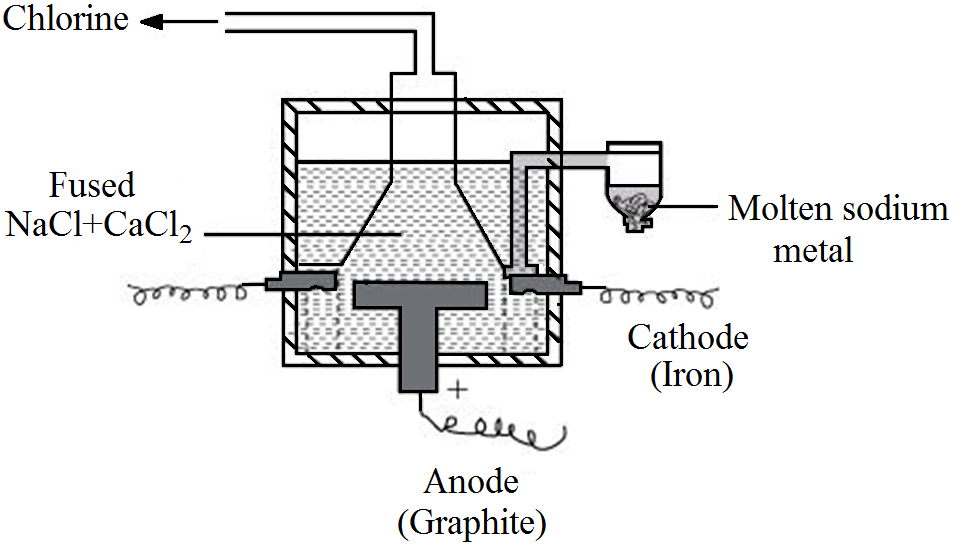
  1. Sodium metal: Sodium can be extracted from sodium chloride by Downs process. This process involves the electrolysis of fused NaCl (40%) and $CaCl_2$ (60 %) at a temperature of 1123 K in Downs cell.

Steel is the cathode and a block of graphite acts as the anode. Metallic Na and Ca are formed at cathode. Molten sodium is taken out of the cell and collected over kerosene.
$\text{NaCl}\xrightarrow{\ \ {\text{Electrolysis}}\ \ \ \ }\text{Na}^++\text{Cl}^-$
Molten
$\text{At Cathode: }\text{Na}^++\text{e}^-\xrightarrow{\ \ \ \ \ \ }\text{Na}$
$\text{At Anode: }\text{Cl}^-+\text{e}^-\xrightarrow{\ \ \ \ \ \ }\text{Cl}$
$\text{Cl}+\text{Cl}\xrightarrow{\ \ \ \ \ \ }\text{Cl}_2$
  1. Sodium hydroxide: Sodium hydroxide can be prepared by the electrolysis of sodium chloride. This is called Castner–Kellner process. In this process, the brine solution is electrolysed using a carbon anode and a mercury cathode.
The sodium metal, which is discharged at cathode, combines with mercury to form an amalgam.
$\text{Cathode: }\text{Na}^++\text{e}^-\xrightarrow{\ \ {\text{Hg}\ \ \ }}\text{Na}-\text{amalgam}$
$\text{Anode: }\text{Cl}^-\xrightarrow{\ \ \ \ \ }\frac{1}{2}\text{Cl}_2+\text{e}^-$
  1. Sodium peroxide:
First, NaCl is electrolysed to result in the formation of Na metal (Downs process).
This sodium metal is then heated on aluminium trays in air (free of $CO_2$) to form its peroxide.
$2\text{Na}+\text{O}_{2(\text{air})}\xrightarrow{\ \ \ \ \ }\text{Na}_2\text{O}_2$
  1. Sodium carbonate: Sodium carbonate is prepared by Solvay process. Sodium hydrogen carbonate is precipitated in a reaction of sodium chloride and ammonium hydrogen carbonate.
$2\text{NH}_3+\text{H}_2\text{O}+\text{CO}_2\xrightarrow{\ \ \ \ \ \ \ }(\text{NH}_4)_2\text{CO}_3$
$(\text{NH}_4)_2\text{CO}_3+\text{H}_2\text{O}+\text{CO}_2\xrightarrow{\ \ \ \ \ }2\text{NH}_4\text{HCO}_3$
$\text{NH}_4\text{HCO}_3+\text{NaCl}\xrightarrow{\ \ \ \ \ \ \ }\text{NH}_4\text{Cl}+\text{NaHCO}_3$
These sodium hydrogen carbonate crystals are heated to give sodium carbonate.
$2\text{NaHCO}_3\xrightarrow{\ \ \ \ \ }\text{Na}_2\text{CO}_3+\text{CO}_2+\text{H}_2\text{O}$
View full question & answer
Question 125 Marks
In the Solvay process, can we obtain sodium carbonate directly by treating the solution containing $\left(\mathrm{NH}_4\right)_2 \mathrm{CO} 3$ with sodium chloride? Explain.
Answer
It is difficult to obtain the precipitate of $\mathrm{NaHCO}_3$ by use of ammonium carbonate. To make the precipitation of $\mathrm{NaHCO}_3$ from solution, ammonium bicarbonate is used rather than ammonium carbonate. Ammonium bicarbonate undergoes a metathesis reaction with sodium chloride to produce sodium bicarbonate precipitate.
$\text{NaCl}(\text{aq})+\text{NH}_4\text{HCO}_3(\text{aq})\xrightarrow{\ \ \ \ \ }\text{NaHCO}_3(\text{S})+\text{NH}_4\text{Cl}(\text{aq})$
Sodium bicarbonate formed inthis process is less soluble than sodium chloride, ammonium bicarbonate, or ammonium chloride. Thus in a very concentrated solution, sodium bicarbonate will be the first to precipitate. This metathesis reaction is the key to the Solvay process.
View full question & answer
Question 135 Marks
How do you account for the strong reducing power of lithium in aqueous solution?
Answer
Electrode potential is a measure of the tendency of an element to lose electrons in the aqueous solution. It mainly depends upon the following three factors:
  1. Sublimation enthalpy.
  2. Ionization enthalpy.
  3. Enthalpy of hydration.
The sublimation enthalpies of alkali metals are almost similar. Since Li has the smallest size, its enthalpy of hydration is the highest among alkali metals. Although ionization enthalpy of Li is the highest among alkali metals, it is more than compensated by the high enthalpy of hydration. Thus, Li has the most negative standard electrode potential (-3.04V) and hence Li is the strongest reducing agent in aqueous solution mainly because of its high enthalpy of hydration.
$\text{Li}(\text{s})\xrightarrow{\text{Sublimation enthalpy}\ }\text{Li}(\text{g})$
$\text{Li}(\text{g})\xrightarrow{\text{Ionization enthalpy}\ }\text{Li}^+(\text{g})$
$\text{Li}^+(\text{g})+\text{aq}\xrightarrow{ }\text{Li}^+(\text{aq})+\text{enthalpy of hydration}$
View full question & answer
Question 145 Marks
Discuss the trend of the following:
Thermal stability of carbonates of Group 2 elements.
Answer
All the alkaline earth metals form carbonates $\left(\mathrm{MCO}_3\right)$. All these carbonates decompose on heating to give $\mathrm{CO}_2$ and metal oxide. The thermal stability; of these carbonates increases down the group, i.e., from Be to Ba ,
$\mathrm{BeCO}_3<\mathrm{MgCO}_3<\mathrm{CaCO}_3<\mathrm{SrCO}_3<\mathrm{BaCO}_3$
$\mathrm{BeCO}_3$ is unstable to the extent that it is stable only in atmosphere of $\mathrm{CO}_2$. It however shows reversible decomposition in closed container.
$\mathrm{BeCO}_3 \rightleftharpoons \mathrm{BeO}+\mathrm{CO}_2$
Hence, more is the stability of oxide formed, less will be stability of carbonates. Stability of oxides decreases down the group. Since beryllium oxide is high stable, it makes $\mathrm{BeCO}_3$ unstable.
View full question & answer
Question 155 Marks
Complete the following equations for the reaction between
i. $\mathrm{Ca}+\mathrm{H}_2 \mathrm{O}$
ii. $\mathrm{Ca}(\mathrm{OH})_2+\mathrm{Cl}_2$
iii. $\mathrm{BeO}+\mathrm{NaOH}$
iv. $\mathrm{BaO}_2+\mathrm{H}_2 \mathrm{SO}_4$
Answer
  1. $\text{Ca}+2\text{H}_2\text{O}\xrightarrow{ \ \ \ \text{Heat} \ \ \\ \ }\text{Ca(OH)}?_2+\text{H}_2$
  2. $\text{Ca(OH)}_2+\text{Cl}_2\xrightarrow{ \ \ \ \ \ \ \ }\text{CaOCl}_2+\text{H}_2\text{O}\\ \ \ \ \ \ \ \ \ \ \ \ \ \ \ \ \ \ \ \ \ \ \ \ \ \ \ \ \ \ \ \ \ \ \ \ \ \ \text{Bleching }\\ \ \ \ \ \ \ \ \ \ \ \ \ \ \ \ \ \ \ \ \ \ \ \ \ \ \ \ \ \ \ \ \ \ \ \ \ \ \ \ \text{power}$
  3. $\text{BeO}+2\text{NaOH}\xrightarrow{ \ \ \ \ \ \ \ }\text{Na}_2\text{BeO}_2+\text{H}_2\text{O}\\ \ \ \ \ \ \ \ \ \ \ \ \ \ \ \ \ \ \ \ \ \ \ \ \ \ \ \ \ \ \ \ \ \ \ \text{Sodium }\\ \ \ \ \ \ \ \ \ \ \ \ \ \ \ \ \ \ \ \ \ \ \ \ \ \ \ \ \ \ \ \ \ \ \ \ \text{beryllate}$
  4. $\text{BaO}_2+\text{H}_2\text{SO}_4\xrightarrow{ \ \ \ \ \ \ \ \ \ }\text{BaSO}_4+\text{H}_2\text{O}_2$
View full question & answer
Question 165 Marks
Write the formulae of:
  1. Albite.
  2. Chile salt petre.
  3. Glauber's salt.
  4. Borax.
Answer
  1. $\text{Albite}\xrightarrow{ \\ \ \ \\ \ \ \ \ }\text{NaAlSi}_3\text{O}_8$
  2. $\text{Chile salt peter}\xrightarrow{ \\ \ \ \\ \ \ \ \ }\text{NaNO}_3$
  3. $\text{Glauber's salta}\xrightarrow{ \\ \ \ \\ \ \ \ \ }\text{Na}_2\text{SO}_410\text{H}_2\text{O}$
  4. $\text{Borax}\xrightarrow{ \\ \ \ \\ \ \ \ \ }\text{Na}_2\text{B}_4\text{O}_7.10\text{H}_2\text{O}$
View full question & answer
Question 175 Marks
The s-block elements are characterised by their larger atomic sizes, lower ionisation enthalpies, invariable $+1$ oxidation state and solubilities of their oxosalts.In the light of these features describe the nature of their oxides, halides and oxosalts.
Answer
Nature of oxides The normal oxides $(M_2O)$ are basic in nature. They form strong alkalies (hydroxides) when dissolved in water. The basic nature increases on moving down the group.
$\text{M}_2\text{O}+\text{H}_2\text{O}\xrightarrow{}2\text{MOH}$
Besides monoxides, sodium and higher alkali metals form peroxides and super oxides. The peroxides $(M_2O_2)$ and superoxides $(MO_2)$ form hydroxides when hydrolysed with water.
$\text{M}_2\text{O}_2+2\text{H}_2\text{O}→\text{2MOH}+\text{H}_2\text{O}_2$
$2\text{MO}_2+2\text{H}_2\text{O}\xrightarrow{}2\text{MOH}+\text{H}_2\text{O}_2+\text{O}_2$
Peroxides and super oxides are strong oxidising agents. Nature of halides The halides $(M^+X^−)$ are crystalline and have high melting and boiling points. The fused halides are good conductors of electricity. All halides except LiFdissolve in water. Halides are colourless and on heating turn yellow, blue, etc. Halides of potassium, rubidium and caesium have a property of combining with extra halogen atoms forming polyhalides $\text{KI}+\text{I}_2\xrightarrow{}\text{KI}_3$ Nature of oxosalts Alkali metals readily react with oxy acids forming corresponding salts with evolution of hydrogen. Lithium salts behave some what abnormally due to polarising power and lattice energy effects. The carbonates of alkali metals are highly stable towards heat and readily soluble in water. The stability increases from Li to Cs as electropositive nature increases. Solutions are alkaline in nature due to hydrolysis $\text{M}_2\text{CO}_3+2\text{H}_2\text{O}\rightleftharpoons2\text{MOH}+\text{H}_2\text{CO}_3$ Nitrates of the type, MNO are known. These are colourless and soluble in water and electrovalent in nature. With the exception of $LiNO_3$, the other nitrates decompose to nitrites and oxygen.
$2\text{MNO}_3\xrightarrow{}2\text{MNO}_2+\text{O}_2\text{LiNO}_3$ on heating gives $NO_2$ and $O_2$.
$2\text{LiNO}_3\xrightarrow{}\text{Li}_2\text{O}+2\text{NO}_2+\frac{1}{2}\text{O}_2$ Sulphate of the type $M_2SO_4$ are known. With the exception of $Li_2SO_4$, other sulphates are soluble in water. These are reduced by carbon oh heating.
$\text{M}_2\text{SO}_4+4\text{C}\xrightarrow{}\text{M}_2\text{S}+4\text{CO}$
The sulphates of alkali metals form double sulphates with the sulphates of trivalent metals like Fe, Al, Cr, etc.
View full question & answer
Question 185 Marks
Present a comparative account of the alkali and alkaline earth metals with respect to the following characteristics:
  1. Tendency to form ionic/ covalent compounds.
  2. Nature of oxides and their solubility in water.
  3. Formation of oxosalts.
  4. Solubility of oxosalts.
  5. Thermal stability of oxosalts.
Answer
 
Alkali metals
 
Alkaline earth metals
i.
All alkali metals except Li form ionic compounds.
i.
All alkaline earth metals except Be form ionic compounds.
ii.
The solubility of oxides of al­kali metals increases down the group.
The basic character of the ox­ides increases down the group.
ii.
The solubility of oxides of Mg, -Ca, Sr and Ba increases from Mg to Ba. BeO, however, is covalent and insoluble in water.
The basic character of oxides in­creases from MgO to BaO. BeO is, however, amphoteric.
iii.
All alkali metals form oxo salts such as carbonates, sul­phates and nitrates.
iii.
All alkaline earth metals form oxo salts such as carbonates, sulphates and nitrates.
iv.
Solubility of carbonates and sul­phates increases down the group.
iv.
Solubility of carbonates and sul­phates decreases down the group.
v.
Carbonates and sulphates of Li decompose on heating while the stability, of carbonates and sulphates of other metals in­creases down the group.
v.
The carbonates and sulphates of alkaline earth metals all decom­pose on heating but the tempera­ture of their decomposition in­creases down the group, i.e., their thermal stability increases.
 
View full question & answer
Question 195 Marks
Give reasons:
i. LiCl is more covalent than NaCl .
ii. Lil has lower melting point than LiCl .
iii. CaCl, is ionic than KCI .
iv. CuCl is more covalent than NaCl .
Answer
i. $\mathrm{Li}^{+}$is smaller in size, has high polarising power, more tendency to form covalent compound.
ii. I is larger in size than CI, LiI is more covalent than LiCl therefore, has lower melting point.
iii. $\mathrm{Ca}^{2+}$ has higher polarising power than therefore, $\mathrm{Ca}^{2+}$ forms less ionic halide.
iv. $\mathrm{Cu}^{+}$has higher polarising power than $\mathrm{Na}^{+}$, therefore, $\mathrm{Cu}^{+}$forms more covalent halides.
View full question & answer
Question 205 Marks
  1. Name alkaline earth metal salt used in tooth paste.
  2. Alkaline earth metal imparts apple green flame, identify.
  3. Which colour is imparted to flame by Cesium?
  4. If egg shell is introduced in flame, which colour will be imparted to flame and why?
Answer
  1. $\mathrm{CaCO}_3$ is used in tooth paste.
  2. 'Ba' imparts apple green flame.
  3. Blue colour is imparted to flame by Cesium.
  4. Brick red is imparted to flame therefore, egg shell is made up of impart brick red colour to flame.
View full question & answer
Question 215 Marks
Write two points of similarity in properties of Beryllium and Aluminium.
Answer
Two points of similarity between Beryllium (Be) and Aluminium (Al) are:
i. Both metals have tendency to form covalent compounds for example, both $\mathrm{BeCl}_2$ and $\mathrm{AICI}_3$ are covalent and are soluble in organic solvents.
ii. Both metals dissolve in strong alkalies to form soluble complexes, beryllates $\left[\mathrm{Be}(\mathrm{OH})_4\right]^{2-}$ and aluminates $\left[\mathrm{Al}(\mathrm{OH})_4\right]^{-}$.
View full question & answer
Question 225 Marks
Discuss the trend of the following:
The solubility and the nature of oxides, of Group 2 elements.
Answer
All the alkaline earth metals form oxides of formula MO. The oxides are very stable due to high lattice energy and are used as refractory material. Except BeO (predominantly covalent), all other oxides are ionic and their lattice energy decreases as the size of cation increases.
The oxides are basic and basic nature increases from BeO to BaO (due to increasing ionic nature).
$\underbrace{\text{BeO<}}\ \ \ \ \ \ \ \ \ \ \ \ \underbrace{\text{MgO<}}\ \ \ \ \ \ \ \ \ \ \underbrace{\text{CaO
BeO dissolves both in acid and alkalies to give salts and is amphoteric.
The oxides of the alkaline earth metals (except BeO and MgO) dissolve in water to form basic hydroxides and evolve a large amount of heat. BeO and MgO possess high lattice energy and thus are insoluble in water.
View full question & answer
Question 235 Marks
When heated in air, the alkali metals form various oxides. Mention the oxides formed by $Li, Na$ and $K$.
Answer
The reactivity of alkali metals towards oxygen increases down the group as the atomic size increases. Thus, Li forms only lithium oxide $(Li_2O)$, sodium forms mainly sodium peroxide $(Na_2O_2)$ along with a small amount of sodium oxide while potassium forms only potassium superoxide $(KO_2)$.
$4\text{Li}+\text{O}_2\xrightarrow{\ \ \ \Delta\ \ \ }2\text{Li}_2\text{O};$
$2\text{Na+}\text{O}_2\xrightarrow{\ \ \ \Delta\ \ \ }\text{Na}_2\text{O}_2+\text{Na}_2\text{O}\\\ \ \ \ \ \ \ \ \ \ \ \ \ \ \ \ \ \ \ \ \ \ \ \ \ \ \text{(Mazor)}\ \ \text{(Minor)}$
$\text{K}+\text{O}_2\xrightarrow{\ \ \ \Delta\ \ \ }\text{KO}_2$
This is because of the following two reasons:
  1. As the size of the metal cation increases, the positive field around it becomes weaker and weaker thereby permitting the initially formed oxide $(O^{2-})$ ion to combine with another oxygen atom to from first peroxide ion $(O^{2-})$ and then superoxide $(0^-_2)$ ion.
$\text{O}^{2-}\xrightarrow{\ \ \ \frac{1}{2}\text{O}_2\ \ \ }\text{O}_2^{2-}\xrightarrow{\ \ \ \text{O}_2\ \ \ }2\text{O}_2^-\\\text{Oxide}\ \ \ \ \ \ \ \ \ \ \ \text{Peroxide}\ \ \ \ \text{Superoxide}$
  1. Since larger cations stabilize larger anions due to higher lattice energies, therefore, the stability increases from oxide → peroxide → superoxide as the size of the metal cation increases down the group and the size of the anion increases from oxide → peroxide → superoxide.
View full question & answer
Question 245 Marks
S. No.
Column I
Column II
1.
Gypsum
$NaHCO_3$
2.
Plaster of Paris
$Na_2CO_3.10H_2O$
3.
Bleaching powder
$CaSO_4.2H_2O$
4.
Washing soda
$\text{CaSO}_4\frac{1}{2}\text{H}_2\text{O}$
5.
Baking soda
$CaOCl_2$
Answer
S. No.
Column I
Column II
1.
Gypsum
$CaSO_4.2H_2O$
2.
Plaster of Paris
$\text{CaSO}_4\frac{1}{2}\text{H}_2\text{O}$
3.
Bleaching powder
$CaOCl_2$
4.
Washing soda
$Na_2CO_3.10H_2O$
5.
Baking soda
$NaHCO_3$
View full question & answer
Question 255 Marks
a. Name two group 2 elements which do not impart colour to the flame and why?
b. Arrange $\mathrm{K}_2 \mathrm{CO}_3, \mathrm{MgCO}_3, \mathrm{CaCO}_3, \mathrm{BeCO}_3$, in increasing order of thermal stability and why?
c. Which metal hydroxide is most soluble in water in group 2 and why?
d. What is Epsom salt?
e. Why is $\mathrm{Na}_2 \mathrm{O}_2$ diamagnetic?
Answer
a. Be and Mg do not impart colour to the flame because they have high ionisation enthalpy and do not absorb light from visible region.
b. $\mathrm{BeCO}_3<\mathrm{MgCO}_3<\mathrm{CaCO}_3<\mathrm{K}_2 \mathrm{CO}_3$ It is due to increase in ionic character and increase in lattice enthalpy.
c. $\mathrm{Ba}(\mathrm{OH})_2$ is most soluble in water because its hydration enthalpy is more than lattice enthalpy.
d. $\mathrm{MgSO}_4 \cdot 7 \mathrm{H}_2 \mathrm{O}$ is epsom salt.
e. In $\mathrm{Na}_2 \mathrm{O}_2, \mathrm{O}_2{ }^{2-}(18)$ has unpaired electron, that is why it is diamagnetic.
View full question & answer
Question 265 Marks
  1. When alkali metals are heated in excess of air, what is the nature of oxides formed?
  2. How can you prepare baking soda?
  3. Which is having more reducing characteristics out of alkali metals and alkaline earth metals?
  4. Alkaline earth metals impart a characteristic colour to the flame but Be and Mg do not give. Why?
  5. Write balanced equations for the reactions between $Na_2O$ and $CO_2$.
Answer
  1. The oxides formed are basic in nature. Lithium The oxid forms monoxide, sodium forms peroxide whereas K, Rb and Cs form superoxides.
  2. $\text{NH}_3+\text{CO}_2+\text{H}_2\text{O}\xrightarrow{\ \ \\ \ \ \ \ \ \ \ }(\text{NH}_4)\text{HCO}_3$
$\text{NH}_4\text{HCO}_3+\text{NaCl}\xrightarrow{\ \ \\ \ \ \ \ \ \ \ }\text{Na}\text{HCO}_3+\text{NH}_4\text{Cl}\\\ \ \ \ \ \ \ \ \ \ \ \ \ \ \ \ \ \ \ \ \ \ \ \ \ \ \ \ \ \ \ \ \ \ \ \ \ \ \ \ \ \ \ \text{Baking soda}$
  1. Alkali metals are stronger reducing agents than alkaline earth metals due to lower ionization energy and low reduction potential.
  2. Be and Mg have high I.E., therefore, do not absorb light from visible region and do not radiate colour. Others have low I.E., they absorb light from visible region and radiate complementary colour.
  3. $\text{Na}_2\text{O}+\text{CO}_2\xrightarrow{ \ \ \ \ \ \ \ }\text{Na}_2\text{CO}_3$
View full question & answer
Question 275 Marks
S. NO.
Column I
Column II
1.
Li
$Na_2O_2$
2.
Na
$Li_2O$
3.
K
$KO_2$
4.
Rb
$K_2O$
5.
 
$Rb_2O$
Answer
S. NO.
Column I
Column II
1.
Li
$Li_2O$
2.
Na
$Na_2O_2$
3.
K
$KO_2$
4.
Rb
$K_2O$
5.
 
$Rb_2O$
View full question & answer
Question 285 Marks
Complete the following reactions:
  1. $\text{NH}_3+\text{CO}_2+\text{H}_2\text{O}\xrightarrow{\ \ \ \\ \ }$
  2. $\text{Mg}(\text{NO}_3)_2\xrightarrow{ \ \ \\ \Delta\ \ \ }$
  3. $\text{BeCl}_2+\text{LiAlH}_4\xrightarrow{\ \ \ \ \ }$
  4. $\text{MgO}+\text{P}_4\text{O}_{10} \xrightarrow{\ \ \ \ \ }$
  5. $\text{Ca(OH)}_2+\text{SO}_2 \xrightarrow{\ \ \ \ \ }$
Answer
  1. $\text{NH}_3+\text{CO}_2+\text{H}_2\text{O} \xrightarrow{\ \ \ \ \ }(\text{NH}_4)\text{HCO}_3$
  2. $2\text{Mg}(\text{NO}_3)_2+\text{H}_2\text{O} \xrightarrow{ \ \ \ \ \text{head} \ \ \ \ }2\text{MgO}+4\text{NO}_2+\text{O}_2$
  3. $2\text{BeCl}_2+\text{LiAlH}_4 \xrightarrow{ \ \ \ \ \ \ \ \ }\text{BeH}_2+\text{LiC}+\text{AlCl}_3$
  4. $6\text{MgO}+\text{P}_4\text{O}_{10} \xrightarrow{ \ \ \ \ \ \ \ \ }2\text{Mg}_3(\text{PO}_4)_2$
  5. $\text{Ca(OH)}_2+\text{SO}_2 \xrightarrow{ \ \ \ \ \ \ \ \ }\text{CaSO}_3+\text{H}_2\text{O}\\ \ \ \ \ \ \ \ \ \ \ \ \ \ \ \ \ \ \ \ \ \ \ \ \ \ \ \ \ \ \ \ \ \ \ \ \ \ (\text{white ppt.)}$
View full question & answer
Question 295 Marks
  1. A solution of $K_2CO_3$ is alkaline. Why?
  2. BaO is soluble but $BaSO_4$ is soluble in water.
  3. Lithium salts are commonly hydrated and those of other alkali metal ions are usually anhydrous. Give reasons.
  4. What is the importance of cement?
  5. What happens when quick lime is heated with phosphorus pentoxide?
Answer
  1. $\text{K}_2\text{CO}_3+2\text{H}_2\text{O}\xrightarrow{\ \ \ \ \ \ \ \ \ \ \ \ }2\text{K}^++2\text{K}^++2\text{OH}^-+\text{H}_2\text{CO}_3$
Since $OH^-$ ions are more than $H^+$ ions, therefore, solution is alkaline. $H_2CO_3$​​​​​​​ is weak acid therefore, $K_2CO_3$ is alkaline.
  1. The lattice of $BaSo_4$​​​​​​​ is higher than hydration energy, whereas hydration energy of BaO is higher than lattice energy.
  2. $Li^+$​​​​​​​ ion is smallest in size, therefore, its salts are hydrated. Other ions are bigger in size therefore, cannot be hydrated. $Li^+$ has highest hydration energy among alkali metal.
  3. Cement is used as building material.
  4. $3\text{CaO}+\text{P}_2\text{O}_5\xrightarrow{\ \ \ \ \ \ \ }\text{Ca}_3(\text{PO}_4)_2\\ \text{Quick lime}$
Calcium phosphate is formed.
View full question & answer