Question
Complete the following reactions:
  1. $\text{NH}_3+\text{CO}_2+\text{H}_2\text{O}\xrightarrow{\ \ \ \\ \ }$
  2. $\text{Mg}(\text{NO}_3)_2\xrightarrow{ \ \ \\ \Delta\ \ \ }$
  3. $\text{BeCl}_2+\text{LiAlH}_4\xrightarrow{\ \ \ \ \ }$
  4. $\text{MgO}+\text{P}_4\text{O}_{10} \xrightarrow{\ \ \ \ \ }$
  5. $\text{Ca(OH)}_2+\text{SO}_2 \xrightarrow{\ \ \ \ \ }$
Answer

  1. $\text{NH}_3+\text{CO}_2+\text{H}_2\text{O} \xrightarrow{\ \ \ \ \ }(\text{NH}_4)\text{HCO}_3$
  2. $2\text{Mg}(\text{NO}_3)_2+\text{H}_2\text{O} \xrightarrow{ \ \ \ \ \text{head} \ \ \ \ }2\text{MgO}+4\text{NO}_2+\text{O}_2$
  3. $2\text{BeCl}_2+\text{LiAlH}_4 \xrightarrow{ \ \ \ \ \ \ \ \ }\text{BeH}_2+\text{LiC}+\text{AlCl}_3$
  4. $6\text{MgO}+\text{P}_4\text{O}_{10} \xrightarrow{ \ \ \ \ \ \ \ \ }2\text{Mg}_3(\text{PO}_4)_2$
  5. $\text{Ca(OH)}_2+\text{SO}_2 \xrightarrow{ \ \ \ \ \ \ \ \ }\text{CaSO}_3+\text{H}_2\text{O}\\ \ \ \ \ \ \ \ \ \ \ \ \ \ \ \ \ \ \ \ \ \ \ \ \ \ \ \ \ \ \ \ \ \ \ \ \ \ (\text{white ppt.)}$

Need a full question paper?

Generate a complete, print-ready paper with questions like this in minutes — across 16+ boards, with answer keys.

Start Generating Free

Similar questions

Give three points of differences between inductive effect and resonance effect.
Explain the terms Inductive and Electromeric effects. Which electron displacement effect explains the following correct orders of acidity of the carboxylic acids?
  1. $Cl_3CCOOH > Cl_2CHCOOH > ClCH_2COOH$.
  2. $CH_3CH_2COOH > (CH_3)_2CHCOOH > (CH_3)_3C.COOH$.
What do you understand by the term ‘auto-protolysis of water? What is its significance?
Define hydrogen bond. Is it weaker or stronger than the van der Waals forces?
Compare the geometry and bond angle of those molecules of type AB₂, AB3, AB4 and AB5 in which the lone (1.p) electron pair is not present on the central atom.
Which method can be used to find out strength of reductant/oxidant in a solution? Explain with an example.
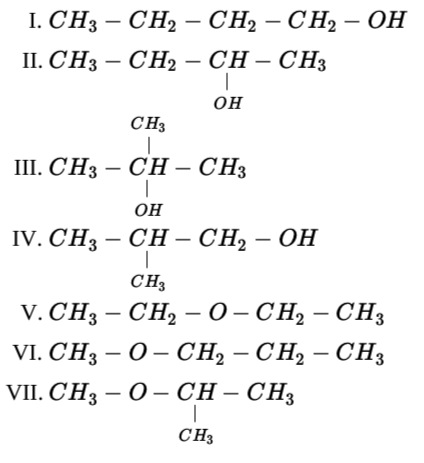
1. Identify the pairs of compounds which are functional group isomers.
Image
2. Explain, how is the electronegativity of carbon atoms related to their state of hybridization in an organic compound.
Write the expression for the equilibrium constant, $K _{ C }$ for each of the following reactions:
a. $2 NOCl ( g ) \rightleftharpoons 2 NO ( g )+ Cl _2(g)$
b. $2 Cu \left( NO _3\right)_2(s) \rightleftharpoons 2 CuO ( s )+4 NO _2(g)+ O _2(g)$
c. $CH _3 COOC _2 H _5( aq )+ H _2 O ( l ) \rightleftharpoons CH _3 COOH ( aq )+ C _2 H _5 OH ( aq )$
d. $Fe ^{3+}( aq )+3 OH ^{-}( aq ) \rightleftharpoons Fe ( OH )_3(s)$
e. $I _2(s)+5 F_2 \rightleftharpoons 2 IF _5$
The concentration of sulphide ion in $0.1$ M HCl solution saturated with hydrogen sulphide is $1.0 \times 10^{-19} \mathrm{M}$. If $10$ mL of this is added to $5$ mL of $0.04$ M solution of the following: $\mathrm{FeSO}_4, \mathrm{MnCl}_2, \mathrm{ZnCl}_2$ and $\mathrm{CdCl}_2$. in which of these solutions precipitation will take place?
  1. Predict the acidic, basic or neutral nature of the following salts:
$NaCN, KBr, NaNO_2, NH_4NO_3$
  1. What is the minimum volume of water required to dissolve 1 g of calcium sulphate at 298K? (For calcium sulphate $K_{sp} is 9.1 \times 10^{-6}$).
  2. At $450K ; K_p = 2.0 \times 10^{10}bar^{-1}$ for the reaction at equilibrium:
​​​​​​​​​​​​​​$2\text{SO}_2(\text{g})+\text{O}_2(\text{g})\rightleftharpoons2\text{SO}_3(\text{g})$
What is $K_c$ at this temperature?