Question 12 Marks
The equilibrium constant for a reaction is 10. What will be the value of $\Delta\text{G}^\ominus$? $\mathrm{R}=8.314 \mathrm{JK}^{-1} \mathrm{~mol}^{-1}, \mathrm{~T}=300 \mathrm{~K}$.
Answer$\Delta\text{G}^\ominus=-\text{RT ln k}=-2.303\text{RT}\log\text{K}.$$\text{R}=8.314\text{Jk}^{-1} \ \text{mol}^{-1};\text{T}=300\text{K};\text{K}=10$
$\Delta\text{G}^\ominus=-2.303\times8.314\text{Jk}^{-1} \ \text{mol}^{-1}\times(300\text{k})\times\log10 $
$=-5527\text{J} \ \text{mol}^{-1}=-5.527\text{kJ} \ \text{mol}^{-1}.$
View full question & answer→Question 22 Marks
The enthalpy of atomisation of $\mathrm{CH}_4$ is $1665 \mathrm{~kJ} \mathrm{~mol}^{-1}$. What is bond enthalpy of $\mathrm{C}-\mathrm{H}$ bond.
AnswerBond enthalpy of C-H bond $=\frac{1665}{4}=416.25\text{ kJ mol}^{-1}$$\because$ $\mathrm{CH}_4$ has 4 C-H bonds.
View full question & answer→Question 32 Marks
Calculate the standard free energy change $\Delta \mathrm{G}^{\circ}$ for the reaction: $2 \mathrm{HgO}(\mathrm{s}) \rightarrow 2 \mathrm{Hg}(\mathrm{l})+\mathrm{O}_2(\mathrm{~g}) \Delta \mathrm{H}^{\circ}=91 \mathrm{~kJ} \mathrm{~mol}^{-1}$ at $298 \mathrm{~K}^2 \mathrm{~S}^{\circ}(\mathrm{HgO})=72.0 \mathrm{~J} \mathrm{~K}^{-1} \mathrm{~mol}^{-1}, \mathrm{~S}_{(\mathrm{Hg})}^{\circ}=77.4 \mathrm{~J} \mathrm{~K}^{-1} \mathrm{~mol}^{-1}$ and $\mathrm{S}_{\left(\mathrm{O}_2\right)}^{\circ}=205 \mathrm{~J} \mathrm{~K}^{-1} \mathrm{~mol}^{-1}$ at 298 K .
Answer$\Delta\text{S}=2\text{S}^\circ_{(\text{Hg})}+\text{S}^\circ_{(\text{O}_2)}-2\text{S}^\circ_{(\text{HgO})}$$=(2\times77.4+205-2\times72.0)\text{J K}^{-1}\text{mol}^{-1}$
$=(154.8+205-144.0)\text{J K}^{-1}\text{mol}^{-1}$
$=(359.8-144.0)=215.8\text{J K}^{-1}\text{mol}^{-1}$
$\Delta_\text{r}\text{G}^\circ=\Delta_\text{r}\text{H}^\circ-\text{T}\Delta_\text{r}\text{S}^\circ$
$=91\text{kJ mol}^{-1}-\frac{298\times215.8}{1000}\text{kJ mol}^{-1}$
$=(91-64.3)\text{kJ mol}^{-1}=26.69\text{kJ mol}^{-1}$
View full question & answer→Question 42 Marks
The standard heat of formation of $\mathrm{CH}_4(\mathrm{~g}), \mathrm{CO}_2(\mathrm{~g})$ and $\mathrm{H}_2 \mathrm{O}(\mathrm{g})$ are $-76.2,-394.8$ and -241.6 kJ mol ${ }^{-1}$ respectively. Calculate the amount of heat evolved by burning $1 \mathrm{~m}^3$ of methane measured at NTP.
AnswerThe burning of methane may be expressed as,$\text{CH}_4(\text{g})+2\text{O}_2(\text{g})\overrightarrow{\ \ \ \ \ \ } \ \text{CO}_2(\text{g})+2\text{H}_2\text{O(g)}$
$\Delta_\text{f}\text{H}^\circ=[\Delta_\text{f}\text{H}^\circ(\text{CO}_2)+2\Delta_\text{f}\text{H}^\circ(\text{H}_2\text{O})]\\-[\Delta_\text{f}\text{H}^\circ(\text{CH}_4)+2\Delta_\text{f}\text{H}^\circ(\text{O}_2)]$
$=[-394.8+2\times(-241.6)]-[-76.2+2\times0]$
$=-801.8\text{kJ}$
1 mole or 22.4 L of $\mathrm{CH}_4$ evolve heat $=801.8 \mathrm{~kJ} 1 \mathrm{~m}^3$ or 1000 L of $\mathrm{CH}_4$ evolve heat $=\frac{801.8 \times 1000}{22.4}=35794.6 \mathrm{~kJ}$
View full question & answer→Question 52 Marks
Standard vaporisation enthalpy of benzene at boiling point is $30.8 \mathrm{~kJ} \mathrm{~mol}^{-1}$. For how long would 100 W electric heater have to operate in order to vaporise a 100 g sample at that temperature (power = energy/ time and $1 \mathrm{~W}=1 \mathrm{~J} \mathrm{~s}^{-1}$ )?
Answer$\Delta_{\text {vap }} \mathrm{H}^{\circ}$ (benzene $)=30.8 \mathrm{~kJ} \mathrm{~mol}^{-1}$ Molar mass of benzene, $\mathrm{C}_6 \mathrm{H}_6=(6 \times 12+6 \times 1) \mathrm{g} \mathrm{mol}^{-1}=78 \mathrm{~g} \mathrm{~mol}^{-1}$ Energy needed to vaporise benzene $=30.8 \mathrm{~kJ} \mathrm{~mol}^{-1} \times \frac{100 \mathrm{~g}}{78 \mathrm{~g} \mathrm{~mol}^{-1}}$
$=39.49 \mathrm{~kJ}$
So, Time $=\frac{\text { energy }}{\text { power }}=\frac{39.49 \mathrm{~kJ}, \mathrm{~J}}{100 \mathrm{~W}}$
$=\frac{39.49 \times 10^3 \mathrm{~J}}{100 \mathrm{~J} \mathrm{~s}^{-1}}=394.9 \mathrm{~s}=6.6 \mathrm{~min}$
View full question & answer→Question 62 Marks
Choose the correct answer. For the process to occur under adiabatic conditions, the correct condition is:
- $\Delta\text{T}=0$
- $\Delta\text{P}=0$
- $\text{q}=0$
- $\text{w}=0$
Answer
- $\Delta\text{P}=0$
Explanation:
A system is said to be under adiabatic conditions if there is no exchange of heat between the system and its surroundings. View full question & answer→Question 72 Marks
Predict in which of the following, entropy increases/ decreases. Give reason.
- Temperature of crystalline solid is raised from 0K to 115K.
- $\mathrm{H}_2(\mathrm{g}) \rightarrow 2 \mathrm{H}(\mathrm{g})$
Answer
- Entropy will increase on increasing the temperature since the particles of solid move with greater speed at higher temperature. At 0K, there is perfect order of the constituent particles, entropy is minimum, tends to zero.
- $\mathrm{H}_2(\mathrm{g}) \rightarrow 2 \mathrm{H}(\mathrm{g})$
Entropy will increase because the number of particles of product are double than that of reactant. View full question & answer→Question 82 Marks
What are the correct thermodynamic conditions for the spontaneous reaction at all temperature?
Answer$\Delta\text{H}^\circ<0,\Delta\text{S}^\circ<0.$$\because\Delta\text{G}^\circ=\Delta\text{H}^\circ-\text{T}\Delta\text{S}^\circ,$
$\text{If }\Delta\text{H}^\circ=-\text{ve},\Delta\text{S}=+\text{ve},\Delta\text{G}^\circ$ will be negative for all values of 'T'.
View full question & answer→Question 92 Marks
Define the term entropy. Write its unit. How does entropy of a system change on increasing temperature?
AnswerEntropy is measure of degree of disorder or randomness. Its unit is $\mathrm{JK}^{-1} \mathrm{~mol}^{-1}$. Entropy of system increases with increase in temperature.
View full question & answer→Question 102 Marks
For oxidation of iron,$4\text{Fe(s)}+3\text{O}_2(\text{g})\overrightarrow{\ \ \ \ \ \ }\ 2\text{Fe}_2\text{O}_3(\text{s})$
entropy change is $-549.4 \mathrm{JK}^{-1} \mathrm{~mol}^{-1}$ at 298 K . Inspite of negative entropy change of this reaction, why is the reaction spontaneous? $\left(\Delta_{\mathrm{r}} \mathrm{H}^{\circ}\right.$ for this reaction is $\left.-1648 \times 10^3 \mathrm{~J} \mathrm{~mol}^{-1}\right)$
Answer$4\text{Fe(s)}+3\text{O}_2(\text{g})\overrightarrow{\ \ \ \ \ \ }\ 2\text{Fe}_2\text{O}_3(\text{s})$$\Delta\text{S}_\text{surr}=-\frac{\Delta_\text{r}\text{H}^\circ}{\text{T}}=\frac{-(-1648\times10^3\text{ J mol}^{-1})}{289\text{K}}$
$\Delta\text{S}_\text{surr}=5530\text{J K}^{-1}\text{mol}^{-1}$
$\Delta\text{S}_\text{sys}=-549.4\text{J K}^{-1}\text{mol}^{-1}$
$\Delta_\text{r}\text{S}_\text{total}=\Delta\text{S}_\text{sys}+\Delta\text{S}_\text{sys}$
$\Rightarrow\Delta_\text{r}\text{S}_\text{total}=5530-549.4$
$=4980.6\text{J K}^{-1}\text{mol}^{-1}$
Since $\Delta_\text{r}\text{S}_\text{total}$ is +ve, therefore, reaction is spontaneous.
$\because\Delta\text{G}=-\text{T}\Delta\text{S}_\text{total}$
$\because\Delta\text{G}=-\text{ve}$
When $\text{S}_\text{total}$ is positive.
View full question & answer→Question 112 Marks
Calculate the free energy change when 1 mole of NaCl is dissolved in water at 298 K . (Given, lattice energy of $\mathrm{NaCl}=$ $-777.8 \mathrm{~kJ} \mathrm{~mol}^{-1}$, hydration energy $=-774.1 \mathrm{~kJ} \mathrm{~mol}^{-1}$ and $\Delta \mathrm{S}=0.043 \mathrm{~kJ} \mathrm{~K}^{-1} \mathrm{~mol}^{-1}$ at 298 K ).
Answer$\Delta\text{H}=$ hydration energy - lattice energy$\Delta\text{H}=-774.1\text{kJ mol}^{-1}-(-777.8\text{kJ mol}^{-1})\\=3.7\text{kJ mol}^{-1}$
$\Delta\text{G}=\Delta\text{H}-\text{T}\Delta\text{S}$
$=+3.7-298\times0.043=+3.7-12.81$
$\Delta\text{G}=-9.11\text{kJ mol}^{-1}$
View full question & answer→Question 122 Marks
Give one point to differentiate the following thermodynamic terms:
- Extensive properties and intensive properties.
- Isothermal process and isobaric process.
Answer
-
|
Extensive Property
|
Intensive Property
|
|
The property that depends on the quantity of a matter contained in the system, e.g. mass, volume and heat capacity.
|
These are the properties that depends on the nature of the substance and not on the amount of substance, e.g. refractive index and viscosity.
|
-
|
Isothermal Process
|
Isobaric Process
|
|
When a process is carried out in such a manner that the temperature remains constant, it is called isothermal process.
|
Isobaric process is the one during which the pressure of the system remains constant.
|
View full question & answer→Question 132 Marks
What will be work done during expansion of a gas from $4 \mathrm{dm}^3$ to $6 \mathrm{dm}^3$ against an external pressure of 3atm. (1L atm $=101.32 \mathrm{~J})$
Answer$P_{\text {ext }}=3 \mathrm{~atm}, V_f=6 \mathrm{dm}^3, V_i=3 \mathrm{~d} \mathrm{~cm}^3 \mathrm{w}=-P \Delta V$
$=-3 \times(6-4)=-6 \mathrm{L~atm}=-6 \times 101.32 \mathrm{~J}=-607.92 \mathrm{~J}=-608 \mathrm{~J}$
View full question & answer→Question 142 Marks
The enthalpy of reaction for the reaction : $2\text{H}_2(\text{g})+\text{O}_2(\text{g})\rightarrow2\text{H}_2\text{O}(\text{l})\ \text{is}\ \Delta_\text{r}\text{H}^\ominus=-572\text{kJ}\ \text{mol}^{-1}$
What will be standard enthalpy of formation of $H_2O(l)$?
AnswerAccording to the definition of standard enthalpy of formation, the enthalpy change for the following reaction will be standard enthalpy of formation of $H_2O (l)\text{H}_2(\text{g})+\frac{1}{2}\text{O}_2(\text{g})\rightarrow\text{H}_2\text{O}(\text{l}).$
or the standard enthalpy of formation of $H_2O(l)$ will be half of the enthalpy of the given equation i.e., $\Delta_\text{r}\text{H}^\ominus$ is also halved.$\Delta_\text{f}\text{H}^\ominus_{\text{H}_2\text{O}}(\text{l})=\frac{1}{2}\times\Delta_\text{r}\text{H}^\ominus=\frac{-572\text{kJ}\ \text{mol}^{-1}}{2}=-286\text{kJ}\ \text{mol}^{-1}$
View full question & answer→Question 152 Marks
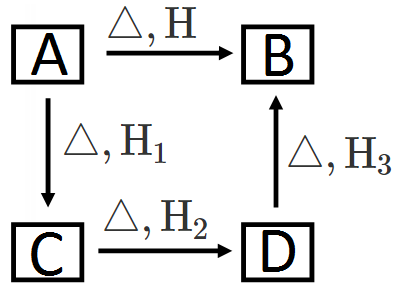
Enthalpy is an extensive property. In general, if enthalpy of an overall reaction A → B along one route is $\Delta_\text{r}\text{H}$ and $\Delta_\text{r}\text{H}_1,\Delta_\text{r}\text{H}_2,\Delta_\text{r}\text{H}_3......$ represent enthalpies of intermediate reactions leading to product B. What will be the relation between $\Delta_\text{r}\text{H}$ for overall reaction and $\Delta_\text{r}\text{H}_1,\Delta_\text{r}\text{H}_2,.....$etc. for intermediate react.
Answer
$\Delta_\text{r}\text{H}=\Delta_\text{r}\text{H}_1+\Delta_\text{r}\text{H}=\Delta_\text{r}\text{H}_2+\Delta_\text{r}\text{H}=\Delta_\text{r}\text{H}_3....$
It can be represented as:
View full question & answer→Question 162 Marks
18.0 g of water completely vapourises at $100^{\circ} \mathrm{C}$ and 1 bar pressure and the enthalpy change in the process is 40.79 kJ $\mathrm{mol}^{-1}$. What will be the enthalpy change for vapourising two moles of water under the same cond tions? What is the standard enthalphy of vapourisation for water?
AnswerEnthalpy of a reaction is the energy change per mole for the process.
$18 \mathrm{~g}$ of $\mathrm{H}_2 \mathrm{O}=1 \mathrm{~mole}\left(\Delta \mathrm{H}_{\text {vap }}=40.79 \mathrm{~kJ} \mathrm{~mol}^{-1}\right)$
Enthalpy change for vapourising 2 moles of $\mathrm{H}_2 \mathrm{O}=2 \times 40.79=81.58 \mathrm{~kJ} \Delta \mathrm{H}_{\text {vap }}^{\circ}=40.79 \mathrm{~kJ} \mathrm{~mol}{ }^{-1}$
View full question & answer→Question 172 Marks
Heat capacity $\left(C_p\right)$ is an extensive property but specific heat (c) is an intensive property. What will be the relation between $C_p$ and $c$ for 1 mol of water?
AnswerFor water, molar heat capacity $=18 \times$ Specific heat or
$C_p=18 \times c$
But, specific heat,
$C=4.18 \mathrm{Jg}^{-1} \mathrm{~K}^{-1} \text { Heat capacity, }$
$C_p=18 \times 4.18 \mathrm{JK}^{-1}=75.24 \mathrm{JK}^{-1}$
View full question & answer→Question 182 Marks
Establish a relationship between $\Delta\text{H}$ and $\Delta\text{U}$ in Haber's process of synthesis of ammonia assuming that gaseous reactants and products are ideal.
AnswerHaber's process of synthesis for ammonia is,$\text{N}_2(\text{g})+3\text{H}_2(\text{g})\overrightarrow{\ \ \ \ \ \ }\ 2\text{NH}_3(\text{g})$
$\Delta\text{n}_\text{g}=2-(1+3)=-2$
But $\Delta\text{H}=\Delta\text{U}+\Delta\text{n}_\text{g}\text{RT}$$\therefore\Delta\text{H}=\Delta\text{U}-2\text{RT}$
View full question & answer→Question 192 Marks
Consider the following reaction: $\mathrm{H}_2(\mathrm{~g})+\mathrm{F}_2(\mathrm{~g}) \rightarrow 2 \mathrm{HF}(\mathrm{g}) \Delta\text{H}^\circ=-542\text{kJ},\ \Delta\text{S}^\circ=14\text{JK}^{-1}$
Calculate the $\Delta\text{G}^\circ$ value for the reaction and state if the reaction is spontaneous at 298K.
Answer$\Delta\text{G}^\circ=\Delta\text{H}^\circ-\text{T}\Delta\text{S}^\circ$$\Delta\text{G}^\circ=-542\text{kJ}-\frac{298\times14}{1000}\text{kJ}$
$=-542-4=-546\text{kJ}$
Since $\Delta\text{G}^\circ$ is negative, therefore, reaction is spontaneous at 298K.
View full question & answer→Question 202 Marks
The difference between $C_p$ and $C_V$ can be derived using the empirical relation $H=U+p V$ Calculate the difference between $C_p$ and $C_V$ for 10 moles of an ideal gas.
AnswerGiven that, $C_v=$ heat capacity at constant volume, $C_p=$ heat capacity at constant pressure Difference between $C_p$ and $C_v$ is equal to gas constant $(R) . \therefore C_p-C_v=n R$ (where, $n=$ no. of moles)
$=10 \times 8.314=83.14 \mathrm{~J}$
View full question & answer→Question 212 Marks
Why standard entropy of an elementary substance is not zero whereas standard enthalpy of formation is taken as zero?
AnswerA substance has a perfectly ordered arrangement of its constituent particles only at absolute zero. Hence, entropy is zero only at absolute zero. Enthalpy of formation is the heat change involed in the formation of one mole of the substance from its elements. An element formed from itself means no heat change, i.e. $\Delta_\text{f}\text{H}^\circ=0.$
View full question & answer→Question 222 Marks
Increase in enthalpy of the surroundings is equal to decrease in enthalpy of the system. Will the temperature of system and surroundings be the same when they are in thermal equilibrium?
AnswerYes, If the system is in thermal equillibrium with the surroundings, then the tempreature of the surroundings is same as that of the system. Also, increase in enthalpy the surroundigs is equal to decrease in the enthalpy of the system.
View full question & answer→Question 232 Marks
Which has more entropy? 1 mole $\mathrm{H}_2 \mathrm{O}(\mathrm{I})$ at $25^{\circ} \mathrm{C}$ or 1 mole $\mathrm{H}_2 \mathrm{O}(\mathrm{I})$ at $35^{\circ} \mathrm{C}$?
Answer1 mole of $\mathrm{H}_2 \mathrm{O}$ at $35^{\circ} \mathrm{C}$ has more entropy because disorder or randomness increases with increase in temperature.
View full question & answer→Question 242 Marks
A 1.25 g sample of octane $\left(\mathrm{C}_8 \mathrm{H}_{18}\right)$ is burnt in excess of oxygen in a bomb calorimeter. The temperature of calorimeter rises from 294.05 to 300.78 K . If heat capacity of the calorimeter is 8.93 kJ K . Find heat transferred to calorimeter.
Answer$\text{m}=\text{n}\times\text{c}\times(\text{T}_2-\text{T}_1)$$=\frac{\text{mass}}{\text{molar mass}}\times\text{C}\times(\text{T}_2-\text{T}_1)$
$=\frac{1.25}{114}\times8.93\text{kJ K}^{-1}\times(300.78\text{K}-294.05\text{K})$
$=\frac{1.25\times8.93\times6.73}{114}=\frac{75.124}{124}$
$=0.66\text{kJ mol}^{-1}$
View full question & answer→Question 252 Marks
Given that $\Delta\text{H}=0$ for mixing of two gases. Explain whether the diffusion of these gases into each other in a closed container is a spontaneous process or not?
AnswerYes it will be a spontaneous process since delta G will be negative and entropy will be positive after diffusing two gases (volume will increase).$\Delta\text{G}=\Delta\text{H}-\text{T}\Delta\text{S}$
View full question & answer→Question 262 Marks
The combustion of benzene(I) gives $\mathrm{CO}_2(\mathrm{g})$ and $\mathrm{H}_2 \mathrm{O}(\mathrm{I})$. Given that heat of combustion at constant volume is $-3263.9 \mathrm{~kJ} \mathrm{~mol}^{-1}$ at $25^{\circ} \mathrm{C}$; calculate heat of combustion in $\mathrm{kJ} \mathrm{~mol}{ }^{-1}$ at constant pressure. $\left[\mathrm{R}=8.314 \mathrm{JK}^{-1} \mathrm{~mol}^{-1}\right]$
Answer$\text{C}_6\text{H}_6(\text{l})+\frac{15}{2}\text{O}_2(\text{g})\overrightarrow{\ \ \ \ \ }\ 6\text{CO}_2(\text{g})+3\text{H}_2\text{O(l)}$ $\Delta\text{H}=?$$\Delta\text{n}=\sum(\text{n}_\text{g})_\text{products}-\sum(\text{n}_\text{g})_\text{reactants}$
$\Delta\text{n}=6-\frac{15}{2}=-\frac{3}{2}$ $[\text{T}=25^\circ\text{C}+273=298\text{K}]$
$\Delta\text{H}=\Delta\text{U}+\Delta\text{nRT}$
$=-3263.9-\frac{3}{2}\times\frac{8.314\times298\text{K}}{1000}$
$=-3263.90\text{kJ}-\frac{3716.36}{1000}\text{kJ}$
$=-3263.92\text{kJ}-3.72\text{kJ}$
$=-3267.62\text{kJ mol}^{-1}$
View full question & answer→Question 272 Marks
Calculate the electron gain enthalpy of fluorine from the data given below: $\Delta_{\mathrm{f}} \mathrm{H}^{\circ}$ of $\mathrm{KF}=-560.8 \mathrm{~kJ} \mathrm{~mol}{ }^{-1}$, Sublimation energy of $\mathrm{K}=87.8 \mathrm{~kJ} \mathrm{~mol}^{-1}$, Dissociation energy of F , is $158.9 \mathrm{~kJ} \mathrm{~mol}{ }^{-1}$, Lattice energy of $\mathrm{KF}^{-15}-807.5 \mathrm{~kJ} \mathrm{~mol}{ }^{-1}$ and Ionisation energy of K is $414.2 \mathrm{~kJ} \mathrm{~mol}^{-1}$.
AnswerElectron gain enthalpy $=\Delta_\text{f}\text{H}-\text{S}-\frac{1}{2}\text{D}-\text{I.E.}-\text{U}$ 'S' is sublimation energy; 'D' is bond dissociation enthalpy. I.E. is ionisation elthalpy. 'U' represents lattice energy.$\text{E.G.E.}=-560.8-87.8-\frac{1}{2}\\\times158.9-414.2-(-807.5)$
$\text{E.G.E.}=-1142.25+807.5\\=-334.75\text{kJ mol}^{-1}$
View full question & answer→Question 282 Marks
The value of $\Delta_\text{f}\text{H}^\ominus$ for $\mathrm{NH}_3$ is $-91.8 \mathrm{~kJ} \mathrm{~mol}^{-1}$. Calculate enthalpy change for the following reaction:$2\text{NH}_3(\text{g})\rightarrow\text{N}_2(\text{g})+3\text{H}_2(\text{g})$
Answer$\frac{1}{2}\text{N}_{2_{(\text{g})}}+\frac{3}{2}\text{H}_{2_{(\text{g})}}\rightarrow\text{NH}_{3_{(\text{g})}},$ $\Delta_\text{f}\text{H}^\circ=-91.8\text{kJ}\ \text{mol}^{-1}$or $\text{N}_2(\text{g})+3\text{H}_2(\text{g})\rightarrow2\text{NH}_3(\text{g}),$
$\Delta_\text{f}\text{H}^\circ=-2\times91.8=-183.6\text{kJ}\ \text{mol}^{-1}$
SO, for the reverce reaction,
$\Delta_\text{r}\text{H}^\circ=183.6\text{kJ}\ \text{mol}^{-1}$
$\therefore\text{The}\ \text{value}\ \text{of}\ \Delta _\text{r}\text{H}^\circ\ \text{for}\ \text{NH}_3\ \text{is}\ +183.6\text{kJ}\ \text{mol}^{-1}$
View full question & answer→Question 292 Marks
Calculate the temperature above which the reduction of lead oxide in the following reaction becomes spontaneous:
PbO(s) + C(s) → Pb(s) + CO(g)
Given: $[\Delta\text{H}=108.4\text{kJ mol}^{-1};\ \Delta\text{S}=190\text{J K}^{-1}\text{mol}^{-1}]$
Answer$\Delta\text{G}=\Delta\text{H}-\text{T}\Delta\text{S}$At equilibrium, $\Delta\text{G}=0\Rightarrow\Delta\text{H}=\text{T}\Delta\text{S}$
$\Rightarrow\text{T}=\frac{\Delta\text{H}}{\Delta\text{S}}=\frac{108.4\times1000\text{ J mol}^{-1}}{190\text{JK}^{-1}\text{mol}^{-1}}$
$\text{T}=570.526\text{K}$
The reaction will become spontaneous above 570.52K because $\Delta\text{G}$ is equal to zero at this temperature and above this temperature, $\Delta\text{G}$ will become -ve.
View full question & answer→Question 302 Marks
Give reasons for the following:
- The enthalpy of neutralisation is always constant, i.e. 57.1kJ/ mol when a strong acid neutralism a strong base.
- Neither q nor w is a state function but q + w is a state function.
Answer
- It is because strong acid and strong base are completely ionised in aqueous solution.
- $\Delta\text{U}=\text{q}+\text{w}$
Since, $\Delta\text{U}$ is a state function and it is equal to q + w which is state function, because $\Delta\text{U}$ depends upon initial and final states and not on path. View full question & answer→Question 312 Marks
Find out whether it is possible to reduce MgO using carbon at 298 K. If not, at what temperature it becomes spontaneous? For reaction:$\text{MgO(s)}+\text{C(s)}\overrightarrow{\ \ \ \ \ \ }\ \text{Mg(s)}+\text{CO(g)}$
$\Delta_\text{r}\text{H}^\circ=91.18\text{kJ mol}^{-1}$ and $\Delta_\text{r}\text{S}^\circ=197.67\text{kJ mol}^{-1}$
Answer$\Delta_\text{r}\text{G}^\circ=\Delta_\text{r}\text{H}^\circ-\text{T}\Delta_\text{r}\text{S}^\circ$$=91.18\text{kJ mol}^{-1}-\frac{298\text{K}\times197.67}{1000}\text{kJ K}^{-1}\text{mol}^{-1}$
$=91.18\text{kJ mol}^{-1}-58.91\text{kJ mol}^{-1}$
$=32.27\text{kJ mol}^{-1}$
Since $\Delta\text{G}$ is +ve, therefore, carbon cannot reduce MgO.
$\Delta_\text{r}\text{G}^\circ=\Delta_\text{r}\text{H}^\circ-\text{T}\Delta_\text{r}\text{S}^\circ$
$0=91.18\text{kJ mol}^{-1}\\-\text{T}\times\frac{197.67}{1000}\text{kJ K}^{-1}\text{mol}^{-1}$
$\text{T}=\frac{91.18\times1000}{197.67}$
$=\frac{91180}{197.67}=461.27\text{K}$
Above 461.27K, $\Delta\text{G}=-\text{ve},$ reaction will become spontaneous.
View full question & answer→Question 322 Marks
Predict the sign of $\Delta\text{S}$ for the following:
- A sample of iron cools from 50°C to 25°C.
- HgO thermally decomposes to $\mathrm{Hg}(\mathrm{l})$ and $\mathrm{O}_2(\mathrm{g})$.
Answer
- $\Delta\text{S}=-\text{ve}.$
- $\Delta\text{S}=+\text{ve}.$
View full question & answer→Question 332 Marks
Consider the following gas phase reaction:$\text{H}_{2}\text{(g)} + \text{Cl}_{2} \text{(g)} \rightleftharpoons\text{2HCl(g)}$
$\Delta\text{H}^{\circ} = -92\text{kJ}, \ \Delta\text{S}^{\circ} = -95\text{JK}^{-1}$
Calculate the equilibrium constant, $K_p$ at 298 K for this reaction.
Answer$\Delta \text{G}^{\circ} =\Delta \text{H}^{\circ} - \text{T}\Delta\text{S}^{\circ}$$ = 92\text{kJ} \frac{298 \times 95}{1000}\text{kJ} = -64\text{kJ}$
$\Delta \text{G}^{\circ} = -2.303 \text{RT} \log \text{k}_{\text{p}}$
$-64\text{kJ} = \frac{-2.303 \times 8.314\times 298\text{K} }{1000}\log \text{K}_{\text{p}}$
$\log \text{K}_{\text{sp}} = \frac{-64\text{kJ}}{-5.7058\text{kJ}} = 11.2166$
$\text{K}_{\text{p}} = \text{Antilog } 11.2166$
View full question & answer→Question 342 Marks
Which has larger absolute entropy per mole?
i. $\mathrm{H}_2 \mathrm{O}(\mathrm{I})$ at 298 K or $\mathrm{H}_2 \mathrm{O}(\mathrm{l})$ at 350 K
ii. $\mathrm{N}_2$ or NO both at 298 K
Answer
- $\mathrm{H}_2 \mathrm{O}$ at 350K has larger absolute entropy per mole as entropy (randomness) is more at higher temperature.
- NO at 298K has greater entropy because it is unstable, highly reactive.
View full question & answer→Question 352 Marks
- Name the two factors that influence the entropy change that takes place in the surrounding.
- Write an equation that shows the relationship.
Answer
- $\Delta\text{S}_\text{surr}$ is directly proportional to $-q_p$, and inversely proportional to temperature in Kelvin.
$-\text{q}_\text{p}=-\Delta\text{H}_\text{sys}$
- $\Delta\text{S}_\text{surr}=\frac{-\Delta\text{H}_\text{sys}}{\text{T}}$
View full question & answer→Question 362 Marks
Calculate $\Delta_\text{r}\text{H}^\circ$ for the reaction,
$\text{H}-\text{C}=\text{C}-\text{H}+30=0\overrightarrow{\ \ \ \ \ \ \ }\\ \ \ \ \ \ \ \ \ \ |\ \ \ \ \ \ \ |\\ \ \ \ \ \ \ \ \ \text{H} \ \ \ \ \ \text{H}\\20=\text{C}=0+2\text{H}-0-\text{H}$
The average bond enthalpies of various bonds are as follows.
|
Bond
|
Bond enthalpy ($\mathrm{kJ} \mathrm{~mol}^{-1}$)
|
|
C-H
|
414
|
|
O=O
|
499
|
|
C=O
|
724
|
|
O-H
|
460
|
|
C=C
|
619
|
AnswerIn this reaction, four $\mathrm{C}-\mathrm{H}$ bonds, one $\mathrm{C}=\mathrm{C}$ bond and three $\mathrm{O}=\mathrm{O}$ bonds are broken and four $\mathrm{C}=\mathrm{O}$ bonds and four $\mathrm{O}-\mathrm{H}$ bonds are formed. Thus, $\Delta \mathrm{H}^{\circ}=[4 \times$ (bond enthalpy of $\mathrm{C}-\mathrm{H})+$ (bond enthalpy) of $\mathrm{C}=\mathrm{C}$ ) $+3[$ bond enthalpy of $\mathrm{O}=\mathrm{O}]$ $-4 \times[$ bond enthalpy of $\mathrm{C}=\mathrm{O}]+4$ (bond enthalpy of $\mathrm{O}-\mathrm{H}$ ) $]$
$\Delta \mathrm{H}=(4 \times 414+619+3 \times 499)-(4 \times 724+4 \times 460)$
$=-964 \mathrm{~kJ} \mathrm{~mol}^{-1}$
View full question & answer→Question 372 Marks
Heat has randomising influence on a system and temperature is the measure of average chaotic motion of particles in the system. Write the mathematical relation which relates these three parameters.
AnswerHeat has randomizing influence on a system and temperature is the measure of average chaotic motion of particles in the system. The mathematical relation which relates these three parameters is $\Delta\text{S}=\frac{\text{q}_\text{rev}}{\text{T}}$ Here, $\Delta\text{S}=$ change in entropy$\text{q}_\text{rev}=$ heat of reversible reaction
T = tempreature
View full question & answer→Question 382 Marks
Use the following thermodynamic data to calculate the enthalpy change for the formation of solid lithium fluoride, LiF(s) from Li(s) and $\text{F}_2$(g):$\text{Li(s)}+\frac{1}{2}\text{F}_2(\text{g})\overrightarrow{\ \ \ \ \ \ \ }\ \text{LiF(s)}$
$\text{Li(s)}\overrightarrow{\ \ \ \ \ \ \ \ }\ \text{Li(g)};$ $\Delta_\text{s}\text{H}^\circ=155\text{kJ mol}^{-1}$
$\frac{1}{2}\text{F}_2(\text{g})\overrightarrow{\ \ \ \ \ \ \ }\ \text{F(g)};$ $\Delta\text{H}^\circ=75\text{kJ}$
$\text{Li(g)}\overrightarrow{\ \ \ \ \ } \ \text{Li}^{+}(\text{g})+\text{e}^-;$ $\Delta\text{H}^\circ=520\text{kJ mol}^{-1}$
$\text{F(g)}+\text{e}^-\overrightarrow{\ \ \ \ \ \ } \ \text{F}^-(\text{g});$ $\Delta\text{H}^\circ=-333\text{kJ mol}^{-1}$
$\text{Li}^+\text{(g)}+\text{F}^-(\text{g})\overrightarrow{\ \ \ \ \ \ \ \ }\ \text{LiF(s)};$ $\Delta\text{H}^\circ=-1012\text{kJ mol}^{-1}$
Answer$\Delta_\text{f}\text{H}=\Delta_\text{s}\text{H}^\circ+\Delta_\text{D}\text{H}^\circ+\Delta_\text{I}\text{H}^\circ\\+\Delta_\text{EA}\text{H}^\circ+\Delta_\text{Lattice}\text{H}^\circ$$=155+75+520-333-1012$
$=750-1345=-595\text{kJ mol}^{-1}$
$\Delta_\text{s}\text{H}^\circ=$ enthalpy of sublimation
$\Delta_\text{D}\text{H}^\circ=$ Bond dissociation enthalpy
$\Delta_\text{I}\text{H}^\circ=$ Ionisation enthalpy
$\Delta_\text{EA}\text{H}^\circ=$ Electron gain enthalpy
$\Delta_\text{lattice}\text{H}^\circ=$ Lattice energy
$\Delta_\text{f}\text{H}^\circ=$ Enthalpy of formation
View full question & answer→Question 392 Marks
Comment on the spontaneity of a reaction at constant temperature and pressure in the following cases:
- $\Delta\text{H}<0\text{ and }\Delta\text{S}>0$
- $\Delta\text{H}>0\text{ and }\Delta\text{S}<0$
- $\Delta\text{H}<0\text{ and }\Delta\text{S}<0$
- $\Delta\text{H}>0\text{ and }\Delta\text{S}>0$
Answer
- $\Delta\text{H}<0\text{ and }\Delta\text{S}>0;$ $\Delta\text{G}$ will be -ve and process will always be spontaneous.
- $\Delta\text{H}>0\text{ and }\Delta\text{S}<0;$ $\Delta\text{G}$ will be +ve and process will never be spontaneous.
- $\Delta\text{H}<0\text{ and }\Delta\text{S}<0;$ $\Delta\text{G}$ will be -ve, if $\Delta\text{H}>\text{T}\Delta\text{S}$ and the process will be spontaneous at low temperature.
- $\Delta\text{H}>0\text{ and }\Delta\text{S}>0;$ $\Delta\text{G}$ will be -ve, if $\text{T}\Delta\text{S}>\Delta\text{H}$ and the process will be spontaneous at high temperature.
View full question & answer→Question 402 Marks
The enthalpy of vapourisation of $\mathrm{CCl}_4$ is $30.5 \mathrm{~kJ} \mathrm{~mol}^{-1}$. Calculate the heat required for the vapourisation of 284 g of $\mathrm{CCl}_4$ at constant pressure. (Molar mass of $\mathrm{CCl}_4=154 \mathrm{~g} \mathrm{~mol}^{-1}$ ).
Answer$\text{q}_\text{p}=\Delta\text{H}=30.5\text{kJ}\ \text{mol}^{-1}$$\therefore$ Heat required for vapourisation of 284g of $\mathrm{CCl}_4$
$=\frac{284\text{g}}{154\text{g}\ \text{mol}^{-1}}\times30.5\text{kJ}\ \text{mol}^{-1}$
$= 56.2\text{kJ}$
View full question & answer→Question 412 Marks
A swimmer coming out from a pool is covered with a film of water weighing about 18 g . How much heat must be supplied to evaporate this water at 298 K ? Calculate the internal energy of vaporisation at $100^{\circ} \mathrm{C} . \Delta_{\text {vap }} \mathrm{H}^{\circ}$ for water at $373 \mathrm{~K}=40.66 \mathrm{~kJ} \mathrm{~mol}^{-1}$.
Answer$18\text{g of H}_2\text{O(liquid)}\xrightarrow{\text{Vaporisation}}18\text{g H}_2\text{O(vapour)}$$\Delta_\text{vap}\text{H}^\circ\text{ for H}_2\text{O}=40.66\text{kJ mol}^{-1}$
No. of moles in 18g of water $=\frac{18\text{g}}{18\text{g mol}^{-1}}=1\text{ mole}$
1 mole of $\mathrm{H}_2 \mathrm{O}$ needs 40.66 kJ of energy for vaporization
$\Delta_\text{vap}\text{H}^\circ=\Delta_\text{vap}\text{U}^\circ+\Delta \text{nRT}$
$\Delta_\text{vap}\text{U}^\circ=\Delta_\text{vap}\text{H}^\circ-\Delta \text{nRT}$
$=40.66-1\times8.314\times10^{-3}\times373$
$=37.56\text{kJ mol}^{-1}$
View full question & answer→Question 422 Marks
At 0°C, ice and water are in equilibrium and $\Delta\text{H}=6.06\text{kJ mol}^{-1}$ for the process, $\mathrm{H}_2 \mathrm{O}(\mathrm{s}) \rightarrow \mathrm{H}_2 \mathrm{O}(\mathrm{l})$
What will be $\Delta\text{S}$ and $\Delta\text{G}$ for the conversion of ice into liquid water?
AnswerFor equilibrium reaction,$\text{H}_2\text{O(s)}\rightleftharpoons\text{H}_2\text{O(l)}$
$\Delta\text{G}=0\Rightarrow\Delta\text{G}=\Delta\text{H}-\text{T}\Delta\text{S}$
$\Rightarrow0=\Delta\text{H}-\text{T}\Delta\text{S}$
$\Delta\text{S}=\frac{\Delta\text{H}}{\text{T}}=\frac{6.06\text{kJ mol}^{-1}}{273}$
$=0.02219\text{kJ K}^{-1}\text{mol}^{-1}$
$=22.2\text{JK}^{-1}\text{mol}^{-1}$
View full question & answer→Question 432 Marks
Acetic acid (ethanoic acid) and hydrochloric acid react with KOH solution. The enthalpy of neutralisation of ethanoic acid is $-55.8kJ mol^{-1}$ while that of hydrochloric acid is $-57.3kJ mol^{-1}$
Can you think of why are these different?
AnswerThe thermochemical equations for the neutralisation of acetic acid and hydrochloric acids are,$\text{CH}_3\text{COOH(aq)}+\text{KOH(aq)}\overrightarrow{\ \ \ \ \ \ }\ \text{CH}_3\text{COOK(aq)}\\+\text{H}_2\text{O(l)};$ $\Delta_\text{n}\text{H}^\circ=-55.8\text{kJ mol}^{-1}$
and $\text{HCl(aq)}+\text{KOH(aq)}\overrightarrow{\ \ \ \ \ }\ \text{KCl(aq)}+\text{H}_2\text{O(l)};$ $\Delta_\text{n}\text{H}^\circ=-57.3\text{kJ mol}^{-1}$ In dilute solution HCl is completely ionised into $H^+$ and $Cl^-$, whereas $CH_3COOH$ is ionised to very small extent. This difference between the enthalpy of neutralisation of the two acids is due to tie endothermic nature of the reaction involving tie ionisation of acetic acid, i.e.,$\text{CH}_3\text{COOH(aq)}\rightleftharpoons\text{CH}_3\text{COO}^-(\text{aq})+\text{H}^+(\text{aq})$
$\Delta_\text{ion}\text{H}^\circ=-55.8-(-57.3)\text{kJ mol}^{-1}$
$=1.5\text{kJ mol}^{-1}$
View full question & answer→Question 442 Marks
Calculate the standard enthalpy of formation of $\mathrm{C}_2 \mathrm{H}_4(\mathrm{~g})$ from the following thermochemical equation.
$\mathrm{C}_4 \mathrm{H}_8(\mathrm{~g})+6 \mathrm{O}_2(\mathrm{~g}) \rightarrow 4 \mathrm{CO}_2+4 \mathrm{H}_2 \mathrm{O}$
Given that $\Delta_{\mathrm{f}} \mathrm{H}^{\ominus}$ of $\mathrm{CO}_2(\mathrm{~g}), \mathrm{H}_2 \mathrm{O}(\mathrm{g})$ as -393.5 and $-249 \mathrm{~kJ} \mathrm{~mol}^{-1}$ respectively.
Answer$\Delta_\text{f}\text{H}^\ominus$ of $O_2(g) = 0$ by convention$\Delta_\text{r}\text{H}^-=\sum\Delta_\text{f}\text{H}^\ominus(\text{products})-\sum\Delta_\text{f}\text{H}^\ominus(\text{reactants})$
Substituting the given values
$-2646=[4(-393.5)+4\times(-249.0)]\\-[\Delta_\text{f}\text{H}^\ominus(\text{C}_4\text{H}_8)+0]$
$=[-1574-996]-\Delta_\text{f}\text{H}^\ominus(\text{C}_2\text{H}_4)$
$=-2570=\Delta_\text{f}\text{H}^\ominus(\text{C}_2\text{H}_4)$
$\Delta_\text{f}\text{H}^\ominus(\text{C}_2\text{H}_4)=2646-2570=76\text{kJ mol}^{-1}$
View full question & answer→Question 452 Marks
The equilibrium constant at $25^{\circ} \mathrm{C}$ for the process $\mathrm{CO}^{3+}(\mathrm{aq})+6 \mathrm{NH}_3(\mathrm{aq}) \rightleftharpoons\left[\mathrm{CO}\left(\mathrm{NH}_3\right)_6\right]^{3+}(\mathrm{aq})$ is $2.5 \times 10^6$. Calculate the value of $\Delta \mathrm{G}^{\circ}$ at $25^{\circ} \mathrm{C}\left(\mathrm{R}=8.314 \mathrm{~J} \mathrm{~K}^{-1} \mathrm{~mol}^{-1}\right)$. In which direction is the reaction spontaneous under standard conditions?
Answer$\Delta\text{G}^\circ=-2.303\text{ RT}\log\text{K}$$=-2.303\times8.314\times298\log2.5\times10^6$
$=-5705.8[0.3980+6.0000]$ $[\log2.5=0.3980,\log10^6=6.0000]$
$=\frac{-5705.8\times6.3980}{1000}=-36.505\text{ kJ mol}^{-1}$
The reaction is spontaneous is forward direction under standard conditions because $\Delta\text{G}=-\text{ve}.$
View full question & answer→Question 462 Marks
For an isolated system, $\Delta\text{U}=0,$ what will be $\Delta\text{S}?$
AnswerChange in internal energy $(\Delta\text{U})$ for an isolated system is zero for it does not exchange any energy with the surroundings. But entropy tends to increase in case of spontaneous reaction. Therefore, $\Delta\text{S}>0$ or positive.
View full question & answer→Question 472 Marks
What is bond energy? Why is it called enthalpy of atomisation?
AnswerBond energy is the amount of energy released when bonds are formed between isolated atoms in gaseous state to form one mole of gaseous molecule. It is called enthalpy of atomisation because it may also be defined as the amount of energy required to dissociate bonds present between the atoms of 1 mole of a gaseous molecule into constituting atoms.
View full question & answer→Question 482 Marks
$\Delta\text{H}$ and $\Delta\text{S}$ for a reaction are found to be $-10000 \mathrm{~J} \mathrm{~mol}^{-1}$ and $-33.3 \mathrm{JK}^{-1}$. Under what conditions reaction will proceed in reverse direction.
Answer$\Delta\text{G}=\Delta\text{H}-\text{T}\Delta\text{S}$$0=-10000-\text{T}\times(-33.3)\text{J}$
$\Rightarrow\text{T}=\frac{10000}{33.3}=300.3\text{K}$
The reaction will proceed in backward direction above 300.3K because $\Delta\text{G}$ will +ve for forward reaction above 300.3K, hence $\Delta\text{G}$ will -ve for backward reaction.
View full question & answer→Question 492 Marks
Derive the relationship between isothermal and free expansion of an ideal gas.
AnswerWork done in isothermal reversible expansion of an ideal gas $\text{w}=-2.303\text{n RT}\log\frac{\text{V}_2}{\text{V}_1}$$=-2.303\text{n RT}\log\frac{\text{P}_1}{\text{P}_2}$
In free expansion of an ideal gas. w = 0 because ideal gases have negligible force of attraction, therefore. work done is zero in free expansion because no external force is acting.$\text{w}=-\text{P}_\text{ext}\Delta\text{V}$
$\text{P}_\text{ext}=0$
$\text{w}=0$
View full question & answer→Question 502 Marks
Calculate the total entropy change, $\Delta \mathrm{S}_{\text {total }}$ and state if the process is spontaneous, when one mole of liquid mercury $\mathrm{Hg}(\mathrm{l})$ changes to mercury vapour, $\mathrm{Hg}(\mathrm{g})$ at 298 K . The molar entropy of vapourisation of Hg is $99 \mathrm{JK}^{-1} \mathrm{~mol}^{-1}$ and molar enthalpy of vapourisation is $59.1 \mathrm{k} \mathrm{J} \mathrm{mol}^{-1}$.
Answer$\Delta\text{S}_\text{surr}=\frac{-\Delta\text{H}_\text{sys}}{\text{T}}=\frac{-59100\text{J mol}^{-1}}{298\text{K}}$$=-198\text{JK}^{-1}\text{mol}^{-1}$
$\Delta\text{S}_\text{total}=\Delta\text{S}_\text{sys}+\Delta\text{S}_\text{surr}$
$=99\text{J}-198\text{J}=-99\text{JK}^{-1}\text{mol}^{-1}$
Since $\Delta\text{S}_\text{total}=-\text{ve},$ therefore, process is non-spontaneous at 298K.
View full question & answer→Question 512 Marks
Show that for an isothermal expansion of an ideal gas (i) $\Delta\text{U}=0$ and (ii) $\Delta\text{H}=0.$
Answer
- For one mole of an ideal gas, $\text{C}_\text{V}=\Big(\frac{\Delta\text{U}}{\Delta\text{T}}\Big)_\text{V}$
$\Delta\text{U}=\text{C}_\text{V}\Delta\text{T}$
For an isothermal process, T is constant so that $\Delta\text{T}=0$
$\therefore\Delta\text{U}=0$
- $\Delta\text{H}=\Delta\text{U}+\Delta(\text{pV})$
For an ideal gas, pV = RT
$\therefore\Delta\text{H}=\Delta\text{U}+\Delta(\text{RT})=\Delta\text{U}+\text{R}\Delta\text{T}$
Since T is constant, $\Delta\text{T}=0$
$\therefore\Delta\text{H}=0$ View full question & answer→Question 522 Marks
Given that the enthalpy of formation of $\mathrm{H}_2 \mathrm{O}$ is $-68 \mathrm{kcal} / \mathrm{mol}$. Calculate the enthalpy of formation of OH ions.
AnswerFor neutralisation reaction, we know that$\text{H}^++\text{OH}^-\overrightarrow{\ \ \ \ \ \ }\ \text{H}_2\text{O};$ $\Delta_\text{r}\text{H}^\circ=-13.7\text{kcal}$
$\therefore\Delta_\text{r}\text{H}^\circ=\Delta_\text{f}\text{H}^\circ(\text{H}_2\text{O})-[\Delta_\text{f}\text{H}^\circ(\text{H}^+)+\Delta_\text{f}\text{H}^\circ(\text{OH}^-)]$
i.e., $-13.7=-68-[0+\Delta_\text{f}\text{H}^\circ(\text{OH}^-)]$ $[\because+\Delta_\text{f}\text{H}^\circ(\text{H}^+)=0]$$\Delta_\text{f}\text{H}^\circ(\text{OH}^-)=-68+13.7$
$=-54.3\text{kcal mol}^{-1}$
View full question & answer→Question 532 Marks
Use the following data to calculate the $\text{K}_{\text{sp}}$ value for Agl(s)$\text{H}_{2}\text{(g)} + \text{Cl}_{2} \text{(g)} \rightleftharpoons\text{2HCl(g)}$
$\Delta\text{H}^{\circ} = -92\text{kJ}, \ \Delta\text{S}^{\circ} = -95\text{JK}^{-1}$
Answer$\Delta \text{G}^{\circ} = \sum\Delta\text{G}^{\circ}_{\text{products}} - \sum\Delta\text{G}^{\circ}_{\text{reactants}}$$ = 77\text{kJ} - 52\text{kJ} - (-25.5\text{kJ})$
$= 50.5\text{kJ}$
$\Delta \text{G}^{\circ} = -2.303 \text{RT} \log \text{k}_{\text{sp}}$
$50.5 \text{kJ} = \frac{-2.303 \times 8.314\times 298\text{K} \log \text{K}_{\text{sp}}}{1000}$
$\log \text{K}_{\text{sp}} = \frac{-50.5\text{kJ}}{5.7058} $
$= -8.8506 + 1 - 1 = \bar{9}.1496$
$\text{K}_{\text{sp}} = \text{Antilog} \ \bar{9}.1496 = 1.411 \times 10^{-9}$
View full question & answer→Question 542 Marks
Find out the value of equilibrium constant for the following reaction at 298K.$2\text{NH}_3(\text{g})+\text{CO}_2(\text{g})\rightleftharpoons\text{NH}_2\text{CONH}_2(\text{aq})+\text{H}_2\text{O(l)}$
Standard Gibbs energy change, $\Delta_\text{r}\text{G}^\circ$ at the given temperature is $-13.6 \mathrm{~kJ} \mathrm{~mol}^{-1}$.
Answer$\log\text{K}=\frac{\Delta_\text{r}\text{G}^\circ}{2.303\text{RT}}=\frac{-13.6\times1000\text{J mol}^{-1}}{2.303\times8.314\times298}$$=\frac{13.6\times1000}{5705.8}$
$\log\text{K}=+2.38$
$\text{K}=\text{Antilog }2.38=2.4\times10^2$
$[\text{Antilog of }0.38=2.4,\ \text{Antilog }2.38=2.4\times10^2]$
View full question & answer→Question 552 Marks
The standard molar entropy of $\mathrm{H}_2 \mathrm{O}(\mathrm{l})$ is $70 \mathrm{JK}^{-1} \mathrm{~mol}^{-1}$. Will the standard molar entropy of $\mathrm{H}_2 \mathrm{O}(\mathrm{s})$ be more, or less than $70 \mathrm{JK}^{-} \mathrm{mol}^{-1}$ ?
AnswerThe standard molar entropy of $\mathrm{H}_2 \mathrm{O}(1)$ is $70 \mathrm{JK}^{-1} \mathrm{~mol}^{-1}$. The solid form of $\mathrm{H}_2 \mathrm{O}$ is ice. In ice, molecules of $\mathrm{H}_2 \mathrm{O}$ are less random than in liquid water. Thus, molar entropy of $\mathrm{H}_2 \mathrm{O}(\mathrm{s})<$ molar entropy of $\mathrm{H}_2 \mathrm{O}$ (1). The standard molar entropy of $\mathrm{H}_2 \mathrm{O}(\mathrm{s})$ is less than $70 \mathrm{KK}^1 \mathrm{~mol}^{-1}$.
View full question & answer→Question 562 Marks
1g of graphite is burnt in a bomb calorimeter in excess of oxygen at 298K and 1 atmospheric pressure according to the equation:$\text{C(graphite)}+\text{O}_2(\text{g})\overrightarrow{\ \ \ \ \ \ \ }\ \text{CO}_2(\text{g})$
During the reaction, temperature rises from 298K to 299K. If the heat superb, of the bomb calorimeter is 20.7kJ/ K, then what is the enthalpy change for the shove reaction at 298K and 1atm?
Answer$\text{q}=-\text{C}_\text{V}\times\Delta\text{T}$$=-20.7\text{kJ/ k}(299-298\text{K})$
$\text{q}=-20.7\text{kJ}$
$\Delta\text{H}$ for combustion of the 1g of carbon = -20.7kJ
$\Delta\text{H}$ for combustion of 1 mole = 12g carbon
$=-\frac{20.7}{1}\times12$
$=-2.48\times10^2\text{kJ mol}^{-1}$
View full question & answer→Question 572 Marks
Expansion of a gas in vacuum is called free expansion. Calculate the work done and the change in internal energy when 1litre of ideal gas expands isothermally into vacuum until its total volume is 5litre?
AnswerDuring free expansion, external pressure is zero, so Work done, $\text{w}=-\text{p}_\text{ext}\Delta\text{V}$ = -0(5-1) = 0 Since the gas is expanding isothermally, therefore, $\text{q}=0$$\Delta\text{U}=\text{q}+\text{w}=0+0=0$
View full question & answer→Question 582 Marks
Derive the relationship between $\text{C}_\text{p}$ and $\text{C}_\text{V}$ for an ideal gas.
AnswerAt constant volume $\text{C}_\text{V}=\Big(\frac{\text{dE}}{\text{dT}}\Big)_\text{V}$ for an ideal gas$\text{C}_\text{P}=\Big(\frac{\text{dH}}{\text{dT}}\Big)_\text{P}$ for an ideal gas
$\text{H}=\text{E}+\text{PV}=\text{E}+\text{RT}$
$\frac{\text{dH}}{\text{dt}}=\frac{\text{dE}}{\text{dt}}+\text{R}$
$\Rightarrow\text{C}_\text{P}=\text{C}_\text{V}+\text{R}$
$\Rightarrow\text{C}_\text{P}=\text{C}_\text{V}+\text{R}$ for an ideal gas
Alternate Answer
'q' at constant volume = $\text{q}_\text{v} $=\text{C}_\text{v}\Delta\text{T}=\Delta\text{U}$ 'q' at constant pressure = $\text{q}_\text{p} $=\text{C}_\text{p}\Delta\text{T}=\Delta\text{H}$$\Delta\text{H}=\Delta\text{U}+\Delta(\text{pV})$
$\Delta\text{H}=\Delta\text{U}+\Delta(\text{RT})$ $[\because\text{pV}=\text{RT}]$
$\Delta\text{H}=\Delta\text{U}+\text{R}\Delta\text{T}$ $[\because\text{‘R’} \text{ is constant}]$
$\text{C}_\text{p}\Delta\text{T}=\text{C}_\text{r}\Delta\text{T}+\text{R}\Delta\text{T}$
$\text{C}_\text{p}=\text{C}_\text{v}+\text{R}$
$\text{C}_\text{p}-\text{C}_\text{v}=\text{R}$
View full question & answer→Question 592 Marks
A 5 litre cylinder contained 10 moles of oxygen gas at $27^{\circ} \mathrm{C}$. Due to sudden leakage through the hole, all the gas escaped into the atmosphere and the cylinder got empty. If the atmospheric pressure was 1.0 atm, calculate the work done by the gas.
$\left[\mathrm{R}=0.0821 \mathrm{~L} \mathrm{~atm} \mathrm{~K}^{-1} \mathrm{~mol}^{-1} ; 1 \mathrm{~L} \mathrm{~atm}=101.3 \mathrm{~J}\right]$
Answer$W=P \Delta V=1.0 \times 5=5 \text { litre atm }$
$=5 \times 101.3 \mathrm{J~mol}^{-1}$
$\mathrm{~W}=10 \times 5 \times 101.3 \mathrm{~J}=50 \times 101.3 \mathrm{~J}$
$\mathrm{~W}=5065.3 \mathrm{~J}$
$\mathrm{~W}=5.0653 \mathrm{~kJ}$
View full question & answer→Question 602 Marks
An average healthy man needs about 10000 kJ of energy per day. How much carbohydrates (in mass) he will have to consume assuming that all this energy needs are met only by carbohydrates in the form of glucose? The enthalpy of combustion of glucose is $2816 \mathrm{~kJ} \mathrm{~mol}^{-1}$.
AnswerEnthalpy of combustion of glucose $=2816 \mathrm{~kJ} \mathrm{~mol}^{-1}$
Molecular mass of glucose $\left(\mathrm{C}_6 \mathrm{H}_{12} \mathrm{O}_6\right)$
$=6 \times 12+12 \times 1+6 \times 16=180 \mathrm{~g} \mathrm{~mol}^{-1}$
2816 KJ of energy is evolved from glucose $=180 \mathrm{~g}$
10000 kJ of energy will be evolved from glucose $=\frac{180}{2816} \times 10000=639.20 \mathrm{~g}$
View full question & answer→Question 612 Marks
Calculate the heat of reaction of the following reaction:$\text{CO}_2\text{(g)}+\text{H}_2(\text{g})\overrightarrow{\ \ \ \ \ \ }\ \text{CO(g)}+\text{H}_2\text{O(g)}$
Given that the $\Delta_\text{f}\text{H}^\circ\text{CO(g)}=-110.5\text{kJ mol}^{-1},$ $\Delta_\text{f}\text{H}^\circ\text{CO}_2\text{(g)}=-393.8\text{kJ mol}^{-1}$ and $\Delta_\text{f}\text{H}^\circ\text{H}_2\text{O(g)}=-241.8\text{kJ mol}^{-1}$ respectively.
Answer$\text{CO}_2\text{(g)}+\text{H}_2(\text{g})\overrightarrow{\ \ \ \ \ \ }\ \text{CO(g)}+\text{H}_2\text{O(g)}$$\Delta\text{H}=\sum\Delta_\text{f}\text{H}_{(\text{products})}-\sum\Delta_\text{f}\text{H}_{(\text{reactants})}$
$=\Delta_\text{f}\text{H}^\circ\text{CO(g)}+\Delta_\text{f}\text{H}^\circ\text{H}_2\text{O(g)}\\-\Delta_\text{f}\text{H}^\circ\text{CO}_2(\text{g})-\Delta_\text{f}\text{H}^\circ\text{H}_2(\text{g})$
$=-110.5-241.8-(-393.8)-0$
$=-352.3+393.8=41.5\text{kJ}$
View full question & answer→Question 622 Marks
The enthalpy of vapourisation of a liquid is $30 \mathrm{~kJ} \mathrm{~mol}^{-1}$ and entropy of vapourisation $75 \mathrm{JK}^{-1} \mathrm{~mol}^{-1}$. Calculate the boiling point of liquid at 1atm.
Answer$\Delta\text{S}_\text{vap}=\frac{\Delta_\text{vap}\text{H}^\circ}{\text{Boiling point in Kelvin}}$Boiling point in Kelvin $=\frac{\Delta_\text{vap}\text{H}^\circ}{\Delta\text{S}_\text{vap}}=\frac{30\times1000\text{J mol}^{-1}}{75\text{JK}^{-1}\text{mol}^{-1}}$
Boiling point of liquid = 400K
View full question & answer→Question 632 Marks
$1 \mathrm{~m}^3$ of $\mathrm{C}_2 \mathrm{H}_4$ at STP Is burnt in oxygen, according to the thermochemical reaction:
$\mathrm{C}_2 \mathrm{H}_4(\mathrm{~g})+3 \mathrm{O}_2(\mathrm{~g}) \longrightarrow 2 \mathrm{CO}_2(\mathrm{~g})+2 \mathrm{H}_2 \mathrm{O}(\mathrm{l}) ; \Delta \mathrm{H}=-1410 \mathrm{~kJ} \mathrm{~mol}{ }^{-1}$
Assuming 70% efficiency, determine how much of useful heat is evolved in the reaction.
Answer$1 \mathrm{~m}^3=1000 \mathrm{~L}$ Since 22.4 L of $\mathrm{C}_2 \mathrm{H}_4$ at STP produces 1410 kJ of energy 1000 L of $\mathrm{C}_2 \mathrm{H}_4$ at STP produces $\frac{1410}{22.4} \times 1000$ (if efficiency is $100 \%$ ) $=\frac{1410}{22.4} \times 1000 \times \frac{70}{100}$ (if efficiency is $70 \%$ )
$=44.02 \times 10^3 \mathrm{~kJ}$
View full question & answer→Question 642 Marks
Explain with the help of example, the difference between bond dissociation energy and bond energy.
AnswerBond dissociation energy is energy required to break 1 mole of bonds,
e.g. $\text{H}-\text{H(g)}\overrightarrow{\ \ \ \ \ \ }\ 2\text{H(g)};$ $\Delta\text{H}=436\text{kJ mol}^{-1}$
Bond energy is energy released when 1 mole of bonds are formed,
e.g. $2\text{H}\overrightarrow{\ \ \ \ \ \ }\ \text{H}_2(\text{g});$ $\Delta\text{H}=-436\text{kJ mol}^{-1}$
In diatomic molecule, both bond dissociation energy and bond energy are equal in magnitude but opposite in sign.
View full question & answer→Question 652 Marks
Calculate the heat of combustion of glucose from the following data:$\text{C(graphite)}+\text{O}_2(\text{g})\overrightarrow{\ \ \ \ \ }\text{CO}_2(\text{g});$ $\Delta\text{H}=-395.0\text{kJ mol}^{-1}$
$\text{H}_2(\text{g})+\frac{1}{2}\text{O}_2(\text{g})\overrightarrow{\ \ \ \ \ \ \ }\text{H}_2\text{O(l)};$ $\Delta\text{H}=-269.4\text{kJ mol}^{-1}$
$6\text{C(graphite)}+6\text{H}_2(\text{g})+\text{O}_2(\text{g})\overrightarrow{\ \ \ \ \ \ }\text{C}_6\text{H}_{12}\text{O}_6(\text{s});$ $\Delta\text{H}=-1169.8\text{kJ mol}^{-1}$
Answer$\text{C}_6\text{H}_{12}\text{O}_6(\text{s})+6\text{O}_2(\text{g})\overrightarrow{\ \ \ \ \ }\ 6\text{CO}_2(\text{g})+6\text{H}_2\text{O}(\text{g});$$\Delta\text{H}=?$
$\text{C(graphite)}+\text{O}_2(\text{g})\overrightarrow{\ \ \ \ \ }\ \text{CO}_2(\text{g});$ $\Delta\text{H}=-395.0\text{kJ mol}^{-1}\dots(\text{i})$
$\text{H}_2(\text{g})+\frac{1}{2}\text{O}_2(\text{g})\overrightarrow{\ \ \ \ \ \ \ }\ \text{H}_2\text{O(l)};$ $\Delta\text{H}=-269.4\text{kJ mol}^{-1}\dots(\text{ii})$
$6\text{C(graphite)}+6\text{H}_2(\text{g})+\text{O}_2(\text{g})\overrightarrow{\ \ \ \ \ \ }\ \text{C}_6\text{H}_{12}\text{O}_6(\text{s});$ $\Delta\text{H}=-1169.8\text{kJ mol}^{-1}\dots(\text{iii})$
Multiplying equations (i) and (ii) each by 6 and reversing (iii), we get
$6\text{C(graphite)}+6\text{O}_2(\text{g})\overrightarrow{\ \ \ \ \ \ }\ 6\text{CO}_2(\text{g});$ $\Delta\text{H}=-2370\text{kJ}\dots(\text{iv})$
$6\text{H}_2(\text{g})+3\text{O}_2(\text{g})\overrightarrow{\ \ \ \ \ \ }\ 6\text{H}_2\text{O(l)};$ $\Delta\text{H}=1616.4\text{kJ}\dots(\text{v})$
$\text{C}_6\text{H}_{12}\text{O}_6(\text{s})\overrightarrow{\ \ \ \ \ \ }\ 6\text{C(graphite)}+6\text{H}_2\text{(g)}+3\text{O}_2(\text{g})$ $\Delta\text{H}=-1169.8\text{kJ mol}^{-1}\dots(\text{vi})$
Adding eq. (iv), (v) and (vi)
$\text{C}_6\text{H}_{12}\text{O}_6(\text{s})+6\text{O}_2(\text{g})\overrightarrow{\ \ \ \ \ }\ 6\text{CO}_2(\text{g})+6\text{H}_2\text{O}(\text{g});$
$\Rightarrow\Delta_\text{c}\text{H}(\text{C}_6\text{H}_{12}\text{O}_6)=-2370.0-1616.4+1169.8$
$=-2816.6\text{kJ mol}^{-1}$
View full question & answer→Question 662 Marks
The net enthalpy change of a reaction is the amount of energy required to break all the bonds in reactant molecules minus amount of energy required to form all the bonds in the product molecules. What will be the enthalpy change for the following reaction.$\text{H}_2(\text{g})+\text{Br}_2(\text{g})\rightarrow2\text{HBr}(\text{g})$
Given that Bond energy of $\mathrm{H}_2, \mathrm{Br}_2$ and HBr is $435 \mathrm{~kJ} \mathrm{~mol}^{-1}, 192 \mathrm{~kJ} \mathrm{~mol}^{-1}$ and $368 \mathrm{~kJ} \mathrm{~mol}^{-1}$ respectively.
Answer$\Delta_\text{r}\text{H}^\circ=\sum\text{B.E.}_{(\text{reactants})}-\sum\text{B.E.}_{(\text{products})}$$=\text{B.E.}_{\text{H}_2}+\text{B.E.}_{\text{Br}_2}-2\times\text{B.E.}_\text{HBr}$
$= 435 + 192 - (2 \times 368)$
$= -109\text{kJ mol}^{-1}$
View full question & answer→Question 672 Marks
The enthalpy change for the reaction, $\text{Zn(s)}+2\text{H}^+(\text{aq})\overrightarrow{\ \ \ \ \ \ } \ \text{Zn}^{2+}(\text{aq})+\text{H}_2(\text{g}),$ is $-154.40 \mathrm{~kJ} \mathrm{~mol}^{-1}$. The formation of 2g of hydrogen expands the system by 22.4L at 1atm pressure.
What is the internal energy change of the reaction?
AnswerTaking the initial volume as negligible (as no gaseous reactant is present), change in volume during expansion $(\Delta\text{V})=22.4\text{L}.$External pressure $\left(\mathrm{P}_{\mathrm{ext}}\right)$ = 1atm$\Delta\text{H}=\Delta\text{U}+\text{p}\Delta\text{V}$
$\Delta\text{U}=\Delta\text{H}-\text{p}\Delta\text{V}$
$\text{p}\Delta\text{V}=1\text{atm}\times22.4\text{L}=22.4\text{L atm}$
$=22.4\times101.3\text{J}=2307\text{J}=2.31\text{kJ}$
$\therefore\Delta\text{U}=-154.4-2.31=-156.71\text{kJ}$
View full question & answer→Question 682 Marks
A position filled with one of mole ideal gas of 25°C undergoes free expansion free a volume of 10.0ml to 100ml. It 150J of heat is absorbed doing the process. What will be changes in $\Delta\text{U}$ and $\Delta\text{H}.$
Answer$\Delta\text{U}=0$ $[\text{w}=-\text{P}\Delta\text{V}]$$\Delta\text{H}=\text{q}+\text{w}$ $[\text{w}=0]$
$=150+0=150\text{J}\ (\therefore\text{Free expansion})$
View full question & answer→Question 692 Marks
Will entropy increase or decrease in the following changes?
- Sugar dissolved in water.
- Normal egg to hard boiled egg.
Answer
- When sugar dissolves in water, entropy increases because molecules of sugar become free to move disorder increases.
- Hard boiled egg has more entropy because denatured protein has random coil structure having more disorder where as normal egg have ordered structure of protein.
View full question & answer→Question 702 Marks
At $298 \mathrm{~K} . \mathrm{K}_{\mathrm{p}}$ for the reaction $\text{N}_2\text{O}_4(\text{g})\rightleftharpoons2\text{NO}_2(\text{g})\ \text{is}\ 0.98.$ Predict whether the reaction is spontaneous or not.
Answer$\Delta_\text{r}\text{G}^\circ=-\text{RT}\ \text{In}\ \text{K}_\text{p}$$=-\text{RT}\ \text{In}\ (0.98)$
Since In (0.98) is negative
$\therefore\Delta_\text{r}\text{G}^\circ$ is positive
$\Rightarrow$ the reaction is non spontaneous
View full question & answer→Question 712 Marks
Does an aqueous solution of $\text{Mg}^{2+}$ ions have a larger entropy before or after hydration of the ions?
Answer$\text{Mg}^{2+}$ has more entropy before hydration of ions because after hydration it will be surrounded by water molecules and its movement will be less.
View full question & answer→Question 722 Marks
Taking a specific example, show that $\Delta\text{S}_\text{total }$ is a criterion for the spontaneity of a change.
AnswerFor spontaneous process, $\Delta\text{S}_\text{total }$ must be positive, i.e. $\Delta\text{S}_\text{total}=\Delta\text{S}_\text{system}+\Delta\text{S}_\text{surroundings}>0$ Consider the freezing of water at 272K and 1atm pressure. For this process, $\Delta\text{S}_\text{system}=-21.85\text{JK}^{-1}\text{mol}^{-1}$$\Delta\text{S}_\text{surroundings}=+21.93\text{JK}^{-1}\text{mol}^{-1}$
$\therefore\text{S}_\text{total}=-21.85+(21.93)=+0.08\text{JK}^{-1}\text{mol}^{-1}$
As $\Delta\text{S}_\text{total }$ is positive, the freezing of water at 272K and 1atm pressure is spontaneous.
View full question & answer→Question 732 Marks
Calculate the bond enthalpy of $Cl - Cl$ bond from the following data:
$CH_4(g)+Cl_2(g) \rightarrow CH_3 Cl(l)+HCl(l) ;\left[\Delta H=-100.3 kJ mol^{-1}\right]$
Given, bond enthalpies of $C - H , C - Cl$ and $H - Cl$ bonds are 413,326 and $431 kJ mol ^{-1}$ respectively.
Answer$\ \ \ \ \ \ \ \ \ \text{H}\\ \ \ \ \ \ \ \ \ \ \ |\\ \ \text{H}-\text{C}-\text{H(g)}+\text{Cl}-\text{Cl(g)}\overrightarrow{\ \ \ \ \ \ \ }\\\ \ \ \ \ \ \ \ \ \ |\\ \ \ \ \ \ \ \ \ \ \text{H}\\\ \ \ \ \ \ \ \ \text{H}\\ \ \ \ \ \ \ \ \ \ | \\ \text{H}-\text{C}-\text{Cl}(\text{g})+\text{H}-\text{Cl}(\text{g})\\ \ \ \ \ \ \ \ \ |\\ \ \ \ \ \ \ \ \text{H}$$\Delta\text{H}=-100.3\text{kJ mol}^{-1}$
Enthalpy of reaction = $\sum$ Bond energy of reactants - $\sum$ Bond energy of products
$\Delta\text{H}=$ $[4 \times B.E.(C-H) + B.E.(Cl-Cl)] - [3 \times B.E.(C-H) + B.E.(Cl-Cl) + B.E.(H-Cl)]$
$\Delta\text{H}=$ $[B.E.(C-H) + B.E.(Cl-Cl)] - B.E.(C-Cl) - B.E.(H-Cl) - 100.3$
$= 413 + B.E.(Cl-Cl) - 326 - 431$
$B.E.(Cl-Cl) = -100.3 + 326 + 431 - 413$
$B.E.(Cl-Cl) = 243.7kJ mol^{-1}$
View full question & answer→Question 742 Marks
At 298 K what will be the change in standard internal energy change for the given reaction:
$\mathrm{OF}_2(\mathrm{~g})+\mathrm{H}_2 \mathrm{O}(\mathrm{~g}) \rightarrow \mathrm{O}_2(\mathrm{~g})+2 \mathrm{HF}(\mathrm{~g}) \Delta \mathrm{H}=-310 \mathrm{~kJ}$
Answer$\Delta\text{n}=$ Number of moles of gaseous products - Number of moles of gaseous reactants= 3 - 2 = 1
$\mathrm{T}=298 \mathrm{k}, \Delta \mathrm{H}=-310 \mathrm{~kJ}, \mathrm{R}=8.3145 \mathrm{k}^{-1} \mathrm{~mol}^{-1}$
$\Delta\text{H}^\circ=\Delta\text{U}^\circ+\Delta\text{nRT}-310\text{kJ}$
$=\Delta\text{U}^\circ+\frac{1\times8.314\times298\text{K}}{1000}\text{kJ}$
$\Delta\text{U}=-310\text{kJ}-2.48\text{kJ}$
$\Delta\text{U}=-312.48\text{kJ}$
View full question & answer→Question 752 Marks
Calculate $\Delta_\text{r}\text{G}^\circ$ for conversion of oxygen to ozone, $\frac{3}{2}\text{O}_2(\text{g})\overrightarrow{\ \ \ \ \ }\ \text{O}_3(\text{g})$ at 298K, if $K_p$ for this conversion is $2.47 \times 10^{-29}$.
Answer$\Delta_\text{r}\text{G}^\circ=-2.303\text{RT}\log\text{K}_\text{p}$$=-2.303\times8.314\text{J K}^{-1}\text{mol}^{-1}\\ \times298\text{K}\times\log2.47\times10^{-29}$
$[\log2.47=0.3927,\log^{-29}=-29.000]$
$=-5705.8\text{J mol}^{-1}\times(0.3927-29.000)$
$=-5705.8\text{J mol}^{-1}\times(-28.6073)$
$=163228\text{J mol}^{-1}=163\text{kJ mol}^{-1}$
View full question & answer→Question 762 Marks
Determine the value of $\Delta \mathrm{H}$ and $\Delta \mathrm{U}$ for the reversible isothermal evaporation of 90.0 g of water at $100^{\circ} \mathrm{C}$. Assume that water vapour behave as an ideal gas and heat of evaporation of water is $540 \mathrm{cal}\left(\mathrm{R}=2.0 \mathrm{cal} \mathrm{~mol}^{-1} \mathrm{~K}^{-1}\right)$.
Answer$\Delta\text{H}=90.0\times540=48600\text{cal}$$\text{T}=100^\circ\text{C}=273+100=373\text{K}$
$\Delta\text{H}=\Delta\text{U}+\text{p}\Delta\text{V}$
$=\Delta\text{U}+\text{p}(\text{V}_\text{vap}-\text{V}_\text{liq})$
Volume of liquid is negligible as compared to volume of vapour.
$\Delta\text{H}=\Delta\text{U}+\text{p}\text{V}_\text{vap}$
$\Delta\text{H}=\Delta\text{U}+\text{nRT}$
$\Delta\text{U}=\Delta\text{H}-\text{nRT}$
$=48600-\frac{90}{18}\times2\times373\Big(\text{n}=\frac{90}{18}\Big)$
$=48600-3730=44870\text{cal}$
View full question & answer→Question 772 Marks
The enthalpy of formation of carbon monoxide and steam are -110.5 and -243.0 kJ respectively. Calculate the heat of the reaction when steam is passed over coke as $\mathrm{C}(\mathrm{s})+\mathrm{H}_2 \mathrm{O}(\mathrm{g}) \rightarrow \mathrm{CO}(\mathrm{g})+\mathrm{H}_2(\mathrm{~g})$.
AnswerWe are given,$\text{C(s)}+\frac{1}{2}\text{O}_2(\text{g})\overrightarrow{\ \ \ \ \ }\ \text{CO}_2(\text{g});$ $\Delta\text{H}=-110.5\text{kJ}$
$\text{H}_2(\text{g})+\frac{1}{2}\text{O}_2(\text{g})\overrightarrow{\ \ \ \ \ }\ \text{H}_2\text{O}(\text{g});$ $\Delta\text{H}=-243.0\text{kJ}$
Subtracting eq. (ii) from eq. (i), we get $\mathrm{C}(\mathrm{s})+\mathrm{H}_2 \mathrm{O}(\mathrm{g}) \rightarrow \mathrm{CO}(\mathrm{g})+\mathrm{H}_2(\mathrm{~g}) ; \Delta \mathrm{H}=+132.5 \mathrm{~kJ}$
View full question & answer→Question 782 Marks
Define the following terms:
- Enthalpy of neutralisation.
- Hess's law of constant heat summation.
Answer
- Enthalpy of Neutralisation: It is defined as enthalpy change (heat evolved) when 1 mole of $\mathrm{H}^{+}$from acid combines with 1 male of $\mathrm{OH}^{-}$from base to form water.
$\text { e.g. } \mathrm{NaOH}+\mathrm{HCl} \rightarrow \mathrm{NaCl}+\mathrm{H}_2 \mathrm{O} \Delta \mathrm{H}=-57.1 \mathrm{~kJ} \mathrm{~mol}^{-1}$
- Hess's law of constant heat summation: It states that total enthalpy of reaction remains the same whether the reaction takes place in one step or several steps.
View full question & answer→Question 792 Marks
The enthalpy of atomisation for the reaction $\mathrm{CH}_4(\mathrm{~g}) \rightarrow \mathrm{C}(\mathrm{g})+4 \mathrm{H}(\mathrm{g})$ is $16650 \mathrm{~kJ} \mathrm{~mol}^{-1}$. What is the bond energy of $\mathrm{C}-\mathrm{H}$ bond?
AnswerTo atomization of $\mathrm{CH}_4$ molecule it needs to break $4 \mathrm{C}-\mathrm{H}$ bonds. So if we divide the enthalpy change by 4 we will get the energy of breaking one C-H bond. So the bond energy of C-H bond will be $=1665 / 4$ $=416.25 \mathrm{KJ} / \mathrm{mol}$
View full question & answer→Question 802 Marks
Carbon monoxide is allowed to expand isothermally and reversibly from $10 \mathrm{~m}^3$ to $20 \mathrm{~m}^3$ at 300 K and work obtained is 4.754 kJ . Calculate the number of moles of carbon monoxide.
Answer$\text{W}=-2.303\text{nRT}\log\frac{\text{V}_2}{\text{V}_1}-4754$$=-2.303\times\text{n}\times8.314\times300\times\log\frac{20}{10}$
On solving, n = 2.75mol
View full question & answer→Question 812 Marks
The equilibrium constant for a reaction is 100. What will be the value of $\Delta\text{G}^\circ?$ $\mathrm{R}=8.314 \mathrm{JK}^{-1} \mathrm{~mol}^{-1}, \mathrm{~J}=300 \mathrm{~K}$.
Answer$\Delta\text{G}^\circ=-2.303\times\text{RT}\log\text{K}$$=-2.303\times8.314\times300\text{K}\log100$
$=-19.147\times300\text{K}\times2$ $[\log100=2.0000]$
$=\frac{-57.441\times100\times2}{1000}\text{kJ mol}^{-1}$
$=\frac{-114.882}{10}=-11.49\text{kJ mol}^{-1}$
View full question & answer→Question 822 Marks
Which quantity out of $\Delta_\text{r}\text{G}$ and $\Delta_\text{r}\text{G}^\ominus$ will be zero at equilibrium?
AnswerGibbs energy for a reaction in which all reactants and products are in standard state. $\Delta_\text{r}\text{G}^\circ$ is related to the equilibrium constant of the reaction as follows:$\Delta_\text{r}\text{G}=\text{A}_\text{r}\text{G}^\circ+\text{RT}\ \text{In}\ \text{K}$
At equalibrium, $0=\Delta_\text{r}\text{G}^\circ+\text{RT}\ \text{In}\ \text{A}^-(\Delta_\text{r}\text{G}=0)\ \text{or}\ \Delta_\text{r}\text{G}^\circ=-\text{RT}\ \text{In}\text{K}$$\Delta_\text{r}\text{G}^\circ=0$ when K = 1
For all other values of K, $\text{A}_\text{r}\text{G}^\circ$ will be non - zero.
View full question & answer→Question 832 Marks
Compound with carbon-carbon double bond, such as ethylene ($\text{C}_2\text{H}_4$) and hydrogen in a reaction is called hydrogenation.$\text{C}_2\text{H}_4(\text{g})+\text{H}_2(\text{g})\overrightarrow{\ \ \ \ \ \ }\ \text{C}_2\text{H}_6(\text{g})$
Calculate enthalpy change for the reaction using the following combustion data:$\text{C}_2\text{H}_4(\text{g})+3\text{O}_2(\text{g})\overrightarrow{\ \ \ \ \ }\ 2\text{CO}_2(\text{g})+2\text{H}_2\text{O(g)};$ $\Delta\text{H}=-1401\text{kJ/ mol}$
$\text{C}_2\text{H}_6(\text{g})+\frac{7}{2}\text{O}_2(\text{g})\overrightarrow{\ \ \ \ \ \ }\ 2\text{CO}_2(\text{g})+3\text{H}_2\text{O(l)};$ $\Delta\text{H}=-1550\text{kJ/ mol}$
$\text{H}_2(\text{g})+\frac{1}{2}\text{O}_2(\text{g})\overrightarrow{\ \ \ \ \ \ }\ \text{H}_2\text{O(l)};$ $\Delta\text{H}=-286.0\text{kJ/ mol}$
Answer$\Delta\text{H}=\Delta\text{H}_\text{c}(\text{reactants})-\Delta\text{H}_\text{c}(\text{products})$$=\Delta\text{H}_\text{c}(\text{C}_2\text{H}_4)+\Delta\text{H}_\text{c}(\text{H}_2)-\Delta\text{H}_\text{c}(\text{C}_2\text{H}_6)$
$=-1401-286-(-1550)$
$=-1401-286+1550=-1687+1550$
$=-137\text{kJ mol}^{-1}$
View full question & answer→Question 842 Marks
Predict the change in internal energy for an isolated system at constant volume.
AnswerFor isolated system, there is no transfer of energy as heat or as work i.e., w = 0 and q = 0. According to the first law of thermodynamics.$\Delta\text{U}=\text{q}+\text{w}$
= 0 + 0 = 0$\therefore\Delta\text{U}=0$
View full question & answer→Question 852 Marks
The molar enthalpy of vapourisation of acetone is less than that of water. Why?
AnswerAcetone does not have hydrogen bond, and thus intermolecular forces are weaker which make boiling fast and less molar enthalpy of vapourisation. Whereas water contain hydrogen bond which make more strong intermolecular forces and molar enthalpy of vapourisation.
View full question & answer→Question 862 Marks
Define:
- Intensive properties.
- Adiabatic process.
Answer
- Intensive properties: The properties which depend only on the nature of the substance and not on the amount of the substance are called intensive properties, e.g. density.
- Adiabatic process: A process during which no heat flows between the system and the surroundings is called an adiabatic process, i.e., q = 0.
View full question & answer→Question 872 Marks
A sample of 1.0mol of a monoatomic ideal gas is taken through a cyclic process of expansion and compression as shown in Fig. What will be the value of $\Delta\text{H}$ for the cycle as a whole?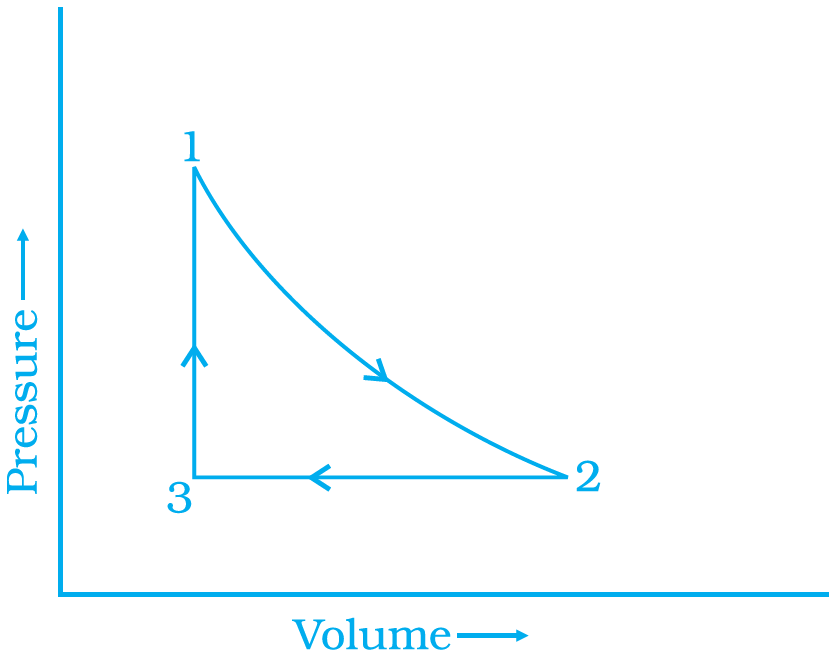
AnswerFor a cyclic process, $\Delta\text{H}=0$
View full question & answer→