MCQ
  • A
    Statement-I is true but Statement-II is false
  • B
    Both Statement-I and Statement-II are false
  • C
    Both Statement-I and Statement-II are true
  • Statement-I is false but Statement-II is true

Answer

Correct option: D.
Statement-I is false but Statement-II is true
(D) Statement-I is false but Statement-II is true
Sol. $=\frac{\frac{\varepsilon_1}{r_1}+\frac{\varepsilon_2}{r_2}}{\frac{1}{r_1}+\frac{1}{r_2}}=\varepsilon$

Need a full question paper?

Generate a complete, print-ready paper with questions like this in minutes — across 16+ boards, with answer keys.
Start Generating Free

Similar questions

A particle of mass $m$ undergoes oscillations about $x=0$ in a potential given by $V(x)-\frac{1}{2} k x^2-V_0 \cos \left(\frac{x}{a}\right)$, where $V_0, k, a$ are constants. If the amplitude of oscillation is much smaller than $a$, the time period is given by
The phenomenon of radioactivity is
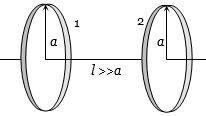
What is the mutual inductance of a two-loop system as shown with centre separation l
move in opposite direction with speed ratio $1: 2$

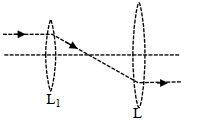
The following figure represents two biconvex lenses $L_1$ and $L_2$ having focal length $10 \mathrm{~cm}$ and $15 \mathrm{~cm}$ respectively. The distance between $\mathrm{L}_1 \& \mathrm{~L}_2$ is :
Two waves are represented by the equations ${y_1} = a\sin \omega t$ and ${y_2} = a\cos \omega t.$ The first wave
A particle executing simple harmonic motion along $Y- $axis has its motion described by the equation $y = A\sin (\omega \,t) + B$. The amplitude of the simple harmonic motion is
A solid disc of radius $20 \,{cm}$ and mass $10\, {kg}$ is rotating with an angular velocity of $600\, {rpm}$, about an axis normal to its circular plane and passing through its centre of mass. The retarding torque required to bring the disc at rest in $10\, {s}\, ......\, \pi \times \,10^{-1}\, {Nm}$.
$P-V$ diagram of a diatomic gas is a straight line passing through origin. The molar heat capacity of the gas in the process will be
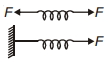
Figure shows two cases. In first case a spring (spring constant $K$ ) is pulled by two equal and opposite forces $F$ at both ends and in second case is pulled by a force $F$ at one end. Extensions $(x)$ in the springs will be
The electric field in an electromagnetic wave is given by ${E}=\left(50\, {NC}^{-1}\right) \sin \omega({t}-{x} / {c})$

The energy contained in a cylinder of volume ${V}$ is $5.5 \times 10^{-12} \, {J}$. The value of ${V}$ is $......{cm}^{3}$ $\left(\right.$ given $\left.\in_{0}=8.8 \times 10^{-12} \,{C}^{2} {N}^{-1} {m}^{-2}\right)$