Questions

SECTION - A [PHYSICS MCQ]

Take a timed test

20 questions · auto-graded multiple-choice test.

MCQ 14 Marks
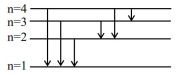
The number of spectral lines emitted by atomic hydrogen that is in the $4^{\text {t }}$ energy level, is
  • 6
  • B
    0
  • C
    3
  • D
    1
Answer
Correct option: A.
6
(A) 6

Image
Total possible transition $=6$
View full question & answer
MCQ 24 Marks
A cup of coffee cools from $90^{\circ} C$ to $80^{\circ} C$ in t minutes when the room temperature is $20^{\circ} C$. The time taken by the similar cup of coffee to cool from $80^{\circ} C$ to $60^{\circ} C$ at the same room temperature is :
  • $\frac{13}{5} t$
  • B
    $\frac{10}{13} t$
  • C
    $\frac{13}{10} t$
  • D
    $\frac{5}{13} t$
Answer
Correct option: A.
$\frac{13}{5} t$
(A) $\frac{13}{5} t$
Sol. By using average form of Newton's law of cooling$
\begin{array}{l}
\frac{90-80}{t}=k\left(\frac{90+80}{2}-20\right) \\
\frac{80-60}{t^{\prime}}=k\left(\frac{80+60}{2}-20\right)
\end{array}
$
$
\begin{array}{l}
\text { (i)/(ii) } \\
\frac{10 \times t^{\prime}}{t \times 20}=\frac{65}{50} \\
t^{\prime}=\frac{65}{50} \times 2 t=\frac{65}{25} t=\frac{13}{5} t
\end{array}
$
View full question & answer
MCQ 34 Marks
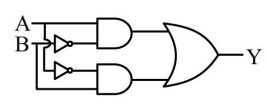
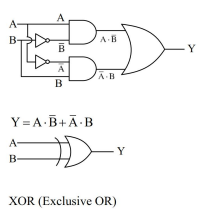
The truth table for the circuit given below is :
Image
  • ABC
    000
    011
    101
    110
  • B
    ABC
    000
    100
    110
    011
  • C
    ABC
    000
    101
    010
    110
  • D
    ABC
    000
    111
    101
    011
Answer
Correct option: A.
ABC
000
011
101
110
(A)
ABC
000
011
101
110

Sol.
Image
View full question & answer
MCQ 44 Marks
Match List-I with List-II
 List-I List-II
(A)Magnetic induction(I)Ampere meter
(B)Magnetic intensity(II)Weber
(C)Magnetic flux(III)Gauss
(D)Magnetic moment(IV)Ampere meter
Choose the correct answer from the options given below :
  • A
    (A)-(III), (B)-(IV), (C)-(I), (D)-(II)
  • (A)-(III), (B)-(IV), (C)-(II), (D)-(I)
  • C
    (A)-(I), (B)-(II), (C)-(III), (D)-(IV)
  • D
    (A)-(III), (B)-(II), (C)-(I), (D)-(IV)
Answer
Correct option: B.
(A)-(III), (B)-(IV), (C)-(II), (D)-(I)
(B) (A)-(III), (B)-(IV), (C)-(II), (D)-(I)
View full question & answer
MCQ 54 Marks
Match List-I with List-II
 List-I List-II
(A)Young's Modulus(I)$ML ^{-1} T^{-1}$
(B)Torque(II)$ML ^{-1} T^{-2}$
(C)Coefficient of Viscosity(III)$M ^{-1} L^3 T^{-2}$
(D)Gravitational Constant(IV)$ML ^{2} T^{-2}$
Choose the correct answer from the options given below :
  • A
    (A)-(I), (B)-(III), (C)-(II), (D)-(IV)
  • B
    (A)-(II), (B)-(I), (C)-(IV), (D)-(III)
  • C
    (A)-(IV), (B)-(II), (C)-(III), (D)-(I)
  • (A)-(II), (B)-(IV), (C)-(I), (D)-(III)
Answer
Correct option: D.
(A)-(II), (B)-(IV), (C)-(I), (D)-(III)
(D) (A)-(II), (B)-(IV), (C)-(I), (D)-(III)
Sol.
(A) $[ Y ]=\frac{ F }{ A \left(\frac{\Delta \ell}{\ell}\right)} \Rightarrow \frac{ MLT ^{-2}}{L^2}= ML ^{-1} T^{-2}$
(B) Torque $(\vec{\tau})=\overrightarrow{ r } \times \overrightarrow{ F }$
$
(\vec{\tau})=L \times MLT^{-2}=ML^2 T^{-2}
$
(C) Coefficient of viscosity $\Rightarrow F =\eta A \frac{ dV }{ dt }$
$
\eta \rightarrow \text { Pa'sec }
$
$
[\eta]=\frac{MLT^{-2}}{L^2} \times T=ML^{-1} T^{-1}
$
(D) Gravitational constant (G)$
\begin{array}{l}
F=\frac{GM_1 M_2}{r^2} \\
{[G]=\frac{F \cdot r^2}{m_1 m_2}=\frac{MLT^{-2} \times L^2}{M^2}=M^{-1} L^3 T^{-2}}
\end{array}
$
View full question & answer
MCQ 64 Marks
Sol.
Image
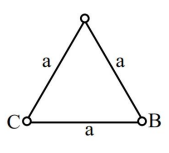
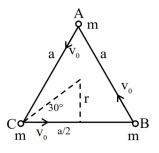
Three equal masses $m$ are kept at vertices (A, B, C) of an equilateral triangle of side $a$ in free space. At $t =0$, they are given an initial velocity $\vec{V}_A=V_0 \overrightarrow{A C}, \quad \vec{V}_B=V_0 \overrightarrow{B A}$ and $\vec{V}_C=V_0 \overrightarrow{C B}$.
Here, $\overrightarrow{ AC }, \overrightarrow{ CB }$ and $\overrightarrow{ BA }$ are unit vectors along the edges of the triangle. If the three masses interact gravitationally, then the magnitude of the net angular momentum of the system at the point of collision is :
  • A
    $\frac{1}{2} amV _0$
  • B
    $3 am V _0$
  • $\frac{\sqrt{3}}{2} amV _0$
  • D
    $\frac{3}{2} am V _0$
Answer
Correct option: C.
$\frac{\sqrt{3}}{2} amV _0$
(C) $\frac{\sqrt{3}}{2} amV _0$
Sol.
Image
$\begin{array}{l}\tan 30^{\circ}=\frac{2 r}{a}=\frac{1}{\sqrt{3}} \\ r=\frac{a}{2 \sqrt{3}} \\ L=\left( mvr _{\perp}\right) \times 3 \\ = mv _0 \frac{ a }{2 \sqrt{3}} \times 3 \\ =\frac{\sqrt{3}}{2} mv _0 a \end{array}$
View full question & answer
MCQ 74 Marks
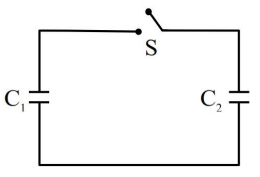
A capacitor, $C _1=6 F$ is charged to a potential difference of $V _0=5 V$ using a 5 V battery. The battery is removed and another capacitor, $C _2=12$ $\mu F$ is inserted in place of the battery. When the switch ' S ' is closed, the charge flows between the capacitors for some time until equilibrium condition is reached. What are the charges $\left(q_1\right.$ and $q_2$ ) on the capacitors $C _1$ and $C _2$ when equilibrium condition is reached.
Image
  • A
    $q_1=15 \mu C , q _2=30 \mu C$
  • B
    $q _1=30 \mu C , q _2=15 \mu C$
  • $q _1=10 \mu C , q _2=20 \mu C$
  • D
    $q_1=20 \mu C , q _2=10 \mu C$
Answer
Correct option: C.
$q _1=10 \mu C , q _2=20 \mu C$
(C) $q _1=10 \mu C , q _2=20 \mu C$
Sol.
Image

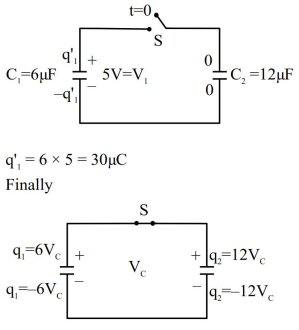
$\begin{array}{l}6 V_{ c }+12 V_{ c }=30+0 \\ 18 V_{ c }=30 \\ V_{ C }=\frac{30}{18}=\frac{5}{3} Volt \\ \Rightarrow q _1=\frac{6 \times 5}{3}=10 \mu C \\ \Rightarrow q _2=\frac{12 \times 5}{3}=20 \mu C \end{array}$
View full question & answer
MCQ 84 Marks
A convex lens mode of glass (refractive index $=$ 1.5) has focal length 24 cm in air. When it is totally immersed in water (refractive index $=1.33$ ), its focal length changes to
  • A
    72 cm
  • 96 cm
  • C
    24 cm
  • D
    48 cm
Answer
Correct option: B.
96 cm
(B) 96 cm
Sol.
$
\begin{array}{l}
\frac{1}{8}=\left(\frac{\mu_e}{\mu_{s}}-1\right)\left[\frac{1}{R_1}-\frac{1}{R_2}\right] \\
\frac{1}{24}=(1.5-1)\left[\frac{2}{R}\right] \\
\frac{1}{f^{\prime}}=\left(\frac{1.5}{1.33}-1\right)\left(\frac{2}{R}\right) \\
\frac{1}{f^{\prime}}=\left(\frac{1.5 \times 3}{4}-1\right) \frac{2}{R}
\end{array}
$
(i) divided by (ii)
$
\begin{array}{l}
\frac{f^{\prime}}{24}=4 \\
f^{\prime}=96 cm
\end{array}
$
View full question & answer
MCQ 94 Marks
A sand dropper drops sand of mass $m ( t )$ on a conveyer belt at a rate proportional to the square root of speed (v) of the belt, i.e. $\frac{d m}{d t} \propto \sqrt{ v }$. If P is the power delivered to run the belt at constant speed then which of the following relationship is true?
  • A
    $P ^2 \propto v ^3$
  • B
    $P \propto \sqrt{ v }$
  • C
    $P \propto V$
  • $P^2 \propto v^s$
Answer
Correct option: D.
$P^2 \propto v^s$
(D) $P^2 \propto v^s$
Sol.$\quad$ Power $=\overrightarrow{ F } \cdot \overrightarrow{ V }$
$
\begin{array}{l}
F=\frac{dp}{dt}[p=mv] \\
F=\left(\frac{dm}{dt}\right) v=C(\sqrt{v})_{v} \\
F=Cv^{\frac{3}{2}} \\
\text { Power }=C\left(v^{3 / 2}\right) v=Cv^{5 / 2} \\
p^2 \propto v^5
\end{array}
$
View full question & answer
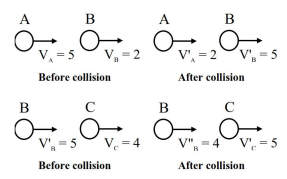
MCQ 104 Marks
  • A
    Both (A) and (R) are true but (R) is NOT the correct explanation of (A)
  • B
    (A) is true but (R) is false
  • C
    Both (A) and (R) are true and (R) is the correct explanation of (A).
  • (A) is false but $( R )$ is true
Answer
Correct option: D.
(A) is false but $( R )$ is true
(D) (A) is false but $( R )$ is true
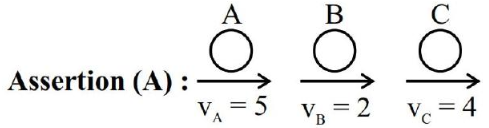
Sol. In elastic collision for same mass, velocities interchange
Image
$V _{ A }^{\prime}=2 m / s \quad V _{ B }^{\prime \prime}=4 m / s \quad V _{ C }^{\prime}=5 m / s$
View full question & answer
MCQ 114 Marks
Two bodies A and B of equal mass are suspended from two massless springs of spring constant $k _1$ and $k _2$, respectively. If the bodies oscillate vertically such that their amplitudes are equal, the ratio of the maximum velocity of A to the maximum velocity of $B$ is
  • $\sqrt{\frac{ k _1}{ k _2}}$
  • B
    $\frac{k_1}{k_2}$
  • C
    $\frac{ k _2}{ k _1}$
  • D
    $\sqrt{\frac{ k _2}{ k _1}}$
Answer
Correct option: A.
$\sqrt{\frac{ k _1}{ k _2}}$
(A) $\sqrt{\frac{ k _1}{ k _2}}$
$
\begin{array}{l}Sol.\
V_1=A_1 \omega_1 \\
V_2=A_2 \omega_2 \\
A_1=A_2 \\
\frac{V_1}{V_2}=\frac{\omega_1}{\omega_2}=\frac{\sqrt{\frac{K_1}{m}}}{\sqrt{\frac{K_2}{m}}} \\
\frac{V_1}{V_2}=\sqrt{\frac{K_1}{K_2}}
\end{array}
$
View full question & answer
MCQ 124 Marks
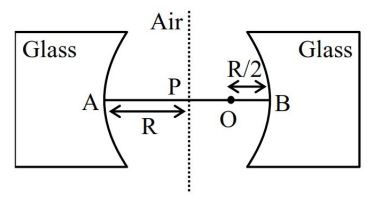
Image
Two concave refracting surfaces of equal radii of curvature and refractive index 1.5 face each other in air as shown in figure. A point object O is placed midway, between P and B. The separation between the images of O , formed by each refracting surface is :
  • A
    0.214 R
  • 0.114 R
  • C
    0.411 R
  • D
    0.124 R
Answer
Correct option: B.
0.114 R
(B) 0.114 R
Sol. For B
$
\begin{array}{l}
\frac{\mu_2}{V}-\frac{\mu_1}{u}=\frac{\mu_2-\mu_1}{R} \\
\frac{1.5}{V}+\frac{1}{\frac{R}{2}}=\frac{0.5}{-R} \\
\frac{1.5}{V}=-\frac{1}{2 R}-\frac{2}{R} \\
\frac{1.5}{V}=\frac{-5}{2 R} \Rightarrow V_{B}=-0.6 R
\end{array}
$
For A
$
\begin{array}{l}
\frac{1.5}{V}+\frac{2}{3 R}=\frac{0.5}{-R} \\
\frac{1.5}{V}=-\frac{1}{2 R}-\frac{2}{3 R} \\
\frac{1.5}{V}=-\frac{7}{6 R} \\
V_{A}=-\frac{9}{7} R
\end{array}
$
Distance between images
$
=2 R-\left(0.6 R+\frac{9}{7} R\right)=0.114 R
$
View full question & answer
MCQ 134 Marks
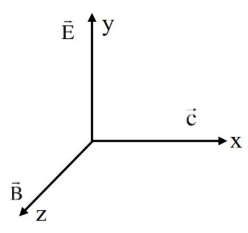
A plane electromagnetic wave propagates along the $+x$ direction in free space. The components of the electric field, $\vec{E}$ and magnetic field, $\vec{B}$ vectors associated with the wave in Cartesian frame are :
  • A
    $E _{ y }, B _{ x }$
  • $E _y, B_z$
  • C
    $E _x, B_y$
  • D
    $E _z, B_y$
Answer
Correct option: B.
$E _y, B_z$
(B) $E _y, B_z$
Sol.
Image

Direction of propogation
$
=\overrightarrow{E} \times \overrightarrow{B}
$
View full question & answer
MCQ 144 Marks
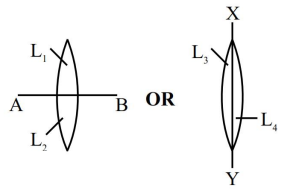
Two identical symmetric double convex lenses of focal length $f$ are cut into two equal parts $L _1, L_2$ by $A B$ plane and $L_3, L_4$ by $X Y$ plane as shown in figure respectively. The ratio of focal lengths of lenses $L_1$ and $L_3$ is
Image
  • A
    $1: 4$
  • B
    $1: 1$
  • C
    $2: 1$
  • $1: 2$
Answer
Correct option: D.
$1: 2$
(D) $1: 2$
$
\begin{array}{l}Sol.
f_{L_1}=f_{L_2}=f \\
f_{L_3}=f_{L_4}=2 f \\
\therefore f_{L_1}: f_{L_3}=1: 2
\end{array}
$
View full question & answer
MCQ 154 Marks
Sol.
Image
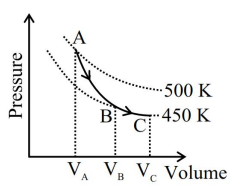
A poly-atomic molecule $\left( C _{ V }=3 R , C _{ p }=4 R\right.$, where $R$ is gas constant) goes from phase space point $A \left( P _{ A }=10^4 Pa, V _{ A }=4 \times 10^{-3} m^3\right)$ to point $B \left( P _{ B }=5\right.$ $\left.\times 10^4 Pa, V _{ B }=6 \times 10^{-6} m^3\right)$ to point $C \left( P _{ C }=10^4 Pa\right.$, $V _{ c }=8 \times 10^{-6} m^3$ ). A to B is an adiabatic path and B to C is an isothermal path.
The net heat absorbed per unit mole by the system is :
  • A
    $500 R (\ln 3+\ln 4)$
  • $450 R (\ln 4-\ln 3)$
  • C
    $500 R \ln 2$
  • D
    $400 R \ln 4$
Answer
Correct option: B.
$450 R (\ln 4-\ln 3)$
(B) $450 R (\ln 4-\ln 3)$
$
\begin{array}{l}Sol.\
\Delta Q_{A B}=0 \text { adiabatic } \\
\Delta Q_{BC}=\Delta W_{BC} \\
=nRT \ell n\left(\frac{V_{C}}{V_{B}}\right)=450 R \ell n\left(\frac{8 \times 10^{-6}}{6 \times 10^{-6}}\right) \\
=450 R \ell n\left(\frac{4}{3}\right)=450 R(\ell n 4-\ell n 3) \\
\therefore \Delta Q=\Delta Q_{AB}+\Delta Q_{BC} \\
\Delta Q=450 R(\ell n 4-\ell n 3)
\end{array}
$
Note : Solution is based on direct data. B and C are not satisfying the condition of isothermal process.
View full question & answer
MCQ 164 Marks
A point charge causes an electric flux of $-2 \times 10^4$ $Nm ^2 C ^{-1}$ to pass through a spherical Gaussian surface of 8.0 cm radius, centred on the charge. The value of the point charge is :
(Given $\in_0=8.85 \times 10^{-12} C ^2 N^{-1} m^{-2}$ )
  • $-17.7 \times 10^3 C$
  • B
    $-15.7 \times 10^{-8} C$
  • C
    $17.7 \times 10^{-8} C$
  • D
    $15.7 \times 10^{-8} C$
Answer
Correct option: A.
$-17.7 \times 10^3 C$
(A) $-17.7 \times 10^3 C$
$
\begin{array}{l}Sol.\
\phi=-2 \times 10^4 \frac{Nm^2}{C} \\
r=8.0 cm \\
\phi=\frac{q}{\in_0} \Rightarrow q=\in_0 \phi \\
=\left(8.85 \times 10^{-12}\right) \times\left(-2 \times 10^4\right) \\
q=-17.7 \times 10^{-8} C
\end{array}
$
View full question & answer
MCQ 174 Marks
In an experiment with photoelectric effect, the stopping potential.
  • A
    increases with increase in the wavelength of the incident light
  • B
    increases with increase in the intensity of the incident light
  • is $\left(\frac{1}{e}\right)$ times the maximum kinetic energy of the emitted photoelectrons
  • D
    decreases with increase in the intensity of the incident light
Answer
Correct option: C.
is $\left(\frac{1}{e}\right)$ times the maximum kinetic energy of the emitted photoelectrons
(C) is $\left(\frac{1}{e}\right)$ times the maximum kinetic energy of the emitted photoelectrons
Sol.
$\begin{aligned} \frac{ hC }{\lambda} & = W + eV _{ s } \\ \frac{ hC }{\lambda} & = W +\left( K _{\max }\right) \\ \therefore V _{ s } & =\frac{ K _{\max }}{ e }\end{aligned}$
View full question & answer
MCQ 184 Marks
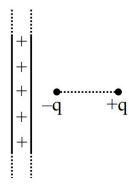
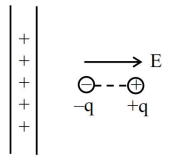
An electric dipole is placed at a distance of 2 cm from an infinite plane sheet having positive charge density $\sigma_0$. Choose the correct option from the following.
Image
  • A
    Torque on dipole is zero and net force is directed away from the sheet.
  • B
    Torque on dipole is zero and net force acts towards the sheet.
  • Potential energy of dipole is minimum and torque is zero.
  • D
    Potential energy and torque both are maximum
Answer
Correct option: C.
Potential energy of dipole is minimum and torque is zero.
(C) Potential energy of dipole is minimum and torque is zero.
Sol.
Image
$
\begin{array}{l}
\text { Here } E=\frac{\sigma}{2 \in_0}, \vec{\tau}=\overrightarrow{P} \times \overrightarrow{E} \\
\vec{\tau}=0 \\
U=-\overrightarrow{P} \cdot \overrightarrow{E} \quad U \rightarrow \text { minimum }
\end{array}
$
View full question & answer
MCQ 194 Marks
Given below are two statements. One is labelled as Assertion (A) and the other is labelled as Reason (R).
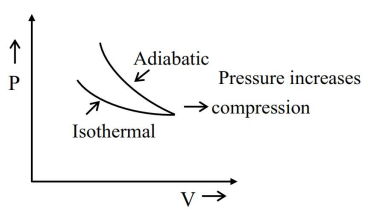
Assertion (A) : With the increase in the pressure of an ideal gas, the volume falls off more rapidly in an isothermal process in comparison to the adiabatic process.
Reason (R) : In isothermal process, $PV =$ constant, while in adiabatic process $PV ^\gamma=$ constant. Here $\gamma$ is the ratio of specific heats, P is the pressure and V is the volume of the ideal gas.
In the light of the above statements, choose the correct answer from the options given below :
  • A
    Both (A) and (R) are true but (R) is NOT the correct explanation of (A)
  • B
    (A) is true but (R) is false
  • Both (A) and (R) are true and (R) is the correct explanation of (A).
  • D
    (A) is false but (R) is true
Answer
Correct option: C.
Both (A) and (R) are true and (R) is the correct explanation of (A).
(C) Both (A) and (R) are true and (R) is the correct explanation of (A).
Sol.
Image
$\left(\frac{ dP }{ dV }\right)_{\text {Adsiatic: }}>\left(\frac{ dP }{ dV }\right)_{\text {Ischacmel }}$
View full question & answer
MCQ 204 Marks
The difference of temperature in a material can convert heat energy into electrical energy. To harvest the heat energy, the material should have
  • A
    low thermal conductivity and low electrical conductivity
  • B
    high thermal conductivity and high electrical conductivity
  • low thermal conductivity and high electrical conductivity
  • D
    high thermal conductivity and low electrical conductivity
Answer
Correct option: C.
low thermal conductivity and high electrical conductivity
(C) low thermal conductivity and high electrical conductivity
Sol. See-back effect
Low thermal conductivity
High electrical conductivity
View full question & answer