Questions

(Each question 2 marks)

Take a timed test

58 questions · self-marked practice — reveal the answer and mark yourself.

Question 12 Marks
Classify the following pairs of lines as coincident, parallel or intersecting: 2x + y - 1 = 0 and 3x + 2y + 5 = 0
Answer
2x + y - 1 = 0, 3x + 2y + 5 = 0 Writing equation in the form y = mx + c $\text{y}=-2\text{x}+1, \ \text{y}=\frac{-3}{2}\text{x}-\frac{5}{2}$ $\Rightarrow\text{m}=-2, \ \text{m}'=\frac{-3}{2}$ $\text{m}\not=\text{m}',\text{m}_1\text{m}_2\not=-1$ ⇒ The lines are intersecting
View full question & answer
Question 22 Marks
Find the equation of a straight line: with slope $\frac{-1}{3}$ and y-intercept -4.
Answer
with slope $\frac{-1}{3}$ and y-intercept = (0, -4) $\text{m}=\frac{-1}{3},\text{c}=-4$ The required equation of line is y = mx + c $\Rightarrow\text{y}=\frac{-1}{3}\text{x}-4$ $\Rightarrow3\text{y}+\text{x}=-12$
View full question & answer
Question 32 Marks
Find the equation of a line passing through (3, -2) and perpendicular to the line x - 3y + 5 = 0.
Answer
Any equation passing through (3, -2) and perpendicular to given line is $\text{y}-\text{y}_1=-\frac{1}{\text{m}}(\text{x}-\text{x}_1) \ ...(1)$ where $(x_1 - y_1)$ is (3, -2) and m is slope of line. $\frac{-1}{\text{m}}$ is taken as lines are perpendicular Finding slope of line x - 3y + 5 = 0 $3\text{y}=\text{x}+5$ $\text{y}=\frac{\text{x}}{3}+\frac{5}{3}$ $\Rightarrow\text{m}=\frac{1}{3}$ Substituting the value of m and $(x_1 - y_1​​​​​​​)$ in (1) $\text{y}-(-2)=-\frac{1}{\frac{1}{3}}(\text{x}-3)$ $\text{y}+2=-3(\text{x}-3)=-3\text{x}+9$ $3\text{x}+\text{y}=7$
View full question & answer
Question 42 Marks
Find the equation of a line making an angle of 150° with the x-axis and cutting off an intercept 2 from y-axis.
Answer
The equation of the line having slope m and y-intercept (0, c) is given by: y = mx + c Now, $\text{m}=\tan(150^\circ)=\frac{-1}{\sqrt{3}}$ and y-intercept (0, 2) The required equation of line is y = mx + c $\Rightarrow\text{y}=\frac{\text{-x}}{\sqrt{3}}+2$ $\Rightarrow\sqrt{3\text{y}}-2\sqrt{3}+\text{x}=0$ $\Rightarrow\text{x}+\sqrt{3\text{y}}=2\sqrt{3}$
View full question & answer
Question 52 Marks
Find the equation of the straight line intersecting y-axis at a distance of 2 units above the origin and making an angle of 30° with the positive direction of the x-axis.
Answer
The required equation of line is $y - y_1 = m(x - x_1)$ where $\text{m}=\tan30^\circ=\frac{1}{\sqrt{3}}$ point is $(x_1y_1)$ = (0, 2) $\Rightarrow\text{y}-2=\frac{1}{\sqrt{3}}(\text{x}-0)$ $\text{x}-\sqrt{3}\text{y}+2\sqrt{3}=0$
View full question & answer
Question 62 Marks
A quadrilateral has vertices (4, 1), (1, 7), (-6, 0) and (-1, -9). Show that the mid-points of the sides of this quadrilateral form a parallelogram.
Answer
Let A(4, 1), B(1, 7), C(-6, 0) and D(-1, -9) be the vertices of the given quadrilateral. Let P, Q, R and S be the mid points of AB, BC, CD, and DA respectively. So, the cocrdinate of P, Q, R and S are $\text{p}\Big(\frac{5}{2},4\Big),\ \text{Q}\Big(\frac{-5}{2},\frac{7}{2}\Big),\text{R}\Big(\frac{-7}{2},\frac{-9}{2}\Big)$ and $\text{S}\Big(\frac{3}{2},-4\Big).$ In order to prove that PQRS is a parallelogram, it is sufficient to show that PQ is parallel to RS and PQ is equal to RS Now, we have, Slope of $\text{PQ}=\frac{\frac{7}{2}-4}{\frac{-5}{2}-\frac{5}{2}}=\frac{1}{10}$ Slope of $\text{RS}=\frac{-4+\frac{9}{2}}{\frac{3}{2}+\frac{7}{2}}=\frac{1}{10}$ Clearly, slope of PQ= Slope of RS Therefore, $\text{PQ||RS}$ $\text{PQ}=\sqrt{\Big(-\frac{5}{2}-\frac{5}{2}\Big)^2+\Big(\frac{7}{2}-4\Big)^2}=\frac{\sqrt{101}}{2}$ $\text{RS}=\sqrt{\Big(\frac{3}{2}+\frac{7}{2}\Big)^2+\Big(-4+\frac{9}{2}\Big)^2}=\frac{\sqrt{101}}2{}$ Therefore, PQ = RS Thus, $\text{PQ||RS}$ and $\text{PQ||RS}$ Hence, the mid point of the sides of the given quadrilateral form a parallelogram.
View full question & answer
Question 72 Marks
Find the equation of a line for which: $\text{p}=8,\alpha=300^\circ$
Answer
$\text{P}=8,\ \alpha=300^\circ $$\text{x}\cos\alpha+\text{y}\sin\alpha=\text{P}$
$\Rightarrow\text{x}\cos300^\circ+\text{y}\sin300^\circ=8$
$\Rightarrow\text{x}\times\frac{1}{2}-\text{y}\times\frac{\sqrt3}{2}=8$
$\Rightarrow\text{x}-\sqrt{3\text{x}}=16$
View full question & answer
Question 82 Marks
Find the equation of a line for which: $\text{p}=5,\alpha=60^\circ$
Answer
$\text{p}=5,\ \alpha=60^\circ$$\text{x}\cos\alpha+\text{y}\sin\alpha=\text{p}$
$\Rightarrow\text{x}\cos60^\circ+\text{y}\sin60^\circ=5$
$\Rightarrow\text{x}\times\frac{1}{2}+\text{y}\times\frac{\sqrt3}{2}=5$
$\Rightarrow\text{x}+\sqrt{3\text{y}}=10$
View full question & answer
Question 92 Marks
Find the distance of the point $(4, 5)$ from the straight line $3x - 5y + 7 = 0$.
Answer
Distance of a point ($x_1, y_1$) from $ax + by + c = 0$ is $=\Big|\frac{\text{ax}_1+\text{by}_1+\text{c}}{\sqrt{\text{a}^2+\text{b}^2}}\Big|$
​​​​​​​Here, $a = 3, b = -5, c = 7, x_1 = 4, y_1 = 5 \therefore$ Distance $\Big|\frac{3(4)-5(5)+7}{\sqrt{3^2+5^2}}\Big|$ $\Big|\frac{12-25+7}{\sqrt{9+25}}\Big|=\Big|\frac{6}{\sqrt{34}}\Big|\text{units}.$
View full question & answer
Question 102 Marks
Prove that the points (-4, -1), (-2, -4), (4, 0) and (2, 3) are the vertices of a rectangle.
Answer
Here A(-4, -1), B(-2, -4), C(4, 0) and D(2, 3) Slope of $\text{AB}=\frac{\text{y}_2-\text{y}_1}{\text{x}_2-\text{x}_1}=\frac{-4+1}{-2+4}$ $\text{M}_{\text{AB}}=\frac{-3}{2}$ Slope of $\text{BC}=\frac{3+1}{2+4}$ $\text{M}_\text{BC}=\frac{2}{3}$ Slope of $\text{AD}=\frac{3+1}{2+4}$ $\text{M}_\text{AD}=\frac{2}{3}$ Slope of $\text{CD}=\frac{3-0}{2-4}$ $\text{M}_\text{CD}=\frac{-3}{2}$ $\Rightarrow\text{M}_\text{AB}=\text{M}_\text{CD}$ and $\text{M}_\text{BC}=\text{M}_\text{AD}$ $\Rightarrow\text{AB}||\text{CD}$ and $\text{BC}||\text{AD}$ $\text{M}_\text{AB}\times\text{M}_\text{BC}=\frac{-3}{2}\times\frac{2}{3}$ $\text{M}_\text{AB}\times\text{M}_\text{BC}=-1$ $\text{AB}\bot\text{BC}$ $\text{M}_\text{BC}\times\text{M}_\text{CD}=\frac{2}{3}\times\frac{-3}{2}$ $\text{M}_\text{BC}\times\text{M}_\text{CD}=-1$ $\Rightarrow\text{BC}\bot\text{CD}$ Thus, $\text{AB}||\text{CD}$ and $\text{BC}||\text{AD}$ $\text{AB}\bot\text{BC}, \ \text{BC}\bot\text{CD}, \ \text{CD}\bot\text{DA}$ ⇒ ABCD is a rectangle
View full question & answer
Question 112 Marks
Find the equation of the line which passes through the point (-4, 3) and the portion of the line intercepted between the axes is divided internally in the ratio 5 : 3 by this point.
Answer
The equation of the given line is,$\frac{\text{x}}{\text{a}}+\frac{\text{y}}{\text{b}}=1$
It cuts the axes at A(a, 0) and B(0, b)
THe portion of AB intercepted between the axis is 5 : 3.
$\therefore\text{h}=\frac{3\times\text{a}+5\times0}{8}$ and $\text{k}=\frac{3\times0+5\times\text{b}}{8}$
$\Rightarrow\text{p}=\Big(\frac{3\text{a}}{8},\frac{5\text{b}}{8}\Big)$
The line is passing through the point (-4, 3)
$\Rightarrow\frac{3\text{a}}{8}=-4\ \frac{5\text{b}}{8}=3$
$\Rightarrow\text{a}=\frac{-32}{3}\ \text{b}=\frac{24}{5}$
$\therefore$ The equation of the given line is,
$\frac{\text{x}}{\frac{-32}{3}}+\frac{\text{y}}{\frac{24}{5}}=1$
$\frac{-3\text{x}}{32}+\frac{\text{5y}}{24}=1$
$\text{9x}-\text{20y}+96=0$
View full question & answer
Question 122 Marks
Show that the line joining (2, -5) and (-2, 5) is perpendicular to the line joining (6, 3) and (1, 1).
Answer
Slope of line joining (2, -5) and (-2, 5) is $\text{m}_1\frac{5-(-5)}{-2-2}=\frac{-5}{2}$ Slope of line joining (6, 3) and (1, 1) $\text{m}_2=\frac{1-3}{1-6}=\frac{2}{5}$ $\text{m}_1\times\text{m}_2=\frac{-5}{2}\times\frac{2}{5}=-1$ $\therefore$ The two lines are perpendicular to each other.
View full question & answer
Question 132 Marks
Find the equation of a straight line:with slope -2 and intersecting the x-axis at a distance of 3 units to the left of origin.
Answer
$m=-2, c=-3$ The required equation of line is $y-y_1=m\left(x-x_1\right)$ Since the line cuts the $x$-axis at $(-3,0)$ with slope -2 , we have, $y-0=-2(x+3) \Rightarrow y=-2 x-6 \Rightarrow 2 x+y+6=0$
View full question & answer
Question 142 Marks
A straight line drawn through the point A (2, 1) making an angle $\frac{\pi}{4}$ with positive x-axis intersects another line x + 2y + 1 = 0 in the point B. Find length AB.
Answer
The equation of line is$\frac{\text{x}-2}{\cos\alpha}=\frac{\text{y}-1}{\sin\alpha}=\text{r}$
$\Rightarrow\frac{\text{x}-2}{\frac{1}{\sqrt2}}=\frac{\text{y}-1}{\frac{1}{\sqrt2}}=\text{r}$
or $\text{x}=\frac{1}{\sqrt2}\text{r}+2,\ \text{y}=\frac{1}{\sqrt2}\text{r}+1$
$\text{B}\Big(\frac{\text{r}}{\sqrt2}+2,\ \frac{\text{r}}{\sqrt2}+1\Big)$ lie on x + 2y + 1 = 0
$\therefore\frac{\text{r}}{\sqrt2}+2+\frac{2\text{r}}{\sqrt2}+2+1=0$
$\frac{3\text{r}}{\sqrt2}=\pm5$
$\text{r}=\frac{5\sqrt2}{3}$
The lenght of AB is $\frac{5\sqrt2}{3}$ units.
View full question & answer
Question 152 Marks
If the straight line through the point P (3, 4) makes an angle $\frac{\pi}{6}$ with the x-axis and meets the line 12x + 5y + 10 = 0 at Q, find the length PQ.
Answer
The equation of line is $\frac{\text{x}-3}{\cos\frac{\pi}{6}}=\frac{\text{y}-4}{\sin\frac{\pi}{6}}=\pm\text{r}$
or $\text{x}=\pm\frac{\sqrt3}{2}\text{r}+3$ and $\text{y}=\pm\frac{1}{2}\text{r}+4$
$\text{Q}\Big(\pm\frac{\sqrt3\text{r}}{2}+3,\ \pm\frac{\text{r}}{2}+4\Big)$ lie in $\text{12x}+\text{5y}+10=0$
$\therefore12\Bigg(\pm\frac{\sqrt3\text{r}}{2}+3\Bigg)+5\Big(\pm\frac{\text{r}}{2}+4 \Big)+10=0$
$\pm\frac{12\sqrt3\text{r}}{2}+36\pm\frac{5\text{r}}{2}+20+10=0$
$\text{r}=\frac{\pm132}{5+12\sqrt3}$
Hence, lenght PQ is $\frac{132}{12\sqrt3+5}$
View full question & answer
Question 162 Marks
Find the equation of the line parallel to x-axis and passing through (3, -5).
Answer
Let the equation of the line be: $\text{y}-\text{y}_1=\text{m}(\text{x}-\text{x}_1)$ Now, $\text{m}=0 \ [\because$ parallel lines have equal slopes, the slope of x axis is 0$]$ $(\text{x}_1,\text{y}_1)=(3,-5)$ $\therefore\text{y}-\text{y}_1=\text{m}(\text{x}-\text{x}_1)$ $\text{y}-(-5)=0(\text{x}-3)$ $\text{y}+5=0$
View full question & answer
Question 172 Marks
Show that the line joining (2, -3) and (-5, 1) is parallel to the line joining (7, -1) and (0, 3).
Answer
Slope of line joining (2, -3) and (-5, 1) $\text{m}_1=\frac{1-(-3)}{-5-2}=\frac{4}{-7}$ Slope of the line joining (7, -1) and (0, 3) $\text{m}_2=\frac{3-(-1)}{0-7}=\frac{4}{-7}$ Since $m_1 = m_2$, the two lines are parallel.
View full question & answer
Question 182 Marks
What can be said regarding a line if its slope is:
  1. Zero.
  2. Positive.
  3. Negative?
Answer
  1. If the slope $=\tan\theta=0\Rightarrow\theta=0$
When the slope of line is zero then the line is parallel to x axis.
  1. If the slope is positive then $\tan\theta=$ positive $\Rightarrow\theta=$ acute
Thus the line makes an acute angle $\Big(0<\theta<\frac{\pi}{2}\Big)$ with the positive $\text{x}$ axis.
  1. When the slope is negative then $\tan\theta=$ negative $\Rightarrow\theta$ is obtuse
Thus the line makes an abtuse angle $\Big(\theta<\frac{\pi}{2}\Big)$with the positive x axis.
View full question & answer
Question 192 Marks
Find the equation of a line which is perpendicular to the line joining (4, 2) and (3, 5) and cuts off an intercept of length 3 on y-axis.
Answer
The required equation of line is y = mx + c Here, c = 3 Let m be the slope of the required line. Then, m × slope of given line = -1 Slope of given line $=\frac{\text{y}_2-\text{y}_1}{\text{x}_2-\text{x}_1}=\frac{5-2}{3-4}=\frac{3}{-1}=-3$ $\Rightarrow\text{m}=\frac{1}{3}$ So, the required equation is: y = mx + c $\text{y}=\frac{1}{3}\text{x}+3$ x - 3y + 9 = 0
View full question & answer
Question 202 Marks
Find the equation of the line perpendicular to x-axis and having intercept -2 on x-axis.
Answer
The slope of x-axis is 0, any line perpendicular to it will have slope $=\frac{-1}{0}$ Also the required line is passing through the point (-2, 0) (because it is given it has x intercept is -2) The required equation of line is $\text{y}-\text{y}_1=\text{m}(\text{x}-\text{x}_1)$ where $\text{m}=\frac{-1}{0},(\text{x}_1\text{y}_1)\Rightarrow(2,0)$ $\text{y}-0=\frac{-1}{0}\big(\text{x}-(-2)\big)$ $\text{y}-0=\frac{-1}{0}\big(\text{x}+2\big)$ $-(\text{x}+2)=0$ $\text{x}+2=0$ $\text{x}=-2$
View full question & answer
Question 212 Marks
Find the slope of a line:
  1. Which bisects the first quadrant angle.
  2. Which makes an angle of 30° with the positive direction of y-axis measured anticlockwise.
Answer
  1. Line bisects first quadrant.
⇒ Angle between line and positive direction of x axis $=\frac{90^\circ}{2}$
= 45°
Slope of line $(\text{m})=\tan\theta$
$\text{m}=\tan45^\circ$
$\text{m}=1$
  1. Line makes angle of 30° with the positive direction y axis.
= Angle between line and positive side of axis = 90° + 30°
$\theta^\circ=120^\circ$
$\text{m}=\tan120^\circ$
$\text{m}=-\sqrt3$
View full question & answer
Question 222 Marks
Reduce the equation $\sqrt{3}\text{x}+\text{y}+2=0$ to: The normal form and find p and $\alpha.$
Answer
Normal form $(\text{x}\cos\alpha+\text{y}\sin\alpha=\text{p})$$\sqrt3\text{x}+\text{y}+2=0$
$\Rightarrow-\sqrt3\text{x}-\text{y}=2$
$\Rightarrow\Big(\frac{-\sqrt3}{2}\Big)\text{x}+\Big(\frac{-1}{2}\Big)\text{y}=1 $
$\Rightarrow\cos\alpha=\frac{-\sqrt3}{2}=\cos210^\circ$ and $\sin\alpha=\frac{-1}{2}=\sin210^\circ$
$\Rightarrow\text{p}=1,\ \alpha=210^\circ$
View full question & answer
Question 232 Marks
Reduce the following equations to the normal form and find p and $\alpha$ in each case: $\text{x}+\sqrt{3}\text{y}-4=0$
Answer
$\text{x}+\sqrt3\text{y}-4=0$Divide the equation by 2, we get
$\frac{1}{2}\text{x}+\frac{\sqrt3}{2}\text{y}=2$
$\text{x}\cos60^\circ+\text{y}\sin60^\circ=2$
So, $\text{p}=2$ and $\omega=60^\circ$
View full question & answer
Question 242 Marks
Find the equations of the straight lines which pass through (4, 3) and are respectively parallel and perpendicular to the x-axis.
Answer
Slope of the line parallel to x-axis = 0 Since the line passes through (4, 3), The required equation of the line parallel to x-axis is $\text{y}-\text{y}_1=\text{m}(\text{x}-\text{x}_1)$ $\text{y}-(3)=0(\text{x}-4)$ $\text{y}-3=0$ $\text{y}=3$Slope of the line parallel to x-axis $=\frac{-1}{0}$
The required equation line perpendicular to x-axis is $\text{y}-\text{y}_1=\text{m}(\text{x}-\text{x}_1)$$\text{y}-3=\frac{-1}{0}(\text{x}-4)$
$\text{x}-4=0$$\text{x}=4$
View full question & answer
Question 252 Marks
A line a drawn through A (4, -1) parallel to the line 3x - 4y + 1 = 0. Find the coordinates of the two points on this line which are at a distance of 5 units from A.
Answer
The required line is parallel to 3x - 4y + 1 = 0 $\therefore$ Slope of the line = Slope of $3\text{x}-\text{4y}+1=\frac{-3}{-4}$ $\tan\alpha=\frac{3}{4}$ $\Rightarrow\sin\alpha=\frac{3}{5}$ and $\cos\alpha=\frac{4}{5}$ The equation of line is $\frac{\text{x}+4}{\cos\alpha}+\frac{\text{y}+1}{\sin\alpha}=\text{r}$ $\Rightarrow\frac{\text{x}-4}{\frac{4}{5}}+\frac{\text{y}+1}{\frac{3}{5}}=\pm5$ $\Rightarrow\ \text{x}=8$ and $\text{y}=2$ or $\text{x}=0$ and $\text{y}=-4$ $\therefore$ (8, 2) and (0, -4) are coordinates of two points on the line which are at a distance of 5 units from (4, 1)
View full question & answer
Question 262 Marks
What is the value of y so that the line through (3, y) and (2, 7) is parallel to the line through (-1, 4) and (0, 6)?
Answer
Slope of the line joining (-1, 4) and (0, 6) is $\text{m}_1=\frac{6-4}{0-(-1)}=2$ Slope of the line joining (3, y) and (2, 7) is $\text{m}_2=\frac{7-\text{y}}{2-3}=\text{y}-7$ Since the two lines are parallel $m_1 = m_2 \Rightarrow 2 = y - 7 \Rightarrow y = 9$
View full question & answer
Question 272 Marks
A line passes through a point A (1, 2) and makes an angle of 60° with the x-axis and intersects the line x + y = 6 at the point P. Find AP.
Answer
The equation of line throughn (1, 2) and making an angle 60° with the x axis is $\frac{\text{x}-1}{\cos60^\circ}=\frac{\text{y}-2}{\sin60^\circ}=\text{r}$ $\frac{\text{x}-1}{\frac{1}{2}}=\frac{\text{y}-2}{\frac{\sqrt3}{2}}=\text{r}$ Where are is the distance of any point on the line from A(1, 2). The coordinates of P on the line are $\Big(1+\frac{1}{2}\text{r},\ 2+\frac{\sqrt3}{2}\text{r}\Big)$ and P lies on x + y = 6 $\therefore1+\frac{\text{r}}{2}+2+\frac{{\sqrt3}\text{r}}{2}=6$ or $\text{r}=\frac{6}{1+\sqrt3}=3(\sqrt3-1)$ Hence lenght AP $=3(\sqrt3-1)$
View full question & answer
Question 282 Marks
For what values of a and b the intercepts cut off on the coordinate axes by the line ax + by + 8 = 0 are equal in length but opposite in signs to those cut off by the line 2x - 3y + 6 = 0 on the axes.
Answer
The equation of given line is,$\text{ax}+\text{by}+8=0$
$\Rightarrow-\frac{\text{x}}{\frac{8}{\text{a}}}-\frac{\text{y}}{\frac{8}{\text{b}}}=1$
It cuts the axes at $\text{A}\Big(\frac{-8}{\text{a}},0\Big)$ and $\text{B}\Big(0,\frac{-8}{\text{b}}\Big).$
The equation of given line is.
$\text{2x}-\text{3y}+6=0$
$\Rightarrow\frac{-\text{x}}{3}+\frac{\text{y}}{2}=1$
It cuts the axes at C(-3, 0) and D(0, 2).
The intercepts of both the lines are opposite in sign
$\Rightarrow\Big(\frac{-8}{\text{a}},0\Big)=-(-3,0)$and $\Big(0,\frac{-8}{\text{b}}\Big)=-(0,2)$
$\Rightarrow\frac{-8}{\text{a}}=3$ and $\frac{-8}{\text{b}}=-2$
$\Rightarrow\text{a}=\frac{-8}{3}$ and $\text{b}=4$
View full question & answer
Question 292 Marks
Find the equation of a line for which: $\text{p}=4,\alpha=150^\circ$
Answer
$\text{P}=4,\ \alpha=150^\circ$$\text{x}\cos\alpha+\text{y}\sin\alpha=\text{P}$
$\Rightarrow\text{x}\cos150^\circ+\text{y}\sin150^\circ=4$
$\Rightarrow-\text{x}\times\frac{\sqrt3}{2}+\text{y}\times\frac{1}{2}=4$
$\Rightarrow-\sqrt{3\text{x}}+\text{y}=8$
View full question & answer
Question 302 Marks
Find the equation of a line passing through the point (2, 3) and parallel to the line 3x - 4y + 5 = 0.
Answer
Equation of a line through (2, 3) is $y - y_1 = m(x - x_1)$ ...(1) $(2, 3)$ is $(x_1y_1)$ Since the line is parallel to 3x - 4y + 5 = 0 ⇒ The slope will be equal Slope of 3x - 4y + 5 = 0 $4\text{y} = 3\text{x} + 5$ $\text{y}=\frac{3}{4}\text{x}+\frac{5}{4}$ $\Rightarrow\text{m}=\frac{3}{4}$ Substituting m and ($x_1y_1$) is (1) $\text{y}-3=\frac{3}{4}(\text{x}-2)$ $4\text{y} -12= 3\text{x} -6$ $3\text{x}-4\text{y} =-12+6=-6$ $3\text{x}-4\text{y}+6=0$
View full question & answer
Question 312 Marks
The equation of the line that passes through $P (x_1, y_1)$ and makes an angle of $\theta$ with the x-axis is $\frac{\text{x}-\text{x}_1}{\cos\theta}=\frac{\text{y}-\text{y}_1}{\sin\theta}.$
Answer
The equation of line is$\frac{\text{x}-\text{x}_1}{\cos\theta}=\frac{\text{y}-\text{y}_1}{\sin\theta}=\pm\text{r}$
or
$\text{x}=\text{x}_1\pm\text{r}\cos\theta$ and $\text{y}-\text{y}_1=\pm\text{r}\sin\theta$
$\text{Q}(\text{x}_1\pm\text{r}\cos\theta,\ \text{y}_1\pm\text{r}\sin\theta)$ lie in $\text{ax}+\text{by}+\text{c}=0$
$\Rightarrow\ \text{a}(\text{x}_1+\text{r}\cos\theta)+\text{b}(\text{y}_1\pm\text{r}\sin\theta)+\text{c}=0$
$\Rightarrow\ \pm\text{r}(\text{a}\cos\theta+\text{b}\sin\theta)=-\text{c}-\text{ax}_1-\text{by}_1$
$ \Rightarrow\ -\text{r}=\Big|\frac{\text{ax}_1+\text{by}_1+\text{c}}{\text{a}\cos\theta+\text{b}\sin\theta}\Big|$
View full question & answer
Question 322 Marks
Find the equation of a line that has y-intercept -4 and is parallel to the line joining (2, -5) and (1, 2).
Answer
Here, y intercept, c = -4 The required line is parallel to line joining (2, -5) and (1, 2) Let m be the slope of the required line, then m = slope of (2, -5) and (1, 2) $\text{m}=\frac{\text{y}_2-\text{y}_1}{\text{x}_2-\text{x}_1}=\frac{2-(-5)}{1-2}=\frac{7}{-1}=-7$ $\therefore$ the required equation of line is y = mx + c y = -7x - 4 7x + y + 4 = 0
View full question & answer
Question 332 Marks
Find the equation of the line parallel to x-axis and having intercept -2 on y-axis.
Answer
The slope of x-axis is 0Any line parallel to x axis will also have the same slope.
therefore m = 0
Also line has y intercept, ie (a, b)
$\Rightarrow (0, -2) \Rightarrow (x_1y_1)$
The required equation of line is $\text{y}-\text{y}_1=\text{m}(\text{x}-\text{x}_1)$
$\text{y}-(-2)=0(\text{x}-0)$
$\text{y}+2=0$
$\text{y}=-2$
View full question & answer
Question 342 Marks
Find the equations of the bisectors of the angles between the coordinate axes.
Answer
The given lines are x = 0, y = 0. The equations of the bisectors of the angles between x = 0 and y = 0 are: $\frac{\text{x}}{\sqrt{(1)^2+(0)^2}}=\pm\frac{\text{y}}{\sqrt{(0)^2+(1)^2}}$ $\text{x}=\pm\text{y}$ $\text{x}\pm\text{y}=0$
View full question & answer
Question 352 Marks
Find the equation of a line which makes an angle of $tan^{-1} (3)$ with the x-axis and cuts off an intercept of 4 units on negative direction of y-axis.
Answer
$\theta=\tan^{-1}3\Rightarrow\text{m}=\tan\theta=3$ Intercept in negative direction of y-axis is (0, -4) Hence, required equation of line is y = mx + c ⇒ y = 3x - 4
View full question & answer
Question 362 Marks
If three points A(h, 0), P(a, b) and B(0, k) lie on a line, show that: $\frac{\text{a}}{\text{h}}+\frac{\text{b}}{\text{k}}=1.$
Answer
If 3 points lie on the line (i.e., they are collinear) lines joining this points have the same slope $\therefore$ slope of AP= slope of PB= slope of BA $\Rightarrow\frac{\text{b}-0}{\text{a}-\text{h}}=\frac{\text{k}-\text{b}}{0-\text{a}}=\frac{\text{k}-0}{0-\text{h}}...(\text{i})$ $\Rightarrow\frac{\text{k}-\text{b}}{0-\text{a}}=\frac{\text{k}-0}{0-\text{h}}$ $\Rightarrow-\text{kh}+\text{bh}=\text{-ka}$ $\Rightarrow-1+\frac{\text{b}}{\text{k}}=\frac{-\text{a}}{\text{h}}$ (dividing by kh) $\Rightarrow\frac{\text{a}}{\text{h}}+\frac{\text{b}}{\text{k}}=1$
View full question & answer
Question 372 Marks
Using the method of slope, show that the following points are collinear: A(4, 8), B(5, 12), C(9, 28)
Answer
A(4, 8), B(5, 12), C(9, 28) slope of $\text{AB}=\frac{12-8}{5-4}=\frac{4}{1}=4$ slope of $\text{BC}=\frac{28-12}{9-5}=\frac{16}{4}=4$ slope of $\text{CA}=\frac{8-28}{4-9}=\frac{-20}{-5}=4$ Since all 3 line segments have the same slope, they are parallel. Since they have a common point B, they are collinear.
View full question & answer
Question 382 Marks
Find the equation of the line which passes through the point (3, 4) and is such that the portion of it intercepted between the axes is divided by the point in the ratio 2 : 3.
Answer
Suppose P = (3, 4) divides the line joining the points A(a, 0) and B(0, b) in the ratio 2 : 3.Then,
$3=\frac{2(0)+3(\text{a})}{2+3}\Rightarrow3=\frac{3\text{a}}{5}\Rightarrow\text{a}=5$
$4=\frac{2(\text{b})+3(0)}{2+3}\Rightarrow4=\frac{2\text{b}}{5}\Rightarrow\text{b}=10$
$\therefore$ A is (5, 0), B is (0, 10)
Equation of AB is
$\frac{\text{x}}{5}+\frac{\text{y}}{10}=1$
$\text{2x}=\text{y}=10$
View full question & answer
Question 392 Marks
Find the equation of a straight line: with slope 2 and y-intercept 3;
Answer
with slope 2 and y-intercept 3 m = 2, point is (0, 3) The required equation of line is y = mx + c ⇒ y = 2x + 3
View full question & answer
Question 402 Marks
Find the equation of a line for which: $\text{p}=8,\alpha=225^\circ$
Answer
$\text{P}=8,\ \alpha=255^\circ$$\text{x}\cos\alpha+\text{y}\sin\alpha=\text{P}$
$\Rightarrow\text{x}\cos225^\circ+\text{y}\sin225^\circ=8$
$\Rightarrow-\text{x}\times\frac{1}{\sqrt2}-\text{y}\times\frac{1}{\sqrt2}=8$
$\Rightarrow\text{x}+\text{y}+8\sqrt2=0$
View full question & answer
Question 412 Marks
Prove that the lines $2x + 3y = 19$ and $2x + 3y + 7 = 0$ are equidistant from the line $2x + 3y = 6$.
Answer
Since the coefficient of x and y in the equation 2x + 3y - 19 = 0, 2x + 3y + 7 = 0 and 2x + 3y - 6 = 0 are same, therefore all the times are parallel. Distance between parallel lines is $\text{d}=\Big|\frac{\text{c}_2-\text{c}_1}{\sqrt{\text{a}_2+\text{b}_2}}\Big|,$ where ax + by + $c_1 = 0$ and ax + by + $c_2 = 0$ are the lines parallel to each other. Distance between the lines 2x + 3y - 19 = 0 and 2x + 3y - 6 = 0 is $\text{d}_1=\Big|\frac{-19+6}{\sqrt{2^2+3^2}}\Big|=\Big|\frac{13}{\sqrt{13}}\Big|={\sqrt{13}}$ Distance between the lines 2x + 3y + 7 = 0 and 2x + 3y - 6 = 0 is $\text{d}_2=\Big|\frac{7+6}{\sqrt{2^2+3^2}}\Big|=\Big|\frac{13}{\sqrt{13}}\Big|={\sqrt{13}}$ Since the distance of both the lines 2x + 3y + 7 = 0 and 2x + 3y - 19 = 0 from the line 2x + 3y - 6 = 0 are equal, therefore the lines are equidistant.
View full question & answer
Question 422 Marks
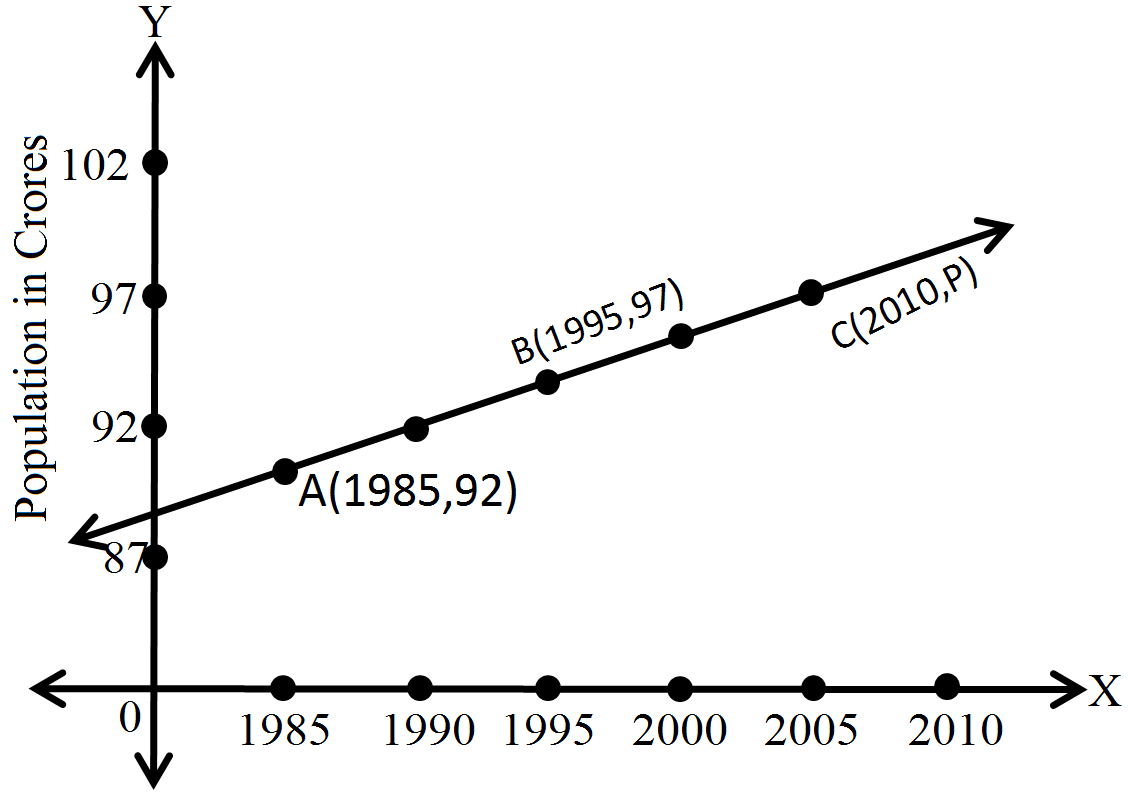
Consider the following population and year graph: Find the slope of the line AB and using it, find what will be the population in the year 2010.
Answer
Slope of $\text{AB}=\frac{97-92}{1995-1985}=\frac{5}{10}=\frac{1}{2}$ Population (p) in 2010 can be calaulated using the slope of AC. Slope of $\text{AC}=\frac{\text{p}-92}{2010-1985}=\frac{\text{p}-92}{25}=\frac{1}{2}=$ Slope of AB $\Rightarrow\text{p}-92=\frac{25}{2}$ $\Rightarrow\text{2p}-184=25$ $\Rightarrow\text{2p}=209$ $\Rightarrow\text{p}=\frac{209}{2}$ $\therefore$ P = 104.59 crores.
View full question & answer
Question 432 Marks
Find the equation of two straight lines which are parallel to x + 7y + 2 = 0 and at unit distance from the point (1, -1).
Answer
Let the required equation be y = mx + c where m is slpoe of the line which is equal to slpoe of x + 7y + 2 = 0 $\Big(\text{i.e}\frac{-1}{7}\Big)$ as the two lines are parallel. $\therefore$ The required equation is $\text{y}=\frac{-1}{7}\text{x}+\text{c}$ which is a unit distance from (1, 1). $\therefore \ \Big|\frac{7(1)+(1)-7\text{c}}{\sqrt{49+1}}\Big|=1$ $8-7\text{c}=\sqrt{50}$ $64+49\text{c}^2-112\text{c}=50$ $49\text{c}^2-112\text{c}-14=0$ $7\text{c}^2-16\text{c}-2=0$ $\text{c}=\frac{6\pm5\sqrt{2}}{7} \ \Big[\text{using}\frac{-\text{b}\pm\sqrt{\text{b}^2-4\text{ac}}}{2\text{a}}\Big]$ $\therefore$ The required equation is. $\text{y}=\frac{-1}{7}\text{x}+\frac{6\pm5\sqrt{2}}{7}$ or $7\text{y}+\text{x}+6\pm5\sqrt{2}=0$
View full question & answer
Question 442 Marks
Find the distance of the point (2, 3) from the line 2x - 3y + 9 = 0 measured along a line making an angle of 45° with the x-axis.
Answer
Equation of line is $\frac{\text{x}-2}{\cos45^\circ}=\frac{\text{y}-3}{\sin45^\circ}=\text{r}$
$\text{x}=\frac{\text{r}}{\sqrt2}+2$ and $\text{y}=\frac{\text{r}}{\sqrt2}+3$
$\text{P}\Big(\frac{\text{r}}{\sqrt2}+2,\ \frac{\text{r}}{\sqrt2}+3\Big)$ lie on $2\text{x}-3\text{y}+9=0$
$\therefore2\Bigg(\frac{\text{r}+2\sqrt2}{\sqrt2}\Bigg)-3\Bigg(\frac{\text{r}+3\sqrt2}{\sqrt2}\Bigg)+9=0$
$\Rightarrow\ 2\text{r}+4\sqrt2-\text{3r}-9\sqrt2+9\sqrt2=0$
$\Rightarrow\ \text{r}=4\sqrt2$
$\therefore$ The point (2, 3) is at a distance of $4\sqrt2$ from $2\text{x}-3\text{y}+9=0$
View full question & answer
Question 452 Marks
Find the equation of the perpendicular to the line segment joining (4, 3) and (-1, 1) if it cuts off an intercept -3 from y-axis.
Answer
The required equation of line is y = mx + c Here, c = -3 Let m be the slope of the required line. Then, m × slope of given line = -1 Slope of given line joining (4, 3) and (-1, 1) $=\frac{\text{y}_2-\text{y}_1}{\text{x}_2-\text{x}_1}=\frac{1-3}{-1-4}=\frac{-2}{-5}=\frac{2}{5}$ $\Rightarrow\text{m}=-\frac{5}{2}$ So, the required equation is: y = mx + c $\text{y}=-\frac{5}{2}\text{x}-3$ $\text{y}+3=\frac{-5\text{x}}{2}$ $2\text{y}+5\text{x}+6=0$
View full question & answer
Question 462 Marks
Without using the distance formula, show that points (-2, -1), (4, 0), (3, 3) and (-3, 2) are the vertices of a parallelogram.
Answer
Let A(-2, -1), B(4, 0), C(3, 3) and D(-3, 2) be a quadrilateral. slope of $\text{AB}=\frac{0-(-1)}{4-(-2)}=\frac{1}{6}$ slope of $\text{BC}=\frac{3-0}{3-4}=-3$ slope of $\text{CD}=\frac{3-2}{3-(-3)}=\frac{1}{6}$ slope of $\text{DA}=\frac{2-(-1)}{-3-(-2)}=-3$ we observe that the slope of opposite side of the quadrilateral ABCD are equal. Hence the quadrilateral ABCD is a parallelogram.
View full question & answer
Question 472 Marks
By using the concept of equation of a line, prove that the three points (-2, -2), (8, 2) and (3, 0) are collinear.
Answer
The equation of line passing through the points (-2, -2) and (8, 2) is$\text{y}+2=\frac{2+2}{8+2}(\text{x}+2)$
$2\text{x}-5\text{y}-6=0$
Clearly, (3, 0) satisfies the equation which means that the line passing through (-2, -2) and (8, 2)also passes through (3, 0)
Hence three points are collinear.
View full question & answer
Question 482 Marks
A straight line passes through the point $(\alpha, \ \beta)$ and this point bisects the portion of the line intercepted between the axes. Show that the equation of the straight line is $\frac{\text{x}}{2\alpha}+\frac{\text{y}}{2\beta}=1.$
Answer
The line intercepted by the axes are (a, 0) and (0, b), if this line segment is bisected at point $(\alpha, \ \beta)$ then $\frac{\text{a}+0}{2}=\alpha,\frac{0+\text{y}}{2}=\beta$ (using mid point formula) $\text{a}=2\alpha,\text{b}=2\beta$ The equation of straight line in the intercept form is $\frac{\text{x}}{\text{a}}+\frac{\text{y}}{\text{b}}=1$$\frac{\text{x}}{2\alpha}+\frac{\text{y}}{2\beta}=1$
View full question & answer
Question 492 Marks
Find the equations of the straight lines which cut off an intercept 5 from the y-axis and are equally inclined to the axes.
Answer
If a line is equally inclined to axis, then $\theta=45^\circ$ or $\theta=135^\circ\Rightarrow\text{m}=\tan\theta=\pm1$ Since, y intercept, c = 5 $\therefore$ we get the solution of the line as: y = mx + c y = ±x + 5 y - x = 5 or y + x = 5
View full question & answer
Question 502 Marks
Using the method of slope, show that the following points are collinear: A(16, -18), B(3, -6), C(-10, 6)
Answer
A(16, -18), B(3, -6), C(-10, 6) slope of $\text{AB }=\frac{-6-(-18)}{3-16}=\frac{12}{-13}$ slope of $\text{BC}=\frac{6-(-6)}{-10-3}=\frac{12}{-13}$ slope of $\text{CA}=\frac{6-(-18)}{-10-16}=\frac{12}{-13}$ Since all the 3 line segments have the same slope and share a common vertex B, they are collinear.
View full question & answer
Question 512 Marks
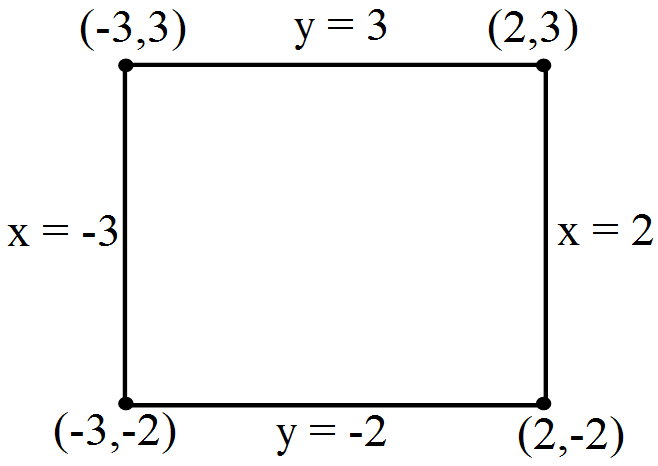
Draw the lines x = -3, x = 2, y = -2, y = 3 and write the coordinates of the vertices of the square so formed.
Answer
The figure with the line $\text{x}=-3,\text{x}=2,\text{y}=-2,\text{y}=3$ is as follows:
From the figure, the coordinates of the vertices of the square are $(2,3),(-3,3),(-3,-2),(2,-2).$
View full question & answer
Question 522 Marks
Without using Pythagoras theorem, show that the points A(0, 4), B(1, 2) and C(3, 3) are the vertices of a right angled triangle.
Answer
Slope of $\text{AB}=\frac{2-4}{1-0}=-2$ Slope of $\text{BC}=\frac{3-2}{3-1}=\frac{1}{2}$ slope of AB × slope of BC $=-2\times\frac{1}{2}=-1$ $\therefore$ Anlgle between AB and BC $=\frac{\pi}{2}$ $\therefore$ ABC are the vertices of a right angled triangle.
View full question & answer
Question 532 Marks
Find the equation to the straight line which cuts off equal positive intercepts on the axes and their product is 25.
Answer
Let the intercepts on the axes be (a, 0) and (0, a).Then,
$\text{a}\times\text{a}=25$
$\text{a}^2=25$
$\text{a}=25$
(Ignoring negative sign because it is given that the intercepts are positive)
⇒ a = b = 5 (given the intercepts are equal)
$\therefore$ Putting in equation of straight line
$\frac{\text{x}}{\text{a}}+\frac{\text{y}}{\text{b}}=1$
$\frac{\text{x}}{5}+\frac{\text{y}}{5}=1$
$\text{x}+\text{y}=5$
View full question & answer
Question 542 Marks
Reduce the equation $\sqrt{3}\text{x}+\text{y}+2=0$ to: slope-intercept form and find slope and y-intercept;
Answer
Slope intercept from (y = mx + c)$\sqrt3\text{x}+\text{y}+2=0$
$\Rightarrow\text{y}=-\sqrt3\text{x}-2$
$\Rightarrow\text{m}=-\sqrt3,\ \text{c}=-\sqrt2$
y-intercept = -2, slope = $-\sqrt3$
View full question & answer
Question 552 Marks
State whether the two lines in the following are parallel, perpendicular or neither. Through (5, 6) and (2, 3); through (9, -2) and (6, -5)
Answer
Slope of line joining (5, 6) and (2, 3) $\text{m}_1=\frac{\text{y}_2-\text{y}_1}{\text{x}_2-\text{x}_1}=\frac{3-6}{2-5}=\frac{-3}{-3}=1$ Slope of line joining (9, -2) and (6, -5) $\text{m}_2=\frac{\text{y}_2-\text{y}_1}{\text{x}_2-\text{x}_1}=\frac{-5-(-2)}{6-9}=\frac{-5+2}{-3}=1$ Here $m_1 = m_2 \therefore$ The two lines are parallel.
View full question & answer
Question 562 Marks
Reduce the equation $\sqrt{3}\text{x}+\text{y}+2=0$ to: Intercept form and find intercept on the axes;
Answer
Intercept from $\Big(\frac{\text{x}}{\text{a}}+\frac{\text{y}}{\text{b}}=1\Big)$$\sqrt3\text{x}+\text{y}+2=0$
$\Rightarrow\sqrt3\text{x}+\text{y}=-2$
$\Rightarrow\frac{\sqrt3\text{x}}{-2}+\frac{\text{y}}{-2}=1$
$\Rightarrow\frac{\text{x}}{\frac{-2}{\sqrt3}}+\frac{\text{y}}{-2}=1$
⇒ x intercept $=\frac{-2}{\sqrt3},$ y intercept = -2
View full question & answer
Question 572 Marks
Find the equation of the line on which the length of the perpendicular segment from the origin to the line is 4 and the inclination of the perpendicular segment with the positive direction of x-axis is 30°.
Answer
Given inclination of perpendicular line (L) passing through origin is 30° ⇒ Slope $=\tan30^\circ=\frac{1}{\sqrt3}$Slope of perpendicular line (M) which is perpendicularn to line L is $-\sqrt3$
So equation of line M is $\text{y}=-\sqrt{3\text{x}}+\text{c}$
Given perpendicular distance from origin to line M is 4
$4=\frac{\text{c}}{2}\Rightarrow\text{c}=8$
So, equation of line M is $\text{y}=-\sqrt{3\text{x}}+8$
View full question & answer
Question 582 Marks
By using the concept of slope, show that the points (-2, -1), (4, 0), (3, 3) and (-3, 2) are the vertices of a parallelogram.
Answer
Let the vertices be A(-2, -1), B(4, 0), C(3, 3) and D(-3, 2). Using slope formula, $\text{m}=\frac{\text{y}_2-\text{y}_1}{\text{x}_2-\text{x}_1},$ we get: Slope of $\text{AB}(\text{m}_1)=\frac{0-(-1)}{4-(-2)}=\frac{1}{6}$ Slope of $\text{CD}(\text{m}_2)=\frac{2-3}{-3-3}=\frac{-1}{-6}=\frac{1}{6}$ $\Rightarrow\text{m}_1=\text{m}_2\Rightarrow\text{AB}||\text{CD}$ Also Slope of $\text{AD }(\text{m}_2)=\frac{2-(-1)}{-3-(-2)}=\frac{3}{-1}=-3$ Slope of $\text{BC }(\text{m}_4)=\frac{3-0}{3-4}=\frac{3}{-1}=-3$ $\Rightarrow\text{m}_3=\text{m}_4\Rightarrow\text{AD}||\text{BC}$ Hence, ABCD is a parallelogram.
View full question & answer