Question
  1. Account for the following:
  1. Ozone is thermodynamically unstable.
  2. Solid $PCl_5$ is ionic in nature.
  3. Fluorine forms only one oxoacid HOF.
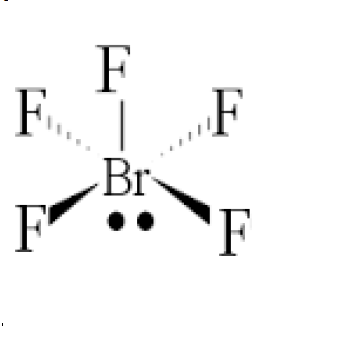
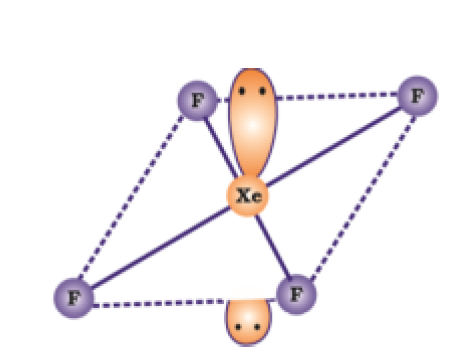
  1. Draw the structure of
  1. $BrF_{5.}$​​​​​​​
  2. $XeF_{4.}​​​​​​​$​​​​​​​

Answer

  1.  
  1. Endothermic compound/decomposition of ozone is exothermic in nature and $\Delta $G is negative/decomposition of ozone is spontaneous.
  2. Exists as $[PCl_4]^+[PCl_6]^-$
  3. Shows only $-1$ oxidation state/most electronegative element/absence of d-orbitals.
  1.  
  1.  

Need a full question paper?

Generate a complete, print-ready paper with questions like this in minutes — across 16+ boards, with answer keys.

Start Generating Free

Similar questions

On the basis of crystal theory, octahedral in the presence of strong field ligand and weak field ligand. Explain the difference in crystal field splitting.
  1. Define the following terms:
  1. Mole fraction.
  2. Van’t Hoff factor.
  1. $100 mg$ of a protein is dissolved in enough water to make $10.0 mL$ of a solution. If this solution has an osmotic pressure of $13.3 mm$ Hg at $ 25° C$, what is the molar mass of protein?
$(R = 0.0821 L\ atm\ mol^{–1} K^{–1}$ and $760 mm\ Hg\ = 1 atm.)$
Calculate the depression in the freezing point of water when $10\ g$ of $CH_3CH_2CHClCOOH$ is added to $250\ g$ of water. $K_a = 1.4 \times 10^{–3},\ K_f = 1.86\ K\ kg\ mol^{–1}.$
  1. When concentrated sulphuric acid was added to an unknown salt present in a test tube a brown gas (A) was evolved. This gas intensified when copper turnings were added to this test tube. On cooling, the gas (A) changed into a colourless solid (B).
  1. Identify (A) and (B).
  2. Write the structures of (A) and (B).
  3. Why does gas (A) change to solid on cooling?
  1. Arrange the following in the decreasing order of their reducing character:
HF, HCl, HBr, HI
  1. Complete the following reaction:
$\text{XeF}_4+\text{SbF}_5\xrightarrow{\ \ \ \ \ \ \ \ }$
  1. Draw the structures of the following:
  1. $H_2S_2O_7$.
  2. $HClO_3$.
  1. Explain the following observations:
  1. In the structure of $HNO_3$, the N–O bond.
$(121\ pm)$ is shorter than the N–OH bond $(140\ pm)$.
  1. All the P–Cl bonds in $PCl_5$​​​​​​​ are not equivalent.
  2. ICl is more reactive than $I_2$​​​​​​​.
After watching a programme on TV about the presence of carcinogens (cancer causing agents) Potassium bromate and Potassium iodate in bread and other bakery products, Rupali a Class XII student decided to make others aware about the adverse effects of these carcinogens in foods. She consulted the school principal and requested him to instruct the canteen contractor to stop selling sandwiches, pizzas, burgers and other bakery products to the students. The principal took an immediate action and instructed the canteen contractor to replace the bakery products with some protein and vitamin rich food like fruits, salads, sprouts, etc. The decision was welcomed by the parents and the students.
After reading the above passage, answer the following questions:
  1. What are the values (at least two) displayed by Rupali?
  2. Which polysaccharide component of carbohydrates is commonly present in bread?
  3. Write the two types of secondary structures of proteins.
  4. Give two examples of water soluble vitamins.
What is the role of adsorption in heterogenous catalysis?
Concentration terms such as mass percentage, ppm, mole fraction and molality are independent of temperature, however molarity is a function of temperature. Explain.
Explain primary, secondary and tertiary structure of proteins with diagram.
Classify carbohydrates and also give examples of each.