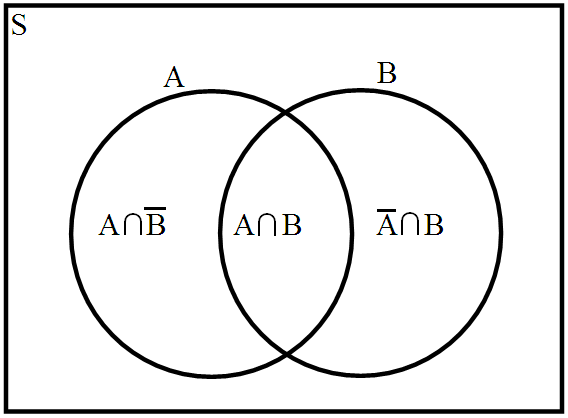
Two events A and B are said to be independent, if $\text{P}(\text{AB})=\text{P}(\text{A})\times\text{P}(\text{B})$ Distracter Rationale.
- Let P(A) = m, P(B) = n, 0 < m, n < 1
A and B are mutually exclusive.
$\therefore\text{A}\cap\text{B}=\phi$
$\Rightarrow\text{P}(\text{AB})=0$
$\text{However,}\ \text{P}(\text{A})\cdot\text{P}(\text{B})=mn\neq0$
$\therefore\text{P}(\text{A}).\text{P}(\text{B})\neq\text{P}(\text{AB})$
- Consider the result given in alternative.
$\text{P}(\text{A}'\text{B}')=\big[1-\text{P}(\text{A})\big]\big[1-\text{P}(\text{B})\big]$
$\Rightarrow\text{P}(\text{A}'\cap\text{B}')=1-\text{P}(\text{A})-\text{P}(\text{B})+\text{P}(\text{A}).\text{P}(\text{B})$
$\Rightarrow1-\text{P}(\text{A}\cup\text{B})=1-\text{P}(\text{A})-\text{P}(\text{B})+\text{P}(\text{A}).\text{P}(\text{B})$
$\Rightarrow\text{P}(\text{A}\cup\text{B})=\text{P}(\text{A})+\text{P}(\text{B})-\text{P}(\text{A})\cdot\text{P}(\text{B})$
$ \Rightarrow\text{P}(\text{A})+\text{P}(\text{B})-\text{P}(\text{AB})=\text{P}(\text{A})+\text{P}(\text{B})-\text{P}(\text{A}).\text{P}(\text{B})$
$\Rightarrow\text{P}(\text{AB})=\text{P}(\text{A}).\text{P}(\text{B})$
This implies that A and B are independent, if
$\text{P}(\text{A}'\text{B}')=\big[1-\text{P}(\text{A})\big]\big[1-\text{P}(\text{B})\big]$ - Let A: Event of getting an odd number on throw of a die = {1, 3, 5}
$\Rightarrow\text{P}(\text{A})=\frac{3}{6}=\frac{1}{2}$
B: Event of getting an even number on throw of a die = {2, 4, 6}
$\text{P}(\text{B})=\frac{3}{6}=\frac{1}{2}$
Here,
$\text{A}\cap\text{B}=\phi$ $\therefore\text{P}(\text{AB})=0 $
$\text{P}(\text{A}).\text{P}(\text{B})=\frac{1}{4}\neq0$
$ \Rightarrow\text{P}(\text{A}).\text{P}(\text{B})\neq\text{P}(\text{AB})$
- From the above example, it can be seen that,
$\text{P}(\text{A})+\text{P}(\text{B})=\frac{1}{2}+\frac{1}{2}=1$
However, it cannot be inferred that A and B are independent.
Thus, the correct answer is B.