Questions

3 Marks Question

🎯

Test yourself on this topic

12 questions · timed · auto-graded

Question 13 Marks
A charge of $+2.0 \times 10^{-8}C$ is placed on the positive plate and a charge of $-1.0 \times 10^{-8}C$ on the negative plate of a parallel-plate capacitor of capacitance $1.2\times10^{-3}\mu\text{F}.$ Calculate the potential difference developed between the plates.
Answer
$\text{q}_1=+2.0\times10^{-8}\text{c}$$\text{q}_2=-1.0\times10^{-8}\text{c}$
$\text{C}=1.2\times10^{-3}\mu\text{F}=1.2\times10^{-9}\text{F}$
$\text{net q}=\frac{\text{q}_1-\text{q}_2}{2}=\frac{3.0\times10^{-8}}{2}$
$\text{V}=\frac{\text{q}}{\text{c}}=\frac{3\times10^{-8}}{2}\times\frac{1}{1.2\times10^{-9}}=12.5\text{V}$
View full question & answer
Question 23 Marks
A parallel-plate capacitor having plate area $25cm^2$ and separation 1.00mm is connected to a battery of 6.0V. Calculate the charge flown through the battery. How much work has been done by the battery during the process?
Answer


$\text{A}=25\text{cm}^2=2.5\times10^{-3}\text{cm}^2$
$\text{d}=1\text{mm}=0.01\text{m}$
$\text{V}=\text{6V},\ \text{Q}=1$
$\text{C}=\frac{\in_0\text{A}}{\text{d}}=\frac{8.854\times10^{-12}\times2.5\times10^{-3}}{0.01}$
$\text{Q}=\text{CV}=\frac{8.854\times10^{-12}\times2.5\times10^{-3}}{0.01}\times6$
$=1.32810\times10^{-10}\text{C}$
$\text{W}=\text{Q}\times\text{V}=1.32810\times10^{-10}\text{C}\times6$
$=8\times10^{-10}\text{J}.$
View full question & answer
Question 33 Marks
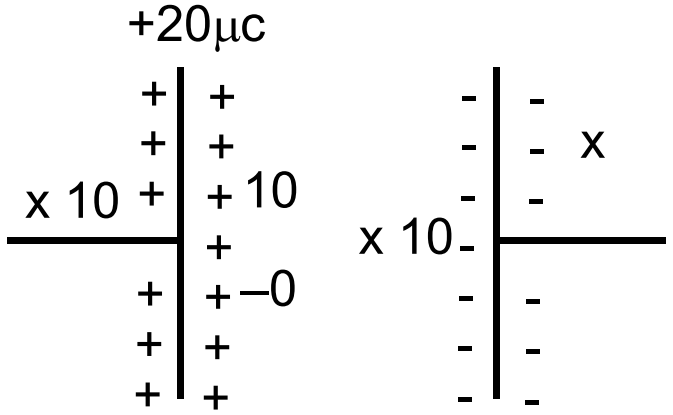
A charge of $20\mu\text{C}$ is placed on the positive plate of an isolated parallel-plate capacitor of capacitance $10\mu\text{F}.$ Calculate the potential difference developed between the plates.
Answer

$\therefore$ Given that
Capacitance $=10\mu\text{F}$
Charge $=20\mu\text{C}$
$\therefore$ The effective charge $=\frac{20-0}{2}=10\mu\text{F}$
$\therefore\text{C}=\frac{\text{q}}{\text{V}}$
$\Rightarrow\text{V}=\frac{\text{q}}{\text{C}}=\frac{10}{10}=1\text{V}$
View full question & answer
Question 43 Marks
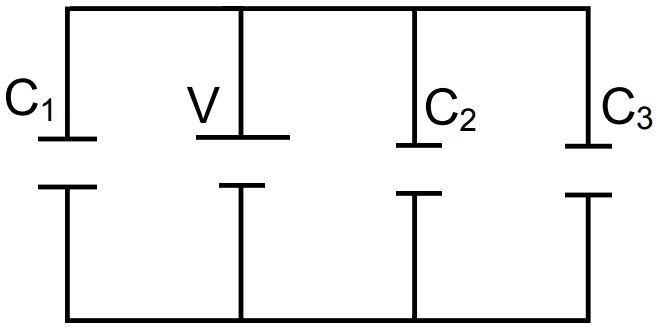
Find the charges on the three capacitors connected to a battery as shown in figure. Take $\text{C}_1=2.0\mu\text{F},\ \text{C}_2=4.0\mu\text{F},\ \text{C}_3=6.0\mu\text{F}$ and V = 12 volts.
Answer

$\text{C}_1=2\mu\text{F},\ \text{C}_2=4\mu\text{F},\ \text{C}_3=6\mu\text{F}$
$\text{V}=12\text{V}$
$\text{cq}=\text{C}_1+\text{C}_2+\text{C}_3$
$=2+4+6=12\mu\text{F}$
$=12\times10^{-6}\text{F}$
$\text{q}_1=12\times2=24\mu\text{C}$
$\text{q}_2=12\times4=48\mu\text{C}$
$\text{q}_3=12\times6=72\mu\text{C}$
View full question & answer
Question 53 Marks
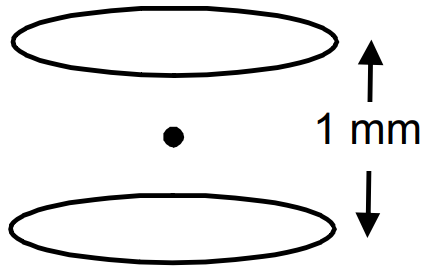
Suppose, one wishes to construct a 1.0 farad capacitor using circular discs. If the separation between the discs be kept at 1.0mm, what would be the radius of the discs?
Answer
Let the radius of the disc = R $\therefore$ Area $=\pi\text{R}^2$
$\text{C}=1\text{f}$
$\text{D}=1\text{mm}=10^{-3}\text{m}$
$\therefore\text{C}=\frac{\in_0\text{A}}{\text{d}}$
$\Rightarrow1=\frac{8.85\times10^{-12}\times\pi\text{r}^2}{10^{-3}}$
$\Rightarrow\text{r}^2=\frac{10^{-3}\times10^{12}}{8.85\times\pi}=\frac{10^9}{27.784}$
$=5998.5\text{m}=6\text{Km}$
View full question & answer
Question 63 Marks
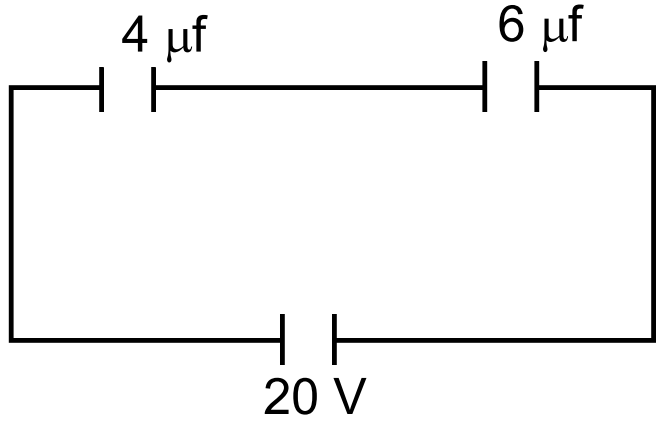
Two capacitors of capacitances $4.0\mu\text{F}$ and $6.0\mu\text{F}$ are connected in series with a battery of 20V. Find the energy supplied by the battery.
Answer

$\therefore\text{C}_1=4\mu\text{F},\ \text{C}_2=6\mu\text{F},\ \text{V}=20\text{V}$
Eq. capacitor $\text{C}_{\text{eq}}=\frac{\text{C}_1\text{C}_2}{\text{C}_1+\text{C}_2}=\frac{4\times6}{4+6}=2.4$
$\therefore$ The Eq Capacitance $\text{C}_{\text{eq}}=2.5\mu\text{F}$
$\therefore$ The energy supplied by the battery to each plate
$\text{E}=\Big(\frac{1}{2}\Big)\text{CV}^2$
$=\Big(\frac{1}{2}\Big)\times2.4\times20^2=480\mu\text{J}$
$\therefore$ The energy supplies by the battery to capacitor $=2\times480=960\mu\text{J}$
View full question & answer
Question 73 Marks
A metal sphere of radius $R$ is charged to a potential $V:$
  1. Find the electrostatic energy stored in the electric field within a concentric sphere of radius $2R.$
  2. Show that the electrostatic field energy stored outside the sphere of radius $2R$ equals that stored within it.
Answer
$\text{Q}=\text{CV}=4\pi\in_0\text{R}\times\text{V}$
$\text{E}=\frac{1}2{}\frac{\text{q}^2}{\text{C}}$
$[\therefore\ 'C\ ' $in a spherical shell $=4\pi\in_0\text{R}]$
$\text{E}=\frac{1}{2}\frac{16\pi^2\in_0^2\times\text{R}^2\times\text{V}^2}{4\pi\in_0\times2\text{R}}=2\pi\in_0\text{RV}^2$
$['C\ '$ of bigger shell $=4\pi\in_0\text{R}]$
View full question & answer
Question 83 Marks
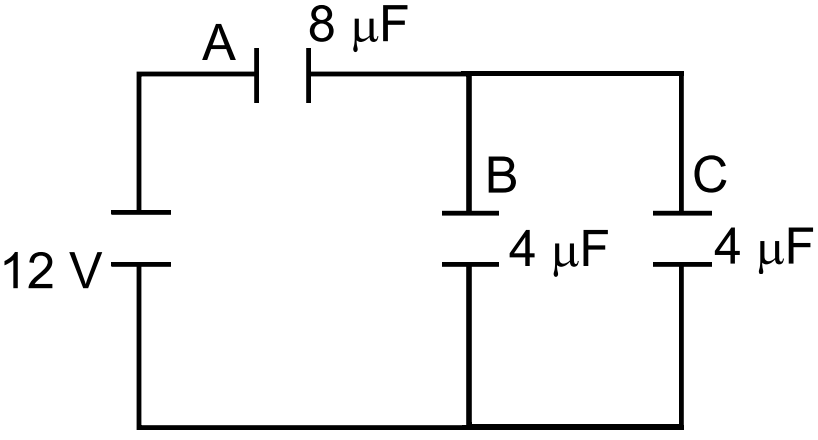
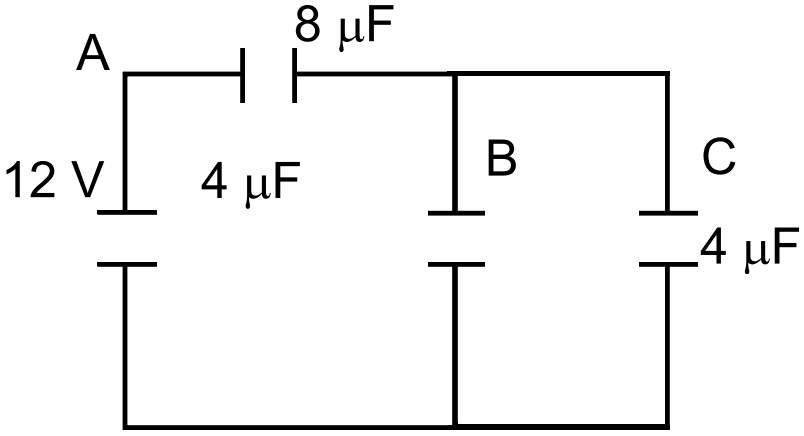
Find the charge appearing on each of the three capacitors shown in figure.
Answer

$\text{C}_1=8\mu\text{F},\ \text{C}_2=4\mu\text{F},\ \text{C}_3=4\mu\text{F}$
$\text{C}_{\text{eq}}=\frac{(\text{C}_2+\text{C}_3)\times\text{C}_1}{\text{C}_1+\text{C}_2+\text{C}_3}$
$=\frac{8\times8}{16}=4\mu\text{F}$
Since B & C are parallel & are in series with A.
So, $\text{q}_1=8\times6=48\mu\text{C}$
$\text{q}_2=4\times6=24\mu\text{C}$
$\text{q}_3=4\times6=24\text{C}\mu$
View full question & answer
Question 93 Marks
A large conducting plane has a surface charge density $1.0\times10^{-4}\text{Cm}^{-2}.$ Find the electrostatic energy stored in a cubical volume of edge 1.0cm in front of the plane.
Answer
$\sigma=1\times10^{-4}\text{c/m}^2$$\text{a}=1\text{cm}=1\times10^{-2}\text{m}$
$\text{a}^3=10^{-6}\text{m}$
The energy stored in the plane $=\frac{1}{2}\frac{\sigma^2}{\in_0}=\frac{1}{2}\frac{(1\times10^{-4})^2}{8.85\times10^{-12}}$
$=\frac{10^4}{17.7}=564.97$
The necessary electro static energy stored in a cubical volume of edge 1cm infront of the plane $=\frac{1}{2}\frac{\sigma^2}{\in_0}\text{a}^3=265\times10^{-6}=5.65\times10^{-4}\text{J}$
View full question & answer
Question 103 Marks
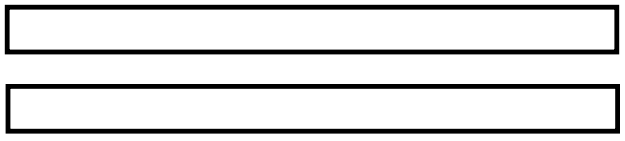
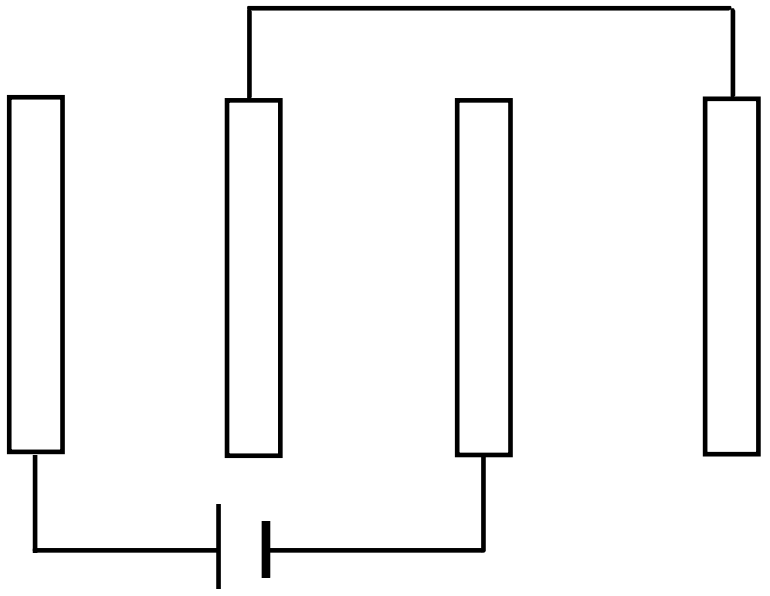
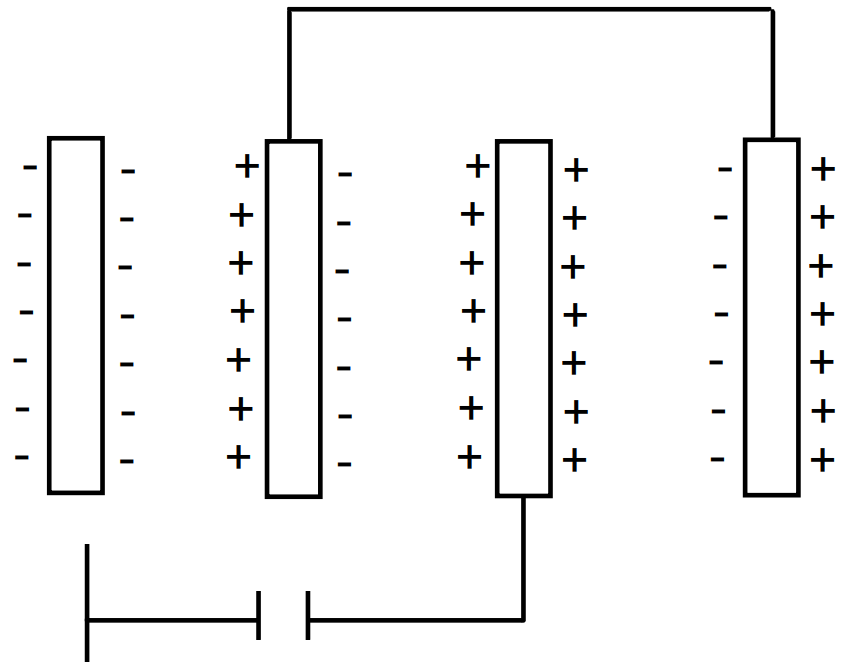
Each of the plates shown in figure has surface area $\Big(\frac{96}{\in_0}\Big)\times10^{-12}\text{Fm}$ on one side and the separation between the consecutive plates is $4.0mm$. The emf of the battery connected is $10\ volts$. Find the magnitude of the charge supplied by the battery to each of the plates connected to it.
Answer


Here three capacitors are formed
And each of $\text{A}=\frac{96}{\in_0}\times10^{-12}\text{f.m.}$
$\text{d}=4\text{mm}=4\times10^{-3}\text{m}$
$\therefore$ Capacitance of a capacitor
$\text{C}=\frac{\in_0\text{A}}{\text{d}}=\frac{\in_0\frac{96\times10^{-12}}{\in_0}}{4\times10^{-3}}=24\times10^{-9}\text{F}$
$\therefore$ As three capacitor are arranged is series
So, $\text{C}_\text{eq}=\frac{\text{C}}{\text{q}}=\frac{24\times10^{-9}}{3}=8\times10^{-9}$
$\therefore$ The total charge to a capacitor = $8 \times 10^{-9} \times 10 = 8 \times 10^{-8}c$
$\therefore$ The charge of a single Plate = $2 \times 8 \times 10^{-8} = 16 \times 10^{-8} = 0.16 \times 10^{-6} = 0.16\mu c.$
View full question & answer
Question 113 Marks
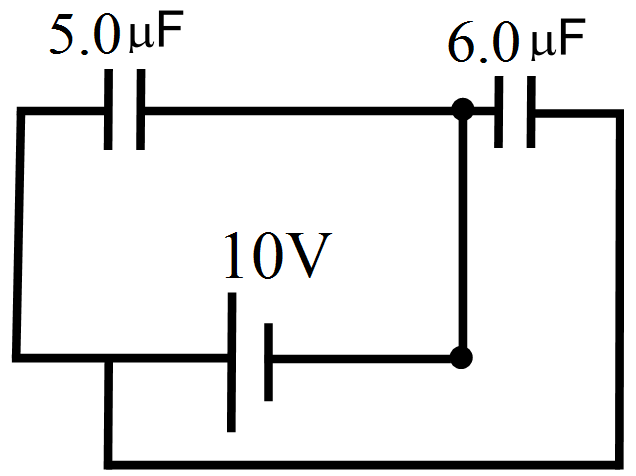
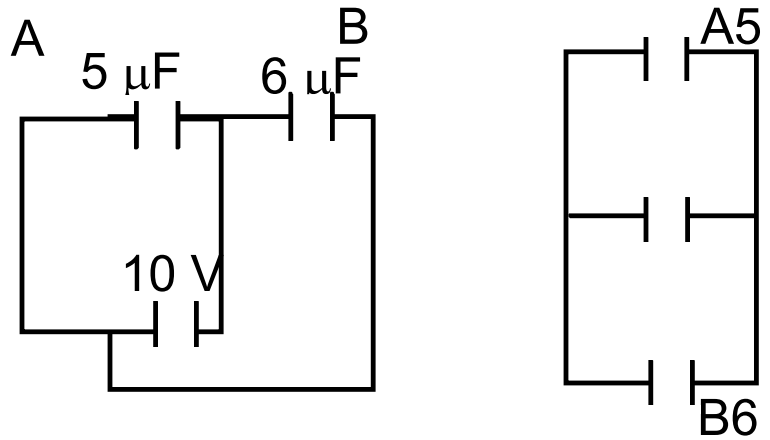
Find the charge supplied by the battery in the arrangement shown in figure.
Answer

$\text{V}=\text{10v}$
$\text{C}_{\text{eq}}=\text{C}_1+\text{C}_2$ $[\therefore$ They are parallel$]$
$=5+6=11\mu\text{F}$
$\text{q}=\text{CV}=11\times10=110\mu\text{C}$
View full question & answer
Question 123 Marks
When $1.0 \times 10^{12}$ electrons are transferred from one conductor to another, a potential difference of 10V appears between the conductors. Calculate the capacitance of the two-conductor system.
Answer
Given that Number of electron = $1 \times 10^{12}$ Net charge $Q = 1 \times 10^{12} \times 1.6 \times 10^{-19} = 1.6 \times 10^{-7}C$ $\therefore$ The net potential difference = 10L.
$\therefore$ Capacitance $\text{C}=\frac{\text{q}}{\text{v}}$
$=\frac{1.6\times10^{-7}}{10}=1.6\times10^{-8}\text{F}.$
View full question & answer
3 Marks Question - Physics STD 11 Science Questions - Vidyadip