Questions · Page 2 of 2

3 Marks Question

Question 513 Marks
A SONAR system fixed in a submarine operates at a frequency $40.0 kHz$ . An enemy submarine moves towards the $SONAR$ with a speed of $360 km h ^{-1}$. What is the frequency of sound reflected by the submarine? Take the speed of sound in water to be $1450 m s ^{-1}$.
Answer
The frequency of SONAR received by enemy submarine will be further reflected back to SONAR which it will receive again with a different frequency.
$SONAR$ frequency $(V_s) = 40kHz = 40 \times 10^3Hz$
Speed of enemy submarine($V_o$​​​​​​​) = 360km/h
$=360\times\frac{5}{18}=100\text{m/s}$
Speed of sound in water = 1450m/s
Apparent frequency received by submarine is
$\text{f}'=\Big\{\frac{\text{V}+\text{V}_\text{o}}{\text{V}}\Big\}\text{f}=\Big\{\frac{1450+100}{1450}\Big\}\times40=42.76\text{kHz}$
Now, the reflected wave have a different frequency,
$\text{f}"=\Big\{\frac{\text{V}}{\text{V}-\text{V}_\text{o}}\Big\}\text{f}'=\Big\{\frac{1450}{1450-100}\Big\}\times42.76=45.93\text{kHz}$
View full question & answer
Question 523 Marks
Define standing wave. Displacement of a string in which standing wave is formed is given as $\text{y}=(20\sin157\text{x}\cos314\text{t})$ Find:
  1. Amplitude of individual waves.
  2. Velocity of wave.
Answer
A standing wave is a pattern generated due to the superposition of two waves moving in opposite direction. It has varying amplitude.
$\text{Y} =20\sin157\text{x}\cos314\text{t}$
On comparison with $\text{Y}=2\text{A}\sin\text{kx}\cos\omega\text{t}$
We have,
  1. Amplitude $= 10$ units.
  2. Velocity of wave $=\frac{\omega}{\text{k}}=\frac{314}{157}=2\text{ units}.$
View full question & answer
Question 533 Marks
From a cloud at an angle of 30° to the horizontal, we hear the thunder clap 8 s after seeing the lightening flash. What is the height of the cloud above the ground if the velocity of sound in air is 330m/s?
Answer
Here, $\theta=30^\circ,$
$\text{t}=8\text{s},$
$\nu=330\text{m/s},$
$\text{h}=?$
Distance of cloud,$\text{s}=\nu\times\text{t}=330\times8\text{m}$
As $\theta$ is angle with horizontal therefore, height of cloud (h) is given by
$\frac{\text{h}}{\text{s}}=\sin\theta,$
$\text{h}=\text{s}\sin\theta=330\times8\sin30^\circ$
$=330\times8\times\frac{1}{2}$
$=1320\text{m}=1.320\text{km}$
View full question & answer
Question 543 Marks
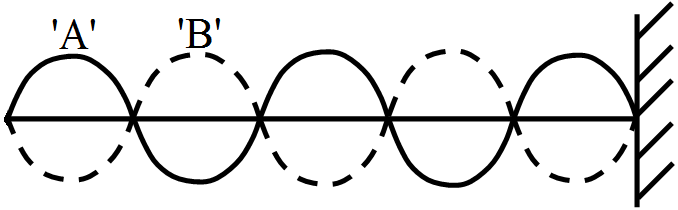
What are standing waves? Discuss graphical method for formation of standing waves on stretched strings.
Answer
Standing waves are the pattern of waves produced when two waves moving in opposite direction interact. They do not transport energy.

If a wave ‘A’ is made to hit a rigid support, there will be a reflected wave 'B' from the rigid support. As the two waves are super imposed, there will be a standing wave (as shown) produced.
It can be represented by the equation, $\text{y}=2\text{A}\sin\text{kx}\cos\omega\text{t}$indicating a position varying amplitude $(2\text{A}\sin\text{kx})$
View full question & answer
Question 553 Marks
What is the nature of sound waves in air? How is the speed of sound waves in atmosphere affected by the $(i)$ humidity $(ii)$ temperature?
Answer
Longitudinal.
  1. Increases with increase in humidity.
  2. Increases with increase in temperature.
View full question & answer
Question 563 Marks
A string of mass 2.50kg is under a tension of 200N. The length of the stretched string is 20.0m. If the transverse jerk is struck at one end of the string, how long does the disturbance take to reach the other end?
Answer
Mass of the string, M = 2.50kg
Tension in the string, T = 200N
Length of the string, 1 = 20.0m
Mass per unit length, $\mu=\frac{\text{M}}{\text{L}}=\frac{2.50}{20}=0.125\text{kg m}^{-1}$
The velocity (v) of the transverse wave in the string is given by the relation:
$\text{v}=\sqrt{\frac{\text{T}}{\mu}}$
$=\sqrt{\frac{200}{0.125}}=\sqrt{1600}=40\text{m/s}$
Time taken by the disturbance to reach the other end, t = l/v = 20/40 = 0.50s
View full question & answer
Question 573 Marks
Consider the wave $\text{y}(\text{x, t})=2.2\cos(300\text{t}-0.24\text{x}).$ If the units for $y, t$ and $x$ are $mm, s$ and $m$ respectively, deduce:
  1. The amplitude.
  2. The frequency.
  3. The wavelength.
  4. The wave velocity.
  5. The amplitude of particle velocity.
Answer
The given wave equation is $\text{y(x, t)} = 2.2\cos(300\text{t}-0.24\text{x})$
The equation is of the type $\text{y(x, t)} = \text{A}\cos(\omega\text{t}-\text{kx})$
Comparing the two equations, we obtain
  1. Amplitude wave $\text{A}=2.2\text{mm}=2.23\times10^{-3}\text{m}$
  2. $\omega=300\text{rad s}^{-1}$
$\therefore$ Frequency $\text{v}=\frac{\omega}{2\pi}=\frac{300}{2\pi}=47.7\text{Hz}$
  1. $\text{k}=0.24\text{m}^{-1}$
$\therefore$ wavetength $\lambda=\frac{2\pi}{\text{K}}=\frac{2\pi}{0.24}=26.2\text{m}$
  1. $\therefore$ Wave velocity $v=\text{v}\lambda=47.7\times26.2=1250\text{ms}^{-1}$
  2. Amplitude of particle velocity $=\text{A}\omega=2.2\times10^{-3}\times300=0.66\text{mm}.$
View full question & answer
Question 583 Marks
On a certain day, speed of sound in air is 350m/s. What is the frequency of fundamental note in a closed pipe of length 0.5m? Also find the frequency of second overtone.
Answer
Here v = 350m/s, l = 0.5m
$\therefore$ For closed pipe fundamental frequency
$\text{v}=\frac{u}{4\text{l}}=\frac{350}{4\times0.5}=175\text{Hz}$
Frequency of second overtone = 5v = 5 × 175
= 875Hz
View full question & answer
Question 593 Marks
Explain the Doppler's effect.
Answer
Whenever there is a relative motion between a source of sound and the listener, the apparent frequencies of sound heard by the listener is different from the actual frequency of sound emitted by the source.
For sound the observed frequency v' is given by
$\text{v}'=\Big(\frac{v+v_0}{v+v_\text{s}}\Big)\text{v}$
View full question & answer
Question 603 Marks
 A source and an observer are approaching one another with velocity $4 m / s$. If the true frequency is $1200 Hz$ , deduce the observed frequency under the following conditions:
i. All velocity is in the source alone.
ii. All velocity is in the observer alone.
Take the velocity of sound waves in air to be $340 ms^{-1}$.
Answer
  1. $\text{v}'=\text{v}\Big(\frac{\nu}{\nu-\nu_\text{s}}\Big)=1200\Big(\frac{340}{336}\Big)\text{ft}$
$=1214.28\text{Hz}$
  1. $\text{v}'=\text{v}\Big(\frac{\nu+\nu_0}{\nu_0}\Big)=1200\Big(\frac{344}{340}\Big)$
$=1214.11\text{Hz}$
View full question & answer
Question 613 Marks
A stone dropped from the top of a tower of height 300 m splashes into the water of a pond near the base of the tower. When is the splash heard at the top given that the speed of sound in air is $340 m s ^{-1} ?\left(g=9.8 m s ^{-2}\right)$
Answer
Here, $h =300 m, g =9.8 m s ^{-2}$ and velocity of sound, $v =340 m s ^{-1}$ Let $t _1$ be the time taken by the stone to reach at the surface of pond.
Then using $\text{s}=\text{ut}+\frac{1}{2}\text{at}^2\frac{1}{2}\text{at}^2$
$\Rightarrow\text{h}=0\times\text{t}+\frac{1}{2}\text{gt}^2_1$
$\therefore\ \text{t}_1=\sqrt{\frac{2\times300}{9.8}}=7.82\text{s}$
Also if $t_2$ is the time taken by the sound to reach at a height h, then
$\text{t}_2=\frac{\text{h}}{\text{v}}=\frac{300}{340}=0.88\text{s}$
$\therefore$ Total time after which sound of splash is heard $= t_1 + t_2$​​​​​​​_
$=7.82+0.88=8.7\text{s}$
View full question & answer
Question 623 Marks
A policeman on duty detects a drop of 15% in the pitch of the horn of a motor car as it crosses him. If the velocity of sound is 330m/sec, calculate the speed of the car.
Answer
Before crossing source is moving towards listener,
$\therefore \text{V}'=\frac{\text{u}\text{V}}{\nu-\nu_\text{s}}\ \dots(\text{i})$
After crossing, source is moving away from listener
$\therefore \text{V}''=\frac{\text{u}\text{V}}{\nu+\nu_\text{s}}\dots(\text{ii})$
Dividing (ii) by (i), we get
$\frac{\text{V}'}{\text{V}''}=\frac{\nu-\nu_\text{s}}{\nu+\nu_\text{s}}$
Drop of 15% means
$\frac{\text{V}'}{\text{V}''}=\frac{85}{100}$
$\frac{85}{100}=\frac{330-\nu_\text{s}}{330+\nu_\text{s}}$
$\nu_\text{s}=26.7\text{m/s}$
View full question & answer
Question 633 Marks
  1. If the successive overtones of vibrating string are $280Hz$ and $350Hz$, what is the frequency of the fundamental note?
  2. If the amplitude of a sound wave is tripled, by how many $dB$ will the intensity level increases?
Answer
  1. Here $nv = 280Hz$
and $(n + 1)v = 350Hz$
$\therefore (n + 1)v - nv$
$= 350 - 280 = 70$
$v = 70Hz$
  1. Here $\frac{\text{a}_2}{\text{a}_1}=3$
$\therefore \frac{\text{I}_2}{\text{I}_1}=\Big(\frac{\text{a}_2}{\text{a}_1}\Big)^2=9$
Now, $\log_{10}\Big(\frac{\text{I}_2}{\text{I}_1}\Big)=10\log_{10}\Big(\frac{\text{I}_2}{\text{I}_1}\Big)$
$=10\log_{10}(9)=10\log_{10}3^2\\=20\log_{10}3=\log_{10}3^{20}$
$\therefore \frac{\text{I}_2}{\text{I}_1}=3^{20}$
$\text{I}_2=3^{20}\text{I}_1.$
View full question & answer
Question 643 Marks
An open pipe is suddenly closed at one end with the result that the frequency of the $3rd$ harmonic of the closed pipe is found to be higher by 100Hz than the fundamental frequency of the open pipe. What is the fundamental frequency of open pipe?
Answer
$\text{v}_0=\frac{\text{v}}{2\text{L}}\ \dots(1)$
where $n_0$​​​​​​​ = fundamental frequency of open pife. Frequency of third harmonic of closed pipe is
$\text{v}_\text{c}=3\Big(\frac{\nu}{4\text{L}}\Big)\ \dots(2)$
$\frac{(2)}{(1)}$ gives $=\frac{\text{v}_\text{c}}{\text{v}_0}=\frac{3}{2}$ or $v_\text{c}=\frac{2}{2}\text{v}_0\ \dots(3)$
Also $\text{v}_\text{c}-\text{​​v}_0=100$ (given)
$\frac{3}{2}\text{v}_0-\text{v}_0=100$
$\frac{​​​​​​\text{​​v}_0}{2}=100$
$\text{​​v}_0=200​​​​​​\text{​​Hz}.$
View full question & answer
Question 653 Marks
Compare the velocities of sound in hydrogen $\left( H _2\right)$ and carbon dioxide $\left( CO _2\right)$. The ratio $(\gamma)$ of specific heats of $H _2$ and $CO _2$ are respectively $1.4$ and $1.3 .$
Answer
$\vartheta=\sqrt{\frac{\gamma_1\text{P}}{\rho_1}}$ and $\text{J}_2=\sqrt{\frac{\gamma _2\text{P}}{\rho_2}}$
$\frac{\vartheta_1}{\vartheta_2}=\sqrt{\frac{\gamma_1\rho_2}{\gamma_2\rho_1}}$
Since density of a gas is proportional to its molecular weight,
$\frac{\rho_2}{\rho_1}=\frac{44.01}{2.016}=21.83$
$\frac{\vartheta_1}{\vartheta_2}=\sqrt{\frac{1.4}{1.3}\times21.83}=4.85$
Velocity of sound in hydrogen in 4.85 times that in carbon dioxide.
View full question & answer
Question 663 Marks
A travelling harmonic wave on a string is described by
$\text{y}(\text{x, t})=7.5\sin\Big(0.0050\text{x}+12\text{t}+\frac{\pi}{4}\Big)$
Locate the points of the string which have the same transverse displacements and velocity as the x = 1cm point at t = 2s, 5s and 11s.
Answer
Propagation constant is related to wavelength as:
$\text{k}=\frac{2\pi}{\lambda}$
$\therefore\ \lambda=\frac{2\pi}{\lambda}=\frac{2\times3.14}{0.0050}$
$=1256\text{cm}=12.56$
Therefore, all the points at distances $\text{n}_\lambda,$ (n = ± 1, ± 2.... and so on) i.e. ± 12.56m, ± 25.12m, … and so on for x = 1cm, will have the same displacement as the x = 1cm points at t = 2s, 5s, and 11s.
View full question & answer
Question 673 Marks
A steel wire has a length of $12 m$ and a mass of $2.10 kg$ . What will be the speed of a transverse wave on this wire when a tension of $2.06 \times 10^4 N$ is applied?
Answer
l = 12M (Total mass) =2.10kg
$\text{m}=\frac{\text{M}}{\text{l}}=\frac{2.1}{12}\text{T}=2.06\times10^4\text{N}$
$\therefore\text{v}\sqrt{\frac{\text{T}}{\text{m}}}\sqrt{\frac{2.06\times10^4\times12}{2.10}}=\sqrt{\frac{1236\times10^4}{105}}$
$=\sqrt{11.77}\times10^2=3.43\times10^2$
$\text{v}=343.0\text{m/ s}$
View full question & answer
Question 683 Marks
Equation of a wave travelling on a string is $\text{Y}=0.1\sin (300 \text{t}-0.01\text{x})$
Here $x$ is in $cm$ and $t$ is in seconds. Find :
  1. Wavelength of the wave.
  2. Time taken by the wave to travel $1m.$
Answer
Since $K = 0.01cm^{-1},$
We get $\frac{2\pi}{\lambda}=0.01$
or $\lambda =\frac{2\pi}{0.01}=628\text{cm}$
Since $\omega=300,$
$\text{T}=\frac{2\pi}{300}$ for travelling $\lambda$
Time for travelling $1m$
$=\frac{\text{T}}{\lambda \text{ in m}}=\frac{2\pi}{300\times6.28}$
$=\frac{1}{300}=3.33\text{ms}$
View full question & answer
Question 693 Marks
A wave travelling along a string is described by,
$
y(x, t)=0.005 \sin (80.0 x-3.0 t) \text {, }
$
in which the numerical constants are in SI units $\left(0.005 m , 80.0 rad m ^{-1}\right.$, and $3.0 rad s ^{-1}$ ). Calculate (a) the amplitude, (b) the wavelength, and (c) the period and frequency of the wave. Also, calculate the displacement $y$ of the wave at a distance $x=30.0 cm$ and time $t=20 s ?$
Answer
On comparing this displacement equation with Eq. (14.2),
$
y(x, t)=a \sin (k x-\omega t),
$
we find
(a) the amplitude of the wave is $0.005 m =5 mm$.

(b) the angular wave number $k$ and angular frequency $\omega$ are
$
k=80.0 m ^{-1} \text { and } \omega=3.0 s ^{-1}
$
We, then, relate the wavelength $\lambda$ to $k$ through Eq. (14.6),
$
\begin{aligned}
\lambda & =2 \pi / k \\
& =\frac{2 \pi}{80.0 m ^{-1}} \\
& =7.85 cm
\end{aligned}
$

(c) Now, we relate $T$ to $\omega$ by the relation
$
\begin{aligned}
T & =2 \pi / \omega \\
& =\frac{2 \pi}{3.0 s ^{-1}} \\
& =2.09 s
\end{aligned}
$
and frequency, $v=1 / T=0.48 Hz$
The displacement $y$ at $x=30.0 cm$ and time $t=20 s$ is given by
$
\begin{aligned}
y & =(0.005 m ) \sin (80.0 \times 0.3-3.0 \times 20) \\
& =(0.005 m ) \sin (-36+12 \pi) \\
& =(0.005 m ) \sin (1.699) \\
& =(0.005 m ) \sin \left(97^{\circ}\right) \simeq 5 mm
\end{aligned}
$
View full question & answer
3 Marks Question - Page 2 - Physics STD 11 Science Questions - Vidyadip