Question 14 Marks
In Fig. $\text{AB}=\text{AC}$ and $\angle\text{ACD}=105^\circ,$ find $\angle\text{BAC}.$
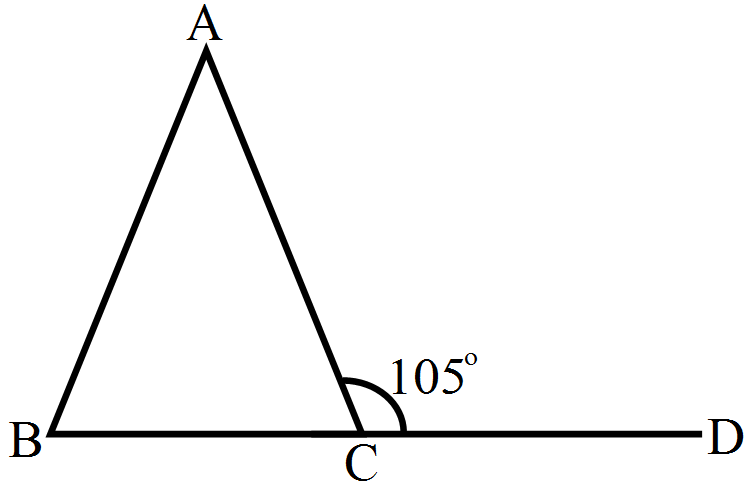
AnswerWe have, $\text{AB}=\text{AC}$ and $\angle\text{ACD}=(10)5^\circ$
Since, $\angle\text{BCD}=180^\circ=\text{Straight angle}$
$\angle\text{BCA}+\angle\text{ACD}=180^\circ$
$\angle\text{BCA}+(10)5^\circ=180^\circ$
$\angle\text{BCA}=180^\circ-(10)5^\circ$
$\angle\text{BCA}=75^\circ$ And also, $\triangle\text{ABC}$ is an isosceles triangle [AB = AC]
$\angle\text{ABC}=\angle\text{ACB}$ [Angles opposite to equal sides are equal] From $(i)$,
we have $\angle\text{ACB}=75^\circ$
$\angle\text{ABC}=\angle\text{ACB}=75^\circ$ And
also, Sum of Interior angles of a triangle $= 180^\circ$
$\angle\text{ABC}=\angle\text{BCA}+\angle\text{CAB}=180^\circ$
$75^\circ+75^\circ+\angle\text{CAB}=180^\circ$
$150^\circ+\angle\text{BAC}=180^\circ$
$\angle\text{BAC}=180^\circ-150^\circ=30^\circ$
$\angle\text{BAC}=30^\circ$
View full question & answer→Question 24 Marks
Prove that in a quadrilateral the sum of all the sides is geater than the sum of its diagonals.
Answer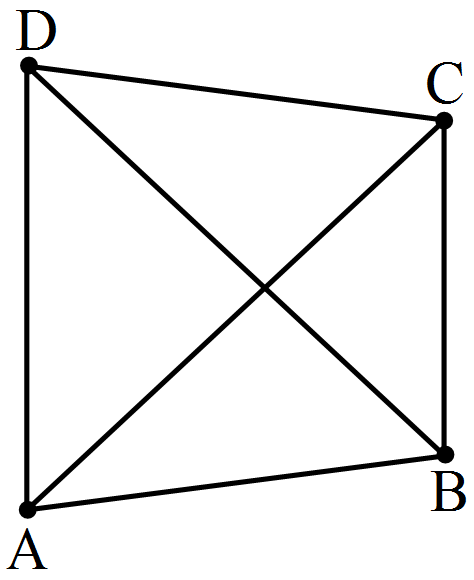
Diagonal AC and BD is joined. Since sum of any two sides of a triangles is greater than the thirdside.
Therefore, In $\triangle\text{ABC}$
$\text{AB}+\text{BC}>\text{AC}\ ....(1)$ In $\triangle\text{ACD}$
$\text{AD}+\text{DC}>\text{AC}\ .....(2)$ In $\triangle\text{ABD}$
$\text{AB}+\text{AD}>\text{BD}\ .....(3)$ andin $\triangle\text{BCD}$
$\text{BC}+\text{CD}>\text{BD}\ ......(4)$ adding $(1), (2), (3)$ and $(4)$
we get $2\text{AD}+2\text{DC}+2 \text{AB}+2\text{BC}>2\text{AC}+2\text{BD}$
$\Rightarrow\text{AB}+\text{BC}+\text{CD}+\text{DA}>\text{AC}+\text{BD}$ Hence proved. View full question & answer→Question 34 Marks
In a $\triangle\text{ABC},$ if $\text{AB}=\text{AC}$ and $\angle\text{B}=70^\circ.$ Find $\angle\text{A}.$
AnswerIn a $\triangle\text{ABC},$ if $\text{AB}=\text{AC}$ and $\angle\text{B}=70^\circ$
Since, $\text{AB}=\text{AC }\triangle\text{ABC}$ is an isosceles triangle
$\angle\text{B}=\angle\text{C}$ [Angles opposite to equal sides are equal]
$\angle\text{B}=\angle\text{C}=70^\circ$ And
also, Sum of angles in a triangle $= 180^\circ$
$\angle\text{A}+\angle\text{B}+\angle\text{C}=180^\circ$
$\angle\text{A}+70^\circ+70^\circ=180^\circ$
$\angle\text{A}=180^\circ-140^\circ$
$\angle\text{A}=40^\circ$
View full question & answer→Question 44 Marks
$ABC$ is a triangle in which $BE$ and $CF$ are, respectively, the perpendiculals to the side $AC$ and $AB$. if $\text{BE}=\text{CF},$ prove that $\triangle\text{ABC}$ is isosceles.
Answer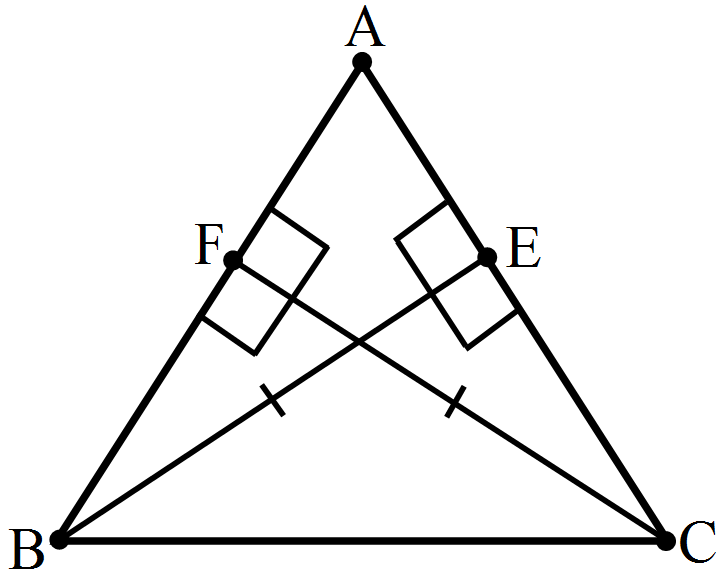
In $\triangle\text{BEC}$ and $\triangle\text{CFB}$
$\text{BC}=\text{BC}$ [commonj hypotenuse]
$\angle\text{BFC}=\angle\text{CEB}=90^\circ$
[given] $\text{BE}=\text{CF}$ [given] By
$RHS$ congurence criterion $\triangle\text{BEC}\cong\triangle\text{CFB}$
$\therefore\angle\text{B}=\angle\text{C}$ [c.p.c.t]
$\Rightarrow\text{AB}=\text{AC}$
$\Rightarrow\triangle\text{ABC}$ is isosceles. View full question & answer→Question 54 Marks
$ABC$ is a triangle in which $\angle\text{B}=2\angle\text{C}.$ $D$ is a point on $BC$ such that $AD$ bisects $\angle\text{BAC}$ and $\text{AB}=\text{CD}.$ Prove that $\angle\text{BAC}=72^\circ.$
AnswerGiven that in ABC, $\angle\text{B}=2\ \angle\text{C}$ and $D$ is a point on $BC$ such that $AD$ bisectors $\angle\text{BAC}$ and $\text{AB}=\text{CD}.$
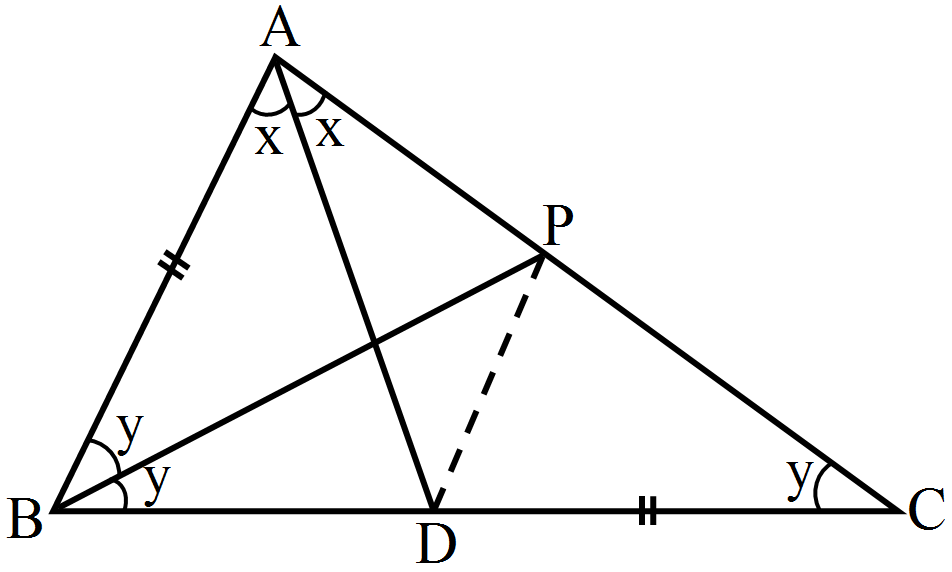
We have to prove that $\angle\text{BAC}=72^\circ$
Now, draw the angular bisector of $\angle\text{ABC},$ which meets $AC$ in $P$. Join $PD$
Let $\text{C}=\angle\text{ACB}=\text{y}$
$\angle\text{B}=\angle\text{ABC}=2\angle\text{C}=2\text{y}$ and also
Let $\angle\text{BAD}=\angle\text{DAC}$
$\angle\text{BAC}=2\text{x}$
$[$ AD is the bisector of $\angle\text{BAC}]$
Now, in $\triangle\text{BPC},$
$\angle\text{CBP}=\text{y}$
$[$ BP is the bisector of $\angle\text{ABC}]$
$\angle\text{PCB}=\text{y}$
$\angle\text{CBP}=\angle\text{PCB}=\text{y}[\text{PC}=\text{BP]}$
Consider, $\triangle\text{ABP}$ and $\triangle\text{DCP},$
we have $\triangle\text{ABP}=\triangle\text{DCP}=\text{y}$
$\text{AB}=\text{DC}$ [Given] And $\text{PC}=\text{BP}$ [From above]
So, by $SAS$ congruence criterion,
we have $\triangle\text{ABP}\cong\triangle\text{DCP}$
Now, $\angle\text{BAP}=\angle\text{CDF}$ and $\text{AP}=\text{DP}$ [Corresponding parts of congruent triangles are equal] $\angle\text{BAP}=\angle\text{CDP}=2$ Consider, $\triangle\text{APD},$
We have $\text{AP}=\text{DP}$
$\angle\text{ADP}=\angle\text{DAP}$ But $\angle\text{DAP}=\text{x}$
$\angle\text{ADP}=\angle\text{DAP}=\text{x}$
Now, In $\triangle\text{ABD}.$
$\angle\text{ABD}+\angle\text{BAD}+\angle\text{ADB}=180^\circ$ And also $\angle\text{ADB}+\angle\text{ADC}=180^\circ$ [Straight angle] From the above two equations,
we get $\angle\text{ABD}+\angle\text{BAD}+\angle\text{ADB}+\angle\text{ADC}$
$2\text{y}+\text{x}=\angle\text{ADP}+\angle\text{PDC}$
$2\text{y}+\text{x}=\text{x}+2\text{y}$
$2\text{y}=2\text{x}$
$\text{y}=\text{x}\text{ (or})\text{ x}=\text{y}$ We know, Sum of angles in a triangle $= 180^\circ$
So, In $\triangle\text{ABC},$
$\angle\text{A}+\angle\text{B}+\angle\text{C}=180^\circ$
$2\text{x}+2\text{y}+\text{y}=180^\circ$
$[\angle\text{A}=2\text{x},\angle\text{B}=2\text{y},\angle\text{C}=\text{y}]$
$2(\text{y}+3\text{y}=180^\circ[\text{x}=\text{y}]$
$5\text{y}=180^\circ$
$\text{y}=36^\circ$ Now, $\angle\text{A}=\angle\text{BAC}=2\times36^\circ=72^\circ$ View full question & answer→Question 64 Marks
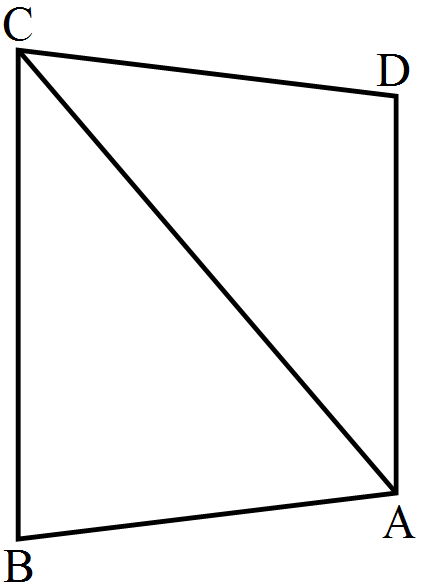
In Fig. prove that:
AnswerTo prove,
$i. CD + DA + AB + BC > 2AC$
$ii.CD + DA + AB > BC$
From the given figure, We know that, in a triangle sum of any two sides is greater than the third side.
$i.$ So,
In $\triangle\text{ABC},$ we have
$AB + BC > AC ....(i)$
In $\triangle\text{ADC},$ we have
$CD + DA > AC ....(ii)$
Adding $(i)$ and $(ii)$, we get
$AB + BC + CD + DA > AC + AC$
$AB + BC + CD + DA > 2AC$
$ii.$ Now, In $\triangle\text{ABC},$ we have,
$AB + AC > BC ...(iii)$
And in $\triangle\text{ADC},$ we have
$CD + DA > AC$
Add $AB$ on both sides
$CD + DA + AB > AC + AB$
From equation $(iii)$ and $(iv)$, we get,
$CD + DA + AB > AC + AB > BC$
$CD + DA + AB > BC$
Hence proved.
View full question & answer→Question 74 Marks
$ABC$ is an isosceles triangle in which $AB = AC. BE$ and $CF$ are its two medians. Show that $BE = CF.$
AnswerIn the triangle ABC it is given that $\text{AB}=\text{AC},$ $BE$ and $CF$ are medians.
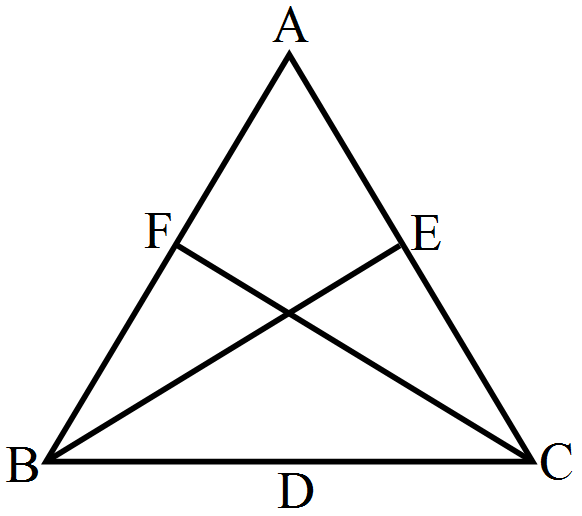
We have to show that $\text{BE}=\text{CF}$ To show $\text{BE}=\text{CF}$
we will show that $\triangle\text{BFC}\cong\triangle\text{BEC}$ In triangle $\triangle\text{BFC}$ and $\triangle\text{BEC}$
As $\text{AB}=\text{AC},$
so $\angle\text{FBC}=\angle\text{ECF}\ .....(1)$
$\text{BC}=\text{BC} (common sides) ......(2)$
Since, $\text{AB}=\text{AC}$
$\frac{1}{2}\text{AB}=\frac{1}{2}\text{AC}$ As $F$ and $E$ are mid points of sides $AB$ and $AC$ respectively,
so $\text{BF}=\text{CF}\ .....(3)$
From equation $(1), (2),$ and $(3)$
$\triangle\text{BFC}\cong\triangle\text{BEC}$
Hence $\text{FC}=\text{BE}$ Proved. View full question & answer→Question 84 Marks
$BD$ and $CE$ are bisectors of $\angle\text{B}$ and $\angle\text{C}$ of an isosceles $\triangle\text{ABC}$ with $\text{AB}=\text{AC}.$ Prove that $\text{BD}=\text{CE}.$
Answer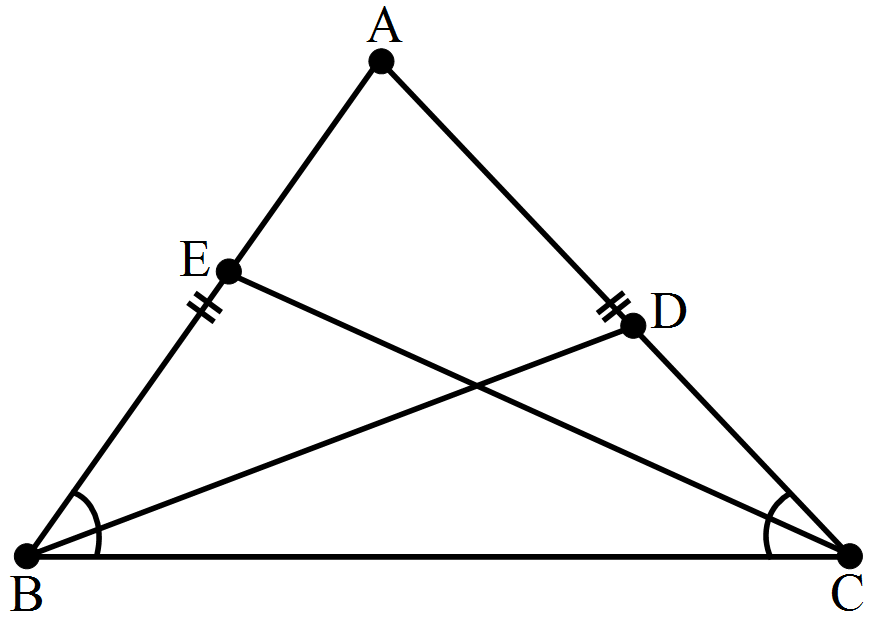
In $\triangle\text{ABC}$
$\because\text{AB}=\text{AC}$
$\therefore\angle\text{ABC}=\angle\text{ACB}$ [Angle opposite to equal sides are equal] $\Rightarrow\frac{1}{2}\angle\text{ABC}=\frac{1}{2}\angle\text{ACB}$
$\Rightarrow\angle\text{DBC}=\angle\text{ECB}$
$[$BD and CE bisects $\angle\text{B}$ and $\angle\text{C}]$
Now In $\triangle\text{DBC}$ and $\triangle\text{ECB}$
$\angle\text{DBC}=\angle\text{ECB}$ [provedearlier] $\angle\text{B}=\angle\text{C}$ [given]
$\text{BC}=\text{BC}$ [common] By $ASA$ congurence criterion $\triangle\text{DBC}\cong\triangle\text{ECB}$
$\therefore\text{BD}=\text{CE}$ [c.p.c.t] View full question & answer→Question 94 Marks
$O$ is any point in the interior of $\triangle\text{ABC}.$ Prove that
$i. \text{AB}+\text{AC}>\text{OB}+\text{OC}$
$ii. \text{AB}+\text{BC}+\text{CA}>\text{OA}+\text{OB}+\text{OC}$
$iii. \text{OA}+\text{OB}=\text{OC}>\frac{1}{2}(\text{AB}+\text{BC}+\text{CA)}$
AnswerIt is given that, $O$ is any point in the interior of $\triangle\text{ABC}$
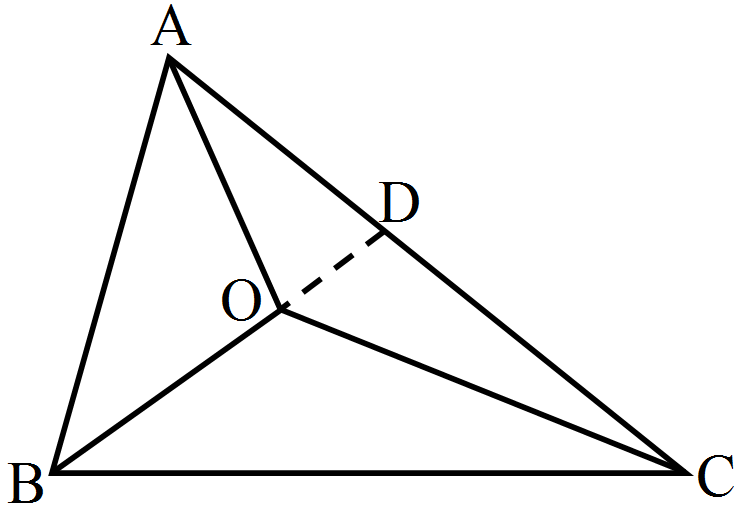
We have to prove that.
$i. AB + AC > OB + OC$ produced $BO$ to meet $AC$ at $D.$
In $\triangle\text{ABC}$ we have
$AB + AD > BD$
$\Rightarrow AB + AD > OB + OD ......(1)$
And in $\triangle\text{ODC}$ we have
$OD + CD > OC ......(2)$
Adding $(1) \ (2)$ we get.
$AB + AD + OD + DC > OB + OD + OC$
Hence $AB + AC > OB + OC$ proved.
$ii.$ We have to prove that $AB + BC + CA > OA + OB + OC$
From the first result we have
$BC + BA > OA + OC .......(3)$
And
$CA + CB > OA + OB .......(4)$
Adding above $(4)$ equation.
$2(AB + BC + AC) > 2(OA + OB + OC)$
Hence $AB + BC + CA > OA + OB + OC $proved.
$iii.$ We have to prove that $\text{OA}+\text{OB}+\text{OC}>\frac{1}{2}(\text{AB}+\text{BC}+\text{CA})$
In triangles $OAB, OBC$ and $OCA $ we have
$OA + OB > AB$
$OB + OC > BC$
$OC + OA > AC$
Adding these three results.
$2(OA + OB + OC) > AB + BC + AC$
Hence $\text{OA}+\text{OB}+\text{OC}>\frac{1}{2}(\text{AB}+\text{BC}+\text{CA})$ Proved. View full question & answer→Question 104 Marks
$AB$ is a line segment. $P$ and $Q$ are points on opposite sides of $AB$ such that each of them is equidistant from the points $A$ and $B$ (See Fig). Show that the line $PQ$ is perpendicular bisector of $AB.$
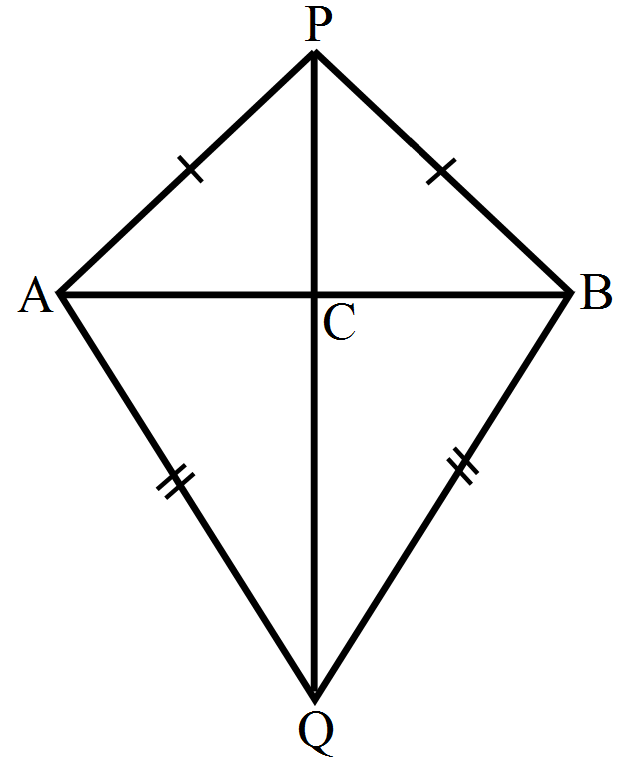
AnswerConsider the figure.
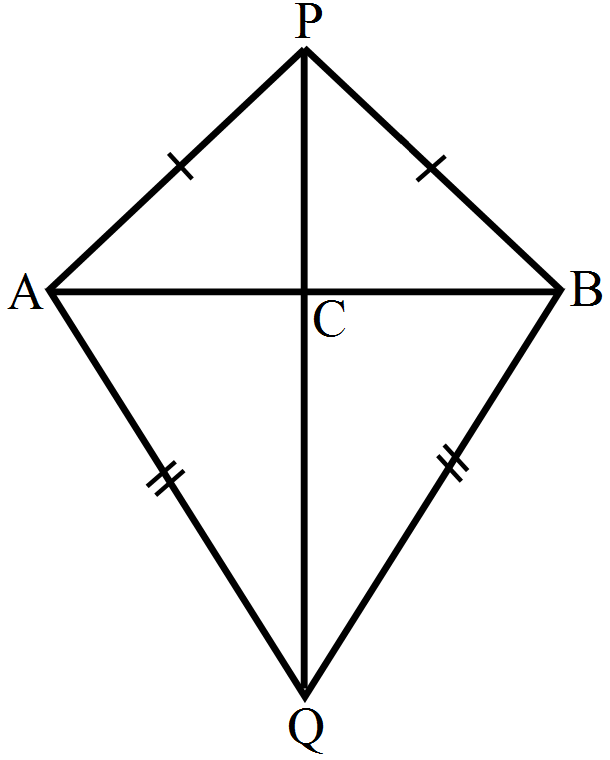
We have $A B$ is a line segment and $P, Q$ are points on opposite sides of $A B$ such that $\text{AP}=\text{BP}\ ....(\text{i)}$
$\text{AQ}=\text{BQ}\ ....(\text{ii)}$
We have to prove that $PQ$ is perpendicular bisector of $AB$.
Now consider $\triangle\text{PAQ}$ and $\triangle\text{PBQ},$
We have $\text{AP}=\text{BP}$ [From $(i)$]
$\text{AQ}=\text{BQ}$ [From (ii)] And $\text{PQ}-\text{PQ}$ [Common site]
$\triangle\text{PAQ}\simeq\triangle\text{PBQ}\ ....(\text{i})(ii)$ [From $SAS$ congruence]
Now, we can observe that $APB$ and $ABQ $are isosceles triangles.
[From $(i)$ and $(ii)$] $\angle\text{PAB}=\angle\text{ABQ}$ and $\angle\text{QAB}=\angle\text{QBA}$
Now consider $\triangle\text{PAC}$ and $\triangle\text{PBC}$ $C$ is the point of intersection of $AB$ and $PQ$ $\text{PA}=\text{PB}$ [From $(i)]$
$\angle\text{APC}=\angle\text{BPC}$ [From $(ii)$]
$\text{PC}=\text{PC}$ [common side]
So, from $SAS $congruency of triangle $\triangle\text{PAC}\cong\triangle\text{PBC}$
$\text{AC}=\text{CB}$ and $\angle\text{PCA}=\angle\text{PBC}\ .....(\text{iv)}$
[Corresponding parts of congruent triangles are equal] And also, $ACB$ is line segment $\angle\text{ACP}+\angle\text{BCP}=180^\circ$
$\angle\text{ACP}=\angle\text{PCB}$
$\angle\text{ACP}=\angle\text{PCB}=90^\circ<$
We have $\text{AC}=\text{CB}\Rightarrow\text{C}$ is the midpoint of $A B$ From $(iv)$ and $(v)$
We can conclude that $P C$ is the perpendicular bisector of $A B$ Since $C$ is a point on the line $P Q$,
we can say that $P Q$ is the perpendicular bisector of $A B$. View full question & answer→Question 114 Marks
In two right triangles one side an acute angle of one are equal to the corresponding side and angle of the other. Prove that the triangles are congruent.
AnswerGiven that, in two right triangles one side and acute angle of one are equal to the corresponding side and angles of the other. 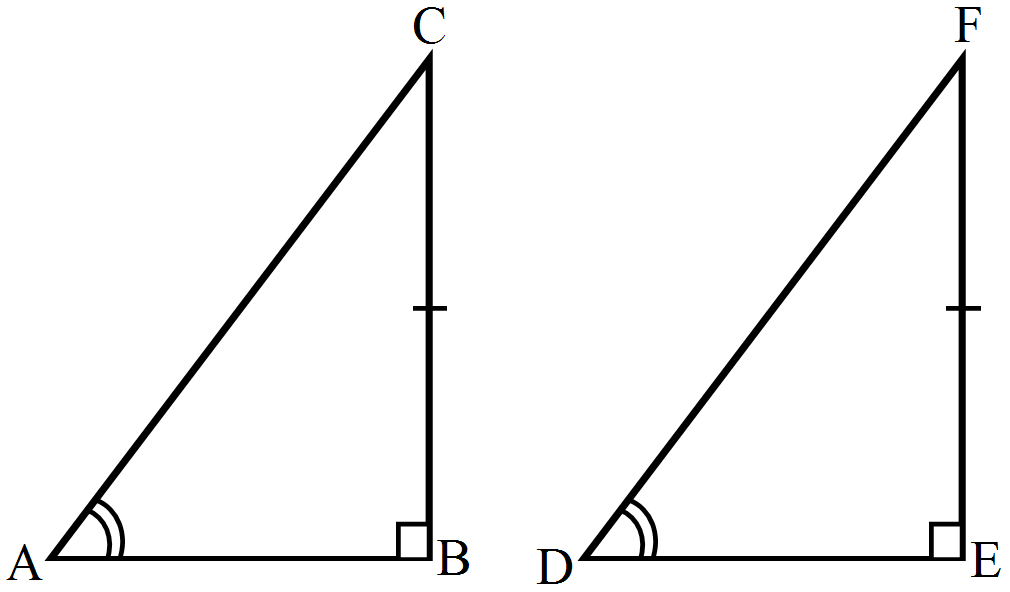
We have to prove that the triangles are congruent. Let us consider two right triangles such that $\angle\text{B}=\angle\text{C}=90^\circ\ ....(\text{i})$ $\text{AB}=\text{DE}\ ....(\text{ii})$ $\angle\text{C}=\angle\text{F}$
From $(iii)$
Now observe the two triangles $ABC$ and $DEF$
$\angle\text{C}=\angle\text{F}$ [From $(iii)]$
$\angle\text{B}=\angle\text{E}$ [From $(i)]$
and $\text{AB}=\text{DE}$ [From $(ii)]$
So, by $AAS$ congruence criterion,
we have $\triangle\text{ABC}\cong\triangle\text{DEF}$
Therefore, the two triangles are congruent Hence proved. View full question & answer→Question 124 Marks
In $\triangle ABC , \angle B =35^{\circ}, \angle C =65^{\circ}$ and the bisector of $\angle BAC$ meets$ BC$ in $P$ . Arrange $AP , BP$ and $CP$ in descending order.
AnswerIn angle $A+B+C=180 A+35+65=180 A=180-100 A=80$
So $\angle BAP$ and $\angle CAP =\frac{80}{2}=40$
we know that side opposite to the greater angle is longer $\ln \triangle BAP$
we know that side opposite to the greater angle is longer so $BP > AP$
In $\triangle CAP ACP (65)> CAP (40)$ so $AP > CP$ so $BP > AP > CP$
View full question & answer→Question 134 Marks
$A B C$ is a triangle and $D$ is the mid-point of $B C$. The perpendiculars from $D$ to $A B$ and $A C$ are equal. prove that the triangle is isosceles.
Answer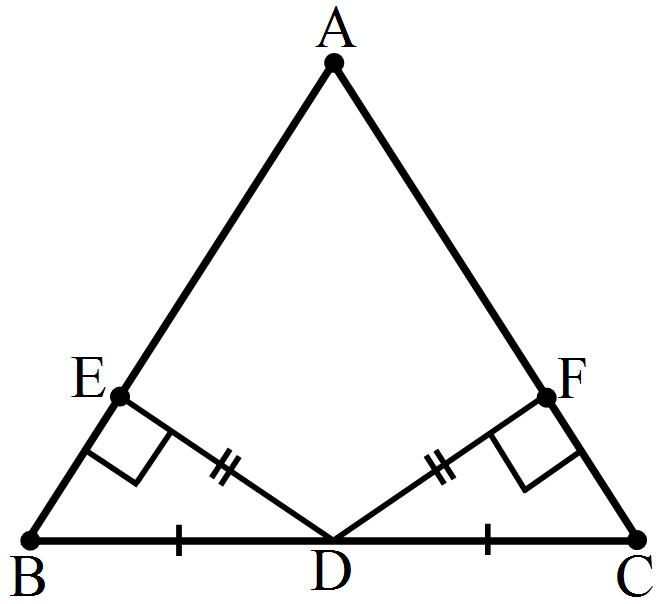
In $\triangle\text{BDE}$ and $\triangle\text{CDF}$
$\angle\text{BED}=\angle\text{DFC}=90^\circ$
[given] $\text{DE}=\text{DF}$ [given] $\text{BD}=\text{DC}$
[D is themidpoint] By $RHS$ congurence criterion
$\triangle\text{BDE}\cong\triangle\text{CDF}$
$\Rightarrow\angle\text{B}=\angle\text{C}$ [c.p.c.t]
$\Rightarrow\text{AB}=\text{AC}$ [Sides opposite to angles are equal]
Hence $\triangle\text{ABC}$ is isosceles. View full question & answer→Question 144 Marks
In a $\triangle\text{ABC},$ it is given that $\text{AB}=\text{AC}$ and the bisectors of $B$ and $C$ intersect at $O$. If $M$ is a point on $BO$ produced, prove that $\angle\text{MOC}=\angle\text{ABC}.$
AnswerGiven that in $\triangle\text{ABC},$
$\text{AB}=\text{AC}$ and the bisector of $\angle\text{B}$ and $\angle\text{C}$ intersect at $O$.
If $M$ is a point on $BO$ produced
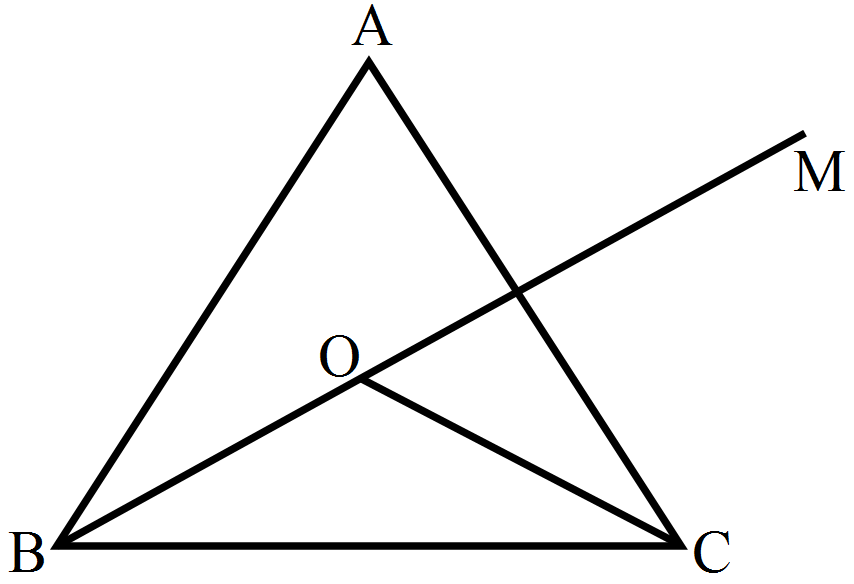
We have to prove $\angle\text{MOC}=\angle\text{ABC}$
Since, $\text{AB}=\text{AC}$ ABC is isosceles $\angle\text{B}=\angle\text{C}\text{ (or})$
$\angle\text{ABC}=\angle\text{ACB}$
Now, $BO$ and $CO$ are bisectors of $\angle\text{ABC}$ and $\angle\text{ACB}$ respectively $\Rightarrow\text{ABO}=\angle\text{OBC}=\angle\text{ACO}=\angle\text{OCB}$
$=\frac{1}{2}\angle\text{ABC}=\frac{1}{2}\angle\text{ACB}\ ...(\text{i)}$
We have, $\triangle\text{OBC}$
$\angle\text{OBC}+\angle\text{OCB}+\angle\text{BOC}=180^\circ\ ....(\text{ii)}$ And also $\angle\text{BOC}+\angle\text{COM}=180^\circ\ ....(\text{iii)}$ [Straight angle]
Equating $(ii)$ and $(iii)$
$\angle\text{OBC}+\angle\text{OCB}+\angle\text{BOC}=\angle\text{BOC}+\angle\text{MOC}$
$\angle\text{OBC}+\angle\text{OCB}=\angle\text{MOC}$ [From $(i)]$
$2\Big(\frac{1}{2}\angle\text{ABC}\Big)=\angle\text{MOC}$ [From $(i)]$
$\angle\text{ABC}=\angle\text{MOC}$
Therefore, $\angle\text{MOC}-=\angle\text{ABC}$ View full question & answer→Question 154 Marks
In $\triangle\text{ABC},$ if $\angle\text{A}=40^\circ$ and $\angle\text{B}=60^\circ.$ Determine the longest and shortest sides of the triangle.
AnswerGiven that in $\triangle\text{ABC},\angle\text{A}=40^\circ$ and $\angle\text{B}=60^\circ$
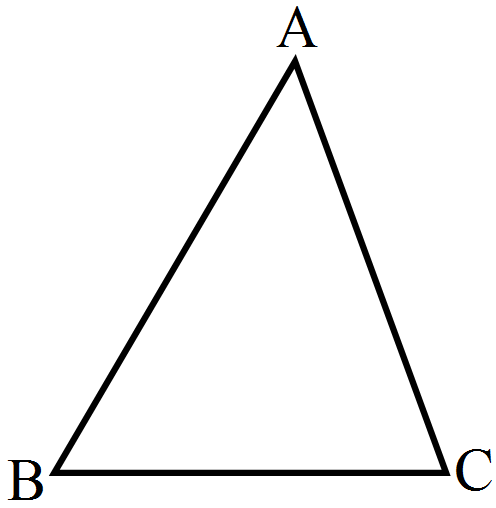
We have to find longest and shortest side We know that,
Sum of angles in a triangle $180^\circ $
$\angle\text{A}+\angle\text{B}+\angle\text{C}=180^\circ$
$40^\circ+60^\circ-\big((10)0^\circ\big)=180^\circ$
$\angle\text{C}=180^\circ$ Now, $\Rightarrow40^\circ<60^\circ<80^\circ=\angle\text{A}<\angle\text{B}<\angle\text{C}$
$\Rightarrow\angle\text{C}$ is greater angle and $\angle\text{A}$ is smaller angle.
Now, $\angle\text{A}<\angle\text{B}<\angle\text{C}$
$\Rightarrow\text{BC}<\text{AAC}<\text{AB}$
[Side opposite to greater angle is larger and side opposite to smaller angle is smaller]
$AB$ is longest and $BC $is smallest or shortest side. View full question & answer→Question 164 Marks
Find the measure of each exterior angle of an equilateral triangle.
AnswerGiven to find the measure of each exterior angle of an equilateral triangle consider an equilateral triangle $A B C$.
We know that for an equilateral triangle $AB = BC = CA$ and $\angle ABC =\angle BCA = CAB =\frac{180^{\circ}}{3}=60^{\circ} \ldots (i)$
Now, Extend side $B C$ to $D, C A$ to $E$ and $A B$ to $F$.
Here $B C D$ is a straight line segment $B C D=$ Straight angle $=180^{\circ}$
$\angle BCA +\angle ACD =180^{\circ}[$ From $(i) ] $
$60^{\circ}+\angle ACD =180^{\circ} \angle ACD =120^{\circ}$ similarly,
we can find $\angle FAB$ and $\angle FBC$ also as $120^{\circ}$
because $ABC$ is an equilateral triangle $\angle ACD =\angle EAB -\angle FBC =120^{\circ}$
Hence, the median of each exterior angle of an equilateral triangle is $120^{\circ}$
View full question & answer→Question 174 Marks
Prove that each angle of an equilateral triangle is$ 60^\circ .$
AnswerGiven to prove each angle of an equilateral triangle is 60°. Let us consider an equilateral triangle ABC. Such that AB = BC = CA Now, AB = BC $\angle\text{A}=\angle\text{C}\ ....(\text{i})$ [Opposite angles to equal sides are equal] And $\text{BC}=\text{AC}$ $\angle\text{B}=\angle\text{A}\ ...(\text{ii)}$ From (i) and (ii), we get $\angle\text{A}=\angle\text{B}=\angle\text{C}\ ...(\text{iii})$ 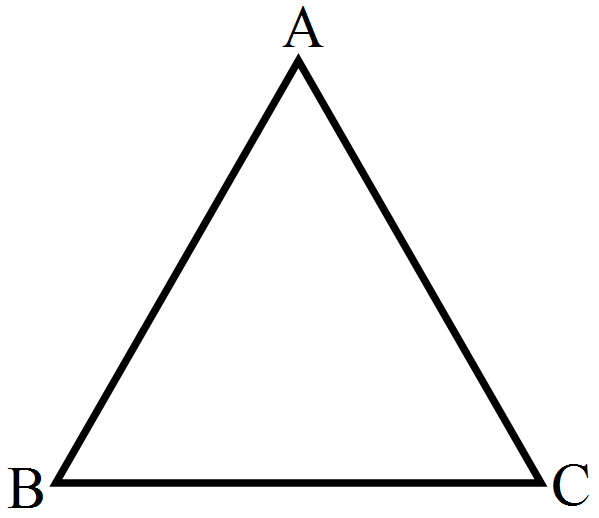
We know that Sum of angles in a triangle = 180 $\angle\text{A}+\angle\text{B}+\angle\text{C}=180$
$\angle\text{A}+\angle\text{A}+\angle\text{A}=180$
$3\angle\text{A}=60$
$\angle\text{A}=60$
$\angle\text{A}=\angle\text{B}=\angle\text{C}=60$
Hence, each angle of an equilateral triangle is $60^\circ .$ View full question & answer→Question 184 Marks
In the given figure, if $\text{AB}=\text{AC}$ and $\angle\text{B}=\angle\text{C}.$ Prove that $\text{PQ}=\text{CP}.$ 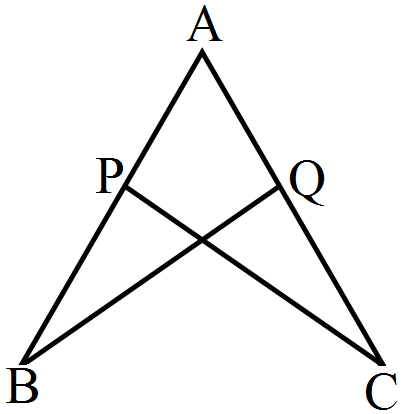
AnswerIt is given that $\text{AB}=\text{AC},$ and $\angle\text{B}=\angle\text{C}$
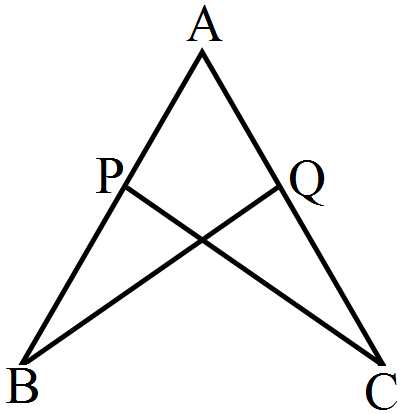
We have to prove that $\text{BQ}=\text{CP}$
We basically will prove $\triangle\text{ABQ}\cong\triangle\text{ACP}$ to
show $\text{BQ}=\text{CP}$ In $\triangle\text{ABQ}$ and $\triangle\text{ACP}$
$\angle\text{B}=\angle\text{C}$ (Given) $\text{AB}=\text{AC}$
(Given) And $\angle\text{A}$ is common in both the triangles
So all the properties of congruence are satisfied
So $\triangle\text{ABQ}\cong\triangle\text{ACP}$
Hence $\text{BQ}=\text{CP}$ Proved. View full question & answer→Question 194 Marks
Is it possible to draw a triangle with sides of length $2\ cm, 3\ cm$ and $7\ cm?$
AnswerGiven lengths of sides are $2\ cm, 3\ cm$ and $7\ cm$
To check whether it is possible to draw a triangle with the given lengths of sides
We know that,A triangle can be drawn only when the sum of any two sides is greater than the third side.
So, let's check the rule. $2+3\not>7\text{ or }2+3<7$
$2+7>3$ and $3+7>2$ Here $2+3\not=7$
So, the triangle does not exit.
View full question & answer→Question 204 Marks
$ABC$ is a right angled triangle in which $\angle\text{A}=90^\circ$ and $\text{AB}=\text{AC}.$ and $\angle\text{B}$ and $\angle\text{C}.$
AnswerGiven that $ABC$ is a right angled triangle such that $\angle\text{A}=90^\circ$ and $\text{AB}=\text{AC}$
since, $\text{AB}=\text{AC}$
$\triangle\text{ABC}$ is also isosceles.
Therefore, we can say that $\triangle\text{ABC}$ is right angled isosceles triangle.
$\angle\text{C}=\angle\text{B}$ and $\angle\text{A}=90^\circ \ ...(\text{i)}$
Now, we have sum of angled in a triangle $= 180^\circ$
$\angle\text{A}+\angle\text{B}+\angle\text{C}=180^\circ$
$90^\circ+\angle\text{B}+\angle\text{B}=180^\circ$ [From $(i)]$
$2\angle\text{B}=180^\circ-90^\circ$
$\angle\text{B}=45^\circ$
Therefore, $\angle\text{B}=\angle\text{C}=45^\circ$
View full question & answer→Question 214 Marks
Two lines $AB$ and $CD$ intersect at $O$ such that $BC$ is equal and parellel to $AD$. prove that the lines $AB$ and $CD$ bisect at $O.$
AnswerIn $\triangle\text{AOD}$ and $\triangle\text{BOC}$
$\angle\text{BCO}=\angle\text{ADO}$ [alternate angles]
$\angle\text{DAO}=\angle\text{CBO}$ [alternate angles]
$\text{BC}=\text{AD}$ [given] By $ASA$ conguence criterion $\triangle\text{AOD}\cong\triangle\text{BOC}$
$\therefore\text{BO}=\text{OA}$ [c.p.c.t] $\text{OC}=\text{OD}$ [c.p.c.t]
Therefore, $AB$ and $CD$ bisect at $O.$
View full question & answer→Question 224 Marks
In Fig. $AB = AC $and $DB = DC$, find the ratio $\angle\text{ABD}:\angle\text{ACD}.$
AnswerConsider the figure.
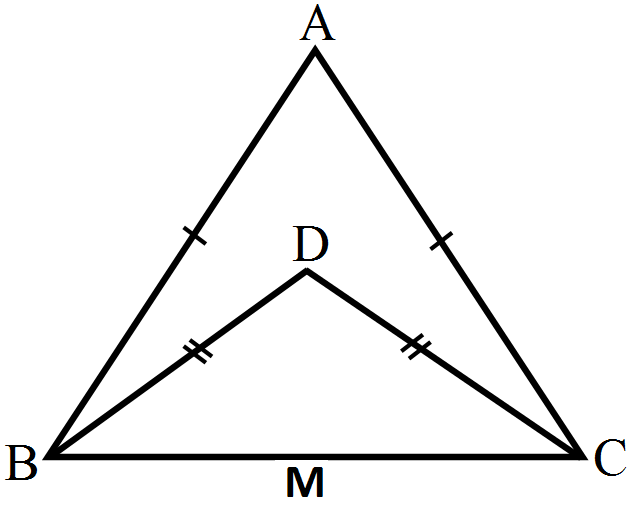
Given, $AB = AC, DB = DC$ and given to find the ratio $\angle\text{ABC}=\angle\text{ACD}$
Now, $\triangle\text{ABC}$ and $\triangle\text{DBC}$ are isosceles triangles since $\text{AB}=\text{AC}$ and $\text{DB}=\text{DC}$ respectively $\angle\text{ABC}=\angle\text{ACB}$ and $\angle\text{DBC}=\angle\text{DCB}$ [Angles opposite to equal sides are equal]
Now consider, $\angle\text{ABC}:\angle\text{ACD}$
$(\angle\text{ABC}-\angle\text{DBC}):(\angle\text{ACB}-\angle\text{DCB})$
$(\angle\text{ABC}-\angle\text{DBC}):(\angle\text{ABC}-\angle\text{DBC})$
$[\angle\text{ABC}=\angle\text{ABC}=\angle\text{ACB}\text{ and }\angle\text{DBC}=\angle\text{DBC]}$
$1:1$
$\text{ABC}:\text{ACD}=1:1$ View full question & answer→Question 234 Marks
If the bisector of the exterior vertical angle of a triangle be parallel to the base. Show that the triangle is isosceles.
AnswerGiven that the bisector of the exterior vertical angle of a triangle is parallel to the base and we have to prove that the triangle is isosceles. Let $ABC$ be a triangle such that $AD$ is the angular bisector of exterior vertical angle $EAC$ and $AD \| BC.$ 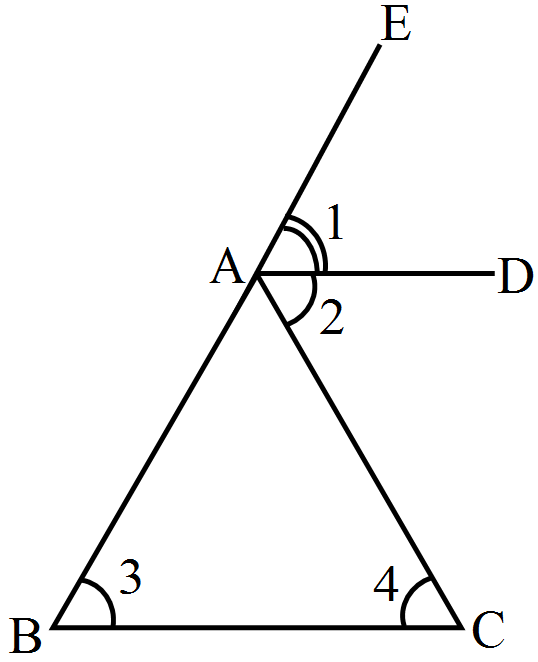
Let $\angle\text{EAD}= (\text{i}),$
$\angle\text{DAC}=(\text{ii}),$
$\angle\text{ABC}=(\text{iii})$ and $\angle\text{ACB}=(\text{iv})$
We have, $(i) = (ii)$
$\big[$AD is a bisector of $\angle\text{EAC}\big]$ $(i) = (iii)$
[Corresponding angles] and $(ii) = (iv)$
[alternative angle] $(iii) = (iv) \text{AB}=\text{AC}$
Since, in $\triangle\text{ABC},$
two sides $AB$ and $AC$ are equal we can say that
$\triangle\text{ABC}$ is isosceles triangle. View full question & answer→Question 244 Marks
In fig. $\text{PQRS}$ is a square and $\text{SRT}$ is an equilateral triangle. Prove that:
$i. PT = QT.$
$ii. \angle\text{TQR}=15^\circ.$
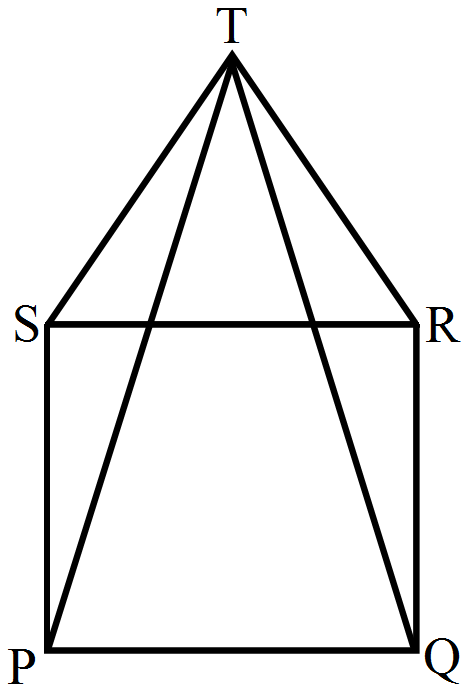
AnswerGiven that $\text{PQRS}$ is a square and $\text{SRT}$ is an equilateral triangle. And given to prove that
$i.\text{PT}=\text{QT}$
$ii.\angle\text{TQR}=15^\circ$
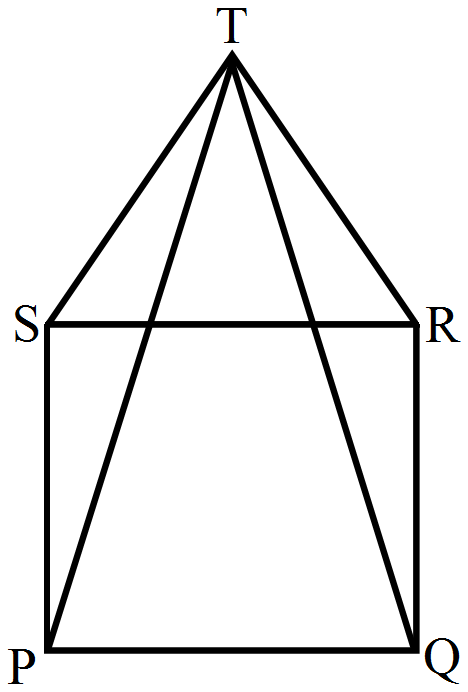
Now, $\text{PQRS}$ is a square
$\text{PQ}=\text{QR}=\text{RS}=\text{SP}\ ....(\text{i)}$
and $\angle\text{SPQ}=\angle\text{PQR}=\angle\text{QRS}=\angle\text{RSP}=90^\circ=\text{tight angle}$
And also, $\text{SRT}$ is an equilateral triangle.
$\text{SR}=\text{RT}=\text{TS}\ .....(\text{ii)}$
and $\angle\text{TSR}=\angle\text{SRT}=\angle\text{RTS}=60^\circ$
From $(i)$ and $(ii)$
$\text{PQ}=\text{QR}=\text{SP}=\text{SR}=\text{RT}=\text{TS}\ ....(\text{iii)}$
And also,
$\angle\text{TSP}=\angle\text{TSR}+\angle\text{RSP}=60^\circ+90^\circ+150^\circ$
$\Rightarrow\angle\text{TSR}=\angle\text{TRQ}=150^\circ\ .....(\text{iv)}$
$\text{SP}=\text{RQ} [$From $(iii)]$
So, by $\text{SAS}$ congruence criterion we have
$\triangle\text{TSP}=\triangle\text{TRQ}$
$\text{PT}=\text{QT} [$Corresponding parts of congruent triangles are equal$]$
Consider $\triangle\text{TQR}.$
$\text{QR}=\text{TR} [$From $(iii)]$
$\triangle\text{TQR}$ is a isosceles triangle.
$\angle\text{QTR}=\angle\text{TQR} [$angles opposite to equal sides$]$
Now,
Sum of angles in a triangle is equal to $180^\circ .$
$\Rightarrow\angle\text{QTR}+\angle\text{TQR}+\angle\text{TRQ}=180^\circ$
$\Rightarrow2\angle\text{TQR}+150^\circ=180^\circ [$From $(iv)]$
$\Rightarrow2\angle\text{TQR}=180^\circ-150^\circ$
$\Rightarrow2\angle\text{TQR}=30^\circ[\angle\text{TQR}=15^\circ]$
Hence proved.
View full question & answer→Question 254 Marks
Prove that the sum of three altitudes of a triangle is less than the sum of its sides.
AnswerWe have to prove that the sum of three altitude of the triangle is less than the sum of its sides. In $\triangle\text{ABC}$
we have $\text{AD}\perp\text{BC},\text{BE}\perp\text{AC}$ and $\text{CF}\perp\text{AB}$
We have to prove $\text{AD}+\text{BE}+\text{CF}<\text{AB}+\text{BC}+\text{AC}$
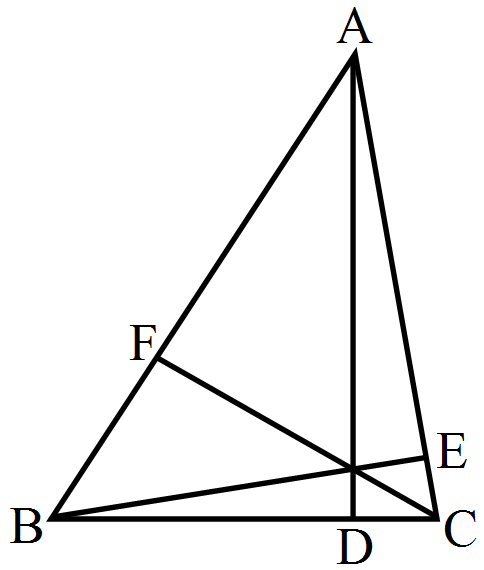
As we know perpendicular line segment is shortest in length Since $\text{AD}\perp\text{BC}$
So $\text{AB}>\text{AD}\ .....(1)$
And $\text{AC}>\text{AD}\ ......(2)$
Adding $(1)$ and $(2)$
we get $\text{AB}+\text{AC}>\text{AD}+\text{AD}$
$\text{AB}+\text{AC}>2\text{AD}\ ......(3)$
Now $\text{BE}\perp\text{AC},$
so $\text{BC}+\text{BA}>\text{BE}+\text{BE}$
$\text{BC}+\text{BA}>2\text{BE}\ ......(4)$ And again $\text{CF}\perp\text{AB},$ this implies that $\text{AC}+\text{BC}>2\text{CF}\ .....(5)$
Adding $(3) \& (4)$ and $(5)$
we have $(\text{AB}+\text{AC})+(\text{AB}+\text{BC})$
$+(\text{AC}+\text{BC)}>2\text{AD}+2\text{BE}+2\text{CF}$
$\Rightarrow(\text{AB}+\text{BC}+\text{AC})>2(\text{AD}+\text{BE}+\text{CF})$
Hence $\text{AD}+\text{BE}+\text{CF}<\text{AB}+\text{BC}+\text{AC}$ Proved. View full question & answer→Question 264 Marks
$CDE$ is an equilateral triangle formed on a side $CD$ of a square $ABCD$. Show that $\triangle\text{ADE}\cong\triangle\text{BCE}.$
AnswerWe have to prove that $\triangle\text{ADE}\cong\triangle\text{BCE}$
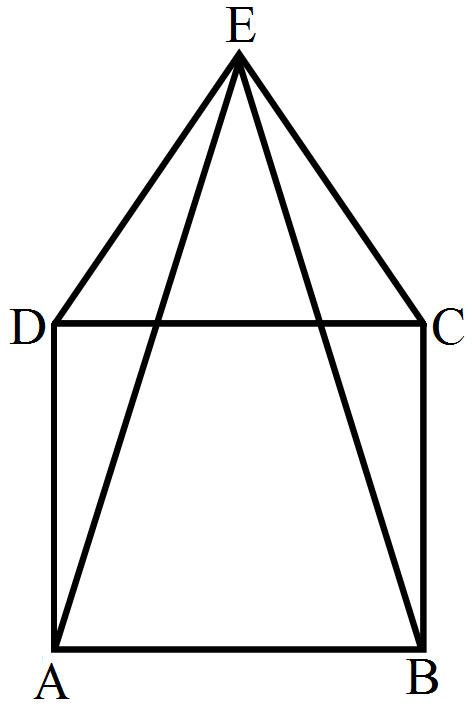
Given $ABCD$ is a square So $\text{AB}=\text{BC}=\text{CD}=\text{AD}$
Now in $\triangle\text{EDC}$ is equilateral triangle.
So $\text{DE}=\text{EC}=\text{CB}$ In $\triangle\text{AED}$ and $\triangle\text{CEB}$
$\text{AD}=\text{BC}$ (Side of triangle) $\text{DE}=\text{CE}$ (Side of equilateral triangle) $\angle\text{ADE}=\text{ADC}+\angle\text{CDE}$
$=90+60$
$=150$ And, $\angle\text{BCE} =\angle\text{BCD}+\angle\text{DCE}$
$90+60$
$=150$ So $\angle\text{ADE}=\angle\text{BCE}$ Hence from $SAS$ congruence $\triangle\text{ADE}\cong\triangle\text{BCE}$ Proved. View full question & answer→Question 274 Marks
Angles $A, B, C$ of a triangle $ABC$ are equal to each other. Prove that $\triangle\text{ABC}$ is equilateral.
AnswerGiven that angles $A, B, C$ of a triangle $ABC$ equal to each other.
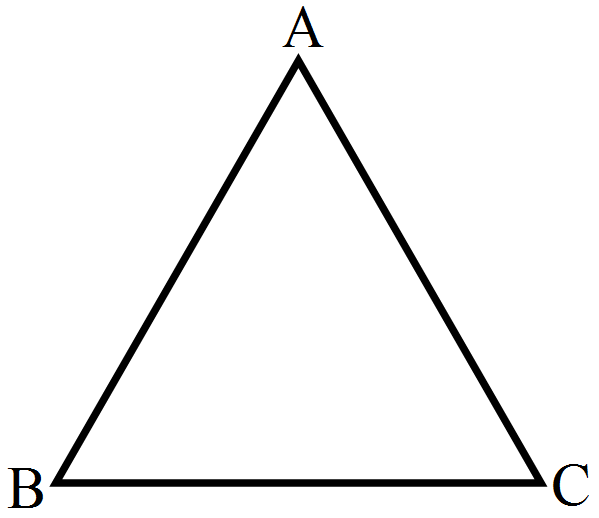
We have to prove that $\triangle\text{ABC}$ is equilateral
We have, $\angle\text{A}=\angle\text{B}=\angle\text{C}$
Now, $\angle\text{A}=\angle\text{B}$ $BC = AC$
[opposite sides to equal angles are equal] And $\angle\text{B}=\angle\text{C}$
$\text{AC}=\text{AB}$ From the above we get $\text{AB}=\text{BC}=\text{AC}$
$\triangle\text{ABC}$ is equilateral. View full question & answer→Question 284 Marks
In a $\triangle\text{ABC},$ if $\angle\text{A}=120^\circ$ and $\text{AB}=\text{AC}.$ Find $\angle\text{A}$ and $\angle\text{C}.$
AnswerConsider a $\triangle\text{ABC}.$
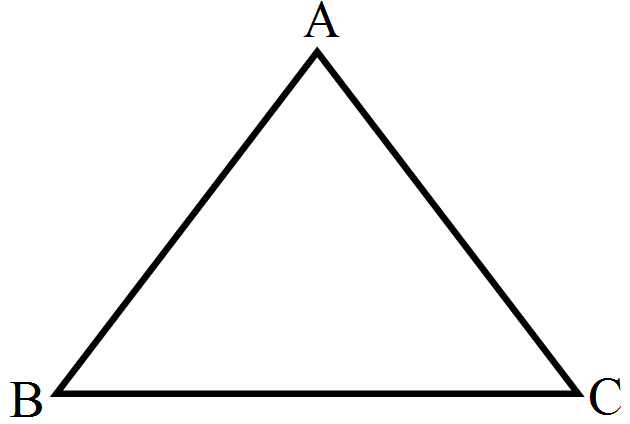
Given Mat $\angle\text{A}=120^\circ$ and $\text{AB}=\text{AC}$ and given to find $\angle\text{B}$ and $\angle\text{C}.$
We can observe that $\triangle\text{ABC}$ is an isosceles triangle since $\text{AB}=\text{AC}$
$\angle\text{B}=\angle\text{C}$ $(i)$ [Angles opposite to equal sides are equal]
We know that sum of angles in a triangle is equal to $180^\circ $
$\Rightarrow\angle\text{A}+\angle\text{B}+\angle\text{C}=180^\circ$
$\Rightarrow\angle\text{A}+\angle\text{B}+\angle\text{B}=180^\circ$
$\Rightarrow120^\circ+2\angle\text{B}=180^\circ$
$\Rightarrow2\angle\text{B}=180^\circ-120^\circ$
$\Rightarrow\angle\text{B}=\angle\text{C}=30^\circ$ View full question & answer→Question 294 Marks
Determine the measure of each of the equal angles of a right-angled isosceles triangle. $OR ABC$ is a right-angled triangle in which $\angle\text{A}=90^\circ$ and $\text{AB}=\text{AC}.$ Find $\angle\text{A}$ and $\angle\text{C}.$
Answer$ABC$ is a right angled triangle Consider on a right - angled isosceles triangle $ABC$ such that $\angle\text{A}=90^\circ$ and $\text{AB}=\text{AC}$ since, $\text{AB}=\text{AC}$
$\Rightarrow\angle\text{C}=\angle\text{B}\ ....(\text{i)}$ [Angles opposite to equal sides are equal]
Now, Sum of angles in a triangle $= 180^\circ \angle\text{A}+\angle\text{B}+\angle\text{C}=180^\circ$
$\Rightarrow90^\circ+\angle\text{B}+\angle\text{B}=180^\circ$
$\Rightarrow2\angle\text{B}=90^\circ$
$\Rightarrow\angle\text{B}=45^\circ$
$\angle\text{B}=45^\circ,\angle\text{C}=45^\circ$
Hence, the measure of each of the equal angles of a right-angled Isosceles triangle Is $45^\circ $
View full question & answer→Question 304 Marks
Prove that the medians of an equilateral triangle are equal.
AnswerGiven, To prove the medians of an equilateral triangle are equal. Median: The line Joining the vertex and midpoint of opposite side. Now, consider an equilateral triangle $A B C$. Let $D, E, F$ are midpoints of $B C, C A$ and $A B$.
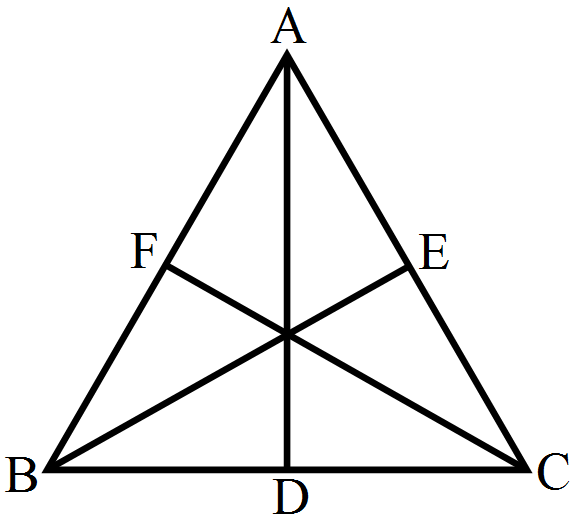
Then, $AD, BE$ and $CF$ are medians of $ABC$.
Now, $D$ is midpoint of $\text{BC}$
$\Rightarrow\text{BD}=\text{DC}=\frac{\text{BC}}{2}$
Similarly, $\text{CE}=\text{EA}=\frac{\text{AC}}{2}$
$\text{AF}=\text{FB}=\frac{\text{AB}}{2}$
Since$\triangle\text{ABC}$ is an equilateral triangle
$\Rightarrow\text{AB}=\text{BC}=\text{CA}\ ...(\text{i)}$
$\Rightarrow\text{BD}=\text{DC}=\text{CE}=\text{EA}=\text{AF}=\text{FB}$
$=\frac{\text{BC}}{2}=\frac{\text{AC}}{2}=\frac{\text{AB}}{2}\ ...(\text{ii})$ And also, $\angle\text{ABC}=\angle\text{BCA}=\angle\text{CAB}=60^\circ\ ....(\text{iii)}$
Now, consider $\triangle\text{ABC}$ and $\triangle\text{BCE}\text{ AB}=\text{BC}$ [From $(i)]$
$\text{BD}=\text{CE}$ [From $(ii)]$
Now, in $\triangle\text{TSR}$ and $\triangle\text{TRQ}$
$\text{TS}=\text{TR}$ [From $(iii)]$
$\angle\text{ABD}=\angle\text{BCE}$ [From $(iii)]$
$\big[\angle\text{ABD}$ and $\angle\text{ABC}$ and $\angle\text{BCE}$ and $\angle\text{BCA}$ are same $\big]$
So, from $SAS$ congruence criterion,
we have $\triangle\text{ABD}=\triangle\text{BCE}$
$\text{AD}=\text{BE}\ ...(\text{iv})$ [Corresponding parts of congruent triangles are equal]
Now, consider $\triangle\text{BCE}$ and $\triangle\text{CAF},\text{BC}=\text{CA}$ [From $(i)]$
$\angle\text{BCE}=\angle\text{CAF}$ [From $(ii)]$
$\big[\angle\text{BCE}$ and $\angle\text{BCA}$ and $\angle\text{CAF}$ and $\angle\text{CAB}$ are same $\big]$
$\text{CE}=\text{AF}$ [From $(ii)]$
So, from $SAS$ congruence criterion,
we have $\triangle\text{BCE}=\triangle\text{CAF}$
[Corresponding parts of congruent triangles are equal]
From $(iv)$ and $(v)$, we have $A D=B E=C F$ Median $A D=$ Median $B E=$ Median $C F$ The medians of an equilateral triangle are equal. Hence proved View full question & answer→Question 314 Marks
Prove that the perimeter of a triangle is greater than the sum of its altitudes.
AnswerGiven, $\triangle\text{ABC}$ in which $\text{AD}\perp\text{BC},\text{ DE}\perp\text{AC }$and $\text{CF}\perp\text{AB}$ To prove, $AD + BE + CF < AB + BC + AC$ Figure:
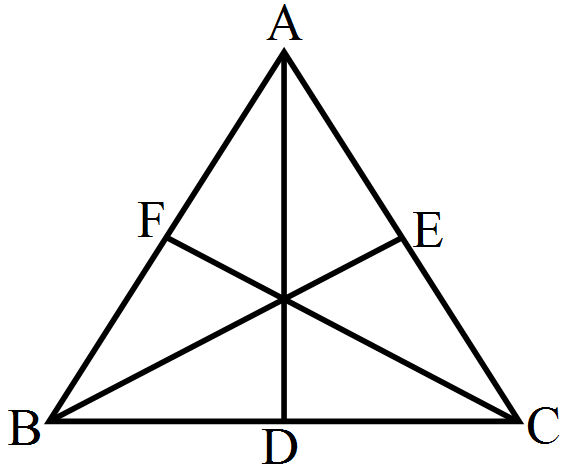
Proof: We know that of all the segments that can be drawn to a given line, from a point not lying on it, the perpendicular distance i.e, the perpendicular line segment is the shortest.Therefore
$\text{AD}\perp\text{BC}AB > AD$ and $AC > AD$
$AB + AC > 2AD .... (i)$
$\text{BE}\perp\text{AC}BA > BE$ and $BC > BE$
$BA + BC > 2BE ... (ii)$
$\text{CF}\perp\text{AB}CA > CF$ and $CB > CF$
$CA + CB > 2CF ... (iii)$
Adding $(i), (ii)$ and $(iii)$, we get $AB + AC + BA + BC + CA + CB > 2AD + 2BE + 2CF 2AB + 2BC$$ + 2CA > 2(AD + BE + CF) AB + BC + CA > AD + BE + CF$
The perimeter of the triangle is greater than that the sum of its altitudes. Hence proved View full question & answer→Question 324 Marks
The vertical angle of an isosceles triangle is $100^\circ $. Find its base angles.
AnswerConsider an isosceles $\triangle\text{ABC}$ such that $\text{AB}=\text{AC}$
Given that vertical angle A is $100^\circ $
To find the base angles Since $\triangle\text{ABC}$ is isosceles $\angle\text{B}=\angle\text{C}$
[Angles opposite to equal sides are equal] And
also, Sum of interior angles of a triangle $= 180^\circ $
$\angle\text{A}+\angle\text{B}+\angle\text{C}=180^\circ$
$(10)0^\circ+\angle\text{B}\angle\text{B}=180^\circ$
$2\angle\text{B}=180^\circ-(10)0^\circ$
$\angle\text{B}=40^\circ$$\angle\text{B}=\angle\text{C}=40^\circ$
View full question & answer→Question 334 Marks
In $\triangle\text{ABC},$ side $AB$ is produced to $D$ so that $\text{BD}=\text{BC}.$ if $\angle\text{B}=60^\circ$ and $\angle\text{A}=70^\circ.$ Prove that: $(i) AD > CD (ii) AD > AC$
AnswerGiven that, in $\triangle\text{ABC},$ side $AB$ is produced to $D$ so that $\text{BD}=\text{BC}.$
$\angle\text{B}=60^\circ,$ and $\angle\text{A}=70^\circ$
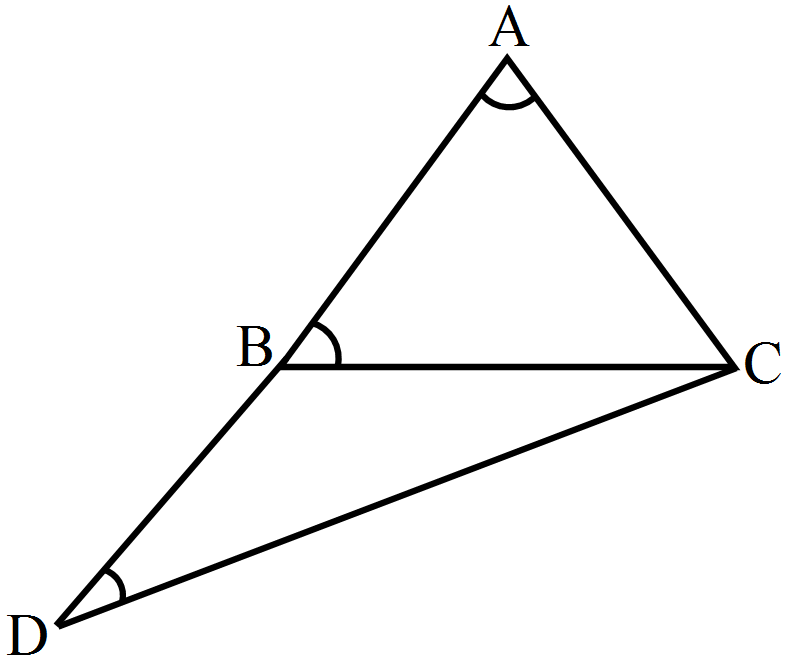
To prove, $AD > CD AD > AC$ First join $C$ and $D$
We know that, Sum of angles in a triangle $=180^\circ $
$\angle\text{A}+\angle\text{B}+\angle\text{C}=180^\circ$
$70^\circ+60^\circ+\angle\text{C}=180^\circ$
$\angle\text{C}=180^\circ-(130^\circ)=50^\circ$
$\angle\text{C}=50^\circ$
$\angle\text{ACB}=50^\circ\ ...(\text{i)}$ And also in $\triangle\text{BDC}$
$\angle\text{DBC}=180^\circ-\angle\text{ABC}$ [$ABD$ is a straight angle]
$180^\circ-60^\circ=120^\circ$ and also $\text{BD}=\text{BC}$ [given]
$\angle\text{BCD}=\angle\text{BDC}$ [Angles opposite to equal sides are equal]
Now, $\angle\text{DBC}+\angle\text{BCD}+\angle\text{BDC}=180^\circ$ [Sum of angles in a triangle $=180^\circ $] $\Rightarrow120^\circ+\angle\text{BCD}+\angle\text{BCD}=180^\circ$
$\Rightarrow120^\circ+2\angle\text{BCD}=180^\circ$
$\Rightarrow2\angle\text{BCD}=180^\circ-120^\circ=60^\circ$
$\Rightarrow\angle\text{BCD}=30^\circ$
$\Rightarrow\angle\text{BCD}=\angle\text{BDC}=30^\circ\ ....(\text{ii)}$
Now, consider $\triangle\text{ADC}.$
$\angle\text{BAC}\Rightarrow\angle\text{DAC}=70^\circ$ [given] $\angle\text{BDC}$
$\Rightarrow\angle\text{ADC}=30^\circ$ [From $(ii)]$
$\angle\text{ACD}=\angle\text{ACB}+\angle\text{BCD}$ $= 50^\circ + 30^\circ$ [From $(i)$ and $(ii)] = 80^\circ$
Now, $\angle\text{ADC}<\angle\text{DAC}<\angle\text{ACD}$
$\text{AC}<\text{DC}<\text{AD}$ [Side opposite to greater angle is longer and smaller angle is smaller]
$\text{AD}>\text{CD}$ and $\text{AD}>\text{AC}$
Hence proved Or,
We have, $\angle\text{ACD}>\angle\text{DAC}$ and $\angle\text{ACD}>\angle\text{ADC}$
$\text{AD}>\text{DC}$ and $\text{AD}>\text{AC}$
[Side opposite to greater angle is longer and smaller angle is smaller] View full question & answer→Question 344 Marks
$ABCD$ is a square, $X$ and $Y$ are points on sides $AD$ and $BC$ respectively such that $\text{AY}=\text{BX}.$ prove that $\text{BY}=\text{AX}$ and $\angle\text{BAY}=\angle\text{ABX}.$
Answer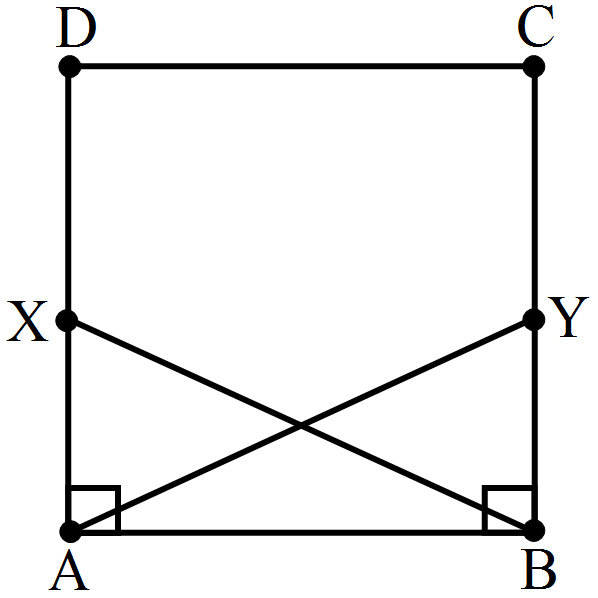
In $\triangle\text{ABX}$ and $\triangle\text{BAY}$
$\text{AY}=\text{BX}$ [given] $\text{AB}=\text{AB}$ [common]
$\angle\text{BAX}=\angle\text{ABY}=90^\circ$ [given]
By $RHS$ congurence criterion $\triangle\text{ABX}\cong\triangle\text{BAY}$
$\therefore\text{AY}=\text{BX}$ [c.p.c.t]
$\angle\text{BAY}=\angle\text{ABX}$ [c.p.c.t] View full question & answer→Question 354 Marks
If perpendiculars from any point within an angle on its arms are congruents, prove that it lies on thebisector of that angle.
Answer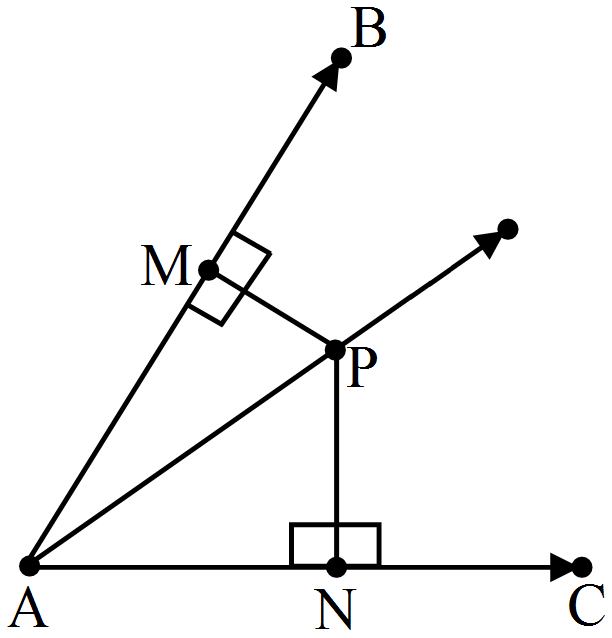
Here $\text{PM}=\text{PN}$ and $\angle\text{PMA}=\angle\text{PNA}=90^\circ$
In $\triangle\text{APM}$ and $\triangle\text{APN}$
$\text{AP}=\text{AP}$ [common]
$\text{PN}=\text{PM}$ [given]
$\angle\text{PMA}=\angle\text{PNA}=90^\circ$ [given]
By $RHS$ congurence criterion
$\triangle\text{APN}\cong\triangle\text{APN}$
$\therefore\angle\text{MAP}=\angle\text{NAP}$ [c.p.c.t]
Hence, $AP$ is the bisector of $\angle\text{BAC}.$ View full question & answer→Question 364 Marks
In a $\triangle\text{ABC},$ if $\angle\text{B}=\angle\text{C}=45^\circ,$ which is the longest side?
AnswerGiven that in $\triangle\text{ABC},$
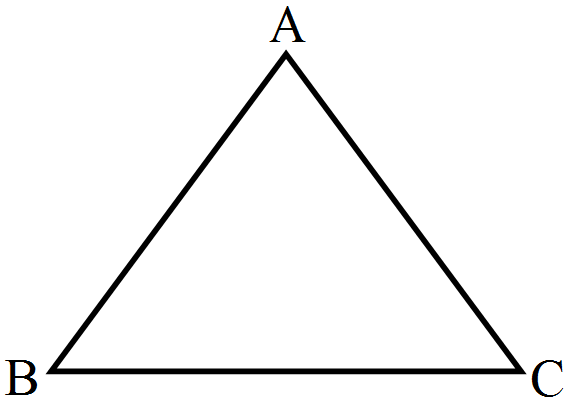
$\angle\text{B}=\angle\text{C}=45^\circ$
We have to find longest side We know that. Sum of angles in a triangle $= 180^\circ $
$\angle\text{A}+\angle\text{B}+\angle\text{C}=180^\circ$
$\angle\text{A}+45^\circ+45^\circ=180^\circ$
$\angle\text{A}=180^\circ-(45^\circ+45^\circ)=180^\circ-90^\circ=90^\circ$
$\angle\text{A}=90^\circ$ View full question & answer→Question 374 Marks
$P$ is a point on the bisector of an $\angle\text{ABC}.$ If the line through $P$ parallel to $AB$ meets $BC$ at $Q$, prove that triangle $BPQ$ is isosceles.
AnswerGiven that $P$ is a point on the bisector of an $\angle\text{ABC},$ and $\text{PQ}\parallel\text{AB}.$
We have to prove that $\triangle\text{BPQ}$ is isosceles.
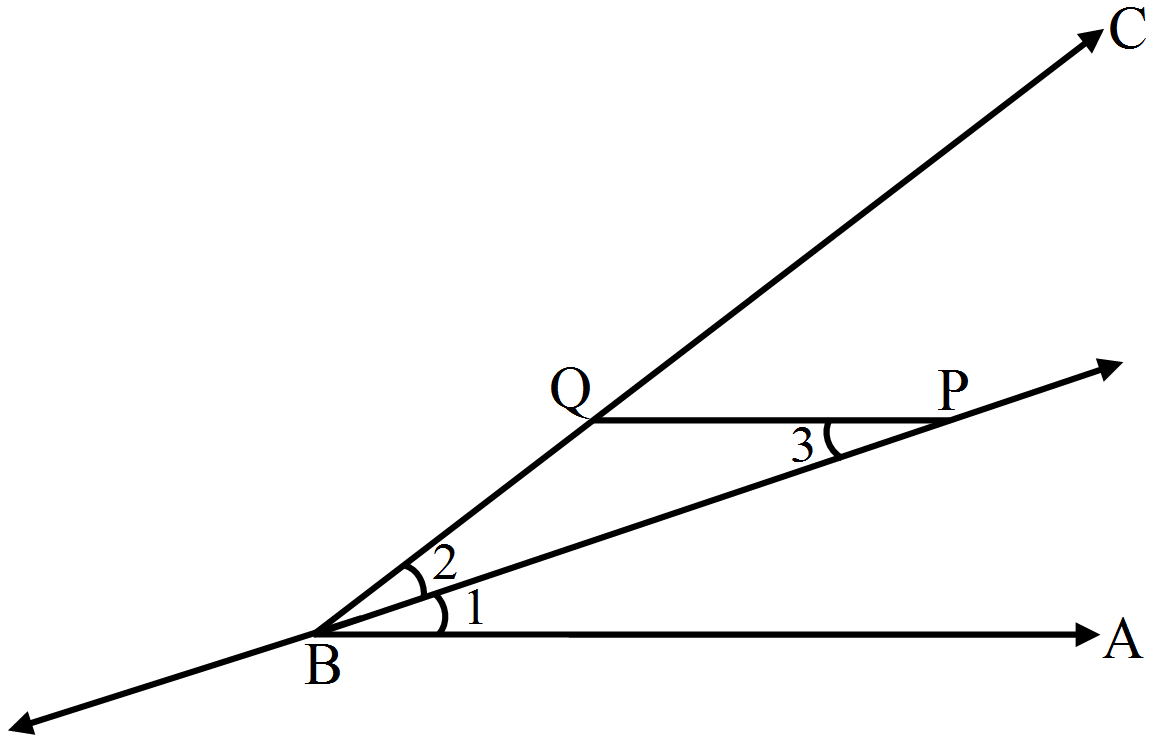
Since, $BP$ is bisector of $\angle\text{ABC}=\angle\text{ABP}=\angle\text{PBC}\ ....(\text{i)}$
Now, $\text{PQ}\parallel\text{AB}$
$\angle\text{BPQ}=\angle\text{ABP}\ ....(\text{ii)}$ [alternative angles]
From $(i)$ and $(ii),$
we get $\angle\text{BPQ}=\angle\text{PBC}\text{ (or}) \ \angle\text{BPQ}=\angle\text{PBQ}$ Now, In $\text{BPQ},$
$\angle\text{BPQ}=\angle\text{PBQ}$
$\triangle\text{BPQ}$ is an isosceles triangle.
Hence proved. View full question & answer→Question 384 Marks
In a $\triangle\text{PQR},$ if $PQ = QR$ and $L, M$ and $N$ are the mid-points of the sides $PQ, QR$ and $RP$ respectively. Prove that $LN = MN.$
AnswerGiven that, In $\triangle\text{PQR},$ $PQ = QR$ and $L, M, N$ are midpoints of the sides $PQ, QP$ and $RP$ respectively and given to prove that $LN = MN$
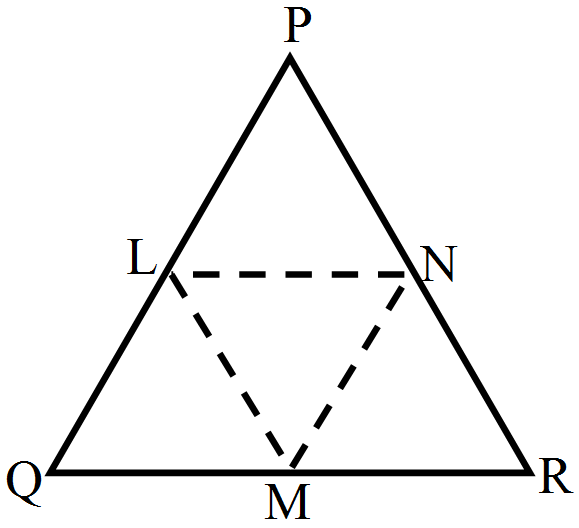
Here we can observe that $\triangle\text{PQR}$ is an isosceles triangle
$PQ = QR$ and $\angle\text{QPR}=\angle\text{QRP}\ ...(\text{i})$ And
also, $L$ and $M$ are midpoints of $PQ$ and $QR$
respectively $\text{PL}=\text{LQ}=\text{QM}=\text{MR}=\frac{\text{PQ}}{2}=\frac{\text{QR}}{2}$ And
also, $\text{PQ}=\text{QR}$
Now, consider $\triangle\text{LPN}$ and
$\triangle\text{MRN},\text{LP}=\text{MR}$ [From $- (2)]$
+$\angle\text{LPN}=\angle\text{MRN}$ [From - $(1)]$
$\angle\text{QPR}$ and $\angle\text{LPN}$ and $\angle\text{QRP}$ and
$\angle\text{MRN}$ are same. $PN = NR [N$ is midpoint of $PR]$
So, by $SAS$ congruence criterion,
we have $\triangle\text{LPN}=\triangle\text{MRN}$
$LN = MN$ [Corresponding parts of congruent triangles are equal] View full question & answer→Question 394 Marks
In Fig. it is given that $\text{RT}=\text{TS},\angle1=2\angle2$ and $\angle4=2\angle3.$ prove that $\triangle\text{RBT}\cong\triangle\text{SAT}.$ 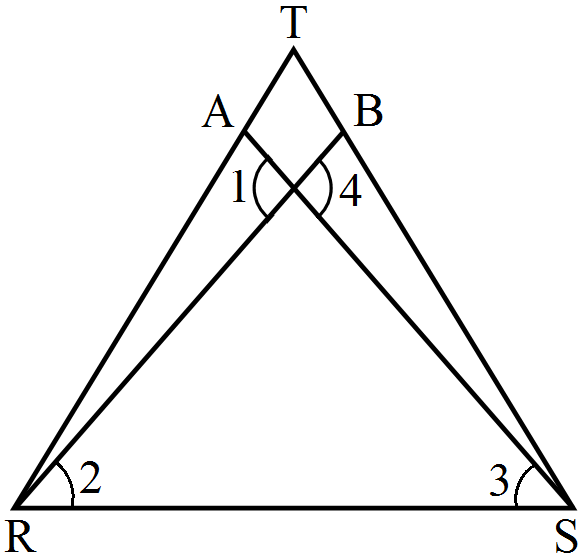
AnswerHere, $\angle1=2\angle2$ and $\angle4=2\angle3$
$\big[\therefore$ Exterior angle = sum of opposite interior angles $\big]$
$\angle1=\angle4$ [vertically opposite angle] $\therefore2\angle2=2\angle3$
$\Rightarrow\angle2=\angle3$ Now $\text{RT}=\text{TS}$ [given]
$\Rightarrow\angle\text{TRS}=\angle\text{TSR}$
[Angle opposite to equal sides are equal]
$\therefore\angle\text{TRS}-\angle2=\angle\text{TSR}-\angle3$
$\Rightarrow\angle\text{TRB}=\angle\text{TSA}$
Now in $\triangle\text{RBT}$ and $\triangle\text{SAT}$
$\angle\text{T}=\angle\text{T}$ [common]
$\angle\text{TRB}=\angle\text{TSA}$ [proved earlier]
$\text{RT}=\text{TS}$ [given]
By $ASA$ conguence criterion
$\triangle\text{RBT}\cong\triangle\text{SAT}$
View full question & answer→Question 404 Marks
In triangles $ABC$ and $CDE$, if $AC = CE, BC = CD$, $\angle\text{A}=60^\circ,\angle\text{C}=30^\circ$ and $\angle\text{D}=90^\circ.$ Are two triangles congruent?
AnswerFor the triangles $ABC$ and $ECD,$
we have the following information and corresponding figure: $\text{AC}=\text{CE}$
$\text{BC}=\text{CD}$
$\angle\text{}A=60^\circ$
$\angle\text{C}=30^\circ$
$\angle\text{D}=90^\circ$
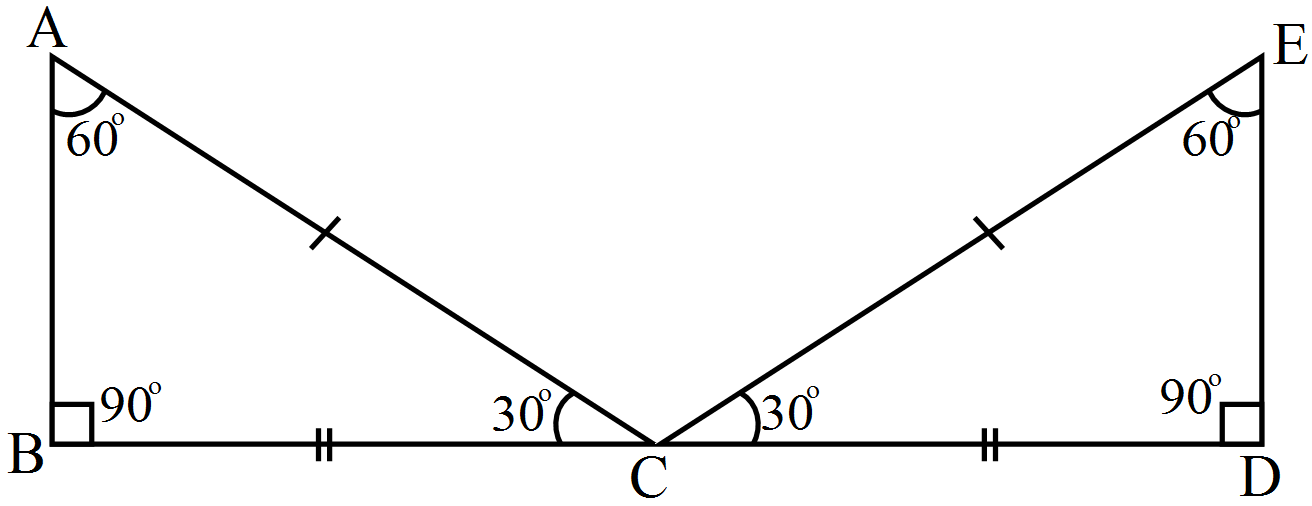
In triangles $ABC$ and $ECD,$
we have $\text{AC}=\text{EC}$
$\text{BC}=\text{CD}$ and $\angle\text{BAC}=\angle\text{CED}$
The $SSA$ criteria for two triangles to be congruent are being followed.
So both the triangles are congruent. View full question & answer→Question 414 Marks
$PQR$ is a triangle in which $PQ = PR$ and is any point on the side $PQ$. Through $S$, a line is drawn parallel to $QR$ and intersecting $PR$ at $T$. Prove that $PS = PT.$
AnswerGiven that $P Q R$ is a triangle such that $P Q=P R$ ant $S$ is any point on the side $P Q$ and $S T|\mid Q R$. 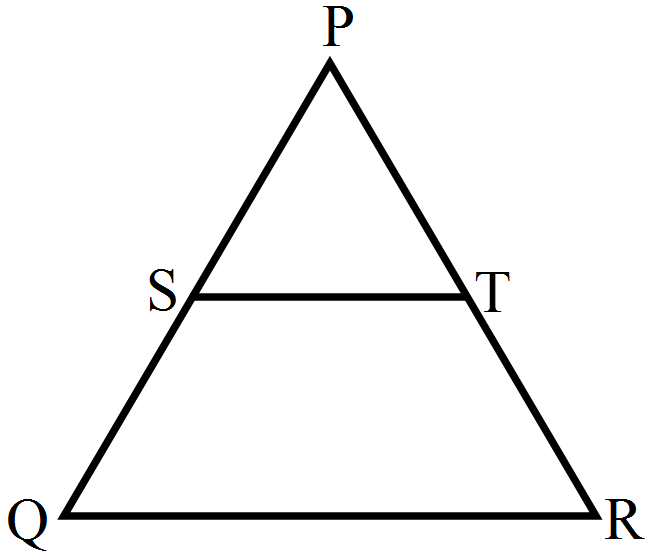
To Prove, $PS = PT$ Since, $PQ = PR PQR$ is an
isosceles triangle. $\angle\text{Q}=\angle\text{R}\text{ (or) }\angle\text{PQR}=\angle\text{PRQ}$
Now, $\angle\text{PST}=\angle\text{PQR}$ and
$\angle\text{PTS}=\angle\text{PRQ}$ [Corresponding angles as $ST$ parallel to $QR]$
Since, $\angle\text{PQR}=\angle\text{PTS}$
$\angle\text{PST}=\angle\text{PTS}$
Now, In $\triangle\text{PST},\angle\text{PST}=\angle\text{PTS}$
$\triangle\text{PST}$ is an isosceles triangle Therefore, $\text{PS}=\text{PT}$ View full question & answer→Question 424 Marks
In an isosceles triangle, if the vertex angle is twice the sum of the base angles, calculate the angles of the triangle.
AnswerLet $\triangle\text{ABC}$ be isosceles such that $\text{AB}=\text{AC}.$ $\angle\text{B}=\angle\text{C}$ 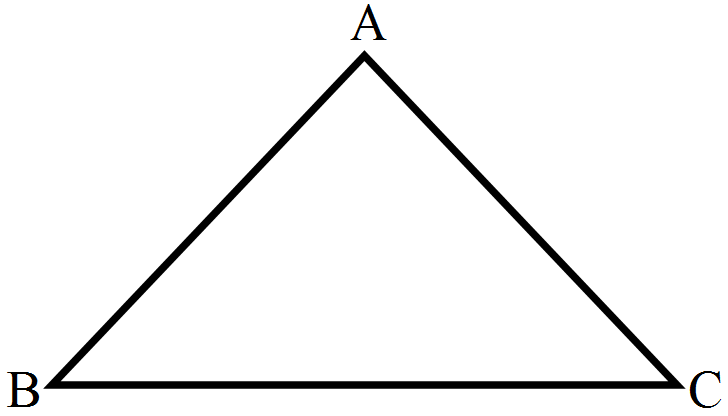
Given that vertex angle A is twice the sum of the base angles $B$ and $C$.
i..e., $\angle\text{A}=2(\angle\text{B}=\angle\text{C})$
$\angle\text{A}=2(\angle\text{B}+\angle\text{B})$
$\angle\text{A}=2(2\angle\text{B})$
$\angle\text{A}=4(\angle\text{B})$
Now, We know that sum of angles in a triangle $= 180^\circ$
$\angle\text{A}+\angle\text{B}+\angle\text{C}=180^\circ$
$4\angle\text{B}+\angle\text{B}+\angle\text{B}=180^\circ$
$6\angle\text{B}=180^\circ$
$\angle\text{B}=30^\circ$ Since, $\angle\text{B}=4\angle\text{B}$
$\angle\text{B}=\angle\text{C}=30^\circ$ And $\angle\text{A}=4\angle\text{B}$
$\angle\text{A}=4\times30^\circ=120^\circ$
Therefore, angles of the given triangle are $120^\circ , 30^\circ$ and $30^\circ. $
$=428$ and $\text{LB}=\text{LC}$ View full question & answer→Question 434 Marks
In Fig. the sides $BA$ and $CA$ have been produced such that: $BA = AD$ and $CA = AE$. Prove that segment $DE \| BC.$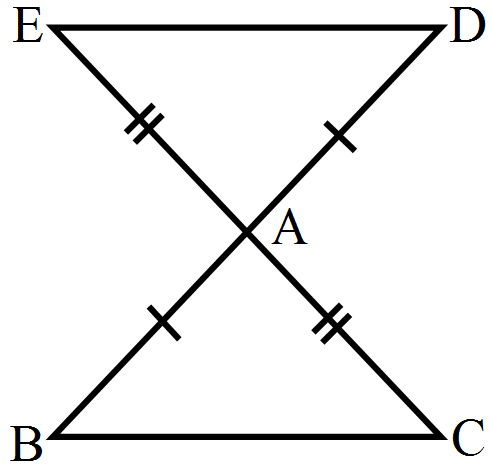
AnswerGiven that, the sides $BA$ and $CA$ have been produced such that $BA = AD$ and $CA = AE$ and given to prove $DE \| BC$ Consider triangle $BAC$ and $DAE,$
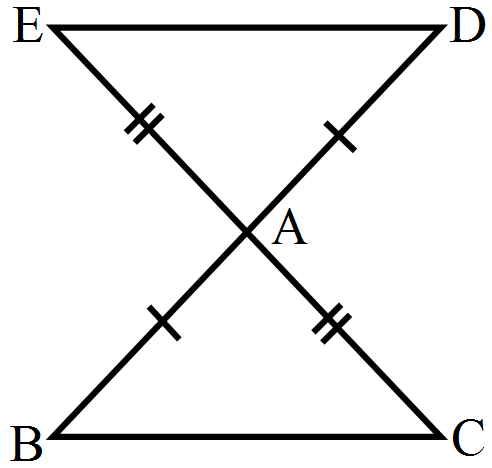
We have $BA = AD and CA = AE$ [given in the data] And
also $\angle\text{BAC}=\angle\text{DAE}$ [vertically opposite angles]
So, by $SAS$ congruence criterion,
we have $\angle\text{BAC}\simeq\angle\text{DAE}$
$\text{BC}=\text{DE}$ and $\angle\text{DEA}=\angle\text{BCA},\angle\text{EDA}=\angle\text{CBA}$ [Corresponding parts of congruent triangles are equal]
Now, $DE$ and $BC$ are two lines intersected by a transversal that
$\angle\text{DEA}=\angle\text{BCA}\text{ i}.\text{e}..$
Alternate angles are equal Therefore, $DE, BC \| BC.$ View full question & answer→