Questions

[3 marks Question Answer]

🎯

Test yourself on this topic

13 questions · timed · auto-graded

Question 13 Marks
Column I Column II
aXylem4semi-permeable
bPhloem 3permeable
cCell membrane1downward flow of sap
dRoot pressure 5upward flow of water
eCell wall2guttation
Answer
Column I Column II
aXylem4upward flow of water
bPhloem 3downward flow of sap
cCell membrane1semi-permeable
dRoot pressure 5guttation
eCell wall2permeable
View full question & answer
Question 23 Marks
Show by a series of diagrams, the change which a plant cell will undergo when placed in Hypotonic salt solution
View full question & answer
Question 33 Marks
Show by a series of diagrams, the change which a plant cell will undergo when placed in
Hypertonic salt solution
View full question & answer
Question 43 Marks
Two potato cubes each 1 cm3 in size, were placed separately in two containers (A and B), the container A having water and the other (B) containing concentrated sugar solution. After 24 hours when the cubes were examined, those placed in water were found to be firm and had increased slightly in size and those placed in concentrated sugar solution were found to be soft and somewhat decreased in size. Use the above information to answer the questions that follow: Account for the softness and decrease in size of the potato cubes which were placed in sugar solution.
Answer
Sugar solution is hypertonic to the potato cells, due to which exosmosis occurs and water flows out of the potato cells. The potato cell loses its distended appearance, the cytoplasm shrinks and the plasma membrane withdraws from the cell wall. The cells become limp or flaccid. This causes the softness and decrease in size of the potato cubes when placed in sugar solution.
View full question & answer
Question 53 Marks
Two potato cubes each 1 cm3 in size, were placed separately in two containers (A&B), the container (A) having water and the other (B) containing concentrated sugar solution. After 24 hours when the cubes were examined, those placed in water were found to be firm and had increased slightly in size and those placed in concentrated sugar solution were found to be soft and had somewhat decreased in size. Use the above information to answer the questions that follow: Account for the firmness and increase in the size of the potato cubes placed in water.
Answer
Water is hypotonic to the potato cells, due to which endosmosis occurs and water enters the potato cells. The protoplasm swells up pressing tight against the cell wall. The cells are fully distended i.e. turgid. This causes the firmness and increase in the size of the potato cubes when placed in water.
View full question & answer
Question 63 Marks
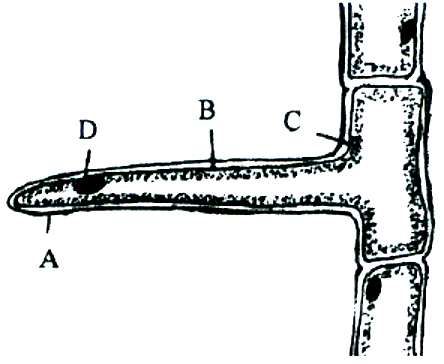
The diagram below represents a layer of epidermal cells showing a fully grown root hair. Study the diagram and answer the questions that follow:
Draw a diagram of the above root hair cell as it would appear when a concentrated solution of fertilizers is added near it.
View full question & answer
Question 73 Marks
A plant cell when kept in a hypertonic salt solution for about 30 minutes turns flaccid.
Answer
In a hypertonic solution, the solution outside the cell has higher solute concentration than the fluids inside the cell. Therefore, water flows out from the plant cell due to exosmosis. The cytoplasm shrinks and the plasma membrane withdraws away from the cell wall and this the cell becomes flaccid. Hence a plant cell when kept in a hypertonic salt solution for about 30 minutes turns flaccid.
View full question & answer
Question 83 Marks
It is better to transplant seedlings in a flower-bed in the evening and not in the morning.
Answer
Transplantation causes stress to the seedlings. If the seedlings are transplanted in the morning, they would have to immediately bear the additional stress of excessive transpiration occurring during the hot afternoon. Transplantation in the evening helps the seedlings to adjust for a longer time during the night (cooler temperatures) because the quantity of water absorbed exceeds the loss of water through transpiration. Therefore, it is better to transplant seedling in a flower bed in the evening and not in the morning.
View full question & answer
Question 93 Marks
What is the difference between ‘flaccid’ and ‘turgid’? Give one example of flaccid condition in plants.
Answer
The cell is said to be turgid when the plant cell wall becomes rigid and stretched by an increase in the volume of vacuoles due to the absorption of water when placed in hypotonic solution. On the other hand, the cell is said to be flaccid when the cell contents get shrunken when the cell is placed in hypertonic solution and the cell is no more tight. Flaccidity is the reverse of turgidity. Example: Weeds can be killed in a playground by sprinkling excessive salts around their base.
Or
A plant cell when immersed in hypertonic solution like salt solution for about 30 minutes will become flaccid or limp.
View full question & answer
Question 103 Marks
Differentiate between the following:Plasmolysis and deplasmolysis
Answer
Plasmolysis Deplasmolysis
1It refers to the shrinkage of the cytoplasm and withdrawal of the plasma membrane from the cell wall caused due to the withdrawal of water when placed in a hypertonic solution.1Deplasmolysis is the recovery of a plasmolysed cell when it is placed in water, wherein the cell's protoplasm again swells up due to the re-entry of water.
2In Plasmolysis, the cell becomes flaccid.2In deplasmolysis, the cell becomes turgid.

View full question & answer
Question 113 Marks
Leaves of the sensitive plant wilt and droop down on a slight touch. What mechanism brings about this change?
Answer
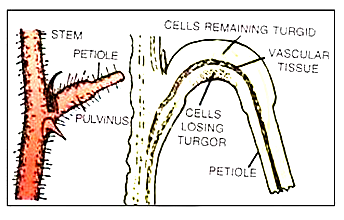
Leaves of the sensitive plant wilt and droop down on a slight touch due to turgor movement. Petiole of sensitive plant is held up by turgid pulvinus tissue. The stimulus of touch leads to loss of turgor at the base of the leaflets and at the base of the petioles i.e. pulvinus. The cells of the lower side of pulvinus lose water and the petiole collapses. This causes the wilting and drooping of the leaves
View full question & answer
Question 123 Marks
Concentration of mineral nutrient elements is higher inside the root hairs than in the surrounding soil. How do roots take them in from the soil?
Answer
If the concentration of mineral nutrient elements is higher inside the root-hairs than in the surrounding soil, then roots take them in from the soil by 'active transport'. In active transport, the mineral ions are forcibly carried from the surrounding soil i.e. the region of their lower concentration into the roots i.e. the region of their higher concentration through the cell membrane by expenditure of energy. This energy is supplied by the cell in the form of ATP.
View full question & answer
Question 133 Marks
Give two examples of turgor movements in plants.
Answer
Examples of turgor movements in plants:
  • In Mimosa pudica, a sensitive plant, the stimulus of touch leads to loss of turgor at the base of the leaflets and at the base of the petioles called This causes the folding and drooping of leaves of the plant.
  • The leaves of insectivorous plants close up to entrap a living prey. When the insect come in contact with; the leaf, itloses itturgor hence closing the leaves of the
  • The bending movements of certain flowers towards the (Any two)
View full question & answer