Question
Give two examples of turgor movements in plants.

Answer

Examples of turgor movements in plants:
  • In Mimosa pudica, a sensitive plant, the stimulus of touch leads to loss of turgor at the base of the leaflets and at the base of the petioles called This causes the folding and drooping of leaves of the plant.
  • The leaves of insectivorous plants close up to entrap a living prey. When the insect come in contact with; the leaf, itloses itturgor hence closing the leaves of the
  • The bending movements of certain flowers towards the (Any two)

Need a full question paper?

Generate a complete, print-ready paper with questions like this in minutes — across 16+ boards, with answer keys.

Start Generating Free

Similar questions

Define the four stages in the uterine cycle.
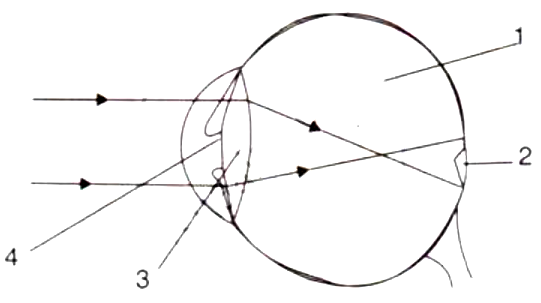
Given below is a diagram depicting a defect of the human eye? Study the same and answer the question that follow:

Draw a labeled diagram to show how the above mentioned defect is rectified using the lens named above.
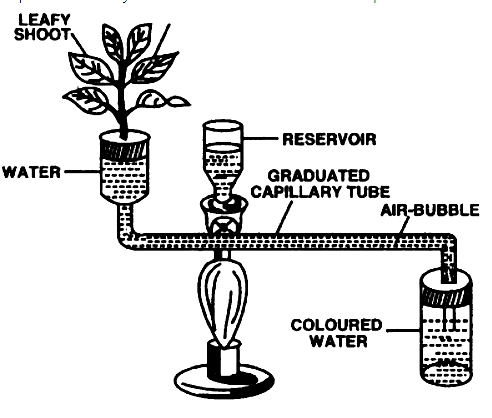
Given below is an apparatus used to study a particular process in plants. Study the same and answer the questions that follow :

(i) Name the apparatus.
(ii) Mention one limitation of this apparatus.
(iii) Which phenomenon is studied with the help of this apparatus?
(iv) What is the function of the part marked ‘reservoir’?
(v) What is the role of the air bubble in the experiment?
Differentiate between the following:
Auxins and Gibberellins
The diagram given below is a representation of a certain phenomenon pertaining to the nervous system. Study the diagram and answer the following questions:
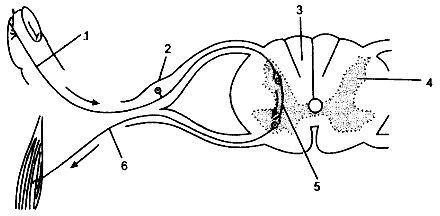
(i) Name the phenomenon which is being depicted.
(ii) Give the technical term for the point of contact between the two nerve cells.
(iii) Name the parts 1, 2, 3, and 4.
(iv) Write the functions of parts 5 and 6
(v) How does the arrangement of neurons in the spinal cord differ from that of the brain?
Write a short note on sex determination in man.
Sketch and label the V. S. of pituitary gland.
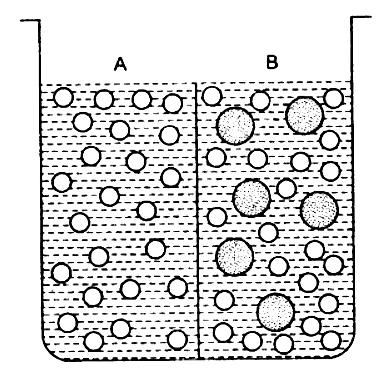
The beaker is divided into two chambers A and B. The big circle represents solute and the small circles solvent.

(i) What can you say about the size of the holes in the membrane, if it is to behave semi- permeably between these two?
(ii) Will the solvent molecules pass through the membrane from left to right, from right to left, in either direction or in both directions?
(iii) In which direction will there be a net movement of solvent molecules?
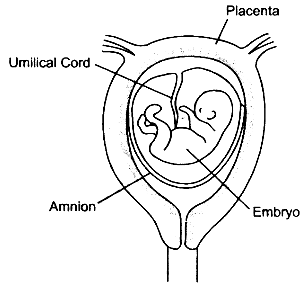
The below diagram is of a developing embryo is a mother’s womb:

(i) Write the functions of the placenta, amnion, and umbilical cord.
(ii) How are the waste products of a fetus removed?
(iii) What is the gestation period?
Write in sequence the regions in which a mature sperm travels from the seminiferous tubules up to the urethral opening?