Question
Two potato cubes each 1 cm3 in size, were placed separately in two containers (A&B), the container (A) having water and the other (B) containing concentrated sugar solution. After 24 hours when the cubes were examined, those placed in water were found to be firm and had increased slightly in size and those placed in concentrated sugar solution were found to be soft and had somewhat decreased in size. Use the above information to answer the questions that follow: Account for the firmness and increase in the size of the potato cubes placed in water.
Answer

Water is hypotonic to the potato cells, due to which endosmosis occurs and water enters the potato cells. The protoplasm swells up pressing tight against the cell wall. The cells are fully distended i.e. turgid. This causes the firmness and increase in the size of the potato cubes when placed in water.

Need a full question paper?

Generate a complete, print-ready paper with questions like this in minutes — across 16+ boards, with answer keys.

Start Generating Free

Similar questions

Greenhouse effect has produced several impacts that we experience today. Explain the major impacts of this effect?
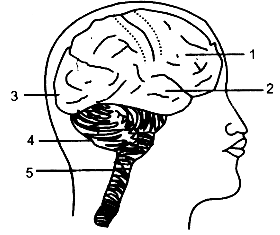
The following diagram is that of a human brain. Guidelines 1 to 5 indicate different parts of the surface of the brain and these are as follows:
1. The frontal lobe of the cerebrum
2. The temporal lobe of the cerebrum
3. The occipital lobe of the cerebrum
4. Cerebellum
5. Medulla oblongata
Study the diagram and answer the following questions:
(i) What handicaps would result from:
(a) Damage toçart numbered 3.
(b) Damage to part numbered 4.
(ii) Mention one main function of each of the parts numbered 1,2, and 5.
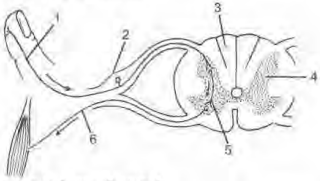
The diagram given below is a representation of a certain phenomenon pertaining to the nervous system. Study the diagram and answer the following questions :

Image
(i) Name the phenomenon that is being depicted.
(ii) Give the technical term for the point of contact between the two nerve cells.
(iii) Write the functions of parts 5 and 6.
Corpus callosum and Corpus luteum (Function).
Give a diagramatic representation of circulatory system in humans.
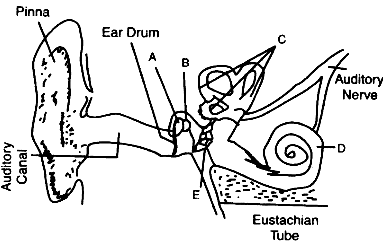
Given below is the diagram of the human ear. Study the diagram and then answer the questions that follow:
(i) What role does the eardrum play in hearing?
(ii) What common term is given to the parts labeled A, B, and E?
(iii) Would there be any difference if these three parts mentioned in (ii) above were replaced by one by one? Why?
(iv) Give the biological term for the parts labeled C and D.
(v) Name the fluid which fills the parts mentioned in (iv) above.
(vi) State the functions of the ear.
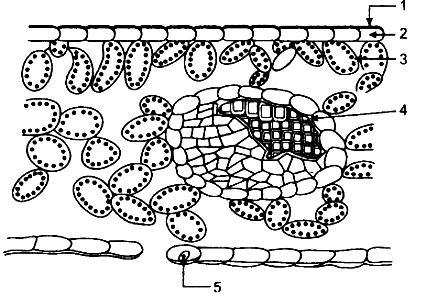
The figure below represents the vertical section of a leaf:

(i) Name the parts 1 to 5.
(ii) How many veins have been shown?
(iii) State the functions of parts 4 and 5.
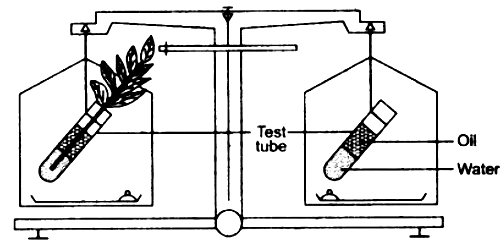
Study the diagram given alongside and answer the questions that follow:

(i) Explain the physiological process of being study.
(ii) What will be the observations in the two test-tubes after about 2-3 days?
(iii) Give a reason for your answer in (ii) above.
(iv) Why is the surface of water covered with oil?
(v) State the purpose of setting up test tube B.
Differentiate between guttation and bleeding in plants.
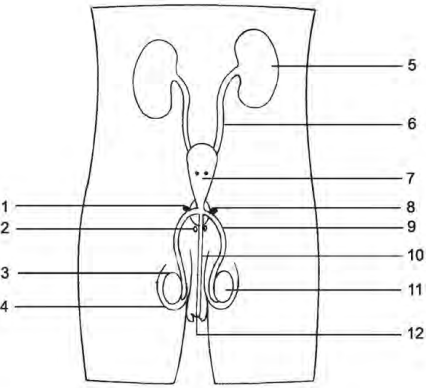
Refer to the given diagram of male reproductive system.
(i) Label the diagram.
(ii) Name the major ducts.
(iii) Name the accessory glands.

Image