Questions

[3 marks sum]

🎯

Test yourself on this topic

14 questions · timed · auto-graded

Question 13 Marks
(i) Plot the points A (3, 5) and B (-2, -4). Use 1 cm = 1 unit on both the axes.

(ii) A’ is the image of A when reflected in the x-axis. Write down the co-ordinates of A’ and plot it on the graph paper.

(iii) B’ is the image of B when reflected in the y-axis, followed by reflection in the origin. Write down the co-ordinates of B’ and plot it on the graph paper.

(iv) Write down the geometrical name of the figure AA’BB’.

(v) Name the invariant points under reflection in the x-axis.

Answer
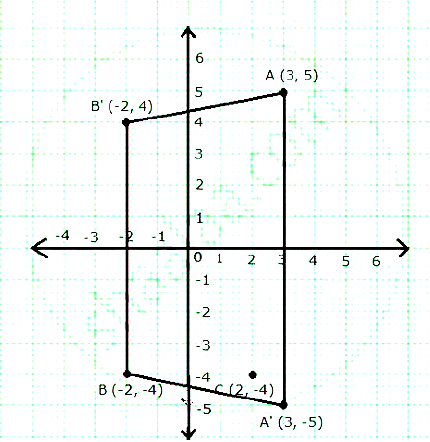
(i) The points A (3, 5) and B (-2, -4) can be plotted on a graph as shown.
(ii) A’ = Image of A when reflected in the x-axis = (3, -5)
(iii) C = Image of B when reflected in the y-axis = (2, -4) B’ = Image when C is reflected in the origin = (-2, 4)
(iv) Isosceles trapezium
(v) Any point that remains unaltered under a given transformation is called an invariant. Thus, the required two points are (3, 0) and (-2, 0).
View full question & answer
Question 23 Marks
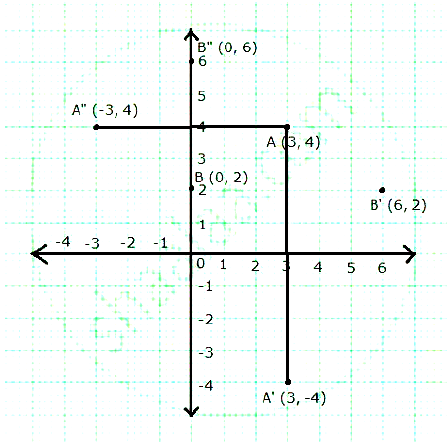
Points A and B have co-ordinates (3, 4) and (0, 2) respectively. Find the image:

(a) A’ of A under reflection in the x-axis.

(b) B’ of B under reflection in the line AA’.

(c) A” of A under reflection in the y-axis.

(d) B” of B under reflection in the line AA”.

Answer

(a) A’ = Image of A under reflection in the x-axis = (3, -4)
(b) B’ = Image of B under reflection in the line AA’ = (6, 2)
(c) A” = Image of A under reflection in the y-axis = (-3, 4)
(d) B” = Image of B under reflection in the line AA” = (0, 6)
View full question & answer
Question 33 Marks
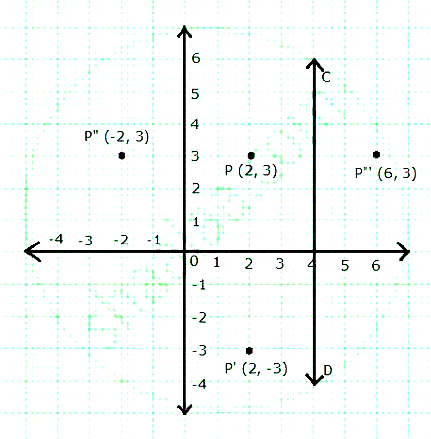
A point P (a, b) is reflected in the x-axis to P’ (2, -3). Write down the values of a and b. P” is the image of P, reflected in the y-axis. Write down the co-ordinates of P”. Find the co-ordinates of P”’, when P is reflected in the line, parallel to y-axis, such that x = 4.
Answer

A point P (a, b) is reflected in the x-axis to P’ (2, -3).
We know Mx (x, y) = (x, -y)
Thus, co-ordinates of P are (2, 3). Hence, a = 2 and b = 3.
P” = Image of P reflected in the y-axis = (-2, 3)
P”’ = Reflection of P in the line (x = 4) = (6, 3)
View full question & answer
Question 43 Marks
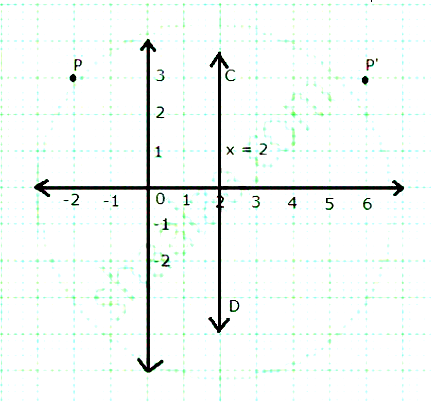
A point P (-2, 3) is reflected in line x = 2 to point P’. Find the coordinates of P’.
Answer
The line x = 2 is a line parallel to y-axis and at a distance of 2 units from it.
Mark point P (-2, 3).
From P, draw a straight line perpendicular to line CD and produce. On this line mark a point P’ which is at the same distance to the right of CD as P is to the left of it.
The co-ordinates of P’ are (6, 3).
View full question & answer
Question 53 Marks
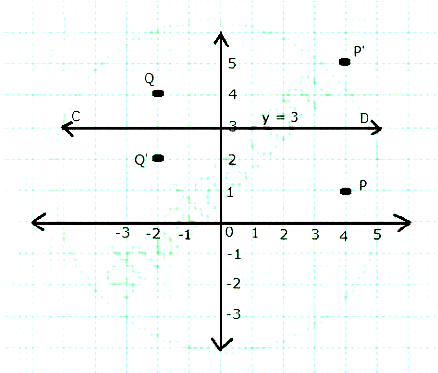
The points P (4, 1) and Q (-2, 4) are reflected in line y = 3. Find the co-ordinates of P’, the image of P and Q’, the image of Q.
Answer
The line y = 3 is a line parallel to x-axis and at a distance of 3 units from it.
Mark points P (4, 1) and Q (-2, 4).
From P, draw a straight line perpendicular to line CD and produce. On this line mark a point P’ which is at the same distance above CD as P is below it.
The co-ordinates of P’ are (4, 5). Similarly, from Q, draw a line perpendicular to CD and mark point Q’ which is at the same distance below CD as Q is above it.
The co-ordinates of Q’ are (-2, 2).
View full question & answer
Question 63 Marks
Attempt this question on graph paper.

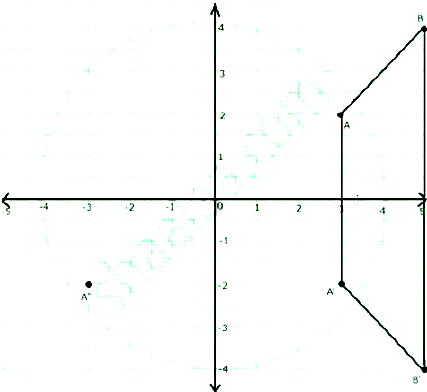
(a) Plot A (3, 2) and B (5, 4) on graph paper. Take 2 cm = 1 unit on both the axes.

(b) Reflect A and B in the x-axis to A’ and B’ respectively. Plot these points also on the same graph paper.

(c) Write down:

(i) the geometrical name of the figure ABB’A’;

(ii) the measure of angle ABB’;

(iii) the image of A” of A, when A is reflected in the origin.

(iv) the single transformation that maps A’ to A”.

Answer

(c)
(i) From graph, it is clear that ABB’A’ is an isosceles trapezium.
(ii) The measure of angle ABB’ is 45°.
(iii) A” = (-3, -2)
(iv) Single transformation that maps A’ to A” is the reflection in y-axis.
View full question & answer
Question 73 Marks

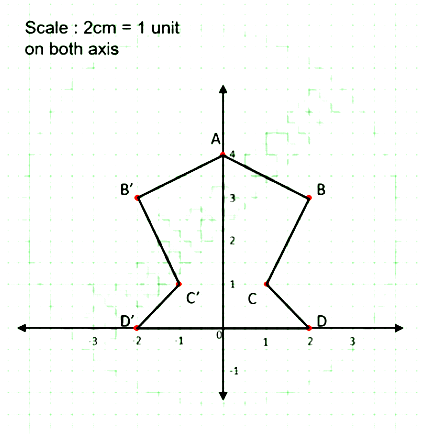
Use a graph paper for this question: (Take 2cm = 1 unit on both x and y axes) (i) Plot the following points: A(0,4), B(2,3), C(1,1) and D(2,0).

(ii) Reflect points B, C, D on the y-axis and write down their coordinates. Name the images as B', C', D' respectively.

(iii) Join the points A, B, C, D, D', C', B' and A in order, so as to form a closed figure. Write down the equation to the line about which if this closed figure obtained is folded, the two parts of the figure exactly coincide.

Answer
(i)Plotting A(0,4), B(2,3), C(1,1) and D(2,0).

(ii) Reflected points B'(-2,3), C'(-1,1) and D'(-2,0).
(iii) The figure is symmetrical about x = 0
View full question & answer
Question 83 Marks

Use graph paper for this question.

(Take 2 cm = 1 unit along both side x-axis and y-axis.)

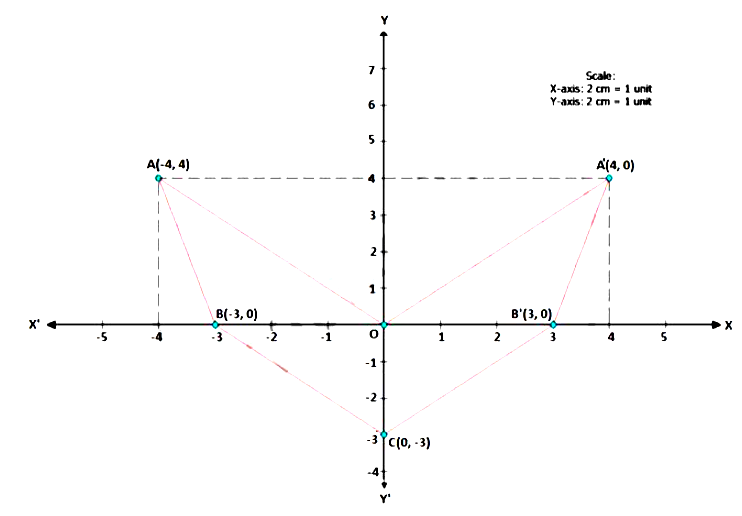
Plot the points O(0,0), A(-4, 4), B(-3, 0) and C(0, -3).

  1. Reflect points A and B on the y-axis and name them A' and B' respectively. Write down their co-ordinates.
  2. Name the figure OABCB'A'.
  3. iii. State the line of symmetry of this figure. [Now symmetry is not in course]
Answer
1. $A^{\prime}=(4,4) A N D B^{\prime}=(3,0)$
2. The figure is an arrow head.
3. iii. The $y$-axis i.e. $x=0$ is the line of symmetry of figure $O A B C B^{\prime} A^{\prime}$.
View full question & answer
Question 93 Marks
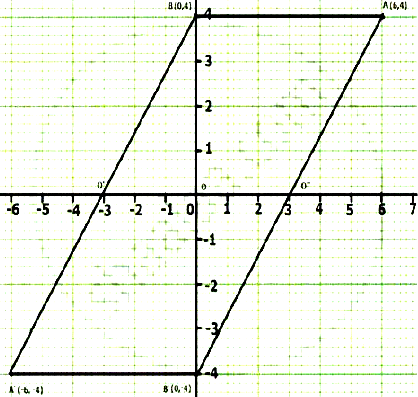
Using a graph paper, plot the point A (6, 4) and B (0, 4).

(a) Reflect A and B in the origin to get the image A’ and B’.

(b) Write the co-ordinates of A’ and B’.

(c) Sate the geometrical name for the figure ABA’B’.

(d) Find its perimeter.

Answer
(a)
(b) Co-ordinates of A'=(-6,-4)
Co-ordinates of B'=(0,-4)
(c) ABA'B' is parallelogram.
(d) In ABA'B',BB'=8 units, A'B'=6 units
$\therefore B A \prime=\sqrt{6^2+8^2}=\sqrt{36+64}=\sqrt{100}=10$ units
$\Rightarrow B ı A=10$ units
$A B=A^{\prime} B^{\prime}=6$ units
∴ the perimeter of ABA'B'=AB+BA'+A'B'+B'A
=6+10+6+10
=32 units
View full question & answer
Question 103 Marks
The triangle $A B C$, where $A$ is $(2,6), B$ is $(-3,5)$ and $C$ is $(4,7)$, is reflected in the $y$-axis to triangle $A^{\prime} B^{\prime} C^{\prime}$. Triangle $A^{\prime} B^{\prime} C^{\prime}$ is then reflected in the origin to triangle $A^{\prime \prime} B^{\prime \prime} C^{\prime \prime}$.
i. Write down the co-ordinates of $A ^{\prime \prime}, B ^{\prime \prime}$ and $C ^{\prime \prime}$.
ii. Write down a single transformation that maps triangle $A B C$ onto triangle $A^{\prime \prime} B^{\prime \prime} C^{\prime \prime}$.
Answer
(i) Reflection in $y$-axis is given by $M_y(x, y)=(-x, y) \therefore A^{\prime}=$ Reflection of $A(2,6)$ in $y$-axis $=(-2,6)$
Similarly, $B^{\prime}=(3,5)$ and $C^{\prime}=(-4,7)$
Reflection in origin is given by $M_O(x, y)=(-x,-y)$
$\therefore A ^{\prime \prime}=$ Reflection of $A ^{\prime}(-2,6)$ in origin $=(2,-6)$
Similarly, $B^{\prime \prime}=(-3,-5)$ and $C^{\prime \prime}=(4,-7)$
(ii) A single transformation which maps triangle $A B C$ to triangle $A^{\prime \prime} B^{\prime \prime} C^{\prime \prime}$ is reflection in $x$-axis.
View full question & answer
Question 113 Marks
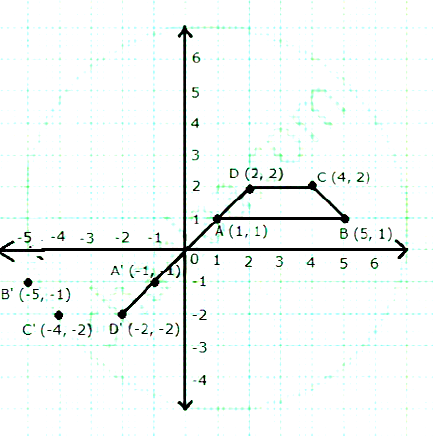
A (1, 1), B (5, 1), C (4, 2) and D (2, 2) are vertices of a quadrilateral. Name the quadrilateral ABCD. A, B, C, and D are reflected in the origin on to A’, B’, C’ and D’ respectively. Locate A’, B’, C’ and D’ on the graph sheet and write their co-ordinates .

Are D, A, A’ and D’ collinear?

Answer

Quadrilateral ABCD is an isosceles trapezium.
Co-ordinates of A’, B’, C’ and D’ are A'(-1, -1), B'(-5, -1), C'(-4, -2) and D'(-2, -2) respectively.
It is clear from the graph that D, A, A’ and D’ are collinear.
View full question & answer
Question 123 Marks
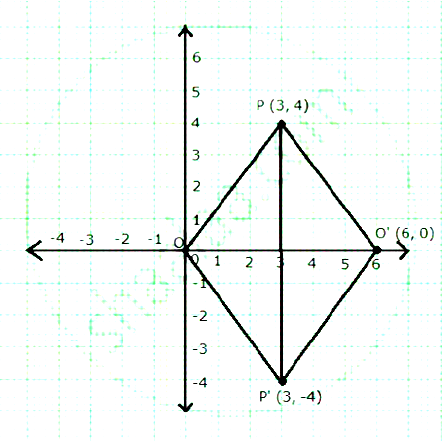
The point P (3, 4) is reflected to P’ in the x-axis; and O’ is the image of O (the origin) when reflected in the line PP’.

Write:

(i) the co-ordinates of P’ and O’.

(ii) the length of the segments PP’ and OO’.

(iii) the perimeter of the quadrilateral POP’O’.

(iv) the geometrical name of the figure POP’O’.

Answer

(i) Co-ordinates of P’ and O’ are (3, -4) and (6, 0) respectively.
(ii) PP’ = 8 units and OO’ = 6 units.
(iii) From the graph it is clear that all sides of the quadrilateral POP’O’ are equal.
In right Δ PO’Q, PO’ $=\sqrt{(4)^2+(3)^2}=5$ units
So, perimeter of quadrilateral POP’O’ = 4 PO’ = 4 × 5 units = 20 units
(iv) Quadrilateral POP’O’ is a rhombus.
View full question & answer
Question 133 Marks
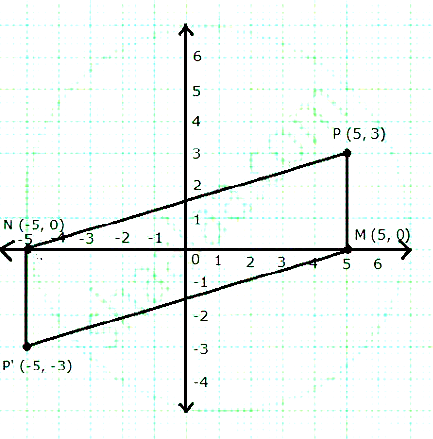
The point $P (5, 3)$ was reflected in the origin to get the image $P’.(a)$ Write down the co-ordinates of P’.
(b) If M is the foot if the perpendicular from P to the x-axis, find the co-ordinates of M.
(c) If N is the foot if the perpendicular from P’ to the x-axis, find the co-ordinates of N.
(d) Name the figure PMP’N.
(e) Find the area of the figure PMP’N.
Answer

(a) Co-ordinates of $P’ = (-5, -3)$
(b) Co-ordinates of $M = (5, 0)$
(c) Co-ordinates of $N = (-5, 0)$
(d) PMP’N is a parallelogram.
$\text { (e) Are of PMP'N }=\operatorname{ar}(\triangle PMN )+\operatorname{ar}\left(\triangle MNP ^{\prime}\right)$
$=\frac{1}{2} \times 10 \times 3+\frac{1}{2} \times 10 \times 3$
$=15+15$
$=30 \text { sq. units }$ 
View full question & answer
Question 143 Marks
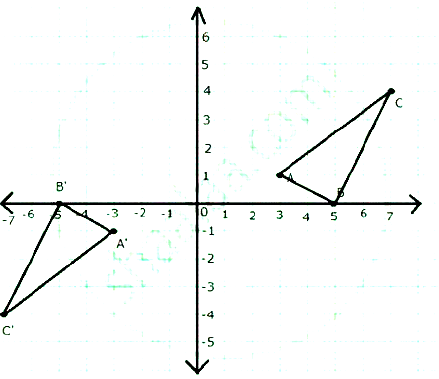
On a graph paper, plot the triangle ABC, whose vertices are at points A (3, 1), B (5, 0) and C (7, 4).

On the same diagram, draw the image of the triangle ABC under reflection in the origin O (0, 0).

Answer
The graph shows triangle ABC and triangle A’B’C’ which is obtained when ABC is reflected in the origin
View full question & answer
[3 marks sum] - Mathematics STD 10 Questions - Vidyadip