Questions

[3 marks sum]

🎯

Test yourself on this topic

34 questions · timed · auto-graded

Question 13 Marks
Construct an equilateral Δ ABC such that:
Each side is 6 cm.
Answer
Steps of Construction :
(i) Draw a line segment $A B=6 cm$.
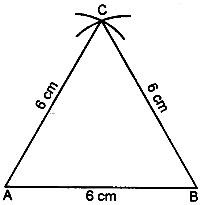

(ii) At $A$ and $B$ as centre and $6 cm$ as radius draw two arcs intersecting each other at $C$.
(iii) Join $A C$ and $B C$.
$\triangle ABC$ is the required triangle.
View full question & answer
Question 23 Marks
Construct an isosceles Δ ABC such that:
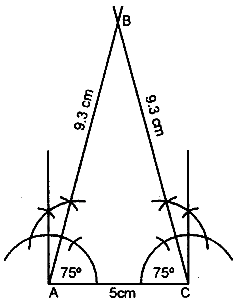
Base AC = 5 cm and base angle = 75°. Measure the other two sides of the triangle.
Answer
Steps of Construction:
We know that the base angles of an isosceles triangle are equal.

(i) Draw a line segment $AC =5 cm$.
(ii) At A and $C$, draw rays making an angle of $75^{\circ}$ each which intersects each other at $B$.
$\triangle A B C$ is the required triangle.
On measuring the equal sides, each is $9.3 cm$ in length.
View full question & answer
Question 33 Marks
Construct an isosceles Δ ABC such that:
Base BC = 4 cm and base angle = 30°. Measure the other two sides of the triangle.
Answer
Steps of Construction:
We know that in an isosceles triangle base angles are equal.

(i) Draw a line segment $BC =4 cm$.
(ii) At $B$ and $C$, draw rays making an angle of $30^{\circ}$ each intersecting each other at $A$.
$\triangle ABC$ is the required triangle.
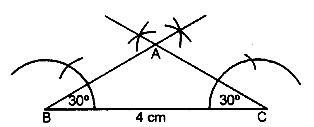
On measuring the equal sides each is $2.5 cm$ (approx.) in length.
View full question & answer
Question 43 Marks
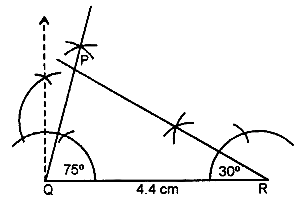
Construct a ∆ PQR such that:
QR = 4.4 cm, ∠R = 30° and ∠Q = 75°. Measure PQ and PR.
Answer
Steps of Construction:
(i) Draw a line segment $Q R=4.4 cm$.

(ii) At $Q$, draw a ray making an angle of $75^{\circ}$
(iii) At R, draw another arc making an angle of $30^{\circ}$; which intersects the first ray at $R$
$\triangle PQR$ is the required triangle.
On measuring the lengths of $P Q$ and $P R, P Q=2.1 cm$ and $P R=4.4$ $cm$.
View full question & answer
Question 53 Marks
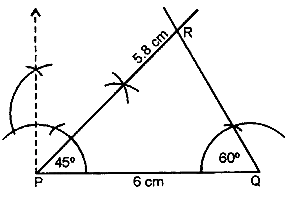
Construct a ∆ PQR such that :
PQ = 6 cm, ∠Q = 60° and ∠P = 45°. Measure ∠R.
Answer
Steps of Construction:
(i) Draw a line segment $P Q=6 cm$.
(ii) At $P$, draw a ray making an angle of $45^{\circ}$
(iii) At $Q$, draw another ray making an angle of $60^{\circ}$ which intersects the first ray at $R$.
$\triangle PQR$ is the required triangle. On measuring $\angle R$, it is $75^{\circ}$.
View full question & answer
Question 63 Marks
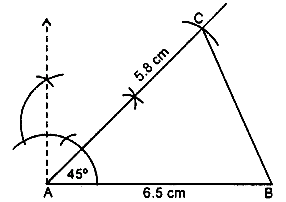
Construct a ∆ ABC such that:
AB = 6.5 cm, AC = 5.8 cm and ∠A = 45°
Answer
Steps of Construction :
(i) Draw a line segment $A B=6.5 cm$

(ii) At A, draw a ray making an angle of $45^{\circ}$ and cut off $AC =5.8 cm$
(iii) Join CB.
$\triangle ABC$ is the required triangle.
View full question & answer
Question 73 Marks
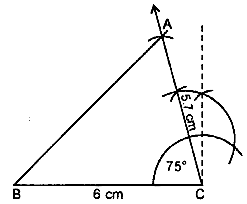
Construct a ∆ ABC such that:
BC = 6 cm, AC = 5.7 cm and ∠ACB = 75°
Answer
Steps of Construction :
(i) Draw a line segment $BC =6 cm$.
(ii) At $C$, draw a ray making an angle of $75^{\circ}$ and cut off $C A=5.7 cm$.
(iii) join $A B$.
$\triangle A B C$ is the required triangle.
View full question & answer
Question 83 Marks
Construct a ∆ ABC such that:
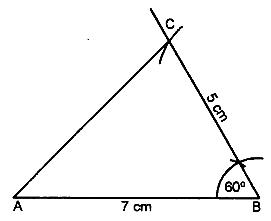
AB = 7 cm, BC = 5 cm and ∠ABC = 60°
Answer
Steps of Construction :
(i) Draw a line segment $A B=7 cm$.

(ii) At $B$, draw a ray making an angle of $60^{\circ}$ and cut off $B C=5 cm$
(iii) Join AC.
$\triangle ABC$ is the required triangle.
View full question & answer
Question 93 Marks
Construct a ∆ABC such that:
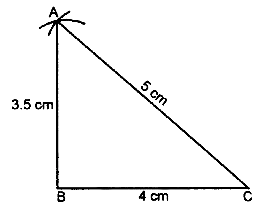
BC = 4 cm, AC = 5 cm and AB = 3.5 cm
Answer
Steps of Construction :
(i) Draw a line segment $B C=4 cm$.
(ii) With centre $B$ and radius $3.5 cm$, draw an arc.
(iii) With centre $C$ and radius $5 cm$, draw another arc which intersects the first arc at $A$.

(iv) Join $A B$ and $A C$.
$\triangle ABC$ is the required triangle.
View full question & answer
Question 103 Marks
Construct a ∆ABC such that:
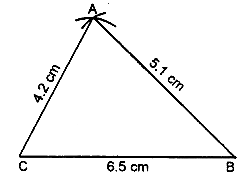
CB = 6.5 cm, CA = 4.2 cm and BA = 51 cm
Answer
Steps of Construction :
(i) Draw a line segment $C B=6.5 cm$

(ii) With centre $C$ and radius $4.2 cm$ draw an arc.
(iii) With centre $B$ and radius $5.1 cm$ draw another arc intersecting the first arc at $A$.
(iv) Join $A C$ and $A B$.
$\triangle ABC$ is the required triangle.
View full question & answer
Question 113 Marks
Construct a ∆ABC such that:
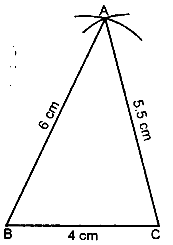
AB = 6 cm, BC = 4 cm and CA = 5.5 cm
Answer
Steps of Construction :
(i) Draw a line segment $BC =4 cm$.

(ii) With centre $B$ and radius $6 cm$ draw an arc.
(iii) With centre $C$ and radius $5.5 cm$, draw another arc intersecting the First are at $A$.
(iv) Join $A B$ and $A C$.
$\triangle ABC$ is the required triangle.
View full question & answer
Question 123 Marks
The ratio between a base angle and the vertical angle of an isosceles triangle is 1: 4. Find each angle of the triangle.
Answer
Ratio between base angle and vertical angle of an isosceles triangle $=1: 4$
Let each base angle $=x$
then vertical angle $=4 x$
$\therefore \mathrm{x}+\mathrm{x}+4 \mathrm{x}=180^{\circ}$ ............... (Sum of angles of a triangle)
$ \begin{aligned} & \Rightarrow 6 x=180^{\circ} \\ & \Rightarrow x=\frac{180^{\circ}}{6}=30^{\circ} \end{aligned} $
$\therefore$ Each base angle $=\mathrm{x}=30^{\circ}$ and vertical angle $=4 \mathrm{x}$
$ =4 \times 30^{\circ}=120^{\circ} $
View full question & answer
Question 133 Marks
The vertical angle of an isosceles triangle is three times the sum of its base angles. Find each angle.
Answer
Let each base angle of an isosceles, triangle $=x$ then its vertical $=3(x+x)=3 \times 2 x=6 x$.
$\therefore 6 x+x+x=180^{\circ} \ldots . . . .$. (Sum of angles of a triangle)
$ \Rightarrow 8 \mathrm{x}=180^{\circ} $
$ \Rightarrow \mathrm{x}=\frac{180^{\circ}}{8}=22.5^{\circ} $
$\therefore$ Each base angle $=22.5^{\circ}$
and vertical angle $=3 \times(22.5+22.5)$
$ =3 \times 45=135^{\circ} $
View full question & answer
Question 143 Marks
The vertical angle of an isosceles triangle is 15° more than each of its base angles. Find each angle of the triangle.
Answer
Let each angle of the base of the isosceles triangle $=x^{\circ}$
Then vertical angle $=x+15^{\circ}$
Now $x+x+x+15^{\circ}=180^{\circ}$ ............ (Sum of angles of a triangle)
$ \begin{aligned} & \Rightarrow 3 \mathrm{x}+15^{\circ}=180^{\circ} \\ & \Rightarrow 3 \mathrm{x}=180^{\circ}-15^{\circ}=165^{\circ} \\ & \Rightarrow \mathrm{x}=\frac{165^{\circ}}{3}=55^{\circ} \end{aligned} $
Hence each base angle $=55^{\circ}$
and vertical angle $=55^{\circ}+15^{\circ}=70^{\circ}$
View full question & answer
Question 153 Marks
In an isosceles triangle, each base angle is four times its vertical angle. Find all the angles of the triangle.
Answer
Let vertical angle of an isosceles triangle $=x$
$\therefore$ Each base angle $=4 x$
$ \therefore \mathrm{x}+4 \mathrm{x}+4 \mathrm{x}=180^{\circ} $.......... (Sum of angles of a triangle)
$ \Rightarrow 9 \mathrm{x}=180^{\circ} $
$ \Rightarrow \mathrm{x}=\frac{180^{\circ}}{9}=20^{\circ} $
$\therefore$ Vertical angle $=20^{\circ}$
and each of the base angle $=4 x$
$ =4 \times 20^{\circ}=80^{\circ} $
View full question & answer
Question 163 Marks
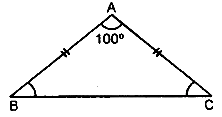
The angle of a vertex of an isosceles triangle is 100°. Find its base angles.
Answer
In $\triangle A B C$,

$
\begin{aligned}
& \because A B=A C \\
& \therefore \angle B=\angle C \\
& \text { But } \angle A =100^{\circ} \\
& \text { and } \angle A +\angle B +\angle C =180^{\circ} \ldots \ldots . \text { (Angles of a triangle) } \\
& \Rightarrow 100^{\circ}+\angle B +\angle B =180^{\circ} \\
& \Rightarrow 2 \angle B =180^{\circ}-100^{\circ} \\
& \Rightarrow 2 \angle B=80^{\circ} \\
& \therefore \angle B =\frac{80^{\circ}}{2}=40^{\circ}
\end{aligned}
$
Hence $\angle B=\angle C=40^{\circ}$
View full question & answer
Question 173 Marks
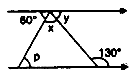
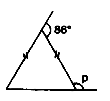
Apply the properties of isosceles and equilateral triangles to find the unknown angles in the given figure:
Answer
In fig.,
130° = x + p ........(Exterior angle of a triangle is equal to the sum of its interior opposite angles)
∵ Lines are parallel ........(Given)
∴ p = 60° ..............(Alternate angle)
and y = a
But a + 130° = 180° ..........(Linear pair)
⇒ a = 180° − 130° = 50°
∴ y = 50°
and x + p = 130°
⇒ x + 60° = 130°
⇒ x = 130° − 60° = 70°
Hence x = 70°, y = 50° and p = 60°
View full question & answer
Question 183 Marks
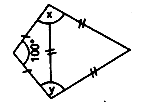
Apply the properties of isosceles and equilateral triangles to find the unknown angles in the given figure:
Answer
In fig.,
In an equilateral triangle.
each angle $=60^{\circ}$
In an isosceles triangle.,
Let each base angle $=$ a
$\therefore \mathrm{a}+\mathrm{a}+100^{\circ}=180^{\circ}$
$\Rightarrow 2 \mathrm{a}+100^{\circ}=180^{\circ}$
$\Rightarrow 2 \mathrm{a}=180^{\circ}-100^{\circ}=80^{\circ}$
$\therefore \mathrm{a}=\frac{80^{\circ}}{2}=40^{\circ}$
$\therefore x=60^{\circ}+40^{\circ}=100^{\circ}$
and $y=60^{\circ}+40^{\circ}=100^{\circ}$
View full question & answer
Question 193 Marks
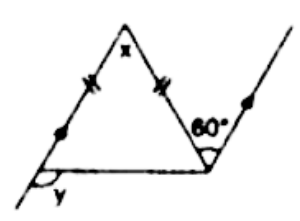
Find the unknown marked angles in the given figure:
Image
Answer
In the figure,
$ x=60^{\circ} $.........(Alternate angles)
Let each equal angle of an isosceles triangle be a
then $a+a+x=180^{\circ}$ ........... (Angles of a triangle)
$ \begin{aligned} & \Rightarrow 2 \mathrm{a}+\mathrm{x}=180^{\circ} \\ & \Rightarrow 2 \mathrm{a}+60^{\circ}=180^{\circ} \\ & \Rightarrow 2 \mathrm{a}=180^{\circ}-60^{\circ}=120^{\circ} \\ & \Rightarrow \mathrm{a}=\frac{120^{\circ}}{2}=60^{\circ} \end{aligned} $
$ \therefore y=x+a=60^{\circ}=120^{\circ} $
Hence $x=60^{\circ}$ and $y=120^{\circ}$
View full question & answer
Question 203 Marks
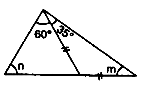
Find the unknown angles in the given figure:
Answer
In the figure,
m = 35° .........(Angles opposite to equal sides)
But m + n + (60° + 35°) = 180° ..........(Angles of a triangle)
⇒ m + n + 95° = 180°
⇒ 35° + n + 95° = 180°
⇒ n + 130° = 180°
⇒ n = 180° − 130° = 50°
Hence m = 35°, n = 50°
View full question & answer
Question 213 Marks
Find the unknown angles in the given figure:
Answer
In the figure,
Let each equal angle of an isosceles triangle be $x$,
then $x+x=86^{\circ} \Rightarrow 2 x=86^{\circ}$
$ \Rightarrow x=\frac{86^{\circ}}{2}=43^{\circ} $
But $p+x=180^{\circ}$ (Linear pair)
$ p+43^{\circ}=180^{\circ} $
$ \Rightarrow \mathrm{p}=180^{\circ}-43^{\circ} $
$ \Rightarrow \mathrm{p}=137^{\circ} $
Hence $p=137^{\circ}$
View full question & answer
Question 223 Marks
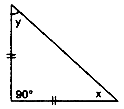
Find the unknown angles in the given figure:
Answer
In the figure,
$ x=y $ ........ (Angles opposite to equal sides)
But $x+y+90^{\circ}=180^{\circ}$ ....... (Angles of a triangle)
$ \Rightarrow x+x+90^{\circ}=180^{\circ} $
$ \Rightarrow 2 \mathrm{x}+90^{\circ}=180^{\circ} $
$ \Rightarrow 2 \mathrm{x}=180^{\circ}-90^{\circ}=90^{\circ} $
$ \therefore \mathrm{x}=\frac{90^{\circ}}{2}=45^{\circ} $
$ \therefore \mathrm{y}=\mathrm{x}=45^{\circ} $
Hence $x=45^{\circ}, y=45^{\circ}$
View full question & answer
Question 233 Marks
Find the unknown angles in the given figure:
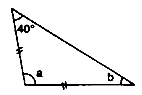
Answer
In the figure,
b = 40° .........(Angles opposite to equal sides)
But a + b + 40° = 180° .........(Angles of a triangle)
⇒ a + 40°+ 40° = 180°
⇒a + 80° = 180°
⇒ a = 180°− 80° = 100°
Hence a = 100°, b = 40°
View full question & answer
Question 243 Marks
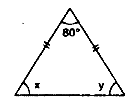
Find the unknown angles in the given figure:
Answer
In the figure,
$x=y$ ..(Angles opposite to equal sides)
But $x+y+80^{\circ}=180^{\circ}$ (Angles of a triangle)
$ \Rightarrow \mathrm{x}+\mathrm{x}+80^{\circ}=180^{\circ} $
$ \Rightarrow 2 \mathrm{x}+80^{\circ}=180^{\circ} $
$ \Rightarrow 2 \mathrm{x}=180^{\circ}-80^{\circ}=100^{\circ} $
$ \Rightarrow \mathrm{x}=\frac{100^{\circ}}{2}=50^{\circ} $
$ \therefore y=x=50^{\circ} $
Hence $x=50^{\circ}, y=50^{\circ}$
View full question & answer
Question 253 Marks
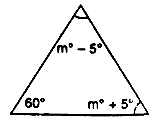
Find the unknown marked angles in the given figure:
Answer
In the figure, $\angle \mathrm{A}+\angle \mathrm{B}+\angle \mathrm{C}=180^{\circ}$....... (Sum of angles of a triangle)
$ \begin{aligned} & \left(\mathrm{m}^{\circ}-5^{\circ}\right)+60^{\circ}+\left(\mathrm{m}^{\circ}+5^{\circ}\right)=180^{\circ} \\ & \Rightarrow \mathrm{m}^{\circ}-5^{\circ}+60^{\circ}+\mathrm{m}^{\circ}+5^{\circ}=180^{\circ} \\ & \Rightarrow 2 \mathrm{~m}^{\circ}=180^{\circ}-65^{\circ}+5^{\circ} \\ & \Rightarrow 2 \mathrm{~m}^{\circ}=120^{\circ} \\ & \Rightarrow \mathrm{m}^{\circ}=\frac{120^{\circ}}{2}=60^{\circ} \end{aligned} $
Hence $\angle A=m^{\circ}-5^{\circ}=60^{\circ}-5^{\circ}=55^{\circ}$
and $\angle \mathrm{C}=\mathrm{m}^{\circ}+5^{\circ}=60^{\circ}+5^{\circ}=65^{\circ}$
View full question & answer
Question 263 Marks
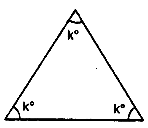
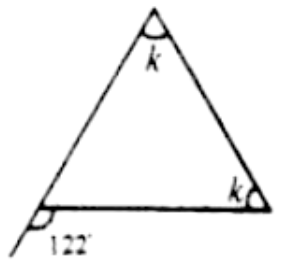
Find the unknown marked angles in the given figure:
Answer
In the figure,
$\angle A+\angle B+\angle C=180^{\circ}$.....(Sum of angles of a triangle)
$ \begin{aligned} & \mathrm{k}^{\circ}+\mathrm{k}^{\circ}+\mathrm{k}^{\circ}=180^{\circ} \\ & \Rightarrow 3 \mathrm{k}^{\circ}=180^{\circ} \\ & \Rightarrow \mathrm{k}^{\circ}=\frac{180^{\circ}}{3}=60^{\circ} \end{aligned} $
Hence $\angle \mathrm{A}=\mathrm{k}^{\circ}=60^{\circ}, \angle
\mathrm{B}=\mathrm{k}^{\circ}=60^{\circ}$
and $\angle \mathrm{C}=\mathrm{k}^{\circ}=60^{\circ}$
View full question & answer
Question 273 Marks
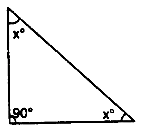
Find the unknown marked angles in the given figure:
Answer
In the figure, $\angle A+\angle B+\angle C=180^{\circ} $........ (Sum of angles of a triangle)
$ x^{\circ}+90^{\circ}+x^{\circ}=180^{\circ} $
$ \begin{aligned} & \Rightarrow 2 x^{\circ}+90^{\circ}=180^{\circ} \\ & \Rightarrow 2 x^{\circ}=180^{\circ}-90^{\circ} \\ & \Rightarrow 2 x^{\circ}=90^{\circ} \end{aligned} $
$ \Rightarrow x^{\circ}=\frac{90^{\circ}}{2}=45^{\circ} $
Hence $\angle A=x^{\circ}=45^{\circ}$
and $\angle C=x^{\circ}=45^{\circ}$
View full question & answer
Question 283 Marks
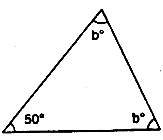
Find the unknown marked angles in the given figure:
Answer
In the figure, $\angle A+\angle B+\angle C=180^{\circ} $.......... (Sum of angles of a triangle)
$ \begin{aligned} & \mathrm{b}^{\circ}+50^{\circ}+\mathrm{b}^{\circ}=180^{\circ} \\ & \Rightarrow 2 \mathrm{~b}^{\circ}+50^{\circ}=180^{\circ} \\ & \Rightarrow 2 \mathrm{~b}^{\circ}=180^{\circ}-50^{\circ}=130^{\circ} \\ & \Rightarrow \mathrm{b}^{\circ}=\frac{130^{\circ}}{2}=65^{\circ} \end{aligned} $
Hence $\angle A=b^{\circ}=65^{\circ}$
and $\angle \mathrm{C}=\mathrm{b}^{\circ}=65^{\circ}$
View full question & answer
Question 293 Marks
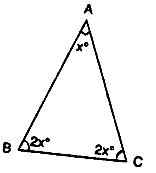
Find the value of the angle in the given figure:
Answer
In the figure, $\angle \mathrm{A}+\angle \mathrm{B}+\angle \mathrm{C}=180^{\circ}$.....(Sum of angles of a triangle)
$ \begin{aligned} & \Rightarrow x^{\circ}+2 x^{\circ}+2 x^{\circ}=180^{\circ} \\ & \Rightarrow 5 x^{\circ}=180^{\circ} \\ & \Rightarrow x^{\circ}=\frac{180^{\circ}}{5}=36^{\circ} \end{aligned} $
$\therefore \angle \mathrm{A}=\mathrm{x}^{\circ}=36^{\circ}$
$ \angle B=2 x^{\circ}=2 \times 36^{\circ}=72^{\circ} $
and $\angle \mathrm{C}=2 \mathrm{x}^{\circ}=2 \times 36^{\circ}=72^{\circ}$
View full question & answer
Question 303 Marks
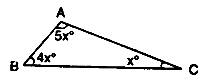
Find the value of the angle in the given figure:
Answer
In the figure,
$\angle \mathrm{A}+\angle \mathrm{B}+\angle \mathrm{C}=180^{\circ} $......... (Sum of angles of a triangle)
$ \begin{aligned} & \Rightarrow 5 x^{\circ}+4 x^{\circ}+x^{\circ}=180^{\circ} \\ & \Rightarrow 10 x^{\circ}=180^{\circ} \end{aligned} $
$ \Rightarrow \mathrm{x}=\frac{180^{\circ}}{10}=18^{\circ} $
$ \therefore \angle \mathrm{A}=5 \mathrm{x}^{\circ}=5 \times 18^{\circ}=90^{\circ} $
$ \angle B=4 x=4 \times 18^{\circ}=72^{\circ} $
and $\angle C=x=18^{\circ}$
View full question & answer
Question 313 Marks
In a triangle PQR, ∠P = 60° and ∠Q = ∠R, find ∠R.
Answer
Let $\angle Q=\angle R=x, \angle P=60^{\circ}$
But $\angle \mathrm{P}+\angle \mathrm{Q}+\angle \mathrm{R}=180^{\circ}$
$\therefore 60^{\circ}+\mathrm{x}+\mathrm{x}=180^{\circ}$
$\Rightarrow 60^{\circ}+2 \mathrm{x}=180^{\circ}$
$\Rightarrow 2 \mathrm{x}=180^{\circ}-60^{\circ}=120^{\circ}$
$\Rightarrow \mathrm{x}=\frac{120^{\circ}}{2}=60^{\circ}$
$\therefore \angle \mathrm{Q}=\angle \mathrm{R}=60^{\circ}$
Hence, $\angle \mathrm{R}=60^{\circ}$
View full question & answer
Question 323 Marks
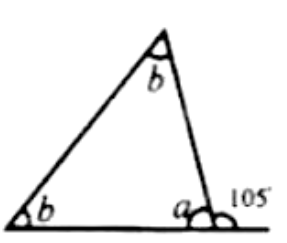
Find the unknown marked angles in the given figure:
Image
Answer
We know that in a triangle if one side of it is produced, then
Exterior angle $=$ sum of its interior opposite angles.
In fig.,
$105^{\circ}=b+b$
$\Rightarrow 2 \mathrm{~b}=105^{\circ}$
$\Rightarrow \mathrm{b}=\frac{105^{\circ}}{2}=52.5^{\circ}$
But a $+105^{\circ}=180^{\circ}$ .. (Linear pair)
$\Rightarrow \mathrm{a}=180^{\circ}-105^{\circ}=75^{\circ}$
Hence $a=75^{\circ}, b=52.5^{\circ}$
View full question & answer
Question 333 Marks
Find the unknown marked angles in the given figure:
Image
Answer
We know that in a triangle if one side of it is produced, then
Exterior angle $=$ sum of its interior opposite angles.
In fig.,
$ 120^{\circ}+a+a $
$ \Rightarrow 2 \mathrm{a}=120^{\circ} $
$ \Rightarrow \mathrm{a}=\frac{120^{\circ}}{2}=60^{\circ} $
$ \therefore \mathrm{a}=60^{\circ} $
View full question & answer
Question 343 Marks
Find the unknown marked angles in the given figure:
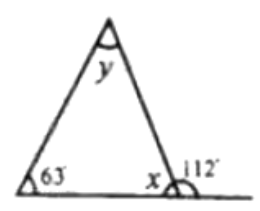
Image
Answer
We know that in a triangle if one side of it is produced, then
Exterior angle = sum of its interior opposite angles.
In fig.,
112° + x° = 180° ...............(Linear pair)
⇒ x = 180°− 112° = 68°
and 112° = y + 63° = 49°
Hence x = 68°, y = 49°
View full question & answer