Question 15 Marks
The three vertices of a parallelogram are (3, 4) (3, 8) and (9, 8). Find the fourth vertex.
AnswerLet A(3, 4), B(3, 8) and C(9, 8) be the three given vertex then fourth vertex be D(x, y)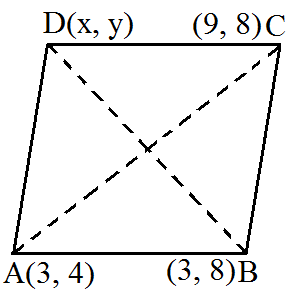
Since, ABCD is parallelogram, the diagonals bisect each other.
Therefore, the mid-point of the diagonals of the parallelogram coincide.
Let P(x, y) be the mid-point of diagonal AC then,
$\text{P}(\text{x},\text{y})=\Big(\frac{3+9}{2},\frac{4+8}{2}\Big)$ P(x, y) = (6, 6)Let Q(x, y) be the mid-point of diagonal BD then,
$\text{Q}(\text{x},\text{y})=\Big(\frac{3+\text{x}}{2},\frac{8+\text{y}}{2}\Big)$ Coordinates of mid-point AC = Coordinates of mid-point BD P(x, y) = Q(x, y) $\Rightarrow\ (6,6)=\Big(\frac{3+\text{x}}{2},\frac{8+\text{y}}{2}\Big)$ Now, equating individual components, $\Rightarrow\ 6=\frac{3+\text{x}}{2}$ and $6=\frac{8+\text{y}}{2}$ ⇒ 3 + x = 12 and 8 + y = 12 ⇒ x = 9 and y = 4Hence, coordinates of fourth point are (9, 4). View full question & answer→Question 25 Marks
The points A(2, 9), B(a, 5) and C(5, 5) are the vertices of a triangle ABC right angled at B. Find the values of a and hence the area of $\triangle\text{ABC}.$
AnswerGiven that, the points $A(2,9), B(a, 5)$ and $C(5,5)$ are the vertices of a $\triangle A B C$ right angled at $B$. By pythagoras theorem,
$AC ^2= AB ^2+ BC ^2 \ldots .$. .(i)
Now, by distance formula, $AB =\sqrt{( a -2)^2+(5-9)^2}$
$[\because$ distance between two points
$\left( x _1, y _1\right)$ and $\left.\left( x _2, y _2\right)=\sqrt{\left( x _2- x _1\right)^2+\left( y _2- y _1\right)^2}\right]=\sqrt{ a ^2+4-4 a +16}=\sqrt{ a ^2-4 a +20}$
$BC =\sqrt{(5- a )^2+(5-5)^2}=\sqrt{(5- a )^2+0}=5- a$ and $AC =\sqrt{(2-5)^2+(9-5)^2}$
$=\sqrt{(-3)^2+(4)^2}=\sqrt{9+16}=\sqrt{25}=5$
Put the values of $A B, B C$ and $A C$ in Eq. (i),
we get $(5)^2=\sqrt{\left(a^2-4 a+20\right)^2}+(5-a)^2 $
$\Rightarrow 25=a^2-4 a+20+25+a^2-10 a$
$ \Rightarrow 2 a^2-14 a+20=0 $
$\Rightarrow a^2-7 a+10= 0$
$\Rightarrow a^2-2 a-5 a+10=0[$ by factorisation method$]$
$\Rightarrow a(a-2)-5(a-2)=0 $
$\Rightarrow(a-2)(a-5)=0 $
$\therefore a=2,5$ Here,
$a \neq 5$, since at $a=5$,
the length of $B C=0$.
It is not possible because the sides $A B, B C$ and $C A$ from a right angled triangle.
So, $a=2$ Now, the coordinate of $A, B$ and $C$ becomes $(2,9),(2,5)$ and $(5,5)$ respectively.
$\therefore \text { Area of } \triangle ABC=\frac{1}{2}\left[x_1\left(y_2-y_3\right)+x_2\left(y_3-y_1\right)+x_3\left(y_1-y_2\right)\right]$
$\therefore \triangle=\frac{1}{2}[2(5-5)+2(5-9)+5(9-5)]$
$=\frac{1}{2}[2 \times 0+2(-4)+5(4)]$
$=\frac{1}{2}(0-8+20)=\frac{1}{2} \times 12=6$
Hence, the required area of $\triangle ABC$ is 6 sq . units.
View full question & answer→Question 35 Marks
Find the lengths of the medians of a triangle whose vertices are A(-1, 3), B(1, -1) and C(5, 1).
Answer
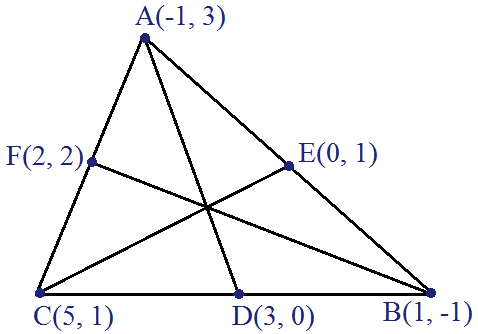 Let AD, BF and CE be the medians of $\triangle\text{ABCD}$
Coordinates of D are $\Big(\frac{5+1}{2},\frac{1-1}{2}\Big)=(3,0)$
Coordinates of E are $\Big(\frac{-1+1}{2},\frac{3-1}{2}\Big)=(0,1)$
Coordinates of F are $\Big(\frac{5-1}{2},\frac{1+3}{2}\Big)=(2,2)$
Length of $\text{AD}=\sqrt{(-1-3)^2+(3-0)^2}=5\text{ units}$
Length of $\text{BF}=\sqrt{(2-1)^2+(2+1)^2}=\sqrt{10}\text{ units}$
Length of $\text{CE}=\sqrt{(5-0)^2+(1-1)^2}=5\text{ units}$ View full question & answer→Question 45 Marks
Find the ratio in which the point (2, y) divides the line segment joining the points A(-2, 2) and B(3, 7). Also, find the value of y.
AnswerLet the point P(2, y) divide the line segment joining the points A(-2, 2) and B(3, 7) in the ratio k : 1
Then, the coordinates of P are,
$\bigg[\frac{3\text{k}+(-2)\times1}{\text{k+1}},\frac{7\text{k}+2\times1}{\text{k+1}}\bigg]$
$\bigg[\frac{3\text{k}-2}{\text{k+1}},\frac{7\text{k}+2}{\text{k}+1}\bigg]$
But the coordinates of P are given as (2, y).
$\therefore\ \frac{3\text{k}-2}{\text{k}+1}=2$
$\Rightarrow\ 3\text{k}-2=2\text{k}+2$
$\Rightarrow\ 3\text{k}-2\text{k}=2+2$
$\Rightarrow\ \text{k}=4$
$\frac{7\text{k}+2}{\text{k}+1}=\text{y}$
Putting the value of k, we get
$\frac{7\times4+2}{4+1}=\text{y}$
$\frac{30}{5}=\text{y}$
$6=\text{y}$
i.e., $\text{y}=6$
Hence, the ratio is 4 : 1 and y = 6.
View full question & answer→Question 55 Marks
Prove that the points (-4, -1), (-2, 4), (4, 0) and (2, 3) are the vertices of a rectangle.
AnswerLet the vertices of a quadrilateral ABCD are A(-4, -1), B(-2, -4), C(4, 0) and D(2, 3) Join AC and BD which intersect each other at O. If O is the mid-point of AC then its coordinates will be $=\Big(\frac{\text{x}_1+\text{x}_2}{2},\frac{\text{y}_1+\text{y}_2}{2}\Big)$ or $\Big(\frac{-4+4}{2},\frac{-1+0}{2}\Big)$ $=\Big(\frac{0}{2},\frac{-1}{2}\Big)$ or $\Big(0,\frac{-1}{2}\Big)$If O is the mid-point of BD, then its co-ordinates will be $=\Big(\frac{-2+2}{2},\frac{-4+3}{2}\Big)$
or $\Big(\frac{0}{2},\frac{-1}{2}\Big)$ or $\Big(0,\frac{-1}{2}\Big)$ $\because$ The mid-points of AC and BD are the same. $\therefore$ AC and AD bisect eachother at O Now, $\text{AC}=\sqrt{(\text{x}_2-\text{x}_1)^2+(\text{y}_2-\text{y}_1)^2}$ $=\sqrt{[4-(-4)]^2+[0-(-1)]^2}$ $=\sqrt{(4+4)^2+(1)^2}=\sqrt{(8)^2+(1)^2}$ $=\sqrt{64+1}=\sqrt{65}$ and $\text{BD}=\sqrt{[2-(-2)]^2+[3-(-4)]^2}$ $=\sqrt{(2+2)^2+(3+4)^2}=\sqrt{(4)^2+(7)^2}$ $=\sqrt{16+49}=\sqrt{65}$ $\because$ Diagonal bisect eachother at O and are equal. $\therefore$ ABCD is a rectangle.
View full question & answer→Question 65 Marks
If the points A(1, -2), B(2, 3), C(a, 2) and D(-4, -3) form a parallelogram, find the value of a and height of the parallelogram taking AB as base.
AnswerIn parallelogram, we know that, diagonals bisects each other i.e., mid-point of AC = mid-point of BD 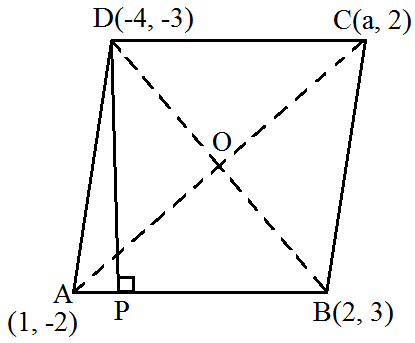
$\Rightarrow\left(\frac{1+ a }{2}, \frac{-2+2}{2}\right)=\left(\frac{2-4}{2}, \frac{3-3}{2}\right) \Rightarrow \frac{1+ a }{2}=\frac{2-4}{2}=\frac{-2}{2}=-1 \quad$ Since, mid-point of a line segment having points $\left(x_1, y_1\right)$ and $\left(x_2, y_2\right)$ is $\left.\left(\frac{x_1+x_2}{2}, \frac{y_1+y_2}{2}\right)\right] \Rightarrow 1+a=-2 \Rightarrow a=-3$ So, the required value of a is -3 . Given that, $A B$ as base of a parallelogram and drawn a perpendicular from $D$ to $A B$ which meet $A B$ at $P$. So, $D P$ is a height of a parallelogram. Now, equation of base $A B$, passing through the points $(1,-2)$ and $(2,3)$ is $\Rightarrow\left( y - y _1\right)=\frac{ y _2- y _1}{ x _2- x _1}\left( x - x _1\right) \Rightarrow( y +2)=\frac{3+2}{2-1}( x -1) \Rightarrow( y +2)=5( x -1) \Rightarrow 5 x - y =7$ (i) Slope of $A B$, say $m _1=\frac{ y _2- y _1}{ x _2- x _1}=\frac{3+2}{2-1}=5$ Let the slope of DP be $m _2$. Since, DP is perpendicular to $A B$. By condition of perpendicularity $m _1 \times m _2=-1 \Rightarrow 5 m_2=-1 \Rightarrow m_2=-\frac{1}{5}$ Now, Eq. of DP, having slope ( $-\frac{1}{5}$ ) and passing the point $(-4,-3)$ is $\left(y-y_1\right)=m_2\left(x-x_1\right) \Rightarrow(y+3)=-\frac{1}{5}(x+4) \Rightarrow 5 y+15=-x-4 \Rightarrow x+5 y=-19$ (ii) On adding Eq. (i) and (ii), then we get the intersection point P. Put the value of $y$ from Eq. (i) in Eq. (ii), we get $x+5(5 x-7)=-19$ [using Eq. (i)] $\Rightarrow x+25 x-35=-19 \Rightarrow 26 x=16 \therefore x=\frac{8}{13}$ Put the value of $x$ in Eq. (i), we get $y=5\left(\frac{8}{13}\right)-7=\frac{40}{13}-7 \Rightarrow y=\frac{40-91}{13} \Rightarrow y=\frac{-51}{13}$
$\therefore$ Coordinates of point $P =\left(\frac{8}{13}, \frac{-51}{13}\right)$
So, length of the height of a parallelogram, $DP =\sqrt{\left(\frac{8}{13}+4\right)^2+\left(\frac{-51}{13}+3\right)^2}[\because$ by distance formula, distance two points $\left( x _1, y _1\right)$ and $\left( x _2, y _2\right)$ is $\left.d =\sqrt{\left( x _2- x _1\right)^2\left( y _2- y _1\right)^2}\right] \Rightarrow DP =\sqrt{\left(\frac{60}{13}\right)^2+\left(\frac{-12}{13}\right)^2}$ $=\frac{1}{13} \sqrt{3600+144}=\frac{1}{13} \sqrt{3744}=\frac{12 \sqrt{26}}{13}$ Hence, the required length of height of a parallelogram is $\frac{12 \sqrt{26}}{13}$. View full question & answer→Question 75 Marks
The points (3, -4) and (-6, 2) are the extremities of a diagonal of a parallelogram. If the third vertex is (-1, -3). Find the coordinates of the fourth vertex.
Answer
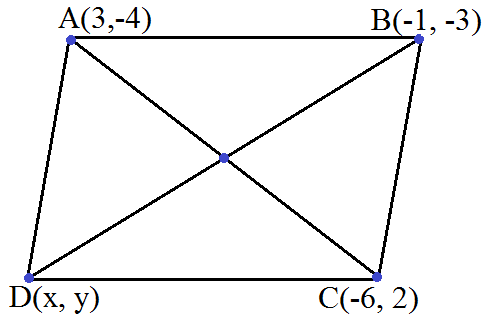 Let A(3, -4) and C(-6, -2) be the extremities of diagonal AC and B(-1, -3), D(x, y) be the extremities of diagonal BD.
Since the diagonals of a parallelogram bisect each other.
$\therefore$ Coordinates of mid-point of AC = Coordinates of mid-point of BD.
$\Rightarrow\ \frac{3-6}{2}=\frac{\text{x}-1}{2}$
$\Rightarrow\ \frac{-3}{2}=\frac{\text{x}-1}{2}$
$\Rightarrow\ \text{x}=-2$
And, $\frac{-4+2}{2}=\frac{\text{y}-3}{2}$
$\Rightarrow\ \frac{-2}{2}=\frac{\text{y}-3}{2}$
$\Rightarrow\ \text{y}=1$
Hence, fourth vertex of parallelogram is (-2, 1). View full question & answer→Question 85 Marks
The centre of a circle is (2a, a - 7). Find the values of a if the circle passes through the point (11, -9) and has diameter $10\sqrt{2}$ units.
AnswerBy given condition, Distance between the centre C (2a, a - 7) and the point P (11, -9), which lie on the circle = Radius of circle 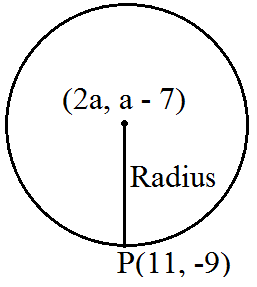
$\therefore \text { Radius of circle }=\sqrt{(11-2 a)^2+(-9-a+7)^2} \ldots \ldots \text { (i) }\left[\because \text { distance between two points }\left(x_1, y_1\right)\right. \text { and }$
$\left.\left(x_2, y_2\right)=\sqrt{\left(x_2-x_1\right)^2+\left(y_2-y_1\right)^2}\right]$
Given that, length of diameter $=10 \sqrt{2} \therefore$ Length of radius $=\frac{\text { Lenght of diameter }}{2}$
$=\frac{10 \sqrt{2}}{2}=5 \sqrt{2}$
Put this value in eq.(i), we get $5 \sqrt{2}=\sqrt{(11-2 a )^2+(-2- a )^2}$
Squaring on both sides, we get
$50=(11-2 a)^2+(2+a)^2$
$\Rightarrow 50=121+4 a^2-44 a+4+a^2+4 a$
$\Rightarrow 5 a^2-40 a+75=0$
$\Rightarrow a^2-8 a+15=0$
$\Rightarrow a^2-5 a-3 a+15=0$
[By factorisation method] $\Rightarrow a(a-5)-3(a-5)=0$
$\Rightarrow(a-5)(a-3)=0$
$\therefore a=3,5$ Hence, the required values of $a$ are 5 and 3 . View full question & answer→Question 95 Marks
Find the coordinates of the points which divide the line segment joining the points (-4, 0) and (0, 6) in four equal parts.
AnswerThe co-ordinates of the midpoint $\left(x_m, y_m\right)$ between two points $\left(x_1, y_1\right)$ and $\left(x_2, y_2\right)$ is given by,
$\left(x_{m}, y_{m}\right)=\left[\left(\frac{x_1+x_2}{2}\right),\left(\frac{y_1+y_2}{2}\right)\right]$
Here we are supposed to find the points which divide the line joining $A(-4,0)$ and $B(0,6)$ into 4 equal parts. We shall first find the midpoint $M(x, y)$ of these two points since this point will divide the line into two equal parts, $\left( x _{ m }, y _{ m }\right)=\left[\left(\frac{-4+0}{2}\right),\left(\frac{0+6}{2}\right)\right]\left( x _{ m }, y _{ m }\right)=(-2,3)$ So the point $M (-2,3)$ splits this line into two equal parts. Now, we need to find the midpoint of $A(-4,0)$ and $M(-2,3)$ separately and the midpoint of $B(0,6)$ and $M(-2,3)$. These two points along with $M(-2,3)$ split the line joining the original two points into four equal parts. Let $M_1(e, d)$ be the midpoint of $A(-4,0)$ and $M(-2,3) .(e, d)=\left[\left(\frac{-4-2}{2}\right),\left(\frac{0+3}{2}\right)\right](e, d)=\left(-3, \frac{3}{2}\right)$ Now let $M_2(g, h )$ be the midpoint of $B(0,6)$ and $M(-2,3) \cdot(g, h)=\left[\left(\frac{0-2}{2}\right),\left(\frac{6+3}{2}\right)\right]( g , h )=\left(-1, \frac{9}{2}\right)$ Hence the co-ordinates of the points which divide the line joining the two given points are $\left(-3, \frac{3}{2}\right),(-2,3)$ and $\left(-1, \frac{9}{2}\right)$.
View full question & answer→Question 105 Marks
Find the ratio in which the line segment joining (-2, -3) and (5, 6) is divided by (i) x-axis (ii) y-axis. Also, find the coordinates of the point of division in each case.
Answer
- Let x-axis divides PQ in the ratio.
$\lambda:1$
Let R(x, y) be the coordinates of the point of division.
Then, the coordinates of the point of division are,
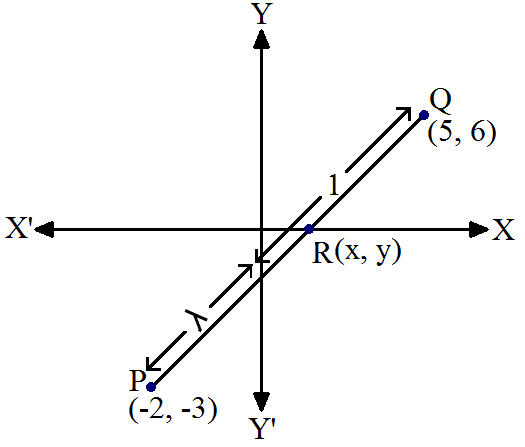
$\text{R}\bigg(\frac{5\times\lambda+(-2)\times1}{\lambda+1},\frac{6\times\lambda+(-3)\times1}{\lambda+1}\bigg)=\bigg(\frac{5\lambda-2}{\lambda+1},\frac{6\lambda-3}{\lambda+1}\bigg)$
Since R lies on x-axis.
Therefore, y-coordinates of every point on x-axis is zero.
$\therefore\ \frac{6\lambda-3}{\lambda+1}=0$
$\Rightarrow\ 6\lambda-3=0$
$\Rightarrow\ 6\lambda=3$
$\Rightarrow\ \lambda=\frac{3}{6}=\frac{1}{2}$
Hence, the required ratio is $\frac{1}{2}:1$ or 1 : 2
Let point R(x, y) divide the line joining in the ratio 1 : 2.
Putting $\lambda=\frac{1}{2}$ in the coordinates of R, we get
$\text{R}(\text{x, y})=\Bigg[\Bigg(\frac{5\times\frac{1}{2}-2}{\frac{1}{2}+1}\Bigg)\Bigg(\frac{6\times\frac{1}{2}-3}{\frac{1}{2}+1}\Bigg)\Bigg]$
Now, equating the individual components,
$\Rightarrow\ \text{x}=\frac{\frac{5-2}{2}}{\frac{1+1}{2}}$ and $\text{y}=\frac{3-3}{\frac{1+2}{1}}$
$\Rightarrow\ \text{x}=\frac{1}{3}$ and $\text{y}=0$
$\text{R}(\text{x,y})=\Big(\frac{1}{3},0\Big)$
Hence, the point $\Big(\frac{1}{3},0\Big)$ divide the line joining PQ in the ratio 1 : 2.
- $\because$ Abscissa of a point on y-axis is zero.
Let the point be (0, y).
Let this point divides the line segment joining (-2, -3) and (5, 6) in the ratio m : n.
$\therefore\ 0=\frac{\text{mx}_2+\text{nx}_1}{\text{m+n}}=\frac{\text{m(5)+n(-2)}}{\text{m+n}}$
$\Rightarrow\ 0=\frac{5\text{m}-2\text{n}}{\text{m+n}}\Rightarrow5\text{m}-2\text{n}=0$
$\Rightarrow\ 5\text{m}=2\text{n}\Rightarrow\ \frac{\text{m}}{\text{n}}=\frac{2}{5}$
$\therefore$ Ratio = 2 : 5
and $\text{y}=\frac{2\times6+5\times(-3)}{2+5}=\frac{12-15}{7}=\frac{-3}{7}$
$\therefore$ Required point $=\Big(0,\frac{-3}{7}\Big)$ View full question & answer→Question 115 Marks
Prove that (4, 3), (6, 4) (5, 6) and (3, 5) are the angular points of a square.
AnswerLet the given points be, A(4, 3), B(6, 4) C(5, 6) and D(3, 5) respectively. Then, 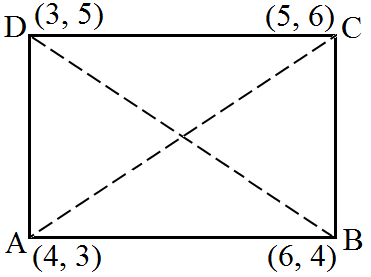 Now, $\text{AB}=\sqrt{(6-4)^2+(4-3)^2}$ $=\sqrt{4+1}$ $=\sqrt{5}\ \text{units}$ and $\text{BC}=\sqrt{(5-6)^2+(6-4)^2}$$=\sqrt{1+4}$
$=\sqrt{5}\ \text{units}$ $\text{CD}=\sqrt{(3-5)^2+(5-6)^2}$ $=\sqrt{4+1}$ $=\sqrt{5}\ \text{units}$ $\text{AD}=\sqrt{(3-4)^2+(5-3)^2}$ $=\sqrt{1+4}$ $=\sqrt{5}\ \text{units}$ Thus, AB = BC = CD = AD Diagonal $\text{AC}=\sqrt{(5-4)^2+(6-3)^2}$ $=\sqrt{1+9}$ $=\sqrt{10}\ \text{units}$ Diagonal $\text{BD}=\sqrt{(3-6)^2+(5-4)^2}$ $=\sqrt{9+1}$ $=\sqrt{10}\ \text{units}$ $\therefore$ AB = BC = CD = AD and diagonal AC = diagonal BD. Thus, ABCD is a quadrilateral in which all sides are equal and the diagonal are equal. Hence, ABCD is a square. View full question & answer→Question 125 Marks
If P(-5, -3), Q(-4, -6), R(2, -3) and S(1, 2) are the vertices of a quadrilateral PQRS, find its area.
AnswerP(-5, -3), Q(-4, -6), R(2, -3) and S(1,2) are the vertices of a quadrilateral PQRS. Join PR which forms two triangles PQR and PSR,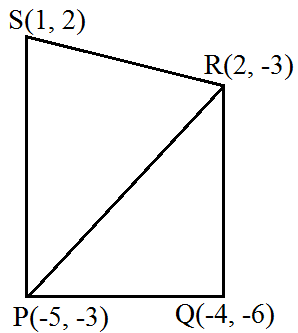
Now area of $\triangle\text{PQR}$
$=\frac{1}{2}[\text{x}_1(\text{y}_2-\text{y}_3)+\text{x}_2(\text{y}_3-\text{y}_1)+\text{x}_3(\text{y}_1-\text{y}_2)]$
$=\frac{1}{2}[-5(-6+3)+(-4)(-3+3)+2(-3+6)$
$=\frac{1}{2}[-5\times(-3)+(-4\times0)+2\times3]$
$=\frac{1}{2}(15+0+6)=\frac{1}{2}\times21=\frac{21}{2}$
and area of $\triangle\text{PSR}$
$=\frac{1}{2}[-5\times(2+3)+1(-3+3)+2(-3-2)]$
$=\frac{1}{2}[-5\times5+1\times0+2\times(-5)]$
$=\frac{1}{2}[-25+0-10]=\frac{1}{2}\times(-35)=\frac{-35}{2}$
$\therefore$ Area of quadrilateral PQRS $=\frac{21}{2}+\frac{35}{2}=\frac{56}{2}=28\text{ sq units}$ View full question & answer→Question 135 Marks
Find the area of a triangle whose vertices are,
$(\text{at}_1^2, 2\text{at}_1), (\text{at}_2^2, 2\text{at}_2)$ and $(\text{at}_3^2, 2\text{at}_3).$
AnswerCo-ordinates of $\triangle\text{ABC}$ are $\text{A}(\text{at}_1^2, 2\text{at}_1), \text{B}(\text{at}_2^2, 2\text{at}_2)$ and $\text{C}(\text{at}_3^2, 2\text{at}_3)$$\therefore$ Area of $\triangle=\frac{1}{2}|\text{x}_1(\text{y}_2-\text{y}_3)+\text{x}_2(\text{y}_3-\text{y}_1)+\text{x}_3(\text{y}_1-\text{y}_2)|$
$=\frac{1}{2}|\text{at}_1^2(2\text{at}_2-2\text{at}_3)+\text{at}_2^2(2\text{at}_3-2\text{at}_1)+\text{at}_3^2(2\text{at}_1-2\text{at}_2)|$
$=\frac{1}{2}|2\text{a}^2\text{t}_1^2\text{t}_2-2\text{a}^2\text{t}_1^2\text{t}_3+2\text{a}^2\text{t}_2^2\text{t}_3-2\text{a}^2\text{t}_2^2\text{t}_1+2\text{a}^2\text{t}_3^2\text{t}_1-2\text{a}^2\text{t}_3^2\text{t}_2|$
$=\frac{1}{2}\times2\text{a}^2|\text{t}_1^2\text{t}_2-\text{t}_1^2\text{t}_3+\text{t}_2^2\text{t}_3-\text{t}_2^2\text{t}_1+\text{t}_3^2\text{t}_1-\text{t}_3^2\text{t}_2|$
$= \text{a}^2|\text{t}_1^2\text{t}_2 - \text{t}_1^2\text{t}_3 + \text{t}_2^2\text{t}_3 - \text{t}_3^2\text{t}_2 -\text{t}_2^2\text{t}_1 + \text{t}_3^2\text{t}_1|$
$= \text{a}^2|\text{t}_1^2(\text{t}_2 - \text{t}_3) + \text{t}_2\cdot\text{t}_3(\text{t}_2 - \text{t}_3) - \text{t}_1(\text{t}_2^2 -\text{ t}_3^2)|$
$= \text{a}^2|\text{t}_1^2(\text{t}_2 - \text{t}_3) + \text{t}_2\text{t}_3(\text{t}_2 - \text{t}_3) - \text{t}_1(\text{t}_2 +\text{ t}_3)(\text{t}_2-\text{t}_3)|$
$= \text{a}^2|(\text{t}_2 - \text{t}_3)[\text{t}_1^2 +\text{t}_2\text{t}_3 - \text{t}_1\text{t}_2 - \text{t}_1\text{t}_3]|$
$= \text{a}^2|(\text{t}_2 - \text{t}_3)[\text{t}_1^2 -\text{t}_1\text{t}_2 - \text{t}_1\text{t}_3 +\text{t}_2\text{t}_3]|$
$= \text{a}^2|(\text{t}_2 - \text{t}_3)[\text{t}_1(\text{t}_1 - \text{t}_2) - \text{t}_3(\text{t}_1 - \text{t}_2)]|$
$= \text{a}^2|(\text{t}_2 - \text{t}_3)(\text{t}_1 - \text{t}_2)(\text{t}_1 - \text{t}_3)|$
$= \text{a}^2(\text{t}_1 - \text{t}_2)(\text{t}_2 - \text{t}_3)(\text{t}_3 - \text{t}_1)$
View full question & answer→Question 145 Marks
Prove that the points (3, 0), (6, 4) and (-1, 3) are vertices of a right-angled isosceles triangle.
Answer
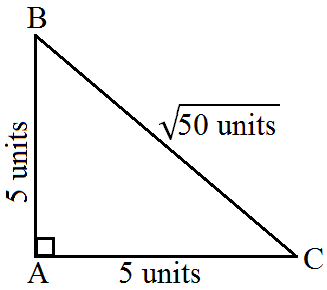
Let A(3, 0), B(6, 4) and C(-1, 3) be the given points. Then,
$\text{AB}=\sqrt{(6-3)^2+(4-0)^2}$
$=\sqrt{9+16}=5\text{ units}$
$\text{BC}=\sqrt{(-1-6)^2+(3-4)^2}$
$=\sqrt{49+1}=\sqrt{50}\text{ units}$
$\text{AC}=\sqrt{(-1-3)^2+(3-0)^2}$
$=\sqrt{16+9}=5\text{ units}$
Thus, $A B=A C=5$ units
$\therefore \triangle ABC$ is isosceles.
Also, $A B^2+A C^2=5^2+5^2=50$ and
$BC ^2=(\sqrt{50})^2=50$
Thus, $A B^2+ AC ^2= BC ^2$
This shows that $\triangle ABC$ is right-angled at A . View full question & answer→Question 155 Marks
The points A(2, 0), B(9, 1) C(11, 6) and D(4, 4) are the vertices of a quadrilateral ABCD. Determine whether ABCD is a rhombus or not.
AnswerThe co-ordinates of vertices of a quadrilateral ABCD are A(2, 0), B(9, 1), C(11, 6) and D(4, 4) AC and BD are its diagonals which intersect each other at O. 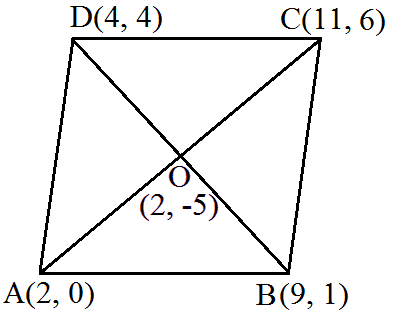 Let O is the mid-point of AC then co-ordinates of O will be $\Big(\frac{2+11}{2},\frac{0+6}{2}\Big)$ or $\Big(\frac{13}{2},\frac{6}{2}\Big)$ or $\Big(\frac{13}{2},3\Big)$ Let O is the mid-point of BD, then co-ordinates of O will be $\Big(\frac{9+4}{2},\frac{1+4}{2}\Big)$ or $\Big(\frac{13}{2},\frac{5}{2}\Big)$The co-ordinates of O in both cases are not same.
It is not a parallelogram and also not a rhombus. View full question & answer→Question 165 Marks
Three consecutive vertices of a parallelogram are (-2, 1), (1, 0) and (4, 3). Find the fourth vertex.
AnswerLet the co-ordinates of three vertices are A(-2, -1), B(1, 0) and C(4, 3) and let the diagonals AC and BD bisect each other at O. 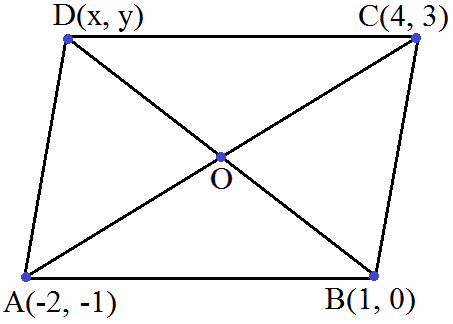 $\because$ O is the mid-point of AC. $\therefore$ Vertices of O will be$\Big(\frac{\text{x}_1+\text{x}_2}{2},\frac{\text{y}_1+\text{y}_2}{2}\Big)$ or $\Big(\frac{-2+4}{2},\frac{-1+3}{2}\Big)$
or $\Big(\frac{2}{2},\frac{2}{2}\Big)$ or (1, 1)
Let co-ordinates of the fourth vertex D be (x, y)
$\because$ O is the mid-point of BD $\therefore$ co-ordinates of O will be $\Big(\frac{1+\text{x}}{2},\frac{0+\text{y}}{2}\Big)$ or $\Big(\frac{1+\text{x}}{2},\frac{\text{y}}{2}\Big)$ $\therefore\ \frac{1+\text{x}}{2}=1$ $\Rightarrow\ 1+\text{x}=2\Rightarrow\ \text{x}=2-1=1$ and $\frac{\text{y}}{2}=1\Rightarrow\ \text{y}=2$ Co-ordinates of D will be (1, 2). View full question & answer→Question 175 Marks
The vertices of ΔABC are (-2, 1), (5, 4) and (2, -3) respectively. Find the area of the triangle and the length of the altitude through A.
AnswerGiven: The vertices of triangle $A B C$ are $A(-2,1)$ and $B(5,4)$ and $C(2,-3)$ To find: The area of triangle $A B C$ and length if the altitude through A.
Proof: We know area of triangle formed by three points $\left( x _1, y _1\right),\left( x _2, y _2\right)$ and $\left( x _3, y _3\right)$ is given by
$\Delta=\frac{1}{2}\left|x_1\left(y_2-y_3\right)+x_2\left(y_3-y_1\right)+x_3\left(y_1-y_2\right)\right|$
Now Area of $\triangle ABC$
Taking three points $A (-2,1)$ and $B (5,4)$ and $C (2,-3)$
Area $(\triangle ABC )=\frac{1}{2}|(-8-15+2)-(5+8+6)|$
$=\frac{1}{2}|(-21)-(19)|$
$=\frac{1}{2}|(-40)|$
$=\frac{1}{2}(40)$
$=20$
We have, $BC =\sqrt{(5-2)^2+(4+3)^2}$
$BC=\sqrt{(3)^2+(7)^2}$
$BC=\sqrt{9+49}$
$BC=\sqrt{58}$
Now, Area $(\triangle ABC )=\frac{1}{2} \times BC \times$ length of altitude through A
$20=\frac{1}{2} \times \sqrt{58} \times$ length of altitude through $A$
length of altitude through $A =\frac{40}{\sqrt{58}}$
View full question & answer→Question 185 Marks
The point A divides the join of P(-5, 1) and Q(3, 5) in the ratio k : 1. Find the two values of k for which the area of ΔABC where B is (1, 5) and C(7, -2) is equal to 2 units.
AnswerGiven that,
Point A divides the line segment joining P(-5, 1) and Q(3, 5) in the ratio k : 1.
So the coordinates of A are,
$\Big(\frac{3\text{k}-5}{\text{k}+1},\frac{5\text{k}+1}{\text{k}+1}\Big)$
We know that, area of triangle formed by three points $\left( x _1, y _1\right),\left( x _2, y _2\right)$ and $\left( x _3, y _3\right)$ is given by.
$\triangle=\frac{1}{2}|\text{x}_1(\text{y}_2-\text{y}_3)+\text{x}_2(\text{y}_3-\text{y}_1)+\text{x}_3(\text{y}_1-\text{y}_2)|$
It is given that area of $\triangle\text{ABC}$ is 2 square units.
Now, three points are
$\text{A}\Big(\frac{3\text{k}-5}{\text{k}+1},\frac{5\text{k}+1}{\text{k}+1}\Big),$ B(1, 5) and C(7, -2)
$\Rightarrow\ 2=\frac{1}{2}\Big|\frac{3\text{k}-5}{\text{k}+1}(5-(-2))+1\Big[(-2)-\Big(\frac{5\text{k}+1}{\text{k}+1}\Big)\Big]+7\Big(\frac{5\text{k}+1}{\text{k}+1}-5\Big)\Big|$
$\Rightarrow\ 2=\frac{1}{2}\Big|\frac{21\text{k}-35}{\text{k}+1}+\Big(\frac{-2\text{k}-2-5\text{k}-1}{\text{k}+1}\Big)+\Big(\frac{35\text{k}+7-35\text{k}-35}{\text{k}+1}\Big)\Big|$
$\Rightarrow\ 2=\frac{1}{2}\Big|\frac{21\text{k}-35-7\text{k}-3-28}{\text{k}+1}\Big|$
$\Rightarrow\ 2=\frac{1}{2}\Big|\frac{14\text{k}-66}{\text{k}+1}\Big|$
$\Rightarrow\ 2=\frac{1}{2}\times2\Big|\frac{7\text{k}-33}{\text{k}+1}\Big|$
$\Rightarrow\ \frac{7\text{k}-33}{\text{k}+1}=\pm2$
$\Rightarrow\ 7\text{k}-33=\pm2(\text{k}+1)$
⇒ 7k - 33 = 2k + 2 or 7k - 33 = -2k - 2
⇒ 5k = 35 or 9k = -2 + 33
⇒ k = 7 or $\text{k}=\frac{31}{9}$
Hence, the value of k is either 7 or $\frac{31}{9}.$
View full question & answer→Question 195 Marks
Find the area of a quadrilateral ABCD, the coordinates of whose varities are A(-3, 2), B(5, 4), C(7, -6) and D(-5, -4).
AnswerArea of quadrilateral ABCD = area of ∆ABC + area of ∆ACD

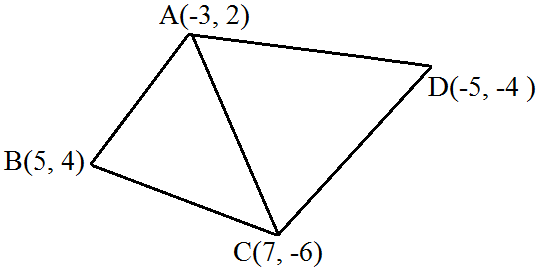
$=\frac{1}{2}|(-12-30+14)-(10+28+18)|$$+\frac{1}{2}(18-28-10)-(14+30+12)|$
$=\frac{1}{2}|-28-56|+\frac{1}{2}|-20-56|$
$=\frac{1}{2}|-84|+\frac{1}{2}|-76|$
$=42+38=80\text{ sq.units}$
$\therefore$ Area of quadrilateral = 80 sq.units View full question & answer→Question 205 Marks
The base PQ of two equilateral triangles PQR and PQR' with side 2a lies along y-axis such that the mid-point of PQ is at the origin. Find the coordinates of the vertices R and R' of the triangles.
Answer∆PQR and PQR’ are equilateral triangles with side 2a each and base PQ and mid of point of PQ is O(0, 0) and PQ lies along y-axis,
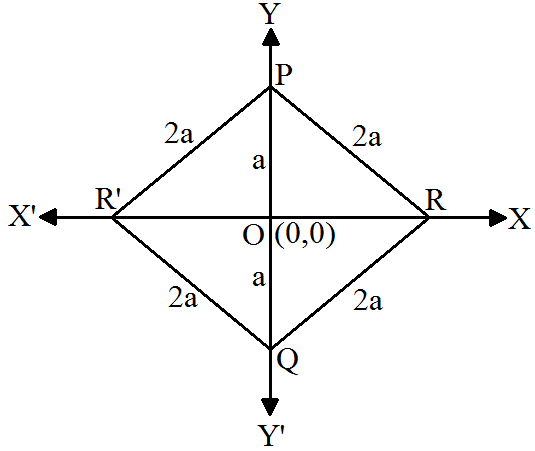
$\because P R=Q R=P R^{\prime}=Q R^{\prime}=2 a P O=O Q=a \therefore \text { In right } \triangle P R O$
$P R^2=P O^2+O R^2(P y t h a g o r a s \text { Theorem }) \Rightarrow(2 a)^2=(a)^2+O R^2 \Rightarrow 4 a^2=a^2+O R^2 O R^2=4 a^2-a^2=3 a^2$
$\therefore O R=\sqrt{3} a$
Similarly $OR ^{\prime}=-\sqrt{3} a$, Now, co-ordinates of $R$ will be $(\sqrt{3} a , 0)$ and co-ordinates of $R$ will be $(-\sqrt{3} a , 0)$ View full question & answer→Question 215 Marks
The area of a triangle is 5. Two of its vertices are (2, 1) and (3, -2). The third vertex lies on y = x + 3. Find the third vertex.
AnswerGiven: The area of triangle is 5 . Two of its vertices are $(2,1)$ and $(3,-2)$. The third vertex lies on $y=x+3$.
To find: The third vertex.
Proof: Let the third vertex be ( $x , y$ )
We know area of triangle formed by three points $\left(x_1, y_1\right),\left(x_2, y_2\right)$ and $\left(x_3, y_3\right)$ is given by,
$\triangle=\frac{1}{2}|(\text{x}_1\text{y}_2+\text{x}_2\text{y}_3+\text{x}_3\text{y}_1)-(\text{x}_2\text{y}_1+\text{x}_3\text{y}_2+\text{x}_1\text{y}_3)|$
Now,
Taking three points (x, y), (2, 1) and (3, -2)
$\triangle=\frac{1}{2}|(\text{x}-4+3\text{y})-(2\text{y}+3-2\text{x})|$
$\triangle=\frac{1}{2}|3\text{x}+\text{y}-7|$
$5=\frac{1}{2}|3\text{x}+\text{y}-7|$
$\pm10=3\text{x}+\text{y}-7$
$10 = 3x + y - 7 or -10 = 3x + y - 7$
$0 = 3x + y - 17........(i) or 0 = 3x + y + 3 ......(ii)$
Also, it is given the third vertex lies on y = x + 3
Substituting the value in equation (i) and (ii) we get
$\pm10=3\text{x}+\text{y}-7$
$10 = 3x + y - 7$
$0 = 3x + y - 17........(i)$
$0 = 3x + (x + 3) - 17$
$\text{x}=\frac{7}{2}$
Again substituting the value of x in equation (i) we get
0 = 3x + y - 17........(i)
$0=3\Big(\frac{7}{2}\Big)+\text{y}-17$
$\text{y}=\frac{13}{2}$
Hence, $\Big(\frac{7}{2},\frac{13}{2}\Big)$
Similarly,
$-10 = 3x + y - 7$
$0 = 3x + y + 3 ......(ii)$
$0 = 3x + (x + 3) + 3$
$\text{x}=\frac{-3}{2}$
Again substituting the value of x in equation (ii) we get
$0 = 3x + y + 3 ......(ii)$
$0=3\Big(\frac{-3}{2}\Big)+\text{y}+3$
$\text{y}=\frac{3}{2}$
Hence, $\Big(\frac{-3}{2},\frac{3}{2}\Big)$
Hence the coordinates of $\Big(\frac{7}{2},\frac{13}{2}\Big)$ and $\Big(\frac{-3}{2},\frac{3}{2}\Big).$
View full question & answer→Question 225 Marks
The coordinates of the point P are (-3, 2). Find the coordinates of the point Q which lies on the line joining P and origin such that OP = OQ.
AnswerCo-ordinates of P are (-3, 2) and origin O are (0, 0)
Let co-ordinates of Q be (x, y)
O is the mid point of PQ
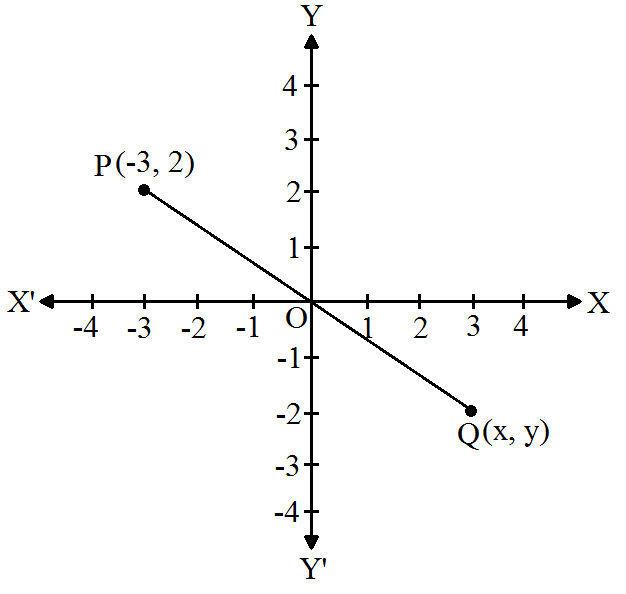
O is the mid point so that
$\text{O}=\frac{-3+\text{x}}{2}$
$\text{O}=-3+\text{x}$
$\text{x}=3$
$\text{O}=\frac{2+\text{y}}{2}$
$\text{O}=2+\text{y}$
$\text{y}=-2$
Therefore Co-ordinate of Q(x, y) = (3, -2). View full question & answer→Question 235 Marks
Prove that the points (4, 5) (7, 6), (6, 3), (3, 2) are the vertices of a parallelogram. Is it a rectangle.
AnswerLet $A(4,5) ; B(7,6) ; C(6,3)$ and $D(3,2)$ be the vertices of a quadrilateral. We have to prove that the quadrilateral $A B C D$ is a parallelogram. We should proceed with the fact that if the diagonals of a quadrilateral bisect each other than the quadrilateral is a parallelogram. Now to find the mid-point $P(x, y)$ of two points $A\left(x_1, y_1\right)$ and $B\left(x_2, y_2\right)$ we use section
,$\text{P(x, y)}=\bigg(\frac{\text{x}_1+\text{x}_2}{2},\frac{\text{y}_1+\text{y}_2}{2}\bigg)$
So the mid-point of the diagonal AC is,
$\text{Q(x, y)}=\bigg(\frac{4+6}{2},\frac{5+3}{2}\bigg)$ = (5, 4) Similarly mid-point of diagonal BD is, $\text{R(x,y)}=\bigg(\frac{7+3}{2},\frac{6+2}{2}\bigg)$ = (5, 4) Therefore the mid-points of the diagonals are coinciding and thus diagonal bisects each other. Hence ABCD is a parallelogram. Now to check if ABCD is a rectangle, we should check the diagonal length. $\text{AC}=\sqrt{(6-4)^2+(3-5)^2}$ $=\sqrt{4+4}$ $=2\sqrt{2}$ Similarly, $\text{BD}=\sqrt{(7-3)^2+(6-2)^2}$ $=\sqrt{16+16}$ $=4\sqrt{2}$ Diagonals are of different lengths. Hence ABCD is not a rectangle.
View full question & answer→Question 245 Marks
The length of a line segment is of 10 units and the coordinates of one end-point are (2, -3). If the abscissa of the other end is 10, find the ordinate of the other end.
AnswerThe distance d between two points $\left( x _1, y _1\right)$ and $\left( x _2, y _2\right)$ is given by the formula, $d =\sqrt{\left( x _1- x _2\right)^2+\left( y _1- y _2\right)^2}$ Here it is given that one end of a line segment has co-ordinates $(2,-3)$. The abscissa of the other end of the line segment is given to be 10. Let the ordinate of this point be ' $y$ '.
So, the co-ordinates of the other end of the line segment is $(10, y)$.
The distance between these two points is given to be 10 units.
Substituting these values in the formula for distance between two points we have,
$d =\sqrt{(2-10)^2+(-3- y )^2} 10=\sqrt{(-8)^2+(-3- y )^2}$ Squaring on both sides of the equation we have,
$100=(-8)^2+(-3-y)^2$
$100=64+9+y^2+6 y$
$27=y^2+6 y$
We have a quadratic equation for ' $y$ '. Solving for the roots of this equation we have, $y^2+6 y-27=0 y^2+9 y-3 y-27$ $=0 y(y+9)-3(y+9)=0(y+9)(y-3)=0$ The roots of the above equation are ' -9 ' and ' 3 '. Thus the ordinates of the other end of the line segment could be -9 or 3.
View full question & answer→Question 255 Marks
Prove that (2, -2) (-2, 1) and (5, 2) are the vertices of a right angled triangle. Find the area of the triangle and the length of the hypotenuse.
AnswerLet A(2, -2), B(-2, 1) and C(5, 2) be the given points.$\text{AB}=\sqrt{(-2-2)^2+(1+2)^2}$
$\Rightarrow\ \text{AB}=\sqrt{(-4)^2+(3)^2}$
$\Rightarrow\ \text{AB}=\sqrt{16+9}$
$\Rightarrow\ \text{AB}=\sqrt{25}$
$\text{BC}=\sqrt{(5+2)^2+(2-1)^2}$
$\Rightarrow\ \text{BC}=\sqrt{(7)^2+(1)^2}$
$\Rightarrow\ \text{BC}=\sqrt{49+1}$
$\Rightarrow\ \text{BC}=\sqrt{50}$
$\text{AC}=\sqrt{(5-2)^2+(2+2)^2}$
$\Rightarrow\ \text{AC}=\sqrt{(3)^2+(4)^2}$
$\Rightarrow\ \text{AC}=\sqrt{9+16}$
$\Rightarrow\ \text{AC}=\sqrt{25}$
$\text{AB}^2=(\sqrt{25})^2$
$\Rightarrow\ \text{AB}^2=25$
$\text{BC}^2=(\sqrt{50})^2$
$\Rightarrow\ \text{BC}^2=50$
Since, $AB^2 + AC^2 = BC^2$
$\therefore$ ABC is a right angled triangle.
Length of the hypotenuse $\text{BC}=\sqrt{50}=5\sqrt{2}$
$\text{Area of }\triangle\text{ABC}=\frac{1}{2}\times\text{AB}\times\text{AC}$
$=\frac{1}{2}\times\sqrt{25}\times\sqrt{25}$
$=\frac{25}{2}\text{square units}.$
View full question & answer→Question 265 Marks
If two opposite vertices of a square are (5, 4) and (1, -6), find the coordinates of its remaining two vertices.
AnswerTwo opposite points of a square are (5, 4) and (1, -6). Let ABCD be a square and A(5, 4) and C(1, -6) are the opposite points. Let the co-ordinates of B be (x, y). Join AC.
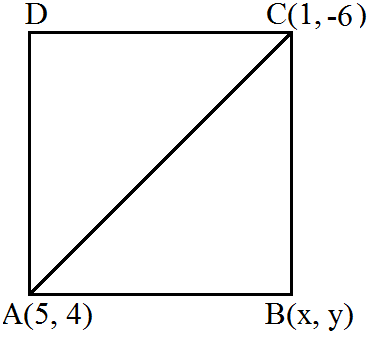
Now, $\because A B=B C$ (Sides of a square) $\Rightarrow A B^2=B C^2 \Rightarrow(x-5)^2+(y-4)^2=(x-1)^2+(y+6)^2 \Rightarrow x^2-10 x+25+y^2-8 y+$ $16=x^2-2 x+1+y^2+12 y+36 \Rightarrow-10 x+2 x-8 y-12 y=37-41 \Rightarrow-8 x-20 y=-4 \Rightarrow 2 x+5 y=1$ (Dividing by -4$) \Rightarrow$ $2 x=1-5 y \Rightarrow x=\frac{1-5 y}{2} \because A B C$ is a right angled triangle.
$\therefore A C^2=A B^2+B C^2 \Rightarrow(5-1)^2+(4+6)^2=x^2-10 x+25+y^2-8 y+16+x^2-2 x+1+y^2+12 y+36 \Rightarrow(4)^2+(10)^2=$ $2 x^2+2 y^2-12 x+4 y+78 \Rightarrow 16+100=2 x^2+2 y^2-12 x+4 y+78 \Rightarrow 2 x^2+2 y^2-12 x+4 y+78-16-100=0 \Rightarrow x^2+$ $y ^2-6 x +2 y -19=0$ (Dividing by 2) Substituting $x =\frac{1-5 y }{2}\left(\frac{1-5 y }{2}\right)^2+ y ^2-6\left(\frac{1-5 y }{2}\right)+2 y -19=0$ $\Rightarrow \frac{1+25 y^2-10 y}{4}+ y ^2-3(1-5 y)+2 y -19=0 \Rightarrow 1+25 y ^2-10 y +4 y ^2-12(1-15 y )+8 y -76=0 \Rightarrow 1+25 y ^2-$ $10 y+4 y^2-12+60 y+8 y-76=0 \Rightarrow 29 y^2+58 y-87=0 \Rightarrow y^2+2 y-3=0$ (Dividing by 29 ) $\Rightarrow y^2+3 y-y-3=0 \Rightarrow$ $y(y+3)-1(y+3)=0 \Rightarrow(y+3)(y-1)=0$ Either $y+3=0$, then $y=-3$ or $y-1=0$, then $y=1$ If $y=1$, then $x =\frac{1-5 y }{2}=\frac{1-5 \times 1}{2}$
$=\frac{1-5}{2}=\frac{-4}{2}=-$
If $y =-3$, then $x =\frac{1-5(-3)}{2}=\frac{1+15}{2}$ $=\frac{16}{2}=8$
$\therefore$ Other points are $(-2,1)$ and $(8,-3)$. View full question & answer→Question 275 Marks
Prove analytically that the line segment joining the middle points of two sides of a triangle is equal to half of the third side.
AnswerIn ∆ABC, D and E are the mid points of the sides AB and AC respectively,
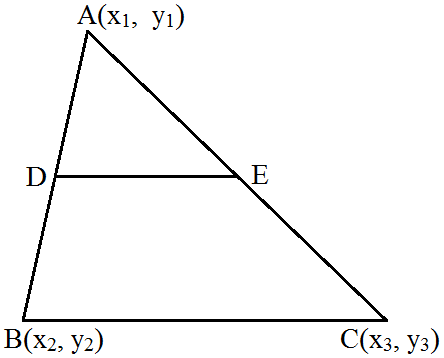
Then $\text{DE}=\frac{1}{2}\text{BC}$
Let the co-ordinates of the vertices of a $\triangle A B C$ be $A\left(x_1, y_1\right), B\left(x_2, y_2\right)$ and $C\left(x_3, y_3\right)$.
Then coordinates of D will be,
$\Big(\frac{\text{x}_1+\text{x}_2}{2},\frac{\text{y}_1+\text{y}_2}{2}\Big)$
Then coordinates of E will be,
$\Big(\frac{\text{x}_1+\text{x}_3}{2},\frac{\text{y}_1+\text{y}_3}{2}\Big)$
Now length of $\text{BC}=\sqrt{(\text{x}_2-\text{x}_3)^2+(\text{y}_2-\text{y}_3)^2}\ ....(\text{i})$
and length of $\text{DE}=\sqrt{\Big(\frac{\text{x}_1+\text{x}_2}{2}-\frac{\text{x}_1+\text{x}_3}{2}\Big)^2+\Big(\frac{\text{y}_1+\text{y}_2}{2}-\frac{\text{y}_1+\text{y}_3}{2}\Big)^2}$
$=\sqrt{\Big(\frac{\text{x}_1+\text{x}_2-\text{x}_1-\text{x}_3}{2}\Big)^2+\Big(\frac{\text{y}_1+\text{y}_2-\text{y}_1-\text{y}_3}{2}\Big)^2}$
$=\sqrt{\Big(\frac{\text{x}_2-\text{x}_3}{2}\Big)^2+\Big(\frac{\text{y}_2-\text{y}_3}{2}\Big)^2}$
$=\frac{1}{2}\sqrt{(\text{x}_2-\text{x}_3)^2+(\text{y}_2-\text{y}_3)^{2}}$
$=\frac{1}{2}\text{BC}$ [From (i)]
Hence proved. View full question & answer→Question 285 Marks
Find the centre of the circle passing through (6, -6), (3, -7) and (3, 3).
AnswerThe distance d between two points $\left( x _1, y _1\right)$ and $\left( x _2, y _2\right)$ is given by the formula, $d =\sqrt{\left( x _1- x _2\right)^2+\left( y _1- y _2\right)^2}$ The centre of a circle is at equal distance from all the points on its circumference. Here it is given that the circle passes through the points $A(6,-6), B(3,-7)$ and $C(3,3)$. Let the centre of the circle be represented by the point $O(x, y)$. So we have $A O=B O=C O A O=\sqrt{(6-x)^2+(-6-y)^2} BO =\sqrt{(3-x)^2+(-7-y)^2}$
$CO =\sqrt{(3- x )^2+(3- y )^2}$ Equating the first pair of these equations we have,
$A O=B O$
$\sqrt{(6-x)^2+(-6-y)^2}=\sqrt{(3-x)^2+(-7-y)^2}$ Squaring on both sides of the equation we have, $(6-x)^2+$ $(-6-y)^2=(3-x)^2+(-7-y)^2 36+x^2-12 x+36+y^2+12 y=9+x^2-6 x+49+y^2+14 y 6 x+2 y=143 x+y=7$
Equating another pair of the equations we have, $AO = CO \sqrt{(6- x )^2+(-6- y )^2}=\sqrt{(3- x )^2+(3- y )^2}$
Squaring on both sides of the equation we have, $(6-x)^2+(-6-y)^2=(3-x)^2+(3-y)^2 36+x^2-12 x+36+y^2+12 y$ $=9+x^2-6 x+9+y^2-6 y 6 x-18 y=54 x-3 y=9$ Now we have two equations for ' $x$ ' and ' $y$ ', which are $3 x+y=7 x-$ $3 y=9$ From the second equation we have $y=-3 x+7$. Substituting this value of ' $y$ ' in the first equation we have, $x$ -
$3(-3 x+7)=9 x+9 x-21=910 x=30$
$x=3$
Therefore the value of ' $y$ ' is,
$y=-3 x+7$
$y=-3(3)+7$
$y=-2$
Hence the co-ordinates of the centre of the circle are $(3,-2)$.
View full question & answer→Question 295 Marks
In what ratio does the point (-4, 6) divide the line segment joining the points A(-6, 10) and B(3, -8)?
AnswerLet (-4, 6) Divide AB internally in the ratio k : 1 using three section formula, we get $(-4,6)=\Big(\frac{3\text{k}-6}{\text{k}+1},\frac{-8\text{k}+10}{\text{k}+1}\Big)$ So, $-4=\frac{3\text{k}-6}{\text{k}+1}$ i.e., -4k - 4 = 3k - 6i.e., 7k = 2
i.e., k : 1 = 2 : 7
You check for the y-coordinate also, So, the point (-4, 6) divides the line segment joining the points A(-6, 10) and B(3, -8) in the ratio 2 : 7.
View full question & answer→Question 305 Marks
If (-4, 3) and (4, 3) are two vertices of an equilateral triangle, find the coordinates of the third vertex, given that the origin lies in the,
- interior,
- exterior of the triangle.
AnswerLet the third vertex of an equilateral triangle be $(x, y)$. Let $A(-4,3), B(4,3)$ and $C(x, y)$. We know that, in equilateral triangle the angle between two adjacent side is 60 and all three sides are equal.. $\therefore A B=B C=C A$ $\Rightarrow A B^2=B C^2=C A^2$.......(i) Now taking first two parts.
$A B^2=B C^2$
$\Rightarrow(4+4)^2+(3-3)^2=(x-4)^2+(y-3)^2 \Rightarrow 64+0=x^2+16-8 x+y^2+9-6 y \Rightarrow x^2+y^2-8 x-6 y=39 \ldots . .$. (ii)Now, taking first and third parts.
$AB ^2= CA ^2$
$\Rightarrow(4+4)^2+(3-3)^2=(-4-x)^2+(3-y)^2 \Rightarrow 64+0=16+x^2+8 x+9+y^2-6 y \Rightarrow x^2+y^2+8 x-6 y=39$ subtracting eq.(ii) from eq.(iii), we get
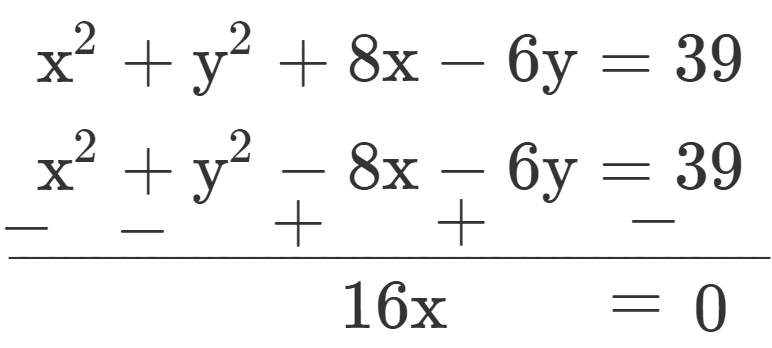
⇒ x = 0Now, put the value of x in eq.(ii), we get
$0 + y^2 - 0 - 6y = 39$
$\Rightarrow y^2 - 6y - 39 = 0$
$\therefore\ \text{y}=\frac{6\pm\sqrt{(-6)^2-4(1)(-39)}}{2\times1}$
$\bigg[\because$ Solution of ax + bx + c = 0 is $\text{x}={-\text{b}\pm\sqrt{\text{b}^2-4\text{ac}}\over2\text{a}}\bigg]$
$\Rightarrow\ \text{y}=\frac{6\pm\sqrt{36+156}}{2}$
$\Rightarrow\ \text{y}=\frac{6\pm\sqrt{192}}{2}$
$\Rightarrow\ \text{y}=\frac{6\pm2\sqrt{48}}{2}$
$\Rightarrow\ \text{y}=3\pm\sqrt{48}$
$\Rightarrow\ \text{y}=3\pm4\sqrt{3}$ $\Rightarrow\ \text{y}=3+4\sqrt{3}$ or $3-4\sqrt{3}$ So, the points of third vertex are, $(0, 3+4\sqrt{3})$ or $(3-4\sqrt{3})$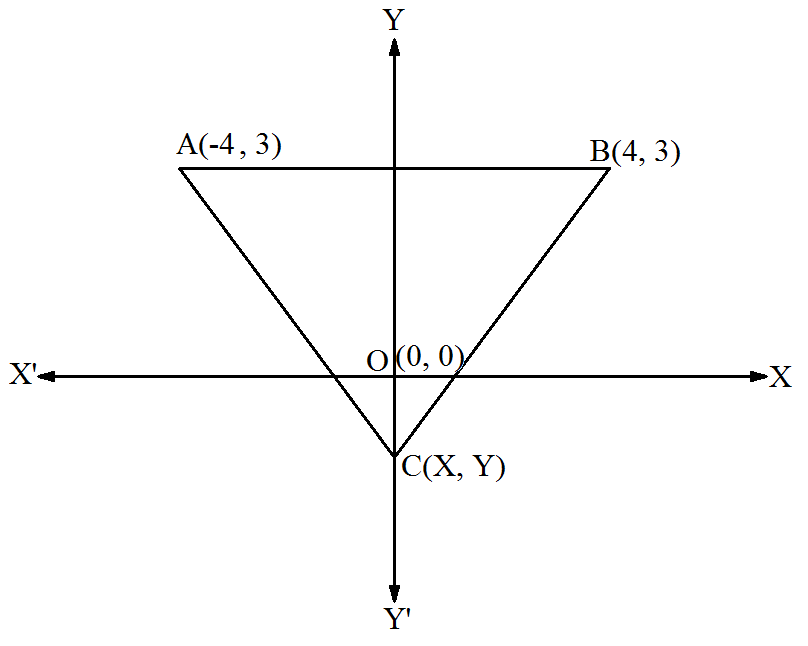
But given that, the origin lies in the interior of the ∆ABC and the x-coordinate of third vertex is zero.
Then, y-coordinate of third vertex should be negative.
Hence, the require coordinate of third vertex,
$\text{C}=(0,3-4\sqrt{3}).[\text{C}\neq(0,3+4\sqrt{3})]$ View full question & answer→Question 315 Marks
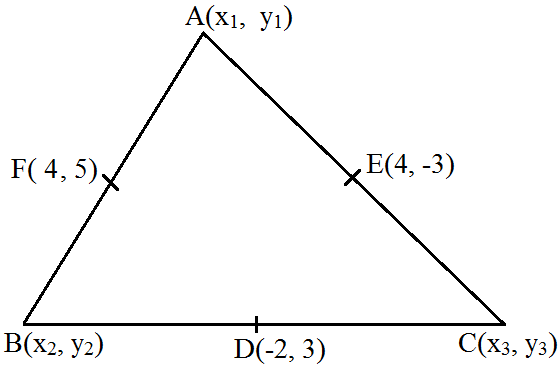
If (-2, 3), (4, -3) and (4, 5) are the mid-points of the sides of a triangle, find the coordinates of its centroid.
AnswerIn $\triangle A B C, D, E$ and $F$ are the mid-points of the sides $B C, C A$ and $A B$ respectively. The co-ordinates of $D$ are $(-2,3)$, of $E$ are $(4,-3)$ and of $F$ are $(4,5)$. Let the co-ordinates of $A, B$ and $C$ be $\left(x_1, y_1\right),\left(x_2, y_2\right),\left(x_3, y_3\right)$ respectively.
$\because D$ is mid point of $B C \therefore x=\frac{x_2+x_3}{2}$ and $y=\frac{y_2+y_3}{2} \Rightarrow-2=\frac{x_2+x_3}{2}$
$\Rightarrow x _2+ x _3=-4$
and $3=\frac{ y _2+ y _3}{2} \Rightarrow y _2+ y _3=6$
Similarly E and F are the mid points of AC and AB respectively. $\therefore 4=\frac{ x _3+ x _1}{2} \Rightarrow x _3+ x _1=8$
and $-3=\frac{ y _3+ y _1}{2} \Rightarrow y _3+ y _1=-6$
$4=\frac{ x _1+ x _2}{2} \Rightarrow x _1+ x _2=8$
and $5=\frac{ y _1+ y _2}{2} \Rightarrow y _1+ y _2=10$
Now, $x_2+x_3=-4$ $\qquad$ (i) $x_3+x_1=8$
......(ii) $x_1+x_2=8$ $\qquad$ (iii) Adding we get, $2\left( x _1+ x _2+ x _3\right)=12$
$\Rightarrow x _1+ x _2+ x _3=\frac{12}{2}$
$\Rightarrow x _1+ x _2+ x _3=6$ $\qquad$ (iv) Subtracting (i), (ii) and (iii) from
(iv) $x_1=10 x_2=-2 x_3=-2$ Similarly, $y_2+y_3=6$ $\qquad$ (v) $y _3+$
$y_1=-6$ $\qquad$ (vi) $y_1+y_2=10$ $\qquad$ (vii) Adding, we get $2\left( y _1+ y _2+ y _3\right)=10 \Rightarrow y _1+ y _2+ y _3=\frac{10}{2}$
$\Rightarrow y_1+y_2+y_3=5$ $\qquad$ (viii) Subracting (v), (vi) and (vii) from (viii) $y _1=-1 y _2=11 y _3=-5 \therefore$ Co-ordinates of $A , B$ and C will be $(10,-1),(-2,11),(-2,-5)=\left(\frac{x_1+x_2+x_3}{3}, \frac{y_1+y_2+y_3}{3}\right)$ or $\left(\frac{10-2-2}{3}, \frac{-1+11-5}{3}\right)$ or $\left(\frac{6}{3}, \frac{5}{3}\right)$ or $\left(2, \frac{5}{2}\right)$ View full question & answer→Question 325 Marks
Prove that the lines joining the middle points of the opposite sides of a quadrilateral and the join of the middle points of its diagonals meet in a point and bisect one another.
Answer
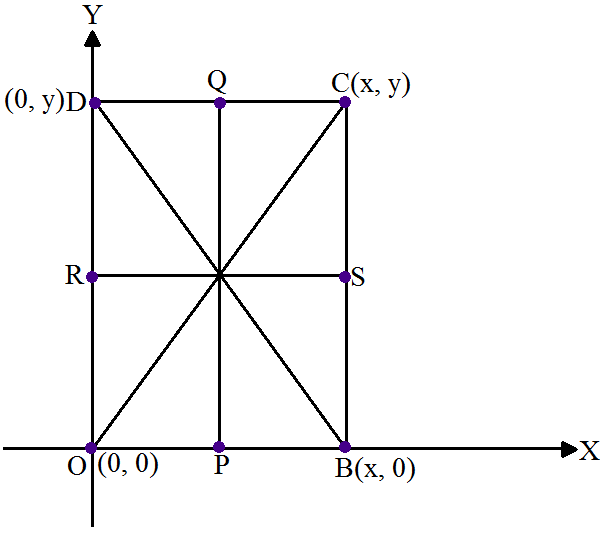 Let OBCD be the quadrilateral P, Q, R, S be the midpoint off OB, CD, OD and BC.
Let the coordinates of O, B, C, D are (0, 0), (x, 0), (x, y) and (0, y).
coordinates of P are $\Big(\frac{\text{x}}{2},0\Big)$
coordinates of Q are $\Big(\frac{\text{x}}{2},\text{y}\Big)$
coordinates of R are $\Big(0,\frac{\text{y}}{2}\Big)$
coordinates of S are $\Big(\text{x},\frac{\text{y}}{2}\Big)$
Coordinates of midpoint of PQ are $\bigg[\frac{\frac{\text{x}}{2}+\frac{\text{x}}{2}}{2},\frac{0+\text{y}}{2}\bigg]=\Big(\frac{\text{x}}{2},\frac{\text{y}}{2}\Big)$
Coordinates of midpoint of RS are $\bigg[\frac{(0+\text{x})}{2},\frac{\frac{\text{y}}{2}+\frac{\text{y}}{2}}{2}\bigg]=\Big[\frac{\text{x}}{2},\frac{\text{y}}{2}\Big]$
Since, the coordinates of the mid-point of PQ = coordinates of mid-point of RS
$\therefore$ PQ and RS bisect each other. View full question & answer→Question 335 Marks
If $\text{D}\Big(\frac{-1}{2},\frac{5}{2}\Big),$ E(7, 3) and $\text{F}\Big(\frac{7}{2},\frac{7}{2}\Big)$ are the mid-points of sides of ∆ABC, find the area of ∆ABC.
Answer
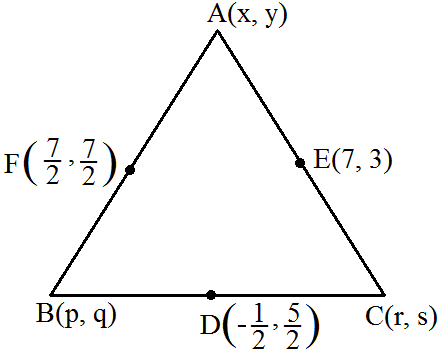 The midpoint of BC is $\text{D}\Big(\frac{-1}{2},\frac{5}{2}\Big)$
The midpoint of AB is $\text{F}\Big(\frac{7}{2},\frac{7}{2}\Big)$
The midpoint of AC is E(7, 3),
Consider the line segment BC,
$\Rightarrow\ \frac{\text{p}+\text{r}}{2}=-\frac{1}{2};\ \frac{\text{q}+\text{s}}{2}=\frac{5}{2}$
$\Rightarrow\ \text{p}+\text{r}=-1;\ \text{q}+\text{s}=5\ .....(\text{i})$
Consider the line segment AB,
$\Rightarrow\ \frac{\text{p}+\text{x}}{2}=\frac{7}{2};\ \frac{\text{q}+\text{y}}{2}=\frac{7}{2}$
$\Rightarrow\ \text{p}+\text{x}=7;\ \text{q}+\text{y}=7\ .....(\text{ii})$
Consider the line segment AC,
$\Rightarrow\ \frac{\text{r}+\text{x}}{2}=7;\ \frac{\text{s}+\text{y}}{2}=3$
$\Rightarrow\ \text{r}+\text{x}=14;\ \text{s}+\text{y}=6\ ....(\text{iii})$
Solve (i), (ii) and (iii) to get A(x, y) = A(11, 4), B(p, q) = B(-4, 3), C(r, s) = C(3, 2)
Let us assume that BC is base of the triangle,
$\overline{\text{BC}}=\sqrt{(-4-3)^2+(3-2)^2}=\sqrt{50}$
Equation of the line BC is,
$\frac{\text{x}+4}{-4-3}=\frac{\text{y}-3}{3-2}$
$\Rightarrow\ \text{x}+7\text{y}-17=0$
The perpendicular distance from a point $P(x_1, y_1)$ is,
$\text{P}=\Big|\frac{1(11)+7(4)-17}{\sqrt{50}}\Big|=\frac{22}{\sqrt{50}}$
The area of the triangle is $\text{A}=\frac{1}{2}\times\sqrt{50}\times\frac{22}{\sqrt{50}}$
= 11sq. units View full question & answer→Question 345 Marks
In Fig., a right triangle BOA is given C is the mid-point of the hypotenuse AB. Show that it is equidistant from the vertices O, A and B.
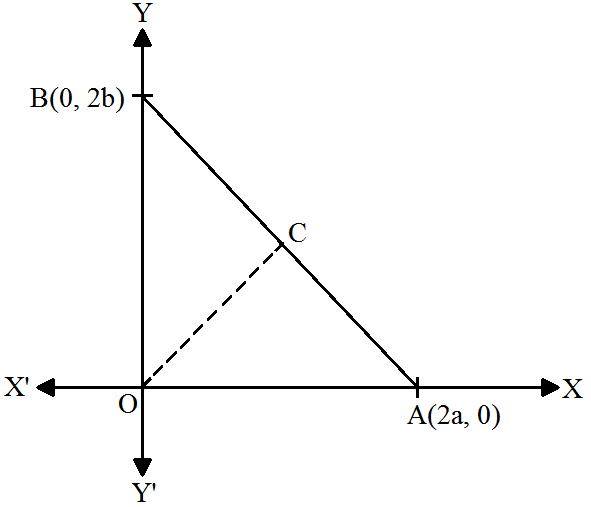
AnswerWe have a right angle triangle $\triangle\text{BOA,}$ right angled at O. Co-ordinates are B(0, 2b), A(2a, 0) and C(0, 0). We have to prove that mid-point C of hypotenuse AB is equidistant from the vertices. In general to find the mid-point P(x, y) of two points $A(x_1, y_1) and B(x_2, y_2)$ we use section formula as, $\text{P}(\text{x, y})=\Big(\frac{\text{x}_1+\text{x}_2}{2},\frac{\text{y}_1+\text{y}_2}{2}\Big)$So co-ordinates of C is,
$C ( a , b )$ In general, the distance between $A \left( x _1, y _1\right)$ and $B \left( x _2, y _2\right)$ is given by,
$\text{AB}=\sqrt{(\text{x}_2-\text{x}_1)^2+(\text{y}_2-\text{y}_1)^2}$
So, $\text{CO}=\sqrt{(\text{a}-0)^2+(\text{b}-0)^2}$ $=\sqrt{\text{a}^2+\text{b}^2}$ $\text{CB}=\sqrt{(\text{a}-0)^2+(\text{b}-2\text{b})^2}$ $=\sqrt{\text{a}^2+\text{b}^2}$ $\text{CA}=\sqrt{(\text{a}-2\text{a})^2+(\text{b}-0)^2}$ $=\sqrt{\text{a}^2+\text{b}^2}$Hence, mid-point C of hypotenuse AB is equidistant from the vertices.
View full question & answer→Question 355 Marks
Determine the ratio in which the point (-6, a) divides the join of A(-3, 1) and B(-8, 9). Also find the value of a.
AnswerThe co-ordinates of a point which divided two points $(x_1, y_1)$ and $(x_2, y_2)$ internally in the ratio m : n is given by the formula,$(\text{x},\text{y})=\bigg[\Big(\frac{\text{mx}_2+\text{nx}_1}{\text{m}+\text{n}}\Big),\Big(\frac{\text{my}_2+\text{ny}_1}{\text{m}+\text{n}}\Big)\bigg]$
Here we are given that the point P(-6, a) divides the line joining the points A(-3, 1) and B(-8, 9) in some ratio.
Let us substitute these values in the earlier mentioned formula.
$(-6,\text{a})=\bigg[\Big(\frac{\text{m}(-8)+\text{n}(-3)}{\text{m}+\text{n}}\Big),\Big(\frac{\text{m}(9)+\text{n}(1)}{\text{m}+\text{n}}\Big)\bigg]$Equating the individual components we have,
$-6=\frac{\text{m}(-8)+\text{n}(-3)}{\text{m}+\text{n}}$ $-6\text{m}-6\text{n}=-8\text{m}-3\text{n}$ $2\text{m}=3\text{n}$ $\frac{\text{m}}{\text{n}}=\frac{3}{2}$ We see that the ratio in which the given point divides the line segment is 3 : 2. Let us now use this ratio to find out the value of ‘a’. $(-6,\text{a})=\bigg[\Big(\frac{\text{m}(-8)+\text{n}(-3)}{\text{m}+\text{n}}\Big),\Big(\frac{\text{m}(9)+\text{n}(1)}{\text{m}+\text{n}}\Big)\bigg]$ $(-6,\text{a})=\bigg[\Big(\frac{3(-8)+2(-3)}{3+2}\Big),\Big(\frac{3(9)+2(1)}{3+2}\Big)\bigg]$ Equating the individual components we have $\text{a}=\frac{3(9)+2(1)}{3+2}$ $\text{a}=\frac{29}{5}$ Thus the value of 'a' is $\frac{29}{5}.$
View full question & answer→Question 365 Marks
In what ratio is the line segment joining the points (-2, -3) and (3, 7) divided by the y-axis? Also, find the coordinates of the point of division.
AnswerLet y-axis divides PQ in the ratio.$\lambda:1$
Let R(x, y) be the coordinates of the point of division.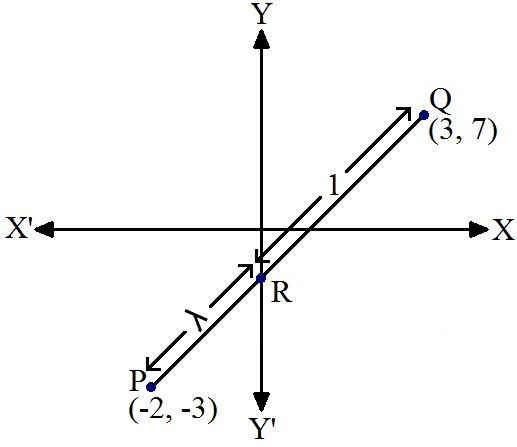
Then, the coordinates of the point of division are,$\text{R}\bigg(\frac{3\times\lambda+(-2)\times1}{\lambda+1},\frac{7\times\lambda+(-3)\times1}{\lambda+1}\bigg)=\bigg(\frac{3\lambda-2}{\lambda+1},\frac{7\lambda-3}{\lambda+1}\bigg)$
Since R lies on y-axis and x-coordinates of every point on y-axis is zero.$\therefore\ \frac{3\lambda-2}{\lambda+1}=0$
$\Rightarrow\ 3\lambda-2=0$
$\Rightarrow\ 3\lambda=2$
$\Rightarrow\ \lambda=\frac{2}{3}$
Hence, the required ratio is $\frac{2}{3}:1$ i.e., 2 : 3 putting $\lambda=\frac{2}{3}$ in the coordinates of R, we get$\Rightarrow\ \frac{7\lambda-3}{\lambda+1}=\frac{7\times\frac{2}{3}-3}{\frac{2}{3}+1}$
$\Rightarrow\ \frac{\frac{14-9}{3}}{\frac{2+3}{3}}=\frac{\frac{5}{3}}{\frac{5}{3}}=1$
Hence, the coordinates of R(0, 1). View full question & answer→Question 375 Marks
If Q(0, 1) is equidistant from P(5, -3) and R(x, 6), find the values of x. Also, find the distances QR and PR.
AnswerGiven Q(0, 1) is equidistant from P(-5, -3) and R(x, 6) so PQ = QR $\sqrt{(5-0)^2+(-3-1)^2}=\sqrt{(0-\text{x})^2+(1-6)^2}$ $\sqrt{(5)^2+(-4)^2}=\sqrt{(-\text{x})^2+(-5)^2}$ $\sqrt{25+16}=\sqrt{\text{x}^2+25}$$41=\text{x}^2+25$
$16=\text{x}^2$
$\text{x}=\pm4$
So, point R is (4, 6) or (-4, 6) When point R is (4, 6)$\text{PR}=\sqrt{(5-4)^2+(-3-6)^2}$
$=\sqrt{1^2+(-9)^2}=\sqrt{1+81}=\sqrt{82}$
$\text{QR}=\sqrt{(0-4)^2+(1-6)^2}$
$=\sqrt{(-4)^2+(-5)^2}=\sqrt{16+25}=\sqrt{41}$
When point R is (-4, 6)$\text{PR}=\sqrt{(5-(-4))^2+(-3-6)^2}$
$=\sqrt{(9)^2+(-9)^2}=\sqrt{81+81}=9\sqrt{2}$
$\text{QR}=\sqrt{(0-(-4))^2+(1-6)^2}$
$=\sqrt{(4)^2+(-5)^2}=\sqrt{16+25}=\sqrt{41}$
View full question & answer→Question 385 Marks
Find the area of a parallelogram ABCD if three of its vertices are A(2, 4), $\text{B}(2+\sqrt{3},\ 5)$ and C(2, 6).
AnswerThree vertices of a ||gm ABCD are A(2, 4), $\text{B}(2+\sqrt{3},\ 5)$ and C(2, 6). Draw one diagonal AC of ||gm ABCD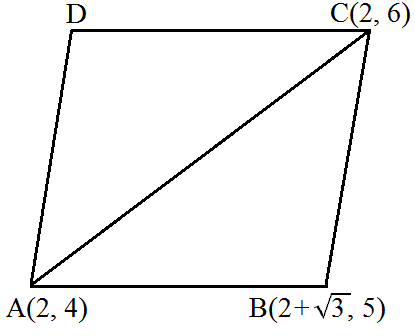
$\because$ Diagonal bisects the ||gm into triangle equal in area
Area of $\triangle\text{ABC}=\frac{1}{2}[\text{x}_1(\text{y}_2-\text{y}_3)+\text{x}_2(\text{y}_3-\text{y}_1)+\text{x}_3(\text{y}_1-\text{y}_2)]$
$=\frac{1}{2}[2(5-6)+(2+\sqrt{3})(6-4)+2(4-5)]$
$=\frac{1}{2}[2\times(-1)+(2+\sqrt{3})\times2+2\times(-1)]$
$=\frac{1}{2}[-2+4+2\sqrt{3}-2]$
$=\frac{1}{2}(2\sqrt{3})=\sqrt{3}\text{ sq.units}$
$\therefore$ Area of ||gm ABCD = 2 × area $(\triangle\text{ABC})$
$=2\times(\sqrt{3})=2\sqrt{3}\text{ sq.units}$ View full question & answer→Question 395 Marks
Show that A(-3, 2), B(-5, -5), C(2, -3), and D(4, 4) are the vertices of a rhombus.
AnswerVertices of a quadrilateral ABCD are A(-3, 2), B(-5, -5), C(2, -3) and D(4, 4). Join the diagonals AC and BD which intersect each other at O.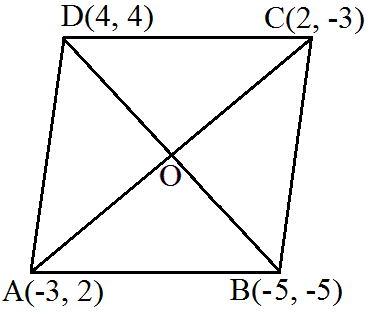
Let O is the mid-point of AC, then co-ordinates of O will be $\Big(\frac{\text{x}_1+\text{x}_2}{2},\frac{\text{y}_1+\text{y}_2}{2}\Big)$
or $\Big(\frac{-3+2}{2},\frac{2-3}{2}\Big)$ or $\Big(\frac{-1}{2},\frac{-1}{2}\Big)$ If O is the mid-point of BD, their co-ordinates of O will be. $\Big(\frac{-5+4}{2},\frac{-5+4}{2}\Big)$ or $\Big(\frac{-1}{2},\frac{-1}{2}\Big)$ $\because$ The co-ordinates of O in both case are same length of $\text{AC}=\sqrt{(\text{x}_2-\text{x}_1)^2+(\text{y}_2-\text{y}_1)^2}$ $=\sqrt{(-3-2)^2+(2+3)^2}$$=\sqrt{(-5)^2+(5)^2}=\sqrt{25+25}$
$=\sqrt{50}=\sqrt{25\times2}=5\sqrt{2}$
and $\text{BD}=\sqrt{(-5-4)^2+(-5-4)^2}$ $=\sqrt{(-9)^2+(-9)^2}$ $=\sqrt{81+81}=\sqrt{162}=\sqrt{2\times81}=9\sqrt{2}$ Side $\text{AB}=\sqrt{(-3+5)^2+(2+5)^2}$ $=\sqrt{(2)^2+(7)^2}=\sqrt{4+49}=\sqrt{53}$ $\text{BC}=\sqrt{(2+5)^2+(-3+5)^2}$ $=\sqrt{(7)^2+(2)^2}=\sqrt{49+4}=\sqrt{53}$ $\text{CD}=\sqrt{(4-2)^2+(4+3)^2}$ $\text{CD}=\sqrt{(2)^2+(7)^2}$ $\text{CD}=\sqrt{4+49}$ $\text{CD}=\sqrt{53}$ and $\text{DA}=\sqrt{(-3-4)^2+(2-4)^2}$ $\text{DA}=\sqrt{(-7)^2+(-2)^2}$ $\text{DA}=\sqrt{49+4}$ $\text{DA}=\sqrt{53}$ $\because$ The diagonals bisect each other, but length of diagonals is not equal and sides are equal. $\therefore$ The figure is of a rhombus. Hence proved. View full question & answer→Question 405 Marks
Which point on x-axis is equidistant from (5, 9) and (-4, 6)?
AnswerLet A(5, 9) and B(-4, 6) be the given points. Let C(x, 0) be the point on x-axis Now,$\text{AC}=\sqrt{(\text{x}-5)^2+(0-9)^2}$
$\Rightarrow\ \text{AC}=\sqrt{\text{x}^2+25-10\text{x}+(-9)^2}$
$\Rightarrow\ \text{AC}=\sqrt{\text{x}^2-10\text{x}+25+81}$
$\Rightarrow\ \text{AC}=\sqrt{\text{x}^2-10\text{x}+106}$
$\text{BC}=\sqrt{(\text{x}+4)^2+(0-6)^2}$
$\Rightarrow\ \text{BC}=\sqrt{\text{x}^2+16+8\text{x}+(-6)^2}$
$\Rightarrow\ \text{BC}=\sqrt{\text{x}^2+8\text{x}+16+36}$
$\Rightarrow\ \text{BC}=\sqrt{\text{x}^2+8\text{x}+52}$
$Since, AC = BC Or, AC^2 = BC^2 x^2 - 10x + 106 = x^2 + 8x + 52$
$\Rightarrow -10x + 106 = 8x + 52 \Rightarrow -10x - 8x = 52 - 106$
⇒ -18x = -54 $\Rightarrow\ \text{x}=\frac{54}{18}$
⇒ x = 3 Hence the points on x-axis is (3, 0).
View full question & answer→Question 415 Marks
If P(9a - 2, -b) divides the line segment joining A(3a + 1, -3) and B(8a, 5) in the ratio 3 : 1, find the values of a and b.
AnswerLet P(9a - 2, -b) divides AB internally in the ratio 3 : 1.
By section formula,
$9\text{a}-2=\frac{3(8\text{a})+1(3\text{a}+1)}{3+1}$
$\Bigg[\because$ internal section formula, the coordinates of point P divides the line segment joining the point $\left(x_1, y_1\right)$ and $\left(x_2, y_2\right)$ in the ratio $m_1 : m_2$ internally is $\bigg(\frac{\text{m}_2\text{x}_1+\text{m}_1\text{x}_2}{\text{m}_1+\text{m}_2},\frac{\text{m}_2\text{y}_1+\text{m}_1\text{y}_2}{\text{m}_1+\text{m}_2}\bigg)\Bigg]$
and $-\text{b}=\frac{3(5)+1(-3)}{3+1}$
$\Rightarrow9\text{a}-2=\frac{24\text{a}+3\text{a}+1}{4}$
and $-\text{b}=\frac{15-3}{4}$
$\Rightarrow9\text{a}-2=\frac{27\text{a}+1}{4}$
and $-\text{b}=\frac{12}{4}$
⇒ 36a - 8 = 27a + 1
and b = -3
⇒ 36a - 27a - 8 - 1 = 0
⇒ 9a - 9 = 0
a = 1
View full question & answer→Question 425 Marks
If G be the centroid of a triangle ABC and P be any other point in the plane, prove that $PA^2 + PB^2 + PC^2 = GA^2 + GB^2 + GC^2 + 3GP^2.$
AnswerLet $\triangle ABC$ be any triangle whose coordinates are $A\left(x_1, y_1\right), B\left(x_2, y_2\right)$ and $C\left(x_3, y_3\right)$. Let $P$ be the origin and $G$ be the centraid of the triangle.
Now, we have to prove that
$PA^2 + PB^2 + PC^2 = GA^2 + GB^2 + GC^2 + 3GP^2 .......(i)$
We know that,
Coordinates of the centraid $G$ of the triangle $A B C$ whose coordinates are $A\left(x_1, y_1\right), B\left(x_2, y_2\right)$ and $C\left(x_3, y_3\right)$ is given by,
$G\left(\frac{x_1+x_2+x_3}{3}, \frac{y_1+y_2+y_3}{3}\right)$
The distance between $A \left( x _1, y _1\right)$ and $B \left( x _2, y _2\right)$ is given by,
$\text{AB}=\sqrt{(\text{x}_2-\text{x}_1)^2+(\text{y}_2-\text{y}_1)^2}$
So,
$PA^2 = (x_1 - 0)^2 + (y_1 - 0)^2$
$PA^2 = x_1^2 + y_1^2$
$PB^2 = (x_2 - 0)^2 + (y_2 - 0)^2$
$PB^2 = x_2^2 + y_2^2$
$PC^2 = (x_3 - 0)^2 + (y_3 - 0)^2$
$PC^2 = x_3^2 + y_3^2$
Now,
$\text{GP}^2=\Big(\frac{\text{x}_1+\text{x}_2+\text{x}_3}{3}-0\Big)^2+\Big(\frac{\text{y}_1+\text{y}_2+\text{y}_3}{3}-0\Big)^2$
$=\frac{(\text{x}_1+\text{x}_2+\text{x}_3)^2}{9}+\frac{\text{(y}_1+\text{y}_2+\text{y}_3)^2}{9}$
$\text{GA}^2=\Big(\text{x}_1-\frac{\text{x}_1+\text{x}_2+\text{x}_3}{3}\Big)^2+\Big(\text{y}_1-\frac{\text{y}_1+\text{y}_2+\text{y}_3}{3}\Big)^2$
$=\Big(\frac{\text{3x}_1-\text{x}_1-\text{x}_2-\text{x}_3}{3}\Big)^2+\Big(\frac{\text{3y}_1-\text{y}_1-\text{y}_2-\text{y}_3}{3}\Big)^2$
$=\frac{\text{(2x}_1-\text{x}_2-\text{x}_3)^2}{9}+\frac{\text(\text{2y}_1-\text{y}_2-\text{y}_3)^2}{9}$
$\text{GB}^2=\Big(\text{x}_2-\frac{\text{x}_1+\text{x}_2+\text{x}_3}{3}\Big)^2+\Big(\text{y}_2-\frac{\text{y}_1+\text{y}_2+\text{y}_3}{3}\Big)^2$
$=\frac{(2\text{x}_2-\text{x}_1-\text{x}_3)^2}{9}+\frac{(2\text{y}_2-\text{y}_1-\text{y}_3)^2}{9}$
$\text{GC}^2=\Big(\text{x}_3-\frac{\text{x}_1+\text{x}_2+\text{x}_3}{3}\Big)^2+\Big(\text{y}_3-\frac{\text{y}_1+\text{y}_2+\text{y}_3}{3}\Big)^2$
$\text{GC}^2=\frac{(3\text{x}_3-\text{x}_1-\text{x}_2)^2}{9}+\frac{(3\text{y}_3-\text{y}_1-\text{y}_2)^2}{9}$
Now, we get the value of left hand side of equation (i) as
$PA^2 + PB^2 + PC^2 = x_1^2 + x_2^2 + x_3^2 + y_1^2 + y_2^2 + y_3^2$
Similarly, we get the value of right hand side of equation (i) as
$GA^2 + GB^2 + GC^2 + 3GP^2$ $=\frac{(2\text{x}_1-\text{x}_2-\text{x}_3)^2}{9}+\frac{(2\text{y}_1-\text{y}_2-\text{y}_3)^2}{9}+\frac{(2\text{x}_2-\text{x}_1-\text{x}_3)^2}{9}+\frac{(2\text{y}_2-\text{y}_1-\text{y}_3)^2}{9}$$+\frac{(2\text{x}_3-\text{x}_1-\text{x}_2)^2}{9}+\frac{\text{(2y}_3-\text{y}_1-\text{y}_2)^2}{9}+3\times\Big[\frac{(\text{x}_1+\text{x}_2+\text{x}_3)^2}{9}+\frac{(\text{y}_1+\text{y}_2+\text{y}_3)^2}{9}\Big]$
$=\Big[\frac{2}{3}(\text{x}^2_1+\text{x}^2_2+\text{x}^2_3)+\frac{1}{3}(\text{x}^2_1+\text{x}^2_2+\text{x}^2_3)\Big]+\Big[\frac{2}{3}(\text{y}^2_1+\text{y}^2_2+\text{y}^2_3)+\frac{1}{3}(\text{y}^2_1+\text{y}^2_2+\text{y}^2_3)\Big]$
$= x_1^2 + x_2^2 + x_3^2 + y_1^2 + y_2^2 + y_3^2$
$Hence, PA^2 + PB^2 + PC^2 = GA^2 + GB^2 + GC^2 + 3GP^2.$
View full question & answer→Question 435 Marks
If A(-3, 5), B(-2, -7), C(1, -8) and D(6, 3) are the vertices of a quadrilateral ABCD, find its area.
AnswerIt is given that A(-3, 5), B(-2, -7), C(1, -8) and D(6, 3) are the vertices of a quadrilateral ABCD.
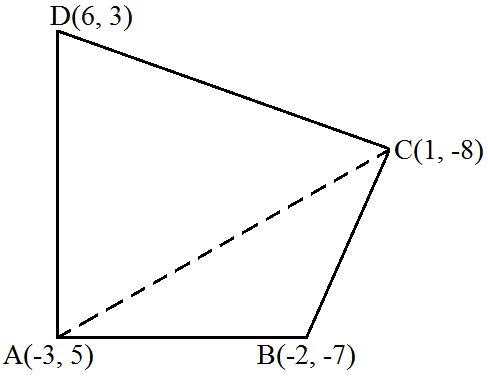
Area of the quadrilateral ABCD $=\text{Area of }\triangle\text{ABC}+\text{Area of }\triangle\text{ACD}$
$\text{ar}(\triangle\text{ABC})=\frac{1}{2}|\text{x}_1(\text{y}_2-\text{y}_3)+\text{x}_2(\text{y}_3-\text{y}_1)+\text{x}_3(\text{y}_1-\text{y}_2)|$
$=\frac{1}{2}|-3(-7-(-8))+(-2)(-8-5)+1(5-(-7))|$
$=\frac{1}{2}|-3+26+12|$
$=\frac{35}{2}\text{ sq.units}$
$\text{ar}(\triangle\text{ACD})=\frac{1}{2}|\text{x}_1(\text{y}_2-\text{y}_3)+\text{x}_2(\text{y}_3-\text{y}_1)+\text{x}_3(\text{y}_1-\text{y}_2)|$
$=\frac{1}{2}|-3(-8-3)+1(3-5)+6(5-(-8))|$
$=\frac{1}{2}|33-2+78|$
$=\frac{109}{2}\text{ sq.units}$
$\therefore$ Area of the quadrilateral $\text{ABCD}=\frac{35}{2}+\frac{109}{2}=\frac{144}{2}=72\text{sq. units}$
Hence, the area of the given quadrilateral is 72 square units. View full question & answer→Question 445 Marks
Prove that the points (2, 3), (-4, -6) and $\Big(1, \frac{3}{2}\Big)$ do not form a triangle.
AnswerLet the given points A(2, 3), B(-4, -6) and $\text{C}\Big(1, \frac{3}{2}\Big)$ Then, $\text{AB}=\sqrt{(-4-2)^2+(-6-3)^2}$ $=\sqrt{36+81}$ $=\sqrt{117}=\sqrt{9\times13}$ $=3\sqrt{13 }$ $\text{BC}=\sqrt{(1-(-4))^2+\Big(\frac{3}{2}-(-6)\Big)^2}$ $=\sqrt{25+\Big(\frac{3}{2}+6\Big)^2}$ $=\sqrt{25+\Big(\frac{15}{2}\Big)^2}$ $=\sqrt{25+\frac{225}{4}}$ $=\sqrt{\frac{100+225}{4}}$ $=\sqrt{\frac{335}{4}}$ $=\sqrt{83.75}$ $\text{AC}=\sqrt{(1-2)^2+\Big(\frac{3}{2}-3\Big)^2}$ $=\sqrt{1+\Big(\frac{3-6}{2}\Big)^2}$ $=\sqrt{1+\frac{9}{4}}=\sqrt{\frac{13}{4}}$$=\sqrt{3.25}$
We know that, In triangle sum of any two sides is greater than the third side. Since, $\text{AC} + \text{AB} \ngtr \text{BC}$Here, Sum of two sides is not greater than the third side.
Therefore, Points (2, 3), (-4, -6) and $\Big(1, \frac{3}{2}\Big)$ do not form a triangle.
View full question & answer→Question 455 Marks
Find the area of the quadrilaterals, the coordinates of whose vertices are (1, 2), (6, 2), (5, 3) and (3, 4).
AnswerLet the vertices of quadrilateral ABCD be A(1, 2), B(6, 2), C(5, 3) and D(3, 4). Join AC
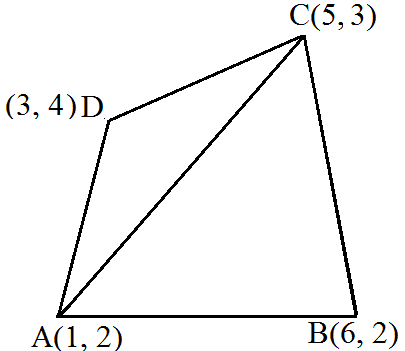
We get two triangles: $\triangle\text{ABC}$ and $\triangle\text{ADC}$
Now area of $\triangle\text{ABC}$
$=\frac{1}{2}[\text{x}_1(\text{y}_2-\text{y}_3)+\text{x}_2(\text{y}_3-\text{y}_1)+\text{x}_3(\text{y}_1-\text{y}_2)]$
$=\frac{1}{2}[1(2-3)+6(3-2)+5(2-2)]$
$=\frac{1}{2}[1\times(-1)+6\times1+5\times0]$
$=\frac{1}{2}[-1+6+0]$
$=\frac{1}{2}(5)=\frac{5}{2}\text{ sq. units}$
and area of $\triangle\text{ADC}$
$=\frac{1}{2}[1(3-4)+5(4-2)+3(2-3)]$
$=\frac{1}{2}[1\times(-1)+5\times2+3\times(-1)]$
$=\frac{1}{2}[-1+10-3]$
$=\frac{1}{2}\times6=3\text{ sq. units}$
$\therefore$ Area of quadrilateral ABCD
$=\frac{5}{2}+3=\frac{5+6}{2}$
$=\frac{11}{2}\text{ sq. units}$ View full question & answer→Question 465 Marks
Find the area of the quadrilaterals, the coordinates of whose vertices are (-4, -2), (-3, -5), (3, -2) and (2, 3).
AnswerLet the vertices of the quadrilateral be A(-4, -2), B(-3, -5), C(3, -2) and D(2, 3).Join AC to form two triangle $\triangle\text{ABC}$ and $\triangle\text{ACD}.$
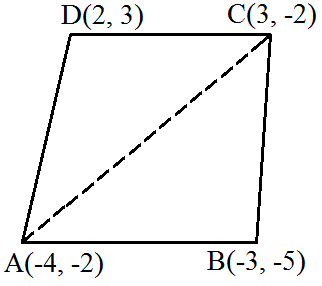
Area of quadrilateral ABCD $=|\text{Area of }\triangle\text{ABC}|+|\text{Area of }\triangle\text{ACD}|$
Area of $\triangle\text{ABC}$
$=\frac{1}{2}|\text{x}_1(\text{y}_2-\text{y}_3)+\text{x}_2(\text{y}_3-\text{y}_1)+\text{x}_3(\text{y}_1-\text{y}_2)|$
$=\frac{1}{2}|(-4)[(-5)-(-2)]+(-3)[(-2)-(-2)]+3[(-2)-(-5)]|$
$=\frac{1}{2}|(12+0+9)|=\frac{21}{2}\text{ sq. units}$
Area of $\triangle\text{ACD}$
$=\frac{1}{2}|(-4)[(-2)-(3)]+3[(3)-(-2)]+2((-2)-(-2))|$$=\frac{1}{2}|20+15+0|=\frac{35}{2}\text{ sq.units}$
Area of quadrilateral ABCD $=\text{Ar.}(\triangle\text{ABC})+\text{Ar.}(\triangle\text{ACD})$
$=\Big(\frac{21}{2}+\frac{35}{2}\Big)\text{ sq.units}$
$=28\text{ sq.units.}$ View full question & answer→Question 475 Marks
Find the ratio in which the point $\text{P}\Big(\frac{3}{4},\frac{5}{12}\Big)$ divides the line segment joining the points $\text{A}\Big(\frac{1}{2},\frac{3}{2}\Big)$ and B(2, -5).
AnswerSuppose $\text{P}\Big(\frac{3}{4},\frac{5}{12}\Big)$ divides the line segment joining the points $\text{A}\Big(\frac{1}{2},\frac{3}{2}\Big)$ and B(2, -5) in the ratio k : 1.Using section formula, we get
Coordinates of $\text{P}=\Bigg(\frac{2\text{k}+\frac{1}{2}}{\text{k}+1},\frac{-5\text{k}+\frac{3}{2}}{\text{k}+1}\Bigg)$
$\therefore\ \Bigg(\frac{2\text{k}+\frac{1}{2}}{\text{k}+1},\frac{-5\text{k}+\frac{3}{2}}{\text{k}+1}\Bigg)=\Big(\frac{3}{4},\frac{5}{12}\Big)$
$\Rightarrow\ \frac{2\text{k}+\frac{1}{2}}{\text{k}+1}=\frac{3}{4}$ and $\frac{-5\text{k}+\frac{3}{2}}{\text{k}+1}=\frac{5}{12}$
Now,
$\frac{2\text{k}+\frac{1}{2}}{\text{k}+1}=\frac{3}{4}$
⇒ 8k + 2 = 3k + 3
⇒ 5k = 1
$\Rightarrow\ \text{K}=\frac{1}{5 }$
Putting $\text{K}=\frac{1}{5 }$ in $\ \frac{-5\text{k}+\frac{3}{2}}{\text{k}+1}=\frac{5}{12},$ we get
$\text{LHS}=\frac{-5\times\frac{1}{5}+\frac{3}{2}}{\frac{1}{5}+1}=\frac{-1+\frac{3}{2}}{\frac{1}{5}+1}$
$=\frac{\frac{1}{2}}{\frac{6}{5}}=\frac{5}{12}=\text{RHS}$
Thus, the required ratio is $\frac{1}{5}:1$ or 1 : 5.
View full question & answer→Question 485 Marks
If the points (2, 1) and (1, -2) are equidistant from the point (x, y), show that x + 3y = 0.
AnswerLet P(x, y), Q(2, 1), R(1, -2) be the given points,
$Here,x_1 = x, y_1 = y$
$x_2 = 2, y_2 = 1$
The distance between two points P(x, y) and Q(2, 1) is given by,
$\text{PQ}=\sqrt{(2-\text{x})^2+(1-\text{y})^2}$
Similarly,
$\text{PR}=\sqrt{(1-\text{x})^2+(-2-\text{y})^2}$
Now, both these distance are given to be the same
PQ = PR
$\sqrt{(2-\text{x})^2+(1-\text{y})^2}=\sqrt{(1-\text{x})^2+(-2-\text{y})^2}$
Squaring both the sides,
$\Rightarrow (2 - x)^2 + (1 - y)^2 = (1 - x)^2 + (-2 - y)^2$
$\Rightarrow 4 + x^2 -4x + 1 + y^2 - 2y = 1 + x^2 - 2x + 4 + y^2 + 4y$
$\Rightarrow 4 + x^2 - 4x + 1 + y^2 - 2y - 1 - x^2 + 2x - 4 - y^2 - 4y = 0$
$\Rightarrow -2x - 6y = 0$
$\Rightarrow -2(x + 3y) = 0$
$\Rightarrow x + 3y = 0$
Hence prove.
View full question & answer→Question 495 Marks
Find the values of x, y if the distances of the point (x, y) from (-3, 0) as well as from (3, 0) are 4.
AnswerWe have P(x, y), Q(-3, 0) and R(3, 0)
$\text{PQ}=\sqrt{(\text{x}+3)^2+(\text{y}-0)^2}$
$\Rightarrow\ 4=\sqrt{\text{x}^2+9+6\text{x}+\text{y}^2}$
Squaring both sides,
$\Rightarrow\ (4)^2=\Big(\sqrt{\text{x}^2+9+6\text{x}+\text{y}^2}\Big)^2$
$\Rightarrow\ 16=\text{x}^2+9+6\text{x}+\text{y}^2$
$\Rightarrow\ \text{x}^2+\text{y}^2=16-9-6\text{x}$
$\Rightarrow\ \text{x}^2+\text{y}^2=7-6\text{x}\ .....(1)$
$\text{PR}=\Big(\sqrt{(\text{x}-3)^2+(\text{y}-0)^2}\Big)$
$\Rightarrow\ 4=\sqrt{\text{x}^2+9-6\text{x}+\text{y}^2}$
Squaring both sides,
$\Rightarrow\ (4)^2=\Big(\sqrt{\text{x}^2+9-6\text{x}+\text{y}^2}\Big)^2$
$\Rightarrow\ 16=\text{x}^2+9-6\text{x}+\text{y}^2$
$\Rightarrow\ \text{x}^2+\text{y}^2=16-9+6\text{x}$
$\Rightarrow\ \text{x}^2+\text{y}^2=7+6\text{x}\ .....(2)$
Equating (1) and (2),
7 - 6x = 7 + 6x
⇒ 7 - 7 = 6x + 6x
⇒ 0 = 12x
⇒ x = 0
Substituting the value of x = 0 in (2)
$x^2 + y^2 = 7 + 6x$
$0 + y^2 = 7 + 6 \times 0$
$y^2 = 7$
$\text{y}=\pm\sqrt{7}$
View full question & answer→Question 505 Marks
Points P, Q, R and S divides the line segment joining A(1, 2) and B(6, 7) in 5 equal parts. Find the coordinates of the points P, Q and R.
AnswerPoints P, Q, R and S divides AB in 5 equal parts and let coordinates of P, Q, R and S be
P divides AB in the ratio 1 : 4$\therefore\ \text{x}_1=\frac{1\times6+4\times1}{1+4}=\frac{6+4}{5}$
$=\frac{10}{5}=2$
$\Big\{\text{x}=\frac{\text{m}_1\text{x}_2+\text{m}_2\text{x}_1}{\text{m}_1+\text{m}_2}\Big\}$
$\text{y}_1=\frac{1\times7+4\times2}{1+4}=\frac{7+8}{5}$
$=\frac{15}{5}=3$
$\therefore$ Coordinates of P are (2, 3) Q divides AB in the ratio 2 : 3
$\therefore\ \text{x}_2=\frac{2\times6+3\times1}{2+3}=\frac{12+3}{5}$
$=\frac{15}{5}=3$
$\text{y}_2=\frac{2\times7+3\times2}{2+3}=\frac{14+6}{5}$
$=\frac{20}{5}=4$
$\therefore$ Coordinates of Q are (3, 4) R divides AB in the ratio 3 : 2
$\therefore\ \text{x}_3=\frac{3\times6+2\times1}{3+2}=\frac{18+2}{5}$
$=\frac{20}{5}=4$
$\text{y}_3=\frac{3\times7+2\times2}{3+2}=\frac{21+4}{5}$
$=\frac{25}{5}=5$
Coordinates of R are (4, 5).
S divides line AB in 4 : 1 ratio $\text{x}_4=\frac{4\times6+1\times1}{4+1}=\frac{24+1}{5}=\frac{25}{5}=5$ $\text{y}_4=\frac{4\times7+1\times2}{4+1}=\frac{28+2}{5}=\frac{30}{5}=6$ Therefore co-ordinate of $S(x_4, y_4) = (5, 6).$ View full question & answer→Question 515 Marks
Show that the points (-4, -1), (-2, -4) (4, 0) and (2, 3) are the vertices points of a rectangle.
Answer
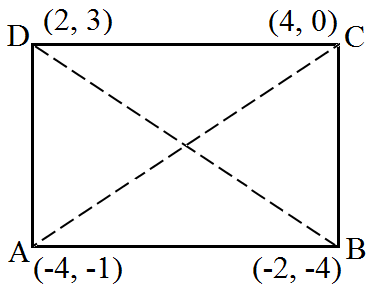 Given that: Let A(-4, -1), B(-2, -4), C(4, 0) and D(2, 3) be vertices of quadrilateral ABCD. Then
$\text{AB}=\sqrt{(-2-(-4))^2+(-4-(-1))^2}$
$=\sqrt{(-2+4)^2+(-4+1)^2}$
$=\sqrt{(2)^2+(-3)^2}$
$=\sqrt{4+9}$
$=\sqrt{13}\text{units}$
$\text{BC}=\sqrt{(4-(-2))^2+(0-(-4))^2}$
$=\sqrt{36+16}$
$=\sqrt{52}\text{units}$
$\text{CD}=\sqrt{(2-4)^2+(0-3)^2}$
$=\sqrt{4+9}$
$=\sqrt{13}\text{units}$
$\text{AD}=\sqrt{(2-(-4))^2+(3-(-1))^2}$
$=\sqrt{36+16}$
$=\sqrt{52}\text{units}$
Also, $\text{AC}=\sqrt{(4-(-4))^2+(0-(-1))^2}$
$=\sqrt{64+1}$
$=\sqrt{65}\text{units}$
And, $\text{BD}=\sqrt{(2-(-2))^2+(3-(-4))^2}$
$=\sqrt{16+49}$
$=\sqrt{65}\text{units}$
Since opposite sides AB = CD, BC = AD and diagonal AC = BD are also equal.
Thus, ABCD is a quadritateral whose opposite sides are equal and the diagonal are also equal.
Hence, quadrilateral ABCD is a rectangle. View full question & answer→Question 525 Marks
Prove that the points (2a, 4a), (2a, 6a) and $(2\text{a}+\sqrt{3}\text{a}, 5\text{a})$ are the vertices of an equilateral triangle.
AnswerThe distance d between two points$( x _1, y _1)$ and $( x _2, y _2)$ is given by the formula,$\text{d}=\sqrt{(\text{x}_1-\text{x}_2)^2+(\text{y}_1-\text{y}_2)^2}$
In an equilateral triangle all the sides have equal length.
Here the three points are A(2a, 4a), B(2a, 6a) and $\text{C}(2\text{a}+\text{a}\sqrt{3}, 5\text{a}).$ Let us now find out the lengths of all the three sides of the given triangle.$\text{AB}=\sqrt{(2\text{a}-2\text{a})^2+(4\text{a}-6\text{a})^2}$
$=\sqrt{(0)^2+(-2\text{a})^2}$
$=\sqrt{0+4\text{a}^2}$
$\text{AB}=2\text{a}$
$\text{BC}=\sqrt{(2\text{a}-2\text{a}-\text{a}\sqrt{3})^2+(6\text{a}-5\text{a})^2}$
$=\sqrt{(-\text{a}\sqrt{3})^2+(\text{a})^2}$
$=\sqrt{3\text{a}^2+\text{a}^2}$
$=\sqrt{4\text{a}^2}$
$\text{BC}=2\text{a}$
$\text{AC}=\sqrt{(2\text{a}-2\text{a}-\text{a}\sqrt{3})^2+(4\text{a}-5\text{a})^2}$
$=\sqrt{(-\text{a}\sqrt{3})^2+(-\text{a})^2}$
$=\sqrt{3\text{a}^2+\text{a}^2}$
$=\sqrt{4\text{a}^2}$
$\text{AC}=2\text{a}$
Since all the three sides have equal lengths the triangle has to be an equilateral triangle.
View full question & answer→Question 535 Marks
Find the length of the medians of a ΔABC having vertices at A(0, -1), B(2, 1) and C(0, 3).
Answer
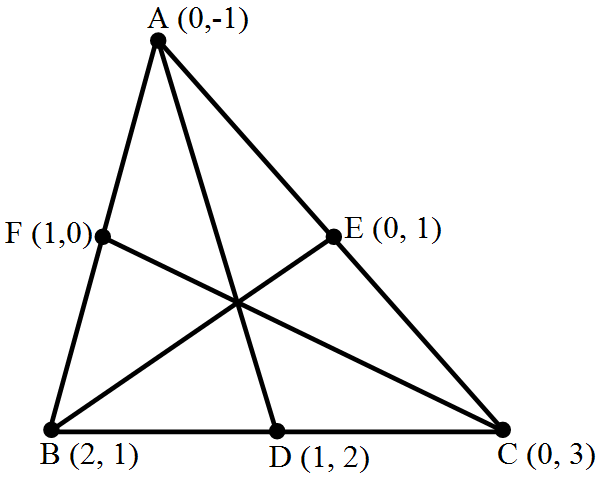 Let A(0, 1), B(2, 1) and C(0, 3) be the given points.
Let AD, BE and CF be the medians.
Coordinates of D are $\Big(\frac{2+0}{2},\frac{1+3}{2}\Big)=(1,2)$
Coordinates of E are $\Big(\frac{0}{2},\frac{3-1}{2}\Big)=(0,1)$
Coordinates of F are $\Big(\frac{2+0}{2},\frac{1-1}{2}\Big)=(1,0)$
Length of median $\text{AD}=\sqrt{(1-0)^2+(2+1)^2}=\sqrt{10}\ \text{units}$
Length of median $\text{BE}=\sqrt{(2-0)^2+(1-1)^2}=2\ \text{units}$
Length of median $\text{CF}=\sqrt{(1-0)^2+(0-3)^2}=\sqrt{10}\text{ units}$ View full question & answer→Question 545 Marks
Determine the ratio in which the point P(m, 6) divides the join of A(-4, 3) and B(2, 8). Also, find the value of m.
AnswerGiven that:The point P(m, 6) divides the line joining the points A(-4, 3) and B(2, 8) in the ratio $\lambda:1$
Then, by section formula,
$(\text{m},6)=\Big(\frac{\lambda\times2+1\times(-4)}{\lambda+1},\frac{\lambda\times8+1\times3}{\lambda+1}\Big)$
Equation the individual components we have,
$\Rightarrow\ 6=\frac{\lambda\times8+1\times3}{\lambda+1}$
$\Rightarrow\ 8\lambda+3=6\lambda+6$
$\Rightarrow\ 8\lambda-6\lambda=6-3$
$\Rightarrow\ 2\lambda=3$
$\Rightarrow\ \lambda=\frac{3}{2}$
Hence, the point P divides AB in the ratio $\frac{3}{2}:1$ i.e., 3 : 2
Let us now use this ratio to find out the value of m.
$(\text{m},6)=\Big(\frac{\lambda\times2+1\times(-4)}{\lambda+1},\frac{8\lambda+3\times1}{\lambda+1}\Big)$
Equating the individual components and we have,
$\Rightarrow\ \text{m}=\frac{2\lambda-4}{\lambda+1}$
$=\frac{2\times\frac{3}{2}-4}{\frac{3}{2}+1}=\frac{-2}{5}$
Hence, the value of m is $\frac{-2}{5}.$
View full question & answer→Question 555 Marks
Find the ratio in which the y-axis divides the line segment joining the points (5, -6) and (-1, -4). Also, find the coordinates of the point of division.
AnswerLet y-axis divides P(5, -6) and Q(-1, -4) in the ratio $\lambda:1$ let R(x, y) be the coordinates of the point of division. Then, the coordinates of the point of division are $\text{R}\bigg(\frac{(-1)\times\lambda+1\times5}{\lambda+1},\frac{(-4)\times\lambda+(-6)\times1}{\lambda+1}\bigg)$ Since R lies on y-axis and x-coordinates of every point on y-axis is zero.$\Rightarrow\ \text{R}\Big(\frac{-\lambda+5}{\lambda+1},\frac{-4\lambda-6}{\lambda+1}\Big)$
$\therefore\ \frac{-\lambda+5}{\lambda+1}=0$
$\Rightarrow\ -\lambda+5=0$
$\Rightarrow\ \lambda=5$
Hence, the required ratio is 5 : 1 Putting $\lambda=5$ in the co-ordinates of R, we get$\text{R}\Big(\frac{-5+5}{5+1},\frac{-4\times5-6}{5+1}\Big)=\Big(0,\frac{-13}{3}\Big)$
View full question & answer→Question 565 Marks
Prove that the points A(2, 3) B(-2, 2) C(-1, -2), and D(3, -1) are the vertices of a square ABCD.
AnswerPoints A(2, 3) B(-2, 2) C(-1, -2), and D(3, -1). 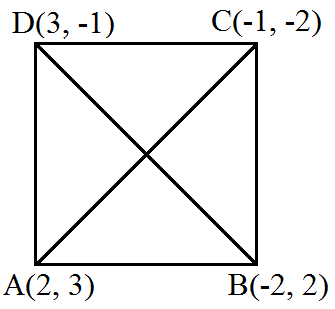 $\therefore\ \text{AB}=\sqrt{(\text{x}_2-\text{x}_1)^2+(\text{y}_2-\text{y}_1)^2}$ $=\sqrt{(-2-2)^2+(2-3)^2}$ $=\sqrt{(-4)^2+(-1)^2}$ $=\sqrt{16+1}=\sqrt{17}$ Similarly,$\text{BC}=\sqrt{(-1+2)^2+(-2-2)^2}$
$=\sqrt{(1)^2+(-4)^2}$
$=\sqrt{1+16}=\sqrt{17}$$\text{CD}=\sqrt{(3+1)^2+(-1+2)^2}$
$=\sqrt{(4)^2+(1)^2}$ $=\sqrt{16+1}=\sqrt{17}$ and $\text{DA}=\sqrt{(2-3)^2+(3+1)^2}$$=\sqrt{(-1)^2+(4)^2}$
$=\sqrt{1+16}=\sqrt{17}$$\text{AC}=\sqrt{(-1-2)^2+(-2-3)^2}$
$=\sqrt{(-3)^2+(-5)^2}$
$=\sqrt{9+25}=\sqrt{34}$
$\text{BD}=\sqrt{(3+2)^2+(-1-2)^2}$$=\sqrt{(5)^2+(-3)^2}$
$=\sqrt{25+9}=\sqrt{34}$
$\because$ Sides AB, BC, CD and DA are equal and diagonals AC and BD are also equal.
$\therefore$ ABCD is a square. View full question & answer→Question 575 Marks
Find the ratio in which the point P(x, 2) divides the line segment joining the points A(12, 5) and B(4, -3). Also, find the value of x.
AnswerSuppose P(x, 2) divides the line segment joining the points A(12, 5) and B(4, -3) in the ratio k : 1.Using section formula, we get
Coordinates of $\text{P}=\Big(\frac{4\text{k}+12}{\text{k}+1},\frac{-3\text{k}+5}{\text{k}+1}\Big)$
$\therefore\ \Big(\frac{4\text{k}+12}{\text{k}+1},\frac{-3\text{k}+5}{\text{k}+1}\Big)=(\text{x},2)$
$\Rightarrow\ \text{x}=\frac{4\text{k}+12}{\text{k}+1}$ and $\frac{-3\text{k}+5}{\text{k}+1}=2$
Now,
$\frac{-3\text{k}+5}{\text{k}+1}=2$
$\Rightarrow\ -3\text{k}+5=2\text{k}+2$
$\Rightarrow\ 5\text{k}=3$
$\Rightarrow\ \text{k}=\frac{3}{5}$
So, P divides the line segment AB in the ratio 3 : 5.
Putting $\text{k}=\frac{3}{5}$ in $\text{x}=\frac{4\text{k}+12}{\text{k}+1},$ we get
$\text{x}=\frac{4\times\frac{3}{5}+12}{\frac{3}{5}+1}=\frac{12+60}{3+5}$
$=\frac{72}{8}=9$
Thus, the value of x is 9.
View full question & answer→Question 585 Marks
If (0, -3) and (0, 3) are the two vertices of an equilateral triangle, find the coordinates of its third vertex.
AnswerLet the given points be A(0, -3) and B(0, 3). Suppose the coordinates of the third vertex be C(x, y).Now, $\triangle\text{ABC}$ is an equilateral triangle.
$\therefore$ AB = BC = CA
$\sqrt{(0-0)^2+(-3-3)^2}$ $=\sqrt{(\text{x}-0)^2+(\text{y}-(-3))^2}=\sqrt{(\text{x}-0)^2+[\text{y}-(-3)^2]}$ (Distance formula)
Squaring on both sides, we get
$36 = x^2 + (y - 3)^2 = x^2 + (y + 3)^2$
$\Rightarrow x^2 + (y - 3)^2 = x^2 + (y + 3)^2 and x^2 + (y - 3)^2 = 36$
$Now, x^2 + (y - 3)^2 = x^2 + (y + 3)^2$
$\Rightarrow y^2 - 6y + 9 = y^2 + 6y + 9$
$\Rightarrow -12y = 0$
$\Rightarrow y = 0$
Putting$ y = 0 in x^2 + (y - 3)^2 = 36, we get$
$x^2 + (0 - 3)^2= 36$
$\Rightarrow x^2 = 36 - 9 = 27$
$\Rightarrow\text{x}=\pm\sqrt{27}=\pm3\sqrt{3}$
Thus, the coordinates of the third vertex are $(3\sqrt{3}, 0)$ or $(-3\sqrt{3}, 0).$
View full question & answer→Question 595 Marks
Find the ratio in which the line segment joining the points A(3, -3) and B(-2, 7) is divided by the x-axis. Also, find the coordinates of the point of division.
AnswerLet a point P(x, 0)
x-axis divides the line segment joining the points A(3, -3) and B(-2, 7) in the ratio $m_1 : m_2$
$\therefore\ 0=\frac{\text{m}_1\text{y}_2+\text{m}_2\text{y}_1}{\text{m}_1+\text{m}_2}$
$\Rightarrow\ 0=\frac{\text{m}_1\times7+\text{m}_2(-3)}{\text{m}_1+\text{m}_2}$
$\Rightarrow\ 7\text{m}_1-3\text{m}_2=0$
$\Rightarrow\ 7\text{m}_1=3\text{m}_2$
$\Rightarrow\ \frac{\text{m}_1}{\text{m}_2}=\frac{3}{7}$
$\therefore\ \text{m}_1:\text{m}_2=3:7$
$\therefore\ \text{x}=\frac{3(-2)+7\times3}{3+7}=\frac{-6+21}{10}$
$\therefore\ \text{x}=\frac{15}{10}=\frac{3}{2}$
$\therefore\ \text{x}=\frac{3}{2}$
and coordinates of P will be $\Big(\frac{3}{2},0\Big)$
View full question & answer→Question 605 Marks
Prove that the points (-2, 5), (0, 1) and (2, -3) are collinear.
AnswerLet the points be A(-2, 5), B(0, 1) and C(2, -3)
Now $\text{AB}=\sqrt{(\text{x}_2-\text{x}_1)^2+(\text{y}_2-\text{y}_1)^2}$
$=\sqrt{(0+2)^2+(1-5)^2}$
$=\sqrt{(2)^2+(-4)^2}=\sqrt{4+16}$
$=\sqrt{20}=\sqrt{4\times5}=2\sqrt{5}$
Similarly, $\text{BC}=\sqrt{(2-0)^2+(-3-1)^2}$
$=\sqrt{(2)^2+(-4)^2}$
$=\sqrt{4+16}=\sqrt{20}$
$=\sqrt{4\times5}=2\sqrt{5}$
$\text{CA}=\sqrt{(-2-2)^2+(5+3)^2}$
$=\sqrt{(-4)^2+(8)^2}=\sqrt{16+64}$
$=\sqrt{80}=\sqrt{16\times5}=4\sqrt{5}$
Now, $\text{AB}+\text{BC}=2\sqrt{5}+2\sqrt{5}$
and $\text{CA}=4\sqrt{5}$
AB + BC = CA
A, B and C are collinear.
View full question & answer→Question 615 Marks
If $\text{a}\neq\text{b}\neq\text{c},$ prove that the points $(a, a^2), (b, b^2), (c, c^2)$ can never be collinear.
AnswerLet $(a, a^2), (b, b^2), (c, c^2)$ he given points. Three points are collinear if area enclosed by three points is zero. Area of $\triangle\text{ABC}=\frac{1}{2}|\text{x}_1(\text{y}_2-\text{y}_3)+\text{x}_2(\text{y}_3-\text{y}_1)+\text{x}_3(\text{y}_1-\text{y}_2)|$ $=\frac{1}{2}|\text{a}(\text{b}^2-\text{c}^2)+\text{b}(\text{c}^2-\text{a}^2)+\text{c}(\text{a}^2-\text{b}^2)|$ $=\frac{1}{2}|\text{ab}^2-\text{ac}^2+\text{bc}^2-\text{a}^2\text{b}+\text{a}^2\text{c}-\text{b}^2\text{c}|$ $=\frac{1}{2}|(\text{a}^2\text{c}-\text{a}^2\text{b})+(\text{ab}^2-\text{ac}^2)+(\text{bc}^2-\text{b}^2\text{c})|$ $=\frac{1}{2}|(-\text{a}^2)(\text{b}-\text{c})+\text{a}(\text{b}^2-\text{c}^2)-\text{bc}(\text{b}-\text{c})|$ $=\frac{1}{2}|(\text{b}-\text{c})(-\text{a}^2+\text{a}(\text{b}+\text{c})-\text{bc})|$$=\frac{1}{2}|(\text{b}-\text{c})(-\text{a}^2+\text{ab}+\text{ac}-\text{bc})|$
$=\frac{1}{2}|(\text{b}-\text{c})[(-\text{a})(\text{a}-\text{b})+\text{c}(\text{a}-\text{b})]|$
$=\frac{1}{2}|(\text{b}-\text{c})(\text{c}-\text{a})(\text{a}-\text{b})|$
It is given that $\text{a}\neq\text{b}\neq\text{c}$ Hence area of triangle made by three points is never zero. Hence given points are never collinear.
View full question & answer→Question 625 Marks
Find the value of x such that PQ = QR where the coordinates of P, Q and R are (6, -1) , (1, 3) and (x, 8) respectively.
AnswerThe distance d between two points $( x _1, y _1)$ and $( x _2, y _2)$ is given by the formula,$\text{d}=\sqrt{(\text{x}_1-\text{x}_2)^2+(\text{y}_1-\text{y}_2)^2}$
The three given points are P(6, -1), Q(1, 3) and R(x, 8).
Now let us find the distance between ‘P’ and ‘Q’.
$\text{PQ}=\sqrt{(6-1)^2+(-1-3)^2}$
$=\sqrt{(5)^2+(-4)^2}$
$=\sqrt{25+16}$
$\text{PQ}=\sqrt{41}$
Now, let us find the distance between ‘Q’ and ‘R’.
$\text{QR}=\sqrt{(1-\text{x})^2+(3-8)^2}$
$\text{QR}=\sqrt{(1-\text{x})^2+(-5)^2}$
It is given that both these distances are equal. So, let us equate both the above equations,
PQ = QR
$\sqrt{41}=\sqrt{(1-\text{x})^2+(-5)^2}$
Squaring on both sides of the equation we get,
$41 = (1 - x)^2 + (-5)^2$
$41 = 1 + x^2 - 2x + 25$
$15 = x^2 - 2x$
Now we have a quadratic equation. Solving for the roots of the equation we have,
$x^2 - 2x - 15 = 0$
$x^2 - 5x + 3x - 15 = 0$
$x(x - 5) + 3(x - 5) = 0$
$(x - 5)(x + 3) = 0$
Thus the roots of the above equation are 5 and -3.
Hence the values of ‘x’ are 5 or -3.
View full question & answer→Question 635 Marks
Find the area of the triangle PQR with Q(3, 2) and the mid-points of the sides through Q being (2, -1) and (1, 2).
AnswerLet $P(x_1, y_1), Q(3, 2)$ and $R(x_2, y_2)$ be the vertices of the $\triangle\text{PQR.}$ Suppose S(2, -1) and T(1, 2) be the mid-point of sides QR and PQ, respectively.
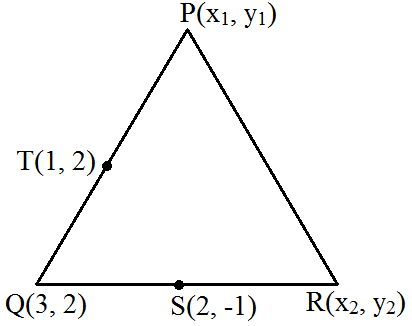
$\Rightarrow x_1+3=2, y_1+2=4 \Rightarrow x_1=-1, y_1=2 \therefore \text { Coordinates of } P=(-1,2) \text { Also, } \frac{x_2+3}{2}=2, \frac{y_2+2}{2}=-1 \Rightarrow x_2+3=4, y_2$
$+2=-2 \Rightarrow x_2=1, y_2=-4 \therefore \text { Coordinates of } R=(1,-4) \text { So, } P(-1,2), Q(3,2) \text { and } R(1,-4) \text { are the vertices of } \triangle P Q R .$
$\therefore \operatorname{ar}(\triangle P Q R)=\frac{1}{2}\left|x_1\left(y_2-y_3\right)+x_2\left(y_3-y_1\right)+x_3\left(y_1-y_2\right)\right|$
$=\frac{1}{2}|-1(2-(-4))+3(-4-2)+1(2-2)|=\frac{1}{2}|-6-18+0|=\frac{1}{2}|-24|=\frac{1}{2} \times 24=12 \text { sq.units }$
Hence, the area of the triangle is 12 sq . units. View full question & answer→Question 645 Marks
Show that the points A(1, -2), B(3, 6), C(5, 10) and D(3, 2) are the vertices of a parallelogram.
AnswerLet A(1, -2), B(3, 6), C(5, 10) , D(3, 2) be the given points,$\text{AB}=\sqrt{(3-1)^2+(6+2)^2}$
$\Rightarrow\ \text{AB}=\sqrt{(2)^2+(8)^2}$
$\Rightarrow\ \text{AB}=\sqrt{4+64}$
$\Rightarrow\ \text{AB}=\sqrt{68}$
$\text{CD}=\sqrt{(5-3)^2+(10-2)^2}$
$\Rightarrow\ \text{CD}=\sqrt{(2)^2+(8)^2}$
$\Rightarrow\ \text{CD}=\sqrt{4+64}$
$\Rightarrow\ \text{CD}=\sqrt{68}$
$\text{AD}=\sqrt{(3-1)^2+(2+2)^2}$
$\Rightarrow\ \text{AD}=\sqrt{(2)^2+(4)^2}$
$\Rightarrow\ \text{AD}=\sqrt{4+16}$
$\Rightarrow\ \text{AD}=\sqrt{20}$
$\text{BC}=\sqrt{(5-3)^2+(10-6)^2}$
$\Rightarrow\ \text{BC}=\sqrt{(2)^2+(4)^2}$
$\Rightarrow\ \text{BC}=\sqrt{4+16}$
$\Rightarrow\ \text{BC}=\sqrt{20}$
$\therefore$ AB = CD and AD = BC
Since opposite sides of a parallelogram are equal.
Hence, ABCD is a parallelogram.
View full question & answer→Question 655 Marks
Find the value of k, if the point P(0, 2) is equidistant from (3, k) and (k, 5).
AnswerLet the point P(0, 2) is equidistant from A(3, k) and (k, 5)
$PA = PB$
$PA^2 = PB^2$
$(3 - 0)^2 + (k - 2)^2 = (k - 0)^2 + (5 - 2)^2$
$\Rightarrow 9 + k^2 + 4 - 4k = k^2 + 9$
$\Rightarrow 9 + k^2 + 4 - 4k - k^2 - 9 = 0$
$\Rightarrow 4 - 4k = 0$
$\Rightarrow -4k = -4$
$\Rightarrow k = 1$
View full question & answer→Question 665 Marks
If A(-1, 3), B(1, -1) and C(5, 1) are the vertices of a triangle ABC, find the length of the median through A.
AnswerLet D, E, F be the mid-points of sides BC, CA and AB respectively.
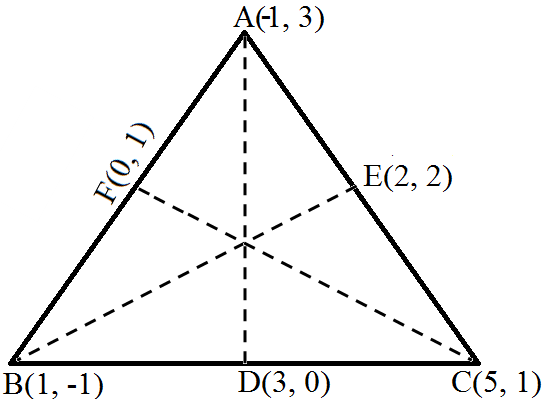
The coordinates of the mid-point $(x_m, y_m)$ between two points $( x _1, y _1)$ and $( x _2, y _2)$ is given by.
$(\text{x}_\text{m},\text{y}_\text{m})=\Big(\frac{\text{x}_1+\text{x}_2}{2},\frac{\text{y}_1+\text{y}_2}{2}\Big)$
Then, the coordinates of D, E and F are,
$\text{D}\bigg(\frac{1+5}{2},\frac{-1+1}{2}\bigg)=\text{D(3,0)}$
$\text{E}\bigg(\frac{-1+5}{2},\frac{3+1}{2}\bigg)=\text{E}(2,2)$
$\text{F}\bigg(\frac{-1+1}{2},\frac{3-1}{2}\bigg)=\text{F}(0,1)$
length of median AD is,
$\text{AD}=\sqrt{(3-(-1))^2+(0-3)^2}$
$=\sqrt{16+9}$
$=\sqrt{25}$
$=5\ \text{units}$ View full question & answer→Question 675 Marks
Name the quadrilateral formed, if any, by the following points, and given reason for your answers:
A(-3, 5), B(3, 1), C(0, 3), D(-1, -4).
AnswerPoints are $A(-3,5), B(3,1), C(0,3), D(-1,-4)$ Now, $A B=\sqrt{\left(x_2-x_1\right)^2+\left(y_2-y_1\right)^2} A B^2=\left(x_2-x_1\right)^2+\left(y_2-y_1\right)^2=(3$ $+3)^2+(1-5)^2=(6)^2+(-4)^2=36+16=52$ Similarly, $B C^2=(0-3)^2+(3-1)^2=(-3)^2+(2)^2=9+4=13 C D^2=(-1-$ $0)^2+(-4-3)^2=(-1)^2+(-7)^2=1+49=50$
$D A^2=(-3+1)^2+(5+4)^2=(-2)^2+(9)^2$
$= 4 + 81 = 85$
Diagonal $AC^2 = (0 + 3)^2 + (3 - 5)^2 = (3)^2 + (-2)^2$
$= 9 + 4 = 13$
$\therefore\ \text{In }\triangle\text{ABC}$
$\text{AB}=\sqrt{52},\ \text{AC}=\sqrt{13},\ \text{BC}=\sqrt{13}$
$\because\ \text{AC}+\text{BC}=\sqrt{13}+\sqrt{13}=2\sqrt{13}$
$=\sqrt{4\times13}=\sqrt{52}$
$\because$ AC + BC = AB
$\therefore\ \triangle\text{ABC}$ is not possible.
Hence ABCD is not a quadrilateral.
View full question & answer→Question 685 Marks
If G be the centroid of a triangle ABC, prove that:
$AB^2 + BC^2 + CA^2 = 3(GA^2 + GB^2 + GC^2)$
AnswerLet $A(b, c), B(0,0)$ and $C(a, 0)$ be the coordinates of $\triangle A B C$ Then coordinates of centroid are $G\left[\frac{a+b}{3}, \frac{c}{3}\right]$ To prove: $A B^2+B C^2+C A^2=3\left(G A^2+G B^2+G C^2\right)$ Solving L.H.S. $A B^2+B C^2+C A^2=b^2+c^2+a^2(a-b)^2+c^2=b^2+c^2+a^2+a^2$ $+b^2-2 a b+c^2=2 a^2+2 b^2+2 c^2-2 a b$ Solving R.H.S.
.$3\bigg[\Big(\frac{\text{a+b}}{3}-\text{b}\Big)^2+\Big(\text{c}-\frac{\text{c}}{3}\Big)^2+\Big(\frac{\text{a+b}}{3}\Big)^2+\Big(\frac{\text{c}}{3}\Big)^2+\Big(\frac{\text{a+b}}{2}-\text{a}\Big)^2+\Big(\frac{\text{c}}{3}\Big)^2\bigg]$
$=3\bigg[\Big(\frac{\text{a}-2\text{b}}{3}\Big)^2+\Big(\frac{\text{2c}}{3}\Big)^2+\Big(\frac{\text{a+b}}{3}\Big)^2+\Big(\frac{\text{c}}{3}\Big)^2+\Big(\frac{\text{b}-\text{2a}}{3}\Big)^2+\Big(\frac{\text{c}}{3}\Big)^2\bigg]$ $=3\bigg[\frac{\text{a}^2+4\text{b}^2-4\text{ab}}{9}+\frac{4\text{c}^2}{9}+\frac{\text{a}^2+\text{b}^2+2\text{ab}}{9}+\frac{\text{c}^2}{9}+\frac{\text{b}^2+4\text{a}^2-4\text{ab}}{9}+\frac{\text{c}^2}{9}\bigg]$ $=3\bigg[\frac{\text{a}^2+4\text{b}^2-4\text{ab}+\text{4c}^2+\text{a}^2+\text{b}^2+2\text{ab+}\text{c}^2+\text{b}^2+4\text{a}^2-4\text{ab+}\text{c}^2}{9}\bigg]$ $=3\bigg[\frac{6\text{a}^2+6\text{b}^2+6\text{c}^2-6\text{ab}}{9}\bigg]$ $=3\times3\bigg[\frac{2\text{a}^2+2\text{b}^2+2\text{c}^2-2\text{ab}}{9}\bigg]$$=2\text{a}^2+2\text{b}^2+2\text{c}^2-2\text{ab}$
$\therefore$ L.H.S = R.H.S proved
View full question & answer→Question 695 Marks
Find the coordinates of the points which divide the line segment joining A(-2, 2) and B(2, 8) into four equal parts.
AnswerThe co-ordinates of the midpoint $(x_m, y_m)$ between two points $( x _1, y _1)$ and $( x _2, y _2)$is given by, $(\text{x}_\text{m},\text{y}_\text{m})=\bigg[\Big(\frac{\text{x}_1+\text{x}_2}{2}\Big),\Big(\frac{\text{y}_1+\text{y}_2}{2}\Big)\bigg]$ Here we are supposed to find the points which divide the line joining A(-2, 2) and B(2, 8) into 4 equal parts. We shall first find the midpoint M(x, y) of these two points since this point will divide the line into two equal parts.$(\text{x}_\text{m},\text{y}_\text{m})=\bigg[\Big(\frac{-2+2}{2}\Big),\Big(\frac{2+8}{2}\Big)\bigg]$
$(\text{x}_\text{m},\text{y}_\text{m})=(0,5)$
So the point M(0, 5) splits this line into two equal parts. Now, we need to find the midpoint of A(-2, 2) and M(0, 5) separately and the midpoint of B(2, 8) and M(0, 5). These two points along with M(0, 5) split the line joining the original two points into four equal parts. Let $M_1$(e, d) be the midpoint of A(-2, 2) and M(0, 5).$(\text{e},\text{d})=\bigg[\Big(\frac{-2+0}{2}\Big),\Big(\frac{2+5}{2}\Big)\bigg]$
$(\text{e},\text{d})=\Big(-1,\frac{7}{2}\Big)$
Now let $M_2$(g, h) bet the midpoint of B(2, 8) and M(0, 5).$(\text{g},\text{h})=\bigg[\Big(\frac{2+0}{2}\Big),\Big(\frac{8+5}{2}\Big)\bigg]$
$(\text{g},\text{h})=\Big(1,\frac{13}{2}\Big)$
Hence the co-ordinates of the points which divide the line joining the two given points are $\Big(-1,\frac{7}{2}\Big),$ (0, 5) and $\Big(1,\frac{13}{2}\Big).$
View full question & answer→Question 705 Marks
The four vertices of a quadrilateral are (1, 2), (-5, 6), (7, -4) and (k, -2) taken in order. If the area of the quadrilateral is zero, find the value of k.
Answer
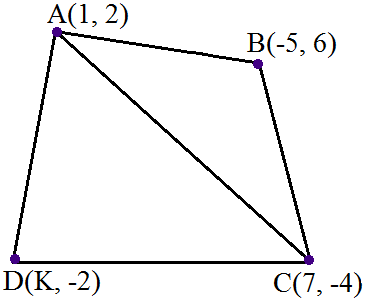 Let A(1, 2), B(-5, 6), C(7, -4) and D(k, -2) be the given points.
Area of $\triangle\text{ABC}$
$=\frac{1}{2}[1(6+4)+(-5)(-4-2)+7(2-6)]$
$=\frac{1}{2}[10+30-28]$
$=\frac{1}{2}\times12$
$=6$
Area of $\triangle\text{ADC}$
$=\frac{1}{2}[1(-4+2)+7(-2-2)+\text{k}(2+4)]$
$=\frac{1}{2}[-2+7\times(-4)+\text{k}\times6]$
$=\frac{1}{2}[-2-28+6\text{k}]$
$=\frac{1}{2}[-30+6\text{k}]$
$=-15+3\text{k}$
$=3\text{k}-15$
Area of quadrilateral ABCD
= Area of ABC + Area of ADC
= (6 + 3k - 15)
But area of quadrilateral = 0 (given)
$\therefore$ 6 + 3k - 15 = 0
⇒ 3k = 15 - 6
⇒ 3k = 9
⇒ k = 3 View full question & answer→Question 715 Marks
An equilateral triangle has two vertices at the points (3, 4) and (-2, 3), find the coordinates of the third vertex.
AnswerLet two vertices of an equilateral triangle are A(3, 4), and B(-2, 3) and let the third vertex be C(x, y).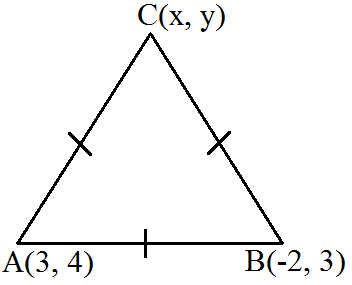
Now, $\text{AB}=\sqrt{(\text{x}_2-\text{x}_1)^2+(\text{y}_2-\text{y}_1)^2}$ $=\sqrt{(-2-3)^2+(3-4)^2}=\sqrt{(-5)^2+(-1)^2}$$\sqrt{25+1}=\sqrt{26}$
$\text{BC}=\sqrt{(\text{x}+2)^2+(\text{y}-3)^2}$
and, $\text{CA}=\sqrt{({3}-\text{x})^2+({4}-\text{y})^2}$
$\because$ The triangle is an equilateral triangle.
$\therefore$ AB = BC = CA$\because$ BC = AB
$\therefore\sqrt{(\text{x}+2)^2+(\text{y}-3)^2}=\sqrt{26}$
$\Rightarrow(x+2)^2+(y-3)^2=26 \text { (Squaring) } \Rightarrow x^2+4 x+4+y^2-6 y+9=26 $
$\Rightarrow x^2+y^2+4 x-6 y+13=26 $
$\Rightarrow x^2+y^2+4 x-6 y=26-13=13 \ldots \ldots \text {. (i) Again } C A=A B .$
$ \therefore \sqrt{(3-x)^2+(4-y)^2}=\sqrt{26}$
$\text { Squaring, }(3-x)^2+(4-y)^2=26 $
$\Rightarrow 9+x^2-6 x+16+y^2-8 y=26 $
$\Rightarrow x^2+y^2-6 x-8 y+25=26$
$\Rightarrow x^2+y^2-6 x-8 y=26-25=1 \ldots \ldots \text {.(ii) Subtracting (ii) from (i) } 10 x+2 y=12$
$\Rightarrow 5 x+y=6 \ldots . . \text { (iii) } y=6-5 x$
$\text { Subtracting in (i) } x^2+(6-5 x)^2+4 x-6(6-5 x)=13$
$\Rightarrow x^2+36+25 x^2-60 x+4 x-36+30 x-13=0 $
$\Rightarrow 26 x^2-26 x-13=0 $
$\Rightarrow 2 x^2-2 x-1=0 \text { Here } a=2, b=-2, C=-1$
$=\frac{-(-2)\pm\sqrt{(-2)^2-4\times2\times(-1)}}{2\times2}$
$=\frac{2\pm\sqrt{4+8}}{4}$
$=\frac{2\pm\sqrt{12}}{4}$
$=\frac{2\pm\sqrt{4\times3}}{4}$
$=\frac{2\pm2\sqrt{3}}{4}=\frac{1\pm\sqrt{3}}{2}$
$\text{x}=\frac{1+\sqrt{3}}{2}$ and $\frac{1-\sqrt{3}}{2}$
If $\text{x}=\frac{1+\sqrt{3}}{2},$ then $\text{y}=6-5\text{x}$ $=6-\frac{5(1+\sqrt{3})}{2}$ $=\frac{12-5-5\sqrt{3}}{2}=\frac{7-5\sqrt{3}}{2}$ and if $\text{x}=\frac{1-\sqrt{3}}{2},$ then $\text{y}=6-5\text{x}$ $=6-\frac{5(1-\sqrt{3})}{2}$ $=\frac{12-5+5\sqrt{3}}{2}=\frac{7+5\sqrt{3}}{2}$ Hence co-ordinates of the point will be $\Big(\frac{1+\sqrt{3}}{2},\frac{7-5\sqrt{3}}{2}\Big)$ or $\Big(\frac{1-\sqrt{3}}{2},\frac{7+5\sqrt{3}}{2}\Big).$ View full question & answer→Question 725 Marks
In ∆ABC, the coordinates of vertex A are (0, -1) and D(1, 0) and E(0, 1) respectively the mid-points of the sides AB and AC. If F is the mid-point of side C, find the area of ∆DEF.
AnswerLet B(p, q), C(r, s) and F(x, y) Mid-point of AB = Coordinates of D 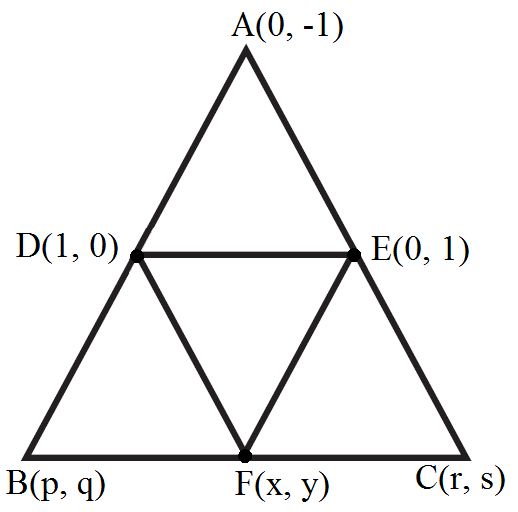 $\Big(\frac{0+\text{p}}{2},\frac{-1+\text{q}}{2}\Big)=(1,0)$
$\frac{\text{p}}{2}=1$ $\text{p}=2$ $\frac{-1+\text{q}}{2}=0$ $-1+\text{q}=0$ $\text{q}=1$ $\therefore\ \text{B}(\text{p, q})=\text{B}(2,1)$ Mid-point of AC = Coordinates of E $\Big(\frac{0+\text{r}}{2},\frac{-1\text{+s}}{2}\Big)=(0,1)$ $\frac{\text{r}}{2}=0$ $\Rightarrow\ \text{r}=0$ $\frac{-1\text{+s}}{2}=1$ $-1+\text{s}=2$ $\Rightarrow\ \text{s}=3$ $\therefore\ \text{C}(\text{r, s})=\text{C}(0, 3)$ Coordinates of F = Mid-point of BC $(\text{x},\text{y})=\Big(\frac{\text{p}+\text{r}}{2},\frac{\text{q}+\text{s}}{2}\Big)$ $=\Big(\frac{2+0}{2},\frac{1+3}{2}\Big)=\text{F}(1,2)$ A(0, -1), B(2, 1), C(0, 3) $\therefore$ Area of ∆ABC $=\frac{1}{2}[\text{x}_1(\text{y}_2-\text{y}_3)+\text{x}_2(\text{y}_3-\text{y}_1)+\text{x}_3(\text{y}_1-\text{y}_2)]$ $=\frac{1}{2}[0(1-3)+2(3+1)+0(-1-1)]$ $=\frac{1}{2}(8)=4\ \text{sq.units}$ $\therefore$ Area of ∆DEF $=\frac{1}{2}[1(1-2)+0(2-0)+1(0-1)]$ $=\frac{1}{2}(-1-1)=-1$ $=1\text{ sq.units}$ [As area of ∆ is always +ve.] View full question & answer→Question 735 Marks
Find the area of the quadrilaterals, the coordinates of whose vertices are (-3, 2), (5, 4), (7, -6) and (-5, -4).
AnswerLet the vertices of the quadrilateral be A(-3, 2), B(5, 4), C(7, -6) and D(-5, -4). Join AC to form two triangle $\triangle\text{ABC}$ and $\triangle\text{ACD}.$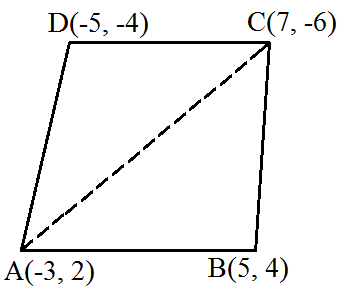
Area of quadrilateral ABCD $=|\text{Area of }\triangle\text{ABC}|+|\text{Area of }\triangle\text{ACD}|$
Area of $\triangle\text{ABC}=\frac{1}{2}|\{\text{x}_1(\text{y}_2-\text{y}_3)+\text{x}_2(\text{y}_3-\text{y}_1)+\text{x}_3(\text{y}_1-\text{y}_2)\}|$
$=\frac{1}{2}|\{-3(4-(-6))+5(-6-2)+7(2-4)\}|$
$=\frac{1}{2}|(-30-40-14)|=42\text{ sq.units}$
Area of $\triangle\text{ACD}=\frac{1}{2}|\{-3(-6+4)+7(-4-2)-5(2+6)\}|$
$=\frac{1}{2}|(6-42-40)|=38\text{ sq.units}$
Area of quadrilateral ABCD = 42 + 38 = 80 sq.units View full question & answer→Question 745 Marks
Four points A(6, 3), B(-3, 5), C(4, -2) and D(x, 3x) are given in such a way that $\frac{\triangle\text{DBC}}{\triangle\text{ABC}}=\frac{1}{2},$ find x.
AnswerLet A(6, 3), B(-3, 5), C(4, -2) and D(x, 3x) are the vertices of quadrilateral ABCD. AC and BD are joined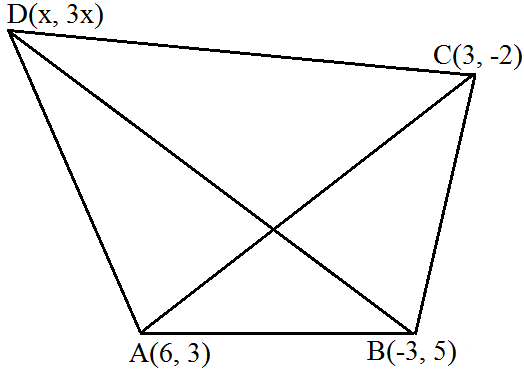
Now, area of $\triangle\text{ABC}$ $=\frac{1}{2}[\text{x}_1(\text{y}_2-\text{y}_3)+\text{x}_2(\text{y}_3-\text{y}_1)+\text{x}_3(\text{y}_1-\text{y}_2)]$ $=\frac{1}{2}[6(5+2)+(-3)(-2-3)+4(3-5)]$ $=\frac{1}{2}[6\times7+(-3)(-5)+4(-2)]$ $=\frac{1}{2}[42+15-8]=\frac{49}{2}$ and area of $\triangle\text{DBC},$ $=\frac{1}{2}[\text{x}(5+2)+(-3)(-2-3\text{x})+4(3\text{x}-5)]$ $=\frac{1}{2}[7\text{x}+6+9\text{x}+12\text{x}-20]$ $=\frac{1}{2}[28\text{x}-14]=14\text{x}-7$ Now, $\frac{\triangle\text{DBC}}{\triangle\text{ABC}}=\frac{14\text{x}-7}{\frac{49}{2}}$ $=\frac{(14\text{x}-7)\times2}{49}$ $=\frac{2(14\text{x}-7)}{49}$ $\therefore\ \Big|\frac{2(14\text{x}-7)}{49}\Big|=\frac{1}{2}$ $\Rightarrow\ 4|14\text{x}-7|=\pm49$ If $56\text{x}-28=49$ $\Rightarrow\ 56\text{x}=49+28=77$ $\Rightarrow\ \text{x}=\frac{77}{56}=\frac{11}{8}$ If $4(14\text{x}-7)=-49$ $\Rightarrow\ 56\text{x}-28=-49$ $\Rightarrow\ 56\text{x}=-49+28=-21$ $\Rightarrow\ \text{x}=\frac{-21}{56}=\frac{-3}{8}$ $\therefore\ \text{x}=\frac{11}{8}$ or $\frac{-3}{8}.$ View full question & answer→Question 755 Marks
Prove that the points (3, -2), (4, 0), (6, -3) and (5, -5) are the vertices of a parallelogram.
AnswerGiven that: Let A(3, -2), B(4, 0), C (6, -3) and D(5, -5) be vertices of quadrilateral ABCD. Then
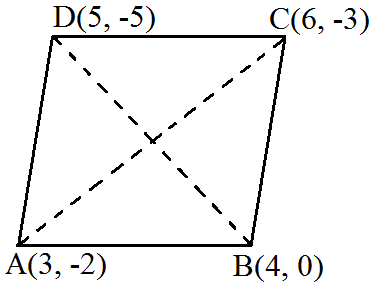
$\text{AB}=\sqrt{(4-3)^2+(0-(-2))^2}$
$=\sqrt{1+4}$
$=\sqrt{5}\text{ units}$
$\text{BC}=\sqrt{(6-4)^2+(-3-0)^2}$
$=\sqrt{4+9}$
$=\sqrt{13}\text{ unit}$
$\text{CD}=\sqrt{(5-6)^2+(-5-(-3))^2}$
$=\sqrt{1+4}$
$=\sqrt{5}\ \text{unit}$
$\text{AD}=\sqrt{(5-3)^2+(-5-(-2))^2}$
$=\sqrt{4+9}$
$=\sqrt{13}\ \text{unit}$
$\therefore$ AB = CD and AD = BC
Diagonal $\text{AC}=\sqrt{(6-3)^2+(-3-(-2))^2}$
$=\sqrt{9+1}$
$=\sqrt{10}\text{ units}$
Diagonal $\text{BD}=\sqrt{(5-4)^2+(-5-0)^2}$
$=\sqrt{1+25}$
$=\sqrt{26}\text{ unit}$
$\therefore\ \text{AC}\neq\text{BC}$
Since opposite sides AB = CD, BC = AD are equal but diagonal are not equal.
Hence, quadrilateral ABCD is a parallelogram. View full question & answer→Question 765 Marks
ABCD is a rectangle formed by joining the points A(-1, -1), B(-1, 4) C(5, 4) and D(5, -1). P, Q, R and S are the mid-points of sides AB, BC, CD and DA respectively. Is the quadrilateral PQRS a square? a rectangle? or a rhombus? Justify your answer.
Answer
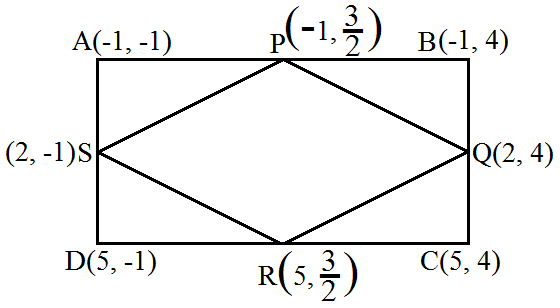 Length of $\text{PQ}=\sqrt{(-1-2)^2+\Big(\frac{3}{2}-4\Big)^2}$
$=\sqrt{9+\frac{25}{4}}=\sqrt{\frac{61}{4}}$
Length of $\text{QR}=\sqrt{(2-5)^2+\Big(4-\frac{3}{2}\Big)^2}$
$=\sqrt{9+\frac{25}{4}}=\sqrt{\frac{61}{4}}$
Length of $\text{RS}=\sqrt{(5-2)^2+\Big(\frac{3}{2}+1\Big)^2}$
$=\sqrt{9+\frac{25}{4}}=\sqrt{\frac{61}{4}}$
Length of $\text{SP}=\sqrt{(2+1)^2+\Big(-1-\frac{3}{2}\Big)^2}$
$=\sqrt{9+\frac{25}{4}}=\sqrt{\frac{61}{4}}$
Length of $\text{PR}\sqrt{(-1-5)^2+\Big(\frac{3}{2}-\frac{3}{2}\Big)^2}=6$
Length of $\text{QS}\sqrt{(2-2)^2+(4+1)^2}=5$
Here all sides of given quadrilateral is of same measure but the diagonals are of different lengths. So, PQRS is a rhombus. View full question & answer→Question 775 Marks
Find the centre of the circle passing through (5, -8), (2, -9) and (2, 1).
AnswerThe distance d between two points $(x_1, y_1)$ and $(x_2, y_2)$ is given by the formula,
$\text{d}=\sqrt{(\text{x}_1-\text{x}_2)^2+(\text{y}_1-\text{y}_2)^2}$
The centre of a circle is at equal distance from all the points on its circumference.
Here it is given that the circle passes through the points A(5, -8), B(2, -9) and C(2, 1).
Let the centre of the circle be represented by the point O(x, y).So
we have $AO = BO = CO$
$\text{AO}=\sqrt{(5-\text{x})^2+(-8-\text{y})^2}$
$\text{BO}=\sqrt{(2-\text{x})^2+(-9-\text{y})^2}$
$\text{CO}=\sqrt{(2-\text{x})^2+(1-\text{y})^2}$
Equating the first pair of these equations we have,
AO = BO $\sqrt{(5-\text{x})^2+(-8-\text{y})^2}=\sqrt{(2-\text{x})^2+(-9-\text{y})^2}$
Squaring on both sides of the equation
we have, $(5 - x)^2 + (-8 - y)^2$
$= (2 - x)^2 + (-9 - y)^2 25 + x^2 - 10x + 64 + y^2 + 16y$
$= 4 + x^2 - 4x + 81 + y^2 + 18y 6x + 2y$
$= 4 3x + y = 2E$ quating another pair of the equations
we have, AO = CO
$=\sqrt{(5-\text{x})^2+(-8-\text{y})^2}=\sqrt{(2-\text{x})^2+(1-\text{y})^2}$Squaring on both sides of the equation
we have,
$(5 - x)^2 + (-8 - y)^2$
$= (2 - x)^2 + (1 - y)^2 25 + x^2 - 10x + 64 + y^2 + 16y$
$= 4 + x^2 - 4x + 1 + y^2 - 2y 6x - 18y$
$= 84 x - 3y$
$= 14$
Now we have two equations for ‘x’ and ‘y’,
which are $3x + y = 2 x - 3y = 14$
From the second equation
we have y = -3x + 2.
Substituting this value of ‘y’ in the first equation
we have, $x - 3(-3x + 2)$
$= 14 x + 9x - 6$
$= 14 10x$
$= 20 x$
$= 2$
Therefore the value of ‘y’ is, $y = -3x + 2 y = -3(2) + 2 y = -4H$
ence the co-ordinates of the centre of the circle are (2, -4).
View full question & answer→Question 785 Marks
If the points $(-2, -1), (1, 0), (x, 3)$ and $(1, y)$ form a parallelogram, find the values of x and y.
AnswerThe given points are $A(-2, -1), B(1, 0), C(x, 3)$ and $D(1, y)$
.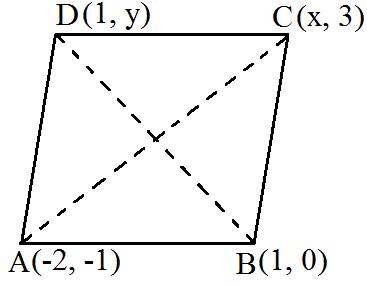
We know that the diagonals of a prallelogram bisect each other.
Therefore, the coordinates of the mid-point of AC are same as the coordinates of the mid-point of BD.
Let $P(x_m, y_m)$ be the mid-point of AC and BD.
$\text{P}(\text{x}_\text{m},\text{y}_\text{m})=\Big(\frac{-2+\text{x}}{2},\frac{-1+3}{2}\Big)=\Big(\frac{-2+\text{x}}{2},1\Big)$$\text{P}(\text{x}_\text{m},\text{y}_\text{m})=\Big(\frac{1+1}{2},\frac{0+\text{y}}{2}\Big)=\Big(1,\frac{\text{y}}{2}\Big)$
$\because$ diagonals of parallelogram bisect each other,
$\therefore\ \Big(\frac{-2+\text{x}}{2},1\Big)=\Big(1,\frac{\text{y}}{2}\Big)$
Equating the individual components,
we have, $\Rightarrow\ \frac{-2+\text{x}}{2}=1$ and $1=\frac{\text{y}}{2}$
$\Rightarrow -2 + x = 2$ and$ y = 2$
$\Rightarrow x = 4 and y = 2$
Hence, the value of x and y are 4 and 2. View full question & answer→Question 795 Marks
Two vertices of an isosceles triangle are $(2, 0)$ and $(2, 5)$. Find the third vertex if the length of the equal sides is 3.
Answer
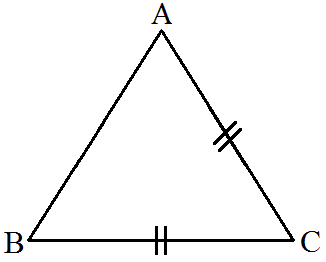
Given vertex are A(2, 0) and B(2, 5)
Let third vertex be C(x, y)
$\text{AB}=\sqrt{(2-2)^2+(5-0)^2}$
$=\sqrt{25}=5\text{ units}$
$\text{BC}=\sqrt{(\text{x}-2)^2+(\text{y}-5)^2}$
$=\sqrt{\text{x}^2+4-4\text{x}+\text{y}^2+25-10\text{y}}$
$=\sqrt{\text{x}^2+\text{y}^2-4\text{x}-10\text{y}+29}\ .....(1)$
$\text{AC}=\sqrt{(\text{x}-2)^2+(\text{y}-0)^2}$
$=\sqrt{\text{x}^2+4-4\text{x}+\text{y}^2}$
$=\sqrt{\text{x}^2+\text{y}^2-4\text{x}+4}\ ......(2)$
$\because$ AB is not one of the equal sides of the isosceles triangle.
$\therefore$ BC = AC
$\sqrt{\text{x}^2+\text{y}^2-4\text{x}-10\text{y}+29}=\sqrt{\text{x}^2+\text{y}^2-4\text{x}+4}$
Squaring both the sides,
$\Rightarrow x^2 + y^2 - 4x - 10y + 29 = x^2 + y^2 - 4x + 4$
$\Rightarrow x^2 + y^2 - 4x - 10y + 29 - x^2 - y^2 + 4x - 4 = 0$
$\Rightarrow -10y + 25 = 0$
$\Rightarrow -10y = -25$
$\Rightarrow\ \text{y}=\frac{-25}{-10}$
$\Rightarrow\ \text{y}=\frac{5}{2}$
$\because$ Length of the equal side is 3 units so putting the value of y in eq(2)
$\text{AC}=\sqrt{\text{x}^2+\text{y}^2-4\text{x}+4}$
$3=\sqrt{\text{x}^2+\Big(\frac{5}{2}\Big)^2-4\text{x}+4}$
Squaring both the sides,
$\Rightarrow\ 9=\text{x}^2+\frac{25}{4}-4\text{x}+4$
$\Rightarrow\ 9=\frac{4\text{x}^2+25-16\text{x}+16}{4}$
$\Rightarrow 36 = 4x^2 + 25 - 16x + 16$
$\Rightarrow -4x^2 - 25 + 16x - 16 + 36 = 0$
$\Rightarrow -4x^2 + 16x - 5 = 0$
$\Rightarrow -1(4x^2 - 16x + 5) = 0$
$\Rightarrow 4x^2 - 16x + 5 = 0$
Now, solving the quadratic equation using quadratic formula,
$\text{x} = {-\text{b} \pm \sqrt{\text{b}^2-4\text{ac}} \over 2\text{a}}$
Here, $a = 4, b = -16, c = 5$
$\Rightarrow\ \text{x}=\frac{-(-16)\pm\sqrt{(-16)^2-4\times4\times5}}{2\times4}$
$\Rightarrow\ \text{x}=\frac{16\pm\sqrt{256-80}}{8}$
$\Rightarrow\ \text{x}=\frac{16\pm\sqrt{176}}{8}$
$\Rightarrow\ \text{x}=\frac{16\pm4\sqrt{11}}{8}$
$\Rightarrow\ \text{x}=\frac{4(4\pm\sqrt{11})}{8}=2\pm\frac{\sqrt{11}}{2}$
Hence, the third vertex of isosceles triangle are $\Big(2-\frac{\sqrt{11}}{2},\frac{5}{2}\Big),\Big(2+\frac{\sqrt{11}}{2},\frac{5}{2}\Big).$ View full question & answer→Question 805 Marks
Two opposite vertices of a square are (-1, 2) and (3, 2). Find the coordinates of other two vertices.
Answer
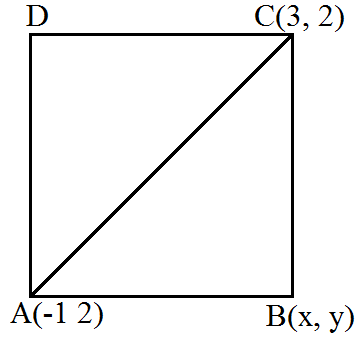
Let ABCD is a square, in which co-ordinates of A are (-1, 2) and of C are (3, 2) join AC.
Let co-ordinates of B be (x, y).
AB = BC (Sides of a square)
$\Rightarrow AB^2 = BC^2$
Now, $\text{AB}=\sqrt{(\text{x}_2-\text{x}_1)^2+(\text{y}_2-\text{y}_1)^2}$
$=\sqrt{(\text{x}+1)^2+(\text{y}-2)^2}$
$\Rightarrow AB^2 = (x + 1)^2 + (y - 2)^2$
Similarly, $BC^2 = (x - 3)^2 + (y - 2)^2$
$\because$ $AB = BC$
$\therefore$ $(x + 1)^2 + (y - 2)^2 = (x - 3)^2 + (y - 2)^2$
$\Rightarrow (x + 1)^2 = (x - 3)^2$
$\Rightarrow x^2 + 2x + 1 = x^2 - 6x + 9$
$\Rightarrow x^2 + 2x + 6x - x^2 = 9 - 1 = 8$
$\Rightarrow 8x = 8$
$\Rightarrow\ \text{x}=\frac{8}{8}=1$
Now in right $\triangle\text{ABC}$
$AC^2 = AB^2 + BC^2$
$(3 + 1)^2 + (2 - 2)^2 = (x + 1)^2 + (y - 2)^2 + (x - 3)^2 + (y - 2)^2$
$\Rightarrow (4)^2 + (0)^2 = x^2 + 2x + 1 + y^2 - 4y + 4 + x^2 - 6x + 9 + y^2 - 4y + 4$
$\Rightarrow 16 = 2x^2 + 2y^2 - 4x - 8y + 18$
$\Rightarrow 2x^2 + 2y^2 - 4x - 8y = 16 - 18$
$\Rightarrow 2x^2 + 2y^2 - 4x - 8y = -2$
$\Rightarrow x^2 + y^2 - 2x - 4y = -1$
Substituting the value of x,
$(1)^2 + y^2 - 2 \times 1 - 4y = -1$
$1 + y^2 - 2 - 4y = -1$
$y^2 - 4y = -1 - 1 + 2 = 0$
$y(y - 4) = 0$
Either y = 0
or y - 4 = 0, then y = 4
$\therefore$ Co-ordinates of other points will be
(1, 0) and (1, 4). View full question & answer→Question 815 Marks
Find the lengths of the medians of a ΔABC having vertices at A(5, 1), B(1, 5), and C(-3, -1).
AnswerLet D, E, F be the mid-points of sides BC, CA and AB respectively
.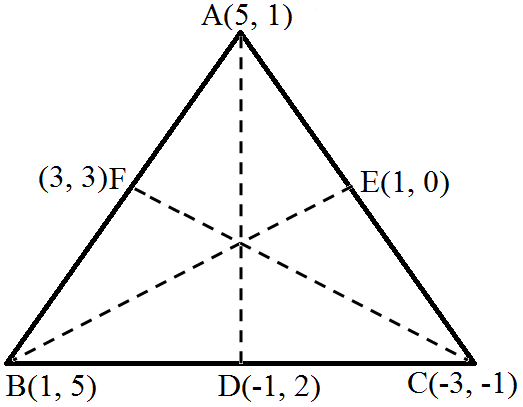
The coordinates of the mid-points $\left(x_m, y_m\right)$ between two points $\left(x_1, y_1\right)$ and $\left(x_2, y_2\right)$ is
given by,$(\text{x}_\text{m},\text{y}_\text{m})=\Big(\frac{\text{x}_1+\text{x}_2}{2},\frac{\text{y}_1+\text{y}_2}{2}\Big)$
Then, the coordinates of D, E and F are,
$\text{D}\Big(\frac{-3+1}{2},\frac{-1+5}{2}\Big)=\text{D}(-1,2)$
$\text{E}\Big(\frac{-3+5}{2},\frac{-1+1}{2}\Big)=\text{E}(1,0)$
$\text{F}\Big(\frac{1+5}{2},\frac{1+5}{2}\Big)=\text{F}(3,3)$
length of median AD is, $\text{AD}=\sqrt{(-1-5)^2+(2-1)^2}$
$=\sqrt{36+1}$ $=\sqrt{37}\ \text{units}$ length of median BE is, $\text{BE}=\sqrt{(1-1)^2+(0-5)^2}$
$=\sqrt{25}$ $=5\text{ units}$ length of median CF is, $\text{CF}=\sqrt{(-3-3)^2+(-1-3)^2}$
$=\sqrt{36+16}$ $=\sqrt{52}$ $=2\sqrt{13}\ \text{units}$ View full question & answer→