Question 15 Marks
Find a natural number whose square diminished by 84 is equal to thrice of 8 more than the given number.
AnswerLet n be a required natural number.
Square of a natural number diminished by $= n^2 - 84$
and thrice of 8 more than the natural numbar = 3(n + 8)
Now, by given condition,
$\Rightarrow n^2 - 84 = 3(n + 8)$
$\Rightarrow n^2 - 84 = 3n + 24$
$\Rightarrow n^2 - 3n - 108 = 0$
$\Rightarrow n^2 - 12n + 9n - 108 = 0 $[by splitting the middle term]
$\Rightarrow n(n - 12) + 9(n - 12) = 0$
$\Rightarrow (n - 12)(n + 9) = 0$
$\Rightarrow n = 12 [ n \neq -9$ because n is a natural number]
Hence, the required natural number is 12.
View full question & answer→Question 25 Marks
If the roots the equations $ax^2 + 2bx + c = 0$ and $\text{bx}^2-2\sqrt{\text{ac}}\text{x}+\text{b}=0$ are simultaneously real, then prove that $b^2 = ac.$
AnswerThe given equation are
$\text{ax}^2+2\text{bx}+\text{c}=0\ ....(\text{i})$
$\text{bx}^2-2\sqrt{\text{ac}}\text{x}+\text{b}=0\ .....(\text{ii})$
Roots are simultaneously real,
Then prove that $\text{b}^2=\text{ac}$
Let $D_1$ and $D_2$ be the discriminants of equation (i) and (ii) respectively.
Then, $\text{D}_1=(2\text{b})^2-4\text{ac}$
$\text{D}_1=4\text{b}^2-4\text{ac}$
And, $\text{D}_2=(-2\sqrt{\text{ac}})^2-4\times\text{b}\times\text{b}$
$\text{D}_2=4\text{ac}-4\text{b}^2$
Both the given equation will have real roots, if $\text{D}_1\geq0$ and $\text{D}_2\geq0$
$4\text{b}^2-4\text{ac}\geq0$
$4\text{ac}\geq4\text{b}^2$
$\text{b}^2\geq\text{ac}\ ....(\text{iii})$
$4\text{ac}-4\text{b}^2\geq0$
$4\text{ac}\geq4\text{b}^2$
$\text{ac}\geq\text{b}^2\ ....(\text{iv})$
From equations (iii) and (iv) we get
$\text{b}^2=\text{ac}$
Hence, $\text{b}^2=\text{ac}$
View full question & answer→Question 35 Marks
A pole has to be erected at a point on the boundary of a circular park of diameter 13 meters in such a way that the difference of its distances from two diametrically opposite fixed gates A and B on the boundary is 7 meters. Is it the possible to do so? If yes, at what distances from the two gates should the pole be erected?
AnswerIn a circcle, AB is the diameters and AB = 13m
Let P be the pole on the circle Let PB = x m,
Then PA = (x + 7)m
Now in right $\triangle\text{APB}$ (P is in semi circle)
$AB^2 = AB^2 + AP^2$ (Pythagoras Theorem)
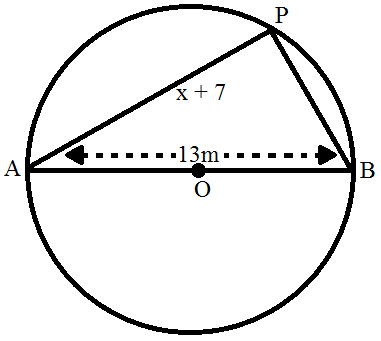
$\Rightarrow (13)^2 = x^2 + (x + 7)^2$
$\Rightarrow x^2 + x^2 + 14x + 49 = 169$
$\Rightarrow 2x^2 + 14x + 49 - 169 = 0$
$\Rightarrow 2x^2+ 14x - 120 = 0$
$\Rightarrow x^2 + 7x - 60 = 0$ (Dividing by 2)
$\Rightarrow x^2 + 12x - 5x - 60 = 0$
$\Rightarrow x(x + 12) - 5(x + 12) = 0$
$\Rightarrow (x + 12)(x - 5) = 0$
Either x + 12 = 0, then x = -12 which is not possible being negative
Or x - 5 = 0, then x = 5
P is at distance of 5m from B and 5 + 7 = 12m from A. View full question & answer→Question 45 Marks
A two-digit number is such that the product of digit is 12. When 36 is added to the number the digits interchange their places. Determine the number.
AnswerLet the tens digit be x then, the unit digits $=\frac{12}{\text{x}}$
Therefore, number $=\Big(10\text{x}+\frac{12}{\text{x}}\Big)$
And number obtained interchanging the digits $=\Big(10\times\frac{12}{\text{x}}+\text{x}\Big)$
Then according to question
$\Big(10\text{x}+\frac{12}{\text{x}}\Big)+36 =\Big(10\times\frac{12}{\text{x}}+\text{x}\Big)$
$\Big(10\text{x}+\frac{12}{\text{x}}\Big)+36=\Big(\frac{120}{\text{x}}+\text{x}\Big)$
$\Big(10\text{x}+\frac{12}{\text{x}}\Big)-\Big(\frac{120}{\text{x}}+\text{x}\Big)+36=0$
$\frac{(10\text{x}^2+12)-(120+\text{x}^2)+36\text{x}}{\text{x}}=0$
$10\text{x}^2+12-120-\text{x}^2+36\text{x}=0$
$9(\text{x}^2+4\text{x}-12)=0$
$\text{x}^2-2\text{x}+6\text{x}-12=0$
$\text{x}(\text{x}-2)+6(\text{x}-2)=0$
$(\text{x}-2)(\text{x}+6)=0$
$(\text{x}-2)=0$
$\text{x}=2$
Or $(\text{x}+6)=0$
$\text{x}=-6$
So, the digit can never be negative.
Therefore,
When x = 2 then unit digits
$=\frac{12}{\text{x}}$
$=\frac{12}{2}$
$=6$
And number
$=\Big(10\text{x}+\frac{12}{\text{x}}\Big)$
$=(10\times2+6)$
$=26$
Thus, the required number be 26
View full question & answer→Question 55 Marks
Find the value of k for which root are real and equal in the following equations:
$x^2 - 2(5 + 2k)x + 3(7 + 10k) = 0$
AnswerThe given quadric equation is $x^2 - 2(5 + 2k)x + 3(7 + 10k) = 0,$ and roots are real and equal
Then find the value of k.
Here, a = 1, b = -2(5 + 2k) and c = 3(7 + 10k)
As we know that $D = b^2 - 4ac$
Putting the value of a = 1, b = -2(5 + 2k) and, c = 3(7 + 10k)
$= (-2(5 + 2k))^2 - 4 \times 1 \times 3(7 + 10k)$
$= 4(25 + 20k + 4k^2) - 12(7 + 10k)$
$= 100 + 80k + 16k^2 - 84 - 120k$
$= 16 - 40k + 16k^2$
The given equation will have eqal and equal roots, if D = 0
Thus, $16 - 40k + 16k^2= 0$
$8(2k^2 - 5k + 2) = 0$
$(2k^2 - 5k + 2) = 0$
Now factorizing of the above equation
$(2k^2 - 5k + 2) = 0$
$2k^2 - 4k - k + 2 = 0$
$2k (k - 2) - 1(k - 2) = 0$
So, either (k - 2) = 0
k = 2
(2k - 1) = 0
$\text{k}=\frac{1}{2}$
therefore, the value of $\text{k}=2,\frac{1}{2}$
View full question & answer→Question 65 Marks
Solve the following quadratic equations by factorization:
$\frac{\text{x}+1}{\text{x}-1}+\frac{\text{x}-2}{\text{x}+2}=4-\frac{2\text{x}+3}{\text{x}-2},$ $\text{x}\neq1,-2,2$
Answer$\Rightarrow\frac{\text{x}+1}{\text{x}-1}+\frac{\text{x}-2}{\text{x}+2}=4-\frac{2\text{x}+3}{\text{x}-2}$
$\Rightarrow\frac{(\text{x}+1)(\text{x}+2)+(\text{x}-1)(\text{x}-2)}{(\text{x}-1)(\text{x}+2)}\\=\frac{4(\text{x}+2)-(2\text{x}+3)}{\text{x}+2}$
$$$\Rightarrow\frac{(\text{x}^2+2\text{x}+\text{x}+2)+(\text{x}^2-2\text{x}-\text{x}+2)}{\text{x}^2+\text{x}-2}\\=\frac{4\text{x}-8-2\text{x}-3}{\text{x}-2}$
$\Rightarrow\frac{\text{x}^2+3\text{x}+2+\text{x}^2-3\text{x}+2}{\text{x}^2+\text{x}-2}=\frac{2\text{x}-11}{\text{x}-2}$
$\Rightarrow\frac{2\text{x}^2+4}{\text{x}^2+\text{x}-2}=\frac{2\text{x}-11}{\text{x}-2}$
$\Rightarrow 2x^3 - 4x^2 + 4x - 8 = 2x^3 + 2x^2 - 4x - 11x^2 - 11x + 22$
$\Rightarrow 2x^3 - 4x^2 + 4x - 8 = 2x^3 - 9x^2 - 15x + 22$
$\Rightarrow 2x^3 - 2x^3 - 4x^2 + 9x^2 + 4x + 15x - 8 - 22 = 0$
$\Rightarrow 5x^2 + 19x - 30 = 0$
$\Rightarrow 5x^2+ 25x - 6x - 30 = 0$
$\Rightarrow 5x(x + 5) - 6(x + 5) = 0$
$\Rightarrow (5x - 6)(x + 5) = 0$
$\Rightarrow 5x - 6 = 0, x + 5 = 0$
$\Rightarrow\text{x}=\frac{6}{5},$ x = -5
View full question & answer→Question 75 Marks
Find the value of k for which the quadratic equation $(3k + 1)x^2 + 2(k + 1)x + 1 = 0$ has equal roots. Also, find the roots.
Answer$(3k + 1)x^2 + 2(k + 1)x + 1 = 0Here, a = (3k + 1), b = 2(k + 1), c = 1$
Now, $b^2 - 4ac$
$= [2(k + 1)]^2 - 4 \times (3k + 1) \times 1$
$= 4(k^2 + 2k + 1) - 4(3k + 1)$
$= 4k^2 + 8k + 4 - 12k - 4$
$= 4k^2 - 4k$
$\because$ Roots are real and equal,
$\therefore$ $b^2 - 4ac = 0$
$\Rightarrow 4k^2 - 4k = 0$
$\Rightarrow k^2 - k = 0$
$\Rightarrow k^2 - k = 0$
$\Rightarrow k(k - 1) = 0X$
Either k = 0 or k - 1 = 0, then k = 1
$\therefore$ k = 0, 1
When k = 0,
Then, $(3 \times 0 + 1)x^2 + 2(0 + 1)x + 1 = 0$
$\Rightarrow x^2 + 2x + 1 = 0$
$\Rightarrow (x + 1)^2 = 0$
$\Rightarrow x + 1 = 0$
$\therefore$ x = -1
When k = 1,
Then, $(3 \times 1 + 1)x^2 + 2(1 + 1)x + 1 = 0$
$\Rightarrow 4x^2 + 4x + 1 = 0$
$\Rightarrow (2x + 1)^2 = 0$
$\Rightarrow 2x + 1 = 0$
$\Rightarrow 2x = -1$
$\Rightarrow\text{x}=\frac{-1}{2}$
$\therefore\text{x}=1,\frac{-1}{2}$
View full question & answer→Question 85 Marks
Solve the following quadratic equations by factorization:
$\frac{4}{\text{x}}-3=\frac{5}{2\text{x}+3},$ $\text{x}\neq-0,-\frac{3}{2}$
Answer$\frac{4}{\text{x}}-3=\frac{5}{2\text{x}+3}$
$\Rightarrow\frac{4-3\text{x}}{\text{x}}=\frac{5}{2\text{x}+3}$
$\Rightarrow (4 - 3x)(2x + 3) = 5x$
$\Rightarrow 8x + 12 - 6x^2 - 9x = 5x$
$\Rightarrow -6x^2 - 6x + 12 = 0$
$\Rightarrow x^2 + x - 2 = 0$
$\Rightarrow x^2 + 2x - x - 2 = 0$
$\Rightarrow x(x + 2) - 1(x + 2) = 0$
$\Rightarrow (x - 1)(x + 2) = 0$
$\Rightarrow x - 1 = 0 or x + 2 = 0$
$\Rightarrow x = 1 or x = -2$
Hence, the factors are 1 and -2
View full question & answer→Question 95 Marks
Sum of the area of two squares is 400cm$^2$. If the difference of their perimeters is 16cm, find the sides of two squares.
AnswerLet the side of the smaller square be x cm
Perimeter of any square = (4 × side of the square)cm
It is given that the difference of the perimeters of two squares is 16cm
Then side of the bigger square $=\frac{16+4\text{x}}{4}$
= (4 + x)cm
According to the question,
$\Rightarrow x^2 + (4 + x)^2 = 400$
$\Rightarrow x^2 + 16 + x^2 + 8x = 400$
$\Rightarrow 2x^2 + 8x - 384 = 0$
$\Rightarrow x^2 + 4x - 192 = 0$
$\Rightarrow x^2 + 16x - 12x - 192 = 0$
$\Rightarrow x(x + 16) - 12(x + 16) = 0$
$\Rightarrow (x - 12)(x + 16) = 0$
$\Rightarrow x - 12 = 0 or x + 16 = 0$
$\Rightarrow x = 12 or x = -16$
Since, side of the square cannot be negative.
Thus, the side of the smaller square is 12cm and the side of the bigger square is (4 + 12) = 16cm.
View full question & answer→Question 105 Marks
Find two consecutive numbers whose squares have the sum 85.
AnswerLet two consecutive numbers be X and (x + 1)
Then according to question
$x^2 + (x + 1)^2 = 85$
$x^2 + x^2 + 2x + 1 = 85$
$2x^2 + 2x - 85 + 1 = 0$
$2x^2 + 2x - 84 = 0$
$x^2 + x - 42 = 0$
$x^2 + 7x - 6x - 42 = 0$
$x(x + 7) - 6(x + 7) = 0$
$(x + 7)(x - 6) = 0$
$(x + 7) = 0$
$x = -7$
$or (x - 6) = 0$
$x = 6$
Since, x being a number,
Therefore,
When x = -7 then
x + 1 = -7 + 1
x + 1 = -6
And when x = 6 then
x + 1 = 6 + 1
x + 1 = 7
Thus, two consecutive number be either 6, 7 or -6, -7
View full question & answer→Question 115 Marks
Solve the following quadratic equations by factorization:$\frac{\text{x+3}}{\text{x}-2}-\frac{1-\text{x}}{\text{x}}=\frac{17}{4}$
AnswerWe have,
$\frac{\text{x+3}}{\text{x}-2}-\frac{1-\text{x}}{\text{x}}=\frac{17}{4}$
$\Rightarrow\frac{\text{x}(\text{x}+3)-(\text{x}-2)(1-\text{x})}{\text{x}(\text{x}-2)}=\frac{17}{4}$
$\Rightarrow\frac{\text{x}^2+3\text{x}-(\text{x}-\text{x}^2-2+2\text{x})}{\text{x}^2-2\text{x}}=\frac{17}{4}$
$\Rightarrow\frac{\text{x}^2+3\text{x}-\text{x}+\text{x}^2+2-2\text{x}}{\text{x}^2-2\text{x}}=\frac{17}{4}$
$\Rightarrow\frac{2\text{x}^2+2}{\text{x}^2-2\text{x}}=\frac{17}{4}$
$\Rightarrow 4(2x^2 + 2) = 17(x^2 - 2x)$
$\Rightarrow 8x^2 + 8 = 17x^2 - 34x$
$\Rightarrow 8x^2 + 8 = 17x^2 - 34x$
$\Rightarrow (17 - 8)x^2 - 34x - 8 = 0$
$\Rightarrow 9x^2 - 34x - 8 = 0$
$[9 \times -8 = -72 \Rightarrow -72 = 36 \times 2$ and $-34 = -36 + 2]$
$\Rightarrow 9x^2 - 36x + 2x - 8 = 0$
$\Rightarrow 9x(x - 4) + 2(x - 4) = 0$
$\Rightarrow (x - 4)(9x + 2) = 0$
$\Rightarrow (x - 4) = 0 or 9x + 2 = 0$
⇒ x = 4 or $\text{x}=\frac{-8}{2}$
$\therefore$ x = 4 and $\text{x}=\frac{-8}{2}$ are the two roots of the given equation.
View full question & answer→Question 125 Marks
Solve the following quadratic equations by factorization:
$\frac{1}{\text{x}-3}+\frac{2}{\text{x}-2}=\frac{8}{\text{x}},$ $\text{x}\neq0, 2, 3$
Answer$\frac{1}{\text{x}-3}+\frac{2}{\text{x}-2}=\frac{8}{\text{x}}$
$\Rightarrow\frac{(\text{x}-2)+2(\text{x}-3)}{(\text{x}-3)(\text{x}-2)}=\frac{8}{\text{x}}$
$\Rightarrow\frac{\text{x}-2+2\text{x}-6}{\text{x}^2-2\text{x}-3\text{x}+6}=\frac{8}{\text{x}}$
$\Rightarrow\frac{3\text{x}-8}{\text{x}^2-5\text{x}+6}=\frac{8}{\text{x}}$
$\Rightarrow x(3x - 8) = 8(x^2 - 5x + 6)$
$\Rightarrow 3x^2 - 8x = 8x^2 - 40x + 48$
$\Rightarrow 5x^2 - 32x + 48 = 0$
$\Rightarrow 5x^2 - 20x - 12x + 48 = 0$
$\Rightarrow 5x(x - 4) - 12(x - 4) = 0$
$\Rightarrow (5x - 12)(x - 4) = 0$
$\Rightarrow 5x - 12 = 0 or x - 4 = 0$
$\Rightarrow\text{x}=\frac{12}{5}$ or x = 4
Hence, the factors 4 and $\frac{12}{5}$
View full question & answer→Question 135 Marks
Find the value of k for which the root are real and equal in the following equations:
$x^2 - 2kx + 7k - 12 = 0$
Answer$x^2 - 2kx + 7k - 12 = 0$
Here a = 1, b = -2k, c = (7k - 12)
$\therefore$ Discriminant$ (D) = b^2 - 4ac$
$= (-2k)^2 - 4 \times 1 \times (7k - 12)$
$= 4k^2 - 4(7k - 12)$
$= 4k^2 - 28k + 48$
$\because$ Roots are real and equal
$\therefore$ D = 0
$\Rightarrow 4k^2 - 28k + 48 = 0$
$\Rightarrow k^2 - 7k + 12 = 0 (Dividing by 4)$
$\Rightarrow k^2 - 3k - 4k + 12 = 0$
$\begin{Bmatrix}\because12=-3\times(-4)\\-7=-3-4\end{Bmatrix}$
⇒ k(k - 3) - 4(k - 3) = 0
⇒ (k - 3)(k - 4) = 0
Either k - 3 = 0, then k = 3
or k - 4 = 0, then k = 4
$\therefore$ k = 3, 4
View full question & answer→Question 145 Marks
Divide 29 into two parts so that the sum of the squares of the parts is 425.
AnswerLet first numbers be x and other (29 - x)
Then according to question
$x^2 + (29 - x)^2 = 425$
$x^2 + x^2 - 58x + 841 = 425$
$2x^2 - 58x + 841 = 425$
$2x^2 - 58x + 841 - 425 = 0$
$2x^2 - 58x + 416 = 0$
$x^2 - 29x + 208 = 0$
$x^2 - 16x - 13x + 208 = 0$
$x(x - 16) - 13(x - 16) = 0$
$(x - 16)(x + 13) = 0$
$(x - 16) = 0$
$x = 16$
$or (x + 13) = 0$
$x = -13$
Since, 29 beging a positive number, so x cannot be negative.
Therefore,
When x = 16 then
29 - x = 29 - 16
29 - x = 13
Thus, two consecutive number be 13, 16
View full question & answer→Question 155 Marks
Find the roots of the following quadratic equation (if they exist) by the method of completing the square.
$4\text{x}^2+4\sqrt{3}\text{x}+3=0$
AnswerWe have been given that,
$4\text{x}^2+4\sqrt{3}\text{x}+3=0$
Now divide throughout by 4 we get,
$\text{x}^2+\sqrt{3}\text{x}+\frac{3}{4}=0$
Now take the constant term to the R.H.S. and we get,
$\text{x}^2+\sqrt{3}\text{x}=-\frac{3}{4}$
Now add square of half of co-efficient of 'x' on both the sides. we have,
$\text{x}^2+2\Big(\frac{\sqrt{3}}{2}\Big)\text{x}+\Big(\frac{\sqrt{3}}{2}\Big)^2=\Big(\frac{\sqrt{3}}{2}\Big)^2-\frac{3}{4}$
$\text{x}^2+2\Big(\frac{\sqrt{3}}{2}\Big)\text{x}+\Big(\frac{\sqrt{3}}{2}\Big)^2=0$
$\Big(\text{x}+\frac{\sqrt{3}}{2}\Big)^2=0$
Since R.H.S. is a positive number, therefore the roots of the equation exist.
So, now take the square root on both the sides and we get,
$\text{x}+\frac{\sqrt{3}}{2}=0$
$\text{x}=-\frac{\sqrt{3}}{2}$
Now, we have the value of 'x' as
$\text{x}=-\frac{\sqrt{3}}{2}$
Also we have,
$\text{x}=-\frac{\sqrt{3}}{2}$
Therefore the roots of the equation are $\text{x}=-\frac{\sqrt{3}}{2}$ and $\text{x}=-\frac{\sqrt{3}}{2}$
View full question & answer→Question 165 Marks
The sum of ages of a man and his son is 45 years. Five years ago, the product of their ages was four times the man's age at the time. Find their present ages.
AnswerLet the present age of the man be x years
Then present age of his son is = (45 - x) years
Five years ago, man's age = (x - 5) years
And his son's age (45 - x - 5) = (40 - x) years
Then according to question,
$(x - 5)(40 - x) = 4(x - 5)$
$40x - x^2 + 5x - 200 = 4x - 20$
$-x^2 + 45x - 200 = 4x - 20$
$-x^2 + 45x - 200 - 4x + 20 = 0$
$-x^2 + 41x - 180 = 0$
$x^2 - 41x + 180 = 0$
$x^2 - 36x - 5x + 180 = 0$
$x(x - 36) - 5(x - 36) = 0$
$(x - 36)(x - 5) = 0$
So, either
(x - 5) = 0
x = 5
But, the father's age never be 5 years
Therefore, when x = 36 then
45 - x = 45 - 36
45 - x = 9
Hence, man's present age is = 36 years and his son's age is = 9 years.
View full question & answer→Question 175 Marks
The perimeter of a rectangular field is 82m and its area is $400m^2$. Find the breadth of the rectangle.
AnswerLet the breadth of the rectangle be = x metres. Then
Perimeter = 82 metres
2(length + breadth) = 82
(length + x) = 41
length = 41 - x
And area of the rectangle
length × breadth = 400
$(41 - x)x = 400$
$41x - x^2 = 400$
$x^2 - 41x + 400 = 0$
$x^2 - 25x - 16x + 400 = 0$
$x(x - 25) - 16(x - 25) = 0$
$(x - 25)(x - 16) = 0$
$(x - 25) = 0$
$x = 25$
$Or (x - 16) = 0$
$x = 16$
Since perimeter is 82 meter. So breadth can't be 25 meter.
Hence, breadth 16 metres.
View full question & answer→Question 185 Marks
Solve the following quadratic equations by factorization:
$(\text{x}-5)(\text{x}-6)=\frac{25}{(24)^2}$
AnswerWe have been given that,
$(\text{x}-5)(\text{x}-6)=\frac{25}{(24)^2}$
$\text{x}^2-11\text{x}+30-\frac{25}{576}=0$
$\text{x}^2-11\text{x}+\frac{17255}{576}=0$
$\text{x}^2-\frac{145}{24}\text{x}-\frac{119}{24}\text{x}+\frac{17255}{576}=0$
$\text{x}\Big(\text{x}-\frac{145}{24}\Big)-\frac{119}{24}\Big(\text{x}-\frac{145}{24}\Big)=0$
$\Big(\text{x}-\frac{119}{24}\Big)\Big(\text{x}-\frac{145}{24}\Big)=0$
Therefore,
$\text{x}-\frac{119}{24}=0$
$\text{x}=\frac{119}{24}$
or, $\text{x}-\frac{145}{24}=0$
$\text{x}=\frac{145}{24}$
Hence, $\text{x}=\frac{119}{24}=4\frac{23}{24}$ or $\text{x}=\frac{145}{24}=6\frac{1}{24}$
View full question & answer→Question 195 Marks
In the following, determine whether the given values are solution of the given equation or not:
$\text{x}^2-\sqrt{2}\text{x}-4=0,$ $\text{x}=-\sqrt{2},$ $\text{x}=-2\sqrt{2}$
Answer$\text{x}^2-\sqrt{2}\text{x}-4=0,$ $\text{x}=-\sqrt{2},$ $\text{x}=-2\sqrt{2}$When, $\text{x}=-\sqrt{2}$
Substituting $\text{x}=-\sqrt{2}$
L.H.S.
$=\text{x}^2-\sqrt{2}\text{x}-4$
$=(-\sqrt{2})^2-\sqrt{2}(-\sqrt{2})-4$
$=2+2-4=0$
= R.H.S.
$\therefore\text{x}=-\sqrt{2}$ is its solution
When, $\text{x}=-2\sqrt{2}$
Substituting $\text{x}=-2\sqrt{2}$
L.H.S.
$=\text{x}^2-\sqrt{2}\text{x}-4$
$=(-2\sqrt{2})^2-\sqrt{2}(-2\sqrt{2})-4$
$=8+4-4$
$=8\neq\text{R.H.S}$
$\therefore\text{x}=-2\sqrt{2}$ is not its solution.
View full question & answer→Question 205 Marks
Rs. 9000 were divided equally among a certain number of persons. Had there been 20 more persons, each would have got Rs. 160 less. Find the original number of persons.
AnswerTotal amount = Rs. 9000
Let number of presons = x
Then each share $=\text{Rs.}\frac{9000}{\text{x}}$
Increased persons = (x + 20)
According to the condition,
$\frac{9000}{\text{x}}-\frac{9000}{\text{x}+20}=160$
$\Rightarrow\frac{9000\text{x}+180000-9000\text{x}}{\text{x}(\text{x}+20)}=160$
$\Rightarrow\frac{180000}{\text{x}^2+20\text{x}}=160$
$\Rightarrow 160x^2 + 3200x = 180000$
$\Rightarrow 160x^2 + 3200x - 180000 = 0$
$\Rightarrow x2 + 20x - 1125 = 0$
$\begin{Bmatrix}\because-1125=45\times(-25)\\20=45 - 25 \end{Bmatrix}$
$x^2 + 45x - 25x - 1125 = 0$
$x(x + 45) - 25(x + 45) = 0$
$(x + 45)(x - 25) = 0$
Either x + 45 = 0, then x = -45 which is not possible being negative or x - 25 = 0, then x = 25
Number of persons = 25
View full question & answer→Question 215 Marks
Solve the following quadratic equations by factorization:
$\sqrt{3}\text{x}^2-2\sqrt{2}\text{x}-2\sqrt{3}=0$
Answer$\sqrt{3}\text{x}^2-2\sqrt{2}\text{x}-2\sqrt{3}=0$
Here, $\text{a}=\sqrt{3},\text{b}=-2\sqrt{2},\text{c}=-2\sqrt{3}$
$\text{D}=\text{b}^2-4\text{ac}$
$=\big(-2\sqrt{2}\big)^2-4\times\sqrt{3}\times\big(-2\sqrt{3}\big)$
$=8+24=32$
$\because\text{D}>0$
$\therefore$ The given equation has real roots,
$\text{x}=\frac{-\text{b}\pm\sqrt{\text{D}}}{2\text{a}}$
or $\frac{-\big(-2\sqrt{2}\big)\pm\sqrt{32}}{2\times\sqrt{3}}$
or $\text{x}=\frac{2\sqrt{2}\pm\sqrt{16\times2}}{2\sqrt{3}}$
$=\frac{2\sqrt{2}\pm4\sqrt{2}}{2\sqrt{3}}$
Either $\text{x}=\frac{2\sqrt{2}+4\sqrt{2}}{2\sqrt{3}}$ or $\text{x}=\frac{2\sqrt{2}-4\sqrt{2}}{2\sqrt{3}}$
$=\frac{6\sqrt{2}}{2\sqrt{3}}=\frac{3\sqrt{2}}{\sqrt{3}}$ or $=\frac{-2\sqrt{2}}{2\sqrt{3}}=\frac{-\sqrt{2}}{\sqrt{3}}$
$\Rightarrow\frac{3\sqrt{2}}{\sqrt{3}}\times\frac{\sqrt{3}}{\sqrt{3}}$ or $\frac{-\sqrt{2}}{\sqrt{3}}\times\frac{\sqrt{3}}{\sqrt{3}}$
$\Rightarrow\frac{3\sqrt{6}}{3}\text{ and }\frac{-\sqrt{6}}{3}$
$\Rightarrow\sqrt{6}\ \text{and}\ \frac{-\sqrt{6}}{3}$
$\therefore\text{x}=\sqrt{6}$ and $\frac{-\sqrt{6}}{3}$
View full question & answer→Question 225 Marks
Solve the following quadratic equations by factorization:
$\frac{3}{\text{x}+1}-\frac{1}{2}=\frac{2}{3\text{x}-1},$ $\text{x}\neq-1,\frac{1}{3}$
Answer$\frac{3}{\text{x}+1}-\frac{1}{2}=\frac{2}{3\text{x}-1}$
$\Rightarrow\frac{6-(\text{x}-1)}{2(\text{x}+1)}=\frac{2}{3\text{x}-1}$
$\Rightarrow\frac{6-\text{x}-1}{2\text{x}+2}=\frac{2}{3\text{x}-1}$
$\Rightarrow (5 - x)(3x - 1) = 2(2x + 2)$
$\Rightarrow 15x - 5 - 3x^2 + x = 4x + 4$
$\Rightarrow -3x^2 + 16x - 5 - 4x - 4 = 0$
$\Rightarrow -3x^2 + 12x + 9 = 0$
$\Rightarrow x^2 - 4x + 3 = 0$
$\Rightarrow x^2 - 3x - x + 3 = 0$
$\Rightarrow x(x - 3) - 1(x - 3) = 0$
$\Rightarrow (x - 1)(x - 3) = 0$
$\Rightarrow x - 1 = 0 or x - 3 = 0$
$\Rightarrow x = 1 or x = 3$
Hence, the factors are 3 and 1
View full question & answer→Question 235 Marks
An airplane left 50 minutes later than its scheduled time, and in order to reach the destination, 1250km away, in time, it had to increase its speed by 250km/hr from its usual speed. Find its usual speed.
AnswerLet the usual speed of the plane be x km/hr
Distance coverred by the plane = 1250km
Time taken by the plane with usual speed $=\frac{1250}{\text{x}}=\text{ hrs.}$
To cover the delay of 50 minutes, the speed of the plane is increased by 250km/hr
Now,
Speed of plane after increasing = (x + 250) km/hr and
Time taken by the plane with increased speed $=\frac{1250\text{ km}}{\text{(x}+250)\text{km/hr}}=\frac{1250}{\text{x}+250}\text{hr}$
From the data we have,
$\frac{1250}{\text{x}}\text{hr}-\frac{1250}{\text{x}+250}\text{hr}=50\text{ min}$
$\Rightarrow1250\text{ hr}\Big(\frac{1}{\text{x}}-\frac{1}{\text{x}+250}\Big)$ $=\frac{50}{60}\text{hr}[\because1\text{hr}=60\text{min}]$
$\Rightarrow250\Big(\frac{\text{x}+250-\text{x}}{\text{x}(\text{x}+250}\Big)=\frac{1}{6}$
$\Rightarrow 250 \times 250 \times 6 = x(x + 250) \times 1$
$\Rightarrow 375000 = x^2 + 250x$
$\Rightarrow x^2 + 250x - 375000 = 0$
$\Rightarrow x^2+ (750 - 500)x + (750 \times -500) = 0$
$\Rightarrow x^2+ 750x - 500x + (750 \times -500) = 0$
$\Rightarrow (x + 750)(x - 500) = 0$
⇒ (x - 500) = 0 or x = 500
Since, speed cannol be a negative value. So, x = 500
$\therefore$ The usual speed of the plane = 500 km/hr.
View full question & answer→Question 245 Marks
A plane left 40 minutes late due to bad weather and in order to reach its destination, 1600km away in time, it had to increase its speed by 400km/hr from its usual speed. Find the usual speed of the plane.
AnswerDistance = 1600km
Let usual speed of the plance = x km/hr
Increased speed = (x + 400) km/hr
According the condition,
$\Rightarrow\frac{1600}{\text{x}}-\frac{1600}{\text{x}+400}\\=\frac{40}{60}=\frac{2}{3}$
$\Rightarrow\frac{1600\text{x}+640000-1600\text{x}}{\text{x}(\text{x}+400)}=\frac{2}{3}$
$\Rightarrow\frac{640000}{\text{x}^2+400\text{x}}=\frac{2}{3}$
$\Rightarrow 2x^2 + 800x = 1920000$
$\Rightarrow x^2 + 400x - 960000 = 0 (Dividing by 2)$
$\Rightarrow x^2 + 1200x - 800x - 960000 = 0$
$\begin{cases}\because-960000\\=1200\times(-800)\\400=1200-800\end{cases}$
$\Rightarrow x(x + 1200) - 800(x + 1200) = 0$
$\Rightarrow (x + 1200)(x - 800) = 0$
Either x + 1200 = 0, then x = 0 - 1200 which
is not possible being negative or x - 800 = 0, then x = 800
Usual speed of the plane = 800km/hr
View full question & answer→Question 255 Marks
The sum of the squares of three consecutive natural number is 149. Find the numbers.
AnswerLet three consecutive integer be x, (x + 1) and (x + 2)
Then according to question,
$x^2 + (x + 1)^2 + (x + 2)^2 = 149$
$x^2 + x^2 + 2x + 1 + x^2 + 4x + 4 = 149$
$3x^2 + 6x + 5 - 149 = 0$
$3x^2 + 6x - 144 = 0$
$3x^2 + 6x - 144 = 0$
$3x^2 + 6x - 144 = 0$
$3(x^2 + 2x - 48) = 0$
$x^2 + 2x - 48 = 0$
$x^2 + 8x - 6x - 48 = 0$
$x(x + 8) - 6(x + 8) = 0$
$(x + 8)(x - 6) = 0$
$(x + 8) = 0$
$x = -8$
$Or (x - 6) = 0$
$x = 6$
Since, x being a positive number, so x cannot be negative.
Therefore,
When x = 6 then other positive integer
x + 1 = 6 + 1
x + 1 = 7
And, x + 2 = 6 + 2
x + 2 = 8
Thus, three consecutive positive integer be 6, 7, 8
View full question & answer→Question 265 Marks
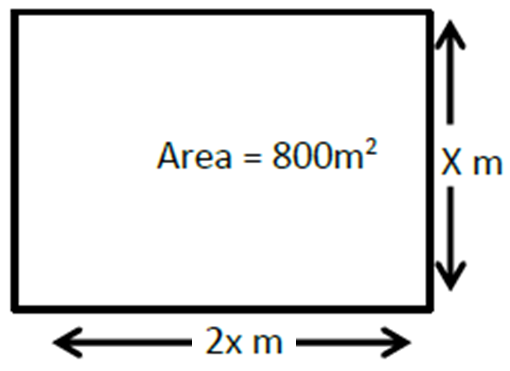
Is it possible to design a rectangular mango grove whose length is twice its breadth and the area is 800m$^2$? If so, find its length and breadth.
AnswerLet the breadth of the rectangular mango grove be x meter.
Given that length is twice that of breadth,
lengrh = 2 × xm
Given that area of the grove is 800m$^2$.
But we know that
Area of a rectangle = length × breadth
$\Rightarrow 800m^2 = 2xm \times xm$
$\Rightarrow 2x^2 = 800$
$\Rightarrow x^2 = 400$
$\Rightarrow\text{x}=\sqrt{400}$
$\Rightarrow\text{x}=\sqrt{(20)^2}$
$\Rightarrow\text{x}\pm20$
Since, x cannot be a negative value
So, x = 20m
Breadth of the manogo grove = 20m and length of the mango grove
= 2xm = 2 × 20m = 40m
Yes. It is possible to dising a rectangular mango grove whose length is twice its breadth and the area is 800m$^2$. View full question & answer→Question 275 Marks
A train, travelling at a uniform speed for 360km, would have taken 48 minutes less to travel the same distance if its speed were 5km/hr more. Find the original speed of the train.
AnswerLet the original speed of the train = x km/h
Then, the increased speed of the train = (x + 5) km/h [by given condition]
and distance = 360km
According to the question,
$\frac{360}{\text{x}}-\frac{360}{\text{x}+5}=\frac{4}{5}$
$\begin{bmatrix}\because\text{Time}=\frac{\text{Distance}}{\text{Speed}}\\ \text{and }48 \text{ min}=\frac{48}{60}\text{h}=\frac{4}{5}\text{h}\end{bmatrix}$
$\Rightarrow\frac{360(\text{x}+5)-360\text{x}}{\text{x}(\text{x}+5)}=\frac{4}{5}$
$\begin{bmatrix}\because48\text{ min}=\frac{48}{60}\text{h}\\=\frac{4}{5}\text{h}\end{bmatrix}$
$\Rightarrow\frac{360\text{x}+1800-360\text{x}}{\text{x}^2+5\text{x}}=\frac{4}{5}$
$\Rightarrow\frac{1800}{\text{x}^2+5\text{x}}=\frac{4}{5}$
$\Rightarrow\text{x}^2+5\text{x}=\frac{1800\times5}{4}\\=2250$
$\Rightarrow\text{x}^2+5\text{x}-2250=0$
$\Rightarrow\text{x}^2+(50\text{x}-45\text{x})-2250=0$
$\Rightarrow\text{x}^2+50\text{x}-45\text{x}-2250=0$ [by factoris method]
$\Rightarrow\text{x}(\text{x}+50)-45(\text{x}+50)=0$
$\Rightarrow(\text{x}+50)(\text{x}-45)=0$
Now, $\text{x}+50=0$
$\Rightarrow\text{x}=-50$
Which is not possible because speed cannot be negative
and $\text{x}-45=0$
$\Rightarrow\text{x}=45$
Hence, the original speed of the train = 45km/h
View full question & answer→Question 285 Marks
Solve the following quadratic equations by factorization:
$9x^2 - 6b^2x - (a^4 - b^4) = 0$
Answer$9x^2 - 6b^2x - (a^4 - b^4) = 0$
$\Rightarrow 9x^2 - 6b^2x - (a^2 - b^2)(a^2 + b^2) = 0$
$\Rightarrow 9x^2 + 3(a^2 - b^2)x - 3 (a^2 + b^2)x - (a^2 - b^2)(a^2 + b^2) = 0$
$\Rightarrow 3x[3x + (a^2 - b^2)] - (a^2 + b^2)[3x + (a^2 - b^2)] = 0$
$\Rightarrow [3x + (a^2 - b^2)] [3x - (a^2 + b^2)] = 0$
$\Rightarrow 3x + (a^2 - b^2) = 0 or 3x - (a^2 - b^2) = 0$
$3x = b^2 - a^2 or 3x = a^2 + b^2$
$\Rightarrow\text{x}=\frac{\text{b}^2 -\text{a}^2}{3}$ or $\text{x}=\frac{\text{a}^2 +\text{b}^2}{3}$
$\Rightarrow\text{x}=\frac{\text{a}^2 -\text{b}^2}{3}$ or $\text{x}=\frac{\text{b}^2 -\text{a}^2}{3}$
Hence, the factors are $\frac{\text{a}^2 -\text{b}^2}{3}$ and $\frac{\text{b}^2 -\text{a}^2}{3}$
View full question & answer→Question 295 Marks
If the roots of the equation $(b - c)x^2 + (c - a)x + (a - b) = 0$ are equal, then prove that 2b = a + c.
AnswerThe given quadric equation is $(b - c)x^2 + (c - a)x + (a - b) = 0$, and roots are real.
Then prove that 2b = a + c
Here, a = (b - c), b = (c - a) and c = (a - b)
As we know that $D = b^2 - 4ac$
Putting the value of $a = (b - c), b = (c - a) and c = (a - b)$
$D = b^2 - 4ac$
$= (c - a)^2 - 4 \times (b - c) \times (a - b)$
$= c^2- 2ca + a^2 - 4(ab - b^2 - ca + bc)$
$= c^2- 2ca + a^2 - 4ab + 4b^2 + 4ca - 4bc$
$= c^2+ 2ca + a^2 - 4ab + 4b^2 - 4bc$
$= a^2 + 4b^2+ c^2 + 2ca - 4ab - 4bc$
As we know that $(a^2 + 4b^2 + c^2 + 2ca - 4ab - 4bc) = (a + c - 2b)^2$
$D = (a + c - 2b)^2$
The given equation will have real roots, if D = 0
$(a + c - 2b)^2$
Square root both side we get
$\sqrt{(\text{a}+\text{c}-2\text{b})^2}=0$
$a + c - 2b = 0$
$a + c = 2b$
Hence 2b = a + c
View full question & answer→Question 305 Marks
While boarding an aeroplane, a passenger got hurt. The pilot showing promptness and concern, made arrangements to hospitalise the injured and so the plane started late by 30 minutes to reach the destination, 1500km away in time, the pilot increased the speed by 100km/hr. Find the original speed/hour of the plane.
AnswerLet the original speed of the plane be x km/hr
Increased speed of the plane = (x + 100) km/hr
Total Distance = 1500km,
We know that, $\text{Time}=\frac{\text{Distance}}{\text{Speed}}$
Time taken to reach the destination at original speed $=\text{t}_1=\frac{1500}{\text{x}}\text{ hr}$
Time taken to reach the destination at increasing speed $=\text{t}_2=\frac{1500}{\text{x}+100}\text{ hr}$
Acording to the question, $t_1 - t_2 = 30 min$
$\Rightarrow\frac{1500}{\text{x}}-\frac{1500}{\text{x}+100}=\frac{30}{60}$
$\Rightarrow\frac{1500\text{(x}+100)-1500\text{x}}{\text{x}(\text{x}+100)}= \frac{1}{2}$
$\Rightarrow\frac{1500\text{x}+150000-1500\text{x}}{\text{x}^2+100\text{x}}=\frac{1}{2}$
$\Rightarrow\frac{150000}{\text{x}^2+100\text{x}}=\frac{1}{2}$
$\Rightarrow 300000 = x^2 + 100x$
$\Rightarrow x^2 + 100x - 300000 = 0$
$\Rightarrow x^2 + 600x - 500x - 300000 = 0$
$\Rightarrow x(x - 600) - 500(x + 600) = 0$
$\Rightarrow (x - 500 )( x + 600) = 0$
$\Rightarrow x - 500 = 0 or x = -600 = 0$
$\Rightarrow x = 500 or x = -600$
Since, speed cannot be negative.
Thus, the orginal speed/hour of the plane is 500 km/hr.
View full question & answer→Question 315 Marks
Solve the following quadratic equations by factorization:
$3\Big(\frac{7\text{x}+1}{5\text{x}-3}\Big)-4\Big(\frac{5\text{x}-3}{7\text{x}+1}\Big)=11,$ $\text{x}\neq\frac{3}{5},-\frac{1}{7}$
Answer$\Rightarrow3\Big(\frac{7\text{x}+1}{5\text{x}-3}\Big)-4\Big(\frac{5\text{x}-3}{7\text{x}+1}\Big)=11$
$\Rightarrow\frac{3(7\text{x}+1)^2-4(5\text{x}-3)^2}{(5\text{x}-3)(7\text{x}+1)}=11$
$\Rightarrow\frac{3(49\text{x}^2+1+14\text{x})-4(25\text{x}^2+9-30\text{x})}{35\text{x}^2+5\text{x}-21\text{x}-3}=11$
$\Rightarrow\frac{147\text{x}^2+3+42\text{x}-100\text{x}^2-36+120\text{x}}{35\text{x}^2-16\text{x}-3}=11$
$\Rightarrow47\text{x}^2+162\text{x}-33\\=11(35\text{x}^2-16\text{x}-3)$
$\Rightarrow47\text{x}^2+162\text{x}-33\\=385\text{x}^2-176\text{x}-33$
$\Rightarrow385\text{x}^2-47\text{x}^2-176\text{x}\\-162\text{x}-33+33=0$
$\Rightarrow338\text{x}^2-338\text{x}=0$
$\Rightarrow\text{x}^2-\text{x}=0$
$\Rightarrow\text{x}(\text{x}-1)=0$
$\Rightarrow\text{x}=0$ or $\text{x}-1=0$
$\Rightarrow\text{x}=0$ or $\text{x}=1$
Hence, the factors are 0 and 1.
View full question & answer→Question 325 Marks
The sum of the reciprocals of Rehman's ages (in years) 3 years ago and 5 years from now is $\frac{1}{3}.$ Find his present age.
AnswerLet the present age of Rehman be x years.
Now, Rehman's age 3 years ago = (x - 3) years
And Rehman's 5 years later = (x + 5) years
Gievn that,
The sum of reciprocals of Rehman's ages 3 years ago and 5 years later is $\frac{1}{3}.$
$\Rightarrow\frac{1}{\text{x}-3}+\frac{1}{\text{x}+5}=\frac{1}{3}$
$\Rightarrow\frac{\text{x}+5+\text{x}-3}{(\text{x}-3)(\text{x}+5)}=\frac{1}{3}$
$\Rightarrow (2x + 2) \times 3 = 1(x - 3)(x + 5)$
$\Rightarrow 6x + 6 = x^2 + 5x - 3x - 15$
$\Rightarrow x^2 + 2x - 6x - 15 - 6 = 0$
$\Rightarrow x^2 - 4x - 21 = 0$
$\Rightarrow x^2 - 7x + 3x - 21 = 0$
$\Rightarrow x(x - 7) + 3(x - 7) = 0$
$\Rightarrow (x - 7)(x + 3) = 0$
$\Rightarrow x - 7 = 0 or x + 3 = 0$
$\Rightarrow x = 7 or x = -3$
Since, age cannot be in negative value. So, x = 7 years
Hence, the present age of Rehman is 7 years.
View full question & answer→Question 335 Marks
Solve the following quadratic equations by factorization:
$\frac{\text{x}-4}{\text{x}-5}+\frac{\text{x}-6}{\text{x}-7}=\frac{10}{3},$ $\text{x}\neq5,-7$
Answer$\frac{\text{x}-4}{\text{x}-5}+\frac{\text{x}-6}{\text{x}-7}=\frac{10}{3}$$\Rightarrow\frac{(\text{x}-4)(\text{x}-7)+(\text{x}-6)(\text{x}-5)}{(\text{x}-5)(\text{x}-7)}=\frac{10}{3}$
$\Rightarrow\frac{\text{x}^2-11\text{x}+28+\text{x}^2-11\text{x}+30}{\text{x}^2-12\text{x}+35}=\frac{10}{3}$
$\Rightarrow\frac{2\text{x}^2-22\text{x}+58}{\text{x}^2-12\text{x}+35}=\frac{10}{3}$
$\Rightarrow 3(2x^2 - 22x + 58) = 10(x^2 - 12x + 35)$
$\Rightarrow 6x^2 - 66x + 174 = 10x^2 - 120x + 350$
$\Rightarrow 4x^2 - 54x + 176 = 0$
$\Rightarrow 2x^2 - 27x + 88 = 0$
$\Rightarrow 2x^2 - 11x - 16x + 88 = 0$
$\Rightarrow x(2x - 11) - 8(2x - 11) = 0$
$\Rightarrow (x - 8)(2x - 11) = 0$
$\Rightarrow x - 8 = 0 or 2x - 11 = 0$
⇒ x = 8 or $\text{x}=\frac{11}{2}$
Hence, the factors are 8 and $\frac{11}{2}$
View full question & answer→Question 345 Marks
Solve the following quadratic equations by factorization:
$4\sqrt{3}\text{x}^2+5\text{x}-2\sqrt{3}=0$
AnswerWe have been given
$4\sqrt{3}\text{x}^2+5\text{x}-2\sqrt{3}=0$
$4\sqrt{3}\text{x}^2+8\text{x}-3\text{x}-2\sqrt{3}=0$
$4\text{x}\big(\sqrt{3}\text{x}+2\big)-\sqrt{3}\big(\sqrt{3}\text{x}+2\big)=0$
$\big(\sqrt{3}\text{x}+2\big)\big(4\text{x}-\sqrt{3}\big)=0$
Therefore,
$\sqrt{3}\text{x}+2=0$
$\sqrt{3}\text{x}=-2$
$\text{x}=\frac{-2}{\sqrt{3}}$
or, $4\text{x}-\sqrt{3}=0$
$4\text{x}=\sqrt{3}$
$\text{x}=\frac{\sqrt{3}}{4}$
Hence, $\text{x}=\frac{-2}{\sqrt{3}}$ or $\text{x}=\frac{\sqrt{3}}{4}$
View full question & answer→Question 355 Marks
Find the roots of the following quadratic equation (if they exist) by the method of completing the square.
$2\text{x}^2-7\text{x}+3=0$
Answer$2\text{x}^2-7\text{x}+3=0$
$\text{x}^2-\frac{7}{2}\text{x}+\frac{3}{2}=0$ (Dividing by 2)
$(\text{x}^2)-2\times\frac{7}{4}\times\text{x}+\Big(\frac{7}{4}\Big)^2-\frac{25}{16}=0$
$\begin{cases}\frac{3}{2} = \frac{49}{16}-\frac{25}{16}=\frac{24}{16}\end{cases}$
$\Rightarrow\Big(\text{x}-\frac{7}{4}\Big)^2=\frac{25}{16}=\Big(\pm\frac{5}{4}\Big)^2$
$\Rightarrow\text{x}-\frac{7}{4}=\pm\frac{5}{4}$
$\therefore\text{x}=\frac{7}{4}+\frac{5}{4}$
$\text{x}=\frac{12}{4}=3$
and $\text{x}=\frac{7}{4}-\frac{5}{4}$
$\text{x}=\frac{2}{4}=\frac{1}{2}$
$\therefore$ Roots are $3,\frac{1}{2}$
View full question & answer→Question 365 Marks
If the roots of the equation $\left(c^2-a b\right) x^2-2\left(a^2-b c\right) x+b Z^2-a c=0$ are equal, prove that either $a=0$ or $a^3+b^3+c^3=3 a b c$.
Answer$(c^2 - ab)x^2 - 2(a^2 - bc)x + b^2 - ac = 0$
Here $A = c^2 - ab, B = -2(a^2 - bc), C = b^2 - ac$
$\therefore$ Discriminant $(D) = B^2 - 4AC$
$= [-2(a^2 - bc)]^2 - 4(c^2 - ab)(b^2 - ac)$
$= 4[a^4 + b^2c^2 - 2a^2bc] - 4[b^2c^2 - ac^3 - ab^3 + a^2bc]$
$= 4a^4 + 4b^2c^2 - 8a^2bc - 4b^2c^2 + 4ac^3 + 4ab^3 - 4a^2bc$
$= 4a^4 + 4ab^3 + 4ac^3 - 12a^2bc$
$= 4a[a^3 + b^3 + c^3 - 3abc]$
The roots are equal
$\therefore$ D = 0
$\therefore$ $4a(a^3 + b^3 + c^3 - 3abc) = 0$
$\Rightarrow a(a^3 + b^3 + c^3 - 3abc) = 0$
Either a = 0
or $a^3 + b^3 + c^3 - 3abc = 0$
$\Rightarrow a^3 + b^3 + c^3 =$ 3abc Hence proved.
View full question & answer→Question 375 Marks
Solve the following quadratic equations by factorization:
$\frac{3}{\text{x}+1}+\frac{4}{\text{x}-1}=\frac{29}{4\text{x}-1},$ $\text{x}\neq-1,-1,\frac{1}{4}$
Answer$\frac{3}{\text{x}+1}+\frac{4}{\text{x}-1}=\frac{29}{4\text{x}-1}$
$\frac{3\text{x}-3+4\text{x}+4}{(\text{x}^2-1)}=\frac{29}{4\text{x}-1}$
$\Rightarrow\frac{7\text{x}+1}{\text{x}^2-1}=\frac{29}{4\text{x}-1}$
$\Rightarrow (7x + 1)(4x - 1) = 29(x^2 - 1)$
$\Rightarrow 28x^2 - 7x + 4x - 1 = 29x^2 - 29$
$\Rightarrow 29x^2- 29 - 28x^2 + 7x - 4x + 1 = 0$
$\Rightarrow x^2 + 3x - 28 = 0$
$\begin{Bmatrix}\because-28=7\times(-4) \\3=7-4\end{Bmatrix}$
$\Rightarrow x^2 + 7x - 4x - 28 = 0$
$\Rightarrow x(x + 7) - 4(x + 7) = 0$
$\Rightarrow (x + 7)(x - 4) = 0$
Either x + 7 = 0, then x = -7
or x - 4 = 0, then x = 4
$\therefore$ x = 4, -7
View full question & answer→Question 385 Marks
Solve the following quadratic equations by factorization:
$\frac{\text{x}-3}{\text{x}+3}-\frac{\text{x}+3}{\text{x}-3}=\frac{48}{7},$ $\text{x}\neq3,\text{x}\neq-3$
Answer$\frac{\text{x}-3}{\text{x}+3}-\frac{\text{x}+3}{\text{x}-3}=\frac{48}{7}$
$\Rightarrow\frac{\text{x}-3}{\text{x}+3}-\frac{\text{x}+3}{\text{x}-3}=\frac{48}{7}$
$\Rightarrow\frac{(\text{x}-3)^2-(\text{x}+3)^2}{(\text{x}+3)(\text{x}-3)}=\frac{48}{7}$
$\Rightarrow\frac{\text{x}^2-6\text{x}+9-\text{x}^2-6\text{x}-9}{\text{x}^2-9}=\frac{48}{7}$
$\Rightarrow\frac{-12\text{x}}{\text{x}^2-9}=\frac{48}{7}$
$\Rightarrow 48x^2 + 84x - 432 = 0$
$\Rightarrow 4x^2 + 7x - 36 = 0 (Dividing by 12)$
$\Rightarrow 4x^2 + 16x - 9x - 36 = 0$
$\begin{cases}\because36\times4=-144\\\therefore-144=16\times-9\\7=16-9\end{cases}$
$\Rightarrow 4x(x + 4) - 9(x + 4) = 0$
$\Rightarrow (x + 4)(4x - 9) = 0$
Either x + 4 = 0, then x = -4
or 4x - 9 = 0, then 4x = 9
$\Rightarrow\text{x}=\frac{9}{4}$
$\therefore$ Roots are -4, $\frac{9}{4}$
View full question & answer→Question 395 Marks
Two pipes running together can fill a tank in $11\frac{1}{9}$ minutes. If one pipe takes 5 minutes more than the other to fill the tank separately, find the time in which each pipe would fill the tank separately.
AnswerTwo pipes fill the tank in 1 minutes $=\frac{9}{100}$
Let first pipe can fill in one minute $=\frac{1}{\text{x}}$
Then second pipe will fill it in 1 minute $=\frac{1}{\text{x}+5}$
According to the condition,
$\frac{1}{\text{x}}+\frac{1}{\text{x}+5}=\frac{9}{100}$
$\Rightarrow\frac{\text{x}+5+\text{x}}{\text{x}(\text{x}+5)}=\frac{9}{100}$
$\Rightarrow\frac{2\text{x}+5}{\text{x}^2+5\text{x}}=\frac{9}{100}$
$\Rightarrow 9x^2 + 45x = 200x + 500$
$\Rightarrow 9x^2 + 45x - 200x - 500 = 0$
$\Rightarrow 9x^2 - 155x - 500 = 0$
$\Rightarrow 9x^2 - 180x + 25x - 500 = 0$
$\begin{Bmatrix}\because9\times(-500)=-4500\\\therefore-4500=-180\times25\\-155=-180+25 \end{Bmatrix}$
9x(x - 20) + 25(x - 20) = 0
(x - 20)(9x + 25) = 0
Either x = -20 = 0, then x = 20 or 9x + 25 = 0 then 9x = -25
$\Rightarrow\text{x}=\frac{-25}{9}$ but it is not possible being negative
⇒ x = 20
Time taken by two pipes = 20 minutes and 20 + 5 = 25 minutes.
View full question & answer→Question 405 Marks
In the following, determine whether the given values are solution of the given equation or not:
$\text{x}+\frac{1}{\text{x}}=\frac{13}{6},$ $\text{x}=\frac{5}{6},\text{x}=\frac{4}{3}$
Answer$\text{x}+\frac{1}{\text{x}}=\frac{13}{6},$ $\text{x}=\frac{5}{6},\text{x}=\frac{4}{3}$When, $\text{x}=\frac{5}{6}$
Substituting $\text{x}=\frac{5}{6}$
L.H.S.
$=\frac{5}{6}+\frac{6}{5}$
$=\frac{25+36}{30}$
$=\frac{61}{30}\neq\frac{13}{6}$
$\therefore\text{x}=\frac{5}{6}$ is not its solution
When, $\text{x}=\frac{4}{3}$
Substituting $\text{x}=\frac{4}{3}$
L.H.S.
$=\text{x}+\frac{1}{\text{x}}=\frac{4}{3}+\frac{3}{4}$
$=\frac{16+9}{12}$
$=\frac{25}{12}\neq\frac{13}{6}$
$\therefore\text{x}=\frac{4}{3}$ is not its solution.
View full question & answer→Question 415 Marks
A dealer sells an article for Rs. 24 and gains as much percent as the cost price of the article. Find the cost price of the article.
AnswerLet cost price of article = Rs. x
Selling price = Rs. 24
Gain = x%
According to the condition,
$\text{S.P.}=\text{C.P}.\times\frac{100+\text{gain%}}{100}$
$\Rightarrow24=\frac{\text{x}(100+\text{x})}{100}$
$\Rightarrow 2400= 100x + x^2$
$\Rightarrow x^2 + 100x - 2400 = 0$
$\Rightarrow x^2 - 20x + 120x - 2400 = 0$
$\begin{cases}-2400=120\times(-20)\\100=120-20\end{cases}$
⇒ x(x - 20) + 120(x - 20) = 0
⇒ (x - 20)(x + 120) = 0
Either x - 20 = 0, then x = 20
or x + 120 = 0, then x = -120 which is not possible beging negative
$\therefore$ cost price = Rs. 20
View full question & answer→Question 425 Marks
The sum of two numbers is 48 and their product is 432. Find the numbers.
AnswerSum of two numbers = 48
Let first number = x
The second number = 48 - x
According to the condition,
$\Rightarrow x(48 - x) = 432$
$\Rightarrow 48x - x^2 = 432$
$\Rightarrow -x^2 + 48x - 432 = 0$
$\Rightarrow x^2 - 48x + 432 = 0$
$\Rightarrow x^2 - 12x - 36x + 432 = 0$
$\Rightarrow x(x - 12) - 36(x - 12) = 0$
$\Rightarrow (x - 12)(x - 36) = 0$
Either x - 12 = 0, then x = 12 or x - 36 = 0, then x = 36
- If x = 12, then First number = 12 and second number = 48 - 12 = 36
- If x = 36, then First number = 36 and second number = 48 - 36 = 12
Numbers are 12, 36 View full question & answer→Question 435 Marks
Find the value of k for which the root are real and equal in the following equations:
$(k + 1)x^2 - 2(3k + 1)x + 8k + 1 = 0$
AnswerThe given equation is $(k + 1)x^2 - 2(3k + 1)x + 8k + 1 = 0$
It is in the from of equation $ax^2 + bx + c = 0$
Here, x = k + 1, b = -2(3k + 1) and c = 8k + 1
Given that the nature of the roots of the given equation are real and equal i.e.,
$D = b^2 - 4ac = 0$
$\Rightarrow [-2(3k + 1)]^2 - 4 \times (k + 1)x(8k + 1) = 0$
$\Rightarrow 4(3k + 1)^2 - 4(k + 1)(8k + 1) = 0$
$\Rightarrow (3k + 1)^2 - (k + 1)(8k + 1) = 0$
$\Rightarrow 9k^2 + 6k + 1 - [8k^2 + 9k + 1] = 0$
$\Rightarrow 9k^2 + 6k + 1 - 8k^2 - 9k - 1 = 0$
$\Rightarrow k^2 - 3k = 0$
$\Rightarrow k(k - 3) = 0$
$\therefore$ k = 0 or k = 3
$\therefore$ The value of 'k' for the given quadratic equation are 0 and 3
View full question & answer→Question 445 Marks
Solve the following quadratic equations by factorization:
$\frac{5+\text{x}}{5-\text{x}}-\frac{5-\text{x}}{5+\text{x}}=3\frac{3}{4},$ $\text{x}\neq5,-5$
Answer$\frac{5+\text{x}}{5-\text{x}}-\frac{5-\text{x}}{5+\text{x}}=3\frac{3}{4}$
$\frac{(5+\text{x})^2-(5-\text{x})^2}{(5-\text{x})(5+\text{x})}=\frac{15}{4}$
$\frac{25+\text{x}^2+10\text{x}-25-\text{x}^2+10\text{x}}{25-\text{x}^2}=\frac{15}{4}$
$\frac{20\text{x}}{25-\text{x}^2}=\frac{15}{4}$
$\Rightarrow 80x = 375 - 15x^2$
$\Rightarrow 15x^2 + 80x - 375 = 0$
$\Rightarrow 3x^2 + 16x - 75 = 0$
$\Rightarrow 3x^2 + 25x - 9x - 75 = 0$
$\Rightarrow x(3x + 25) - 3(3x + 25) = 0$
$\Rightarrow (x - 3)(3x + 25) = 0$
Either x - 3 = 0
$\therefore$ x = 3
or 3x + 25 = 0
⇒ 3x = -25
$\text{x}=-\frac{25}{3}$
View full question & answer→Question 455 Marks
If Zeba were younger by 5 years than what she really is, then the square of her age (in years) would have been 11 more than 5 times her actual age. What is her age now?
AnswerLet the actual age of Zeba = x years
Her age when she was 5 years younger = (x - 5) years
Now, by given condition,
Square of her age = 11 more than 5 times her actual age
$(x - 5)^2 = 5 \times $ actual age + 11
$\Rightarrow (x - 5)^2 = 5x + 11$
$\Rightarrow x^2 + 25 - 10x = 5x + 11$
$\Rightarrow x^2 - 15x + 14 = 0$
$\Rightarrow x^2 - 14x - x + 14 = 0$ [by splitting the middle term]
$\Rightarrow x(x - 14) - 1(x - 14) = 0$
$\Rightarrow x = 14$
[Here, x ≠ 1 because her age is x - 5. So, x – 5 = 1 - 5 = -4 i.e., age cannot be negative]
Hence, required Zeba’s age now is 14 years.
View full question & answer→Question 465 Marks
Solve the following quadratic equations by factorization:
$7\text{x}+\frac{3}{\text{x}}=35\frac{3}{5}$
AnswerWe have been given,
$7\text{x}+\frac{3}{\text{x}}=35+\frac{3}{5}$
$7\text{x}^2+3=\Big(35+\frac{3}{5}\Big)\text{x}$
$7\text{x}^2-\Big(35+\frac{3}{5}\Big)\text{x}+3=0$
Therefore,
$7\text{x}^2-35\text{x}-\frac{3}{5}\text{x}+3=0$
$7\text{x}(\text{x}-5)-\frac{3}{5}(\text{x}-5)=0$
$\Big(7\text{x}-\frac{3}{5}\Big)(\text{x}-5)=0$
Therefore,
$7\text{x}-\frac{3}{5}=0$
$7\text{x}=\frac{3}{5}$
$\text{x}=\frac{3}{35}$
or, $\text{x}-5=0$
$\text{x}=5$
Hence, $\text{x}=\frac{3}{35}$ or $\text{x}=5$
View full question & answer→Question 475 Marks
Sum of the areas of two squares is $640m^2$. If the difference of their perimeters is 64m. Find the sides of the two squares.
AnswerLet side of first square = x m
and of second squares = y m
According to the given conditions,
$4x - 4y = 64$
$\Rightarrow x - y = 16 ....(i)$
and $x^2 + y^2 = 640 .....(ii)$
From $(i), x = 16 + y$
In (ii)
$\Rightarrow (16 + y)^2 + y^2 = 640$
$\Rightarrow 256 + 32y + y^2 + y^2 = 640$
$\Rightarrow 2y^2 + 32y + 256 - 640 = 0$
$\Rightarrow y^2 + 16y - 192 = 0 (Dividing by 2)$
$\Rightarrow y^2 + 24y - 8y - 192 = 0$
$\Rightarrow y(y + 24) - 8(y + 24) = 0$
$\Rightarrow (y + 24)(y - 8) = 0$
Either y + 24 = 0, then y = -24, which is not possible as it is negative
Or y - 8 = 0, then y = 8
x = 16 + y = 16 + 8 = 24
Side of first square = 24m and side of second = 8m
View full question & answer→Question 485 Marks
Find the value of k for which root are real and equal in the following equations:
$(3k + 1)x^2 + 2(k + 1)x + k = 0$
Answer$(3k + 1)x^2 + 2(k + 1)x + k = 0$
Here $a = 3k + 1, b = 2(k + 1), c = k$
$\therefore$ Discriminant $(D) = b^2 - 4ac$
$= [2(k + 1)]^2 - 4 \times (3k + 1) \times k$
$= 4(k^2 + 2k + 1) - 4k(3k + 1)$
$= 4k^2 + 8k + 4 - 12k^2 - 4k$
$\Rightarrow -8k^2 + 4k + 4$
$\because$ Roots are real and equal
$\therefore$ D = 0
$\therefore$$ -8k^2 + 4k + 4 = 0$
$\Rightarrow 2k^2 - k - 1 = 0 (Dividing by -4)$
$\Rightarrow 2k^2 - 2k + k - 1 = 0$
$\begin{Bmatrix}\because-2=-2\times2\\-1=-2+1\end{Bmatrix}$
⇒ 2k(k - 1) + 1(k - 1) = 0
⇒ (k - 1)(2k + 1) = 0
Either k - 1 = 0, then k = 1
or 2k + 1 = 0, then 2k = -1
$\Rightarrow\text{k}=\frac{-1}{2}$
$\therefore\text{k}=1,\frac{-1}{2}$
View full question & answer→Question 495 Marks
Two squares have sides x cm and (x + 4)cm. The sum of their areas is $656cm^2$. Find the sides of the squares.
AnswerSide of the first square = x cm
Its area $= (side)^2 = x^2 cm^2$
Side of the second square = (x + 4)cm
Its area $= (x + 4)^2cm^2$
According to the condition,
$\Rightarrow X^2 + (x + 4)^2 = 656$
$\Rightarrow x^2 + x^2 + 8x + 16 = 656$
$\Rightarrow 2x^2 + 8x + 16 - 656 = 0$
$\Rightarrow 2x^2 + 8x - 640 = 0$
$\Rightarrow x^2 + 4x - 320 = 0$ (Dividing by 2)
$\Rightarrow x^2+ 20x - 16x - 320 = 0$
$\Rightarrow x(x + 20) - 16(x + 20) = 0$
$\Rightarrow (x + 20)(x - 16) = 0$
Either x + 20 = 0, then x = -20 which is not possible beging negative
Or x - 16 = 0, then x = 16
Side of the first square = 16cm and side of the second square = 16 + 4 = 20cm
View full question & answer→Question 505 Marks
Some students planned a picnic. The budget for food was Rs. 500. But, 5 of them failed to go and thus the cost of food for each member increased by Rs. 5. How many students attended the picnic?
AnswerLet the number of students planned for the picnic be x'
Given budget for food = Rs. 500
Initially share of food for each student $=\frac{\text{total budget}}{\text{no. of students}}=\text{Rs.}\frac{500}{\text{x}}$
Given that 5 students failed to go for the picnic
No. of students attended the picnic will be (x - 5)
Now, share of food for eqch student will be equal to $=\frac{\text{total budget}}{\text{no. of students attended}}=\text{Rs.}\frac{500}{\text{x}-5}$
Given that, share of food for eqch student is increased
$\Rightarrow\text{Rs.}\frac{500}{\text{x}-5}-\text{Rs.}\frac{500}{\text{x}}=\text{Rs. 5}$
$\Rightarrow\frac{500}{\text{x}-5}-\frac{500}{\text{x}}=5$
$\Rightarrow500\Big(\frac{1}{\text{x}-5}-\frac{1}{\text{x}}\Big)=5$
$\Rightarrow500\Big(\frac{\text{x}-(\text{x}-5)}{\text{x}(\text{x}-5)}\Big)=5$
$\Rightarrow500\Big(\frac{\text{x}-\text{x}+5}{\text{x}^2-5\text{x}}\Big)=5$
$\Rightarrow500\Big(\frac{5}{\text{x}^2-5\text{x}}\Big)=5$
$\Rightarrow 500 = x^2 - 5x$
$\Rightarrow x^2 - 5x - 500 = 0$
$\Rightarrow x^2 - 25x + 20x - 500 = 0$
$\Rightarrow x(x - 25) + 20(x - 25) = 0$
$\Rightarrow (x - 25)(x + 20) = 0$
$\Rightarrow (x - 25) = 0 or (x + 20) = 0$
Since, the value of x cannot be negative,
⇒ x = 25
Here, x is the no. of students planned,
Given that 5 students failed to go
No. of students attended the picnic = x - 5 = 25
$\therefore$ No. of students attended the picnic = 20
View full question & answer→