MCQ 11 Mark
The angle of depression of a car parked on the road from the top of a $150m$ high tower is $30^\circ$ . The distance of the car from the tower $($in metres$)$ is :
- A
$50\sqrt{3}$
- ✓
$150\sqrt{3}$
- C
$150\sqrt{2}$
- D
$75$
AnswerCorrect option: B. $150\sqrt{3}$
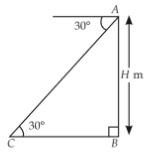
We have a high tower whose height $(AC) = 150m$
Angle of depression $= 30^\circ$
Here given angle of depression $\angle\text{DCB}=30^\circ$
We know,
$\angle\text{DCB}=\angle\text{ACB}\ ($Alternate angles$)$
Let,
Distance the car from tower $AB = x m$
In triangle $\text{ABC}$ we know,
$\Rightarrow\tan30^\circ=\frac{\text{AC}}{\text{AB}}$
$\Rightarrow\frac{1}{\sqrt3}=\frac{150}{\text{x}}$
$\Rightarrow\text{x}=150\sqrt3\text{m}$
View full question & answer→MCQ 21 Mark
The angle of depression of a car parked on the road from the top of a $150m$ high tower is $30^\circ$ . The distance of the car from the tower $($in metres$)$ is :
- A
$50\sqrt{3}$
- ✓
$150\sqrt{3}$
- C
$150\sqrt{2}$
- D
$75$
AnswerCorrect option: B. $150\sqrt{3}$
We have a high tower whose height $(AC) = 150m$
Angle of depression $= 30^\circ $
Here given angle of depression $\angle\text{DCB}=30^\circ$
We know,
$\angle\text{DCB}=\angle\text{ACB} \ ($Alternate angles$)$
Let,
Distance the car from tower $AB = x m$
In triangle $\text{ABC}$ we know,
$\Rightarrow\tan30^\circ=\frac{\text{AC}}{\text{AB}}$
$\Rightarrow\frac{1}{\sqrt3}=\frac{150}{\text{x}}$
$\Rightarrow\text{x}=150\sqrt3\text{m}$
View full question & answer→MCQ 31 Mark
A kite is flying at a height of $30m$ from the ground. The length of string from the kite to the ground is $60m.$ Assuming that there is no slack in the string, the angle of elevation of the kite at the ground is :
- A
$45^\circ$
- ✓
$30^\circ$
- C
$60^\circ$
- D
$90^\circ$
AnswerCorrect option: B. $30^\circ$
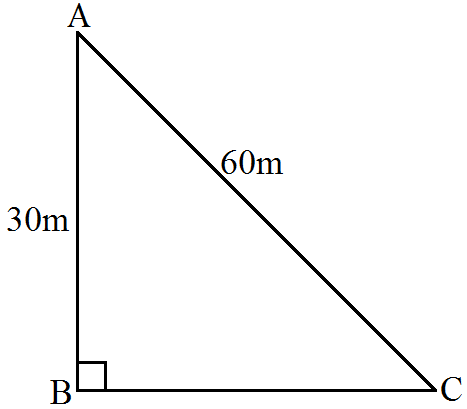
Let $AB$ be the height of the kite above the ground.
Now $, AB = 30m$
Let the length of the string $= AC = 60m$
Let $\angle\text{ABC}=\theta=$ angle of elevation
Now, $\sin\theta=\frac{\text{AB}}{\text{AC}}$
$\Rightarrow\sin\theta=\frac{30}{60}$
$\Rightarrow\sin\theta=\frac{1}{2}$
$\Rightarrow\sin\theta=\sin30^\circ$
$\Rightarrow\theta=30^\circ$ View full question & answer→MCQ 41 Mark
A tower stands vertically on the ground. From a point on the ground which is $25 m$ away from the foot of the tower, the angle of elevation of the top of the tower is found to be $45^\circ$ . Then the height $($in meters$)$ of the tower is :
- A
$25\sqrt{2}$
- B
$25\sqrt{3}$
- ✓
$25$
- D
$12.5$
Answer
Let the height of the tower be $h.$
So $, AB = h$
Distance of the point from the foot of the tower $= 25m$
Hence $,CB = 25m$
Now,
$\tan\text{C}=\frac{\text{AB}}{\text{CB}}$
$\tan45^\circ=\frac{\text{AB}}{\text{CB}}$
$1=\frac{\text{h}}{25}$
$25=\text{h}$
Or $\text{h}=25$
Hence, height of the tower $= h = 25m.$ View full question & answer→MCQ 51 Mark
A ladder makes an angle of $60^\circ$ with the ground when placed against a wall. If the foot of the ladder is $2 m$ away from the wall, then the length of the ladder $($in metres$)$ is :
- A
$\frac{4}{\sqrt{3}}$
- B
$4\sqrt{3}$
- C
$2\sqrt{2}$
- ✓
$4$
Answer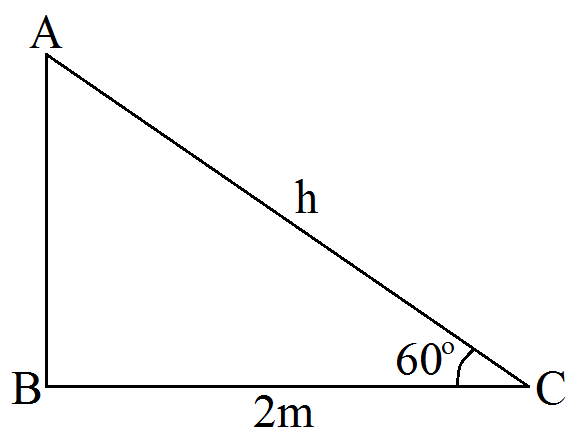
Distance between foot of the ladder and wall $= 2m$
Angle of elevation $\theta=60^\circ$
Length of the ladder $= L = AC$
Now figure forms a right angle triangle $\text{ABC}$
We know,
$\cos\theta=\frac{\text{adjacent side}}{\text{hypotenuse}}$
$\cos60^\circ=\frac{\text{BC}}{\text{AC}}$
$\frac{1}{2}=\frac{2}{\text{AC}}$
$\text{AC}=4\text{m}$
$\therefore$ Length of ladder $(L) = 4m.$ View full question & answer→MCQ 61 Mark
A ladder makes an angle of $60^\circ$ with the ground when placed against a wall. If the foot of the ladder is $2m$ away from the wall, then the length of the ladder $($in metres$)$ is :
- A
$\frac{4}{\sqrt{3}}$
- B
$4\sqrt{3}$
- C
$2\sqrt{2}$
- ✓
$4$
Answer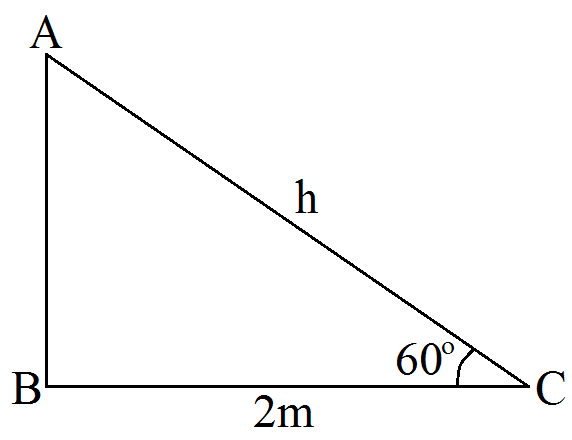
Distance between foot of the ladder and wall $= 2m$
Angle of elevation $\theta=60^\circ$
Length of the ladder $= L = AC$
Now figure forms a right angle triangle $\text{ABC}$
We know,
$\cos\theta=\frac{\text{adjacent side}}{\text{hypotenuse}}$
$\cos60^\circ=\frac{\text{BC}}{\text{AC}}$
$\text{AC}=4\text{m}$
$\therefore$ Length of ladder $(L) = 4m.$ View full question & answer→MCQ 71 Mark
The angle of depression of a car, standing on the ground, from the top of a $75 m$ high tower, is $30^{\circ}$. The distance of the car from the base of the tower $($in $m.)$ is :
- ✓
$25\sqrt{3}$
- B
$50\sqrt{3}$
- C
$75\sqrt{3}$
- D
$150$
AnswerCorrect option: A. $25\sqrt{3}$
Given that the angle of depression is $30^\circ ,$ then angle of elevation is $(90 - 30 = 60^\circ ).$
Therefore,
We have,
$\tan60^{\circ} =\frac{\text{height of tower}}{\text{distance of the car from the base of the tower}} $
$\Rightarrow\sqrt{3} = \frac{75}{\text{distance of the car from the base of the tower}}$
$\Rightarrow$ distance of the car from the base of the tower $=\frac{75}{\sqrt{3}} $ or $\frac{75\sqrt{3}}{(\sqrt{3}\sqrt{3})}=\frac{25}{\sqrt{3}}$
View full question & answer→MCQ 81 Mark
The length of shadow of a tower on the plane ground is $\sqrt{3}$ times the height of the tower. The angle of elevation of sun is :
- A
$45^\circ$
- ✓
$30^\circ$
- C
$60^\circ$
- D
$90^\circ$
AnswerCorrect option: B. $30^\circ$
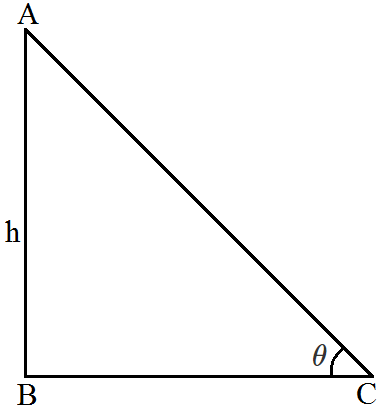
Given that the length of shadow of the tower on the plane ground is $\sqrt3$ times the height of the tower.
Let $\theta$ be the angle of elevation.
From the given statement, $\text{BC}=\sqrt3\times\text{AB}$
$\Rightarrow\frac{\text{BC}}{\text{AB}}=\sqrt3$
$\Rightarrow\frac{\text{BC}}{\text{h}}=\cot\theta$
$\Rightarrow\cot\theta=\frac{\text{BC}}{\text{h}}=\sqrt3$
$\Rightarrow\cot\theta=\cot30^\circ$
$\Rightarrow\theta=30^\circ$ View full question & answer→MCQ 91 Mark
The angle of elevation of the top of a tower from a point on the ground. which is $30m$ away from the foot of the tower is $45^{\circ}$. The height of the tower $($in metres$)$ is :
- A
$15$
- B
$30$
- ✓
$30\sqrt{3}$
- D
$10\sqrt{3}$
AnswerCorrect option: C. $30\sqrt{3}$
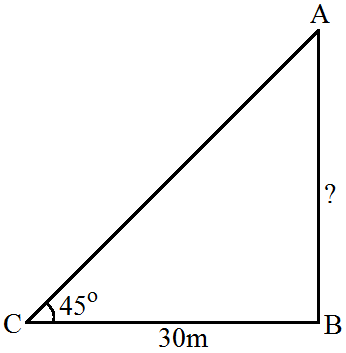
Given :
Distance of tower from point $C$
Hence $, BC = 30\ cm$
Angle of elevation $\angle\text{ACB}=45^\circ$
$\tan\text{C}=\frac{\text{AB}}{\text{BC}}$
$\tan45^\circ=\frac{\text{AB}}{30}$
$1=\frac{\text{AB}}{30}$
$\text{AB}=30\text{m}$ View full question & answer→MCQ 101 Mark
The angle of elevation and the angle of depression from an object on the ground to an object in the air are related as :
AnswerThe angle of elevation and the angle of depression from an object on the ground to an object in the air are related as equal if the height of objects are the same.
View full question & answer→MCQ 111 Mark
A pole casts a shadow of length $2\sqrt{3}\text{m}$ on the ground when the sun's elevation is $60^\circ$ . The height of the pole is :
- ✓
$6\text{m}$
- B
$4\sqrt{3}\text{m}$
- C
$12\text{m}$
- D
$3\text{m}$
AnswerCorrect option: A. $6\text{m}$
Let the height of the pole be $h$ metres.
Then, $\frac{\text{h}}{2\sqrt3}=\tan60^\circ=\sqrt{3}$
$\Rightarrow\text{h}=(2\sqrt{3}\times\sqrt{3})=6.$
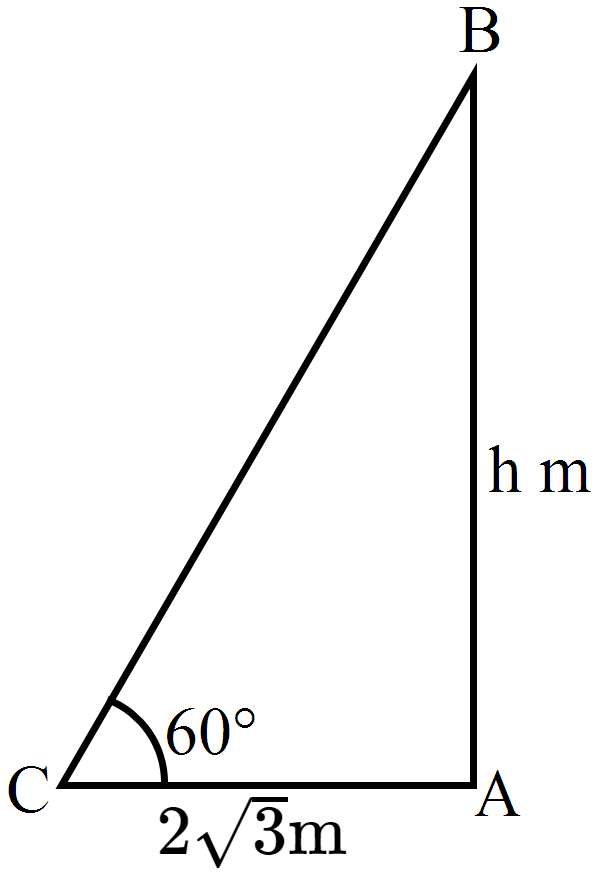
View full question & answer→MCQ 121 Mark
The angle of elevation of the top of a tower from a point on the ground $30\ m$ away from the foot of the tower is $30^\circ$ . The height of the tower is :
- A
$30\text{m}$
- ✓
$10\sqrt{3}\text{m}$
- C
$20\text{m}$
- D
AnswerCorrect option: B. $10\sqrt{3}\text{m}$
Let $AB$ be the tower and $O$ be the point of observation.
Also $,\angle\text{AOB}=30^\circ,$ and $OB = 30m$
Let : $AB = h \ m$
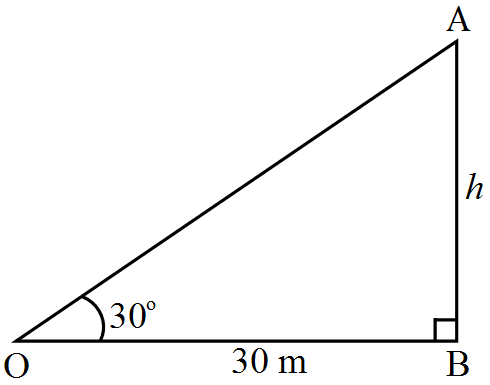
In $\triangle\text{AOB},$
We have :
$\tan30^\circ=\frac{\text{AB}}{\text{OB}}$
$\Rightarrow\frac{1}{\sqrt{3}}$
$\Rightarrow\frac{\text{h}}{30}=\frac{1}{\sqrt{3}}$
$\Rightarrow\text{h}=\frac{30}{\sqrt{3}}\times\frac{\sqrt{3}}{\sqrt{3}}$
$=\frac{30\sqrt{3}}{3}=10\sqrt{3}\text{m}$
Hence, the height of the tower is $10\sqrt{3}\text{m}.$ View full question & answer→MCQ 131 Mark
The angle of elevation of the top of a hill at the foot of a tower is $60^\circ$ and the angle of elevation of the top of the tower from the foot of the hill is $30^\circ$ . If the tower is $50m$ high, then the height of the hill is :
- ✓
$150\text{m}$
- B
$50\sqrt3\text{m}$
- C
$150\sqrt3\text{m}$
- D
$100\sqrt3\text{m}$
AnswerCorrect option: A. $150\text{m}$
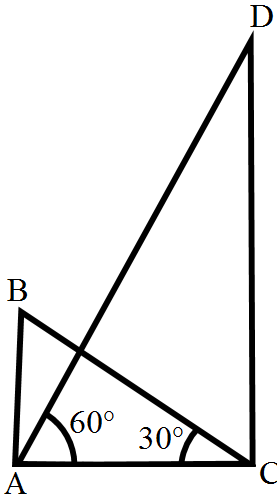
Let the height of the hill be $h m$.
$\tan60^\circ=\frac{\text{DC}}{\text{AC}}$
$\Rightarrow\sqrt3=\frac{\text{h}}{\text{AC}}$
$\Rightarrow\sqrt3=\frac{\text{h}}{\sqrt3}\text{m }...(\text{i})$
In right triangle $\text{ABC},$
$\tan30^\circ=\frac{50}{\text{AC}}$
$\Rightarrow\frac{1}{\sqrt3}=\frac{50}{\text{AC}}$
$\Rightarrow\text{AC}=50\sqrt3\text{m }...(\text{ii})$ From eq. $(i)$ and $(ii),$
$50\sqrt3=\frac{\text{h}}{\sqrt3}$
$\Rightarrow\text{h}=50\times\sqrt3\times\sqrt3=150\text{m}$ View full question & answer→MCQ 141 Mark
If the height of the tower is $\sqrt3$ times of the length of its shadow, then the angle of elevation of the sun is :
- A
$30^\circ$
- ✓
$60^\circ$
- C
$45^\circ$
- D
$15^\circ$
AnswerCorrect option: B. $60^\circ$
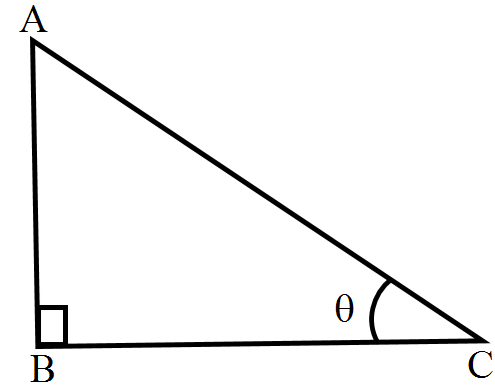
Let the lenght of the shadow be $x$ meters.
Then the height of the tower be $\sqrt{3\text{x}}\text{ meter}.$
$\therefore\tan\theta=\frac{\text{AB}}{\text{BC}}$
$\Rightarrow\tan\theta=\frac{\sqrt{3\text{x}}}{\text{x}}$
$\Rightarrow\tan\theta=\sqrt3$
$\Rightarrow\tan\theta=\tan60^\circ$
$\Rightarrow\theta=60^\circ$ View full question & answer→MCQ 151 Mark
If the length of the shadow of a tower is $\sqrt3$ times that of its height, then the angle of elevation of the sun is :
- A
$45^\circ$
- B
$60^\circ$
- C
$75^\circ$
- ✓
$30^\circ$
AnswerCorrect option: D. $30^\circ$
Let $AB$ be the tree and $AP$ be the shadow.
Let $AB = x$ meters.
Then $\text{AP}=\text{x}\sqrt3\text{ meters}$
Also, $\angle\text{APB}=\theta$
In right angled triangle $\text{ABP}$
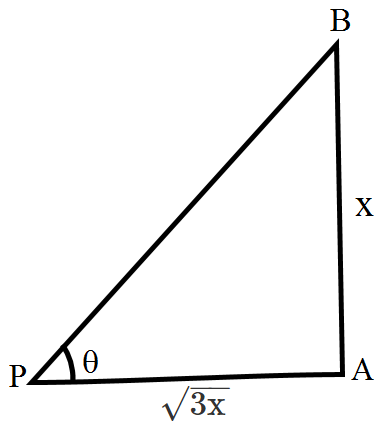
$\tan\theta=\frac{\text{AB}}{\text{AP}}$
$\Rightarrow\tan\theta=\frac{\text{x}}{\text{x}\sqrt3}=\frac{1}{\sqrt3}$
$\Rightarrow\tan\theta=\tan30^\circ$
$\Rightarrow\theta=30^\circ$
Therefore, the angle of elevation of the Sun is $30^\circ $. View full question & answer→MCQ 161 Mark
If the angle of elevation of a cloud from a point $200m$ above a lake is $30^\circ$ and the angle of depression of its reflection in the lake is $60^\circ,$ then the height of the cloud above the lake is :
- A
$200m$
- B
$500m$
- C
$30m$
- ✓
$400m$
AnswerCorrect option: D. $400m$
Let $AB$ be the surface of the lake and $P$ be the point of observation.
So $AP = 60m$.
The given situation can be represented as,
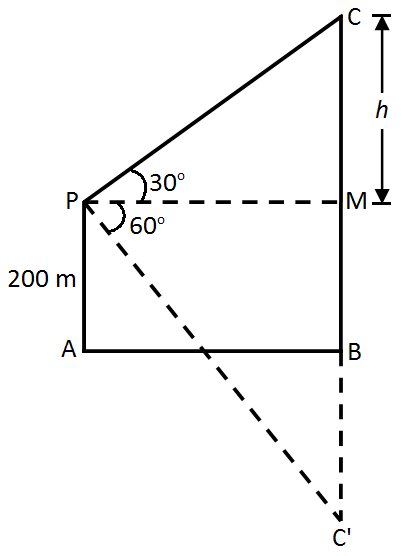
Here $, C$ is the position of the cloud and $C\ '$ is the reflection in the lake.
Then $CB = C'B.$
Let PM be the perpendicular from $P$ on $CB.$
Then $\angle\text{CPM}=30^\circ$ and $\angle\text{C}'\text{PM}=60^\circ.$
Let $CM = h, PM = x,$ then $CB = h + 200$ and $C'B = h + 200$
Here, we have to find the height of cloud.
So we use trigonometric ratios.
In $\triangle\text{CMP,}$
$\Rightarrow\ \tan30^\circ=\frac{\text{CM}}{\text{PM}}$
$\Rightarrow\ \frac{1}{\sqrt{3}}=\frac{\text{h}}{\text{x}}$
$\Rightarrow\ \text{x}=\sqrt{3}\text{h}$
Again in $\triangle\text{PMC}\ ',$
$\Rightarrow\ \tan60^\circ=\frac{\text{C}'\text{M}}{\text{PM}}$
$\Rightarrow\ \sqrt{3}=\frac{\text{C}'\text{B}+\text{BM}}{\text{PM}}$
$\Rightarrow\ \sqrt{3}=\frac{\text{h}+200+200}{\text{x}}$
$\Rightarrow\ \sqrt{3}\text{x}=\text{h}+400$
Put, $\text{x}=\sqrt{3}\text{h}$
$\Rightarrow 3h = h + 400$
$\Rightarrow 2h = 400$
$\Rightarrow h = 200$
Now,
$\Rightarrow CB = h + 200$
$\Rightarrow CB = 200 + 200$
$\Rightarrow CB = 400m$ View full question & answer→MCQ 171 Mark
A pole $6m$ high casts a shadow $2\sqrt3\text{m}$ long on the ground, then the sun’s elevation is :
- ✓
$60^\circ$
- B
$30^\circ$
- C
$45^\circ$
- D
$75^\circ$
AnswerCorrect option: A. $60^\circ$
Let height $= 6m$ lenght of shadow $=2\sqrt{3\text{m}}$
$\theta$ is angle of elevation $\tan\theta=\frac{\text{(height)}}{\text{(Shadow length)}}$
$=\frac{6}{2}\sqrt3=\sqrt3$
$\theta=\frac{\pi}{3}$
Angle of inclination is $= 60^\circ .$
View full question & answer→MCQ 181 Mark
A pole of height $60m$ has a shadow of length $20\sqrt3\text{m}$ at a particular instant of time. The angle of elevation of the sun at this point of time.
- A
$30^\circ$
- B
$60^\circ$
- ✓
$45^\circ$
- D
AnswerCorrect option: C. $45^\circ$
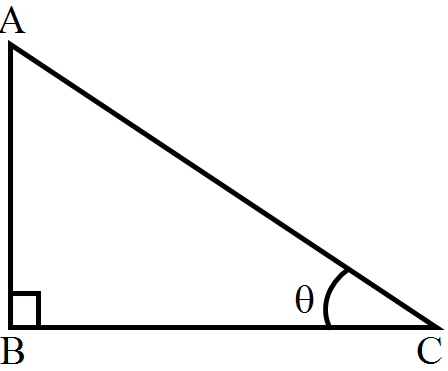
Let the height of the pole $AB = 60m,$
The lenght of the shadow $\text{B}=20\sqrt3\text{m}$ and angle of elevation be $\theta$
$\therefore\tan\theta=\frac{\text{AB}}{\text{BC}}$
$\Rightarrow\tan\theta=\frac{60}{20\sqrt3}$
$\Rightarrow\tan\theta=\frac{3}{\sqrt3}\times\frac{\sqrt3}{\sqrt3}$
$\Rightarrow\tan\theta=\sqrt3$
$\Rightarrow\tan\theta=\tan60^\circ$
$\Rightarrow\theta=60^\circ$ View full question & answer→MCQ 191 Mark
A tree $12m$ high is broken by the wind in such a way that its top touches the ground and makes an angle $30^\circ$ with the ground. The height at which from the bottom the tree is broken by the wind is :
Answer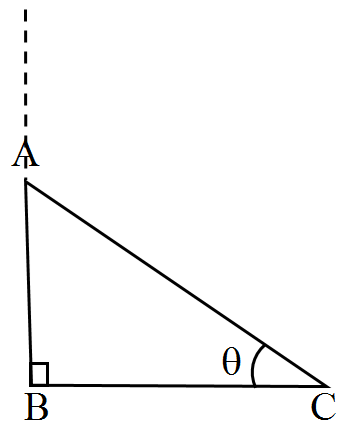
Let tree broke from the height of $x$ from point $A,$ then length of the broken tree be $(12 - x)$ meters and angle of elevation $= \theta=30^\circ$
In triangle $\text{ABC} , \sin30^\circ=\frac{\text{AB}}{\text{AC}}$
$\Rightarrow\frac{1}{2}=\frac{\text{x}}{12-\text{x}}$
$\Rightarrow2\text{x}=12-\text{x}$
$\Rightarrow3\text{x}=12$
$\Rightarrow\text{x}=4\text{m}$ View full question & answer→MCQ 201 Mark
A ladder $15m$ long just reaches the top of a vertical wall. If the ladder makes an angle of $60^\circ$ with the wall, then the height of the wall is :
AnswerCorrect option: C. $\frac{15}{2}\text{m}$
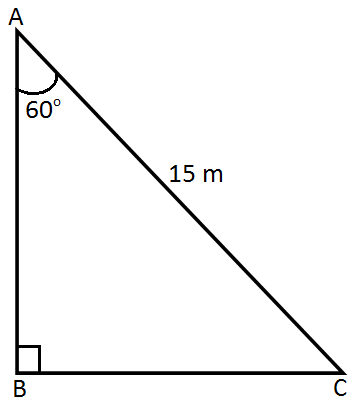
Suppose $AB$ is the wall and $AC$ is the ladder.
It is given that, $AC = 15m$ and $\angle\text{CAB}=60^\circ.$
In right $\triangle\text{ABC,}$
$\cos60^\circ=\frac{\text{AB}}{\text{AC}}$
$\Rightarrow\frac{1}{2}=\frac{\text{AB}}{15}$
$\Rightarrow\text{AB}=\frac{15}{2}\text{m}$
Thus, the height of the wall is $\frac{15}{2}\text{m.}$ View full question & answer→MCQ 211 Mark
The tops of two towers of heights $x$ and $y,$ standing on a level ground subtend angles of $30^\circ$ and $60^\circ,$ respectively at the centre of the line joining their feet. Then, $x : y$ is :
- A
$1 : 2$
- B
$2 : 1$
- ✓
$1 : 3$
- D
$3 : 1.$
AnswerCorrect option: C. $1 : 3$
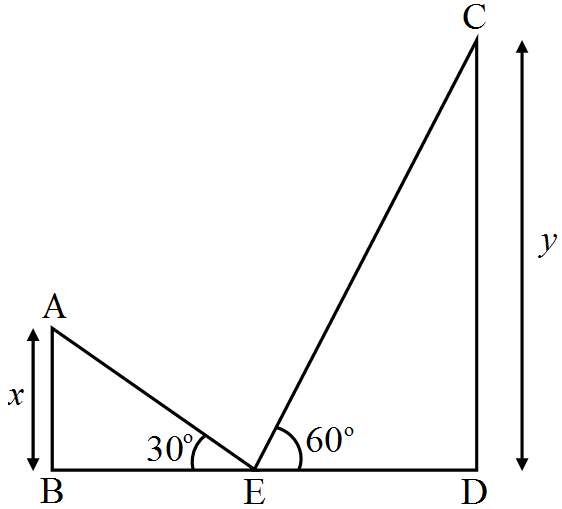
Let $AB$ and $CD$ be the two towers such that $AB = x$ and $CD = y.$
We have,
$\angle\text{AEB}=30^\circ,\angle\text{CED}=60^\circ$ and $BE = DE$
In $\triangle\text{ABE},$
$\tan30^\circ=\frac{\text{AB}}{\text{BE}}$
$\Rightarrow\frac{1}{\sqrt{3}}=\frac{\text{x}}{\text{BE}}$
$\Rightarrow\text{BE}=\text{x}{\sqrt{3}}$
Also, in $\triangle\text{CDE},$
$\Rightarrow\tan60^\circ=\frac{\text{CD}}{\text{DE}}$
$\Rightarrow\sqrt{3}=\frac{\text{y}}{\text{DE}}$
$\Rightarrow\text{DE}=\frac{\text{y}}{\sqrt{3}}$
As $, BE = DE$
$\Rightarrow\text{x}\sqrt{3}=\frac{\text{y}}{\sqrt{3}}$
$\Rightarrow\frac{\text{x}}{\text{y}}=\frac{1}{\sqrt{3}\times\sqrt{3}}$
$\Rightarrow\frac{\text{x}}{\text{y}}=\frac13$
$\therefore\ \text{x}:\text{y}=1:3$ View full question & answer→MCQ 221 Mark
In a rectangle, the angle between a diagonal and a side is $30^\circ$ and the length of this diagonal is $8\ cm.$ the area of the rectangle is :
AnswerCorrect option: C. $16\sqrt{3}\text{ cm}^2$
Let $\text{ABCD}$ be the rectangle in which $\angle\text{BAD}=30^\circ$ and $AC = 8\ cm.$
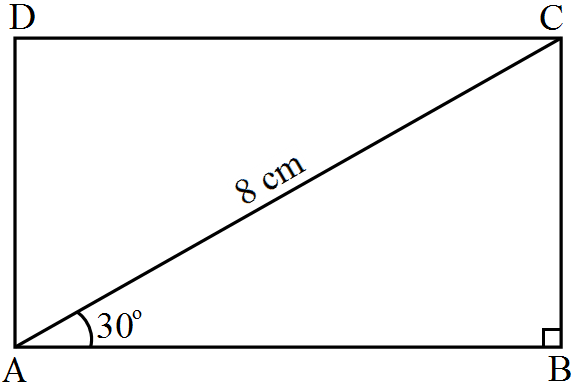
In $\triangle\text{BAC},$
We have :
$\frac{\text{AB}}{\text{AC}}=\cos30^\circ=\frac{\sqrt{3}}{2}$
$\Rightarrow\frac{\text{BC}}{8}=\frac{1}{2}$
$\Rightarrow\text{BC}=\frac82=4\text{m}$
$\therefore$ Area of the rectangle $=(\text{AB}\times\text{BC})$
$=(4\sqrt{3}\times4)=16\sqrt{3} \ \text{cm}^2$ View full question & answer→MCQ 231 Mark
From the top of a cliff $20m$ high, the angle of elevation of the top of a tower is found to be equal to the angle of depression of the foot of the tower. The height of the tower is :
Answer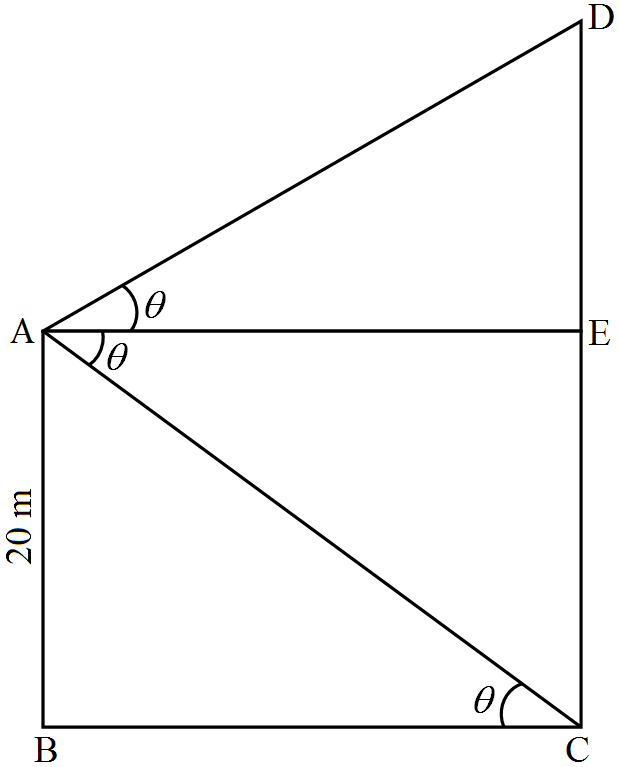
Let $AB$ be the cliff and $CD$ be the tower.
We have,
$AB = 20m$
Also, $CE = AB = 20m$
Let $\angle\text{ACB}=\angle\text{CAE}=\angle\text{DAE}=\theta$
In $\triangle\text{ABC},$
$\tan\theta=\frac{\text{AB}}{\text{BC}}$
$\Rightarrow\tan\theta=\frac{20}{\text{BC}}$
$\Rightarrow\tan\theta=\frac{20}{\text{AE}}\ ($As, $BC = AE)$
$\Rightarrow\text{AE}=\frac{20}{\tan\theta}\dots(\text{i})$
Also, in $\triangle\text{ADE},$
$\tan\theta=\frac{\text{DE}}{\text{AE}}$
$\Rightarrow\tan\theta=\frac{\text{DE}}{\Big(\frac{20}{\tan\theta}\Big)}\ [$Using $(i)]$
$\Rightarrow\tan\theta=\frac{\text{DE}\times\tan\theta}{20}$
$\Rightarrow\text{DE}=\frac{20\times\tan\theta}{\tan\theta}$
$\Rightarrow\text{DE}=20\text{m}$
Now, $\text{CD} = \text{DE} + \text{CE}$
$=20+20$
$\therefore\ \text{CD}=40\text{m}$
Disclaimer : The answer given in the textbook is incorrect,
The same has been rectified above. View full question & answer→MCQ 241 Mark
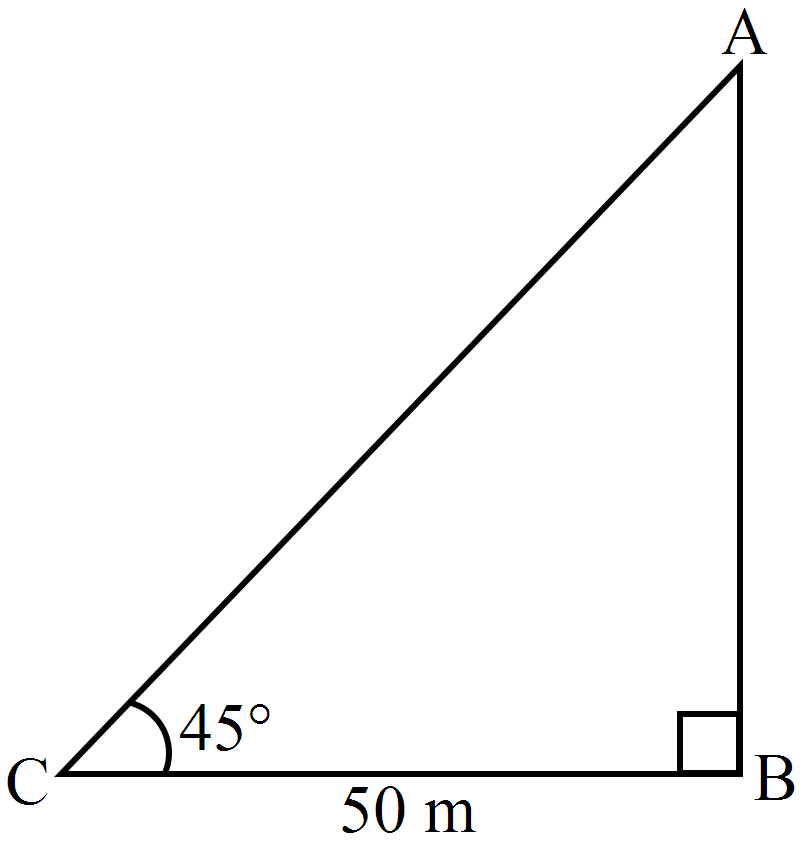
The angle of elevation of the top of a tower at a point on the ground $50m$ away from the foot of the tower is $45^\circ$ . Then the height of the tower $($in metres$)$ is :
- ✓
$50$
- B
$50\sqrt{3}$
- C
$\frac{50}{\sqrt{2}}$
- D
$\frac{50}{\sqrt{3}}$
AnswerLet $AB$ be tower and $C$ is as a point on the ground $52m$ away
From foot of tower $B$
Angle of elevation is $45^\circ$
let $h$ be height of tower $= x m$
$\therefore\tan\theta=\frac{\text{AB}}{\text{BC}}$
$\Rightarrow\tan45^\circ=\frac{\text{AB}}{5}$
$\Rightarrow1=\frac{\text{AB}}{50}$
$\Rightarrow=50\text{m}$ View full question & answer→MCQ 251 Mark
If altitude of the sun is $60^\circ,$ the height of a tower which casts a shadow of length $30m$ is :
- A
$10\sqrt3\text{m}$
- B
$15\sqrt3\text{m}$
- C
$20\sqrt3\text{m}$
- ✓
$30\sqrt3\text{m}$
AnswerCorrect option: D. $30\sqrt3\text{m}$
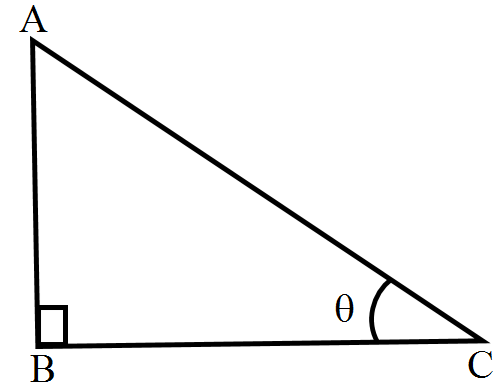
Given : Angle of elevation $\theta=60^\circ$
Let the height of the tower $AB$ be $h$ meters.
And the lenght of the shodow $BC$ is $30$ meters.
$\therefore\tan60^\circ=\frac{\text{AB}}{\text{BC}}$
$\Rightarrow\sqrt3=\frac{\text{h}}{30}$
$\Rightarrow\text{h}=30\sqrt3\text{ meters}.$
Therefore the height of the tower is $30\sqrt3\text{ meters}.$ View full question & answer→MCQ 261 Mark
The shadow of a tower on a level plane is found to be $60$ metres longer when the sun's altitude is $30^\circ$ than that when it is $45^\circ$ . The height of the tower in metres is :
- ✓
$30(\sqrt{3}+1)$
- B
$30(\sqrt{3}-1)$
- C
$30(3+\sqrt{3})$
- D
$30(3-\sqrt{3})$
AnswerCorrect option: A. $30(\sqrt{3}+1)$
$30(\sqrt{3}+1)$
View full question & answer→MCQ 271 Mark
A circus artist is climbing a long rope, which is tightly stretched and tied from the top of a vertical pole to the ground. The ratio of the height of the pole to the length of the string is $ 1 : \sqrt2.$ The angle made by the rope with the ground level is :
- ✓
$45^\circ$
- B
$60^\circ$
- C
$30^\circ$
- D
AnswerCorrect option: A. $45^\circ$
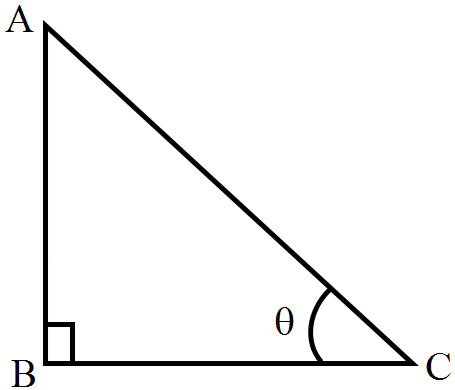
Let the height of the pole $AB$ be $x$ meters and length of string $AC$ be $\sqrt2\text{x}\text{ meters}.$
Angle of elevation $=\theta$
$\therefore\sin\theta=\frac{\text{AB}}{\text{AC}}$
$\Rightarrow\sin\theta=\frac{\text{x}}{\sqrt2\text{x}}$
$\Rightarrow\sin\theta=\frac{1}{\sqrt2}$
$\Rightarrow\sin\theta=\sin45^\circ$
$\Rightarrow\theta=45^\circ$ View full question & answer→MCQ 281 Mark
A tower subtends an angle of $30^\circ$ at a point on the same level as its foot. At a second point hmetres above the first, the depression of the foot of the tower is $60^\circ$ . The height of the tower is :
- A
$\frac{\text{h}}{2}\text{m}$
- B
$\sqrt{3}\text{h m}$
- ✓
$\frac{\text{h}}{3}\text{m}$
- D
$\frac{\text{h}}{\sqrt{3}}\text{m}$
AnswerCorrect option: C. $\frac{\text{h}}{3}\text{m}$
Let $AB$ be the tower and $C$ is a point on the same level as its foot such that $\angle\text{ACB}=30^\circ$
The given situation can be represented as,
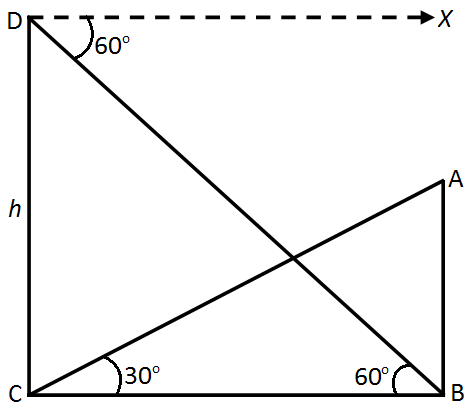
Here $D$ is a point $h m$ above the point $C$.
In $\angle\text{BCD,}$
$\Rightarrow\ \tan\text{B}=\frac{\text{CD}}{\text{CB}}$
$\Rightarrow\ \tan60^\circ=\frac{\text{h}}{\text{CB}}$
$\Rightarrow\ \sqrt{3}=\frac{\text{h}}{\text{CB}}$
$\Rightarrow\ \text{CB}=\frac{\text{h}}{\sqrt{3}}\ .....(1)$
Again in triangle $\text{ABC},$
$\tan\text{C}=\frac{\text{AB}}{\text{CB}}$
$\Rightarrow\ \tan30^\circ=\frac{\text{AB}}{\big(\frac{\text{h}}{\sqrt{3}}\big)} \ [$Using $(1)]$
$\Rightarrow\ \frac{1}{\sqrt{3}}=\frac{\text{AB}}{\big(\frac{\text{h}}{\sqrt{3}}\big)}$
$\Rightarrow\ \text{AB}=\frac{\text{h}}{3}$ View full question & answer→MCQ 291 Mark
The string of a kite is $100m$ long and it makes an angle of $60^\circ$ with the horizontal. If these is no slack in the string, the height of the kite from the ground is :
- ✓
$50\sqrt{3}\text{m}$
- B
$100\sqrt{3}\text{m}$
- C
$50\sqrt{2}\text{m}$
- D
AnswerCorrect option: A. $50\sqrt{3}\text{m}$
Let $AB$ be the string of the kite and $AX$ br the horizontal line.
If $\text{BC}\perp\text{AX},$ then $AB = 100m$ and $\angle\text{BAC}=60^\circ.$
Le t:
$BC = h m$
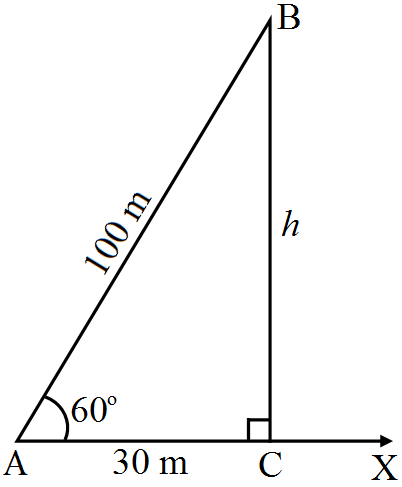
In the right $\triangle\text{ACB},$
We have :
$\frac{\text{BC}}{\text{AB}}=\sin60^\circ=\frac{\sqrt{3}}{2}$
$\Rightarrow\frac{\text{h}}{100}=\frac{\sqrt{3}}{2}$
$\Rightarrow\text{h}=\frac{100\sqrt{3}}{2}$
$=50\sqrt{3}\text{m}$
Hence, the height of the kite is $=50\sqrt{3}\text{m}.$ View full question & answer→MCQ 301 Mark
An electric pole is tied from the top to a point $($some distance away from the base$)$ on the ground using a string. The ratio of the height of pole to the string is $\sqrt3 : 22, $ then the angle of elevation of the top from the point on the ground is :
- A
$45^\circ$
- ✓
$60^\circ$
- C
$30^\circ$
- D
AnswerCorrect option: B. $60^\circ$
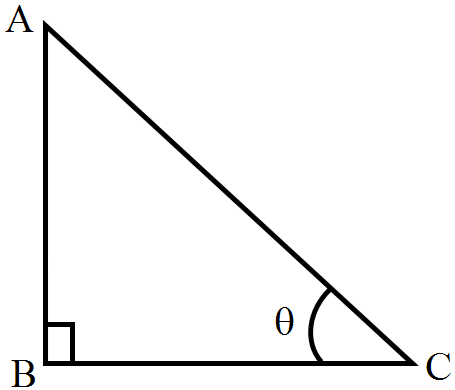
Let the height of the pole $\text{AB}=\sqrt3\text{x}\text{ meters}$ and length of the string $AC = 2x$ meters.
An angle of elevation be $\theta$
$\therefore\sin\theta=\frac{\text{AB}}{\text{AC}}$
$\Rightarrow\sin\theta=\frac{\sqrt3\text{x}}{2\text{x}}$
$\Rightarrow\sin\theta=\frac{\sqrt3}{2}$
$\Rightarrow\sin\theta=\sin60^\circ$
$\Rightarrow\theta=60^\circ$ View full question & answer→MCQ 311 Mark
From a light house the angles of depression of two ships on opposite sides of the light house are observed to be $30^\circ$ and $45^\circ$ . If the height of the light house is $h$ metres, the distance between the ships is :
- ✓
$(\sqrt{3}+1)\text{h meters}$
- B
$(\sqrt{3}-1)\text{h meters}$
- C
$\sqrt{3}\text{h meters}$
- D
$1+\Big(1+\frac{1}{\sqrt{3}}\Big)\text{h meters}$
AnswerCorrect option: A. $(\sqrt{3}+1)\text{h meters}$
Let $AB$ be light house and $P$ and $Q$ are two ships on its opposite sides which form angle of elevation of $A$ as $45^\circ$ and $30^\circ$ respectively $AB = h.$
Let $PB = x$ and $QB = y$
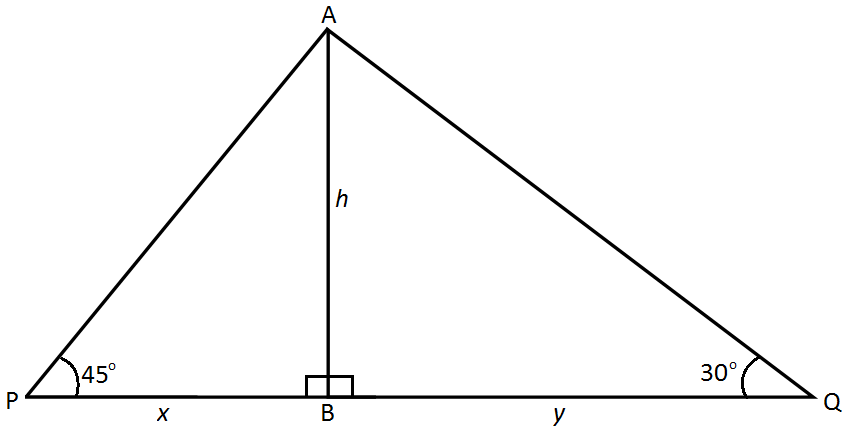
Now in right $\triangle\text{APB,}$
$\tan\theta=\frac{\text{Perpendicular}}{\text{Base}}=\frac{\text{AB}}{\text{PB}}$
$\Rightarrow\ \tan45^\circ=\frac{\text{h}}{\text{x}}$
$\Rightarrow\ 1=\frac{\text{h}}{\text{x}}$
$\Rightarrow\ \text{x}=\text{h}\ .....(\text{i})$
Similarly in right $\triangle\text{AQB,}$
$\tan30^\circ=\frac{\text{AB}}{\text{QB}}=\frac{\text{h}}{\text{y}}$
$\Rightarrow\ \frac{1}{\sqrt{3}}=\frac{\text{h}}{\text{y}}$
$\Rightarrow\ \text{y}=\sqrt{3}\text{h}\ ......(\text{ii})$
Adding $(i)$ and $(ii)$
$\text{PQ}=\text{x}+\text{y}=\text{h}+\sqrt{3}\text{h}$
$(\sqrt{3}+1)\text{h meters}$ View full question & answer→MCQ 321 Mark
The angle of elevation of the top of a tower from a point on the ground and at a distance of $30m$ from its foot is $30^\circ$ . The height of the tower is :
- A
$30\sqrt{3}\text{m}$
- B
$10\text{m}$
- ✓
$10\sqrt{3}\text{m}$
- D
$30\text{m}$
AnswerCorrect option: C. $10\sqrt{3}\text{m}$
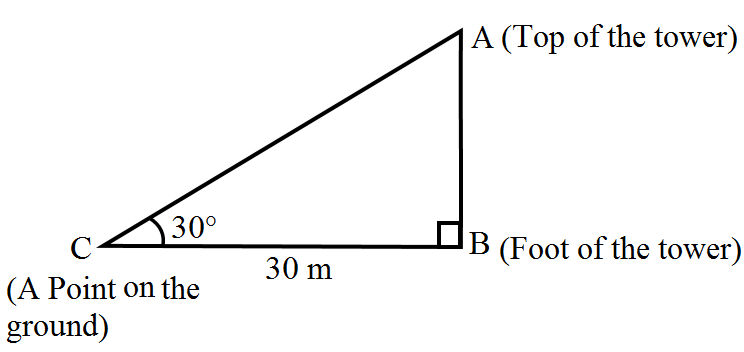
In right triangle $\text{ABC},$
$\tan30^\circ=\frac{\text{AB}}{\text{BC}}$
$\Rightarrow\frac{1}{\sqrt{3}}=\frac{\text{AB}}{30}$
$\text{AB}=\frac{30}{\sqrt{3}}\text{m}$
$\Rightarrow\frac{30}{\sqrt{3}}\times\frac{\sqrt{3}}{\sqrt{3}}$
$=10\sqrt{3}\text{m}$
Hence the height of the tower is $10\sqrt{3}\text{ meters}.$ View full question & answer→MCQ 331 Mark
The measure of the angle of elevation of the top of a tower $75\sqrt3\text{m}$ high from a point at a distance of $75m$ from the foot of the tower in a horizontal plane is :
- ✓
$60^\circ$
- B
$45^\circ$
- C
$15^\circ$
- D
$30^\circ$
AnswerCorrect option: A. $60^\circ$
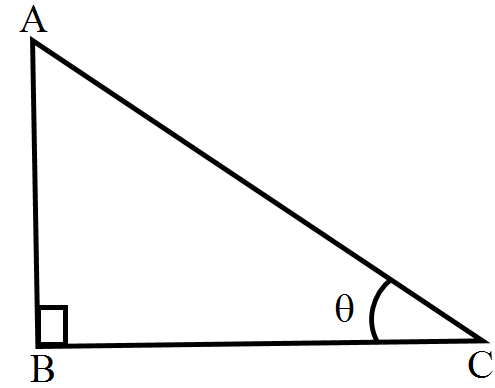
Given : distance from a point to the foot of the tower $= 75m$ and the height of the tower $=75\sqrt3\text{m}$
$\therefore\tan\theta=\frac{\text{AB}}{\text{BC}}$
$\Rightarrow\tan\theta=\frac{75\sqrt3}{75}$
$\Rightarrow\tan\theta=\sqrt3$
$\Rightarrow\tan\theta=\tan60^\circ$
$\Rightarrow\theta=60^\circ$
View full question & answer→MCQ 341 Mark
A vertical stick $20\ cm$ long casts a shadow $15\ cm$ long. At the same time, a tower casts a shadow $30m$ long. The height of the tower is :
Answer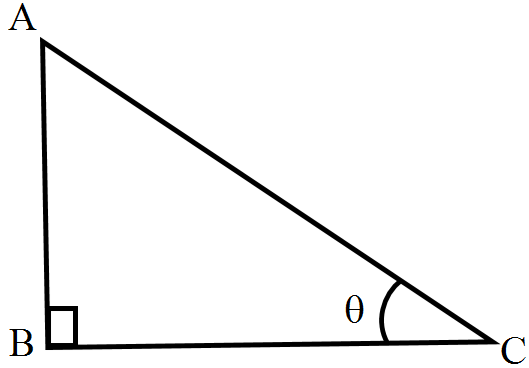
Let the height of the vertical stick be $AB = 20\ cm,$ the length of the shadow of the stick be $BC = 15\ cm$ and angle of elevation $\theta$
At the same time the height of the tower be $h$ meters and the shadow of the tower $= QR = 30\ cm$ and the angle of elevation.
$\angle\text{PRQ}=\theta$
Now, in triangle $\text{ABC},$
$\tan\theta=\frac{\text{AB}}{\text{BC}}$
$\Rightarrow\tan\theta=\frac{20}{15}=\frac{4}{3}.....(\text{i})$
Again in triangle $\text{PQR},$
$\tan\theta=\frac{\text{PR}}{\text{QR}}$
$\Rightarrow\frac{4}{3}=\frac{\text{h}}{30}\ [$From eq. $(i)]$
$\Rightarrow\text{h}=\frac{30\times4}{3}=40\text{ meters}$ View full question & answer→MCQ 351 Mark
If the height of a tower is half the height of the flagstaff on it and the angle of elevation of the top of the tower as seen from a point on the ground is $30^\circ ,$ then the angle of elevation of the top of the flagstaff as seen from the same point is :
- A
$30^\circ$
- ✓
$60^\circ$
- C
$45^\circ$
- D
AnswerCorrect option: B. $60^\circ$
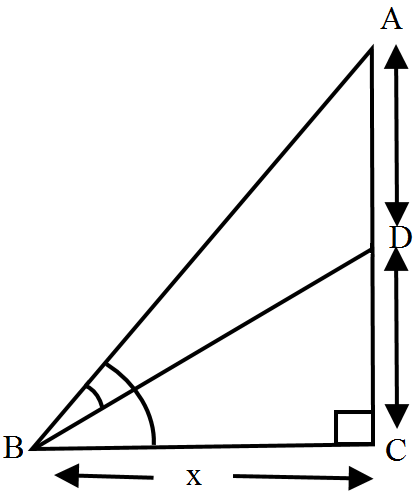
Here height of the tower $=\text{CD}=\frac{\text{h}}{2}\text{ meters},$ height of the flagstaff $= AD = h$ meters, angle of elevation of top of the tower $=\angle\text{DBC}=30^\circ$ and angle of elevation of the top of the flagstaff from ground $\angle\text{ABC}=\theta$
Now, in triangle $\text{DBC},$
$\tan30^\circ=\frac{\frac{\text{h}}{2}}{\text{x}}$
$\Rightarrow\text{x}=\frac{\text{h}\sqrt3}{2}.....(\text{i})$
Again, in triangle $\text{ABC},$
$\tan\theta=\frac{\text{h}+\frac{\text{h}}{2}}{\text{x}}$
$\Rightarrow\tan\theta=\frac{3\text{h}}{2\text{x}}$
$\Rightarrow\tan\theta=\frac{3\text{h}\times2}{2\times\text{h}\sqrt3} \ [$From eq.$(i)] x$
$\Rightarrow\tan\theta=\frac{3}{\sqrt3}$
$\Rightarrow\tan\theta=\sqrt3$
$\Rightarrow\tan\theta=\tan60^\circ$
$\Rightarrow\theta=60^\circ$ View full question & answer→MCQ 361 Mark
lf the shadow of a tower is $\sqrt{3}$ times of its height, the altitude of the sun is :
- A
$15^\circ$
- ✓
$30^\circ$
- C
$45^\circ$
- D
$60^\circ$
AnswerCorrect option: B. $30^\circ$
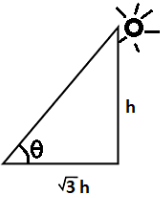
Let the height of tower be $h.$
$\text{tan}\theta =\frac{\text{h}}{\sqrt{\text{3h}}}$
$\text{tan}\theta =\frac{\text{1}}{\sqrt{\text{3h}}}$
$\Rightarrow \theta = 30^\circ $
View full question & answer→MCQ 371 Mark
The angles of elevation of top of a pole from two points $A$ and $B$ on the horizontal line lying on opposite side of the pole are observed to be $30^\circ$ and $60^\circ$ If $AB = 100m,$ then height of the pole is :
- A
$20\sqrt{3}\text{m}$
- B
$15\sqrt{3}\text{m}$
- C
$10\sqrt{3}\text{m}$
- ✓
$25\sqrt{3}\text{m}$
AnswerCorrect option: D. $25\sqrt{3}\text{m}$
$25\sqrt{3}\text{m}$
View full question & answer→MCQ 381 Mark
The tops of two poles of height $16m$ and $10m$ are connected by a wire of length $l$ metres. If the wire makes an angle of $30^\circ$ with the horizontal, then $l =$
AnswerLet $AB$ and $CD$ be the poles such that $AB = 16m$ and $CD = 10m.$
The given information can be represented as,
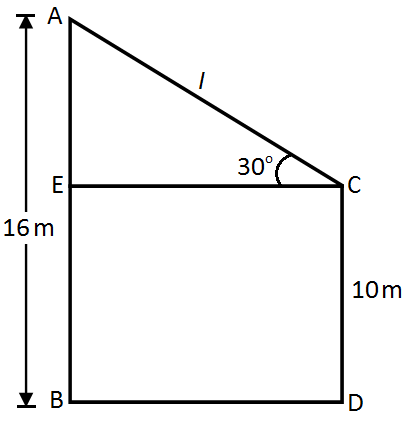
Here $, AC$ is the length of wire which is $l$.
Also $, AE = AB - BE $
$= 16m - 10m = 6m$
We have to find the length of wire $l$.
So we use trigonometric ratios.
In triangle $\text{ACE},$
$\sin\text{C}=\frac{\text{AE}}{\text{EC}}$
$\Rightarrow\ \sin30^\circ=\frac{6}{\text{l}}$
$\Rightarrow\ \frac{1}{2}=\frac{6}{\text{l}}$
$\Rightarrow\ \text{l}=12\text{m}$ View full question & answer→MCQ 391 Mark
The horizontal distance between two towers is $60m$ and angular depression of the top of the first as seen from the second, which is $150m$ in height, is $30^\circ $. The height of the first tower is :
- A
$\big(150+20\sqrt{3}\big)\text{m}$
- B
$\big(150+15\sqrt{3}\big)\text{m}$
- C
$\big(150-20\sqrt{5}\big)\text{m}$
- ✓
$\big(150-20\sqrt{3}\big)\text{m}$
AnswerCorrect option: D. $\big(150-20\sqrt{3}\big)\text{m}$
$\big(150-20\sqrt{3}\big)\text{m}$
View full question & answer→MCQ 401 Mark
The $...........$ of an object is the angle formed by the line of sight with the horizontal when the object is above the horizontal level.
AnswerThe angle of elevation of an object is the angle formed by the line of sight with the horizontal when the object is above the horizontal level.
View full question & answer→MCQ 411 Mark
A vertical tower stands on a horizontal plane and is surmounted by a vertical flag staff of height $5m$. From a point on the plane the angles of elevation of the bottom and top of the flagstaff are respectively $30^\circ$ and $60^\circ $. The height of the tower is :
AnswerCorrect option: B. $2.5m$
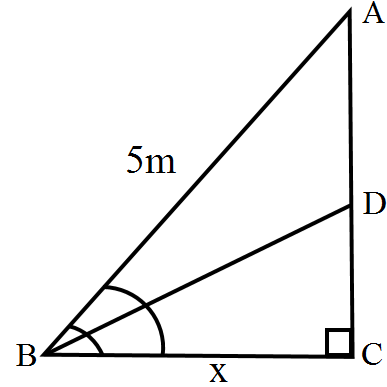
Here Height of the tower $= CD = h $ meters, height of the flagstaff $= AD = 5$ meters,
Angle of elevation of top of the tower $=\angle\text{DBC}=30^\circ$ and angle of elevation of the top of the flagstaff from ground $=\angle\text{ABC}=60^\circ$
Now, in triangle $\text{DBC},$
$\tan30^\circ=\frac{\text{h}}{\text{x}}$
$\Rightarrow\frac{1}{\sqrt3}=\frac{\text{h}}{\text{x}}$
$\Rightarrow\text{x}=\text{h}\sqrt3....(\text{i})$
And $\tan60^\circ=\frac{\text{h}+5}{\text{x}}$
$\Rightarrow\sqrt3=\frac{\text{h}+5}{\text{x}}$
$\Rightarrow\sqrt3=\frac{\text{h}+5}{\text{x}}....(\text{ii})$ View full question & answer→MCQ 421 Mark
If the height of a vertical pole is $\sqrt{3}$ times the length of its shadow on the ground, then the angle of elevation of the sun at that time is :
- A
$30^\circ$
- ✓
$60^\circ$
- C
$45^\circ$
- D
$75^\circ$
AnswerCorrect option: B. $60^\circ$
Let $AB$ be a vertical pole and let its shadow be $BC$
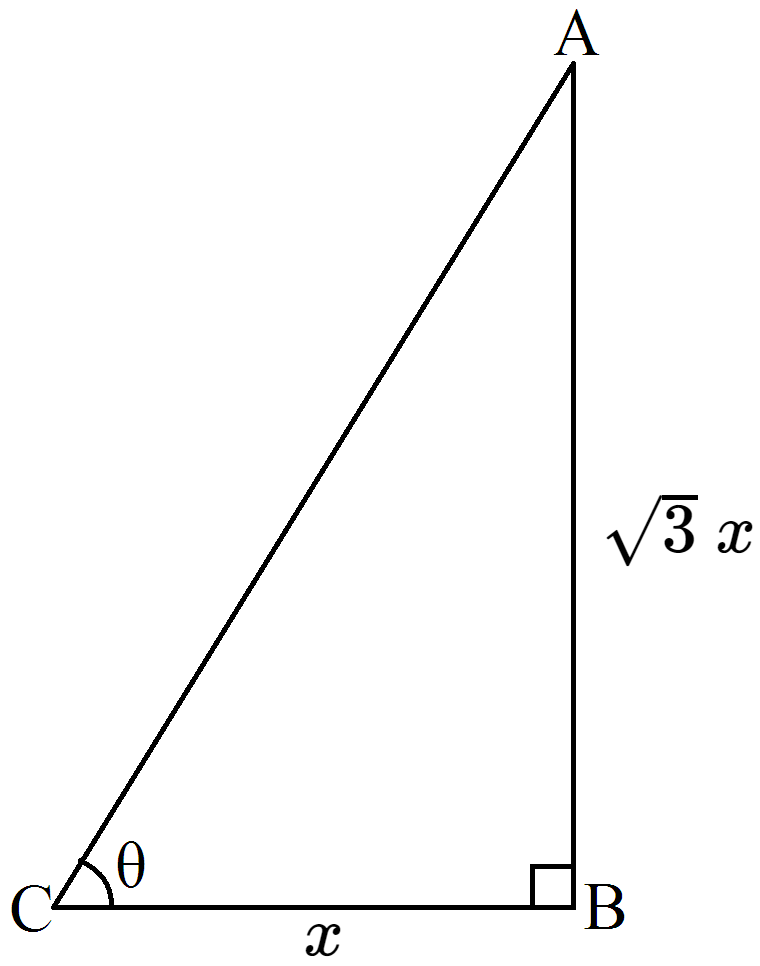
Let $BC = x m,$ then length of pole $=\sqrt{3}\text{x},$
$\theta$ be the angle of elevation
$\therefore\tan\theta=\frac{\text{AB}}{\text{BC}}$
$=\frac{\sqrt{3}\text{x}}{\text{x}}=\sqrt{3}$
$=\tan60^\circ$
$\therefore\theta=60^\circ$ View full question & answer→MCQ 431 Mark
The upper part of a tree broken by the windfalls to the ground without being detached. The top of the broken part touches the ground at an angle of $30^\circ$ at a point $8m$ from the foot of the tree. The original height of the tree is :
- A
$8\text{m}$
- ✓
$8\sqrt3\text{m}$
- C
$24\sqrt3\text{m}$
- D
$24\text{m}$
AnswerCorrect option: B. $8\sqrt3\text{m}$
In right triangle $\text{ABC},$
$\cos30^\circ=\frac{\text{BC}}{\text{AC}}$
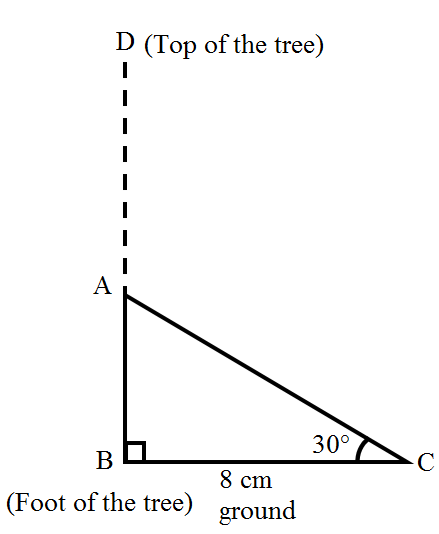
$\Rightarrow\frac{\sqrt3}{2}=\frac{8}{\text{AC}}$
$\Rightarrow\text{AC}=\frac{16}{\sqrt3}\text{m}$
Again, $\tan30^\circ=\frac{\text{AB}}{\text{BC}}$
$\Rightarrow\frac{1}{\sqrt3}=\frac{\text{AB}}{8}$
$\Rightarrow\text{AB}=\frac{8}{\sqrt3}\text{m}$
$\therefore$ Height of the tree $=\text{AB}+\text{AC}$
$=\frac{8}{\sqrt3}+\frac{16}{\sqrt3}=\frac{24}{\sqrt3}$
$=\frac{24}{\sqrt3}\times\frac{\sqrt3}{\sqrt3}=8\sqrt3\text{m}$
The height of the tree is $8\sqrt3\text{m}.$ View full question & answer→MCQ 441 Mark
The $...........$ is the angle between the horizontal and the line of sight to an object when the object is below the horizontal level.
AnswerThe angle of depression is the angle between the horizontal and line of sight to an object when the object is below the horizontal level.
The angle of depression is formed when the observer is higher than the object he is looking at.
It is the angle between the horizontal line and the line joining observer's eye and the object.
It plays very important role in determining the heights and distances.
View full question & answer→MCQ 451 Mark
If the angle of depression of a car from a $100m$ high tower is $45^\circ,$ then the distance of the car from the tower is :
- A
$200\sqrt3\text{m}$
- B
$200\text{m}$
- C
$100\sqrt3\text{m}$
- ✓
$100\text{m}$
AnswerCorrect option: D. $100\text{m}$
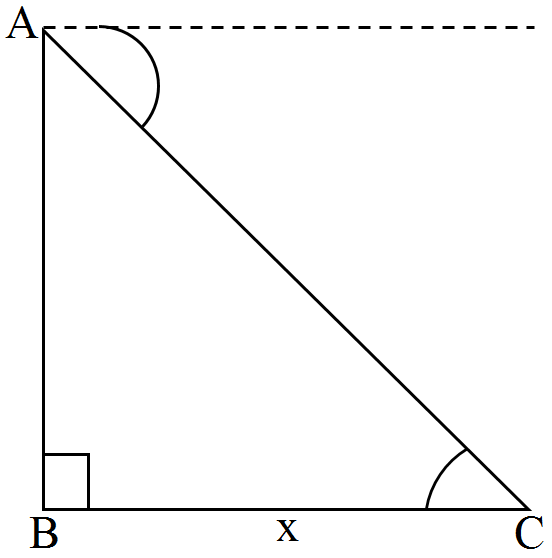
Let the distance of the car from the tower be $x$ meters.
$\tan45^\circ=\frac{\text{AC}}{\text{BC}}$
$\Rightarrow1=\frac{100}{\text{x}}\text{m}$
$\text{x}=100\text{m}$
Therefore, the distance of the car from the tower is $100m.$ View full question & answer→MCQ 461 Mark
If the height of a tower and the distance of the point of observation from its foot, both, are increased by $10\%,$ then the angle of elevation of its top :
Answer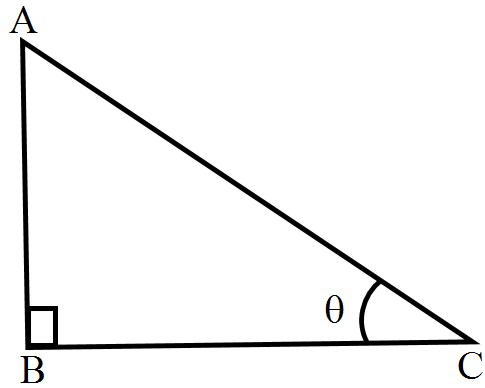
Let height of the tower be $h$ meters and distance of the point of observation from its foot be $x$ meters and angle of elevation be $\theta$
$\therefore\tan\theta=\frac{\text{h}}{\text{x}}......(\text{i})$
Now, new height $= h + 10\%$ of $\text{h}=\text{h}+\frac{10}{100}$
$\text{h}=\frac{11\text{h}}{10}$ And new distance $= x + 10\%$ of $\text{x}=\text{x}+\frac{10}{100}$
$\text{x}=\frac{11\text{x}}{10}$
$\therefore\tan\theta=\frac{\frac{11\text{h}}{10}}{\frac{11\text{x}}{10}}=\frac{\text{h}}{\text{x}}.....(\text{ii})$
From eq. $(i)$ and $(ii),$ it is clear that the angle of elevation is same
i.e., angle of elevation remains unchanged. View full question & answer→MCQ 471 Mark
It is found that on walking $x$ meters towards a chimney in a horizontal line through its base, the elevation of its top changes from $30^\circ$ to $60^\circ$ . The height of the chimney is :
AnswerCorrect option: C. $\frac{\sqrt{3}}{2}\text{x}$
In the figure $,AB$ is chimney and $CB$ and $DB$ are its shadow
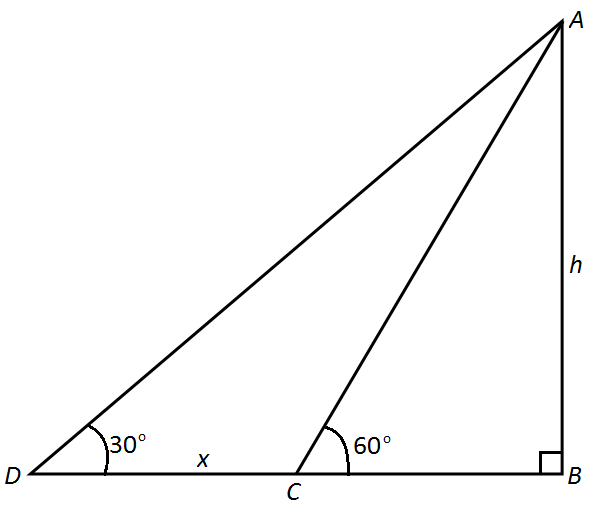
$\tan60^\circ=\frac{\text{AB}}{\text{BC}}=\frac{\text{h}}{\text{BC}}$
$\Rightarrow\ \sqrt{3}=\frac{\text{h}}{\text{BC}}$
$\Rightarrow\ \text{BC}=\frac{\text{h}}{\sqrt{3}}\ .....(\text{i})$
and $\tan30^\circ=\frac{\text{h}}{\text{DB}}=\frac{\text{h}}{\text{DB}+\text{BC}}$
$\frac{1}{\sqrt{3}}=\frac{\text{h}}{\text{x}+\text{BC}}$
$\text{x}+\text{BC}=\text{h}\sqrt{3}$
$\Rightarrow\ \text{BC}=\text{h}\sqrt{3}-\text{x}\ .....(\text{ii})$
From $(i)$ and $(ii)$
$\frac{\text{h}}{\sqrt{3}}=\text{h}\sqrt{3}-\text{x}$
$\Rightarrow\ \frac{\text{h}}{\sqrt{3}}-\text{h}\sqrt{3}=-\text{x}$
$\text{x}=\text{h}\sqrt{3}-\frac{\text{h}}{\sqrt{3}}$
$=\text{h}\Big(\sqrt{3}-\frac{1}{\sqrt{3}}\Big)$
$\text{x}=\text{h}\frac{3-1}{\sqrt{3}}$
$\Rightarrow\ \text{x}=\frac{2\text{h}}{\sqrt{3}}$
$\therefore\ \text{h}=\frac{\sqrt{3}}{2}\text{x}$ View full question & answer→MCQ 481 Mark
If a pole $12m$ high casts a shadow $4\sqrt{3}\text{m}$ long on the ground, then the sun's elevation is :
- ✓
$60^\circ$
- B
$45^\circ$
- C
$30^\circ$
- D
$90^\circ$
AnswerCorrect option: A. $60^\circ$
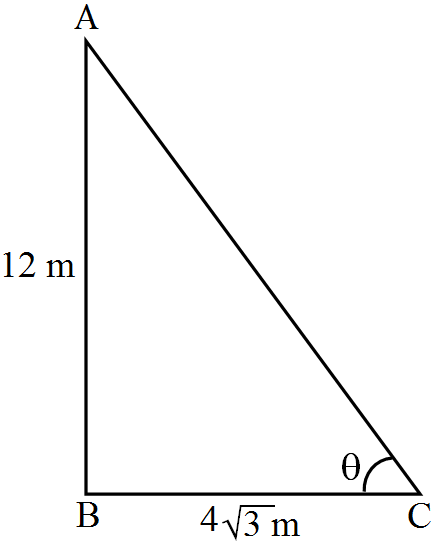
Let $AB$ be the pole and $BC$ be its shadow and $\theta$ be the sun's elevation.
We have,
$AB = 12m$ and $\text{BC}=4\sqrt{3}\text{m}$
In $\triangle\text{ABC},$
$\tan\theta=\frac{\text{AB}}{\text{BC}}$
$\Rightarrow\tan\theta=\frac{12}{4\sqrt{3}}$
$\Rightarrow\tan\theta=\frac{3}{\sqrt{3}}$
$\Rightarrow\tan\theta=\frac{3}{\sqrt{3}}\times\frac{\sqrt{3}}{\sqrt{3}}$
$\Rightarrow\tan\theta=\frac{3\sqrt{3}}{3}$
$\Rightarrow\tan\theta=\sqrt{3}$
$\Rightarrow\tan\theta=\tan60^\circ$
$\therefore\ \theta=60^\circ$ View full question & answer→MCQ 491 Mark
A balloon moving in a straight line passes vertically above two points $A$ and $B$ on horizontal plane $1000$ ft apart. When above $A$ it has an altitude of $60^\circ$ as seen from $B$. When above $B$ it has an altitude of $45^\circ$ as seen from $A$. The distance of $B$ from the point at which it will touch the plane is :
AnswerCorrect option: A. $500(\sqrt{3}+1)\text{ft}$
$\tan60=\frac{\text{h}}{1000}$
$\text{h}=1000\sqrt{3}$
$\frac{1000\sqrt{3}}{1000+\text{x}}=\frac{1000}{4}$
$\text{x}^2=\frac{1000}{(\sqrt{3}-1)}$
$\text{x}^2=500(\sqrt{3}+1)$
View full question & answer→MCQ 501 Mark
The tops of two poles of height $16m$ and $10m$ are connected by a wire. If the wire makes an angle of $60^\circ$ with the horizontal, then the length of the wire is :
- ✓
$12\text{m}$
- B
$10\text{m}$
- C
$10\sqrt3\text{m}$
- D
$16\text{m}$
AnswerCorrect option: A. $12\text{m}$
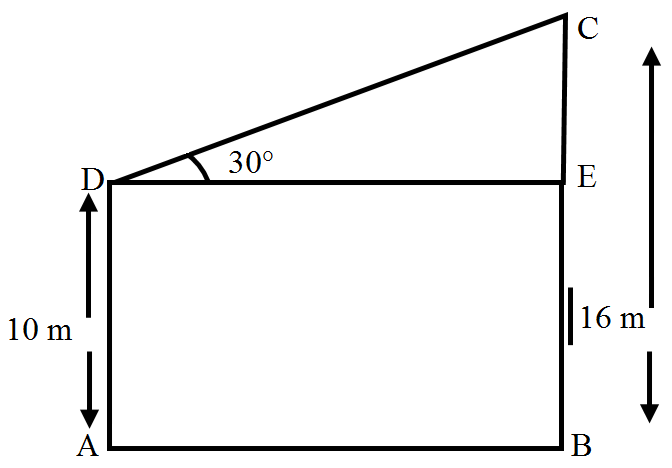
Given : Two poles $BC = 16m$ and $AD = 10m$
And $\angle\text{CDE}=30^\circ$
To find : Lenght of wire $CD = x$
$\therefore$ In triangle $\text{CDE},$
$\sin30^\circ=\frac{\text{CE}}{\text{CD}}$
$\Rightarrow\frac{1}{2}=\frac{\text{BC}-\text{BE}}{\text{CD}}$
$\Rightarrow\frac{1}{2}=\frac{16-10}{\text{x}}$
$\Rightarrow\frac{1}{2}=\frac{6}{\text{x}}$
$\Rightarrow\text{x}=12\text{m}$
Therefore, the lenght of the wire is $12m.$ View full question & answer→MCQ 511 Mark
A person walking $50$ metres towards a chimney in a horizontal line. The angle of elevation of its top changes from $30^\circ$ to $45^\circ$ . Height of the chimney $($in metres$)$ is :
- A
$25(3+\sqrt{3})\text{m}$
- B
$50(\sqrt{3}+1)\text{m}$
- ✓
$25(\sqrt{3}+1)\text{m}$
- D
$25(\sqrt{3}-1)\text{m}$
AnswerCorrect option: C. $25(\sqrt{3}+1)\text{m}$
$25(\sqrt{3}+1)\text{m}$
View full question & answer→MCQ 521 Mark
The angles of elevation of the top of a tower from two points on the ground at distances $8m$ and $18m$ from the base of the tower and in the same straight line with it are complementary. The height of the tower is :
Answer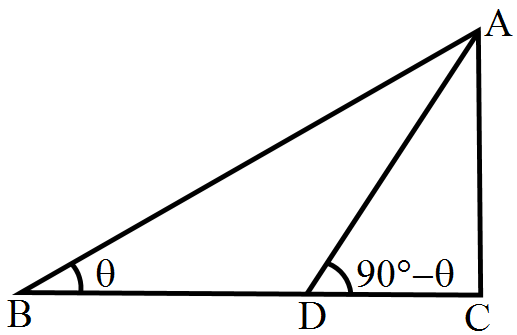
In triangle $\text{ABC}, \tan\theta=\frac{\text{h}}{18}...(\text{i})$
And in triangle $\text{ADC}, \tan(90^\circ-\theta)=\frac{\text{h}}{8}\text{h}$
$\Rightarrow\cot\theta=\frac{\text{h}}{8}...(\text{ii})$
Multiplying eq. $(i)$ and $(ii),$ we get
$\tan\theta.\cot\theta=\frac{\text{h}}{18}\times\frac{\text{h}}{8}$
$\Rightarrow1=\frac{\text{h}^2}{144}$
$\Rightarrow\text{h}^2=144$
$\Rightarrow\text{h}=12\text{m}.$ View full question & answer→MCQ 531 Mark
The top of a broken tree has its top touching the ground at a distance of $10m$ from the bottom. If the angle made by the broken part with the ground is $30^\circ, $ then the length of the broken part is :
AnswerCorrect option: A. $\frac{20}{\sqrt3\text{m}}$
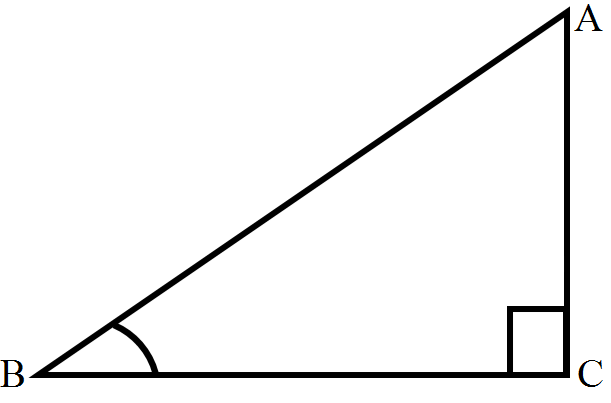
Let $AB$ be the broken part of the tree.
$\therefore\cos30^\circ=\frac{\text{BC}}{\text{AB}}$
$\Rightarrow\frac{\sqrt3}{2}=\frac{10}{\text{AB}}$
$\Rightarrow\text{AB}=\frac{10\times2}{\sqrt3}=\frac{20}{\sqrt3}\text{ meters}$
Therefore, the length of the broken part of the tree is $\frac{20}{\sqrt3}\text{ meters}.$ View full question & answer→MCQ 541 Mark
From the top of a cliff $25m$ high the angle of elevation of a tower is found to be equal to the angle of depression of the foot of the tower. The height of the tower is :
- A
$25m$
- ✓
$50m$
- C
$75m$
- D
$100m$
AnswerGiven that : height of cliff is $25m$ and angle of elevation of the tower is equal to angle of depression of foot of the tower that is $\theta.$
Now, the given situation can be represented as,
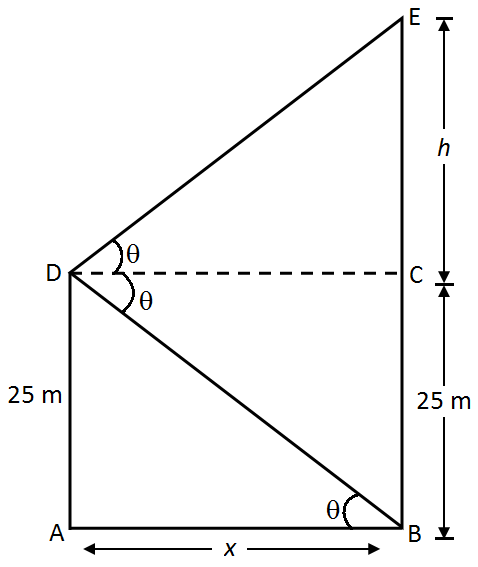
Here, $D$ is the top of cliff and $BE$ is the tower.
Let $CE = h, AB = x$.
Then $, AB = DC = x$
Here, we have to find the height of the tower $BE.$
So, we use trigonometric ratios.
In a triangle $\text{ABD},$
$\Rightarrow\ \tan\theta=\frac{\text{AD}}{\text{AB}}$
$\Rightarrow\ \tan\theta=\frac{25}{\text{x}}\ .....(1)$
Again in a triangle $\text{DCE},$
$\tan\theta=\frac{\text{CE}}{\text{CD}}$
$\Rightarrow\ \tan\theta=\frac{\text{h}}{\text{x}}$
$\Rightarrow\ \frac{25}{\text{x}}=\frac{\text{h}}{\text{x}}\ [$Using $(1)]$
$\Rightarrow\ \text{h}=25$
Thus, height of the tower $= BE = BC + CE $
$= (25 + 25)m = 50m$ View full question & answer→MCQ 551 Mark
A kite is flying at a height of $30m$ from the ground. The length of string from the kite to the ground is $60m.$ Assuming that there is no slack in the string, the angle of elevation of the kite at the ground is :
- A
$45^\circ$
- ✓
$30^\circ$
- C
$60^\circ$
- D
$90^\circ$
AnswerCorrect option: B. $30^\circ$
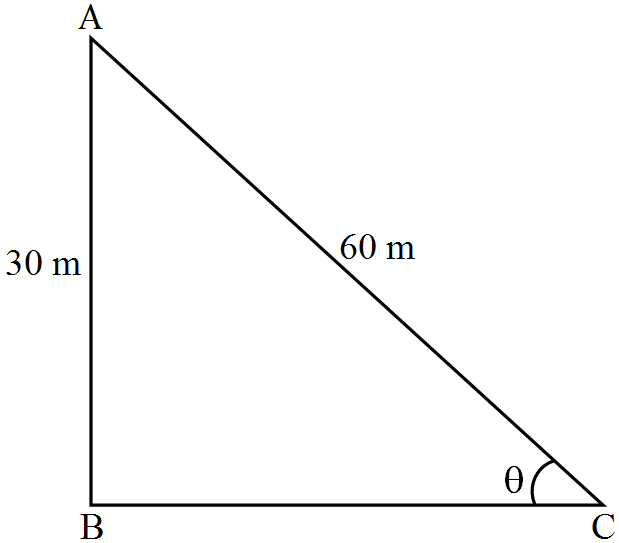
Let point $A$ be the position of the kite and $AC$ be its string.
We have,
$AB = 30m,$ and $AC = 60m$
Let $\angle\text{ACB}=\theta$
In $\triangle\text{ABC},$
$\sin\theta=\frac{\text{AB}}{\text{AC}}$
$\Rightarrow\sin\theta=\frac{30}{60}$
$\Rightarrow\sin\theta=\frac{1}{2}$
$\Rightarrow\sin\theta=\sin30^\circ$
$\therefore\ \theta=30^\circ$ View full question & answer→MCQ 561 Mark
The ratio of the length of a pole and its shadow is $1: \sqrt{3}.$ The angle of elevation of the sun is :
- A
$90^\circ$
- B
$60^\circ$
- C
$45^\circ$
- ✓
$30^\circ$
AnswerCorrect option: D. $30^\circ$
$\tan\theta=\frac{\text{h}}{\text{x}}$
$\Rightarrow\tan\theta=\frac{1}{\sqrt{3}}$
$\Rightarrow\tan\theta=\tan30^\circ$
$\Rightarrow\theta=30^\circ$
Hence, the answer is $= 30^\circ .$
View full question & answer→MCQ 571 Mark
On the level ground, the angle of elevation of a tower is $30^\circ $. On moving $20m$ nearer, the angle of elevation is $60^\circ $. The height of the tower is :
- A
$10\text{m}$
- ✓
$10\sqrt{3}\text{m}$
- C
$15\text{m}$
- D
$5\sqrt{3}\text{m}$
AnswerCorrect option: B. $10\sqrt{3}\text{m}$
Let $AB$ be the tower and $C$ and $D$ be the points of observation such that $\angle\text{BCD}=30^\circ,\angle\text{BDA}=60^\circ,\text{CD}=20\text{m}$ and $AD = x m.$
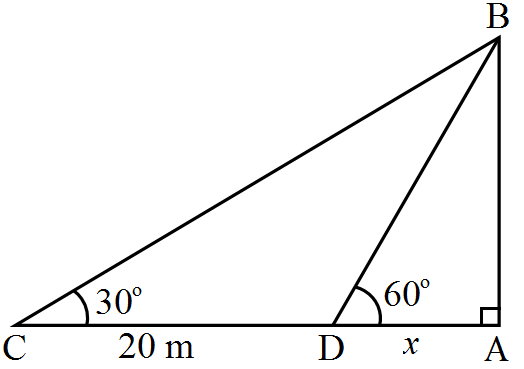
Now, in $\triangle\text{ADB},$
We have :
$\frac{\text{AB}}{\text{AD}}=\tan60^\circ=\sqrt{3}$
$\Rightarrow\frac{\text{AB}}{\text{x}}=\sqrt{3}$
$\Rightarrow\text{AB}=\sqrt{3}\text{x}$
In $\triangle\text{ACB},$
We have :
$\frac{\text{AB}}{\text{AC}}=\tan30^\circ=\frac{1}{\sqrt{3}}$
$\frac{\text{AB}}{20+\text{x}}=\frac{1}{\sqrt{3}}$
$\Rightarrow\text{AB}=\frac{20+\text{x}}{\sqrt{3}}$
$\therefore\sqrt{3}\text{x}=\frac{20+\text{x}}{\sqrt{3}}$
$\Rightarrow3\text{x}=20+\text{x}$
$\Rightarrow2\text{x}=20$
$\Rightarrow\text{x}=10$
$\therefore$ Height of the tower $\text{AB}=\sqrt{3}\text{x}=10\sqrt{3}\text{m}$ View full question & answer→MCQ 581 Mark
The angle of elevation of the sun when the shadow of a pole of height $‘h\ ’$ metres is $\sqrt3\text{h }\text{metres}$ long is :
- A
$45^\circ$
- ✓
$30^\circ$
- C
$60^\circ$
- D
AnswerCorrect option: B. $30^\circ$
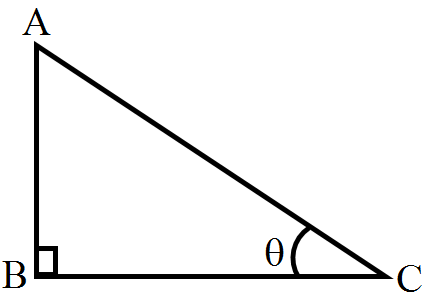
Let Height of the pole $= AB = h$
Meters and length of the shadow of the pole $=\text{BC}=\sqrt3\text{h }\text{ meters}.$
$\therefore\tan\theta=\frac{\text{AC}}{\text{BC}}$
$\Rightarrow\tan\theta=\frac{\text{h}}{\sqrt3\text{h}}=\frac{1}{\sqrt3}$
$\Rightarrow\tan\theta=\tan30^\circ$
$\Rightarrow\theta=30^\circ$ View full question & answer→MCQ 591 Mark
A pole $10m$ high cast a shadow $10m$ long on the ground, then the sun’s elevation is :
- A
$60^\circ$
- B
$15^\circ$
- ✓
$45^\circ$
- D
$30^\circ$
AnswerCorrect option: C. $45^\circ$
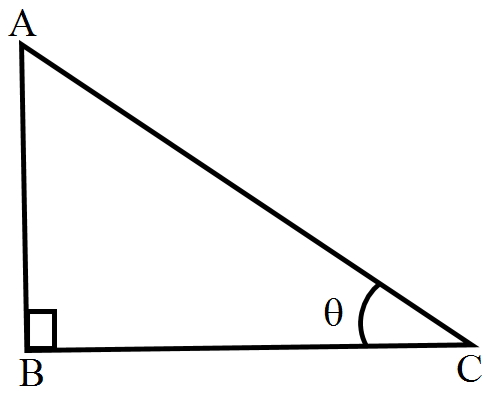
Let the length of the shadow $BC$ be $10$ meters.
Then the height of the pole $AB$ is $10$ meter.
$\therefore\tan\theta=\frac{\text{AB}}{\text{BC}}$
$\Rightarrow\tan\theta=\frac{10}{10}$
$\Rightarrow\tan\theta=1$
$\Rightarrow\tan\theta=\tan45^\circ$
$\Rightarrow\theta=45^\circ$ View full question & answer→MCQ 601 Mark
If the angle of depression of an object from a $75m$ high tower is $30^{\circ},$ then the distance of the object from the tower is :
- ✓
$75\sqrt3\text{m}$
- B
$25\sqrt3\text{m}$
- C
$100\sqrt3\text{m}$
- D
$50\sqrt3\text{m}$
AnswerCorrect option: A. $75\sqrt3\text{m}$
In triangle $\text{ABC},$
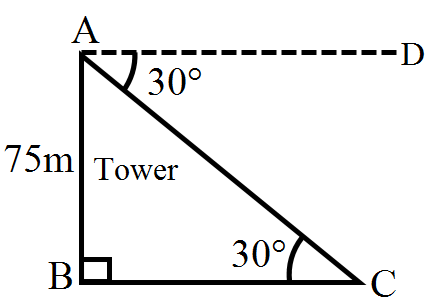
$\tan30^\circ=\frac{\text{AB}}{\text{BC}}$
$\Rightarrow\frac{1}{\sqrt3}=\frac{75}{\text{BC}}$
$\Rightarrow\text{BC}=75\sqrt3\text{m}$
Therefore, the distance between $P$ and foot of the tower is $75\sqrt3\text{m}$ meters. View full question & answer→MCQ 611 Mark
From a point $P$ on the level ground, the angle of elevation of the top of a tower is $30^{\circ}$. If the tower is $100m$ high, the distance between $P$ and the foot of the tower is :
- ✓
$100\sqrt3\text{m}$
- B
$300\sqrt3\text{m}$
- C
$150\sqrt3\text{m}$
- D
$200\sqrt3\text{m}$
AnswerCorrect option: A. $100\sqrt3\text{m}$
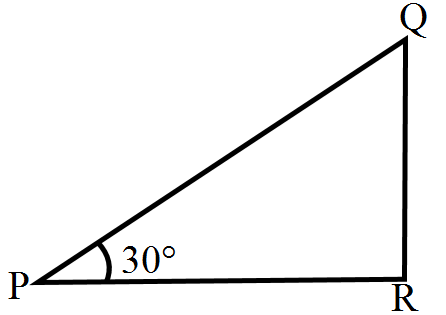
Let $QR$ be the height of the tower,
then $QR = 100m$ and the angle of elevation of the top of the tower be
$\angle\text{QPR}=30^\circ$
$\therefore\tan30^\circ=\frac{\text{QR}}{\text{PR}}$
$\Rightarrow\frac{1}{\sqrt3}=\frac{100}{\text{PR}}\text{m}$
$\Rightarrow\text{PR}=100\sqrt3\text{ meters}$
Therefore, the distance between $P$ and the foot of the tower is $100\sqrt3\text{ meters}.$ View full question & answer→MCQ 621 Mark
The ratio between the height and the length of the shadow of a pole is $ 3-\sqrt{3} : 1,$ then the sun’s altitude is :
- A
$45^\circ$
- B
$30^\circ$
- C
$75^\circ$
- ✓
$60^\circ$
AnswerCorrect option: D. $60^\circ$
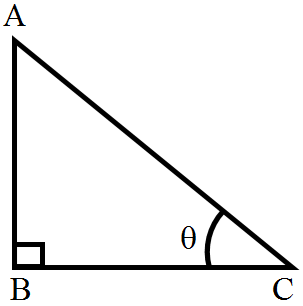
Let the height of the pole be $\text{AB}=\sqrt{3}\text{x}\text{ meters}$ and the lenght of the shadow be $BC = x$ meters and angle of elevation $=\theta$
$\therefore\tan\theta=\frac{\sqrt{3}\text{x}}{\text{x}}$
$\Rightarrow\tan\theta=\sqrt{3}$
$\Rightarrow\tan\theta=\tan60^\circ$
$\Rightarrow\theta=60^\circ$ View full question & answer→MCQ 631 Mark
The angle of elevation of the sun, when the length of the shadow of a pole is equal to its height, is :
- A
$30^\circ$
- ✓
$45^\circ$
- C
$60^\circ$
- D
$90^\circ$
AnswerCorrect option: B. $45^\circ$
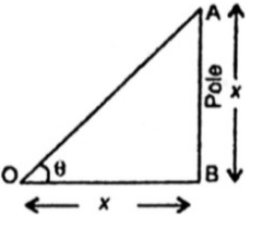
Let the height of the pole be $AB = x m$
Then the length of the shadow of the pole $AB$ will be $OB = x m$
Let the angle of elevation be $\theta$ i.e., $\angle AOB = \theta$
In the right $-$ angled triangle $\text{OAB},$ we have
$\Rightarrow \text{tan} \theta = \frac{AB}{\text{OB}}$
$=\frac{\text{x}}{\text{x}}$
$= 1$
$\Rightarrow \theta = \text{tan}^{-1}45^\circ $
Therefore angle of elevation is $45^\circ $
View full question & answer→MCQ 641 Mark
In the given figure, a tower $AB$ is $20m$ high and $BC,$ its shadow on the ground is $20\sqrt{3}\text{m}$ long. The sun's altitude is :
- ✓
$30^\circ$
- B
$45^\circ$
- C
$60^\circ$
- D
AnswerCorrect option: A. $30^\circ$
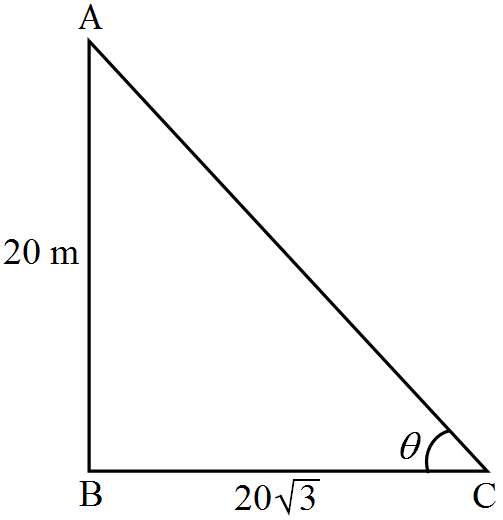
Let the sun's altitude be $\theta.$
We have,
$AB = 20m$ and $\text{BC}=20\sqrt{3}\text{m}$
In $\triangle\text{ABC},$
$\tan\theta=\frac{\text{AB}}{\text{BC}}$
$\Rightarrow\tan\theta=\frac{20}{20\sqrt{3}}$
$\Rightarrow\tan\theta=\frac{1}{\sqrt{3}}$
$\Rightarrow\tan\theta=\tan30^\circ$
$\therefore\ \theta=30^\circ$ View full question & answer→MCQ 651 Mark
The length of the shadow of a tower standing on level ground is found to be $2x$ metres longer when the sun's elevation is $30^\circ$ than when it was $45^\circ $. The height of the tower is :
- A
$\big(2\sqrt{3}\text{x}\big)\text{m}$
- B
$\big(3\sqrt{2}\text{x}\big)\text{m}$
- C
$\big(\sqrt{3}-1\big)\text{x }\text{m}$
- ✓
$\big(\sqrt{3}+1\big)\text{x }\text{m}$
AnswerCorrect option: D. $\big(\sqrt{3}+1\big)\text{x }\text{m}$
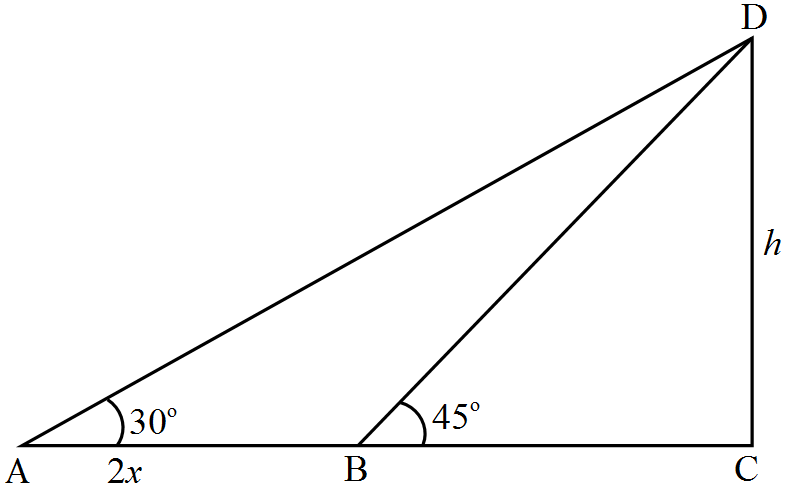
Let $CD = h$ be the height if the tower.
We have,
$AB = 2x, \angle\text{DAC}=30^\circ$ and $\angle\text{DBC}=45^\circ$
In $\triangle\text{BCD},$
$\tan45^\circ=\frac{\text{CD}}{\text{BE}}$
$\Rightarrow1=\frac{\text{h}}{\text{BC}}$
$\Rightarrow\text{BC}=\text{h}$
Now, in $\triangle\text{ACD},$
$\tan30^\circ=\frac{\text{CD}}{\text{AC}}$
$\Rightarrow\frac{1}{\sqrt{3}}=\frac{\text{h}}{\text{AB}+\text{BC}}$
$\Rightarrow\frac{1}{\sqrt{3}}=\frac{\text{h}}{2\text{x}+\text{h}}$
$\Rightarrow2\text{x}+\text{h}=\text{h}\sqrt{3}$
$\Rightarrow\text{h}\sqrt{3}-\text{h}=2\text{x}$
$\Rightarrow\text{h}\big(\sqrt{3}-1\big)=2\text{x}$
$\Rightarrow\text{h}=\frac{2\text{x}}{\big(\sqrt{3}-1\big)}\times\frac{\big(\sqrt{3}+1\big)}{\big(\sqrt{3}+1\big)}$
$\Rightarrow\text{h}=\frac{2\text{x}\big(\sqrt{3}+1\big)}{(3-1)}$
$\Rightarrow\text{h}=\frac{2\text{x}\big(\sqrt{3}+1\big)}{2}$
$\therefore\ \text{h}=\text{x}\big(\sqrt{3}+1\big)\text{m}$ View full question & answer→MCQ 661 Mark
An observer $1.5m$ tall $28.5$ away from a tower and the angle of elevation of the top of the tower form the eye of the observer is $45^\circ$ . The height of the tower is :
AnswerLet $AB$ be the observer and $CD$ be the tower.
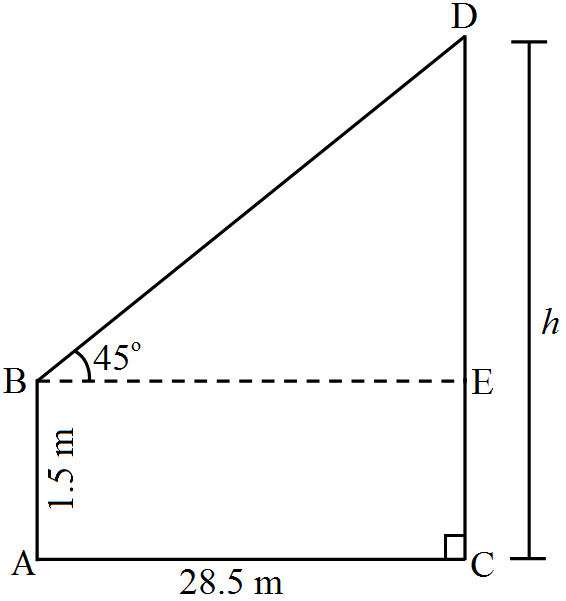
Draw $\text{BE}\perp\text{CD},$ let $CD = h$ metres.
Then, $\text{AB}=1.5\text{m},\text{BE}=\text{AC}=28.5\text{m}$ and $\angle\text{EBD}=45^\circ.$
$DE = (CD - EC) = (CD - AB) = (h - 1.5)m.$
In right $\triangle\text{BED},$
We have:
${\frac{\text{DE}}{\text{BE}}}=\tan45^\circ=1$
$\Rightarrow\frac{(\text{h}-1.5)}{28.5}=1$
$\Rightarrow\text{h}-1.5=28.5$
$\Rightarrow\text{h}=28.5+1.5=30\text{m}$
Hence the height of the tower is $30m.$ View full question & answer→MCQ 671 Mark
If the length of a shadow of a tower is increasing, then the angle of elevation of the sun is :
- ✓
- B
- C
- D
Neither increasing nor decreasing
AnswerIf the elevation moves towards the tower, it is increasing and if its elevation moves away from the tower, it decreases.
Hence if the shadow of a tower is increasing, then the angle of elevation of the sun is not increasing.
View full question & answer→MCQ 681 Mark
If the length of the shadow of a tower is equal to its height, then the angle of elevation of the sun is a :
- A
$30^\circ$
- ✓
$45^\circ$
- C
$60^\circ$
- D
$75^\circ$
AnswerCorrect option: B. $45^\circ$
Let $AB$ be the tower and $AC$ be its Shadow.
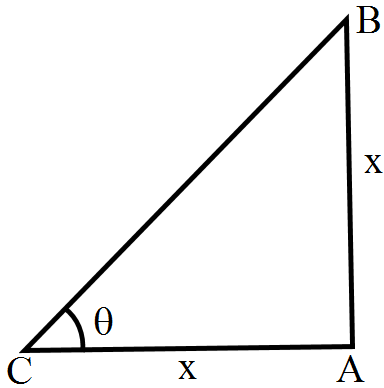
And $AB = AC = x m$
Let the angle of elevation of the sun be $\theta.$
Then $\angle\text{ACB}=\theta$
In right angled triangle $\text{ABC}$
$\tan\theta=\frac{\text{AB}}{\text{AC}}$
$\Rightarrow\tan\theta=\frac{\text{x}}{\text{x}}=1$
$\Rightarrow\tan\theta=\tan45^\circ$
$\Rightarrow\theta=45^\circ$
Therefore, the angle of the elevation of the sun is $45^\circ .$ View full question & answer→MCQ 691 Mark
From the top of a hill, the angles of depression of two consecutive $\ km$ stones due east are found to be $30^\circ$ and $45^\circ .$ The height of the hill is :
- A
$\frac{1}{2}\big(\sqrt{3}-1\big)\text{km}$
- ✓
$\frac{1}{2}\big(\sqrt{3}+1\big)\text{km}$
- C
$\big(\sqrt{3}-1\big)\text{km}$
- D
$\big(\sqrt{3}+1\big)\text{km}$
AnswerCorrect option: B. $\frac{1}{2}\big(\sqrt{3}+1\big)\text{km}$
Let $AB$ be the hill making angles of depression at points $C$ and $D$ such that $\angle\text{ADB}=45^\circ,\angle\text{ACB}=30^\circ$ and $CD = 1\ km.$
Let :
$AB = h \ km$ and $AD = x \ km$
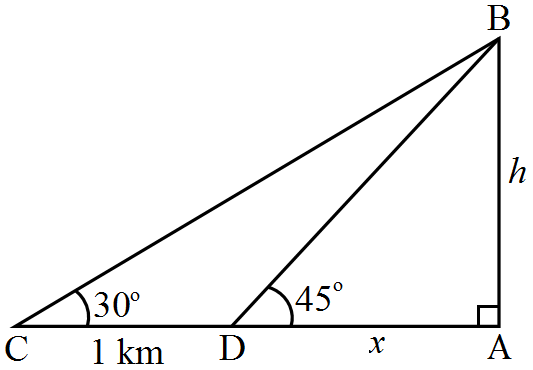
In $\triangle\text{ADB},$
We have :
$\frac{\text{AB}}{\text{AD}}=\tan45^\circ=1$
$\Rightarrow\frac{\text{h}}{\text{x}+1}=\frac{1}{\sqrt{3}}\dots(\text{ii})$
On putting the value of $h$ taken from $(i)$ in $(ii),$ we get:
$\frac{\text{h}}{\text{h}+1}=\frac{1}{\sqrt{3}}$
$\Rightarrow\sqrt{3}\text{h}=\text{h}+1$
$\Rightarrow\big(\sqrt{3}-1\big)\text{h}=1$
$\Rightarrow\text{h}=\frac{1}{\big(\sqrt{3}-1\big)}$
On multiplying the numerator and denominator of the above equation by $\big(\sqrt{3}+1\big),$
We get:
$\text{h}=\frac{1}{\big(\sqrt{3}-1\big)}\times\frac{\big(\sqrt{3}+1\big)}{\big(\sqrt{3}+1\big)}$
$=\frac{\big(\sqrt{3}+1\big)}{2}=\frac12\big(\sqrt{3}+1\big)\text{km}$
Hence, the height of the hill is $\frac12\big(\sqrt{3}+1\big)\text{km}.$ View full question & answer→MCQ 701 Mark
A ladder $14m$ long rests against a wall. If the foot of the ladder is $7m$ from the wall, then the angle of elevation is :
- ✓
$60^\circ$
- B
$45^\circ$
- C
$30^\circ$
- D
$75^\circ$
AnswerCorrect option: A. $60^\circ$
Let $AB$ be the ladder of length $14m$ and $BC = 7m$
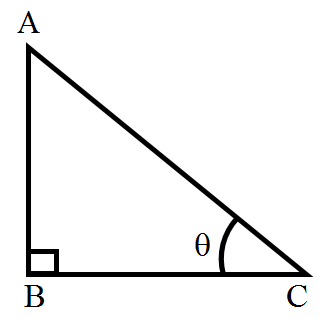
Let angle of elevation
$\angle\text{ACB}=\theta$
$\therefore\cos\theta=\frac{\text{BC}}{\text{AC}}$
$\Rightarrow\cos\theta=\frac{7}{14}$
$\Rightarrow\cos\theta=\frac{1}{2}$
$\Rightarrow\cos\theta=\cos60^\circ$
$\Rightarrow\theta=60^\circ$ View full question & answer→MCQ 711 Mark
The ratio between the height and the length of the shadow of a pole is $\sqrt{3} : 1,$ then the sun’s altitude is :
- A
$30^\circ$
- B
$45^\circ$
- C
$75^\circ$
- ✓
$60^\circ$
AnswerCorrect option: D. $60^\circ$
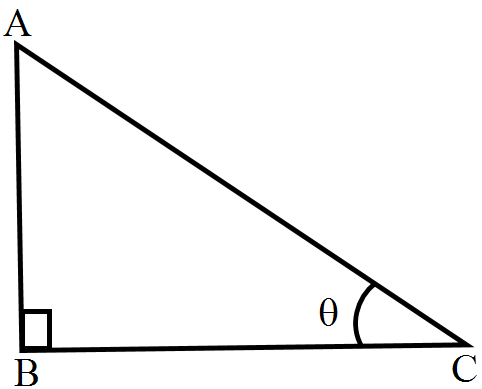
Let the height of the pole be $\text{AB}=\sqrt{3}\text{x}\text{ meters}$ and the length of the shadow be $BC = x$ methers and angle of elevation $=\theta$
$\therefore\tan\theta=\frac{\sqrt{3}\text{x}}{\text{x}}$
$\Rightarrow\tan\theta=\sqrt{3}$
$\Rightarrow\tan\theta=\tan60^\circ$
$\Rightarrow\theta=60^\circ$ View full question & answer→MCQ 721 Mark
The $............$ of an object is the angle formed by the line of sight with the horizontal when the object is above the horizontal level.
AnswerThe angle of elevation of an object is the angle formed by the line of sight with the horizontal when the object is above the horizontal level.
View full question & answer→MCQ 731 Mark
If the angle of elevation of a tower from a distance of $100$ metres from its foot is $60^\circ ,$ then the height of the tower is :
AnswerCorrect option: A. $100\sqrt{3}\text{m}$
Let $AB$ be the tower and a point $P$ at a distance of $100m$ from its foot, angle of elevation of the top of the tower is $60^\circ .$
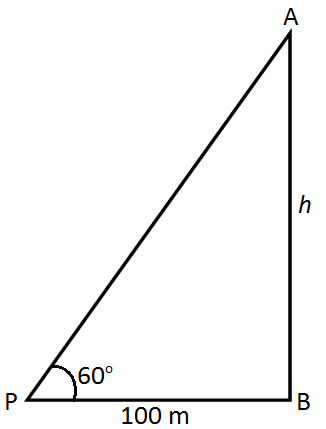
Let height of the tower $= h$
Then in right $\triangle\text{APB,}$
$\tan\theta=\frac{\text{Perpendicular}}{\text{Base}}=\frac{\text{AB}}{\text{PB}}$
$\Rightarrow\ \tan60^\circ=\frac{\text{h}}{100}$
$\Rightarrow\ \sqrt{3}=\frac{\text{h}}{100}$
$\Rightarrow\ \text{h}=100\sqrt{3}$
$\therefore$ Height of tower $=100\sqrt{3}\text{m}$ View full question & answer→MCQ 741 Mark
A $20m$ pole casts a $5m$ long shadow. If at the same time of the day, a building casts a shadow of $20m,$ how high is the building?
- A
$400m$
- B
$4m$
- ✓
$80m$
- D
$100m$
AnswerLet the angle subtended between pole and shadow be $\theta$
$\Rightarrow \text{tan} \theta =\frac{20}{5}=4$
Similarly,
At same time of the day, angle subtended will remain same as position of sun is fixed.
Given that the shadow is $20m$ long.
Let height of the building be $x$
$\Rightarrow \text{tan} \theta =\frac{\text{x}}{20}=4$
$\Rightarrow \text{x}=80 \text{m}$
View full question & answer→MCQ 751 Mark
The height of a tower is $100m$. When the angle of elevation of the sun changes from $30^\circ$ to $45^\circ ,$ the shadow of the tower becomes $x$ metres less. The value of $x$ is :
AnswerCorrect option: C. $100(\sqrt{3}-1)\text{m}$
Let $AB$ be tower and $AB = 100m$ and angles of elevation of $A$ at $C$ and $D$ are $30^\circ $ and $45^\circ $ respectively and $CD = x$
Let $BD = y$
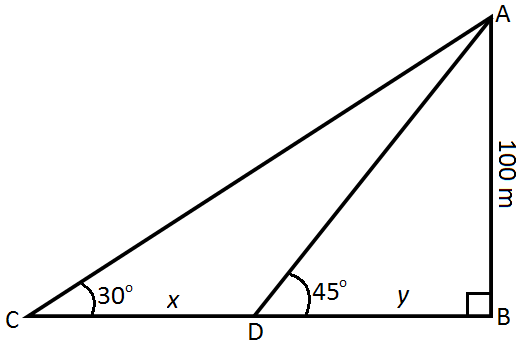
Now in right $\triangle\text{ADB},$
$\tan\theta=\frac{\text{Perpendicular}}{\text{Base}}=\frac{\text{AB}}{\text{DB}}$
$\tan45^\circ=\frac{100}{\text{y}}$
$\Rightarrow\ 1=\frac{100}{\text{y}}$
$\Rightarrow\ \text{y}=100\ ....(\text{i})$
Similarly in right $\triangle\text{ACB,}$
$\tan30^\circ=\frac{\text{AB}}{\text{CB}}$
$\Rightarrow\ \frac{1}{\sqrt{3}}=\frac{100}{\text{y}+\text{x}}$
$=\frac{100}{100+\text{x}}$
$\Rightarrow\ 100+\text{x}=100\sqrt{3}$
$\Rightarrow\ \text{x}=100\sqrt{3}-100$
$=100(\sqrt{3}-1)\text{m}$ View full question & answer→MCQ 761 Mark
The height of the vertical pole is $\sqrt{3}$ times the length of its shadow on the ground, then angle of elevation of the sun at that time is :
- A
$30^\circ$
- ✓
$60^\circ$
- C
$45^\circ$
- D
$75^\circ$
AnswerCorrect option: B. $60^\circ$
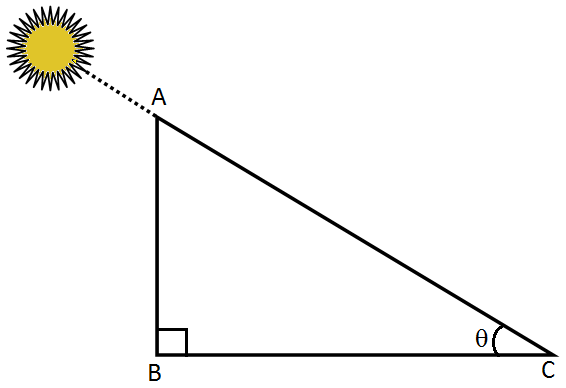
Let the angle of elevation of the sun be $\theta.$
Suppose $AB$ is the height of the pole and $BC$ is the length of its shadow.
It is given that, $\text{AB}=\sqrt{3}\text{BC}$
$\tan\theta=\frac{\text{AB}}{\text{BC}}$
$\Rightarrow\tan\theta=\frac{\sqrt{3}\text{BC}}{\text{BC}}=\sqrt{3}$
$\Rightarrow\tan\theta=\tan60^\circ$
$\Rightarrow\theta=60^\circ$
Thus, the angle of elevation of the sun is $60^\circ .$ View full question & answer→MCQ 771 Mark
The lengths of a vertical rod and its shadow are in the ratio $1:\sqrt{3}.$ The angle of elevation of the sun is :
- ✓
$30^\circ$
- B
$45^\circ$
- C
$60^\circ$
- D
$90^\circ .$
AnswerCorrect option: A. $30^\circ$
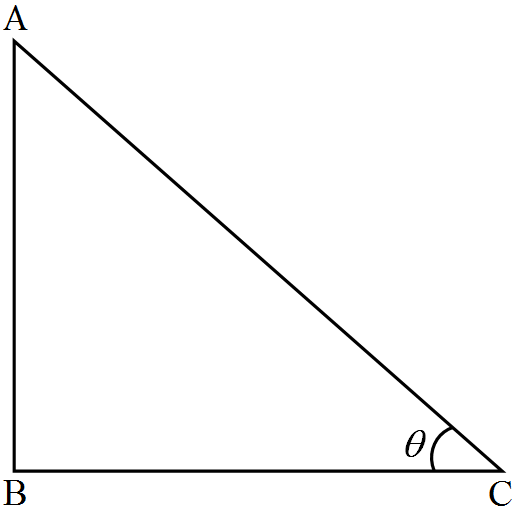
Let $AB$ be the rod and $BC$ be its shadow; and $\theta$ be the angle of elevation of the sun.
We have,
$\text{AB}:\text{BC}=1:\sqrt{3}$
Let $AB = x$
Then, $\text{BC}=\text{x}\sqrt{3}$
In $\triangle\text{ABC},$
$\tan\theta=\frac{\text{AB}}{\text{BC}}$
$\Rightarrow\tan\theta=\frac{1}{\sqrt{3}}$
$\Rightarrow\tan\theta=\tan30^\circ$
$\therefore\ \theta=30^\circ$ View full question & answer→MCQ 781 Mark
The angle of elevation of the top of a tower at a point on the ground $50m$ away from the foot of the tower is $45^\circ$ . Then the height of the tower $($in metres$)$ is :
- A
$50\sqrt{3}$
- ✓
$50$
- C
$\frac{50}{\sqrt{2}}$
- D
$\frac{50}{\sqrt{3}}$
AnswerLet $AB$ be tower and $C$ is a point on the ground $50m$ away.
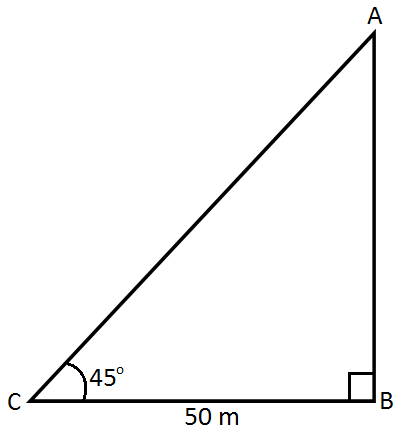
From foot of tower $B$
Angle of elevation is $45^\circ$
Let $h$ be height of tower $= xm$
$\therefore\ \tan\theta=\frac{\text{AB}}{\text{BC}}$
$\Rightarrow\ \tan45^\circ=\frac{\text{AB}}{5}$
$\Rightarrow\ 1=\frac{\text{AB}}{50}$
$\Rightarrow\ \text{AB}=50\text{m.}$ View full question & answer→MCQ 791 Mark
The angle of elevation of a cloud from a point h metre above a lake is $\theta.$ The angle of depression of its reflection in the lake is $45^\circ$ . The height of the cloud is :
- ✓
$\text{h}\tan(45^\circ+\theta)$
- B
$\text{h}\cot(45^\circ-\theta)$
- C
$\text{h}\tan(45^\circ-\theta)$
- D
$\text{h}\cot(45^\circ+\theta)$
AnswerCorrect option: A. $\text{h}\tan(45^\circ+\theta)$
Let $C$ is the cloud and $R$ is its reflection in the lake
From the lake $, '7’m$ aboves it, $E$ is point
where angle of elevation of $C$ is $\theta$
and angle of depression of reflection is $45^\circ $
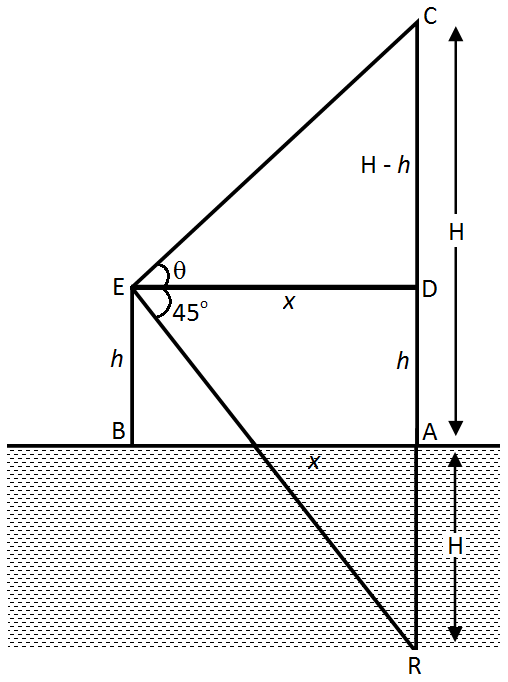
Let height of cloud $C$ is $H$
$\therefore CA = H = AR$
$AD = BE = h$
$CD = H - h$ and $BR = H + h$
Now in right $\triangle\text{CED,}$
$\tan\theta=\frac{\text{CD}}{\text{ED}}=\frac{\text{H}-\text{h}}{\text{x}}$
$\Rightarrow\ \text{x}=\frac{\text{H}-\text{h}}{\tan\theta}\ .....(\text{i})$
and in $\triangle\text{EDR,}$
$\tan45^\circ=\frac{\text{DR}}{\text{ED}}=\frac{\text{H}+\text{h}}{\text{x}}$
$\Rightarrow\ \text{x}=\frac{\text{H}+\text{h}}{\tan45^\circ}=\frac{\text{H}+\text{h}}{1}$
$\Rightarrow\ \text{x}=\text{H}+\text{h}\ .....(\text{i})$
From $(i) $ and $(ii)$
$\frac{\text{H}-\text{h}}{\tan\theta}=\text{H}+\text{h}$
$\Rightarrow\ \text{H}-\text{h}=\tan\theta(\text{H}+\text{h})$
$\Rightarrow\ \text{H}-\text{h}=\text{H}\tan\theta+\text{h}\tan\theta$
$\Rightarrow\ \text{H}-\text{H}\tan\theta=\text{h}+\text{h}\tan\theta$
$\Rightarrow\ \text{H}(1-\tan\theta)=\text{h}(1+\tan\theta)$
$\Rightarrow\ \text{H}=\frac{\text{h}(1+\tan\theta)}{1-\tan\theta}$
$\therefore$ Height of the cloud $=\frac{\text{h}(1+\tan\theta)}{1-\tan\theta}$
$=\text{h}\tan(45^\circ+\theta)$ View full question & answer→MCQ 801 Mark
A pole $10m$ high cast a shadow $10m$ long on the ground, then the sun's elevation is :
- A
$60^\circ$
- ✓
$45^\circ$
- C
$30^\circ$
- D
$90^\circ$
AnswerCorrect option: B. $45^\circ$
In $\triangle BAC,$
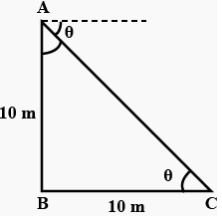
$\Rightarrow \text{tan} \theta = \frac{\text{AB}}{\text{BC}} =\frac{10}{10} = 1$
$\Rightarrow \theta = 45^\circ$
Hence, the answer is $45^\circ$ .
View full question & answer→MCQ 811 Mark
An electric pole is $10\sqrt3\text{m}$ high and its shadow is $10m$ in length, then the angle of elevation of the sun is :
- A
$45^\circ$
- B
$30^\circ$
- ✓
$60^\circ$
- D
$15^\circ$
AnswerCorrect option: C. $60^\circ$
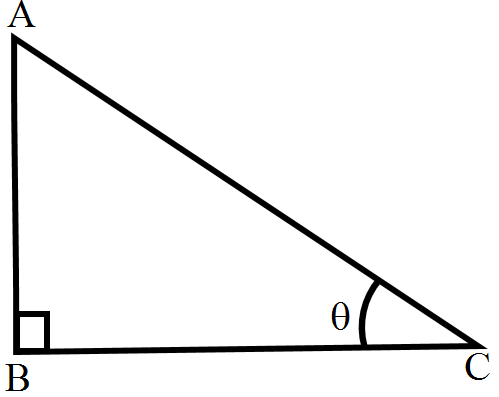
Let ab be the electric pole of height $10\sqrt3\text{m}$ its Shadow be $BC$ of lenght $10m.$
And the angle of elevation of the sun be $\theta.$
$\therefore\tan\theta=\frac{\text{AB}}{\text{BC}}$
$\Rightarrow\tan\theta=\frac{10\sqrt3}{10}$
$\Rightarrow\tan\theta=\sqrt3$
$\Rightarrow\tan\theta=\tan60^\circ$
$\Rightarrow\theta=60^\circ$ View full question & answer→MCQ 821 Mark
In a right $\triangle\text{ABC}, AC$ is the hypotenuse of length $10\ cm$. If $\angle\text{A} = 30^\circ,$ then the area of the triangle is :
AnswerCorrect option: C. $\frac{25}{2}\sqrt3\text{ cm}^2$
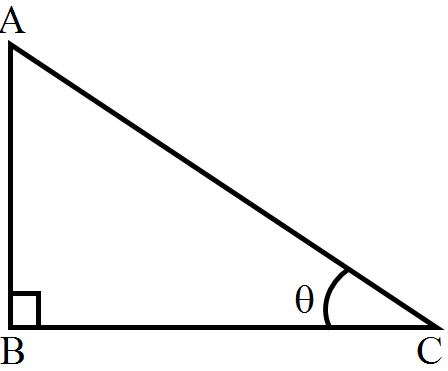
In triangle $\text{ABC}, AC$ is hypotenuse of the length $= 10\ cm \angle\text{A}=30^\circ$
Now, $\sin30^\circ=\frac{\text{BC}}{\text{AC}}$
$\Rightarrow\frac{1}{2}=\frac{\text{BC}}{10}$
$\Rightarrow\text{BC}=\frac{10}{2}=5\text{ cm}$
Now, $\text{AB}=\sqrt{(\text{AC})^2-(\text{BC})^2}$
$=\sqrt{(10)^2-(5)^2}$
$=\sqrt{100-25}$
$=\sqrt{75}=5\sqrt3\text{ cm}$
$\therefore$ ar $(\triangle\text{ABC})=\frac{1}{2}\times\text{BC}\times\text{AB}$
$=\frac{1}{2}\times5\sqrt3\times5$
$=\frac{25\sqrt3}{2}\text{sq.}\text{cm}$ View full question & answer→MCQ 831 Mark
The angle of depression of a car parked on the road from the top of a $150-m-$ high tower is $30^\circ$ . The distance of the car from the tower is :
- A
$50\sqrt{3}\text{m}$
- ✓
$150\sqrt{3}\text{m}$
- C
$150\sqrt{2}\text{m}$
- D
$75\text{m}$
AnswerCorrect option: B. $150\sqrt{3}\text{m}$
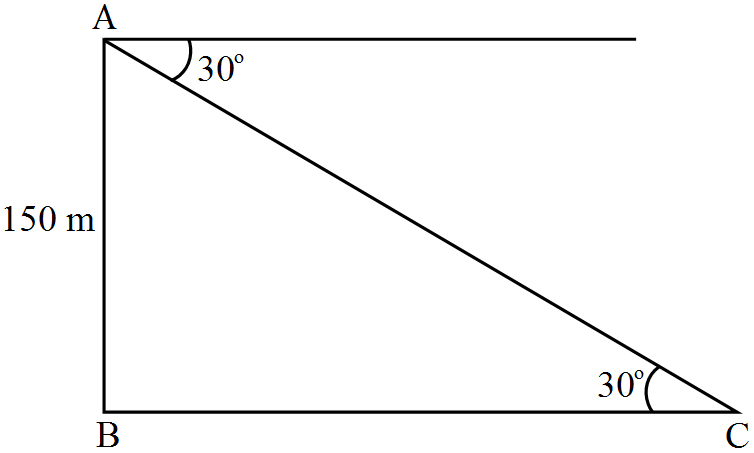
Let $AB$ be the tower and point $C$ be the position of the car.
We have,
$AB = 150m,$ and $\angle\text{ACB}=30^\circ$
In $\triangle\text{ABC},$
$\tan30^\circ=\frac{\text{AB}}{\text{BC}}$
$\Rightarrow\frac{1}{\sqrt{3}}=\frac{150}{\text{BC}}$
$\therefore\ \text{BC}=150\sqrt{3}\text{m}$ View full question & answer→MCQ 841 Mark
A plane is observed to be approaching the airport. It is at a distance of $12\ km$ from the point of observation and makes an angle of elevation of $30^\circ$ there at. Its height above the ground is :
- A
$6\ km$
- ✓
$10\ km$
- C
$12\ km$
- D
AnswerCorrect option: B. $10\ km$
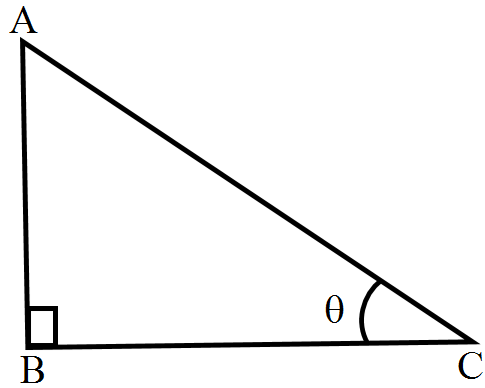
Let the height of the flying plane be $AB = h$ meters,
distance from the point of observation $AC = 12\ km$ and angle of elevation $ \theta=30^\circ$
$\therefore\sin30^\circ=\frac{\text{AB}}{\text{AC}}$
$\Rightarrow\frac{1}{2}=\frac{\text{h}}{12}$
$\Rightarrow\text{h}=6\text{ meters}.$ View full question & answer→MCQ 851 Mark
The angle of elevation of the top of a tower from two points $P$ and $Q$ at distances of $'a\ ’$ and $'b\ ’$ respectively from the base and in the same straight line with it are complementary. The height of the tower is :
- A
$2\sqrt{\text{ab}}$
- B
$\text{None of these}$
- C
$\text{ab}$
- ✓
$\sqrt{\text{ab}}$
AnswerCorrect option: D. $\sqrt{\text{ab}}$
Let $TW$ be the tower of height $h$ meters and $P$ and $Q$ are two points such that $PW = a$ and $QW = b.$
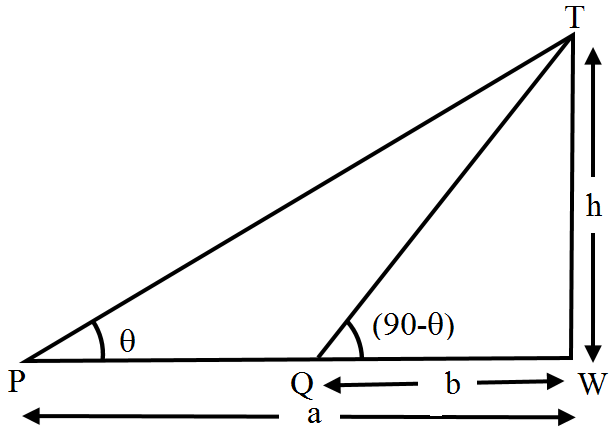
Let angles of elevation be $\angle\text{WPT}=\theta$
And $\angle\text{WQT}=90^\circ-\theta$
Now, in right angled triangle $\text{TWP},$
$\tan\theta=\frac{\text{TW}}{\text{PW}}$
$\Rightarrow\tan\theta=\frac{\text{h}}{\text{a}}$
$\Rightarrow\text{h}=\text{a}\tan\theta...(\text{i})$
Again in right angled triangle $\text{TWQ},$
$\tan(90^\circ-\theta)=\frac{\text{h}}{\text{b}}$
$\Rightarrow\cot\theta=\frac{\text{h}}{\text{b}}$
$\Rightarrow\text{h}=\text{b}\cot\theta...(\text{ii})$
Multiplying eq. $(i)$ and $(ii),$ we get
$\text{h}\times\text{h}=(\text{a}\tan \theta)(\text{b}\cot\theta)$
$\Rightarrow\text{h}^2=\text{ab}$
$\Rightarrow\text{h}^2=\sqrt{\text{ab}}$
Therefore, the height of the tower is $\sqrt{\text{ab}}.$ View full question & answer→MCQ 861 Mark
In a right triangle $\text{ABC}, \angle\text{C}=90^\circ.$ If $ \text{AC}=\sqrt{3} BC$ and $ \angle\text{B}=\text{f},$ then find its value.
- A
$45^\circ$
- B
$30^\circ$
- ✓
$60^\circ$
- D
AnswerCorrect option: C. $60^\circ$
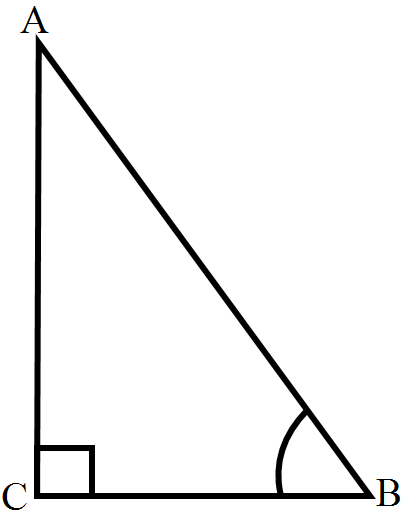
Given : $\angle\text{C}=90^\circ.$ If $ \text{AC}=\sqrt{3} BC$ and $\angle\text{B}=\phi$
$\therefore\tan\phi=\frac{\text{AB}}{\text{BC}}$
$\Rightarrow\tan\phi=\frac{\sqrt{3}\text{BC}}{\text{BC}}=\sqrt{3}$
$\Rightarrow\tan\phi=\tan60^\circ\phi$
$\Rightarrow\phi=60^\circ$ View full question & answer→MCQ 871 Mark
From the top of a cliff $24m$ height, a man observes the angle of depression of a boat is to be $60^\circ.$ The distance of the boat from the foot of the cliff is :
- ✓
$8\sqrt{3}\text{m}$
- B
$8\sqrt{2}\text{m}$
- C
$8\sqrt{5}\text{m}$
- D
$8\text{m}$
AnswerCorrect option: A. $8\sqrt{3}\text{m}$
$8\sqrt{3}\text{m}$
View full question & answer→MCQ 881 Mark
An observer $1.5m$ tall is $23.5m$ away from a tower $25m$ high. The angle of elevation of the top of the tower from the eye of the observer is :
- A
$30^\circ$
- B
$60^\circ$
- ✓
$45^\circ$
- D
AnswerCorrect option: C. $45^\circ$
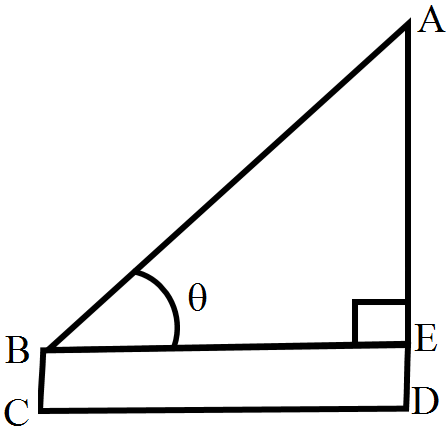
Let $\theta$ be the angle of elevation,
The height of the tower $AD = 25m$
And $CD = 23.5m$
In triangle $\text{ABE},$
$\therefore\tan\theta=\frac{\text{AE}}{\text{BE}}=\frac{\text{AD}-\text{ED}}{\text{CD}}$
$\Rightarrow\tan\theta=\frac{25-1.5}{23.5}=\frac{23.5}{23.5}=1$
$\Rightarrow\tan\theta=\tan45^\circ\theta$
$\Rightarrow\theta=\tan45^\circ$ View full question & answer→MCQ 891 Mark
A flag staff stands upon the top of a building. At a distance of $40m$. the angles of elevation of the tops of the flag staff and building are $60^\circ$ and $30^\circ$ then the height of the flag staff in metres is :
- A
$40\sqrt{3}$
- B
$\frac{40}{\sqrt{3}}$
- C
$\frac{160}{\sqrt{3}}$
- ✓
$\frac{80}{\sqrt{3}}$
AnswerCorrect option: D. $\frac{80}{\sqrt{3}}$
$\frac{80}{\sqrt{3}}$
View full question & answer→MCQ 901 Mark
A ladder makes an angle of $60^\circ$ with the ground when placed against a wall. If the foot of the ladder is $2m$ away from the wall, then the length of the ladder $($in metres$)$ is :
- A
$\frac{4}{\sqrt{3}}$
- B
$4\sqrt{3}$
- ✓
$4$
- D
$2\sqrt2$
AnswerSuppose $AB$ is the ladder of length $x m$
$\therefore OA = 2m, \angle\text{OAB}=60^\circ$
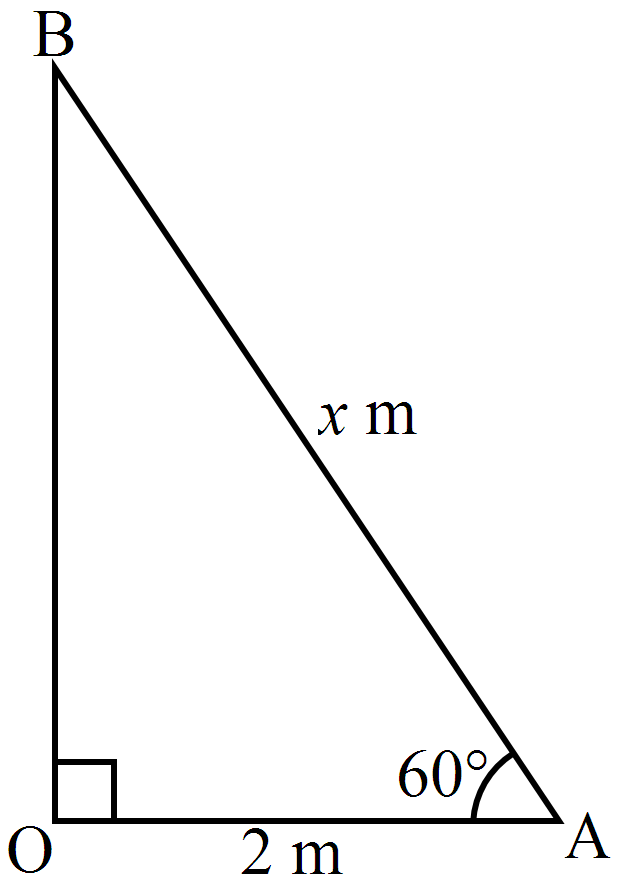
In right $\triangle\text{AOB},$
$\sec60^\circ=\frac{\text{x}}{2}$
$\Rightarrow2=\frac{\text{x}}{2}$
$\Rightarrow=4\text{m}$ View full question & answer→MCQ 911 Mark
If the shadow of a boy $'x\ ’$ metres high is $1.6m$ and the angle of elevation of the sun is $45^\circ,$ then the value of $'x\ ’$ is :
- A
$0.8m$
- ✓
$1.6m$
- C
$3.2m$
- D
$2m$
AnswerCorrect option: B. $1.6m$
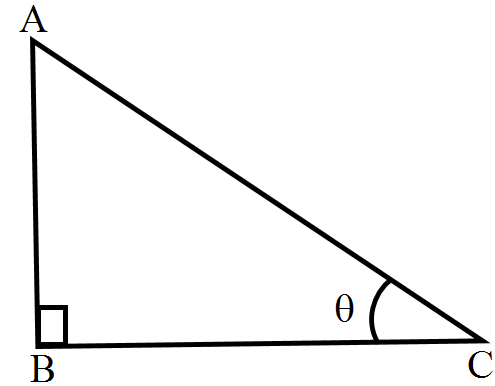
Given : Height of the boy $= AB =x$ meters
And the lenght of the shadow of the boy $= BC = 1.6m$
And angled of elevation $\theta=45^\circ$
$\therefore\tan45^\circ=\frac{\text{AB}}{\text{BC}}$
$\Rightarrow1=\frac{\text{x}}{1.6}$
$\Rightarrow\text{x}=1.6\text{m}$ View full question & answer→MCQ 921 Mark
From a point on the ground which is $15m$ away from the foot of a tower, the angle of elevation is found to be $60^\circ$ . The height of the tower is :
- ✓
$15\sqrt{3}\text{m}$
- B
$20\sqrt{3}\text{m}$
- C
$10\sqrt{3}\text{m}$
- D
$10\text{m}$
AnswerCorrect option: A. $15\sqrt{3}\text{m}$
Let the height of the tower be $h$ meters.
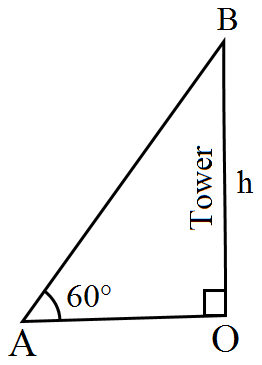
In triangle $\text{AOB},$
$\tan60^\circ=\frac{\text{AB}}{\text{OA}}$
$\Rightarrow\tan60^\circ=\frac{\text{h}}{15}$
$\Rightarrow\sqrt{3}=\frac{\text{h}}{15}$
$\Rightarrow\text{h}=15\sqrt{3}\text{m}$
Therefore, the height of the tower is $15\sqrt{3}\text{ meters}.$ View full question & answer→MCQ 931 Mark
From the top of a building $60m$ high, the angles of depression of the top and the bottom of a tower are observed to be $30^\circ$ and $60^\circ$ . The height of the tower is :
Answer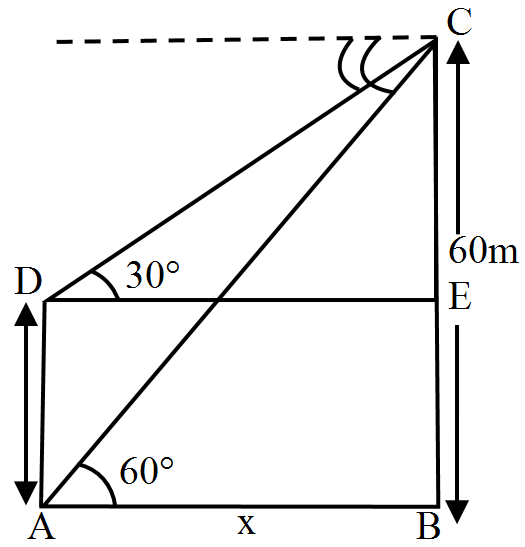
In triangle $\text{CDE},$
$\tan30^\circ=\frac{60-\text{h}}{\text{x}}$
$\Rightarrow\frac{1}{\sqrt3}=\frac{60-\text{h}}{\text{x}}$
$\Rightarrow\text{x}=\sqrt3(60-\text{h})\text{ meters }....(\text{i})$
Again, in triangle $\text{CAB},$
$\tan60^\circ=\frac{60}{\text{x}}$
$\Rightarrow\sqrt3=\frac{60}{\text{x}}$
$\Rightarrow\text{x}=\frac{60}{\sqrt3}\text{ meters }....(\text{ii})$
From eq. $(i),$ and $(ii)$ we get,
$\sqrt{3}(60-\text{h})=\frac{60}{\sqrt3}$
$\Rightarrow60-\text{h}=20$
$\Rightarrow\text{h}=40\text{ meters}$ View full question & answer→MCQ 941 Mark
From a point $P$ on the level ground, the angle of elevation of the top of a tower is $30^\circ$ . If the tower is $100m$ high, the distance between $P$ and the foot of the tower is :
- A
$300\sqrt{3}\text{m}$
- B
$150\sqrt{3}\text{m}$
- C
$200\sqrt{3}\text{m}$
- ✓
$100\sqrt{3}\text{m}$
AnswerCorrect option: D. $100\sqrt{3}\text{m}$
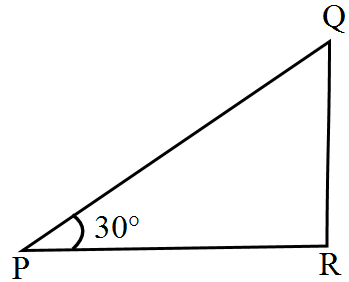
Let $QR$ be the height of the tower, then $QR = 100m$
And the angle of elevation of the top of the tower be $\angle\text{QPR}=30^\circ$
$\therefore\tan30^\circ=\frac{\text{QR}}{\text{PR}}$
$\Rightarrow\frac{1}{\sqrt3}=\frac{100}{\text{PR}}\text{m}$
$\Rightarrow\text{PR}=100\sqrt{3}\text{ meters}$
Therefore, the distance between $P$ and the foot of the tower is $100\sqrt{3}\text{ meters}.$ View full question & answer→MCQ 951 Mark
Two poles are $'a\ '$ metres apart and the height of one is double of the other. If from the middle point of the line joining their feet an observer finds the angular elevations of their tops to be complementary, then the height of the smaller is :
- A
$\sqrt{2}\text{a}\text{ meters}$
- ✓
$\frac{\text{a}}{2\sqrt{2}}\text{ meters}$
- C
$\frac{\text{a}}{\sqrt{2}}\text{ meters}$
- D
$2\text{a meters}$
AnswerCorrect option: B. $\frac{\text{a}}{2\sqrt{2}}\text{ meters}$
Let height of pole $CD = h$
and $AB = 2h, BD = a$
$M$ is mid $-$ point of $BD$
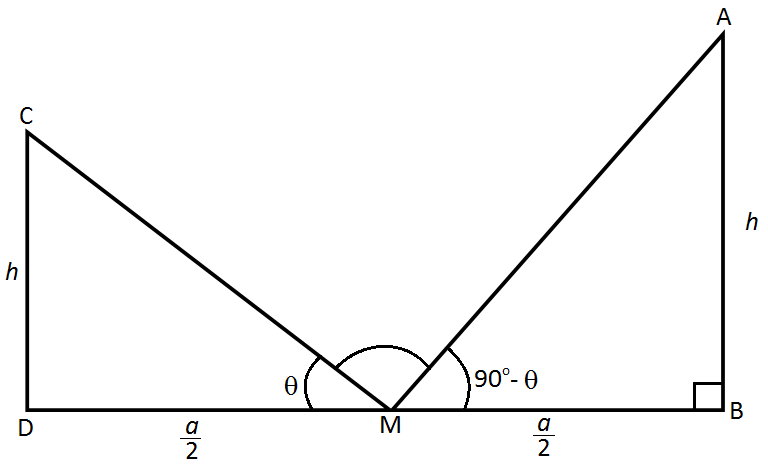
$\therefore\ \text{DM}=\text{MB}=\frac{\text{a}}{2}$
Let $\angle\text{CMD}=\theta,$
then $\angle\text{AMB}=90^\circ-\theta$
Now, $\tan\theta=\frac{\text{CD}}{\text{DM}}=\frac{\text{h}}{\frac{\text{a}}{2}}=\frac{2\text{h}}{\text{a}}\ ....(\text{i})$
and $\tan(90^\circ-\theta)=\frac{\text{AB}}{\text{MB}}$
$=\frac{2\text{h}}{\frac{\text{a}}{2}}=\frac{4\text{h}}{\text{a}}$
$\Rightarrow\ \cot\theta=\frac{4\text{h}}{\text{a}}\ .....(\text{ii})$
Multiplying $(i)$ and $(ii)$
$\tan\theta,\ \cot\theta=\frac{2\text{h}}{\text{a}}\times\frac{4\text{h}}{\text{a}}$
$1=\frac{8\text{h}^2}{\text{a}^2}$
$\Rightarrow\ \text{h}^2=\frac{\text{a}^2}{8}\text{m}$
$\text{h}=\sqrt{\frac{\text{a}^2}{8}}=\frac{\text{a}}{\sqrt{8}}$
$=\frac{\text{a}}{2\sqrt{2}}\text{m}$ View full question & answer→MCQ 961 Mark
The angle of elevation of the top of a tower standing on a horizontal plane from a point $A$ is $\alpha.$ After walking a distance d towards the foot of the tower the angle of elevation is found to be $\beta.$ The height of the tower is :
- A
$\frac{\text{d}}{\cot\alpha+\cot\beta}$
- ✓
$\frac{\text{d}}{\cot\alpha-\cot\beta}$
- C
$\frac{\text{d}}{\tan\beta-\tan\alpha}$
- D
$\frac{\text{d}}{\tan\beta+\tan\alpha}$
AnswerCorrect option: B. $\frac{\text{d}}{\cot\alpha-\cot\beta}$
The given information can be represented with the help of a diagram as below.
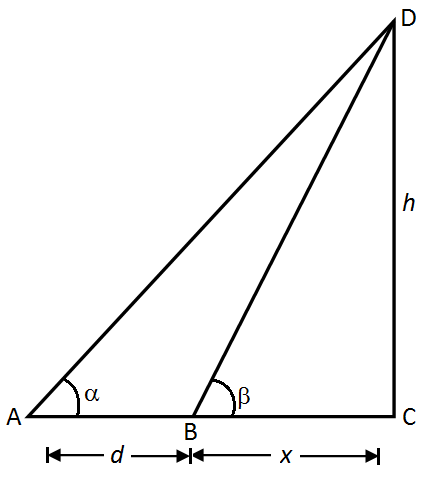
Here $,CD = h$ is the height of the tower.
Length of $BC$ is taken as $x.$
In $\triangle\text{ACD},$
$\tan\text{A}=\frac{\text{CD}}{\text{AC}}$
$\tan\alpha=\frac{\text{h}}{\text{d}+\text{x}}$
$\text{h}=(\text{d}+\text{x})\tan\alpha\ .......(1)$
In $\triangle\text{BCD},$
$\tan\text{B}=\frac{\text{CD}}{\text{BC}}$
$\tan\beta=\frac{\text{h}}{\text{x}}$
$\text{x}=\text{h}\cot\beta\ .....(2)$
From $(1)$ and $(2),$
$\text{h}=(\text{d}+\text{h}\cot\beta)\tan\alpha$
$\text{h}=\text{d}\tan\alpha+\text{h}\cot\beta\tan\alpha$
$\text{h}(1-\cot\beta\tan\alpha)=\text{d}\tan\alpha$
$\text{h}=\frac{\text{d}\tan\alpha}{(1-\cot\beta\tan\alpha)}=\frac{\text{d}}{\cot\alpha-\cot\beta}$ View full question & answer→MCQ 971 Mark
Two men are on opposite sides of a tower. They observe the angles of elevation of the top of the tower as $30^\circ$ and $45^\circ$ respectively. If the height of the tower is $100m,$ then the distance between them is :
- A
$100(1-\sqrt3)\text{m}$
- B
$100(\sqrt3-1)\text{m}$
- C
$\text{none of these}$
- ✓
$100(\sqrt3+1)\text{m}$
AnswerCorrect option: D. $100(\sqrt3+1)\text{m}$
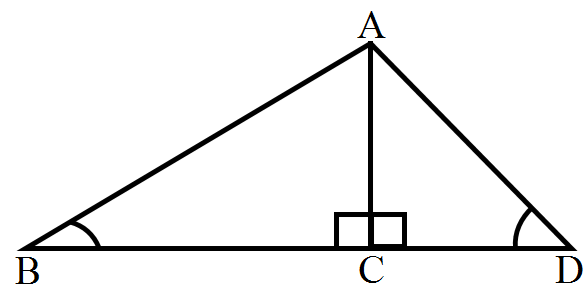
Let the height of the tower $AC = 100m$
Now, in triangle $\text{ABC},$
$\tan30^\circ=\frac{\text{AC}}{\text{BC}}$
$\Rightarrow\frac{1}{\sqrt3}=\frac{100}{\text{BC}}$
$\Rightarrow\text{BC}=100\sqrt3\text{m}$
Now, in triangle $\text{ACD},$
$\tan45^\circ=\frac{\text{AB}}{\text{CD}}$
$\Rightarrow1=\frac{100}{\text{CD}}$
$\Rightarrow\text{CD}=100\text{m}$
Therefore, the required distance $=\text{BC}+\text{CD}$
$=100\sqrt3+100$
$=100(\sqrt3+1)\text{m}$ View full question & answer→MCQ 981 Mark
The angle of depression of a boat from the top of a cliff $300m$ high is $60^\circ$ . The distance of the boat from the foot of the cliff is :
- ✓
$100\sqrt{3}$
- B
$100$
- C
$300\sqrt{3}$
- D
$300$
AnswerCorrect option: A. $100\sqrt{3}$
$100\sqrt{3}$
View full question & answer→MCQ 991 Mark
A boy is flying a kite, the string of the kite makes an angle of $30^\circ$ with the ground. If the height of the kite is $18m,$ then the length of the string is :
- A
$18\sqrt3\text{m}$
- B
$18\text{m}$
- ✓
$36\text{m}$
- D
$36\sqrt3\text{m}$
AnswerCorrect option: C. $36\text{m}$
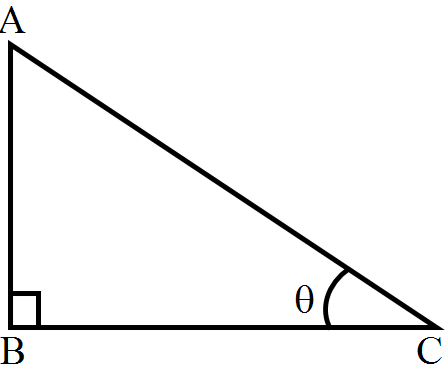
Let height of the kite $AB = 18m,$
length of the string $= AC$ and angle of elevation $= \theta =30^\circ$
$\therefore\sin30^\circ=\frac{\text{AB}}{\text{AC}}$
$\Rightarrow\frac{1}{2}=\frac{18}{\text{AC}}$
$\Rightarrow\text{AC}=36\text{m}$ View full question & answer→MCQ 1001 Mark
A ladder $15m$ long just reaches the top of a vertical wall. If the ladder makes an angle of $60^\circ$ with the wall, then the height of the wall is :
AnswerCorrect option: C. $\frac{15}{2}\text{m}$
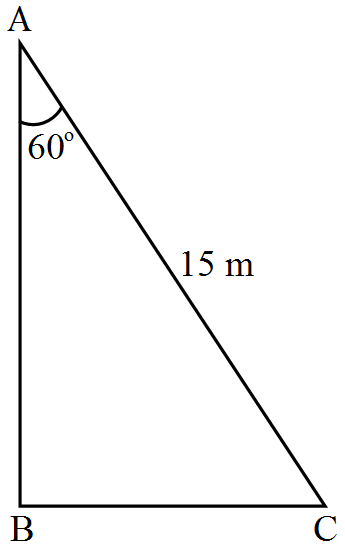
Let $AB$ be the wall and $AC$ be the ladder
We have,
$AC = 15m,$ and $\angle\text{BAC}=60^\circ$
In $\triangle\text{ABC},$
$\cos60^\circ=\frac{\text{AB}}{\text{AC}}$
$\Rightarrow\frac{1}{2}=\frac{\text{AB}}{15}$
$\therefore\ \text{AB}=\frac{15}{2}\text{m}$ View full question & answer→MCQ 1011 Mark
A ladder makes an angle of $60^\circ$ with the ground when placed against a wall. If the foot of the ladder is $2m$ away from the wall, then the length of the ladder is :
AnswerCorrect option: D. $4\text{m}$
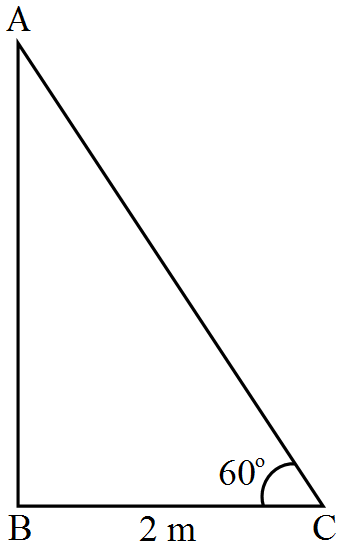
Let $AB$ be the wall and $AC$ be the ladder
We have,
$BC = 2m,$ and $\angle\text{ACB}=60^\circ$
In $\triangle\text{ABC},$
$\cos60^\circ=\frac{\text{BC}}{\text{AC}}$
$\Rightarrow\frac{1}{2}=\frac{2}{\text{AC}}$
$\therefore\ \text{AC}=4\text{m}$ View full question & answer→MCQ 1021 Mark
Two persons are a metres apart and the height of one is double that of the other. If from the middle point of the line joining their feet, an observer finds the angular elevation of their tops to be complementary, then the height of the shorter post is :
AnswerCorrect option: D. $\frac{\text{a}}{2\sqrt{2}}$
Let $AB$ and $CD$ be the two persons such that $AB < CD.$
Then, let $AB = h$ so that $CD = 2h$
Now, the given information can be represented as,
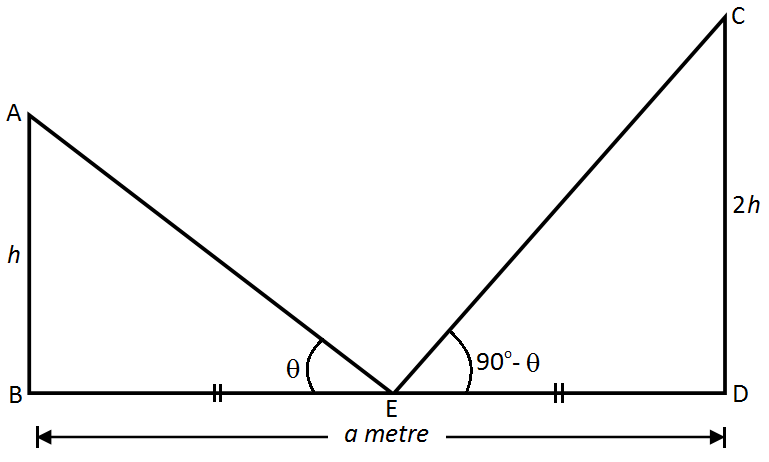
Here, $E$ is the midpoint of $BD$.
We have to find height of the shorter person.
So we use trigonometric ratios.
In triangle $\text{ECD},$
$\tan\angle\text{CED}=\frac{\text{CD}}{\text{ED}}$
$\Rightarrow\ \tan(90^\circ-\theta)=\frac{2\text{h}}{\big(\frac{\text{a}}{2}\big)}$
$\Rightarrow\ \cot\theta=\frac{4\text{h}}{\text{a}}\ ....(1)$
Again in triangle $\text{ABE},$
$\tan\angle\text{AEB}=\frac{\text{AB}}{\text{BE}}$
$\Rightarrow\ \tan\theta=\frac{\text{h}}{\big(\frac{\text{a}}{2}\big)}$
$\Rightarrow\ \frac{1}{\cot\theta}=\frac{2\text{h}}{\text{a}}$
$\Rightarrow\ \frac{\text{a}}{4\text{h}}=\frac{2\text{h}}{\text{a}}$
$\Rightarrow\ \text{a}^2=8\text{h}^2$
$\Rightarrow\ \text{h}=\frac{\text{a}}{2\sqrt{2}}$ View full question & answer→MCQ 1031 Mark
The angle of depression of a car, standing on the ground, from the top of a 75m tower, is 30°. The distance of the car from the base of the tower (in metres) is:
- ✓
$25\sqrt{3}$
- B
$50\sqrt{3}$
- C
$75\sqrt{3}$
- D
$150$
AnswerCorrect option: A. $25\sqrt{3}$
(A) $25\sqrt{3}$
View full question & answer→MCQ 1041 Mark
A pole stands vertically, inside a triangular park $\text{ABC}$. If the angle of elevation of the top of the pole from each corner of the park is same, then the foot of the pole is at the :
AnswerIf angle of elevation $(p)$ is same from all the vertices then the Pole must be at Equal Distance from each of the vertices which will be $= R\ ($Circumradius$)$
as $\tan\text{p}=\frac{\text{H}}{\text{R}}$
$\Rightarrow\frac{\text{H}}{\tan\text{p}}\ [$which is same from all vertices$]$
therefore, the pole must be lying on the Circumcenter
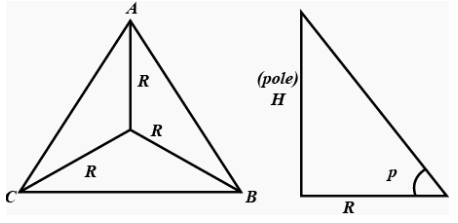
View full question & answer→MCQ 1051 Mark
The length of the shadow of a $20m$ tall pole on the ground when the sun’s elevation is $45^\circ$ is :
- A
$20\sqrt2\text{m}$
- ✓
$20\text{m}$
- C
$40\text{m}$
- D
$20\sqrt3\text{m}$
AnswerCorrect option: B. $20\text{m}$
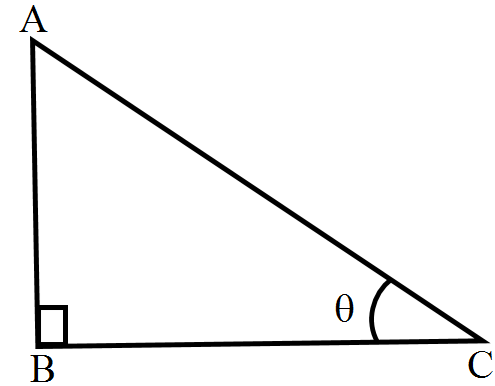
Given : Height of pole $= AB = 20$m and angle of elevation $\theta=45^\circ$
Let lenght of shadow of pole $= BC = x$ meters.
$\therefore\tan45^\circ=\frac{\text{AB}}{\text{BC}}$
$\Rightarrow1=\frac{20}{\text{x}}$
$\Rightarrow\text{x}=20\text{m}$
Therefore, the lenght of the shadow of the pole is $20m.$ View full question & answer→MCQ 1061 Mark
If two trees of height $'x\ ’$ and $'y\ ’$ standing on the two ends of a road subtend angles of $30^\circ$ and $60^\circ$ respectively at the midpoint of the road, then the ratio of $x : y$ is :
- A
$1 : 1$
- B
$1 : 2$
- C
$3 : 1$
- ✓
$1 : 3$
AnswerCorrect option: D. $1 : 3$
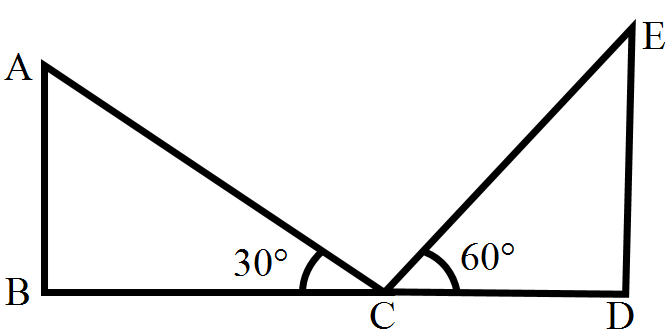
Here two trees $AB$ abd $ED$ are of height $x$ and $y$ respectively. And $BC = CD$
$\therefore\tan30^\circ=\frac{\text{x}}{\text{BC}}$
$\Rightarrow\frac{1}{\sqrt3}=\frac{\text{x}}{\text{BC}}$
$\Rightarrow\text{x}=\frac{\text{BC}}{\sqrt3}$ And $\tan60^\circ=\frac{\text{y}}{\text{CD}}$
$\Rightarrow\sqrt3=\frac{\text{y}}{\text{CD}}$
$\Rightarrow\text{y}=\text{CD}\sqrt3=\text{BC}\sqrt3 \ [BC = CD]$
Now, $\frac{\text{x}}{\text{y}}=\frac{\text{BC}}{\sqrt3\times\text{BC}\sqrt3}=\frac{1}{3}$
$\Rightarrow\text{x}:\text{y}=1:3$ View full question & answer→MCQ 1071 Mark
A man standing on a level plane observes the elevation of the top of a pole to be $\alpha$ . He then walks a distance equal to double the height of the pole and then finds that the elevation is now $2\alpha$ . Then $\alpha =$
- A
$30^\circ$
- ✓
$15^\circ$
- C
$60^\circ$
- D
$45^\circ$
AnswerCorrect option: B. $15^\circ$
$15^\circ$
View full question & answer→MCQ 1081 Mark
A ladder makes an angle of $60^\circ$ with the ground when placed against a wall. If the foot of the ladder is $2m$ away from the wall, then the length of the ladder $($in metres$)$ is :
- A
$\frac{4}{\sqrt{3}}$
- B
$4\sqrt{3}$
- C
$2\sqrt{2}$
- ✓
$4$
Answer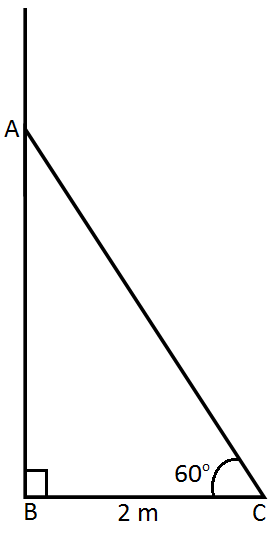
Suppose $AC$ is the ladder and $BC$ is the distance of the foot of the ladder from the wall.
It is given that $, BC = 2m$ and $\angle\text{ACB}=60^\circ.$
In right $\triangle\text{ABC,}$
$\cos60^\circ=\frac{\text{BC}}{\text{AC}}$
$\Rightarrow\ \frac{1}{2}=\frac{2}{\text{AC}}$
$\Rightarrow\ \text{AC}=4\text{m}$
Thus, the length of the ladder is $4m.$ View full question & answer→MCQ 1091 Mark
In a $\triangle\text{ABC}$ right angled at $B, \angle\text{A}=30^\circ$ and $AC = 6\ cm,$ then the lenght of $BC$ is :
- A
$3\sqrt3\text{ cm}$
- B
$2\sqrt3\text{ cm}$
- ✓
$3\text{ cm}$
- D
$4\sqrt3\text{ cm}$
AnswerCorrect option: C. $3\text{ cm}$
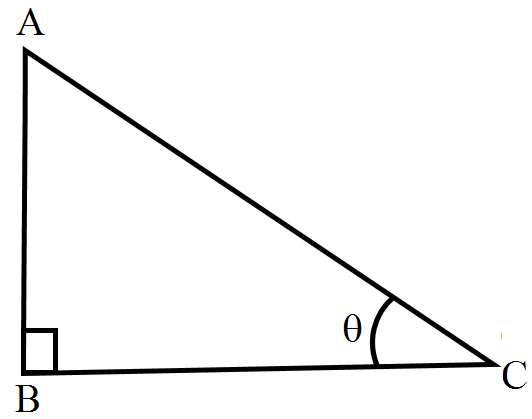
In triangle $\text{ABC}, \angle\text{A}=30^\circ,$ and $AC = 6\ cm$
Then the lenght of $BC,$
$\sin30^\circ=\frac{\text{BC}}{6}$
$\Rightarrow\frac{1}{2}=\frac{\text{BC}}{6}$
$\Rightarrow\text{BC}=\frac{6}{2}=3\text{ cm}$
$=\frac{6}{2}=3\text{ cm}$
Therefore, the length of $BC$ is $3\ cm$. View full question & answer→MCQ 1101 Mark
The angle of elevation of a cliff from a point $A$ on the ground and from the point $B 100m$ vertically above $A$ are $\alpha$ and $\beta$ respectively. The height of the cliff $($in metres$)$ is :
- A
$\frac{100\tan\beta}{\cot\beta-\cot\alpha}$
- ✓
$\frac{100\cot\beta}{\cot\beta-\cot\alpha}$
- C
$\frac{100\tan\beta}{\cot\alpha+\cot\beta}$
- D
$\frac{100\cot\beta}{\cot\alpha+\cot\beta}$
AnswerCorrect option: B. $\frac{100\cot\beta}{\cot\beta-\cot\alpha}$
$\frac{100\cot\beta}{\cot\beta-\cot\alpha}$
View full question & answer→MCQ 1111 Mark
A kite is flying at a height of $90m$ above the ground. The string attached to the kite is temporarily tied to a point on the ground. The inclination of the string with the ground is $60^\circ.$ The length of the string, assuming that there is no slack in the string is :
- ✓
$60\sqrt3\text{m}$
- B
$90\text{m}$
- C
$90\sqrt3\text{m}$
- D
$45\text{m}$
AnswerCorrect option: A. $60\sqrt3\text{m}$
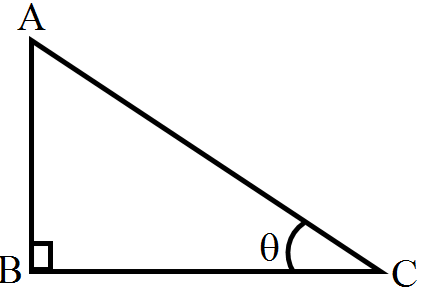
Let Height of the flying kite $= AB = 90m$
And the angle of elevation $=\theta=60^\circ$
And the length of the string $= AC$
$\therefore\sin60^\circ=\frac{\text{AB}}{\text{AC}}$
$\Rightarrow\frac{\sqrt3}{2}=\frac{90}{\text{AC}}$
$=\text{AC}=\frac{90\times2}{\sqrt3}\times\frac{\sqrt3}{\sqrt3}$
$=60\sqrt3\text{m}$ View full question & answer→MCQ 1121 Mark
If the angle of depression of an object from a $75m$ high tower is $30^\circ,$ then the distance of the object from the tower is :
- A
$25\sqrt{3}\text{m}$
- B
$50\sqrt{3}\text{m}$
- C
$100\sqrt{3}\text{m}$
- ✓
$75\sqrt{3}\text{m}$
AnswerCorrect option: D. $75\sqrt{3}\text{m}$
In triangle $\text{ABC},$
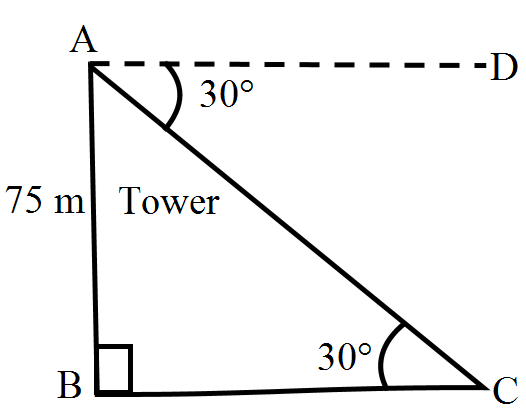
$\tan30^\circ=\frac{\text{AB}}{\text{BC}}$
$\Rightarrow\frac{1}{\sqrt3}=\frac{75}{\text{BC}}$
$\Rightarrow\text{BC}=75\sqrt3\text{m}$
Therefore, the distance between $P$ and foot of the tower is $75\sqrt{3}\text{ meters}.$ View full question & answer→MCQ 1131 Mark
The $..........$ is the line drawn from the eye of an observer to the point in the object viewed by the observer.
AnswerThe line of sight is the imaginary line drawn from the eye of an observer to the point in the object viewed by the observer.
The angle between the line of sight and the ground is called angle of elevation.
View full question & answer→MCQ 1141 Mark
If the angles of elevation of a tower from two points at distances $'m\ ’$ and $'n\ ’$ where $m > n$ from its foot and in the same line from it are $30^\circ$ and $60^\circ ,$ then the height of the tower is :
- A
$\sqrt{\text{m}+\text{n}}$
- ✓
$\sqrt{\text{m}\text{n}}$
- C
$\sqrt\frac{\text{m}}{\text{n}}$
- D
$\sqrt{\text{m}-\text{n}}$
AnswerCorrect option: B. $\sqrt{\text{m}\text{n}}$
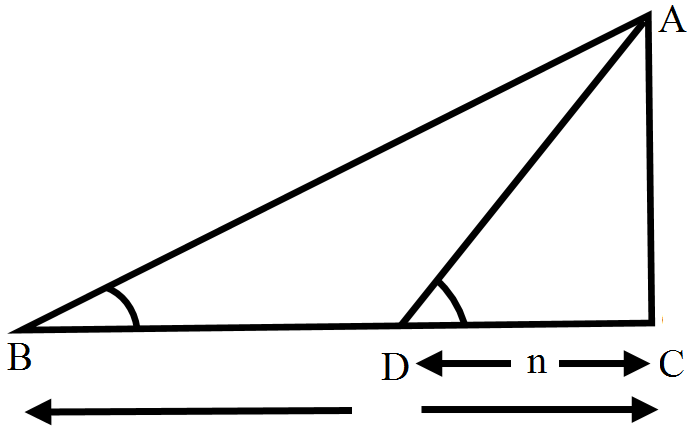
In triangle $\text{ABC}, \angle\text{ABC}=30^\circ$
$\tan30^\circ=\frac{\text{h}}{\text{m}}$
$\Rightarrow\frac{1}{\sqrt3}=\frac{\text{h}}{\text{m}}$
$\Rightarrow\text{h}=\frac{\text{m}}{\sqrt3}.....(\text{i})$
In triangle $\text{ADC}, \angle\text{ADC}=60^\circ$
$\tan60^\circ=\frac{\text{h}}{\text{n}}$
$\Rightarrow\sqrt3=\frac{\text{h}}{\text{n}}$
$\Rightarrow\text{h}=\text{n}\sqrt3.....(\text{ii})$ View full question & answer→MCQ 1151 Mark
The angle of elevation of an object viewed is the angle formed by the line of sight with the horizontal when it is :
- ✓
Above the horizontal level
- B
Below the horizontal level
- C
- D
AnswerCorrect option: A. Above the horizontal level
In the figure $,AB$ is a vertical object with $A$ as foot and $B$ as top.
$P$ is the point of observation.
So $,PA$ is the line of horizontal sight and we have to raise our head if we look at $B.$
The angle, described in this case $\angle\text{PAB}$ when $PB$ is the line of sight.
But by definition, $\angle\text{APB}$ is the angle of elevation.
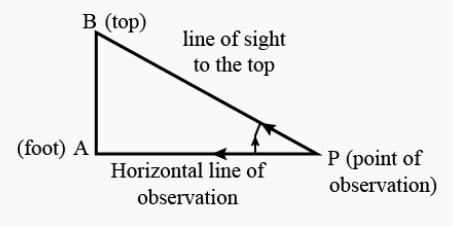
View full question & answer→MCQ 1161 Mark
If the height of the tower is $\sqrt{3}$ times of the length of its shadow, then the angle of elevation of the sun is :
- A
$15^\circ$
- B
$30^\circ$
- ✓
$60^\circ$
- D
$45^\circ$
AnswerCorrect option: C. $60^\circ$
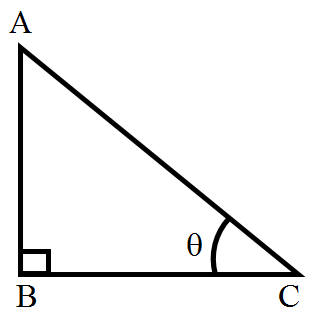
Let the length of the shadow be $x$ meters.
Then the height of the tower be $\sqrt{3}\text{x}\text{ meter}.$
$\therefore\tan\theta=\frac{\text{AB}}{\text{BC}}$
$\Rightarrow\tan\theta=\frac{\sqrt{3}\text{x}}{\text{x}}$
$\Rightarrow\tan\theta=\sqrt{3}$
$\Rightarrow\tan\theta=\tan60^\circ$
$\Rightarrow\theta=60^\circ$ View full question & answer→MCQ 1171 Mark
If the length of the shadow of a tower is $\sqrt{3}\text{ times}$ its height then the angle of elevation of the sun is :
- A
$45^\circ$
- ✓
$30^\circ$
- C
$60^\circ$
- D
$90^\circ$
AnswerCorrect option: B. $30^\circ$
Let $AB$ be the pole and $BC$ be its shadow.
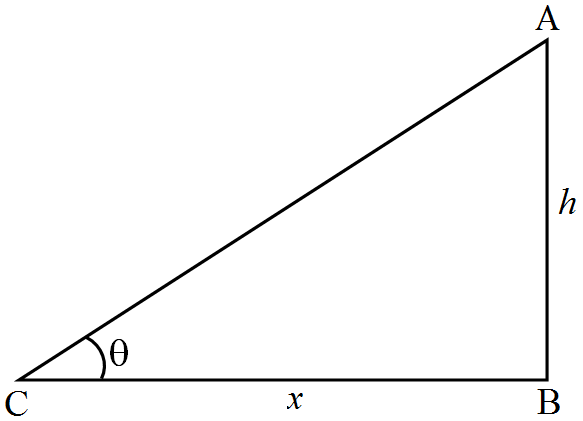
Let $AB = h$ and $BC = x$ such that $\text{x}=\sqrt{3}\text{h}\ ($given$)$ and $\theta$ be the angle of elevation.
From $\triangle\text{ABC},$ we have:
$\frac{\text{AB}}{\text{BC}}=\tan\theta$
$\Rightarrow\frac{\text{h}}{\text{x}}=\frac{\text{h}}{\sqrt{3}\text{h}}=\tan\theta$
$\Rightarrow\tan\theta=\frac{1}{\sqrt{3}\text{h}}$
$\Rightarrow\theta=30^\circ$ View full question & answer→MCQ 1181 Mark
The length of the shadow of a tower standing on level ground is found to be $2x$ metres longer when the sun's elevation is $30^\circ$ than when it was $45^\circ$ . The height of the tower in metres is :
- ✓
$(\sqrt{3}+1)\text{x}$
- B
$(\sqrt{3}-1)\text{x}$
- C
$2\sqrt{3}\text{x}$
- D
$3\sqrt{2}\text{x}$
AnswerCorrect option: A. $(\sqrt{3}+1)\text{x}$
Let $h$ be the height of tower $AB.$
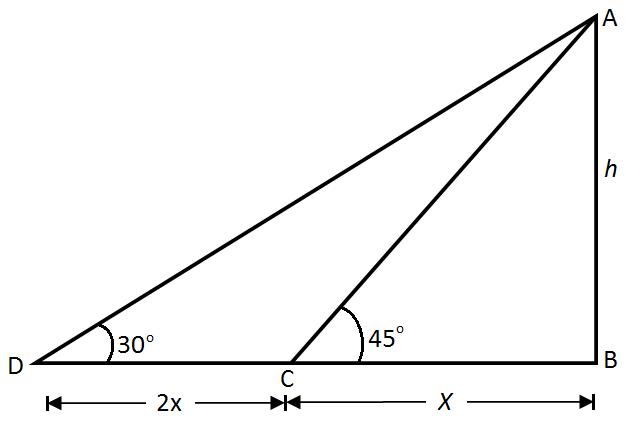
Given that : angle of elevation of sun are $\angle\text{D}=30^\circ$ and $\angle\text{C}=45^\circ.$
Then Distance $CD = 2x$ and we assume $BC = X$
Here, we have to find the height of tower.
So we use trigonometric ratios.
In a triangle $\text{ABC},$
$\Rightarrow\ \tan\text{C}=\frac{\text{AB}}{\text{BC}}$
$\Rightarrow\ \tan45^\circ=\frac{\text{AB}}{\text{BC}}$
$\Rightarrow\ 1=\frac{\text{h}}{\text{X}}$
$\Rightarrow\ \text{X}=\text{h}$
Again in a triangle $\text{ABD},$
$\Rightarrow\ \tan\text{D}=\frac{\text{AB}}{\text{BC}+\text{CD}}$
$\Rightarrow\ \tan30^\circ=\frac{\text{h}}{\text{X}+2\text{x}}$
$\Rightarrow\ \frac{1}{\sqrt{3}}=\frac{\text{h}}{\text{h}+2\text{x}} [X = h]$
$\Rightarrow\ \sqrt{3}\text{h}=\text{h}+2\text{x}$
$\text{h}(\sqrt{3}-1)=2\text{x}$
$\Rightarrow\ \text{h}=\frac{2\text{x}}{\sqrt{3}-1}$
$\Rightarrow\ \text{h}=\frac{2\text{x}}{\sqrt{3}-1}\times\frac{\sqrt{3}+1}{\sqrt{3}+1}$
$\Rightarrow\ \text{h}=\text{x}(\sqrt{3}+1)$ View full question & answer→MCQ 1191 Mark
If in a $ \triangle\text{ABC}, \angle\text{C}=90^\circ$ and $\angle\text{B}=45^\circ,$ then state which of the following is true?
AnswerCorrect option: C. Base $=$ Perpendicular
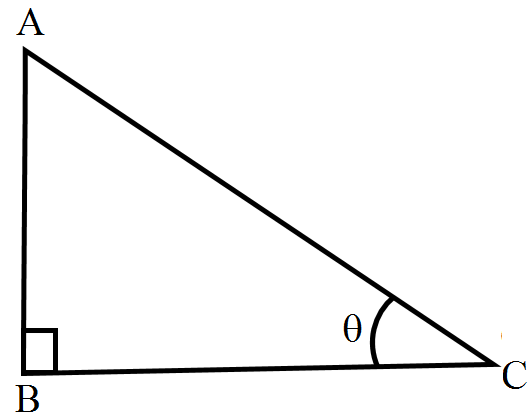
Given : in triangle $\text{ABC}, \angle\text{C}=45^\circ,$ and $\angle\text{B}=90^\circ,$
Since, $\tan\theta=\frac{\text{Perpendicular}}{\text{Base}}$
$\Rightarrow\tan45^\circ=\frac{\text{Perpendicular}}{\text{Base}}$
$1=\frac{\text{Perpendicular}}{\text{Base}}$
$\Rightarrow\text{Base}=\text{Perpendicular}.$ View full question & answer→MCQ 1201 Mark
From a point on the ground which is $15m$ away from the foot of a tower, the angle of elevation is found to be $60^{\circ}$. The height of the tower is :
- A
$10\text{m}$
- B
$10\sqrt3\text{m}$
- C
$20\sqrt3\text{m}$
- ✓
$15\sqrt3\text{m}$
AnswerCorrect option: D. $15\sqrt3\text{m}$
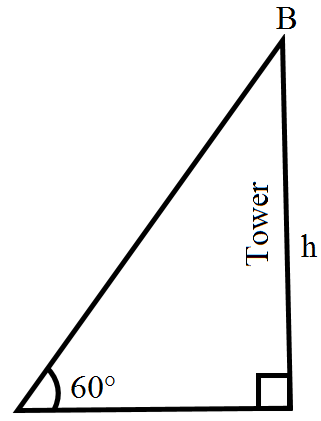
Let the height of the tower be $h$ meters.
In triangle $\text{AOB},$
$\tan60^\circ=\frac{\text{AB}}{\text{OA}}$
$\Rightarrow\tan60^\circ=\frac{\text{h}}{15}$
$\Rightarrow\sqrt3=\frac{\text{h}}{15}$
$\Rightarrow\text{h}=15\sqrt3\text{m}$
Therefore the height of the tower is $15\sqrt3\text{ meters}.$ View full question & answer→MCQ 1211 Mark
A kite is flying at a height of $200m$ above the ground. The string attached to the kite is temporarily tied to a point on the ground. The inclination of the string with the ground is $45^\circ$ . The length of the string, assuming that there is no slack in the string is :
- A
$100\text{m}$
- ✓
$200\sqrt3\text{m}$
- C
$200\text{m}$
- D
$100\sqrt2\text{m}$
AnswerCorrect option: B. $200\sqrt3\text{m}$
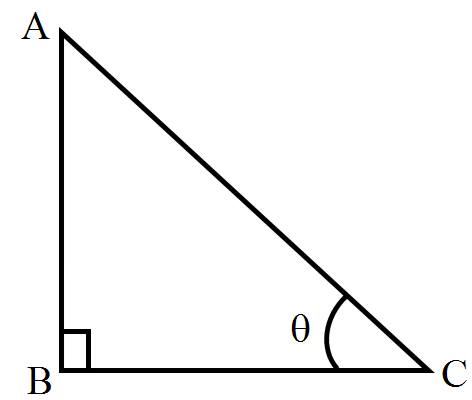
Here, in triangle $\text{ABC},$ Height of the slide $= AB = 200m$
Angle of elevation $= \theta=45^\circ$
To find : Length of string $= AC$
$\therefore\sin45^\circ=\frac{\text{AB}}{\text{AC}}$
$\Rightarrow\frac{1}{\sqrt{2}}=\frac{200}{\text{AC}}$
$\Rightarrow\text{AC}=200\sqrt2\text{m}$ View full question & answer→MCQ 1221 Mark
In a right triangle $\text{ABC}, \angle\text{C}=90^\circ.$ If $\text{AC}=\sqrt3 BC$ and $ \angle\text{B}=\phi,$ then find its value.
- ✓
$60^\circ$
- B
$30^\circ$
- C
$45^\circ$
- D
AnswerCorrect option: A. $60^\circ$
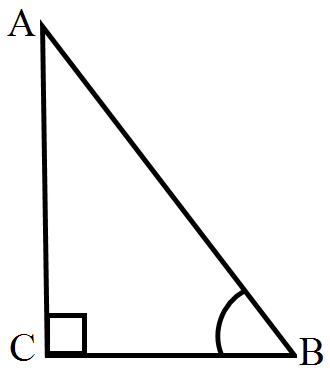
Given : $\angle\text{C}=90^\circ.$
If $\text{AC}=\sqrt3 BC$ and $ \angle\text{B}=\phi,$
$\therefore\tan\phi=\frac{\text{AC}}{\text{BC}}$
$\Rightarrow\tan\phi=\frac{\sqrt3\text{BC}}{\text{BC}}=\sqrt3$
$\Rightarrow\tan\phi=\tan60^\circ\phi$
$\Rightarrow\phi=60^\circ$ View full question & answer→MCQ 1231 Mark
A pole casts a shadow of length $2\sqrt{3}\text{m}$ on the ground when the sun's elevation is $60^\circ$ . The height of the pole is :
- A
$4\sqrt{3}\text{m}$
- ✓
$6\text{m}$
- C
$12\text{m}$
- D
$3\text{m}$
AnswerCorrect option: B. $6\text{m}$
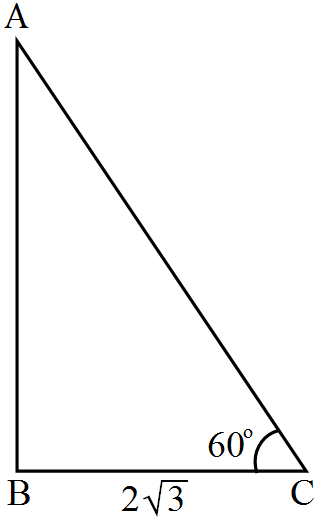
Let $AB $ be the pole and $BC$ be its shadow.
We have,
$\text{BC}=2\sqrt{3}\text{m}$ and $\angle\text{ACB}=60^\circ$
In $\triangle\text{ABC},$
$\tan60^\circ=\frac{\text{AB}}{\text{BC}}$
$\Rightarrow\sqrt{3}=\frac{\text{AB}}{2\sqrt{3}}$
$\therefore\ \text{AB}=6\text{m}$ View full question & answer→MCQ 1241 Mark
A pole $6m$ high casts a shadow $2\sqrt{3}\text{m}$ long on the ground, then the Sun's elevation is :
- ✓
$60^\circ$
- B
$45^\circ$
- C
$30^\circ$
- D
$90^\circ$
AnswerCorrect option: A. $60^\circ$
The sun's elevation angle will be opposite to the side which depicts the height of the pole, and base will be the length of the shadow.
$\text{Base}=2\sqrt{3}\text{m}$
$\text{height = 6m}$
$\tan(\theta)=\frac{6}{2\sqrt{3}}=\sqrt{3}$
$\theta=\tan^{-1}(\sqrt{3})$
$=60^\circ$
$\theta$ being the angle of elevation.
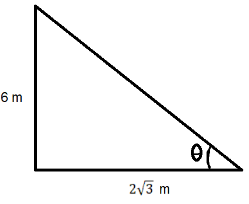
View full question & answer→MCQ 1251 Mark
A ladder $12m$ long rests against a wall. If it reaches the wall at a height of $6\sqrt3\text{m},$ then the angle of elevation is :
- A
$30^\circ$
- B
$45^\circ$
- C
$75^\circ$
- ✓
$60^\circ$
AnswerCorrect option: D. $60^\circ$
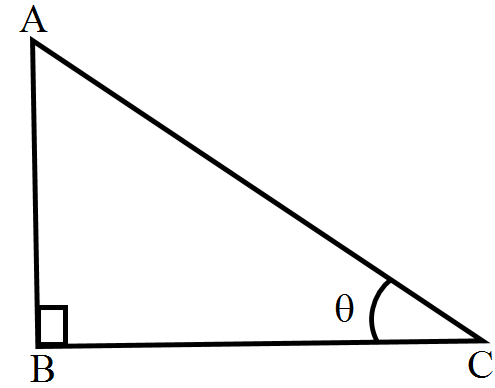
Then the height $AB$ is $6\sqrt3\text{ meter}.$
$\therefore\sin\theta=\frac{\text{AB}}{\text{AC}}$
$\Rightarrow\sin\theta=\frac{6\sqrt3}{12}$
$\Rightarrow\sin\theta=\frac{\sqrt3}{2}$
$\Rightarrow\sin\theta=\sin60^\circ$
$\Rightarrow\theta=60^\circ$ View full question & answer→MCQ 1261 Mark
If a kite is flying at a height of $10\sqrt3\text{m}$ from the level ground attached to a string inclined at $60^\circ$ to the horizontal then the length of the string is :
- A
$40\sqrt3\text{m}$
- B
$60\sqrt3\text{m}$
- C
$80\sqrt3\text{m}$
- ✓
$20\text{m}$
AnswerCorrect option: D. $20\text{m}$
Let $AB$ be the length of the string and $\text{AC}=10\sqrt3\text{m}$
And $\angle\text{ABC}=60^\circ$
In triangle $\text{ABC},$
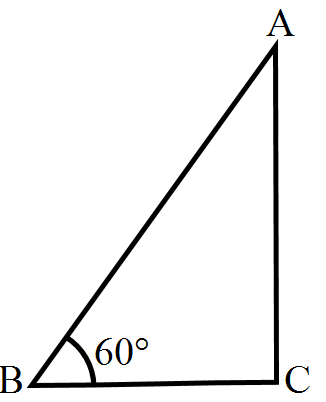
$\sin60^\circ=\frac{\text{AC}}{\text{AB}}$
$\Rightarrow\frac{\sqrt3}{2}=\frac{10\sqrt3}{\text{AB}}$
$\Rightarrow\text{AB}=\frac{10\sqrt3\times2}{\sqrt3}=20\text{ cm}$
Therefore, the lenght of the strigh is $20m$. View full question & answer→MCQ 1271 Mark
The ratio of the length of a rod and its shadow is $1:\sqrt{3}.$ The angle of elevation of the sum is :
- ✓
$30^\circ$
- B
$45^\circ$
- C
$60^\circ$
- D
$90^\circ$
AnswerCorrect option: A. $30^\circ$
Let $\theta$ be angle of elevation of sun.
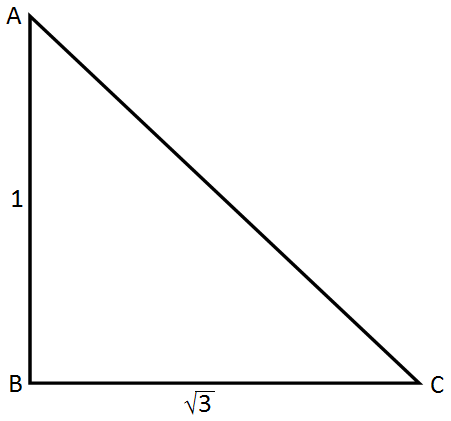
Given that : length of road $AB = 1$ and its shadow $\text{BC}=\sqrt{3}$
Here, we have to find angle of elevation of sun.
So we use trigonometric ratios.
In a triangle $\text{ABC},$
$\Rightarrow\ \tan\text{C}=\frac{\text{AB}}{\text{BC}}$
$\Rightarrow\ \tan\theta=\frac{1}{\sqrt{3}}$
$\Big[\because\ \tan30^\circ=\frac{1}{\sqrt{3}}\Big]$
$\Rightarrow\ \theta=30^\circ$ View full question & answer→MCQ 1281 Mark
A pole $10m$ high cast a shadow $10m$ long on the ground, then the sun’s elevation is :
- A
$15^\circ$
- ✓
$45^\circ$
- C
$30^\circ$
- D
$60^\circ$
AnswerCorrect option: B. $45^\circ$
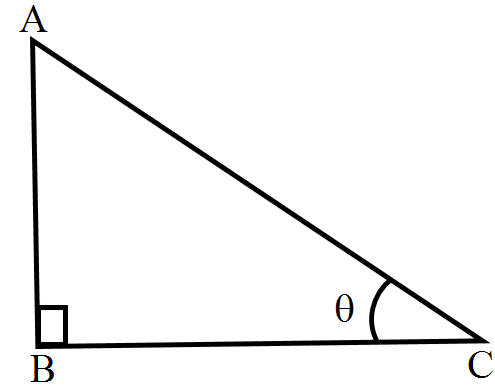
Let the lenght of the shadow $BC$ be $10$ meters.
Then the height of the pole $AB$ is $10$ meter.
$\therefore\tan\theta=\frac{\text{AB}}{\text{BC}}$
$\Rightarrow\tan\theta=\frac{10}{10}$
$\Rightarrow\tan\theta=1$
$\Rightarrow\tan\theta=\tan45^\circ$
$\Rightarrow\theta=45^\circ$ View full question & answer→MCQ 1291 Mark
A kite is flying at a height of $60m$ from the level ground, attached to a string inclined at $30^\circ$ to the horizontal. The length of the string is :
- A
$40\sqrt3\text{m}$
- B
$60\sqrt3\text{m}$
- ✓
$120\text{m}$
- D
$\text60\text{m}$
AnswerCorrect option: C. $120\text{m}$
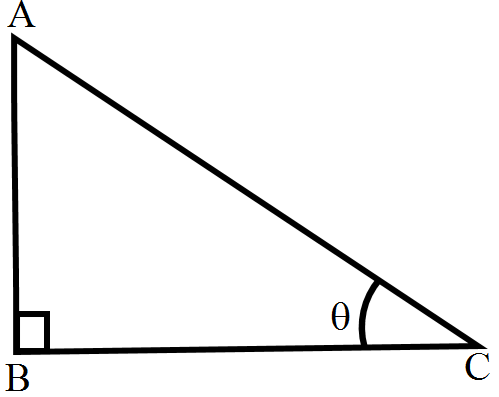
Let kite is flying at a height $AB = 60m$ and angle of elevation $= 30^\circ$
To find : Length of the the string $AC$
$\therefore\sin30^\circ=\frac{\text{AC}}{\text{AB}}$
$\Rightarrow\frac{1}{2}=\frac{6}{\text{AB}}\text{m}$
$\Rightarrow\text{AB}=120\text{m}$
Therefore, the lenght of string is $120m.$ View full question & answer→MCQ 1301 Mark
$A$ and $B$ are two stations due north and south of a tower of height $25m$. The angles of depression of the stations from the top of the towe $r$ observed to be $30^\circ$ and $45^\circ$ respectively. The distance between the two stations is :
- ✓
$25(\sqrt{3}+1)$
- B
$25(\sqrt{3}-1)\text{m}$
- C
$25\sqrt{3}\text{m}$
- D
$25(2+\sqrt{3})\text{m}$
AnswerCorrect option: A. $25(\sqrt{3}+1)$
$\tan45^\circ=\frac{25}{\text{d}_2}$
$\text{d}_2=25$
$\tan30^\circ=\frac{25}{\text{d}_1}$
$\text{d}_1=25\sqrt{3}$
$\text{d}_1+\text{d}_2=25(\sqrt{3}+1)\text{m}$
View full question & answer→MCQ 1311 Mark
If the altitude of the sum is at $60^\circ,$ then the height of the vertical tower that will cast a shadow of length $30m$ is :
AnswerCorrect option: A. $30\sqrt{3}\text{m}$
Let $h$ be the height of vertical tower $AB.$
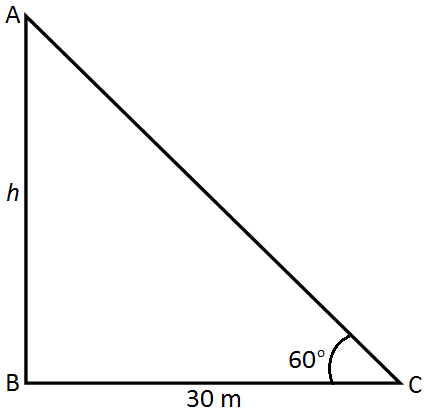
Given that : altitude of sun is $60^\circ$ and shadow of length $BC = 30$ meters.
Here, we have to find the height of tower.
So we use trigonometric ratios.
In a triangle $\text{ABC},$
$\Rightarrow\ \tan\text{C}=\frac{\text{AB}}{\text{BC}}$
$\Rightarrow\ \tan60^\circ=\frac{\text{AB}}{\text{BC}}$
$\Rightarrow\ \sqrt{3}=\frac{\text{h}}{30}$
$\Rightarrow\ \text{h}=30\sqrt{3}$ View full question & answer→MCQ 1321 Mark
A bridge across a river makes an angle of $45^\circ$ with the river bank. If the length of the bridge across the river is $200m,$ then the breadth of the river is :
- ✓
$100\sqrt2\text{m}$
- B
$200\sqrt2\text{m}$
- C
$200\text{m}$
- D
$100\text{m}$
AnswerCorrect option: A. $100\sqrt2\text{m}$
Let the breadth of the river be $h$ meters.
$\sin45^\circ=\frac{\text{h}}{200}$
$\Rightarrow\frac{1}{\sqrt2}=\frac{\text{h}}{200}$
$\Rightarrow\text{h}=\frac{200}{\sqrt2}$
$\Rightarrow\text{h}=\frac{200}{\sqrt2}\times\frac{\sqrt2}{\sqrt2}$
$=100\sqrt2\text{ meters}$
Therefore, the breadth of the river is $100\sqrt2\text{ meters}.$ View full question & answer→MCQ 1331 Mark
The angles of depression of two ships from the top of a light house are $45^\circ$ and $30^\circ$ towards east. If the ships are $100m$ apart. the height of the light house is :
AnswerCorrect option: C. $50(\sqrt{3}-1)\text{m}$
Let $AB$ be the light house $C$ and $D$ are two ships whose angles of depression on $A$ are $30^\circ $ and $45^\circ $ respectively.
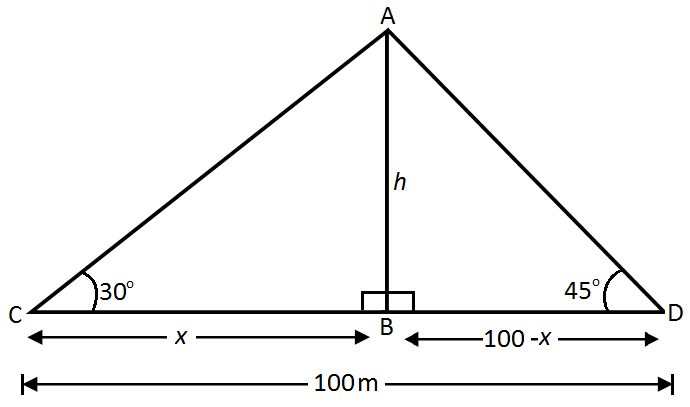
$\because \text{XAY} \| CD$
$\therefore\ \angle\text{ACB}=\angle\text{XAC}=30^\circ$
and $\angle\text{ADB}=\angle\text{YAD}=45^\circ,$
$CD = 100m$
Let $AB = h$ and $CB = x,$ then $BD = (100 - x)$
Now in right $\triangle\text{ACB,}$
$\tan\theta=\frac{\text{Perpendicular}}{\text{Base}}=\frac{\text{AB}}{\text{CB}}$
$\tan30^\circ=\frac{\text{h}}{\text{x}}$
$\Rightarrow\ \frac{1}{\sqrt{3}}=\frac{\text{h}}{\text{x}}$
$\Rightarrow\ \text{x}=\sqrt{3}\text{h}\ ......(\text{i})$
Similarly in right $\triangle\text{ADB,}$
$\tan45^\circ=\frac{\text{AB}}{\text{BD}}$
$\Rightarrow\ 1=\frac{\text{h}}{100-\text{x}}$
$\Rightarrow\ 100-\text{x}=\text{h}$
$\Rightarrow\ \text{x}=100-\text{h}\ .....(\text{ii})$
From $(i)$ and $(ii)$
$\sqrt{3}\text{h}=100-\text{h}$
$\Rightarrow\ \sqrt{3}\text{h}+\text{h}=100$
$\Rightarrow\ (\sqrt{3}+1)\text{h}=100$
$\text{h}=\frac{100}{\sqrt{3}+1}=\frac{100(\sqrt{3}-1)}{(\sqrt{3}+1)(\sqrt{3}-1)}$
$=\frac{100(\sqrt{3}-1)}{3-1}=\frac{100(\sqrt{3}-1)}{2}$
$=50(\sqrt{3}-1)$
$\therefore$ Height of light house $=50(\sqrt{3}-1)\text{m}$ View full question & answer→MCQ 1341 Mark
If the angle of depression of a car from a $100m$ high tower is $45^\circ,$ then the distance of the car from the tower is :
- ✓
$100\text{m}$
- B
$200\text{m}$
- C
$100\sqrt{3}\text{m}$
- D
$200\sqrt{3}\text{m}$
AnswerCorrect option: A. $100\text{m}$
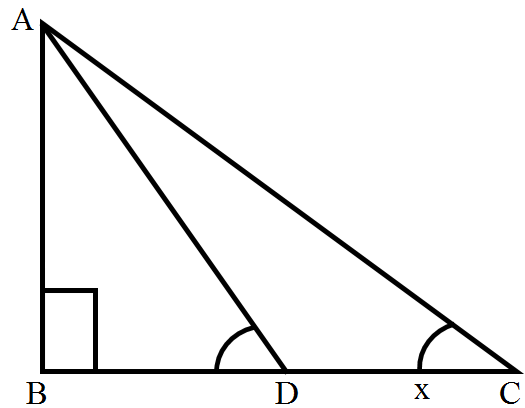
Let the distance of the car from the tower be $x$ meters.
$\therefore\tan45^\circ=\frac{\text{AC}}{\text{BC}}$
$\Rightarrow1=\frac{100}{\text{x}}\text{m}$
$\Rightarrow\text{x}=100\text{m}$
Therefore, the distance of the car from the tower is $100m.$ View full question & answer→MCQ 1351 Mark
The shadow of a $5m$ long stick is $2m$ long. At the same time, the length of the shadow of a $12.5m$ high tree is :
AnswerRatio of lengths of objects $=$ ratio of lengths of their shadows.
Let the length of shadow of the tree be $x m$.
Then $,\frac{5}{12.5}=\frac{2}{\text{x}}$
$\Rightarrow5\text{x}=2\times12.5=25$
$\Rightarrow\text{x}=5$
View full question & answer→MCQ 1361 Mark
A $1.2m$ tall boy stands at a distance of $2.4m$ from a lamp post and casts a shadow of $3.6m$ on the ground. The height of the lamp post is :
AnswerIn triangle $\text{ABC}$ and $\text{BED},$
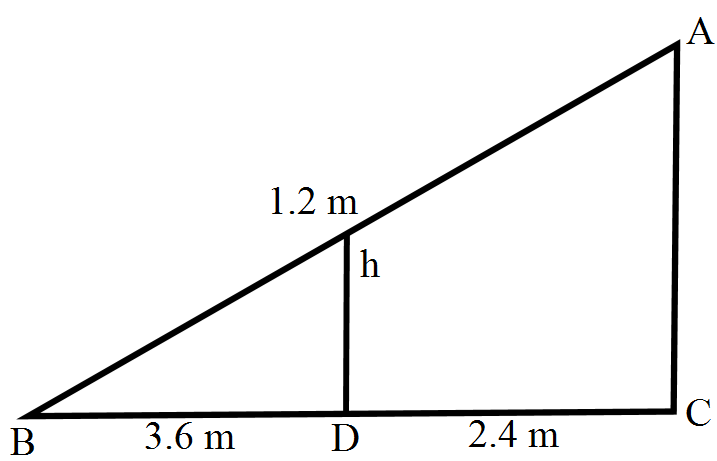
$\angle\text{C}=\angle\text{EDB} \ [$Each $90^\circ ]$
and $\angle\text{B}=\angle\text{B}\ [$Common$]$
$\therefore\triangle\text{ABC}\sim\triangle\text{BDE}$
$\therefore\frac{\text{AC}}{\text{DE}}=\frac{\text{BC}}{\text{DC}}$
$\Rightarrow\frac{\text{h}}{1.2}=\frac{6}{3.6}$
$\Rightarrow\text{h}=\frac{6\times1.2}{3.6}=2\text{m}$ View full question & answer→MCQ 1371 Mark
The angle formed by the line of sight with the horizontal, when the point being viewed is above the horizontal level is called :
AnswerThe angle of Elevation is the angle formed by the line of sight with the horizontal, when the point being viewed is above the horizontal level.
Hence, the answer is angle of elevation.
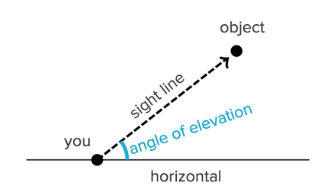
View full question & answer→MCQ 1381 Mark
The tops of two poles of height $20m$ and $14m$ are connected by a wire. If the wire makes an angle of $30^\circ$ with horizontal, then the length of the wire is :
AnswerLet $AB$ and $CD$ be two poles $AB = 20m, CD = 14m. $
$A$ and $C$ are joined by a wire $CE \| DB$ and angle of elevation of $A$ is $30^\circ .$
Let $CE = DB = x$ and $AC = l$
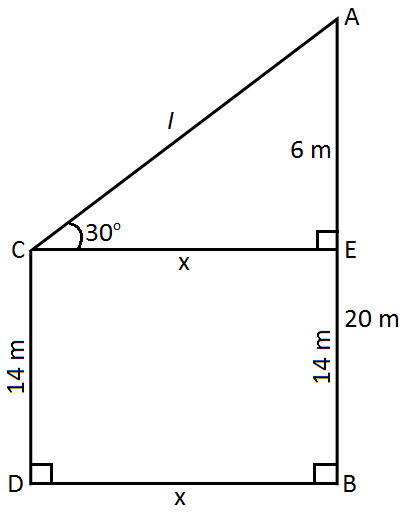
Now $, AE = AB - EB = AB - CD $
$= 20 - 14 = 6m$
Now in right $\triangle\text{ACE,}$
$\sin\theta=\frac{\text{Perpendicular}}{\text{Hypotenuse}}=\frac{\text{AE}}{\text{AC}}$
$\Rightarrow\ \sin30^\circ=\frac{6}{\text{AC}}$
$\Rightarrow\ \frac{1}{2}=\frac{6}{\text{AC}}$
$\Rightarrow\ \text{AC}=2\times6=12$
$\therefore$ Length of $AC = 12m.$ View full question & answer→MCQ 1391 Mark
A circus artist is climbing a $20m$ long rope, which is tightly stretched and tied from the top of a vertical pole to the ground. If the angle made by the rope with the ground level is $30^\circ ,$ then the height of the pole is :
- ✓
$10\text{m}$
- B
$10\sqrt3\text{m}$
- C
$20\text{m}$
- D
$20\sqrt3\text{m}$
AnswerCorrect option: A. $10\text{m}$
In right triangle $\text{ABC},$
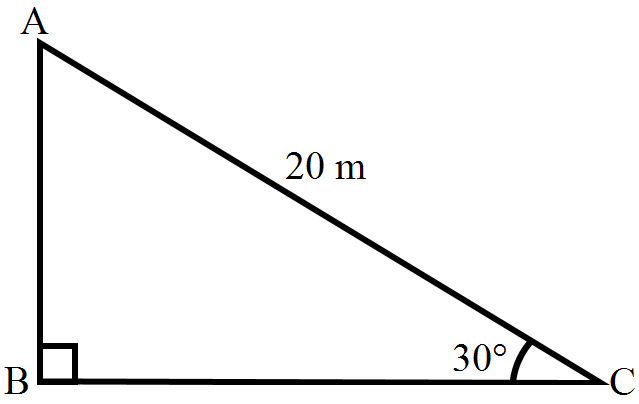
$\sin30^\circ=\frac{\text{AB}}{\text{AC}}$
$\Rightarrow\frac{1}{2}=\frac{\text{AB}}{20}$
$\Rightarrow\text{AB}=10\text{m}$
Hence, the height of the pole is $10m$. View full question & answer→MCQ 1401 Mark
$..........$ is an instrument for measuring the angles of elevation and depression.
AnswerA theodolite is an instrument for measuring the angles of elevation and depression.
A Theodolite is a more accurate instrument for measuring horizontal and vertical angles.
View full question & answer→MCQ 1411 Mark
A ladder $12m$ long just reaches the top of a vertical wall. If the ladder makes an angle of $45^\circ$ with the wall, then the height of the wall is :
- A
$12\sqrt2\text{m}$
- B
$6\text{m}$
- C
$12\text{m}$
- ✓
$6\sqrt2\text{m}$
AnswerCorrect option: D. $6\sqrt2\text{m}$
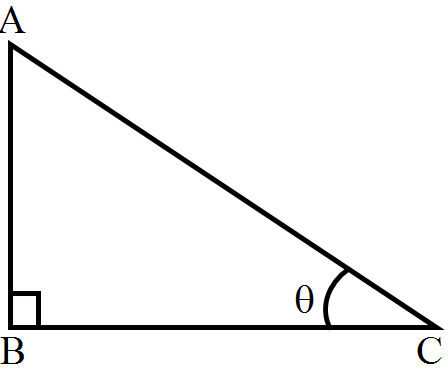
Let the height of the top of the ladder reaches to a vertical wall $= AB$
The length of the ladder $= AC = 12m$
The angle of elevation $=\theta=45^\circ$
$\therefore\sin45^\circ=\frac{\text{AB}}{\text{AC}}$
$\Rightarrow\frac{1}{\sqrt2}=\frac{\text{AB}}{12}$
$\Rightarrow\text{AB}=\frac{12}{\sqrt2}\times\frac{\sqrt2}{\sqrt2}$
$\Rightarrow\text{AB}=6\sqrt2\text{m}$ View full question & answer→MCQ 1421 Mark
A man on the top of an observation tower finds an object at an angle of depression $30^\circ$ . After the object was moved $30$ metres in a straight line towards the tower, he finds the angle of depression to be $45^\circ$ . The distance of the object now from the foot of the tower in metres is :
- A
$15\sqrt{3}$
- ✓
$15(\sqrt{3}+1)$
- C
$15(\sqrt{3}-1)$
- D
$15(2+\sqrt{3})$
AnswerCorrect option: B. $15(\sqrt{3}+1)$
$15(\sqrt{3}+1)$
View full question & answer→MCQ 1431 Mark
Two men are on opposite sides of a tower. They observe the angles of elevation of the top of the tower as $60^\circ$ and $45^\circ$ respectively. If the height of the tower is $60m,$ then the distance between them is :
- ✓
$20(\sqrt3+3)\text{m}$
- B
$20(3-\sqrt3)\text{m}$
- C
$20(\sqrt3-3)\text{m}$
- D
$\text{None of these}$
AnswerCorrect option: A. $20(\sqrt3+3)\text{m}$
Let the height of the tower $= AD = 60m$ and angles of elevation of the top of the tower of two men are $60^\circ $ and $45^\circ $ respectively.
To find : Distance between two men $= BC$
In triangle $\text{ABD},$
$\tan60^\circ=\frac{60}{\text{BD}}$
$\Rightarrow\sqrt3=\frac{60}{\text{BD}}$
$\Rightarrow\text{BD}=\frac{60}{\sqrt3}\times\frac{\sqrt3}{\sqrt3}=20\sqrt3\text{m}$
In triangle $\text{ADC},$
$\tan45^\circ=\frac{60}{\text{DC}}$
$\Rightarrow1=\frac{60}{\text{DC}}$
$\Rightarrow\text{DC}=60\text{m}$
$\therefore\text{BC}=\text{BD}+\text{DC}=20\sqrt3+60$
$=20(\sqrt3+3)\text{m}$ View full question & answer→MCQ 1441 Mark
he ratio of the length of a pole and its shadow is $1: \sqrt{3}$. The angle of elevation of the sun is :
- A
$90^\circ$
- B
$60^\circ$
- ✓
$30^\circ$
- D
$45^\circ$
AnswerCorrect option: C. $30^\circ$
$\text{tan}\ \theta =\frac{\text{h}}{\text{x}}$
$\Rightarrow \text{tan}\ \theta =\frac{1}{\sqrt{3}}$
$\Rightarrow \tan\theta = \tan30^\circ$
$\Rightarrow \theta = 30^\circ$
Hence, the answer is $= 30^\circ .$
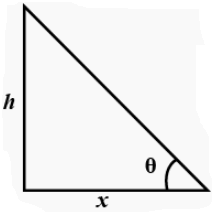
View full question & answer→MCQ 1451 Mark
The $.........$ is the angle between the horizontal and the line of sight to an object when the object is below the horizontal level.
AnswerThe angle of depression is the angle between the horizontal and line of sight to an object when the object is below the horizontal level.
The angle of depression is formed when the observer is higher than the object he is looking at.
It is the angle between the horizontal line and the line joining the observer's eye and the object.
It plays a very important role in determining the heights and distances.
View full question & answer→MCQ 1461 Mark
The angles of elevation of the top of $12m$ high tower from two points in opposite directions with it are complementary. If distance of one point from its base is $16m,$ then distance of second point from tower's base is?
Answer$\frac{\text{AB}}{\text{BC}}={\tan}\theta $
$\Rightarrow {\tan}\theta =\frac{12}{16}$
$\frac{\text{AB}}{\text{BB}}={\tan}(90−\theta )$
$\Rightarrow {\cot}\theta =\frac{12}{\text{x}} $
eq. $(1)\times$ eq. $(2)$ we get
$\frac{12}{16}\times \frac{12}{\text{x}}={\tan}\theta \times {\cot}\theta =1$
$\Rightarrow 16\text{x}=144$
$\Rightarrow \text{x}=\frac{144}{16}=9\text{m}.$
View full question & answer→MCQ 1471 Mark
From a point on the ground, $30m$ away from the foot of a tower, the angle of elevation of the top of the tower is $30^\circ .$ The height of the tower is :
- A
$30\text{m}$
- ✓
$10\sqrt{3}\text{m}$
- C
$10\text{m}$
- D
$30\sqrt{3}\text{m}$
AnswerCorrect option: B. $10\sqrt{3}\text{m}$
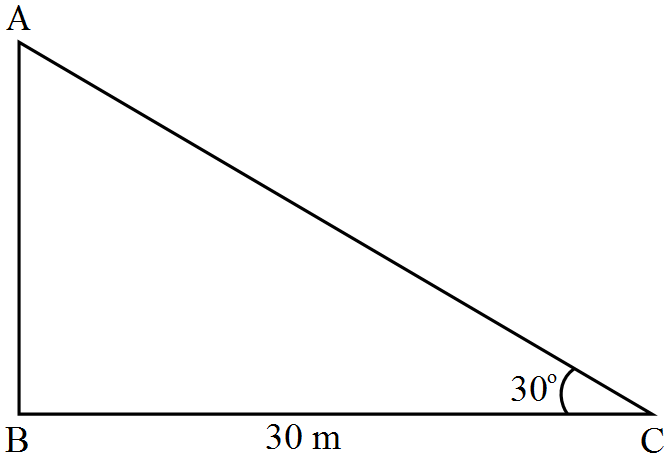
Let $AB$ be the tower and point $C$ be the point of obseevation on the ground.
We have,
$BC = 30m,$ and $\angle\text{ACB}=30^\circ$
In $\triangle\text{ABC},$
$\tan30^\circ=\frac{\text{AB}}{\text{BC}}$
$\Rightarrow\frac{1}{\sqrt{3}}=\frac{\text{AB}}{30}$
$\Rightarrow\text{AB}=\frac{30}{\sqrt{3}}$
$\Rightarrow\text{AB}=\frac{30}{\sqrt{3}}\times\frac{\sqrt{3}}{\sqrt{3}}$
$\Rightarrow\text{AB}=\frac{30\sqrt{3}}{3}$
$\therefore\ \text{AB}=10\sqrt{3}\text{m}$ View full question & answer→MCQ 1481 Mark
If the elevation of the sun changes form $30^\circ$ to $60^\circ,$ then the difference between the lengths of shadows of a pole $15m$ high, is :
- A
$7.5\text{m}$
- B
$15\text{m}$
- ✓
$10\sqrt{3}\text{m}$
- D
$5\sqrt{3}\text{m}$
AnswerCorrect option: C. $10\sqrt{3}\text{m}$
Let $AB$ be the pole and $AC$ and $AD$ be its shadows.
We have :
$\angle\text{ACB}=30^\circ,\angle\text{ADB}=60^\circ$ and $AB = 15m.$
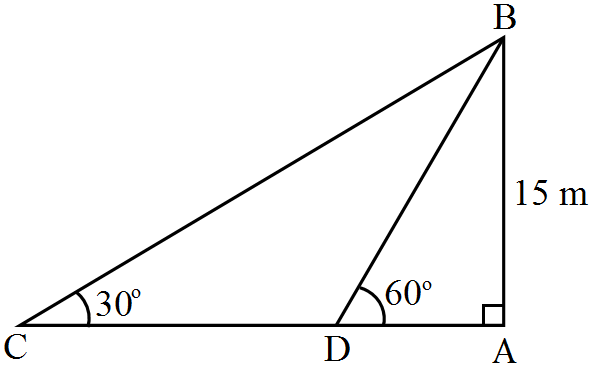
In $\triangle\text{ACB},$
We have :
$\frac{\text{AC}}{\text{AB}}=\cot30^\circ=\sqrt{3}$
$\Rightarrow\frac{\text{AC}}{15}={\sqrt{3}}$
$\Rightarrow\text{AC}=15\sqrt{3}\text{m}$
Now, in $\triangle\text{ADB},$ we have:
$\frac{\text{AD}}{\text{AB}}=\cot60^\circ=\frac{1}{\sqrt{3}}$
$\Rightarrow\frac{\text{AD}}{15}=\frac{1}{\sqrt{3}}$
$\Rightarrow\text{AD}=\frac{15}{\sqrt{3}}=\frac{15\times\sqrt{3}}{\sqrt{3}\times\sqrt{3}}$
$\Rightarrow\frac{15\sqrt{3}}{3}=5\sqrt{3}\text{m}$
$\therefore$ Difference between the lengths of the shadows
$=\text{AC}-\text{AD}=15\sqrt{3}-5\sqrt{3}=10\sqrt{3}\text{m}$ View full question & answer→MCQ 1491 Mark
If a $l.5-m-$ tall girl stands at a distance of $3m$ from a lamp post and casts a shadow of length $4.5m$ on the ground, then the height of the lamp post is :
- A
$1.5m$
- B
$2m$
- ✓
$2.5m$
- D
$2.8m.$
AnswerCorrect option: C. $2.5m$
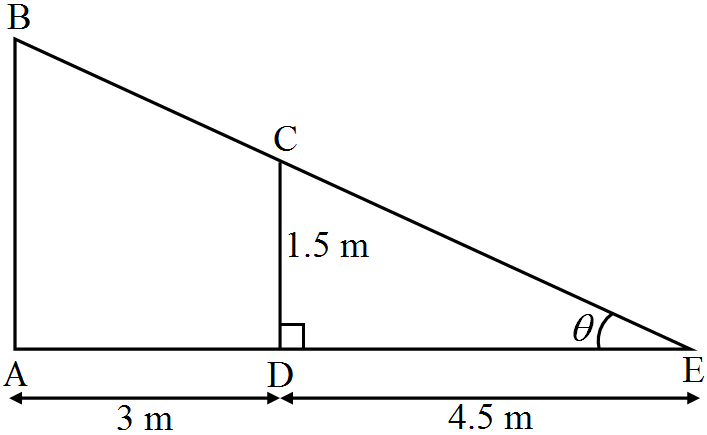
Let $AB$ be the lamp $-$ post; $CD$ be the girl and $DE$ be her shadow.
We have,
$CD = 1.5m, AD =3m, DE = 4.5m$
Let $\angle\text{E}=\theta$
In $\triangle\text{CDE},$
$\tan\theta=\frac{\text{CD}}{\text{DE}}$
$\Rightarrow\tan\theta=\frac{1.5}{4.5}$
$\Rightarrow\tan\theta=\frac{1}{3}\dots(\text{i})$
Now, in $\triangle\text{ABE},$
$\tan\theta=\frac{\text{AB}}{\text{AE}}$
$\Rightarrow\frac{1}{3}=\frac{\text{AB}}{\text{AD}+\text{DE}}\ [$Using $(i)]$
$\Rightarrow\frac{1}{3}=\frac{\text{AB}}{3+4.5}$
$\Rightarrow\text{AB}=\frac{7.5}{3}$
$\therefore\ \text{AB}=2.5\text{m}$ View full question & answer→MCQ 1501 Mark
If the altitude of the sun is $60^\circ,$ the height of a tower which casts a shadow of length $90m$ is :
- A
$60\text{m}$
- ✓
$90\sqrt3\text{m}$
- C
$90\text{m}$
- D
$60\sqrt3\text{m}$
AnswerCorrect option: B. $90\sqrt3\text{m}$
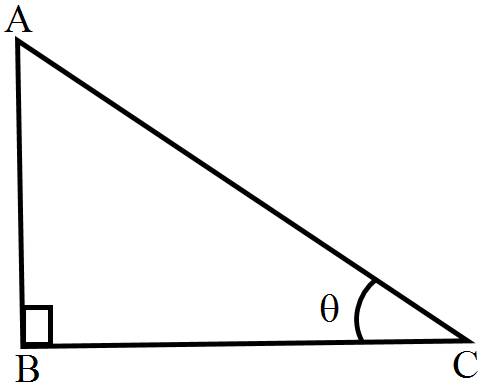
Let Height of the tower $= AB = h$ meters,
Length of the shadow $= BC = 90m$
And angle of elevation $\theta=60^\circ$
$\therefore\tan60^\circ=\frac{\text{AB}}{\text{BC}}$
$\Rightarrow\sqrt{3}=\frac{\text{h}}{90}$
$\Rightarrow\text{h}=90\sqrt{3}\text{ meters}.$ View full question & answer→MCQ 1511 Mark
The $............$ is the line drawn from the eye of an observer to the point in the object viewed by the observer.
AnswerThe line of sight is the imaginary line drawn from the eye of an observer to the point in the object viewed by the observer.
The angle between the line of sight and the ground is called angle of elevation.
View full question & answer→MCQ 1521 Mark
The ratio between the height and the length of the shadow of a pole is $1:\sqrt3,$ then the sun’s altitude is :
- A
$45^\circ$
- ✓
$30^\circ$
- C
$75^\circ$
- D
$60^\circ$
AnswerCorrect option: B. $30^\circ$
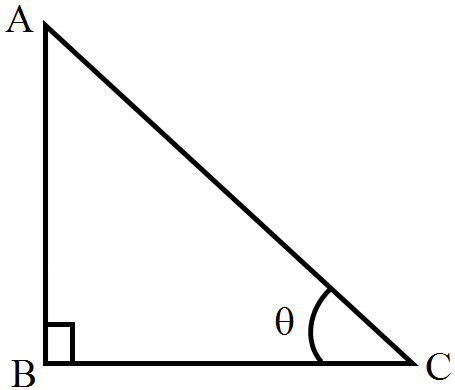
Let Height of the pole $AB = xm$ and length of the shadow $\text{BC}=\sqrt3\text{x}\text{ meters}.$
$\therefore\tan\theta=\frac{\text{AB}}{\text{BC}}$
$\Rightarrow\tan\theta=\frac{\text{x}}{\sqrt3\text{x}}$
$\Rightarrow\tan\theta=\frac{1}{\sqrt3}$
$\Rightarrow\tan\theta=\tan30^\circ$
$\Rightarrow\theta=30^\circ$ View full question & answer→MCQ 1531 Mark
Choose the correct answer from the given four options. A pole $6m$ high casts a shadow $2\sqrt{3}\text{m}$ long on the ground, then the Sun’s elevation is :
- ✓
$60^\circ$
- B
$45^\circ$
- C
$30^\circ$
- D
$90^\circ$
AnswerCorrect option: A. $60^\circ$
Let $\text{BC}=6\text{m}$ be the height of the pole and $\text{AB}=2\sqrt{3}\text{m}$ be the lenth of the shadow on the ground.
let the Sun's makes an angle $\theta$ on the ground.
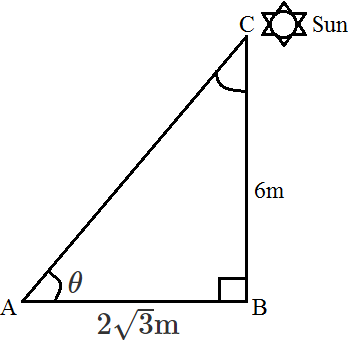
Now, in $\triangle\text{BAC},\ \tan\theta=\frac{\text{BC}}{\text{AB}}$
$\Rightarrow\ \tan\theta=\frac{6}{2\sqrt{3}}=\frac{3}{\sqrt{3}}.\frac{\sqrt{3}}{\sqrt{3}}$
$\Rightarrow\ \tan\theta=\frac{3\sqrt{3}}{3}=\sqrt{3}$
$=\tan60^\circ\ [\because\tan60^\circ=\sqrt{3}]$
$\therefore\ \theta=60^\circ$
Hence, the Sun's elevation is $60^\circ .$ View full question & answer→MCQ 1541 Mark
If the angles of elevation of the top of a tower from two points distant $a$ and $b$ from the base and in the same straight line with it are complementary, then the height of the tower is :
AnswerCorrect option: B. $\sqrt{\text{ab}}$
Let $h$ be the height of tower $AB.$
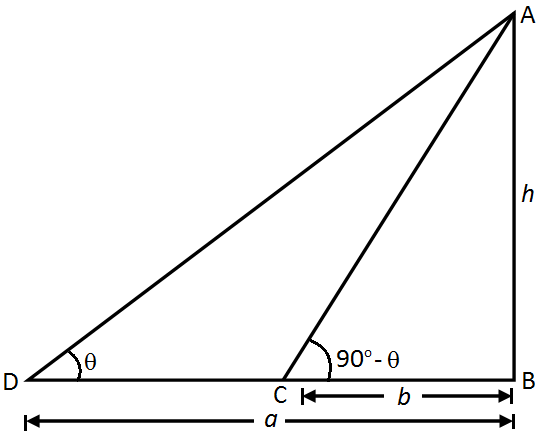
Given that : angle of elevation of top of the tower are $\angle\text{D}=\theta$ and $\angle\text{C}=90^\circ-\theta.$
Distance $BC = b$ and $BD = a$
Here, we have to find the height of tower.
So we use trigonometric ratios.
In a triangle $\text{ABC},$
$\Rightarrow\ \tan\text{C}=\frac{\text{AB}}{\text{BC}}$
$\Rightarrow\ \tan(90^\circ-\theta)=\frac{\text{h}}{\text{b}}$
$\Rightarrow\ \cot\theta=\frac{\text{h}}{\text{b}}$
Again in a triangle $\text{ABD},$
$\tan\text{D}=\frac{\text{AB}}{\text{BD}}$
$\Rightarrow\ \tan\theta=\frac{\text{h}}{\text{a}}$
$\Rightarrow\ \frac{1}{\cot\theta}=\frac{\text{h}}{\text{a}}$
$\cot\theta=\frac{\text{h}}{\text{b}}$
$\Rightarrow\ \frac{\text{b}}{\text{h}}=\frac{\text{h}}{\text{a}}$
$\Rightarrow\ \text{h}^2=\text{ab}$
$\Rightarrow\ \text{h}=\sqrt{\text{ab}}$ View full question & answer→MCQ 1551 Mark
A ramp for disabled people in a hospital must slope at not more than $30^\circ$ . If the height of the ramp has to be $1m,$ then the length of the ramp be :
- A
$3\text{m}$
- B
$1\text{m}$
- ✓
$2\text{m}$
- D
$\sqrt{3}\text{m}$
AnswerCorrect option: C. $2\text{m}$
Let height of the ramp be $AB = 1m,$ the slope of the ramp $AC$ and angle of elevation $=\theta=30^\circ$
In triangle $\text{ABC},$
$\sin30^\circ=\frac{\text{AB}}{\text{AC}}$
$\Rightarrow\frac{1}{2}=\frac{1}{\text{AC}}$
$\Rightarrow\text{AC}=2\text{ meters}$
Therefore, the length of the ramp is $2m$.
View full question & answer→MCQ 1561 Mark
The angle of depression of a car parked on the road from the top of a $150m$ high tower is $30^\circ$ . The distance of the car from the tower $($in metres$)$ is :
- A
$50\sqrt{3}$
- ✓
$150\sqrt{3}$
- C
$150\sqrt{2}$
- D
$75$
AnswerCorrect option: B. $150\sqrt{3}$
Let $AB$ be the tower of height $150m.$
$C$ is car and angle of depression is $30^\circ $
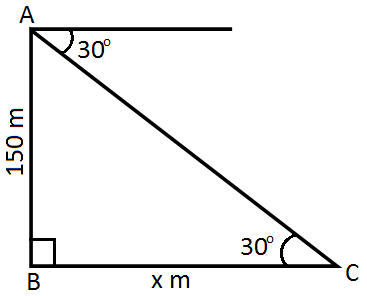
Therefore, $\angle\text{ACB}=30^\circ \ ($alternate angle$)$
In right $-$ angled triangle $\text{ABC},$
$\frac{\text{BC}}{\text{AB}}=\cot30^\circ$
$\Rightarrow\frac{\text{BC}}{150}=\sqrt{3}$
$\Rightarrow\text{BC}=150\sqrt{3}\text{m}.$
That is, distance of the car from the tower is $150\sqrt{3}\text{m.}$ View full question & answer→MCQ 1571 Mark
The angles of depression of the foot and the top of a pole at the top of a tower of height $100$ metres are $45^\circ$ and $30^\circ$ respectively. The height of the pole is :
AnswerCorrect option: B. $\frac{100(3-\sqrt{3})}{3}$
$\tan45=\frac{100}{\text{d}}$
$\tan30^\circ=\frac{100-\text{h}}{\text{d}}$
$\sqrt{3}=\frac{100}{100-\text{h}}$
$\sqrt{3}100-100=\text{h}\sqrt{3}$
$\text{h}=\frac{100(3-\sqrt{3})}{3}\text{m}.$
View full question & answer→MCQ 1581 Mark
If the height of a vertical pole is equal to the length of its shadow on the ground, the angle of elevation of the sun is :
- A
$0^\circ$
- B
$30^\circ$
- ✓
$45^\circ$
- D
$60^\circ$
AnswerCorrect option: C. $45^\circ$
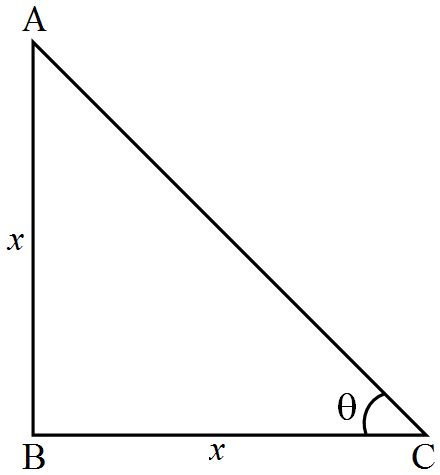
Let $AB$ represents the vertical pole and $BC$ represents the shadow on the ground and $\theta$ represents angle of elevation the sun.
In $\triangle\text{ABC},$
$\tan\theta=\frac{\text{AB}}{\text{BC}}$
$\Rightarrow\tan\theta=\frac{\text{x}}{\text{x}} \ ($As, the height of the pole $,AB =$ the shadow, $BC = x)$
$\Rightarrow\tan\theta=1$
$\Rightarrow\tan\theta=\tan45^\circ$
$\therefore\theta=45^\circ$ View full question & answer→MCQ 1591 Mark
If the angles of elevation of the top of a tower form tow points at distances $a$ and $b$ from the base and in the same straight line with it are complementary, then the height of the tower is :
AnswerCorrect option: B. $\sqrt{\text{ab}}$
Let $AB$ be the tower and $C$ and $D$ be the points of observation on $AC.$
Let : $\angle\text{ACB}=\theta,\angle\text{ADB}$
$=90-\theta$ and $AB = h m$
Thus,
We have :
$AC = a, AD = b$ and $CD = a - b$
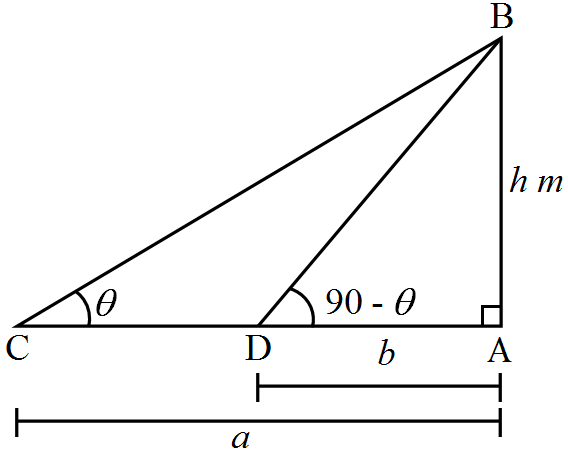
Now, in the right $\triangle\text{ABC},$
We have :
$\tan\theta=\frac{\text{AB}}{\text{AC}}$
$\Rightarrow\frac{\text{h}}{\text{a}}=\tan\theta\dots(\text{i})$
In the right $\triangle\text{ABD},$
We have :
$\tan(90-\theta)=\frac{\text{AB}}{\text{AD}}$
$\Rightarrow\cot\theta=\frac{\text{h}}{\text{b}}\dots(\text{ii})$
On multiplying $(i)$ and $(ii),$
We have :
$\tan\theta\times\cot\theta=\frac{\text{h}}{\text{a}}\times\frac{\text{h}}{\text{b}}$
$\Rightarrow\frac{\text{h}}{\text{a}}\times\frac{\text{h}}{\text{b}}=1$
$\Big[\because\tan\theta=\frac{1}{\cot\theta}\Big]$
$\Rightarrow\text{h}^2=\text{ab}$
$\Rightarrow\text{h}=\sqrt{\text{ab}}\text{m}$
Hence, the height of the tower is $\sqrt{\text{ab}}\text{m}.$ View full question & answer→MCQ 1601 Mark
If the angles of elevation of a tower from two points distant $a$ and $b \ (a > b)$ from its foot and in the same straight line from it are $30^\circ$ and $60^\circ ,$ then the height of the tower is :
- A
$\sqrt{\text{a}+\text{b}}$
- ✓
$\sqrt{\text{ab}}$
- C
$\sqrt{\text{a}-\text{b}}$
- D
$\sqrt{\frac{\text{a}}{\text{b}}}$
AnswerCorrect option: B. $\sqrt{\text{ab}}$
Let $AB$ be the tower and $P$ and $Q$ are such points that $PB = a, QB = b $ and angles of elevation at $P$ and $Q$ are $30^\circ $ and $60^\circ $ respectively.
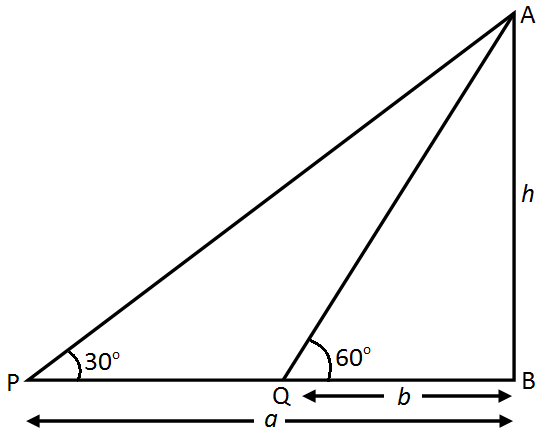
Let $AB = h$
Now in right $\triangle\text{APB,}$
$\tan\theta=\frac{\text{Perpendicular}}{\text{Base}}=\frac{\text{AB}}{\text{PB}}$
$\Rightarrow\ \tan30^\circ=\frac{\text{h}}{\text{a}}$
$\Rightarrow\ \frac{1}{\sqrt{3}}=\frac{\text{h}}{\text{a}}\ .....(\text{i})$
Similarly in right $\triangle\text{AQB,}$
$\tan60^\circ=\frac{\text{AB}}{\text{QB}}$
$\Rightarrow\ \sqrt{3}=\frac{\text{h}}{\text{b}}\ .....(\text{ii})$
Multiplying $(i)$ and $(ii)$
$\frac{1}{\sqrt{3}}\times\sqrt{3}=\frac{\text{h}}{\text{a}}\times\frac{\text{h}}{\text{b}}$
$\Rightarrow\ 1=\frac{\text{h}^2}{\text{ab}}$
$\Rightarrow\ \text{h}^2=\text{ab}$
$\Rightarrow\ \text{h}=\sqrt{\text{ab}}$
$\therefore$ Height of the tower $=\sqrt{\text{ab}}$ View full question & answer→MCQ 1611 Mark
From a point on the ground, $30m$ away from the foot of a tower, the angle of elevation of the top of the tower is $30^\circ$. The height of the tower is :
- A
$10\text{m}$
- B
$30\text{m}$
- ✓
$10\sqrt3\text{m}$
- D
$30\sqrt3\text{m}$
AnswerCorrect option: C. $10\sqrt3\text{m}$
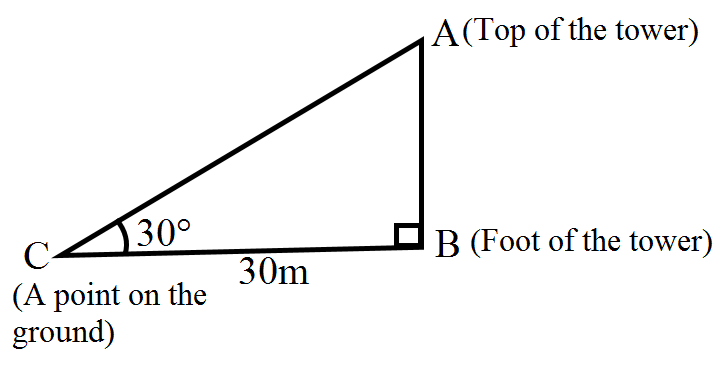
In right triangle $\text{ABC},$
$\tan30^\circ=\frac{\text{AB}}{\text{BC}}$
$\Rightarrow\frac{1}{\sqrt3}=\frac{\text{AB}}{30}$
$\text{AB}=\frac{30}{\sqrt3}\text{m}$
$\Rightarrow\frac{30}{\sqrt3}\times\frac{\sqrt3}{\sqrt3}$
$10\sqrt3\text{m}$
Hence the height of the tower is $10\sqrt3\text{ meters}.$ View full question & answer→MCQ 1621 Mark
The angle of elevation of the sun when the shadow of a pole $'h\ ’$ metres high is $\frac{\text{h}}{\sqrt3}\text{metres}$ long is :
- ✓
$60^\circ$
- B
$45^\circ$
- C
$30^\circ$
- D
AnswerCorrect option: A. $60^\circ$
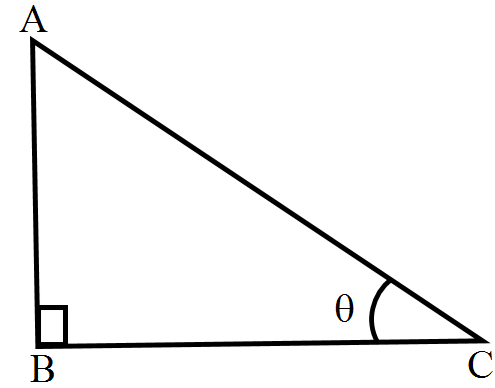
Given : Height of the pole $= Ab = h$ meters
And the length of the shadow of the pole $= BC =\frac{\text{h}}{\sqrt3}\text{ meters}.$
$\Rightarrow\tan\theta=\frac{\text{h}}{\frac{\text{h}}{\sqrt3}}$
$\Rightarrow\tan\theta=\sqrt3$
$\Rightarrow\tan\theta=\tan60^\circ$
$\Rightarrow\theta=60^\circ.$ View full question & answer→MCQ 1631 Mark
The $..........$ of an object can be determined with the help of trigonometric ratios.
AnswerThe height of an object can be determined with the help of trigonometric ratios if angle of elevation/depression and one side is known.
View full question & answer→MCQ 1641 Mark
If a $1.5m$ tall girl stands at a distance of $3m$ from a lamp-post and casts a shadow of length $4.5m$ on the ground, then the height of the lamp $-$ post is :
- A
$1.5m$
- B
$2m$
- ✓
$2.5m$
- D
$2.8m$
AnswerCorrect option: C. $2.5m$
Let $AB$ is girls and $CD$ is lamp $-$ post $AB = 1.5$
which casts her shadow $EB$
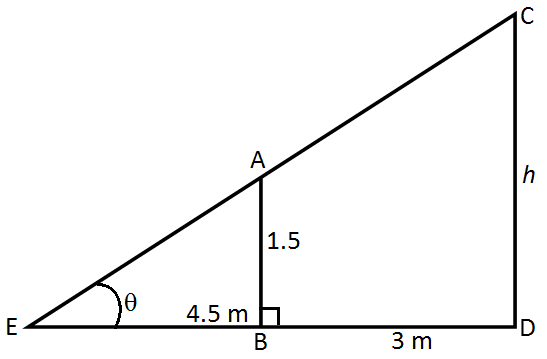
$\because EB = 4.5m, BD = 3m$
Now in $\triangle\text{AEB}$
$\tan\theta=\frac{\text{AB}}{\text{BE}}=\frac{1.5}{4.5}=\frac{1}{3}$
and in $\triangle\text{CED}$
$\tan\theta=\frac{\text{CD}}{\text{ED}}$
$\Rightarrow\frac{1}{3}=\frac{\text{h}}{4.5+3}$
$\Rightarrow\frac{1}{3}=\frac{\text{h}}{7.5}$
$\Rightarrow\text{h}=\frac{7.5}{3}=2.5\text{m}$
$\therefore$ Height of lamp $-$ post $= 2.5m$ View full question & answer→MCQ 1651 Mark
In a right $\triangle\text{PQR}, PR$ is the hypotenuse of length $20\ cm$ and $\angle\text{P}=60^\circ.$ The area of the triangle is :
- ✓
$50\sqrt3\text{ cm}^2$
- B
$100\sqrt3\text{ cm}^2$
- C
$100\text{ cm}^2$
- D
$50\text{ cm}^2$
AnswerCorrect option: A. $50\sqrt3\text{ cm}^2$
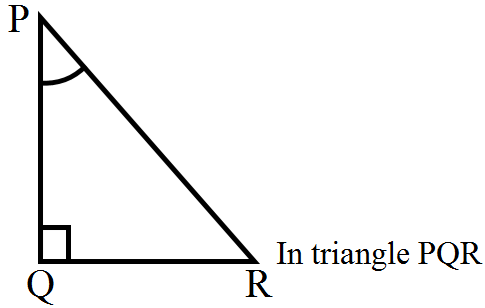
In a triangle $\text{PQR},$
$\cos60^\circ=\frac{\text{PQ}}{\text{PR}}$
$\Rightarrow\frac{1}{2}=\frac{\text{PQ}}{20}$
$\Rightarrow\text{PQ}=10\text{ cm}$
And $\sin60^\circ=\frac{\text{QR}}{\text{PR}}$
$\Rightarrow\frac{\sqrt3}{2}=\frac{\text{QR}}{20}$
$\Rightarrow\text{QR}=10\sqrt3\text{ cm}$
$\therefore$ ar $(\triangle\text{PQR})$
$=\frac{1}{2}\times10\sqrt3\times10$
$=50\sqrt3\text{ cm}^2$ View full question & answer→MCQ 1661 Mark
From the top of a tower, $80m$ high, the angles of depression of two points $P$ and $Q$ in the same vertical plane with the tower are $45^\circ$ and $75^\circ$ respectively, find the value of $PQ [$Use $\tan75^\circ2+\sqrt{3}]$
AnswerCorrect option: B. $80(\sqrt{3}-1)\text{m}$
$80(\sqrt{3}-1)\text{m}$
View full question & answer→MCQ 1671 Mark
An electric pole is $10\sqrt3\text{m}$ high and its shadow is $10m$ in length, then the angle of elevation of the sun is :
- A
$45^\circ$
- B
$15^\circ$
- C
$30^\circ$
- ✓
$60^\circ$
AnswerCorrect option: D. $60^\circ$
Let $AB$ be the electric pole of height $10\sqrt3\text{m}$ and its shadow be $BC$ of length $10m.$
And the angle of elevation of the sun be $\theta$.
$\therefore\tan\theta=\frac{\text{AB}}{\text{BC}}$
$\Rightarrow\tan\theta=\frac{10\sqrt{3}}{10}$
$\Rightarrow\tan\theta=\sqrt{3}$
$\Rightarrow\tan\theta=\tan60^\circ$
$\Rightarrow\theta=60^\circ$
View full question & answer→MCQ 1681 Mark
The shadow of a $5-m-$ long stick is $2m$ long. At the same time the length of the shadow of a $12.5-m-$ high tree is :
Answer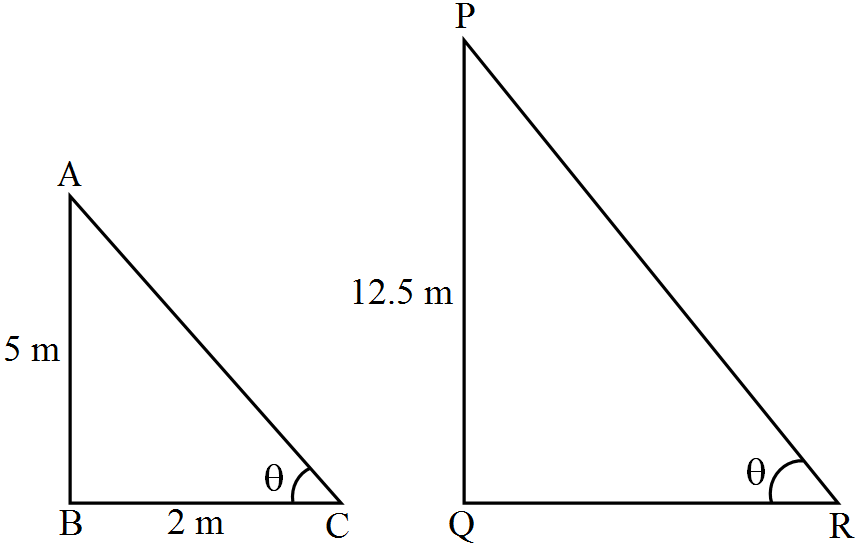
Let $AB$ be the stick and $BC$ be its shadow and $PQ$ be the tree and $QR$ be its shadow.
We have,
$AB = 5m, BC = 2m, PQ = 12.5m$
In $\triangle\text{ABC},$
$\tan\theta=\frac{\text{AB}}{\text{BC}}$
$\Rightarrow\tan\theta=\frac{5}{2}$
Now, In $\triangle\text{PQR},$
$\tan\theta=\frac{\text{PQ}}{\text{QR}}$
$\Rightarrow\frac{5}{2}=\frac{12.5}{\text{QR}} \ [$Using $(i)]$
$\Rightarrow\text{QR}=\frac{12.5\times2}{5}=\frac{25}{5}$
$\therefore\ \text{QR}=5\text{m}$ View full question & answer→MCQ 1691 Mark
A ramp for disabled people in a hospital must slope at not more than $30^\circ$. If the height of the ramp has to be $1m,$ then the length of the ramp be
- A
$\sqrt3\text{m}$
- B
$1\text{m}$
- ✓
$2\text{m}$
- D
$3\text{m}$
AnswerCorrect option: C. $2\text{m}$
Let the height of the ramp be $AB = 1m,$ the slope of the ramp $AC$ and angle of elevation $ =\theta=30^\circ$
In triangle $\text{ABC},$
$\sin30^\circ=\frac{\text{AB}}{\text{AC}}$
$\Rightarrow\frac{1}{2}=\frac{1}{\text{AC}}$
$\Rightarrow\text{AC}=2\text{ meters}$
Therefore, the length of the ramp is $2m.$
View full question & answer→MCQ 1701 Mark
If the height of a vertical pole is $\sqrt{3}\text{ times}$ the length of its shadow on ground then the angle of elevation of the sun at that time is :
- A
$30^\circ$
- B
$45^\circ$
- ✓
$60^\circ$
- D
$75^\circ$
AnswerCorrect option: C. $60^\circ$
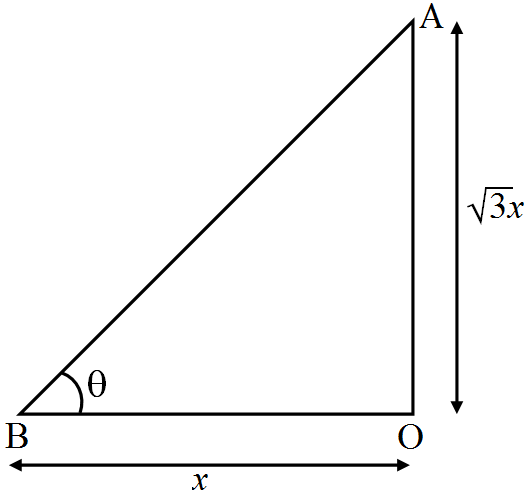
Here, $AO$ be the pole; $BO$ be its shadow and $\theta$ be the angle of elevation of the sun.
Let $BO = x$
Then, $\text{AO}=\text{x}\sqrt{3}$
In $\triangle\text{AOB},$
$\tan\theta=\frac{\text{AO}}{\text{BO}}$
$\Rightarrow\tan\theta=\frac{\text{x}\sqrt{3}}{\text{x}}$
$\Rightarrow\tan\theta=\sqrt{3}$
$\Rightarrow\tan\theta=\tan60^\circ$
$\therefore\theta=60^\circ$ View full question & answer→MCQ 1711 Mark
A contractor planned to install a slide for the children to play in a park. If he prefers to have a slide whose top is at a height of $1.5m$ and is inclined at an angle of $30^\circ$ to the ground, then the length of the slide would be.
- A
$\sqrt3\text{m}$
- ✓
$3\text{m}$
- C
$1.5\text{m}$
- D
$2\sqrt3\text{m}$
AnswerCorrect option: B. $3\text{m}$
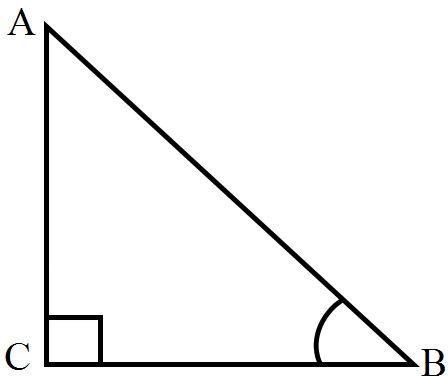
Here, Height of the Slide $= AC = 1.5m,$
Angle of elevation $= \theta=30^\circ$
To find : Length of slide $= AB$
$\therefore\sin30^\circ=\frac{\text{AC}}{\text{AB}}$
$\Rightarrow\frac{1}{2}=\frac{1.5}{\text{AB}}$
$\Rightarrow\text{AB}=3\text{m}.$ View full question & answer→MCQ 1721 Mark
A river is $60m$ wide. $A$ tree of unknown height is on one bank. The angle of elevation of the top of the tree from the point exactly opposite to the foot of the tree, on the other bank, is $30^\circ$ . The height of the tree is :
- A
$30\sqrt{3}\text{m}$
- B
$10\sqrt{3}\text{m}$
- ✓
$20\sqrt{3}\text{m}$
- D
$60\sqrt{3}\text{m}$
AnswerCorrect option: C. $20\sqrt{3}\text{m}$
Let $BC = 60m$ be the width of the river and angle of elevation $= 30^\circ$
To find : Height of the tree $AC$
$\therefore\tan30^\circ=\frac{\text{AC}}{\text{BC}}$
$\Rightarrow\frac{1}{\sqrt{3}}=\frac{\text{AC}}{60}$
$\Rightarrow\text{AC}=\frac{60}{\sqrt{3}}$
$=\frac{60}{\sqrt{3}}\times\frac{\sqrt{3}}{\sqrt{3}}=20\sqrt{3}\text{m}$
Therefore, the height of the tree is $20\sqrt{3}\text{m}.$
View full question & answer→MCQ 1731 Mark
The length of shadow of a tower on the plane ground is $\sqrt{3}$ times the height of the tower. The angle of elevation of sun is :
- A
$45^\circ$
- ✓
$30^\circ$
- C
$60^\circ$
- D
$90^\circ$
AnswerCorrect option: B. $30^\circ$
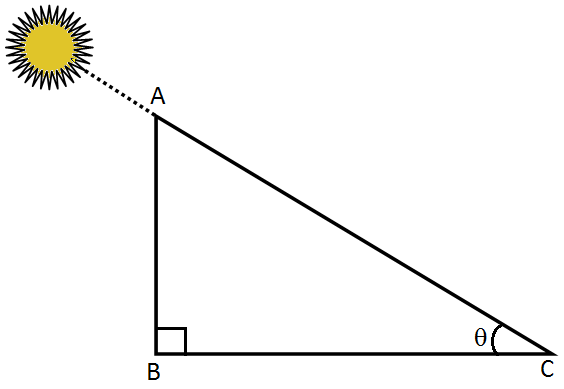
Let the angle of elevation of the sun be $\theta.$
Suppose $AB$ is the height of the tower and $BC$ is the length of its shadow.
It is given that, $\text{BC}=\sqrt{3}\text{AB}$
In right $\triangle\text{ABC,}$
$\tan\theta=\frac{\text{AB}}{\text{BC}}$
$\Rightarrow\tan\theta=\frac{\text{AB}}{\sqrt{3}\text{AB}}=\frac{1}{\sqrt{3}}$
$\Rightarrow\tan\theta=\tan30^\circ$
$\Rightarrow\theta=\tan30^\circ$
Thus, the angle of elevation of the sun is $30^\circ .$ View full question & answer→MCQ 1741 Mark
A circus artist is climbing a $30m$ long rope, which is tightly stretched and tied from the top of a vertical pole to the ground. If the angle made by the rope with the ground level is $45^\circ ,$ then the height of the pole is :
- ✓
$15\sqrt2\text{m}$
- B
$20\text{m}$
- C
$10\sqrt2\text{m}$
- D
$20\sqrt2\text{m}$
AnswerCorrect option: A. $15\sqrt2\text{m}$
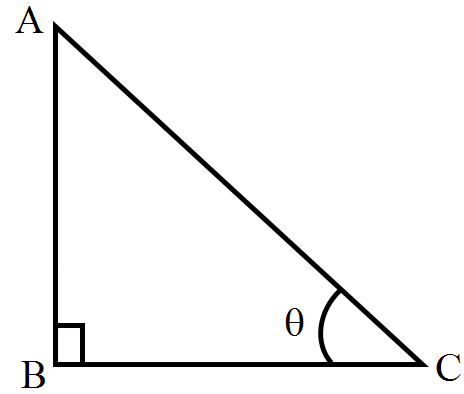
$\therefore\sin45^\circ=\frac{\text{AB}}{\text{AC}}$
$\Rightarrow\frac{1}{\sqrt2}=\frac{\text{h}}{30}$
$\Rightarrow\text{h}=\frac{30}{\sqrt2}\times\frac{\sqrt2}{\sqrt2}$
$=15\sqrt2\text{m}$ View full question & answer→MCQ 1751 Mark
In a right $\triangle\text{XYZ}, XZ$ is the hypotenuse of length $12\ cm$ and $\angle\text{X}=45^\circ.$ The area of the triangle is :
- ✓
$36 \mathrm{~cm}^2$
- B
$24 \mathrm{~cm}^2$
- C
$72 \mathrm{~cm}^2$
- D
$12 \mathrm{~cm}^2$
AnswerCorrect option: A. $36 \mathrm{~cm}^2$
In triangle $\text{XYZ},$
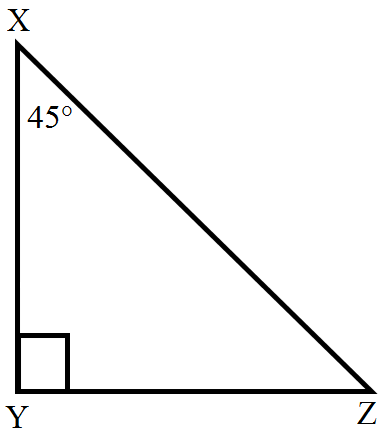
$\cos45^\circ=\frac{\text{XY}}{\text{XZ}}$
$\Rightarrow\frac{1}{\sqrt2}=\frac{\text{XY}}{12}$
$\Rightarrow\text{XY}=\frac{12}{\sqrt2}\text{ cm}$ and $\sin45^\circ=\frac{\text{YZ}}{\text{XZ}}$
$\Rightarrow\frac{1}{\sqrt2}=\frac{\text{YZ}}{12}$
$\Rightarrow\text{YZ}=\frac{12}{\sqrt2}\text{ cm}$
$\therefore$ ar $(\triangle\text{XYZ})$
$=\frac{1}{2}\times\frac{12}{\sqrt2}\times\frac{12}{\sqrt2}$
$=36\text{ cm}^2$ View full question & answer→MCQ 1761 Mark
If a flag staff of length $6m$ is placed on the top of a tower throws a shadow of $2\sqrt{3}\text{m }$ along the ground, then the angle that the sun makes with the ground is :
- A
$45^\circ$
- B
$30^\circ$
- C
$75^\circ$
- ✓
$60^\circ$
AnswerCorrect option: D. $60^\circ$
$60^\circ$
View full question & answer→MCQ 1771 Mark
If the shadow of a tower is $30m$ long when the sun’s elevation is $30^\circ$ . The length of the shadow, when the sun’s elevation is $60^\circ$ is :
- A
$20\text{m}$
- ✓
$10\text{m}$
- C
$30\text{m}$
- D
$10\sqrt3\text{m}$
AnswerCorrect option: B. $10\text{m}$
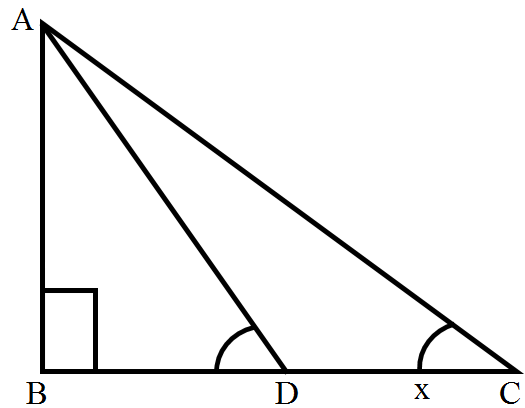
Let the height of the tower be $h$
$\therefore\tan30^\circ=\frac{\text{h}}{30}$
$\Rightarrow\frac{1}{\sqrt3}=\frac{\text{h}}{30}$
$\Rightarrow\text{h}=\frac{30}{\sqrt3}$
Again $\tan60^\circ=\frac{\text{h}}{\text{x}}$
$\Rightarrow\sqrt3=\frac{30}{\sqrt3\times\text{x}}$
$\Rightarrow\text{x}=10\text{m}$
Therefore, the lenght of the shadow is $10m$ long. View full question & answer→MCQ 1781 Mark
If the height of the window is $8 m$ above the ground. A ladder is placed against the wall such that its top reaches the window. If angle ofelevation is observed to be $45^{\circ}$, then horizontal distance between the foot of ladder and wall is
Answer(d) : Let $A B$ be the horizontal distance between the foot of ladder and wall.
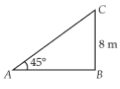
In $\triangle A B C, \frac{B C}{A B}=\tan 45^{\circ}$
$\Rightarrow \frac{8}{A B}=1 \Rightarrow A B=8 m$ View full question & answer→MCQ 1791 Mark
A window is $6 m$ above the ground. A ladder is placed against the wall such that its top reaches the window. If angle made by the foot of ladder to the ground is $30^{\circ}$, then length of the ladder is
- A
$8 m$
- B
$10 m$
- ✓
$12 m$
- D
$14 m$
AnswerCorrect option: C. $12 m$
(c) : Let $A C$ be the length of the ladder.
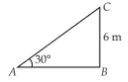
In $\triangle A B C, \frac{B C}{A C}=\sin 30^{\circ}$
$
\Rightarrow \frac{6}{A C}=\frac{1}{2} \Rightarrow A C=12 m
$ View full question & answer→MCQ 1801 Mark
A figure is given below : Jyoti and Ravi observed the figure and said the following :
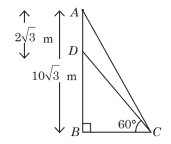
Jyoti : $C D=14 m$
Ravi : $C D=15 m$
Which of them is/are correct? AnswerClearly, $B D=A B-A D$
$=(10 \sqrt{3}-2 \sqrt{3}) m =8 \sqrt{3} m$
Now, in $\triangle \text{B C D}$, we have
$\sin 60^{\circ}=\frac{B D}{D C}$
$\Rightarrow \frac{\sqrt{3}}{2}=\frac{8 \sqrt{3}}{D C} $
$\Rightarrow D C=16 m$
View full question & answer→MCQ 1811 Mark
The angle of elevation is always
Answer(b) : The angle of elevation is always an acute angle.
View full question & answer→MCQ 1821 Mark
A bridge across a river makes an angle of $45^{\circ}$ with the river bank. If the length of the bridge across the river is $50 m$, then what is the width of the river?
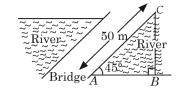
- A
$20 \sqrt{2} m$
- B
$50 \sqrt{2} m$
- ✓
$25 \sqrt{2} m$
- D
$10 \sqrt{2} m$
AnswerCorrect option: C. $25 \sqrt{2} m$
From figure, in $\triangle A B C$, we have
$\sin 45^{\circ}=\frac{B C}{A C} $
$\Rightarrow \frac{1}{\sqrt{2}}=\frac{B C}{50}$
$\Rightarrow B C=\frac{50}{\sqrt{2}}=25 \sqrt{2} m$
Hence, the width of the river is $25 \sqrt{2} m$.
View full question & answer→MCQ 1831 Mark
A peacock sitting on the top of a tree observes a serpent on the ground making an angle of depression $30^{\circ}$. If the peacock with a speed of $300 m$ per minute catches the serpent in 12 seconds, then the height of the tree is
- A
$30 m$
- B
$30 \sqrt{3} m$
- C
$\frac{30}{\sqrt{3}} m$
- D
$15 m$
View full question & answer→MCQ 1841 Mark
If the length of shadow of a building, when the Sun's altitude is $60^{\circ}$, is $20 m$ less than when it was $45^{\circ}$, then the height of the building is (Use $\sqrt{3}=1.732$ )
- A
$54.48 m$
- B
$47.32 m$
- C
$64.32 m$
- D
$57.48 m$
View full question & answer→MCQ 1851 Mark
A man standing on the deck of a ship, which is $10 m$ above the water level observes the angle of elevation of the top of a hill as $60^{\circ}$ and the angle of depression of the base of the hill as $30^{\circ}$. The distance of the hill from the ship is
- A
$40 m$
- ✓
$10 \sqrt{3} m$
- C
$10 m$
- D
$20 \sqrt{3} m$
AnswerCorrect option: B. $10 \sqrt{3} m$
Let $A B$ be the hill and $C D$ be the deck of the ship.
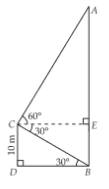
$C D=10 m\ ($Given$)$
In $\triangle C D B$,
$\tan 30^{\circ}=\frac{C D}{B D} $
$\Rightarrow \frac{1}{\sqrt{3}}=\frac{10}{B D}$
$\Rightarrow B D=10 \sqrt{3} m$
Hence, the distance of the hill from the ship is $10 \sqrt{3} m$. View full question & answer→MCQ 1861 Mark
A portion of a $45 m$ long tree is broken by tornado and the top struck up the ground making an angle of $30^{\circ}$ with the ground level. The height of the point where the tree is broken, is equal to
- A
$30 m$
- ✓
$15 m$
- C
$10 m$
- D
$20 m$
AnswerCorrect option: B. $15 m$
(b) : Let $A B$ be the tree which is broken at $C$.
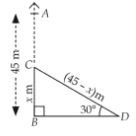
Let $B C=x m$.
In $\triangle B C D, \frac{B C}{D C}=\sin 30^{\circ}$
$\Rightarrow \quad \frac{x}{45-x}=\frac{1}{2}$
$\Rightarrow 2 x=45-x \Rightarrow x=15$
Hence, the height of the point where tree is broken is $15 m$. View full question & answer→MCQ 1871 Mark
A steel pole is $30 m$ high. To keep the pole upright, one end of a steel wire is tied to the top of the pole while the other end has been fixed on the ground. If the steel wire makes an angle of $45^{\circ}$ with the horizontal through the base point of the pole, then find the length of the steel wire.
- ✓
$30 \sqrt{2} m$
- B
$30 \sqrt{3} m$
- C
$15 m$
- D
$15 \sqrt{2} m$
AnswerCorrect option: A. $30 \sqrt{2} m$
(a) : Let $A B$ be the pole and $A C$ be the steel wire fixed on the ground at $C$.
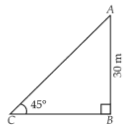
In $\triangle A B C, \sin 45^{\circ}=\frac{A B}{A C}$
$
\Rightarrow \frac{1}{\sqrt{2}}=\frac{30}{A C} \Rightarrow A C=30 \sqrt{2} m
$ View full question & answer→MCQ 1881 Mark
If the ratio of the height of a tree and its shadow is $1: \frac{1}{\sqrt{3}}$, then the angle of the Sun's elevation is
- A
$30^{\circ}$
- B
$45^{\circ}$
- ✓
$60^{\circ}$
- D
$90^{\circ}$
AnswerCorrect option: C. $60^{\circ}$
(c) : Let $A B$ be the tree and $B C$ be its shadow such that $\frac{A B}{B C}=\frac{1}{\left(\frac{1}{\sqrt{3}}\right)}=\sqrt{3}$.
Let $\theta$ be the Sun's elevation.
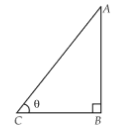
$
\text { In } \triangle A B C, \tan \theta=\frac{A B}{B C}=\sqrt{3}=\tan 60^{\circ}
$
$
\Rightarrow \theta=60^{\circ}
$
Hence, the angle of the Sun's elevation is $60^{\circ}$. View full question & answer→MCQ 1891 Mark
Suppose a straight vertical tree is broken at some point due to storm and the broken part is inclined at a certain distant from the foot of the tree. If the top of broken part of a tree touches the ground at a point whose distance from foot of the tree is equal to height of remaining part, then its angle of inclination is
- A
$30^{\circ}$
- B
$60^{\circ}$
- ✓
$45^{\circ}$
- D
AnswerCorrect option: C. $45^{\circ}$
(c) : Let $AB$ be the tree of height $h$.Let $B D=B C=x m$
$\therefore$ In $\triangle C B D$,
$
\begin{aligned}
\tan \theta & =\frac{B C}{B D}=1 \\
\Rightarrow \tan \theta & =\tan 45^{\circ} \Rightarrow \theta=45^{\circ}
\end{aligned}
$
View full question & answer→MCQ 1901 Mark
There are two temples one on each bank of a river just opposite to each other. One temple is $40 m$ high. As observed from the top of this temple, the angle of depression of the top and foot of the other temple are $30^{\circ}$ and $60^{\circ}$ respectively. The width of river is
AnswerCorrect option: A. $\frac{40 \sqrt{3}}{3} m$
Let $A B$ be the temple of height $40 m$ and $P Q$ be the other temple.
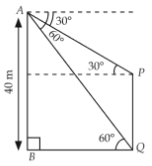
In $\triangle \text{A B Q,} \frac{A B}{B Q}=\tan 60^{\circ}$
$\Rightarrow \frac{40}{B Q}=\sqrt{3}$
$\Rightarrow B Q=\frac{40}{\sqrt{3}}$
So, width of the river $=\frac{40 \sqrt{3}}{3} m$ View full question & answer→MCQ 1911 Mark
Two men standing on opposite sides of a flagstaff measure the angles of elevation of the top of the flagstaff is $30^{\circ}$ and $60^{\circ}$. If the height of the flagstaff is $20 m$, then approximate distance between the men is $($Use $\sqrt{3}=1.732)$
- ✓
$46.19 m$
- B
$40 m$
- C
$50 m$
- D
$30 m$
AnswerCorrect option: A. $46.19 m$
Let $C$ and $D$ be the positions of the men and $A B$ be the height of flagstaff.
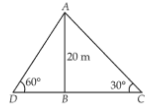
In $\triangle \text{A B C}, \tan 30^{\circ}=\frac{A B}{B C}$
$\Rightarrow \frac{1}{\sqrt{3}}=\frac{20}{B C} $
$\Rightarrow B C=20 \sqrt{3}$
In $\triangle \text{A B D}, \tan 60^{\circ}=\frac{A B}{B D}$
$\Rightarrow \sqrt{3}=\frac{20}{B D} $
$\Rightarrow B D=\frac{20}{\sqrt{3}}$
Distance between the men, $C D=B C+B D$
$=20 \sqrt{3}+\frac{20}{\sqrt{3}}=\frac{60+20}{\sqrt{3}}=\frac{80}{\sqrt{3}}$
$=\frac{80 \sqrt{3}}{3}=\frac{80 \times 1.732}{3}=46.187 \approx 46.19 m$ View full question & answer→MCQ 1921 Mark
The length of a string between a kite and a point on the ground is $85 m$. If the string makes an angle $\theta$ with level ground such that $\tan \theta=\frac{15}{8}$, then how high is the kite?
- ✓
$75 m$
- B
$78.05 m$
- C
$226 m$
- D
AnswerCorrect option: A. $75 m$
(a) : Length of the string of the kite $=A B=85 m$
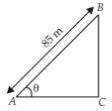
$\tan \theta=\frac{15}{8}$
$\Rightarrow \cot \theta=\frac{8}{15} \Rightarrow \operatorname{cosec}^2 \theta-1=\frac{64}{225}$
$\Rightarrow \operatorname{cosec}^2 \theta=1+\frac{64}{225}=\frac{289}{225}$
$\Rightarrow \operatorname{cosec} \theta=\sqrt{\frac{289}{225}}=\frac{17}{15} \Rightarrow \sin \theta=\frac{15}{17}$
In $\triangle A B C, \sin \theta=\frac{B C}{A B} \Rightarrow \frac{15}{17}=\frac{B C}{85} \Rightarrow B C=75$
$\therefore \quad$ Height of the kite $=75 m$ View full question & answer→MCQ 1931 Mark
A lamp post $8 m$ high casts a shadow $8 \sqrt{3} m$ long on the ground. The sun's elevation at this moment is
- ✓
$30^{\circ}$
- B
$45^{\circ}$
- C
$60^{\circ}$
- D
$90^{\circ}$
AnswerCorrect option: A. $30^{\circ}$
(a): Let $A B$ be the lamp post and $B C$ be the shadow of it. Let sun's elevation be $\theta$.
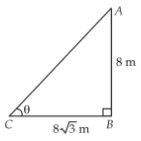
In $\triangle A B C$,
$\tan \theta=\frac{A B}{B C}=\frac{8}{8 \sqrt{3}}=\frac{1}{\sqrt{3}}$
$\Rightarrow \tan \theta=\tan 30^{\circ}$
$\Rightarrow \theta=30^{\circ}$
Hence, sun's elevation at the moment is $30^{\circ}$. View full question & answer→MCQ 1941 Mark
The angle of depression of a car parked on the road from the top of a $150 m$ high tower is $30^{\circ}$. The distance of the car from the tower (in metres) is
- A
$50 \sqrt{3}$
- ✓
$150 \sqrt{3}$
- C
$150 \sqrt{2}$
- D
AnswerCorrect option: B. $150 \sqrt{3}$
(b): Let, $A C=x m$ be the distance between tower and car and let $A B=150 m$ be height of tower.
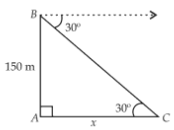
In $\triangle A B C$,
$\tan 30^{\circ}=\frac{150}{x}$
$\Rightarrow \frac{1}{\sqrt{3}}=\frac{150}{x} \Rightarrow x=150 \sqrt{3} m$
Hence, distance between tower and car $=150 \sqrt{3} m$. View full question & answer→MCQ 1951 Mark
The angle of elevation of the top of an incomplete vertical pillar at a horizontal distance of $100 m$ from its base is $45^{\circ}$. If the angle of elevation of the top of the complete pillar at the same point is to be $60^{\circ}$, then the height of the incomplete pillar is to be increased by
- A
$100(\sqrt{3}+1) m$
- B
$100 m$
- C
$100 \sqrt{3} m$
- ✓
$100(\sqrt{3}-1) m$
AnswerCorrect option: D. $100(\sqrt{3}-1) m$
(d) : Let $A B$ be the incomplete pillar and $A D$ is the height to be increased.
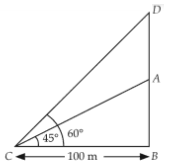
In $\triangle A B C, \frac{A B}{B C}=\tan 45^{\circ}$
$\Rightarrow \frac{A B}{100}=1 \Rightarrow A B=100 m$
In $\triangle D B C, \frac{D B}{B C}=\tan 60^{\circ}$
$\Rightarrow \quad \frac{A D+100}{100}=\sqrt{3}$
$\Rightarrow A D=100(\sqrt{3}-1) m$
Hence, the height of the incomplete pillar is to be increased by $100(\sqrt{3}-1) m$. View full question & answer→MCQ 1961 Mark
The angle of elevation of the top of a tower from a point on the ground, which is $15 m$ away from the foot of the tower is $60^{\circ}$. The height of the tower (in metres) is
- A
- ✓
- C
$30 \sqrt{3}$
- D
$15 \sqrt{3}$
Answer(b): Let $A B$ be the tower and $P$ be the point on the ground.
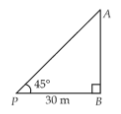
In $\triangle A B P, \frac{A B}{B P}=\tan 60^{\circ}$
$
\Rightarrow \frac{A B}{15}=\sqrt{3} \Rightarrow A B=15 \sqrt{3} m
$ View full question & answer→MCQ 1971 Mark
A person walking $20m$ towards a chimney in a horizontal line through its base observes that its angle of elevation changes from $30^{\circ}$ to $45^{\circ}$. The height of chimney is
AnswerCorrect option: A. $\frac{20}{\sqrt{3}+1} m$
Suppose height of the chimney be $h$ metres.
Let $A$ and $B$ be the points of observation and $\text{BC}$ be $x m$. In $\triangle \text{ACD}$,
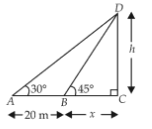
$\tan 30^{\circ}=\frac{CD}{AC}$
$\Rightarrow \frac{1}{\sqrt{3}}=\frac{h}{20+x}$
$\Rightarrow 20+x=h \sqrt{3}$
$\Rightarrow x=h \sqrt{3}-20$
Now, in $\triangle \text{DBC,} \tan 45^{\circ}=\frac{CD}{BC}$
$\Rightarrow 1=\frac{h}{x}$
$\Rightarrow x=h$
From $(i)$ and $(ii),$ we get
$h=h \sqrt{3}-20$
$\Rightarrow h \sqrt{3}-h=20$
$\therefore h=\frac{20}{\sqrt{3}-1} m$ View full question & answer→MCQ 1981 Mark
The tops of two poles of height $18 m$ and $10 m$ are connected by a wire of length $l$. If the wire makes an angle of $30^{\circ}$ with the horizontal, then $l$ is equal to
- A
$26 m$
- ✓
$16 m$
- C
$12 m$
- D
$10 m$
AnswerCorrect option: B. $16 m$
Let $A B$ and $C D$ be the two poles of height $18 m$ and $10 m$ respectively, such that $A C=l$.
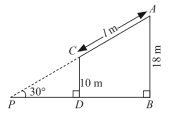
In $\triangle \text{C D P}, \sin 30^{\circ}$
$\Rightarrow \frac{1}{2}=\frac{10}{P C}$
$\Rightarrow P C=20 m$
In $\triangle \text{A B P}, \sin 30^{\circ}=\frac{A B}{P A} $
$\Rightarrow \frac{1}{2}=\frac{18}{P A}$
$ \Rightarrow P A=36 m$
Now, $l=A C=P A-P C=36-20=16 m$ View full question & answer→MCQ 1991 Mark
The angle of elevation of the top of a pillar from a point on the ground is $15^{\circ}$. On walking $100 m$ towards the pillar, the angle of elevation becomes $30^{\circ}$. Find the height of the pillar.
- A
$25 m$
- ✓
$50 m$
- C
$50 \sqrt{2} m ( d )$
- D
$25 \sqrt{2} m$
AnswerCorrect option: B. $50 m$
Let $A B$ be the pillar and $C$ and $D$ be the two points of observation.
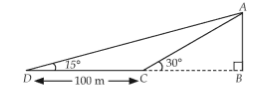
$\angle \text{ACB}=\angle \text{CDA} + \angle \text{CAD}$
$\Rightarrow 30^{\circ}=15^{\circ}+\angle \text{CAD}[$ By exterior angle property$]$
$\Rightarrow \angle \text{CAD}=15^{\circ}=\angle \text{ADC}$
$\therefore \text{CA=CD}=100 m$
$[\because$ Sides opposite to equal angles are equal$]$
In $\triangle \text{ABC}$,
$\sin 30^{\circ}=\frac{AB}{AC}$
$\Rightarrow \frac{1}{2}=\frac{A B}{100}$
$\Rightarrow 2\text{AB}=100$
$\Rightarrow \text{AB}=50 m$
Hence, the height of the pillar is $50 m$. View full question & answer→MCQ 2001 Mark
The angle of elevation of the top of a tower from a point on the ground, which is $30 m$ away from the foot of the tower is $45^{\circ}$. The height of the tower (in metres) is
- A
- ✓
- C
$30 \sqrt{3}$
- D
$10 \sqrt{3}$
Answer(b) : Let $A B$ be the tower and $P$ be the point on the ground.
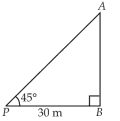
In $\triangle A B P, \frac{A B}{B P}=\tan 45^{\circ}$
$\Rightarrow \frac{A B}{30}=1 \Rightarrow A B=30 m$ View full question & answer→MCQ 2011 Mark
The length of shadow of a tower on the plane ground is $\sqrt{3}$ times the height of the tower. The angle of elevation of Sun is
- A
$45^{\circ}$
- ✓
$30^{\circ}$
- C
$60^{\circ}$
- D
$90^{\circ}$
AnswerCorrect option: B. $30^{\circ}$
(b): Let $A B$ be the tower and $B C$ be the length of the shadow of the tower.
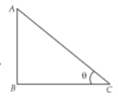
Let $\theta$ be the angle of elevation of Sun.
Given, $B C=\sqrt{3} A B$
In $\triangle A B C, \tan \theta=\frac{A B}{B C}=\frac{A B}{\sqrt{3} A B}$
$\Rightarrow \tan \theta=\frac{1}{\sqrt{3}} \Rightarrow \theta=30^{\circ}$
Thus, the angle of elevation of the Sun is $30^{\circ}$. View full question & answer→MCQ 2021 Mark
The ratio of the length of a vertical rod and the length of its shadow is $1: \sqrt{3}$. Find the angle of elevation of the Sun at that moment.
- ✓
$30^{\circ}$
- B
$60^{\circ}$
- C
$45^{\circ}$
- D
AnswerCorrect option: A. $30^{\circ}$
(a) : Let $A C$ be the length of vertical rod, $A B$ be the length of its shadow and $\theta$ be the angle of elevation of the Sun.
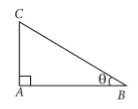
In $\triangle A B C, \tan \theta=\frac{A C}{A B}$
$\Rightarrow \tan \theta=\frac{1}{\sqrt{3}}$ (Given)
$\Rightarrow \tan \theta=\tan 30^{\circ}$
$\Rightarrow \theta=30^{\circ}$ View full question & answer→MCQ 2031 Mark
A kite is flying at a height of $45 m$ above the ground. The string attached to the kite is temporarily tied to a point on the ground. The inclination of the string with the ground is $60^{\circ}$. Find the length of the string assuming that there is no slack in the string. $($Use $\sqrt{3}=1.732$ )
- A
$45.35 m$
- B
$72.96 m$
- ✓
$51.96 m$
- D
$50 m$
AnswerCorrect option: C. $51.96 m$
Let $C$ be the position of kite.
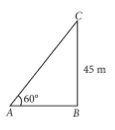
Now, in $\triangle \text{A B C}$,
$\sin 60^{\circ}=\frac{B C}{A C} $
$\Rightarrow \frac{\sqrt{3}}{2}=\frac{45}{A C}$
$\Rightarrow A C=\frac{45 \times 2}{\sqrt{3}}$
$=\frac{90}{\sqrt{3}}=30 \sqrt{3}=51.96 m$
Thus, the length of the string is $51.96 m$. View full question & answer→MCQ 2041 Mark
From the given figure, the angle of depression of point $C$ from the point $P$ is
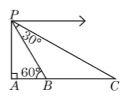
- A
$45^{\circ}$
- B
$90^{\circ}$
- C
$75^{\circ}$
- ✓
$30^{\circ}$
AnswerCorrect option: D. $30^{\circ}$
(d) : From figure, $\angle B P Q=\angle A B P$
[Alternate interior angles]
$
\Rightarrow \angle C P Q+\angle B P C=60^{\circ} \Rightarrow \angle C P Q+30^{\circ}=60^{\circ}
$
$
\Rightarrow \angle C P Q=30^{\circ}
$
Hence, angle of depression of point $C$ from the point $P$ is $30^{\circ}$.
View full question & answer→MCQ 2051 Mark
A man sitting on the top of a tower of height $30 m$ observes the angle of depression of a dog sitting on the ground as $60^{\circ}$. Find the distance between the foot of the tower and the dog. $($Use $\sqrt{3}=1.732)$
- A
$5 \sqrt{3} m$
- ✓
$10 \sqrt{3} m$
- C
$8 \sqrt{3} m$
- D
$12 \sqrt{3} m$
AnswerCorrect option: B. $10 \sqrt{3} m$
Let $A B$ be the tower of height $30 m$ and the dog is sitting on the ground at point $C$.
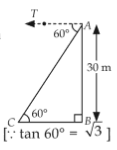
In $\triangle \text{A B C}$,
$\tan 60^{\circ}=\frac{A B}{B C}$
$\Rightarrow \sqrt{3}=\frac{30}{B C}$
$\Rightarrow B C=\frac{30}{\sqrt{3}}=\frac{30 \times \sqrt{3}}{\sqrt{3} \times \sqrt{3}}=10 \sqrt{3} m$
Hence, the distance between foot of the tower and the $\operatorname{dog}$ is $10 \sqrt{3} m$. View full question & answer→MCQ 2061 Mark
At certain time of the day, the length of the shadow of a tower is equal to its height. Then the Sun's altitude at that time is
- A
$30^{\circ}$
- B
$60^{\circ}$
- C
$90^{\circ}$
- ✓
$45^{\circ}$
AnswerCorrect option: D. $45^{\circ}$
(d) : Let $A B$ be the tower of height $h$ units and altitude of Sun at a certain time is $\theta$.

We have, $A B=B C=h$ (say)
In $\triangle A B C$,
$
\Rightarrow \tan \theta=\tan 45^{\circ} \Rightarrow \theta=45^{\circ}
$ View full question & answer→MCQ 2071 Mark
If the height of a vertical pole is $\sqrt{3}$ times the length of its shadow on the ground, then the angle of elevation of the Sun at that time is
- A
$30^{\circ}$
- ✓
$60^{\circ}$
- C
$45^{\circ}$
- D
$75^{\circ}$
AnswerCorrect option: B. $60^{\circ}$
(b) : Let $B C=h$ be the length of shadow of vertical pole and $A B=h \sqrt{3}$ be the height of pole.
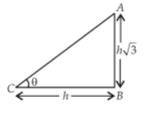
In $\triangle A B C, \tan \theta=\frac{h \sqrt{3}}{h}=\frac{\sqrt{3}}{1}$
$
\Rightarrow \theta=60^{\circ}
$ View full question & answer→MCQ 2081 Mark
The figure shows the $..........$
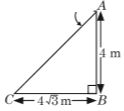
observation of point $C$ from point $A$. The angle of depression of $A$ is - ✓
$30^{\circ}$
- B
$45^{\circ}$
- C
$50^{\circ}$
- D
$75^{\circ}$
AnswerCorrect option: A. $30^{\circ}$
In $\triangle A B C, \angle B=90^{\circ}$.
Let $\angle A C B=\theta$
$\therefore \tan \theta=\frac{A B}{B C}=\frac{4}{4 \sqrt{3}}=\frac{1}{\sqrt{3}}$
$\Rightarrow \tan \theta=\tan 30^{\circ} $
$\Rightarrow \theta=30^{\circ}$
Hence, the angle of depression from $A$ is $30^{\circ}$.
View full question & answer→MCQ 2091 Mark
A lamp post $5 \sqrt{3} m$ high casts a shadow $5 m$ long on the ground. The Sun's elevation at this moment is
- A
$30^{\circ}$
- B
$45^{\circ}$
- ✓
$60^{\circ}$
- D
$90^{\circ}$
AnswerCorrect option: C. $60^{\circ}$
(c) : Let $A B$ be the lamp post and $B C$ be the shadow of it. Let Sun's elevation be $\theta$.
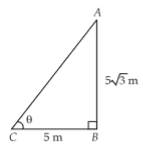
In $\triangle A B C$,
$
\tan \theta=\frac{A B}{B C}=\frac{5 \sqrt{3}}{5}=\sqrt{3}
$
$\Rightarrow \tan \theta=\tan 60^{\circ}$$
\Rightarrow \theta=60^{\circ}
$
Hence, Sun's elevation at the moment is $60^{\circ}$. View full question & answer→MCQ 2101 Mark
From a point on the ground, which is $15 m$ away from the foot of a vertical tower, the angle of elevation of the top of the tower, is found to be $60^{\circ}$. The height of the tower (in metres) is
- A
$5 \sqrt{3}$
- ✓
$15 \sqrt{3}$
- C
- D
AnswerCorrect option: B. $15 \sqrt{3}$
(b) : Let height of tower $A B=h$ metres
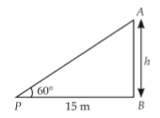
In $\triangle A P B$,
$
\tan 60^{\circ}=\frac{A B}{P B}=\frac{h}{15}
$
$\Rightarrow \sqrt{3}=\frac{h}{15}$
or $h=15 \sqrt{3} m$
$\therefore$ Height of the tower $=15 \sqrt{3} m$ View full question & answer→MCQ 2111 Mark
A ladder makes an angle of $60^{\circ}$ with the ground when placed against a wall. If the foot of the ladder is $2 m$ away from the wall, then the length of the ladder (in meters) is
- A
$\frac{4}{\sqrt{3}}$
- B
$4 \sqrt{3}$
- C
$2 \sqrt{2}$
- ✓
Answer(d): Let $M N$ be the length of the ladder.
In right-angled triangle $M N B$,
$
\cos 60^{\circ}=\frac{B N}{M N} \Rightarrow \frac{1}{2}=\frac{2}{M N}
$
$
\Rightarrow M N=2 \times 2=4 m
$
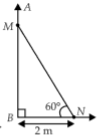
Therefore, the length of the ladder is $4 m$. View full question & answer→