Question 12 Marks
Prove the following trigonometric identities.
$\text{cos}^2\text{A}+\frac{1}{1+\cot^2\text{A}}=1$
AnswerWe know that,
$\sin^2\text{A}+\cos^2\text{A}=1,$
$\text{cosec}^2\text{A}-\text{cot}^2\text{A}=1$
So,
$\text{L.H.S.} = \text{cos}^2\text{A}+\frac{1}{1+\cot^2\text{A}}$
$\cos^2\text{A}+\frac{1}{1+\cot^2\text{A}}=\cos^2\text{A}+\frac{1}{\text{cosec}^2\text{A}}$
$=\cos^2\text{A}+\Big(\frac{1}{\text{cosec A}}\Big)^2$
$=\cos^2\text{A}+(\sin\text{ A})^2$
$=\cos^2\text{A}+\sin^2\text{A}$
$=1 = \text{R.H.S.}$
$\therefore\ \text{L.H.S}=\text{R.H.S}$
View full question & answer→Question 22 Marks
Prove the following trigonometric identities.
$\sin^2\text{A}\cot^2\text{A}+\cos^2\text{A}\tan^2\text{A}=1$
Answer$\text{L.H.S}=\sin^2\text{A}.\frac{\cos^2\text{A}}{\sin^2\text{A}}+\cos^2\text{A}\times\frac{\sin^2\text{A}}{\cos^2\text{A}}$
$=\cos^2\text{A}+\sin^2\text{A} \Big[\because \text{A}=\cos^2\frac{\text{A}}{\sin^2\text{A}}\tan^2\text{A}=\frac{\sin^2\text{A}}{\cos^2\text{A}}\Big]$
$=1=\text{R.H.S}$
$\therefore\ \text{L.H.S}=\text{R.H.S}$
View full question & answer→Question 32 Marks
What is the value of $\frac{\tan^2\theta-\sec^2\theta}{\cot^2\theta-\text{cosec}^2\theta}?$
Answer$\frac{\tan^2\theta-\sec^2\theta}{\cot^2\theta-\text{cosec}^2\theta}=\frac{-(\sec^2\theta-\tan^2\theta)}{-(\text{cosec}^2\theta-\cot^2\theta)}$
$=\frac{-1}{-1}=1 \ \begin{cases}\because \sec^2\theta-\tan^2\theta= 1 \\ \text{cosec}^2\theta-\cot^2\theta=1 \end{cases}$
View full question & answer→Question 42 Marks
Prove the following trigonometric identities.
$(1+\tan^2\theta)(1-\sin\theta)(1+\sin\theta)=1$
AnswerWe have to prove $(1+\tan^2\theta)(1-\sin\theta)(1+\sin\theta)=1$ We know that, $\sin^2\theta+\cos^2\theta=1,$ $\sec^2\theta-\tan^2\theta=1$ So, $\text{L.H.S}=(1+\tan^2\theta)(1-\sin\theta)(1+\sin\theta)$ $=(1+\tan^2\theta)\{(1-\sin\theta)(1+\sin\theta)\}$ $=(1+\tan^2\theta)(1-\sin^2\theta)$ $=\sec^2\theta\cos^2\theta$ $=\frac{1}{\cos^2\theta}\cos^2\theta$$=1=\text{R.H.S}$
$\therefore\ \text{L.H.S}=\text{R.H.S}$
View full question & answer→Question 52 Marks
Prove the following trigonometric identities.
$\frac{1+\cos\theta-\sin^2\theta}{\sin\theta(1+\cos\theta)}=\cot\theta$
Answer$\text{L.H.S}=\frac{(1+\cos\theta)-\sin^2\theta}{\sin\theta(1+\cos\theta)}$
$=\frac{(1+\cos\theta)-(1-\cos^2\theta)}{\sin\theta(1+\cos\theta)}$
$=\frac{(1+\cos\theta)-(1-\cos\theta)(1+\cos\theta)}{\sin(1+\cos\theta)}$
$=\frac{(1+\cos\theta)(1-1+\cos\theta)}{\sin\theta(1+\cos\theta)}$
$=\frac{\cos\theta}{\sin\theta}$
$=\cot\theta=\text{R.H.S}$
$\therefore\ \text{L.H.S}=\text{R.H.S}$
View full question & answer→Question 62 Marks
Prove the following trigonometric identities.
$\frac{\cos\theta}{1+\sin\theta}=\frac{1-\sin\theta}{\cos\theta}$
Answer$\text{L.H.S}=\frac{\cos\theta}{1+\sin\theta}$
$=\frac{\cos\theta}{(1+\sin\theta)}\times\frac{1-\sin\theta}{1-\sin\theta}$
$=\frac{(1-\sin\theta)\cos\theta}{1-\sin^2\theta}$
$=\frac{(1-\sin\theta)\cos\theta}{\cos^2\theta}$
$=\frac{(1-\sin\theta)}{\cos\theta}$
$=\text{R.H.S}$
$\therefore\ \text{L.H.S}=\text{R.H.S}$
View full question & answer→Question 72 Marks
If $\sec\theta+\tan\theta=\text{x},$ write the value of $\sec\theta-\tan\theta$ in terms of x.
Answer$\sec\theta+\tan\theta=\text{x}$
We know that
$\sec^2\theta-\tan^2\theta=1$
$\Rightarrow\ (\sec\theta+\tan\theta)(\sec\theta-\tan\theta)$
$=1\ \{\text{a}^2-\text{b}^2=(\text{a}+\text{b})(\text{a}-\text{b})\}$
$\Rightarrow\ \text{x}(\sec\theta-\tan\theta)=1$
$\Rightarrow\ \sec\theta-\tan\theta=\frac{1}{\text{x}}$
View full question & answer→Question 82 Marks
What is the value of $(1-\cos^2\theta)\text{ cosec}^2\theta?$
Answer$(1-\cos^2\theta)\text{cosec}^2\theta=\sin^2\theta\times\text{cosec}^2\theta$
$\begin{Bmatrix}\because1-\cos^2\theta=\sin^2\theta\text{ and }\sin\theta\text{ cosec }\theta=1\end{Bmatrix}$
$=(\sin\theta\text{ cosec }\theta)^2$
$=(1)^2=1$
View full question & answer→Question 92 Marks
What is the value of $6\tan^2\theta-\frac{6}{\cos^2\theta}?$
Answer$6\tan^2\theta-\frac{6}{\cos^2\theta}=6\tan^2-6\sec^2\theta$
$\begin{cases}\because \frac{1}{\cos\theta}=\sec\theta\end{cases}$
$=-6(\sec^2\theta-\tan^2\theta)\{\sec^2\theta-\tan^2\theta=1\}$
$=-6\times1=-6$
View full question & answer→Question 102 Marks
Prove the following trigonometric identities.
$(1+\cot^2\text{A})\sin^2\text{A}=1$
Answer$\text{L.H.S}=(1+\cot^2\text{A})\sin^2\text{A}$
$=\text{cosec}^2\text{A}\times\sin^2\text{A}\ [1+\cot^2\theta=\text{cosec}^2\theta]$
$=\frac{1}{\sin^2\text{A}}\times\sin^2\text{A}$
$=1=\text{R.H.S}$
$\therefore\ \text{L.H.S}=\text{R.H.S}$
View full question & answer→Question 112 Marks
AnswerAn identity is an equation which is true for all values of the variable (s) involved.
View full question & answer→Question 122 Marks
Prove the following trigonometric identities.
$(\sec\theta+\cos\theta)(\sec\theta-\cos\theta)=\tan^2\theta+\sin^2\theta$
AnswerWe have to prove $(\sec\theta+\cos\theta)(\sec\theta-\cos\theta)=\tan^2\theta+\sin^2\theta$
We know that, $\sin^2\theta+\cos^2\theta=1$
$\text{L.H.S}=(\sec\theta+\cos\theta)(\sec\theta-\cos\theta)$
$\sec^2\theta-\tan^2\theta=0$
$(\sec\theta+\cos\theta)(\sec\theta-\cos\theta)=\sec^2\theta-\cos^2\theta$
$=(1+\tan^2\theta)-(1-\sin^2\theta)$
$1+\tan^2\theta-1+\sin^2\theta$
$=\tan^2\theta+\sin^2\theta=\text{R.H.S}$
$\therefore\ \text{L.H.S}=\text{R.H.S}$
View full question & answer→Question 132 Marks
Prove the following trigonometric identities.
$\frac{\text{cosec A}}{\text{cosec A}-1}+\frac{\text{cosec A}}{\text{cosec A}+1}=2\sec^2\text{A}$
Answer$\text{L.H.S}=\frac{\text{cosec A}}{\text{cosec A}-1}+\frac{\text{cosec A}}{\text{cosec A}+1}$
$=\frac{\text{cosec A}(\text{cosec A+1})+\text{cosec A}(\text{cosec A}+1)}{(\text{cosec A}-1)(\text{cosec}+1)}$
$=\frac{\text{cosec}^2\text{A}+\text{cosec A}+\text{cosec}^2\text{A}-\text{cosec A}}{\text{cosec}^2-1}$
$=\frac{2\text{cosec}^2\text{A}}{\cot^2\text{A}}$
$=\frac{2\times\sin^2\text{A}}{\sin^2\text{A}\cos^2\text{A}}$
$=2\sec^2\text{A}$
$=\text{R.H.S}$
$\therefore\ \text{L.H.S}=\text{R.H.S}$
View full question & answer→Question 142 Marks
If $\cos\theta=\frac{3}{4},$ then find is the value of $9\tan^2\theta+9$.
AnswerGiven,
$\cos\theta=\frac{3}{4}$
$\Rightarrow\ \frac{1}{\cos\theta}=\frac{4}{3}$
$\Rightarrow\ \sec\theta=\frac{4}{3}$
We know that,
$\sec^2\theta-\tan^2\theta=1$
$\Rightarrow\ \Big(\frac{4}{3}\Big)^2-\tan^2\theta=1$
$\Rightarrow\ \tan^2\theta=\frac{16}{9}-1$
$\Rightarrow\ \tan^2\theta=\frac{7}{9}$
Therefore,
$9\tan^2\theta+9=9\times\frac{7}{9}+9$
$=7+9$
$=16$
View full question & answer→Question 152 Marks
If $\sin\theta=\frac{4}{5},$ what is the value of $\cot\theta+\text{cosec }\theta?$
Answer$\sin\theta=\frac{1}{\text{cosec}\theta}=\frac{4}{5}\Rightarrow\ \text{cosec }\theta=\frac{5}{4}$
$\cot\theta=\frac{\cos\theta}{\sin\theta}=\frac{\sqrt{1-\sin^2\theta}}{\sin^2\theta}=\frac{\sqrt{1-\Big(\frac{4}{5}\Big)^2}}{\frac{4}{5}}$
$=\frac{\sqrt{1-\frac{16}{15}}}{\frac{4}{5}}=\frac{\sqrt{\frac{25-16}{25}}}{\frac{4}{5}}=\frac{\sqrt{\frac{9}{25}}}{\frac{4}{5}}$
$=\frac{3}{5}\times\frac{5}{4}=\frac{3}{4}$
Now $\cot\theta+\text{cosec }\theta=\frac{3}{4}+\frac{5}{4}=\frac{3+5}{4}$
$=\frac{8}{4}=2$
View full question & answer→Question 162 Marks
Write the value of $\sin\text{A}\cos(90^\circ-\text{A})+\cos\text{A}\sin(90^\circ-\text{A})$.
Answer$\sin\text{A}\cos(90^\circ-\text{A})+\cos\text{A}\sin(90^\circ-\text{A})$
$=\sin\text{A}\sin\text{A}+\cos\text{A}\cos\text{A}$
$\begin{cases}\because \cos(90^\circ-\text{A})=\sin\text{A} \\ \sin(90^\circ-\text{A})=\cos\text{A} \\ \sin^2\text{A}+\cos^2\text{A}=1\end{cases}$
$=\sin^2\text{A}+\cos^2\text{A}=1$
View full question & answer→Question 172 Marks
Prove the following trigonometric identities.
$\frac{1+\sec\theta}{\sec\theta}=\frac{\sin^2\theta}{1-\cos\theta}$
Answer$\text{L.H.S}=\frac{1+\sec\theta}{\sec\theta}$
$=\frac{1+\frac{1}{\cos\theta}}{\frac{1}{\cos\theta}}$
$=\frac{\cos\theta+1}{\cos\theta}\times\cos\theta$
$=(1+\cos\theta)\times\frac{1-\cos\theta}{1-\cos\theta}$
$=\frac{(1-\cos^2\theta)}{(1-\cos\theta)}$
$=\frac{\sin^2\theta}{(1-\cos\theta)}=\text{R.H.S}$
$\therefore\ \text{L.H.S}=\text{R.H.S}$
View full question & answer→Question 182 Marks
If $\sin\theta+\cos\theta=\sqrt{2}\cos(90^\circ-\theta),$ find $\cot\theta$.
Answer$\sin\theta+\cos\theta=\sqrt{2}\cos(90^\circ-\theta)$
$\Rightarrow\ \sin\theta+\cos\theta=\sqrt{2}\sin\theta$
$\Rightarrow\ \cos\theta=\sqrt{2}\sin\theta-\sin\theta$
$\Rightarrow\ \cos\theta=\sin\theta(\sqrt{2}-1)$
$\Rightarrow\ \frac{\cos\theta}{\sin\theta}=(\sqrt{2}-1)$
$\Rightarrow\ \cot\theta=(\sqrt{2}-1)$
View full question & answer→Question 192 Marks
Prove the following trigonometric identities.
If $3\sin\theta+5\cos\theta=5,$ prove that $5\sin\theta-3\cos\theta=\pm3.$
AnswerGiven, $3\sin\theta+5\cos\theta=5$
We have to prove that $5\sin \theta-3\cos\theta=5$
We know that $\sin^2\theta+\cos^2\theta=1$
$\text{L.H.S}=3\sin\theta+5\cos\theta=5$
Squaring the given equation, we have
$(3\sin\theta+5\cos\theta)^2=(5)^2$
$\Rightarrow\ 9\sin^2\theta+2\times3\sin\theta\times5\cos\theta+25\cos^2\theta=25$
$\Rightarrow\ 9(1-\cos^2\theta)+2\times3\sin\theta\times5\cos\theta+25(1-\sin^2\theta)=25$
$\Rightarrow\ 9-9\cos^2\theta+2\times3\sin\theta\times5\cos\theta+25-25\sin^2\theta=25$
$\Rightarrow\ 34-(9\cos^2\theta-2\times3\sin\theta\times5\cos\theta+25\sin^2\theta)=25$
$\Rightarrow\ -(25\sin^2\theta-2\times5\sin\theta\times3\cos\theta+9\cos^2\theta)=-9$
$\Rightarrow\ (25\sin^2\theta-2\times5\sin\theta\times3\cos\theta+9\cos^2\theta)=9$
$\Rightarrow\ (5\sin\theta-3\cos\theta)^2=9$
$\Rightarrow\ 5\sin\theta-3\cos\theta=\pm3=\text{R.H.S}$
$\therefore\ \text{L.H.S}=\text{R.H.S}$
View full question & answer→Question 202 Marks
If $\sin^2\theta\cos^2\theta(1+\tan^2\theta)(1+\cos^2\theta)=\lambda,$ then find is the value of $\lambda$.
AnswerGiven,
$\sin^2\theta\cos^2\theta(1+\tan^2\theta)(1+\cos^2\theta)=\lambda,$
$\Rightarrow\ \sin^2\theta\cos^2\theta\sec^2\theta\text{ cosec}^2\theta=\lambda$
$\Rightarrow\ (\sin^2\theta\text{ cosec}^2\theta)\times(\cos^2\theta\sec^2\theta)=\lambda$
$\Rightarrow\ \Big(\sin^2\theta\times\frac{1}{\sin^2\theta}\Big)\Big(\cos^2\theta\times\frac{1}{\cos^2\theta}\Big)=\lambda$
$\Rightarrow\ \lambda=1\times1=1$
Hence, the value of $\lambda$ is 1.
View full question & answer→Question 212 Marks
If $\text{cosec}^2\theta(1+\cos\theta)(1-\cos\theta)=\lambda,$ then find is the value of $\lambda$.
Answer$\text{cosec}^2\theta(1+\cos\theta)(1-\cos\theta)=\lambda$
$\Rightarrow\ \text{cosec}^2\theta(1-\cos^2\theta)=\lambda \ \{(\text{a}+\text{b})(\text{a}-\text{b})=\text{a}^2-\text{b}^2\}$
$\Rightarrow\ \text{cosec}^2\theta\text{ x}\sin\theta=\lambda \ (1-\cos^2\theta=\sin^2\theta)$
$\Rightarrow\ 1=\lambda \ (\sin\theta\text{ cosec }\theta=1)$
$\therefore\ \lambda=1$
View full question & answer→Question 222 Marks
$\sqrt{\frac{1+\sin\text{A}}{1-\sin\text{A}}}=\sec\text{A}+\tan\text{A}$
Answer$\text{L.H.S}=\sqrt{\frac{1+\sin\text{A}}{1-\sin\text{A}}}$
$=\sqrt{\frac{(1+\sin\text{A})(1+\sin\text{A})}{(1-\sin\text{A})(1+\sin\text{A})}}$
$=\sqrt{\frac{(1+\sin\text{A})^2}{1-\sin^2\text{A}}}=\sqrt{\frac{(1+\sin\text{A})^2}{\cos^2\text{A}}}$
$\frac{1+\sin\text{A}}{\cos\text{A}}=\frac{1}{\cos\text{A}}+\frac{\sin\text{A}}{\cos\text{A}}$
$=\sec\text{A}+\tan\text{A}=\text{R.H.S}$
$\therefore\ \text{L.H.S}=\text{R.H.S}$
View full question & answer→Question 232 Marks
Prove the following trigonometric identities.
$\tan^2\text{A}+\cot^2\text{A}=\sec^2\text{A}\text{ cosec}^2\text{A}-2$
Answer$\text{L.H.S}=\tan^2\text{A}+\cot^2\text{A}$
$=\sec^2\text{A}-1+\text{cosec}^2\text{A}-1$
$=\sec^2\text{A}+\text{cosec}^2\text{A}-2$
$=\frac{1}{\cos^2\text{A}}+\frac{1}{\sin^2\text{A}}-2$
$=\frac{\sin^2\text{A}+\cos^2\text{A}}{\cos^2\text{A}\sin^2\text{A}}-2$
$=\frac{1}{\cos^2\text{A}\sin^2\text{A}}-2$
$=\sec^2\text{A}\text{ cosec}^2\text{A}-2=\text{R.H.S}$
$\therefore\ \text{L.H.S}=\text{R.H.S}$
View full question & answer→Question 242 Marks
Prove the following trigonometric identities.
$\frac{1-\sin\theta}{1+\sin\theta}=(\sec\theta-\tan\theta)^2$
Answer$\text{L.H.S}=\frac{(1-\sin\theta)}{(1+\sin\theta)}$
$=\frac{1-\sin\theta}{1+\sin\theta}\times\frac{(1-\sin\theta)}{(1-\sin\theta)}$
$=\frac{(1-\sin\theta)^2}{(1-\sin^2\theta)}$
$=\frac{(1-\sin\theta)^2}{\cos^2\theta}$
$=\frac{1-2\sin\theta+\sin^2\theta}{\cos^2\theta}$
$=\frac{1}{\cos^2\theta}-2\frac{\sin\theta}{\cos^2\theta}+\frac{\sin^2\theta}{\cos^2\theta}$
$=\sec^2\theta-2\sec\theta\tan\theta+\tan^2\theta$
$=(\sec\theta-\tan\theta)^2=\text{R.H.S}$
$\therefore\ \text{L.H.S}=\text{R.H.S}$
View full question & answer→Question 252 Marks
Prove the following trigonometric identities.
$\text{cosec}\theta\sqrt{1-\cos^2\theta}=1$
Answer$\text{L.H.S}=\text{cosec}\theta\sqrt{\sin^2\theta}\ [\because\ 1-\cos^2\theta=\sin^2\theta]$
$=\text{cosec}\theta\times\sin\theta$
$=1=\text{R.H.S}$
$\therefore\ \text{L.H.S}=\text{R.H.S}$
View full question & answer→Question 262 Marks
What is the value of $(1+\cot^2\theta)\sin^2\theta?$
AnswerWe have,
$(1+\cot^2\theta)\sin^2\theta=\text{cosec}^2\theta\times\sin^2\theta$
$=\Big(\frac{1}{\sin\theta}\Big)^2\times\sin^2\theta$
$=\frac{1}{\sin^2\theta}\times\sin^2\theta$
$=1$
View full question & answer→Question 272 Marks
Write the value of $\cot^2\theta-\frac{1}{\sin^2\theta}$.
AnswerWe have,
$\cot^2\theta-\frac{1}{\sin^2\theta}=\cot^2\theta-\Big(\frac{1}{\sin\theta}\Big)^2$
$=\cot^2\theta-(\text{cosec }\theta)^2$
$=\cot^2\theta-\text{cosec}^2\theta$
We know that, $\cot^2\theta-\text{cosec}^2\theta=-1$
$\therefore\ \cot^2\theta-\frac{1}{\sin^2\theta}=-1$
View full question & answer→Question 282 Marks
Prove the following trigonometric identities.
$\sqrt{\frac{1-\cos\theta}{1+\cos\theta}}=\text{cosec}\theta-\cot\theta$
Answer$\text{L.H.S}=\sqrt{\frac{1-\cos\theta}{1+\cos\theta}}$
$=\sqrt{\frac{1-\cos\theta}{1+\cos\theta}}\times\sqrt{\frac{1-\cos\theta}{1-\cos\theta}}$
$=\sqrt{\frac{(1-\cos\theta)^2}{(1-\cos^2\theta)}}$
$=\frac{(1-\cos\theta)}{\sqrt{\sin^2\theta}}$
$=\frac{1-\cos\theta}{\sin\theta}$
$=\frac{1}{\sin\theta}-\frac{\cos\theta}{\sin\theta}$
$=\text{cosec}\theta-\cot\theta=\text{R.H.S}$
$\therefore\ \text{L.H.S}=\text{R.H.S}$
View full question & answer→Question 292 Marks
What is the value of $9\cot^2\theta-9\text{ cosec}^2\theta?$
AnswerWe have,
$9\cot^2\theta-9\text{cosec}^2\theta$
$=9(\cot^2\theta-\text{cosec}^2\theta)$
$=-9(\text{cosec}^2\theta-\cot^2\theta)$
We know that, $\text{cosec}^2\theta-\cot^2\theta=1$
Therefore, $9\cot^2\theta-9\text{cosec}^2\theta=-9$
View full question & answer→Question 302 Marks
Prove the following trigonometric identities.
$(\sec^2\theta-1)(\text{cosec}^2\theta-1)=1$
Answer$\text{L.H.S}=(\sec^2\theta-1)(\text{cosec}^2\theta-1)$
$ [\because\ 1+\tan^2\theta=\sec^2\theta,1+\cot^2\theta=\text{cosec}^2\theta]$
$=(1+\tan^2\theta-1)(1+\cot^2\theta-1)$
$=\tan^2\theta\times\cot^2\theta$
$=\tan^2\theta\times\frac{1}{\tan^2\theta}$
$=1=\text{R.H.S}$
$\therefore\ \text{L.H.S}=\text{R.H.S}$
View full question & answer→Question 312 Marks
If $\sin\theta=\frac{1}{\sqrt{2}},$ find all other trigonometric rations of angle $\theta$.
AnswerWe have $\sin\theta=\frac{1}{\sqrt{2}}$
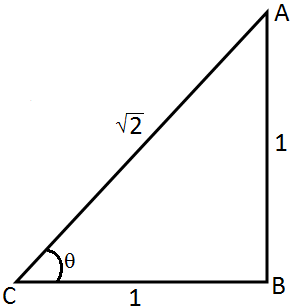
In $\triangle\text{ABC}$
$\text{AC}^2=\text{AB}^2+\text{BC}^2$
$\Rightarrow\ (\sqrt{2})=(1)^2+\text{BC}^2$
$\Rightarrow\ \text{BC}^2=2-1$
$\Rightarrow\ \text{BC}=1$
$\therefore\ \cos\theta=\frac{\text{BC}}{\text{AC}}=\frac{1}{\sqrt{2}}$
$\tan\theta=\frac{\text{AB}}{\text{BC}}=\frac{1}{1}=1$
$\cot\theta=\frac{1}{\tan\theta}=1$
$\sec\theta=\frac{1}{\cos\theta}=\sqrt{2}$
$\text{cosec }\theta=\frac{1}{\sin\theta}=\sqrt{2}$ View full question & answer→Question 322 Marks
Prove the following trigonometric identities.
$(\sin\theta+\cos\theta)(\tan\theta+\cos\theta)=\sec\theta+\text{cosec }\theta$
AnswerConsider the L.H.S $(\sin\theta+\cos\theta)(\tan\theta+\cot\theta)$$\text{L.H.S}=(\sin\theta+\cos\theta)(\tan\theta+\cot\theta)$
$=(\sin\theta+\cos\theta)\Big(\frac{\sin\theta}{\cos\theta}+\frac{\cos\theta}{\sin\theta}\Big)$ $=(\sin\theta+\cos\theta)\Big(\frac{\sin^2\theta+\cos^2\theta}{\sin\theta\times\cos\theta}\Big)$ $=\frac{\sin\theta+\cos\theta}{\sin\theta\times\cos\theta} \big[\sin^2\theta+\cos^2\theta=1\Big]$ $=\frac{1}{\cos\theta}+\frac{1}{\sin\theta}$ $=\sec\theta+\text{cosec }\theta=\text{R.H.S}$ $\therefore\ \text{L.H.S}=\text{R.H.S}$
View full question & answer→Question 332 Marks
If $\sec^2\theta(1+\sin\theta)(1-\sin\theta)=\text{k},$ then find is the value of k.
Answer$\sec^2\theta(1+\sin\theta)(1-\sin\theta)=\text{k}$
$\Rightarrow\ \sec^2\theta(1-\sin\theta)=\text{k}$
$\begin{Bmatrix}\because (\text{a}+\text{b})(\text{a}-\text{b}) \\ =\text{a}^2-\text{b}^2 \\ 1-\sin^2\theta=\cos^2\theta \\ \cos\theta\sec\theta=1\end{Bmatrix}$
$\Rightarrow\ \sec^2\theta\cos^2\theta=\text{k}$
$1=\text{k}$
$\therefore\ \text{k}=1$
View full question & answer→Question 342 Marks
Prove the following trigonometric identities.
$\frac{\cot\text{A}-\cos\text{A}}{\cot\text{A}+\cos\text{A}}=\frac{\text{cosec A}-1}{\text{cosec A}+1}$
Answer$\text{L.H.S}=\frac{\frac{\cos\text{A}}{\sin\text{A}}-\cos\text{A}}{\frac{\cos\text{A}}{\sin\text{A}}+\cos\text{A}}\ \Big[\because \cot\text{A}=\frac{\cos\text{A}}{\sin\text{A}}\Big]$
$=\frac{\cos\text{A}\Big[\frac{1}{\sin\text{A}}-1\Big]}{\cos\text{A}\Big[\frac{1}{\sin\text{A}}+1\Big]}$
$=\frac{\text{cosec A}-1}{\text{cosec A}+1}=\text{R.H.S}$
$\therefore\ \text{L.H.S}=\text{R.H.S}$
View full question & answer→Question 352 Marks
Write the value of $\text{cosec}^2(90^\circ-\theta)-\tan^2\theta$.
Answer$\text{cosec}^2(90^\circ-\theta)\tan^2\theta$
$=\sec^2\theta-\tan^2\theta=1$
$\begin{cases}\because \text{cosec }(90^\circ-\theta)=\sec\theta \\ \text{and }\sec^3\theta-\tan^3\theta=1 \end{cases}$
View full question & answer→Question 362 Marks
Prove the following trigonometric identities.
$\frac{1-\cos\theta}{\sin\theta}=\frac{\sin\theta}{1+\cos\theta}$
AnswerWe have to prove $\frac{1-\cos\theta}{\sin\theta}=\frac{\sin\theta}{1+\cos\theta}$
We know that, $\sin^2\theta+\cos^2\theta=1$
Multiplying both numberator and denominator by $(1 + \cos\theta)$, we have
$\text{L.H.S}=\frac{1-\cos\theta}{\sin\theta}=\frac{(1-\cos\theta)(1+\cos\theta)}{\sin\theta(1+\cos\theta)}$
$=\frac{1-\cos^2\theta}{\sin\theta(1+\cos\theta)}$
$=\frac{\sin^2\theta}{\sin\theta(1+\cos\theta)}$
$=\frac{\sin\theta}{1+\cos\theta}=\text{R.H.S}$
$\therefore\ \text{L.H.S}=\text{R.H.S}$
View full question & answer→Question 372 Marks
What is the value of $\sin^2\theta+\frac{1}{1+\tan^2\theta}?$
Answer$\sin^2\theta+\frac{1}{1+\tan^2\theta}=\sin^2\theta+\frac{1}{\sec^2\theta}$
$\begin{cases}\because 1+\tan^2\theta=\sec^2\theta\\ \frac{1}{\sec\theta}=\cos\theta \\ \text{and }\sin^2\theta+\cos^2\theta = 1\end{cases}$
$=\sin^2\theta+\cos^2\theta$
$=1$
View full question & answer→Question 382 Marks
Prove the following trigonometric identities.
$\cot^2\text{A}\text{ cosec}^2\text{B}-\cot^2\text{B cosec}^2\text{A}=\cot^2\text{A}-\cot^2\text{B}$
Answer$\text{L.H.S}=\cot^2\text{A cosec}^2\text{B}-\cot^2\text{B cosec}^2\text{A}$
$=\cot^2\text{A}(1+\cot^2\text{B})-\cot^2\text{B}(1+\cot^2\text{B}) \big[\because \text{cosec}^2\theta=1+\cot^2\theta\big]$
$=\cot^2\text{A}+\cot^2\text{A}\cot^2\text{B}-\cot^2\text{B}-\cot^2\text{B}\cot^2\text{A}$
$=\cot^2\text{A}-\cot^2\text{B}=\text{R.H.S}$
$\therefore\ \text{L.H.S}=\text{R.H.S}$
View full question & answer→Question 392 Marks
Prove the following trigonometric identities.
$\tan\theta+\frac{1}{\tan\theta}=\sec\theta\text{cosec}\theta$
AnswerWe know that, $\sec^2\theta-\tan^2\theta=1$
So,
$\text{L.H.S.} = \tan\theta+\frac{1}{\tan\theta}$
$\tan\theta+\frac{1}{\tan\theta}=\frac{\tan^2\theta+1}{\tan\theta}$
$=\frac{\sec^2\theta}{\tan\theta}$
$=\sec\theta\frac{\sec\theta}{\tan\theta}$
$=\sec\theta\frac{\frac{1}{\cos\theta}}{\frac{\sin\theta}{\cos\theta}}$
$=\sec\theta\frac{1}{\sin\theta}$
$=\sec\theta\text{cosec}\theta$
$= \text{R.H.S}$
$\therefore\ \text{L.H.S}=\text{R.H.S}$
View full question & answer→Question 402 Marks
Prove the following trigonometric identities.
$1+\frac{\cot^2\theta}{1+\text{cosec }\theta}=\text{cosec }\theta$
Answer$\text{L.H.S}=1+\frac{\cot^2\theta}{1+\text{cosec }\theta}$
$1+\frac{\text{cosec}^2\theta-1}{1+\text{cosec }\theta}\ \big[\because \text{cosec}^2\theta-\cot^2\theta=1,\cot^2\theta=\text{cosec }^2\theta-1\big]$
$1+\frac{(\text{cosec }\theta-1)(\text{cosec }\theta+1)}{1+\text{cosec }\theta}$
$=1+\text{cosec }\theta-1\ \big[\because(\text{a}+\text{b})(\text{a}-\text{b})=\text{a}^2-\text{b}^2\text{a}=\text{cosec}^2\theta-1\big]$
$=\text{cosec }\theta=\text{R.H.S}$
$\therefore\ \text{L.H.S}=\text{R.H.S}$
View full question & answer→Question 412 Marks
Prove the following trigonometric identities.
$\text{sin}^2\text{A}+\frac{1}{1+\tan^2\text{A}}=1$
Answer$\text{L.H.S} = \sin^{2}\text{A} + \frac{1}{1 + \tan^{2}\text{A}}$
$1+\tan^2\text{A}=\sec^2\text{A}\ [\because \sec^2\text{A}-\tan^2\text{A}=1]$
$= \sin^2\text{A}+\frac{1}{\sec^2\text{A}}\ [1+\tan^2\text{A}=\sec^2\text{A}]$
$=\sin^2\text{A}+\cos^2\text{A}$
$= 1=\text{R.H.S}$
$\therefore\ \text{L.H.S}=\text{R.H.S}$
View full question & answer→Question 422 Marks
What is the value of $(1+\tan^2\theta)(1-\sin\theta)(1+\sin\theta)?$
Answer$(1+\tan^2\theta)(1-\sin\theta)(1+\sin\theta)$
$=(1+\tan^2\theta)\{(1-\sin\theta)(1+\sin\theta)\}$
$=(1+\tan^2\theta)(1-\sin^2\theta)$
We know that,
$\sec^2\theta-\tan^2\theta=1$
$\Rightarrow\ \sec^2\theta=1+\tan^2\theta,$
$\sin^2\theta+\cos^2\theta=1$
$\Rightarrow\ \cos^2\theta=1-\sin^2\theta$
Therefore,
$(1+\tan^2\theta)(1-\sin\theta)(1+\sin\theta)=\sec^2\theta\times\cos^2\theta$
$=\frac{1}{\cos^2\theta}\times\cos^2\theta$
$=1$
View full question & answer→Question 432 Marks
Prove the following trigonometric identities.
$\frac{\sec\text{A}-\tan\text{A}}{\sec\text{A}+\tan\text{A}}=\frac{\cos^2\text{A}}{(1+\sin\text{A})^2}$
Answer$\text{L.H.S}=\frac{\sec\text{A}-\tan\text{A}}{\sec\text{A}+\tan\text{A}}$
$=\frac{\frac{1}{\cos\text{A}}-\frac{\sin\text{A}}{\cos\text{A}}}{\frac{1}{\cos\text{A}}+\frac{\sin\text{A}}{\cos\text{A}}}$
$=\frac{\frac{1-\sin\text{A}}{\cos\text{A}}}{\frac{1+\sin\text{A}}{\cos\text{A}}}$
$=\frac{1-\sin\text{A}}{1+\sin\text{A}}$
$=\frac{(1-\sin\text{A})}{(1+\sin\text{A})}\times\frac{(1+\sin\text{A})}{(1+\sin\text{A})}$
$=\frac{(1-\sin^2\text{A})}{(1+\sin\text{A})^2} \big[\because \text{a}^2-\text{b}^2=(\text{a}+\text{b})(\text{a}-\text{b})\big]$
$=\frac{\cos^2\text{A}}{(1+\sin\text{A})^2}=\text{R.H.S}$
$\therefore\ \text{L.H.S}=\text{R.H.S}$
View full question & answer→Question 442 Marks
Prove the following trigonometric identities.
$\tan^2\theta-\sin^2\theta=\tan^2\theta\sin^2\theta$
Answer$\text{L.H.S}=\tan^2\theta-\sin^2\theta$
$=\frac{\sin^2\theta}{\cos^2\theta}-\frac{\sin^2\theta}{1}$
$=\sin^2\theta\Big[\frac{1}{\cos^2\theta}-\frac{1}{1}\Big]$
$=\sin^2\theta\Big(\frac{1-\cos^2\theta}{\cos^2\theta}\Big)=\sin^2\theta\cdot\frac{\sin^2\theta}{\cos^2\theta}$
$\sin^2\theta\cdot\tan^2\theta=\text{R.H.S}$
View full question & answer→Question 452 Marks
If $\sqrt{3}\tan\theta-1=0,$ find the value of $\sin^2-\cos^2\theta$.
AnswerGiven that, $\sqrt{3}\tan\theta=1$
$\Rightarrow\ \tan\theta=\frac{1}{\sqrt{3}}=\tan30^\circ$
$\Rightarrow\ \theta=30^\circ$
Now, $\sin^2\theta-\cos^2\theta=\sin^230^\circ-\cos^230^\circ$
$=\Big(\frac{1}{2}\Big)^2-\Big(\frac{\sqrt{3}}{2}\Big)^2$
$=\frac{1}{4}-\frac{3}{4}=\frac{1-3}{4}=-\frac{2}{4}=-\frac{1}{2}$
View full question & answer→Question 462 Marks
Prove the following trigonometric identities.
$\tan^2\theta\cos^2\theta=1-\cos^2\theta$
AnswerWe know that, $\sin^2\theta+\cos^2\theta=1$ So, $\text{L.H.S.} = \tan^2\theta\cos^2\theta$ $\tan^2\theta\cos^2\theta=(\tan\theta\times\cos\theta)^2$ $=\Big(\frac{\sin\theta}{\cos\theta}\times\cos\theta\Big)^2$ $=(\sin\theta)^2$ $=\sin^2\theta$$=1-\cos^2\theta = \text{R.H.S.}$
$\therefore\ \text{L.H.S}=\text{R.H.S}$
View full question & answer→Question 472 Marks
If $\text{cosec }\theta-\cot\theta=\alpha,$ write the value of $\text{cosec }\theta+\cos\alpha$.
AnswerGiven, $\text{cosec }\theta-\cot\theta=\alpha$
We know that, $\text{cosec}^2\theta-\cot^2\theta=1$
Therefore,
$\text{cosec}^2\theta-\cot^2\theta=1$
$\Rightarrow\ (\text{cosec }\theta+\cot\theta)(\text{cosec }\theta-\cot\theta)=1$
$\Rightarrow\ (\text{cosec }\theta+\cot\theta)\alpha=1$
$\Rightarrow\ (\text{cosec }\theta+\cot\theta)=\frac{1}{\alpha}$
Hence, $\text{cosec }\theta-\cot\theta=\frac{1}{\alpha}$
View full question & answer→Question 482 Marks
Prove the following trigonometric identities.
$\frac{\sin\theta}{1-\cos\theta}=\text{cosec}\theta+\cot\theta$
Answer$\text{L.H.S}=\frac{\sin\theta}{1-\cos\theta}$
Rationalizer both Nr and Or with $1+\cos\theta$
$\Rightarrow\ \frac{\sin\theta}{1-\cos\theta}\times\frac{1+\cos\theta}{1+\cos\theta}$
$\Rightarrow\ \frac{\sin\theta(1+\cos\theta)}{1-\cos^2\theta}\ [\because(\text{a}-\text{b})(\text{a}+\text{b})=\text{a}^2-\text{b}^2]$
$\Rightarrow \frac{\sin\theta+\sin\theta\cos\theta}{\sin^2\theta}\ [\because 1-\cos^2\theta-\sin^2\theta]$
$\Rightarrow \frac{\sin\theta}{\sin^2\theta}+\frac{\sin\theta\cos\theta}{\sin^2\theta}$
$\Rightarrow\ \frac{1}{\sin\theta}+\frac{\cos\theta}{\sin\theta}$
$\Rightarrow\ \text{cosec }\theta+\cot\theta=\text{R.H.S}$
$\therefore\ \text{L.H.S}=\text{R.H.S}$
View full question & answer→Question 492 Marks
Prove the following trigonometric identities.
$\tan^2\text{A}\sec^2\text{B}-\sec^2\text{A}\tan^2\text{B}=\tan^2\text{A}-\tan^2\text{B}$
AnswerWe have to prove $\tan^2\text{A}\sec^2\text{B}-\sec^2\text{A}\tan^2\text{B}=\tan^2\text{A}-\tan^2\text{B}$
We know that, $\sec^2\text{A}-\tan^2\text{A}=1$
So,
$\text{L.H.S}=\tan^2\text{A}\sec^2\text{B}-\sec^2\text{A}\tan^2\text{B}$
$=\tan^2\text{A}(1+\tan^2\text{B})-(1+\tan^2\text{A})\tan^2\text{B}$
$=\tan^2\text{A}+\tan^2\text{A}\tan^2\text{B}-\tan^2\text{B}-\tan^2\text{A}\tan^2\text{B}$
$=\tan^2\text{A}-\tan^2\text{B}=\text{R.H.S}$
$\therefore\ \text{L.H.S}=\text{R.H.S}$
View full question & answer→Question 502 Marks
If $\sin\theta=\frac{1}{3},$ then find is the value of $2\cot^2\theta+2$.
Answer$\sin\theta=\frac{1}{3}$
$\therefore\ \text{cosec }\theta=\frac{1}{\sin\theta}=\frac{3}{1}$
Now, $2\cot^2\theta+2=2(\cot^2\theta+1)$
$=2\text{cosec}^2\theta=2\times(3)^2$
$=2\times9=18$
View full question & answer→Question 512 Marks
If $\tan\theta=\frac{3}{4},$ find the value of $\frac{1-\cos\theta}{1+\cos\theta}$.
Answer$\sec\theta=\sqrt{1+\tan^2\theta}$
$=\sqrt{1+\Big(\frac{3}{4}\Big)^2}=\sqrt{1+\frac{9}{16}}$
$\Rightarrow\ \sqrt{\frac{16-9}{16}}=\frac{5}{4}$
$\therefore\ \sec\theta=\frac{1}{\cos\theta}=\frac{1}{\frac{5}{4}}=\frac{4}{5}=\cos\theta$
$\therefore\ \text{We get }\frac{1-\frac{4}{5}}{1+\frac{4}{5}}=\frac{\frac{1}{5}}{\frac{9}{5}}=\frac{1}{9}$
View full question & answer→Question 522 Marks
If $2\sin^2\theta-\cos^2\theta=2,$ then find the value of $\theta$.
AnswerGiven, $2\sin^2\theta-\cos^2\theta=2$
$\Rightarrow\ 2\sin^2\theta-(1-\sin^2\theta)=2 \ \big[\because\ \sin^2\theta+\cos^2\theta=1\big]$
$\Rightarrow\ \sin^2\theta+\sin^2\theta-1=2$
$\Rightarrow\ 3\sin^2\theta=3$
$\Rightarrow\ \sin^2\theta=1\ \big[\because\ \sin90^\circ=1\big]$
$\Rightarrow\ \sin\theta=1=\sin90^\circ$
$\therefore\ \theta=90^\circ$
View full question & answer→Question 532 Marks
Prove the following trigonometric identities.
If $\text{cosec }\theta+\cot\theta=\text{m and cosec }\theta-\cot\theta=\text{n},$ prove that mn = 1.
Answer$\text{L.H.S}=\text{mn}$
$=(\text{cosec }\theta+\cot\theta)(\text{cosec }\theta-\cot\theta)$
$=\text{coese}^2\theta-\cot^2\theta$
$=1 \big[\because(\text{a}+\text{b})(\text{a}-\text{b})=\text{a}^2-\text{b}^2\text{ cosec}^2\theta-\cot^2\theta=1\big]$
$=1=\text{R.H.S}$
$\therefore\ \text{L.H.S}=\text{R.H.S}$
View full question & answer→Question 542 Marks
Prove the following trigonometric identities.
$\sin^2\text{A}\cos^2\text{B}-\cos^2\text{A}\sin^2\text{B}=\sin^2\text{A}-\sin^2\text{B}$
Answer$\text{L.H.S}=\sin^2\text{A}\cos^2\text{B}-\cos^2\text{A}\sin^2\text{B}$
$=\sin^2\text{A}(1-\sin^2\text{B})-(1-\sin^2\text{A})(\sin^2\text{B})$
$(\because \cos^2\text{A}=1-\sin^2\text{A})$
$=\sin^2\text{A}-\sin^2\text{A}\sin^2\text{B}-\sin^2\text{B}+\sin^2\text{A}\sin^2\text{B}$
$=\sin^2\text{A}-\sin^2\text{B}=\text{R.H.S}$
$\therefore\ \text{L.H.S}=\text{R.H.S}$
View full question & answer→Question 552 Marks
Prove the following trigonometric identities.
$\frac{(1+\cot^2\theta)\tan\theta}{\sec^2\theta}=\cot\theta$
AnswerWe have to prove $\frac{(1+\cot^2\theta)\tan\theta}{\sec^2\theta}=\cot\theta$
We know that, $\sec^2\theta-\tan^2\theta=1$
So,
$\text{L.H.S}=\frac{(1+\cot^2\theta)\tan\theta}{\sec^2\theta}=\frac{(1+\cot^2\theta)\tan\theta}{1+\tan^2\theta}$
$=\frac{\Big(1+\frac{1}{\tan^2\theta}\Big)\tan\theta}{(1+\tan^2\theta)}$
$=\frac{\Big(\frac{\tan^2\theta+1}{\tan^2\theta}\Big)\tan\theta}{(1+\tan^2\theta)}$
$=\frac{(1+\tan^2\theta)\tan\theta}{\tan^2\theta(1+\tan^2\theta)}$
$=\frac{1}{\tan\theta}$
$=\cot\theta=\text{R.H.S}$
$\therefore\ \text{L.H.S}=\text{R.H.S}$
View full question & answer→Question 562 Marks
Prove the following trigonometric identities.
$\text{cosec}^6\theta=\cot^6\theta+3\cot^2\theta\text{cosec}^2\theta+1$
Answer$\text{L.H.S}=\text{cosec}^6\theta$
$=(\text{cosec}^2\theta)^3$
$=(1+\cot^2\theta)^3 \big[\because \text{cosec}^2\theta=1+\cot^2\theta\big]$
$=(1)^3+(\cot^2\theta)^3+3\cot^2\theta\times1(1+\cot^2\theta)$
$=1+\cot^6\theta+3\cot^2\theta\text{cosec}^2\theta$
$=\cot^6\theta+3\cot^2\theta\text{cosec}^2\theta+1=\text{R.H.S}$
$\therefore\ \text{L.H.S}=\text{R.H.S}$
View full question & answer→Question 572 Marks
Prove the following trigonometric identities.
$(\text{cosec}\theta+\sin\theta)(\text{cosec}\theta-\sin\theta)=\cot^2\theta+\cos^2\theta$
Answer$\text{L.H.S}=(\text{cosec}\theta+\sin\theta)(\text{cosec}\theta-\sin\theta)$
$=(\text{cosec}^2\theta-\sin^2\theta)$
$=(1+\cot^2\theta)-(1-\cos^2\theta)$
$=1+\cot^2\theta-1+\cos^2\theta$
$=\cot^2\theta+\cos^2\theta=\text{R.H.S}$
$\therefore\ \text{L.H.S}=\text{R.H.S}$
View full question & answer→Question 582 Marks
Prove the following trigonometric identities.
$\frac{1+\cos\text{A}}{\sin^2\text{A}}=\frac{1}{1-\cos\theta}$
AnswerWe know that $\sin^2\text{A}+\cos^2\text{A}=1$
$\sin^2\text{A}=1-\cos^2\text{A}$
$\Rightarrow\ \sin^2\text{A}=(1-\cos\text{A})(1+\cos\text{A})$
$\Rightarrow\ \text{L.H.S}=\frac{(1+\cos\text{A})}{(1-\cos\text{A})(1+\cos\text{A})}=\frac{1}{1-\cos\text{A}}$
$\therefore\ \text{L.H.S}=\text{R.H.S}$
Hence proved.
View full question & answer→Question 592 Marks
Prove the following trigonometric identities.
$(1-\cos^2\text{A})\text{cosec}^2\text{A}=1$
AnswerWe know $\sin^2\text{A}+\cos^2\text{A}=1$
$\text{L.H.S.} = (1-\cos^2\text{A})\text{cosec}^2\text{A}$
$\sin^2\text{A}=1-\cos^2\text{A}$
$=\ \sin^2\text{A}.\text{cosec}^2\text{A}$
$=\ \sin^2\text{A}.\frac{1}{\sin^2\text{A}}=1$
$=1= \text{R.H.S.}$
$$$\therefore\ \text{L.H.S.}=\text{R.H.S}$
View full question & answer→Question 602 Marks
Prove the following trigonometric identities.
$(\text{cosec}\text{A}-\sin\text{A})(\sec\text{A}-\cos\text{A})(\tan\text{A}+\cot\text{A})= 1$
Answer$\text{L.H.S.}=(\text{cosec A}-\sin\text{A})(\sec\text{A}-\cos\text{A})(\tan\text{A}+\cot\text{A})$
$=\Big[\frac{1}{\sin\text{A}}-\sin\text{A}\Big]\Big[\frac{1}{\cos\text{A}}-\cos\text{A}\Big]\Big[\frac{\sin\text{A}}{\cos\text{A}}+\frac{\cos\text{A}}{\sin\text{A}}\Big]$
$\Big(\frac{1-\sin^2\text{A}}{\sin\text{A}}\Big)\Big(\frac{1-\cos^2\text{A}}{\cos\text{A}}\Big)\Big(\frac{\sin^2\text{A}+\cos^2\text{A}}{\sin\text{A}\cos\text{A}}\Big)$
$\frac{\cos^2\text{A}}{\sin\text{A}}\times\frac{\sin^2\text{A}}{\cos\text{A}}\times\frac{1}{\sin\text{A}\cos\text{A}}$
$\frac{\cos^2\text{A}\cdot\sin^2\text{A}}{\cos^2\text{A}\cdot\sin^2\text{A}}$
$=1=\text{R.H.S}.$
View full question & answer→Question 612 Marks
Prove the following trigonometric identities.
$\frac{\cos\theta}{\text{cosec }\theta+1}+\frac{\cos\theta}{\text{cosec }\theta-1}=2\tan\theta$
Answer$\text{L.H.S}=\frac{\cos\theta}{\text{cosec }\theta+1}+\frac{\cos\theta}{\text{cosec}-1}$
$=\frac{\cos\theta(\text{cosec}\theta-1)+\cos\theta(\text{cosec}\theta+1)}{(\text{cosec}\theta+1)(\text{cosec }\theta-1)}$
$=\frac{\cos\theta\text{cosec }\theta-\cos\theta+\cos\theta\text{ cosec }\theta+\cos\theta}{\text{cosec}^2\theta-1}$
$=\frac{2\cos\theta\text{ cosec }\theta}{\cot^2\theta}$
$=\frac{2\cos\theta}{\sin\theta}\times\frac{\sin^2\theta}{\cos^2\theta}$
$=2\frac{\sin\theta}{\cos\theta}$
$=2\tan\theta=\text{R.H.S}$
$\therefore\ \text{L.H.S}=\text{R.H.S}$
View full question & answer→