MCQ 11 Mark
The value of $\frac{\cos^320^\circ-\cos^370^\circ}{\sin^370^\circ-\sin^320^\circ}$ is:
- A
$\frac{1}{2}$
- B
$\frac{1}{\sqrt{2}}$
- ✓
$1$
- D
$2$
AnswerWe have to evaluate the value. The formula to be used,
$\text{a}^3+\text{b}^3=(\text{a}+\text{b})(\text{a}^2+\text{b}^2-\text{ab})$
$\text{a}^3-\text{b}^3=(\text{a}-\text{b})(\text{a}^2+\text{b}^2+\text{ab})$
So,
$=\frac{\cos^320^\circ-\cos^370^\circ}{\sin^370^\circ-\sin^320^\circ}$
$=\frac{(\cos20^\circ-\cos70)(\cos^220^\circ+\cos^270+\cos20^\circ\cos70^\circ)}{(\sin70^\circ-\sin20^\circ)(\sin^270^\circ+\sin^220^\circ+\sin70^\circ\sin20^\circ)}$
Now using the properties of complementary angles,
$=\frac{(\sin70^\circ-\sin20)(\sin^270^\circ+\cos^270+\cos20^\circ\cos70^\circ)}{(\sin70^\circ-\sin20^\circ)(\sin^270^\circ+\cos^270^\circ+\sin70^\circ\sin20^\circ)}$
$=\frac{1+\cos20^\circ\cos70^\circ}{1+\sin70^\circ\sin20^\circ}$
$=\frac{1+\cos20^\circ\cos70^\circ}{1+\cos20^\circ\cos70^\circ}$
$=1$
Hence the correct option is (c)
View full question & answer→MCQ 21 Mark
$\tan5^\circ\times\tan30^\circ\times4\tan85^\circ$ is equal to:
- ✓
$\frac{4}{\sqrt{3}}$
- B
$4\sqrt{3}$
- C
$1$
- D
$4$
AnswerCorrect option: A. $\frac{4}{\sqrt{3}}$
We have to find $\tan5^\circ\times\tan30^\circ\times4\tan85^\circ$
We know that
$\tan(90^\circ-\theta)=\cot\theta$
$\tan\theta\cot\theta=1$
$\tan30^\circ=\frac{1}{\sqrt{3}}$
So,
$\tan5^\circ\times\tan30^\circ\times4\tan85^\circ$
$=\tan(90^\circ-85^\circ)\times\tan30^\circ\times4\tan85^\circ$
$=\cot85^\circ\times\tan30^\circ\times4\tan85^\circ$
$=4\cot85^\circ\times\tan85^\circ\tan30^\circ$
$=4\times1\times\frac{1}{\sqrt{3}}$
$=\frac{4}{\sqrt{3}}$
Hence the correct option is (a)
View full question & answer→MCQ 31 Mark
The value of $\tan1^\circ\tan2^\circ\tan3^\circ.....\tan89^\circ$ is:
AnswerHere we have to find: $\tan1^\circ\tan2^\circ\tan3^\circ.....\tan89^\circ$
$\tan1^\circ\tan2^\circ\tan3^\circ.....\tan89^\circ$
$=\tan(90^\circ-89^\circ)\tan(90^\circ-88^\circ)\tan(90^\circ-87^\circ)\ \\ \ \ \ \ ...\tan87^\circ\tan88^\circ\tan89^\circ$
$=\cot89^\circ\cot88^\circ\cot87^\circ...\tan87^\circ\tan88^\circ\tan89^\circ$
$=(\cot89^\circ-\tan89^\circ)(\cot88^\circ\tan88^\circ) \\ \ \ \ \ (\cot87^\circ\tan87^\circ)...(\cot44^\circ\tan44^\circ)\tan45^\circ$
$=1\times1\times1...1\times1$ $[\text{since}\cot\theta\tan\theta=1]$
$=1$
Hence the correct option is (a)
View full question & answer→MCQ 41 Mark
If $\text{x}\tan45^\circ\cos60^\circ=\sin60^\circ\cot60^\circ,$ then x is equal to:
- ✓
$1$
- B
$\sqrt{3}$
- C
$\frac{1}{2}$
- D
$\frac{1}{\sqrt{2}}$
Answer$\text{x}\tan45^\circ\cos60^\circ=\sin60^\circ\cot60^\circ$
$\Rightarrow\text{x}\times1\times\frac{1}{2}=\frac{\sqrt{3}}2\times{\frac{1}{\sqrt{3}}}$
$\Rightarrow\frac{\text{x}}{2}=\frac{1}{2}$
$\Rightarrow{\text{x}}=1$
Hence the correct option is (a)
View full question & answer→MCQ 51 Mark
$\frac{2\tan30^\circ}{1-\tan^230^\circ}$ is equal to:
- A
$\cos60^\circ$
- B
$\sin60^\circ$
- ✓
$\tan60^\circ$
- D
$\sin30^\circ$
AnswerCorrect option: C. $\tan60^\circ$
We are asked to find the value of the following
$\frac{2\tan30^\circ}{1-\tan^230^\circ}$
$=\frac{2\tan30^\circ}{1-\tan^230^\circ}$
$=\frac{2\times\frac{1}{\sqrt{3}}}{1-\Big(\frac{1}{\sqrt{3}}\Big)^2}$
$=\frac{\frac{2}{\sqrt{3}}}{1-\frac{1}{3}}$
$=\frac{\frac{2}{\sqrt{3}}}{\frac{2}{3}}$
We know that $\begin{bmatrix}\tan30^\circ=\frac{1}{\sqrt{3}}\\\tan60^\circ=\sqrt{3}\end{bmatrix}$
$=\frac{3}{\sqrt3}$
$=\frac{3}{\sqrt3}\times\frac{\sqrt3}{\sqrt3}$
$=\sqrt3$
$=\tan60^\circ$
Hence the correct option is (c)
View full question & answer→MCQ 61 Mark
If $\theta$ is an acute angle such that $\tan^2\theta=\frac{8}{7},$ then the value of $\frac{(1+\sin\theta)(1-\sin\theta)}{(1+\cos\theta)(1-\cos\theta)}$ is:
- ✓
$\frac{7}{8}$
- B
$\frac{8}{7}$
- C
$\frac{7}{4}$
- D
$\frac{64}{49}$
AnswerCorrect option: A. $\frac{7}{8}$
Given that: $\tan^2\theta=\frac{8}{7}$ and $\theta$ is an acute angle
We have to find the following expression
$\frac{(1+\sin\theta)(1-\sin\theta)}{(1+\cos\theta)(1-\cos\theta)}$
Since
$\tan^2\theta=\frac{8}{7}$
$\tan^2\theta=\sqrt\frac{8}{7}$
$\tan\theta=\frac{\sqrt8}{\sqrt7}$
Since $\tan\theta=\frac{\text{Perpedicular}}{\text{Base}}$
$\Rightarrow{\text{perpedicular}}=\sqrt{8}$
$\Rightarrow\text{Base}=\sqrt{7}$
$\Rightarrow\text{Hypotenuse}=\sqrt{8+7}$
$\Rightarrow\text{Hypotenuse}=\sqrt{15}$
We know that $\sin\theta=\frac{\text{Perpendicular}}{\text{Hypotenuse}}$ and $\cos\theta=\frac{\text{Base}}{\text{Hypotenuse}}$
We find:
$\frac{(1+\sin\theta)(1-\sin\theta)}{(1+\cos\theta)(1-\cos\theta)}$
$=\frac{\Big(1+\frac{\sqrt{8}}{\sqrt{15}}\Big)\Big(1-\frac{\sqrt{8}}{\sqrt{15}}\Big)}{\Big(1+\frac{\sqrt{7}}{\sqrt{15}}\Big)\Big(1-\frac{\sqrt{7}}{\sqrt{15}}\Big)}$
$=\frac{\Big(1-\frac{8}{15}\Big)}{\Big(1-\frac{7}{15}\Big)}$
$=\frac{\frac{7}{15}}{\frac{8}{15}}$
$=\frac{7}{8}$
Hence the correct option is (a)
View full question & answer→MCQ 71 Mark
If $\text{x}\sin(90^\circ-\theta)\cot(90^\circ-\theta)=\cos(90^\circ-\theta),$ then x =
AnswerWe have: $\text{x}\sin\text({90}^\circ-\theta)\cot(90^\circ-\theta)=\cos(90^\circ-\theta)$
Here we have to find the value of x
$\begin{bmatrix}\sin(90^\circ-\theta)=\cos\theta \\\cos(90^\circ-\theta)=\sin\theta\\\cot(90^\circ-\theta)=\tan\theta \end{bmatrix}$
We know that
$\Rightarrow\text{x}\sin(90^\circ-\theta)\cot(90^\circ-\theta)=\cos(90^\circ-\theta)$
$\Rightarrow\text{x}\cos\theta\tan\theta=\sin\theta$
$\Rightarrow\text{x}\cos\theta\times\frac{\sin\theta}{\cos\theta}=\sin\theta$
$\Rightarrow\text{x}=1$
Hence the correct option is (b)
View full question & answer→MCQ 81 Mark
The value of $\frac{\tan55^\circ}{\cot35^\circ}+\cot1^\circ\cot2^\circ\cot3^\circ....\cot90^\circ,$ is:
AnswerWe have to find the value of the following expression
$\frac{\tan55^\circ}{\cot35^\circ}+\cot1^\circ\cot2^\circ\cot3^\circ....\cot90^\circ$
$=\frac{\tan55^\circ}{\cot35^\circ}+\cot1^\circ\cot2^\circ\cot3^\circ ....\cot90^\circ$
$=\frac{\tan(90^\circ-35^\circ)}{\cot35^\circ}+\cot(90^\circ-89^\circ)\cot(90^\circ-88^\circ)\\\ \ \ \ \cot(90^\circ-87^\circ) ....\cot87^\circ\cot88^\circ\cot89^\circ ....\cot90^\circ$
$=\frac{\cot35^\circ}{\cot35^\circ}+\tan89^\circ\tan88^\circ\tan87^\circ ....\cot87^\circ\cot88^\circ\cot89^\circ....\cot90^\circ$
$=1+1\times1\times1\ ....\times\ 0$
$=1$
As $\cot90^\circ=0$
View full question & answer→MCQ 91 Mark
If $\cos\theta=\frac{2}{3},$ then $2\sec^2\theta+2\tan^2\theta-7$ is equal to:
AnswerGiven that $\cos\theta=\frac{2}{3}$
We have to find $2\sec^2\theta+2\tan^2\theta-7$
As we are given
$\cos\theta=\frac{2}{3}$
$\Rightarrow\text{Base}=2$
$\Rightarrow\text{Hypotenuse}=3$
$\Rightarrow\text{Perpendicular}=\sqrt{(3)^2-(2)^2}$
$\Rightarrow\text{Perpendicular}=\sqrt{5}$
We know that:
$\cos\theta=\frac{\text{Base}}{\text{Hypotenuse}}$
$\tan\theta=\frac{\text{Perpindicular}}{\text{Base}}$
Now we have to find $2\sec^2\theta+2\tan^2\theta-7$
So,
$2\sec^2\theta+2\tan^2\theta-7$
$=2\Big(\frac{3}{2}\Big)^2+2\Big(\frac{\sqrt{5}}{2}\Big)^2-7$
$=\frac{18}{4}+\frac{10}{4}-7$
$=\frac{18+10-28}{4}$
$=0$
Hence the correct option is (b)
View full question & answer→MCQ 101 Mark
If A, B and C are interior angles of a triangle ABC, then $\sin\Big(\frac{\text{B}+\text{C}}{2}\Big)=$
AnswerCorrect option: B. $\cos\frac{\text{A}}{2}$
We know tht in triangle ABC
$\text{A+B+C}=180^\circ$
$\Rightarrow\text{B+C}=180^\circ-\text{A}$
$\Rightarrow\frac{\text{B+C}}{2}=\frac{90^\circ}{2}-\frac{\text{A}}{2}$
$\Rightarrow\sin\Big(\frac{\text{B+C}}{2}\Big)=\sin\Big(90^\circ-\frac{\text{A}}{2}\Big)$
Since $\sin(90^\circ-\text{A})=\cos{\text{A}}$
So,
$\Rightarrow\sin\Big(\frac{\text{B+C}}{2}\Big)=\cos\frac{\text{A}}{2}$
Hence the correct option is (b)
View full question & answer→MCQ 111 Mark
If $5\tan\theta-4=0,$ then the value of $\frac{5\sin\theta-4\cos\theta}{5\sin\theta+4\cos\theta}$ is:
- A
$\frac{5}{3}$
- B
$\frac{5}{6}$
- ✓
$\ 0$
- D
$\frac{1}{6}$
AnswerGiven that: $5\tan\theta-4=0.$We have to find the value of the following expression
$\frac{5\sin\theta-4\cos\theta}{5\sin\theta+4\cos\theta}$
Since $5\tan\theta-4=0$ $\Rightarrow \tan\theta =\frac{4}{5}$
$\tan\theta=\frac{\text{Perpendicular}}{\text{Base}}$
We know that:
$\Rightarrow \text{Base}=5$
$\Rightarrow{\text{perpendicular}}=4$
$\Rightarrow{\text{Hypotenuse=}\sqrt{\text{(Perpendicular)}^2+(\text{Base)}^2}}$
$\Rightarrow{\text{Hypotenuse=}}\sqrt{16+25}$
$\Rightarrow{\text{Hypotenuse=}}\sqrt{41}$
Since $\sin\theta =\frac{{\text{Perpendicular}}}{\text{Hypotenuse}}$ and $\cos\theta=\frac{\text{Base}}{{\text{Hypotenuse}}}$
Now we find
$\frac{5\sin\theta-4\cos\theta}{5\sin\theta+4\cos\theta}$
$=\frac{5\times\frac{4}{\sqrt{41}}-4\times\frac{5}{\sqrt{41}}}{5\times\frac{4}{\sqrt{41}}+4\times\frac{5}{\sqrt{41}}}$
$=\frac{\frac{20}{\sqrt{41}}-\frac{20}{\sqrt{41}}}{\frac{20}{\sqrt{41}}+\frac{20}{\sqrt{41}}}$
$=0$
Hence the correct option is (c)
View full question & answer→MCQ 121 Mark
If angles A, B, c to a $\triangle\text{ABC}$ from an increasing AP, then sin B =
- A
$\frac{1}{2}$
- ✓
$\frac{\sqrt{3}}{2}$
- C
$1$
- D
$\frac{1}{\sqrt{2}}$
AnswerCorrect option: B. $\frac{\sqrt{3}}{2}$
Let the angles A, B & C of $\triangle\text{ABC}$
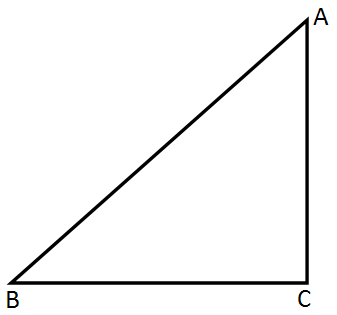
$\angle\text{A}=(\text{a}-\text{d})$
$\angle\text{B}=\text{a}$
$\angle\text{C}=\text{a}+\text{d}$
from an increasing A.P
then sum of the all there angles of $\triangle\text{ABC}$
$\Rightarrow\angle\text{A}+\angle\text{B}+\angle\text{C}=180^\circ$
$\Rightarrow(\text{a} -\text{d})+\text{a}+(\text{a+d})=180^\circ$
$\Rightarrow\text{3a}=180^\circ $
$\Rightarrow\text{a}=60^\circ =\angle\text{B}$
then $\sin\text{b=}\sin\text{a}=\sin60^\circ$ (from the table)
$=\frac{\sqrt{3}}{2}$
Hence the correct option is (b) View full question & answer→MCQ 131 Mark
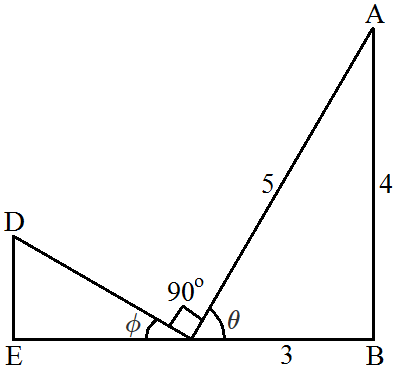
In Fin. the value of $\cos\phi$ is:
- A
$\frac{5}{4}$
- B
$\frac{5}{3}$
- C
$\frac{3}{5}$
- ✓
$\frac{4}{5}$
AnswerCorrect option: D. $\frac{4}{5}$
We should proceed with the fact that sum of angles on one side of a straight line is 180°
So from the given figure,
$\theta+\phi+90^\circ=180^\circ$
So, $\theta=90^\circ-\phi\ \dots(1)$
Now from the triangle $\triangle\text{ABC},$
$\sin\theta=\frac{4}{5}$
Now we will use equation (1) in the above,
$\sin(90^\circ-\phi)=\frac{4}{5}$
Therefore, $\cos\phi=\frac{4}{5}$
So the answer is (d)
View full question & answer→MCQ 141 Mark
If $16\cot\times=12,$ then $\frac{\sin\text{x}-\cos\text{x}}{\sin\text{x}+\cos\text{x}} $ equals:
- ✓
$\frac{1}{7}$
- B
$\frac{3}{7}$
- C
$\frac{2}{7}$
- D
$0$
AnswerCorrect option: A. $\frac{1}{7}$
We are given $16\cot\text{x}=12.$We are asked to find the following
$\frac{\sin\text{x}-\cos\text{x}}{\sin\text{x}+\cos\text{x}} $
We know that: $\cot\text{x}=\frac{\text{Base}}{\text{Perpendicular}}$
$\Rightarrow{\text{Base}}=3$
$\Rightarrow\text{Perpendicular}=4$
$\Rightarrow \text{Hypotenuse}=\sqrt{(\text{Perpendicular)}^2+\text{(Base)}^2}$
$\Rightarrow \text{Hypotenuse}=\sqrt{16+9}$
$\Rightarrow \text{Hypotenuse}=5$
Now we have
$16\cot\text{x}=12$
$\cot\text{x}=\frac{12}{16}$
$\cot\text{x}=\frac{3}{4}$
We know $\sin\text{x}=\frac{ \text{Perpendicular}}{ \text{Hypotenuse}}$ and $\cos\text{x}=\frac{ \text{Base}}{ \text{Hypotenuse}}$
Now we find
$\frac{\sin\text{x-cos}\text{x}}{\sin\text{x}+\cos\text{x}}$
$=\frac{\frac{4}{5}-\frac{3}{5}}{\frac{4}{5}+\frac{3}{5}}$
$=\frac{\frac{1}{5}}{\frac{7}{5}}$
$=\frac{1}{7}$
Hence the correct option is (a)
View full question & answer→MCQ 151 Mark
If $3\cos\theta=5\sin\theta,$ then the value of $\frac{5\sin\theta-2\sec^3\theta+2\cos\theta}{5\sin\theta+2\sec^3\theta-2\cos\theta}$ is:
- ✓
$\frac{271}{979}$
- B
$\frac{316}{2937}$
- C
$\frac{542}{2937}$
- D
$\text{None of these}$
AnswerCorrect option: A. $\frac{271}{979}$
We have,
$3 \cos\theta=5\sin\theta$
$\frac{\cos\theta}{\sin\theta}=\frac{5}{3 }$
${\cot\theta}=\frac{5}{3} $
In $\triangle\text{ABC}, $
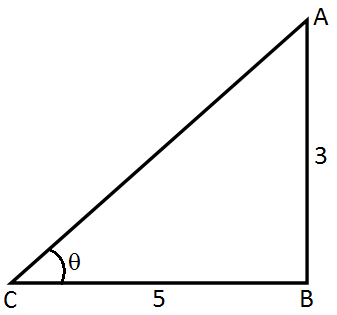
$\text{AC}^2=\text{AB}^2+\text{BC}^2$
$\Rightarrow \text{AC}^2=(3)^2+(5)^2$
$\Rightarrow \text{AC}^2=9+25$
$\Rightarrow \text{AC}^2=34$
$\Rightarrow \text{AC}=\sqrt{34}$
$\therefore \sin\theta=\frac{3}{\sqrt{34}}\ \cos\theta=\frac{5}{\sqrt{34}}\ \sec\theta=\frac{\sqrt{34}}{{5}}$
Now, $\frac{5\sin\theta-2\sec^3+2\cos}{5\sin\theta+2\sec^3-2\cos}$
$=\frac{5\times\frac{3}{\sqrt{34}}-2\Big(\frac{\sqrt{34}}{5}\Big)^3+2\times\frac{5}{\sqrt{34}}}{5\times\frac{3}{\sqrt{34}}+2\Big(\frac{\sqrt{34}}{5}\Big)^3-2\times\frac{5}{\sqrt{34}}}$
$=\frac{\frac{125\times15-2\times34\times34+10\times125}{125\sqrt{34}}}{\frac{125\times15+2\times34\times34-10\times125}{125\sqrt{34}}}$
$=\frac{1875-2312+1250}{1875+2312-1250}$
$=\frac{813}{2937} $
$=\frac{271}{979} $
Thus, $\frac{5\sin\theta-2\sec\theta+2\cos\theta}{5\sin\theta+2\sec\theta-2\cos\theta}=\frac{271}{979}$
Hence the correct option is (a) View full question & answer→MCQ 161 Mark
The value of $\cos1^\circ\cos2^\circ\cos3^\circ.....\cos180^\circ$ is:
AnswerHere we have to find: $\cos1^\circ\cos2^\circ\cos3^\circ.....\cos180^\circ$
$\cos1^\circ\cos2^\circ\cos3^\circ.....\cos180^\circ$
$=\cos1^\circ\cos2^\circ\cos3^\circ...\cos89^\circ\cos90^\circ\cos91^\circ...\cos180^\circ$ $[\text{since} \cos90^\circ=0]$
$=\cos1^\circ\cos2^\circ\cos3^\circ...0\times\cos90^\circ...\cos180^\circ$
$=0$
Hence the correct option is (b)
View full question & answer→MCQ 171 Mark
If $\tan^245^\circ-\cos^230^\circ=\text{x}\sin45^\circ\cos45^\circ,$ then x =
- A
$2$
- B
$-2$
- C
$-\frac{1}{2}$
- ✓
$\frac{1}{2}$
AnswerCorrect option: D. $\frac{1}{2}$
We have,
$\tan^245^\circ-\cos^230^\circ=\text{x}\sin45^\circ\cos45^\circ\dots(1)$
Put the values in (1)
$\Rightarrow(1)^2-\Big(\frac{\sqrt{3}}{2}\Big)^2=\text{x}\times\frac{1}{\sqrt{2}}\times\frac{1}{\sqrt{2}}$
$\Rightarrow1-\frac{3}{4}=\text{x}\times\frac{1}{2}$
$\Rightarrow\frac{1}{4}=\frac{\text{x}}{2}$
$\Rightarrow\text{x}=\frac{1}{2}$
Thus, $\text{x}=\frac{1}{2}$
Hence the correct option is (d)
View full question & answer→MCQ 181 Mark
$\frac{1-\tan^245^\circ}{1+\tan^245^\circ}$ is equal to:
- A
$\tan90^\circ$
- B
$1$
- C
$\sin45^\circ$
- ✓
$\sin0^\circ$
AnswerCorrect option: D. $\sin0^\circ$
We have to find the value of the following
$\frac{1-\tan^245^\circ}{1+\tan^245^\circ}$
So,
$\frac{1-\tan^245^\circ}{1+\tan^245^\circ}$
$=\frac{1-(1)^2}{1+(1)^2}$
$=\frac{0}{1}$
$=0$
We know that $\begin{bmatrix}\tan45^\circ=1\\\sin0^\circ=0\end{bmatrix}$
$=\sin0^\circ$
Hence the correct option is (d)
View full question & answer→MCQ 191 Mark
If $\tan\theta=\frac{\text{a}}{\text{b}},$ then $\frac{\text{a sin}\theta+\text{b cos}\theta}{\text{a sin}\theta-\text{b cos}\theta}$ is equal to:
- ✓
$\frac{\text{a}^2+\text{b}^2}{\text{a}^2-\text{b}^2}$
- B
$\frac{\text{a}^2-\text{b}^2}{\text{a}^2+\text{b}^2}$
- C
$\frac{\text{a}+\text{b}}{\text{a}-\text{b}}$
- D
$\frac{\text{a}-\text{b}}{\text{a}+\text{b}}$
AnswerCorrect option: A. $\frac{\text{a}^2+\text{b}^2}{\text{a}^2-\text{b}^2}$
We have,
$\tan\theta=\frac{\text{a}}{\text{b}}$
In $\triangle \text{ABC}.$
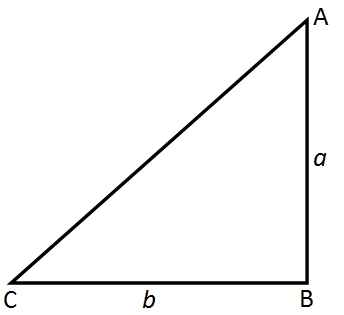
$\text{AC}^2=\text{AB}^2+\text{BC}^2$
$\text{AC}^2=\text{a}^2+\text{b}^2$
$\text{AC}=\sqrt{\text{a}^2+\text{b}^2}$
$\therefore \sin\theta=\frac{\text{AB}}{\text{AC}}=\frac{\text{a}}{\sqrt{\text{a}^2+\text{b}^2}}$
$\cos\theta=\frac{\text{BC}}{\text{AC}}=\frac{\text{b}}{\sqrt{\text{a}^2+\text{b}^2}}$
Now, $\frac{\text{a sin}\theta+\text{b cos}\theta}{\text{a sin}\theta-\text{bcos}\theta}=\frac{\text{a}\times\frac{\text{a}}{\sqrt{a^2+b^2}}+\text{b}\times\frac{\text{b}}{\sqrt{a^2+b^2}}}{\text{a}\times\frac{a}{\sqrt{a^2+b^2}}-\text{b}\times\frac{\text{b}}{\sqrt{a^2+^2}}}$
$= \frac{\frac{\text{a}^2+\text{b}^2}{\sqrt{\text{a}^2+\text{b}^2}}}{\frac{\text{a}^2-\text{b}^2}{\sqrt{\text{a}^2+\text{b}^2}}}$
$= \frac{\text{a}^2+\text{b}^2}{\text{a}^2-\text{b}^2}$
Hence the correct option is (a) View full question & answer→MCQ 201 Mark
If $\tan\theta=\frac{1}{\sqrt{7}},$ then $\frac{\text{cosec}^2\theta-\sec^2\theta}{\text{cosec}^2\theta+\sec^2\theta}=$
- A
$\frac{5}{7}$
- B
$\frac{3}{7}$
- C
$\frac{1}{12}$
- ✓
$\frac{3}{4}$
AnswerCorrect option: D. $\frac{3}{4}$
Given that:
$\tan\theta=\frac{1}{\sqrt{7}}$
We are asked to find the value of the following expression
$\frac{\text{cosec}^2\theta-\sec^2\theta}{\text{cosec}^2\theta+\sec^2\theta}$
Since $\tan\theta=\frac{\text{Perpendicular}}{\text{Base}}$
$\Rightarrow{\text{perpendicular}}=1$
$\Rightarrow{\text{Base}}=\sqrt{7}$
$\Rightarrow{\text{Hypotennuse}}=\sqrt{1+7}$
$\Rightarrow{\text{Hypotennuse}}=\sqrt{8}$
We know that $\sec\theta=\frac{\text{Hypotenuse}}{\text{Base}}$ and $\text{cosec}\theta=\frac{\text{Hypotenuse}}{\text{perpendicular}}$
We find:
$\frac{\text{cosec}^2\theta-\sec^2\theta}{\text{cosec}^2\theta+\sec^2\theta}$
$=\frac{\Big(\frac{\sqrt{8}}{1}\Big)^2-\Big(\frac{\sqrt{8}}{\sqrt{7}}\Big)^2}{\Big(\frac{\sqrt{8}}{1}\Big)^2+\Big(\frac{\sqrt{8}}{\sqrt{7}}\Big)^2}$
$=\frac{\frac{{8}}{1}-\frac{{8}}{{7}}}{\frac{{8}}{1}+\frac{{8}}{{7}}}$
$=\frac{\frac{48}{7}}{\frac{64}{7}}$
$=\frac{3}{4}$
Hence the correct option is (d)
View full question & answer→MCQ 211 Mark
The value of $\frac{\cos(90^\circ-\theta)\sec(90^\circ-\theta)\tan\theta}{\text{cosec}(90^\circ-\theta)\sin(90^\circ-\theta)\cot(90^\circ-\theta)}+\frac{\tan(90^\circ-\theta)}{\cot\theta}$ is:
AnswerWe have to find: $\frac{\cos(90^\circ-\theta)\sec(90^\circ-\theta)\tan\theta}{\text{cosec}(90^\circ-\theta)\sin(90^\circ-\theta)\cot(90^\circ-\theta)}+\frac{\tan(90^\circ-\theta)}{\cot\theta}$
So, $\frac{\cos(90^\circ-\theta)\sec(90^\circ-\theta)\tan\theta}{\text{cosec}(90^\circ-\theta)\sin(90^\circ-\theta)\cot(90^\circ-\theta)}+\frac{\tan(90^\circ-\theta)}{\cot\theta}$
$=\frac{\sin\theta\text{cosec }\theta\tan\theta}{\sec\theta\cos\theta\tan\theta}+\frac{\cot\theta}{\cot\theta}$
$=\frac{1\times\tan\theta}{1\times\tan\theta}+\frac{\cot\theta}{\cot\theta}$
$=1+1$
$=2$
Hence the correct option is (c)
View full question & answer→MCQ 221 Mark
If $\tan\theta=\frac{3}{4},$ then $\cos^2\theta-\sin^2\theta=$
- ✓
$\frac{7}{25}$
- B
$1$
- C
$\frac{-7}{25}$
- D
$\frac{4}{25}$
AnswerCorrect option: A. $\frac{7}{25}$
We have,
$\tan\theta= \frac{3}{4}$
In $\triangle \text{ABC},$
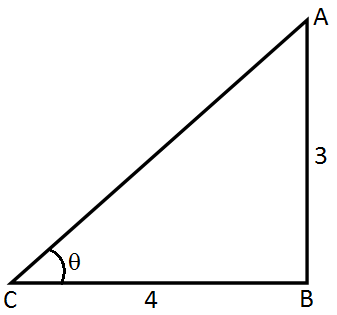
$\text{AC}^2=\text {AB}^2+\text{BC}^2$
$\Rightarrow \text {AC}^2=(3)^2+(4)^2$
$\Rightarrow \text {AC}^2=9+16$
$\Rightarrow \text {AC}^2=25$
$\Rightarrow \text {AC}=5$
$\therefore \sin \theta=\frac{3}{5}$ and $\cos\theta=\frac{4}{5}$
Now, $\cos^2\theta-\sin^2 =\Big(\frac{4}{5}\Big)^2-\Big(\frac{3}{5}\Big)^2$
$=\frac{16}{25}- \frac{9}{25}$
$=\frac{16-9}{25}$
$=\frac{7}{25}$
Hence the correct option is (a) View full question & answer→MCQ 231 Mark
If $\theta$ and $2\theta-45^\circ$ are acute angles such that $\sin\theta=\cos(2\theta-45^\circ),$ then $\tan\theta$ is equal to:
- ✓
$1$
- B
$-1$
- C
$\sqrt{3}$
- D
$\frac{1}{\sqrt{3}}$
AnswerGiven that: $\sin\theta=\cos(2\theta-45^\circ)$ and $\theta$ and $2\theta-45$ are acute angles
We have to find $\tan\theta$
$\Rightarrow\sin\theta=\cos(2\theta-45^\circ)$
$\Rightarrow\cos(90^\circ-\theta)=\cos(2\theta-45^\circ)$
$\Rightarrow90^\circ-\theta=2\theta-45^\circ$
$\Rightarrow3\theta=135^\circ$
Where $\theta$ and $2\theta-45^\circ$ are acute angles
Since $\theta=45^\circ$
Now
$\tan\theta$
$=\tan45^\circ$ Put $\theta=45^\circ$
$=1$
Hence the correct option is (a)
View full question & answer→MCQ 241 Mark
The value of $\cos^217^\circ-\sin^273^\circ$ is:
AnswerWe have:
$= \cos^217^\circ-\sin^273^\circ$
$= \cos^2(90^\circ-73^\circ)-\sin^273^\circ$
$= \sin^273^\circ-\sin^273^\circ$
$= 0$
Hence the correct option is (c)
View full question & answer→MCQ 251 Mark
If $8\tan \text{x} = 15,$ then $\sin \text{x} - \cos \text{x}$ is equal to:
- A
$\frac{8}{17}$
- B
$\frac{17}{7}$
- C
$\frac{1}{17}$
- ✓
$\frac{7}{17}$
AnswerCorrect option: D. $\frac{7}{17}$
We have,
$8\tan\text{x}=15$ $\Rightarrow\tan\text{x}=\frac{15}{8}$
In $\triangle\text{ABC,}$
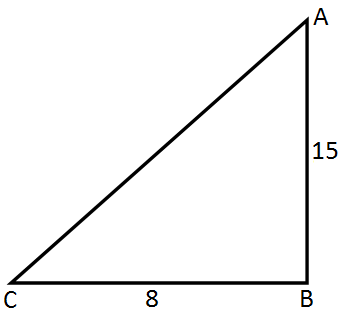
$\text{AC}^2=\text{AB}^2+\text{BC}^2$
$\Rightarrow\text{AC}^2=(15)^2+(8)^2$
$\Rightarrow\text{AC}^2=225+64$
$\Rightarrow\text{AC}^2=289$
$\Rightarrow\text{AC}=17$
$\therefore\sin\text{x}=\frac{15}{17} $ and $\cos\text{x}=\frac{8}{17}$
Now, $\sin\text{x}-\cos\text{x}=\frac{15}{17}-\frac{8}{17}$
$=\frac{15-8}{17}$
$=\frac{7}{17}$
Hence the correct option is (d) View full question & answer→MCQ 261 Mark
If A and B are complementary angles, then:
- A
$\sin\text{A}=\sin\text{B}$
- B
$\cos\text{A}=\cos\text{B}$
- C
$\tan\text{A}=\tan\text{B}$
- ✓
$\sec\text{A}=\text{cosec B}$
AnswerCorrect option: D. $\sec\text{A}=\text{cosec B}$
Given: A and are B are complementary angles
Since $\sec(90^\circ-\text{B})=\text{cosec }\text{B}$
therefore A + B = 90°
$\Rightarrow\text{A}=90^\circ-\text{B}$
$\Rightarrow\sec\text{A}=\sec(90^\circ-\text{B})$
$\Rightarrow\sec\text{A}=\text{cosec }\text{B}$
Hence the correct option is (d)
View full question & answer→MCQ 271 Mark
If $\frac{\text{x cosec}^230^\circ\sec^245^\circ}{8\cos^245^\circ\sin^260^\circ}=\tan^260^\circ-\tan^230^\circ,$ then x =
AnswerWe have,
$=\frac{\text{x cosec}^230^\circ\sec^245^\circ}{8\cos^245^\circ\sin^260^\circ}=\tan^260^\circ-\tan^230^\circ$
$\Rightarrow\frac{\text{x}\times(2)^2\times(\sqrt{2})^2}{8\Big(\frac{1}{\sqrt{2}}\Big)^2\times \Big(\frac{\sqrt{3}}{2}\Big)^2}=(\sqrt{3})^2-\Big(\frac{1}{\sqrt{3}}\Big)^2$
$\Rightarrow\frac{4\text{x}\times2}{\frac{8}{2}\times\frac{3}{4}}=3-\frac{1}{3}$
$\Rightarrow\frac{8\text{x}}{3}=\frac{9-1}{3}$
$\Rightarrow8\text{x}=8$
$\Rightarrow\text{x}=\frac{8}{8}$
$\Rightarrow\text{x}=1$
Hence the correct option is (a)
View full question & answer→MCQ 281 Mark
If $\theta$ is an acute angle such that $\cos\theta=\frac{3}{5},$ then $\frac{\sin\theta\tan\theta-1}{2\tan^2\theta}=$
- A
$\frac{16}{625}$
- B
$\frac{1}{36}$
- ✓
$\frac{3}{160}$
- D
$\frac{160}{3}$
AnswerCorrect option: C. $\frac{3}{160}$
Given $\cos\theta=\frac{3}{5}$ and we need to find the value of the following expression $\frac{\sin\theta\tan\theta-1}{2\tan^2\theta}$
We know that: $\cos\theta=\frac{\text{Base}}{\text{Hypotenuse}}$
We know that:
$\Rightarrow \text{Base}=3$
$\Rightarrow\text{Hypotenuse}=5$
$\Rightarrow\text{Perpendicular}=\sqrt{(\text{Hypotenuse)}^2-(\text{Base)}^2}$
$\Rightarrow\text{Perpendicular}=\sqrt{25-9}$
$\Rightarrow\text{Perpendicular}=4$
Since $\sin \theta=\frac{\text{perpendicular}}{\text{Hypotenuse}}$
and $\tan \theta=\frac{\text{perpendicular}}{\text{Base}}$
So we find,
$\frac{\sin\theta\tan\theta-1}{2\tan^2\theta}$
$=\frac{\frac{4}{5}\times\frac{4}{3}-1}{2\times\Big(\frac{4}{3}\Big)^2}$
$=\frac{\frac{16}{15}-1}{\frac{32}{9}}$
$=\frac{\frac{1}{15}}{\frac{32}{9}}$
$=\frac{3}{160}$
Hence the correct option is (c)
View full question & answer→MCQ 291 Mark
If $\theta$ is an acute angle such that $\sec^2\theta=3,$ then the value of $\frac{\tan^2\theta-\text{cosec}^2\theta}{\tan^2\theta+\text{cosec}^2\theta}$ is:
- A
$\frac{4}{7}$
- B
$\frac{3}{7}$
- C
$\frac{2}{7}$
- ✓
$\frac{1}{7}$
AnswerCorrect option: D. $\frac{1}{7}$
Given that:
$\sec^2\theta=3$
$\sec\theta=\sqrt{3}$
We need to find the value of the expression
$\frac{\tan^2\theta-\text{cosec}^2\theta}{\tan^2\theta+\text{cosec}^2\theta}$
$\text{since}\ \sec \theta=\frac{\text{Hypotenuse}}{\text{Base}}$
So, $\Rightarrow{\text{Hypotenuse}}=\sqrt{3}$
$\Rightarrow\text{Base}=1$
$\Rightarrow\text{Perpendicular}=\sqrt{3-1}$
$\Rightarrow\text{Perpendicular}=\sqrt{2}$
Here we have to find: $\frac{\tan^2\theta-\text{cosec}^2\theta}{\tan^2\theta+\text{cosec}^2\theta}$
$\Rightarrow\frac{\tan^2\theta-\text{cosec}^2\theta}{\tan^2\theta+\text{cosec}^2\theta}=\frac{\frac{2}{1}-\frac{3}{2}}{\frac{2}{1}+\frac{3}{2}}$
$\Rightarrow\frac{\tan^2\theta-\text{cosec}^2\theta}{\tan^2\theta+\text{cosec}^2\theta}=\frac{\frac{1}{2}}{\frac{7}{2}}$
$\Rightarrow\frac{\tan^2\theta-\text{cosec}^2\theta}{\tan^2\theta+\text{cosec}^2\theta}=\frac{1}{7}$
Hence the correct option is (d)
View full question & answer→MCQ 301 Mark
If $5\theta$ and $4\theta$ are acute angles satisfying $\sin5\theta=\cos4\theta,$ then $2\sin3\theta-\sqrt{3}\tan3\theta$ is equal to:
AnswerWe are given that $5\theta$ and $4\theta$ are acute angles satisfying the following condition
$\sin5\theta=\cos4\theta$
We are asked to find $2\sin3\theta-\sqrt{3}\tan3\theta$
$\Rightarrow\sin5\theta=\cos4\theta$
$\Rightarrow\cos(90^\circ-5\theta)=\cos4\theta$
$\Rightarrow90^\circ-5\theta=4\theta$
$\Rightarrow9\theta=90^\theta$
Where $5\theta$ and $4\theta$ are acute angles
$\Rightarrow\theta=10^\circ$
Now we have to find:
$2\sin3\theta-\sqrt{3}\tan3\theta$
$=2\sin30^\circ-\sqrt{3}\tan30^\circ$
$=2\times\frac{1}{2}-\sqrt{3}\times\frac{1}{\sqrt{3}}$
$=1-1$
$=0$
Hence the correct option is (b)
View full question & answer→MCQ 311 Mark
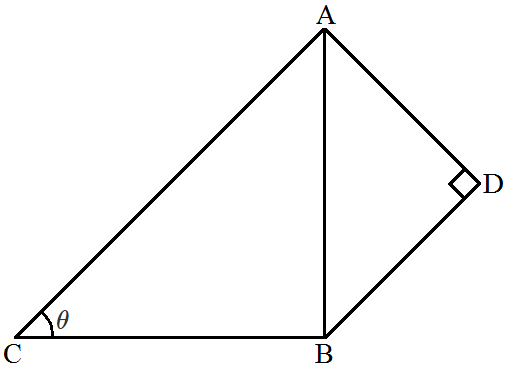
In Fig. AD = 4cm, BD = 3cm and CB = 12cm, find the $\cot\theta.$
- ✓
$\frac{12}{5}$
- B
$\frac{5}{12} $
- C
$\frac{13}{12}$
- D
$\frac{12}{13}$
AnswerCorrect option: A. $\frac{12}{5}$
We have the following given data in the figure, AD= 4cm, BD = 3cm, CB = 12cm
Now we will use Pythagoras theorem in $\triangle\text{ABD},$
$\text{AB}=\sqrt{3^2+4^2}$
$=5\text{cm}$
Therefore,
$\cot\theta=\frac{\text{CB}}{\text{AB}}$
$=\frac{12}{5}$
So the answer is (a)
View full question & answer→MCQ 321 Mark
$\frac{2\tan30^\circ}{1+\tan^230^\circ}$ is equal to:
- ✓
$\sin60^\circ$
- B
$\cos60^\circ$
- C
$\tan60^\circ$
- D
$\sin30^\circ$
AnswerCorrect option: A. $\sin60^\circ$
We have to find the value of the following expression
$\frac{2\tan30^\circ}{1+\tan^230^\circ}$
$\frac{2\tan30^\circ}{1+\tan^230^\circ}$
$=\frac{2\times\frac{1}{\sqrt3}}{1+\Big(\frac{1}{\sqrt3}\Big)^2}$
$=\frac{\frac{2}{\sqrt3}}{1+\frac{1}{3}}$
$=\frac{\frac{2}{\sqrt3}}{\frac{4}{3}}$
$\begin{bmatrix}\text{Since}\tan60^\circ=\frac{\sqrt3}{2}\\\text{Since}\tan30^\circ=\frac{1}{\sqrt3}\end{bmatrix}$
$=\frac{\sqrt3}{2}$
$=\sin60^\circ$
Hence the correct option is (a)
View full question & answer→MCQ 331 Mark
The value of $\tan10^\circ\tan15^\circ\tan75^\circ\tan80^\circ$ is:
AnswerHere we have to find: $\tan10^\circ\tan15^\circ\tan75^\circ\tan80^\circ$
Now,
$\tan10^\circ\tan15^\circ\tan75^\circ\tan80^\circ$
$=\tan(90^\circ-80^\circ)\tan(90^\circ-75^\circ)\tan75^\circ\tan80^\circ$
$=\cot80^\circ\cot75^\circ\tan75^\circ\tan80^\circ$
$=(\cot80^\circ\tan80^\circ)(\cot75^\circ\tan75^\circ)$
$=1\times1$ $[\text{Since}\cot\theta\tan\theta=1]$
$=1$
Hence the correct option is (c)
View full question & answer→MCQ 341 Mark
$\sin2\text{A}=2\sin\text{A}$ is true when A =
- ✓
$0^\circ$
- B
$30^\circ$
- C
$45^\circ$
- D
$60^\circ$
AnswerCorrect option: A. $0^\circ$
We are given $\sin2\text{A}=2\sin\text{A}.\cos\text{A}$
So,
$\Rightarrow\sin2\text{A}=2\sin\text{A}$
$\Rightarrow2\sin\text{A}.\cos\text{A}=2\sin\text{A}$
$\Rightarrow\cos\text{A}=1$
$\Rightarrow\cos\text{A}=\cos0^\circ$
As $\text{A}=0^\circ$
Hence the correct option is (a)
View full question & answer→MCQ 351 Mark
If A + B = 90°, then $\frac{\tan\text{A}\tan\text{B}+\tan\text{A}\cot\text{B}}{\sin\text{A}\sec\text{B}}-\frac{\sin^2\text{B}}{\cos^2\text{A}}$ is equal to:
- A
$\cot^2\text{A}$
- ✓
$\cot^2\text{B}$
- C
$-\tan^2\text{A}$
- D
$-\cot^2\text{A}$
AnswerCorrect option: B. $\cot^2\text{B}$
We have:
$\text{A+B}=90^\circ$
$\Rightarrow\text{B}=90^\circ-\text{A}$
We have to find the value of the following expression
$\frac{\tan\text{A}\tan\text{B}+\tan\text{A}\cot\text{B}}{\sin{\text{A}\sec\text{B}}}-\frac{\sin^2\text{B}}{\cos^2\text{A}}$
So,
$\frac{\tan\text{A}\tan\text{B}+\tan\text{A}\cot\text{B}}{\sin{\text{A}\sec\text{B}}}-\frac{\sin^2\text{B}}{\cos^2\text{A}}$
$=\frac{\tan\text{A}\tan(90^\circ-\text{A})+\tan\text{A}\cot(90^\circ-\text{A})}{\sin{\text{A}\sec(90^\circ-\text{A})}}-\frac{\sin^2(90^\circ-\text{A})}{\cos^2\text{A}}$
$=\frac{\tan\text{A}\cot{\text{A}}+\tan\text{A}\tan\text{A}}{\sin\text{A}\text{cosecA}}-\frac{\cos^2\text{A}}{\cos^2\text{A}}$
$=1+\tan^2\text{A}-1$
$=\tan^2\text{A}$
$=\tan^2(90^\circ-\text{B})$
$=\cot^2\text{B}$
Hence the correct option is (b)
View full question & answer→MCQ 361 Mark
$\frac{2 \tan 30^{\circ}}{1+\tan ^2 30^{\circ}}$ is equal to
- ✓
$\sin 60^{\circ}$
- B
$\cos 60^{\circ}$
- C
$\tan 60^{\circ}$
- D
$\sin 30^{\circ}$
AnswerCorrect option: A. $\sin 60^{\circ}$
View full question & answer→MCQ 371 Mark
$\frac{2 \tan 30^{\circ}}{1-\tan ^2 30^{\circ}}$ is equal to
- A
$\cos 60^{\circ}$
- B
$\sin 60^{\circ}$
- ✓
$\tan 60^{\circ}$
- D
$\sin 30^{\circ}$
AnswerCorrect option: C. $\tan 60^{\circ}$
View full question & answer→MCQ 381 Mark
$\sin 2 A=2 \sin A$ is true when $A=$
- ✓
$0^{\circ}$
- B
$30^{\circ}$
- C
$45^{\circ}$
- D
$60^{\circ}$
AnswerCorrect option: A. $0^{\circ}$
View full question & answer→MCQ 391 Mark
$\frac{1-\tan ^2 45^{\circ}}{1+\tan ^2 45^{\circ}}$ is equal to
- A
$\tan 90^{\circ}$
- B
- C
$\sin 45^{\circ}$
- ✓
$\sin 0^{\circ}$
AnswerCorrect option: D. $\sin 0^{\circ}$
View full question & answer→MCQ 401 Mark
Given that $\sin \theta=\frac{a}{b}$, then $\tan \theta$ is equal to
- A
$\frac{b}{\sqrt{a^2+b^2}}$
- B
$\frac{b}{\sqrt{b^2-a^2}}$
- C
$\frac{a}{\sqrt{a^2-b^2}}$
- ✓
$\frac{a}{\sqrt{b^2-a^2}}$
AnswerCorrect option: D. $\frac{a}{\sqrt{b^2-a^2}}$
View full question & answer→MCQ 411 Mark
If $\tan A=\frac{3}{4}$, then $\frac{\sin ^2 A+\cos ^2 A}{\sec A}$ is equal to
- A
$\frac{4}{3}$
- ✓
$\frac{4}{5}$
- C
$\frac{3}{5}$
- D
$\frac{5}{4}$
AnswerCorrect option: B. $\frac{4}{5}$
View full question & answer→MCQ 421 Mark
If $5 \tan \theta-12=0$, then the value of $\sin \theta$ is
- A
$\frac{5}{12}$
- ✓
$\frac{12}{13}$
- C
$\frac{5}{13}$
- D
$\frac{12}{5}$
AnswerCorrect option: B. $\frac{12}{13}$
View full question & answer→MCQ 431 Mark
If $\sin \theta=1$, then the value of $\frac{1}{2} \sin \frac{\theta}{2}$ is
- ✓
$\frac{1}{2 \sqrt{2}}$
- B
$\frac{1}{\sqrt{2}}$
- C
$\frac{1}{2}$
AnswerCorrect option: A. $\frac{1}{2 \sqrt{2}}$
View full question & answer→MCQ 441 Mark
If $\sin \theta=\cos \theta\left(0^{\circ}<\theta<90^{\circ}\right)$, then the value of $\sec \theta \sin \theta$ is
- A
$1 / \sqrt{2}$
- B
$\sqrt{2}$
- ✓
- D
$0$
View full question & answer→MCQ 451 Mark
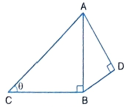
In Fig. if $A D=4 cm B D=3 cm$ and $C B=12 cm$, then $\cot \theta=$
- ✓
$\frac{12}{5}$
- B
$\frac{5}{12}$
- C
$\frac{13}{12}$
- D
$\frac{12}{13}$
AnswerCorrect option: A. $\frac{12}{5}$
View full question & answer→MCQ 461 Mark
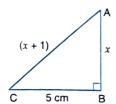
In a $\triangle A B C$, if $\angle B=90^{\circ}, B C=5 cm, A C-A B=1 cm$. Then the value of $\frac{1+\sin C}{1+\cos C}$ is
- A
$\frac{18}{25}$
- B
$\frac{36}{31}$
- ✓
$\frac{25}{18}$
- D
$\frac{31}{36}$
AnswerCorrect option: C. $\frac{25}{18}$
(C)$\frac{25}{18}$
Let $A B=x cm$. Then, $A C-A B=1 cm$ gives $A C=(x+1) cm$.
Applying Pythagoras Theorem in $\triangle A B C$, we obtain
$
\begin{array}{ll}
& A C^2=A B^2+B C^2 \Rightarrow(x+1)^2=x^2+25 \Rightarrow 2 x+1=25 \Rightarrow x=12 \\
\therefore & A B=12 cm \text { and } A C=13 cm
\end{array}
$
Thus, $\sin C=\frac{A B}{A C}=\frac{12}{13}$ and $\cos C=\frac{B C}{A C}=\frac{5}{13}$
Hence, $\quad \frac{1+\sin C}{1+\cos C}=\frac{1+\frac{12}{13}}{1+\frac{5}{13}}=\frac{25}{18}$
View full question & answer→MCQ 471 Mark
In an acute angled triangle $A B C$, if $\sin (A+B-C)=\frac{1}{2}$ and $\cos (B+C-A)=\frac{1}{\sqrt{2}}$. Then masure of angle $B$ is
- ✓
$37 \frac{1}{2}^{\circ}$
- B
$45^{\circ}$
- C
$75^{\circ}$
- D
$62.5^{\circ}$
AnswerCorrect option: A. $37 \frac{1}{2}^{\circ}$
(A)$37 \frac{1}{2}^{\circ}$
We have, $\sin (A+B-C)=\frac{1}{2}$ and, $\cos (B+C-A)=\frac{1}{\sqrt{2}}$
$
\begin{array}{ll}
\Rightarrow & \sin (A+B-C)=\sin 30^{\circ} \text { and } \cos (B+C-A)=\cos 45^{\circ} \\
\Rightarrow & A+B-C=30^{\circ} \text { and } B+C-A=45^{\circ} \Rightarrow(A+B-C)+(B+C-A)=30^{\circ}+45^{\circ} \\
\Rightarrow & 2 B=75^{\circ} \Rightarrow B=37 \frac{1^{\circ}}{2}
\end{array}
$
View full question & answer→MCQ 481 Mark
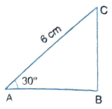
In Fig. lengths of sides $B C$ and $A B$ are respectively
- A
$12 cm, 3 \sqrt{3} cm$
- ✓
$3 cm, 3 \sqrt{3} cm$
- C
$12 cm, 6 \sqrt{3} cm$
- D
$18 cm, 9 \sqrt{3} cm$
AnswerCorrect option: B. $3 cm, 3 \sqrt{3} cm$
(B)$3 cm, 3 \sqrt{3} cm$
In $\triangle A B C$, we have
$
\begin{array}{l}
\sin 30^{\circ}=\frac{B C}{A C} \text { and } \cos 30^{\circ}=\frac{A B}{A C} \\
\Rightarrow \quad \frac{1}{2}=\frac{B C}{6} \text { and } \frac{\sqrt{3}}{2}=\frac{A B}{6} \Rightarrow B C=3 cm, A B=3 \sqrt{3} cm
\end{array}
$
View full question & answer→MCQ 491 Mark
$\frac{2 \tan 30^{\circ}}{1+\tan ^2 30^{\circ}}$ is equal to
- ✓
$\sin 60^{\circ}$
- B
$\cos 60^{\circ}$
- C
$\tan 60^{\circ}$
- D
$\sin 30^{\circ}$
AnswerCorrect option: A. $\sin 60^{\circ}$
(A)$\sin 60^{\circ}$
$
\text {} \frac{2 \tan 30^{\circ}}{1+\tan ^2 30^{\circ}}=\frac{2 \times \frac{1}{\sqrt{3}}}{1+\left(\frac{1}{\sqrt{3}}\right)^2}=\frac{\frac{2}{\sqrt{3}}}{1+\frac{1}{3}}=\frac{2}{\sqrt{3}} \times \frac{3}{4}=\frac{\sqrt{3}}{2}=\sin 60^{\circ}
$
View full question & answer→MCQ 501 Mark
If $\tan (A+B)=\sqrt{3}$ and $\tan (A-B)=\frac{1}{\sqrt{3}}, A>B$, then the value of $A$ is
- A
$30^{\circ}$
- ✓
$45^{\circ}$
- C
$60^{\circ}$
- D
$90^{\circ}$
AnswerCorrect option: B. $45^{\circ}$
(B)$45^{\circ}$
We have,
$
\begin{array}{l}
\tan (A+B)=\sqrt{3} \text { and } \tan (A-B)=\frac{1}{\sqrt{3}} \Rightarrow \tan (A+B)=\tan 60^{\circ} \text { and } \tan (A-B)=\tan 30^{\circ} \\
\Rightarrow \quad A+B=60^{\circ} \text { and } A-B=30^{\circ} \Rightarrow(A+B)+(A-B)=60^{\circ}+30^{\circ} \Rightarrow 2 A=90^{\circ} \Rightarrow A=45^{\circ}
\end{array}
$
View full question & answer→MCQ 511 Mark
If $\tan \theta=\frac{5}{12}$, then the oalue of $\frac{\sin \theta+\cos \theta}{\sin \theta-\cos \theta}$ is
- ✓
$-\frac{17}{7}$
- B
$\frac{17}{7}$
- C
$\frac{17}{13}$
- D
$-\frac{7}{13}$
AnswerCorrect option: A. $-\frac{17}{7}$
(A)$-\frac{17}{7}$
$
\text { SOLUTION } \frac{\sin \theta+\cos \theta}{\sin \theta-\cos \theta}=\frac{\frac{\sin \theta+\cos \theta}{\cos \theta}}{\frac{\sin \theta-\cos \theta}{\cos \theta}}
$ $\qquad$ [Dividing the numerator and denominator by $\cos \theta$ ]
$=\frac{\frac{\sin \theta}{\cos \theta}+1}{\frac{\sin \theta}{\cos \theta}-1}=\frac{\tan \theta+1}{\tan \theta-1}=\frac{\frac{5}{12}+1}{\frac{5}{12}-1}=\frac{17}{-7}=-\frac{17}{7}$
View full question & answer→MCQ 521 Mark
$\sec \theta$ when expresed in terms of $\cot \theta$, is equal to
- A
$\frac{1+\cot ^2 \theta}{\cot \theta}$
- B
$\sqrt{1+\cot ^2 \theta}$
- ✓
$\frac{\sqrt{1+\cot ^2 \theta}}{\cot \theta}$
- D
$\frac{\sqrt{1-\cot ^2 \theta}}{\cot \theta}$
AnswerCorrect option: C. $\frac{\sqrt{1+\cot ^2 \theta}}{\cot \theta}$
(C)$\frac{\sqrt{1+\cot ^2 \theta}}{\cot \theta}$
$
\begin{array}{l}
\text { } 1+\cot ^2 \theta=\operatorname{cosec}^2 \theta \Rightarrow \sqrt{1+\cot ^2 \theta}=\operatorname{cosec} \theta \\
\qquad \frac{\sqrt{1+\cot ^2 \theta}}{\cot \theta}=\frac{\operatorname{cosec} \theta}{\cot \theta}=\frac{1}{\sin \theta} \times \frac{\sin \theta}{\cos \theta}=\frac{1}{\cos \theta}=\sec \theta
\end{array}
$
View full question & answer→MCQ 531 Mark
If $\sin \theta-\cos \theta=0$, then the value of $\sin ^4 \theta+\cos ^4 \theta$ is
- A
- ✓
$\frac{1}{2}$
- C
$\frac{1}{4}$
- D
$\frac{3}{4}$
AnswerCorrect option: B. $\frac{1}{2}$
(B)$\frac{1}{2}$
We have,
$
\begin{array}{l}
\therefore \quad \sin \theta-\cos \theta=0 \Rightarrow \sin \theta=\cos \theta \Rightarrow \frac{\sin \theta}{\cos \theta}=1 \Rightarrow \tan \theta=1 \Rightarrow \theta=45^{\circ} \\
\therefore \quad \sin ^4 \theta+\cos ^4 \theta=\left(\sin 45^{\circ}\right)^4+\left(\cos 45^{\circ}\right)^4=\left(\frac{1}{\sqrt{2}}\right)^4+\left(\frac{1}{\sqrt{2}}\right)^4=\frac{1}{4}+\frac{1}{4}=\frac{1}{2}
\end{array}
$
View full question & answer→MCQ 541 Mark
In a $\triangle A B C$, right angled at $B$, the value of $\sin (A+C)$ is
- A
$0$
- ✓
- C
$\frac{1}{2}$
- D
$\frac{\sqrt{3}}{2}$
Answer(B)1
In $\triangle A B C$, it is given that $\angle B=90^{\circ}$
$
\therefore \quad A+B+C=180^{\circ} \Rightarrow A+90^{\circ}+C=180^{\circ} \Rightarrow A+C=90^{\circ} \Rightarrow \sin (A+C)=\sin 90^{\circ}=1
$
View full question & answer→MCQ 551 Mark
If $\sin \theta+\cos \theta=\sqrt{2} \cos \theta, \theta \neq 90^{\circ}$, then $\tan \theta=$
- ✓
$\sqrt{2}-1$
- B
$\sqrt{2}+1$
- C
$\sqrt{2}$
- D
$-\sqrt{2}$
AnswerCorrect option: A. $\sqrt{2}-1$
(A)$\sqrt{2}-1$
We have,
$
\sin \theta+\cos \theta=\sqrt{2} \cos \theta \Rightarrow \sin \theta=(\sqrt{2}-1) \cos \theta \Rightarrow \frac{\sin \theta}{\cos \theta}=\sqrt{2}-1 \Rightarrow \tan \theta=\sqrt{2}-1
$
View full question & answer→MCQ 561 Mark
If $\sin \alpha=\frac{\sqrt{3}}{2}$ and $\cos \beta=0$, then the value of $\tan (\beta-\alpha)$ is
- A
- B
$\sqrt{3}$
- ✓
$\frac{1}{\sqrt{3}}$
- D
$\frac{\sqrt{3}}{2}$
AnswerCorrect option: C. $\frac{1}{\sqrt{3}}$
(C)$\frac{1}{\sqrt{3}}$
We have,
$
\begin{array}{ll}
& \sin \alpha=\frac{\sqrt{3}}{2} \text { and } \cos \beta=0 \Rightarrow \sin \alpha=\sin 60^{\circ} \text { and } \cos \beta=\cos 90^{\circ} \Rightarrow \alpha=60^{\circ} \text { and } \beta=90^{\circ} \\
\therefore \quad & \tan (\beta-\alpha)=\tan \left(90^{\circ}-60^{\circ}\right)=\tan 30^{\circ}=1 / \sqrt{3}
\end{array}
$
View full question & answer→MCQ 571 Mark
$\frac{3}{4} \tan ^2 30^{\circ}-\sec ^2 45^{\circ}+\sin ^2 60^{\circ}$ is equal to
- ✓
- B
$\frac{5}{6}$
- C
$-\frac{3}{2}$
- D
$\frac{1}{6}$
Answer(A)-1
$
\begin{aligned}
\text { } & \frac{3}{4} \tan ^2 30^{\circ}-\sec ^2 45^{\circ}+\sin ^2 60^{\circ} \\
= & \frac{3}{4}\left(\frac{1}{\sqrt{3}}\right)^2-(\sqrt{2})^2+\left(\frac{\sqrt{3}}{2}\right)^2=\frac{3}{4} \times \frac{1}{3}-2+\frac{3}{4}=1-2=-1
\end{aligned}
$
View full question & answer→MCQ 581 Mark
Given that $\sin (A+2 B)=\frac{\sqrt{3}}{2}$ and $\cos (A+4 B)=0$, where $A$ and $B$ are acute angles. The value of $A$ is
- ✓
$30^{\circ}$
- B
$45^{\circ}$
- C
$60^{\circ}$
- D
$90^{\circ}$
AnswerCorrect option: A. $30^{\circ}$
(A)$30^{\circ}$
We have, $\sin (A+2 B)=\frac{\sqrt{3}}{2}$ and $\cos (A+4 B)=0$
$
\begin{array}{ll}
\therefore & \sin (A+2 B)=\sin 60^{\circ} \text { and } \cos (A+4 B)=\cos 90^{\circ} \\
\Rightarrow & A+2 B=60^{\circ} \text { and } A+4 B=90^{\circ} \\
\Rightarrow & 2 A+4 B=120^{\circ} \text { and } A+4 B=90^{\circ} \Rightarrow(2 A+4 B)-(A+4 B)=120^{\circ}-90^{\circ} \Rightarrow A=30^{\circ}
\end{array}
$
View full question & answer→MCQ 591 Mark
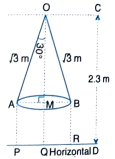
A pendulum of length $\sqrt{3} m$ is attached to a point 2.3 m from the ground. It swings through an angle of $30^{\circ}$ on each side of the vertical. The height above the ground at ends of its path is
Answer(D)0.8m
In right triangle $A M O$, we obtain
$
\begin{array}{ll}
& \cos 30^{\circ}=\frac{O M}{O A} \Rightarrow \frac{\sqrt{3}}{2}=\frac{O M}{\sqrt{3}} \Rightarrow O M=\frac{3}{2} m=1.5 m \\
\therefore & A P=B R=M Q \\
\Rightarrow & A P=B R=O Q-O M=2.3 m-1.5 m=0.8 m
\end{array}
$
View full question & answer→MCQ 601 Mark
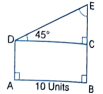
ln Fig. the value of DE is
- A
$5 \sqrt{2}$ units
- B
- ✓
$10 \sqrt{2}$ units
- D
$15 \sqrt{2}$ units
AnswerCorrect option: C. $10 \sqrt{2}$ units
(C)$10 \sqrt{2}$ units
Clearly, $C D=A B=10$ units. In right triangle $D C E$, we obtain
$
\tan 45^{\circ}=\frac{C E}{C D} \Rightarrow 1=\frac{C E}{10} \Rightarrow C E=10 \text { units }
$
Again in $\triangle D C E$, we obtain
$
\sin 45^{\circ}=\frac{C E}{D E} \Rightarrow \frac{1}{\sqrt{2}}=\frac{10}{D E} \Rightarrow D E=10 \sqrt{2} \text { units }
$
View full question & answer→MCQ 611 Mark
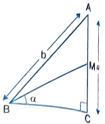
In Fig. $A M=M C$ and $\angle C$ is a right angle, then $\sin ^2 \alpha-\cos ^2 \alpha$ is equal to
- A
$\frac{4 b^2-3 a^2}{5 a^2-4 b^2}$
- ✓
$\frac{5 a^2-4 b^2}{4 b^2-3 a^2}$
- C
$\frac{4 a^2-5 b^2}{3 b^2-4 a^2}$
- D
$\frac{3 b^2-4 a^2}{4 a^2-5 b^2}$
AnswerCorrect option: B. $\frac{5 a^2-4 b^2}{4 b^2-3 a^2}$
(B)$\frac{5 a^2-4 b^2}{4 b^2-3 a^2}$
Applying Pythagoras Theorem in right triangle $A B C$, we obtain
$
A B^2=A C^2+B C^2 \Rightarrow b^2=a^2+B C^2 \Rightarrow B C=\sqrt{b^2-a^2}
$
Thus, in right triangle $B C M$, we obtain: $B C=\sqrt{b^2-a^2}$ and $C M=a / 2$.
Applying Pythagoras Theorem in $\triangle B C M$, we obtain
$
B M^2=B C^2+C M^2 \Rightarrow B M^2=b^2-a^2+\frac{a^2}{4}=\frac{4 b^2-3 a^2}{4} \Rightarrow B M=\frac{\sqrt{4 b^2-3 a^2}}{2}
$
In $\triangle B C M$, we obtain
$
\begin{aligned}
& \sin \alpha=\frac{C M}{B M}=\frac{a / 2}{\frac{\sqrt{4 b^2-3 a^2}}{2}}=\frac{a}{\sqrt{4 b^2-3 a^2}} \text { and } \cos \alpha=\frac{B C}{B M}=\frac{2 \sqrt{b^2-a^2}}{\sqrt{4 b^2-3 a^2}} \\
\therefore \quad & \sin ^2 \alpha-\cos ^2 \alpha=\frac{a^2}{4 b^2-3 a^2}-\frac{4\left(b^2-a^2\right)}{4 b^2-3 a^2}=\frac{5 a^2-4 b^2}{4 b^2-3 a^2}
\end{aligned}
$
View full question & answer→MCQ 621 Mark
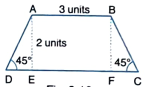
In Fig. ABCD is an isosceles trapezium, its perimeter is
- A
$(8+4 \sqrt{2})$ units
- B
$(10+2 \sqrt{2})$ units
- ✓
$(10+4 \sqrt{2})$ units
- D
$(11+4 \sqrt{2})$ units
AnswerCorrect option: C. $(10+4 \sqrt{2})$ units
(C)$(10+4 \sqrt{2})$ units
In $\triangle A E D$, we obtain
$
\tan 45^{\circ}=\frac{A E}{D E} \Rightarrow 1=\frac{2}{D E} \Rightarrow E D=2 \Rightarrow C F=2
$
Again in $\triangle A E D$, we obtain
$
\sin 45^{\circ}=\frac{A E}{A D} \Rightarrow \frac{1}{\sqrt{2}}=\frac{2}{A D} \Rightarrow A D=2 \sqrt{2}
$
$\begin{array}{l}C D=C l+I l+C D=2+3+2=7 \\ \text { Perimeter }=A B+B C+C D+A D=3+2 \sqrt{2}+7+2 \sqrt{2}=(10+4 \sqrt{2}) \text { units }\end{array}$
View full question & answer→MCQ 631 Mark
If $2 \tan A=3$, then the value of $\frac{4 \sin A+3 \cos A}{4 \sin A-3 \cos A}$ is
- A
$\frac{7}{\sqrt{13}}$
- B
$\frac{1}{\sqrt{13}}$
- ✓
- D
Answer(C)3
We have, $2 \tan A=3 \Rightarrow \tan A=\frac{3}{2}$
$
\therefore \quad \frac{4 \sin A+3 \cos A}{4 \sin A-3 \cos A}=\frac{\frac{4 \sin A+3 \cos A}{\cos A}}{\frac{4 \sin A-3 \cos A}{\cos A}}
$$\qquad$[Dividing numerator and denominator by $\cos A$ ]
$=\frac{4 \tan A+3}{4 \tan A-3}=\frac{4 \times \frac{3}{2}+3}{4 \times \frac{3}{2}-3}=\frac{9}{3}=3$
View full question & answer→MCQ 641 Mark
If $\tan \theta=\frac{4}{5}$, then the value of $\frac{5 \sin \theta-2 \cos \theta}{5 \sin \theta+2 \cos \theta}$ is
- ✓
$\frac{1}{3}$
- B
$\frac{2}{5}$
- C
$\frac{3}{5}$
- D
AnswerCorrect option: A. $\frac{1}{3}$
(A)$\frac{1}{3}$
We have, $\tan \theta=\frac{4}{5}$.
Dividing numerator and denominator by $\cos \theta$, we obtain
$
\frac{5 \sin \theta-2 \cos \theta}{5 \sin \theta+2 \cos \theta}=\frac{\frac{5 \sin \theta}{\cos \theta}-\frac{2 \cos \theta}{\cos \theta}}{\frac{5 \sin \theta}{\cos \theta}+\frac{2 \cos \theta}{\cos \theta}}=\frac{5 \tan \theta-2}{5 \tan \theta+2}=\frac{5 \times \frac{4}{5}-2}{5 \times \frac{4}{5}+2}=\frac{4-2}{4+2}=\frac{1}{3}
$
View full question & answer→MCQ 651 Mark
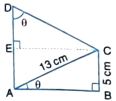
In Fig. if $A D=14 cm$, then the value of $\tan \theta$ is
- A
$\frac{14}{3}$
- ✓
$\frac{4}{3}$
- C
$\frac{5}{3}$
- D
$\frac{13}{3}$
AnswerCorrect option: B. $\frac{4}{3}$
(B)$\frac{4}{3}$
We have, $A E=B C=5 cm$
$
A D=14 cm \Rightarrow A E+D E=14 cm \Rightarrow D E=(14-5) cm=9 cm
$
In right triangle $A B C$, we obtain
$
\begin{aligned}
& A C^2=A B^2+B C^2 \\
\Rightarrow & 13^2=A B^2+5^2 \Rightarrow A B^2=169-25=144 \Rightarrow A B=12 cm \Rightarrow C E=12 cm
\end{aligned}
$
In right triangle $C E D$, we obtain
$
\tan \theta=\frac{C E}{D E}=\frac{12}{9}=\frac{4}{3}
$
View full question & answer→MCQ 661 Mark
If for some angle $\theta, \cot 2 \theta=\frac{1}{\sqrt{3}}$, then the value of $\sin 3 \theta$, where $3 \theta \leq 90^{\circ}$, is
- A
$\frac{1}{\sqrt{2}}$
- ✓
- C
$0$
- D
$\frac{\sqrt{3}}{2}$
Answer(B)1
We have, $\cot 2 \theta=\frac{1}{\sqrt{3}} \Rightarrow 2 \theta=60^{\circ} \Rightarrow \theta=30^{\circ} \Rightarrow 30=90^{\circ} \Rightarrow \sin 3 \theta=\sin 90^{\circ}=1$
View full question & answer→MCQ 671 Mark
In $\triangle A B C$, right-angled at $C$, if $\tan A=1$, then the value of $2 \sin A \cos A$ is

- ✓
- B
$\frac{1}{2}$
- C
- D
$\frac{\sqrt{3}}{2}$
Answer(A)1
In $\triangle A B C$, it is given that $\tan A=1 \Rightarrow \frac{B C}{A C}=1$
So, let $B C=x$ and $A C=x$. Using Pythagoras Theorem in $\triangle A B C$, we obtain
$
\begin{array}{l}
A B^2=A C^2+B C^2 \Rightarrow A B^2=x^2+x^2 \Rightarrow A B=\sqrt{2} x \\
\therefore \quad \sin A=\frac{B C}{A B}=\frac{x}{\sqrt{2} x}=\frac{1}{\sqrt{2}} \text { and } \cos A=\frac{A C}{A B}=\frac{x}{\sqrt{2} x}=\frac{1}{\sqrt{2}}
\end{array}
$
Hence, $2 \sin A \cos A=2 \times \frac{1}{\sqrt{2}} \times \frac{1}{\sqrt{2}}=1$
View full question & answer→MCQ 681 Mark
If $\cos \theta=\frac{2}{3}$, then $2 \sec ^2 \theta+2 \tan ^2 \theta-7$ is equal to
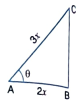
Answer(B)0
We have
$
\cos \theta=\frac{2}{3} \Rightarrow \frac{\text { Base }}{\text { Hypotenuse }}=\frac{2}{3}
$
So, consider a right triangle $A B C$ with base $A B=2 t$ and hypotenuse $=A C=3 x$. Using Pythagoras Theorem, we obtain
$
A C^2=A B^2+B C^2 \Rightarrow(3 x)^2=(2 x)^2+B C^2 \Rightarrow B C=\sqrt{5} x
$
In $\triangle A B C$, we obtain
$
\begin{aligned}
& \sec \theta=\frac{3 x}{2 x}=\frac{3}{2}, \tan \theta=\frac{\sqrt{5} x}{2 x}=\frac{\sqrt{5}}{2} \\
\therefore \quad & 2 \sec ^2 \theta+2 \tan ^2 \theta-7=2 \times\left(\frac{3}{2}\right)^2+2\left(\frac{\sqrt{5}}{2}\right)^2-7=\frac{9}{2}+\frac{5}{2}-7=0
\end{aligned}
$
View full question & answer→MCQ 691 Mark
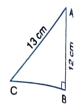
In Fig. $\tan A-\cot C$ is equal to
- ✓
$0$
- B
$\frac{5}{12}$
- C
$\frac{7}{13}$
- D
$-\frac{7}{13}$
Answer(A)0
In right triangle $A B C$, we have $A B=12 cm, A C=13 cm$.
$
\begin{array}{ll}
\therefore & A C^2=A B^2+B C^2 \Rightarrow B C=\sqrt{A C^2-A B^2}=\sqrt{169-144}=5 \\
\therefore & \tan A=\frac{B C}{A B} \text { and } \cot C=\frac{B C}{A B} \\
\Rightarrow & \tan A=\frac{5}{12} \text { and } \cot C=\frac{5}{12} \Rightarrow \tan A-\cot C=0
\end{array}
$
View full question & answer→MCQ 701 Mark
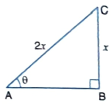
If $\operatorname{cosec} \theta=2$ and $\cot \theta=\sqrt{3} a$, then the value of $a$ is
- ✓
- B
- C
$\sqrt{3}$
- D
$2 / \sqrt{3}$
Answer(A)1
We have, $\operatorname{cosec} \theta=2$ and $\cot \theta=\sqrt{3} a$
$
\begin{array}{ll}
\Rightarrow & \frac{A C}{B C}=2 \text { and } \frac{A B}{B C}=\sqrt{3} a \\
\Rightarrow & B C=\frac{1}{2} A C \text { and } A B=\sqrt{3} a B C \\
\Rightarrow & B C=\frac{1}{2} A C \text { and } A B=\frac{\sqrt{3}}{2} a A C
\end{array}
$
Applying Pythagoras Theorem in $\triangle A B C$, we obtain
$
\begin{array}{ll}
& A B^2+B C^2=A C^2 \\
\Rightarrow \quad & \frac{3}{4} a^2 A C^2+\frac{1}{4} A C^2=A C^2 \\
\Rightarrow \quad & \frac{3}{4} a^2+\frac{1}{4}=1 \Rightarrow \frac{3}{4} a^2=\frac{3}{4} \Rightarrow a^2=1 \Rightarrow a=1
\end{array}
$
ALITER We have, $\operatorname{cosec} \theta=\frac{2}{1}$. So, consider a right triangle $A B C$ with hypotenuse $(=A C)=2 x$ and perpendicular $(=B C)=x$. Applying Pythagoras Theorem in $\triangle A B C$, we obtain
$
\begin{array}{l}
A C^2=A B^2+B C^2 \Rightarrow 4 x^2=A B^2+x^2 \Rightarrow A B=\sqrt{3} x \\
\therefore \quad \cot \theta=\frac{A B}{B C} \Rightarrow \cot \theta=\frac{\sqrt{3} x}{x} \Rightarrow \cot \theta=\sqrt{3} \Rightarrow \sqrt{3} a=\sqrt{3} \Rightarrow x=1
\end{array}
$
View full question & answer→MCQ 711 Mark
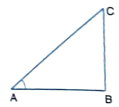
If $A$ is an acute angle in a right triangle $A B C$, right angled at $B$, then the value of $\sin A+\cos A$ is
Answer(B)greater than 1
In $\triangle A B C$, we find that
$
\begin{aligned}
& \sin A=\frac{B C}{A C} \text { and } \cos A=\frac{A B}{A C} \\
\Rightarrow \quad & \sin A+\cos A=\frac{B C}{A C}+\frac{A B}{A C}=\frac{A B+B C}{A C}
\end{aligned}
$
In $\triangle A B C$, the sum of any two sides is greater than the third side.
$
\therefore \quad A B+B C>A C \Rightarrow \frac{A B+B C}{A C}>1 \Rightarrow \sin A+\cos A>1
$
View full question & answer→MCQ 721 Mark
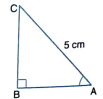
In Fig. $\triangle A B C$ is right-angled at $B$ and $\tan A=\frac{4}{3}$. If $A C=5 cm$, then the length of $B C$ is
Answer(A)4 cm
We have,
$
\tan A=\frac{4}{3} \Rightarrow \frac{B C}{A B}=\frac{4}{3} \Rightarrow A B=\frac{3}{4} B C
$
Applying Pythagoras Theorem in $\triangle A B C$, we obtain
$
\begin{aligned}
& A B^2+B C^2=A C^2 \\
\Rightarrow & \left(\frac{3}{4} B C\right)^2+B C^2=25 \Rightarrow 9 B C^2+16 B C^2=400 \Rightarrow 25 B C^2=400 \Rightarrow B C^2=16 \Rightarrow B C=4
\end{aligned}
$
View full question & answer→MCQ 731 Mark
If $0 \leq A, B \leq 90^{\circ}$ such that $\sin A=\frac{1}{2}$ and $\cos B=\frac{1}{2}$, then $A+B=$
- A
$0^{\circ}$
- B
$60^{\circ}$
- ✓
$90^{\circ}$
- D
$30^{\circ}$
AnswerCorrect option: C. $90^{\circ}$
(C)$90^{\circ}$
We have, $\sin A=\frac{1}{2}$ and $\cos B=\frac{1}{2} \Rightarrow A=30^{\circ}$ and $B=60^{\circ} \Rightarrow A+B=90^{\circ}$
View full question & answer→MCQ 741 Mark
If $\cos \theta=\frac{1}{2}$, then $\cos \theta-\sec \theta$ is equal to
- A
$\frac{3}{2}$
- ✓
$-\frac{3}{2}$
- C
$\frac{\sqrt{3}}{2}$
- D
$-\frac{\sqrt{3}}{2}$
AnswerCorrect option: B. $-\frac{3}{2}$
(B)$-\frac{3}{2}$
We have, $\cos \theta=\frac{1}{2}$. Therefore, $\sec \theta=\frac{1}{\cos \theta}=2$. Hence, $\cos \theta-\sec \theta=\frac{1}{2}-2=-\frac{3}{2}$
ALITER $\cos \theta=\frac{1}{2} \Rightarrow \theta=60^{\circ} \Rightarrow \sec \theta=\sec 60^{\circ}=2$
Hence, $\quad \cos \theta-\sec \theta=\frac{1}{2}-2=-\frac{3}{2}$
View full question & answer→MCQ 751 Mark
For $0^{\circ} \leq \theta<90^{\circ}$, the maximum value of $\frac{1}{\sec \theta}$ is
- ✓
- B
$0$
- C
- D
$\frac{\sqrt{3}}{2}$
Answer(A)1
We find that $\frac{1}{\sec \theta}=\cos \theta$, which attains all values between 0 and 1 (including 1 but excluding 0 ) as $\theta$ varies between $0^{\circ}$ to $90^{\circ}$. Hence, the maximum value of $\frac{1}{\sec \theta}$ is 1 .
View full question & answer→MCQ 761 Mark
Which of the following is not defined?
- A
$\cos 0^{\circ}$
- B
$\tan 45^{\circ}$
- ✓
$\sec 90^{\circ}$
- D
$\sin 90^{\circ}$
AnswerCorrect option: C. $\sec 90^{\circ}$
(C) $\sec 90^{\circ}$
By using definitions of various trigonometric ratios, we find that $\sec 90^{\circ}$ is undefined.
AUTER $\sec 90^{\circ}=\frac{1}{\cos 90^{\circ}}=\frac{1}{0}$, which is undefined.
View full question & answer→MCQ 771 Mark
In Fig. if $D$ is the mid-point of $B C$, then the value of $\frac{\cot y^{\circ}}{\cot x^{\circ}}$ is
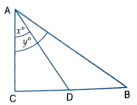
- A
- ✓
$1 / 2$
- C
$1 / 3$
- D
$3 / 4$
AnswerCorrect option: B. $1 / 2$
View full question & answer→MCQ 781 Mark
In Fig. the value of $\cos \phi$ is
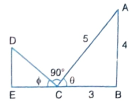
- A
$\frac{5}{4}$
- B
$\frac{5}{3}$
- C
$\frac{3}{5}$
- ✓
$\frac{4}{5}$
AnswerCorrect option: D. $\frac{4}{5}$
View full question & answer→MCQ 791 Mark
If $\cos \theta=\frac{2}{3}$, then $2 \sec ^2 \theta+2 \tan ^2 \theta-7$ is equal to
View full question & answer→MCQ 801 Mark
If $\theta$ is an acute angle such that $\sec ^2 \theta=3$, then the value of $\frac{\tan ^2 \theta-\operatorname{cosec}^2 \theta}{\tan ^2 \theta+\operatorname{cosec}^2 \theta}$ is
- A
$\frac{4}{7}$
- B
$\frac{3}{7}$
- C
$\frac{2}{7}$
- ✓
$\frac{1}{7}$
AnswerCorrect option: D. $\frac{1}{7}$
View full question & answer→MCQ 811 Mark
If angles $A, B, C$ of a $\triangle A B C$ form an increasing $A P$, then $\sin B=$
- A
$\frac{1}{2}$
- ✓
$\frac{\sqrt{3}}{2}$
- C
- D
$\frac{1}{\sqrt{2}}$
AnswerCorrect option: B. $\frac{\sqrt{3}}{2}$
View full question & answer→MCQ 821 Mark
If $x \tan 45^{\circ} \cos 60^{\circ}=\sin 60^{\circ} \cot 60^{\circ}$, then $x$ is equal to
- ✓
- B
$\sqrt{3}$
- C
$\frac{1}{2}$
- D
$\frac{1}{\sqrt{2}}$
View full question & answer→MCQ 831 Mark
If $\frac{x \operatorname{cosec}^2 30^{\circ} \sec ^2 45^{\circ}}{8 \cos ^2 45^{\circ} \sin ^2 60^{\circ}}=\tan ^2 60^{\circ}-\tan ^2 30^{\circ}$, then $x=$
View full question & answer→MCQ 841 Mark
If $\tan ^2 45^{\circ}-\cos ^2 30^{\circ}=x \sin 45^{\circ} \cos 45^{\circ}$, then $x=$
- A
- B
- C
$-\frac{1}{2}$
- ✓
$\frac{1}{2}$
AnswerCorrect option: D. $\frac{1}{2}$
View full question & answer→MCQ 851 Mark
If $3 \cos \theta=5 \sin \theta$, then the value of $\frac{5 \sin \theta-2 \sec ^3 \theta+2 \cos \theta}{5 \sin \theta+2 \sec ^3 \theta-2 \cos \theta}$ is
- ✓
$\frac{271}{979}$
- B
$\frac{316}{2937}$
- C
$\frac{542}{2937}$
- D
AnswerCorrect option: A. $\frac{271}{979}$
View full question & answer→MCQ 861 Mark
If $\theta$ is an acute angle such that $\tan ^2 \theta=\frac{8}{7}$, then the value of $\frac{(1+\sin \theta)(1-\sin \theta)}{(1+\cos \theta)(1-\cos \theta)}$ is
- ✓
$\frac{7}{8}$
- B
$\frac{8}{7}$
- C
$\frac{7}{4}$
- D
$\frac{64}{49}$
AnswerCorrect option: A. $\frac{7}{8}$
View full question & answer→MCQ 871 Mark
If $\tan \theta=\frac{3}{4}$, then $\cos ^2 \theta-\sin ^2 \theta=$
- ✓
$\frac{7}{25}$
- B
- C
$\frac{-7}{25}$
- D
$\frac{4}{25}$
AnswerCorrect option: A. $\frac{7}{25}$
View full question & answer→MCQ 881 Mark
If $\tan \theta=\frac{1}{\sqrt{7}}$, then $\frac{\operatorname{cosec}^2 \theta-\sec ^2 \theta}{\operatorname{cosec}^2 \theta+\sec ^2 \theta}=$
- A
$\frac{5}{7}$
- B
$\frac{3}{7}$
- C
$\frac{1}{12}$
- ✓
$\frac{3}{4}$
AnswerCorrect option: D. $\frac{3}{4}$
View full question & answer→MCQ 891 Mark
If $8 \tan x=15$, then $\sin x-\cos x$ is equal to
- A
$\frac{8}{17}$
- B
$\frac{17}{7}$
- C
$\frac{1}{17}$
- ✓
$\frac{7}{17}$
AnswerCorrect option: D. $\frac{7}{17}$
View full question & answer→MCQ 901 Mark
If $16 \cot x=12$, then $\frac{\sin x-\cos x}{\sin x+\cos x}$ equals
- ✓
$\frac{1}{7}$
- B
$\frac{3}{7}$
- C
$\frac{2}{7}$
- D
$0$
AnswerCorrect option: A. $\frac{1}{7}$
View full question & answer→MCQ 911 Mark
If $5 \tan \theta-4=0$, then the value of $\frac{5 \sin \theta-4 \cos \theta}{5 \sin \theta+4 \cos \theta}$ is
- A
$\frac{5}{3}$
- B
$\frac{5}{6}$
- ✓
$0$
- D
$\frac{1}{6}$
View full question & answer→MCQ 921 Mark
If $\tan \theta=\frac{a}{b}$, then $\frac{a \sin \theta+b \cos \theta}{a \sin \theta-b \cos \theta}$ is equal to
AnswerCorrect option: A. $\frac{a^2+b^2}{a^2-b^2}$
View full question & answer→MCQ 931 Mark
If $\theta$ is an acute angle such that $\cos \theta=\frac{3}{5}$, then $\frac{\sin \theta \tan \theta-1}{2 \tan ^2 \theta}=$
- A
$\frac{16}{625}$
- B
$\frac{1}{36}$
- ✓
$\frac{3}{160}$
- D
$\frac{160}{3}$
AnswerCorrect option: C. $\frac{3}{160}$
View full question & answer→MCQ 941 Mark
If the angle of $\triangle A B C$ are in the ratio $1: 1: 2$ respectively (the largest angle being angle $C$ ), then the value of $\frac{\sec A}{\operatorname{cosec} B}-\frac{\tan A}{\cot B}$ is
- ✓
$0$
- B
$1 / 2$
- C
- D
$\sqrt{3} / 2$
View full question & answer→MCQ 951 Mark
If $\triangle A B C$ right angled at $B$. If $\tan A=\sqrt{3}$, then $\cos A \cos C-\sin A \sin C=0$
View full question & answer→MCQ 961 Mark
If $4 \tan \beta=3$, then $\frac{4 \sin \beta-3 \cos \beta}{4 \sin \beta+3 \cos \beta}=$
- ✓
$0$
- B
$1 / 3$
- C
$2 / 3$
- D
$7 / 25$
View full question & answer→MCQ 971 Mark
If $\sin \theta=x$ and $\sec \theta=y$, then $\tan \theta$ is equal to
- ✓
$x y$
- B
$x / y$
- C
$y / x$
- D
$1 / x y$
View full question & answer→