Question types

Electricity question types

655 questions across 9 question groups — pick any mix to generate a Science paper with step-by-step answer keys.

655
Questions
9
Question groups
5
Question types
Sample Questions

Electricity questions

One sample from each question group in this chapter. Select any group above to see the full set with answer keys.

Q 1M.C.Q1 Mark
Why is electrical wiring usually made from copper :
  • A
    Because copper is shiny.
  • Because copper conducts electricity.
  • C
    Because copper is not magnetic
  • D
    none of these

Answer: B.

View full solution
Q 2M.C.Q1 Mark
Which of the following option has no effect on an electric fuse wire?
  • A
    Its specific resistance
  • B
    Its radius
  • Its colour
  • D
    Current flowing through it

Answer: C.

View full solution
Q 3M.C.Q1 Mark
The amount of heat produced in a wire depends on its material $-$
  • A
    Length
  • B
    Thickness
  • Length and thickness
  • D
    None of these

Answer: C.

View full solution
Q 5M.C.Q1 Mark
Which of the following gases are filled in electric bulbs?
  • A
    Helium and Neon
  • B
    Neon and Argon
  • C
    Argon and Hydrogen
  • Argon and Nitrogen

Answer: D.

View full solution
In the following questions, a statement of Assertion is given by the corresponding statement of Reason. Of the statements, mark the correct answer as :
Assertion : Fuse wire must have high resistance and low melting point.
Reason : Fuse is used to protect the circuit.
 
  • A
    If both Assertion and Reason are true and Reason is the correct explanation of Assertion.
  • If both Assertion and Reason are true, but Reason is not the correct explanation of Assertion.
  • C
    If Assertion is true, but Reason is false.
  • D
    Assertion is false, but Reason is true.

Answer: B.

View full solution
For two statements are given$-$one labelled
Assertion $(A)$ and the other labelled
Reason $(R).$ Select the correct answer to these questions from the codes $(a), (b), (c)$ and $(d)$ as given below:
Assertion: Fuse wire must have high resistance and low melting point.
Reason: Fuse is used for small current flow only.
  • A
    Both $A$ and $R$ are true, and $R$ is correct explanation of the assertion.
  • B
    Both $A$ and $R$ are true, but $R$ is not the correct explanation of the assertion.
  • $A$ is true, but $R$ is false.
  • D
    $A$ is false, but $R$ is true.

Answer: C.

View full solution
For two statements are given-one labelled
Assertion $(A)$ and the other labelled
Reason $(R)$. Select the correct answer to these questions from the codes $(a), (b), (c)$ and $(d)$ as given below:
Assertion: Electron has a negative charge.
Reason: Electrons move always from a region of higher potential to a region of lower potential.
  • A
    Both $A$ and $R$ are true, and $R$ is correct explanation of the assertion.
  • B
    Both $A$ and $R$ are true, but $R$ is not the correct explanation of the assertion.
  • $A$ is true, but $R$ is false.
  • D
    $A$ is false, but $R$ is true.

Answer: C.

View full solution
For two statements are given $-$ one labelled Assertion $(A)$ and the other labelled Reason $(R)$. Select the correct answer to these questions from the codes $\ce{(a), (b), (c)}$ and $(d)$ as given below :
Assertion : A bird perches on a high $-$ power line and nothing happens to the bird.
Reason : The circuit is incomplete for the bird sitting on high-power line.
  • Both $A$ and $R$ are true and $R$ is correct explanation of the assertion.
  • B
    Both $A$ and $R$ are true but $R$ is not the correct explanation of the assertion.
  • C
    $A$ is true but $R$ is false.
  • D
    $A$ is false but $R$ is true.

Answer: A.

View full solution
For two statements are given $-$ one labelled Assertion $(A)$ and the other labelled Reason $(R)$. Select the correct answer to these questions from the codes $\ce{(a), (b), (c)}$ and $(d)$ as given below :
Assertion : The connecting wires are made of copper.
Reason : The electrical conductivity of copper is high.
  • Both $A$ and $R$ are true, and $R$ is correct explanation of the assertion.
  • B
    Both $A$ and $R$ are true, but $R$ is not the correct explanation of the assertion.
  • C
    $A$ is true, but $R$ is false.
  • D
    $A$ is false, but $R$ is true.

Answer: A.

View full solution
Q 17True-False1 Mark
When resistors are connected in parallel, the sum of the currents in them is the current drawn from cell. [True/ False]
View full solution
A piece of wire of resistance $R$ is cut into three equal parts. These parts are then connected in parallel. If the equivalent resistance of this parallel combination is $R_1$, what is the value of the ratio $R_1: R$ ?
View full solution
(i) State the law that explains the heating effect of current with respect to the measurable properties in an electrical circuit.
(ii) List the factors on which the resistance of a conductor depends.
View full solution
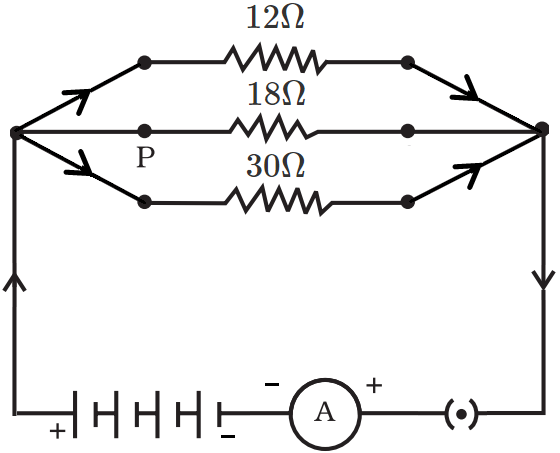
For the circuit shown in the diagram given below:
Calculate:
  1. The total effective resistance of the circuit.
  2. The total current drawn from the battery.
  3. The value of current through each resistor.
View full solution
  1. Define the term ‘volt’.
  2. State the relation between work, charge and potential difference for an electric circuit.
Calculate the potential difference between the two terminals of a battery if 100 joules of work is required to transfer 20 coulombs of charge from one terminal of the battery to the other.
View full solution
  1. Distinguish between the terms ‘overloading’ and ‘short-circuiting’ as used in domestic circuits.
  2. Why are the coils of electric toasters made of an alloy rather than a pure metal?
View full solution
Two lamps, one rated 60 W at 220 V and the other 40 W at 220 V, are connected in parallel to the electric supply at 220 V.
  1. Draw a circuit diagram to show the connections.
  2. Calculate the current drawn from the electric supply.
  3. Calculate the total energy consumed by the two lamps together when they operate for one hour.
View full solution
Explain with the help of a labelled circuit diagram how you will find the resistance of a combination of three resistors, of resistance $R_1, R_2$ and $R_3$, joined in parallel. Also mention how you will connect the ammeter and the voltmeter in the circuit when measuring the current in the circuit and the potential difference across one of the three resistors of the combination.
View full solution
Derive the expression for the heat produced due to a current ‘I’ flowing for a time interval ‘t’ through a resistor ‘R’ having a potential difference ‘V’ across its ends. With which name is the relation known? How much heat will an instrument of 12W produce in one minute if it is connected to a battery of 12V?
View full solution
  1. What is meant by saying that the potential difference between two points is 1 volt? Name a device that helps to measure the potential difference across a conductor.
  2. Why does the connecting cord of an electric heater not glow hot while the heating element does?
  3. Electrical resistivities of some substances at $20^{0}\text{C}$ are given below:
Silver $1.60\times10^{-8} \Omega \text{ m}$
Copper $1.62\times10^{-8} \Omega \text{ m}$
Tungsten $5.20\times10^{-8} \Omega \text{ m}$
Iron $10.0\times10^{-8} \Omega \text{ m}$
Mercury $94.0\times10^{-8} \Omega \text{ m}$
Nichrome $100\times10^{-6} \Omega \text{ m}$
Answer the following questions in relation to them:
  1. Among silver and copper, which one is a better conductor? Why?
  2. Which material would you advise to be used in electrical heating devices? Why?
View full solution
  1. Name an instrument that measures electric current in a circuit. Define the unit of electric current.
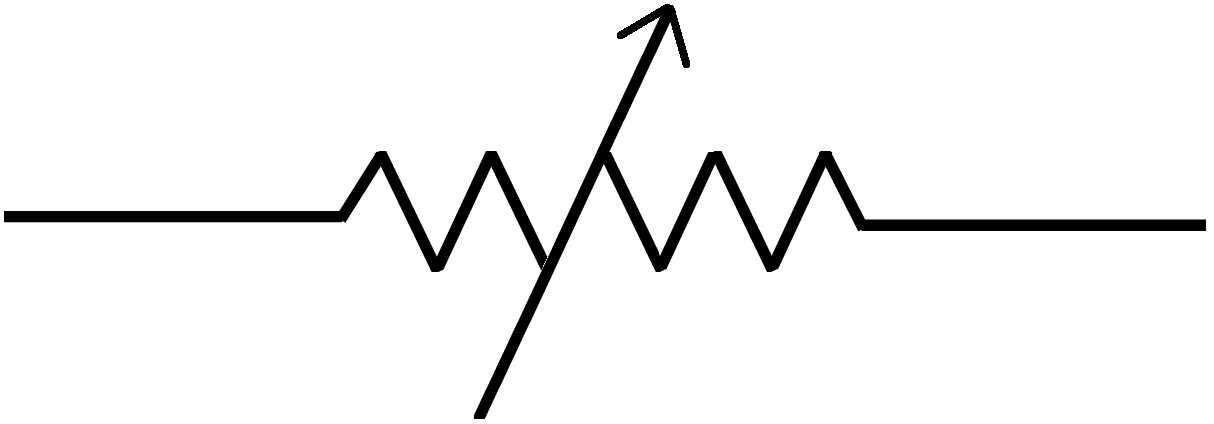
  2. What do the following symbols mean in circuit diagrams?
  1.  
  1.  
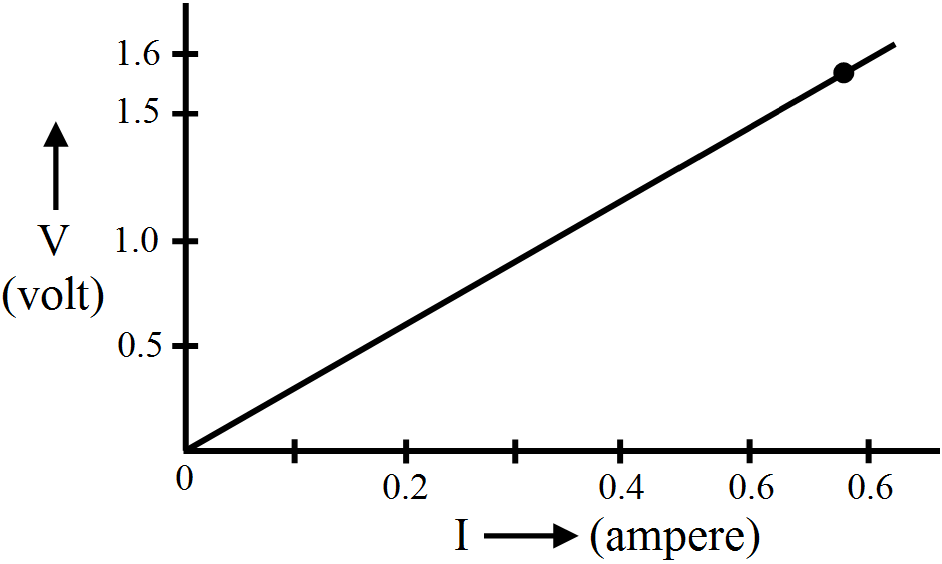
  1. An electric circuit consisting of a 0.5 m long nichrome wire XY, an ammeter, a voltmeter, four cells of 1.5 V each and a plug key was set up.
  1. Draw a diagram of this electric circuit to study the relation between the potential difference maintained between the points ‘X’ and ‘Y’ and the electric current flowing through XY.
  2. Following graph was plotted between V and I values:

What would be the values $\frac{\text{V}}{\text{I}}$of ratios when the potential difference is 0.8 V, 1.2 V and 1.6 V respectively? What conclusion do you draw from these values?
View full solution
  1. What is scattering of light? Explain how the colour of the scattered light depends on the size of the scattering particles.
  2. Explain the reddish appearance of the Sun at sunrise or sunset. Why does it not appear red at noon?
View full solution
Use the data in Table 12.2 to answer the following–
  1. Which among iron and mercury is a better conductor?
  2. Which matcrial is the best conductor?
Electrical resistivity of some substances at $20^oC$
- Meterial Resistivity ($\Omega$ m)
Conductors Silver $1.60 \times 10^{-8}$
Copper $1.60\times 10^{-8}$
Aluminium $2.63\times 10^{-8}$
Tungsten $5.20 \times 10^{-8}$
Nickel $6.84\times 10^{-8}$
Iron $10.0 \times 10^{-8}$
Chromoium $12.9 \times 10^{-8}$
Mercury $94.0\times 10^{-8}$
Manganese $1.84 \times 10^{-6}$
Constant (alloy of Cu, Mn and Ni) $49 \times 10^{-6}$
Alloys Manganin (alloy of Cu, Mn and Ni) $44 \times 10^{-6}$
Nichrome (alloy of Ni, Cr, MN and Fe) $100 \times 10^{-6}$
Glass $10^{10}-10^{14}$
Insulators Hard rubber $10^{13}-10^{16}$
Ebonite $10^{15}-10^{17}$
Diamond $10^{12}-10^{13}$
Paper (dry) $10^{12}$
View full solution
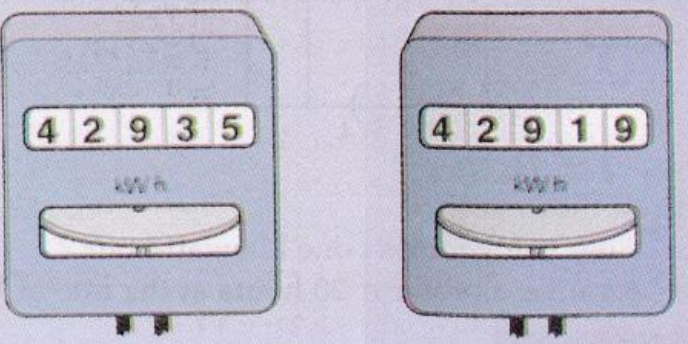
A boy noted the readings on his home’s electricity meter on Sunday at 8AM and again on Monday at 8AM (see figure below).
  1. What was the meter reading on Sunday?
  2. What was the meter reading on Monday?
  3. How many units of electricity have been used?
  4. In how much time these units have been used?
  5. If the rate is Rs. 5 per unit, what is the cost of electricity used during this time?
View full solution
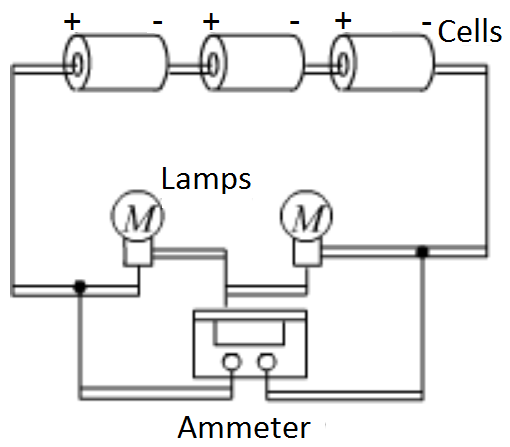
A student made an electric circuit shown here to measure the current through two lamps.
  1. Are the lamps in series or parallel?
  2. The student has made a mistake in this circuit. What is the mistake?
  3. Draw a circuit diagram to show the correct way to connect the circuit. Use the proper circuit symbols in your diagram.
View full solution
Read the following and answer any three questions from (i) to (iv).The rate of flow of charge is called electric current. The SJ unit of electric current is Ampere (A). The direction of flow of current is always opposite to the direction of flow of electrons in the current. The electric potential is defined as the amount of work done in bringing a unit positive test charge from infinity to a point in the electric field. The amount of work done in bringing a unit positive test charge from one point to another point in an electric field is defined as potential difference.
$\text{V}_{\text{AB}}=\text{V}_{\text{B}}-\text{V}_\text{A}=\frac{\text{W}_{\text{BA}}}{\text{q}}$
The SJ unit of potential and potential difference is volt.
  1. The 2C of charge is flowing through a conductor in 100ms, the current in the circuit will?
     
  2. Define electric current? what is the SJ unit of electric current.
     
  3. The potential difference between the two terminals of battery, if 100 joules of work is required to transfer 20 coulombs of charge from one terminal of the battery to other will?
OR
  1. a) Then number of electrons flowing per second in a conductor if I A current is passing through it?
    b) The voltage can be written as.
View full solution
Read the following and answer any three questions from (i) to (iv).The electrical energy consumed by an electrical appliance is given by the product of its power rating and the time for which it is used. The SI unit of electrical energy is Joule. Actually, Joule represents a very small quantity of energy, and therefore it is inconvenient to use where a large quantity of energy is involved. So for commercial purposes we use a bigger unit of electrical energy which is called kilowatt-hour. 1 kilowatt-hour is equal to $3.6 × 10^6$ joules of electrical energy.
  1. The energy dissipated by the heater is E. When the time of operating the heater is doubled, the energy dissipated will?
     
  2. The power of a lamp is 60W. The energy consumed in 1 minute will?
     
  3. The electrical refrigerator rated 400W operates 8 hours a day. The cost of electrical energy is ₹ 5 per kWh. Find the cost of running the refrigerator for one day?
    OR
  4. Calculate the energy transformed by a 5A current flowing through a resistor of $2\Omega$ for 30 minutes?
View full solution

Generate a Electricity paper free

Pick question groups from the list above, set marks and difficulty, and export a branded PDF with step-by-step answer keys. First 3 chapters free — no signup.

Download App