Questions

[5 marks Questions]

Take a timed test

10 questions · self-marked practice — reveal the answer and mark yourself.

Question 15 Marks
Categorize some of the activities performed by you as an eco-friendly person. Suggest some more eco-friendly activities which we should adopt in day-to-day life.
Answer
The simplest way to define what being eco friendly means is to say that it is the act of living with intent. The intent is focused on not creating harm to environment, and to prevent as much harm from occurring to the environment through your interactions with it. It goes beyond an idea and extends to actual practices that influence how communities, businesses and individuals conduct themselves. Being eco-friendly goes far beyond just turning off lights when you leave the room or separating your garbage for recycling – it is about changing the purpose of how you live. How to Become Eco-friendly: You can start to become eco-friendly by becoming aware of the how your choices effect the environment. There are three basic stages to becoming eco-friendly, they are.
  1. Learning to consume items that cause minimal environmental harm.
  2. Discovering the extent of your carbon footprint and acting to lessen that footprint on the environment.
  3. Striving to support others that work to live and produce eco-friendly and sustainable communities.
Here are 10 Steps to Become Eco-friendly:
  1. R’s of Waste Hierarchy: The 3 R’s of waste hierarchy can reduce the amount of waste generated and improve the waste management processes. Reducing what is produced and what is consumed can reduce the amount of waste that is generated. Reuse items for different purposes instead of disposing them off. Recycle items like aluminum cans, plastic, paper, glass that can be shaped into a new item.
  2. Conserve Water and Electricity: It takes energy to produce fresh water and electricity. Few simple ways like turning off lights when not in use, fixing leakages, proper insulation, using maximum daylight, installing energy efficient windows, purchasing energy efficient gadgets can reduce your daily energy consumption.
  3. Plant More Trees: We all know why we need more trees on this planet. They give us oxygen, fruits, timber, prevent soil erosion, control floods, provide shelter to wildlife. Massive scale deforestation in last couple of decades has reduced forest area by significant percentage. The need of hour is to work with environmental groups to educate more people and plant more trees so as to make this planet clean and eco-friendly.
  4. Buy Recycled Products: Always look out for recycling symbol when you visit grocery shop to buy items for your home. That will make you environmentally responsible and eco-friendly. Also, try to carry grocery bag with you to avoid buying items in plastic bags that will later end up in landfills.
  5. Join Environmental Groups to Combat Pollution: Protecting mother Earth is everyone’s responsibility including you. The best you can do is to join different environmental groups in your city and provide helping hand to make this planet environmentally friendly.
View full question & answer
Question 25 Marks
Give a detailed account of ozone layer depletion and the harm ozone layer depletion has caused to the ecosystem.
Answer
Ozone layer depletion is simply the wearing out (reduction) of the amount of ozone in the stratosphere. Unlike pollution, which has many types and causes, Ozone depletion has been pinned down to one major human activity.Industries that manufacture things like insulating foams, solvents, soaps, cooling things like Air Conditioners, Refrigerators and ‘Take-Away’ containers use something called chlorofluorocarbons (CFCs). These substances are heavier than air, but over time, (2-5years) they are carried high into the stratosphere by wind action.
Depletion of the ozone layer has consequences on humans, animals, and plants. This typically results from higher UV levels reaching us on earth.
Humans: Research confirms that high levels of UV Rays cause non-melanoma skin cancer. Additionally, it plays a major role in malignant melanoma development. UV is also linked to cataracts (a disease of the eye which clouds the eye’s lens).
Plants: The damage that extreme UV levels have on plants is one that our eyes do not see much, but humans can feel the impact. Plant growth, as well as its physiological and developmental processes, are all affected negatively. These include the way plants form, the timing of development and growth, distribution of plant nutrients and metabolism, etc. These changes can have important implications for plant competitive balance, animals that feed on these plants, plant diseases, and biogeochemical cycles.
Marine (or water) Ecosystems: Phytoplankton form the foundation of aquatic food webs. These usually grow closer to the surface of the water, where there is enough sunlight. Changes in UV levels are known to affect the development and growth of phytoplankton, and naturally, the fish that feed on them. The UV radiation is also known to have affected the development stages of fish, shrimp, crab, amphibians and other animals. When this happens, animals in the upper food chain that feed on these tiny fishes are all affected.
Effects on Biogeochemical Cycles: The power of higher UL levels affect the natural balance of gasses (and greenhouse gases) in the biosphere: e.g., carbon dioxide (CO2), carbon monoxide (CO), carbonyl sulfide (COS) and ozone. Changes in UV levels can cause biosphere-atmosphere feedback resulting from the atmospheric buildup of these gases.
View full question & answer
Question 35 Marks
What are the functions of an ecosystem?
Answer
The functions of an ecosystem are-
  1. Regulating Function: Maintenance of essential ecological process and life support system.
Explanation: Both biotic and abiotic components live in an ecosystem which interacts with each other forming a stable, self-supporting system.
  1. Energy Flow: The ecosystem act as a buffer through which the flow of energy takes place to all the organisms in the ecosystem.
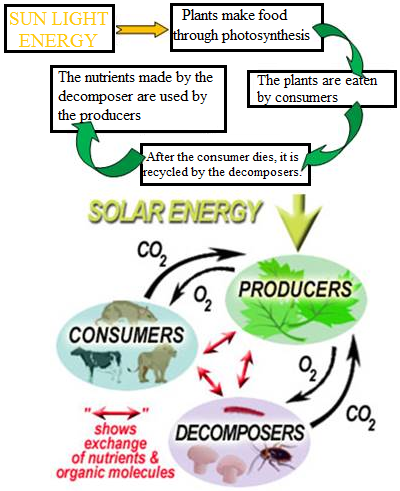
Explanation: Energy flow in a unidirectional manner starting from sunlight to producers, herbivores, carnivores and finally decomposers thus utilising solar energy to produce chemical energy in the form of glucose by plants which are the main source of energy for all living organisms.
  1. Recycling of nutrients: The ecosystem is responsible for the recycling of the minerals in the biodiversity.
Explanation: The plants take inorganic material from the soil and convert it into food with help of sunlight. The food is used to produce chemical energy by the secondary level organism which breaks them into simple organic compound when the secondary level organism dies it gets decomposed by the action of decomposers which convert the complex substance to simple inorganic substance which are then mixed with soil. Thus, the ecosystem is designed to recycle nutrients.
View full question & answer
Question 45 Marks
Consider the following food chains:
  1. Plants → Mice → Snakes → Hawks
  2. Plants → Mice → Hawks
If energy available at the producer level in both the food chains is 100J, in which case will hawks get more energy as food and by how much? Justify your answer.
Answer
(i) The producer level in the food chain are plants, so 100J of energy is available in plants as food. Applying the 10% law to the above food chain:
  1. According to the 10% law, 10% of energy of plants will be available as food in mice. Thus, the energy available to mice will be 10% of 100J, which is 10J.
  2. The energy available to snakes will be 10% of 10J, which is 1J.
  3. The energy available to hawks will be 10% of 1J, which is 0.1J.
$\text{Plants}\ \ \ \xrightarrow{10\%}\ \ \ \text{Mice}\ \ \ \xrightarrow{10\%}\ \ \ \text{Snakes}\ \ \ \xrightarrow{10\%}\ \ \ \text{Hawk}\\100\text{J}\ \ \ \ \ \ \ \ \ \ \ \ \ \ \ \ \ \ \ 10\text{J}\ \ \ \ \ \ \ \ \ \ \ \ \ \ \ \ \ \ \ \ \ 1\text{J}\ \ \ \ \ \ \ \ \ \ \ \ \ \ \ \ \ \ \ \ \ 0.1\text{J}$
(ii) The producer level in the food chain is plants, so 100J of energy is available in plants as food. Applying the 10% law to the above food chain:
  1. According to the 10% law, 10% of energy of plants will be available as food in mice. Thus, the energy available to mice will be 10% of 100J, which is 10J.
  2. The energy available to hawks will be 10% of 10J, which is 1J.
$\text{Plants}\ \ \ \xrightarrow{10\%}\ \ \ \text{Mice}\ \ \ \xrightarrow{10\%}\ \ \ \text{Hawk}\\100\text{J}\ \ \ \ \ \ \ \ \ \ \ \ \ \ \ \ \ \ \ 10\text{J}\ \ \ \ \ \ \ \ \ \ \ \ \ \ \ \ \ \ \ \ 1\text{J}$
Hawks will get more energy in food chain.
  1. Because in this food chain there are three trophic levels so the energy available will be more as compared to food chain.
  2. Which has four trophic levels.
View full question & answer
Question 55 Marks
What is the environment? What type of substances are the major pollutants of the environment?
Answer
Environment is everything that is around us. It can be living or non-living things. It includes physical, chemical and other natural forces.The environment is something you are very familiar with. It's everything that makes up our surroundings and affects our ability to live on the earth—the air we breathe, the water that covers most of the earth's surface, the plants and animals around us, and much more.
Types of Environmental Pollutants:
Soil Pollutants: Soil pollution is the pollution of the Earth's land surfaces. According to Green Pack, the most common types of soil pollutants are heavy metals such as cadmium, chromium, copper, zinc or mercury, pesticides or herbicides, organic chemicals, oils and tars, explosive or toxic gases, combustible or radioactive materials, biologically active compounds and asbestos.
Air Pollutants: Air pollution is the pollution of the Earth's atmosphere. The U.S. Environmental Protection Agency identifies six types of common air pollutants. They include ozone, particulate matter, carbon monoxide, nitrogen oxides, sulfur dioxide and lead. These and other air pollutants typically enter the atmosphere through industrial processes related to the generation of heat and power, incineration of solid wastes and transportation.
Water Pollutants: Water pollution is the pollution of the Earth's oceans and other water sources. According to the Minnesota Center for Environmental Recovery, common types of water pollutants include mercury, nitrates, phosphorous, fecal coliform and bacterial pollution.
Noise Pollutants: Noise pollution is a form of air pollution related specifically to the types of sound present in the atmosphere. The Environmental Protection Agency defines a noise pollutant as any sound that interferes with normal activities or disrupts or diminishes one's quality of life.
View full question & answer
Question 65 Marks
Divide the wastes generated from your house into biodegradable and non-biodegradable categories. Suggest methods for their disposal.
Answer
Materials having properties that do not breakdown or decay are called Non-biodegradable.Examples include:
• Glass. • Metals. • Plastics. • Electronic devices. • Medical waste. Biodegradable materials are composed of waste from living organisms and the actual plant, animal or another organism when its life ends. Examples of Biodegradable materials often referred to as “bio-waste”, include the following: • Human and animal waste. • Plant products, wood, unwanted paper, unused food waste, leaves, grass clippings, clothes. • Remains from the death of living creatures. Best way to Disposal Non-biodegradable: There are a few methods to help non-biodegradable waste Recycling: Recycling is the process of converting waste materials into reusable objects to prevent waste. The materials from which the items are made can be reprocessed into new products. Recycling such material saves product and it also reduces the amount of manufacture to make new products. It also helps in energy saving and reducing global climate change. Combustion: is a chemical process in which a substance reacts rapidly with oxygen and gives off heat. Waste like plastic and rubber tires can be burned using this combustion process. These make use of the heat energy generated by the combustion & incineration process to electricity. It reduces the demand for non-renewable energy sources. Landfills: Landfill refers the disposal of waste material by burying it.Landfills is extended storage area for non-biodegradable waste. Landfill is an area, which prevent contamination from the waste entering the area surrounding by soil and water and it also helps to reduce odour and pests. Disposal of Hazardous Waste: Hazardous waste is waste that poses substantial or potential threats to public health or the environment. Hazardous waste is waste that is dangerous or potentially harmful to our health or the environment. Hazardous wastes can be liquids, solids, gases, or sludge’s.
  • Ignitability means that the waste can easily catch on fire.
  • Corrosive wastes are acids/ bases that are capable of corroding metal containers.
  • Reactive wastes are unstable under normal conditions. They can cause explosions, when heated.
  • Toxic wastes are potentially harmful when absorbed. They can pollute water if not disposed of properly.
View full question & answer
Question 75 Marks
In what way, the biotic components of an ecosystem are different from abiotic components?
Answer
Difference between Biotic and Abiotic:
Biotic Abiotic
(a) Biotic is referred to all living parts of an ecosystem. Abiotic is referred to all nonliving parts of an ecosystem.
(b) Biotic factors depend on abiotic factors to survive for their survival. Abiotic factors don’t rely on the biotic factors for their survival.
(c) Directly or indirectly affect the individual species, community, biosphere, the population of species and ecosystem. Affect the survival of individual species, community, biosphere, the population of species and ecosystem.
(d) Obtained directly from the biosphere and are capable of reproduction. Obtained directly from the lithosphere, atmosphere, and hydrosphere.
(e) The measurement is often subjective. The measurement is often objective.
(f) Involved in determining the total number of living things, directly or indirectly affecting the organisms in the environment. Involved in determining the total number and different types and of organisms existing in the environment.
(g) Have an ability to adapt to changes in the environment. Unable to adapt to changes in the environment.
(h) Resources include forests, animals, plants, fungi, bacteria and more. Resources include land, fossil fuels, water and more.
(i) Renewable resource of energy. Non-renewable resource of energy.
(j) Few examples of biotic factors are all living things including, animals, plants, fungi, bacteria, etc. Few examples of abiotic factors are sunlight, air, climate, temperature, moisture minerals, soil and more.
View full question & answer
Question 85 Marks
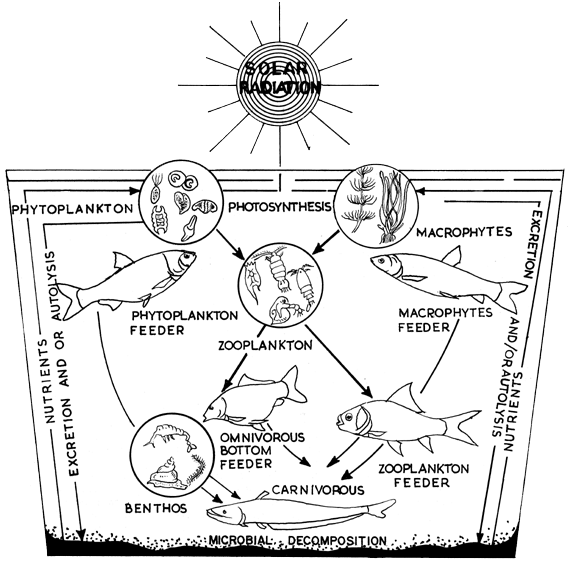
Draw a pond ecosystem showing its different components.
Answer

Pond and lake are fresh water ecosystems in which, like other ecosystems, there are two main components:
  1. Abiotic component: Abiotic component of pond consists of water, dissolved minerals, oxygen and carbon dioxide. Solar radiations are the main source of energy.
  2. Biotic component: It includes the following:
  1. Producers: The main producers in pond or lake ecosystem are algae and other aquatic plants, such as Azolla, Hydrilla, Potamogeton, Pistia, Wolffia, Lemna, Eichhornia, Nymphaea, Jussiaea, etc. These are either floating or suspended or rooted at the bottom. The green plants convert the radiant energy into chemical energy through photosynthesis. The chemical energy stored in the form of food is utilized by all the organisms. Oxygen evolved by producers in photosynthesis is utilized by all the living organisms in respiration.
  2. Consumers: In a pond ecosystem, the primary consumers are tadpole larvae of frogs, fishes and other aquatic animals which consume green plants and algae as their food. These herbivorous aquatic animals are the food of secondary consumers. Frogs, big fishes, water snakes, crabs are secondary consumers. In the pond, besides the secondary consumers, there are consumers of highest order, such as water-birds, turtles, etc.
  3. Decomposers and Transformers: When aquatic plants and animals die, a large number of bacteria and fungi attack their dead bodies and convert the complex organic substances into simpler inorganic compounds and elements. These micro-organisms are called decomposers chemical elements liberated by decomposers are again utilized by green plants in their nutrition.
View full question & answer
Question 95 Marks
What happens once the Sun's energy reaches the Earth? Explain with the help of a diagram.
Answer
Energy from the sun consists of various wavelengths of light. Out of all the rays, only UV (Ultraviolet rays) radiations fall on earth. The UV (Ultraviolet) radiations from the sun reach the earth's atmosphere which is heavily rich in oxygen. These high energy UV rays split molecular oxygen $\left( O _2\right)$ into free oxygen ( O $)$. Afterward, this free oxygen reacts with molecular oxygen; it forms ozone $\left( O _3\right)$. This ozone layer filters the UV rays and allows only some part of it to fall on earth.
These harmful UV radiations of the sun can cause skin cancer in human and can cause many health hazards like skin cancer, cataract, destruction of plants, etc.
Plants capture sun energy by chlorophyll pigment found on the leaves of the plants.
Then they prepare their food in the form of carbohydrates through the process of photosynthesis. Then when energy flows from one trophic level to another in a food chain and finally gets released into the atmosphere after the decomposition of the organisms carrying it.
View full question & answer
Question 105 Marks
An industry is being established near a town. How can the wastes generated from this industry affect the local environment?
Answer
Industrial waste is the waste produced by industrial activity which includes any material that is rendered useless during a manufacturing process such as that of factories, industries, mills, and mining operations.
Industries are important for the economic growth and development of a society, but it can also be harmful to the environment. Industrial process can cause pollution to air, water and soil, health issues, extinction of species, and more. Disposing of waste has huge environmental impacts and can cause serious problems like:
Air-Emissions: Industry is a major cause of air pollution, as it results in the emission of pollutants, including organic solvents, respirable particles, sulfur dioxide $\left( SO _2\right)$ and nitrogen oxides $\left( NO _{ X }\right)$.
Waste water: The sources of effluent- treated or untreated wastewater that is discharged into surface waters - are many and varied. Untreated wastewater can cause environmental problems including: pollution of groundwater reservoirs, damage of transport and wastewater treatment systems, and degradation of treated wastewater and sludge such that it would disqualify them from being used for agricultural purposes.
Land-Pollution: Leakage from the fuel and energy industries, as well as industries involving hazardous materials, is the main causes of land contamination. Soil contamination is caused by direct exposure to the pollutant, leakage of toxic gases into buildings, and groundwater pollution.
Hazardous-Materials: Hazardous materials are widely used by almost all the industries. If not properly treated, stored, or dealt with, hazardous materials can cause damage to human health, environment and property.
Radiation: Human and the environment are at-risk from exposure to both ionizing radiation (sources include radioactive materials, x-ray machines, and accelerators) and non-ionizing radiation.
These harmful radiations can cause many health hazards like skin cancer, cataract, destruction of plants, etc.
View full question & answer
[5 marks Questions] - Science STD 10 Questions - Vidyadip